
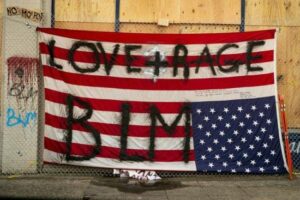
 Part I: The Challenge of a New Historical Turning Point
Turning points in history are very rare. We are now living in the midst of one, with the two months of virtually continuous protests against police abuse, the criminal injustice system, and for a human society that have swept the U.S. as well other parts of the world since the police murder of George Floyd on May 25.
These massive and ongoing protests are defined by the clash between two absolute opposites—the forces of death embodied in police murder, racism, misogyny, environmental destruction, and the domination of dead labor (or capital) over living labor—and the forces of life, embodied in those aspiring for human emancipation.
Nothing displays the deadly part of that contradiction more than the decision of the Trump administration (supported by the entire Republican and much of the Democratic Party) to send hundreds of federal troops from the Department of Homeland Security and Immigration and Customs Enforcement to a dozen cities at the end of July to tear gas, beat, and arrest—often without warning or provocation—hundreds of protesters. This is not just a passing move aimed at bolstering Trump’s support among the racist far right. It represents an effort to repress through direct military measures a movement that has so far proven uncontainable. Such repressive moves are bound to only intensify following the November election—especially if Trump refuses to acknowledge its results and leave office should he lose.
Exactly how this movement (which no one anticipated prior to its emergence at the end of May) will develop and progress we cannot yet know. But this we do know: when history suddenly surges forward, it isn’t enough just repeat what you said, did, or thought even weeks earlier. You either catch the historic current and move along with it, or you are swept backward relative to the new turning point that has been reached.
Turning points in history are exciting but also painful and difficult to live through. We need to be sensitive to this, as we try to understand what is going on.
The wave of protests that has occurred over the past two months is unprecedented. Multiracial events largely led by African Americans have occurred in 2,000 U.S. cities, towns, and rural areas. It is estimated that 26 million participated in protests in the U.S. alone. Most amazing, it has become an international movement. Protests against police abuse, racism, and social inequality have broken out in four dozen European and Latin American countries as well several in Africa and Asia, involving tens of thousands at a time. This has never happened before.
Chileans who were injured (and in some cases blinded) by tear gas and rubber bullets in protests there last fall are advising U.S. activists on how to protect themselves; anti-Assad activists in Idlib Province in Syria, the last remaining bastion of the opposition, have created an anti-racist mural in solidarity with the movement for Black lives. Dozens of such examples abound in other countries. As a friend in India wrote, “Could anyone even imagine what a worldwide wildfire a single spark in the U.S. has lighted up within so short a time? It is as if thousands of Arab Springs are happening simultaneously all over the world.”
The protests are largely spontaneous—but not disorganized. On May 31, a Chicago artist who hasn’t been active in left politics asked on his Facebook page if anyone was interested in holding a rally on the North Side; 24 hours later 5,000 showed up and marched for six hours. Countless other examples abound of such self-organization born from spontaneity. At the same time, grassroots activists who have long been part of the struggle to defund police and abolish the prison system have developed an array of new venues across the U.S. in the weeks after the first burst of protests at the end of May and beginning of June. It has brought together Native Americans, Asian immigrants, Blacks, Latinx, and white youth on a level not seen in decades.
Most important of all, the movement has reshaped political discourse in the U.S. Proposals routinely dismissed by liberals and tired radicals just months ago—defunding police, abolishing prisons, and reparations—are becoming mainstream. A large majority of the Minneapolis City Council has come out in favor dismantling its police department. There are also calls to eliminate police unions, the most egregious protector of murderous cops. Recognition is growing that cops are not workers; they are instead gendarmes of capital who must be disarmed.
A lot has changed since Marxist-Humanists authored the document “Where to Begin? Growing Seeds of Liberation in a World Torn Asunder” in mid-April.[1] In recounting a series of important mass uprisings around the world in 2019, it noted, “No such mass revolts have occurred recently in the U.S.” But we did add, “the same seeds of radical self-organized liberation” have been planted here. These have now sprouted, as seen not just in the size but the form of protests. These often differ from traditional marches in that they serve as vehicles for providing aid to impoverished communities and a forum for discussing issues and ideas. Women speaking out against sexual violence; immigrants opposing deportation; former prisoners decrying the lack of measures to prevent the spread of COVID-19; transgender people demanding their rights—all this and more are given space to be heard. Mutual aid is one of the striking features of the protests, with assistance being provided in the form of food, water, medical attention and legal services at almost every event. What we cited from activists in the citizen assemblies of Chile in 2019 applies just as well to the situation many have experienced in these protests: “We are living a total break with the everyday life to which we were subjected. That’s why the atmosphere is very special, invigorating and even joyful. We are recovering a sense of humanity from the rebellion, the appropriation of spaces in our communities.”[2]
Clearly, this marks the most powerful threat to Trump since his election. But it is not just a challenge to Trump. Minneapolis is one of the most progressive cities in the U.S.; Clinton got 65% of its vote in 2016. Yet since 2012 only 1% of complaints against police abuse has led to disciplinary action. New York’s Bill de Blasio, a liberal elected to end the “stop and frisk” policy against Blacks and Latinx, now defends police riots against protesters. And Laurie Lightfoot, Chicago’s first Black woman Mayor, was one of the first to impose a curfew leading to hundreds of beatings and arrests—while supporting Trump’s sending Federal goon-squads to Chicago after initially expressing opposition to it. Today’s protesters are not looking to restore America to what it was before Trump, but oppose the whole edifice of neoliberalism that made him possible.
How could such a movement arise so fast, so unexpectedly? A big reason is the pandemic, which exposed racial, class, and gender inequities as never before. Big business getting massive bailouts while millions of laid-off workers got little or nothing; the net wealth U.S. billionaires increasing 15% during the pandemic while millions go hungry; Amazon and other companies ratcheting up production while not providing protective gear to workers—the coronavirus class divide is all too evident. So is the gender divide, as women forced to work from home face the double burden of caring for children off from school and ill relatives while receiving no compensation and little recognition. The racial divide is the most obvious of all, with Blacks suffering death rates twice that of whites and Latinx workers (especially in meatpacking and agriculture) suffering from extremely high infection rates.
Since racism is the Achilles heel of U.S. society, and class relations have been structured along racial lines since its inception, revolts against racist dehumanization have historically served as the catalyst for challenging its dominant social relations. And so it is today. The protests have not detracted from the class struggle, they have enhanced it, by bringing into view the deadly ramifications of life under capitalism. Which is why so many from diverse backgrounds have joined it, including working class whites.
To be sure, the growth of new labor organizing during the pandemic helped prepare the ground for this. Strikes by bus drivers in Detroit, Amazon workers in Staten Island, meatpackers in Iowa and South Dakota, as well as labor protests in Brazil, Ivory Coast, Pakistan, Palestine, Kenya, Italy and Germany against the failure to protect workers’ safety during the pandemic, all indicated (as Ron Herrera of the Los Angeles County of Labor put it a week before the murder of George Floyd), “we’ve been moving toward a worker rebellion.”[3] But it took the response to his murder to bring all this to the surface, in a new, unexpected form.
In a word, we may now be witnessing a new kind of multiracial working-class movement.
After Biden won the South Carolina primary with significant support from African Americans, some questioned the relevance of the Marxist-Humanist concept of “Black Masses as Vanguard,” developed over a 50-year engagement with U.S. Black freedom struggles. But they overlooked the importance of youth. Most Black youth either didn’t vote in the primaries or went for Sanders. (He won the support of Black and Latinx voters under 35 in virtually every primary that he contested). And there is no question this new movement is led and driven by youth.
The generational gap within Black America has not gone away, any more than its internal class divisions. The two often go hand-in-hand, as seen in the number of Black corporate Democrats who (along with Biden) are opposing the growing calls to defund police departments. A new stage of revolt does not only bring people together, it also accentuates the divide between those aiming to uproot the system versus those who want to maintain their place within it.
The central role of youth in the protests underlines the Marxist-Humanist conception, articulated by Raya Dunayevskaya as far back as 1958, that “Even though the youth are not directly involved in production, they are the ones whose idealism in the finest sense of the word combines with opposition to existing adult society in so unique a way that it literally brings them alongside the workers as builders of the new society.”[4] White youth at rallies are holding up signs like “White Silence is White Compliance” and interspersing themselves between the police and the crowd so that people of color have less chance of being the first to be beaten by their batons. It is as if years of discussion and debate on race theory and white privilege has been absorbed by a new generation. The impact of this is likely to be felt far into the future, even as the movement experiences (as all do) ebbs and flows.
Precisely for this reason, the forces of bourgeois society are moving to attack the movement, discredit it, or co-opt it into “safe” channels. This initially took the form of trying to impose a separation between “good, peaceful” demonstrators and “bad, violent” ones. It goes without saying that there are always adventurists who use protests for their own purposes, just as there are bound to be agent provocateurs and undercover police out to create mayhem. But undifferentiated attacks on the looting and rioting that characterized early phases of the response to Floyd’s death—as if violence against people is the same as against property—completely misses the point: namely, that the violence inflicted by racialized capitalism calls such actions into existence.
What Vicky Osterweil wrote about the Ferguson protests of 2014 speaks aptly to today: “In making a strong division between Good Protesters and Bad Rioters, or between ethical non-violence practitioners and supposedly violent looters—the narrative of the criminalization of Black youth is reproduced….Looting is extremely dangerous to the rich (and most white people) because it reveals, with an immediacy that has to be moralized away, that the idea of private property is just that: an idea, a tenuous and contingent structure of consent, backed up by the lethal force of the state. When rioters take territory and loot, they are revealing precisely how, in a space without cops, property relations can be destroyed and things can be had for free.”[5]
Once it became clear that the vast majority of the protests were in fact peaceful, the effort to discredit them gave way to the claim (made especially by liberals) that posing such “radical” demands as abolishing police and prisons risks antagonizing potential “allies” and makes it easier for Trump to stir up “whitelash” against the movement. But as has become clear to anyone paying attention, Trump and his allies will paint anyone who takes action against state repression and police violence as a “dangerous radical”—he even accuses Biden of being one, who has long been an accomplice in augmenting the power of the police and criminal injustice system.
The fundamental divide opened up by the recent events is between two concepts of freedom. One side defines freedom as the atomized individual being free from all external constraints—especially those provided by the lives of other people. This is exemplified in Trump supporters protesting social distancing—with guns in hand. As one woman who refused to put on a face mask put it, “we have individual rights, we don’t have community rights.”[6] The other side defines freedom as the ability to actualize our human potential—central to which is care and concern for the lives of other people. This is exemplified in protesters insisting that the lives of others, especially Black lives, matter. These two irreconcilable definitions of freedom are based on radically different notions of the individual. One counterpoises the individual to society, expressed by Margaret Thatcher as “society does not exist, only individuals do”; the other expressed by Karl Marx as “the individual is the social entity”[7] and “society does not consist of individuals, but expresses the sum of interrelations within which these individuals stand.”[8]
But make no mistake: this is no mere clash between two abstract, metaphysical notions of “freedom.” It is a clash of ideas embodied in two antagonistic social forces. One is armed and backed up by the most powerful military on earth, the other is not.
As Frantz Fanon put it, “The natives’ challenge to the colonial world is not a rational confrontation of points of view. It is not a treatise on the universal, but the untidy affirmation of an original idea propounded as an absolute. The colonial world is a Manichean world.”[9]
The unanswered question is which concept of freedom will prevail. Answering this will depend on a fight to the finish, which has only just begun. All those who aspire for freedom and liberation need to become a party to the fight and not a mere bystander to it. And that fight involves a battle of ideas, which are never epiphenomenal or of secondary importance. Which idea of freedom will prevail—the one which seeks egoistic self-aggrandizement as an end in itself (which is the substance of capitalism), or the one that expresses humanity’s ontological characteristic as social, caring beings (which is the substance of socialism)?
It is by no means assured that consciousness of the idea of freedom immanent in today’s protests will lead to developing a viable alternative to capitalism. Ideas arise spontaneously from mass struggles, but a philosophy that can address what happens after the revolution does not. As Dunayevskaya put it, the consciousness that arises spontaneously from below “does not exhaust the question of cognition, of Marx’s philosophy of revolution.”[10] If, however, it is held that the social consciousness that arises from below does exhaust cognition, it follows that a philosophy of revolution that can give spontaneous revolts a direction is completely superfluous. This is the approach that has been followed by many on the Left, which has resulted in an abdication of responsibility for providing a vision of the future that can point us beyond capitalism.
As Marx once put it, “We do not confront today’s realities in a doctrinaire way with a new principle: Here is the truth, kneel down before it! We develop new principles for the world out of the world’s own principles. We do not say to the world: Cease your struggles, they are foolish; we will give you the true slogan of struggle. We merely show the world what it is really fighting for, and consciousness is something that it has to acquire, even if it does not want to.”[11]
Such consciousness is needed because once attained, the day of revolution cannot be far off. Here too we take our cue from Marx: “The recognition of the products as its own, and the judgment that its separation from the conditions of its realization is improper—forcibly imposed—is an enormous advance in consciousness, itself the product of the mode of production resting on capital, and as much the knell to its doom as, with the slave’s consciousness that he cannot be the property of another, with his consciousness of himself as a person, the existence of slavery becomes a merely artificial, vegetative existence, and ceases to be able to prevail as the basis of production.”[12]
Part II: Can Anti-Racist Movements Help Elicit an Alternative to Capitalism?
“The people see the punishment, but it does not see the crime, and because it sees punishment where there is no crime, it will see no crime where there is punishment”
—Karl Marx, “Debates on Thefts of Wood”
Given today’s events, we can expect a further growth of interest in socialism—indeed, it has been happening since the Great Recession of 2008. The combined impact of the COVID-19 pandemic and the response to police killings has so highlighted the bankruptcy of capitalism that the quest for a socialist alternative is bound to reach new levels.
However, we have a problem: Socialism is largely understood today as the “fair” redistribution of surplus value and profit. This is to be expected, given today’s unparalleled levels of social and economic inequality. However, while calls for redistributing wealth can be helpful in mobilizing opposition to capitalism, they are inherently self-defeating since they leave untouched the social, class, and human relations that define the capitalist mode of production and reproduction. Redistributing surplus value assumes the continued existence of value production—a system based on augmenting wealth in monetary form as an end in itself. After all, one cannot redistribute what does not exist. Such a standpoint defines the new society by the principles of the old one. It is impossible to develop a viable alternative to capitalism on this basis.
To obtain perspective on this problem, let’s turn to history. Massive socialist movements emerged at the end of the nineteenth century, and a number of them came to power in the twentieth century. Virtually all of them defined capitalism as an anarchic market economy based on private property, and socialism as a planned economy based on nationalized or socialized property. This was quite understandable, since prior to the 1930s capitalism was a highly anarchic, unplanned, and competitive system.
But what happened when a new global stage of capitalism emerged in the 1930s—state-capitalism? It took the form of Stalinism in the USSR, Nazism in Germany, and FDR’s New Deal in the U.S. We know what happened when it came to Stalinism: those who defined the new society as a planned economy based on nationalized property embraced so-called “socialism” in the USSR (and later Mao’s China) even as democracy was negated in favor of a totalitarian single party state. Not all who supported such regimes were bad people: some were serious revolutionaries. But they suffered from a narrow understanding of capitalism and socialism which led them astray. However, we also have to pay attention to what happened to the “democratic socialists” who also believed that socialism is defined by social planning and socialized property. They too capitulated to the new stage of state-capitalism by endorsing FDR’s New Deal and the Keynesian welfare state whose aim was save capitalism. By no accident, many of these Social Democrats also ended up supporting U.S. imperialism.
By the end of twentieth century, when the bottom fell out from the Keynesian welfare state and “Soviet-type” societies, virtually all of them—democratic socialists and Stalinists alike—had capitulated to existing capitalist society. So extensive was this that the “death of Marxism” was proclaimed around the world (often by its former adherents).
What does this tell us? A defective understanding of capitalism and socialism becomes deadly, especially when a turning point is reached with the rise of a new stage of capitalism.
But what about the movements of the 1960s? They too were massive and spontaneous, and many in them embraced socialism by the 1970s. But did a conception of socialism arise that broke with the narrow Social Democratic and Marxist-Leninist idea that socialism equals nationalized property? Sadly, it did not. One part of the New Left gravitated back to Social Democracy, while another took the plunge into one or another form of “Marxist-Leninism” centered on building “a vanguard party to lead.” No fundamental rethinking of the meaning of socialism emerged from either one. That was true of even the most revolutionary dimensions of the 1960s. Few were more revolutionary than the Black Panthers, whose militancy and revolutionary propagation of mutual aid inspired an entire generation; yet while they initially embraced a series of independent radical perspectives, most of its members ended up embracing Maoism—just in time for Mao to betray the Black struggle by rolling out the red carpet for Nixon.
Unlike the 1930s, which gave us state-capitalism, or even the 1970s, when it slightly mutated into what many call neoliberalism, today we are not facing a new stage of capitalism. We are instead facing the decay of capitalism, which can no longer fulfil its mission of revolutionizing the means of production and providing a better life for masses of people. A decaying economic system spews forth a decaying political superstructure, personified in such despicable characters as Trump, Bolsonaro, Duterte, Netanyahu, Orban, Erdogan, and Putin. All they have to offer is egotistical self-aggrandizement run amok.
These personifications of capital (Trump included) have however done us a big favor: they allow everyone to finally see what capitalism is really made of. There is no going back to the “third way” of the Blairs and Clintons who painted our exploitation in pretty colors. The only way is to move forward, by developing a new concept of socialism that is adequate for our life and times.
But there is no assurance we will get there, since today most people continue to define socialism as the redistribution of value—which is based on the old notion that capitalism is defined by market anarchy, and socialism by social planning. So, what we can we do to move the discussion of a genuine alternative to capitalism forward?
I wish to pursue this by exploring whether the anti-racist struggles and movement for Black lives provide a basis for reconceptualizing socialism beyond the limits of redistribution.
We have heard it said many times in the past weeks that people of color have been excluded from the social contract. But what does this mean? In capitalism wage labor takes the form of appearance of a contract. Workers agree to sell their labor power to capitalists, who agree to pay them a wage. Mutual recognition takes place insofar as each agrees to acknowledge (at least formally) the claims of the other. But recognition on the level of wage labor is limited and superficial, since the capitalists extend recognition to the workers only insofar as they provide them with surplus value, while the workers extend recognition to the capitalists only insofar as they continue to employ them. Recognition is therefore purely juridical—but it does take place.
But what happens when race enters the picture? To make contract with someone, you have to acknowledge, at least on some level, that they are a person. But what happens when whites “see” Blacks not as persons but as things? This is of course the essence of racism. When the person is Black there is no recognition even on the juridical level. Their personhood, their humanity, is not seen at all. This is what makes it so easy for racist police to kill with abandon.
Since humanity is comprised of social beings, and society is a product of the social contract, those outside the contract are viewed as not truly human. As Frantz Fanon argued, the very being of Blacks becomes problematic in a racialized society. This barrier to formal, juridical recognition is very painful. But there is a positive in this negative. Since victims of racism have weaker ties to juridical relations, their revolt has the potential to go beyond calls for a “fairer” distribution of the products of labor by questioning the dehumanized character of social life itself.
In a psychiatric paper that has recently become available, Fanon notes that since Blacks are excluded from the social contract they often refrain from cooperating with the police and other authorities. Cooperation depends on a contractual relation—which is absent for people of color. He writes, when “I confess as a citizen I validate the social contract.”[13] But if society does not view you as a person you have no stake in the contract: “There can be no reintegration if there has been no integration.”[14] Hence, anti-racist revolts challenge the very basis of existing society.
However, it is always possible to reduce the struggle for recognition to a plea for acceptance by the forces of existing society. Such pursuits are fruitless, since capitalism acknowledges people only insofar as they are embodiments of economic categories—insofar as they are viewed as things…which is the very basis of racism to begin with! We need a revolution precisely because our humanity cannot and will not be recognized in capitalism. But what kind of revolution? And what kind of socialism?
Surely not one that treats race and gender as secondary to class. All workers have ethnic, racial and gendered attributes. Advocates of a “class first” position tend to abstract from all this. Ironically, this is exactly how “the worker” appears from the standpoint of capital: as a mere bearer of labor power, the expenditure of undifferentiated labor in the abstract. Viewing people abstracted from the life-world of their lived experience may be adequate from the standpoint of capital, but it is completely inadequate for those trying to become free from capital’s dominance.
Likewise, a “revolution” limited either to a social-democratic program of income redistribution or a centralized state plan fails to address the real aim of the class struggle—the abolition of abstract or alienated labor, which to Marx, is the substance of value. In contrast, as Fanon put in in another paper, “Labor must be recovered as the humanization of man. Man, when he throws himself into work, fecundates nature, but he fecundates himself also.”[15]
In sum, uprooting capitalism as well as racial and gendered oppression can only be achieved by multiple forces of liberation that seek not mere juridical acknowledgment of their suffering but a revolutionary transformation of the very fabric of human relations. I believe the objective conditions for achieving this are being generated today by the logic of capital.
Capitalism is internally driven to augment value by reducing the relative proportion of living labor to dead labor at the point of production. Relatively fewer workers become employed in productive labor (or labor that produces surplus value), while the number of unemployed and underemployed grows. However, the working class as a whole actually increases in size as fewer are employed at the point of production, since expanded reproduction depends not just on the production of surplus value on also its realization. A host of new occupations open up to ensure the latter (information technology, service work, etc.). Contrary to the claims made by some, the working class is larger today than ever before—over 3.5 billion people. A worker is defined as someone who does not own the means of production and does not play a supervisory role for those who do. However, because of the extremely high organic composition of capital that defines contemporary capitalism, today’s concentration and centralization of capital tends to produce not a compact and unified working class but rather a highly differentiated and variegated one employed in multiple arenas.
As living labor becomes detached from the direct process of production and becomes more precarious, workers’ connection to the contractual form of appearance of wage labor becomes increasingly tenuous. Workers entering the labor market today can expect to change jobs half a dozen times during their lives. As a result of their more precarious existence, workers tend to no longer obtain even the pretense of recognition from the personifications of capital, since they are increasingly displaced from having a direct connection to them. The struggle for recognition seems to hit a dead end…and yet every human being does want to be recognized. So, what then?
As capitalism deprives recognition to those who once received it on a minimal level, some become moved to identify with those to whom recognition has always been denied on any level. Battles over of race, gender, and sexuality increasingly serve as the catalyst for bringing a differentiated and dispersed working class onto the streets. We may be witnessing something like this today, with the possible emergence of a multiracial working-class movement.
The COVID-19 pandemic reminds us that life is fragile, precious, and short. It is above all finite. We have no choice but to manage as well we can our finite time. Let’s engage in pursuits, projects, and debates that develop an alternative to capitalism. That choice is one of life versus death.
—August 2, 2020
[1] See https://imhojournal.org/articles/where-to-begin-growing-seeds-of-liberation-in-a-world-torn-asunder.
[2] Quoted in Juan Manuel Boccacci, “Citizen Assemblies Are Challenging the Neoliberal Model in Chile,” Orinoco Tribune, Feb. 3, 2020.
[3] See Michelle Goldberg, “The Phony Class War,” The New York Times, May 19, 2020.
[4] Constitution of News and Letters Committees (1958), p. 2. The organization that still bears that name long ago failed to live up to such principles—which was a major reason for the formation of the International Marxist-Humanist Organization.
[5] Vicky Osterweil, “In Defense of Looting,” New Inquiry, August 21, 2014.
[6] “Workers in Stores, Already at Risk, Confront Violence When Enforcing Mask Rules,” by Neil McFarquhar, The New York Times, May 16, 2020.
[7] Karl Marx, “Private Property and Communism,” in Marx-Engels Collected Works, Vol. 3 (New York: International Publishers, 1975), p. 299.
[8] Karl Marx, Grundrisse, translated by Martin Nicholas (New York: Penguin, 1973), p. 265.
[9] Frantz Fanon, The Wretched of the Earth (New York: Grove Press, 1973), p. 41.
[10] Raya Dunayevskaya, Rosa Luxemburg, Women’s Liberation, and Marx’s Philosophy of Revolution (New Jersey: Humanities Press, 1981), p. 60.
[1] Karl Marx, “Letter to Arnold Ruge” (September 1843), in MECW, Vol. 3, p. 144.
[12] Grundrisse, p. 463.
[13] Frantz Fanon, “Conducts of Confession in North Africa (I),” in Alienation and Freedom (London: Bloomsbury 2018), p. 415.
[14] Alienation and Freedom, p. 412.
[15] Fanon, “The Meeting Between Society and Psychiatry,” in Alienation and Freedom, p. 530.
 If you’ve read this far, you were pretty interested, right? Isn’t that worth a few bucks -maybe more? Please

Leave a Reply