
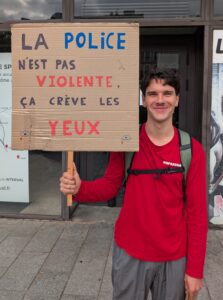
[Toulouse, France, Oct. 17, 2026] Hundreds of thousands of students marched in cities throughout France today demanding improvements in the school system. I am in Toulouse, the capital of France’s southern Occitanie region, a city of 515,000 in a metropolitan area of 1,100,000. The march had not yet started when I arrived. Toulouse has about 18,000 public high school students, and it looks like a majority of them have showed up today.
So have hundreds of France’s notoriously violent national riot police, the Compagnie Républicaine de Sécurité or CRS. They wear helmets, body armor, carry shields and have their clubs ready to teach the students a lesson. For weeks police have been using their billy clubs and tear gas against the students of Toulouse and other cities. Students has responded with stones and little fires in the street, though occasionally a fire gets out of hand.
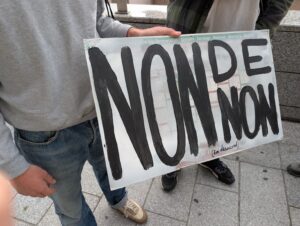
Also present today are scores of autonomes as they are called, black clad anarchists, some wearing masks.
There are thousands of students milling around near the train station, waiting for the protest to begin. I approach a group of six young people, five boys and a girl, from a few different high schools.
When I ask them how they met, one of them explains that three of them met in elementary school and the other three in high school. They seem like an exceptionally nice bunch of kids, friendly, well mannered, thoughtful.
“We’re all 18,” one says.
“We want to improve things for students,” one volunteers, “but we also want better conditions for others.” And others there are, millions of them, workers and the poor.
It’s a national day of protest in France, not just for the high school students, but for a variety of other groups as well. The “yellow vest,” the movement of ununionized small town workers and small business people are blocking the roundabouts in their rural towns and shutting down highways to protest high fuel prices and the rising cost of living. The French firefighters’ union is also on strike, protesting the government’s failure to deal with the causes of the horrific, months-long wildfires they have faced this past year. But today is, above all, the day of student protests.
On occasion in various places firefighters and school teachers have formed cordon around the students to protect them from the police.

I ask them if they’re worried about being attacked by the police.
“We’re prepared for them,” says one. “We have face masks for the gas and goggles to protect our eyes.”
“Why are you here?” I ask. “What do you hope to accomplish?”
They have come to demonstrate for students, to improve education, they say, but the young woman adds, “We’re here for everyone.”
One guy says, “The environment is a big issue.”
“Do you think that you and the yellow vests are in the same fight? A fight for the same things?” I ask.
“They’re different fights for different things,” says the young woman. “But we’re fighting against the same system.”
“What about the immigrant movement?”
They seem not to understand me. I explain that in Paris I saw a lot of African and Arab students and women in hijabs.
“We’re all French,” a few of them say. They reject entirely the idea that there are immigrants. “We’re all French.”
“The yellow vests, the firemen, us,” we all want change, says one.
“Do you think you can win?” I ask.
“Not until after the presidential elections,” says one guy. The election is scheduled for April.
As I’m talking with them, another student goes by with a sign that reads, “Out with Macron,” that is, Emmanuel Macron, France’s president now in his ninth year in office.
“Do you support one of the presidential candidates?” I ask.
For a minute they don’t offer an answer. So, I press on.
“What do you think of Melanchon?” I ask, referring to Jean-Luc Melanchon, the leader of the leftwing party France Unbowed.. “Do you support him?”
“He’s good,” one says.
“Yes, we support him,” says another.
“Most students support him,” adds a third.
We’ve been talking for a while, there are a lot of police in the area, the march will begin soon, it’s time to move on.
“Thanks for your time,” I say. “Good luck with your fight.”
They all smile, wave, and wish me well too.
French media, much like the American media that I am more familiar with, presents an unfavorable picture of the protests. The financial crisis facing French education doesn’t result from the doubling of the French military budget from €32 billion in 2017 when Macron took office to €64 billion by 2027, but rather say the media, from the school teachers’ large pensions. The violence, the media say, comes from the students who protested peacefully for weeks, not from the brutal CRS riot squads who beat and tear gas the students.
Well today in Toulouse as everywhere else in France, the police moved in to quash the protests, with watercannons and teargas, and, as always, the clubs, but the students resisted, took their licks, but also, when they could, they gave back blow for blow. Hundreds of protestors were arrested, many police and students were injured.
I didn’t see the young people to whom I’d spoken earlier, before the march, later in the day. I hope they’re alright.
 If you’ve read this far, you were pretty interested, right? Isn’t that worth a few bucks -maybe more? Please
Leave a Reply