Place: Western Europe
The current global crisis of capitalism makes the task set by the Daniel Singer Millennium Prize Foundation* look relatively straightforward.
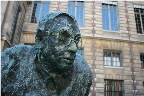
In the late 1960s it seemed to many almost certain that Jean-Paul Sartre would be remembered as the most important philosopher of the twentieth century and the most important public intellectual on the left of that era. Certainly it seemed so to me at the time. Sartre had in the 1930s taken Martin Heidegger’s Being and Time and its reactionary and religious version of phenomenology and transformed them in Being and Nothingness into his new humanist philosophy of existentialism, a leftwing philosophy of freedom.
Swiss German labor activists on the left have over the last few years undertaken a project which might be of interest to those of us in North America. Denknetz or Think Network is a leftwing think tank created in 2004 by a group of labor union activists, staff members, and others to address policy issues. The fundamental principles of the group are the promotion of freedom, justice and solidarity and the view that those three things must be fundamentally linked to each other.
The Bureaucrat and the Poor: Encounters in French Welfare Offices
By Vincent Dubois
Ashgate, 2010
Originally published in French as La vie au guichet: Relation administrative et traitement de la misère By Economica, Paris 2010 (1st edition 1999) Translated by Jean Yves-Bart
In a sober, balanced sketch of the history and historiography of the 1915 Armenian genocide included in a two-part article on Turkey published in the London Review of Books in September 2008, Perry Anderson notes that the perpetrators’ academic defenders have largely abandoned a discredited strategy of blanket denial for one of minimization or relativization, now increasingly discredited in its turn.
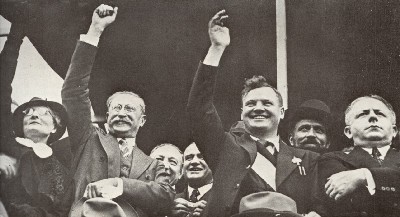
Decades since the spring of 1934 when the Communists first proposed the Popular Front as their strategy for fighting fascism and even longer since the summer of 1939 when it was suddenly terminated by the Hitler-Stalin Pact, the Popular Front—the alliance of the Communists with Socialists, liberals, and even sometimes conservative political parties—remains an issue for the left.
Note: This article begins a series by Richard Greeman. Longtime socialist and international activist Richard Greeman is best know for his studies and translations of Victor Serge, the Franco-Russian novelist and revolutionary.
Among the great British Marxist historians Eric Hobsbawm is the only one to remain in the Communist Party until the late 1980s. His decision to do so has never fully been explained. Thus the publication of his autobiography, Interesting Times, is an exciting event, as it has the potential of addressing this question. How did Hobsbawm manage to reconcile himself, for example, to 1956? Did he not at least feel disillusioned when he learned about Stalinist atrocities?
We are witnessing today a paradoxical and unsettling phenomenon: the rise of fascist-inspired political movements in the European arena (from France to Italy, from Belgium to Austria), accompanied, in the heart of intellectual circles, by a massive campaign to denigrate the entire anti-fascist tradition.
In France we have just experienced a great wave of strikes that directly addressed matters of political power. French history is defined by explosions of militancy which, for our governing class and for most of our journalists, are a "French sickness" that would be good to get rid of: before 2003 there was 1995; before 1995, 1968; before 1968, 1953 and so forth, all the way back to the Revolution. But this time there is something new: the latest wave of militant action is not an end to itself and is only an introduction.
The Swiss health insurance system, which mandates every individual to buy private health insurance, has been held up by many as a realistic model for the United States. In Switzerland, however, private insurers are far more highly regulated than is conceivable to imagine in the U.S. for example, they are not allowed to make profit on “basic” coverage. Yet even so, as my friend Dennis Clagett who lives in Switzerland has written to me, popular dissatisfaction with the country’s healthcare system is mounting due to the way that the private insurers have behaved.
[Note: This is a corrected version of the footnoted article that was earlier posted on the web.]
Are all cultures are equally valid and commendable? asks Peter Tatchell. I just received an email describing speeches Peter Tatchell has delivered on this subject. ( You can follow him with twitter at http://twitter.com/PeterTatchell or Facebook at http://tinyurl.com/cj9y6s ).
Law professor John Spencer, of Cambridge University, has created a huge controversy in the UK by suggesting a reduction in the current age of sexual consent of 16. His proposals, broadcast on BBC Radio 4’s Iconoclasts programme, with my support as a co-advocate, have been savaged by The Sun and the Daily Mail.
Law professor John Spencer, of Cambridge University, has created a huge controversy in the UK by suggesting a reduction in the current age of sexual consent of 16. His proposals, broadcast on BBC Radio 4’s Iconoclasts programme, with my support as a co-advocate, have been savaged by The Sun and the Daily Mail.
Multiculturalism vs. human rights?
Defending multiculturalism but warning against its excesses
Multiculturalism has many positive benefits. It defends the right to the different, which is a very important and precious human right, especially for those people whose difference has historically resulted in social marginalization and exclusion: including women, black, disabled and lesbian, gay, bisexual and transgender (LGBT) people.
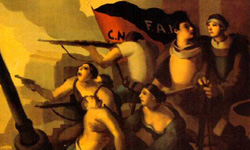
THERE IS A CONSENSUS among democratic socialists today that the struggle for deep social change has to somehow reflect the kind of society we want to build, but this remains inseparable from the questions of power, political strength and effectiveness because prefiguration goes beyond the "pure" ethical sphere to include wider issues of ideological/cultural, political and socio-economic hegemony. The revolutionary syndicalist answer to the problem of integral prefiguration represents a specific and important historical (and contemporary) synthesis.
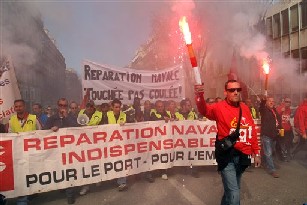 TRANSLATED BY MICHAEL SEITZ GUADELOUPE HAS MADE AN IMPRESSION . . . but not yet on the French union movement. The capitalist crisis affects France as it does all industrialized countries.The ingredients are the same:
 AS PRESSURE GROWS in Canada to adopt the American justice model of harsh prisons and long sentences, Finland has saved millions and prevented centuries of human misery doing the opposite. HAMEENLINNA, Finland — In a classroom thick with wigs, sinks and barber chairs, a man sprays water through a woman's sudsy hair and works his fingers carefully to rinse the shampoo. Standing in front of a large mirror, another man brushes and sprays a woman's hair. Two others discuss styling techniques. It could be a scene from any community college, but for the bars on the windows.
- « Newer Posts
- 1
- …
- 13
- 14
- 15
- 16