Place: Western Europe
 Book Review of Martin Comack. Wild Socialism: Workers Councils in Revolutionary Berlin, 1918-1921. New York: Rowman & Littlefield, 2012. Chronology. Bibliography. Index. 97pp. Paperback or e-book: $24.99
The International Monetary Fund acknowledged making an egregious error in its evaluation of the Greek bailout it helped create after its ambitious push for harsh austerity last month. Their failed analysis highlights the dangers of austerity measures imposed on Greek citizens. According to the IMF report:
It was supposed to mark the beginning of a new era in Irish politics. The Green Party entered into a coalition government with Fianna Fail in 2007 bringing with it the ideas of a new greener economy and all the hopes and aspirations of environmentalists, but instead their time in power turned out like a comedic tragedy.

There seems to exist a secret complicity between the rediscovery of Rosa Luxemburg and rebellious times. The last period when her life and writings raised much interest was in the 1960s and 70s, during the “street-fighting years” (Tariq Ali’s expression). Could the recent publication of several of her works, in many parts of the world, be the sign of a new “critical” epoch? In the English speaking world, the good news is the project of publishing The Complete Works of Rosa Luxemburg in fourteen volumes, five of which only with her correspondence.
(Translation By Özlem İlyas Tolunay; Turkish version here.)
Oğuzhan Müftüoğlu was born in Anamur, Turkey in 1944. He joined the Revolutionary Youth (Dev-Genç) movement while he was a law student at Ankara University during the 1960s.
The killing of Clément Méric, an 18-year-old anti-fascist activist and member of a student union, by a young fascist skinhead in Paris on May 6th has shocked French public opinion.
The execrable Maggie Thatcher, erstwhile British prime minister, passed on April 8 with much rending of clothing by her nation’s Right but with something approaching joy by much of the nation’s rest. The following sendoff appears in the Summer 2013 Democratic Left, minus its last graf slapping the endlessly slappable Slavoj Zizek for writing that the Left could learn from her.

Book Review: David Black and Chris Ford. 1839: The Chartist Insurrection. Foreword by John McDonnell, M.P. London: Unkant Publishers, 2011. 233 pages. Chronology. Illustrations. Appendices. Index. £10.99.
Maybe we are not organized, but we are neither apolitical nor without ideology. We were only afraid, because we are the daughters and sons of a generation, killed and tortured to death just before and after the military coup of September 12, 1980 in Turkey. But, we have now learned that cowards die many times before their deaths. We went beyond the fear threshold and achieved the collective confidence that one smells in the air.
Last night Turkish President Recep Tayyip Erdoğan ordered police to drive protesters from Taksim Square in Istanbul and with water cannons, tear gas and clubs they did so.
The on-going resistance to the remodeling of Taksim Square in Central Istanbul, Turkey took on a new more militant form on Monday evening when bulldozers arrived at the park and began demolishing some parts of the Gezi Park’s wall and removed nearby trees. Taksim Solidarity, the resistance movement whose members were at a regular meeting at the park during the demolition, succeeded in stopping the demolition when they moved into the area where the bulldozers were removing the trees. A group of 20 to 30 people stayed on guard duty throughout the night.
To the Government of the Republic of Turkey and the Public
Citizens have been expressing their democratic outrage in Taksim Istanbul and all around the country against the insensitivity of the government for the public concern about the de-facto destruction of the Taksim Gezi Park that took place around 10 PM on May 27th.
We share the pain of Abdullah Comert’s and Mehmet Ayvalitas’s families and wish to extend our get-well wishes to thousands of wounded citizens.
Amid twinkling fingers and Guy Fawkes masks, few were pining for central committees. Occupy’s emergence was welcomed. The movement galvanized radicals, bringing the language of class and economic justice into view. Yet an unwarranted arrogance underlined the protests. Occupy, in part a media event that mobilized relatively few, was quick to assert its novelty and earth-shattering significance.
The following open letter was issued yesterday.
January 26, 2013
Letter of Support and Solidarity to Greek Transport Workers
We have read about your strike against threatened pay cuts and the Greek government’s emergency decree and use of riot police to force you back to work. We are horrified by the attempt to toss your contracts aside; your pay is already not adequate to maintain a decent standard of living.
The Austerity Allstars explain their political program.
May it catch on widely!
Describing Dutch society and politics in 2012, sociologist Willem Schinkel used the metaphor of a museum.[1] Conservative and turned inward, Dutch society is afraid of change, fixated on something called "Dutch values." One expression of this is the right-wing, nationalist populism that since a decade stood in the center of Dutch politics and public debate. Social-economic policies were guided by an unquestioned acceptance of neoliberal principles. The elections of 2012 seemed a chance to break with this pattern.
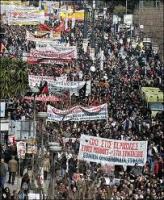 In recent years Greece has come to exemplify the attempt of capitalist elites to respond to the global capitalist crisis through an attack on the rights and living standards of workers and ordinary citizens around the world.
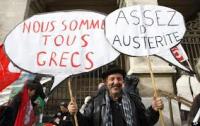 When New Politics asked me this July to write a piece about France under the new Socialist government, I excitedly drove out to Serviers-et-La Baume — my Provençal sweetheart Elyane’s little village located in the heart of la France profonde — to interview her rural neighbor Robert about this big change (and sip some of his home-made plum brandy).
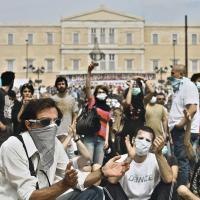 SEPTEMBER 2012—What is happening today in Greece is only the most extreme example of a global phenomenon: the world’s political and economic elites, who are responsible for the current economic crisis, want to make the rest of us pay for that crisis, no matter how much suffering this creates.
While in Istanbul last week I participated in a march and demonstration by the Freedom and Solidarity Party (ODP) on Dec. 9 to launch a campaign to link grassroots community organizations to a broader program for social and political change in Turkey. The march of hundreds of ODP members of all ages, some of them families with children, was a peaceful event though the chants were militant. "Let us live like human beings. Take the government's hands off the people," was one. And periodically the marchers shouted, "Revolt!"
In a surprisingly warm and positive obituary, the New York Times noted the death of Michael Wreszin in August of this year. The obit says of Wrezin’s writings, “His subjects were cosmopolitan, humanist thinkers who saw a growing militarism in American political culture but whose scrupulous habits of mind could make them misfits in the ideological camps they joined.” Mike Wreszin was a frequent contributor to New Politics. We miss him already.
- « Newer Posts
- 1
- …
- 11
- 12
- 13
- 14
- 15
- 16
- Older Posts »