Place: Latin America
The Mexican government confronts a major political crisis on two fronts. The first is as a result of the massacre and kidnapping that took place on September 26 when police and other assailants in Ayotzinapa, Guerrero killed six, wounded twenty-five, and kidnapped 43 students. Since the massacre and kidnapping took place, there have been demonstrations in Guerrero, Mexico City, and several other states, some of them massive and some violent.
Dear Friend of the Campaign for Peace and Democracy,
Dilma Rousseff of the Workers Party (PT) won Brazil’s presidential election on October 26, meaning that when her term ends her party will have held the nation’s top office for a remarkable sixteen years, longer than any party in Brazilian history. Rousseff began as part of an armed revolutionary guerrilla organization during the dictatorship from 1964-1985, then helped found the Democratic Workers Party (PDT), and only joined the PT in 2001.
Once again the Workers’ Party (PT) found itself in the difficult position of having to defend its government’s sorry record on issues such as the economy, corruption and energy policies, all while fending off right-wing opposition candidates. Fortunately for the PT and its incumbent president and presidential candidate Dilma Rousseff, their adversaries at the national level never managed to assemble a political program that differentiated itself from the PT’s.
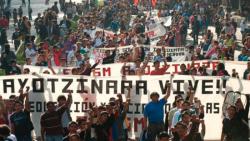
[October 24, 2014] Public outrage over the police murders of six people and forced disappearances of 43 students from the Atoytzinapa rural teachers’ college in the southern Mexican state of Guerrero continued to snowball this week.
Throughout Mexico there is continued shock, horror, indignation, and anger at the police killing of 5 and wounding of 17 other students, and above all at the disappearance of 43 students on the night of September 26 and the early morning of September 27. For almost a month now protests peaceful and violent involving tens of thousands have rippled across Mexico, as students, teachers, and other citizens demand that the missing students be returned alive, though some evidence suggests they may already be dead.
Largely downplayed in the U.S. media, ground-shaking events are rattling Mexico. On one key front, Mexican Interior Minister Miguel Angel Osorio Chong announced October 3 the Pena Nieto administration’s acceptance of many of the demands issued by striking students of the National Polytechnic Institute (IPN). IPN Director Yoloxichitl Bustamante, whose ouster had been demanded by the students, handed in her resignation.
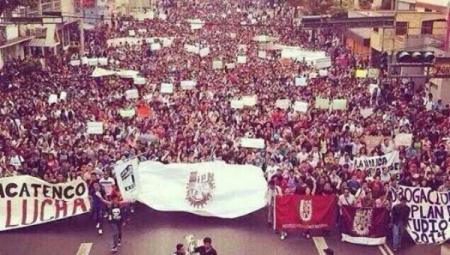

A little more than year ago, Brazil was paralyzed by the enormous popular protests of the June Days of 2013 as, according to a highly regarded poling agency IBOPE, some 8.5 million people joined demonstrations in 400 cities and 22 state capitals, first against high transportation costs and then against just about everything else that had to do with government policies. IBOPE found that 72 percent of the population approved of the demonstraitons and that 89 percent had no faith in the political parties.
Will MORENA, the National Regeneration Movement founded and led by former presidential candidate Andrés Manuel López Obrador, be able to change Mexican politics and what sort of change might that mean? We will soon have an idea. Founded in November 2012, MORENA is now a legitimate political party with the right to run candidates in elections.
The World Cup is the most widely viewed sporting event around the world. Millions of viewers will tune in Sunday to watch the broadcast of the upcoming final match and cheer on their favorite teams as they battle for the golden trophy. In the United States, the event has become a much anticipated and celebrated source of entertainment – an opportunity for people to show support for their country and an excuse to grab a drink and watch the game with friends at a local bar.
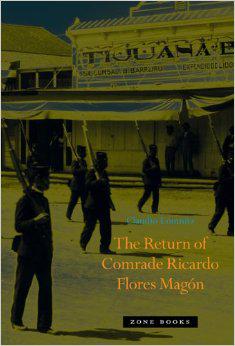 Claudio Lomnitz. The Return of Comrade Ricardo Flores Magón. New York: Zone Books, 2014. 594 pages. Notes. Index of Names. Photos. Hardback. $35.95.
If it were a house, Claudio Lomnitz’s The Return of Comrade Ricardo Flores Magón would be a rambling, decaying mansion with various jerrybuilt stories and wings, a ramshackle place filled with archives and artifacts, old political posters and antique typewriters, a building straddling the U.S.-Mexico border, a shared abode whose residents are an interesting and odd collection of characters, some of them lovely people, some noble, and others quite disagreeable, coming and going at all hours, sometimes reciting poetry. And don’t be surprised if, while you’re visiting, the place is raided by Furlong or Pinkerton agents, by the police or the Texas rangers who carry off some of the boarders to prison; some of whom will be gone for years at a time.
 Scholars have sometimes noted that Argentinian history seems unusually punctuated by periods of booming prosperity followed by dramatic collapse.
On February 7, 2014, I sat down with Adelina Nicholls, executive director of the Georgia Latino Alliance for Human Rights (GLAHR) in Atlanta, to talk about the organization’s history and achievements, as well as to reflect on the political role of Latino immigrants in the United States today.
Book Review
Bernard Duterme et al. Zapatisme: la rébellion qui dure. Alternatives du Sud. Paris: Centre Tricontinental and Éditions Syllepse, 2014. Chronology. Notes. Index. 205pp.
The Party of the Democratic Revolution (PRD), which was founded in 1989 as the hope of the left, celebrated its twenty-fifth anniversary on May 5 amidst expressions of disappointment and disillusion. The hope that the PRD would become a left political party capable of winning the presidency and a majority in the legislature and changing the face of Mexico has not been fulfilled.
Venezuela is torn between the destabilising attempts of the right-wing, the limits of the Bolivarian process and the possibility the working class and the popular movements will advance the [revolutionary] project, [but] not without tensions and contradictions.
“Today the counter-revolutionary Right is reactivating itself,” according to long-time Venezuelan revolutionary Roland Denis, “taking advantage of the profound deterioration that this slow revolutionary process is suffering.
This article was written for Mexican Labor News and Analysis and therefore emphasizes NAFTA’s impact on Mexico.
The Three Amigos summit meeting of President Barack Obama of the United States, President Enrique Peña Nieto of Mexico, and President Stephen Harper of Canada just held in Mexico amounted to little more than a reaffirmation of the neoliberal agenda represented by the North American Free Trade Agreement (NAFTA) that took effect twenty years ago.
Four Argentine oil workers were convicted last December 12 of having killed a policeman in the midst of a strike and a demonstration demanding the release of a jailed union member. The four—Ramón Cortez, José Rosale, Franco Padilla, and Hugo González—were sentenced to life in prison, while six other defendants were each sentenced to five years in prison on charges of coercion.
 The inner-city parish of La Vega sits in the lush mountain terrain of Western Caracas. Roughly 130,000 poor residents are cordoned off sociologically from nearby El Paraíso, a wealthy neighborhood that supplies the clients for the upscale shopping center that separates the two communities. In La Vega, the bottom 20 percent of households live on US$125 per month, while the average family income is $US409.
The Chiapas Rebellion led by the Zapatistas took place twenty years ago this month. What was the importance of the rebellion and of the Zapatistas? What was the impact at the time? And what has been its political legacy? What is the role of the Zapatistas in Mexico today?
- « Newer Posts
- 1
- …
- 14
- 15
- 16
- 17
- 18
- 19
- 20
- 21
- Older Posts »