Blog

  • Neither the Establishment Nor its Money Can Oust Trump in 2020

    Neither the Establishment Nor its Money Can Oust Trump in 2020

    With Democratic primary campaigns in full-swing and the 2020 election just over a year away, I thought I’d take a look at some of the reports on available data that could shed light on the motives and actions of the American electorate in 2016. In particular, I wanted to consider which observed trends seemed to play a role in the unlikely victory of Donald Trump in 2016 to think about which candidate (or candidates) would have the best shot of beating him in 2020. Of course, just because there was an observable voter trend in one election does not mean it will repeat four years later. Also, it’s certainly possible that unforeseen developments or turnout (or lack thereof) from some un-predicted composite of voters could affect things in unforeseeable ways in 2020. So, in short, one never knows for sure. The outcome of the 2016 election is itself an indication of this. This is not an attempt to exhaustively flesh out substance from numbers or a consideration of every possible theoretical contingency. Rather, it’s simply a little dip into some data and a bit of reflection.
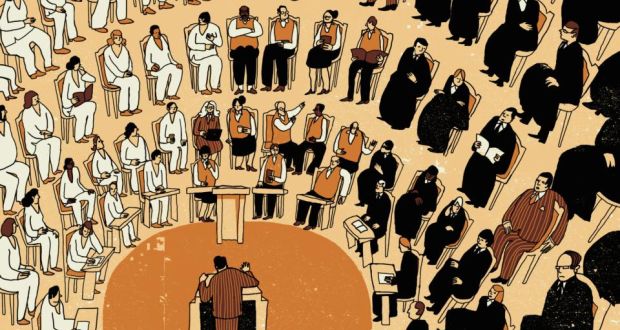

    One significant factor which played a role in Trump’s victory was the turnout of improbable voters in 2016 – either first-time voters or those who did not vote in recent presidential elections. Like it or not, Trump inspired these folks to show up for him at the polls. He represented an option for many disaffected voters, a candidate for whom they could cast a protest vote as an expression of their discontent with the political establishment. Since exit poll respondents who identified as first-time voters turned out for Clinton over Trump by a three-to-two margin, one may be inclined to think that these improbable voters didn’t help nudge Trump to a majority in the states where he prevailed. In some states, he just scarcely did so, indicating just how volatile and unpredictable those outcomes were. However, this three-to-two margin is a slimmer majority that broke for the Democratic candidate compared to the last two elections. A greater proportion of first-time voters turned out for Obama the two elections before, with a two-to-one margin over his Republican opponent in 2012 and a 2.2-to-1 margin in 2008. Also, there were more first-time voters in 2016 – 15%, an increase from 9% in 2012. So the portion of first-time voters that voted for Trump in 2016, while a minority of such voters, was a larger statistical minority than that of the previous two years who voted for the Republican candidate. Also, more actual voters turned out overall in 2016 than both 2012 and 2008.[1]

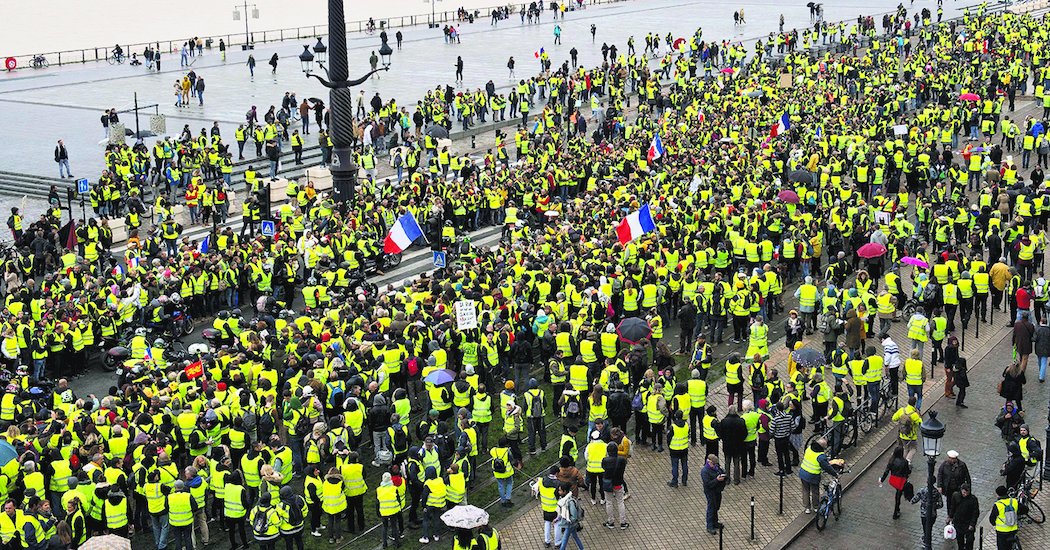
    A recurring narrative for those who cast their votes for Trump, especially White working class voters, was frustration toward the political establishment. Based on a large post-election poll, White non-college graduates in particular represented a 14% larger portion of voters in 2016 than 2012, and voted for Trump over Clinton 63% to 32%. Another post-election poll by the Center for American Progress found that 50% of Trump voters responded that the most important factor shaping their decision to vote for him was to “shake up the political establishment.” A study which drilled down into a relatively small cohort of 20 white working class men showed that Clinton was broadly seen as the status quo candidate and that voters for Trump were motivated by his self-presentation as a political outsider who was in it to shake up politics as usual. With reservations expressed about both candidates, the men interviewed overwhelmingly either voted for Trump or didn’t vote at all. A larger qualitative study of White working class communities across multiple regions of the country indicated the same finding, that for many of these voters, Trump inspired them by tapping into an “insurgent, anti-establishment rage against ‘politics as normal.’”

    There’s obviously more to it than this. With Trump’s overtly racist and xenophobic rhetoric in relation to immigration, depiction of American society and values as under attack, and promises of greater prosperity for those who felt left behind, these “dispossessed” voters, as sociologist Daniel Bell once referred to them, were willing to take a chance on Trump, the populist self-styled outsider vowing to shake up Washington, drain the swamp, and “Make America Great Again.” Diana Mutz’s analysis of a large pool of voter data showed that a sense that “the American way of life is threatened” was a reliable predictor of support for Trump. As dominant groups (Whites, men, Christians, etc.) perceive a decline in their status and privilege, this experience of status threat makes traditional and hierarchical social arrangements more attractive. A report by the North Carolina Center for Public Policy Research comprehensively outlined the bases on which Trump came to symbolize “the candidate of change” for voters. Namely, he appealed to those who were apprehensive or fearful of social transformations with regard to the economy, cultural life (LGBTQ rights, contemporary struggles for racial justice, “PC culture,” etc.), immigration, public safety with regard to violence and terrorism, and the standing of the U.S. in the world.

    The composition of voters who stayed home in 2016 and their rationale for doing so are also informative for understanding how the election tipped in Trump’s direction. The two most unpopular candidates in the field faced off against each other, and predictably the most frequently given reason for not voting was dissatisfaction with both choices. Eligible voters who did not vote were more likely to identify as independents and Democrats. Independents who did vote were slightly more likely to vote for Clinton. If independents who stayed home and voters who identified with one of the two major parties turned out and voted along party lines, Clinton would have won. Trump would have been edged out in enough states for Clinton to win the Electoral College, especially considering the razor thin margin by which Trump won in swing states like Michigan, Wisconsin, and Pennsylvania. Voters who disliked both candidates who did vote, were more likely to vote for Trump.

    A blend of white racial resentment, anti-immigrant xenophobia, and cultural and economic insecurity undoubtedly contributed to many voters’ sense of social and political disaffection and to Trump’s appeal. Clinton being a standard bearer of the Democratic Party establishment and favorite of the liberal donor class and corporate media did not ingratiate her with those looking to vote against the status quo or to those susceptible to the sort of ethnonationalist appeals and promises of swift and miraculous socioeconomic transformation that Trump was making. However, implicit and explicit sexism directed toward Clinton was unmistakable and also a factor. Outrage and hostility toward Clinton surged from the right. There were certainly legitimate populist grievances in relation to Clinton and the Democratic Party in the run-up to the 2016 election. Though, given the depth of Trump’s duplicitousness and corruption, this was a selective hostility. In other words, a level of perceived corruption and cronyism, compromised integrity, or opportunism that is routinely tolerated with more traditional candidates, when apparent with regard to Hillary Clinton, at least for a segment of the electorate, was intolerable. It should be mentioned that the Clintons evoke an almost mythical level of sniveling anger from the right, and it’s hard to say to what degree another woman in the 2016 presidential race (of either party) would have produced a comparable level of opposition. Nevertheless, hostility toward women in professional roles indicated that voters were less likely to vote for Clinton (or Jill Stein) in 2016 in particular, a trend which was more prevalent among whites, men, and Republicans. That said, a vote for Donald Trump or staying home and withholding one’s vote for either candidate in 2016 were ways for voters to express their angst. This was an anti-establishment angst, to be sure, but also one mediated by a growing sense of status threat for dominant social groups.

    While much is rightly made about the seemingly unconditional support for Trump among his core supporters, his reelection also rests in the hands of those whose support is more apprehensive. A FiveThirtyEight-commissioned SurveyMonkey poll drilled down into more “reluctant” Trump supporters. The survey showed that this contingent represented about 1/5 of his 2016 turnout. Respondents in this group were slightly more likely to be college educated, self-identify as independent, and describe themselves as moderate. Within this category 57% continued to maintain their support just over a year after Trump’s term began while 28% weren’t sure. The economy was a major determinant in whether these voters maintained their support. They were also frustrated with the media establishment, especially what they saw as “overblown” coverage of the Mueller inquiry. A nationwide poll conducted by NORC at the University of Chicago for the Associated Press observed a similar proportion of voters (18%) who described themselves as “somewhat approving” of Trump. The poll showed that these respondents were more likely to disagree with Trump on key issues like healthcare, immigration, climate change, and gun control. Issues which nudged them toward a Trump vote were their rejection of the political and Democratic Party establishments, the economy, and potential Supreme Court vacancies. However, 64% of them felt that if the Meuller probe found that the president obstructed justice in the investigation of Russian election interference, that it would be at least a “somewhat” serious matter. Now, with the impeachment inquiry into Trump’s soliciting of Ukraine’s president to investigate Joe Biden, who Trump likely sees as his most formidable political opponent, this sector of potentially wavering supporters of Trump may be even more inclined to be among those who stay home in 2020. Perhaps they’d even vote for a maverick Democrat. However, the impact of Trump’s actions on Biden’s reputation for these “moderates” remains to be seen. It’s important to keep in mind that Hillary Clinton’s perceived moral and political corruption and lack of integrity was a recurring justification for those who voted for Trump, even though they were dissatisfied with both candidates.

    Concerns with corruption and that the system is “rigged” are not unfounded. Much has been written about the influence of money in politics. Also, as touched on in the paragraph above, Joe Biden’s son, Hunter Biden, joining the board of Burisma in Ukraine and making millions due to his father’s connections while VP, is just one example of the moral corruption (though legal) that has been largely normalized among elites who nimbly pass through the revolving door between politics and business. Such influence-peddling has rightly frustrated Americans. This culture of legitimate grift in a society that is so rich yet unequal is fundamental to understanding the cynicism and despair which led to a Trump victory. Everyone knows Donald Trump and his family are no strangers to these sorts of conflicts-of-interest and ethically problematic connections, which is why it is essential for the Democrats, if they want to beat Trump in 2020, to nominate someone largely seen as an honest outsider to the political establishment. Joe Biden isn’t that.

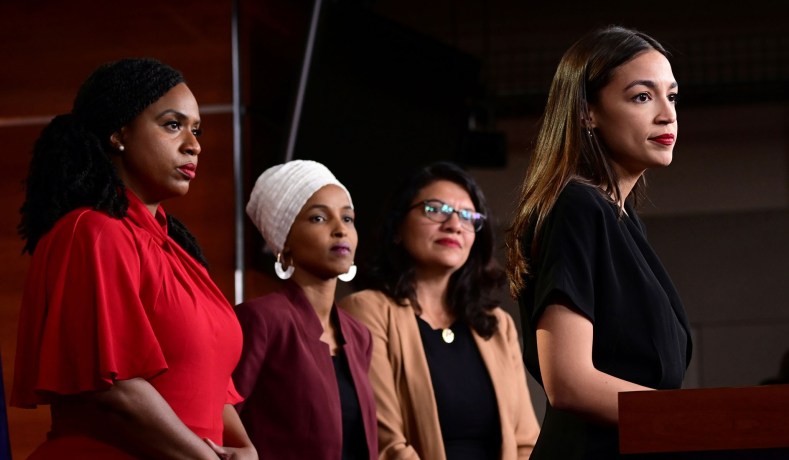
    Notably, there has been a recent rise of independent and progressive figures in the Democratic Party, like Bernie Sanders in 2016 and midterm Congressional candidates in 2018 like Alexandria Ocasio-Cortez and Ilhan Omar (among others). Bernie saw an unlikely burst of support, especially among young voters, and he unexpectedly positioned himself as a viable contender to Hillary Clinton, pushing her to the left of her usual policy positions contributing to perceptions of her as disingenuous and morally corrupt (e.g. her alignment with Wall Street firms, entrenchment and loyalty to the intelligence and Pentagon systems, support for past wars, support for the Patriot Act, past opposition to marriage equality, support for Bill Clinton’s neoliberal assault on the safety net, support for the 1990s crime bill that accelerated the mass incarceration of poor, black, and brown people, etc. etc.). Omar and Ocasio-Cortez, along with other progressive congressional contenders, won their primary races and ultimately seats in Congress. The appeal of such insurgent progressives and their bold policy ideas has shifted the entire conversation among Democratic presidential hopefuls during the string of recent primary debates. This has upset the establishment. Various billionaires, Democratic Party donors, and prominent centrist Democrats have warned the party of its embrace of “political extremes.” Michael Bloomberg and Starbucks mogul Charles Schultz even publicly considered running as independents on pro-business, centrist tickets if the Democrats failed to nominate a centrist. Bloomberg came close to running in 2016 as well. Such actions are cynical, alienating, and patronizing, implicitly communicating that voters should just let the big boys who know better tell them what’s best. The public be damned, and if they don’t listen, the billionaires and donor-class will get involved directly.

    With the leaking of private Democratic National Committee (DNC) emails in the summer of 2016, it was evident that top officials in the DNC were disparaging Sanders, despite presumptions of impartiality. This was seen as a clear indication of preference for the centrist, establishment candidate, Hillary Clinton. This internal DNC documentation revealing that the Party was operating to move Clinton forward as the nominee actually damaged the Democratic Party’s chances at winning the election. Many (across the political spectrum) saw this a just another piece of evidence that the game was “rigged” and that Clinton was the presumptive favorite even before the process had a chance to fairly shake out. Aside from centrists already in the Dem/Clinton camp, to many from the center out to the hard right of the political spectrum, this disenchantment translated to a vote against the establishment either by staying home or turning out for Trump – a decision for many voters that was only solidified in the week before the election. These “late-deciders” who voted broke for Trump by 11% in Michigan, by 17% in Florida and Pennsylvania, and 29% in Wisconsin, representing yet another significant trend in relation to Trump’s unexpected victory by such slim margins in the swing states.

    The display of Party elites and donors working to sway opinion away from popular policy proposals like Medicare For All and a Green New Deal indicates a tone deaf elitism that will take work and time to challenge and change but in the meantime will make the Democrats’ road to beating Trump in 2020 more difficult. In an April 2019 New York Times piece, it detailed an event organized by a former Democratic Party official, Leah Daughtry, where she held a closed-door event in San Francisco in March 2019 with 100 wealthy liberal donors. She described her affect on attendees as having “freaked them out” by warning that Sanders may be among the top candidates come convention time. Many Party-insiders and centrist donors see the recent progressive ascent as a threat and are organizing to obstruct it. David Brock, a polarizing party operative has been enlisted to organize the 2020 anti-Sanders operation. Brock is somewhat infamous. He coordinated networks of social media trolls to attack Sanders supporters in coordination with the pro-Clinton super PAC, Correct the Record, during the runup to the 2016 election. Before aligning with the Democrats and Clinton, he waged a viciously misogynistic campaign to discredit Anita Hill’s accusations of sexual harassment against Clarence Thomas shortly after Thomas’ Supreme Court confirmation hearings.

    ThinkProgress, website and appendage of the think tank Center for American Progress (CAP), ran a smear video against Sanders earlier in the year when his most recent tax returns showed that he’d become a millionaire from the sales of his books. CAP was started by John Podesta, former chief of staff for Bill Clinton and campaign chair for Hillary Clinton’s 2016 campaign. Neera Tanden is the current head of the think tank and is a fierce Clinton ally. Under her direction, she has noted that CAP is focusing on addressing antagonisms with “millennial agitators” in the Party and working on pitching watered down, more market-based versions progressive initiatives like Medicare For All.

    Warren has also been a target of concern recently. A recent CNBC story reported that Wall Street and other corporate Democratic Party donors are threatening to “sit out the presidential campaign fundraising cycle” or even support Trump if Elizabeth Warren is the Democratic nominee. The report noted Warren’s criticism of big banks and corporations, support for a wealth tax, and her recent surge in the polls against Joe Biden. One wealthy donor noted, “I want to help the party, but she’s going to hurt me, so I’m going to help President Trump.” To more disenchanted voters in the political center and right (regardless of party affiliation) who are rightly concerned about their economic and social well-being, all this is just more evidence that Democratic promises to address their problems are empty. For many on the progressive left, it shows a willingness of the ruling-class flank of American liberalism, Democratic Party bosses, and wealthy donors to risk empowering an ascendant proto-fascism instead of even considering modest policy alternatives to neoliberalism or taking seriously popular demands for economic, gender, sexual, racial, and climate justice.

    Trump has his work cut out for him, especially now as he’s embroiled in the Ukraine scandal and facing the impeachment inquiry in the House. His reelection, to some extent, relies on a delicate balance. He needs to continue to signal his usual toxic blend of coded and not-so-coded racism, elitism, misogyny, and anti-LGBTQ bigotry to his MAGA hat-wearing base while not pushing away his reluctant, more moderate supporters. His winning key swing states again in 2020 is, in part, dependent on this juggling act. He also has to maintain enough legitimacy for his supporters overall as more and more information is revealed about the depths of his criminality and corruption. However, there’s still a lot of time between now and November 2020.

    If the Democratic Party and American voters more generally want to defeat Trump, an establishment candidate awash in establishment money isn’t going to get the job done. Democratic primary voters need to make sure an establishment outsider seen as honest and smart with a track record of advocating in good faith for the public is the nominee in 2020. Either an honest, consistent, progressive populist like Bernie Sanders or a liberal, policy savvy, advocate like Elizabeth Warren are the best shot for the nation at defeating Trump at the polls. Of course, we don’t need a populism that appeals to the lowest tendencies of our society and empowers forces of hate. Rather, a principled candidate running on bold policy initiatives which address injustice without appearing to be delivering finely tuned, focus group-tested sound bites could peel away some of those disgruntled, anti-establishment voters that turned out for Trump in 2016. Warren and Sanders, though different, can do this.

    I feel that a person would stand an even greater chance of beating Trump if they transparently addressed the Democratic Party’s elitism and its shameful pursuit of large donor, special interest, and Wall Street support at the expense of the interests of the Party’s base and of the American public. This would be damaging for the Democratic Party machine as it currently exists, but would deeply ingratiate the candidate with voters exasperated with politics as usual and be good for the party and country in the long run. Trump upended the GOP machine by taking on politics as usual, and he’s, well, Trump. Imagine if a progressive with integrity who wasn’t self-serving or stoking social divisions within the populace gave it a shot. Joe Biden is not the person for the job. Sanders could take on Democratic machine given his vast grassroots funding base and still prevail. This would be trickier for Warren, and it could come across as largely rhetorical and superficial, given reports that she’s quietly assuring Democratic Party insiders behind the scenes. This makes Sanders the more broadly appealing candidate in 2020 if we’re thinking beyond just traditional Democratic voters. Though, either can potentially win. Taking on the establishment in either capacity could even inspire more Democrats and independents to show up on Election Day, which, if trends repeat from 2016 (and there’s no guarantee that they will) would favor the Democratic candidate. As for the potential of centrist and conservative Democrats sitting out the election if a progressive gets the nomination, Trump should provide enough of a unifying force to bring enough of them out either way. After all, centrist and conservative Clinton supporters were keen on disparaging Sanders supporters in 2016 based on the notion that they did not turn out to support Clinton in the election. Hopefully Democratic establishment loyalists will walk the walk in 2020 if Biden fails to win the nomination of their party.

    If we look at current data, the major and most recent polls based on the RealClearPolitics (RCP) average, show that Biden has a +7.7% advantage against Trump in the general election, compared to a +4.8% advantage for Sanders and a +4.0% advantage for Warren. Given that, it’s tempting to conclude that, of course, Biden would be our best shot at beating Trump. However, consider that this time in the last presidential election cycle, Clinton showed a +5.0% advantage based on the RCP average. By the time of the election, that spread thinned out to +3.2%. Sanders terminated his candidacy in July 2016 and endorsed Clinton, but polling through May and early June of that year showed that he was favored over Trump with a +10.4% advantage. There’s no way of knowing if that lead would have held through November would Sanders have been the nominee, as polls at this juncture are not so predictive, something for which 2016 has provided a sore lesson.

    Trumps’ most recent woes will hopefully discourage his voters whose support and inclination to come through for him on Election Day are far from certain. Anything can happen between now and then, but Biden is not up to the job of facing Trump, and there’s no telling how things will shake out with the Ukraine scandal in relation to either of them and how that might impact Biden as a candidate. In this atmosphere, a democratic candidate who is visibly and genuinely concerned with and shows a track record of addressing the environmental crisis, poverty, healthcare, war and violence, unchecked corporate power, social injustice, and the corruption of the political establishment may compel those who somewhat approve of Trump but are averse to voting Democratic to sit this one out or perhaps even vote for the Democratic candidate in the next presidential election.

    Though there are substantive difference between them and given what we know at this point in time, only a Sanders or Warren candidacy, despite their differences, can defeat Trump in 2020. Biden’s policy history is problematic, and his establishment pedigree and frequent mentions of his time as Obama’s VP will only take him so far in a general election campaign. While they shouldn’t, optics do matter, and he’s not the Joe Biden that brashly trounced Paul Ryan in the 2012 Vice Presidential Debate. Donald Trump will bluster and shout, and a soft-spoken Biden who is easily flustered and needs time to fish for words will be soundly dominated on the public stage in such a venue, and he will appear weak, all else equal. Not to mention, Biden’s strategic shift to the left may play in a similarly disingenuous way in the run-up to the general election as Clinton’s did in 2016, but as mentioned above, this discrepancy may be somewhat mitigated since he wouldn’t face the implicit and explicit sexism that Clinton experienced. Sanders more than Warren can run insulated from the corrupting forces of the DNC and Democratic Party establishment in terms of public perceptions of his integrity and motivations, but that establishment can continue to make things hard for Sanders (or any candidate who doesn’t play ball). Warren or Sanders would offer a much stronger show of force against Trump and are largely understood by voters, regardless of politics and party, as having integrity, grit, commitment, and a genuine concern for the public – things that Trump can’t compete with.

    [1] A larger portion of eligible voters voted in 2008 than 2016, but more actual voters turned out in 2016.

  • Bulls-Eye: Why Democracy by Lottery is Right for DSA

    Bulls-Eye: Why Democracy by Lottery is Right for DSA

    In his analysis of the procedural shortcomings at the Democratic Socialists of America’s national convention, Andrew Sernatinger calls for the organization to imagine “a theory of democracy beyond voting.” Democracy is a “moving target,” he notes, and while he doesn’t stipulate where the arrow should land, he pleads for a process that allows for multiple levels of engagement. What Sernatinger seeks, the ancient Athenians provided two and a half millennia ago: Democracy by lottery. In their system, any eligible citizen could serve in government via civic lotteries that chose them. While the power to pass legislation resided in the Assembly (open to all) a Council of 500, selected by lot, developed the proposals. Lotteries also chose magistrates and even judges. Only a few positions, like generals, relied on voting. Why? Because the Greeks understood a truth we’ve bitterly come to learn—wealthy elites control elections and the politicians they produce. This domination isn’t a perversion of the system, but inherent to it. “The appointment of magistrates by lot is democratical,” Aristotle observes in Politics, “and the election is oligarchical.”

    The Athenians harbored a realistic view of human nature. On the one hand, they knew that when placed in adverse circumstances, people succumb to corruption. On the other, they believed that ordinary citizens—no matter experience, status, or education—can make sound judgments when set up for success. Contemporary democratic innovation vindicates their view. Through a process of stratified selection, modern civic lotteries create a Citizens’Assembly, a representative cross-section of the populace. After consulting experts, its members work together to identify the pros, cons and trade-offs of policy options. They then render high-quality public judgments backed by considered, easily understood reasons. In this way, democracy by lottery achieves greater diversity, effectiveness, and credibility. It gives every citizen an equal chance of governing; allows them to develop an informed understanding of complex issues; and promotes long-term thinking and solutions that garner public trust.

    Today, governments in Ireland, Belgium, Britain, and more are all experimenting with civic lotteries. Leftist political parties in other countries have adopted similar processes for their internal operations. In Spain, Podemos has used lotteries to pick 17.5% of the members of its standing committee in several provinces. The radical political movement La France Insoumise did the same to select the twelve-hundred delegates to its 2017 national convention. And Mexican President Obrador’s MORENA party uses a combination of elections and lotteries to fields its candidates for the national legislature.

    If DSA wants to improve future conventions—and transform our oligarchic political system—we must follow the lead of our comrades abroad and embrace democracy by lottery. Moving to an allotted system to generate delegates, committees, and leadership could happen swiftly, with sweeping results. We could then call for the implementation of the same structures in the State, doing so with integrity and boldness. To that end, we should work to elect politicians who agree to call Citizens’Assemblies once in office. In fact, we should make a pro-democracy by lottery position a requirement for candidates seeking our endorsement. Unions and cooperative businesses should adopt the method, too, along with universities, schools, and religious bodies. The more people become exposed to real democracy in all areas of life, the more it will whet their appetite for it in politics.

    What might such a system look like for DSA? In a 2013 article for the Journal of Public Deliberation, Terrill Bouricius offers a game-changing idea: multi-body democracy by lottery. He breaks up the journey of a law into stages, assigning each stage to a separate Citizens’ Assembly. In the first stage, an Agenda Council acts as a “meta-legislative” body. This Council’s work would serve as the pre-convention, so to speak, and all DSA members would be eligible to serve (with the option to opt-out). Using a stratified civic lottery, the selected members (about 1,000) would constitute a statically representative sample of DSA. Using techniques pioneered by the Dutch organization G1000, they would identify issues needing attention and put them on the docket, under the guidance of facilitators. But they would not draft policy or vote on resolutions. To maintain accountability, openness, and universal access, all DSA members could watch the proceedings and submit petitions; petitions crossing a threshold of signatures could automatically make it onto the agenda. The Council could also solicit feedback during their sessions using crowdsourcing technologies.

    Several weeks later, the agenda items would move to a second stage for deliberation and draft resolutions. Here, fresh DSA members selected by lot would sit on Review Panels, smaller assemblies (thirty-five to fifty) focusing on each policy area designated by the Agenda Council— healthcare, education, transportation, etc. Again, all DSA members would be eligible to serve, (except those picked for the Agenda Council) and, again, members could opt out if they chose. The Review Panels would consult policy experts, engage in research, and conduct substantive deliberations. Facilitators could design the process to promote seeking common ground, while avoiding group-think, polarization, and domination by vocal individuals. The deliberations would emphasize critical thought, open-mindedness, and a civil dialogue of ideas.

    To ensure broad participation, all local DSA chapters would have the opportunity to pitch policies to the Review Panels. Each would create an Interest Panel for the respective agenda areas in the weeks leading up to this stage. Chapter members could join as many Interest Panels as they wanted; together, they would research and develop proposals. The Review Panels would then conduct hearings, either online or in-person, with each Interest Panel from each local. Com-bined with their own research, the Review Panels would coordinate and collate the various proposals into comprehensive resolutions, debating and refining them in the process. After a final vote, the Panels would issue both a majority and minority reports, making the former give an ac- counts of its decisions, and the latter a formal opportunity for dissent.

    They would not make the final decisions, however. That responsibility would fall to Policy Juries. These bodies would again be constituted through civic lotteries, with new DSA members populating them (barring those who served in the previous stages). Numbering several hundred people each, these Juries would meet online or in person and serve anywhere from a few days to a week or more. An individual Jury would convene for every policy platform and con- duct a trial of the proposed resolutions. Proponents from the Review Panels would defend the policy’s merits, while opponents would argue its defects. Upon conclusion, and without debate among themselves, the Jury would vote via secret ballot. This would avoid factionalism and interference with a member’s conscientious choice. To promote unity, resolutions receiving sixty percent of the vote or higher would pass; those receiving forty percent or less would die. Any- thing in between would kick back to the Review Panels for reconsideration. The result would reflect what DSA as a whole would decide if all its members had the information and time to reflect. But even if the Jury decided purely on the grounds of self-interest, “at worst we arrive at the ideal outcome envisioned by adversarial liberal democracy,” Bouricius explains, “which is finding the majority preference among competing interests.”

    As for terms of service, veterans of the Agenda Council and Review Panels would have to wait at least one whole convention before being eligible for selection again. E.g., a member who sits on a Review Panel in 2021 would be automatically ineligible for the Review Panels or Agenda Council in 2023 (but could serve on a Policy Jury). This limit would both reduce corrupting tendencies associated with incumbency, and ensure broad participation by the member- ship. A Rules Council, also constituted via a civic lottery, would establish and update the procedures of the whole process, without knowing how changes would affect particular resolutions. To avoid abuse, it would not have the authority to increase its own power, and any rule changes would take effect only once it achieved complete turnover in membership. They would also hear complaints of biased or unfair behavior—e.g., charismatic but misleading presentations to a Policy Jury.

    As for DSA’s National Political Committee, its members would also be chosen by lot, and limited to a single term. Like now, the NPC would guide DSA, populate the various steering committees, and hire staff. Plato knew that philosophers make for the best rulers but will never seek power, out of fear of corruption. With that in mind, the NPC would conduct a thorough vetting process when selecting personnel, people at once highly qualified, yet who do not proactively seek the job. After selecting a batch of experienced candidates, the NPC would make the final selections by lot. A separate Oversight Council, also allotted, could act as a watchdog of the NPC and the various committees and commissions. This Council would evaluate the performance of leadership and staff, removing incompetent or abusive office holders. To avoid conflicts of interest, the Oversight Council would be repopulated with new members before seeking any replacement.

    Along with the civic lotteries themselves, the key to the success of this system is the quality of the deliberations. Rather than engage in the adversarial, gamesmanship approach engendered by Roberts’ Rules of Order, Citizens’ Assemblies investigate various perspectives by hearing from experts. They then explore ideas and establish common ground before finally reaching a decision. And instead of a zero-sum objective, the process seeks and strives for consensus. Facilitators help the group identify and counteract common biases, while also training them in the art of collaborative inquiry and joint questioning of specialists. The group learns how to call on their own experts, too. But the deliberations don’t paper over substantive differences or aim for the lowest common denominator. Quite the opposite—facilitators help the members surface disagreements and engage conflicts. Resolution is desirable, but consensus is not a must. If after much effort the group remains divided, they can take a vote via secret ballot, employing one of the various tools available: the Condorcet method, multi-option voting, preferential voting, etc. The group then produces both a majority and a minority report.

    A multi-body approach along these lines would mark a watershed in the history of DSA, of the American left itself. Bouricius’s design isn’t the only way to implement democracy by lottery, nor does it achieve immaculacy. None does. Our fallible human nature will find ways to weaken any process. The structure contains vulnerabilities, points where corrupt actors could throttle the system. Like any form of government, its success depends on the ethics of its partici-pants. This concession makes the Rules and Oversight Councils such critical additions. These bodies provide the means of improving the system and fixing flaws. A self-learning, self-correcting intelligence animates the whole apparatus as a result. It’s difficult to imagine a more effective conception. In considering it, DSA shouldn’t ask, “Would this be perfect?” We should ask instead, “Would this be better?” And the answer, resoundingly, is yes.

  • Palestinians in Israel at the Polls

    Palestinians in Israel at the Polls

    Who could have missed Ayman Odeh’s eloquent op-ed piece in the New York Times, where he rightly asserted that “Arab-Palestinian citizens have chosen to reject Prime Minister Benjamin Netanyahu, his politics of fear and hate, and the inequality and division he advanced for the past decade”? Or his explanation of why he and the coalition he leads chose to nominate Benny Gantz—an IDF chief accused of war crimes against fellow Palestinians—for prime minister. It was on this promise, and with the full knowledge that the Joint List will never be part of the emerging future ruling coalition, that sixty percent of Israel’s’ Arab citizens voted, making the Joint List coalition of Palestinian-Arab-led parties the third-largest list in the Knesset and the leading oppositional force in Israel.

    This needs some unpacking. Palestinian-Arabs within pre-1967 Israel face Jewish chauvinism on two levels: as individual citizens and as a national minority.  The Declaration of Independence and the Basic Laws of Israel, however, preclude the construction of apartheid, a condition characterized by institutional restrictions imposed on individuals due to their racial, gender, religious or national origin. Resident Palestinian-Arabs, in contrast, have the right to be citizens; to obtain an education; to participate freely in the political life of the country; to practice their religions; to retain the right to immigrate and emigrate; and the right to choose where to live and ones’ job and place of work.

    That these rights are often poorly enforced or enforced in bad faith, or with a blind-eye toward specific violations, does not change the fact. The legal system of Israel stipulates its non-apartheid character, which is why Palestinian political life in Israel is not primarily oriented around the struggle for civil rights.

    Palestinian oppression inside Israel is primarily and systemically rooted in the national question, at the level of the collectivity, not of the individual. In context, all existing Arab majority states arguably oppress both on an apartheid (individual, e.g., by withholding equal gender or religious minorities rights) and on an Arab chauvinist (communal/national, where minority Kurds and Berber communities, for instance, have no national rights) level. Israeli Palestinian-Arab parties reject the Zionist character of the Israeli state for its failure to their community as a legitimate national minority.

    The Communists seek a non-national state, a state of its citizens such as exists in the U.S.—where the state defines the nation, rather than where the dominant nation defines the state. The other parties exist to advance an assertion of Palestinian nationalism in one form or another. That is the common reason why the ruling Zionist parties have always refused formal electoral coalitions with these groups. It is understood that a Zionist coalition with any Palestinian party would be a slippery slope functional concession to the bi-national reality of Israel. It would challenge the existing Jewish power monopoly over political life, a challenge that the Zionist structure of Israel seeks to suppress. Israel is not an apartheid state, but it is a Jewish chauvinist state.

    That is not to deny that Zionist parties, even settler parties, have and have always had Arab lists. But these slots exist to cement loyalties based on patronage. Israel functions as a Jewish chauvinist state, not as an apartheid state, precisely because its dominant Jewish circles are unwilling to adopt the conditionality of any Palestinian-Israeli party’s national platform as a basis for an electoral alliance. Israel is willing to accept, and at times even actively promote, the social and economic integration of Palestinian-Arab citizens, but draws a line at their political integration.

    As long as Israel remains in a cold war with its Arab minority, it will be unable to reach real peace with the Arab world. Not even if it successfully navigates formal power accords from on high with neighboring Arab ruling classes. Real peace between separate states no less than between nations within a bi-national or multi-national state framework can only be cemented from below; not by superior force of numbers or of arms, but by democratizing the relations among peoples.

    That unwillingness to seek a democratic accord internally effectively locks out the Arab community from full participation in the governance of society and deprives that community from an equitable distribution of state funds—both developmentally and culturally—needed to put it on an equal footing with Israel’s Jewish majority. This democratic deficit has habitually bred a cynical contempt—even resignation—on the part of the Arab community within Israel that no gains can be leveraged through electoral participation and has been reflected time and again in low voter turnout. Avenues of advancement could only be personal—through credentialization, entrepreneurship, or artistic and athletic achievement.

    That is, until now.

    The point is this. It was not the seemingly endless occupation that brought Palestinians to the polls in near record numbers. If that were the decisive issue, they might have been electorally engaged and committed long ago. They might have selected to support dovish Zionist parties that were in a position to place the occupation center stage as they did years ago when they backed Rabin. A poll conducted in April notably found that far more of them prefer to self-identify as Arab Israelis than as Palestinians.

    No, it was rather on a far more intimate level that the loathsome Netanyahu regime threatened its Arab citizens. With the Nation-State Law, and with his attempt to permanently restrict and circumvent the legal system as a check against legislative excess—and to inoculate himself against serial law breaking—Palestinians began to see the outline of Netanyahu’s ultimate nullification of the legal proscriptions against apartheid. Finally fed up with Netanyahu’s Arab-baiting, racialized “othering” and unhinged chauvinist demagoguery, a continuous incitement that portended an immanent rollback of whatever social gains Palestinians have attained, Israeli Palestinians took matters into their own hands.

    The election was a fight-back. Palestinians sought to preserve and extend their hard-fought individual rights in the only way they could, by asserting their collective political rights to a shared future with Jews in this part of their common homeland.

    Such is the background to the Arab vote. But before romanticizing this choice, it is necessary to understand that this is a devil’s bargain. Benny Gantz, the leader of Kahol Lavan, who 11 out of 13 Arab parties on the Joint List recommended to form the next government, is no leftist, no liberal and no centrist. He is a soft Likudnik. The party he leads is a right wing party led by generals, and certainly not dovish generals. Gantz boasted in his campaign about the hundreds killed under his command in two Gaza incursions. He is hardly likely to restart peace talks with the Palestinian Authority and is ambiguous, in the most optimistic of readings, at a future two-state solution.

    That the Joint List’s Balad party refused to recommend him is cynically, but realistically seen as a feather in Gantz’s cap, saving him from the charge of being an “Arab-lover” and thereby burnishing his hardline appeal. The Joint List’s recommendation, even in its dissent, are two-prongs of a desperate ploy to put an end to the Netanyahu era.

    Israelis—Jewish and Arab—are undoubtedly among the most misled peoples of any democracy. With the decades old dismantling of Israel’s bureaucratic collectivist social democracy—in a process not utterly unlike that which transpired in Eastern Europe and Russia—state and Histadrut (Israel’s Mapai-controlled labor union federation) properties were auctioned off at bargain basement prices to would be oligarchs. Celebrated in the long aftermath as a “start-up” economy, it is now one of the most unequal among advanced economies in the world. Its wealth is concentrated within a handful of families, who dominate the political process to the detriment of any progressive social agenda. The manifest inability to find affordable housing has driven hordes of Israelis, who have no real ideological or religious commitment to colonialization, to settle in the occupied territories.

    And the Arab parties are really not much more appealing. Its leading faction, Hadash, led by the now celebrated Ayman Odeh, is, as are most Arab Communist Parties, staunchly pro-Bashar al-Assad. It even staged a demonstration in Tel Aviv calling for the investigation into the world wide “conspiracy against Syria.” The rest of the Joint List also contains an amalgam of Nasserists and Islamists, some of whose prominent representatives are repugnant even to Jewish leftists for their repeated public celebration of the murder of innocents Jews as a legitimate form of national self-expression and their retailing of blood libels such as the harvesting of Palestinian organs.

    Still, and for better or worse, these parties are the legitimate representatives of the overwhelming majority of Israel’s Arab population, and certainly no more odious than Jewish-Israel’s long dominant political parties.

    It seems likely that this election will end in a unity government led by Gantz and Likud. But if it were a Likud shorn of or with a massively disempowered Netanyahu, Israelis Arabs would have done themselves, Israel and the world a tremendous service.

  • One Member/One Vote: CA Health Care Workers Show How To Endorse, Democratically

    One Member/One Vote: CA Health Care Workers Show How To Endorse, Democratically

    At the national, state, and even local level, union political endorsements are often made with insufficient membership involvement.

    Union leaders and legislative/political directors like to get their favorite candidates endorsed, without too much debate or discussion.

    Instead of giving every member a voice in such decisions, a pliant local executive board, a meeting of union delegates, or an appointed political action committee decides which candidate to back—and support financially.

    As Labor Notes just reported, this top-down approach is increasingly controversial, particularly among Bernie Sanders supporters who were not consulted about their unions’ ill-fated embrace of Hillary Clinton three years ago.

    To avoid being by-passed again, some union activists are demanding a bigger say in 2020 presidential primary endorsements.  Now, thanks to the National Union of Healthcare Workers (NUHW), they have a good working model for making candidate endorsements more democratic, by opening up the process to all members.

    NUHW represents 15,000 hospital and nursing home workers in California. Like the United Electrical Workers (UE), it’s not affiliated with the AFL-CIO. And, along with the UE, NUHW was one of only seven national unions that backed Sanders in 2016.

    A Dual Endorsement

    On Thursday, Sept 26, the NUHW announced that it was endorsing both Sanders and Massachusetts Senator Elizabeth Warren because “the union’s executive board decided that [was] the most appropriate reflection of the will of the membership.”

    But, to determine the will of the members, NUHW didn’t just rely on the judgement of a few union officials. Every NUHW dues payer was invited to designate his or her first choice for president or top three picks.

    This on-line voting was conducted by email or text and overseen by an outside firm. Balloting was held after information on presidential candidates was posted on the union’s website, utilizing their own responses, if any, to a detailed NUHW questionnaire.

    In the results just announced, the final tally showed what percentage of the ballots mentioned each candidate’s name. The names of Warren and Sanders appeared on 61 and 50 percent of the ballots respectively, resulting in the NUHW decision “to offer grassroots support to both the Warren and Sanders campaigns” (along with a $5,000 donation to each).

    Kamala Harris and Joe Biden were listed on 34 and 32 percent of the ballots respectively, while Pete Buttigieg appeared on 21 percent of the electronic votes cast.

    President Donald Trump’s name appeared on 12 percent of the ballots, even though his campaign declined to answer the NUHW candidate questionnaire or send a video message to its annual stewards’ conference (for the full tally, see: https://nuhw.org/nuhw-members-endorse-warren-sanders-president/).

    Direct Questioning

    At that statewide meeting in Anaheim on Sept. 20-22, four hundred NUHW stewards were able to question Vermont Senator Bernie Sanders directly via a live hook-up. Other candidates sent prerecorded video messages that to, varying degrees, addressed the union’s top queries about health care, immigration, and labor law reform.

    At the stewards’ conference, Sanders, received the strongest audience response, followed by Warren. Both made a convincing argument that strengthening the labor movement would be a central goal of their administrations, although Sanders’ explanation of his proposed Workplace Democracy Act provided a more detailed road map for doing that.

    In a later open-mic discussion of the relative merits of various contenders, some NUHW delegates, like Marie Chavez, seemed to favor a dual endorsement of Sanders and Warren.

    “Bernie has really shifted the conversations were having about economic inequality and single payer healthcare,” Chavez said. “I also appreciate the things Senator Warren is doing.”

    Meanwhile, Kamala Harris and Joe Biden each came under fire for a damaging faux pas involving the very union they were wooing.

    A Private Insurance Defender

    In her endorsement pitch, Harris stressed her long history of involvement with California healthcare workers but made the mistake of repeatedly referring to her audience as “UHW,” rather than NUHW.

    NUHW became an independent union rival to the SEIU-affiliated United Healthcare Workers ten years ago after many of its leaders were removed from office and their statewide local put under trusteeship by then-SEIU President Andy Stern. Some of NUHW’s largest bargaining units had to wage bitter fights to leave UHW.

    On the issue of health care reform, Harris was similarly tone-deaf. She explained that her proposal for a “universal system that gives us choice” preserved a role for private insurers during a “10-year transition period” because union officials have urged her not to “give away our chance to negotiate on health benefits.”

    That didn’t go over well because NUHW is a longtime Medicare for All supporter and heavily involved in healthcare industry disputes—including strikes—over benefit issues. None of its activists or leaders seem particularly eager to have President Harris help perpetuate these nightmarish bargaining situations for another decade.

    In fact, one of NUHW’s on-going contract campaigns involves the hugely profitable but still concession seeking Kaiser Permanente. As part of a long struggle by Kaiser mental health professionals for better staffing, some NUHW members in LA picketed a political fund-raiser hosted by Dr. Cynthia Telles, a UCLA medical school professor and board member of the Kaiser Foundation.

    Who was the special guest at Dr. Telles’ gathering of wealthy corporate Democrats? None other than former Vice-President Joe Biden, a regular at such “high dollar donor” affairs.

    “Say No To Joe”

    For that reason, viewers of Biden’s video message were doubtful about his claim that, “under a Biden Administration, collective bargaining and the right to organize will be a sacred.”

    Several speakers recalled that Biden never responded to NUHW requests that he encourage his friends and donors in Kaiser management to settle their long-running conflict with the hospital chain’s mental health therapists.

    “Not only did Joe cross our picket line, he flat out refused to even acknowledge us,” reported Kaiser worker Stacy Cohen. “He does not love us, doesn’t care about us, and he is not with us.”  After Cohen spoke, Deborah Silverman, a fellow Kaiser employee, took the floor, aired the same grievance against

    Biden, and led a rousing chant—“Say No to Joe!”

    According to NUHW President Sal Rosselli, this kind of open debate (and related rank-and-file endorsement vote) is essential to making political action “member-driven,” rather than leadership directed. When union activists are questioned by skeptical co-workers about how and why the union is taking political stands, they can reply, as mental health therapist Marirose Occhiogrosso does, that she’s “proud to belong to a union where we decide which candidates to support.”

    Although a longer voting period might have enabled more membership participation, NUHW’s unusual exercise in democracy stands in sharp contrast to organized labor’s usual endorsement procedures, not to mention the controversial method just used by the union-backed Working Families Party (WFP)

    To engineer an endorsement of Warren, instead of Sanders, fifty WFP local and national leaders gave their candidate preference the same weight as the total vote by hundreds of Party members and supporters who participated in an on-line presidential poll.

    This “super delegate” travesty generated membership complaints, bad press in the mainstream media, and sharp criticism on the left (see: https://www.jacobinmag.com/2019/09/working-families-party-elizabeth-warren-endorsement and https://www.jacobinmag.com/2019/09/working-families-party-endorsement-elizabeth-warren-bernie-sanders).

    If unions and organizations allied with them, like the WFP, are serious about internal democracy and restoring membership confidence in their political endorsements, they need to give rank-and-file members the final say.

    And that means discontinuing their traditional top-down decision-making and not resorting instead to electronic balloting rigged to insure the preferred outcome of the officialdom.

  • An Open Letter to the Democratic Socialists of America (DSA)

    An Open Letter to the Democratic Socialists of America (DSA)

    In Resolution 62 of the Atlanta Convention of DSA you asserted your support for the Cuban government and condemned the U.S. policy of economic sanctions on that country.

    I who write to you, a Cuban formed in the struggle by trying to create for his country a better society, consider this letter a greeting of solidarity among all of us in Cuba and the United States who fight for the ideal of social justice. I agree with you in your opposition to the politics of the economic embargo against Cuba and, in particular, oppose the indirect backing by the darkest currents of neo-fascism and the white supremacy of the Trump administration. But it is also my desire to warn you of the danger that because of a lack of information and despite you best intentions, you may fall into the historic error of adopting positions and making judgments that don’t coincide either with Cuban reality or the ideals that you yourselves claim to defend.

    The economic system installed in Cuba, without any popular vote, was copied from the Russian Stalinist model, an arbitrary and opportunistic interpretation of the Marxist theory of socialist revolution, that returned to the most reactionary elements of Hegelian thought embodied in his Philosophy of Law regarding a state that should absorbed all of civil society and all individual wills. In Cuba this took the form of a state that took over the confiscated latifundios (large plantations) of the great landlords and instead of dividing these lands among the dispossessed peasants, became itself the “supreme landlord,” as Marx himself called it in the third volume of Capital, to continue exploiting the day laborers in the countryside. In the cities the same thing took place with industries, business, banks and other enterprises, giving the state the absolute monopoly and generating a corrupt bureaucracy that has arisen in the midst of the poverty of the country. And not satisfied with all of that, in 1968 it took from independent workers their modest means of survival.

    That leadership, in the name of a so-called socialism, jailed and shot many veteran comrades in the sruggle for oppose this model imposed by force, and then censured and gagged those intellectuals who proposed to make their model of more democratic, shutting down magazines, publicly insulting them, jailing them, sending them for long period of time to do hard labor or forcing them to pronounce humiliating mea culpas.

    Not only did they violate the citizens’ fundamental rights, but they institutionalized these violations in coth the constitution of 1976 as well as in the constitution adopted this year, in 2019, in which there are no constitutional guarantees in defense of such rights. The executive, judicial, legislative, and electoral branches of government are all placed under the control of the Communist Party, which also enjoys a monopoly power over the means of communication. In the so-called elections, the citizen really has no right to elect candidates, since they have been preselected by candidate commissions, which themselves were not elected by the citizens.

    Moreover, the leadership has raised the flag of anti-imperialism not principally to defend national sovereignty but to turn attention away from the real contradiction that Cubans face today between a group that converted a country into its own fiefdom and a people that has had its fundamental freedoms and rights sundered. José Martí, who is considered as the inspiration of our independence struggle, had already pointed out in 1894 one of the dangers of the socialist ideals: “that of the violence and disguised rage of the ambitious who to lift themselves up in the world, begin to pretend that on their shoulders they will raise up fanatical defenders of the dispossessed.”

    I who am writing to you could not defend such a system and at the same time hold up the banner of democratic socialism, and it is my duty, out of solidarity, to advise you that you should be better informed before you take a position in favor of what in reality has meant treason to the dreams and ideals of some many generations that fought an died for liberty and social justice.

    This article was originally published in Cubaencuentro on Sept. 17, 2019. The English translation above is by Dan La Botz. The original Spanish version of the article is found below.

    Carta Abierta los Socialistas Democráticos de América (DSA)

    Ariel Hidalgo

    En la Resolución 62 de la Convención de Atlanta ustedes manifestaron su respaldo al gobierno de Cuba y condenaron la política de Estados Unidos de restricciones económicas a ese país.

    Quien les escribe, un cubano formado en el fragor de intentar crear para su país una sociedad mejor, considera esta misiva como un saludo de confraternización entre todos los que tanto en Cuba como en Estados Unidos, luchamos por el ideal de la justicia social. Coincido con ustedes en su oposición a la política de embargo económico sobre Cuba y, en particular, al respaldo indirecto a las corrientes más oscuras del neofascismo y de la supremacía blanca de la administración Trump. Pero también es mi deseo alertarles sobre el peligro de que por falta de información y a pesar de sus nobles intenciones, caigan en el error histórico de adoptar posiciones y emitir juicios que no se ajustan con la realidad cubana ni a los ideales que ustedes dicen defender.

    El sistema económico social instaurado en Cuba sin una consulta plebiscitaria, fue copiado del modelo estalinista ruso, una interpretación arbitraria y oportunista de la teoría marxista de la revolución socialista, que retornó a los aspectos más reaccionarios del pensamiento hegeliano plasmados en La Filosofía del Derecho acerca de un Estado que debía absorber a toda la sociedad civil y a todas las voluntades individuales. En Cuba esto se materializó en un Estado que conservó los latifundios confiscados a los grandes terratenientes en vez de repartir las tierras entre los campesinos desposeídos, para convertirse en el “supremo terrateniente”, como lo calificara el propio Marx en el tercer tomo de El Capital, para continuar explotando a los jornaleros del campo. En las ciudades repitieron lo mismo con las industrias, comercios, bancos y otras empresas para hacer del Estado un monopolio absoluto y generar una burocracia corrupta que ha sumido en la miseria a todo el país. Y no bastándoles con todo lo anterior, despojaron en 1968 a los trabajadores independientes de sus modestos medios de supervivencia.

    Esa dirigencia, en nombre de ese supuesto socialismo, encarceló o fusiló a muchos de sus antiguos compañeros de lucha por oponerse a este modelo impuesto por la fuerza, y luego censuró y amordazó a los intelectuales que proponían un modelo de socialismo más democrático, cerrando sus revistas, insultándolos públicamente, encarcelándolos, enviándolos por largos períodos a realizar duras labores u obligándolos a bochornosos mea culpas.

    No sólo se violaron los derechos fundamentales de los ciudadanos, sino que estas violaciones fueron institucionalizadas, tanto en la constitución de 1976 como en la del presente año, 2019, por lo que no existen garantías constitucionales para la defensa de esos derechos. Los poderes ejecutivo, judicial, legislativo y electoral, se colocaron bajo el control del Partido Comunista, quien también goza del dominio monopólico de los medios masivos de comunicación. En las llamadas elecciones, el ciudadano no tiene realmente el derecho a elegir a los candidatos, los cuales son preseleccionados por comisiones de candidaturas que tampoco han sido electas por la ciudadanía.

    Por otra parte, la bandera del antiimperialismo ha sido enarbolada por dicha dirigencia, no tanto por defender la soberanía nacional como para desviar la atención de la verdadera contradicción que enfrentan hoy los cubanos, entre un grupo que convirtió al país en un gran feudo, y un pueblo al que se le han cercenado sus libertades y derechos fundamentales. José Martí, considerado como el numen de nuestra lucha independentista, ya había alertado en 1894, de uno de los peligros del ideal socialista, “el de la violencia y rabia disimulada de los ambiciosos que para ir levantándose en el mundo, empiezan por fingirse, para tener hombros en que alzarse, frenéticos defensores de los desamparados”.

    Quien les escribe no podría defender semejante sistema y al mismo tiempo enarbolar la bandera del socialismo democrático, y es mi deber, por solidaridad, aconsejarles que se informen bien antes de emitir un juicio favorable a lo que en realidad ha significado una traición a los sueños e ideales de tantas generaciones que lucharon y murieron por la libertad y la justicia social.

  • Sunday September 22: Livestream International Labor Solidarity Dialogue

    Sunday September 22: Livestream International Labor Solidarity Dialogue

    Sponsored by the Alliance of Middle Eastern and North African Socialists

    Endorsed by New Politics 

    For the link to the livestream on the day of the event,  go to https://www.facebook.com/Alliance-of-MENA-Socialists-2196931800604746/

    Speakers:

    Kevin Lin is an activist and researcher of China’s labor movement. He co-edits the open-access journal Made in China (https://madeinchinajournal.com) that analyzes labor and social movements in China. He works on building international labor solidarity and is a contributor to JacobinLabor Notes, New Politics and New Labor Forum.

    Raga Makawi is a Sudanese labor activist and liaison for the Sudan Workers’ Restoration Movement.

    Kamal Aissat is an Algerian university lecturer, trade unionist and has been a member of the national bureau of the higher education lecturers’ union. He was also a founding member with other trade-unionists of the Solidarity Committee with workers’ struggles in 2012. He has been very active in the current ongoing popular movement in Algeria.

    Jose Bodas is the general secretary of the Unitary Federation of Oil Workers in Venezuela.

    Frieda Afary produces Iranian Progressives in Translation and  is a member of the Alliance of MENA Socialists. She has written articles in English and Persian about labor and feminist struggles in Iran, socialist feminism, Marx’s Capital, and Marxist critiques of state capitalism in the former USSR and Maoist China.

    Ellen David-Friedman is a retired organizer with the National Education Association in Vermont. She is a founding member of Vermont’s Progressive Party and a member of the Labor Notes policy committee.

    John Reimann has been a union activist for 35 years. He is the former recording secretary of Carpenters Local 713 in the U.S. He helped organize a wildcat strike of San Francisco Bay Area carpenters in 1999 which led to his expulsion by the union bureaucracy. He produces the blog  Oaklandsocialist.com and has written various articles about solidarity with international labor struggles including Iran and Venezuela.  He has visited the workers’ movement in Mexico, Pakistan, Egypt and Venezuela.

    Moderator:

    Selma Oumari is an Algerian French member of the New Anticapitalist Party in France and a member of the Alliance of MENA Socialists. She is involved in anti-racist struggles as well as international solidarity.

    The following questions will be discussed:

    1. What are the various labor struggles taking place in each country represented.  These will include women and oppressed minorities, migrant and slave labor?
    2. What is the specific character of capitalism and imperialism  in each country. To what extent have labor struggles responded to these realities?  To what extent have labor struggles fallen short in responding to these realities and why?
    3. How can labor struggles in the countries represented on this panel help each other?
    4. We live in an age in which state capitalism is on the rise. What types of concepts and struggles are needed to overcome both private and state capitalism?  What does emancipated labor mean?

    The last 25 minutes of the livestream will be for answering questions from the Facebook audience sent through the Facebook page of the Alliance of MENA Socialists.

    For the link to the livestream on the day of the event,  go to https://www.facebook.com/Alliance-of-MENA-Socialists-2196931800604746/

  • Global Warming, “Grass” Farming and a Planned Economy

    Global Warming, “Grass” Farming and a Planned Economy

    As the Global Climate Strike date (Sept. 20) approaches, the question that will be on the minds of millions will be: “Is there a possible way to avoid a disaster that could threaten the existence of life on earth?” Michael Pollan’s book The Omnivore’s Dilemma helps provide an answer, and that answer is “yes,” but with some qualifications. Here’s why:

    A short history of corn
    Pollan starts with an explanation of corn, which is the largest crop grown in the United States. Corn seems to have evolved from the grass called teosinte. It is a most unusual plant, starting with the unusual way in which it recruits carbon from the atmosphere, also known as photosynthesis. Most plants create carbon compounds that have three carbon atoms. Corn has a simple trick: It creates compounds with four such atoms. That sounds like a minor detail, until one realizes that the process of photosynthesis also involves the plant’s releasing water into the atmosphere. Since corn absorbs one-third more carbon atoms for photosynthesis than do most other plants, it also is far more efficient in relation to how much water it releases. Also, whereas a single seed of wheat produces about 150 wheat seeds, a single corn kernel produces up to 300 new ones.

    Then there’s the evolution aspect. Corn has evolved to be completely reliant on human beings. That’s because its seeds (kernels) are tightly encased in leaves and cannot be released on their own. Also, because the corn seeds grow half way up the plant, they absorb more of the plant’s energy, meaning that the growth of the plant, itself, takes up less energy related to the production of the corn seeds (the kernels) than in other annuals (wheat, barley, etc. all of which die at the end of their growing season).

    These features (plus a few more) made early societies like the Aztecs dependent on corn. As Pollan puts it, “corn has succeeded in domesticating us.” And because of its complex pollination system, corn proved easy to hybridize. The Native Americans hybridized thousands of different species of corn, adapted to different soils and climates. Also, corn is an easy crop to store for long periods of time.

    US Agricultural policy and corn monoculture
    Under FDR, US agricultural policy was to keep the small farmers in business by in effect paying them not to grow too much in order to keep prices higher. Under Reagan, that changed to direct price subsidies. No matter how much a farmer grew, a certain price was guaranteed and if they got a lower price, the federal government paid the farmer the difference. This induces the farmer to grow ever more. Economies of scale means that growing massive amounts of a single crop creates more profits. Corn is a natural for monoculture because of the amount it produces from a single kernel. The fact that it depletes nitrates from the soil at a higher rate than other crops is not a deterrent because of the development of modern chemistry; chemical fertilizers take care of that (to a point). And if monoculture attracts pests, then modern pesticides can take care of that too. The resulting soil depletion (also due to plowing the soil) are compensated for by ever increasing doses of chemicals. These facts lead to a policy that rewards the huge growers.

    “So the plague of cheap corn goes on, impoverishing the farmers (both here and in the countries to which we export it), degrading the land, polluting the water, and bleeding the federal treasury, which now spends up to $5 billion a year subsidizing cheap corn,” writes Pollan. In 1970, the US produced 4 billion bushels of corn. By 2005, that was 10 billion, according to Pollan. (By 2013-14 it had increased to 13 billion bushels.)

    As for what to do with all the surplus corn, again modern chemistry takes care of that, partly through breaking down the corn into such products as high fructose corn syrup, which is added to huge numbers of processed foods. But the single greatest user of corn and corn by-products is the beef industry; 60% of the corn produced in the US goes to feed cattle on the feed lots, known as “Concentrated Animal Feeding Operations” or CAFO’s.

    Here, the cattle are concentrated by the thousands in huge, open air pens and fed a mixture of products, most of which cows did not evolve to eat. Corn and corn by products are the major ingredient. Because cows (which are ruminants) evolved to eat grass, not corn, they do not digest the corn easily and are subject to infection and disease as a result. That’s partly why they have to be fed antibiotics on their way to their date at the slaughter house.

    These methods not only produce unhealthy meat, they also deplete the soil by killing off the bacteria and insects that maintain soil fertility and health. By plowing the earth, they help increase erosion. There is also the run-off of nitrates and pesticides which damage the environment, including causing algae bloom in oceans.

    Not directly mentioned in Pollan’s book, but of significance here, it is estimated that 9% of global greenhouse gas emissions comes from agriculture. We will see the relevance below.

    Organic farming

    Organic farming, which as of 2005 was an $11 billion per year industry, has been popularized as a solution. Although in some ways it is really a fraud (such as with “organic, free range chickens” who are cooped up in a hen-house and given access to a tiny patch of bare dirt which qualifies them to be labeled “free range”), it is a step forward. For one, it doesn’t damage the soil as much. Also, the farm workers aren’t exposed to as many chemicals, nor are those who eat the product.

    Pollan also says that it has been shown that organic vegetables are, in fact, higher in nutritional value. That may be because the plants are forced to produce their own defenses against pests – defenses which translate into nutrition for us. Another possible reason might be that the soil is healthier and provides more nutrients.

    It does little or nothing for the issue of global warming, however. That’s because, according to Pollan 80% of the fuel used for agriculture is used to bring food to the market. According to the US Department of Agriculture, 30% by weight of all hauling by rail, roadways and waterways is so used. The transport sector is the single largest emitter of greenhouse gas (at 29% of the total). But these figures are misleading; they underestimate how a transformation in agricultural practices can be a huge step away from global climate disaster.

    “Grass farming”
    No, we’re not talking about growing and smoking pot! We’re referring to what is also known as regenerative farming. To understand this, we have to return to the beginning.

    And in the beginning, there was… the bison. And there were the wolves. And there were thousands of square miles of grasslands at least in North America; similar conditions existed elsewhere. It is estimated that in the US these grasslands (and some other areas) supported up to 60 million bison, which are also a ruminant, like cattle. The bison were forced by predators – mainly wolves – to bunch up together and also to frequently be on the move. This accomplished several things: It prevented the bison from grazing the grass down to the very roots, which would have prevented the grass from regenerating itself as well as from the more ground-hugging types from growing altogether. It also meant that the bison were a constantly moving fertilizer (manure) spreader.

    Joel Salatin
    Enter Joel Salatin, about whom Pollan spends a major portion of his book. Although he calls himself a “grass farmer”, Salatin raises not only beef, but hogs, chicken (both broilers and egg layers), turkeys, rabbits and vegetables. Salatin mimics nature by how he raises his animals through “managed grazing”. He divides his pastures into small “paddocks” enclosed with mobile electric fences and moves the cattle from one paddock to another every few days.

    How does all this relate to the issue of greenhouse gas emissions and global climate disaster? Let’s get back to the roots, literally – the roots and the dirt they grow in.

    Joel Salatin with his contented cattle

    When Pollan visited his farm – named “Polyface Farm” – the first thing Salatin did was take him out to a field and get him down to dirt level. He emphasized that healthy soil is not simply a soil with proper NPK (nitrogen, phosphorous, potassium) amounts and balance (as modern chemistry claims). Nor is it inert; rather it is in constant change, more like a living organism than a “thing.” Pollan explains the importance of humus, which is “what’s left of organic matter after it has been broken down by the billions of big and small organisms that inhabit a spoonful of earth – the bacteria, phages, fungi and earthworms responsible for its decomposition” if they haven’t been killed off by harsh chemicals. Pollan explains that this decomposition is only part of the process. “A whole group of other organisms slowly breaks humus down into chemical elements plants need to grow, elements including but not limited to, nitrogen, phosphorus, and potassium. This process is as much biological as chemical, involving the symbiosis of plants and the mycorrhizal fungi that live in and among the roots; the fungi offer soluble nutrients to the roots, receiving a drop of sucrose in return…. [Humus also enables the soil to]hold water in suspension so that rainfall remains available to plant roots instead of instantly seeping away.” Think: water and soil retention vs. water runoff and soil erosion.

    Salatin explains to Pollan that grass grows in phases – slowly at first, then a sudden spurt and then another slow stage where it becomes “woody” and less sweet. He explains that it’s vital to have the cows graze at the peak of the first growth phase, after it’s started to grow but before the growth levels off. This accomplishes a couple of things: It allows the lower-to-earth grasses such as clover to grow. A legume, clover fixes nitrogen to the soil with its roots. This rotational grazing also stimulates the just grazed grass to grow again. In doing so, the grass puts most of its energy into growing above the soil, shedding much of its roots, which then decay below ground, enriching the soil.

    First cows, then chickens
    After the cattle, Salatin brings in the chickens who, among other things, eat the fly larvae growing in the cow manure. Scratching and clawing at the manure to get at the larvae, they also help spread it. Also, by eating the larvae, they eliminate a huge mass of flies, thereby eliminating the need for Salatin to bathe his cattle in pesticides. They, too, leave their nitrogen-rich droppings in the paddock as they happily run about doing what chickens were born to do.

    Carbon “sequestration” (removal)
    Here’s where the issue of carbon emissions and sequestration (removal of carbon from the atmosphere) comes in.According to Pollan “if the sixteen million acres now being used to grow corn to feed cows in the United States became well-managed pasture, that would remove fourteen billion pounds of carbon from the atmosphere each year, the equivalent of taking four million cars off the road.” Given that there are about 270 million cars in the US, that is just a drop in the bucket. But it shows how “grass farming” could be a major step in the right direction, if combined with other fundamental economic and political changes.

    These changes include one that Salatin insists on: Selling locally only. Since as Pollan explains, 80% of the fuel used in bringing food to the market is used by processing and transporting the food, consuming locally grown foods would be another important step.

    Up to individual consumers?
    Simply leaving it up to individual consumers to “consume locally” is a non-starter. It might make a few people feel morally just doing so, but it won’t counter all the pressures that agribusiness and their allies bring to bear. In addition, businesses from Cargill to Dow Chemical have too much influence to ever allow such methods to become generalized. From imposing all kinds of “health” requirements on slaughterhouses that enable only the biggest to survive, to socializing the real costs (in terms of environmental degradation, human health, etc.) thereby enabling them to sell cheap, industrial agriculture will remain the order of the day under capitalism. But Salatin’s “grass farming” (he actually backtracks and says he’s not even farming grass; he’s farming solar power!) shows what’s scientifically possible.

    The largest recipients of farm subsidies. It’s big business.

    Harvesting subsidies
    There are powerful interests opposed to these methods. First are the recipients of agricultural subsidies. According to Forbes, by 2018, “Over $11 billion in farm subsidies flowed to just 6,618 lucky recipients who received at least $1 million since 2008.”Of the 23 largest recipients, these subsidies ranged from $10 million to $23.8 million. Nor did the money even go to rural residents. “Residents living in America’s five most populated cities received $18 milion in farm subsidies” and 25% of the subsidy money went to somebody who received at least $250,000.

    As for the smaller farmer, like a drug addict hooked on meth, once she or he is hooked on government subsidies to raise corn, it’s nearly impossible to get off. That’s because after just a few years the soil has become so depleted (and also compacted by the use of heavy equipment) that it would take years to recover. Meanwhile, the mortgage and other debts have to be repaid. And big farm or small, the over 90 million acres of farmland devoted to raising corn involve massive investment in that particular crop.

    According to Pollan, just two companies – Cargill and ADM – buy one-third of all the corn produced in the US. They control the corn-growing process from start to finish. All this means that there are powerful investments in keeping US agriculture as it is.

    Chemical industry
    Then there is the chemical fertilizer industry, which invests $3.8 billion annually in new facilities (according to their report). As far as pesticides and herbicides, the EPA stopped releasing reports on their total sales 20 years ago, according to Pesticide Action Network. However, they report that in 2012, agribusiness spent $12.6 billion on pesticides (90% of the total) and the expenditures for pesticides as a percentage of overall farming costs is increasing.

    Corn is also essential to the food processing industry, as Pollan explains. He also explains the profits involved. Whereas 40% of the retail price of an egg (= unprocessed food) goes to the farmer whose chickens laid the egg, only 4% of the price of the ubiquitous corn sweeteners go to the corn farmer. (This also proves the labor theory of value!) As Pollan quotes farmers, “there’s money to be made in food, unless you’re trying to grow it!”

    According to the capitalists – including Bill Gates, who salutes the chemical fertilizer industry – all these methods are necessary in order to provide inexpensive food. But is it really so cheap? The reality is that they have once again privatized the profits while socializing many of the costs – costs which include algae bloom from nitrate runoff into lakes and oceans, health care costs, and the costs of long term environmental damage including but not limited to global climate change.

    Two truly revolutionary steps
    Two revolutionary steps are necessary: One is to gear food production to social – including environmental – need rather than private profit. This would have to coincide with a conscious and systematic plan for such production. But neither of these steps is possible in isolation; they could only be realized in the context of a planned economy based on social and environmental need. And in any case, even if it were possible to plan food production based on human and environmental need inside a profit-driven (i.e. a capitalist) economy, just that change alone wouldn’t solve the global climate change crisis. What’s needed for that is the transformation of the entire economy, including transportation, industrial production, etc. through such planning.

    Such a plan would have to include an integration of the countryside with more urban areas. True, more labor is required for grass or regenerative farming, but huge amounts of labor are potentially being freed up through the introduction of computers and mechanization in other industries.

    Then there’s another issue: This writer, who grew up in New York City, worked for a couple of summers on dairy farms as a teenager. My experience tells me how enormously healthy, both physically and mentally, such work is, especially for young people. Yes, “getting back to nature” should be part of a planned economy!

    Another part would have to be preserving wilderness areas. Three quarters of Polyfarm is actually forest. And Salatin explains how the forest areas are necessary for soil and general environmental health of the rest of the farm.

    All of this and more would have to be considered in planning an economy.

    As shown by the failure of the Soviet Union and similar governments, such a plan can only succeed if it is managed and controlled by the workers themselves, including such farmers as Joel Salatin. In other words, through a workers’ state.

    And how we get there is a whole other topic!

    Further reading
    If you found this article interesting, you would be interested in the following:

    David Walters has written further on the topic of regenerative agriculture. See Developing a Marxist approach to global agriculture: A primer on the role of animals in maintaining soil health.

    Also relevant is the article Can the green new deal save the planet?

    In The Environmentalist Manifesto we expose the role of the non profits and the union bureaucracy in tying the environmental movement to the Democratic Party and to big business, thereby watering down that movement.

    Finally, for a Marxist approach to how a workers state can develop, see our pamphlet What is Revolution?

    Originally posted at Oaklandsocialist.com.

  • Review: Can the Left Learn to Meme?: Adorno, Videogaming, and Stranger Things

    Review: Can the Left Learn to Meme?: Adorno, Videogaming, and Stranger Things

    One of the biggest complaints leftists make about progressive activism—at least in more candid moments—is a failure to communicate effectively. Since Newt Gingrich and Fox News fundamentally changed the dynamics of political agitation in the 1990s through amping up the spectacle and doubling down on hyper-partisanship, many have complained that progressives simply couldn’t compete in terms of political optics. This discrepancy was nicely spoofed by Contrapoints in her early video “The Left,” which opens with a simulated debate between a fascist and a leftist.  The fascist goes to the podium and makes grandstanding, rhetorical, and alarmist statements that are almost entirely empty of content and receives tremendous applause.  The leftist goes on stage and starts talking about how the Hegelian for itself will only be realized in itself through the individuation…one gets the picture.  The leftist is quickly ignored and even booed offstage.  The reputation of leftist political agitation as dull and intellectualized is of course well exploited by the political right. Websites like Prager U feature amusingly simplistic graphs depicting alarming levels of masculinity falling and femininity rising along with pundits who mock liberals and leftists as people with “useless degrees” who have “never done a proper day’s work in their lives.” And of course there is the constantly recycled rhetoric about the “humorless, out of touch” left.

    These issues raise a fundamental dilemma for leftists. How can one address these accusations by becoming more media savvy while not giving up on substance? And in particular how can one appeal to millennials and other young people while countering the growing presence of the political right in digital spaces? These questions are at the heart of Mike Watson’s very interesting monograph for Zero Books Can the Left Learn to Meme?: Adorno, Videogaming, and Stranger Things (available here)The stakes are well established by Watson from the get go, as he describes the efforts by reactionaries like Steve Bannon to capture the “souls” of millennials in the brave new online world:

    “…There exists a fight being waged for millennials’ souls (and electoral votes) as their vast undirected energy, conveyed across the internet on social media, image boards and Massive Online Battle Arenas, is sought by political players such as Steve Bannon, so as to direct it to right-wing ends. Bannon’s premise is that the millennial, unchastened by rules and traditions, needs harnessing and putting to work in the service of a conservative revival. What this book proposes, utilizing the best of Theodor Adorno (his unerring yet understated hope in spite of the odds) against the worst of Adorno (his uncouth cultural elitism), is an embrace of the abstraction of the new media landscape, as millennials refuse to surrender to the cynicism of the markets or of right-wing populism, by out-weirding even the world-at-large.”

    Drawing on the dense but fascinating theories of the Frankfurt School and other thinkers, Watson takes a serious step towards reconceiving left-aesthetics for the Twitter and 4Chan era.

    Stranger Things and Left-Aesthetics

    The main part of Watson’s book begins with an analysis of the hit Netflix show Stranger Things. The main setting is the town of Hawkins in 1980s USA. The plot involves a group of pre-teens who discover that the government has been operating a secret research lab near the town, accidentally opening a gate to inter-dimensional terrors who disrupt the melodramatic normality of middle class America. Watson sees the existence and narrative of Stranger Things as indicating a dark truth about American culture; in its depictions of an initially idealized United States one senses a yearning for a “stable reality that remains ever elusive.” These shows become popular, especially amongst Millennials, because they depict in fantastic form the loss of innocence many of us went through concerning liberal democracy and the morality of American global power. The result is a nostalgic impulse to always want to reconstruct the past since “the young have all but given up on utopia.” This might seem like a pessimistic conclusion, but Watson cautions against despair, because these products of the cultural industry do depict an “imagined otherness” that the young still wish to be delivered from.

    Watson then goes on to examine what role a left-aesthetics could play to energize these feelings and direct them into political action. This is obviously a very difficult task, since Watson points out that while progressive art is necessary to imagine a different future, by itself it can “dream anything but act on nothing.” It also has to wrestle with two competing forces. The first are counter-democratic forces with an interested in maintaining the hegemonic status quo. And the second is democracy itself in the digital age. Left-wing aesthetics has to compete with an endless barrage of cat videos, selfies, and pornography which serve to neutralize efforts at politicization. This is one of the downsides Watson notes to the emergence of digital spaces; what Jean Baudrillard might call the “ecstasy of communication.” Rather than directing their energy towards changing the world, the mass of people have become focused on managing their digital images through a rampant process of categorization, and one might add, social capitalization. But alongside these challenges, Watson points out that this emphasis on digital media can be channeled to emancipatory purposes. These efforts to match the “madness of our media world” through image creation also create the conditions for these aesthetic and creative efforts to be turned towards “creative deliverance from human-made tyranny.”

    Art and the Left in a Digital Era

    Watson then proceeds with a series of different critical looks at the art world, contemporary pop-culture like Mad Men and Stranger Things, and gaming. These cultural products are analyzed through an Adornian lens, and are often as cynical as one might expect given that. Even high art has lost much of its critical potential, having been swallowed within the mechanisms of capitalist production. Shows like Mad Men claim to be critical of the commodification of human life, but can only ever operate from within that system. They require massive amounts of money and time to create, indicating that such high-brow aesthetic critiques of society must depend on the unequal conditions of that society to get going. This is why Watson encourages a turn towards digital media and its democratic production, despite all the aforementioned problems.

    “Given that all creativity is both controlled and abstracted at source, meaningful or truly ‘free’ production seems near impossible. It would appear then that the only option we have is to bastardise the mechanisms of capitalist cultural production and reception from within, over and over, knowing always that the machine is too vast, too all-encompassing to overcome entirely. As pieces of that machine, we do have a right to help reconfigure it with shocks and shudders that might reverberate and rejuvenate the audience at least temporarily….Whether or not this seems palatable, the world of high art has lost its mantle of progressiveness within visual culture to the YouTube video, the meme, social media and gaming culture. If there is a spiritual-revolutionary path for the millennial perhaps it resides here, in a cynical DIY production of culture that is inextricably tied, via appliances, to the materialist path. Some freedom resides in the myriad choices denied to our forebears.”

    Helpfully, Watson goes on to describe these new forms of production in digital media at length in Chapter Six before going on to discuss its political potential in Chapter Seven. He argues that there are “two ways an image can come into being without being immediately co-opted by the capitalist system.” The first are that technological conditions emerge which enable individuals to produce images and aesthetic products cheaply and quickly. This helps counter-cultural and esoteric groups produce an aesthetics which doesn’t need to have mass appeal. The second way an emancipated aesthetic product can come into being is a pscyho-social indifference to the demands of consumer culture. The occasionally bizarre and uninterpretable products that come from the deep internet demonstrate an intransigence towards becoming incorporated into the broader culture industry. These can range from Youtube videos about puppets dealing with existential crises to Vaporwave.  But if the political possibilities of these conditions are left untapped, it is only a matter of time before mass media co-opts them and they lose their emancipatory potential.

    Here Watson is at his most practical. He encourages progressives to take several steps to harness these energies and “learn to meme” as the title of his book goes. To start Watson says we must move from shaming millennials and other youth for failing to “take up” where progressives left off and instead wasting their time in digital spaces, and instead draw value and inspiration from their aesthetic efforts. He points out that the political right has historically been savvier on these fronts, with the American military investing millions to produce pro-service video games and post-modern conservatives like Steve Bannon venturing into the murky world of online gaming at one point. The almost paradoxical willingness of conservatives to venture into the realm of hyper-modern media has given them a temporary advantage in appealing to youth in digital spaces. It is also partly why the right has been moderately successful in rebranding itself as quasi-punk contrarians, despite a law and order agenda that contemporaneously seems determined to return to a nostalgic pastiche of the 1950s as quickly as possible. Prolific Youtuber and far right conspiracy theorist Paul Joseph Watson once opined that “conservatism is the new counter-culture.” While this is substantively ridiculous, the left needs to counter the cultural conditions which made such a conceit plausible to millions of reactionaries. He also encouraged progressives to look at the potential of digital media and games to bring individuals together, including for political purposes. Images of solitary and resentful young men living in their mother’s basements still predominant when we think of the individuals who inhabit digital spaces and game. Instead Watson points out that many of these individuals are involved in robust and highly active communities, and will often socialize and play together on a regular basis. A left which is attentive to these groups could rally their support for progressive causes.

    Conclusion

    Watson’s book is impressively eclectic, bringing together a lot of different influences and topics that one wouldn’t expect to see together. These range from Adorno to World of Warcraft, Jordan Peterson to Tom Huett. This didactism can be difficult to manage, but Watson’s passion and conviction make it very readable throughout. Including in some of the denser passages on aesthetic theory. Beyond that it raises many provocative questions about how the left can present itself in a more aesthetically appealing manner. Especially to young people who may already associate progressivism with moralizing judgement of their way of life and style.

    I think there is growing evidence that many are already taking a stab at this reorientation. YouTubers like Cuck Philosophy, Three Arrows, and Contrapoints herself have produced attractive content that draws in thousands of views per video. Intellectuals in the vein of Zizek and Watson have taken it upon themselves to litter their writings with accessible and informative pop culture analysis, bringing dense topics to life in a way Adorno et al themselves struggled with. And of course outlets like Zero (full disclosure, I have a book coming out for them on post-modern conservatism) and Repeater Books have readily adopted an aesthetic designed to appeal to millennials, including going into the trenches to knock down favored right wing pundits like Ben Shapiro. Whether this indicates we’re at the opening of the kind sea change Watson desires is of course impossible to answer in advance. It will only be in hindsight that we’ll see whether such efforts continue, and if they have a constructive impact. But books like Can the Left Learn to Meme provide a guide on how we can get to a point where leftism is hip enough to move in the most cynical digital circles and radical enough to get people off the computer and into the streets.

  • How the Youth-Led Climate Strikes Became a Global Mass Movement

    How the Youth-Led Climate Strikes Became a Global Mass Movement

    It began as a call to action from a group of youth activists scattered across the globe, and soon became what is shaping up to be the largest planet-wide protest for the climate the world has ever seen.

    The Global Climate Strike, which kicks off on Sept. 20, will not be the first time people all over the world have taken action for the climate on a single day. But if things play out the way organizers hope, it could mark a turning point for the grassroots resistance to fossil fuels.

    “Strikes are happening almost everywhere you can think of,” said Jamie Margolin, a high school student from Seattle who played a role in initiating this global movement. “People are participating in literally every place in the world.”

    “Suddenly there’s this entire new generation of activists calling out everyone no matter who they are for not doing enough, and that’s woken people up.”

    Starting Friday and continuing throughout the following week, thousands or possibly millions of people will participate in actions calling on governments to address the climate crisis. From elementary school students organizing walk-outs, to experienced activists planning nonviolent disruption in major cities, people will call attention to the moral urgency of climate change by interrupting business as usual.

    “It’s a galvanizing moment for the climate movement, which frankly has been losing the battle up to now,” said Jake Woodier of the UK Student Climate Network, which is organizing for the strike in London and other cities across the United Kingdom. “Suddenly there’s this entire new generation of activists calling out everyone no matter who they are for not doing enough, and that’s woken people up.”

    As is nearly always the case for large social movements, momentum for the Climate Strike came from many different people in different places. But if its origins can be traced to a specific event, it would probably be a 2018 march spearheaded by the youth-led organization Zero Hour, which Margolin co-founded a year earlier with a small group of other young activists — mainly students of color.

    The Zero Hour youth climate march took place on July 21 of last year in Washington, D.C. and was preceded two days earlier by a day of lobbying on Capitol Hill, along with other student-led events all over the United States. Hundreds of young people joined the D.C. action despite rainy weather, drawing considerable media attention and shining a spotlight on how Generation Z is disproportionately impacted by the climate crisis. But what hardly anyone could have guessed was that behind the scenes, Zero Hour had put in motion a series of events that would lead to an even larger, worldwide mobilization led by young people.

    Jamie Margolin speaking to a crowd of youth climate activists. (Facebook/Zero Hour)

    On the other side of the Atlantic, Swedish teenager Greta Thunberg, 15 years old at the time, had been reading news about Zero Hour online and was inspired by its leaders’ vision of a distinctively youth-led movement. She began following organizers like Margolin on social media, and soon the teens from different continents were communicating about climate activism over the internet. On August 20, 2018, Thunberg staged her first “climate strike,” skipping school to protest for climate action outside the Swedish parliament. The following month she launched the ongoing “Fridays for Future” strikes, inviting other students to join her in holding school walkouts every week.

    “Greta Thunberg’s actions sparked a movement,” Woodier said. “In a world where we’re often made to feel individualized and atomized, that we’re small and can’t make a difference, she has been a massive inspiration to many young people.”

    In late 2018, Thunberg began attending intergovernmental climate meetings in Europe, including a U.N. summit in Poland. She wasn’t the first young person to show up at the United Nations and call on leaders to take action, but there was something unique about her approach.

    For one thing, Thunberg was decidedly more pointed than her predecessors in calling out policymakers’ inaction, telling the leaders in Poland, “You only talk about moving forward with the same bad ideas that got us into this mess. You are not mature enough to tell it like it is.” For thousands of people around the world who were fed up with decades of government inertia, her tone was a welcome change.

    Moreover, several converging factors contributed to Thunberg’s activism coming at the perfect time. The climate movement has — over the last decade — been getting gradually better at organizing coordinated actions across continents, making possible the rapid spread of new tactics. At the same time, in the United States, the high school student-led March for Our Lives against gun violence provided a model for what a mass youth movement could look like. Finally, with extreme weather hammering nearly every part of the world, more people are waking up to the urgency of the climate crisis, making them receptive to Thunberg’s message. As a well-spoken member of the generation that will bear the costs of climate change more than any other alive today, Thunberg was the perfect movement spokesperson to harness the opportunity created by these events. Soon her addresses to world leaders were going viral on YouTube.

    Meanwhile, the Fridays for Future movement was growing — especially in Europe, where it has had the most influence so far. In July, German Chancellor Angela Merkel cited pressure from youth activists as one reason her government plans to move more aggressively to curb carbon emissions. Across much of Europe, the strike movement has helped put climate change higher on the political agenda for both policymakers and voters. A Green Party surge in May’s E.U. parliamentary elections is possibly the most concrete sign yet of the movement’s impact. But the strikes quickly spread beyond Europe.

    By early 2019, school strikes were taking place in countries including the United States, Brazil, India and Australia. Then, over the spring and summer, calls started coming for a new escalation of the movement — one led by youth, but with participation from people of all ages. The idea was for a worldwide strike where people would leave school, work or other daily tasks to join protests for climate action.

    The date chosen to kick off the planet-wide strike coincides with the lead-up to an emergency climate summit, called by U.N. Secretary-Gen. António Guterres and is scheduled to begin in New York on Sept. 23. Many see this U.N. gathering — intended as an opportunity for countries to strengthen their goals under the Paris climate agreement — as being itself a direct reaction to the grassroots pressure governments are feeling.

    “This climate action summit was called in response to the worsening climate crisis and pressure from the strike movement,” Woodier said. “That’s a reversal from the past, when climate organizers planned demonstrations in response to official events set in stone long beforehand.”

    Greta Thunberg (center) joined other climate striking youth in New York City last month. (Twitter/@GretaThunberg)

    Thunberg has been invited to address the U.N. meeting, and a special youth summit will be attended by teens from around the world, including Margolin. On Aug. 28, Thunberg arrived in New York after crossing the Atlantic in an emissions-free yacht. She had barely set foot on U.S. soil before joining a youth-led climate protest outside the U.N. headquarters. Meanwhile, the Global Climate Strike has been endorsed by close to 200 organizations in the United States alone, and hundreds more internationally.

    While the largest demonstrations will take place in major cities, strike actions are also making waves in smaller towns, even within fossil fuel-producing states. “I expect our growing local climate movement will bring out more people for the strike than we’ve ever seen before,” said Jeff Smith, co-chair of 350 Montana, one of several organization involved in planning a series of strike actions in Missoula. “I expect the crowds alone will be enough to dominate our local news cycle.”

    In the United States, national organizations encouraging their members to join the strikes include Greenpeace, the Sierra Club, Sunrise Movement, Oil Change International, MoveOn, Food and Water Watch and many others. According to the international climate group 350.org, there are now nearly 700 strikes scheduled in the United States, and hundreds of others in 117 countries across the globe.

    350.org has a good amount of experience with this type of international climate mobilization. The organization initiated the first truly large-scale day of action specifically devoted to climate change in October 2009. It took place in the lead-up to that year’s U.N. climate negotiations in Copenhagen and was meant to push delegates to adopt a strong, binding international climate treaty. The idea that such a goal could have been successful at that point may appear naïve in hindsight, but at the time it didn’t seem so unreasonable. The United States had recently elected Barack Obama as its president, and even many climate activists had yet to realize just how deeply entrenched fossil fuel money was in the halls of government.

    Indeed, the 2009 day of global action was largely a festive, celebratory affair. Groups posed for photos with banners in front of melting alpine glaciers and other landmarks affected by climate change. There was lots of artwork and relatively few truly large marches. This made sense for a global movement that was just finding its feet — at a time when it genuinely seemed like world leaders might be gently prodded into doing the right thing. But with international progress on climate change largely stalled, legislative action in the United States nonexistent, and the ascendancy of right-wing leaders like Donald Trump, the mood of the climate movement has changed dramatically.

    “Folks watching the science understand we are now in the runaway phase of climate catastrophe,” said Nadine Bloch, an organizer with #ShutDownDC, which is planning an action to bring work in the U.S. Capitol to a standstill next week. “The urgency of being on fire has finally been heeded by folks outside traditional activist communities.” The Global Climate Strike will take place just 10 years shy of the 2009 mobilization, and it will include larger and more escalated demonstrations. Its message — that action on climate change takes precedence over school and day jobs — reflects this increased urgency.

    Yet, while the word “strike” connotes a more militant type of nonviolent action than photo shoots and rallies, not everyone shares the same vision of what it looks like. “In the United States in particular, a lot of people don’t understand what a strike actually is,” Bloch said. “They’re still talking about getting permits for protests, which isn’t a true strike.” #ShutDownDC envisions something more disruptive, though nonviolent. “We’re planning to interrupt business as usual in the seat of government power where leaders are refusing to acknowledge the climate crisis or take responsibility.”

    Jamie Margolin also sees the strike as a way to bring larger numbers of young people into the climate movement. “A lot of people aren’t initially attracted to the nitty gritty organizing, which is the vast majority of the work that goes into climate activism,” she said. “But if you say to them, ‘Hey do you want to join this mass action?’ — that attracts nearly everyone. Mobilizations like the strike are a point of entry to the wider movement.”Activists are also planning for how to carry momentum from the strike forward into other youth-led movements. “Dismay at government inaction has led people to get involved in the climate strikes,” said Gracie Brett of Divest Ed, which works with over 70 campus-based fossil fuel divestment campaigns. “This same urgency has led to the divestment movement getting a second wind recently. It offers an opportunity to be involved beyond the strike.”

    Margolin, who originally helped inspire Greta Thunberg’s activism, has since followed her lead by regularly striking from school. She has relatives in Colombia and is motivated by the knowledge of how climate change will impact both her current home and the place of her family’s origins. In this sense, she has much in common with other young people in an increasingly diverse and international climate movement — where teenagers and young adults use the internet to coordinate actions across continents and oceans.

    “I’m motivated by two things: What I’m for and what I’m against,” Margolin said. “I’m fighting to protect the beautiful Pacific Northwest where I live today, and the beautiful Amazon Rainforest in the place my family is from. But I’m also fighting against the handful of people at the top of a handful of corporations who are literally destroying life on Earth for the other seven billion of us.”

    Originally posted at WagingNonviolence.org

  • The Revolution has Emerged: Sudan’s Acute Contradictions

    The Revolution has Emerged: Sudan’s Acute Contradictions

    In April, Sudan’s president, Omar al-Bashir, was ousted in a military coup. With the head of the regime cut off, a power struggle ensued between the military junta and the popular movement demanding civilian rule. In August, the main opposition coalition and the transitional military council formally signed a power-sharing agreement following nine months of nationwide protests and brutal repression by paramilitary forces. The massive struggle from below offers a powerful example of how to fight against authoritarianism and for democracy.

    Sudan’s uprising was one of the most well organized and advanced revolts in the region. At its peak, millions were participating in sit-ins, the country was paralyzed by a general strike, and military discipline was breaking down among the rank and file. Women and union leaders were at the forefront of demonstrations. In a widely circulated video that captures the spirit of the revolution, an unnamed woman leads a march, chanting: “From Kordofan [the revolution] has emerged, after we have been hit by gunfire. This is a government with no feelings … and the Nuba mountains, like Darfur their blood is very expensive. We will protect our land, oh farmer. Our Sudan will be set free!”

    This blogpost will focus on the roots of the uprising then examine the events of the 2018-2019 revolution itself with a particular focus on revolutionary agency.

    The roots of Sudan’s uprising

    The neoliberal restructuring of the Sudanese economy began during the 16-year dictatorship of Nimeiry (1969-1985). At the behest of the International Monetary Fund (IMF), he liberalized the economy, curbed food subsidies, and increased privatization which benefited his political Islamist party.

    Rejecting the IMF measures and the implementation of sharia law, a popular uprising toppled Nimeiry in 1985 and ushered in a short-lived democratic government. In 1989, the Islamists retook power through a military coup, bringing Bashir and his National Congress Party to power. They continued to implement neoliberal policies, and the process of privatization enriched a small group of military generals. Bashir devoted an estimated 70% of the national budget to the military and security sector. Overtime, the highest strata of the military developed a significant degree of economic and political power.

    In 2003, Bashir relied on the Janjaweed, a notorious group of Arab militias, to push back rebels in Darfur as part of the ongoing civil war over resources and land allocation. The resulting campaign has been called a genocide. The Janjaweed were transformed into a state-sanctioned paramilitary force called the Rapid Support Forces (RSF) commanded by General Mohamed Hamdan Dagolo (commonly known as ‘Hemedti’). Hemedti uses the RSF as a personal militia to defend his massive business empire or gold mines and airlines.

    Decades of authoritarian rule, repression, racism, and crony neoliberalism wrecked Sudan’s economy and exacerbated social tensions. In 2013, people rioted over bread prices, in a prelude to the recent protests. The RSF crushed the protests, killing over 100 people and arresting hundreds more. During this wave of civil unrest, neighbourhood resistance councils developed, and these small groups of friends and neighbours worked together to share information and coordinate protests.

    Sudan’s economic woes, due in large part to exorbitant military spending, were exacerbated following the succession of South Sudan in 2011. Sudan lost 75% of its oil revenue. Additionally, twenty years of U.S. sanctions largely cut Sudan off from the global financial market. Bashir responded by ramping up austerity measures, with the IMF’s encouragement. The privatization of public assets and the slashing of government food and fuel subsidies contributed to social unrest. In response to soaring commodity prices and repression by the RSF, demonstrations became a consistent feature of Sudanese civil society.

    The 2018-19 revolution 

    In mid-December 2018, people in Atbara, a small town far away from the capital Khartoum, rioted over an increase in bread prices and burned down the headquarters of the ruling National Congress Party. An army colonel defected to the side of the protesters and prevented the RSF from entering the city. In other towns and cities, simmering economic frustration and resentment towards the regime boiled over.

    Though formal trade unions had been infiltrated by the regime, independent labour organizations played a pivotal role in the uprising. In particular, the Sudanese Professionals Association (SPA) took a lead in coordinating protests and came to be seen as the organic leadership of the movement. This network of banned trade unions formed through struggle in 2016, is composed of professional workers such as doctors, lawyers, engineers, and journalists. These workers led increasingly precarious lives as wages declined, working conditions worsened, and the lifting of government subsidies threatened their social position.

    The demands for economic justice quickly broadened to calls for the regime to fall. On the 1 January, 2019, the Forces for Freedom and Change (FFC), a broad opposition coalition spearheaded by the SPA of workers associations, liberal and leftist political parties, feminist groups, and armed movements, published a list of demands. At the top was the end of Bashir’s presidency.

    The revolt continued to gain momentum, reawakening old networks and drawing on experience from past struggles. On 6 April, the anniversary of the 1985 popular uprising, protesters began a massive sit-in at the army headquarters in Khartoum. Similar sit-ins began in other cities. They became a gathering place for millions of people to debate the way forward, share community meals, and sing revolutionary songs. The outpouring of creative resistance and solidarity offered a glimpse into another possible society.

    Though the regime has systematically disenfranchised rural parts of the country and used racism to reinforce the urban/rural divide, the movement permeated rural communities as well. Unlike in 2013, urban resistance was matched by rural struggle. In many places, student led the way with mass marches, and the armed movements followed this non-violent lead. The FFC included the Sudan Revolutionary Front, an alliance between armed rebel groups largely based in peripheral areas. When the regime attempted to use racism divisively, the chant went up, “Ya onsori wa maghroor, kol albalad Darfoor!”/“Hey racist [Omar Al-Bashir], we are all Darfur!” in an extraordinary show of anti-racist solidarity.

    The regime responded to the movement with violence. On 6 April, military and security forces attempted to violently disperse the sit-ins, killing dozens of protesters. Called to fire on fellow citizens, some junior army officers and lower ranking soldiers refused their orders, and several were killed defending the popular movement. The revolutionary consciousness spreading among the lower ranks of the army terrified the high command.

    On 11 April, the generals disposed Bashir, gambling on a coup in order to avoid a collapse of the army and placate the people. The military announced a Transitional Military Council (TMC) headed by Defence Minister Awad bin Auf, a man with direct connections to atrocities committed in Darfur. He was forced to step down within 36 hours. General Abdel Fattah al-Burhan, Bashir’s former chief of staff and head of ground forces, took his place. Hemedti, head of the RSF, emerged as the de facto leader of the TMC.

    The formation of a military junta did not quell the protests. Having learned the lesson of Egypt’s revolution, the movement refused to leave the streets until the military ceded power. In the words of Sudanese activist, Mohamed Mustafa Diab, ‘The Sudanese people understand that the enemy is not a single man; it is the whole regime and everything it represents…“A civilian government or an eternal revolution.” That is one of the most popular slogans right now. As long as we maintain pressure, we — the Sudanese people — will have the final say.’

    Foreign powers quickly backed the Sudanese military, hoping to preserve the structure of the state. Saudi Arabia has benefitted from thousands of RSF troops fighting in their bloody war in Yemen. European nations rely on RSF soldiers to patrol the desert and prevent migrants from reaching Europe. Abdel Fattah el-Sisi, Egypt’s military dictator and head of the African Union, eased political pressure on the TMC in an effort to promote stabilization.

    In late April, the FFC and the TMC entered into a stormy process of negotiations brokered by the African Union and Ethiopia. The negotiations were compromised from the start. In May an article by a small group of socialists in Egypt clearly articulated the contradiction:

    the problem is not so much the personalities of the negotiators as the overall strategy of the opposition. By agreeing to negotiate with Al-Bashir’s generals, and allowing them to participate in the transition period, the leaders of the opposition are trying to reconcile the demands of the revolutionary street on the one hand, and the counter-revolutionary generals on the other. This strategy is suicidal for the revolution. Regardless of who the negotiators are, they will betray the hopes of the revolutionaries.

    The TMC threatened its negotiating partners with arrest and, when talks broke down, conditioned resumption of discussion on compromise. They repeatedly demanded an end to the sit-ins and a dismantling of the barricades set up around Khartoum. Whenever the FFC called off negotiations, they came back to the table before winning significant demands or conditions.

    Much of the negotiating process was opaque. According to Hajooj Kuka, a neighbourhood resistance committee activist, this lack of transparency was frustrating for the movement. He explained, ‘the people who are on the street, who are organizing these protests, who are out and protesting, and putting their lives in danger, don’t really know what’s happening. And this attitude that there’s a few elitists who know better and who should negotiate in hiding… is really against the revolutionary feel of what’s happening on the ground.’

    This negotiation strategy can be explained in part by the political parties within the FFC that have traditionally functioned as the institutionalized opposition to Bashir. Their method of negotiating with the regime and participating in parliament primed them for a compromise with the military. Additionally, the class position of many of the FFC members and explicitly those within the SPA influenced the negotiations. As professional workers, they were more willing than the movement in the streets to trust the generals.

    In organization and in rhetoric, the SPA did not pose itself as a political alternative to Bashir’s neoliberal, autocratic regime. The organization was strictly not a political party. The seemingly apolitical nature of the SPA likely appealed to many people who distrusted political parties. Though the SPA impressively united the resistance to Bashir in the FFC, it missed the opportunity to reclaim or redefine leftist politics in this moment.

    The mobilization rhetoric of SPA derived from Sudan’s effendiya, a nationalist ideology of the small class of Sudanese who were educated to fill the ranks of the civil service during colonialism and who were prepared for post-colonial rule. This framework was too narrow to speak to the diversity of the Sudanese people and reimagine a Sudan that embraces all, across ethnic, racial, religious lines. The dominant slogans of “peace, freedom, and justice” and ‘mandaniyaa’ (civilian) fail to wed political demands with class demands in a moment ripe for a revolutionary message. Rather than drawing from alternative frameworks of the working class or the feminist movement, the SPA appealed to the universal rights and freedoms of citizens, using language that is not incompatible with the neoliberal state.

    The failure to centre class demands and implicitly or explicitly raise revolutionary slogans may partially explain why Khartoum’s peripheral neighbourhoods of poor and displaced people did not join in the protests as enthusiastically as the middle-class neighbourhoods.

    Turning point and road to constitutional agreement

    As negotiations unfolded after April, the popular movement continued to express itself in the streets, demanding civilian rule. The security forces and the RSF continued their repressive campaign of intimidation, arrests, and murder. In late May, the country participated in a 2-day general strike.

    3 June marked a turning point in the revolution. On this day, the last day of Ramadan, the TMC imposed a countrywide internet blackout and sent in the RSF to clear the Khartoum sit-in. The paramilitary force massacred over 100 people, raped dozens, and injured over 500 others. According to eyewitness Mohammed Elnaiem, ‘[The RSF and army] started shooting at us and we all started running away from the barricades, and running into houses to hide. I haven’t been brave enough to go outside to rebuild the barricades like some other people have been since then. It’s terrifying. There’s gunshots everywhere. In my neighborhood there is reports of a sniper in an abandoned building. I don’t know where specifically so it’s really risky. They want to terrorize us at home.’

    In response, the FFC suspended negotiations. The SPA published a list of immediate demands to be met before talks resume. They called for an open-ended political general strike. From 28 May to 29 May, over 80% of the population participated in the strike, shutting down most of the country. Three days after the start of the strike, the SPA called for it to end. The FFC re-entered negotiations with the very forces that were responsible for 3 June massacre before they had been brought to justice.

    But in the streets, the masses advanced ahead of the leadership of the movement. They insisted on retribution for the killing and wounding of protesters. The TMC had lost its moral authority, and mass demonstrations for civilian rule and justice for 3 June martyrs took place across Sudan. On 1 July, the SPA published a 2 week-long plan that matched the militancy of the street. Marches and demonstrations were to culminate in a general strike on 14 July.

    However, four days later, the FFC and TMC reached a verbal agreement to share power. The FFC cancelled protests for the upcoming week and organized demonstrations in support of the deal.

    Immediately, some of the FFC coalition members publicly condemned the tentative deal. A statement from the Darfur Displaced General Coordination (DDGC) read, ‘The aim of this agreement is also to block the realisation of the goals of the revolution: to bring down the regime, prosecute its criminals, achieve freedom, peace and justice, establish a civilian-led government, resolve the civil wars in the country and restore the rights of displaced people and refugees.’ The Sudan Revolutionary Front, a coalition of armed movements, rejected the deal as did the Sudanese Communist Party who withdrew from negotiations and called for popular protests to continue.

    The struggle advances

    On 4 August, the FFC and TMC signed a constitutional declaration that marked the beginning of a 39-month long transitional period. Until elections in 2022, Sudan will be governed by a sovereign council composed of 5 civilian members, 5 military members, and 1 member chosen jointly. A military member will lead for the first 21 months, and then a civilian member will lead for the last 18 months.

    The declaration establishes a council of ministers tasked with implementing its mandates during the transitional period. The FFC nominated economist Abdalla Hamdok as prime minister, and he will select ministers from a list prepared by the FFC. The defence and interior ministers will be appointed by military members of sovereign council.

    The declaration also establishes an appointed transitional legislative council that will be majority civilian with 67 members from the FFC and 33 members from other political forces that were not part of the FFC. In a significant victory, no fewer than 40% of the council members must be women.

    All potential ministers and legislative council members must be confirmed by the sovereign council, and decisions on the sovereign council must be adopted by a two-thirds majority. This means that the minority of military members can veto decisions, in essence nullifying the rule of civilians on the country’s highest authority.

    A few days after the signing of the accord, the SPA announced that it would not take any of the civilian seats on the sovereign council. They intend to participate in the legislative council ‘as an independent regulatory authority’ and ‘watchdog’ to ensure the mandates of the declaration are carried out during the transitional period.

    The declaration did not include concrete economic reforms, specific mandates to improve the rights of women and youth, a plan to prosecute those responsible for war crimes, nor a rigorous investigation of 3 June massacre. The failure to include social and economic reforms leaves many of the movement’s central demands unrealized. The deal also dodged larger questions of war and peace, racism and marginalization, and the rights of displaced persons and refugees.

    Despite its limitations, jubilant crowds gathered in Khartoum to celebrate the signing of the deal. Sara Abdelgalil of the SPA told the New York Times, ‘It’s a very tough compromise. We just hope that we will achieve a civilian-led government at the end of the three years. And if we fail, we will go back to the street.’

    Ordinary activists expressed similar resolve. Ramzi al-Taqi, a fruit seller in Khartoum, told Agence France-Presse, ‘If this council does not meet our aspirations and cannot serve our interests, we will never hesitate to have another revolution. We would topple the council just like we did the former regime.’

    Conclusion

    Sudan is in a state of acute contradiction as popular forces share power with the very actors that repressed the movement. As Sudan enters the next phase of its revolution, much hinges upon whether the FFC can win over a majority of the rank and file soldiers in support of the people.

    Bashir’s trial has begun over corruption charges, but many question whether he will be held accountable for his greatest crimes. Some suspect that the military is using the trial to deflect attention away from 3 June massacre.

    Newly appointed Prime Minister Hamdok has approved 14 civilian minsters from a list provided by the FFC. He reiterated that this is meant to be a government of ‘technocrats’ rather than politicians. Among his selections are Asmaa Abdallah as Sudan’s first female foreign minister and Ibrahim Elbadawi, a former World Bank economist, as finance minister. Hamdok has also reached out to the World Bank and IMF to discuss Sudan’s debt.

    Many of the problems that led millions of Sudanese to revolt – decades of repression, lack of democracy, neoliberal austerity, the unrealized rights of refugees – have not been resolved. Bread and fuel queues have already begun to reappear. The revolutionary process is not over and, as it unfolds, the Sudanese people who have now felt their power, will undoubtedly fight to shape their own destiny.

    In the midst of the 6 April sit-in in Khartoum, a mass movement in Algeria overthrew long time, autocratic president Abdelaziz Bouteflika, imbuing Sudanese protesters with confidence. The emergence of these concurrent movements indicates that the conditions that gave rise to the Arab Spring and protests in Burkina Faso and Senegal will continue to spark resistance.

    Assessing and learning from these movements remains an urgent task. They raise important questions about the level of trade union and working-class involvement, the weakness of organizations and political parties, the ‘absence of ideology’ of the main opposition groups, and the role of the organized left and its revolutionary wing.


    This article originally appeared on The Review of African Political Economy. Featured Photograph: A work by Khalid Kodi showing a Sudanese woman in front of the military HQ in Khartoum; the RSF militia raped dozens of women and killed more than 100 protesters on 3 June as they broke-up the sit-in at the military HQ (16 July, 2019). 

  • New Film about the First Rainbow Coalition

    New Film about the First Rainbow Coalition

    Image result for first rainbow coalition chicago 1960s

    Many young people are unaware that the Black Panthers sought out and formed alliances among Black and white, Puerto Rican and Native American working people. The first “Rainbow Coalition” was created in the 1960s in Chicago and became an example to others across the country. There’s going to be film about it, but the makers need your help. Go here to see a trailer.

    At the urging of Fred Hampton, the Black Panthers, the Puerto Rican Young Lords, and the Young Patriots, made up of Appalachian migrants. Native Americans living in Chicago were also draw into the coalition. Soon there will be a film about this.

    Ray Santisteban has produced documentary films for over 26 years, exploring history, memory and transformation in films such as “Passin’ It On,” about Black Panther leader Dhoruba Bin Wahad, “Voices from Texas,” featuring Texas-based Chicano poets, and as Senior Producer of “Visiones: Latino Art and Culture in the U.S.,” a PBS series. His work has been broadcast nationally and featured in film festivals internationally. He is a Rockefeller Fellow, and a graduate of NYU’s film production program. Now he is making the film on the first Rainbow Coalition.

    Go here to see a trailer. And contribute.


  • Swedish Social Democrats Drift Further Right on Nuclear Ban and the Environment

    Swedish Social Democrats Drift Further Right on Nuclear Ban and the Environment


    On Friday, July 12, after almost two years of discussion, the Swedish minister of foreign affairs, Margot Wallström of the Social Democratic Party, announced that the government has decided to not sign the UN Treaty on the Prohibition of Nuclear Weapons. Wallström gave two reasons why she decided to not sign it: 1) the treaty in its current form is unclear on some definitions such as what kind of weapons are concerned and how the disarmament shall happen, and 2) if she would take the treaty to the parliament, the most likely outcome is that a majority would vote against signing it.

    Currently Sweden is led by a government headed by the Social Democratic Party in coalition with the Center Party, the Greens, and the Liberals. The will to stay in power emerged after the last election in September 2018 and became the highest priority for the leadership of the Social Democrats, who found themselves facing the worst result in the whole history of the party with only 28.3% of the votes. Therefore, they decided to go into a coalition with the Green Party and the two right-wing parties, the Center Party and the Liberals.

    This coalition meant that Social Democrats had to accept the right-wing parties influence on politics, which has meant a deterioration of public welfare, loosening rent control, restrictions of the right for workers to go on strike, and more. Thus, there seems to be no end of how many of the traditional core values which previously used to define the Swedish Social Democratic Party that the current leadership are willing to negotiate away. A world free from nuclear weapons, a no-brainer for anyone on the left, is apparently now something the Social Democrats can put up for discussion.

    Instead of hiding behind excuses about technical formulations in the text of the treaty or the current parliamentary situation, the Minister of Defense Peter Hultqvist of the Social Democrats expressed more clearly why he thought that Sweden should not sign a treaty to ban nuclear weapons. The treaty, Hultqvist insisted, would hurt the military cooperation Sweden is involved in. Journalist Mikael Holmström in fact explained in Dagens Nyheter that both American, French, and British diplomats strongly warned Sweden against signing the treaty.

    Beatrice Fihn from ICAN, an international anti-nuclear weapons agency which won the Nobel Peace Prize in 2017 for its work on banning nuclear weapons, also said in a discussion with Wallström on Swedish radio that the real reason why the Social Democrats decided to not sign the treaty was that the Americans and the other countries which have nuclear weapons strongly dissuaded Sweden from signing the treaty. They did so because Sweden signing could actually have made a real difference. Many other countries will in the near future decide whether they should also sign the treaty, and Sweden’s choice could have served as an important example for other countries to follow, Fihn explained.

    The politics of neutrality, which Sweden at least expressed outwardly during the Cold War, is now officially not a position Sweden holds anymore. Instead, Sweden openly cooperates in military exercises with other Western European countries and with NATO. Another important aspect of Sweden’s military involvement with other countries and NATO is the manufacture and selling of weapons. Earlier this week, it was announced that the US Army signed a five-year contract with SAAB, a Swedish gun manufacturer, to buy weapons for a total value of US$445 million. Whether that contract still would have been negotiated if Sweden had signed onto the UN treaty is something we probably will never know.

    Now, in times when the threat of nuclear war is the highest since the end of the Cold War, coming out against it would have been more important than ever. That is also the position among several of the fractions within the Social Democratic Party. For example, the youth section, SSU, and the women’s association within the party, S-kvinnor, both stated that they thought it was wrong by the party leadership to not sign the UN treaty.

    The Social Democrats giving up on many of their core values is a pattern which has been possible to witness more and more during the last decades. A similar case just a few months back occurred when Preem, a Swedish oil company, wanted to expand its refinery on the Swedish west coast. Preem’s investment would have meant that the plant would become the single biggest emitter of carbon dioxide in Sweden if it could be built according to their plans. Even when confronted, the Social Democrats have been refusing to say anything about the refinery other than the matter is a technical and juridical question for the local municipality and the regional agencies to decide upon.

    At the same time, a massive movement of youth against climate destruction is taking place in Sweden. Thousands of teenagers have, during the last year, gone on strike from their schools on Fridays in order to raise awareness about how much they care about the future of the environment. One of the teenagers who helped kick off the strike, sixteen-year-old Greta Thunberg, is now internationally renowned. But still, even when there is a large public majority in favor of banning oil companies from building big refineries or in favor of signing a UN treaty to ban nuclear weapons, the Social Democratic leadership, instead of listening to the progressive voices and standing firmly for their core values, chooses to meet the will of the market. This signals to young people dreaming of a different world that politics is not about trying to create the world you want. Instead politics appears only as a kind of a technical administration of the forces of the market.

    By forming the massive, now international #Fridaysforfuture movement, the youth of Sweden have started to mobilize their frustration with the current political system’s inability to do anything meaningful against the destruction of the climate. How this movement will evolve is far from clear. But it certainly shows a promising sign of the great spontaneous creative capacity of young people dreaming of another future.

    Originally posted by The International Marxist-Humanist.

  • What’s Next In Puerto Rico’s Movement for Justice and Democracy

    What’s Next In Puerto Rico’s Movement for Justice and Democracy

    For 14 days this summer, Puerto Ricans engaged in nightly protests that resulted in the ousting of Governor Ricardo Rosselló. The protests—which amassed nearly one-third of the archipelago’s population—were sparked by a leaked chat in which the governor and members of his cabinet exchanged misogynistic, homophobic, and classist messages, including threats against political opponents.

    The event, now dubbed “RickyLeaks,” also revealed how the government manipulated media messaging to create a positive image of the administration and gain support for its efforts in privatizing the public sector. Perhaps most stunningly, the chat included jokes made by officials in regards to the 4,645 deaths that resulted from Hurricane Maria.

    However, the leaks were not the main reason people took to the streets in protest. They only revealed what most Puerto Ricans already suspected of their government: that it was engaged in deep-rooted corruption and led by people who did not heed the voices of ordinary Puerto Ricans. The leaks were the catalyst that compelled people to act, but the groundwork for the success of the resistance movement in Puerto Rico was laid well before people first took to the streets of San Juan.

    Puerto Ricans had many reasons to protest. In the last two years alone, austerity measures enacted under the U.S.-imposed Fiscal Control Board have resulted in the closure of more than 400 public schools, the privatization of the archipelago’s electrical company, and a severely slashed budget for the University of Puerto Rico. Such harsh austerity measures have led to a forced migration of Puerto Ricans to the U.S. mainland, weakening the communities they leave behind. The inefficient response to Hurricane Maria shook Puerto Rican confidence in its government.

    All of this, combined with generations of corruption—Ricardo Rosselló’s father was a former governor in the late 1990s, and is known to have systemized corruption in the government—contributed to a growing rage that overflowed into the streets this summer when the insult became too much to bare.

    Continuity of Civil Resistance in Puerto Rican History

    Civil resistance movements like the one taking place today are not new to Puerto Rico. In the 1930s, sugar workers led by Pedro Albizu Campus went on strike, paralyzing Puerto Rico’s economy and severely impacting the profits of U.S. absentee landowners. In 1998, more than 6,000 workers at the Puerto Rican Telephone Company called for a general strike, and thousands took to the streets to protest the privatization of the telephone company under Rossello’s father. A year later, coordinated acts of resistance against the U.S. Navy’s bombing range in Vieques (an island municipality in the west of Puerto Rico) gained the support of a diverse sector of Puerto Rican society. Activists set up camp on the bombing range, effectively halting military exercises for more than a year, and some 150,000 people flooded the streets of San Juan in the largest protest the archipelago had ever seen.

    The unprecedented protests that erupted in San Juan on July 22, 2019 have since solidified their place as the largest act of civil resistance in Puerto Rico’s history, with an estimated 1 million people (about 30% of the population) participating.

    Source: La Colectiva Feminista en Construcción Facebook

    Just as in Vieques, the unity shown in the recent protest marks a unique moment in Puerto Rican history. The events of recent weeks emerged organically with no clear leadership structure. Javier Smith Torres, a long-time activist who was arrested during the protests, said that “the people were self-mobilized through social media,” and that they were galvanized by their frustrations toward the government in the wake of Hurricane Maria. “After Hurricane Maria there was no government, and those who took responsibility for the communities were the people.”

    However, the role of long-established groups such as Colectiva Feminista en Construction (Feminist Collective in Construction),  Jornada: Se Acabaron las Promesas (Jornada: The Promises are Over), LGTTBQ organizations, the university student movement, and various sectors of the Puerto Rican independence movement, cannot be understated. For years, these groups have been at the forefront of denunciations against corruption, misogynistic leaders, and the Fiscal Control Board.

    The Activists: Who They Are, What They Want, and How They Protest

    Calls for the governor’s resignation came from all sectors of society: religious groups, artists, singers, politicians, banks, the construction sector, fishermen, teachers, students, and one police union (COPS), among others. Young people’s participation in the protest was significant. The unity that emerged during the 14-day protest circumvented political parties and status ideologies. The slogan, “Somos Más y No Tenemos Miedo” (“We Are More and We Are Not Afraid”), was repeatedly used in the streets that led to the governor’s residence, La Fortaleza, to demonstrate protesters’ unity and fearlessness.

    puerto rico woman protester

    Source: Colectiva Feminista en Construcción Facebook page

    The diversity and creativity of tactics that emerged throughout the protests were an expression of Puerto Rican heritage. Horse caravans, sky diving, blockading roads and major highways, a motorized caravan of more than 3,000 participants, pot banging, protest songs, prayer and mass, a 5k run, graffiti, street art, performing art, kite flying, removal of the governor’s portrait from government agencies, direct calls to La Fortaleza, singing patriotic songs, mass marches, yoga, and coffee art were all ways people registered their grievances against the government.

    Music also took a central role in the protest. Puerto Rican folk music (such as bomba and plena), long associated with resistance to slavery and colonial rule, were an integral part of the protests in front of La Fortaleza.

    The variety of tactics helped to engage different sectors of society that had previously been marginalized from participating in protest and marked the first time many had ever engaged in an act of civil resistance. Social media played a major part in the mobilization and dissemination of the protests. The hashtags #rickyrenuncia and #rickydictador became trending topics on platforms like Twitter and Instagram.

    The cases of violence that occurred during the protest were most often initiated by police, who were most likely to use violent force against protesters after midnight—as if constitutional protections had a curfew.

    What Happens Now?

    Several weeks have passed since the first people marched to the governor’s residence demanding his resignation and the movement shows no sign of dissipating. On August 4, thousands gathered in front of La Fortaleza for a protest organized by the Campamento en Contra de las Cenizas en Peñuelas (Camp Against the Deposit of Coal Ashes in Peñuelas) calling for Pedro Pierluisi to step down from his newly appointed office (first as secretary of state and then secretly sworn in as governor as Roselló made his exit). Before “Ricky Leaks,” Pierluisi was a lawyer for the Fiscal Control Board and a lobbyist for Applied Energy System (AES)—a group responsible for the contamination of aquifers in Puerto Rico by their coal plant. He is also known to have worked against the rights of women and LGTTBQ. On August 7, the Supreme Court of Puerto Rico ruled that Pierluisi was not the legitimate governor of the archipelago.

    Now, Puerto Ricans are demanding an accountable form of government, one that would end the corruption and listen to the people’s demands. The current political and economic system in Puerto Rico is experiencing what many are calling a “collapse of the colonial system.” Puerto Rico has been in an economic recession for 13 years. The people are clearly calling for a participatory democracy, as reflected by the People’s Assemblies that are currently taking place throughout the archipelago.

    “This is a fight for democracy and decolonization…The people are asking for respect, transparency, and a decolonization process,” Smith Torres said.

    The talk of revolution, a radical change to the entire system of government, is still afoot in Puerto Rico. What has already crystallized here this summer, though, is that ordinary people have become the protagonists in their political sphere. As Smith Torres put it, this summer in Puerto Rico has “vindicate[d] current social struggles and protests and shown us what we are capable of.”

    See also from Sara Vazquez Melendez: “From Local to Transnational: Puerto Ricans’ Struggle against Coal Ash Dumping,” Minds of the Movement, July 25, 2019.

    Originally posted at Minds of the Movement.

  • How Should the U.S. Left Think about China?

    How Should the U.S. Left Think about China?

    Editors’ note: This is the second of three articles providing analysis of what’s happening now in China – and why.

    [Interview with the author on Democracy Now.]

    On the U.S. left, China is treated for the most part as an afterthought, an important but distant country that has little bearing on what’s happening in the United States. For most socialists, the Chinese Revolution never held as much fascination as the Russian Revolution. If the Chinese Cultural Revolution inspired some in the New Left to take an interest in China, they were moved more by the revolutionary idealism of Maoism than a detailed analysis of Mao’s China. Since then China’s capitalist transformation since the 1980s has offered little sign of emancipatory politics.

    The new generation of activists in the United States, politicized successively by the anti-globalization movement, Occupy Wall Street and the democratic socialism of Bernie Sanders, has never really had China on its mind. However, at a time of growing conflict between the United States and China, it is an urgent political task for the Left to think seriously about China and U.S.-China relations. This thinking requires a collective and concerted effort to develop critical and progressive perspectives on the nature of China’s state and society, its increasingly prominent role and influence in the Asia-Pacific region and globally, and its conflict with the US.

    These perspectives should inform how the U.S. left builds solidarity with social movements in China, identifies shared struggles, explores possibilities for collaboration, and helps shape the public understanding of China in the United States. We should have as our goals: deescalating tensions between the U.S. and China; advancing social justice and equality in both countries; and tackling global challenges like climate change through cross-border solidarity and organizing.

    In the United States, these efforts must involve building alliances with social movement activists, progressive groups and unions, as well as with the Chinese-American community, Chinese international students, and whenever it is possible, with activists in China. These are immensely challenging tasks, and they necessitate a shift in the broad U.S. left to make such organizing one of its top priorities so that we can build left internationalism to stop what seems to be an ever intensifying conflict between Beijing and Washington.

    Critical Perspectives on China

    One of the foremost tasks is to develop and clarify our analysis on China and U.S.-China relations from critical and progressive perspectives, something we are woefully behind in doing. The absence of such analysis hampers the left’s ability to develop positions on China, and to shape how China is discussed in the United States. While we should not get bogged down in ideological debate about Mao’s China, we must start by recognizing that China today is not socialist.

    The reason to be clear about this is that if a country is socialist, the left would want to defend its government against capitalist countries. So, is China socialist? If socialism is understood as workers’ democracy—the democratic control over work and all of society—then China is not socialist. It is, in fact, an extremely unequal and deeply divided capitalist class society, regardless of the Chinese state’s claim to practice “socialism with Chinese characteristics.” Moreover, China has transformed itself into a rising world power, exporting capital to developing countries, exploiting their natural resources, and exerting influence over many countries, especially in the Asia-Pacific region.

    While few on the Left believe China is socialist, some view it as an authoritarian state so repressive that they would support any democratic state against it. This is a mistaken viewpoint that we must also guard against. Of course, the left should be for democracy and all states that deny basic democratic rights We must avoid falling into the Cold War trap of supporting the “democratic” West against the “totalitarian” China.

    As anyone with even a cursory knowledge of the history of the United States knows, the U.S. government has fought against the expansion of democracy both at home and abroad whenever it interfered with its ruler’s power and profit. The United States  the rhetoric of human rights and democracy to advance its capitalist and imperialist interests against China, something the U.S. left should not support. Instead it should back popular and progressive movements for liberation and democracy within both countries, rather than taking sides with either state in this growing rivalry.

    There is another version of this mistaken state-centric position. Some in the United States argue that supporting the trade war with China will advance the interests of the American working class. There is no evidence, however, that the trade war will benefit workers in either the United States or China. Even worse, siding with the American government’s protectionism will weaken the international labor solidarity that is necessary today to fight global capitalism.

    International Solidarity Without Allegiance to Either State

    The key in all this work is establishing an independent position for the U.S. left that does not align it with either state. This can be a challenge. Sometimes we will share the same concerns as those with vastly different politics and aims, for instance, on human rights issues in China. These issues are often manipulated by U.S. conservatives and hawkish liberals alike.

    But this fact should not diminish the importance of these issues. Just because others have raised these issues does not mean that the left should refrain taking its own independent stand on them. If anything, the left should be more proactive, for the absence of a left perspective and engagement will have profoundly negative consequences.

    Abstaining on such issues, or even worse denying they exist, violates the left’s commitment to solidarity with the exploited and oppressed in China and throughout the world. Doing so will discredit the left in the eyes of those impacted. Even worse, in the absence of solidarity from the Left, conservatives and hawkish liberals will take the opportunity to co-opt oppressed people and their issues.

    That’s why the left has an obligation to chart a its own perspective and build solidarity with these movements. Such efforts do not mean unthinking support, but critical support precisely because the left has ideas, strategies, and tactics to help liberation struggles avoid traps and succeed in their aims.

    Take the recent demonstrations in Hong Kong as an example. A small minority on the U.S. left thinks that because some political parties and activists in Hong Kong are supported by sections of the American government or elements of the Democratic or Republican parties, then the recent massive demonstrations against the Extradition Bill are therefore illegitimate or a conspiracy to promote a so-called “color revolution,” that is, a political maneuver by some elite group or bourgeois party.

    This conspiratorial view – parroting the Chinese government slander against the Hong Kong protesters – fails embarrassingly to understand the dynamics of social change. Such mass movements cannot be instigated by a few individuals or even political groups from the outside. In particular, we have seen that the protesters today have categorically rejected the more traditional opposition leaders such as the pan-democrats as well as the younger generation of leaders that emerged after the Umbrella Movement.

    The protests of tens of thousands of ordinary Hong Kong citizens reflects their frustration with the undemocratic practices of their government exemplified by the government’s attempt to push through the Extradition Bill early this year. The protests have evolved into a more generalized movement that intersects with social and class grievances, leading not only to mass demonstrations but also to a general strike. This deserves our solidarity, and failing to show solidarity deeply damages to the ability of the left to forge international bonds and to build a global struggle for socialism.

    This does not mean uncritically supporting everything in the movement and ignoring problematic tendencies within it. For instance, we should be critical of those who are xenophobic or outright racists toward immigrants from mainland China and mainland Chinese people more generally, or of those who showed nostalgia for Hong Kong’s British colonial past or who expressed a desire for support from the United States. In fact, those forces have already been condemned by others in the movement.

    We have to recognize that in any mass movement, a variety of people and organizations, some progressive and others with problematic politics, will be present and bring their different viewpoints to the struggle. This is a fact that does not discredit the movement as a whole when it is an expression of genuine and legitimate concerns of a large part of the population. Our role should be to support the movement, especially its best elements and to criticize others. We should use the same approach toward struggles against oppression, for example, in Xinjiang, Uygher Autonomous Region, and in Tibet.

    Building Solidarity and Forging Shared Struggles

    With these perspectives and methods, the U.S. Left should build solidarity with progressive social movements in China. Workers’ strikes, feminist and LGBTQ protests, the environmental movement, and movements for human rights have come a long way in the last twenty years. They have made significant gains but have also suffered from severe repression in recent years.

    Understanding these struggles on their own terms is surely necessary. But learning about them is not enough; the US Left must express solidarity with them and find ways to collaborate with activists and organizations. Organizing and expressing solidarity is a useful way to raise public awareness of these issues and advance internationalism as an alternative to national chauvinism.

    Take the labor struggle in China. In the past twenty years, Chinese workers – first state-sector workers before mid-2000s and then rural migrant workers after mid-2000s – organized collective resistance against exploitation, while worker centers and networks of labor activists emerged to support these struggles. On average, thousands of strikes and protests take place in China each year. And, in part because of workers’ struggles, rural migrant workers have secured not insignificant improvements in their pay and working conditions.

    In the last several years, however, the labor movement in China suffered one of the most sustained assaults by the state in recent history. It started with a coordinated crackdown in late 2015 on a network of worker centers in the southern manufacturing hub of Guangzhou. The government imprisoned three workers and shutdown several organizations. In 2017, three labor activists were detained for conducting undercover investigations into working conditions at factories manufacturing for global brands. In 2018, a unionizing effort by workers and labor activists in Shenzhen sparked a wide crackdown that has led to the detention of more than one hundred labor activists and college student supporters.

    Progressives often ask what we can do to provide solidarity to labor activists in China. There are always opportunities to organize petitions, issue statements, and even participate in demonstrations. Doing all these whenever one can is certainly important. But offering solidarity to workers and labor activists both when they are engaged in labor struggle and under repression could be more creative and targeted.

    For instance, the solidarity letter organized by tech workers at Microsoft in support of Chinese tech workers’ mobilization against lengthy working hours targeted Microsoft, demanding no censorship of the Chinese tech workers’ advocacy on GitHub. Another example is the Cornell University’s School of Industrial and Labor Relations’ suspension of exchange programs with Remin University after the university cooperated with the Chinese authorities in disciplining students who supported workers in the Jasic labor activism.

    However, we should recognize the limits of such efforts. Because of its growing strength, China has been largely ignored by international solidarity actions. We will have to develop much more powerful networks to have an impact.

    One important way to strengthen movements in China is to build struggle here in the U.S. to combat American international aggression and fight for domestic change. Stronger movements in the United States are in the best position to build connections between movements such as labor, feminism and environmental justice, and to collaborate on advocacy efforts on behalf of these shared struggles. This approach moves us beyond one-sided solidarity efforts and could strengthen movements in both countries.

    This works well when there are existing movements that are already international. For example, the feminist movement in China is among the more internationalized movements with links to activists elsewhere and attuned to global events such as the #metoo movement. The Chinese feminist activists have also established ties to networks in the United States. However, collaboration will not be automatic but will have to be organized through purposeful engagement.

    Another example is Uyghur’s struggle against China’s internment in camps and restrictions of their religious freedom. While shining light on any American companies profiting from forced labor in the camps or companies that developed surveillance technology used in the Uyghur province of Xinjiang are no doubt useful, a deeper engagement in shared struggle could be forged on the basis of fighting Islamophobia by groups working on this issue in the United States.

    While direct engagement with activists in China is ideal, it has become extremely challenging. Language difficulties aside, it is highly risky for Chinese activists to engage in international collaboration because they face constant surveillance by the Chinese government. This is why it is crucial to work with people already in the United States, such as Chinese social movement activists, American activists and academics who work on China, Chinese-American communities and Chinese international students, to name a few.

    Engaging “China” in the United States

    Beyond developing perspectives and building solidarity, we should think about how we can shape public discussion of China in the United States. The absence of progressive voices has given space for the American government to frame the issues around trade, intellectual property rights, and national security.

    To shape how China is discussed in the United States requires informed analyses, public meetings and work with community groups, academics, unions and other progressive organizations. In particular, engaging with American unions around the question of US-China relations is critical but also very challenging because of many unions’ acceptance of the myth that Chinese workers are stealing American jobs.

    Furthermore, we have yet to develop a strategy to engage with and organize international students from China. They are often ignored, and their voices either caricatured or missing from U.S.-China discussions. They are too often assumed to be supporters of the Chinese government at best, and agents of the Chinese government at worst. And there is often an unstated presupposition that because these students may come from middle class families, they are necessarily conservative in their politics. Such vast generalizations serve more as excuses not to engage than any useful guide to engagement.

    The U.S. left should begin engaging with Chinese students on political questions. We should begin meeting without assumptions and with patience. We have to meet them where they are at and not dismiss them for expressing different or even offensive political opinions which are in part the result of lack of space in China for open political discussion. Chinese students like everyone else will have mixed ideas, some radical, others uninformed, and often both of these combined together. They may also be fearful of expressing their opinions in the United States, which should not be mistaken for not having an opinion. But not engaging with them is likely to ensure they are more receptive to nationalistic messages.

    The U.S. left should also work to build solidarity with Chinese students and academics in the United States who are now facing increasing restrictions, discrimination and surveillance by the U.S. government. Moreover, U.S. graduate students have a direct interest in working with Chinese graduate students, who make up a significant percentage of those pursuing advanced degrees, in order build graduate student unions. Neglecting such work could lead to the defeat of such organizing efforts.

    More Analysis, More Solidarity and More Organizing

    There are no shortcuts to developing more informed analyses of China, more efforts to build solidarity and more organizing to strengthen social movements in both countries. I have merely touched upon a few issues in these challenging tasks, much of which need to be worked out by activists engaged in these initiatives. I hope to at least raise these issues so that we can continue these conversations collectively so that China and U.S.-China relations become an integral part of U.S. left’s thinking and strategy.


  • Boston’s Straight Pride: Reflections on Fighting the Right

    Boston’s Straight Pride: Reflections on Fighting the Right

    Protesting the “alt-right” in Boston, MA has become a back-to-school routine for the New England left, but this year’s “straight pride” event marked a qualitative and quantitative shift in the dynamics and forces present in The City on a Hill. Much like Seattle, WA and Berkeley, CA, over the past several years, the right has targeted Boston to stage its provocative rallies and base building efforts under the guise of defending free (conservative) speech. However, compared to 2017, which brought over 40,000 counter-protesters to halt the alt-right’s display of nationalism and bigotry, and 2018, which brought several thousand demonstrators, to drown out its anti-immigrant propaganda, this weekend’s event drew a significantly smaller and less organized crowd—a set-back for the left. If the left is to defeat the far-right and the creeping influence of fascist ideology, an honest assessment of this is necessary.

    The straight pride event, hosted by Super Happy Fun America (SHFA), was composed of many of the same groups and figures from years past including the Proud Boys and individuals with ties to Resist Marxism, but unlike 2017 and 2018, the alt-right was able to successfully march and hold a rally for several hours on August 31.  The alt-right crowd was modestly larger but significantly more racially diverse and sophisticated in its messaging than years past. The anti-LGBTQ focus cut across racial divisions and featured Latinx, African American, and even LGBTQ speakers.

    Contrary to 2017 and 2018, the right’s 2019’s event sought to legitimize its ideological position by casting queer rights as an identity politick that the political establishment had catered to at the expense of others. At the straight pride event, Marvina Case, of Moms for America and Texans United for America, argued for a return to traditional values. Identifying herself as a survivor of sexual assault, Case, a Black woman, urged listeners to embrace traditional gender roles and reject identity politics. Railing against accusations of “toxic masculinity” Case argued that “effeminate weak men are destroying the [country’s] balance” and a lack of strong masculine role models has led to the rise of mass shooters. Another speaker criticized the push to include LGBTQ curriculum in schools. Referencing the educational inequities that plague the American public-school system, she emphasized the need for curricular focus on reading and math, not the inclusion of LGBTQ history. These examples demonstrate the growing sophistication of the right’s messaging and its ability to temporarily align itself with constituencies it generally opposes. The right has no interest in the well-being of marginalized communities nor in the adequate funding of public services such as education. Still, its messaging acknowledges contemporary social ills while insisting the antidote is a rejection of identity politics and a return to rigid gender-based hierarchies.

    As reported in the Guardian and elsewhere, the counter-protesters outnumbered the right substantially; nevertheless, this was a significantly smaller ratio compared to years prior. At its height, the counter-protest swelled to about a thousand, while the straight pride event counted two to three hundred. Both crowds thinned out once the march reached its rally point. A smaller organized left presence meant a weaker political messaging among counter-protesters. During the march, several small but energetic organized contingents countered the right’s pro-Trump, anti-immigrant and anti-LGBTQ messages with political chants, but by the time the counter-protesters reached the right’s rally point, the organized contingents had loosened or dissipated completely. This left an ideological vacuum that was filled with underdeveloped and sometimes sophomoric politics (i.e. chanting “find the clit” and “Boston hates you”) and created an opening for provocateurs inside the counter-protest crowd.

    Related, the smaller size of the counter-protests and the weakness in politics allowed for the police to take a significantly more violent position than years past. Antifa identified activists bravely attempted to occupy the streets for brief periods, but were grossly outnumbered by an aggressive police presence. Buses filled with riot-police, pepper-ball guns, and military-grade equipment and tactical gear made clear that the State held the real power. In the end, thirty-six counter-protesters were arrested, but many more were clubbed, and pepper sprayed as the police sought to clear the streets near the conclusion of the straight pride event.

    The legitimization of the far-right and the creeping influence of fascist ideology is a genuine threat that the left must contend with. The alt-right (including the far-right elements within it) uses these street battles as recruitment tools and with the already pitched tension of the 2020 election season as well as the looming economic downturn, it is essential that the growth of these forces be taken seriously. The right’s ability to re-brand itself and mobilize greater numbers indicates that these forces cannot simply be ignored. In a statement that noted the white supremacist underpinnings of the SHFA event, Boston Pride discouraged individuals from attending the counter-protest, arguing that straight pride is “a trolling event, designed to get a rise out of vulnerable communities.” This is the exact opposite position the left should take. As one activist and Democratic Socialists of America member, Na K Jagan, put it, writing on Facebook, “Yesterday in Boston the fascist alt-right was able to successfully hold its straight pride march and rally and the violence was entirely turned over to the police state. There was no street battle between the alt-right and Antifa. The cops did the fighting for them. Intentionally breaking their own lines to smash heads and pepper spray people, charging medics trying to help people, a procession of motorcycles thundering through running into protesters…. The fascist movement today is re-branding itself to have a mainstream appeal while the traditional violence to attack the left, migrants, and workers are carried out by the state with support from the middle class.”

    While we cannot discount the spontaneity that led to the enormous counter-protest in 2017 following the far-right event in Charlottesville and the murder of Heather Heyer, the left must more effectively mobilize for confrontations with the far right. This means creating broader regional and national coalitions that can come together across political disagreements to oppose the right. It also means prioritizing movement work over electoral work and finding synergy between the two. At their recent convention, the 56,000-member Democratic Socialists of America voted to establish an anti-fascist working group; however, there appeared to be very little regional coordination to build for this important event. An organization of this size has the resources to initiate the kinds of broad coalitions necessary to build a larger and more politically coherent opposition to the right. A counter-protest composed of liberals and leftists with clear delineated contingents could have prevented the right’s event (as it has in years past) and been a boon to DSA’s efforts to canvas for Bernie Sander’s 2020 election bid.

    The right has a response to the on-going social crisis: scapegoating immigrants, LGBT people, women, and workers. Trump’s threats to brand Antifa as a terrorist organization while legitimizing the voices of the right show the state’s willingness to tolerate far-right politics in an era that seeks to expand the profit-making capabilities of the ruling class through the increased precarity and exploitation of segments working people. The left needs its own response, which may include electoral expression but also requires deep organizing and broad coalition-building to defeat the right and advance a more just vision for society.

  • Review: The Permanent Guillotine

    Review: The Permanent Guillotine

    Mitchell Abidor, ed. and trans. The Permanent Guillotine: Writings of the Sans-Culottes. Oakland: PM Press, 2018.

    The French Revolution (1789-1795) is generally recorded in world history as having been led by Maximillien Robespierre and the Jacobins, whom are assumed to be in most standard textbooks, the most radical political group, those whom instituted the reign of terror. The reign of terror if we are not careful mystifies that after the first republic was established there were class struggles in the French Revolution whose meaning must be reconsidered.

    While Robespierre and the Jacobins can be seen as proto-socialists on some level, a forerunner of Lenin and the Bolsheviks, most critical historical studies of the French Revolution see them as forces from above, primarily professionals and parliamentarians. To view the Jacobins as radical democrats is a stretch. They were enemies of the old politics of aristocratic rule but advocates of a new authoritarian regime. In fact, there were political actors from below society that more profoundly shaped this social revolution, and expressed a more direct democracy.

    The sans-culottes, those who did not wear silk knee breeches but pantaloons or trousers, were the commoners who stormed the Bastille, freed those imprisoned, killed its superintendent, and carried off his head on a pike. It was this social class, that self-mobilized in often insurgent fashion in their sections (or the neighborhoods of Paris districts), that questioned the economic system and the legitimacy of religion.

    But the sans-culottes, whose names are often obscure, could also be contradictory and inconsistent. While expressing in embryo the communist, anarchist, and socialist conceptions that would emerge later in history, they also could express a national-patriotism and an adherence to a progressive ruling elite, which the Jacobins embodied for a time. The sans-culottes fell short in their perspective of redistributing property though they did believe there should be price controls on the necessities of life such as food. The sans-culottes were really the mass social force that pushed from behind Robespierre’s Jacobins and exposed ultimately their basic authoritarian character.

    Mitchell Abidor’s The Permanent Guillotine does a great service to the scholar of radical history and political thought who has little facility in French by translating into English a selection of the writings of the sans-culottes and their spokespeople, particularly Jacques Roux (1752-1794), Anacharsis Cloots (1755-1794), and Jacques Hebert (1757-1794). The book is organized with an introductory essay by Abidor that surveys deftly the historiography of the French Revolution, particularly those scholars who have recognized popular forces from below society. These include insightful readings of the perspectives of French Revolution historians Albert Soboul, Daniel Guerin, and Peter Kropotkin.

    Abidor’s selection and interpretation may suggest a slight shift in the recording of the sans-culottes heritage. It leads with a collection of mostly unsigned pamphlets, which appear largely in an open letter or dialogic style. It is striking how the sans-culotte critiques, animated by an Enlightenment conception of reason, don’t totally leave religion behind. Neither does their tendency toward a direct democracy discard for all time a republic or social contract with checks and balances that are in reality among a hierarchy.

    It seems that among the miscellany, Jacques-Francois Varlet, associated with Roux, as co-leader of the Enrages, middle class spokesmen for these commoners, and who was arrested with Hebert in May 1793, only to be released after three days and prepare an insurrection, is absent from this collection – but it is difficult to tell because some of this political literature was unsigned.

    Cloots, a Prussian nobleman who was a notable radical internationalist present in France during the revolution, and who was repressed by Robespierre’s Jacobins for his partnership with the radical activities of Hebert, and executed with him at the guillotine, was clearly sympathetic to the popular forces of the social revolution. But as far as I am aware, Cloots has never been previously linked in the past to the sans-culottes.

    Hebert is a compelling figure. Our awareness of his significance in the French Revolution seems to have grown as Jean Varlet’s has declined. Hebert is a type of bridge figure between the Cordeliers Club, Marat’s agitation against the Girondins, the killing of Jean-Paul Marat by Charlotte Corday, a Girdonin sympathizer, and the Enrages. Hebert seems to have superseded Varlet.

    As a journalist Hebert re-created a character or archetype Pere Duchesne, also the name of his newspaper, that transformed what had been a comic stove-merchant into a patriotic rough and witty old man who wore a liberty cap, smoked a pipe, and dressed like the sans-culottes. “Father Duchesne” or “Old Man Duchesne” became the angry voice of ordinary people. He embodied the voice of the toiler against the aristocracy but also the new bourgeoisie or middle class. Those familiar with the historian Morris Slavin, who made his mark late in life re-shaping what we understand of the left and the French Revolution, will wonder if Slavin influenced Abidor’s perspective on placing Hebert deeper in conversation with the sans-culottes.

    Abidor includes a couple of texts by Sylvain Marechal (1750-1803), a French Revolution journalist who was a forerunner of utopian socialism or utopian anarchism based on an outlook of a future Golden Age where all resources would be shared. Marechal was not involved in the conflict between Girondins and Jacobins but later emerges as an ally of Gracchus Babeuf, in the revolt against Thermidorian reaction and the Directory. Marechal’s play celebrating reason may have been a success in his time but too much crime in the name of reason has unfolded since. But I find his lampooning of the Catholic clergy and its rituals still timely (and we must remember he was substantially thrashing ruling authority of his time as embodied in the church not one denomination).

    While these sans-culottes clearly express anger and denounce not just the aristocrats but “moderates” in the midst of a social revolution, whom we must not forget would be deemed “progressive” today, especially in the dialogic pamphlets there is an ambiguity of taking responsibility for militant underground acts that authorities of course wish to criminalize. This will make for a many contoured conversation on what the sans-culottes and their spokespeople actually did.

    Readers of these fugitive tracts that have found their way into the English language will think back to the turn of phrase “Pardon my French” that suggests foul language, and see that long before the Black Panther Party popularized the word “fuck” as an accompaniment to radical politics in the 1960s, the popular language of the sans-culottes of 1790s France used the f-bomb to denounce those that betrayed but also to accentuate an affirmation of those who were most militant, and uncompromisingly heroic, in their actions for a new kind of freedom.

    If the instinct to popular self-management of the sans-culottes did not reveal a programmatic consistency in the 1790s, the truth is the idea of “a people’s republic,” a contradiction in terms to be sure, is still a false premise to be overcome in our own place in time. Further, the ambiguity of such a regime, that it can be a socialist state, capitalist state, or fascist state, cannot allow a mystification that all can only be discarded by ordinary people permanently arriving on their own authority.

  • Why Hindu Nationalists are Intensifying the Occupation of Kashmir

    Why Hindu Nationalists are Intensifying the Occupation of Kashmir

    The irony of India celebrating its 72nd year of national independence as it orchestrates a coup and military lock-down on the occupied territory of Kashmir was apparently lost on Indian Prime Minister Narendra Modi.

    Modi used the occasion of an annual independence day celebration in Delhi to champion the abrogation of Kashmir’s constitutional rights as a decisive step in rooting out terrorism and corruption, promising a new dawn for “development” in the Himalayan region.

    An extensive fact-finding report by a team of Indian activists and academics described the alarming military blockade put into place at the beginning of the month. The free movement of people is being curtailed, and some are being prevented from reaching hospitals and obtaining critical medical care. Food and basic commodities are in short supply.

    Perhaps most unnerving is the veritable communications black-out which has kept the Kashmiri population in the dark, as well as Kashmiris abroad who desperately attempt to connect with their families back home.

    Despite the blockade thousands of people have poured out onto the streets of Srinagar in protest of the Indian government; they are demonstrating to their world their “steadfastness: how to hold on, through lies, murder, brutal repression, breathtaking theft, unbearable despair” (to borrow the words of Alice Walker in her 2011 essay on Palestine).

    This time the Kashmiris “held on” through a hailstorm of teargas, chili grenades and pellet-gun fire, with over 150 of them sustaining injuries. In the Soura neighborhood of Srinagar, protestors have even erected a ramshackle barricade to keep out the Indian security forces.

    “They can only enter Soura over our bodies. We won’t give even an inch of land to India,” Mufeed, a resident said in an interview with AFP. He also went on to compare the Kashmiri freedom struggle to that of the Palestinians.

    Notwithstanding the government’s announcement last week that “normalcy” has been restored to the valley, civil society groups are still scrambling to track down the 4,000 Kashmiri’s who in the preceding weeks were arrested under the Public Safety Act, which allows for the preventative detention of people against whom there may be no recorded criminal offence.

    It is reported that most of the detainees—many of whom were picked up in warrantless midnight raids—have been “flown out” of Kashmir and are being housed in various prisons in Uttar Pradesh.

    The BJP’s recent move in Kashmir can be seen as one key moment in the longer arc of Hindu authoritarianism (Hindutva). For decades the BJP’s parent organization, the Rashtriya Swayamsevak Sangh (RSS), has been campaigning for the repeal of Article 370, which allowed Kashmir to have its own constitution and legislature; and subclause 35A, which barred non-Kashmiris from settling in the valley. Populating the Muslim-majority valley with Hindu settlers is a central plank of the RSS’s vision for a unified, Hindu-only nation.

    A Long History of Betrayals

    At the close of colonial rule the former Princely States (ruled only indirectly by the British Raj) were given the option to secede to India or Pakistan. With 77 percent of its population Muslim, Kashmir was expected to join Pakistan.

    But a crisis of legitimacy ensued when Kashmiri Muslims—eager to overturn the oppressive order of the Hindu princely ruler, Maharaja Hari Singh, and increasingly subject to communal brutality sparked by the Partition of the Punjab—initiated an uprising across at least three districts of Kashmir. Shortly thereafter, a Pakistan-backed Pushtoon incursion entered Kashmir from the North-West Frontier. As the militants approached the gates of Srinagar, the Maharaja hurriedly acceded to India in exchange for military assistance in crushing the multiple rebellions.

    Often downplayed by India’s ruling class in this episode is the fact the Maharaja’s declaration of accession was “provisional”; once the invaders were overcome the Kashmiri people were to be granted the right to determine their own fate (i.e. whether it would remain within the Indian Union, join Pakistan or remain independent) through a plebiscite.

    Nehru and all of the succeeding Congress governments have betrayed this promise. (To be sure, Pakistan, by trying to usurp and infuse an Islamist fundamentalist hue into the Kashmir revolt has also had a major part in frustrating self-determination efforts).

    Over the years India’s Congress Party cynically painted an image of “winning hearts and minds”. As Kavita Krishnan put it, the Congress attempted to “convince the international community that elections and Article 370 prove that Kashmiris are with the Indian Government,” while installing successive puppet governments through fraudulent elections.

    Deepening Militarization

    The 1989 uprising demanding “azaadi” (freedom) from Indian occupation marked a turning point for Indian state repression in Kashmir.

    Draconian laws were passed such as the extension of the Armed Forces Special Powers (AFSPA) which grants soldiers executive powers to search and arrest without a warrant and use lethal force against any person who is “acting against the law.”

    With an estimated 500,000-strong occupying army—more troops than were deployed during the entire second Iraq War by the US and its coalition partners—Kashmir was permanently transformed into the most militarized place on earth.

    Since 1990 more than 70,000 people have died in the conflict. Tens of thousands have been tortured, thousands more have been “disappeared,” and hundreds have been blinded or otherwise injured by pellet gun fire.

    A shocking 2009 report by International People’s Tribunal on Human Rights and Justice in Kashmir documented the presence of 2,700 mass graves across 55 villages in Kashmir. Out of the 2943 cadavers discovered, 89.7% of them were unidentified.

    A separate term, “half-widows”, was invented to describe the women who were left behind after their husbands were “disappeared” mostly by the security forces. They are only “half” widows because they have no way of knowing whether their husbands are dead or alive.

    Since the 1989 uprising the anti-Indian resistance has ebbed and flowed. A flash point was the 2016 murder of the beloved Kashmiri leader, Burhan Wani, by the Indian security forces. The massive protests which ensued were met with brutal repression including the death of 30 civilians. Since then violence has been escalating, the last twelve months being the deadliest in a decade.

    Pulwama: The Lynchpin of Modi’s Reelection 

    While Modi’s pro-development rhetoric may have worked to get him elected in 2014, the country’s economic record at the end of this term did not bode well for the BJP’s re-election bid.

    Belying Modi’s promise of 10 million new jobs, unemployment stood at four-decade high of 6.1 percent from 2017-18. The 2016 demonetization initiative, rather than curbing the flow of black money, led to a crushing currency shortage and devastated the already precarious incomes and employment of small farmers, traders, vendors, and casual workers.

    Combined with the midterm election results, which saw the BJP lose its stronghold over three key states, the saffron party’s prospects seemed imperiled.

    Enter Pulwama. On February 14th Adil Ahad Dhar, a 20-year-old Kashmiri and member of the Pakistan-based Jaish-e-Muhammad, rammed a car with explosives into convoy of 2,500 Indian paramilitary soldiers in Kashmir’s district of Pulwama. 40 Central Reserve Police Force (CRPF) personnel plus Dhar perished in the explosion.

    Modi could not have hoped for anything more auspicious.

    Less than two weeks later, India ordered “preemptive surgical strikes” on what was alleged to be a terrorist camp in Balakot, Pakistan. Pakistan then shot down two of the Indian Air Force (IAF) jets and captured one of the Indian pilots.

    Interestingly on the day of the IAF attack the Indian media broadcast that about 300 militants had been killed. India’s Foreign Secretary, Vijay Gokhale, told reporters that the strike killed “a very large number of Jaish-e-Mohammad terrorists, trainers, senior commanders, and groups of jihadis who were being trained for Fidayeen action [suicide missions] were eliminated.”

    However, a Reuters investigation revealed that not a single person had died in the attack and the only damage done was to a few pine trees. The surgical strike appeared to have missed its target. But this finding was virtually ignored by the Indian press who went on parroting the government’s story.

    Nor did the media seem preoccupied with asking why or how the alleged intelligence tip off from Jammu and Kashmir about the attack was not acted upon by the Indian government. It took no notice of the immense restraint with which Pakistan acted and its relatively humane treatment and quick return of the captured pilot.

    All that mattered in that moment and later during the lead up to the national elections was that Modi had taken a “bold,” “Prime Minister-like” action against the enemy. His move had restored “faith and confidence in the Indian Army and the armed forces.”

    Modi’s landslide electoral victory in May of this year had in part Pulwama (and the media’s jingoistic coverage of it) to thank.

    The Far Right

    To be sure, the unabashed “Make Kashmir Great Again” rhetoric spewing not only from the most rabid Sanghis (shorthand for an RSS member) but also from Bollywood, the Indian press and a host of political parties (including the “lower caste” BSP) is a chilling indication of just how far and wide Hindutva has spread.

    A quick look at the numbers suffices to grasp the magnitude of their forces. The RSS—which draws its inspiration directly from Nazi Germany—currently has an official membership of 5-6 million spread across 56,859 units (shakhas). It is the largest voluntary organization in the world. Its registered trade union Bhartiya Mazdoor Sangh (BMS) is the largest trade union in India with over 6 million members. And the BJP, with 148 million members, is the largest political party in the world.

    The Hindutva movement has also established its superiority in the electoral field. In 18 of India’s 29 states the BJP either directly or through an alliance currently governs.

    Further, in 2017 the BJP installed a Hindu fundamentalist priest, Yogi Adityaanath, as the Chief Minister of the most populous state in India.

    Adityanath is widely known for his uninhibited anti-Muslim hate speech—which in at least one instance was found to have ignited a communal riot.

    Unsurprisingly it is in his state, Uttar Pradesh, where the sanghis have most aggressively run amok in recent years.

    In 2018 alone—the year after Adityanath came to power—five deaths and 21 mob attacks were recorded. 70 of these cases were in the name of “cow-protection” and 75% of those who were targeted belonged to the Muslim community.

    The national picture is not any less disquieting. According to a new hate crime tracker called Citizen’s Religious Hate Crime Watch 90% of religious hate crimes in the past decade have occurred after the BJP assumed power at the national level in 2014. Muslims who comprise 14% of India’s population were the victims in 62% of these cases.

    As Harsh Mander reports, “The permissive environment for hate attacks created by frequent hate speeches by senior leaders of the party, and Modi’s refusal to criticise these attacks…means that communal and vigilante formations feel emboldened and encouraged to attack people of minority identities with impunity.”

    In the same period Hindutva forces also advanced a unified cultural agenda by modifying educational text books to, for example, erase mention of Hindu caste oppression and installing its sympathizers in university administrative positions.

    As Modi did in Gujarat during the 2002 anti-Muslim programs when he was the Chief Minister of that state, the PM masterfully kept an arm’s length from the most brazen acts of religious violence—leaving the dirty work to his closest aids.

    Instead during his first term Modi appealed to middle class voters through the promise of increased FDI and market liberalization. To woo India’s poor he championed new government schemes on housing, electricity and sanitation.

    Now, by no coincidence, the same idiom of development is being employed by the BJP to cover up the Indian state’s atrocities in the Muslim-majority state of Kashmir.

    Islamophobic Feminism

    In the same independence day speech promising development in Kashmir, Modi also vowed that the Indian nation would freely impart “rights” to Kashmiri women. With the repeal of Kashmir’s semi-autonomous status, Muslim women there would enjoy the same rights of their Indian counterparts.

    But this fairy tale has not been so easily fed to the oppressed in India nor in Kashmir. In fact the euphemistically named “Muslim Women Bill” which criminalizes the custom of a Muslim husband divorcing his wife by repeating the word “talaq” (divorce) three times faced strong pushback from Indian civil society.

    While some women’s organizations have long campaigned within their own communities against the triple talaq, many have questioned whether the new Bill would actually facilitate justice for the aggrieved.

    The proposed punishment of imprisonment of the husband for three years, for example, could leave the aggrieved complainant without financial security and/or “at the mercy of her matrimonial family, [which is] liable to turn vengeful towards the wife for putting [her husband] behind bars,” reads a statement issued by the Beeback Collective.

    The protest statement also pointed to the hypocrisy of the Hindu majoritarian government claiming to save Muslim women while fanning the flames of communalism. The Bill is simply one of many ways in which the BJP government is attempting to “criminalize Muslim men in the guise of protecting Muslim women.”

    Modi’s claim to liberate Kashmiri women through a more extensive Indian domination over Kashmir rings hollow in light of this context.

    The Left Must Break with Nationalism

    Rather than unequivocally condemning the occupation and putting forth the case for self-determination, the Indian parliamentary left has historically assumed a series of contradictory positions on Kashmir.

    As detailed in the late Praful Bidwai’s The Phoenix Moment: Challenges Confronting the Left the Communist Party of India (CPI) initially welcomed Kashmir’s accession to India.

    In retrospect, it reversed its position, claiming the party’s position had been based on the “false presumption that India is ‘progressive’, and Pakistan is ‘reactionary’” (12). Nehru’s policy on Kashmir, the party argued, was primarily aimed to “grab and exploit Kashmir’s rich territory”. And the circumstances surrounding accession were “treacherous.”

    But by 1953 the CPI took another sharp turn, deeming the Maharaja’s accession “legitimate.” It went on to pledge its commitment to abide by parliamentary democracy and the newly minted Indian Constitution” and affirm “its support to India’s territorial claims over Jammu and Kashmir” (13).

    This position of the CPI has more or less held and is also reflected in positions of the other largest parliamentary left party, the Communist Party of India-Marxist (CPI-M). Most recently, in the aftermath of the Indian government’s surgical strikes, the CPI-M-led legislature in the state of Kerala passed a resolution congratulating “the Army for taking steps to protect the country and people.”

    Any new Left project must part ways with “war on terror” rhetoric and unequivocally fight for the withdrawal of the Indian army from Kashmir (and from the other militarized areas of the subcontinent such as the North East and Bastar). The left must adopt an uncompromising position in favor of self-determination.

    The CPI/M’s follies aside, there are many on the left including various Marxist-Leninist and Trotskyist organizations which have forged genuine solidarity with the people of Kashmir and affirmed its fundamental right to self-determination.

    The international left must build links with and support these various forces, while mounting pressure within our own countries to end the occupation. Additionally, a longer-term project for the left requires the development of a truly internationalist consciousness on Kashmir.

    A recent statement issued by the Palestinian Boycott Divestment and Sanctions movement is a good starting point. It points to the fact that India regularly draws ideology, technology and weapons from Israel to better control Kashmir. “Our oppressors are united, and our struggles will be stronger if we too unite.”

    This cogent statement helps illustrate the fact that international solidarity is not just a moral imperative, but it is also a practical one if we are to effectively challenge the well-coordinated and transnational imperialist onslaught.


  • The Amazon Burns and the Politics of Death: Resisting the Commodification of Our Future

    The Amazon Burns and the Politics of Death: Resisting the Commodification of Our Future

    Ceaseless shootings, extrajudicial executions, houses invaded both by the military police and by militias, schools closed, firearms being discharged from the sky, and a country burning: it could be a war scenario, but this has been the day-to-day experience of the poorest Black and Indigenous sections of the Brazilian working class under the Bolsonaro government. The blame – the president states – lies with the NGOs and human rights defenders.

    The same lie is told by Rio de Janeiro’s governor while he pushes forward his politics of death in public security, and he is responsible for the direct execution of at least 1075 human beings in six months.[1] Eleven days ago, the country was touched by the stories of six black teenagers murdered in less than 80 hours, as a consequence of this politics. One of them, a 17-year-old mother, was in her way to church carrying her one-year-old baby and was hit by ten shots.[2]  Although none of them had connections with criminal activities, Governor Wilson Witzel, a former judge and a Bolsonaro supporter, blamed NGOs who allegedly support organized crime, since they defend human rights. With the highest unemployment rate in the country – a record 1.3 million individuals – Rio was filled with resistance to state violence and with riots led by women in the favelas in the first weeks of August, but with little media attention and even less support from the traditional left.

    In the middle of this chaos, on August 13, the traditional left, guided by students and teachers’ unions, organized massive national demonstrations to defend public higher education from threats of privatization, represented by the new federal government program Future-se. This program aims to radically transform the logic of public universities, reducing public funding and opening them to private enterprise, i.e., commodifying teaching, research and extension activities. The universities are also facing several budget cuts that especially target the student scholarships that might gradually reconfigure their elite character. Affirmative action policies that since 2004 have been guaranteeing access for Blacks, poor people, and Indigenous peoples to universities are also under constant attack by Bolsonaro supporters at the state and federal levels.

    At the same time, indigenous women from approximately 115 different ethnic groups from all regions of the country were marching on Brasilia, ending a five-day mobilization to declare that they will not accept the genocidal policies of the Bolsonaro government. They stand against Bolsonaro’s measures to dismantle Indigenous education and health, his neglect of the environment and of the demarcation of traditional territories, and his insistent attempts to free up mining in Indigenous lands, including already demarcated areas. On August 14th, the march encountered the traditional Marcha das Margaridas (“March of the Daisies”), in a historical act. Marcha das Margaridas, a mobilization that has occurred since 2000, seeks to gather peasants, rural workers, quilombolas (descendants of free hinterland communities of escaped African slaves), riverside, and landless women and this year advocated a country “with Popular Sovereignty, Democracy, Justice, Equality and Freedom from Violence”.

    Right after this historical meeting that united thousands of women of color, Indigenous peoples from various ethnic groups led a week of mobilization to stop the approval of two constitutional amendments (PEC 187 and PEC 283) which intended to attack their lands by opening them for market production. This process culminated in a day of demonstrations in Brasília on August 21st, and gained a victory, succeeding in postponing the scrutiny of PEC 187. It guaranteed an agreement between parliamentarians to detach it from its worst counterpart, PEC 283. The latter carries out the worst attacks, such as the opening of already demarcated lands for exploitation by farmers and miners.

    Through these attempts in Congress, the ruralist caucus seeks to insert Indigenous lands into the capitalist marketplace, in an agribusiness production model. It is important to say that most of the ruralist congressmen’s lands are concentrated in the country’s last agricultural frontier, Amazônia Legal, the Legal Amazon region, a protected area. This is connected to an ongoing increase in the raising of crops for export like soybeans and cattle.[3] It’s also shocking that in less than six months, the government has approved the use of 250 new agrotoxins, many of them prohibited in other countries. This is a huge danger for rivers, water reserves and human health, arriving without any public debate or consultation. Considering these moves, the recent declarations of Bolsonaro and his Environment Minister, Ricardo Salles, about their interests in developing the Amazon by monetizing it, are not surprising.[4]

    Thus, by the time São Paulo’s sky was taken over by a suffocating darkness on the afternoon of August 19, the Bolsonaro government had been ignoring grassroots voices for weeks – including the voices of the forest peoples who denounced the upsurge in attacks on nature reserves and Indigenous lands via illegal economic activities. The black smoke that came from the Amazon was already the result of a 10-day fire, with no action taken to stop it. When experts linked the darkness to the fires in the Amazon, the Minister of Environment said this was nothing but fake news.[5]

    On August 10th, the number of fire outbreaks suddenly increased in the Amazon. Evidence shows that the wildfires were the result of intentional human activity. A current investigation by the Federal Public Prosecutors Office in Para State has attempted to uncover those responsible for “Fire Day” – a “protest” by farmers that resulted in an increase in the number of fire outbreaks in several municipalities. Para State leads the country in the number of fires and the rate of deforestation[6], and have some of the agricultural lands most disputed by farmers (not to mention that it is also a great focus for illegal gold mining).

    It is already known that more than 70 individuals, among them rural trade unionists, farmers, traders and land grabbers, combined through a WhatsApp group to set fire to the edges of BR-163, the highway that connects this region of Pará to the ports of the Tapajós River and the state of Mato Grosso. Their intent was to show Bolsonaro that they support his ideas about “loosening” IBAMA’s[7] oversight and perhaps getting their fines for environmental violations rescinded.[8] There is evidence that the same group also spread fake news saying that IBAMA and ICM-Bio[9] were intentionally provoking the fire – endorsing the president’s narrative. It is evident that this group was encouraged by the public declarations and the overall environmental politics of the Bolsonaro government, going back to his election campaign. It is important to note that the government also hinted that it would regularize illegally occupied areas, diminishing or even abolishing the mandatory legal reserve area in these regions. In a country with the history of grilagem (land grabbing) that Brazil has, this is a clear instigation for this kind of action.

    In Novo Progresso city (PA), “Fire Day” was reported by a local newspaper even before it happened. The local prosecutor questioned IBAMA and their answer was that they knew about the event, but could do nothing to avoid it since “the inspection actions are hampered by the lack of support from the Military Police, which endangers the safety of the teams on the field”[10]. Here, it is important to highlight that deforestation in the Amazon in July grew by 278% over the same month last year[11]. The data, of which the precision is over 90%, is from Deter (Detection of Real Time Deforestation) a mechanism that belongs to INPE (National Institute for Space Research), an institution that since 2004 helps IBAMA to combat deforestation. This data, uncovered in late July, has opened a crisis between IMPE and Bolsonaro’s Social Liberal Party (PSL), which culminated on August 2 with the dismissal of INPE Director Ricardo Galvão. Bolsonaro declared that “Bad Brazilians” had released “lying numbers” about deforestation in the Amazon rainforest. He replaced Galvão by a military officer and called for the hiring of a private company to do the satellite monitoring of the Amazon.[12] INPE is an internationally recognized institute for scientific research, whose data is collected from satellite images daily and released monthly on its website. Bolsonaro is also threatening to curtail the publication of this data.

    If it is true that fires in Brazilian Amazon increased by 82%[13] this year compared to the same period last year, this story is rooted in a longer-term politics guided by the supremacy of production for profit that undermines human life. Brazil reduced the rate of deforestation from 24,000 km² per year to 4,000 km² between 2004 and 2012, but from 2013 this rate has increased again (now rising to 10,000 km²). Since 2016, IBAMA and ICM-Bio are facing a process of criminalization and their functions have been under constant attack. Investment in environmental protection have been continually cut since 2013 and both institutions have been working with lower budgets than needed to carry out their work for a long time now.[14] But in the first six months of the Bolsonaro government, we have seen a drastic deactivation of deforestation prevention policies and the acceleration of the intentional dismantling of the environmental legislation and its enforcement structure. This large legal and administrative structure was built as the result of hard struggles over the last 30 years, and the damage Bolsonaro is carrying out could take decades to repair. In April, Environment Minister Ricardo Salles ordered a 24% cut in IBAMA’s annual budget, a figure below its operating costs.

    Moreover, the fall in the number of fines applied to environmental offenders coincided with an increase in deforestation and the record outbreaks of forest fires of 2019. Considering all types of environmental infractions throughout the country, IBAMA sanctions decreased by 29.4%[15] compared to the last year. According to civil servants, former civil servants, experts, and environmentalists, the drop in the number of fines is linked to pressure by the federal government since the beginning of the year against allegedly excessive oversight – a promise of Bolsonaro’s electoral campaign – and the transfers of professionals at key positions inside the institution. Its scandalous that of IBAMA’s 27 superintendencies across Brazil,19 are currently vacant – that is, without a permanent head. In the nine states of the Legal Amazon, only one – that of Mato Grosso – already has a definitive head. Experts say that if the current rate of dismantling of the enforcement structure and environmental legislation carried out during the first six months of this government is maintained, forest destruction could reach an irreversible limit in 4 to 8 years.

    In June 2019, in an interview for BBC News Brazil, Environment Minister Salles revealed the main intentions of the Bolsonaro government toward the Amazon region: to attract private sector investment and foreign companies in order to expand economic activities in the rainforest. He argued that the way to reduce illegal deforestation, lodging, and mining in the Amazon is to generate “economic dynamism” and income for those living in forested areas. This reinforces the recent statements by Bolsonaro after a visit to the United States, to the effect that he intends to propose partnerships to “economically exploit” the Amazon in league with Donald Trump. Salles said his policy for the environment focuses mainly on raising foreign funds for paying for environmental services, that is, remunerating preservation, by paying the landowner an additional fee per hectare to carry out environmental preservation. He wants to allow protected areas in the Amazon and elsewhere to develop ecotourism projects and biotechnology research sites.[16]

    Likewise, and recently approved in the Senate, Provisional Measure 881 – the so-called Economic Freedom Act –, whose mission is to establish the “Declaration of the Rights of Economic Freedom,” would allow deforestation by private entities to proceed automatically if environmental agencies delay the issuing of environmental licenses. License applications are also waived completely in so-called “low impact” cases. The impacts on the environment contained in the Measure are irreversible and of huge dimensions, besides violating the Brazilian Constitution, which prohibits the automatic approval of actions that affect the environment. Also, the measure excludes consideration of indirect impacts stemming from environmental licensing processes: only those regions directly affected by a project would be included in the environmental compensation process. In approving a hydroelectric dam, for example, only sites that had their areas covered by a reservoir would be included in the process. The other neighboring municipalities might suffer from the impact of the dam but would not have the power to mitigate them. This is a big attack on the environment. Thinking about the Amazon like this also recalls our struggle against the construction of the Belo Monte dam in the heart of the forest. It is ironic that this same Measure loosens labor safeguards even more than environmental ones.[17]

    Hardly anything seems to stop Brazilian capitalists… perhaps only the fear of external economic sanctions. After the threat of an economic boycott from French President Emmanuel Macron (provoked, it’s important to say, by the demonstrations that took place in many cities in Europe), Bolsonaro felt compelled to give an official statement on Brazilian TV on August 21, addressing the situation in Amazon. Afterwards, Bolsonaro for the first time expressed concern about Amazon and announced that measures would be taken to fight the fires. The measure: enacting a decree of exception and sending the military into the region.[18]  We also must be attentive to the motives of the G7. Although it does not represent the same forces that support Bolsonaro, it embodies a different fraction of global capital and thus a different imperialist agenda.

    Predatory capitalism, accumulation by dispossession, necropolitics… each of these has explanatory strength. But no theoretical category can summarize what we have been experiencing these days and its real impacts on the future of humanity. The Amazon fires are an outrageous sign to the world about what is happening behind the scenes in Brazil. Of how neoliberalism has been connecting together expropriation, exploitation and oppression, carrying out coordinated attacks on all aspects of our existence as human beings. And we all know it can become worse, since this is nothing but the ultimate consequence of capitalism. Bolsonaro’s economic policy is moving us toward returning the focus of the Brazilian economy to the supply of primary agricultural and natural resources to the world economy, carried out through an accelerated accumulation mechanism and an expansion of the agro-industrial complex, pushed forward by financial markets. This is a project that is undermining human life for capital accumulation. Thus, we have a new the possibility to unite several fractions of international working class: Suddenly, demonstrations for the Amazon and against this politics took place in more than 70 cities around the country and in at least in 30 other countries worldwide starting on August 23. These united both the traditional left and the so-called new social movements.

    To confront this, the Brazilian left needs more than ever to develop international connections and to unite around a program that can offer a humanist alternative to this system. Such a program would need to grasp that at the current stage of our social and economic development, we cannot retrogress to a developmentalist, fossil-fuel-centered industrialization. Such a program needs to be guided by a view from below:  from women, Blacks, Indigenous people, and the peoples of the forest.


    [1] Last year, during the same semester, we had 899 executions comitted by the police. Official data from Public Security Institute (ISP). Deaths by the intervention of state officers. Available at: http://www.ispvisualizacao.rj.gov.br/  These statistics do not count forced disappearances, a brutal reality in Brazil. Social movements like Fórum Grita baixada, have counted around 3.000 deaths within the same period.

    [2] Her baby was also hit and is still in hospital. See: https://noticias.uol.com.br/cotidiano/ultimas-noticias/2019/08/14/jovem-morta-no-rj-sonhava-ser-pm-e-teve-10-perfuracoes-no-corpo.htm

    [3] See: https://deolhonosruralistas.com.br/2019/05/12/mapa-das-terras-dos-parlamentares-mostra-que-congressistas-acumulam-fazendas-na-amazonia-e-no-matopiba/?fbclid=IwAR2et4vf9_KzxgdRoeVUb_dB0As6nVHepGbaOZpmlM59J-RvAizpzgRrgLQ

    [4] Amid growing global mobilization over forest fires and deforestation in the Amazon forest,  Brazil’s Environment Minister Ricardo Salles said that the solution to illegal logging in the Amazon is to “monetize it” by opening up more areas for commercial development. See  https://oglobo.globo.com/sociedade/solucao-para-salvar-amazonia-monetiza-la-afirma-ricardo-salles-23897720

    [5] See https://www1.folha.uol.com.br/ambiente/2019/08/salles-diz-que-relacionar-ceu-escuro-em-sp-a-queimadas-na-amazonia-e-fake-news.shtml

    [6] Four states recorded the highest rates of burns increase in these months of Bolsonaro rule. Mato Grosso do Sul saw the number of fires increase 260% compared to last year and leads the list, followed by Rondônia (198%), Pará (188%) and Acre (176%). Those are also the states with the higher rates of conflict over lands and homicide of Indigenous Peoples.

    [7] The Brazilian Institute of Environment and Renewable Natural Resources (Ibama) was created in 1989 and is the federal agency responsible for applying the National Environment Policy – which guides the government actions for the area. Ibama is linked to the Ministry of Environment (MMA) and has police power in the environmental area, even acting in private areas. Ibama is the branch of the Union responsible for combating environmental crimes, but Brazilian law requires that environmental protection be shared between the federal government, states and municipalities. The obligations of each are outlined in the Environmental Crimes Act of 1998, and also by a 2011 Complementary Law.

    [8] See; https://revistagloborural.globo.com/Noticias/noticia/2019/08/grupo-usou-whatsapp-para-convocar-dia-do-fogo-no-para.html?fbclid=IwAR14kpnqKnJBN2B99UkSUdHnp6JQ6muEoirpKpNn_ptCFwt4jXrmYABPm2w

    [9] The Chico Mendes Institute for Biodiversity Conservation (ICMBio) was created in 2007 and its function is to take care of federal conservation units (UCs). Within them, ICMBio exercises environmental police power.

    [10] See https://www1.folha.uol.com.br/ambiente/2019/08/queimadas-disparam-mas-multas-do-ibama-despencam-sob-bolsonaro.shtml

    [11] See https://www1.folha.uol.com.br/ambiente/2019/08/desmatamento-na-amazonia-em-julho-cresce-278-em-relacao-ao-mesmo-mes-em-2018.shtml

    [12]  See https://www1.folha.uol.com.br/ambiente/2019/08/governo-bolsonaro-abre-edital-para-empresa-privada-monitorar-amazonia.shtml

    [13] There were more than 70,000 outbreaks of fire between January and August recorded by INPE in the country. Mato Grosso is the state that leads the list, with over 13,000 fires.

    [14] See https://www.wwf.org.br/informacoes/noticias_meio_ambiente_e_natureza/?63822/uniao-estados-municipios-orcamento-meio-ambiente

    [15] See https://www.bbc.com/portuguese/brasil-49430376?fbclid=IwAR0_GRjiGLe_xsdIkeSFB1tTV-tFkzFjIHRbt1ThVpteFIZsJck9ncd2KWw

    [16] See https://www.bbc.com/portuguese/brasil-48642486

    [17] See https://www.congressonacional.leg.br/materias/medidas-provisorias/-/mpv/136531

    [18] See https://epocanegocios.globo.com/Brasil/noticia/2019/08/o-que-e-glo-que-bolsonaro-decretou-para-combater-queimadas-na-amazonia.html

  • A Second Look at the Workplace Democracy Plan

    A Second Look at the Workplace Democracy Plan

    The Bernie Sanders presidential campaign presents socialists with an unprecedented opening for explicitly socialist politics. And Sanders’ Workplace Democracy Plan (WDP) represents a coherent set of policies through which to examine that opportunity. In a recent Jacobin article, Barry Eidlin calls the plan the “most serious, comprehensive, and equitable plan for promoting workers’ rights ever proposed by a major US presidential candidate.” If the Sanders campaign and the WDP does represent such an opportunity, then surely socialists should use it for maximum effect. With that in mind, let’s talk about the ways that the WDP could be pushed in a more socialist and rank-and-file direction.

    Let’s be honest: Sanders’ WDP is in part aimed at securing endorsements from union officials. Whether that’s a good or bad thing depends on your opinion about the possibility of a Sanders presidency—something I won’t address here. Despite their reduced numbers, unions still have the ability to generate votes. Union households turned away from Hillary Clinton in 2016, helping deliver the White House to Trump. AFL-CIO President Richard Trumka has said, “We’re setting the bar high—higher than it’s ever been.” Trumka continued, “If you want our endorsement … show us that you’re unambiguously pro-worker and pro-union.” Securing union endorsements would represent no small step toward putting Bernie Sanders in the White House.

    At the same time, a fundamental tenant of the “rank-and-file strategy” is to build the “militant minority” on the shop floor, not to “permeate” the upper echelons of the union officialdom. This strategy recognizes that, although the union leaders should represent their members’ interests, bureaucratic organization and imperatives often create a divergence between the interests of leaders and “the ranks.” Since the WPD is pitched in part to the union leadership, this warrants us taking a bit more critical eye toward it.

    Recently, I wrote an essay for Catalyst about how socialists should approach the issue of labor law reform. That essay provides the framework by which we can evaluate the WDP through a socialist lens. The bottom line is that we have to pay attention to the form, not just the content, of labor law. For example, specific provisions establishing rights protective of workers have been used, in statute and case law, to deprive workers of the freedom to engage in a variety of strike actions. My conclusion was that we should be wary about labor rights. This is because rights are claims people can make upon the state to take action. This means labor rights involve substituting state power for worker power. Instead of rights, socialists should focus more on expanding labor freedoms. This does not mean that we should categorically eschew all labor rights—something that would impossible as well as self-defeating under capitalism—nor that we can somehow free ourselves from the confines of labor law under actually existing capitalism. Rather, in concrete, it means we should prioritize the elimination the various bans on strikes that exist under current labor law, and that stifle autonomous working-class organization and formation. This perspective is applied to the WDP in what follows.

    The Good

    Let’s start with the good of the WDP. At the top of the list are the provisions that expand workers’ freedom to strike. The best idea of the whole proposal is the elimination of the ban on secondary boycotts. Federal law currently outlaws actions and even speech by workers’ and unions’ that pressure clients or suppliers—“secondary” actors—of companies with whom there is a “primary” dispute. Perhaps no other provision of US labor law has done more to inhibit coordinated action by workers across companies and to create a fractured and weak labor movement. The WDP would also legalize the right to strike for federal workers.

    More complicated is the WDP’s promise to ban the permanent replacement of striking workers. There is no doubt that the use of permanent replacements has substantially weakened the power of the strike. But the real problem is not so much the employer’s right to hire permanent replacements. It’s the labor law’s effective banning of mass strikes and mass picketing that hinders workers efforts to picket and demonstrate against strikebreakers. Section 8(b)(1) of the National Labor Relations Act prohibits workers from interfering with other workers’ rights not to join or assist labor unions. While on its face this language is neutral, in practice it essentially guarantees that employers get a police escort for scabs. A better proposal to rebuild direct, worker power would be to repeal Section 8(b)(1) rather than to ban permanent replacements. This would limit the ability of the state to step in on an employer’s side in a labor dispute.

    Another notable positive is the plan’s call to “work with the trade union movement to establish a sectoral collective bargaining system that will work to set wages, benefits and hours across entire industries, not just employer-by-employer.” The current, dominant practice of firm-level or workplace-level collective bargaining is another chief source of labor’s strategic weakness, and is the result of a long and tortured trade-union and government-policy history. Countries with sectoral, or broader-based, bargaining have lower wage inequality and often (although this isn’t guaranteed) stronger labor movements. Sectoral bargaining prevents a “race to the bottom” in union standards and pay, which is not only good for workers but also builds solidarity and a broader, class-based consciousness. A plan to move collective bargaining to a sectoral level would be a very good thing.

    On the other hand, the WDP is extraordinarily vague about what its vision of sectoral bargaining looks like. The bullet point says the plan will “[c]reate a sectoral collective bargaining system with wage boards to set minimum standards across industries.” It’s not clear if wage boards are the sectoral collective bargaining system or if they will come in addition to it, as a “minimum” backstop. The main concern here is that wage boards are less sectoral collective bargaining and more sectoral government wage setting. We should be skeptical of any proposal that further distances the determination of working conditions from workers themselves or the organizations that are closest to them, i.e., unions.

    Other very good parts of the WDP include the more directly economic proposals, such as those to protect pensions and provide a fair transition to Medicare for All. I will not say more about these here, except to point out that Sanders is, very savvily, seeking to avoid that conflicts with unions that arose under the Affordable Care Act with the so-called “Cadillac” health-care plans.

    The Bad

    Now let’s turn to the bad. The first two bullet points of the Sanders’ plan are a replay of the Obama-abandoned Employee Free Choice Act, and represents the union leadership’s preferred model of labor law reform. The first point would permit union “certification” by the government conditioned on the union’s obtaining a majority of signed authorization cards. Current practice requires a union to receive a majority of votes in a National Labor Relations Board-supervised election, a process fraught with employer interference and legal-bureaucratic delay. But the more fundamental problem is the government’s supervision of this process, not the method by which unions are selected by workers. Because a government-controlled process for union recognition exists, labor law bans (in Section 8(b)(7)) the use of strikes by employees where the objective is to organize, demand recognition, or bargain with an employer. This puts workers at the mercy of a bureaucratic process outside their control. The existence of any such process should be objectionable to socialists. Simply changing the specifics of the bureaucratic method of selecting (or not) the union will do little to alter this relation of dependency. It would be better to remove the ban on strikes to organize or demand recognition so that workers could control the process themselves.

    The plan’s second provision calls for a guaranteed “first contract” through compulsory mediation or, failing that, binding arbitration. This too was a central feature of the EFCA, and, like so much else in current labor law and many common proposals for labor law reform, it contemplates substituting government action for worker action. Current labor law goes out of its way to substitute bureaucratic process for worker power, as just illustrated with the union recognition process. That substitution is the fundamental reason why it is so difficult for unions to achieve a first contract, even after workers have voted in favor of a union. Since rank-and-file action plays so little role in the recognition stage of union formation, it’s no wonder that employers are so willing to resist unions at the collective bargaining stage. Compulsory mediation and binding arbitration won’t fix any of this. These proposals are fantastic, however, for a union leadership that wants to free itself from being dependent on a source of power that flows from workers themselves. If workers are free to strike for union recognition, they will also have the power to strike for a first contract.

    The Ugly

    And then there’s the ugly. A number of provisions are even harder to characterize as either “bad” or “good.” Companies that merge should absolutely be required to honor existing collective agreements, but this problem will largely be solved if we move to a genuine system of sectoral bargaining which will require all firms in an industry to abide by the sector agreement, regardless of a contractual relationship or history between a specific union and a firm, and especially if that agreement was backed up by the power to strike. The same goes for employers using franchising and subcontracting to avoid responsibility and liability. The provision to provide for termination only for “just cause” is likewise ambiguous. “Just cause” was the practice for decades (and still is) under the US tradition of workplace-level bargaining. Although it provides some security to the worker, it does so by binding the workers’ fortunes with those of the firm, splintering working-class consciousness. “Just cause” also tends to favor labor market “insiders” over “outsiders,” those with the means and ability to enforce such provisions, further stratifying the labor market, often along lines of race, gender, and other oppressed identities. A federal job guarantee and more adequate funding for unemployment insurance would be a better way to provide security in the labor market. The WDP also calls for extending labor rights to historically excluded workers, like domestic workers. Whether this is a good thing depends on whether the above-mentioned changes are made. For example, excluded or misclassified workers do not receive the protections of the NLRA, but they are also not subject to the secondary-boycott ban. Finally, I also have misgivings about the elimination of “right to work.” There is no doubt that the assault on union security is meant to crush what remains of the labor movement. But unions in most other parts of the world, including virtually all of Europe, long ago abandoned union-security agreements. In fact, union-security is part-and-parcel of the US’s narrow and self-defeating model of workplace-level bargaining.

    Conclusion

    Sanders’ Workplace Democracy Plan represents a bold break with past labor law. Instituting sectoral bargaining, eliminating the ban on secondary boycotts, pushing back against the use of permanent replacements (in whatever form)—these would be solid, concrete, and crucially important steps forward, remarkable in the context of contemporary US politics if ever implemented, even partially. But if we truly want to analyze labor law reform through a socialist perspective, we also need to think beyond whether this or that labor law rule favors workers or not. We also need to think about how and by whom those rules are enacted, administered, interpreted, and enforced: by the capitalist state or by workers and their institutions themselves? Thus, Eidlin only gets it half right when he says that Sanders’ plan, by being unambiguously pro-worker, goes beyond the view of the “state as an ostensibly ‘neutral’ arbiter to balance labor and management’s competing interests.” The illusion of state neutrality lies not in the fact that the state always takes one side or the other when it comes to the class struggle. Rather, the illusion is that the state, on balance, will not systematically favor the interests of capitalists: “the working class cannot simply lay hold of the ready-made state machinery, and wield it for its own purposes.” Unless that principle is adhered to, we may get labor rights, and these may benefit the working class in material ways, but they will be fundamentally limited because they will be rights interpreted and enforced by the capitalist state, unable to transcend the logic of capitalism itself. We need to allow workers as much space as possible to create, interpret, and enforce their own version of labor relations, and this can be done by emphasizing and going beyond the best parts of the WPD: give back workers the freedom to strike.

    This essay was also posted, in slightly different form, on the Jacobin website.

  • U.S. and China Conflict: The 21st Century’s Central Inter-Imperial Rivalry

    U.S. and China Conflict: The 21st Century’s Central Inter-Imperial Rivalry

    The rivalry between the U.S. and China is the central inter-imperial rivalry of our epoch. Trump has made this abundantly clear in his administration’s National Security Strategy documents, calling for a shift from a focus on the so-called “War on Terror” to “Great Power Rivalry,” and naming China and Russia as “revisionist powers” that pose a threat to Washington’s hegemony. Trump has confronted China over everything from trade to currency valuation to 5G technology and Beijing’s claims to the waterways of the Asia-Pacific.

    While his administration has raised all of this to a fever pitch, the roots of the conflict between the U.S. and China are deeper than Trump and his gang of hawks, protectionists, and white nationalists. The conflict is the product of developments in global capitalism, the relative decline of U.S. imperialism, and the rise of China as an imperialist power. This explains the growing consensus in the U.S. ruling class about the need to confront and contain Beijing.

    Whatever their strategic and tactical differences, business owners, state managers, and politicians from Joe Biden to Bernie Sanders agree on this. Trump’s solution to the strategic challenge posed by China is what some have called “illiberal hegemony”—a commitment to maintaining U.S. domination while abandoning multilateral cooperation for “America First” nationalism and launching a New Cold War against China.

    The Relative Decline of U.S. Imperialism

    Such inter-rivalry is exactly what the U.S. had hoped to avoid after the end of its Cold War with Russia. The entire strategy Washington pursued after the fall of Moscow’s empire was to prevent the rise of an imperial rival that would challenge its hegemony. Its strategy was to superintend a neoliberal world order as the system’s only superpower. It aimed to incorporate the rest of the world’s states into that order by enticement, pressure, or if need be, force. Successive administrations used military interventions to crush so-called “rogue states” like Iraq and contain crises in various states wrecked by neoliberalism. Throughout their overriding goal was to prevent the rise of a peer competitor, a new rival.

    Three developments undermined this grand strategy. First, the neoliberal boom from the early 1980s to 2008 restructured global capitalism. It produced new centers of capital accumulation, most importantly China. The economic development of these states enabled them to become more geopolitically assertive. Second, the U.S. suffered what General William Odom called the greatest strategic disaster in its history with its invasion and occupation of Iraq, which bogged it down in counter-insurgency warfare. That compromised its ambition to lock the Middle East and its strategic energy reserves under its thumb, and in doing so position it to bully its potential rivals like China, which depend on the region for oil and natural gas. Third, the Great Recession disproportionately hammered the US economy. The ruling class did manage to drag the economy back from the brink of collapse with a combination of austerity and stimulus, but it has not been able trigger a new boom. Indeed, the system and the U.S. and EU in particular are locked in what David McNally has called a global slump characterized by sluggish expansions alternating with deep recessions.

    China, by contrast, managed to sustain its massive expansion with an enormous stimulus package of its own. Indeed, its ongoing boom sustained the economies of numerous countries from Australia to Brazil that export raw materials to feed China’s manufacturing industries. Of course, China isn’t immune from the crisis tendencies of the capitalist system; its stimulus project has only worsened its problem of debt, overcapacity, and overproduction, and these problems, compounded by Trump’s tariffs, have begun to curtail growth to 6.2 percent, the lowest since the early 2000s.

    The result of all these developments taken together has been the relative decline of U.S. imperialism. It no longer oversees a unipolar world order as it did in the 1990s and early 2000s. Instead, an asymmetric multipolar world order has emerged. The U.S. remains the dominant state power with the largest economy, military and geopolitical influence, but it now faces an imperial rival in the form of China and a host of regional powers from Russia to Iran, all of which are jockeying for advantage in an increasingly conflict ridden state system.

    The Rise of China

    In this new order, Beijing has asserted itself as a world power. President Xi Jinping, who came to power in 2012, abandoned his predecessors’ cautious grand strategy, which Deng Xiaoping described as “hiding your strength, biding your time.” Instead XI announced that his regime would pursue a “Chinese Dream” of reasserting China’s rightful place as a world power after its “century of humiliation” at the hands of U.S., European, and Japanese imperialism. Since this announcement, Xi has focused on turning China’s economic might into geopolitical muscle. He launched the $1 trillion One Belt and One Road infrastructure project. Beijing is exporting its industrial overcapacity to construct overland and oversea transit routes throughout Eurasia. Its aim is to establish itself as an economic hub for the world economy.

    Xi has also is determined to lead his economy’s long march up the capitalist value chain through another initiative called China 2025. It will fund new national champions in high tech, especially 5G, to compete with rivals in the U.S., Europe and Japan, who until now have dominated that sphere of the system. All these powers are now locked in competition in high tech not only for profit but also for its increasingly significant military role in cyberwarfare. Xi has also begun to project China’s military strength in the Asia Pacific. He has built up its Navy, deployed ships, established militarized islands in the South and East China Seas to control shipping lanes, claim undersea oil and natural gas reserves, and assert rights to fisheries. Finally, China has become much more assertive in geopolitics, in issues from climate change to trade disputes.

    The Quandary of U.S. Imperialism

    China’s rise and the relative decline of the U.S. has thrown Washington’s imperial strategy into a quandary. It is faced with a geopolitical rival that it is deeply integrated with economically. Its multinational use it as an export processing platform and they covet the enormous Chinese market. On top of that, the U.S. state is deeply in debt to Beijing, which holds vast reserves of treasury bonds. This financial dependency, drove Hillary Clinton to complain “how do you deal toughly with your banker?”

    Before Xi’s turn to imperial assertiveness, the U.S. policy toward China had been a combination of containment and engagement or what some policy analysts call “congagement.” The U.S. tried to incorporate and pressure China to abandon its state capitalist organization of its economy and adopt free market capitalism. At the same time, it remained vigilant because of Beijing’s reluctance to fully follow these dictates. As a result, the U.S. shifted back and forth between emphasizing the two poles of the “congagement” policy. Bill Clinton, during his honeymoon with China in the 1990s, called it a “strategic partner.” Bush tilted in the opposite direction, naming it a “strategic competitor” at the start of his presidency. But, regardless of these different emphases, the U.S. tried to lure Beijing deeper into the neoliberal order of free trade globalization.

    Obama was really the last gasp of “congagement.” He emphasized the containment side of the strategy with his so-called Pivot to Asia. His play was to extract the US from its occupations in the Middle East and reorient US imperialism to contain China. He promised to integrate Asia economically into its neoliberal order through the ratification of the Trans Pacific Partnership (TPP) Agreement and thereby pressure China to abandon its state ownership and state intervention into its economy. He aimed to shift 60 percent of the U.S. Navy to the Asia Pacific to deter Beijing’s military expansion. Finally, he planned to shore up and expand Washington’s historic alliances forged over decades of hegemony in Asia and establish new ones like Vietnam.

    Despite Obama’s best efforts, the Pivot failed. The U.S. remained bogged down in the Middle East, the TPP never even came up for a ratification vote, its alliances frayed as states doubted Washington commitment to the region and they opted for balancing between the two rivals. Thus, US imperial strategy foundered in confusion over what to do about China’s new assertiveness.

    Trump’s America First Nationalism

     The Trump administration however erratically has attempted to implement a new strategy of illiberal hegemony to solve Washington’s imperial puzzle over how confront China. It has four dimensions. First, Trump wants to strengthen the security state by policing its borders, surveilling oppressed people especially immigrants and Muslims, but also Chinese students in US universities. Second, he promises to onshore manufacturing and shift U.S. supply chains away from China. Third, he is shifting away from his predecessors focus on the so-called “War on Terror” to “Great Power Rivalry” specifically against China. He has reoriented defense plans on a new buildup with that confrontation in mind. Fourth, he wants to put “America First” and establish a transactional relationship with both U.S. allies and adversaries.

    Applied to China, this new imperial strategy is moving the U.S. into a New Cold War with Beijing. In economics, Trump is trying to batter down China through a trade war. He wants to stop forced technology transfer between U.S. and Chinese companies, force privatization on Beijing’s state capitalist industry, open the country markets even more to U.S. multinationals, and stop its state support for national champions in high tech like Huawei. In geopolitics, Trump has tried to pressure U.S. allies to ban Huawei from their 5G infrastructure as national security threat. And he is trying to shore up alliance state by state against China. All of this is designed to prevent China from using its economic might to draw Eurasia under its influence. To buttress all of this, the U.S. is building up its defense forces to prepare for war with China, increasing its naval patrols in the Asia Pacific, and selling more weapons to its allies including Taiwan. All of this is escalating tension with Beijing, particularly over trade.

    Neither Washington, Nor Beijing, But International Socialism

    The two powers may end up cutting a deal to resolve the tariff war, but no one should be under the illusion that this will resolve their underlying inter-imperial rivalry. It is deeply rooted in Washington’s determination to retain its hegemony and Beijing’s commitment to establishing itself as a world power. At the same time, there are two counter-tendencies that cut against their rivalry exploding into open conflict: the two states’ deep economic integration means they have interest in preserving the current set up of free trade, and both powers possess nuclear weapons, leading both to try and avoid the risk of mutually assured destruction.

    Despite these counter-tendencies, though, the trajectory of this rivalry escalating in the coming years is unmistakable. This conflict between the U.S. and China will test the international left’s ability to take a clear and independent stand against both imperial powers and for international solidarity from below. In the U.S., the left’s first and foremost obligation is, to paraphrase the great German revolutionary Karl Liebknecht, to oppose main enemy, our own imperialist state.

    But that is not our only task. We also must oppose China as a capitalist state that exploits its own working class and peasantry, oppresses nations and national minorities like the Tibetans and Uighurs, and projects its imperial power against the US and throughout the developing world. We must not fall for the foolish, faux anti-imperialist politics of “my enemy’s enemy is my friend,” but instead oppose both the U.S. and China.

    To challenge both, we must build international solidarity between workers and oppressed groups in each state. In the U.S., we must win workers away from the siren song of economic nationalism sung by both the right wing nationalist and the liberal protectionist that will only bind us to our bosses and their state by painting Chinese workers as the main threat to jobs and wages. In a global economy, we have no choice but organization from below across borders against both imperialist states; that is, the politics of international socialist anti-imperialism.

  • ‘A New Generation Rises’: Eyewitness to Hong Kong Revolt

    ‘A New Generation Rises’: Eyewitness to Hong Kong Revolt

    Hong Kong Teachers in Protest

    The people of Hong Kong are in the fight of their lives against their own government and the Chinese Communist Party. Carrie Lam, the enclave’s chief executive, appointed by Beijing, earlier this year attempted to rush through an extradition bill that would allow Hong Kong citizens to be taken to mainland China to face charges for breaking Chinese laws that don’t apply in Hong Kong.

    Since 1997, when it was formally handed over by the British, the enclave has been a Special Administrative Region of China, with its own protected freedoms and a separate legal system. The extradition bill threatens this. Since June it has provoked waves of protests. While Lam insists that the bill is dead in the water, millions of Hong Kongers continue to mobilise. They have five demands: withdraw the extradition bill, Carrie Lam resign, an inquiry into police brutality, all arrested protesters to be released and universal suffrage.

    The following is an edited transcript of a speech given by Hong Kong socialist Au Loong Yu, via video link, at Perth’s annual Socialism conference on 18 August. Au is a socialist and writer. His latest book is China’s Rise: Strength and Fragility.

    ———-

    The movement in Hong Kong has gone through three stages: the first was in June when millions of people took to the streets. The legislative assembly was besieged and there was violence. There was a radicalisation and the protests became a mass movement. Then Carrie Lam’s administration conceded by announcing that the extradition bill would be temporarily suspended. But discontent persisted. The Lam administration now has zero legitimacy. The labour movement should be mentioned: on 17 June, the confederation of trade unions, one of two, and the more democratic, called for a strike. It was not successful.

    The second stage was characterised by demonstrations and the besieging of the legislature, with the radical youth then breaking into the legislature building. This was in July. It was a hugely radical action – if you did the same in Australia there would be a lot of casualties. But the July protest resulted in zero casualties. This was because the legislature was evacuated by police, which was probably to lure the radicals to break in in the first place and bring on a confrontation. Either way, this action pushed the movement to a higher level. But what followed was horrible: the police collaborated with the mafia in the Yuen Long region [right near the border with China] to carry out indiscriminate attacks in the train station to terrify residents and demonstrators. This antagonised people and even the most moderate liberals became angry.

    So we saw a further radicalisation. There were also 16 or 17 demonstrations in different districts. We saw a broadening of the movement to the community level, which we have never seen before in Hong Kong. This was driven by the attack from the mafia. Hundreds of thousands of people took part. The 27 July protest was even more significant. Until then, the demonstrations were legal. But on 27 July, the police refused a licence for the first time. Hong Kong people are very moderate – or have been for many years. Ordinarily, they would have accepted this. Instead, hundreds of thousands of people took to the streets in defiance. This was the first time since the current movement started that there has been civil disobedience in such large numbers. This laid the groundwork for August.

    August marked the third stage, which we are now in. Importantly, on 5 August, there was a second strike. This time it was successful. One sector of the Hong Kong economy defined the strike movement: the airport and flight industry employees. The Communist Party is now asking for the list of Cathay Pacific employees who went on strike. The union won’t release the list. It’s estimated that 300,000 or 400,000 people took part in the strike. Later in August, there were victory marches every two or three days. More people marched than did in July. So the mobilisations are continuing.

    On 12 August, there were more huge occupations of the airport. This triggered a very angry response from the Communist Party. It sent armed police to the border, about 10,000 of them. This was just a show – there is a huge regiment already stationed in Hong Kong, consisting of nearly 8,000 Chinese troops, just next door to the Hong Kong government. If Beijing wants to crack down, it will use what is available.

    ********

    In terms of the composition of the movement, it is notable that the political parties have played no leading role. They only play a logistical role, providing legal expertise and cohering a united civil front. The front involves unions and NGOs as well as political parties. The front has hosted the marches over the past two months. Without it, the radical youth would find themselves very isolated. We should not underestimate the role of the civil front, but it has offered no political leadership. It always waits for the radical youth to escalate things to a higher level.

    The next component is the young people, especially the radical youth. There are roughly 5,000 to 10,000 young people, mainly students, who are ready to fight the police. It is hard to ascertain correct figures, but there are thousands prepared to use force. And many more thousands of youngsters are not ready to be at the front but are ready to support the radicals. This makes the movement dynamic. Supportive young people provide the visors, helmets, water and so on. Their political inclinations are varied and it is rare for them to join political organisations. They are young – high school and college aged. They genuinely believe in democracy but have a rudimentary understanding of politics. They can be xenophobic towards mainland Chinese, but this has not yet hardened into a program or perspective. At the same time many young people think it is important to win over mainland Chinese and to convince them of the five demands. So there are contradictory positions.

    The third component is the xenophobic localists, who predate the Umbrella Movement of 2014. This current has been weakened since 2016. The Western media love these people, but their organisations are small, not more than two or three dozen, or at most below 100. But their politics are still dangerous because Hong Kong society has always been right wing, and people can take up the idea that mainlanders are the problem and should be expelled.

    The fourth component is labour: labour organisation is not big in Hong Kong. It was good that 5 August was a relatively successful strike, especially since it was not well organised. Hong Kong unions don’t usually organise political strikes, but there is now talk of a third strike in early September.

    Finally, the issue of so-called foreign intervention. If you look at the movement on the ground, you can see that accusations it is controlled or funded by the US government is plain silly. You have two million people taking to the streets. You have people abusing police, calling them pigs. It is silly to say they are controlled by any foreign power.

    **********

    The situation has now entered a deadlock. It is very clear Beijing doesn’t want to lose face and will remain hard line. The Lam government has lost all autonomy but will not retreat either. At the same time, the people are constantly being antagonised by more crackdowns. It might turn into a revolutionary situation. It can, if hundreds of thousands of ordinary citizens and workers merge with the radical youth and fight the police at the same time. We would then enter a revolutionary situation. But this is not easy. Hong Kong is too small to fight Beijing and many people know this. And the movement is not well organised at all and consciousness is very raw.

    Nevertheless, the movement is significant for a number of reasons. First, it represents the rise of a new generation. A new generation that has grown up after the Chinese government took over Hong Kong. It gives a new energy to Hong Kong politics. The new generation is more radical. That they use the word “revolution” is very interesting. My generation fears revolution, which is why our generation stands no chance at all. But now we see a generation welcoming revolution. And they are young and throwing stones at the police for this revolution. This is very good even though also chaotic. It’s both a chance and a challenge.

    The second reason is that this movement represents a clash between two visions of Hong Kong. One is the vision of Beijing and the other is those of the common people. The Beijing government has always treated Hong Kong as an entirely economic city. They have wanted to rob Hong Kong of its political identity and for Hong Kong to play no role in politics. This is understandable, given that Hong Kong is the only city in China with freedom of speech and freedom of political parties. But what is contradictory is that it is precisely this that has politicised the initially apolitical Hong Kong population. The huge politicisation of Hong Kong is not because of foreign intervention; the Communist Party has helped drive it.

    Third, there is a clash of two visions inside Hong Kong – the common people’s and that of the upper class and tycoons. Thirty years ago, the middle class shared the same vision as the tycoons. Counterposed to the Beijing vision, the Hong Kong middle class aspired to a liberal form of capitalism for the island. For the past 30 years, the tycoons have not been committed to this vision. They have been proponents of Beijing’s view of totalitarian capitalism. So there is a conflict.

    Finally, the Hong Kong crisis symbolises the strains of China’s rise. In my book, China’s Rise: Strength and Fragility, I argue that China contains contradictions: it is strong but also carries huge weaknesses. Hong Kong exposes China’s weakness. China is a 1984 type society. It is really difficult to make change there because the society is so harsh. But Hong Kong is different and is an important weakness.

    This article was originally published in Red Flag.