Blog

  • Anti-Regime and Anti-War Statement

    Anti-Regime and Anti-War Statement

    The United Nations Human Rights Council has rightly described the situation of the people of Iran as being caught between two major dangers: external attacks and severe internal repression.

    The unjust war between the regime of the Islamic Republic on one side, and the United States and Israel on the other, has created dire conditions that are highly likely to lead to the danger of breaking out of civil wars and the expansion of ethnic, cultural, and religious cleansing. This situation will destroy, or severely limit, the possibility of advancing progressive, democratic, and participatory struggles from below, which are the main foundation for the growth of a democratic alternative.

    Responsibility for igniting this destructive war lies with two forces: first, the policies of repression, discrimination, inequality, and the imposition of economic hardship by the Islamic Republic regime, along with its destabilizing regional interventions; and second, the aggressive , dominating and colonial policies of Benjamin Netanyahu and Donald Trump.

    Recent efforts by Trump and Netanyahu to open proxy fronts among Kurdish and Baluch nationalities are not aimed at achieving democracy, but rather at fuelling civil wars and a “war of all against all” scenario in Iran, in which the suffering people would be the primary victims.

    The Baluch people, who live in a strategic region and have long been subjected to oppression and discrimination under both the Pahlavi regime and the Islamic Republic, may partially fall into the grave mistake of seeking their salvation through reliance on foreign powers such as the United States and Israel. Ignoring the reality that the region, due to cross-border extremist and jihadist activities, is on the verge of “Somalisation” will have irreversible consequences.

    We believe that the real solution lies in solidarity with progressive, anti-war, and anti–Islamic Republic struggles: an effort to build a democratic and decentralized country that rejects all forms of ethnic, national, religious, gender, and regional discrimination. Only within a decentralized and secular structure of power, emphasizing equal citizenship rights, fair participation in economic resources, and cultural freedoms, can real conditions for eliminating discrimination be achieved.

    Accordingly, we, a group of Baluch abroad, while opposing this reactionary war and emphasizing the necessity of overthrowing the Islamic Republic, declare our solidarity with Iran’s progressive forces. We consider the approach of opportunistic forces and “ethnic” puritan policies, those that resort to foreign dominating and destructive powers, as contrary to the realization of equal rights for the Baluch people and all oppressed people of Sistan and Baluchistan.

    In conclusion, alongside all progressive forces across the country, we call for the immediate release of all political prisoners and the abolition of executions and torture.

    If you wish to add your name to the list of signatories or have any questions, please contact the email below. A pseudonym will only be accepted if your real name is also provided.

    Email: azadi.statement@gmail.com

    The list of signatories can be seen in Persian Statement on بیانیه ضد رژیم و ضد جنگ | تریبون زمانه

  • The End of Communist Cuba?

    The End of Communist Cuba?

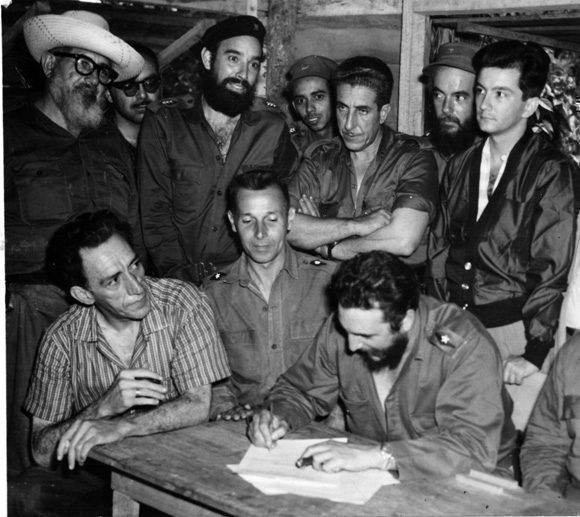
    Fidel Castro and his men in the Sierra Maestra, 1956. Unknown photographer.

    A shorter version of this article appeared in Foreign Policy in Focus on April 7. 2026.

    The Cuban government established by the Revolution of 1959 and Communist since the early 1960s seems destined to disappear within a few months and certain to be overturned one way or another by the end of the year. President Donald Trump recently said,

    “I do believe I’ll be … having the honor ​of taking Cuba. That’s a big honor. Taking Cuba in some form. I ​mean, whether I free it, take it. [I] think I can do anything I want with it, [if] you want to know the truth.”

    At the moment, this seems to be true. The Cuban economy has collapsed and none of its former allies have come to the country’s aid. The government has lost popular support. As we have seen in Venezuela and Iran, Trump is prepared to use military force to accomplish his aims. There seems to be nothing at present to stop Trump from terminating the Cuban Communist government.

    How did we get here? What will happen to the Cuban people? What can be done to help them? And in particular what has been and what is the role of the U.S. left? As I argue here, the U.S. left made serious mistakes in its dealing with Cuba since the revolution. We should do better in the future. But to do so, we need to know something of Cuba’s history, the role of the United States, and the role of the U.S. left in the past. Those of us who lived through this period, from the Cuban Revolution to today, as I did, know this history but younger people will find it useful to recount it, so that we can prepare for tomorrow.

    Cuba: An American Colony, from 1898 until 1959

    At the end of the nineteenth century the United States became a major investor in Cuba which at the time was fighting for its independence from Spain. The United States intervened in support of the Cuban struggle for independence, leading to the Spanish-American War. Victorious in the war the United States took the Philippines and Puerto Rico and made them U.S. colonies, while Congress passed, and Cuba was forced to accept, the Platt Amendment, which gave the United States the right to intervene militarily in Cuba. Thus, Cuba became a virtual colony and a valuable one. The Platt Amendment ended in 1934, but in exchange Cuba granted the United States the Guantanamo Naval Base in perpetuity, but in any case, the U.S. continued to exert its influence on future Cuban governments

    The U.S. government protected the interests of American companies and their investments in Cuba in utilities, railroads, about half of the island’s sugar production, as well as the hotels, gambling casinos, and brothels run by the Mafia, that made Havana a center of international tourism. Fulgencio Batista played a central role in Cuban politics from 1933 when he and four others led a coup, then in 1940 was elected president, and finally in 1952 led another coup and backed, by the U.S. government, U.S. corporations, and rich Cubans, became the country’s dictator. Under Batista, all civil rights and workers’ rights were abolished, ans students and others protested, but hundreds and perhaps thousands murdered.

    In January, 1959, Fidel Castro and his band of guerrillas in the mountains, supported by people in Havana and the smaller cities, overthrew the Batista government and took power.[1] The Cuban people with the exception of the governmental and financial elite overwhelmingly supported the revolution. It led to the total political and economic transformation of the island.

    I Followed and Supported the Revolution

    When I was a teenager in high school, just fourteen years old, my father bought me a subscription to Liberation magazine, the radical pacifist journal founded in 1956. Editor David Dellinger supported the Cuban Revolution and the journal published radical sociologist C. Wright Mills’ essay “Listen Yankee!” (Later a book.) I followed the revolution in the pages of Liberation. Mills convinced me that after more than a half century of U.S. domination, Cuba was engaged in a fight for national liberation that deserved my support.[2]

    In 1959 Ed Sullivan, the liberal host of a television variety show watched by tens of millions of Americans including my family, saying, “Freedom is everybody’s business,” went to Cuba to interview the Revolution’s leader Fidel Castro. Castro promised to end dictatorship in Cuba forever and to strengthen the country’s democratic institutions. Many of the leading U.S. newspapers also at first presented Castro as the democratic leader of a national revolution who looked forward to working with the United States. (See, for example, early coverage in The New York Times.) Many Americans admired Castro and looked forward to a new democratic government in Cuba, as I did.

    The Cuban-U.S. honeymoon was short-lived. By April of 1959 the American press was accusing Castro of being a Communist. Speaking on Meet the Press he denied it, saying. “I am not a Communist.” While it may be true that he was not at that time, a Communist, both his brother Raul Castro and his close collaborator the Argentine doctor Ernesto “Che” Guevara were Communists. Castro promised to strengthen democratic institutions, but he did not organize elections and instead appointed a provisional government. In March of 1959 he promised democratic elections “in two years.” But they never came. Castro, it became clear, would rule the country.

    Immediately following the 1959 revolution, the new Cuban government established revolutionary tribunals that quickly found guilty and executed more than 500 people, most of them former Batista government officials or police, guilty of capital crimes against the Cuban people. These kangaroo courts could not by any stretch of the imagination be said to have carried out fair trials, though there was much popular support for them. And Castro did not tolerate critics within his movement. Commander Huber Matos, a comrade in arms in the July 26 Movement opposed the influence of Communists and in protests publicly resigned his position, for which he was accused of treason and sedition, tried, convicted and sentenced to twenty years in prison in late 1959 and remained imprisoned until 1979. Eleven others, captains and lieutenants, were also tried and imprisoned at the same time. The new government later established concentration camps called “Military Units to Aid Production” (UMAPs) in 1965, through which 30,000 people, gays, religious people, and other “anti-social elements” passed before they were abolished in 1968 because of criticism from abroad. Virtually no left organization criticized the lack of due process in all of this.

    Cuba’s serious problems with the U.S. government may be said to have begun on May 17, 1959 with the agrarian reform law that seized mostly large, foreign, corporate landholdings, many belonging to U.S. companies. The Eisenhower administration began to contemplate the overthrow of the new revolutionary Cuban government that year.

    Fidel Castro and Soviet Premier Nikita Khrushchev embrace.

    In March of 1960, Cuba signed a trade agreement with the Soviet Union, as Castro began to see the Soviet Union’s as an alternative to the U.S. sugar market.

    The U.S. government, concerned about defending American property and businesses and concerned about Cuba’s turn to the Soviet Union, now began to take action against Castro. On March 17, 1960 U.S. President Dwight D. Eisenhower ordered CIA director Allen Dulles to begin training Cuban exiles for a covert invasion of Cuba to overthrow Castro’s government. At the same time, U.S. Secretary of State Lester Mallory wrote a memo argued for an embargo, “…inconspicuous as possible, [which] makes the greatest inroads in denying money and supplies to Cuba, to decrease monetary and real wages, to bring about hunger, desperation and overthrow of government.”  On July 5, 1960 Cuba nationalized all American business and property in Cuba, ending any possible accommodation with the United States.

    At the same time, Cuba’s former government officials, wealthy landowners, businesspeople, and professionals decided this was not their revolution and between 1959 and October 1962 some 200,000 to 250,000 fled the island, most settling in the Miami, Florida area. They proclaimed that they were not immigrants but exiles who would return to Cuba to overthrow Castro and reclaim their property. They created a powerful lobby that would become a permanent part of American politics, always on the right.

    The Cuban Missile Crisis

    Things were moving rapidly now. At a meeting of the United Nations in September 1960, Castro publicly embraced Premier Nikita Khrushchev, making clear his orientation to the Soviet Union. Dark clouds were gathering. A few months later, on January 3, 1961, the United States broke off diplomatic relations with Cuba. Cuba’s course seemed set. On April 16, 1961 Castro declared, “This is a socialist revolution right under the nose of the United States. This is a socialist revolution that we will defend with these rifles.”

    The next day, in a plan conceived by President Eisenhower and carried out by President John F. Kennedy, a group of 1,400 Cuban exiles called the Democratic Revolutionary Front (FDR), directed and financed by the United States, invaded Cuba at the Bay of Pigs. Within three days the FDR had been defeated by Cuban troops personally commanded by Fidel Castro, enormously enhancing his prestige. In July of 1961 Castro’s July 26 Movement merged with the pro-Soviet People Socialist Party, adopting the name Communist Party of Cuba in 1965.

    Later that year, on December 2, 1961, Castro declared, “I am a Marxist-Leninist, and I shall be a Marxist-Leninist to the end of my life,” sealing his alliance with the Soviet Union. Some liberal and left historians have argued that the United States forced Castro to become a Communist. Certainly, the United States was in those first years of the revolution putting enormous pressure on Cuba. But, as Samuel Farber has argued persuasively in his book The Origins of the Cuban Revolution Reconsidered, early on Castro made a conscious, independent decision to become a Communist and orient to the Soviet Union.[3]

    In February 1962 President Kennedy made formal an on-going embargo of Cuba that continues until this day, and consequently Cuba became largely dependent on the Soviet Union and the Eastern European Communist states for many of its imported manufactured goods and for petroleum.

    Later that year, October 1962, U.S. spy planes discovered that Soviet Union had secretly installed nuclear missiles and had sent thousands of Soviet troops in Cuba. The Soviet Union also sent freighters loaded with arms to Cuba. Kennedy responded by establishing a blockade, what he called a “quarantine” of the island. Would the U.S.-Soviet conflict over Cuba break out on the high seas? From October 16 to 28, people everywhere feared the outbreak of a nuclear war between the Soviet Union and the United States. I was a junior in high school at the time and remember the tremendous anxiety in my hometown in the San Diego area and throughout the country. We all feared that a nuclear war might break out at any moment and we feared dying in it.

    Khrushchev and Kennedy negotiated, and in the end the Soviet Union removed its missiles and Kennedy publicly stated that the United States would not attempt to invade Cuba. Fidel Castro was furious, accusing Khrushchev of reneging on its promise to protect. In a secret addendum to the agreement, the United States agreed to remove its Jupiter missiles from Turkey near the Soviet Union.

    Che Guevara

    Che Guevara

    Che Guevara, who had fought alongside Castro in the July 26 Movement, served in the government as head of the National Bank from 1959 to 1961 and then as Minister of Industries from 1961 to 1965. A romantic and utopian, he dreamed at creating a “new man,” a socialist inspired by high ideals. He proposed that workers in Cuba’s centralized, nationalized industries should be motivated not by higher wages but by their revolutionary idealism and should contribute voluntary labor. His economic policies failed while at the same time he had become critical of Castro’s alliance with, dependency upon, and fealty to the Soviet Union.

    By 1965 Guevara decided to turn his attention to exporting Cuban-style guerrilla revolution to colonial countries. First, Guevara with 125 soldiers went to the Congo where the U.S.-backed government had assassinated Patrice Lumumba and there joined rebel forces. He never found his way there. He himself called the mission and failure.

    Guevara next went to Bolivia, a country with strong labor union and socialist traditions, but ignoring those, he went to the rural Cordillera province where he attempted to establish a guerrilla foco, that is a guerilla nucleus, to overthrow the government of René Barrientos and launch a revolution that he believed would spread throughout South America. But his guerrilla center was found by the Bolivian Army and Guevara was assassinated there on October 9, 1967.[4]

    French leftist Régis Debray had at the time popularized Guevara’s idea of organizing guerrilla focos, in his book Revolution in the Revolution, published in 1967 in French and English. The example of the Cuban Revolution and Che’s theory of the guerrilla foco as put forward by Debray, appealed to young people throughout Latin America and they attempted to implement it just as U.S.-backed coups brought dictators to power throughout the continent, leading to a disastrous period for the Latin American left in which thousands died in attempts to carry out guerrilla revolutions. (Debray himself later criticized the guerrilla foco tragedy in his book A Critique of Arms.)

    Most of the far left, in the United States and around the world, loved Castro, Che, and the Cuban Revolution. Castro after all had led a revolution that overthrew a dictator who had been supported by the United States. And Castro won freedom for Cuba. Millions of Latin Americans, especially the young, were thrilled. In 1969 Students for a Democratic Society (SDS) and officials of the Cuban government established the Venceremos (We Will Win) Brigade which took supporters to Cuba to help bring in the sugar harvest. Eventually over 50 years about 10,000 leftists went and volunteered work for Cuba.

    There was in fact a “revolution in the revolution” as Debray had put it, though not exactly the one he meant. Some Communist parties in various countries, especially in Latin America, broke up leading to many Fidelista or Guevarista parties. The left everywhere believed that Cuba was producing a new leftism, an alternative to the old, gray Communists of the Soviet Union—even as in those years Cuba was becoming part of the Soviet sphere.

    Cuba Becomes Communist

    Cuba began to assimilate politically and structurally to the Soviet Union and the states of the Communist Bloc, a process completed by 1970.[5] Cuba became a one-party state where the ruling Communist Party now owned and controlled the economy that had been entirely nationalized from the largest businesses to the smallest farms and shops. We cannot call this the socialization of industry since there were no democratic institutions by which the Cuban people might have taken ownership and control of the country’s industry and businesses. Run by Castro, his closest associates, and the country’s new rubber stamp parliament, it was this Communist Party that took ownership and control of industry and that became the employer of Cuban workers. In 1972 Cuba also formally became part of COMECON, the Council for Mutual Economic Assistance, the Soviet Union’s international economic organization. Cuba now had a new Communist ruling class.

    In the new Communist Cuba, no other political parties were permitted to organize and there were no legitimate elections where people might choose between candidates of diferent parties with different programs. The Communist state-party controlled the official labor unions, and no other unions were permitted to compete with them, nor could the unions strike. Similarly, the Communist state-party controlled all social organizations in the country: women’s groups, student organizations, sports leagues. Democratic civil liberties—freedom of association, the right to assemble and protest, the right to independent newspapers or independent radio and TV broadcasting—were all abolished. The Soviet Union’s secret police, the KGB helped Cuba to create an intelligence service and its own secret police, the Cuban General Directorate of Intelligence (DGI) along the same lines as the Soviet Union’s. In addition, Cuba’s machista culture created new forms of oppression as homosexuality, a “bourgeois perversion,” was made illegal until 1979 and gay Cubans found themselves harassed, arrested, and condemned to forced labor in concentration camps.

    Like the Soviet Union and the Communist Bloc nations of Eastern Europe, Cuba became a totalitarian society where the Communist Party controlled virtually everything. However, unlike the Eastern European Communist countries, most of which had had their Communist government imposed by Soviet tanks, Cuba’s government had come to power through a widely supported revolution and the country was ruled by an enormously popular charismatic leader, Fidel Castro. In the 1960s, the Cuban people were enthusiastic about the revolution and its leader, were proud of the overthrow of Batista and the wresting of independence from U.S. imperial domination. It would take a few decades and a few generations before the popularity of Castro and the Communists would subside.

    In that period of the mid- to late-1960s, I had gone to college and then to graduate school and become part of the anti-Vietnam War movement and the other social movements of that era. I was disappointed to see the Cuban Revolution that I had supported in 1959 and 60 become a Communist state now modeled on and allied with the Soviet Union. In those years, attracted by its slogan “Neither Washington nor Moscow,” I joined the International Socialists (I.S.) and became a Third Camp socialist organization opposed to both capitalism and to the bureaucratic collectivist Communist states like the Soviet Union, China, and Cuba. While I still supported Cuba’s right to self-determination, I was opposed to its Communist government. It was clear that Communist Cuba—with a capital C—had nothing to do with the socialist ideal of communism. I hoped that the Cuban people and democratic socialists in Cuba would find a way to change their government.

    I was appalled by Cuba’s foreign policy. Castro’s loyal to the Soviet Union can be seen in his reaction to the Prague Spring of 1968, a movement in Communist Czechoslovakia calling for the democratization of the government. When the Soviet Union and the Warsaw Pact nations of Communist Eastern Europe invade Czechoslovakia to crush the movement, Castro publicly supported the Soviet Union invasion, calling the democracy movement counter-revolutionary. Similarly when in 1980 Polish workers created the enormous national Solidarity union movement calling for democracy in that nation, Castro supported its crushing by General Wojciech Jaruzelski.

    The Far Left and the Cuban Revolution

    Throughout these years from 1959 until today, most group on the far left—from the Communist Party USA, to the Trotskyists, and later the Democratic Socialists of America (DSA)—supported what they called “socialist” Cuba. (The Maoists initially supported the Cuban Revolution but turned against it when Cuba allied with the Soviet Union which the Maoists believed had become capitalist. But by 1980 the Maoist groups had collapsed and the tendency became irrelevant.) While some left groups had reservations and critique, in the end, they were nearly all supporters of the Cuban state. When Cubans engaged in large scale social protest against food shortages and the lack of democracy in 1994, 2021, and repeatedly from 2024 to today, virtually no group on the left gave full throated support to the Cuban people. And few criticized the Cuban Communist state for its repression.

    (The old Democratic Socialist Organizing Committee and early Democratic Socialist of America in the era of Michael Harrington criticized Cuba’s authoritarian government, but they supported the Democratic Party. The Democrats of the 1970s were no longer so hostile to Cuba, but their call for diplomatic relations and normalization or economic ties was clearly meant to bring Cuba back into the capitalist world. DSA since 2017 supported Communist Cuba.)

    Very seldom did leftists declare that they supported the Cuban people, the poor and working-class Cubans protesting in the streets, against the Communist government. Only a few small socialist organizations, such as the International Socialists (I.S.) of which I was a member, and later the International Socialist Organization (ISO), criticized the Cuban Communists. This journal, New Politics, comes out of that tradition. The tiny anarchist left in the U.S., Europe, and Latin America also criticized the Cuban government and supported leftist dissidents.

    Toward the Cuban Crisis

    From 1970 until the twenty-first century, Cuba remained relatively stable. The U.S. trade embargo had begun in 1962 and had been strengthened by the Helms-Burton Act of 1996. At the same time, Soviet trade and aid were absolutely critical to the survival and function of the Cuban economy between 1959 and 1989, accounting for up to 70% of its trade and subsidizing over 20% of its GNP in the 1980s. The Soviets provided nearly all of Cuba’s oil, grain, and machinery, while purchasing its sugar at inflated prices, thus enabling the survival of the Cuban state despite the U.S. embargo. At the same time, Cuba’s government, modeling its programs on those of the Nordic countries, created excellent health and education systems, with low infant mortality, high life expectancy, and universal literacy. Cuba’s health system’s results were comparable to those of Sweden.

    During the Special Period, now without Soviet oil for cars, buses, and trucks, horses pulled wagons

    Toward the end of the twentieth century, however, Cuba’s stability became stagnation, principally because of the fall of Soviet Communism. With the end of the Soviet regime, Russia suffered its own economic and social crisis and was no longer able to subsidize Cuba. Russian trade and aid—which had provided most of the country’s economic resources—virtually vanished. Fidel Castro, still the ruler of the country, named the new economic era that began in 1990 the “Special Period in Time of Peace.” Cuba’s GDP shrunk by 35%, agricultural production fell by 47%, construction by 75%, and manufacturing by 90%.

    To survive, the Cuban government took several steps that changed the nature of the economy, if not its top-down administration. The country had to carry out dramatic cuts in the national budget, though it protected and maintained the education and health budgets. Cuba found itself unable to import enough goods to feed the population, resulting in widespread hunger. The citizens’ caloric intake declined by 27%; people ate about 1,000 fewer calories per day. So, a new emphasis was placed on food production. And without money for fertilizers and pesticides, Cuba turned toward organic produce. The government created limited free markets for food and some other products. Without fuel, Cubans rode imported Chinese bicycles and vehicles were pulled by horses, mules, or oxen.

    The government now encouraged investment from Western capitalist countries. Canada invested in the nickel industry; Canada and France invested in petroleum; Spain became the principal investor in the tourist industry building hotels. Several other nations were also involved in each of those sectors. International tourism replaced sugar as the country’s principal source of revenue, and by the late 1990s it grew from 340,000 to over one million tourists per year. In the decade of the special period.

    After the fall of the Soviet Union, lack of oil was the biggest economic problems of Cuba. Then in 1999, Hugo Chavez, an admirer of Castro and the Cuban Revolution, became the president of Venezuela. Chavez began in 2000 to send about 100,000 barrels of oil per day to Cuba, about half of the country’s requirements, in exchange for Cuban doctors, teachers, sports coaches, and military and security officers. And Mexico continued to provide subsidized petroleum to Cuba. Those two nations made it possible for Cuba to continue to provide energy to homes and industry.

    In 2008, Fidel Castro, in failing health, retired and was succeeded by his brother Raul, also a veteran of and leader of the Cuban Revolution. His succession insured the continuity of the leadership and the perpetuity of the system.

    Tourism, Trump, COVID-19, and the Crisis 

    Tourists in Cuba in 2016, during the tourism boom. AP image.

    So, Cuba’s economy stabilized in the 2000s. When Barack Obama eased restrictions on Cuba, the tourist sector boomed. “Annual overseas visitors to Cuba rose markedly between 2014 and 2017 to reach 4.65 million. U.S. tourists alone accounted for over 40% of that growth even though there was a surge in arrivals from traditional European source markets such as Germany, France, Italy, Spain, and the United Kingdom (ONEI 2020).” In 2017, the best year for Cuban tourism, hard currency revenues reached 2.3 billion.[6] Then Donald Trump was elected president in 2017, reimposed travel restrictions, resulting in fewer American tourists, and with that Cuba’s tourist business and revenues began to decline.

    Raul Castro, gave up the presidency in April 2018 and retired as First Secretary of the Communist Party of Cuba in April 2021. Miguel Díaz-Canel replaced him in both of those roles. For the first time in many decades a Castro no longer ruled Cuba. Díaz-Canel was chosen for his reliability. The system remained unchanged.

    Then came COVID-19, with widespread sickness and death around the world, and Cuba closed its borders to tourists from March to November 2021. Not surprisingly tourism, the country’s leading industry, “fell from nearly 4.3 million in 2019 to less than 1.1 million in 2020 and to just about 356,000 in 2021.” While Cuba saw some increase in tourism in the next few years, it never fully recovered. “Cuba is going through its worst economic crisis in thirty years, exemplified by plummeting real wages, frequent power outages, shortages of food, water, medicines, and fuel, crumbling infrastructures, a severe liquidity crunch, and a record-breaking mass emigration.”[7] Tourists went elsewhere. The decline of tourism is the decline of the contemporary Cuban economy. Communist Cuba is going out of business.

    Cuba, which depended for years on Mexican and Venezuela for petroleum (Mexico providing 44% and Venezuela 34%) is no longer receiving their oil. The U.S. has imposed an embargo on petroleum shipments to Cuba, permitting only one Russian tanker to make a delivery. The U.S. captured and removal of Nicolás Maduro and established a new relationship between the United States and Venezuela. Acting president Delcy Rodríguez agreed to work with Trump and the United States largely took over the Venezuelan oil industry. Mexican President Claudia Sheinbaum, who expresses her sympathy with Cuba, has been under enormous pressure from Trump who threatens highr tariffs, trade sanctions or even the invasion of Mexico to crush its cartels, so she has stopped shipping oil.

    Tourism, the leading industry and principal source of revenue for Cuba, cannot survive without fuel Cuba’s powerplants than can no longer provide electricity as the country has often gone dark. Without hard currency, Cuba has experienced critical shortages of food, medicine and had to turn to other countries for humanitarian aid. Now, without petroleum, which means without, electricity, businesses, hospitals, schools, and universities no longer function. The economy is in free fall.

    Not surpassingly, in the last four years one million of Cuba’s 11 million people have left the island nation. Migrants were able for a time to go to Nicaragua without visas and then head north toward the United States, but that is no longer possible. As with most countries, Cuban migrants tend to be the healthiest, best educated, and most ambitious young adults, a great loss to the country. We are at the end of an era though what comes next is not clear.

    Cuba’s Military Industrial Complex – GAESA

    Yet it’s hard to accurately assess Cuba’s economic situation because of the opaque military entity called GAESA, Grupo de Administración Empresarial S.A.. run by the Cuban military, which plays such a huge. Role in the national economy. The Cuban public knows nothing about GAESA and neither did anyone else until a leak published in El Nuevo Herald. An article in the Columbia Law Journal analyzed the data:

    The GAESA conglomerate dominates the country’s most strategic and profitable economic sectors. Through its affiliate Gaviota (Grupo de Turismo Gaviota S.A.), it controls a large share of tourism; through affiliates CIMEX and TRD Caribe, retail and wholesale trade, respectively; and through RAFIN S.A. and the Banco Financiero Internacional (BFI), the Cuban financial system.

    It also manages remittance businesses, logistics, and storage—including the Port of Mariel—while participating in construction, transportation, and foreign trade. In practice, it administers the country’s main foreign-currency flows, making it the most influential economic actor in Cuba.

    GAESA’s gross profits on sales represent close to 37% of Cuba’s GDP, which means that more than one-third of the country’s total value added is generated within the military conglomerate.[8]

    GAESA is run by Cuba’s top military leaders who are all Communists, and the public has never had any control over or even a voice in its affairs. With its tremendous GAESA has been called a “state within the state.” This is of course completely consistent with the entire history of Communist Cuba where the people never head a role in running the economy.

    Trump says he can take Cuba. We have to defend the Cuban peoples’ right to self-determination. Image from CiberCuba

    What Will Happen to Cuba

    At present Cubans are suffering, suffering from the lack of nearly everything. If such conditions continue, it could lead to more social protests or to increased crime and violence. It would not be to the benefit of either the current Cuban rulers, the United States, or anyone else to see current conditions continue and worsen

    The Trump administration and Secretary of State Marco Rubio, son of Cuban immigrant, will see no need to militarily conquer Cuba. And the idea that the Cuban Communist state-party would organize a military resistance to U.S. conquest is out of the question given the economic collapse and recent anti-government protests. So, the future of Cuba revolves around what sort of negotiations and can and will be made.

    Donald Trump has frequently said that the U.S. capture of Maduro and his replacement by the more amenable Delcy Rodríguez was a. model operation. He apparently thought he might do something similar when he launched his war on Iran, but as he has learned, that will not be possible. But it might well be possible in Cuba, a small country, near the United States, and now collapsing.

    U.S. Secretary of State Marco Rubio has said, “Cuba needs to change. It needs to change. And it doesn’t have to change all at once. It doesn’t have to change from one day to the next. Everyone is mature and realistic here. And they need to make dramatic reforms. And if they want to make those dramatic reforms that open the space for both economic and eventually political freedom for the people of Cuba, obviously the United States would love to see that.” Rubio seems to be suggesting the Venezuela strategy.

    Raúl Guillermo Rodríguez Castro

    Raúl Guillermo Rodríguez Castro, 41, grandson of former Cuban President Raúl Castro, appears to be the current candidate to be Rubio’s interlocutor in discussions about the island’s future. Known as Raulito, Little Raul, he has been seen frequently lately in the company of Cuban President Díaz-Canel and it is rumored that he has been talking with Rubio. Raul Rodríguez Castro has both a military education and degrees in finance and accounting from the University of Havana. He rose through the army to the rank of colonel and became the head of the General Directorate of Personal Security (DGSP), the equivalent of the U.S. Secret Service, that protects Cuba’s leaders. But he does not have an important position in either the party or the government. His father, General Luis Alberto Rodríguez López-Calleja, was the head of GAESA. Despite his relative insignificance, with the Castro name he might be exactly the person that Marco Rubio would want to head Cuba’s government during transition to a capitalist economy with a liberal state allied with the United States.

    Within the year, it seems very likely that Cuba will have a new ruling group, perhaps evolving out of the current Communist leadership and likely joined by Cuban Americans from Miami. The transition to capitalism at the highest level would be relatively easy given that foreign capitalists already control much of the commanding heights of Cuban industry, the Spanish in hotels and tourism and the Canadians and French in minerals and petroleum. As in the former Soviet Union when its economy collapsed, we could see Cuban Communists, such as those who run GAESA, taking over state enterprises for themselves.

    The Cuban economy will revive only slowly given its current state, and the country will for sometime be dependent upon foreign aid. How many Cubans return to their country and at what rate remains to be seen.

    The United States, and the new Cuban government it creates, will at first dominate the political sphere, but Americans may well prefer to see Cuba with a conservative and a liberal capitalist party, but history suggests that the Communist Party might survive and a democratic socialist labor party develop. Workers will once again fight to create independent labor union with the right to strike and to negotiate contracts.[9]

    The Role of the Left Today

    Clearly neither American capitalism nor the United States government can offer Cubans what they need today. The American capitalist system that exploits workers at home cannot liberate workers in Cuba. And the U.S. government with its racist attitudes and its reactionary social policies cannot lift up the Cuban people.

    What about the U.S. left? The U.S. left never got the Cuban issue right. Understandably thrilled by the revolution and captivated by Fidel Castro and Che Guevara, most leftists gave up their critical faculties and quickly became uncritical supporters of the Cuban Communist state. For more than 60 years the left support a government where the people had no democratic rights and workers had no right to unions of their own choosing. The historic leftist tendencies in the United States, Communists, most Trotskyists, and Democratic Socialists of America all continue to support the Cuban Communists government today.

    Why was it impossible for most leftists to say, as some of us did, we oppose U.S. aggression against Cuba, and we support Cubans’ right to self-determination, but we will not support an undemocratic government where neither citizen in general nor workers in particular have any rights.

    It is time to start anew and to begin by supporting the Cuban people and the Cuban working class in the midst of the collapse of their old state, its economy, and their society, as they attempt to find their place in whatever new order develops. We should oppose U.S. domination of Cuba and defend the Cuban peoples’ right to self-determination. We should support Cuban workers’ demands for economic security, democracy, civil rights and labor rights. There are democratic socialists in Cuba and we should support them when they are able to organize.

     Notes:

    [1] On the background of the Cuban Revolution see Samuel Farber, Revolution and Reaction in Cuba, 1933-1960: A Political Sociology From Machado to Castro (Middletown, Connecticut: Wesleyan University, 1976).

    [2] In 2014 I wrote “Cuba: A Personal Reflection,” https://newpol.org/cuba-personal-reflection/

    [3] Samuel Farber, The Origins of the Cuban Revolution Reconsidered (The University of North Carolina Press, 2007), passim.

    [4] For an excellent account see: Samuel Farber, The Politics of Che Guevara: Theory and Practice (Chicago: Haymarket, 2016.)

    [5] Samuel Farber, Cuba Since the Revolution of 1959; A Critical Assessment (Chicago: Haymarket, 2011).This book remains an excellent overview of what the mature Cuban Communist system and society looked like.

    [6]  Paolo Spadoni, “Lagging Behind Competitors: The Cuban Tourism Industry in the Post-COVID Era,” Columbia Law School,” Dec. 16, 2024, https://horizontecubano.law.columbia.edu/news/lagging-behind-competitors-cuban-tourism-industry-post-covid-era

    [7] Spadoni, ibid.

    [8] Pavel Vidal, “GAESA, the Invisible Elephant in Cuba’s Macroeconomic Stabilizationm,” Columbia Law School, Dec. 19, 2025, https://horizontecubano.law.columbia.edu/news/gaesa-invisible-elephant-cubas-macroeconomic-stabilization#!#text-5976

    [9] See here two other interesting interpretations of the Cuban situation: Jon Lee Anderson, “Is Cuba Next?” The New Yorker, March 23, 2026 at: https://www.newyorker.com/magazine/2026/03/30/is-cuba-next. And Samuel Farber, “Trump’s mounting threats against Cuba: An interview with Samuel Farber,” Tempest, March 16, 2026 at: https://tempestmag.org/2026/03/trumps-mounting-threats-against-cuba/  


  • Demonstrations and Demographics

    Demonstrations and Demographics

    Black Women Said We’d Sit ‘No Kings’ Protest Out, But I couldn’t
    No Kings protest in Atlanta, Georgia, Saturday, October 18, 2025 | Photo by Nehemiah D. Frank for The Black Wall Street Times.

    In the aftermath of the “No Kings Day” demonstrations of March 28th, there has been renewed interest—and concern—that in many cities the participation of people of color generally, and Black people specifically, has been limited.  To my knowledge, no one has done any study on this, so we are forced to rely on a combination of anecdotal information and historical analysis and patterns.

    What is completely obvious to anyone who looks at our situation is that the victories won by progressive social movements in the ‘1960s’ have been set back over a more than forty-year period of relentless attacks.  Focusing on the Black Freedom Movement for a moment, these setbacks have been resisted over time and taking many forms.  The Black-led electoral upsurge that began in the late 1970s and lasted through the end of the 1988 Jesse Jackson Presidential campaign is a case in point of that resistance.  That said, the combination of repression (including assassinations of leaders and activists), strategic confusion and disagreements, and the decline in active mass democratic organizations among African Americans, contributed to a growing malaise, tending towards despair.  Not altogether different from the twenty-year aftermath of the defeat of Reconstruction, there started to be a noticeable though not overwhelming turn inward, with parallels in the direction of the politics and philosophy of Booker T. Washington.

    In our era, the 1995 Million Man March was an example of this turn inward in the aftermath of defeat.  The march had two significant downsides.  First, it was all-men.  To paraphrase the late Amiri Baraka, one does not go to war and leave half the army at home.  Second, there were no demands on the state or corporate America.  The march was very much focused inwardly on Black America and, specifically, on Black men.  Though mass activism certainly did not disappear in the 1990s, the fact that more than a million people would converge on Washington, DC and not place demands on the state given what was happening—and continued to happen—to Black America was phenomenal.

    Over time and with the exception of the trade union movement, non-profit advocacy rose to largely replace mass organizing and the building of member-controlled mass democratic organizations.  While those engaged in the advocacy work are overwhelmingly dedicated and very much committed to justice and democracy, the large-scale turn away from building personal connections with the grassroots along with challenges associated with the growth of social media, the increased environment of isolation has had a noticeable impact on the willingness of many people to engage in struggle, at least over the longer term.

    2020, and the rebellions and protests that followed the murder of George Floyd may appear to be an exception to this but one must be careful with such a conclusion.  The 2020 revolt was both amazing and historic.  Black-led but multi-racial, it appeared to shake the foundations of the country.  In fact, the protests resulted, almost immediately, in shifts in policy by government and corporations alike.  I would further argue that it contributed to the defeat of Donald Trump in the 2020 elections.

    Nevertheless, that movement failed to build and sustain a progressive institutional presence.  While many organizations received significant financial grants to do their work, few of them turned in the direction of mass organizing and the building of mass democratic organizations.  There was also little attention paid to the inevitable counterattack that we should have all been expecting from the far Right.  When that counterattack occurred, specifically in the context of the attacks on alleged Critical Race Theory, along with the hysteria built by the far Right in connection with Latin@ immigration, the progressive movements of color were caught flat-footed.  Of course, there was resistance but the momentum arising from 2020 was lost during the remaining Covid years and the period of the Biden administration.  The far Right was able to shift the narrative and, along with frustration and anger in connection with Biden’s support for the Israeli genocidal war against the Palestinians in Gaza, cynicism, nihilism and paralysis grew.

    Thus, today we have found ourselves attempting to come to grips with a level of despair and demobilization that is the result of a combination of the pounding that Black America in particular has received, as well as the absence of a counterstrategy that will take us to a post-Trump/post-neo-liberal USA.  Arguments about African Americans being fearful of demonstrating are ludicrous, though there are some African Americans who have promoted such a fear, encouraging us to sit home lest we somehow provoke Trump to bring about martial law.  Those who say that the demonstrations fail to address the demands of Black people have only an element of truth in that, yes, the demands need to expand.  That said, Black folks have marched many times under banners that have not specifically addressed us.  Ask any number of Black trade union members who have gone on strike over wages, hours and working conditions (sometimes with demands that ignore outright the issues faced by Black workers).

    If anything, I would suggest that there is a challenge for the Black Left and, for that matter, all leftists of color.  During the Vietnam War it was not unusual to see antiwar demonstrations that were overwhelmingly white.  Though people of color were always active in such demonstrations, things tended to change when leftists of color organized and mobilized their respective constituencies to engage.  Probably the most notable example among people of color was the 1970 Chicano Moratorium against the Vietnam War that mobilized tens of thousands of Chicanos in the streets of Los Angeles.  Within Black America, significant work was done by the Black Panther Party, SNCC and others to reach Black America in connection with the war, not to mention the impact of the oration of Dr. Martin Luther King during the final year of his life.  The antiwar work among Black Americans also included organizing among enlisted personnel in the military.  The Young Lords Party, the Puerto Rican Socialist Party, and other Puerto Rican radicals mobilized Puerto Ricans on the island and the mainland in opposition to the war.  There was nothing short of a ‘rainbow’ of opposition to US aggression and the growing Right led by then President Nixon.

    Today’s Black Left—indeed, all leftists of color—needs to make it their mission to replicate such an approach but under 21st century conditions.  There is nothing wrong with having our own contingents in larger rallies; there is nothing wrong with specific outreach to our constituencies.  In fact, that is precisely what we need to do.  But we must also connect this to a fight for what many people refer to as a Third Reconstruction, that is a progressive future grounded in demands we articulate right now which reflect the needs and aspirations of the oppressed.

    A few weeks ago, I was invited to address a community gathering in Baltimore, Maryland that a friend of mine helped organize.  The aim was to speak about ICE and the threat that it held for not only Latin@ immigrants but for all immigrants of color and for non-immigrant populations.  Perhaps thirty people in the room.  They were Black Baltimore residents, many of whom had little to no historical background on ICE, nativism in the USA, and the threats to democracy that are hiding behind the sophistry of the Trump administration.  They sat there and listened; they asked great questions; and many of them wanted to do something as a result of the meeting.  They were not viewing this gathering through a computer screen, doing their email at the same time.  They were there in-person and were engrossed.  That’s how we begin.

    This article was originally published in Z Net.

    Bill Fletcher, Jr. is a longtime trade unionist, cofounder of the Black Radical Congress, past president of TransAfrica Forum, cofounder of standing4democracy.org, and an author of fiction and nonfiction.

  • Peoples’ Unity Against Fascism is slippery in action: A reflection on campism in our midst

    Peoples’ Unity Against Fascism is slippery in action: A reflection on campism in our midst


    After a busy first day of meetings, discussions, and panels that were challenging in good ways, as revolutionary activists from different countries, involved in different struggles, shared and contrasted their ideas, the end-of-day panel came as a shock. Speakers called for criticism of Venezuela’s Maduro government to be silenced, denounced Ukraine for slaughtering Russians in the east, and, most alarmingly, denounced young demonstrators in Iran as brainwashed agents of Hollywood. Although there was not an opportunity for rebuttal, other speakers on the same stage anticipated these claims and took them apart, countering them with a consistent anti-fascist, anti-imperialist, feminist critique.

    What became clear is that a deep fracture underlies the “peoples’ unity against fascism,” which was the title of this particular panel and a central premise of the Porto Alegre anti-fascist conference. Do we mean unity of peoples in struggle? Including when they move against the same states that are targeted by US imperialism? Or must the unity of the people be organized through the nation-states that pretend to represent them?

    Through a “campist” maneuver, the “peoples” are collapsed into the tidy forms defined by nation-states. Blanca Eekhout, congresswoman and president of the Simon Bolivar Institute in Venezuela, exemplified this approach when she said, by video message, “It is impossible to fight and defeat imperialism without the unity of the peoples. Not a unity that repeats the lies of the imperialist press, but a real, deep unity… That’s the solidarity that can defeat fascism.” With such a “deep unity,” no dissent or critique can be part of the support of states against imperialism. There can be no texture to the composition of our cooperation: deep unity must be a smooth unity, a unity polished like stone ground down and made smooth.

    Is this anti-fascism? Is it anti-imperialism? The Cuban delegate didn’t think so. Fernando Rojas from Havana’s Casa de las Americas also called for unity, but as “integrative lines” between places and movements, for the sake of “our own existence and our own struggles.” His brief talk, which was written before he could have heard Venezuela’s conditions, read as a retort against demanding uncritical support. Rojas said, “The defense of Cuba must be militant: not uncritical, not artificially sweet, but militant. There are concrete examples of solidarity like this conference. We are here not only to receive support but also for critical exchange. We are giving time to this work.”

    There is a programmatic problem here. The unity of peoples-as-states presupposes that state repression is legitimate and necessary to its appearance as a unified body, something that is impossible and requires a suspension of disbelief. This is also a philosophical problem. If we must accept rigid formulas in place of careful research, and rhetoric and slogans in place of critical thought, then we will be disarmed before the rise of new fascism. Fascism is not intelligent, but we must be intelligent to understand it and to fight it.

    The next morning and throughout the second day of the conference, I talked with people about that “unity” panel. A comrade from Puerto Rico said it shows the need for discussion and debate, or else the differences that lurk beneath our slogans for unity will weaken this desperately needed coalition. I decided to focus on this problem with this report in order to make a contribution to that discussion, in the interest of deepening our unities, understanding each other, and also to work on the problem of action. I fear that a unity that is so broad that it includes both states and the peoples they repress will not be a coalition capable of common strategic action against fascism and imperialism.

    The “antifascist” defense of Putin

    There was only one speaker on the “Unity of the Peoples” panel who supported Putin’s invasion of Ukraine, and he was included as a respondent, not a full panelist, but the callousness of his claim that Ukraine is the butcher of Russians, not the other way around, stood out for its audacity. What he said is not new, it is a Putin talking point, and it is consistent with the general argument against Ukraine’s war of self-defense. And it represented the feelings of an important political current at the anti-fascist conference.

    Earlier that night, Rafael Bernabe, former Puerto Rico senator, addressed this problem. “In the name of our struggle against US imperialism, we cannot afford to ignore the repression and brutality and complicity of other states,” he said. “We condemn Israel for genocide in Palestine. And we also condemn the Russian Federation for its military invasion and aggression in Ukraine. And we condemn the theocratic and authoritarian brutality of the Iranian government against their people.” And he added, “We are aware of the arguments against our position: that Putin was responding to encirclement of Russia. But that encirclement is a product of the competition between rival imperialist powers, with Russia’s imperialist designs on Ukraine being one side of that competition. And people say Zelensky’s is a rightwing capitalist government. That’s why we don’t support them but do support the Ukrainian people’s fight for their sovereignty. We affirm that union rights, freedom of assembly and association, the right to strike, the rights and freedoms of women: these are not Western values. These are values held by the international working class.”

    Sushovan Dhar, from the Committee for the Abolition of Illegitimate Debt (CADTM) India, argued that uniting international anti-fascism with and behind repressive states is a false start. Dhar said, “As we fight imperialism, we must be careful not to create new imperialisms. Multipolarity is a counter against the existing US world order, yes. But does it offer us a different path to a better future? No. Look at BRICS.” He said, “It is composed of countries that rule without respect for the rights of people, for democratic rights, that have economies based on extractivism. These countries will not lead us out of the imperialist, capitalist trap we are caught in.”

    Rafael Bernabe said uncritical unity also defers political action and decision-making to governments of so-called progressive states, which are busy navigating Trump’s pressures in the interests of maintaining their own capitalist economies. That means subordinating the defense of those countries directly under attack to the whims of their erstwhile allies. Bernabe said, “Solidarity with Cuba must also extend to so-called progressive governments. By bowing to Trump’s pressure to cut off oil to Cuba, they think they are buying time and currying favor with Trump. But by allowing Trump to control their actions and to attack Cuba, they are guaranteeing their weakness before Trump’s aggression.”

    At a breakout panel on the second day, Eric Toussaint said the old camp of for-or-against the US makes less sense than ever with a shakeup in the organization of global power. “Trump said he wants to convince Putin to stop cooperating with China,” Toussaint said. “For him, relations with Russia are about reducing the influence of China. Trump said, Let me do whatever I want with Iran and Cuba, who are your allies, and I’ll leave you alone about Ukraine.”

    Vasyl, a Ukrainian trade unionist, said, “Ukraine has been subjected to control by great powers because Ukraine also has many natural resources: gas, minerals, as well as agricultural products and land. Russia’s war is about domination of Ukraine’s land and resources. And now, with Trump, we also see that he too is hungry for resources.” The Ukrainian constitution says that the resources of the nation are to be held and enjoyed by the people. In fact, Vasyl said, “That’s not how it goes.” Corporations control and profit from the exploitation of the Ukrainian people’s resources. It is necessary now to defend Ukraine’s sovereignty from Russia’s assault because the conquest of Ukrainian lands by Russia would even further interrupt and set back class struggles against corporate power, whether EU/US or Ukrainian.

    It is true that US and EU imperialists have their own designs for Ukraine’s energy wealth and sovereignty, but that does not mean socialists elsewhere should wash their hands of the Ukrainian war of national self-determination. To the contrary, it demands solidarity with the Ukrainian working class regardless of the forms their struggle takes, based on the imperialist pressures they face on all sides.

    Disposing of women to defend Iran

    More outrageous was the inclusion on the panel of Hossein Khaliloo, from the Iman Al Mahdi Dialogue Center in Brazil, as an informal ambassador for the Islamic Republic of Iran. Khaliloo said that US imperialism has entered Iran “through the economy, through the culture, through the cinema, in order to get into the minds of the new generation.” Referencing the mass protests of December and January, which were put down with bloody violence by government forces and the Revolutionary Guard, Khaliloo blamed Hollywood for colonizing the minds of young Iranians. After being exposed to “imperialist and Zionist” culture and cinema for a while, “the imperialist culture grows in the country,” he said.

    Of course mass cultural propaganda pours out of US culture factories. But the argument that these ideas take root and rot the minds of young people is idealist. People make use of cultural products through their own activity, interpreting and reworking cultural products as historical agents themselves. Culture does not make the world in a unitary, top-down, conspiratorial way. The idea that people are puppets mastered by a vast cultural apparatus has its roots in authoritarian politics, in patriarchy, and leads to antisemitic conspiracy theories. The truth is more challenging because it requires anti-imperialist and socialist forces to deal with fundamental contradictions in society, including their expression and reiteration culturally. If ideas do not contribute to understanding or resolving contradictions, then they do not take root.

    The same respondent who rolled out the Putinist talking point about Ukraine also reinforced Khaliloo’s argument that uprisings in Iran have roots in foreign intervention. Acting flummoxed that anyone could criticize Iran for criminalizing, sexually regulating, and, just weeks ago, slaughtering women, he said that 60% of Iranian medical students are women. This, evidently, was his proof that regardless of the theology of the government, women are not really oppressed in Iran. It’s impossible to take seriously the patriarchal foundations of fascism and capitalism and say these things.

    Although she spoke before them, Patricia Pol, from Attac in France, offered a feminist critique of this disposal of women in the name of anti-imperialism. Pol said, “A social dynamic that allows Trump, Bolsonaro, Millei, Netanyahu to develop fascist politics and policies is misogyny. We cannot fight fascism without fighting patriarchy.” She said, “We need a war on war. A war on sexism. A war on fascism.” Feminist social movements, she said, must be built up in and against the home and in the streets, in workplaces and in movements, persistently and regardless of the popularity of feminist slogans — especially when feminist politics are under attack — in order to counter the patriarchal assault. That includes centering the freedom movements of women in countries targeted by imperialism as constitutive of the militant anti-imperialist struggle.

    We can talk, but can we act?

    A couple months before the conference began, I reached out to other socialist groups in the US and Canada and encouraged them to endorse and send people to the conference. Some replied with hesitation, saying they heard it was being led by campists, groups that support Putin against Ukraine and politically support Maduro, so didn’t want to go. That’s why it wasn’t a surprise to me to hear these sentiments at a main panel, though I admit the degree of support, particularly for the Iranian government, was a shock. Solidarity knew about these dynamics and decided to go anyway because we also knew a lot of groups were going, especially those affiliated with the Fourth International, who support peoples movements against their governments, even when those governments are also at odds with the US.

    The overly broad terms for inclusion in the antifascist conference has not hampered good discussion and sharp, open-hearted critique. It’s been encouraging to be amongst so many critical, curious, and militant thinkers. But sharing a table with parties calculating the practical needs of BRICS alliances and people who dogmatically support any governments under attack by the US has its limits when it comes to strategy and action. And there are hard political and strategic questions that need to be answered by the end of this conference. Alongside commitments to building a mass feminist, anti-racist, pro-migrant, pro-LGBTQ+, anti-fascist movement, I want a conference resolution that calls on Brazil and Mexico to ship oil to Cuba. I want solidarity with Palestine against Israel and with Ukraine against Russia. I want a declaration that refuses the US war on Iran, while offering our hand in political solidarity to the working class and oppressed nationalities in Iran.

    That is unlikely. So, what strategic actions can we take? And what organizational forms can we use, if this whole body can’t move effectively as one? It seems to me that more discussion is needed, with a focus on common action and strategies to effectively confront the coordinated imperialist assault on our world. But to have the unity needed to go beyond discussion and take common action, we’ll have to be clear that states and their defenders cannot be part of our peoples’ unity against fascism.

    Republished from Solidarity

  • Zionist expansionism in Lebanon seizes upon Hezbollah as a pretext

    Zionist expansionism in Lebanon seizes upon Hezbollah as a pretext

    Never had a military initiative of the Lebanese Hezbollah (literally, Party of God) been so much repudiated in Lebanon as its decision on March 2 to launch rockets across the country’s southern border with the Israeli state, in retaliation against the killing of Iran’s Supreme Leader Ali Khamenei. This opening salvo was immediately seized upon by the Zionist state as a pretext to launch a long-premeditated invasion of southern Lebanon.

    The Lebanese people have every right to be overwhelmingly angry at what they perceived as their country’s entanglement in a confrontation beyond its capacity, through a decision made unilaterally by a military organization operating on behalf of a foreign state, parallel to the country’s official institutions. This is especially understandable since these institutions’ legitimacy from the electoral democratic standpoint is beyond question, especially when compared to the regional political context.

    What has exacerbated the public anger is that the cause for which Hezbollah reignited the war with the Zionist state is not one on which a larger segment of the population may agree – unlike solidarity with the Palestinian people in general, and the people of Gaza in particular, in the face of the genocidal war they endured. Indeed, the cause for which Hezbollah entered the fray this time is not even an object of consensus among the Lebanese Shiites themselves, the religious sectarian social base among which the party has built its constituency. The party’s initiative to launch missiles at Israel was ostensibly in retaliation for the assassination of the head of the Iranian state, the Guardian Jurist or Theologian (Vali-ye Faqih in Farsi), according to Iran’s theocratic constitution.

    Hezbollah has never hidden its affiliation to the Iranian state. Its late Secretary-General, Hassan Nasrallah – a cleric himself according to the theocratic rule that presides over the party’s organization in accordance with the Iranian model – once famously boasted: “We are the Party of the Guardianship of the Jurist” (Wilayat al-Faqih in Arabic). This is a fundamentalist theocratic doctrine elaborated by the founding father of the Islamic Republic of Iran, Ruhollah Khomeini, a Grand Ayatollah (Great Sign of God), one of the highest-ranking clerics of Twelver Shiism (the mainstream branch of Shiism) and one of the millions of alleged descendants of the Prophet of Islam, recognizable among clerics – like his successor Khamenei, or Nasrallah himself for that matter – by the black turban they wear, which distinguish them from the rest of clerics who wear a white turban, and by the title of Sayyid (master or lord).

    Khomeini’s doctrine was never consensual among Shiite clerics. Its fundamentalist political interpretation deviated significantly from the original strictly religious understanding of the attributes of the Guardian Jurist. This became even more salient when the same position, at Khomeini’s death in 1989 and as a result of political maneuvers within the new regime, was entrusted to Ali Khamenei, who had only attained the lower rank of Hujjat al-Islam (Argument of Islam). This move necessitated a constitutional change, removing the requirement of the supreme theological degree for the Guardian Jurist, who is elected by the Assembly of Experts – an assembly composed of 88 clerics elected after vetting by the Guardian Council’s twelve members, half of whom are appointed by the Guardian Jurist.

    The same pattern of appointment of a lesser-ranking cleric to the supreme position was repeated with Khamenei’s son, Mojtaba, who like his father at the time of his accession to power, has not gone beyond the rank of Hujjat al-Islam. Thus, the Guardianship of the Jurist, as interpreted in the Islamic Republic of Iran, has become a mere ideological veneer for a regime that is theocratic in form, but lacks spiritual requisites and relies instead on very temporal institutions and interests. Central to these institutions is the Corps of Guardians of the Islamic Revolution, better known in English as the Islamic Revolutionary Guard Corps (IRGC), which is the major ideological component of Iran’s armed forces and controls an economic empire – a military-industrial-social complex funded with Iran’s oil revenues.

    Lebanon’s Hezbollah was founded with direct Iranian involvement amidst the resistance against the 1982 Israeli occupation of half of Lebanon. It thus combined the characteristics of an organization resisting occupation with those of a local armed tentacle of the Iranian regime. This duality became most evident when the party intervened massively in the Syrian civil war, starting from 2013, to shore up a regime that bore no connection whatsoever to Khomeini’s ideology, but rather claimed adherence to an ideology rather opposed to it (Arab nationalism and “socialism”). That involvement constituted the main component of Iran’s intervention on behalf of the Syrian Baathist Assad regime, which was guided by Iranian state interests and only ended with that regime’s collapse at the end of 2024.

    From this perspective, Hezbollah’s initiative to ignite a new war with the Zionist state, as part of the Iranian regime’s strategy of regional expansion of its resistance against the U.S.-Israeli aggression launched on February 28, is the second major act that confirmed in the eyes of most Lebanese the party’s prioritization of the Iranian regime’s interests over the interests of its own country and people, including the interests of its own popular base already exhausted by the two-year war that the party has waged in solidarity with Gaza starting from October 2023 – more specifically in support of Hamas, another ally of Tehran, but one that is also an anti-Zionist fighting force, unlike the Assad regime.

    However, there is a clear common thread between the current Zionist onslaught on Lebanon and the onslaught on Gaza following Operation Al-Aqsa Flood of two and a half years ago. Like for the latter operation, Hezbollah’s launching of its rockets has been seized as a pretext by the current Zionist government – the most rightwing extremist government in the history of the State of Israel – to pursue long-standing expansionist ambitions that lie at the heart of the original Zionist ideology and are fervently upheld by the Israeli far-right, dominant in the present Israeli cabinet. Indeed, the parallel is striking between the way Israel invaded the Gaza Strip, ordering a gradual displacement of its population north to south, and what it is now doing in southern Lebanon.

    And as with Gaza, the most extreme members of the Zionist cabinet are revealing the true objective their government is pursuing. Finance minister Bezalel Smotrich declared on March 24 that “the Litani River must be our new border” with Lebanon (the river is 15 to 30 km – 9 to 19 miles – north of the present border, delimitating a region that constitutes over 10% of Lebanon’s area). Smotrich advocated Israel’s permanent seizure of this portion of Lebanon just as it occupies a portion of the Gaza Strip, with the intention of perpetuating the occupation and annexing it later. On the same day, minister of war Israel Katz, a member of Netanyahu’s Likud party, declared that the coveted region constitutes Israel’s “security zone.”

    In these wars, the Israeli government is exploiting the presence at the White House of a president who is certainly the most lenient toward Zionist ambitions of all U.S. presidents, a Donald Trump who, during his first term, had already been the first U.S. president to recognize the annexation of East Jerusalem and the Syrian Golan Heights, occupied by Israel since 1967. He was also willing to support the annexation of most of the West Bank, had it not been for the Gulf monarchies’ veto, including the “red line” set by the closest of them to Trump, the rulers of the United Arab Emirates. Benjamin Netanyahu and his cabinet hope that the U.S. president will turn a blind eye to their invasion of Southern Lebanon, if not openly support it. They have retained control of more than half of the Gaza Strip, in the hope that Trump, or the failure of his “peace plan,” would allow them to prolong the occupation with a view to later annexing most of the Strip. They also contemplate annexing most of the West Bank, which is undergoing violent creeping appropriation and population displacement by Jewish settlers with governmental support.

    The far-right Zionist government hopes to replicate this situation in southern Lebanon, whose territory it is currently in the process of occupying after emptying it of most of its inhabitants. Just as it uses the continued existence of Hamas and the threat it poses to the State of Israel as a pretext for the perpetuation of its occupation of Gaza, it intends to use the existence of Hezbollah and the threat it represents to its state as a pretext for a long-term occupation of southern Lebanon. From this perspective, Hezbollah’s resistance to occupation, like Hamas’s resistance, is turned into an argument for implementing and perpetuating the occupation.

    But a renewed Israeli occupation of southern Lebanon can only bolster the national legitimacy of Hezbollah’s resistance. It confers renewed rightfulness on its fight against the occupation, in the hope that its harassment of the Israeli army could ultimately force its withdrawal, like what the Hezbollah-led resistance of the 1990s achieved in 2000. True, that withdrawal was carried out by a government led by the Zionist Labor Party, and it is unlikely that the current Israeli government would repeat it. But the Israeli government could change hands in the not too-distant future.

    Under these circumstances, the best that the Lebanese government can do is to actively lobby the Arab states, particularly those with the greatest influence on the White House, i.e. the Gulf monarchies, to bring them to exert pressure on Trump in order to prevent a prolonged occupation of southern Lebanon. These monarchies surely understand that the Israeli occupation of part of Lebanon in the last two decades of the 20th century led to the rise of Hezbollah and the regional expansion of Iranian influence. They thus have a vested interest in preventing a repeat of this scenario. This is what the Lebanese government should focus its efforts on in the face of Israeli aggression – not on disarming Hezbollah under U.S. pressure, a task that is beyond its capabilities.

    Worse still, the Lebanese government has clearly seen that, despite the withdrawal of Hezbollah’s forces from the region south of the Litani River and the deployment of governmental Lebanese Armed Forces (LAF) troops there, in accordance with the ceasefire agreement of November 27, 2024, Israel has not stopped its airstrikes and incursions in that region. And yet, the Lebanese government’s reaction to the new Israeli invasion was to withdraw its troops from the south and raise its voice against Hezbollah, declaring its military action illegal at the most inappropriate moment.

    The country’s best interests require it to aim at a peaceful agreement to integrate Hezbollah’s armed forces within the LAF – a move that will only become possible when the regional equation undergoes a fundamental shift. Any attempt to disarm Hezbollah by force is but a recipe for a renewal of civil war in a country that has already been devastated by fifteen years of such war, between 1975 and 1990.

    * This article is adapted and expanded from an Arabic original published in Al-Quds al-Arabi on March 24, 2026.

  • International Women’s Day Protests in Latin America

    International Women’s Day Protests in Latin America

    Below are two reports from Mexico and Chile reprinted from the Mexico-based journal, Ojala:

    (more…)

  • Using Worker’ Inquiry to Organize and Fight the Boss

    Using Worker’ Inquiry to Organize and Fight the Boss

    In late December 2025, tech, legal, nonprofit, education, and café workers and union organizers, gathered in the East Bay Democratic Socialists of America (DSA) office to talk about their working lives and organizing on their jobs. There have been one-on-one conversations and other workplace organizing workshops in that space, but this training was a little different.

    “Using Workers’ Inquiry to Organize and Fight the Boss” takes its inspiration from Karl Marx’s last published article A Workers’ Inquiry” that appeared in 1880, and has motivated projects such as Notes from Below publishing inquiries in the UK with a UK and sometimes global focus, Long-Haul Magazine in the US, and others ever since.

    “The workshop opened a space for workers to take stock of their productive lives and ruminate on their own knowledge of and ideas about their experiences working and surviving in the Bay Area,” Althea, a union organizer form Oakland, CA shared. These conversations were cathartic and generative, deepening our collective understanding of our shared struggle against wage slavery and the diverse class composition.”

    While often associated, at least in the United States, with Italian Operaismo, workers’ inquiry begins with Marx and has divergent histories. A new form of proletarian literature” later emerged in the United States in 1947 with the publication of The American Worker pamphlet, and has considerable impact in France and Italy where it’s translated in 1949 and 1954 respectively.

    “What workers’ inquiry seeks to accomplish is to understand production and the experience of work from workers’ own perspective,” we shared on a recent episode of Economic Update with Rick Wolff. A workers’ inquiry allows workers to identify how work is organized by the boss to adapt the tactics and strategies of their existing struggles.

    Workers’ inquiry seeks to understand the class composition—that is, workers’ power vis-à-vis boss in their workplace—that workers can use to foster their own class consciousness, advance organizing efforts, read and circulate these struggles, and to understand what the workers are thinking and doing while actually at work.”

    As a conceptual tool we can use class composition to understand how work is organized, or the technical composition, and how workers can adapt their strategies and tactics to it, or the political recomposition. These can help workers identify and transform their struggles in response to the boss and the state’s attempts to decompose its power and reimpose work. Using workers’ inquiries will allow us to overcome the limits of the labor movement so that we can widen, expand, circulate and amplify existing class conflict. The objective is not just a first or better contract, stronger unions or higher union density but organizing the refusal of work that can disrupt production so that workers can control and democratize work to organize a society beyond capitalism.

    As with Notes from Below, we see class composition as a framework” to understand the political power of the working-class as it confronts capitalism in the workplace and across industries to build collective power. As British militant and translator of Italian movement texts Ed Emery famously wrote, there is No politics without inquiry!” This is echoed by the DSA Communist Caucus which argues in its founding Statement that inquiry is necessary for building collective power.”

    Practicing workers’ inquiry adds to the tools and skill sets already deployed by Left labor and union organizers, socialists and militants in the United States today by encountering workers where they are rather than where we want them to be. surveys, interviews, and worker-to-worker organizing are essential parts of an inquiry that can help workers understand and analyze the production process from their own perspective.

    As workers’ inquires circulate they complement reports and stories of organizing found in the labor press by focusing on how workplaces operate, formally and informally, prior to an organizing drive. They serve as strategic interventions to grasp power in the workplace and identify informal work groups and divisions within the class, forms of mutual aid and informal organization, organic” leadership that aid organizing efforts.

    Workshop participants had the opportunity to practice a workers’ inquiry to understand the position of their work in the current capitalist economy to develop new tactics and strategies to build our power. As Robert Ovetz noted, this willprovide a model for workers to emulate in their own struggles elsewhere” and build working-class power to take on fascism.

    Participants met in small groups based on the industries in which they work. They co-interviewed each other asking, Can you tell us a little about your work: what do you do all day, how was the work divided up, what are working conditions like, and what is going to work every day like for you?”

    A legal worker shared how they never catch up on work tasks because their bosses assigned more and more cases which resonated with a nonprofit worker in their group. Both shared how they were concerned about their working-class clients” and the services they endeavor to provide them.

    The lack of worker control over work tasks, specifically in education and café work, took on deeper meaning for participants. They discussed the questionsDescribe how management manages. Describe how your work is organized, work rules, processes and procedures, etc.”

    Identifying widely felt issues is a core component in workplace organizing conversations covered in trainings by Labor Notes and Emergency Workplace Organizing Committee. Participants inquired as toWhich issues at and away from work are most widely effecting your co-workers and why?” These questions allowed them to understand their workplaces as to share their findings and stories with other workers in an attempt to recognize common problems across workplaces and industries.

    Tech workers using Bay Area Silicon Valley company shuttle buses taking them back and forth from home to work recognized it as a space to organize a #NoTechForApartheid campaign against the use of their work products in Gaza. One tech worker talked about how these shuttle buses served as a basis for recent meetings, communications, cooperation, or organizing about these issues.” Following the firing of Independent Workers of Great Britain members at Rockstar Games in November 2025, those outside the sector have noted the uptick in organizing, although those in the sector have been building “worker power” for some time.

    Workers’ inquiry is increasingly being used by organizers. Kevin worked with cafe workers who carried out their own workers’ inquiry of the sector which they published as Class Composition in the Café Sector in 2025. Robert authored the forthcoming Rebels for the System: NGOs, Capitalism and the Labor Movement that does an inquiry “from above” of the non-profit/NGO industry. A grocery workers’ inquiry was just launched with support of members of Trader Joe’s United and New Seasons Labor Union-UE Local 1010.

    Workers’ inquiries in the US and across the planet are identifying working-class self-activity in various sectors, understanding the class struggle from the working-class point of view, and allowing workers to develop their own knowledge of who their work is organized in order to identify vital new tactics and strategies that can allow them to push their struggles forward.

    A Marx declared, workers’ inquiry is by and for the class to whom the future belongs.”

  • Petition: Stop the War Immediately!

    Petition: Stop the War Immediately!

    This statement, endorsed by over one hundred academics, cultural figures, and human rights and political activists from various countries, opposes the ongoing war between Israel/The United States and the Islamic Republic of Iran, and calls for its immediate end.

    Stop the War Immediately!

    Under the long-standing and mutual tensions between the Islamic Republic of Iran, the United States, and Israel, Iran once again became the target of the heaviest military strikes by Israel and the United States amidst negotiations. These strikes, violating established principles of international law, are claimed to aim at weakening, coercing, or overthrowing the government. However, their fallout has been extensive destruction, damage to the country’s vital infrastructure, and an increase in civilian casualties.

    From our perspective of “No to war and no to the Islamic Republic,” this conflict is an absolute evil. It neither brings democracy nor security and well-being for the people. It has been launched in accordance with the interests of the United States and Israel. Humanity lies buried beneath the rubble of bombings, and the lives of millions of innocent people—who were already suffering under the repression and violence of the Islamic Republic—are now subjected to even greater destruction. The killing of children in a school in Minab and attacks on hospitals, medical centres, refineries, and other civilian sites show that the claim of “precision targeting” and purely military objectives is just a lie; it largely results in the deaths of those who have no role in these conflicts.

    Alongside these aggressions, the policies of the Islamic Republic — from the very beginning until now — through the suppression of citizens’ rights, the killing of protesters, anti-Western rhetoric, slogans calling for the elimination of Israel, regional adventurism, and support for proxy forces that have no connection to the national interests of Iranians, have become one of the main sources of instability in the region. A government that, even in the midst of war and after the horrific killings in January, continues to threaten its own people cannot claim to defend them or pursue a just and lasting peace.

    The clash of these two conflicting policies has ultimately resulted in a conflict that has expanded through attacks by the Islamic Republic on neighbouring countries, spreading across the region and threatening the security of both the people of Iran and the wider area. However, we should not forget that the primary responsibility for starting this war lies with the United States and Israel.

    We, the signatories of this statement advocating for a democratic transition in Iran, firmly reject war as a means of resolving international disputes. We highlight the Iranian people’s right to shape their own future and achieve political change within Iran, rather than through foreign intervention. We urge everyone to become independent voices for peace and democracy. This voice does not support aggression, occupation, repression, or authoritarianism, but instead stands with the people suffering under the rubble of war and destructive government policies.

    We call on the global community, international peace and human rights organizations, media outlets, governments, and progressive political groups, not to stay silent, and to condemn any form of providing direct or indirect support for war. Instead, they should back peace initiatives and utilize all political and diplomatic tools to promptly halt the war, prevent its spread, and stop military assaults. Protecting human lives — especially those of children and vulnerable groups — must come before any political or military interests. Hospitals, schools, and homes must become safe sanctuaries. It is also vital to ramp up international pressure for the release of political prisoners whose lives are at risk and who may be the first to fall victim to government retaliation.

    Only through the immediate cessation of war from both sides, adherence to international rules, a return to diplomacy and political solutions, and the adoption of humane approaches can the current deadly cycle be overcome. Such a solution would make possible a future in which security, peace, freedom, and human dignity are not sacrificed to power rivalries. In this regard, the formation of the broadest possible global will against war is an urgent necessity.

    Signatories*:

    Angela Y. Davis,  scholar and activist, USA
    Ervand Abrahamian Professor Emeritus, Baruch College, CUNY, USA
    Gilbert Achcar Professor of Development Studies and International Relations SOAS, University of London, UK
    Stephen R. Shalom, Professor Emeritus of Political Science, William Paterson University, USA
    Robin D.G. Kelley, Distinguished Professor of History, UCLA, USA
    Greg Albo, Associate Professor of Political Science, York University, Canada
    Sam Gindin, Professor Emeritus of Political Science, York University, Canada
    Kevin Anderson, Distinguished Professor of Sociology, University of California, Santa Barbara, USA
    Susan Buck-Morss, Distinguished Professor of Political Philosophy, The Graduate Center, City University of New York (CUNY), USA
    Dan La BotzNew Politics editorial board, USA
    Mehrdad Darvishpour, Associate Professor, Mälardalens University, Sweden
    Kazem Kardavani, Emeritus Professor of  Sociology, Germany
    Hassan Etemadi, journalist, Sweden
    Hedayat Matin-Daftari, Lawyer, Human Rights Advocate, France
    Asghar Rastegar, Yale University School of Medicine, USA
    Farhad Nomani, Emeritus Professor, American University of Paris, France
    Sohrab Behdad, Professor of Economics, Denison University, USA
    Thomas HarrisonNew Politics, USA
    Hassan Hakimian, Professor of Economics, SOAS, University of London, UK
    Haideh Moghissi, Professor Emerita of Sociology, York University, Canada
    Saeed Rahnema Professor Emeritus, York University, Canada
    Tania Das Gupta, Professor of Sociology, York University, Canada
    Mohammad-Reza Nikfar, Lecturer in Political Philosophy, Iran Academia (The Netherlands), Germany
    Mehrdad Vahabi, Professor of Economics, Université Sorbonne Paris Nord, France
    Atif Kubursi, Professor Emeritus of Economics, McMaster University, Canada
    Wenona Giles, Professor Emerita of Anthropology, York University, Canada
    Thabit A.J. Abdullah Professor of History, York University, Canada
    Mark Goodman, Professor Emeritus, Sociology, York University, Canada
    Mojtaba Mahdavi, Professor of Political Science, University of Alberta, Canada
    Hanieh Bahmanpour, Human Rights Lawyer, Canada
    Nancy Holmstrom, Professor Emerita of Philosophy, Rutgers University, USA
    Dan FischerNew Politics editorial board, USA
    Fauzia Ahmed, Associate Professor of Sociology, Miami University, Ohio, USA
    Arang Keshavarzian, Associate Professor of Middle Eastern Studies, New York University (NYU), USA
    Nasser Mohajer, Historian, Researcher, France
    Mahnaz Matin, Researcher, Author, France
    Nayereh Tohidi, Professor of Gender and Women’s Studies, California State University, Northridge, USA
    Ali Akbar Mahdi, Professor of Sociology, California State University, Northridge, USA
    Mohsen Kadivar, Islamic Studies Scholar; Research Professor of Islamic Studies, Duke University, USA
    Mansour Farhang, Former Iranian Diplomat; Professor of International Relations (Retired), Bennington College, USA
    Massoud Karshenas, Professor of Economics, SOAS, University of London, UK
    Kazem Alamdari, Sociologist, Academic Researcher, and Author, USA
    Ashkan Behzad, Composer, Pianist, and Music Educator, Manhattan School of Music, New York, USA
    Esfandiar MonfaredZadeh, Composer, Musician, USA
    Shahram Homayoun, Journalist, Media Host, and Founder of Channel One TV
    Bahareh Dehkordi, Writer, Researcher, USA
    Stanley Heller, Administrator, Promoting Enduring Peace, USA
    Puya Gerami CUNY School of Labor and Urban Studies, USA
    Tyler Olsen, City University of New York (CUNY), USA
    Fatemeh Haghighatjoo, Scholar of Democracy and Human Rights; Former Member of the Iranian Parliament USA
    Ali Afshari, Political Analyst, Activist, USA
    Matthew Mautarelli City University of New York (CUNY), USA
    Laura Altinsoy, Graduate Center, City University of New York (CUNY), USA
    Saira Rafie, City University of New York (CUNY), USA
    Iraj Eshghi, Researcher, New York Genome Center, USA
    Reza Goharzad, Journalist and Political Commentator, USA
    Parvin Ardalan, Writer, Journalist, Human Rights Activist, Sweden
    Alireza Behtoui, Professor of Sociology, Södertörn University, Sweden
    Carl Ulrik Schierup, Professor Emeritus, Linköping University, Sweden
    Diana Mulinari, Professor of Gender Studies, Lund University, Sweden
    Erik Olsson, Professor of Philosophy, Stockholm University, Sweden
    Annika Rabo, Professor Emerita of Social Anthropology, Stockholm University, Sweden
    Ingrid Esser, Professor of Sociology, University of Gothenburg, Sweden
    Håkan Thörn, Professor of Sociology, University of Gothenburg, Sweden
    Fataneh Farahani, Professor of Ethnology, Stockholm University, Sweden
    Soheyla Yazdanpanah, Senior Lecturer in Sociology, Södertörn University, Sweden
    Shahla Aliyari, Senior Lecturer in Social Work, Södertörn University, Sweden
    Angelika Sjöstedt, Associate Professor, Gender Studies, Mid Sweden University, Sweden
    Magnus Granberg, Senior Lecturer, Mid Sweden University, Sweden
    Karin K. Flensner, Senior Lecturer, University West, Sweden
    Zahra Bagheri-Shad, Gender Studies, Åbo Academi University, Finland and Sweden
    Parastou Forouhar, Artist, Visual Arts and Political Art, Germany
    Faraj Sarkouhi, Writer, Journalist, Literary Critic, Germany
    Monireh Baradaran, Writer, Human Rights Advocate, and Former Political Prisoner, Germany
    Arash Sarkohi, Writer, Journalist, Germany
    Hassan Yousefi Eshkevari, Theologian, Researcher, Political Commentator, Germany
    Mihan Rousta, Women’s Rights Activist and Writer, Germany
    Elisabeth Abendroth, researcher in social history and anti‑Nazi resistance, Germany
    Herbert Kramm‑Abendroth, retired high school teacher (Liebig Schule Frankfurt), Germany
    Schoole Mostafawy, Baden State Museum, Karlsruhe, Germany
    Jan Keetman, Journalist and Former Correspondent on Türkiye and Iran, Germany
    Behroz Khaligh, Political Activist, Germany
    Mehdi Fattapour, Political Activist, Germany
    Zhaleh Vafa, Political Activist and Writer, Germany
    Homayoun Mehmaneh, Political Activist and Republican, Germany
    Asghar Izadi, Political Activist and Writer, Germany
    Azadeh Kian, Professor of Sociology and Gender Studies, France
    Saeed Paivandi, Professor of Sociology of Education, Université de Lorraine, France
    Babak Kia, Socialist Solidarity with the Workers of Iran, France
    Houshang Sepehr, Editor of Iran Echo and Activist, France
    Shahram Ghanbari, Political Activist and Writer, France
    Alain Baron, Labour Unionist, France
    Taghi Roozbeh, Political Analyst, Writer, and Leftist Thinker
    Mohsen Yalfani, Playwright and Writer, France
    Hadi Khorsandi, Satirist, Writer, UK
    Randa Alami, Lecturer in Economics, SOAS, University of London, UK
    Nalini Vittal, Lecturer in Economics, University College London (UCL), UK
    Lucia Kula Researcher, SOAS, University of London, UK
    Enayat Fani, Journalist and Political Analyst, UK
    Richard Parncutt, Professor of Systematic Musicology, University of Graz, Austria
    Behrooz Bayat, Nuclear Energy Expert and Physicist, Austria
    Shohreh Zamini, Women’s Rights Activist and Writer, Austria
    Hassan Nayeb-Hashem, Physician and Human Rights Advocate, Austria
    Thomas Weyts, Member, Europa’s Netwerk in Solidariteit met Oekraïne, Belgium
    Mansoureh Shojaee, Women’s Rights Activist, Researcher, Netherlands
    Behzad Karimi, Political Activist and Writer, The Netherlands
    Mehdi Noorbaksh, Senior Professor of International Affairs and Business, Harrisburg University of Science and Technology, USA
    Azar Malouhjian, Writer and Translator, Sweden
    Mehdi Ebrahimzadeh – Political Activist (Germany)

    * Affiliations for identification purposes only

    The Farsi version was signed by over 350 Iranian academics, journalists, lawyers, and human rights activists in different parts of the world.


  • Cesar Chavez: Horrifying Abuse, but One of Many Errors of Judgement

    Cesar Chavez: Horrifying Abuse, but One of Many Errors of Judgement

    We have all been horrified to learn of Cesar Chavez’s sexual assaults and rape of young girls and women. We who worked for years as volunteers or supporters of the United Farm Workers, even those of us like myself who were critical of Chavez, never expected anything like this. The story recently published in The New York Times, carefully investigated and documented, leaves no doubt that Chavez violated those girls as well as betraying the trust that so many had placed in him.

    When I wrote my biography César Chávez and La Causa twenty years ago, part of the Library of American Biography series made up of books to be read by college freshmen and sophomores, I thought about the young Mexican Americans and other Latinos who might read my book and be influenced by it. So, I attempted to give a balanced view of a man who, despite his significant faults, might still inspire young people.[1]

    Chavez for most of his adult life worked to promote the well-being of the Mexican American people, who in the U.S, Southwest in the early twentieth century still faced racial segregation and discrimination. In the 1950s, Chavez was hired by the Community Service Organization, which was backed by labor organizer Saul Alinsky, to registered people to vote. Later through the farm worker organizations that he founded he worked to improve the working conditions and wages of agricultural laborers. In the 1960s Chavez not only headed the United Farm Workers union, but had also become one of the outstanding leaders of the Latino civil rights movement and helped Mexican Americans to play a prominent role in American society and politics. Many believed his achievements were comparable to the work of the Rev. Martin Luther King, Jr. in Black America.

    Chavez’s Political Problems

    But Chavez was not without his political faults and weaknesses. In fact, there were many. In 1965 Chavez merged the predominantly Mexican American National Farm Workers Association (NFWA) that he and Dolores Huerta (one of his rape victims) had founded with the Filipino American Agricultural Workers Organizing Committee (AWOC) to form the United Farm Workers (UFW). Chavez, however, soon pushed the Filipino workers aside, so that the Spanish language, Mexican nationalism as represented by figures like Emiliano Zapata, and Mexican Catholicism with the symbol of the Virgin of Guadalupe became the public image and culture of the union. Arab workers’ identity also became erased in the Mexicanized union. Under Chavez, the United Farm Workers gave a political voice to working class and poor Mexican workers, but to the neglect of the Filipino and Arab workers.

    Chavez based the UFW on the Mexican American Workers who were U.S. citizens, most of whom lived permanently in rural communities. At the same time, he was a strong opponent of undocumented immigrant workers since he felt it would be impossible to organize the vast immigrant Mexican workforce. I remember once in the late 1960s, California Congressperson Lionel Van Deerlin and Cesar Chavez together entered fields in Southern California to drive out the workers that Chavez called “wetbacks” and “illegals.” As a young leftist in my early twenties, I was shocked, but this was Chavez’s position and he went on to organize a “Campaign against Illegals.”

    Chavez extolled the union’s ideology of “mutualismo,” that is of cooperativism, the notion that the members were pooling their resources to support each other. But this was contradicted by the union’s dependence on federal government funds for much of its social work. The UFW received those funds because Chavez formed an alliance with Democratic Party officials, in particular with Robert Kennedy, a Roman Catholic. Chavez hitched the union’s fortunes to the Democrats, who in turn provided the union with money for its social programs to support farm worker families. Chavez and Kennedy turned the UFW into part of the Democratic Party political machine.

    Chavez also virtually turned the UFW into a Catholic union, the faith of most of the union’s members. While Protestant churches and preachers also provided much assistance to the union, as did Jews who were involved as top advisors. Most of the unions Arab members were Muslims, and while the leaders of the Filipino workers were Communist and secular. Yet the union marched under Catholic banners of the Virgin of Guadalupe.

    Chavez also worked to concentrate all power in his own hands. The UFW leadership bodies were made up of Chavez’s long-time associates and family members. Unlike most unions, Chavez did not permit the organization of union locals in different regions of California because he feared he couldn’t control the rank-and-file members who might oppose him. Chavez parodically purged the union of dissident and critics, whether rank-and-file workers, staff, or advisors.

    Chavez was an authoritarian leader in the union, who oversaw everything from labor and political strategy to the management of the everyday affairs of the union office such as who was cleaning the bathrooms. Without consulting the members or his leadership circle, staff or advisors, he often made controversial decisions such as dropping everything to go on a hunger strike. He had the first and last word on virtually everything the union did.

    In the mid- to late-1970s, Chavez became connected to Charles Dederich, the founded of Synanon, the drug rehabilitation program that developed into a cult that controlled its members personal lives. Chavez adopted and brought into the union Synanon’s practice known as “The Game,” a practice of psychological manipulation and vebal abuse. Chavez used The Game to insure the loyalty of his leadership, staff, and union members. Chavez stood by Dederich even when the cult leader had a rattlesnake placed in the mailbox of Paul Morantz, an attorney who had sued Synanon. The snake bit Morantz who became seriously ill and might have died.

    While Chavez succeeded in creating the first stable farmworkers union in California in the 1970s, by the 1980s the union had begun to lose its contracts. Chavez turned toward the organization of a nebulous poor people’s movement. The UFW began to disintegrate. Today less than 1% of U.S. farmworkers are represented by labor unions. There are over one million wage-earning farmworkers, but the unionized percentage is among the lowest of any sector. Only 54,000 to 60,000 workers were covered by collective bargaining agreements as of 2022-2023. Chavez died on April 23, 1993, at the age of 66.

    Chavez’s Pedophilia and Rape

    During his lifetime, his family, friends and associates knew that he had had many sexual affairs that he and they worked to keep secret from his wife Helen Fabela Chavez, mother of their eight children, who died in 2016. Some people in the UFW we now know, thanks to the New York Times reporting, also knew back then about his sexual relations with young girls, some as young as thirteen.

    Dolores Huerta raises a sign saying “Strike” in 1965.

    Let us let Dolores Huerta, Cesar Chavez’s partner in the organization of the union, reveal her experience and how she sees it.

    “As a young mother in the 1960s, I experienced two separate sexual encounters with Cesar. The first time I was manipulated and pressured into having sex with him, and I didn’t feel I could say no because he was someone that I admired, my boss and the leader of the movement I had already devoted years of my life to. The second time I was forced, against my will, and in an environment where I felt trapped.

    “I had experienced abuse and sexual violence before, and I convinced myself these were incidents that I had to endure alone and in secret. Both sexual encounters with Cesar led to pregnancies. I chose to keep my pregnancies secret and, after the children were born, I arranged for them to be raised by other families that could give them stable lives.

    “I carried this secret for as long as I did because building the movement and securing farmworker rights was my life’s work. The formation of a union was the only vehicle to accomplish and secure those rights and I wasn’t going to let Cesar or anyone else get in the way. I channeled everything I had into advocating on behalf of millions of farmworkers and others who were suffering and deserved equal rights.”

    So, for sixty years Huerta kept her personal experience a secret, as did the other women in the UFW.

    Huerta has attempted to put these issues into perspective, writing,

    “The farmworker movement has always been bigger and far more important than any one individual. Cesar’s actions do not diminish the permanent improvements achieved for farmworkers with the help of thousands of people. We must continue to engage and support our community, which needs advocacy and activism now more than ever.””

    While appreciating the pain, suffering, and humiliation of Huerta’s experience, and valuing her thoughts, I believe we need a critical analysis of Chavez’s leadership role and of the structure and culture of the union. We need to analyze the patriarchy characteristic of governments, corporations, and labor unions, and its expression in the machismo of Chavez and the other men who ran the union. I think there is a connection between the political issues that I discussed in my biography of Chavez and the rape and abuse of women and girls. 

    The authoritarian leader always stands above the rest, always in charge, always unchallenged, always permitted everything he wants. Chavez and the union he created, the union that kept his secrets, as several people have pointed out, violated the very principle of the union, its members and supporters, that is, the protection and advancement of society’s exploited and oppressed. And who among them was more oppressed than the farmworker women?

    [1] My book César Chávez and la Causa (2005) is no longer in print, but it can be found as a PDF in the Internet Archive and used copies are available from second hand book dealers online.

  • The U.S. & Israeli War with Iran:  What Is a Needed Approach for a Principled Socialist Left?

    The U.S. & Israeli War with Iran: What Is a Needed Approach for a Principled Socialist Left?

    Below is the revised text of a presentation by Frieda Afary to the South African organization, Zabalaza for Socialism on March 15, 2026. You can also listen to the article by clicking on this audio file link

    (more…)

  • Assassination of Yanar Mohammed, Iraqi feminist human rights defender

    Assassination of Yanar Mohammed, Iraqi feminist human rights defender

    On the morning of March 2, 2026, as Yanar Mohammed was leaving her home in Baghdad’s Al-Bunouk district, she was targeted in an armed attack. Two assailants on a motorcycle fired several shots at close range. Although she was immediately transferred to the hospital, the severity of the wounds to her head and chest prevented doctors from saving her life.

    *****************************************************************************

    Yanar Mohammed: A life of Courage, a Legacy of resistance

    The assassination of Yanar Mohammed on March 2, 2026, in Baghdad is not merely the killing of a feminist activist; it symbolizes the continuation of structural violence and systematic repression that has overshadowed Iraqi society for years. A society in which nationalist-religious ruling forces and their affiliated militias have not only dominated economic resources and state institutions but have also taken citizens’ civil and political freedoms hostage through various tools of repression. In such an environment, protest and demands for rights are often met with bullets, imprisonment, torture, and physical elimination.

    Within this context, women, who make up half of Iraqi society, face multiple layers of discrimination and violence. In addition to the broader social problems of poverty, unemployment, and insecurity, they must also confront deeply rooted gender discrimination. Laws influenced by tribal traditions and conservative religious interpretations frequently limit women’s basic rights. Phenomena such as honor killings, forced marriages, domestic violence, and trafficking of women still exist in many parts of Iraq, and victims often lack adequate legal and social protection.

    Under such conditions, women who advocate not only for women’s rights but also for values such as freedom, secularism, and social equality face even greater risks. Feminist activists, and human rights defenders in Iraq are not only subjected to social pressure and constant threats but are frequently targeted directly by armed groups and extremist forces. In recent years, targeted assassinations of political and civil activists have become a method of silencing dissent.

    In this context, Yanar Mohammed was one of the most prominent figures in this struggle. Born in 1960, she was an Iraqi architect and graduated from the Department of Architecture in 1984 and completing a master’s degree in 1993.  The war and sweeping international sanctions imposed on Iraq during the 1990s severely destabilized Iraqi society and created widespread economic hardship. As living conditions deteriorated and opportunities for professional and civic life diminished, Mohammed and her family left Iraq. In 1995, she relocated to Canada with her husband and young child, joining a growing Iraqi diaspora shaped by displacement and exile.

    While living in Toronto, Mohammed became active in diaspora networks concerned with the situation in Iraq. In 1998, she founded the Defense of Iraqi Women’s Rights, a Canadian-registered NGO dedicated to raising international awareness about the worsening conditions facing Iraqi women during the sanction era, including poverty, reduced access to education and employment, and increasing exposure to social and domestic violence.

    Her activism later expanded beyond advocacy to direct intervention. In 2001, she helped establish a women’s shelter in the Kurdistan Region of Iraq to support women fleeing forced marriage and gender-based violence. Following the 2003 invasion of Iraq and the collapse of state institutions, Mohammed returned to Baghdad and founded the Organization of Women’s Freedom in Iraq (OWFI), which became one of the most prominent feminist organizations working to defend women’s rights and carried out extensive efforts to combat violence against women, honor killings and human trafficking amid the country’s post-war political and social transformation.

    One of Yanar Mohammed’s most significant initiatives was establishing the first network of secret safe houses for women whose lives were in danger. At a time when the Iraqi government refused for years to legally recognize such shelters, this network managed to save the lives of hundreds of women threatened by domestic violence, tribal retaliation, or attacks by armed militias. This courageous initiative made her one of the most well-known women’s rights activists in the region.

    Yanar Mohammed was also a strong advocate of secularism and the separation of religion from the state. She repeatedly spoke out against the influence of extremist religious currents in Iraqi politics and warned about the dangerous consequences of religious interference in civil law. Her outspoken criticism of religious fundamentalism and regional political influence made her a target for extremist groups.

    Her extensive work in the field of human rights also received international recognition. In 2016, she received the Rafto Human Rights Prize, and in 2018 she was named by the BBC as one of the 100 most influential women in the world. Nevertheless, despite this global recognition, her life was constantly under threat.

    An insightful article by Dr. Mehiyar Kathem Al Sa’edi, published on March 7 via Counterfire, offers a glimpse into her grassroots authenticity and leadership. As he writes:  “A distinctive aspect of OWFI under Mohammed’s leadership was its commitment to grounding feminist activism in the lived experiences of Iraqi women. In contrast to many newly established non-governmental organizations that operated primarily within donor-driven frameworks, Mohammed sought to ensure that OWFI’s work remained closely connected to the social realities of Iraqi communities. She was particularly critical of the increasing professionalization of the NGO sector, arguing that civil society work could become detached from genuine social transformation when it was primarily structured as a career-oriented field supported by international funding.

    To counter this tendency,  Yanar actively recruited and employed women who had previously sought refuge in OWFI’s shelters. Many survivors of violence eventually became staff members or volunteers within the organization. Over time, the organization developed a structure in which women with direct experience of gender-based violence played a central role in shaping the organization’s activities. This approach reflected Mohammed’s belief that feminist activism should empower those most directly affected by injustice.”

    Her grassroots activism, authenticity, and unwavering commitment to feminist principles were reflected in her organization’s decision to decline the U.S. State Department’s International Women of Courage Award in 2017. The decision underscored her political integrity and critical stance toward the consequences of the Iraq war. On the website of the Organization of Women’s Freedom in Iraq (OWFI), she stated: “OWFI refuses to accept the award from the U.S. government, which was responsible for the destruction that occurred in Iraq and the ongoing violations against the lives and freedoms of Iraqi women.”

    Yanar and the Organization of Women’s Freedom in Iraq (OWFI) faced heightened public scrutiny and backlash in a society where such agendas were widely contested. With little to no domestic funding available for women’s rights work more than two decades after the invasion of Iraq, OWFI remained heavily dependent on foreign support, which often required adopting the language and priorities set by international donors. Responsible for sustaining OWFI’s expanding work—including six shelters—Yanar found herself navigating growing political and social pressure, including legal petitions calling for the organization’s dissolution.  Despite these mounting challenges and attempts by authorities to restrict OWFI’s activities, Yanar Mohammed continued her work with remarkable determination.

    Just a day before her assassination, an untimely passing, she and her colleagues organized and participated in a conference in Baghdad addressing sex trafficking and accountability for crimes committed against women by members of the Islamic State in Iraq and Syria.  Yanar Mohammad was a secular, grassroots feminist leader who combined outspoken advocacy with frontline protection work for Iraqi women and girls. Despite persistent threats, restrictions on her movement, and repeated death threats, she remained courageous and steadfast in her mission. Pragmatic and deeply service-oriented, she dedicated more than two decades to protecting women at risk and played a direct role in safeguarding hundreds of women from domestic violence and honor killings.

    Yenar was among a generation of women human rights defenders whose values resonated strongly with Iranian feminists and human rights activists. Left-leaning, visionary, and authentic in her leadership, she maintained an unwavering commitment to defending women’s rights in Iraq and confronting violence against women in both private and public spheres, including abuses carried out by state authorities and through tribal practices.

    She always expressed strong solidarity with Iranian feminist activists and frequently spoke about the destabilizing role of the Islamic Republic of Iran in Iraq. The shockwave of her assassination extended well beyond Iraq’s borders, raising troubling questions about the safety of this generation of feminist activists across the region and the growing risks faced by women human rights defenders in fragile political contexts.

    After her tragic assassination, many human rights defenders, civil society organizations, and freedom-loving forces in Iraq and around the world honored her memory. They believe that although the enemies of freedom were able to take her life, they cannot silence the voice that rose for justice and equality.   The name and memory of Yanar, a women human rights defender and a fierce critic of political Islam, will remain forever in the collective memory of freedom movements in the region.

    May she rest in power!


  • Why DSA Should Attempt to Lead the Movement against the War on Iran

    Why DSA Should Attempt to Lead the Movement against the War on Iran

    The Democratic Socialist of America (DSA) with 100,000 members nationally and important experience in organizing campaigns, should put itself forward as a leader of the movement against the U.S.-Israeli war on Iran. In fact, for the good of the American anti-war movement, for the good of the Iranian people and the people of the region, it is important that DSA take the lead.

    The war, now a regional war affecting the entire world, has already claimed thousands of lives and it will kill many more. Many of the victims are civilians, like the 150 children killed by an American missile at a girls school in Iran. U.S. soldiers have also been killed. The war will lead to rising prices for gasoline and everything else, affecting the entire American and world economy. Working people here in America and around the world will pay the price, in fact they are already paying with their lives and their well-being.

    The groups now attempting to lead the anti-war movement—the Workers World Party, the Party of Socialism and Liberation (PSL), and ANSWER—will make it impossible to build a strong, healthy movement that can attract the American people. All of those groups have for years supported the Islamic Republic of Iran, a theocratic totalitarian state that has killed tens of thousands of its citizens for participating in pro-democracy protests. The American people will not want to march against the Iran war under the flags of the Islamic Republic.

    Those groups argue that because Iran has been an enemy of the United States and Israel, and because it is now fighting them, that the Iranian government is an anti-imperialist nation that deserves our political support. Their position of support for the Iranian state made it impossible for them to rally or even to offer full-throated support to the “Woman, Life, Freedom” movement in Iran in 2022 or the reform movement protests of 2025-26.

    Some in DSA want to join with Workers World, PSL, and ANSWER to build the antiwar movement. That would be a grave political mistake. DSA members should consider how their association with pro-Iranian government groups will affect their electoral campaigns and their elected officials. Zohran Mamdani’s mayoralty and the campaigns of other DSA members will be jeopardized by such an alliance. The New York Times and other news media will conduct investigations that reveal such connections. The New York Post, Fox News and other rightwing media will publicize the association in an attempt to discredit DSA.

    Rather than joining the small, existing anti-war movement with its current leaders, DSA, with its large numbers, talented members, and organizing experience, should put itself forth as a leader of the movement. It should enter into a coalition with the groups like Indivisible that have organized the No Kings protests, most of whom are liberal democrats and independents, and many of whom are progressive activists, while some are democratic socialist. DSA should organize with them. As all good organizers have always done, DSA should organize those to its right, not those like PSL who falsely claim to stand on the left. There is nothing leftist about support for the authoritarian governments of Iran, Russia, and China as those group have.

    DSA, unlike Workers World, PSL, and ANSWER, should at the same time demonstrate a consistent anti-imperialism, opposing the imperialist wars of Israel and the United States, but also opposing Russian imperialism and supporting Ukraine. Support for Ukraine means defending its right to sovereignty and self-determination, including its right to get arms wherever it can.

    When an organization campaigns, whether for a candidate or for a cause, it changes itself and it changes its relationship with other groups and with the public. A serious DSA anti-war campaign, based on democratic socialist principles, calling for ending the war on Iran and self-determination for the Iranian people, will bring out the best in DSA, clarifying its politics and unifying its membership.

    DSA has the numbers and the wherewithal to play a leading role in the anti-war movement with allies like those in No Kings, and it should step up now.


  • Ukraine at Greater Jeopardy with War in the Middle East

    Ukraine at Greater Jeopardy with War in the Middle East

    Ukraine energy grid struggles under Russian attack

    The horrific U.S.-Israeli attack on Iran will have many victims, foremost among them the people of Iran who have bombs, missiles, and massive clouds of burning oil descending upon them and who will almost certainly be denied the democracy that most of them crave. Others who live in the region will suffer as well, and globally all who survive on the edge will be devastated by the coming crisis of the world economy. As the cameras focus on Iran, Israel has been able to bombard Lebanon and renew its genocidal cut-off of food and aid to Gaza. But there are other, less obvious but no less real victims of this terrible Middle East war: the people of Ukraine, who have been fighting for their lives against Russia for four long years.

    On February 24, 2022, Vladimir Putin launched an all-out war against Ukraine in an attempt to recreate the Tsarist and Soviet empires. Like Trump in his war of choice against Iran, Putin used the language of existential danger and self-defense to cover up an act of naked aggression. And just as MAGA today preposterously claims there is no war on Iran – just an “operation” or “an excursion” – in order to claim Trump’s campaign promises of peace remain intact, Putin outlawed using the term war, rather than “special military operation” to refer to his invasion. And just as Trump and Netanyahu launched their attack while in the midst of peace talks with Iran (meriting the same infamy as Japan for its attack on Pearl Harbor), Putin tried to disguise his perfidy by declaring he was pulling back his troops just before his forces crossed the Ukrainian border.

    As the Ukrainians knew from the beginning, Russia has 28 times the territory of Ukraine, 3.6 times the population, and a dozen times the economy. Yet the Ukrainian government and its people had the courage to resist Russian imperialism, and with arms from the United States and Europe, and with their heroism and ingenuity, succeeded for a few years in leveling the playing field. They did not win, but neither could Russia defeat them.

    When President Donald Trump entered his second term a year ago, he began to tilt the field sharply in favor of Russia. He pressed Ukraine to accept Russia’s demands, that Kyiv cede major chunks of its territory, including land that is still in Ukraine’s hands. He berated Volodymyr Zelensky for not being sufficiently obsequious. But most seriously of all, in 2025 he ended all new U.S. military aid authorizations to Ukraine. Some previously approved arms were still delivered and the Europeans were allowed to buy some U.S. weapons to give to Ukraine. This limited aid enabled Ukraine to gain a little territory in 2026, but it was not adequate to prevent Russia from wreaking havoc on Ukraine’s power grid.

    Now, however, the U.S-Israeli war on Iran has severely weakened Ukraine’s position. The very weapons that Ukraine desperately needs – particularly antimissile munitions — are now being expended at a prodigious rate by Washington and its allies in the Middle East. Last June, during the previous, much more limited U.S.-Israeli attack on Iran, the US diverted some 20,000 missiles from Ukraine to the Middle East. Bloomberg reports that the United States and its partners in the Gulf have probably used well over 1,000 PAC-3 interceptors alone in the first week of the current war. That’s almost twice the annual production of the weapons and more than the US and its allies have supplied to Ukraine since the Russian invasion four years ago, according to Kyiv. Clearly Trump is not going to prioritize Ukrainian needs. U.S. weapons won’t be available for direct transfer to Ukraine or for European purchase and redelivery to Ukraine.

    Russia on the other hand has no such problems; while it was getting drones from Iran earlier in the war, it has since acquired the technology to build and improve Iranian-style drones in its own factories.

    At the same time, the war has led to the “largest supply disruption in the history of the global oil market,” and a surge in the price of oil – a disaster for much of the world, but a benefit for Russia, which is a major hydrocarbon exporter. And now Trump has temporarily lifted sanctions on Russian oil sales. All this will give Moscow more money to finance its war on Ukraine.

    Not only Iran and the Middle East, but the entire world is drawn into the war as oil markets, trade routes, and stock markets are affected. Prices will rise and life will become harder for many. We live in an age where authoritarian leaders—most recently Donald Trump, Benjamin Netanyahu, and Vladmir Putin—violate international law, invade foreign nations, depose their leaders and impose new ones, commit crimes against humanity, and even genocide.

    The war’s impact on world politics will also be profound, strengthening authoritarianism and great power imperialist rivalries. Trump’s war on Iran, which violates the U.S. Constitution which give Congress the power to declare war, is also a violation of the U.N. Charter, a kind of world constitution intended to prevent acts of aggression. And Trump has now demanded Iran’s unconditional surrender and asserted his right to choose its new leader, yet another and more egregious violation of national sovereignty and democratic norms.

    Wars and violence, decapitation strikes and the slaughter of civilians – these often set off spirals of terrorism. The horrendous attacks on Iran and Lebanon have already led to new terrorist incidents, including antisemitic violence, in the United States and around the world. And we can expect to see more. The war will help extremist groups recruit, raise funds, and buy arms to engage in terrorism. This has nothing to do with left politics, and indeed it will serve the interests of state power, as governments respond to terrorist attacks by mobilizing more police and restricting civil liberties, creating an even more authoritarian political environment.

    If the war goes on for very long, it will lead to mass migration as people fleeing the war seek safety in other countries. Even in the best of cases such migration leads to tensions between migrants and host nations, and in the worst of cases is accompanied by xenophobia and violence. Rightwing parties have in the past demanded that their nations exclude migrants and the issue has frequently carried them to power. All of this is bad for the world at large and particularly for Ukraine.

    Ukraine’s war of self-defense is that of a democratic state—however deeply flawed—against one of the world’s most authoritarian nations. Ukraine’s democracy has been weakened in part by its leadership’s conservative economic policies but also by the state’s transformation because of the war. Wartime conditions led President Zelensky to remain in office without new elections, a reasonable decision, but one that over time undermines democracy.

    The pressures on Ukraine have also led Zelensky to offer the country’s expertise on drone missiles and the defense against them—won at great human cost— to help the United States in defending its bases in the Middle East. This is unfortunate and disappointing. One understands the impossible dilemma that Ukraine faces: it’s hard to plead for U.S. arms and then refuse help in return, particularly when the European have failed to decisively oppose Washington’s war on Iran. Nevertheless, this further ensnares Ukraine in great power politics, puts Zelensky on the side of the U.S.-Israeli imperial war, and will undermine the moral support it has garnered as an opponent of imperialist aggression.

    The U.S. anti-war movement has yet to gain any traction, in part because everything has happened so quickly (other invaders have taken some time to build their public case), in part because of the complexity, and in part because some of the groups organizing the anti-war movement have been supporters of the Iranian government. If an anti-war movement is to be successful, it will have to clarify its views on both Iran and Ukraine.

    In the case of Ukraine, we must reassert our support for Ukrainian sovereignty and self-determination and that country’s right to get arms wherever it can in order to defend itself. At the same time we must support those Ukrainians who fight against their country’s neoliberal economic policies and who defend democracy, unions, workers’ rights and women’s and gay rights.

    In the case of Iran, we must unequivocally oppose the U.S.-Israeli war, while opposing as well Iran’s theocratic and totalitarian government that was prepared to kill 30,000 people to stop popular protests. We support the struggles of the Iranian people for reform, for democracy, and for human rights.

    [Update: March 16: The characterization of the European attitude to the Iran war has been clarified to indicate a lack of decisive opposition.]


  • Why are we against the war? The attack on Iran is an assault on the life and the fate of the people

    Why are we against the war? The attack on Iran is an assault on the life and the fate of the people

    [Editors’ note: We are posting this article, written on the eve of the war, because we believe that its analysis still holds up, and it shows what some progressive forces were saying beforehand. The authors – the Roud Collective, a group of Iranian political activists in exile – offers this note: The initial version (in Persian) of this statement was published – by coincidence – on February 28, the first day of military aggression against Iran. Consequently, it does not analyze the sequence of events that has unfolded since. For this English version, we have summarized the original text without incorporating more recent developments.]

    Introduction: Every war massively endangers or complicates the individual and collective survival of the affected people through its direct effects and consequential damages; apart from the killing of civilians and the mass of injured and refugees. The inevitable occurrence of the catastrophic consequences alone is sufficient to invalidate the claim of a “rescue of the Iranian people through foreign military intervention.” This is particularly true because the extent of the ongoing crises in Iran already (even before the war) imposed horrific suffering on the oppressed people and has brought the state of society to the brink of social collapse. In this test, we first list the most important general consequences of war in a condensed form and then name more specific implications regarding the current war. The writing and publication of this text are driven by the hope that, especially in this critical situation, resistance against war, militarism, and imperialist intervention in Iran (as well as in the Middle East and worldwide) will find a louder voice, without being integrated into the propaganda of the rulers of the Islamic Republic (IR) and their allies/proponents, who are themselves part of the problem.

    1. General effects of war on very conditions of life

    • War destroys and/or interrupts economic infrastructures, people’s livelihoods, and vital service infrastructures.
    • War destroys the natural ecosystem and the human environment, which has immediate and/or permanent consequences for the livelihoods and health of people.
    • War poses additional dangers for the most vulnerable layers of society: primarily for women and children of the lower classes, poor people, as well as for day laborers and precariously employed members of the working class.
    • War creates a space of extreme insecurity that revolves only around bare survival and disrupts social coexistence as well as solidarity.
    • A war atmosphere is accompanied by an intensification of authoritarianism as well as the strengthening of patriarchal relations and violence.
    • In addition to the direct costs at the expense of the livelihoods and supply of the underprivileged, war opens the door for economic-military oligarchs to expand their plundering under the pretext of defense and national security.
    • The direct costs of war (armaments) consume public wealth resources on which the minimal welfare of the underprivileged depends. The follow-up costs (reconstruction of war destruction) also make future minimal welfare impossible.
    • War normalizes death and devalues the life and existence of human beings.

    2. General social and political consequences of war

    War is accompanied by the state’s declaration of a state of emergency and an increasing militarization of public space, which initiates a further tightening of the political blockade and the suppression of opponents. Consequently:

    • War destroys the achievements of social movements, the possibilities for struggle from below, and generally the political agency (subjectivity) of the masses.
    • The general coordinates of war conditions make the position of state’s agency more exclusive. Among other things, it strengthens the predominance of the state due to the increasing dependence of society on basic state services.
    • The aggression of a foreign state makes it easier for those in power to project structural corruption as well as systematic crimes and oppression outward. Generally, through the increase in nationalist tendencies (around national borders and territorial integrity), it creates the basis for the alignment of a part of society with the state and thus leads to the weakening of social solidarity, which is needed for collective struggles against the existing order.
    • The war atmosphere activates already existing divisions beyond the agency of the masses. Likewise, it increases the scope for the emergence and/or growth of militias, opportunistic currents and reactionary and/or far-right tendencies, as well as targeted or disruptive interventions by rival security services (both of the domestic state and other states). All of these, in turn, increases the danger of a social collapse and civil war: the war of all against all, instead of a common struggle against common enemies.
    • War conditions not only massively hinder the possibilities of promoting popular and people-oriented interests and policies (especially in a dis-organized society as Iran), it also ensures that the political field in the post-war period revolves primarily around the owners of violence and wealth, as well as the military. War is a catastrophe for politics from below.
    • War hides the interlocking of authoritarian and imperialist structures, fuels good-evil dualisms, and thereby leads to intellectual misleading and political fragmentation of the oppressed, whereby their potential strength (for a collective struggle) is scattered and weakened.
    • War interrupts the continuity of the chain of struggles of the oppressed, which usually manifest particularly in social movements and mass uprisings.
    • By wearing the people down, eliminating their political agency, and stoking an atmosphere of insecurity, deprivation, and despair, war establishes the conditions for the emergence of imperialist alternatives from above.
    • War weakens the oppressed and strengthens states, powers, and rulers.

    3. Specific implications of a probable war in the current situation

    3.1. War has always been a vehicle for militaristic capital accumulation based on the expansion of a militaristic economy. Given that in crisis-ridden late capitalism: a) the processes of capital accumulation have become stagnant and inefficient; and as a result: b)  imperialist polarizations and conflicts between the centers of global capitalism have increased significantly; and c) conventional policies are no longer capable of managing the consequences of this global crisis, ensuring the submission of the oppressed, or containing their rebellious uprisings; the dependence of capitalism on militaristic accumulation and simultaneously militarism as a management strategy has increased drastically. This is why some theorists, such as Sandro Mezzadra,[1] refer to the current phase of capitalist development as a global war regime.

    3.2. The continuum of militarization, war, and warmongering has long intensified the process of militarism in the Middle East. This process has pushed the economic lives of the region’s oppressed to a breaking point, suffocated the political life of these societies, stifling any potential for political development, and facilitated the state’s suppression of class struggles and social movements. It has also led to the violent elimination of progressive forces and currents, and reinforced the divisions and divergences resulting from religious and national borders to the detriment of the internationalist solidarity of the oppressed. Although this imperialist process has historical and global roots and dimensions, the Iranian state (alongside the state of Israel) has been a firm pillar in the Middle East over the last decades to facilitate and intensify this process to its current acute limits.

    3.3. Particularly with the promotion of nuclear and missile strategies as well as the “Axis of Resistance,” the Islamic Republic (IR) entered a terrain that was consistent both with the geopolitical strategies of Russia in the Middle East (let us remember Syria) and, as a “useful” stimulus, with the imperialist and military expansion of the USA and Israel. By proxy strengthening Russian (and partially Chinese) interests in the regional conflicts between the eastern and western imperialist blocs, the IR effectively placed Iranian society in a permanent state of semi-war, connected to a permanent state of emergency. The main features of this state have been: the devastating economic costs of nuclear policy, the expansion of militarism and regional interventions, as well as the intensification of oppression and political suffocation. All of this was normalized through a pseudo-anti-imperialist discourse centered on the Axis of Resistance, national security narratives focused on an external enemy, and ambitions of establishing a Shiite-Iranian great power. Aside from several instances of military escalation with Israel, most notably the so-called 12-day war in June 2025, the primary manifestation of life under a semi-war state has been the long-term endurance of devastating economic sanctions imposed by the Western imperialist bloc. This crisis-ridden mechanism has further paralyzed the underprivileged majority while enriching the military-economic oligarchy.

    3.4. The patriotic war is a myth. The oppressed people in Iran have been under the fire of both sides for more than a century: both from internal despotism and from imperialist power relations. More importantly: these fire-guns are based on common mechanisms and are interdependent in their functionality. Even after the outbreak of this current war, the duality of aggressor states and victim state remains merely a hollow slogan designed to lead the masses astray into the slaughterhouse. Both sides are constituent elements of a comprehensive system of rule and oppression in the Middle East; a system reproduced through the interwoven functions of these forces at both local and regional levels.[2] Although the recent military aggression by Israel and the U.S. against Iran occurred within the context of imperialist geopolitical conflicts, in which the Islamic Republic has also been an actor, this aggression has imposed yet another war upon the people of Iran. This external conflict stands in addition to the chronic internal war the IR regime has long waged against the majority of its own population.

    3.5. The discourse/approach that concludes from a comparison of the imperialist power/hegemony of the US with the regional power of the IR that one must take the side of the “weaker” in this “unequal war” ignores, in addition to the mentioned interdependencies, the sub-imperialist nature and functions of the IR: the violent reproduction of capitalist relations in Iran and the imperialist order in the Middle East through the subjugation of the masses; the expansion of militarism in the region through the proxy mediation of the imperialist rivalry between the Eastern and Western camps.[3] The propagandists and carriers of such a discourse ignore, wittingly or unwittingly, that both sides of the current war, regardless of their geopolitical differences, have been complementing each other’s functions in the submission of the oppressed in the geography of Iran. Since the Islamic Republic no longer possesses the endurance to ensure the long-term submission of the masses, this war will serve as an auxiliary force to secure that subjugation, albeit in a new guise.

    3.6. The final outbreak of this war, the threat of which has long made the general living conditions of the underprivileged masses much severe and crisis-ridden, was a decision that the elites of the respective states, with their own profit-and-loss calculations, made over the heads of the oppressed masses of Iran and the region. For the maximal oppression and suffocation by the IR have left no room for the oppressed to cultivate and expand their own agency (though this is a general rule of any capitalist state). In the current balance of power, since the masses have possessed a limited level of agency, they are now facing the extreme costs of this imposed war; costs they can pay only with their own lives.

    3.7. Despite all the harsh conditions and hostilities that surround us and have drastically reduced the possibilities of collective resistance, the agency of the oppressed is not entirely eliminable. More importantly, the current precarious situation provides even more vital reasons to continue the struggle. Now, the voice of resistance against the war must be amplified, and a clear line must be drawn against warmongering forces and tendencies. Although the outbreak of war reinforces a discouraging and frightening atmosphere, the inevitable intensification of public misery and political oppression necessitates organized resistance. In such a war situation, resistance does not mean supporting either side, nor does it mean following the myths of rescue from outside or defense of the fatherland (patriotic war). Rather, it will be realized through collective organization to defend the principle of life and to maintain the agency and solidarity of the oppressed. For example, through organizing of aid projects to support the vulnerable social layers; or through any initiative that strengthens organization in the work and public spheres. Such acts and initiatives can, in addition to their immediate necessary functions in the daily lives of people, also build bastions of resistance against the destruction of social solidarity or against the instrumental exploitation of the masses (by those in power). This is the only way to minimize the war’s immediate suffering and devastation while preparing ourselves for the socio-political threats of the looming post-war period.

    3.8. With the outbreak of the mass uprising in December 2025 /January 2026, we did not only witness the horrific and unprecedented repression of the IR. This uprising also showed, in a bitter way, how the oppressed of Iran now stand simultaneously in an unequal struggle against three power fronts: the IR with its openly fascist features as the ruling state; the Pahlavi reactionary front with its openly fascist tendencies as a pretender to power; and the imperialist powers that were the motor for the unfolding of the neofascist rise in the contemporary world. All three fronts attach no value to human life, while having reinforced each other in various ways. Be it through powers that gloss over their geopolitical imperialist goals in a military aggression against Iran in the name of rescuing Iranians from endless suffering; Be it through those who, in order to come to power (the throne), have always beaten the drum of warmongering and the necessity of foreign military intervention; Or be it through the state of the IR, which has long imposed on us a life on the edge of war or in a semi-war state for the survival of its shameful rule; a brutal regime, that now assumes the pose of the victim-state and the defender of the people the same people it slaughters by the thousands if “needed.”

    3.9. All three groups count on our despair. Each of these three fronts hopes that the despair into which we have fallen through our catastrophic life under the death-based ruling system will entirely extinguish our political agency. So that we would say: Let come what may; it can’t get any worse than this. If we look back into our collective historical memory, however, all the bitter experiences we have gone through since the final failure of the constitutional revolution (1906) until today testify that in the sequence of our failures, we were confronted each time with something worse that threw us back into an even more ruinous situation. Even if we do not want to look back into our long-term historical memory, the documented consequences of humanitarian military interventions since the 1990s until today reveal the truth: from Iraq, Yugoslavia, and Afghanistan to Libya, Syria, Yemen, and Sudan. Given the long-standing and multi-dimensional hell that the IR has built, it is completely understandable that the oppressed reach the point of desperation. But if we can set aside the grip of despair for a moment, in favor of the vital decisions that determine the future of society, we will acknowledge that this war will worsen our historical situation.

    3.10. Political currents that have been presenting foreign military aggression as necessary to get rid of the evil of the IR and actively promoted and normalized such a criminal solution consciously remain silent about the evil consequences of this solution. For they are mostly the same ones who enabled the horrific massacre of the IR in January 2026, namely the mass murder of the protesters; those who then presented this massacre with shocking indifference – as the necessary costs of war against the IR regime. This time, too – while they been propagating and normalizing military aggression they are well aware that the costs of war are to be paid by others, so that they themselves can enjoy the blessings of the war.

    3.11. There is no doubt that we must bury the stinking corpse of the IR in order to be able to begin a new way in Iran, for this corpse has shaped the walls of our historical prison. But this can only happen through ourselves, not through powers that, given the testimony of the long history of the 20th century, are themselves prison builders and breeders of prison guard; be the Pahlavi gang or the IR itself.

    Conclusion:

    The current war in Iran is not a war of the US state and Israel against the Islamic Republic, but their common war (by both sides) against the people who, by a misfortune of fate, are forcibly citizens of the IR. This is a catastrophic war against the oppressed of Iran as it disrupts and weakens the unfinished process of their struggles against the oppression system of the IR. This war, as the newest manifestation of inter-imperialist conflicts, in continuation of the previous efforts of the ruling powers, aims to lead the combative aspirations of the oppressed into the abyss. Even after the war, we will be facing to another form of internal war against the oppressed. Therefore, collective resistance against war and militarism cannot be a separate process from the totality of the struggles of the oppressed. Rather, it must be part of a continuous and comprehensive resistance to defend the lives and the fundamental rights of the oppressed.

    Our resistance against the war is a resistance against the core of the ruling policy, whose continuation needs the war[4]: politics from above. We are against the war because we believe in the power of connected and conscious people; in the capacity of the oppressed for transformation. Because a politics from below is both necessary and possible.

    • No to imperialist wars
    • No to warmongering and militarism
    • Long live life
    • Woman Life Freedom


    Contact:

    E-Mail: roudcollective@proton.me

    Instagram: roudcollective.global


    [1]             Mezzadra, S. and Neilson, B. (2024): The Rest and the West: Capital and Power in a Multipolar World. Verso.

    [2]             Let us remember that the counter-revolutionary birth of the Islamic Republic from the 1979 Revolution resulted from an imperialist rupture in a revolutionary process that had its origins in the 1953 coup d’état.

    [3]             The fact that the U.S. government views this war as a means to return Iran to the Western imperialist camp does not change the fundamental mechanism described in this paragraph.

    [4]             Carl von Clausewitz famously stated that “war is a continuation of politics by other means.”

  • Los Angeles Group Statement on War with Iran

    Los Angeles Group Statement on War with Iran

    The Northeast Los Angeles Alliance for Democracy is part of the broader network of democracy and human rights activists in the U.S.

    (more…)

  • Neither Islamabad nor Kabul: A Left Perspective on the Pakistan–Afghanistan War

    Neither Islamabad nor Kabul: A Left Perspective on the Pakistan–Afghanistan War

    In this conversation with Alternative Viewpoint, Pakistani left activist, academic and journalist Farooq Sulehria examines the crisis.

    ****************************************************************************

    (more…)

  • Trump Launches War on Iran:  Will Americans Support It?

    Trump Launches War on Iran: Will Americans Support It?

    The article, below was written the day the U.S.-Israeli war on Iran began for the French journal L’Anticapitaliste and the on-line journal International Viewpoint, but it was not published until March 2. I have updated this version of the article.

    President Donald Trump promised to be the “president of peace” and to avoid foreign wars of regime change such as America’s “endless wars” in Iraq and Afghanistan. Now Trump has launched just such a war on Iran and the question is: Will his base and the American people support or even tolerate it?

    Trump declared war on Iran, and together with Israel, bombed several cities including Teheran, the capital, killing Ali Khamenei, the Supreme Leader, and other top Iranian officials, as well as striking military bases and nuclear facilities. Iran then retaliated by attacking Israel and U.S. bases in Bahrain, Qatar, the United Arab Emirates, Kuwait, Jordan, and Oman. Israel has also gone to war with Lebanon. So now there is a enormous and complicated regional war.

    A diplomatic resolution of U.S. differences with Iran was possible, but Trump, who calls himself “the peace president,” chose war. As is always the case in war, there are innocent victims. There are now thousands of civilian dead and wounded, among them between 160 to 175 young schoolgirls, teachers, and staff of the Shajareh Tayyebeh elementary school in Minab, Iran. Trump launched the war saying, “Our objective is to defend the American people by eliminating imminent threats from the Iranian regime. A vicious group of very hard, terrible people. Its menacing activities directly endanger the United States, our troops, our bases overseas, and our allies throughout the world.”

    Trump suggested that war was necessary because Iran would soon have nuclear weapons and missiles that could reach the United States. U.S. government reports denied both claims. “For that reason, he promised, “We’re going to destroy their missiles and raze their missile industry to the ground.” He added, presenting himself as a liberator, “Finally, to the great proud people of Iran, I say tonight that the hour of your freedom is at hand… When we are finished, take over your government. It will be yours to take.” So, this appears to be just the sort of war for regime change that Trump when he was a candidate for president had promised to avoid.

    Trump launched the war without consulting or even informing the U.S. Congress, which under the U.S. Constitution is the only arm of government with the power to declare war. Democrats had announced earlier that they planned to go to Congress on March 2 with a war powers resolution which would have prevented Trump from going to war with Iran. But Trump beat them to the punch. Democrats will present the resolution this week in an attempt to stop the war.

    Both some Democrats and Republicans have criticized Trump’s turn to war. Rep. Thomas Massie, a Republican, who is co-leading the effort in the House to force a war powers vote, called the strikes on Iran “acts of war unauthorized by Congress.” Democratic Senator Ruben Gallego said, I lost friends in Iraq to an illegal war. Young working-class kids should not pay the ultimate price for regime change and a war that hasn’t been explained or justified to the American people. We can support the democracy movement and the Iranian people without sending our troops to die.”

    In cities around the country there were small protest demonstrations as the war began, but the largest with only a few hundred participants. Some of those organizing these protests actually support Iran’s government, claiming it is, “anti-imperialist.” But there is little popular support for Iran’s regime since Khamenei had the Islamic Revolutionary Guard murder between 25,000 to 35,000 protestors who opposed the authoritarian regime in January.

    Will the American people accept Trump’s war? Will his base turn against him for violating his promise to avoid just this sort of war? Will the Democrats stop him in Congress? Or can the anti-war movement stop him in the streets? That’s our challenge.


  • The Global Left and the Kurdish Question: In Solidarity with Whom?

    The Global Left and the Kurdish Question: In Solidarity with Whom?

    A critique of the Left’s unconditional solidarity with ruling Kurdish parties, and a call for class-based solidarity that sides with workers and toiling classes for a democratic state that guarantees equal rights for all.

    Kurdish-inhabited areas, from wikipedia.org/wiki/Kurdistan#/media/File:Kurdish-inhabited_areas_(orthographic_projection_with_inset).svg


    The global Left faces a complex challenge: how can it defend the legitimate rights of the Kurdish people in the context of existential conflicts, while maintaining consistent critical standards toward all ruling authorities without exception? This balance is a fundamental condition for the credibility of internationalist solidarity itself.

    Solidarity with the oppressed Kurdish people, with other oppressed peoples, and with the toiling masses is a foundational principled position of the global Left. This position is grounded in internationalist values that reject national oppression, class exploitation, and all forms of discrimination based on ethnicity, religion, language, or gender.

    The Kurdish people have been subjected to historical and ongoing national oppression in several countries across the region, encompassing genocide, forced displacement, denial of cultural and linguistic rights, and political repression. This reality imposes on left and progressive forces a clear stance in support of their legitimate rights and just struggles.

    Yet this position, which genuinely serves the cause over the long term, does not rest on unconditional alignment. It must be grounded in reliable sources and the reports of international human rights organizations (See appendix). It also rests on a clear distinction between supporting the Kurdish people’s rights to dignity, equality, cultural and linguistic rights, and the right to self-determination, and granting absolute endorsement to the practices of specific Kurdish nationalist parties that have been documented as complicit in serious human rights violations.

    The essence of this solidarity must be directed toward supporting the project of a citizenship state, a state founded on full equality among all citizens regardless of nationality, religion, language, or gender. A state that guarantees social justice and individual and collective rights through accountable deliberative democratic institutions. Defending national rights does not mean transforming identity into a basis for power, but rather ensuring those rights within a just legal framework that encompasses everyone.

    Some left currents around the world have at times treated certain Kurdish nationalist parties as the exclusive expression of an oppressed people’s cause. They have extended unconditional solidarity without adequate accountability, despite these parties lacking genuine democratic representational legitimacy for the Kurdish people as a whole.

    Despite the complexity of circumstances, these parties did not come to power through free, fair, and transparent elections open to independent international observers. They imposed their dominance through armed force, militias, money, security control, and military and political deals with regional governments or with regional and international powers.

    Documents and sources from numerous credible human rights organizations indicate that some of these ruling Kurdish nationalist forces are implicated in serious human rights violations. Throughout their history, they have carried out political assassinations, arbitrary detentions, enforced disappearances, and torture against their opponents, many of whom came from the ranks of left forces. This conflation of solidarity with the people and support for party authority may harm the cause itself. It transforms solidarity from a principled humanitarian stance into a narrow ideological alignment that may undermine the Left’s moral and political credibility.

    This pattern of engagement with the causes of oppressed peoples is not new in the history of the global Left. In the early 1990s, when I arrived in Europe as a refugee, many left forces were rightly condemning the unjust economic blockade imposed on the Iraqi people following the First Gulf War.

    Some of those same forces simultaneously refused to acknowledge or condemn the crimes of Saddam Hussein’s nationalist regime (1968 to 2003), on the grounds that it was a progressive, anti-imperialist regime, or that the timing was not right and that focus should be exclusively on lifting the blockade.

    This position is being repeated today with the Kurdish question in different forms. This is by no means a comparison between the savage crimes of the Ba’athist nationalist regime in Iraq and the human rights violations committed by ruling Kurdish nationalist parties.

    The underlying logic is similar in both cases: reluctance to criticize documented violations under the pretext of exceptional circumstances, inappropriate timing, or other political priorities.

    Documented Positive Aspects

    According to reports from international human rights organizations and humanitarian bodies, there are positive aspects that must be noted objectively when assessing the situation in Kurdish-majority areas.

    In the Kurdistan Region of Iraq, international reports have documented the region’s hosting of large numbers of displaced persons and refugees from various Iraqi and Syrian communities, providing camps and humanitarian assistance under difficult economic conditions.

    Reports have noted a relatively higher level of social, religious, and cultural freedoms compared to some surrounding areas, with a considerable degree of security and relative religious and ethnic diversity. The region played a documented role in protecting certain minorities, including Yazidis, Christians, Sabaean-Mandaeans, and Sunni Arabs, from the threat of genocide during the rise of ISIS, providing a safe haven for thousands of displaced people.

    In northern and eastern Syria, international reports documented the effective military role of the Syrian Democratic Forces (SDF) in fighting the terrorist organization ISIS, with American and Western support. They contributed to liberating vast areas from the organization’s control and paid a heavy toll in lives.

    There have been attempts to build an administrative model under exceptional wartime conditions and ongoing siege, with efforts to manage the region’s ethnic and religious diversity.

    Reports documented relative progress in women’s participation, particularly in military and administrative spheres, something relatively rare in the regional context. Despite human rights violations, the administration of dozens of displacement camps housing tens of thousands of people under difficult and complex humanitarian conditions was noted, amid limited resources and international support.

    Documented Violations in the Kurdistan Region of Iraq

    Despite these positive aspects, reports from international human rights organizations have documented serious violations in the Kurdistan Region of Iraq, which is jointly governed by the Kurdistan Democratic Party (KDP) and the Patriotic Union of Kurdistan (PUK).

    In practice, the region is divided into two zones with separate party and security administrations, each with its own apparatus, forces, and sphere of influence. A hereditary family rule pattern is entrenched within both parties, with key decision-making positions passed within the Barzani and Talabani families, deepening the monopolization of power and undermining the institutional and democratic foundations of governance.

    Reports have documented increasing restrictions on freedom of expression in the region, including the arrest, mistreatment, and in some cases torture of journalists and human rights defenders. Significant gaps exist in protecting women and girls from domestic violence and crimes committed against them. Widespread repressive practices continue against political opponents and civil society activists, including arbitrary detention, torture, and suppression of freedom of expression and peaceful assembly.

    Documented violations also include the suppression of peaceful demonstrations that emerged in protest against unemployment, corruption, and unpaid salaries. In many instances, security forces used live ammunition against protesters, resulting in deaths and injuries. Dozens of activists and journalists were arrested. Independent media outlets that covered the protests were targeted.

    The security apparatus affiliated with both parties exercises broad surveillance over society. Direct criticism of the ruling families who control power through hereditary succession may expose the critic to security prosecution and worse.

    Documented Violations in Northern and Eastern Syria

    In northern and eastern Syria, reports from neutral international human rights organizations have documented widespread and systematic violations committed by the Syrian Democratic Forces (SDF). These include restrictions on fundamental freedoms such as freedom of expression and peaceful assembly, suppression of political opponents and civil society activists, and the forced recruitment of children under the age of eighteen, a serious and documented violation of the International Convention on the Rights of the Child, as well as widespread arbitrary detentions without fair trials and systematic torture in detention centers.

    In its report on the situation in Syria, Human Rights Watch clearly documented the SDF’s continued recruitment of children, including boys and girls, and the detention of tens of thousands of people, including women and children, under difficult conditions in camps such as Al-Hol and Al-Roj and others, under American supervision.

    The UN Secretary-General’s report on children and armed conflict contained official documentation of multiple cases of child recruitment by Kurdish People’s Protection Forces in Syria, despite the forces’ repeated and publicly declared commitments to end this practice.

    International reports documented the suppression of peaceful demonstrations in several cities, protesting deteriorating services or security practices, through the use of force and arrests. They also documented cases of forced displacement of Arab residents from their villages after liberation from ISIS under security pretexts, raising concerns about demographic engineering.

    Additionally, restrictions on press freedom and freedom of expression were noted, along with the closure of media offices and civil society organizations that criticized the Autonomous Administration’s policies.

    These violations are not isolated incidents. They reflect an authoritarian structure in need of fundamental reform. The war on terrorism and genuine security threats are used as justifications for suppressing opposition and restricting freedoms in ways that go beyond security necessity.

    The Gap Between Progressive Discourse and Authoritarian Practice

    It must be noted that a significant segment of the global Left is drawn to the concept of “Democratic Confederalism” and the theories of Abdullah Öcalan, the imprisoned leader of the Kurdistan Workers’ Party (PKK) in Turkey, adopted by the “Autonomous Administration” in northern and eastern Syria as an alternative to the centralized nation-state. However, a critical reading of actual practice on the ground reveals a sharp paradox: while talk of “communes” and grassroots democracy abounds, real power and military and financial decision-making are concentrated in the hands of unelected Kurdish party cadres operating with rigid centralist logic.

    When progressive concepts such as ecology, feminism, and statelessness are invoked in ways that appear more oriented toward projecting a progressive image before Western public opinion than toward serving as a systematic framework guiding political practice, they risk being reduced to a legitimizing narrative for an authority that has been significantly tied to American military and security support. We would argue that this does not ultimately strengthen left thought, and may indeed weaken its intellectual credibility and political coherence.

    The documented role of the Syrian Democratic Forces in fighting ISIS should be acknowledged. Yet this military role, despite its importance, does not eliminate the need for a critical assessment of the military, political, and economic structures that took shape within the framework of international alliances. External support can create structural dependencies that, over time, may influence internal decision-making processes and organizational priorities, especially if it is not accompanied by the preservation of the movement’s independence and its popular base. This risk is not limited to support coming from the United States and its allies; historical experience shows that reliance on major external powers of any kind carries similar dangers for movements seeking emancipatory change.

    As the center of gravity shifts from autonomous popular mobilization to external dependency, funding, and support, the movement transforms from a social force rooted in a popular base into a paid military force.

    This transformation weakens the voluntary and revolutionary spirit and reorganizes the internal structure according to the logic of external dependency. Over time, the survival of these movements becomes tied to the continuation of international support rather than to the stability of their socio-popular base. When this support stops or its priorities shift, the structural fragility becomes evident, either through a rapid decline in political and military capacity, or through acceptance of the supporting party’s conditions for the sake of survival.

    This structural contradiction becomes clear when SDF leadership accepted, as a fait accompli, the role of the Kurdistan Democratic Party (KDP) as the primary Kurdish national reference point, despite the family-tribal nature of its governance and its associated corruption, despotism, hereditary power, and the dominance of conservative patriarchal values. This positioning reveals the subordination of proclaimed progressive principles to narrow nationalist calculations.

    We also witnessed the withdrawal of most non-Kurdish components from the SDF, the decline of popular support for the project, and the shift in international arrangements as the United States distanced itself and moved toward coordination with the Syrian government, all revealing signs of a deep crisis.

    This contradiction is further confirmed by the recent agreement between the Syrian government and the Syrian Democratic Forces (SDF), with American support and the blessing of the Kurdistan Democratic Party (KDP) in Iraq. While it is a positive step that reduces the likelihood of war and spares the region’s populations of various nationalities further destruction, the agreement contained no clause concerning women’s rights, state secularism, halting privatization, protecting the public sector, the rights of workers, or holding democratic elections to elect all officials, nor any other basic left demands. All of this reflects a clear gap between the progressive theoretical discourse and actual practice on the ground.

    Accordingly, what is occurring cannot be characterized as a struggle between the Left and forces of authoritarianism, but is rather, in its essence, a struggle between competing national classes and elites over power, dominance, and spheres of influence.

    Left Forces Must Clarify Their Position: Which Class of the Kurdish People Do They Stand With?

    Despite the accumulated and independent international documentation of repression and human rights violations referenced briefly above, an influential segment of the global left discourse has continued to classify certain Kurdish nationalist forces within the category of the progressive Left or national liberation movements, without serious accountability for their practices. The historical national oppression suffered by the Kurdish people is treated as if it grants immunity from criticism to forces that claim to represent them, even when those forces engage in repression.

    Here, the global and local Left must resolve its position from a clear class perspective. Peoples are not homogeneous blocs. They are class formations in which national contradictions intersect with class contradictions, and no people or ethnicity is free of internal class struggle. It is not sufficient for the Left to declare abstract solidarity with “the Kurdish people” without clearly specifying exactly with whom it is standing in solidarity, and against whom. It must clearly resolve its position: with which class of the Kurdish people does it stand?

    The Kurdish people are divided into classes with contradictory interests.

    On one side: a rentier bourgeoisie that controls the governance of the Kurdistan Region of Iraq, practicing corruption, despotism, and hereditary rule; and a ruling class in northern and eastern Syria that maintains centralized political and military dominance while allowing only a limited and tightly constrained degree of political pluralism within its formal structures and public sphere, operating under a progressive label.

    The two coordinate fully to impose their class-national authority, integrated into the policies of global capitalism politically and militarily, particularly with the United States and its aggressive imperialist policies in the region, actively supporting the ruling regimes (the oppressive national bourgeoisies), and actively participating now in the nationalist Islamic system of governance in Iraq, and likewise in Syria following the recent agreement between the SDF and the “Syrian government.”

    These two ruling classes have no fundamental class disagreement with these oppressive nationalist regimes regarding their policies that are hostile to the interests of the toiling classes. Rather, they share in impoverishing the masses, suppressing freedoms, and violating the economic, social, and political rights of the toiling masses regardless of their national or religious background.

    On the other side: a broad class of Kurdish workers and intellectuals, and residents of those areas from other nationalities, who suffer from poverty, unemployment, marginalization, corruption, despotism, repression, rising costs of living, and the collapse of basic services in health, education, and infrastructure. Their rights to independent union and political organizing are restricted, and they face security repression at any attempt to protest or demand their rights.

    This is the same class that is exploited to produce the wealth appropriated by the ruling classes, mobilized through nationalist fervor and sectarianism for wars in service of the interests and projects of the first class and its imperialist allies, while it alone pays the price of these conflicts in blood, lives, and the futures of its children, for nationalist wars that serve no real interests of their own.

    Principled Solidarity: Defending the Cause by Also Criticizing Those Who Distort It

    True left solidarity means standing beside the oppressed classes against all who exploit and oppress them, whether from the same nationality or another, and refusing to align with nationalist leaderships that deploy the discourse of national liberation to justify their authoritarian power, class privileges, and plundering of society’s wealth. The Left cannot justify hereditary rule, corruption, or the suppression of the toiling masses under any name.

    Yet this reluctance persists in some left circles when confronting documented violations, under the pretext of protecting solidarity or not serving the enemies of the cause. This position departs from the internationalist values founded on rejecting injustice wherever it occurs and defending human dignity by consistent standards that do not shift with changing national identity or ideological background.

    Beyond principled considerations, this position does not serve the interests of the Kurdish people themselves, and particularly the toiling masses who aspire to democracy, equality, and social justice, and who need genuine democratic mass leaderships that are accountable and subject to real change.

    In light of the documented reports of international human rights organizations, the Left must pose critical questions to itself:

    • Do we reject hereditary rule and demand genuine democratic elections even in areas whose peoples we stand in solidarity with?

    • Do we reject despotism and demand genuine political pluralism and full freedoms?

    • Do we condemn arbitrary detentions and political assassinations and demand accountability for their perpetrators, even when they belong to forces we stand in solidarity with?

    • Do we reject torture and repressive practices in detention centers and demand fair trials for detainees?

    • Do we defend the rights of Kurdish workers and intellectuals?

    • Do we condemn corruption and the pillaging of public funds?

    • Do we defend the right of Kurdish journalists, activists, and human rights defenders to criticize Kurdish authorities without fear of repression?

    • Do we defend the full equality rights of Arab, Turkmen, Syriac, and other citizens in Kurdish-majority areas?

    • Do we reject child recruitment and demand its immediate cessation, even when practiced by forces we stand in solidarity with?

    • Do we believe that detainees, including those accused of ISIS affiliation, deserve humane treatment under international law and fair trials, or should they be humiliated, tortured, and abused as America and the SDF have done in detention centers according to documented reports?

    • Do we reject left and liberatory forces being supporters of or part of the American imperial military and security apparatus, or receiving funding from it?

    If the Left’s response to such questions repeatedly takes the form of “Yes, but the circumstances are exceptional,” or “Yes, we reject these practices, but the timing is not right,” or “Yes, these are our principles, but context must be considered,” then a serious problem emerges. When it comes to documented and systematic violations committed by ruling political authorities, human rights and left principles should not be indefinitely deferred by appeals to exceptional circumstances or political timing.

    Context may help us understand complex situations, but it should not become a permanent justification for suspending core principles. We are not assessing isolated individual actions shaped by personal histories; rather, we are holding accountable organized political forces that exercise institutional power and make deliberate policy decisions.

    The global Left’s position of solidarity with oppressed peoples is greatly appreciated and represents one of its most important historical contributions to the struggle for justice. This solidarity must evolve and deepen. At the same time, it requires frank critical review to ensure its consistency with the core values on which it is founded.

    Solidarity is a principled position that must not be abandoned. It gains its credibility when coupled with frank criticism upon the emergence of documented violations. Reluctance under the pretext of exceptional circumstances may weaken left discourse and bring it closer to the logic of opportunism that it criticizes in capitalism and its institutions. What is required is deepening solidarity by linking it to the values of citizenship, freedom, equality, and accountability for all without discrimination.

    Supporting the Kurdish people’s struggle against the oppression practiced by authoritarian nationalist regimes in the region does not contradict criticizing the repressive practices of ruling Kurdish forces and authorities. Defending a just cause requires criticizing every practice that distorts it.

    Democracy and human rights are left values enshrined in international human rights covenants. They must be applied by a single standard to all. Any double standard may hollow out the left project of its moral content. Credibility requires a clear understanding that true solidarity means defending the rights of all. Here lies the distinction between principled solidarity founded on left values, and uncritical solidarity that may transform into alignment at the expense of left and humanitarian principles.

    The Alternative Project: The Citizenship State and Social Justice

    Current local, regional, and global circumstances do not permit the formation of an independent Kurdish national state in the foreseeable future, nor does there appear to be any serious international support for this path.

    Therefore, the more productive and realistic struggle is the joint struggle between the Kurdish people and the other peoples of the region for an alternative project that transcends the exclusionary nation-state model, guarantees the collective and individual rights of the Kurdish people and all other communities within democratic citizenship states, rather than calling the toiling masses to nationalist wars that serve no genuine interests of their own and produce nothing but further destruction, displacement, and victims.

    The global and local Left must support a democratic citizenship state founded on full equality among all citizens regardless of their nationality, religion, language, or gender. A state built on a democratic constitution grounded in international human rights covenants, one that guarantees the national and cultural equality of all communities and rejects any form of national domination. And a democratic federal system founded on fair geographical and administrative principles, enabling broad self-governance under the umbrella of a unified state that guarantees equal rights and resources for all its components.

    This state is founded on genuine democracy that ensures free and fair elections, political pluralism, separation of powers, judicial independence, press freedom, and independent union and political organization, and that breaks entirely with all forms of hereditary power and family rule. It is also founded on the greatest possible degree of social justice, guaranteeing the rights of workers and intellectuals of all nationalities and religions, and rejecting the privatization and neoliberal policies that impoverish the masses and enrich ruling elites at their expense.

    This is the project that deserves the solidarity of the global and local Left. A project that combines social justice, national justice, political democracy, and social emancipation, one that does not replace one form of national authoritarianism with another that differs only in the language of the ruler and the identity of the dominant elite.

    The Kurdish cause is a just cause deserving genuine solidarity, solidarity that means supporting the struggle of the Kurdish people, all other peoples, and the toiling masses across the region for their human, national, and democratic rights within the framework of a just citizenship state and social justice, not alignment behind nationalist elites who exploit this cause to entrench their power and preserve their class privileges.

    *******************************************

    Appendix: Reports of International and Regional Human Rights Organizations on Human Rights Violations in Iraq, the Kurdistan Region, and Syria

    This article’s analysis draws on reports issued by international and regional human rights organizations, listed in this appendix for documentation and transparency.

    Reports on the Kurdistan Region of Iraq:

    Reports on Northern and Eastern Syria:

  • Trump and Netanyahu’s Lurch into Iran: Imperial Hubris in the Wake of a People’s Uprising

    Trump and Netanyahu’s Lurch into Iran: Imperial Hubris in the Wake of a People’s Uprising

    Reeking of Imperial Hubris

    Seizing upon what they consider to be a generational opportunity, with Iran’s theocratic dictatorship shaken by the January people’s uprising, Trump and Netanyahu launched a “prolonged” attack from the air on February 28. While the attacks are aimed, they say, at eliminating Iran’s nuclear and missile capacity, it clearly involves an effort at regime change. With their nefarious surprise attack – conducted in the middle of negotiations — and the assassination of Iran’s Supreme Leader Ali Khamenei in his residence along with other regime leaders and members of his family, they have committed at least three major war crimes: launching a war of aggression, attacks on the civilian population, and assassination of the political and military leadership of sovereign nation. This is also a precedent for other imperialist and subimperialist powers everywhere.

    Of course, it is not surprising that many sectors of the Iranian population have expressed joy at the demise of the murderous Khamenei, who in January gave the green light to the massacre of at least 7,000 of his fellow citizens who had dared to demand democracy and an end to 47 years of theocratic authoritarianism. But we must ask, as many Iranians also are doing, what the US and Israel have in mind for their country, amid the language about destroying the “evil” Islamic Republic and its violent threats to the region and the world. Spoken by perpetrators of genocide against the Palestinian population of Gaza, and of a new form of fascist imperialism in the Americas, their claims to humanitarianism give the word hypocrisy a bad name.

    The US and Israel have shown incredible technical proficiency in managing to assassinate at one swoop not only the Iran’s Supreme Leader, but also many others in the top leadership. And this is a leadership that was forewarned against such stealthy assassinations by the precedent of Israeli precision attacks in 2024 on the top leadership of Iran-allied Hezbollah inside their secret headquarters in Lebanon and on Hamas representatives right inside highly secure government sites inside Iran itself.

    At this juncture, the US and Israel sense victory against their opponents in the region and seem to believe that now is the time, in Netanyahu’s murderous expression, “to finish them off.” And to be sure, this sense of victory was augmented by the assassinations of February 28. But the more important factor here lies in how all this reeks of imperial hubris, not only from the side of tiny Israel, but even from the gigantic US superpower, the greatest military colossus the world has ever seen. For never in history have airstrikes of this sort overthrown a government without the use of ground troops sent by the imperialist power (as in Iraq) or a well-organized armed rebel force (as in Libya).

    Even as Trump is facing growing social and political opposition at home, including from the cascading revelations of the Epstein files, he keeps expanding his imperial reach.

    At present, this is happening all at once in three major regions: (1) The US has a number of major naval vessels blockading Venezuela, now under what amounts to a predatory protectorate, even as it has formed what amounts to a blockade around Cuba, depriving it  of the oil supplies crucial for the functioning of any modern society. (2) He has launched an open-ended conflict with Iran, population 90 million. (3) Trump has set up a “Board of Peace” to administer the Gaza Strip after the Israeli genocide, in which Israel as well as Arab and Muslim states participate, but no Palestinians. Moreover, he has expressed the intention of developing this Board, over which he has sole veto power, into an alternative to the United Nations.

    Iran in the Wake of the 2026 People’s Uprising

    At this writing, the US believes it has Iran on the ropes. It thinks it can corral a popular uprising that exceeded in depth and scope anything the country has seen since the 1979 revolution. In January, the theocratic regime succeeded in driving the population off the streets at the cost of at least 7000 deaths and 40,000 arrests. The truly massive and determined 2026 uprising united two major strands of recent opposition, the more class-based and rural uprisings of 2017 and 2018-19 over economic grievances, and the giant 2022-23 “Woman, Life, Freedom” movement that united demands for the end of theocratic restrictions on women with unrest in two regions inhabited by oppressed minorities, Kurdistan and Sistan and Baluchistan. In this sense, the opposition matured and deepened by January, embracing very wide sectors of society, including the vast majority of the working people.  However, unlike “Woman, Life, Freedom,” this uprising did not put forth any positive slogans about the future. This is partially but not entirely explained by its very brief duration, only a little over a week, before it was crushed by gunfire.

    Another distinctive feature of the 2026 uprising was its economic context, that of a collapsing currency and other dire economic problems, far worse than those already faced in the uprisings of 2017 and 2018-19. The 2025-26 economic collapse strikes at the very heart of the regime and has forced much of the population into desperation. Given that desperation, the regime evidently decided it had to crack down harder than in the past to contain the movement.

    At the same time, the 2026 uprising against the Islamic Republic has been imbued with deep contradictions, most notably support in certain quarters for Reza Pahlavi, the cossetted son of the shah overthrown in 1979. Pahlavi enjoys this support despite his anti-feminist, anti-Kurdish, pro-Trump, pro-Netanyahu, and other reactionary stances. But because the Pahlavis have been out of power for 47 years, during which time various other forms of opposition to the regime have sprung up but never succeeded even in liberalizing it, a tinge of nostalgia has occluded the reality of their oppressive rule.  While part of this is surely due to media manipulation from abroad, not to speak of organization and funding from the US and Israel, it also reflects the rightwing, neofascist turn that is impacting many countries across the globe at a time when the left is being defeated or relegated to a defensive position.

    That said, some real openings in favor of democracy and social justice are also on the agenda in Iran, as seen most notably in the 2022-23 “Woman, Life, Freedom Movement,” which expressed on the whole an emancipatory agenda with more in common with the aspirations of the global left than with Pahlavi and his ilk. It is also seen in the courageous demonstrations at the end of February by university students, which included a slogan directed against both the regime and Pahlavi, “No monarchy, no supreme leadership.”

    If the popular movement has gained in strength and depth over the past decade, even considering these deep contradictions, the regime has also evolved. Many are noting that the 2026 generation of the Revolutionary Guard Corps (RPGC) and the Basij militia has been much more brutal and callous toward the population than its earlier counterparts. In considering why this seems to be the case, it should be noted that during the 2010’s, Iranian regime forces like the RPGC fought for many years in Syria. There, they took part in and drew lessons from the Assad regime’s slaughter of some 500,000 people in order to suppress the 2011 people’s uprising, which allowed it to stay in power all the way until 2024.

    The 2024 overthrow of the Assad regime in the face of popular unrest and collapse due to internal corruption and misrule, the defeat of Hamas under Israel’s genocidal military campaigns in Gaza by 2025, and the decimation of Lebanese Hezbollah at the hands of Israel in 2024, have left Iran bereft of allies and thus more isolated in the region than at any time in the past century. This stung the regime especially hard, given the fact that only three years ago, it exercised a degree of domination across an entire area sometimes called the Shia crescent, ranging from Iraq through Syria and Lebanon, and then down into Yemen, along with its Sunni Muslim allies Hamas and Islamic Jihad in Palestine. Not for millennia had Iranian power reached into the Mediterranean to this extent. While the current Iranian regime has never more than a subimperialist power, as its economic and military weight remained limited, it too suffered from a kind of wannabee imperial hubris. These pretensions were brutally dashed by the end of 2024.

    All this surely gave the Iranian masses a sense that the regime was entering its final phase. After this year’s uprising, the antagonism between those masses and the regime has reached a point of no return. It is probably irrevocable now. But even though many on the streets may believe that fall of the regime is now on the agenda, this is far from clear. In fact, the failure of parts of the security and military apparatus to come over to the people suggests that the regime may be able to survive in some form. Nor, as mentioned above, can the US-Israeli air attacks topple it on their own. Moreover, US goals remain murky, especially when one considers what happened in Venezuela, where they reached a compromise with factions of the Maduro regime. Do they really want a mass uprising in Iran to succeed?

    Be that as it may, the January uprising and the February-March air attacks have signaled that Iran and the region have entered a real turning point.

    In approaching this, the global left needs to recognize these new developments, which include: (1) a new level of popular unrest in Iran, the deepest anywhere since the COVID pandemic; (2) a new type of reckless, violent, and fascist-tinged imperialism, abetted by frightening new weapons of surveillance and assassination and willing to speak openly of conquest, domination, and forcible resource extraction.

    And while surely focusing on the new, we also need to rely on longstanding principles that have guided the left, such as support for the emancipation of women, oppressed ethnic and sexual minorities, and the working class as a whole; anti-imperialism and support for national independence and sovereignty; and finally, envisioning a society free of dictators, kings, theocrats, and monarchs, not only in the state, but also our families, communities, and workplaces, which can be accomplished fully only with the abolition of capitalism on a humanist basis.

    In the context of Iran today, this would mean the firmest opposition to both the vicious US/Israeli attacks AND to the reactionary, theocratic regime of the Islamic Republic.


  • Ukraine Still Stands

    Ukraine Still Stands

    As Russia’s full-scale war on Ukraine enters its fifth year on February 24, the UKRAINE SOLIDARITY NETWORK (US) calls on progressive and peace-minded people to renew their moral, political, and material support for the people of Ukraine in their resistance to Russia’s invasion and their rights to self-defense and self-determination.

    We must remember Ukraine even as we struggle against so many other outrages that rightly demand our attention: the US-backed genocide in Gaza, US military strikes on Venezuela, Iran, Iraq, Syria, Yemen, Somalia, Nigeria, and small civilian boats in the Caribbean Sea and Pacific Ocean, and the Trump administration’s assault on immigrants, health, the environment, and social and democratic rights.

    Massive Casualties

    Russia’s war of aggression has been as deadly as any war in the world over the last four years. Since Russia’s full-scale invasion began on February 24, 2022, battlefield casualties (killed, wounded, missing) reached an estimated 1.8 million by the end of 2025, including 1.2 million Russians and 600,000 Ukrainians. The battlefield death toll alone is estimated at around 460,000 combatants – 325,000 Russians and 140,000 Ukrainians.

    In addition to battlefield casualties, civilian casualties in Ukraine have reached over 53,000, including over 14,500 killed. The civilian death rate in Ukraine rose 31% in 2025 as Russia escalated its terrorist tactics of targeting civilian homes and energy infrastructure far from frontline battlefields with missile and drone strikes.

    Russia’s constant offensives on the frontlines have been sending Russian soldiers to their deaths at a rate of 1,000 or more a day for the last two years. At around 30,000 per month, twice as many Russian soldiers are dying in Ukraine every month as the nearly 15,000 who died in all of Russia’s 10-year war in Afghanistan in the 1980s.

    The horrors in Ukraine join the horrors of other wars and associated hunger and disease ravaging our planet over the last four years in Palestine, Sudan, Myanmar, and the Democratic Republic of the Congo. People struggling for peace and democracy in all of these countries deserve our active solidarity.

    A Stalemated War

    Contrary to the Kremlin narrative of inevitable Russian victory, Ukraine has fought Russia to a standstill. In the first year of the war in 2022, Ukraine recovered nearly half of the land that Russia occupied in its initial offensive, pushing Russia out of the northern regions of Kyiv, Chernihiv, Sumy, and most of Kharkiv and much of Kherson in the south. Since then, the frontlines have been largely frozen. Despite enormous losses of personnel and materiel, Russia has gained only 1.5% of Ukrainian territory in the last three years.

    Russia’s rulers are afflicting their people with an endless war not of their own choosing. Russia has now been attacking Ukraine longer than it took the Soviet Union to push the Hitler’s Nazi army back to Berlin in World War II.

    Russia’s war finances are in trouble. Oil and gas revenues, 30% to 50% of Russian state revenues over the last decade, dropped by nearly 50% in 2025 to a five-year low. Ukrainian “kinetic sanctions” have hit Russian oil refineries, ports, and tankers, and have combined with declining global oil prices and western sanctions to begin to defund Russia’s war machine. Russia’s 2025 military budget was 40% of its national budget, which means that stronger sanctions might cripple Russia’s military.

    Unspeakable War Crimes

    The war crimes committed by Russia are unspeakable. In March 2023, the International Criminal Court (ICC) issued arrest warrants for Russian President Vladimir Putin and his Commissioner for Children’s Rights, Maria Llova-Belova, for the war crime of abducting tens of thousands of Ukrainian children to Russia for Russified and militarized education. The ICC has issued further arrest warrants for four top Russian military commanders for the war crime of bombing civilians. Russian air strike terrorism on civilian homes and energy infrastructure in Ukraine has increased since these ICC arrest warrants were issued.

    In an ominous escalation, Russian has been striking substations that feed power into the cooling systems of nuclear power stations since November and most recently earlier this February, risking a deadly Chornobyl-scale meltdown and radiation release.

    Russia is training its drone operators on “human safaris” that target Ukrainian civilians in Kherson. One in twenty people remaining in the city of Kherson were a casualty of Russian drones in 2025.

    In the occupied territories, Ukrainians are subjected to political repression and forced Russification. If they refuse to take Russian passports, they are denied access to public services and banking. Children are often taken from parents who want to remain Ukrainian and their homes and property are being confiscated. Many are subject to detention and interrogation, forced conscription into Russia’s army, torturesexual violence, and/or summary execution.

    The Trump-Putin Alliance

    The Trump administration policy has allied with Russia against Ukraine in its actions and negotiation posture. Since the Trump administration came into office, military aid to Ukraine has been cut by 99%. It cut all humanitarian aid to Ukraine shortly after taking office for education, healthcare, shelter, heat and power, war-displaced persons, HIV drugs, mental health services for war-distressed children, families, and veterans, and other services. In December, the US restored a token $2 billion of the former $63 billion USAID budget for humanitarian aid programs that is now being spent through UN programs trying to aid Ukraine and other war-torn countries like Palestine, Syria, Yemen, Myanmar, Ethiopia, and the Democratic Republic of the Congo.

    Also immediately upon taking office, the Trump administration closed US Justice Department programs to monitor and enforce sanctions against Russian frozen assets, influence operations in the US, and other sanctions against Russia for its invasion of Ukraine. Trump defunded US programs to document Russian war crimes, including cooperation with the International Center for the Prosecution of the Crime of Aggression Against Ukraine and the Yale Humanitarian Research Lab, which had identified and documented some 35,000 Ukrainian children forcibly abducted by Russia.

    After repeatedly voting for UN General Assembly resolutions since Russia’s full-scale invasion began on February 24, 2022 that affirmed Ukraine’s sovereignty and demanded that Russia halt its military operations and withdraw back to Russia, in February 2025, the US reversed course under the Trump administration on the third anniversary of Russia’s full-scale war on Ukraine. The US, and its satellites including Israel, voted with Russia against a similar resolution condemning Russia’s invasion and demanding that Russian troops withdraw.

    While Trump still allows Europeans to buy weapons they can send on to Ukraine, US shipment delays have left crucial Ukrainian air defense missile launchers without missiles to fire against incoming Russian missiles in recent weeks.

    Trump’s alliance with Putin is rooted in their far-right ideological affinity for a world of imperial spheres of influence, authoritarian rule, and racist, misogynistic, and homophobic “traditional values.” Grifters on both sides have been bargaining to partition Ukraine between them like a piece of real estate. The Russian side has been led by Kirill Dmitriev, a Stanford and Harvard trained veteran of McKinsey and Goldman Sachs who runs Russia’s sovereign wealth fund and 15 years ago scammed purchasers of apartments in a building development in Kyiv out of their investments. On the US side are Steve WitkoffJared Kushner, and Donald Trump, all long engaged in money laundering the real estate investments of Russian oligarchs and other Russia business ties.

    Russia is now pitching Trump’s team on a $14 trillion business deal that is contingent on the US forcing Ukraine to accept Russia’s negotiation demands. It would involve lifting Western sanctions on Russia, joint arctic oil and gas exploitation, Russia returning to the dollar-based payments system, preferential US access to the Russian market, compensation for US corporate assets lost in Russia during the war, US aid for Russian aircraft modernization, joint mining of lithium, copper, nickel, and platinum, and cooperation on nuclear power plants to power AI data centers. All of this scheming is being conducted behind the backs of the Ukrainians.

    Negotiations on the DimWit Plan

    In the Trump-sponsored negotiations, the US has pressured Ukraine to capitulate to Russia under what has been dubbed the DimWit Plan (after Russian negotiator Dmitriev and US negotiator Witkoff). Russia demands that Ukraine cede occupied land in Crimea, plus land Russia does not control in partially-occupied Luhansk, Donetsk, Zaporizhzhia, and Kherson provinces. Furthermore, Russia demands deep cuts in Ukraine’s military, no international security guarantees for Ukraine, and snap elections in hopes of seating a new Ukrainian government that will become a Russian vassal.

    President Zelensky has indicated a reluctant willingness to compromise on a ceasefire and freeze at the current frontlines and forgo joining NATO – but if and only if Ukraine receives credible international security guarantees against further Russian aggression. The Ukrainian public seems to agree.

    Despite Ukraine’s openness to compromise and Russia’s intransigence, President Trump repeatedly says Putin wants peace and Zelensky is the obstacle. Trump’s year of negotiations has been the deadliest year yet in the war for both Ukrainian civilians and Russia’s predominantly poor and ethnic minority soldiers.

    Campist Contradictions

    The Trump-Putin alliance puts to rest the false proxy war narrative of those campist geopoliticians and privileged pacifists on the Western left who are far away from the Russian assault troops, missiles, and drones raining down terror on Ukraine.

    The campists have claimed that Ukraine is merely a proxy force fighting Russia on behalf of Western imperialism as if the Ukrainians do not have their own reasons to fight for their right to exist. The proxy war claim was always a canard. With Trump now aligning the US with Putin, the narrative collapses on its own contractions. It is more absurd than ever.

    As Artem Chapeye, the Ukrainian writer, progressive activist, and now soldier explained to an American audience last August, “If this is a proxy war between Russia and US, why are the Ukrainians still fighting after the Trump-Putin alliance?”

    Ukrainian Self-Determination

    The Ukraine Solidarity Network totally supports the Ukrainian struggle for self-defense, security, and self-determination – as do most American people by a strong two to one margin in recent polling. It is up to the Ukrainians to democratically decide what is an acceptable peace. We will not stand by while Russian and American oligarchs try to sell out Ukraine and divide it between them for their own profits and far-right ideological objectives.

    We will continue our material aid and public education in coordination with trade unions and progressive organizations in Ukraine.

    We will continue to work with progressive Ukrainians and Russians and support their demands:

    • Full and complete withdrawal of Russian troops from all of Ukraine..

    • International support for the armed and unarmed resistance of Ukrainians against the Russian invasion.

    • International economic sanctions against Russia’s war machinery, including its political, military, and economic elite, its access to the international financial system, its imports of weapons-related technology, and its exports of fossil fuels that fund and fuel Russia’s war machine.*

    • Return to Ukraine of tens of thousands of Ukrainian children forcibly transferred to Russia and Belarus.

    • Freedom for the tens of thousands of Ukrainian civilians in Russian-occupied territories incarcerated for opposition to the occupation and resistance to genocidal Russification.

    • Freedom for all Russians incarcerated for war resistance and political dissent.

    • Asylum in countries abroad for Ukrainians, Russians, Belorussians, Palestinians, Sudanese, Haitians, Venezuelans, Afghans, and all people seeking refuge from political repression and war.

    • No amnesty for Russian war criminals.

    • Cancellation of Ukraine’s foreign debts.

    • Confiscation of Russian assets abroad to be used to support Ukraine’s military self-defense, social services, and post-war reconstruction.

    • Reparations from Russia to help fund a full post-war reconstruction of Ukraine.

    • An end to the Western imperialist policy of imposing a neoliberal program of privatization, deregulation, debt dependence, exploitative mineral extraction, and cuts to public services and labor rights on Ukraine today and for its post-war reconstruction.

    * The question of sanctions is complicated and controversial among activists committed to Ukraine’s struggle. It’s especially important in the US that we do not accept the predatory politics of the imperialist US state. The Ukraine Solidarity Network will be discussing these issues with our Ukrainian comrades whose lives and national freedom are on the line.

  • Fighting Autocracy and Corruption

    Fighting Autocracy and Corruption

    Backroom Bargaining: Racketeering and Rebellion in New York City’s Labor Unions

    By: Jane Latour

    University of Illinois Press, 2026


    My first contact with labor reformers in New York City was nearly 50 years ago. Like many rank-and-file dissidents, before and since, these critics of union corruption were prophets without honor in their own local.

    Teamsters Local 282 was, at the time, one of the most mobbed-up affiliates of a national union then rightly notorious for its organized crime ties. Its members drove trucks full of cement or other building materials to local construction sites, while 282 leaders like Bobby Sasso extorted bribes to insure labor peace or allow non-union operations.

    Sasso held various union jobs for 25 years but his real boss was not the drivers, whose dues paid his salary. It was a wise guy from Howard Beach in Queens named John Gotti. As head the Gambino family, Gotti siphoned hundreds of thousands of dollars from the local, until a hitman responsible for 19 murders – Salvatore (“Sammy the Bull”) Gravano – became an FBI informant and helped put “The Teflon Don” behind bars.

    Rank-and-filers critical of employer shake-downs, no-show jobs for mob associates, and other crooked schemes in Local 282 displayed enormous, almost reckless, courage. In the 1970s and 80s, they called their dissident caucus Fear of Reprisal Ends (FORE)—and suffered retaliation in multiple forms for organizing it. FORE was affiliated with the Professional Drivers Council (PROD), a Ralph Nader inspired advocacy group that I worked for, at the time, and helped merge with Teamsters for a Democratic Union in 1979.

    Most of the 5,000 ​“ready mix” drivers in 282 steered clear of FORE, because its key activists were so regularly threatened, harassed, or blacklisted.

    Nevertheless, a FORE candidate who ran for local union president in 1978 got 42 percent of the vote in a low turn-out election—before being fired, along with his running-mate. The 282 president re-elected that year was John Cody, who was convicted of labor racketeering just a few years later by a U.S. Attorney who described the local as “a candy store for the mob.”

    Nevertheless, some deeply cynical 282 members continued to view FORE as a bunch of “Boy Scouts.” Or, worse yet, “Teamster enemies” working for “the feds,” as local officials like Cody and Sasso always claimed–until Sammy the Bull actually took that route to the federal witness protection program in 1991. The testimony that nailed John Gotti included this proud boast by his former under-boss:

    “I had control of the whole thing. The president [Sasso], the vice-president, the secretary/treasurer, delegates, foreman. If I wanted a foreman in there, I’d tell Bobby, ‘Put this guy to work.’”

    In the last half century, the culture of blue-collar unionism in the Big Apple has become far less Mafia-influenced, due to successful union democracy and reform struggles. In the 1990s, a longtime leader of Teamsters Local 804 in Queens—Ron Carey—became International union president, with the backing of TDU and its chapters around the country. Under Carey’s leadership, the Teamsters conducted a successful nationwide strike at United Parcel Service, the union’s largest employer, in 1997. Local 804 continues to be a model Teamster local today, by nurturing rank-file-activists like Anthony Rosario, a UPS veteran named “2025 Labor Organizer of the Year” by In These Times, because of his exemplary work with non-union employees of Amazon.

    The changes made possible when IBT rank-and-filers, like Rosario, won the right to vote on their top officers became an inspiration for union reformers elsewhere. Just three years ago, UAW members—long saddled with a corrupt and undemocratic Administration Caucus– used referendum voting to put opposition candidates, like Shawn Fain, in office, after decades of tightly controlled convention elections, which favored the incumbents.

    However, in old fashioned business unions—still run from the top down, nationally or locally– institutional loyalty runs deep. Where grifters and goons still hold power in New York City, they’re usually savvy enough to deflect any criticism of themselves by claiming that internal dissent threatens the very existence of trade unionism itself. In the Trump era, there’s even more weary cynicism for incumbents to exploit– about the inevitability of corruption in politics, big business, and organized labor.

    This is the local labor terrain explored by the late Jane Latour, a much-beloved labor organizer, journalist, and advocate for women in the building trades. Her previous book, Sisters Inside the Brotherhoods, was an outgrowth of her work for the Women’s Project of the Brooklyn-based Association for Union Democracy (AUD). Her new volume again utilizes oral history interviews, this time with predominantly male building service employees, painters, carpenters, utility workers, maritime union members, and Teamsters who joined FORE to fight labor-management corruption in the construction industry.

    Backroom Bargaining also profiles two of the most important late 20th century helpers of union dissidents, both past contributors to New Politics. They were Herman Benson, the socialist founder and longtime director of the AUD, and Burton Hall, a Yale Law School graduate and former public defender who helped his labor clients utilize the “membership bill of rights” created by the Landrum-Griffin Act of 1959. As Latour recounts, it was Benson “who built a network of lawyers, scholars, and public intellectuals willing to aid the cause of often ostracized union rebels” and Hall who waged “tenacious court battles to force the union establishment to respect their hard-to-enforce rights.”

    One of the most interesting chapters in the book deals with the limitations of legal remedies–as necessary as their pursuit has been in countless union democracy and reform struggles over the last 65 years. In a chapter entitled, “We’re from the Government and We’re Here to Help You,” the author recounts the debates that have engaged several generations of union members and officials about varying forms of “government interference” in union affairs.

    These have ranged from U.S. Department of Labor investigations leading to re-runs of improperly conducted union elections to longer lasting judicial oversight resulting from Justice Department lawsuits filed under the Racketeer Influenced and Corrupt Organizations (RICO) Act. To settle this debate, sort of, Latour quotes Ken Paff, a co-founder of TDU still involved with the group fifty years later: “We don’t rely on the government or the law. We use the government and the laws, and we rely on the rank-and-file.”

    All of the workers in Latour’s book, who experienced “the gap between the ideal and the disheartening reality of the U.S. labor movement” were dead or long retired before Labor Notes developed one of its most popular current training sessions. That workshop addresses a still relevant question: “What to do when Your Union Breaks Your Heart?”

    According to former teachers’ union organizer and Labor Notes Board member Ellen David-Friedman, the target audience is workers “wondering how it is that their union, an organization that exists to make work life better, is in the hands of people who are not doing that?” As Backroom Bargaining reminds us, the struggle to hold union leaders accountable—and replace them, when necessary, with workers more committed to union democracy and reform—can be difficult and frustrating. But rarely as risky as challenging the mob associates who bullied and betrayed the dues-paying members of Teamsters Local 282 long ago.

    Fortunately, Labor Notes, TDU, and the AUD all remain on duty as essential allies of such efforts. And readers of Jane Latour’s posthumously published book about labor “racketeering and rebellion,” in the past, will find it to be a useful “road map for the fight against autocracy and corruption” anywhere that either exists in our country today.