
 Samuel Farber originally published this article in Spanish on his Facebook page on June 19, 2026, just as Cuba announced a new economic policy. Farber had written the article before those changes were announced. – Editors
Recently several articles have appeared on Facebook regarding the political program that should be adopted in a post-Communist Cuba. These articles focused primarily on the future of the Cuban Communist Party (PCC), specifically on the question of whether the PCC should be banned once it has been removed from power.
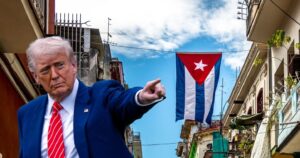
However, this question cannot be resolved without first considering the process whereby the PCC was ousted, and the position that we should adopt with respect to that event. Was this process mainly the product of a democratic revolution in the island? Or was it the product of a successful invasion organized by the U.S. government that concluded in a military occupation of the country, or of the establishment of a protectorate in the Venezuelan style? Like Venezuela, a U.S. protectorate of Cuba could be compatible with the creation of a new variety of state capitalism privatizing important sectors of the economy. Should the US succeed, in one way or another, to regain the control of Cuba after more than 65 years, we Cubans who advocate for democracy and national self-determination, must continue to oppose the CCP (no matter if it ends up in the political margins); but our focus must be the democratic struggle against foreign domination. We cannot allow ourselves to become advisors of the empire on how to govern Cuba, including what to do with the survivors of the PCC.
At the same time, we should prepare ourselves to the likely division that such a situation might generate among the Cuban people. The U.S. rulers would count with the active support of the Cuban American extreme right in Southern Florida and their equivalents inside the island, as well as of other significant sectors of Cubans. But the democratic forces inside the island that genuinely support national self-determination would oppose the foreign power as well as those who support it. Such political divisions are not new to Cuba. The fighters for Cuban independence in the late nineteenth century were not the only political option for Cubans. There were also Cubans who supported autonomy but not independence from Spain, as well as sympathizers of the Spanish “volunteers” and even with the so-called “guerrilleros” who very actively fought on behalf of Spanish colonialism.
Let us suppose, however, that the Cuban government is overthrown from below by a genuinely democratic revolution in the island. That could politically create a much more complex situation vis a vis the status of the PCC. Thus, for example, a split could develop in the PCC if part of its base and even the party bureaucracy supported a democratic revolution. That was the case of the Hungarian Revolution in 1956, when the Communist leader Imre Nagy became the Prime Minister at the head of the revolutionary forces. No wonder that Imre Nagy was executed by the USSR shortly after its invasion and counterrevolution that invaded the country. That was also the case of Czechoslovakia in 1968, where the Communist leader Alexander Dubcek played a role similar to Nagy, with a similar denouement, although less bloody than in Hungary.
The support of members, and even the hierarchy of the PCC for a democratic revolution in Cuba could also affect that revolution in the sense of making it less bloody. It would create other problems with respect to how to deal with the support of PCC elements compromised with their record as an antidemocratic and repressive organization. Nevertheless, none of it would justify forbidding the continuing existence of the PCC after having lost its power, provided that:
First, all the properties owned by the PCC, physical as well as financial, are confiscated and returned to the public purse at the expense of which they were originally obtained.
Second, all members and especially high functionaries of the PCC that committed crimes, whether common or political, who utilized their membership or more probably their high position in the PCC to obtain impunity must be brought to court to stand trial for their offenses just like any other Cuban citizen.
Third, a new Constituent Assembly is elected to revoke all the powers conferred to the PCC under the current constitution. Such an Assembly would of course have to discuss and decide on even more fundamental issues such as the status of the principal elements of the Cuban economy, and of the educational, health and social security systems, among others. Are they going to have a primarily public and democratic nature emerging from below instead of private and capitalist? Even if only a minority supported a socialist and democratic constitution, it is most important that these issues were discussed by the Assembly in public. Regarding the PCC specifically: once deprived by the Assembly of its powers and privileges, the PCC should have the same rights and obligations as any other political party. That means that it would only be able to gather support based on its ideas and practices, and not on its privileged powers. It should be clearly established that no group or party will be declared illegal based on its ideas, no matter how undemocratic they are, but may be so excluded based on their actions, especially those that attack the physical integrity and the democratic rights of the people.
 If you’ve read this far, you were pretty interested, right? Isn’t that worth a few bucks -maybe more? Please
Leave a Reply