
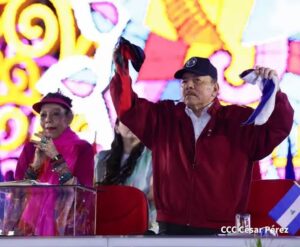
Daniel Ortega, the 80-year-old president of Nicaragua, announced on July 19, the anniversary of the Nicaraguan Revolution of 1979, that, “There will be no more elections.”. Speaking to a cheering crowd of as many as 100,000 people in the Plaza of the Revolution, Ortega said his government was abolishing elections and political parties to present a U.S. inspired counterrevolution that would bring to power the former dictator Anastasio Somoza’s followers. “The history of parties created by the Yankees and the Samocistas attempting to take power is over. Never again.” With this announcement, Ortega has put the last nail in the coffin of the revolution, the final hammer blow in a long process.
It might be more accurate to say that Ortega abolished the pretense of elections, which long ago ceased to be free and fair. Since Ortega returned to the presidency in 2007—he had also been president from 1985-1990—he transformed his politics and those of the Sandinista Front for National Liberation (FSLN). He broke with the leftist Theology of Liberation wing of the Catholic Church and turned toward the conservative hierarchy. He and his wife Rosario Murillo married in the church and launched a campaign against abortion. Ortega and other Sandinista leaders enriched themselves and allied with the country’s wealthy businessmen and landlords. He changed the constitution so he could serve another term and then changed it again to make his wife his co-president. He put family members and close friends in charge of the FSLN which became simply a loyal electoral base. Ortega’s government established a modus vivendi with the United States, avoiding conflict while engaging in criticism of the colossus of the North only to maintain its radical reputation. In the last twenty years under Ortega, Nicaragua became a regular capitalist country with an authoritarian government.
When in 2018 protests against government cuts to pensions merged with demands for democracy from young people in the largest demonstrations in the history of Central America, Ortega sent the police, the military, and the FSLN enforcers, suppressed the movement, killing 350 people and jailing over 700. After that, to Ortega was done tolerating any kind of opposition. Beginning in February 2023, he revoked the citizenship first of 222 political prisoners who were banished from the country, and then of 94 prominent dissidents, who also lost their citizenship and were expelled. Altogether, 450 people were denationalized and had their property confiscated. All of this repression was carried out in the name of defense of the Sandinista Revolution.
(There is a longer history of Ortega’s and the FSLN’s problems with democracy that I discuss in my book What Went Wrong? The Nicaraguan Revolution: A Marxist Analysis and in an article summarizing the book in New Politics).
What will the United States do?
President Donald Trump and Secretary of State Marco Rubio, while actively reasserting U.S. dominance in the Western Hemisphere and particularly in Latin America are unlikely to do anything in the short term. The United States is at present occupied with an enormous, costly, and difficult war against Iran, one that it is losing so badly that it is now turning to attacking civilian targets, leaving itself open to charge of a war crime. Niangua, unlike Venezuela doesn’t have enormous oil resources, and unlike Cuba, it never nationalized its economy, making it a threat to capitalism. Ortega has been careful to maintain a working relationship with the U.S. and to leave channels open for negotiations. A capitalist economy and foreign trade and investment—both of which Nicaragua has—are far more important to the United States than democracy.
How will the Nicaraguan people react?
We should not expect to see any immediate reaction to Ortega’s decree fom the Nicaraguan people.
The tens of thousands in the Plaza of the Revolution, cheered and applauded the announcement, many no doubt feeling that they had better. There are silent opponents of the Ortega regime, some conservative and some social democratic, but given the repression they do not feel they can say a word. Opponents who have been expelled or migrated abroad maintain informal networks but have only tenuous connections to those who remain in the country. There is no united opposition either within or outside of Nicaragua.
The powerful and wealthy who run Nicaragua, a nation of 7.1 million people, sit atop a society of poor people. Despite the regimes claims of economic development and the welfare of the people, Nicaragua remains the second poorest country in the Western Hemisphere. Only Haiti is poorer. Some 25 to 30 percent of the population, mostly in the rural areas live below the country’s own poverty line. Not surprisingly, doctors and hospitals with adequate staff and supplies are available only to the better off who live in urban areas. But while there are severe social problems, at the moment there are no outbreaks of protest from below.
When the Nicaraguan people do decide to act to improve their lives and to establish democracy, we should be prepared to help them.
 If you’ve read this far, you were pretty interested, right? Isn’t that worth a few bucks -maybe more? Please


Leave a Reply