Online Features
The fact that global warming is man-made and poses a grave threat to our future is widely accepted by progressives. Yet, the most commonly proposed solutions emphasize either personal responsibility for a global emergency (buy energy-efficient light bulbs, purchase a Prius), or rely on market-based schemes like cap-and-trade. These responses are not only inadequate, says best-selling author Naomi Klein, but represent a lost opportunity to confront climate change’s root cause: capitalism.

Bennett Muraskin complains that a blog post of mine — a report on a demonstration in Newark protesting the blank check given by NJ senators Menendez and Booker for Israel's crimes — is missing "full recognition of Hamas' war crimes and vile ideology."
There is something missing from Stephen Shalom’s blog post on Israelis crimes in the recent Gaza conflict and it is full recognition of Hamas’ war crimes and vile ideology.
 Filoviridae Ebola is a virus made up of ten proteins that was first identified in 1976 in Zaire, today the Democratic Republic of the Congo (DRC). While today five types of the virus are recognized, they are all believed to be mutations of the first known strain, which one finds today in western Africa. (Gire et al., Science, August 28, 2014).
Review of
This is Not a Test: A New Narrative on Race, Class and Education
By José Luis Vilson
Haymarket Books, 2014
Badass Teachers Unite: Reflections on Education, History and Youth Activism
By Mark Naison
Haymarket Books, 2014
This Labor Day, let’s celebrate “the right to be lazy.” Let’s play, dream, and imagine what a world without alienated labor would be.
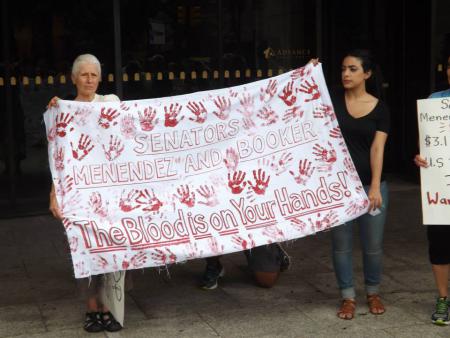
Outside the Gateway Center, where Menendez and Booker have offices. (Photo by Tom Bias.)
[This article was first published on Mondoweiss.]
Sam Gindin, former Research Director of the Canadian Auto Workers union and co-author with Leo Panitch of “The making of global capitalism” graciously agreed to answer questions from NP board members about his book when he and I participated in a conference at the Center for the Study of Work, Labor, and Democracy at the University of California, Santa Barbara.
[We re-post here a statement by Howie Hawkins, Green Party candidate for Governor of New York.—eds.]
Staten Island, Syracuse, Ohio, and Ferguson. Garner, Grant, Crawford, and Brown. Add these locations and names to the long list of young black unarmed men (and women) who are racially profiled and injured or killed at the hands of Police Departments around the country. From every corner of the US there are daily reports of police brutality and misbehavior.
Another young black man has been shot and killed by the police in an American city. Michael Brown’s killing forms part of a national pattern that is a horror for the African American community, an outrage against humanity, and a disgrace to our country.
Review of Sons of Wichita: How the Koch Brothers Became America’s Most Powerful and Private Dynasty
By Daniel Schulman
Grand Central Publishing/Hachette Book Group, 2014
- « Newer Posts
- 1
- …
- 177
- 178
- 179
- 180
- 181
- 182
- 183
- …
- 227
- Older Posts »