
We are being pushed and we are sliding toward an authoritarian state. We now live in a country where many democratic institutions, including the courts, have been seriously weakened, civil society organizations have been deeply compromised, and our civil liberties are being undermined. The United States has never been a model democracy, far from it, especially for people of color. But during the first five months of Donald Trump’s second term as president things began to change fundamentally as he attacked the media, universities, science, medicine and public health, judges and lawyers, public employees and their unions, and above all immigrants, taken from workplaces or even schools, arrested and deported. Agents from Immigration and Customs Enforcement (ICE) have arrested and detained Democratic Party officials, including a U.S. Senator and a New York City Comptroller who was also a mayoral candidate. He established new travel bans for Middle Eastern and African countries, while welcoming white South Africans as victims of “genocide.” There were lawsuits and when Trump lost, he delayed complying and even ignored the courts, including the Supreme Court. And then, gradually—as Masha Gessen put it—normalization; that is, it all began to become routine for us. But in truth, nothing is normal now.
We were aware for months that our rights and our democracy were being eroded, we protested and we lived with it, but gradually many of us recognized that everything was different. We no longer live in the same country to which as native-born people or immigrants we had become accustomed, a country that, whatever its many problems, was not an authoritarian regime. People are becoming aware of this new reality at different moments. For some it came when they saw that immigrant students were being kidnapped off the streets by men in masks who didn’t identify themselves, stuffed into unmarked cars, and sent to camps for deportation. For others it was the site of immigrants who had been sent to a notorious prison in El Salvador or South Sudan, without due process, no hearing or trial, just snatched up and flown away.
The turning point for many, the flash of recognition, from high government officials, to reporters, and to ordinary people, came on June 7 when Trump illegally federalized and deployed the California National Guard to Los Angeles (L.A.) without an invitation from Governor Gavin Newsom or L.A. Mayor Karen Bass. Illegally deployed them because there was neither an invasion nor an insurrection as required by law to justify their mobilization. Soldiers on the streets of an American city are being used to suppress protestors.
Trump initially sent to L.A. 2,000 soldiers, but within a couple of days he mobilized another 2,000, and also sent in 700 Marines. He invoked Title 10 of the U.S. Code, which permits the president to send in federal troops if there “is a rebellion or danger of rebellion against the authority of the Government of the United States” or when “the President is unable with the regular forces to execute the laws of the United States.” But there was no rebellion nor was there the danger of one. The deployment of the Marines is a violation of the Posse Comitatus Act that forbids using troops for domestic policing. Trump doesn’t care. As he said, “We’re going to have troops everywhere.”
Trump has been referring to protestors as “violent, insurrectionist mobs” and “paid insurrectionists,” clearly concocting an argument to justify the invocation of the Insurrection Act. In any case, Trump doesn’t really worry about legal niceties. The Insurrection Act could lead to a nation under martial law. We would then live in a full-blown police state.
At the same time that U.S. troops were intimidating the people of Los Angeles, Trump held a military parade to celebrate the 250th birthday of the U.S. Army—and, by coincidence, his birthday. Marching past the White House were 6,700 soldiers, dozens of M1A2 Abrams tanks and other military vehicles; helicopter gunships flew overhead, and descending from the sky were the Golden Knights Parachute Team who presented the president with a flag. Such parades usually celebrate the end of a war, in this case, they celebrated the beginning of one, against us.
The lack of humanity, the absence of compassion at home, has been paralleled by a similar policy abroad. Trump’s new imperial foreign policy, calls for the United States to take over and rule Panama, Greenland, and Canada, and he has suggested it might also take over Gaza when the Palestinians are removed and turn it into a resort. He has aligned the United States with the dictator Vladimir Putin of Russia against Ukraine, and has supported Israel’s genocide in Gaza and its campaigns against Hezbollah in Lebanon, against the Houthis in Yemen, and its bombing of Syria. Now he has joined Israel’s war on Iran raising the danger of a wider regional conflagration. He has also launched a tariff and trade war against Canada and Mexico, against Western Europe, and against China and Vietnam and other nations of Southeast Asia. The United States has always been an imperialist nation, but under Trump there is no pretense of advancing democracy and human rights or bettering peoples’ lives. The shutting down of USAID, once part of U.S. soft power, will lead to the deaths of hundreds of thousands or even millions from disease and hunger. He is competing against China for world domination. Our present is war of conquest and genocide, our future could be world war or nuclear war.
Clearly, we are in a new period in America, living under a populist, rightwing, authoritarian president. One has to wonder if in Los Angeles he is practicing, preparing the ground for a national imposition of military power over the states, especially the Democratic Party–led states with sanctuary laws that forbid state police from cooperating with ICE. We have to ask ourselves whether Trump is preparing what in Latin America is called an “autogolpe” or “self-coup,” that is, maintaining presidential power while replacing a liberal democratic state with a dictatorship.
At the moment, depending upon the poll one reads, Trump has the support of between 40 percent and a half of all Americans, among them tens of thousands of members of armed militia groups like the Three Percenters and many others, and we have to wonder what happens if he also mobilizes them. Are these the first steps in the imposition of a fascist regime? Do we see in his militarization of Los Angeles the suggestion of a coming civil war, geographically between the coasts, on the one hand, and the Midwest and South, on the other, between urban America and suburban and rural America?
Some political leaders have spoken up both about the danger and about what needs to be done. In an address to Californians, Governor Newsom called Trump’s measures “the acts of a dictator.” He told them and other Americans:
This is about all of us. This is about you. California may be first—but it clearly won’t end here. Other states are next. Democracy is next. Democracy is under assault right before our eyes—the moment we’ve feared has arrived.
What we are witnessing is not law enforcement—it’s authoritarianism. What Trump wants most is your fealty. Your silence. To be complicit in this moment. Do not give it to him.
Similarly, Chicago Mayor Brandon Johnson called Trump a “tyrant.” “I am counting on all of Chicago to resist in this moment,” Johnson said. “Whatever particular vulnerable group is being targeted today, another group will be next.”
Rep. Ilhan Omar of Minnesota said, “We are in the midst of the creation of a police state.… We should all collectively be out in the streets rejecting what is taking place [in Los Angeles and Washington, D.C.].”
This is the first time in my lifetime that I have heard such politicians call for popular resistance to the federal government, encouraging the millions already in the streets. Omar, Johnson, and Newsom are politicians with their own agendas and aspirations—Newsom wants to be president—but they are giving expression to the concerns and feelings of many of their constituents who have taken the same in massive demonstrations—opposing Trump as a dictator. But the Democratic Party, which is bolted and welded into the system, has not thrown itself into the fight against Trump at every level.
Trump may have hoped that his mobilization of the National Guard and the Marines to Los Angeles would intimidate his opponents there and throughout the country, but that has not happened. In L.A. and in forty other cities in twenty-three states there were demonstrations against ICE raids, arrests, and deportations as well as Trump’s deployment of the National Guard and the Marines to L.A. and they did so despite the tear gas, flash-bang grenades, rubber bullets, and the arrest of hundreds of protestors. And wherever ICE goes, locals come out to resist, even at the risk of arrest and imprisonment.
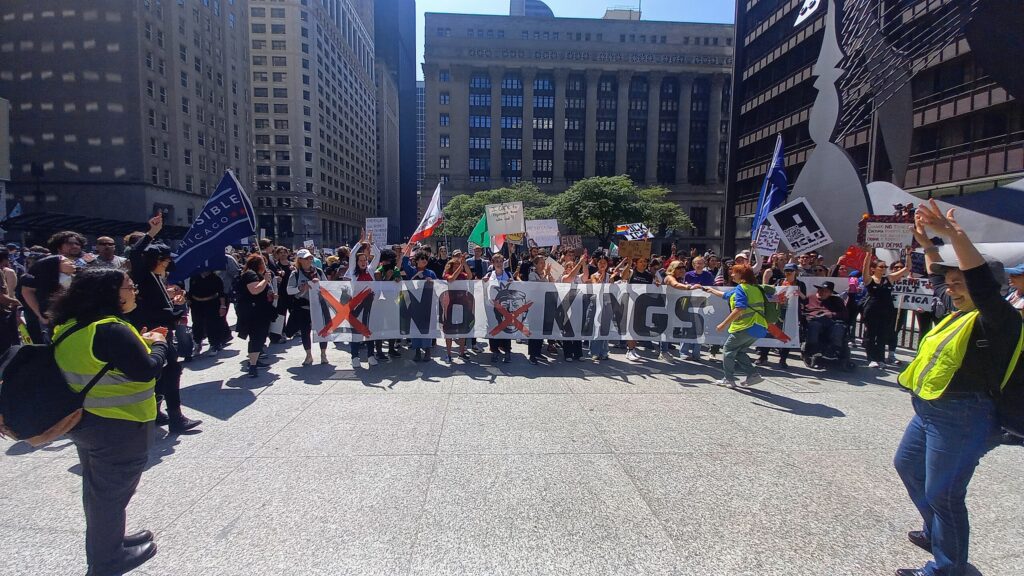
Then, on June 14, an estimated five to ten million people participated in two thousand “No Kings Day” protests in big cities and small towns in all fifty states, the largest yet in a series of national demonstrations against Trump and the largest protest on a single day in U.S. history. The protestors’ signs criticized the president for his attacks on health care, on food programs for children and the elderly, on education and science, and on LGBTQ people and especially transpeople. Some banners read “Fight Oligarchy.” More signs than in earlier protests said, “Fight Fascism!” Where I protested in New York City people chanted, “Whose country? Our country!” In all of the protests there were more American flags and more chants that expressed a desire for national redemption. The anti–ICE protests and No Kings Day marches represented another step forward for the resistance to Trump.
Trump may have thought his immigration raids, bolstered by the military, would enhance his popularity, but various polls conducted in mid-June suggested this was not the case. Trump had promised to go after criminals, but when people saw him arresting working people and breaking up families, support for both him and his immigration raids, declined, though nearly half of all Americans still support him as we head toward the midterm elections in November 2026.
Trump is pressing down on us, and we are rising up. Yet we will need more strength to protect ourselves and to rid ourselves of him. The demonstrations in some places, such as in New York City, have been too white and have lacked proportional participation from communities of color. And a movement like this needs more power, needs strikes and mass civil disobedience.
We have to win over working people and their unions. The labor bureaucracy remains a problem. Teamster President Sean O’Brien gave a virtual endorsement to Trump by speaking at the Republican Party’s national convention. And Shawn Fain, who had supported Democrat Kamala Harris and criticized Trump, subsequently came out strongly in support of Trump’s tariffs. While public employees, especially federal workers oppose Trump, the Building Trades, leaders and ranks, generally support him. Union leaders don’t seem to understand that Trump represents an existential crisis for the unions and for the American people, one that is greater than any particular policy. We need a union movement of workers of all races, ethnicities, and religions opposed to Trump and on the side of democracy and civil liberties—and immigrants—and that unity will have to be built from the bottom up, up from the rank-and-file.
While the large and growing anti-Trump protests are great, we need to see that this movement has a political impact and creates an independent political force. We cannot rely on the Democrats but have to work for a real left, multiracial, all-gender, working-class political party. Such a party, both an electoral party and a social movement, will need a program that speaks to working people about wages, food prices, the cost of housing, the need for health care for all, and free public education from K to PhD—and taxing the corporations and the billionaires to pay for it all. It will need to be a party about social justice for all, about immigrant rights, about reproductive rights, and the rights of racial minorities. It will have to be a working-class party about freedom.
If we have a program that speaks to working people and the oppressed, and a unified working class, and if the movements are willing to engage in strikes and mass civil disobedience, we have a chance to stop the slide from authoritarianism to fascism.
 If you’ve read this far, you were pretty interested, right? Isn’t that worth a few bucks -maybe more? Please
Leave a Reply