
Since Donald Trump, Project 2025, and the Republican Party took control of the U.S. government six months ago, we have faced war abroad and authoritarianism and repression at home. Trump has given the U.S. government’s full support to Israel’s genocidal war in Gaza, where the population is being starved to death and massacred.
When Israel decided to make war on Iran, in violation of the U.N. Charter, Trump approved and then joined in without consulting Congress, in violation of the U.S. Constitution. Trump has said he wants to take back the Panama Canal, acquire Greenland, and even make Canada into an American state. This is a return to the imperialism of the late nineteenth century.
The implementation of Project 2025’s policies via executive orders constitutes a relentless attack on democratic institutions, on immigrants, and on the social and economic infrastructure that supports the majority of Americans. Trump put Elon Musk in charge of a hastily created Department of Government Efficiency (DOGE) that closed entire government agencies and fired hundreds of thousands of federal workers, ignoring both their civil service protections and their labor unions. He has attacked science, public health, education, the environment, and gender, reproductive, civil, and human rights. As we write, Trump is pushing what he calls his “big beautiful bill” through Congress, a law that would increase tax breaks for the rich while cutting money for Medicare, which funds healthcare for low-income and disabled people, and for food stamps. These are cuts that will lead to hunger, sickness, and to death for an estimated fifty thousand people each year, according to experts.
Trump has promised to round-up and deport millions of undocumented immigrants. Over 200,000 have been deported so far. Immigration and Customs Enforcement (ICE) agents have been conducting raids on neighborhoods, workplaces, churches, and schools. They have arrested children as young as six years old and separated parents from their children. They have kidnapped people off the streets and deported them without a hearing, some to Guantanamo, some to a Salvadoran prison, and now some to South Sudan. Students with visas, starting with Mahmoud Khalil, have been detained and targeted for deportation for their opposition to Israeli policy.
Millions of people have responded with a series of local and national demonstrations, one of which, No Kings Day on June 14 was the largest social protest on a single day in U.S. history.
On June 25, Zohran Mamdani, a Muslim immigrant and a democratic socialist, won the Democratic Party primary for New York City’s mayoralty. He campaigned on the promise of taxing the rich to pay for a rent freeze and free buses, and he was not afraid to denounce Israel’s war on Palestinians. He could win the general election, but the backlash against him by Wall Street will make it hard. The billionaires will bankroll and try to unite the anti-Mamdani forces. A Mamdani victory would provide the Democratic Party with a different model, one that the party will most likely reject.
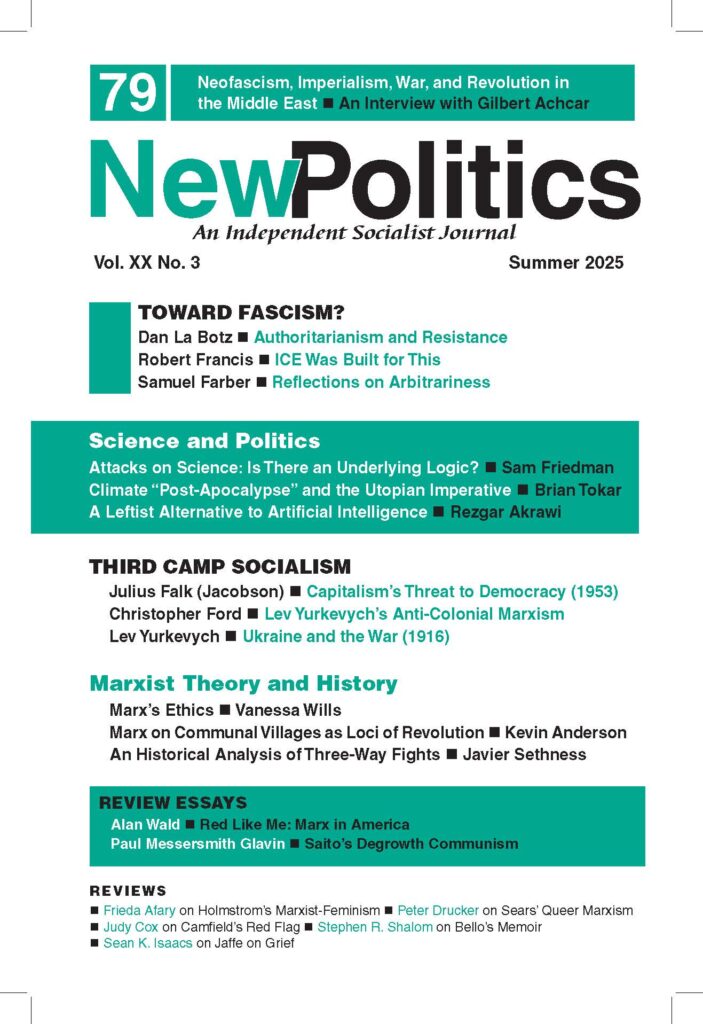
In this issue, we address several current themes, while exploring socialist traditions and analyses.
Three articles look at the descent toward authoritarianism in the United States. Dan La Botz provides an overview of Trump’s program and policies and the resistance that has sprung up in opposition. Robert Francis addresses the horrors being perpetrated by ICE, arguing that their repressive behavior is a feature, not a bug. Samuel Farber considers arbitrariness more generally, one of the key characteristics of the Trump regime.
In a section on “Science and Politics,” Sam Friedman asks whether the sustained attack on science is the result of an intentional plan. Brian Tokar looks at the dangers and potentials being unleashed by the environmental crisis. And Rezgar Akrawi puts forward a leftist alternative to artificial intelligence.
New Politics has always promoted Third Camp Socialism. In his interview with Rodrigo Utrera, Gilbert Achcar discusses political developments in the Middle East from a perspective that refuses to align with either U.S. imperialism or its enemies. We reprint a 1953 article by Julius Jacobson, one of the founding editors of this journal, introduced by Kent Worcester, co-editor of a new volume of writings by Julius and Phyllis Jacobson on Third Camp Socialism. Jacobson argues that the key characteristic of socialism is not control over the means of production, but democracy. Lev Yurkevych was a Ukrainian socialist from more than a century ago who emphasized the mutual need for socialism and self-determination of peoples. We publish here for the first time an English translation of his timely 1916 pamphlet “Ukraine and the War.” Christopher Ford, who has annotated the Yurkevych text, also offers an extensive background essay on its importance.
Three articles make up a special section on Marxism: History and Theory. Some on the left dismiss ethics as a bourgeois defect. Vanessa Wills, however, in her interview with Phil Gasper insists that Marxism has an important ethical core. Kevin Anderson looks at the late Marx for an appreciation of the revolutionary potential of the communal village. In contrast, Javier Sethness argues that anarchism has been more progressive and more consistent with human emancipation than what he sees as Marxism’s authoritarian prescriptions.
We publish two review essays in this issue. In one, Alan Wald takes up Andrew Hartman’s Karl Marx in America, to argue that it is “in Marxist critiques of Marxism that one can find the most thought-provoking avenues for possible explanations and guidance.” As an example, Paul Glavin-Messersmith examines the analysis by Kohel Saito of a degrowth Marxism.
The issue also includes five shorter reviews. Frieda Afary evaluates Nancy Holmstrom’s collection of her writings on Marxist-feminism. Peter Drucker discusses Alan Sears’s integration of Queer studies with classical Marxism. Judy Cox reviews David Camfield’s history of anti-Stalinist Marxism. Stephen R. Shalom appraises the memoir of one of the Global South’s leading intellectual/activists, Walden Bello. And Sean K. Isaacs grapples with Sarah Jaffe’s discussion of our need for grief.
The United States has an increasingly authoritarian federal government, but there is also a broad network of groups and organizations in opposition. We can stop Trump, protect working people, defend immigrants, women, gender non-binary, and people of color. We can speak out on Israel’s war on Palestine, Russia’s war on Ukraine, the war between U.S./Israel and Iran, while we raise the need for socialism.
When this issue of New Politics reaches you, we hope we are in the midst of a summer of protests and mobilizations. We will be part of the resistance.
 If you’ve read this far, you were pretty interested, right? Isn’t that worth a few bucks -maybe more? Please
Leave a Reply