
Donald Trump’s return to the presidency signals a deeper push to use executive power as a tool for repression and control. At the center of this effort isn’t the military or intelligence agencies. It’s U.S. Immigration and Customs Enforcement (ICE). From the beginning, ICE has operated with broad authority, little oversight, and a structure that makes abuse easy and accountability rare. It was built to function outside traditional legal norms and was always ripe for abuse.
What makes ICE especially dangerous is its unique position within the executive branch. Of all federal agencies, immigration enforcement offers the president some of the most unilateral power to act without Congressional approval, without judicial review, and often without public scrutiny. Trump has seized on this fact. He is not targeting immigrants because they pose a threat to the country but because immigration enforcement provides the most incredible freedom for him to consolidate control.
Trump is leveraging ICE and the broader Department of Homeland Security (DHS) to test and expand the boundaries of executive authority. And he’s doing so in a way that invites outrage. His cruelty toward migrants is not incidental; it is strategic. It provokes his opponents, polarizes debate, and opens the door for expanded extrajudicial repression under the guise of national security. This dynamic is not new. What’s different now is how openly it’s being used not only to attack vulnerable communities but to silence political opposition. The more brutal his actions are toward migrants, the more they elicit protest. The more protests there are, the further dissenters fall under DHS and ICE purview. The more executive powers grow, the greater the opportunity to turn the machine against not only scapegoat immigrants but U.S.–born opponents as well.
ICE was not created in a vacuum. It emerged from the aftermath of 9/11, when fear eclipsed foresight and the U.S. security state expanded with bipartisan support. Agencies once separated by function were fused under the DHS. The result was an agency with broad discretion, minimal accountability, and a mandate shaped more by executive interpretation than legal constraint.
From its inception, ICE was built for control. Created through the Homeland Security Act of 2002, it was structured to operate primarily outside traditional checks and balances. ICE uses administrative warrants signed by its officers, not judges, unlike criminal agencies, and operates under executive authority.1 A few lawmakers—Ron Paul and some Democrats—warned against handing such unchecked power to the executive, but were ignored. The bill passed 295–132 in the House and 90–9 in the Senate, pushed through in a climate where questioning national security was equated with disloyalty.
Democrats helped build the system, Republicans expanded it, and Trump weaponized it. What began as an immigration agency now functions as a domestic repression tool poised in Trump’s second term to move beyond borders, punishing dissent and consolidating executive power through fear. Though more Democrats than Republicans opposed the Homeland Security Act, President Obama greatly expanded ICE. He increased its budget, rolled out Secure Communities (later revised as the Priority Enforcement Program), expanded E-Verify, and strengthened ties with local police.2 Simultaneously, he sought to humanize enforcement through DACA and deferred action, but these rested on executive discretion, not lasting reform. Obama governed as a technocrat, believing the system could be fine-tuned. However, he never limited ICE’s authority, and groups like the ACLU and United We Dream and progressive lawmakers warned of potential misuse.3
During his first term, Trump transformed ICE into a blunt enforcement tool. He reinstated Secure Communities, expanded workplace raids, and removed Obama-era enforcement priorities, directing DHS to target virtually all undocumented individuals. DHS agents separated families and detained them for extended periods, leading to children being unaccounted for, according to government representatives.4
Whistleblower reports and oversight organizations documented concerns about mistreatment and the absence of standardized reunification procedures.5 Although the Biden administration introduced policy changes, ICE’s underlying structure remained largely intact.6
In Trump’s second term, the DHS and ICE have metastasized into something more dangerous. Shortly after Trump’s return to power, Trump declared a “national emergency” at the southern border, prompting the Department of Defense to deploy an additional 1,500 troops.7 Framing immigration as a national security threat, the administration leaned heavily into post-9/11 “War on Terror” rhetoric, the same ideological foundation from which DHS and ICE were born.
The State Department officially designated several cartels as foreign terrorist organizations, a move that dramatically expanded the scope of executive power.8 This designation, combined with the emergency declaration, opened the door for Trump’s team to attempt the invocation of the Alien Enemies Act of 1798.9 Crafted initially to authorize the arrest and deportation of nationals from enemy states during wartime, the Act was now being weaponized against foreign nationals allegedly affiliated with gangs. Once the administration started describing gang violence in terms usually reserved for war, it didn’t take long before legal boundaries began to erode. What had separated domestic law enforcement from military authority started to disappear, along with the checks on presidential power.
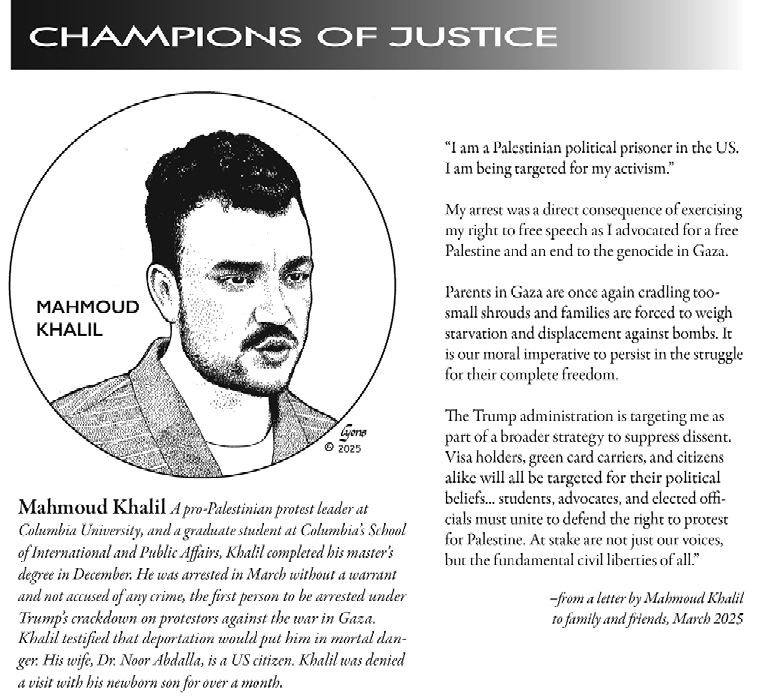
While the groundwork was being laid for expanded executive powers, actions were being taken on an individual basis. Student activists critical of U.S. policy in Gaza were detained under immigration powers despite facing no criminal charges. Mahmoud Khalil, a Palestinian lawful permanent resident and recent Columbia graduate, was placed in deportation proceedings under a rarely used foreign policy provision of the Immigration and Nationality Act for his public speech at pro-Palestinian protests.10 Mohsen Mahdawi, a Palestinian-born U.S. resident at Columbia University, was held under a provision targeting those deemed threats to foreign policy.11 Rümeysa Öztürk, a Turkish doctoral student at Tufts, was detained for alleged visa violations after co-authoring a critical op-ed on Palestine.12
All were targeted not for wrongdoing, but for dissent—their immigration status made them uniquely vulnerable to political retaliation.13 This weaponization of immigration status did not stop with non-citizens, but inevitably expanded to sweep in U.S. citizens as well.
ICE began wrongfully detaining U.S. citizens, including Juan Carlos Lopez Gomez in Florida and José Hermosillo in Arizona, even after evidence of citizenship was provided.14 In Gomez’s case, a judge explicitly ruled there were no legal grounds to hold him, but ICE continued his detention, demonstrating how the agency can disregard judicial authority. These were not isolated errors but early signs of a system increasingly untethered from legal constraints.
A Salvadoran national, Kilmar Abrego Garcia, with legal protection from deportation due to a prior immigration court ruling, was wrongfully deported in March 2025, an act the Trump administration later described as an “administrative error.”15 The case marked a shift: what had previously been framed as immigration enforcement began to take on the contours of a broader national security crackdown that increasingly affected U.S. citizens.
After the unlawful deportation of Garcia, Trump adviser Sebastian Gorka warned that those protesting the removal could be guilty of “aiding and abetting” terrorists. He implied that those criticizing the Trump administration for overreaching immigration policy could be classified as security threats.16 Under this pretense, ICE and DHS, once focused on non-citizens, could now be positioned as tools to suppress domestic dissent. The message was clear that if you stand with immigrants, you may be treated as an enemy.
This shift deepened when Trump suggested using the deportation system against so-called “homegrowns”—citizens—even telling the Salvadoran president to expand prison capacity in anticipation of more removals.17
Then came Stephen Miller, who proposed framing the southern border as an “invasion” to trigger special executive powers, including the suspension of habeas corpus, a constitutional protection.18 While Miller focused this justification on immigrants and asylum seekers, the legal precedent set would allow broad detention powers under the national security pretext.
Together, Miller’s legal strategy and Gorka’s inflammatory rhetoric revealed a troubling alignment: immigration law functioning as one of the executive branch’s most adaptable tools—used not only against migrants, but increasingly against U.S. citizens who voice dissent.
That framing gained further traction in a Senate hearing where Homeland Security Secretary Kristi Noem mischaracterized habeas corpus as “a constitutional right that the president has to be able to remove people from this country.”19 Maggie Hassan (D-NH) correctly explained that habeas corpus protects individuals, including U.S. citizens, by requiring the government to justify detention publicly.
This convergence of rhetoric and executive power sharpened in May 2025, when Trump posted that Democrats used immigration to destroy the country and that it was treason. The word “treason” can’t be assumed to be a metaphor.20 Paired with the administration’s words and acts, the post reads like an accusation that dissent is a punishable offense.
The last time habeas corpus was suspended was during the Civil War. By calling immigration an “invasion” and dissent “aiding and abetting,” constitutional protections are being eroded not only for immigrants, but for Americans who stand with them, being framed as an internal battle or cold civil war. As Gorka’s rhetoric makes apparent, protest, legal defense, and even speech can be reframed as threats to national security. ICE and Homeland Security are no longer just border tools—they’re instruments of political control in this battle.
That logic came to life in May 2025, when Newark mayor Ras Baraka was arrested by ICE while accompanying members of Congress on an oversight visit.21 Charges were dropped against Baraka, but the MAGA acting U.S. attorney has charged Rep. LaMonica McIver (D-NJ10) with assault and suggested that more Democrats could face arrest. This was followed by an incident in Democratic Rep. Jerry Nadler’s office in which DHS agents forced their way in, handcuffing one of his staffers in the process.22 Immigration enforcement had fully turned inward, targeting citizens, elected officials, and dissent.
After a series of high-profile immigration raids in blue states, a disturbing pattern has emerged: federal enforcement is becoming increasingly targeted, theatrical, and politically motivated. Notable operations in Massachusetts, San Diego, and, most recently, Los Angeles triggered protests and community pushback. Rather than de-escalate, the administration used the unrest to justify activating the National Guard, framing the demonstrations as an “insurrection” perpetrated by a “foreign enemy.” 23 The escalation continued when the Pentagon deployed 700 active-duty Marines to Los Angeles. 24 This trend of provocation and escalation will surely continue to ever higher stakes.
These actions show that DHS and ICE are being used to consolidate executive power and suppress political opposition. Under the guise of national security, the administration has recast immigration enforcement to justify expanded detention, surveillance, and even military deployment within U.S. borders, creating a framework that allows political opponents to be targeted as alleged collaborators with “foreign enemies.”
This moment demands more than policy reform. It requires recognizing that the very structure of immigration enforcement is inseparable from authoritarian drift. ICE cannot be “returned to its original purpose” because its original purpose was always expansive, unaccountable state power. It was built for this. If we fail to dismantle or fundamentally transform it, the machinery Trump is using will remain intact long after his term ends, ready for the next strongman to seize.
The danger is not only in what ICE does at the border but in how it is being used to redraw the boundaries of dissent, citizenship, and democracy itself. What begins with deportations ends with disappearances not just of people but of rights.
Notes
1. U.S. Cong., Homeland Security Act of 2002, PL 107-296, 116 Stat. 2135 (2002).
2. ICE, Secure Communities: Activated Jurisdictions, archived May 9, 2011.
3. Joanne Lin, “Speed Over Fairness: Deportation Under the Obama Administration,” ACLU, May 1, 2014; Zenén Jaimes Pérez, Carolina Canizales, and Raúl Alcaraz Ochoa, Immigration Raids: The Real Impact: Findings from the National Deportation Defense Hotline. Washington, D.C.: United We Dream, 2016; Seung Min Kim, “Democrats Lash Out at Obama over Immigration Raids,” Politico, Jan. 6, 2016,
4. Alex Nowrasteh, “Trump Executive Order Reestablishes ‘Secure Communities’,” Cato at Liberty (blog), Jan. 25, 2017; American Immigration Council, “The End of Immigration Enforcement Priorities Under the Trump Administration,” Mar. 7, 2018; Julia, Ainsley, “Trump Admin Asks for More Time to Reunite Kids, Parents Separated at Border,” NBC News, July 6, 2018.
5. Maryam Saleh, “Whistleblower ‘Helpless’ to Stop US Immigration Solitary Confinement Abuses,” International Consortium of Investigative Journalists, May 21, 2019; Susan Ferriss, “Homeland Security Watchdog Attacks ICE for Dangers at Immigrant Detention Center,” Center for Public Integrity, Oct. 2, 2018.
6. David Pekoske, Review of and Interim Revision to Civil Immigration Enforcement and Removal Policies and Priorities, Memorandum, U.S. DHS, Jan. 20, 2021.
7. Dept. of Defense, “DoD Orders 1,500 Troops, Additional Assets to Southern Border,” April 30, 2025.
8. Dept. of State, “Designation of International Cartels,” Feb. 20, 2025.
9. Donald J. Trump, “Invocation of the Alien Enemies Act Regarding the Invasion of the United States by Tren de Aragua,” The White House, March 15, 2025.
10. Mahdawi v. Trump, American Civil Liberties Union, accessed June 12, 2025.
11. Mahdawi v. Trump, American Civil Liberties Union, last updated April 30, 2025, accessed June 12, 2025.
12. Öztürk v. Trump, American Civil Liberties Union, accessed June 12, 2025.
13. Leila Fadel, Jan Johnson, and Kaity Kline, “Columbia Student Mohsen Mahdawi Arrested at Citizenship Appointment,” NPR, Apr. 29, 2025; AP, “Rümeysa Öztürk, Tufts Student Held by ICE, Vows to Continue Legal Action After Jail Release,” Guardian, May 11, 2025.
14. Gisela Salomon, “A US Citizen Was Held for Pickup by ICE Even After Proving He Was Born in the Country,” AP, Apr. 18, 2025; José Olivares, “US Citizen Wrongfully Arrested by Border Patrol in Arizona Held for Nearly 10 Days,” Guardian, Apr. 20, 2025.
15. Noem v. Abrego Garcia, 2025, 604 U.S.
16. Sebastian Gorka, “Trump’s Counterterrorism Czar Says Kilmar Abrego Garcia’s Advocates Could Be Prosecuted for ‘Aiding and Abetting’,” Yahoo News, Apr. 16, 2025.
17. Brian Mann, “Trump Hopes to Deport and Jail U.S. Citizens Abroad,” NPR, Apr. 16, 2025.
18. Julia Ainsley, “Top White House Adviser Stephen Miller Says ‘Actively Looking’ at Suspending Habeas Corpus to Speed Deportations,” NBC News, May 16, 2025.
19. Dareh Gregorian and Didi Martinez, “Homeland Security Secretary Kristi Noem Struggles to Define Habeas Corpus at Senate Hearing,” NBC News, May 20, 2025.
20. Donald J. Trump, Truth Social post, May 21, 2025.
21. Oren Oppenheim, et al., “Newark Mayor Ras Baraka Arrested at ICE Facility While Joining Democrats to Conduct ‘Oversight,.” CNBC, May 10, 2025.
22. “New Video Shows Tussle Between Rep. Nadler Staffer and Federal Officers,” Gothamist, June 5, 2025.
23. Chris Megerian and Michelle L. Price, “Trump Calls Los Angeles Protesters ‘Animals’ and ‘a Foreign Enemy’ in Speech Meant to Mark Army’s 250th Anniversary,” WTTW News, June 10, 2025.
24. Phil Stewart and Idrees Ali, “Pentagon to Deploy 700 Marines to Los Angeles, Official Says,” Reuters, June 9, 2025.
 If you’ve read this far, you were pretty interested, right? Isn’t that worth a few bucks -maybe more? Please
Leave a Reply