Category: Labor
Review of: Bryan D. Palmer. Revolutionary Teamsters: The Minneapolis Truckers’ Strike of 1934. Historical Materialism Book Series. Chicago: Haymarket, 2013. Appendix. Bibliography. Index. Photos. 308 pp.
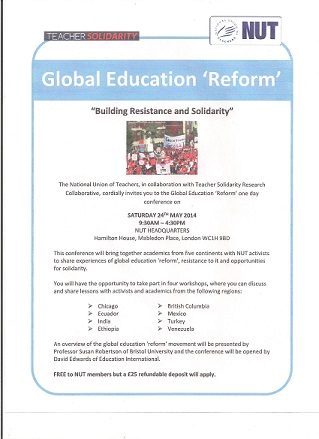
The National Union of Teachers (NUT) hosted a conference on global education “reform” May 24, bringing together NUT activists with union leaders and scholars from the global south and north. My blog this week adapts my presentation, which along with papers from others (all quite informative) will be published on the Research Collaborative of www.teachersolidarity.com
 This brief story about the Philly TAG (Teacher Activist Group) conference suggests what was special about the occasion but it misses what was the most salient political feature of the conclave. Philly teachers who are committed to social justice have formed a caucus in their union, an AFT l
 In studying urban teacher preparation (the hat I wear professionally when I’m not thinking about teacher unionism), I examine how school practices and organization influence teachers and students. To understand what goes on inside classrooms we have to look at the welter of powerful influences within schools and outside their walls. Blaming “teacher quality” f
Ghana, known for its stability and economic prosperity in the last 50 years, is praised as a model African state. Despite their rise to a middle income country, Ghana is struggling to deal with the rise of Kayayo’s, a destitute working class who go unacknowledged by policy makers. This is the story of an American living in a Kayayo town.
This is “Teacher Appreciation Week.” Should we mark the occasion? How? Why?
Union Power’s sweep of the election for union officers in United Teachers of Los Angeles (UTLA) signals a seismic shift in power relations in the American Federation of Teachers (AFT).
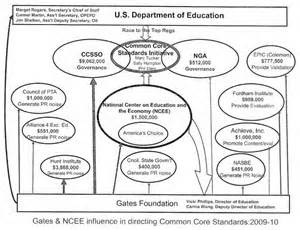
1. More rigorous academic standards required by the new national curriculum, Common Core Curriculum Standards (CCSS) and its high-tech national test PARCC controlled by Pearson will alter employment for US students by making them “college and career ready.”
2. The Common Core Curriculum Standards are a “state-led” initiative.
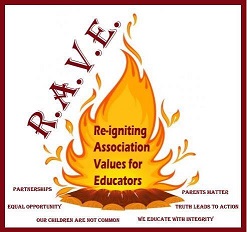 It’s official. Colorado teachers and parents have launched a state-wide caucus, RAVE, that aims to transform both the AFT and NEA affiliates in their state. To my knowledge theirs is the first caucus that includes teachers in both AFT and NEA as well as parent activists. They’ve also reached out to student groups who oppose testing.
Intimidation of US teachers has become truly chilling. Denver has a "do not hire" list on which any school employee can be placed by any supervising administrator. Los Angeles, like New York City, can assign a school employee to what LA teachers have referred to as "teacher jail," and NYC the "rubber room." School employees are sent to a room where they are not permitted to do anything productive, languishing while the administration drags its feet in pursuing claims of misconduct, hoping the teachers will be worn out and quit.
Steve Early. Save Our Unions: Dispatches from a Movement In Distress. Monthly Review Press, November 2013. 304 pages. Notes. Index.
This past week I participated in a “Don’t tread on educators” workshop for NYC teachers who are fighting against having been given unsatisfactory ratings by supervisors. They shared personal stories of being singled out for punishment after years of satisfactory service and of their union, the United Federation of Teachers (UFT) that will not support them and worse, often collaborates at the highest levels with the administration in pushing them out of their careers.
One week, two precedents.
 One can’t know from old modes of media, now state or corporate-controlled in every country I know of, how extensive resistance is to the destruction of systems of public education created in the past century, through struggles of working people to improve their children’s lives. (The best chronicle of these struggles is Read more ›
The forthcoming film Cesar Chavez: An American Hero will be opening in cities across the country on April 4, 2014 and already it has stirred discussion and debate among labor union activists, academics, and those on the left.
In the 1990s, hundreds of U.S. labor activists came together to form the Labor Party. The initiative was the brainchild of Tony Mazzocchi, the passionate leader of the Oil, Chemical and Atomic Workers International Union (which, after two mergers, is today part of the United Steelworkers). Mazzocchi held true to the dream of an independent political party rooted in the labor movement over which working people would have ownership. He was fond of pointing out: “The bosses have two parties. We need one of our own.”
It’s hard for people who have never been on strike to understand how transformative the experience can be, especially if the job is one’s life work. All of sudden, power relations are reversed. Workers are calling the shots about what they will and will not do. Life in school is so routinized that anything new can cause shock waves, and a strike by teachers is a tsunami.
 We’re seeing social movement teacher unionism arise in the South, in NEA, in Organize2020, a hardy band of activists who intend to transform their NEA state affiliate, North Carolina Association of Educators (NCAE). I was invited to speak at their first state-wide conference but when we were iced
The workers of Punto Leather Factory, located at Kazliceşme in the district of Zeytinburnu in Istanbul, have been organized in their union, Deriteks, for a decent livelihood and decent working conditions. They stand against harsh working conditions, health and safety problems, denial of their constitutional right to unionize, disadvantageous health insurance plans, prohibitions against using their annual leave entitlements; in summary they stand against working in conditions of slavery.

(This blog was adapted from my remarks in a remarkable forum on Feb. 8 in NYC that critiqued current policies evaluating principals and teachers and examined possible solutions. The panel was videotaped and will be uploaded shortly. I’ll give readers the URL when that occurs.)
- « Newer Posts
- 1
- …
- 16
- 17
- 18
- 19
- 20
- 21
- 22
- …
- 26
- Older Posts »