
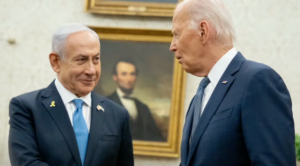
This article was originally published on October 25 on Richard Seymour’s Patreon site.
I.
A decade ago, the Republicans won the US mid-terms. The fall in turnout was unprecedented. That was the point at which Thomas Ferguson, known for his investment theory of politics, foresaw the collapse of the dominance of funding cartels. In 2016, Trump was elected despite the overwhelming mobilisation of the big donors behind his opponent. Over the last eight years, but especially during the Biden administration, core aspects of Trumpism have been institutionalised.
Let’s take a look at the record. First, the ‘China problem’ identified by Steve Bannon and Peter Navarro, became a bipartisan obsession. It is now hegemonic to the extent that Harris attacked Trump from the right on this issue during their debate, condemning him for having ‘sold us out’ by selling chips to China. (He, in fact, limited sales of chips to China.) Second, economic nationalism – including protectionism, stimulus and a domestic industrial policy – was embraced far more vigorously by Biden than Trump. Ironically, he was enabled in this by pressure from the Sanders left, just as Trump was inhibited by pressure from the Republican right. Third, the far right’s borders agenda has been adopted uncontested, and now forms a major plank in Harris’s platform.
Fourth, in all essential ways, Biden adopted Trump’s foreign policy. The withdrawal from Afghanistan, the Abraham Accords and nationalist contestation with China, were all continuous with the previous administration. I suppose it could be argued that Trump would not have supported Zelensky as fulsomely as Biden. We can’t know what Trump would have done because in practice he is mercurial, but in office he deferred to the higher wisdom of the Pentagon. Fifth, Biden has – for different reasons than Trump – made unconditional support for the Likudnik-fascist coalition in Israel a bipartisan affair. That has rebounded into a growing domestic authoritarianism. The countersubversive thrust against the noisome ‘watermelon people’ also corroborates vigilante and racist ‘lone wolf’ attacks.
In the coming election, my hunch is that a Trump victory is nailed on barring some last-minute meltdown on his part. He’ll lose the popular vote and win the college vote on a low turnout. Harris leads, nationwide, by a fraction of a percent – far smaller than Clinton’s lead in 2016. She trails narrowly in most swing states. Her support among black voters is far lower than either Clinton’s or Biden’s. Harris has stalled at 49% of the popular vote since mid-September: roughly coterminous with the ‘debate’, which was the last sign of intelligent aggression from the campaign. Trump’s vote share has steadily climbed since then, suggesting the undecideds are falling in his favour.
Now I can’t honestly explain how the transient emotional contagions around ‘brat girl summer’ and ‘joy’ did not congeal into a more perdurable excitement and affection for Harris, why public appearances with Liz Cheney and Mark Cuban fail to enthral, or why her appearance on The View failed to charm those psephologically decisive suburban moms. Even were Harris to scrape through, however, it would be on terms that confirm Trumpism’s ascendancy both in the GOP and as a factor in the state, and the comprehensive defeat of the left’s populist insurgency within the Democratic Party. Official trasformismo thus leans far more heavily on thematics appropriated from the right than the left.
II.
I’m trying to think about the present historically – always historicise, as Jameson insisted – and find that I have to think against the surfeit of senseless data, the endless flow of emotionally devastating events, and the eternal present of capitalism where all that ever happens is new rounds of accumulation in altered conditions. I think we can understand the institutionalisation of Trumpism as a response to three or four basic trends, including relative imperial decline, problems of ‘secular stagnation’ (dixit Larry Summers) in the capitalist core, the rise of Chinese state-capitalism, and the energy crisis.
The nascency of the modern American empire coincides with the transition from coal to oil as the dominant energy source, and the birth of the People’s Republic of China. It also marked the transition from an imperialism of formal subsumption to an imperialism of real subsumption. In formal subsumption, capitalist markets were violently fashioned trough the colonial liquidation of natural economy and sustained by systems of racial sovereignty. In real subsumption, territorial empires gave way to empires based on control of market access, reshaping labour processes and supply-chains on a more consistently capitalist basis and incorporating workforces into financial and consumer systems to an unprecedented degree. America, following the advice of geographer Isaiah Bowman, pursued a global system of national sovereignty girded by global market rules and policed by anticommunist militarism and dictatorships. The state was internationalised, forced to organise domestic affairs to be consistent with patterns of global management. A new international division of labour dominated by Fordist capital in North America, Western Europe, and Japan, was instituted.
Oil, as Adam Hanieh suggests in Crude Capitalism, powered this transition. The whole system of commodity production was revolutionised by petrochemicals and plastics. Production was faster and commodities cheaper. Financial markets thrived on the enormous cash reserves accumulated by this sector, and birthed new financial structures such as trusts. Oil giants expanded to control vast dominions of manufacturing and construction. The American state expanded into the oil frontiers, effectively inventing the Saudi kingdom and exporting Jim Crow. When the British retreated from their ‘east of Suez’ commitments in 1968, the petrodollar handily replaced sterling and the US navy replaced the British navy. And, of course, the militarily triumphant state of Israel became an American client.
Yet the US was achieving its matchless oil dominance just as it was losing ground in other ways. Defeat in Vietnam, commercial competition from Japan and West Germany, the emergence of Islamism as an historical force, the persistence of hostile nationalist states, the upsurge of national liberation movements, the glut of Soviet oil threatening the dominance of US corporations and fuelling oil nationalism, Third World moves to nationalise Western assets, the much-mythologised oil shock (partly driven by the activities of the Seven Sisters trying to protect their advantage over smaller firms), social revolt, and domestic industrial malaise contributing to urban debt crises, all pointed to the need for a new phase of subsumption. The abandonment of Bretton Woods and the pivot to neoliberal global management under the leadership of financial markets, with their class objectives of militant counter-inflation, sound money, liberalisation of capital controls, and market discipline, was the answer.
Neoliberalism subsumed labour to capital in new ways, while bringing both capital and state under the sway of finance. Workers were paid in bank remittances rather than wages, and consumption was sustained through household debt and financialised housing assets. Corporations were financialised: larger manufacturers augmented their profits with financial investments. Sovereign debt was wielded by the IMF and World Bank as a disciplinary tool, levering neoliberal alliances to power, and enforcing structural adjustment. GATT and, later, the WTO globalised the priorities of the US Treasury.
Fortunately for those driving this transition, south-east Asia’s boom offered rich new seams of value to extract. The opening of Chinese markets by Deng Xiaoping after 1978 was particularly important. In this era, as John Smith suggests in his analysis of contemporary imperialism, labour in the global south ceased to be ‘peripheral’. Specifically, the share of the world’s industrial workers in ‘less developed’ nations rose from 34% at the inception of American dominance, to 53% in 1980, to 79% in 2010. The ingenuity of what Peter Gowan called the Dollar-Wall Street Regime was to ensure that those flows of value circulated through the financial systems of the capitalist core. The dominance of the dollar, meanwhile, allowed US policymakers to periodically restore the competitiveness of domestic producers by devaluing, while also allowing it to run a huge balance of payments deficit. This new Washington Consensus, defended by force where necessary, but usually fronted by economists and technocrats, took on and defeated all enemies. All but one.
III.
The People’s Republic of China, in the decades in which it was isolated from world markets, had undergone a brutal process of primitive accumulation not entirely dissimilar to that implemented by Stalin: as Isabella Weber points out, industrialisation had been achieved in China by squeezing resources from the countryside through a gruellingly exploitative central pricing mechanism. This worked up to a point.
By the time Mao died in 1976, however, China was lagging as south-east Asian economies were beginning to take off. Deng Xiaoping’s turn to market pricing, competition between state-owned enterprises, dissolution of the rural communes, and regulated opening to foreign trade, coincided with the neoliberal restructuring of the world economy: Harvey calls it neoliberalism ‘with Chinese characteristics’, where the main Chinese characteristic in question is the unchallenged and never-relinquished monopoly of the party-state, and its right to direct the overall lines of investment according to its political purposes.
The main way in which China’s market reforms ramified into the neoliberal transition, at first, was its huge workforce. Rural migrants living illegally and precariously in the cities provided corporations with a mass of labour at low unit cost. The US was ambivalent about this rapidly growing rival where the party-state remained in firm control. But it was a source of stability and low inflation thanks to the constant supply of cheap manufactures. When China was invited to join the WTO, it must have seemed that a dose of neoliberalism would weaken the regime and bind its capitalist class to the West. They could not have known how important China would become. It wasn’t until the mid-2000s that it became a major actor in the world economy. According to World Bank data, China represented 1.6% of world GDP in 1980, and 18.53% in 2021: most of that growth came after 2003, and the growth accelerated after the 2008 financial crash.
Nor could they have expected China along with other east Asian economies to go on a corporate and state savings binge after the 1997 Asian financial crisis, to insulate them from future instabilities. China’s aberrantly low household consumption is in part a direct result of this imperative to save, even as state owned enterprises were told to become profitable (which they did by laying off surplus labour). This armed the state with a huge balance of payments surplus. At the same time, China has rapidly progressed from being a source of cheap labour and raw materials to being an important market in itself. Household consumption is officially still only 38% of GDP in China, but there are reasons to suppose that this understates the real level today.
Above all, they could not have foreseen how China would use this accumulated capital to establish the basis for entire supply-chains domestically, while expanding into areas of production that would define the future: even as it burns enormous quantities of coal and funds fossil-fuelled growth through the ‘Belt and Roads’ initiative, it is also far ahead of the US in the development of renewable energy sources, the production of solar panels and the manufacture of electric vehicles.
By the time Trump won in 2016 and referred to ‘American carnage’ in his inaugural address, China already represented 14.86% of global GDP, was the second largest economy in the world, had cornered the market in rare metals, and was plausibly on track to replace the US as the world’s largest economy. You could see why the American far-right would worry that climate change was a ‘Chinese hoax’: while oil had been declining as a source of global energy for decades, the People’s Republic was ahead of its competitors in the energy of the future. The challenge of transitioning from a civilization based on a high-density fossil energy to a low-density renewable energy, was being met faster by an authoritarian party-state than by the supposed leader of the ‘free world’ (whatever that might be today). At the same time, the Democrats had evidently been wildly complacent about the political effects of letting the rustbelts decay, betting on cheap commodities to placate dissent. To be clear, most of the decay was due to corporate downsizing rather than offshoring production: but offshoring did occur, and did drive enormous growth in east Asia, and that is the kernel of truth in the reactionary lament for the American ‘middle class’.
On top of that, there had been several blows to US dominance. The ‘war on terror’ was a bloody debacle. Overstretch in Iraq and Afghanistan gave Putin space to lure Georgia’s Mikheil Saakashvilli into a humiliating military defeat. Russia asserted itself as an independent regional power. The global financial crash, despite neoliberal capitalism’s attempt to lumber on as if nothing had happened while passing the costs to the poor, eventuated in a crisis for the Washington Consensus and a muted trend toward relative ‘deglobalisation’. The political consensus supporting Washington’s leadership in allied states unravelled.
IV.
The strains between the US and China were already evident under Obama, whose ‘pivot to Asia’ centred on the failed Trans Pacific Partnership represented an attempted neoliberal solution to the ‘China problem’. Trump, deciding that the problem was the ‘globalist’ framework itself, pulled out. Meanwhile Xi Jinping finalised the Regional Comprehensive Economic Partnership, bringing countries representing about 30% of world GDP, including Japan, into a free trade bloc with China.
During the Trump era, while relatively little was accomplished, the congressional obsession with China became bipartisan. Biden, signalling his intentions early on with a campaign video calling Trump ‘soft’ on China’s Covid-19 response, sought to exploit the policy space created by Trump. In office, despite having called Trump’s tariffs economically ‘disastrous’ during the campaign, Biden intensified the tariff wars. While he routinely warned against China flooding world markets with ‘artificially cheap’ exports, Janet Yellen complained about Chinese industrial ‘overcapacity’ and cheap green energy exports: a kind of sour grapes way of describing superior competitiveness.
Internationally, the Biden administration tried to secure European acquiescence in a strategy of ‘decoupling’ from China. This failed because China had already become too important for European capital. After a visit to China, EU president Ursula von der Leyen made it clear that there would be no decoupling. Macron warned that Europe must not become a ‘vassal’ to US designs. In the global south, too, it made little impact. Lula, once a hero of the global Third Way, and still a moderate in most senses, now calls for a boost to renminbi and an end to dollar dominance. Under the last government, Britain did acquiesce somewhat in the China wars. The 2021 strategic review of defence and security described China as a ‘systemic competitor’ and the ‘greatest state-based threat to the UK’s economic security’. The UK passed laws blocking investment from Chinese owned companies where it was deemed a risk to (presumably economic) security. But the new government, both needing the US given the limited options after Brexit and unable to turn down possible Chinese opportunities, seems to be moderating the UK’s position.
Ultimately, even Biden’s tariffs are limited, affecting about 4 per cent of imports from China, and focused mainly on areas where there is limited trade anyway. In some ways, they are even self-defeating, since they limit the import of green technologies in which China is more competitive. Far more important than the tariffs, however, has been the return of industrial strategy. The early promise of a $6 trillion bill of social and climate provisions was scaled back substantially, but the Inflation Reduction Act still allocated hundreds of billions to state-subsidised manufacturing and green energy: the tariffs partly exist to create a space for this sector to grow. It is too early to say if the Act is a success, but it has created enough economic activity in Republican constituencies to make it difficult for them to overturn it. Concurrently, of course, Biden expanded oil and gas drilling even more rapidly than Trump: competing with China also means exploiting America’s edge in fossil fuels for as long as possible.
As I’ve said, the irony of Biden’s pivot is that it required pressure from an energised left to do it. The Sanders insurgency, though it had fallen apart by Spring, created a space for Biden to tack left in his campaign. Biden also incorporated a layer of economic advisors who were to the left of the Goldman Sachs crowd that Obama surrounded himself with, and recruited Sanders to help devise policy. But the net effect, after all the congressional wrangling – and one has to allow that Biden hoped for Senators Manchin and Sinema to obstruct most of the left’s policy goals – was to form a bridge beyond the neoliberal settlement toward a more statist capitalism, equipping the United States with the means to take on an efficient state-capitalist rival. It was also to drain the Democratic left of its radical energy and to tie it up in bonds of loyalty with a centrist presidency. The result, now, is that they are scarcely a factor in the 2024 campaign.
V.
This brings us back to the Middle East. Biden and Trump represent two iterations of American nationalism: the former mainly interested in external aggression, the latter in domestic civil war. But on Israel, they have converged. They have different rationales: Trump doesn’t ultimately care about Israel, but he admires a right-wing hardman; Biden may not particularly care for Netanyahu, but he regards Israel as integral to the next American century. Nonetheless, the policy continuity is remarkable.
A crucial part of Biden’s foreign policy legacy, building on the Abraham Accords, was to have been a security deal between Israel and Saudi Arabia. This would further isolate Iran and the ‘axis of resistance’ and effectively neutralise the laboursome Palestinian question. It would secure the political framework for regional oil extraction, and free American military and political force for re-deployment to south-east Asia. Even before 7thOctober last year, and even in American terms, Biden’s support for Israel was aberrant. Throughout the bombing of Gaza in 2021, the bloody suppression of the unity intifada, the ethnic cleansing in East Jerusalem, the settlements expansions and the wave of pogroms ripping through the West Bank in 2022 and 2023, the US tempered its unconditional allegiance and funding with only the mildest hints of concern. Until early 2024, amid the political crisis arising from Israel’s genocidal war, Biden maintained Mike Pompeo’s policy that Israeli settlements in the West Bank were ‘not inconsistent’ with international law. Obama, whose support for Israel was unconditional, did slightly better than that. Even Bush jr., who adored Ariel Sharon, did better than that.
I don’t want to rehearse every soul-murdering thing that has happened since last year. But, by way of explanation for Washington’s pivot to eliminationist Zionism, can we do better than appealing to Biden’s personal predilections, or the advisors he appointed? Oslo was dead for two decades when Biden was elected. The Palestinian national movement had been cleft in twain since 2006. The West Bank settlements grew apace without any major regional political consequence. Gaza appeared to be subdued. ‘Two states’ had become a tired shibboleth, and it had long since ceased to be a serious political option in Israel. But the American state had also undergone a change in composition. The tilt away from neoliberal globalisation, inaugurated by Trump, was always a rupture with the organising philosophy of liberal internationalism. Notwithstanding Biden’s foreign policy messianism over Ukraine, the real efficacy of the mainstays of liberal internationalism has sharply declined.
The fact that this is a moment of decay and decomposition can be seen in the chaos Biden’s policy has caused in the American alliance, accentuating the existing drift of Europe away from the United States. Most allies would not be drafted for the military operation against the Houthis. Italy, Canada, the Netherlands and Spain have formally suspended arms sales to Israel, though Canada remains a flow of ‘off-record’ sales. (Note that Italy, under a far-right and strongly pro-Israel leadership, went farther than the United Kingdom under a Labour government.) Several European leaders including Macron have called for a ceasefire, and at the United Nations the US has been isolated. Not everyone wants to follow Netanyahu into the abyss. It hardly seems worth the blood and treasure.
And so, to Harris, paralysed by the sitting president’s ongoing gambles, able to say nothing solvent, nothing beyond the usual American bromides, nothing that isn’t vague and reactive, and at the mercy of any foreign policy ‘surprise’ Israel might choose to deliver before the election as a gift to Trump. Freed from any dependence on the Democratic left, she is also completely incapable of connecting with the extra-Democratic left, for whom Gaza matters. The Democrats gained something from the momentum of Black Lives Matter in 2020; the pro-Palestine movement of 2023-4 can only cost them. Foreign policy issues usually don’t have an electoral impact. Gaza already did in the United Kingdom. And polling suggests that an arms embargo on Israel – unthinkably as a policy of the American state – would help her in the swing states. By way of contrast, look at the state of organising on the right: the ‘insurrection’ and ensuing crackdown led to a recession of the armed right, but also permitted the rise of a well-funded, middle-class civic right fronted by groups like ‘Moms for Liberty’. Trump has an emotional relationship to this base that Harris doesn’t have with anyone.
It is worse, though, than paralysis. Harris has made scant remark on the climate crisis despite two huge and lethally destructive storms. She has spent more time lauding Republican grotesques and billionaires than soliciting the votes she needs from unions, when her support in union households is lower than it was for Clinton. Her main gesture to those workers is a promise to sign the PRO Act into law. But that act has been blocked several times (by Republicans), and it is unlikely to make it to the White House in the next four years. The net effect is to make Trump’s offer to slap tariffs on all foreign competitors, while limiting competition from migrant labour, seem more realistic and immediately graspable. In a campaign where black support for the Democrat has shrunk by over ten points, her offer to black men – small business loans, legal weed and crypto – is insultingly vapid and might actually have been crafted as an offer to Elon Musk fanboys. The Democrats, having been jolted by Sanders into exhibiting a will to live, have truly reverted to their worst form.
This is the historical meaning of the current election campaign: imperial decay, ramifying into secular trends toward democratic decay and authoritarian entrenchment, economic stagnation, and the ensuing turn to statist solutions, is producing a steady accumulation of force on the far-right in exactly those spaces where liberal civilization has effectively given up. Horkheimer famously said that ‘Whoever is not willing to talk about capitalism should also keep quiet about fascism.’ Poulantzas offered a useful addendum: ‘Strictly speaking, this is incorrect: it is he who does not wish to discuss imperialism who should stay silent on the subject of fascism.’
 If you’ve read this far, you were pretty interested, right? Isn’t that worth a few bucks -maybe more? Please
Leave a Reply