
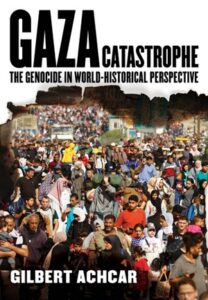
| The Gaza Catastrophe: The Genocide in World-Historical Perspective |
| by Gilbert Achcar |
| (Oakland, CA: University of California Press, 2025) |
Gilbert Achcar is a prolific and perceptive socialist intellectual of Lebanese origins whose writings over the last two decades and more have illuminated the most salient issues emerging from the Middle East and North Africa region. He has fearlessly addressed some of the most contentious questions, deploying a consistently humane, rationalist, secular, and materialist analysis. Achcar excels at illuminating the “big picture,” conjoining his broad historical understanding of geopolitics with detailed understandings of the majority Arab region informed by his personal experiences as a political militant. He was a leading member of the Lebanese Revolutionary Communist Group affiliated with the 4th International and is currently a member of the British ecosocialist organization Anti*Capitalist Resistance.
The subtitle of Achcar’s latest book, The Gaza Catastrophe: The Genocide in World-Historical Perspective, announces his critical method and principal intervention in the debate over Israel’s devastation of Gaza and its meaning. That method was deployed in his previous influential works, The Clash of Barbarisms (2002) which analyzed the post-9/11/2001 world order, and The Arabs and the Holocaust (2010 and 2025) which critiqued both the Zionist instrumentalization of the memory of the Holocaust (in Europe the Hebrew word Shoah, or catastrophe, is more commonly used) and Arab Holocaust denialism. Similarly, his two books on the Arab popular uprisings that erupted in 2010-11 and again in 2019, The People Want (2013 and 2022) and Morbid Symptoms (2016), argue that these region-wide upsurges of mass protest were impelled by the failures of the regimes of capital accumulation and neo-patrimonial governance and marked only the beginnings of the historical process of their unraveling.
The Gaza Catastrophe is a collection of essays, some written before October 7, 2023, and some since then, that insist that the Hamas-led attack on Israeli military and civilian targets on that day and Israel’s subsequent genocidal retaliation are not anomalous eruptions of violence in the history of Israel/Palestine. Rather, they are a continuation of the historical and political trajectory of the Zionist settlement project and the Nakba of 1948. In addition to this long-term structural analysis, the essays offer a meticulous description of specific events since October 7, 2023, and reflections on Israeli and Palestinian politics.
Achcar understands the Gaza genocide as a symptom of the decline of the “Atlanticist international liberal order.” As he argued in an interview with Jacobin, that order “has always been fiction.” But the Gaza genocide represents the era of “the decadence of Western liberalism” and “constitutes a watershed in world history.” (2)
Locally, the genocide was a continuation of what Dahlia Scheindlin termed the “seismic shift” to the right in Israeli society in response to the Second Intifada. (33-34) The November 2022 parliamentary elections brought two messianist-fascist religious Zionist parties into the Israeli government. Their votes in the Knesset (parliament) ensure that Benjamin Netanyahu will not be exposed to jail time should he be convicted in any of his three ongoing trials for corruption as long as he remains prime minister. Consequently, messianist-fascists, in alliance with “ordinary” fanatical right wingers, are the locomotive driving Israel’s policies. Years before October 7 they had been agitating for Israel to annex the West Bank while their settler supporters engaged in pogroms aimed at dispossessing and ethnically cleansing Palestinians from ever-wider areas of the region.
The most valuable new element in Achcar’s book is the introductory essay (of about 50 pages) written for this volume. Here he presents a careful argument that Israel’s tactics in its attack on Gaza – bombing areas of civilian habitation, denial of food and medical supplies, destroying infrastructure – fit the definition of genocide specified in the Convention on the Prevention and Punishment of the Crime of Genocide that came into effect in 1951. Moreover, Western powers, especially the United States, have been fully complicit in this crime. He quotes then-Minister of Defense Yoav Gallant’s description of Palestinians as “human animals,” one of many violently racist statements of Israeli political and military leaders that announced their intention to violate the Genocide Convention. (39)
Already in November 2023 the New York Times had cataloged 18,000 genocidal statements by Israelis on X and reported 286 statements by prominent Israelis potentially inciting unlawful behavior. The Times noted that their, “cumulative effect… normalize[d] public discussion of ideas that would have been considered off limits before Oct. 7: talk of ‘erasing’ the people of Gaza, ethnic cleansing, and the nuclear annihilation of the territory.”
The roots of Israel’s genocidal operations in Gaza are in the “Dahiya doctrine” implemented during Israel’s 2006 invasion of Lebanon that posits using disproportionate force and “prioritize[ing] damaging assets over seeking out each and every launcher” and “target[ing] economic interests and the civilian centers of power….” (33-35) This is augmented by striving for “zero risk” to Israeli soldiers which “encourages unrestrained fire with no concern for civilians,” as Israeli political scientist Prof. Yagil Levy wrote in Haaretz. (36-37)
Alongside his systematic criticism of Israeli apartheid, expansionism, ethnic cleansing, and genocide Achcar sharply denounces Hamas’s misogynist and undemocratic political regime, which provoked demonstrations against its rule in Gaza in the summer of 2023. (13-14) He regards Hamas’s military strategy as “plainly irrational,” ironically quoting Yahya Sinwar’s 2018 quip, “Who really wants to confront a nuclear superpower with four slingshots?” (17) Achcar regards Hamas’s reliance on armed struggle as a mystical delusion and politically counterproductive, concluding, “There is no possible vindication for what has been the most catastrophic miscalculation ever in the history of anticolonial struggle.” (24)
Achcar rejects armed struggle against Israel because it plays in the court where Israel has an overwhelming advantage. Instead, he favors “mass nonviolent struggle…epitomized by the First Intifada.” (17) As early as 2009 he argued that “no rational strategy in confronting the Zionist state is possible without combining the Palestinian and Arab struggle with an effort to split Israeli Jewish society from within.” This entails “[t]ransforming (the Jordanian capital) Amman into an Arab Hanoi” and detaching a significant portion of Israelis Jews “from the Zionist mindset.” (19-20)
In light of the Trump administration’s weaponization of spurious claims of antisemitism to suppress support for Palestinian rights and assault the entire edifice of American liberal education, the Appendix to the volume is painfully relevant. Drafted by Achcar and Raef Zreik, academic co-director of the Minerva Humanities Center at Tel-Aviv University, and endorsed by 122 Palestinian and Arab intellectuals, the statement on “Palestinian Rights and the IHRA (International Holocaust Remembrance Alliance) Definition of Antisemitism” retains its power as a forceful rebuttal to claims that critiques of Israel, no matter how vociferous or fundamental, constitute antisemitism. Originally published in The Guardian in November 2020, the statement remains relevant and a monument to the vitality and moral clarity of leftwing Arab thought despite the domination of the region by kleptocrats and autocrats.
The kind of Palestinian and Arab liberation struggle that Achcar envisions, and even more so the prospect of winning any significant number of Israelis to support it, may seem fanciful in the shadow of “the first genocide…executed by a technologically advanced state since the final defeat in 1945 of the far-right Axis powers….” (2) Achcar is fully aware that for the foreseeable future, the prospects are grim. The messianist-fascist current in Israeli politics is an emblematic component of burgeoning neo-fascist forces in France, Germany, Belgium, Netherlands, the UK, the United States, and beyond – countries that have rendered material aid to Israel’s Gaza genocide and suppressed their own domestic oppositions to it. The discrediting of the Atlanticist international liberal order means that even if the International Court of Justice or the International Criminal Court render verdicts convicting Israel and its leaders of genocide, they will be largely unenforceable.
Nonetheless, Achcar’s engagement with a wide array of left-wing Arab forces as well as many Israeli Jewish oppositional intellectuals whose arguments he quotes generously, allows him to imagine a different future for the Middle East and North Africa even as the forces that may bring it about are weak and scattered today. No economic-political-cultural formation is permanently fixed. The unresolved issues of economic distribution, growth, and governance highlighted by the two recent cycles of Arab uprisings may once again come to the fore through popular struggle. The increasingly evident decline of U.S. imperial power ensures that there will eventually be significant shifts in the international and regional balance of power. These changes will enable political options that are not visible or considered “realistic” today to emerge.
 If you’ve read this far, you were pretty interested, right? Isn’t that worth a few bucks -maybe more? Please
Leave a Reply