Place: United States
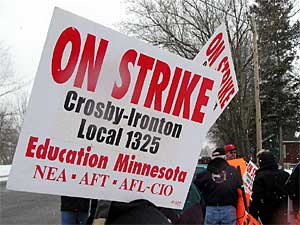
Workers are in no way responsible for the economic crisis of capitalism. This would be or at least should seem to be obvious to socialists. Noncontroversial as it may now be, this has not always been the case. There have been socialists — quite outspoken in their time — who had attributed past turndowns to a profit-squeeze triggered by cumulative decades of militant wage demands.
The New York Times ran a truly despicable story on its front page today. The article, by Scott Shane, argues that Pfc. Bradley Manning is not being treated so badly. But what moves this piece from the category of apologetics to contemptible is its opening paragraphs that try to contrast the plush circumstances of WikiLeaks founder Julian Assange with the grim conditions under which Manning is being held:
Stephen Steinberg’s Boston Review article “Poor Reason: Culture still doesn’t explain poverty“ is a breath of fresh air, reminding us that the path toward ending poverty is creating decent jobs for everyone.
New York City plans to have even more inaccessible taxis
Note: This article begins a series by Richard Greeman. Longtime socialist and international activist Richard Greeman is best know for his studies and translations of Victor Serge, the Franco-Russian novelist and revolutionary.
Christina Romer, the former chair of the President’s Council of Economic Advisors, argues in today’s (October 24) New York Times that “Now Isn’t the Time to Cut the Deficit.” Her argument, which is unexceptional among liberal economists, is simply that “tax cuts and spending increases stimulate demand and raise output and employment; tax increases and spending cuts have the opposite effect.” This, she reassures her readership, is a “basic message of macroeconomics.”
Tomorrow, Oct. 2, I will be marching in the Socialist Contingent at the big march in Washington, DC.
We will gather at 10am at 12th and Constitution and march with the Peace Table. Join us if you can!
I read with keen interest 2 recent articles on the New Politics website: “Card Check: Labor’s Charlie Brown Moment?” by Robert Fitch, and “Does ‘Union Democracy’ Undermine ‘Solidarity?” by Herman Benson.
A note on "Mean Bastards": This short piece, posted after the death of George Steinbrenner, has received a kind of confirmation in Ellen DeGeneres walking out on her five year contract worth tens of millions with "American Idol." I had criticized Simon Cowell (a former AI judge) along with Steinbrenner, Trump, etc.
I admire Claudia Dreifus’s interviews with scientists in the New York Times Tuesday Science section, and particularly her attention to women in science, and I know of her honorable history in the left and feminism. So I befriended her on Facebook. There she publicized her book, with Andrew Hacker, Higher Education? How Colleges are Wasting Our Money and Failing our Kids – and What we Can Do About It, to be published by Times Books/Henry Holt on August 3.
All day long, and on into a second day, here in New York, the media have been full of George Steinbrenner. He’s always been a Mean Bastard — even in the Seinfeld version — and that’s how he is memorialized: a Mean Bastard and a Winner. Sometimes he’s represented as a Mean-Bastard-with-a Heart-of-Gold-who-Gave-Money-to-Good-Causes. It would seem paradoxical to be deep in grief over a man universally acknowledged to be a Mean Bastard.
Unions Representing Workers in Canada, Mexico qnd U.S. Explore Merger:
Would Create International Union of One Million Metal Workers and Miners
The United Steelworkers (USW), which represents 850,000 workers in Canada, the Caribbean and the United States, and the National Union of Miners and Metal Workers (SNTMMRM), known as the Mineros, which represents 180,000 workers in Mexico, have announced plans to explore uniting into one international union. The agreement to begin exploration of a merger was signed on June 21.
It has been more than a year since Barack Obama was inaugurated as the first African- American president of the United States. Despite the obvious historic significance of his election, Obama’s actions to date make it very doubtful that his presidency will alleviate the persisting conditions of racism, discrimination, and general inequality that continue to shape the experience of most African-Americans in the United States.
Canadian author Margaret Atwood famously described the border between our country and the United States as the world’s longest “one-way mirror.”
I was sitting in the homeless unit of the Grove Hall Department of Transitional Assistance (welfare department) chatting with some women. One was living in a homeless shelter in Saugus, a town on the north shore of Massachusetts; the other was applying for shelter. They were ashamed to be here. They said that they had worked and held responsible jobs. Life had dealt them raw blows. One had to leave her job because of an injury to her spine that seemed to require endless treatment, and she did not know when she could return to work.
Stephen Jay Gould, the palaeontologist and science writer who died last year, wrote — brilliantly — on a bewildering series of subjects, but he is perhaps best known for his contribution to four: general evolutionary theory; the sociobiology debate; the relationship between science and religion; and the study (or critique of it) of intelligence testing.
What John Sweeney did unto Lane Kirkland in 1995 may now be done unto him. On September 18, this year, Sweeney announced he would run for reelection as AFL-CIO president, along with Rich Trumka, secretary-treasurer, and Linda Chavez-Thompson, executive vice-president. But his term of office doesn't expire until mid 2005, almost two years to go.
In the days and weeks following the September 11, 2001 Al-Qaeda terrorist attacks in the northeastern United States, there was a sudden proliferation of U.S. flags and other patriotic imagery in public libraries across the nation. U.S. public libraries have traditionally displayed U.S. flags inside or atop their buildings, even though they are financed by local and state tax money and receive little if any federal funding. But the new patriotic décor went well beyond any simple statement of solidarity with the nation in a time of crisis.
- « Newer Posts
- 1
- …
- 63
- 64
- 65
- 66
- 67
- 68
- 69
- …
- 72
- Older Posts »