Place: Puerto Rico
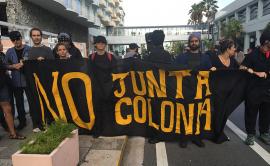
The situation at the University of Puerto Rico is framed within a context of a 10-year economic depression and unsustainable debt crisis, which was meant to be remedied by the 2016 Puerto Rico Oversight Management Economic Stability Act (PROMESA), signed by President Obama, and its federal Fiscal Control Board (Junta de Control Fiscal, the word Junta in Spanish is politically charged). Similar to what was presented at the conference this weekend regarding Greece, South Africa and Mexico, the public university became, throughout the second half of the twentieth century, a vehicle by which many people have escaped poverty.
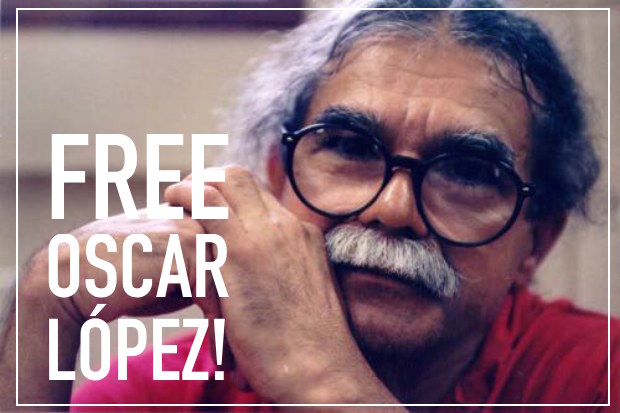
Oscar López Rivera is the longest-held Puerto Rican political prisoner in U.S. history. He has now served 35 years in U.S. federal prisons, including 12 in solitary confinement. The movement calling for his release has intensified, broadened and strengthened in the last few years.
In 2006, the University of North Carolina Press published Puerto Rico in the American Century, a history of Puerto Rico since 1898, written by César J. Ayala and I.
For the many people who have engaged in the struggle for Puerto Rico’s independence, July 25 has a special significance. On that date in 1898, U.S. troops invaded Puerto Rico, beginning a period of U.S. colonial domination on the island that continues to this day. The United States invaded Puerto Rico, along with the Philippines, Guam and Cuba, in the setting of the Spanish-American War. That war was the opening of what would be the menacing role and predatory nature of the U.S. capitalist class in the Caribbean, Latin America and the entire world.
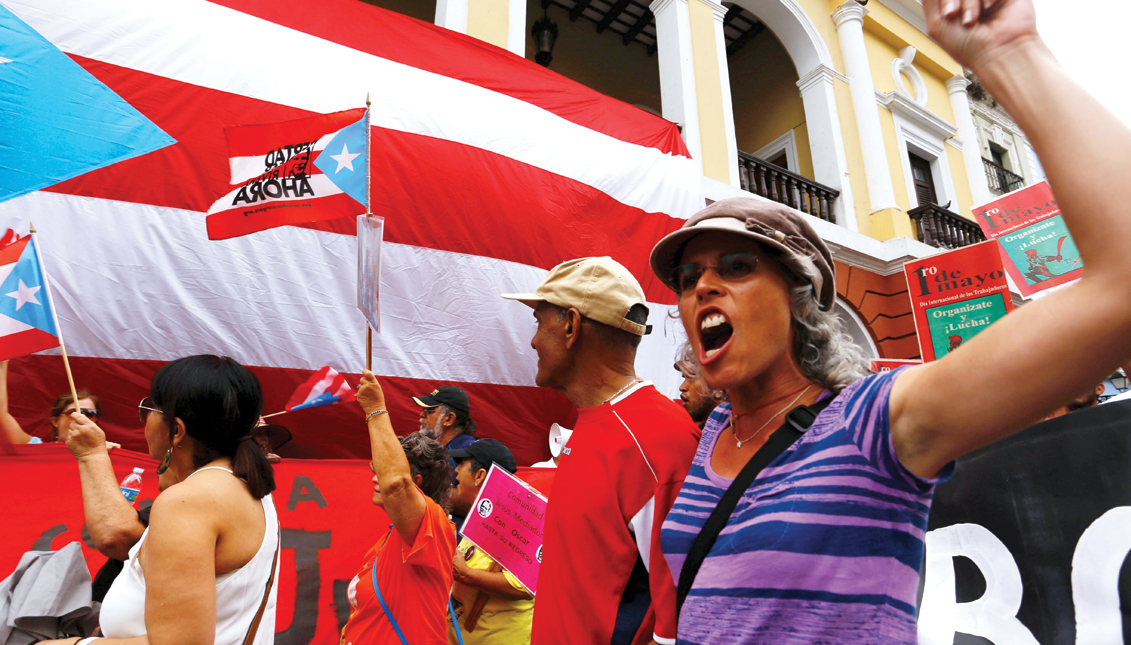
 After ten years of economic contraction, many of the citizens of Puerto Rico find themselves watching the secular decomposition of a reality that in its heyday was painted by many as one of relative socio-economic welfare.

Puerto Rico is undergoing a profound fiscal crisis. Our country is besieged by the big interests of Wall Street’s credit agencies and vulture funds, which as they’ve done in other parts of the world, such as Spain, Greece and Argentina, only seek an uncontrolled increase in their profits. These profits come at the cost of great sacrifices to working people, which include drastic cuts to social services that will have a special impact on education and health care.
In order to impose their inhumane demands, they use their powerful influence within government structures, in the courts and in the mass media to guarantee payment of the immoral and odious debt, with no concern for the deterioration of our quality of life and the elimination of hard-won labor rights. They establish, de facto, a dictatorship of oligarchic and monopoly capital over the whole of society, the working class majority stripped of the financial resources needed to insure a dignified subsistence.
 In a recent op-ed in the New York Times, Nelson Denis describes the horrendous economic situation in Puerto Rico and compellingly shows the source of the problem to be the continuing colonial exploitation of the island by the U.S. government acting on behalf of key U.S.
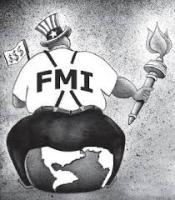
Paul Krugman’s analysis of the Puerto Rican debt crisis has subtle problems, but with big policy implications. Overall, his piece hits key points that other economists continue to miss: 1) Puerto Rico’s fiscal crisis is closely related to its economic depression, 2) the government patched up the problem with borrowing, instead of going to the root of it, 3) Puerto Rico’s low rate of labor force participation is not necessarily a result of welfare, 4) the situation is exacerbated by the Jones Act, 5) too much austerity can be self-defeating, and 6) it would be a terrible idea to give the hedge funds what they want (destroying the island’s education system in the name of fiscal responsibility). All of these points demonstrate Krugman understands the Puerto Rican case better than many Puerto Rican policy makers and economists. However, the subtle problems in his piece should be further discussed.
For the many people who have engaged in the struggle for Puerto Rico’s independence, July 25 has a special significance. On that date in 1898, U.S. troops invaded Puerto Rico, beginning a period of U.S. colonial domination on the island that continues to this day. The United States invaded Puerto Rico, along with the Philippines, Guam and Cuba, in the setting of the Spanish-American War. That war was the opening of what would be the menacing role and predatory nature of the U.S. capitalist class in the Caribbean, Latin America and the entire world.
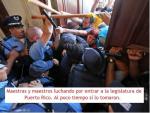 On Monday June 29, the Governor of Puerto Rico, Alejandro García Padilla, delivered a live message to the people of Puerto Rico stating that the government’s $73 billion debt is unpayable. The governor stated, “The public debt, considering the present level of economic activity, is unpayable”.
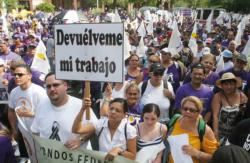
In this brief essay we offer a general and immediate overview of the socioeconomic situation in Puerto Rico. We do it while recognizing that such an analysis is incomplete if the historical, institutional, and political dimensions within the uneven development of capitalism are left out. In this particular case we do not explicitly deal with the colonial relationship of the island with the United States or provide a structural analysis of the economy (these dimensions will be treated in a forthcoming comprehensive article).