Place: North America
The financial crisis that began in 2008 has accelerated many economic trends already at work in the neoliberal period of capitalist development. Wages continue to decline, the class struggle bursts out in contradictory fits and starts at the same time as the societal value of work, and therefore the people who do it, continues to depreciate.
Most of the current literature on the international education crisis gives little to no big-picture context for planning a fight back. Given the parochial view of most popular education authors, many earnest, well-intentioned proposals for fight back are written within parameters the ruling class tolerates.
The high point of social radicalism in America was the Continental Congress of Workers and Farmers for Economic Reconstruction in Washington, DC on May 6 and 7, 1933. Delegates came from around the country in response to the call from a few hundred prominent established leaders of unions, farmers’ organizations, cooperatives, the Socialist Party, student groups, organizations of the unemployed. Signers of the call came from thirty-one states and the District of Columbia. Every organization invited to attend was asked to send two representatives.
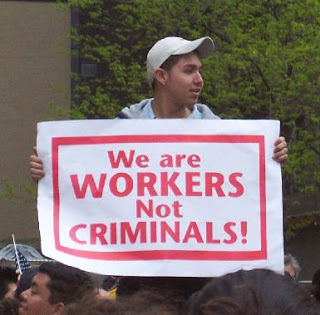
We need an immigration policy based on human, civil, and labor rights, which looks at the reasons why people come to the United States and how we can end the criminalization of their status and work. While proposals from Congress and the administration have started the debate over the need for change in our immigration policy, they are not only too limited and ignore the global nature of migration, but they will actually make the problem of criminalization much worse. We need a better alternative.

As the housing crisis plows through our neighborhoods, it leaves behind the same bleak scenes. The former owner separated from her home, her neighbors, her children’s schools, and possibly her children themselves ― a tragedy anonymous to millions of analogous others across the country. Neighbors staring down the dead, wall-eyed windows of the vacant homes on their block and seeing the promise of rising crime and falling attendance at block parties.

Picture yourself going into a job interview, as many readers of this publication no doubt recently have done or will do in the future. You have a solid record of experience relevant to the position, but you will still need to stand out in a large field of candidates for the same job. Imagine your employer asking the usual questions about your background and suitability for the job, which you handle with ease. Then comes the question: “You checked the ‘yes’ box for the question on whether you have been convicted of a crime.
When Herman Benson writes about the labor movement, I read with interest what he has to say, knowing that his last 50 years as head of the Association for Union Democracy (AUD) represent only the most recent part of an even longer career in the labor movement that began when he was a machinist in the auto industry and a member of the United Auto Workers after World War II.
If you’re a friend of labor, liberal or radical, Rich Trumka’s invitation applies to you. He’s asking for your thoughts on how the AFL-CIO can get ready for the future. (As you know, unions have not been doing so well these days, and maybe someone can come up with some good ideas.) Toward that end, he posted questions on the internet submitted by seven presumed notables, including former labor secretary Robert Reich and In These Times labor editor David Moberg. Within a few electronic moments, over a thousand comments poured in.
A reform caucus in the Newark Teachers Union (NTU) made remarkable gains in the union election that ended on Friday. Out of about 3,000 members eligible to vote, 1,200 NTU members cast their ballots. (Sadly, that proportion is about par for US unions.) The New Visions candidate for President lost by only 9 votes to the long-time chief, Joe Del Grosso, who will now serve his 10th two-year term.
The following letter from me was published in the Boston Globe on June 26, 2013.
June 18, 2013
The Boston Globe
To the Editor:
Richard Roman and Edur Velasco Arregui. Continental Crucible: Big Business, Workers and Unions in the Transformation of North America. Halifax & Winnipeg: Fernwood Publishing, 2013. 148 pages. References. Index. Paperback. Price: $19.95 CAN.
|
Michael Albert, Jessica Azulay, and David Marty
The Indiana University (IU) student strike of April 11-12, 2013, was an important milestone in new student activism. The March 25 issue of The New Republic offers a lengthy piece by Rutgers professor David Greenberg, “Agit-Prof: Howard Zinn’s Influential Mutilations of American History.” The essay presented as a review of Martin Duberman’s Howard Zinn: A Life on the Left (2012) [read the review by Ron Briley, the book editor of History News Network (HNN), here Logos, the online, on point and highly readable journal of modern society & culture features in its most recent issue a symposium on the future of US unions. In addition to a piece by me [“So Why Don’t We Have Better Unions?“] are contributions from Melvin Dubofsky, Bill Fletcher Jr., and Steve Early and Rand Wilson. All worth reading. Enjoy. The ghost of Reagan’s welfare queen still hovers over conservatives. She is black. She is a large part of Mitt Romney’s 47 percent of moochers, and the “takers” that conservatives talk so much about. Most people don’t talk about welfare or know much about it, but conservatives, who also don’t know much about it, use it as a threat when they seek reelection or talk about policy. Republicans, and some Democrats, declare that welfare reform was a success because it brought the rolls down and put “free loaders” back to work. Christopher Dorner's brutal killings of multiple people vaguely associated with the Los Angeles police have caused debates over both the department's deployment of manhunt drones and the disastrous trigger-happiness that had them showering bullets on any hapless civilian with the misfortune to d Which came first, your interest in politics or your interest in cartooning? They actually began together, when I was 13 or 14, with a badly drawn, over-the-top, heartfelt diatribe against my mother’s consumerism. Even though I was just a white, middle class teenager in Connecticut, I was indignant about inequality and injustice. How did you get started as a political cartoonist? Teachers and teacher unions have been under neoliberal attack since the Carnegie Foundation’s 1983 Nation At Risk. However, since the appointment of Arne Duncan as Obama’s Secretary of Education they have been on the sharp-end of the neoliberal attack on working people. Teachers are routinely demonized as ineffective, privileged public employees who are virtually unaccountable. In June 1966, protesting the shooting of James Meredith, the solo freedom marcher, Peggy Terry was among the crowds in Greenwood Mississippi who, in response to Stokely Carmichael’s question "What do you want?," had roared "Black Power! Black Power!" While others were bewildered, Terry recalls "there was never any rift in my mind or my heart. I just felt Black people were doing what they should be doing. NP: For four years we’ve had an African-American president, and that has led some people to argue that we are living in a post-racial society. What do you think of this argument?
Please Donate or Subscribe to New Politics!
|