Place: New York City
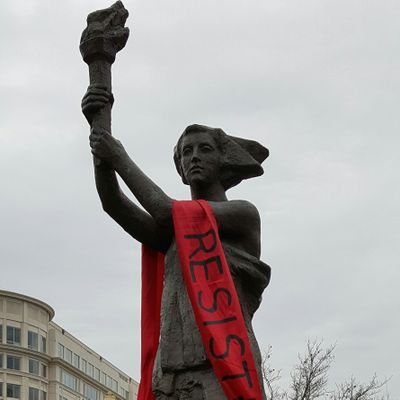
The first few weeks of Donald Trump’s presidency has seen an amazing explosion of mobilizing to oppose him and his administration on oh-so-many levels. And that has been heartening.
But it is not enough.
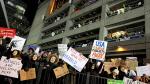
It’s been two weeks since Donald Trump’s inauguration sparked some of the largest rallies in American history. Each week since has also seen demonstrations, culminating in those that broke out at airports across the country at the end of January to protest the president’s new Muslim ban barring travel from seven predominantly Muslim countries. Mass protests are in large measure a bellwether of popular sentiment. They carry an implicit threat that politicians who defy the will of the people will be voted out, but that threat must be channeled strategically, or it will dissipate.
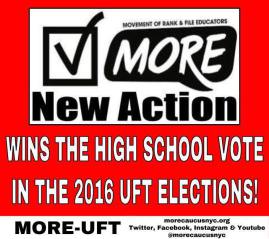
The good news is that the MORE/New Action slate won the seven seats on the UFT Executive Board elected by high school teachers. Furthermore, voter turnout increased across the board from roughly 18% in 2013 to roughly 24% in 2016. Finally, the absolute number of votes for the opposition increased in every division. However, still less than one-quarter of UFT members participated in this election. And the slight increase in voter turnout benefited the ruling Unity caucus at least as much as it benefited MORE/New Action.
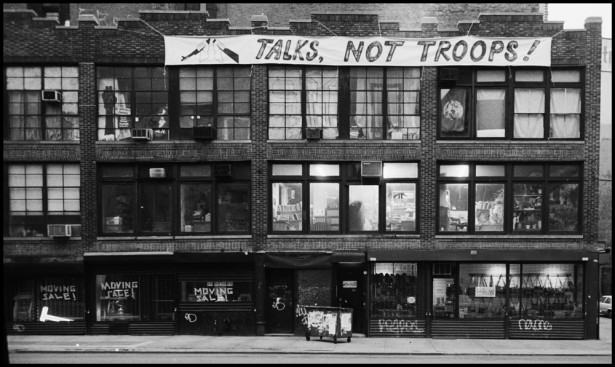
Nearly 20 years ago, as I left the War Resisters League, or WRL, offices in lower Manhattan for the first time, I noticed that my fingertips were covered in black soot and ink. My hands were full of tracts and leaflets, and I had been looking through nonviolence training materials for the last hour. I tried to rub the dirt off onto my jeans, but it wouldn’t budge and later even soap and water had to work really hard.
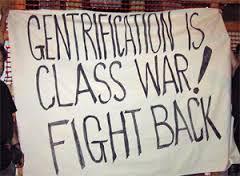
On Tuesday, March 22, the New York City Council is expected to pass Mayor Bill de Blasio’s housing and zoning plan, which permanently ties the creation of a relatively small amount of not-that-affordable housing to the massive co-production of luxury housing.[i] It is being sold as the best we can do with the tools that we have. It is not. Instead, it puts to work the most lucrative and least effective tools available, and locks the city into repeated cycles of gentrification and displacement.

Puerto Rico is undergoing a profound fiscal crisis. Our country is besieged by the big interests of Wall Street’s credit agencies and vulture funds, which as they’ve done in other parts of the world, such as Spain, Greece and Argentina, only seek an uncontrolled increase in their profits. These profits come at the cost of great sacrifices to working people, which include drastic cuts to social services that will have a special impact on education and health care.
In order to impose their inhumane demands, they use their powerful influence within government structures, in the courts and in the mass media to guarantee payment of the immoral and odious debt, with no concern for the deterioration of our quality of life and the elimination of hard-won labor rights. They establish, de facto, a dictatorship of oligarchic and monopoly capital over the whole of society, the working class majority stripped of the financial resources needed to insure a dignified subsistence.
The last protest of the day of the New York City Climate Protests was at a Broadway theatre where Gov. Cuomo was scheduled to attend. It was a spirited demonstration complete with a little orchestra and playful costumes focused on persuading Cuomo to veto the Port Ambrose Liquefied Natural Gas (LNG) plant off the coast of Long Island right near JFK airport. Opponents argue that it is very dangerous security risk, terrible for the environment, and would kill the chance for a 700-megawatt wind farm that would create 17,000 local jobs.

Review of Michael Gould-Wartofsky, The Occupiers. New York: Oxford University Press, 2015.
Occupy was the largest political mobilization of my lifetime. The explosion of energy it produced gave the feeling of perpetuity, with thousands of volunteers supporting each other through donations of food and standing together in solidarity against the police. But as the encampments became rooted, many had to check their excitement with a growing sense of disillusionment. It was clear that the Occupy strategy, and how it played out in practice, was rife with weaknesses that were ultimately exploited by those who sought to destroy Occupy and the discourse that it created.
May First/People Link is being attacked in a Denial of Service attack that is unprecedented in its length and viciousness. We have been fighting off this attack for over three weeks now.
We are convinced that the attack is political. We know how the attackers are targeting us, we know they are targeting the entire organization’s systems and we know that they are carefully monitoring our responses because they are quickly adapting to every move our technologists make to return us to service.
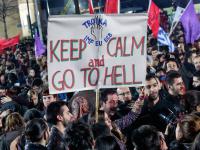 Since the pressures of international financial capital and its subservient political elites will continue with the same if not greater intensity, it is also certain that a new cycle of social mobilization in Greece and the rest of Europe will begin again.
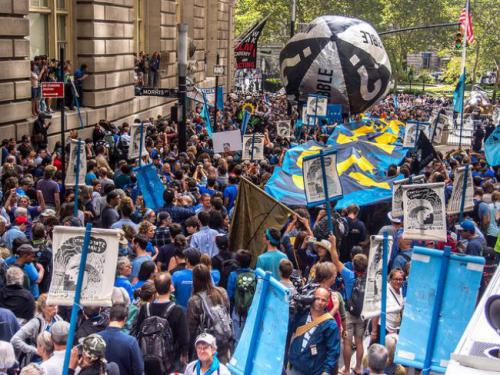
[Eds.: On Monday, March 2, 2015, in New York City a trial begins for eleven activists who are refusing to plead guilty to disorderly conduct and pay fines for taking part in a climate sit-in in Manhattan's Financial District last September. The Flood Wall Street Eleven plan instead to use their trial to illustrate that the bankers who finance climate change are the real harbingers of disorder. Below is a collective statement from the group. You can sign a petition in their support here.]
In order to solve a problem, you must first identify its’ source. . .

Mike Alewitz, the internationally famous muralist, is fighting for the installation his mural “The City at the Crossroads of History” at the Museum of the City of New York. Commissioned by the Puffin Foundation, the museum has refused to install the piece because of objections to its content. Alewitz calls this a case of censorship, while the museum argues it is a question of “curatorial standards.” There is a petition campaign in support of the installation of the mural. (Find at the foot of this article links to a slideshow of the mural, an interview with Alewitz, and the petition site.)
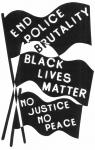
The Black Lives Matter Movement is alive and well. If it has for the moment—under political attack and facing the winter’s sub-freezing temperatures—withdrawn from the streets, it has done so to plan a new stage in the fight for justice for African American victims of police racism and violence. As many as 400 people, mostly young people of color, attended the eight-hour long Black Lives Matter Gathering at the famous Riverside Church in Manhattan on January 30 where in workshops, trainings, and plenary sessions it seemed that a new direction was being set for the movement.
 In the first days of August 2014, the Rosa Luxemburg Stiftung—New York Office brought together one hundred influential leftists from across the United States, Canada, and Europe for an “un-conference” on socialist strategies. The retreat was held at the Edith Macy Center, located in Westchester County about an hour north of New York City.
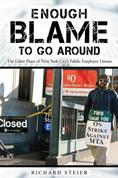 Review of: Richard Steier, Enough Blame to Go Around: The Labor Pains of New York City’s Public Employees. Albany, New York: Excelsior Editions/State University of New York Press, 2014. 304 pp. US$24.95 (paperback).
Two things I know to be true about Richard Steier. He is the best full-time reporter on the New York City labor beat. He is also the only full-time reporter on the New York City labor beat.
There’s blood on many hands tonight. Those that incited violence on this street under the guise of protest, that tried to tear down what New York City police officers did everyday. We tried to warn it must not go on, it cannot be tolerated. That blood on the hands starts on the steps of city hall in the office of the mayor.
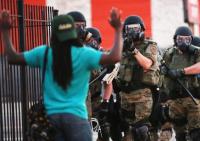 New York, NY — Activists issued a scathing statement this afternoon in response to recent attempts by the NYPD to silence the efforts of citizens seeking justice for victims of police violence.

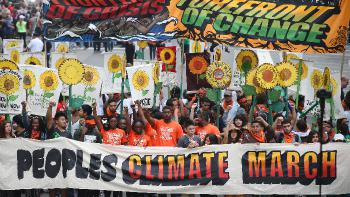
The Climate Convergence with its more than one hundred workshops, its large plenary sessions, and its miles-long mass march of more than 300,000 people, the largest climate protest in American history, represents a turning point for the environmental movement. The gigantic and passionate parade of indigenous people, ethnic groups of all sorts from everywhere in the country, students by the tens of thousands, neighborhood organizations by the dozen, several major national labor unions, and every conceivable sort of ecological cause tramping through New York City carrying huge banners and giant puppets, striding and dancing to the tunes of 29 marching bands, put the issue of the environment and climate change on the national agenda as never before. The national climate movement has arrived—now what will it do?

The Climate Convergence—an opening session on Friday, a hundred meetings on Saturday, a huge march and Occupy the U.N. Climate Summit on Sunday, and other actions on Monday such as #FloodWallStreet (Stop Capitalism. End the Climate Crisis.)—began in New York City on Friday night with an indigenous prayer, speeches from climate activists, and a powerful call to action to save the planet. Organizers have worked to make this a turning-point event.
The Climate Convergence has come to New York to challenge, protest, and attempt to change the climate policies of the corporations, national governments, and the United Nations which is holding its Climate Summit this week in New York.
From teachers to transit workers, civil servants to electricians, the People’s Climate March will have more organized-labor participation than any environmentalist effort in U.S. history.
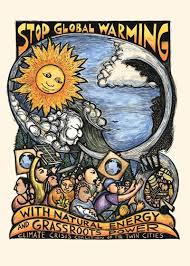
Today it often feels as though we are hopelessly mired in apocalyptic thinking, both in our social movements and in popular culture.
- « Newer Posts
- 1
- 2
- 3
- 4
- 5
- 6
- Older Posts »