Blog

  • New faces and base-building

               Image In studying urban teacher preparation (the hat I wear professionally when I’m not thinking about teacher unionism), I examine how school practices and organization influence teachers and students.  To understand what goes on inside classrooms we have to look at the welter of powerful influences within schools and outside their walls.  Blaming “teacher quality” for unequal academic achievement is an ideological assumption with little evidence.

                This same broader view explains why union officers are only as good as the movement that supports them.  No matter how talented, smart, or radical an individual activist is, s/he must depend on the wisdom and courage of the movement s/he represents.  Officers need to be directed and supported by members. For that to happen, the union needs democratic norms and policies.  Another way officers are supported and nudged is through a caucus.  NEA has semi-official committees that are called caucuses, and this has caused some confusion for teachers who are new to labor union activity.  A union caucus is really an internal political party.  It is independent of the union apparatus and receives no funding or help from the union.  There is no time on the regularly scheduled agenda of the union for caucuses to meet.  Within the caucus, union officers have no special power.  They are equals.   While their position within the union gives them insights and information other union members may not have, it should be understood that their role as officers has removed them from the day-to-day concerns and perspective of members. 

                If a caucus is primarily an electoral vehicle for a few talented people, it cannot serve the function it should. Moreover, using a caucus primarily to elect individuals miseducates members about what’s needed – an entirely different kind of union, one that draws its strength from member activity in their schools.  Because the unions are so decrepit, sometimes what is conceived of as an educational campaign morphs into a real contest and the reformers win.  But more often, activists are seduced by the illusion that if only they could replace the existing officers, the union would be substantially different.
                Without their realizing it, activists who think this way have adopted the strategy the Communist Party used in its union work, a strategy imitated by unions like  SEIU:  mobilization of members on specific campaigns and advocacy of social justice –  without building the union on the shop floor, that is, strengthening union democracy and having members direct the union. This situation gives elected officials power to speak on behalf of the workers (often for the leadership's own political purposes) without empowering them.

                New faces at the top are limited in what they can accomplish on their own.  Newly elected officers often face the problem of long-time staff who have their own ideas about how to organize. Officers can push for democratic practices but their position on the top inhibits  their ability to make change from below.  Both factors weaken the officers’ capacity to mobilize members and build the union in the schools.

                Our enemies are quite aware of teachers’ fears and the unions’ political weakness with the public.  Officers need a strong base in the schools. If/when teachers don’t have the legal right to bargain collectively or if their union can no longer defend them, they have to depend on one another in ways that are immediate and personal. We cannot alter power relations in the schools without (re)building the union on entirely different premises, starting with the idea that “the union” is not the person who is the president or the officers and staff.  Of course leadership counts – as does teacher quality.  But as with teacher quality, the quality of union officers depends on their being supported and being absolutely committed to leading members who will direct them. The education of union officers begins with their being members of reform caucuses committed to union democracy, building the union’s presence in the school, as well as fighting for social justice and mobilizing members in specific struggles.

                Coming soon: The National Union of Teachers (NUT) which represents teachers in the UK and Wales, is hosting a research conference May 24-25 at its London headquarters about how to build international solidarity of teachers unions. Susan Robertson, a brilliant scholar, will start off the event. The event is path-breaking.  Try to join us.

                In June and July I’ll be blogging less frequently to catch up on research and revise “Urban Teaching: The Essentials,” with help from Herm Jerome, a NYC teacher and union activist who serves on the Board of Directors of Teachers Unite.   You can still reach me with comments  at  drweinerlo@gmail.com.  And I’ll be posting (those less frequently) on twitter , Facebook, as well as my blog here at New Politics.

  • Ghana's Invisible Working Class

    Ghana, known for its stability and economic prosperity in the last 50 years, is praised as a model African state. Despite their rise to a middle income country, Ghana is struggling to deal with the rise of Kayayo’s, a destitute working class who go unacknowledged by policy makers. This is the story of an American living in a Kayayo town.

    During his Presidential address on May 1st (still known in Ghana as International Workers Day) President John Mahama began his speech by welcoming the Vice President, the Speaker of Parliament, the Chief Justice and seven other dignitaries before acknowledging the “dedicated and selfless worker of Ghana.” It seems odd that on a day of commemoration for workers, the workers themselves only received a footnote at the end of a drawn out introduction. President Mahama went on to praise the occasion and its importance worldwide, quoting the historical roots of May 1st as the one day each year dedicated to discuss the role of the Proletariat in the marketplace. His praise for the common man was short lived. Only a few sentences later he would apologize for not reaching consensus on an improved minimum wage and address allegations of widespread corruption within the system. All this while simultaneously praising his party for nurturing the ego of Ghana’s working class. Mahama’s speech was everything you would expect from a high profile politician; the use of both praise and apology for the workings of his administration which effectively reduced his message to neutral. This should be expected from any good politician but what was actually contemptible of Mahama's workers day speech was the complete lack of acknowledgment for Ghana's emerging working class: the Kayayo.

    Kayayo (pronounced Kaa-yay-oh), which literally translates to “people who carry heavy loads,” are Ghana's emerging working class. They emigrate from Ghana's rural northern districts to the bustling southern cities looking for employment. Often fitted with high school degrees in Integrated Science, Economics, or General Arts, these young Ghanaians struggle to find any steady employment in their fields. They soon realize their only qualification is their labor power. They are transformed from degree holders to head porters, weaving in and out of busy streets carrying basins on their head full of goods to sell. Everything from loaves of bread to imitation Gucci glasses are sold for a minimal profit. As the African sun sets, Kayayo’s slowly retreat to their living quarters which are notorious for their impoverished housing units. As an American living in Ghana, I am one of the few outsiders to have a firsthand experience of the Kayayo lifestyle.

    My first experience in a Kayayo town occurred when I briefly left my host village in rural north Ghana to meet some expatriate friends in Kumasi, a busy city in southern Ghana. We stayed at a guest house in a secluded area of town, known to locals as “where the white people stay.” After two days of checking Facebook, responding to emails and enjoying hot showers I was ready to return to my mud hut in northern Ghana. My bus was set to leave at 5:00 the next morning. Fearful of walking alone during the early morning hours I decided to call my friend Gabriel, a young man whom I knew from my village in the north. He left the village last year to become a head porter in Kumasi. He offered me a place to stay the night before my departure. I happily accepted. That evening, before leaving the guest house, I said goodbye to my friends, packed my laptop and made sure my bedding was thrown into the dirty laundry basket. Nothing irritates traveler’s more than dirty bed sheets.

    From the busy road side I hailed a taxi and for a small fee was dropped off at a small bus station in Kumasi market town. I exited the cab and was approached by several vendors who pressured me to buy their items. “Parlez-vous Français?” That's my market trick; pretend to only speak French so that vendors will stop bothering you. Ghana, unlike all of its neighboring states, is a not a Francophone country. I continued to the bus station where Gabriel was waiting for me. He immediately hugged me with the same warmth of a close relative who has just stepped off the plane from a long vacation.

    He assured me his house was not far and we began to walk. He wasn't lying. No more than 20 steps behind the bus station was a square structure no larger than a hotel elevator and filled with travel bags and pop culture posters and straw mats. One light bulb inside the small structure provided just enough light to navigate my steps over two people sleeping on the floor and the random assortment of plastic bowls and spoons that littered the ground. Gabriel pointed to a Real Madrid poster on the wall and directly below this was a straw mat to sleep on. I set my bag over the straw mat. Gabriel served me dinner: rice and beans with freshly grounded peppers. We returned to the room to meet his friends were awake and eager to meet me. They assured me that they would keep me safe until the morning. They mentioned that everything in their house was also mine. They’re not spouting idioms, either. While they spoke one man reached over and handed me the last orange that was laying in his corner of the room. Ghanaian hospitality is a constant reminder that this whole country is my second home.

    Before setting off to sleep I was handed a large bucket of water for bathing. I didn’t walk far before Gabriel abruptly stopped me. He removed his flip flops and told me to wear them so I wouldn’t ruin my new American sandals. I opened the door to an empty stall and realized the space was already polluted by a large puddle of stale urine and occupied by three chickens that refused to be chased away. I picked up a small stone and tossed it right above the chickens. The hard clank of the stone and small splash of liquid convinced them to leave. I entered and began my bath, scooping ladels of water over my head. A few minutes later my bucket was empty yet I somehow felt dirtier than when it had been full.

    I dried off, changed clothes, and layed down on my small straw mat with my head against the wall. Next to me was Gabriel, already asleep. Beside him were three of his brothers, sleeping back to back. On the other side of the room lay six other people sleeping back to back with their heads toward the opposite wall and their feet facing me. The two opposite rows of people sleeping back to back created a small walk way banked with dusty feet from a long day of Kayayo work. Throughout the night I was woken up by the sounds of buses starting which rattled the metal ceiling. Crying babies with angry mothers constantly walked by the window. Smoke from burning trash corrupted each breath I took. Daylight was just a few hours away, or so I told myself as I tried to ignore the constant distractions and fall sleep on my straw mat. Early daylight approached unexpectedly and somehow, I slept through my alarm. I scrambled around the room gathering my bag and ran outside to where my bus was loading people. The driver honked the horn impatiently; he was ready to leave. I gave a warm thank you to Gabriel, and hugged him. He assured me we would meet again when he returned home for his sister’s graduation in the coming months. Gabriel waited until the bus left before he turned around to get ready for another day of Kayayo work.

    The phrase used to describe the impoverished living conditions of Kayayo’s is routinely included under an umbrella phrase “the problems of urbanization.” These problems include, at the very least, exposure to crammed living spaces, unclean or lack of necessary resources and exposure to disease carrying insects. It’s a largely academic term that strips away the human experience of Kayayo life. This exact lack of humanism is supposed to be compensated for each year on May Day. Yet the struggle of the Kayayo in Ghana was absent in President Mahama’s May Day speech. This signifies not only willful ignorance by the nation’s top officials but a larger strategy of dismissing a reality of Ghana’s fragile consumer based economy: that it has only benefited a small segment of wealthy citizens while the average Ghanaian is fighting to find a dignified role in the workplace.

    You might be asking yourself an elementary question at this point: why should President Mahama (or anybody else) care about life of the Kayayo? They provide a cheap source of employment in a society that historically doesn’t equate time with labor. It’s an ideal scenario for any business owner. And after all, a necessary ideology of free markets is the ideal of individualism. Why then, you might ask, should you care about the plight of the Kayayo if they don't affect you personally? Around 40 BC the Roman poet Horatius Flaccus advised us well about why we should care. Mutato nomine et de te fabula narrator: Change only the name and this story is also about you.

  • Arundhati’s Demands

    Arundhati Roy, Capitalism: A Ghost Story. Haymarket, April 2014, $15 paperback.

    When you think of ghost stories, you may recall Henry James, Hamlet, or Banquo. Maybe you smell a camp fire, the story going around, the threat of the flame as you extend your arm and that impaled marshmallow over the heat. Or maybe you sense those dying embers, the cool of night taking its grip.

    In Dickens' A Christmas Carol, the ghosts play the role of illuminating something that the world judges to be supposedly good i.e. solid work ethic, but is later evinced by those chain-wielding spirits to be hellish, poisonous, and punitive.

    What chains do Marley’s ghost rattle and bear? The chains of those he’d sacrifice if he would choose Scrooge’s path, the people he’d step on, enslave, chain, if he emulated this old paragon of success. Here, Scrooge is the boss and Marley the worker. It is hard to avoid this Marxist reading of one of English’s most classic texts.

    In fact, Marx, uses the language of the paranormal to describe capitalism, which he said, “conjured up such gigantic means of production and of exchange, that it is like the sorcerer who is no longer able to control the power of the netherworld whom he has called up by his spells.”

    At their core, ghost stories imply the dead will not go away.

    Arundhati Roy’s new book her fourth critical non-fiction book in as many years, is also her most dire. For Roy, capitalism is dead, but in its wake, we are left ill and robbed of our sleep.

    The author of the 1997 Booker Prize winner writes like (and lives like) an explorer, a woman working in the field, mosquitoes, jungle mud, and guerillas at her every step. Her daring is contagious. Now, in this new take on contemporary India, her voice is most confident and hyper-aware.

    In May 2014, India votes in its presidential election. The front-runner Nurendra Modi has been accused by Salman Rushdie and others of allowing a pogrom against Muslims that killed thousands while serving as Minister of Gujarat. For these crimes, the U.S. State Department revoked his visa. The context of Roy’s book seamlessly bridges the political and economic.

    “In India the 300 million of us who belong to the new, post-International Monetary Fund ‘reforms’ middle class—the market—live side by side with the spirits of the netherworld, the poltergeists of dead rivers, dry wells, bald mountains, and denuded forests; the ghosts of 250,000 debt-ridden farmers who have killed themselves, and of the 800 million who have been impoverished and dispossessed to make way for us.”

    How fresh it is to hear such a bold and rugged report on conditions in Indian war zones from which authorities say, “no news must come.”

    Nowhere has capitalism’s rise been faster than India, especially in the Punjab region, where farmers now call the train line, because of the pesticides which they ingest to commit suicide, the Cancer Express.

    Speaking of the at least 2,700 unmarked graves in Kashmir, Roy sarcastically accuses the government. “It is insensitive of the unmarked graves to embarrass the government of India just when India’s record is due for review before the UN Human Rights Council.”

    For Americans, Roy’s demographic may seem distant, but the story of India mirrors the growing wealth disparity and its brutal effects in the United States. In America, four hundred people own the same wealth as half the country.

    Roy adds, “In a nation of 1.2 billion, India’s one hundred richest people own assets equivalent to one-forth of the GDP.”

    What this looks like: private land taken from private citizens and given to private corporations for things such as car manufacturing or even Formula 1 racing.

    This looks like the land of the most expensive dwelling ever built, “Antilla” home to Mukesh Ambani whose twenty-seven story house is so bright that neighboring towns lament, There is no more night.

    India, Roy warns, is now the chain-bearing ghost of its colonial years. Like a climber’s rope, dense, taut, and reliable, Roy’s prophetic prose leads us to daring heights.

    For the rebels, the innocent and the accused, due process does not exist.

    “Most of those involved, prisoners as well as witnesses, cannot read or write. One day, in Dantewada too the dead will begin to speak. And it will not just be dead humans, it will be dead land, dead rivers, dead mountains, and dead creatures in dead forests that will insist on a hearing.”

    Poor farmers, over 400,000 of whom have been imprisoned or relocated, now “await the declaration of the Armed Forces Special Powers Act (AFSPA), which will give the army legal impunity the right to kill ‘on suspicion.’”

    In many villages, especially in Kashmir, there are more soldiers than civilians. Roy describes one female who was arrested in 2011 and tortured in police custody, a schoolteacher named Soni Sori. “Stones were pushed up her vagina to get her to ‘confess’ that she was a Maoist courier. The stones were removed from her body at a hospital in Calcutta, where, after a public outcry, she was sent for a medical check up.”

    Later that year, the superintendent of police who conducted her interrogation was awarded the President’s Police Medal for Gallantry. Sori remains in jail. This is one many examples of such tragedy and torture from the book.

    While Roy repeats some of the revolutionary narrative from her 2011 book Walking with the Comrades, her new work remains fresh and biting.

    Roy is a restless academic in fatigues. She’s a very human writer, down-to-earth, as though she’s sharing a story with us around a campfire. Maybe, it’s a story we think we’ve heard before, but it’s nighttime, we’re cold, and with revolution stirring in Kashmir, the most highly militarized place in the world, we can’t go to sleep.

    Her demands are radical: an end to cross-ownership in business, the end of privatization of all public services, new universal rights declarations for shelter, education and health care, and finally, the prohibition of inheritance.

    Roy knows you don’t want to wait until you’re dead to spot injustice. Then, it’s too late.

  • MEXICO'S PARTY OF THE DEMOCRATIC REVOLUTION AT 25: DISAPPOINTMENT & DISILLUSION

    The Party of the Democratic Revolution (PRD), which was founded in 1989 as the hope of the left, celebrated its twenty-fifth anniversary on May 5 amidst expressions of disappointment and disillusion. The hope that the PRD would become a left political party capable of winning the presidency and a majority in the legislature and changing the face of Mexico has not been fulfilled. The principal founder of the party and repeat presidential candidate, Cuauhtémoc Cárdenas, speaking on the occasion of the party’s twenty-fifth anniversary, said that the Party of the Democratic Revolution is “far from that which we proposed to construct” back in 1989. And its other most important former leader, also a repeat presidential contender, and the party’s biggest vote-getter, Andés Manuel López Obrador, has left the PRD gone off to found a rival left party, the Movement of National Regeneration (MORENA).

    While there is no question that the PRD will continue to play a role in Mexican politics, there is considerable doubt about its leftist character and its value to the country’s working people. The Mexican government, the corporate media, and the two major parties—the Institutional Revolutionary Party (PRI) and the National Action Party (PAN)—have done everything possible to deny the PRD the possibility of winning a presidential election or becoming the majority in congress. At the same time internal factionalism, bribery scandals, alleged involvement with the drug cartels, and the suggestion from others on the far left that the Mexican political system and all of its parties are corrupt and undeserving of support, have over the years discredited the party in the eyes of many Mexicans. The PRD’s problems, some would argue, spring from its birth when elements of the PRI joined with Communists and other leftists to create a party focused on elections.

    The Origins and Growth of the PRD

    In the mid-1980s a new group of “technocrats” trained at universities in the United States took power in the Institutional Revolutionary Party (PRI), advocating neoliberal economic reforms such as privatization of state-owned industries, open markets, and increased foreign investment, as well as cuts in state social welfare spending and a reduction of the power of the labor unions. In reaction to the PRI’s sudden rightward turn, Cuauhtémoc Cárdenas, the son of Mexico’s most famous and beloved modern president, Lázaro Cárdenas, broke with that leadership and established the Democratic Current within the PRI. Then in 1988, Cárdenas left the PRI, formed the National Democratic Front (FDN), attracting support from many on the far left, and ran for president, but lost to his technocratic opponent Carlos Salinas de Gortari, in what most observers believe was a stolen election.

    Following his defeat, C. Cárdenas and his allies Porfirio Muñoz Ledo and Ifigenia Martínez, left the PRI to found the Party of the Democratic Revolution (PRD). This break from the PRI immediately attracted Mexico’s two major leftist organizations that had already worked with Cárdenas in the FDN: the Mexican Workers Party (PMT) of Herberto Castillo and José Álvarez Icaza and the Unified Socialist Party of Mexico (PSUM—Mexico’s pro-Soviet Communist Party—led by Arnold Martinez and Gilberto Rincón Gallardo. It also attracted other smaller parties, some of them much further to the left coming from nationalist, Castroite, Maoist, and Trotskyist traditions. The PRD, originally made up of longtime PRI politicians founded itself involved with leftists whose work had been among peasants and workers or which, in some cases, had been armed guerrilla groups. While the PRD became somewhat more left with the ingress of the old left parties, the historic left itself virtually disappeared from the Mexican scene.

    The PRD took as its symbol the “Sol Azteca,” a yellow, rising sun promising a bright future for the country’s working people. Party leaders pledged to create a party whose leaders would be honest, transparent and responsive to the membership. The PRD’s ideology from the time of its founding until today has been leftist and nationalist, nominally in the tradition of General Lázaro Cárdenas who as president in the 1930s nationalized the foreign oil companies, recognized the industrial labor unions, and distributed millions of acres to poor peasants and indigenous communities. L. Cárdenas also reorganized the state-party by incorporating the labor unions and peasant leagues into it as its constituent organizations, creating the modern Mexican corporativist state-party. His successors affiliated the PRI to the Socialist International, the organization of the European socialist and social democratic parties.

    The General’s son Cuauhtémoc Cárdenas represented the living embodiment of that left, national tradition, though acting within the context of the neoliberal agenda being imposed by the United States, the International Monetary Fund (IMF), and the World Bank, the son’s pronouncements and practice became center-left. López Obrador followed a similar trajectory, left rhetoric giving way to more conservative practice. For example as mayor of Mexico City, he hired U.S. Republican Rudy Giuliani to help him develop a “zero tolerance policy.” The PRD never pretended to be either a working class or a socialist party; it was a self-conceived people’s party fighting for reform. The PRD’s program was only mildly social democratic, its rhetoric populist in the Mexican political tradition, and its practice increasingly compromised by both political bargains and corruption.

    The PRD’s Political Record

    During the 1990s the PRD succeeded in electing several congressmen and then senators as well, winning its greatest number of representatives in both houses in 2006. Since 1997 when Cuauhtémoc won the post, the PRD has won every election for mayor of Mexico City. The party, strongest in central and southern Mexico, also succeeded in winning the governor’s mansion in several states in those regions, tough it also once won the governorship of Baja California Sur. The PRD ran Cárdenas as its candidate for president in 1994 and 2000 and Andrés Manuel López Obrador in 2006 and 2012. Like the 1988 election, the 2006 election was also believed to have been stolen.

    While achieving enough political success to make it Mexico’s second or third political party—after the PRI and the conservative National Action Party (PAN)—the PRD also began to degenerate into just another Mexican political party. The PRD’s internal life became riven by factionalism, the factions generally based on alliances among the various, former left parties that had helped to found the party. If one names only the most important factions, there have been more than half a dozen: the New Left, the National Democratic Left, the National Democratic Alternative, the New Sun Forum, the Political Action Group, the Worthy Fatherland, and the Progressive Movement. In particular the National Democratic Left faction fought for years to wrestle control from of the party from Cuauhtémoc Cárdenas, and for the political offices and perquisites that come with such control.

    Most damaging to the PRD’s reputation were the video-scandals of 2004 in which businessman Carlos Ahumada was videotaped passing money along to various politicians of the PRI, the Mexican Green Ecological Party (PVEM), the PAN, and the PRD. René Bejarano, López Obrador’s personal secretary, was videotaped accepting US$1.45 million. The whole scheme of bribes and tapes seemed to have been arranged in an attempt to discredit López Obrador. Then in 2009 Jesús César Godoy Toscano, a PRD congressman in Michoacán, was accused of having ties with The Family, the drug cartel that controlled the state’s narcotics business. He fled and after losing his legislative immunity remains a fugitive from justice. The PRD’s internal factionalism, the video-scandals, and the presence of a drug dealer in its ranks, seemed to prove that on its fifteenth anniversary it was simply another Mexican party based upon political fear and favors.

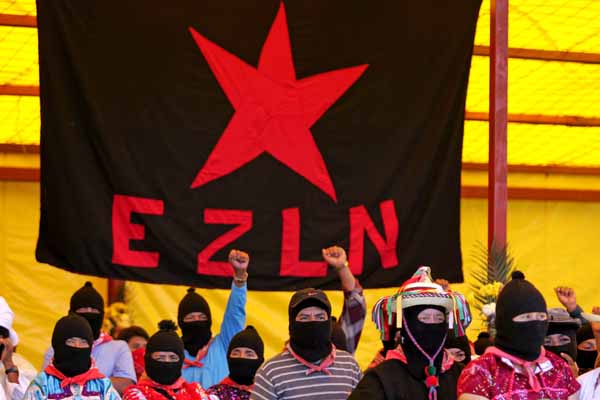
    While the PRD claimed to be the genuine expression of the Mexican left, it was challenged after by the Zapatista Army of National Liberation (EZLN), the small group of revolutionaries who had led a peasant rebellion in the southernmost state of Chiapas on January 1, 1994. The Zaptistas, who also placed themselves in the left nationalist tradition, consistently rejected the existing Mexican government and its political parties, including the Party of the Democratic Revolution. The EZLN spokesman Subcomandante Marcos spoke scathingly the PRD and its candidates Cuauhtémoc Cárdenas and López Obrador, arguing that they were simply another expression of Mexico’s corrupt political system. For the last twenty years the EZLN has rejected any cooperation with the PRD or any participation in electoral politics. Though most other far left groups have critically or uncritically supported the PRD’s campaigns one way or another.

    The PRD Challenged

    Over the last 25 years the PRD has suffered numerous defections, including of some of its most important leaders: founder Porfirio Muñoz Ledo left in 2000, former Mexico City Mayor Rosario Robles in 2004, and Leonel Cota, former governor of Baja California Sur in 2012. The most important renegade, however, is Andrés Manuel López Obrador, the party’s top vote-getter in the presidential election of 2006 when he won 35.3 percent of the vote. He in 2012 he received 31.6 percent. He argues that he was the real victor in both “fraudulent” elections. In 2012 López Obrador left the PRD and founded the Movement of National Regeneration pledging to make it the political party of the left. He has already announced that he will be its candidate for president in 2018.

    At the PRD’s twenty-fifth anniversary celebration, Cárdenas criticized the PRD from wandering from its radical, founding ideas. “The discourse about having to create ‘a modern left that distances itself from radicalism’ only serves the interests of the sell-out regime,” he said. “Principles are not just a fashion.”

    Commenting on the chasm between the party’s founding principles and its current situation, Cárdenas asked rhetorically, “Responsible? On the one hand, the hostility of the state and the so-called real powers that have fought against the PRD’s project of national sovereignty and democracy, and on the other, all of us who founded and make up this organization are all also responsible.”

  • Spring Mix

    The salad days.  Too cold or hot or wet for much of anything this time of year, and rereading E. P. Thompson, Howard Zinn, or David Harvey can get tiresome.  Here’s a few tracks for the indoor season, good for stealing time at work, when jammed into a reduced-service bus, or just sitting around building a 15now chapter. 

    Like movies and literature and art, pop music is an immediate reflection of the tensions and promise of the social movements of the day, a historical record of the creativity and emotion of community, a guide to the ideas centering social forces then and now.  From Ellington to Common, it reinforces the waged-labor nature of musicianship and entertainment, placing performers at the fulcrum of the daily humdrum of leisure work, subjects of market forces, sometimes at the memorable apex of crises and societal change, always on our stereos and bluetooths as motivators or enunciators of political practice.  Crucially, the art of pop music is collective, its creation, performance, and consumption are experienced socially and passionately, a sharp and exhilarating harmony against which destructive individualism is defenseless, an aural transit system we ride elbow to elbow, where we get on and especially off together.

    Surprise: strikers, dreamers, indignados, occupiers have their own rhythm, their own dance. Time to collectivize the earbuds – join the mixtape struggle by posting to the comment section.

    El Général – Rais Iebled (Head of State)

    The underground hip-hop cut that panicked the Tunisian regime in 2010.  El Général was jailed.  A change in season soon followed.

    Queen Latifah – U.N.I.T.Y.

    Who you callin’ a bitch?

    Heaven 17 – (We Don’t Need This) Fascist Groove Thang

    Watch out for those hard right turns.

    Cab Calloway Orchestra – Doing the Reactionary

    All the best dictators do it, millionaires keep stepping to it.

    Ken Boothe – Is It Because I’m Black

    Syl Johnson’s blue-smooth lament turned inside out.  The Trojan Record’s house band is the prototype stepping razor, Boothe is spitting mad.

    Charlie Parker – Ko Ko

    The class tensions that were World War II America produced social movements electric with promise, urgency, resolve, creativity.  Here they all are, in three astonishing breathless minutes.

    Neko Case – Prison Girls

    Most of the time, incarceration is not an exercise in political economy or race studies.

    Flaco Jimenez – Mujer Casada

    If all accordion players were this incendiary, we would have won long ago.

    Magic Sam – All of Your Love

    No self-respecting Chicagoan goes without a copy of West Side Soul, a definitive slice of mid-century community. 

    Archie Shepp – Blues For Brother George Jackson

    The books-on-tape version of how far audacity can take us.

    Sonny Boy Williamson – Help Me

    To be alone is to be powerless.

    Curtis Mayfield – Ghetto Child (demo version of Little Child Runnin' Wild)

    Minus the top-40 cushioning, Little Child as a real kid right here in the kitchen.

    Rahsaan Roland Kirk – Walk On By

    Burt Bacharach’s polite ditty hammered into an exploding stomp, appropriate for the next CTU march.

    Buddy Guy – $100 Bill

    The irony of this classic is forever lost to the one-percenters. Never mind. The horns swagger, Guy grins: Asked my baby for an automobile, she flipped me keys to a Coupe de Ville.

    James Brown – Papa’s Got a Brand New Bag

    Released in June ’65 and riveted to the top of the R&B charts during the Watts revolt, the first hit exercise in funk is an unsung anthem of the civil rights era.

    Larry Young – If

    Recorded just after Watts, a vortex that even remade the 12-bar blues.

    JBs – Blessed Blackness

    Since the proletariat must first of all acquire political supremacy, must rise to be the leading class of the nation, must constitute itself the nation, it is so far itself national, though not in the bourgeois sense of the word.  

    Artie Shaw Orchestra – Nightmare

    Shaw’s signature tune was so slow and gloomy his record label made him change to something snappier.  It was a massive hit anyway, written in 1936 and finally recorded towards the end of the second downturn in ‘38, giving wordless expression to how Great the Depression really was.

    Staple Singers – Uncloudy Day

    Liberation theology never sounded this good.

    Golden Gate Jubilee Quartet – Golden Gate Gospel Train

    Spoke too soon.

    Common featuring Cee Lo – A Song for Assata

     “I’ll be honest with you. I know a whole lot more about what freedom isn’t, than about what it is.”

    Joe Williams – Every Night

    A velvet for the Great Recession survivors, working overtime to support families/partners/spouses.

    Mavis Staples – 99 and 1/2 (Just Won’t Do)

    Way more than a reminder. “It’s not 99% versus 1%,” Vijay Prashad said at Occupy Boston, “this is 100% wrong.”

    Duke Ellington Orchestra – Stompy Jones (1934)

    Prohibition jammed politics, art, booze, work, gender, race, sex, lit, ethnicity, recreational drugs, and music into a tiny noisy smoky illegal bar.  Sounded like this.

    Bob Marley and The Wailers – Get Up Stand Up/No More Trouble/War (Live)

    The 23-minute argument against Marley as just a multikulti Carnival Criuse t-shirt.

    Gang of Four – Natural’s Not In It

    Impossible to even leave the house without a tune about the colonization of desire.

    Augustus Pablo – King Tubby Meets Rockers Uptown

    Ignore the nonsense about how musically influential these two and a half minutes were, in 1975 and since.  Pablo and Tubby instead welcome the post-‘73 apocalypse with equal force, structural erudition, and plenty of space to readjust to a planet of slums.

    Mulatu Astatke – Fire In The Zoo

    There’s always one somewhere.

    Air – King Porter Stomp

    Air’s startling, surging reboot of the King Oliver/Jelly Roll Morton 1924 ragtime exercise is more than a commemoration of the emancipatory practice of improvised music.

    The Golden Palominos – Ride

    In bed or in court, everybody gets off.

    Antibalas – Indictment

    Now that I think about it.

    Mac Roach Quintet with Abbey Lincoln – Love For Sale

    Cole Porter kicked hard in the head.  Lincoln is as much as responsible for propelling the second wave into a tsunami as anyone.

    Joe Bataan – Aftershower Funk

    Here’s hoping that the class traitors at the Chicago Board of Trade who dumped McDonald’s job applications on the LaSalle Street Occupiers never get laid.

    Jazz Passengers – Ring The Bell (featuring Bob Dorough)

    Buy low, sell high.

    Gil Scott Heron – Winter In America

    For the day when this song is no longer relevant.

    La Excelencia – Salsa Dura

    Ditch the earbuds, get a crowd over to the apartment, vent about everything in particular, and turn it up.

    Eric Schuster teaches history in Chicago. 

  • Teacher Appreciation Week: How to #thankateacher

                This is “Teacher Appreciation Week.”  Should we mark the occasion? How? Why?

                 Teaching is still “women’s work” – 85% of K-12 teachers are female. Teaching is taxing work that requires skill and knowledge, the ability to think quickly on one’s feet and be caring. Managing learning for a room of 30 (or more) people is the pre-eminent form of  multi-tasking. Yet, teaching’s difficulty and value are inadequately recognized by the society – as is parenting.  Few schools give teachers the resources and support they need to do their jobs well, one of which is the opportunity to work with colleagues, students and parents as partners, learning from and with them.  Because of the linkage between standardized testing and teachers’ evaluations,  teachers' professional judgment has been circumscribed, teaching's nurturing functions undercut; frightened themselves, local school officials increasingly demand subservience from teachers.  A climate of fear exists in many schools.

                It’s the job of teachers unions to educate parents and citizens about the supports needed for high-quality teaching and learning to occur, to fight for conditions that allow teachers to do their jobs well.  Because union contracts narrow the scope of bargaining, the union has to push self-consciously against those restraints.  Part of this struggle is insisting on a salary that is commensurate with the skill, knowledge, and difficult of the work, a professional wage.  Teachers can’t do their best when they don’t earn enough to support themselves and their families. They also can’t serve kids well when they are fearful of poor evaluations and losing their jobs if they speak honestly about what’s happening in their schools and classrooms. 

                We face an enormous challenge. The superbly orchestrated propaganda campaign against teachers and teachers unions, in support of a privatized school system run by moguls and billionaires through the politicians they have persuaded or bought, has configured teachers and teachers unions as blocking improvements in education for kids who most need high-quality schools and teachers.  However, the reforms being pushed by both parties use the rhetoric of putting “students first” to destroy public ownership of schools and limit opportunity. 

                How should we deal with the daunting task of changing the public perception of teachers and our work?  We see how to do it with the success of the Chicago Teachers Union, about which much has been written.  In contrast, we see how not to do it with the proposed UFT contract, which continues the failed policies of “business unionism.”  A bureaucratic process of developing contract proposals has been accompanied by little or no member involvement in pushing for real improvement in working conditions. This has, unsurprisingly, yielded a poor contract.

                The UFT’s leadership clique publicized the proposed contract as a victory – before members were given the contract language. All union members had was a description of “contract highlights,” released to the press as well. The ensuing publicity, endorsements by national media and a prominent liberal friend of the AFT leadership, was intended to make teachers feel that rejecting this contract is a futile gesture.  That is, the media, politicians, and UFT officers strive to minimize space for union members to decide for themselves whether the contract makes their work better and improves schools. 

                The question New York City teachers should ask themselves in deciding how to vote on this contract proposal is “Will this contract improve education for NYC kids?”  The answer, for me, is a decisive “No.”  It contains a few elements that are especially pernicious.

                1. The contract includes a career ladder,  “merit pay” without the label. If it weren’t designed to serve as "merit pay," we would allow teachers to do these jobs at their same pay. The new positions being created will likely help teachers to help kids so we should demand that more of these positions be created – at the same pay. The career ladder will pit teachers against one another for the pay increase, reinforce the erroneous idea that we can improve teaching by rewarding the "well-deserving" individuals,  and weaken solidarity in the school.

                2. The changes in the “redesigned” school day don’t touch the kind of transformation of working conditions teachers and students desperately need.  Those have to be made by empowered school leadership teams, about which this contract is silent.

                3.  As schools are closed and replaced by charters, more and more teachers will be put into the pool of displaced teachers. Teachers’ lack of protections in this process weakens the union and increases teachers’ fears. Every teacher is in danger of being placed in this pool but the displacements affect older teachers and teachers of color disproportionately. This new contract weakens the position of displaced teachers and in doing so harms the union and kids.

                4. Pay: The press hammers on this issue because they know that half of New Yorkers live at or below the poverty level. The union’s focus on pay reinforces the public perception that the union and teachers are totally self-interested.  Yes teachers deserve a professional wage and the union must fight for that, embedded in a vision for a very different kind of schooling that can win parents and community to our side. 

               Are NYC teachers ready to hear this message?  Teachers’ work now consists of more than what we do in our classrooms.  Our job is to speak truth about what NYC kids need and deserve and demand that our unions organize us with our allies to win those conditions.        

                NEA is publicizing National Teachers Week by having supporters use social media to #thankateacher. AFT and the AFL-CIO have joined this campaign.  On the other hand, President Obama has marked the occasion by proclaiming this “National Charter Schools Week.”  We’re not going to defeat the policies Obama is pushing with the kind of contract the UFT has negotiated.  I suggest we #thankateacher by urging NYC teachers to reject the proposed contract they’ve been told to ratify.

    Other notes: Under the radar of the media (most of the “progressive” media included):  The Philly school system, facing more draconian cuts in funding, now has a reform caucus in its teachers union. At last weekend’s Education for Liberation Conference I saw the great energy that comes from teachers working with students, parents, community groups to take back the schools.  Very powerful and exciting! I’m delighted to add Philly’s Caucus of Working Educators to the list of groups working towards building teachers union with a social justice vision, commitment to democracy, and mobilization, all starting in the school site… Join us at the Trinational Coalition to Defend Public Education this weekend in Chicago.  I’ll be in a workshop on standardized testing.

    You can follow me on twitter and Facebook, as well as my blog every Wednesday here at New Politics.  Or write me at drweinerlo@gmail.com

  • Teachers unions need critical friends

                Union Power’s sweep of the election for union officers in United Teachers of Los Angeles (UTLA) signals a seismic shift in power relations in the American Federation of Teachers (AFT). UTLA’s Union Power now joins reformers from CORE (Caucus of rank and file educators) in the Chicago Teachers Union in demanding a break from the “business union” model that has dominated teachers unions for decades.  Three state-wide reform caucuses have formed in National Education Association (NEA) affiliates, Massachusetts, Colorado, North Carolina.  As I explain in my forthcoming article (Summer, New Politics), these and other developments reflect how teachers are overcoming deep fears and feelings of isolation to build a different kind of union.  It’s happening off the radar of the mass media and most of the liberal press, which is entranced by the rhetoric of neoliberal educational policies that are aimed to destroy teaching as a profession, democratic control of schools, and turn education into another profit center for corporations.  An important exception is The Jacobin’s informed coverage of education and its collaboration with teacher unionists working to transform their unions.

                Union officials in both the AFT and NEA realize public education and the union are in deep trouble. At the same time, they seem incapable of the objective scrutiny needed to reverse course. Josh Eidelson’s Salon.com interview with AFT’s president, Randi Weingarten, exemplifies this phenomenon. Almost every opinion Weingarten expresses changes a disastrous union policy without a hint that there’s been a shift.  Because there’s been no debate in the union and no self-criticism, the new policies are adaptations rather than needed reversals.  Chris Christie?  He’s a villain now but just months ago Weingarten was chortling with him on “Morning Joe” about their collaboration on merit pay and the contract AFT pushed on Newark teachers, a contract that has weakened the union in fighting  the destructive school closings in the works now, which she opposes.  Common Core, the new national curriculum funded mostly by Bill Gates, is in trouble now, due to agitation from both the Right and Left – but without help from either NEA or AFT, which still support it in principle though disagree with implementation. Michelle Rhee, whom Weingarten now criticizes harshly? Rhee was a reigning celebrity, pushed by neoliberal Democrats for Education Reform (DFER), at the Democratic National Convention that nominated Obama for his first term.  NEA and AFT jumped on the Obama bandwagon though he was always explicit about his involvement with DFER and affection for Rhee, merit pay, and charters.

                AFT and NEA have pushed one disastrous accommodation after another, arguing with activists who feel the pain of these policies that the union needs a seat at the table. In contrast, Union Power and CORE understand that the meal being served is not one we can or should eat.  It’s poison and it’s harming kids, killing public education.  Privately and in social media union officers express anger at the “divisiveness” of criticism. However divisions are already present, demonstrated by the emergence of successful challenges of union reformers in the second and third largest teacher union locals in the US.  We need a contest of ideas, not personalities, debate and decisions made by members about policies that are altering their livelihoods and children’s lives. That process should be aided by friends who offer support, encouragement and critique.

                I invite reader comments, sent to me at  drweinerlo@gmail.com.  Is there a subject you want me to tackle? Let me know. And you can follow my thoughts on teaching, schools, and education on twitter , Facebook, as well as my blog here at New Politics.

                Saturday May 3 I’ll be speaking at PhillyTAG’s Education for Liberation conference. It will have super workshops on social justice teaching and education activism. Join us!

  • Rosa Luxemburg—a revolutionary for our time, or a liberal?

    ImageReview of Jason Schulman (ed.), Rosa Luxemburg — Her Life and Legacy, New York: Palgrave Macmillan, 2013, 214 pp.

                In 2001, New Politics published a short article on Rosa Luxemburg by Stephen Bronner. The article sure hit a nerve. Over the next years, a whole series of criticisms were published to which Bronner responded twice in these pages. Jason Schulman collected these articles, added a short introduction and an interview with Bronner, and published them under the title Rosa Luxemburg—Her Life and Legacy. The subtitle of the book is slightly misleading as it contains little about Luxemburg’s life and the term legacy is too neutral to capture the intensity with which contributors fought over their respective understandings of Luxemburg’s theoretical and political work. Playing on Bronner’s 1981 monograph Rosa Luxemburg—A Revolutionary for Our Time[1], it might have been more apt to ask whether that’s still what she is or whether she became an inspiration for liberals in the meantime. Bronner contends that socialism and barbarism are no longer alternatives since efforts to build the former only advanced the latter and the industrial proletariat as the agent of change is on the wane. At the same time, though, Luxemburg’s revolutionary goal of attaining a liberal republican state has been achieved since Soviet power was dismantled by the liberal revolution in Eastern Europe. What socialists should do now is defend the reforms that have been won within the realm of the liberal state and extend their activities to reforming international institutions, as transnational corporations are progressively undermining nation-state sovereignty.

    Image            Bronner claims that he criticizes Luxemburg in much the same way she had criticized Marx. What emerged from this for Bronner was the rejection of Luxemburg’s claim that capitalist crises make social reform impossible and that socialist revolution, paving the way for workers' power exerted through workers’ councils, would be the only way of avoiding the barbaric degeneration of capitalist societies. What remains of Luxemburg is the fighter for the democratic republic, minority rights, and liberal, not proletarian, internationalism.

                This interpretation might have been much to the liking of the Rosa Luxemburg Foundation in Berlin, for whom Bronner’s article was originally written. The Luxemburg Foundation, a think-tank affiliated with the Party of Democratic Socialism, now Die Linke, was eager to leave behind the communist past out of which it had developed. At the same time, it was trying to carve out its political space in post-unification Germany. A Luxemburg that had nothing more to do with overcoming private property but still provided a critical edge vis-à-vis actually existing capitalism was precisely what was needed for this purpose. But it certainly wasn’t what many people around New Politics, used to defending the traditions of revolutionary socialism in the belly of the beast, wanted to hear. Not surprisingly, they responded in kind. As a then editorial board member and continuing sponsor of the journal, Bronner probably knew what he was getting himself into.

                None of Bronner’s critics misses the opportunity to point to the continuities of capitalist exploitation and the support it receives from nation-states and international institutions. More specifically, Alan Johnson draws attention to the fact that today’s working classes make up a larger share of the world population than they did during Luxemburg’s lifetime. Hence, the notion of a waning of the industrial proletariat is misleading. David Camfield charges Bronner with joining the post-Marxist camp whose ranks of disappointed radicals swelled continuously while the neoliberal variant of capitalism came to be seen more and more as the social order without alternative. Paul LeBlanc argues that Bronner’s support for international institutions includes imperialist interventions and Barry Finger turns Bronner’s claim that revolutionary socialism is outdated around by saying that the conditions under which embedded liberalism could flourish are gone. All of this may, or may not be true, but doesn’t take away from the fact that revolutionary workers movement don’t exist anywhere today. Therefore it is easy for Bronner to expose his critics’ defense of revolutionary socialism as a kind of ethical commitment, different from his own in content but as detached from current realities as were the scientific convictions about the inevitable victory of socialism over capitalism that were, allegedly, so characteristic of Luxemburg and most of her contemporaries.

                Considering the complete marginalization of revolutionary socialists in today’s social movements it should be an easy task for Bronner to answer his critics. Yet, there is a tone of self-assurance and impatience in his responses that suggests that he isn’t as convinced of his case as he pretends to be. In restating his case for the liberal republic and reformed international institutions he even takes refuge in empirically unsupported and theoretically inconsistent arguments. For example, he charges Luxemburg with splitting the social democratic left and thus allowing the right wing around Ebert to gain the upper hand within the social democratic party. Of course, one might direct the same charge against Bernstein during the revisionism debate or Kautsky during the mass strike debate. Be this as it may. What is difficult to understand, though, is how he squares his concern with a left united for democracy and republicanism with his endorsement of the Weimar-period SPD as defenders of these very principles. To this end, he invokes the apologetic argument that Weimar was a republic without republicans. Yet, looking at folks like Tucholsky, von Ossietzky and their Weltbühne-collaborators it seems more accurate to say that there was a small band of republicans desperately looking for a republic.[2] Michael Hirsch in his concluding chapter discusses Bronner’s skewed interpretation of Weimar. By the way, in his 1991 book Moments of Decision[3] Bronner also pointed to the continuities between imperial Germany and Weimar. While he changed his views on the Weimar Republic, the commitment to liberal democracy and international institutions that he presented to the Rosa Luxemburg Foundation can already be found in this book. In fact, its German translation, published in 1999, might have been the reason why the Luxemburg Foundation invited Bronner to the talk that caused so much controversy in New Politics.

                Entwined with the discussion of the virtues and insufficiencies of the liberal republic is the question of whether councils can represent an alternative institutional framework or not. Councils, argue Bronner and Michael Thompson, represent only the special interests of industrial workers. Historically, councils only played a role in countries lacking liberal institutions; today there is no interest in them whatsoever. All one could possibly say to defend this line of argument is that those who wanted to replace the bourgeois republic by a councils republic focused very much on industrial workers. This is true, for example, for Richard Müller and Emil Däumig but also for Anton Pannekoek. Despite their commitment to the councils republic, the former sided politically with the Independent Social Democrats[4] while the latter joined the anarcho-syndicalist Communist Workers Party.[5] Neither of them went with Luxemburg and the Spartacists. Bronner rightly points out that Luxemburg was torn between councils and the republic but wrongly says that she had to choose one or the other. With support for the councils too weak to erect an alternative power structure in 1918/19 such a decision would inevitably subject the newly formed republic to the old alliance between the Junkers, smokestack barons, and generals whose internal quarrels had been a major factor leading Imperial Germany to war.[6]

                Luxemburg thought councils might serve as a countervailing power to the forces of reaction, and thus make Weimar a more democratic republic and leave the door for socialist revolution open. The tragedy of the German revolution is that this line of thinking was only understood and supported by marginal circles such as that around the Weltbühne, while the labor movement from anarcho-syndicalists to Ebert-Noske-style social democrats made their respective choices for insurrection and councils or counterrevolution approved by the Weimar Republic. Dual power of the liberal republic and councils might also have allowed the latter to extend beyond industrial workers and soldiers to workers in other sectors, most importantly agriculture, and consumers. Such ideas were discussed theoretically after the counterrevolution had already shut down the possibility of their realization. Karl Korsch made important contributions to this debate, the first of which was published in March 1919 when the revolution was just coming to an end.[7] Although he frequently appears in Schulman’s book, this aspect of his work is ignored or flat-handedly dismissed. As far as later developments are concerned it is worth mentioning that councils were established on numerous occasions and in countries with rather different political systems.[8] It is simply not true that workers never established councils in liberal democracies; the point is that they did so in situations in which they felt not appropriately represented by unions and the political system. This history of self-organization has plenty of experiences to offer from which today’s social movements can learn when seeking alternatives to liberal democracy’s surrender to the dictates of international capital as Chris Maisano argues in his chapter of the book. Bronner confirms his skeptical views about the potential of workers councils in an interview that reviews the preceding debate at the end of the book. What is more interesting about this interview, though, are the connections Bronner makes between Luxemburg in her day and today’s social movements from the Arab Spring, Occupy Wall Street, and Syriza. In this respect he stresses the role of experiences activists are making in collective struggles for the formation of progressive movements.

                One argument that transcends the councils versus republic debate, which figures so prominently in most chapters of the book, comes from Amber Frost. Her starting point is a rebuttal of Thompson’s unambiguous defense of liberal democracy as the only institutional form capable of protecting the rights of minorities for which he cites gay marriage as an example. Frost picks this up to show how easily radical politics, such as feminist and queer activists struggles against the legal institution of marriage, are sidelined by the endorsement of apparently progressive issues. Her warnings against states permeating every aspect of life are more than welcome in a time where neoliberal ideology heralds the withering away of the state in the thin air of global markets. Yet, bringing feminism into this book about Luxemburg, she could have gone further. It is true that Luxemburg had little to no interest in what was called in her day the women’s question, but her economic theory of the colonization of non-capitalist milieus offers analytical tools to understand the transformation of domestic labor and female labor market participation from post-war prosperity until today. Sadly, many feminists engaged in the domestic labor debate recognized the affinity between their own efforts and Luxemburg’s theorizing but decided not to draw on the latter although it might have made their arguments stronger.[9]

                Frost shares the silence on Luxemburg’s economic theory with her co-authors. Bronner sees it as an outdated teleology that might have had currency in the past but certainly has none today. Moreover, he explicitly claims the primacy of what he calls the political moment over economics. Thompson, who agrees with Bronner on the question of republic versus councils, posits the necessity for critical political economy for radical politics of any kind but doesn’t give any hints as to how he understands the relations between economics and politics. Johnson and Camfield, standing on the other side of the republic versus council argument, distance themselves from what they see as a mistaken theory of breakdown. Maisano takes the Great Recession as his starting point but quickly departs into the realm of pure politics. This neglect of economics grossly misrepresents Luxemburg’s work. This is not only true for her explicitly economic works, notably The Accumulation of Capital and The Introduction to Political Economy, but also for her political works that reckon the role of economics. For example, she hints at the limits to social reform due to the recurrence of economic crises in Social Reform or Revolution and The Mass Strike and in The Junius Pamphlet she reconstructs the outbreak of World War I from the pursuit of imperialist politics, driven by the quest for market expansion, great power status, and attempts to deflect from domestic class conflict.

                Bronner suggests that Luxemburg’s adherence to a teleological worldview—her belief in the final victory of socialism—is plainly wrong, and  can’t be substantiated. Sure did she believe in it; one might even claim that her activism was driven by ethical beliefs that Bronner presents as an alternative to teleological beliefs. Nobody would engage in any kind of politics if s/he didn’t think s/he could succeed. Yet, this doesn’t mean that the optimism of the will can’t or shouldn’t be complemented by the pessimism of the intellect. Chances to reach one’s goals are surely greater if one recognizes the economic conditions under which one pursues them instead of ignoring them.

                If all Luxemburg had to offer in this respect was the assurance that capitalism would collapse and thereby fire the starting shot for class struggle or even lead to the automatic rise of socialism, then her economic theory would be as teleological as Bronner claims it is. But it isn’t.[10] Like her contemporaries she used the word "breakdown" all too often and the term invites teleological understandings indeed. To avoid them it might be good to poke fun at it like Joan Robinson did with Marx’s use of the morally charged term "exploitation." Yet, Robinson didn’t do this to dismiss Marx’s economics but to reinvent them during her own lifetime. Sure enough, what came out of this was the conversion of Marx into a proto-Keynesian[11] and Luxemburg received the same treatment.[12] Even if one doesn’t agree with Robinson’s interpretation of Marx and Luxemburg one might find more interesting ideas in it than in mere restatements of Marx’s and Luxemburg’s original work. Bronner is right, these works need to be read and interpreted for everyone’s own time and this will inevitably lead to revisions. In today’s world where everyone talks about economics, 99% fearful and 1% hopeful, socialists have every reason to re-read the classics of critical political economy, reinterpret them against the background of today’s empirical realities and draw their conclusions for radical politics. This is not the same as suggesting to derive politics from economics. The purpose of Marx’s Critique of Political Economy was to highlight human agency behind the mystifications of commodity production and exchange. Luxemburg’s economic works continued this tradition by stressing the role of class struggles and international conflicts in capitalist development. They can certainly contribute to the way that activists interpret their everyday experiences with capitalist realities, share them with workers and other subordinated social groups and thus help to remake the working classes that were so successfully unmade by neoliberal restructuring.[13] We shall see, whether there’ll be a revolution. What is certain, though, is that Luxemburg is a socialist for our times and this sure means seeking ways to overcome capitalism.


    Ingo Schmidt teaches Labour Studies at Athabasca University in Canada. His most recent books are Social Democracy After the Cold War (co-edited and co-authored with Bryan Evans) and Rosa Luxemburg's 'Akkumulation des Kapitals'. He also writes economics columns for Sozialistische Zeitung, a monthly paper in Germany.


    [1] Stephen Eric Bronner, Rosa Luxemburg—A Revolutionary for Our Times (London: Pluto Press, 1981).

    [2] Ursula Madrasch-Groschopp, Die Weltbühne—Portrait einer Zeitschrift (Berlin, Frankfurt: Ullstein, 1985).

    [3] Stephen Eric Bronner, Moments of Decision—Political History and the Crisis of Radicalism (London and New York: Routledge, 1991).

    [4] Ralf Hoffrogge, Richard Müller—Der Mann hinter der Novemberrevolution (Berlin: Dietz Verlag, 2008).

    [5] Hans Manfred Bock, Syndikalismus und Linkskommunismus von 1918 bis 1933 (Darmstadt: Wissenschaftliche Buchgesellschaft, 1993).

    [6] Heiner Karuscheit, Deutschland 1914—Vom Klassenkompromiss zum Krieg (Hamburg: VSA Verlag, 2013).

    [7] Karl Korsch, Schriften zur Sozialisierung (Frankfurt: Europäische Verlagsanstalt, 1969).

    [8] Immanuel Ness and Dario Azzelini, Ours to Master and to Own—Workers Control From the Commune to the Present (Chicago: Haymarket Books, 2011).

    [9] Frieder Otto Wolf, “The Missed Rendezvous of Critical Marxism and Ecological Feminism,” Capitalism, Nature, Socialism, vol. 18, no. 2 (2007), 109-125.

    [10] Ingo Schmidt, “Geschichte und Sozialismus,” in Ingo Schmidt (ed.), Rosa Luxemburg’s Akkumulation des Kapitals (Hamburg: VSA Verlag, 2013), 138-165.

    [11] Joan Robinson, An Essay on Marxian Economics (London: Palgrave Macmillan, 1967).

    [12] Joan Robinson, “Introduction,” in Rosa Luxemburg, Accumulation of Capital (London and New York: Routledge, 2003), xxi-xxxvii.

    [13] Ingo Schmidt, “From Unmaking to Remaking—Neoliberalism and European Working Class Experiences,” in Andreas Bieler (ed.), Labour and Transnational Action in Times of Crisis (forthcoming).


  • Teachers, teachers unions and the “Common Core”: This is a test

    Image

    1. More rigorous academic standards required by the new national curriculum, Common Core Curriculum Standards (CCSS) and its high-tech national test PARCC controlled by Pearson will alter employment for US students by making them “college and career ready.”

    2. The Common Core Curriculum Standards are a “state-led” initiative.

    3. Elected officials of both teachers unions endorsed CCSS and PARCC at the direction of members, after informed debate.

    Answers:

    1. False

                As this 3 minute video explains, Common Core proponents argue it levels the playing field for jobs. It implies but does not say that we need the Common Core because of historic inequality in education linked to race.  If students are “college and career ready” they will find well-paying jobs, or as the US Department of Education phrased its goal in the reauthorization of the Elementary and Secondary Act, ”The goal for America’s educational system is clear… Every student should have meaningful opportunities to choose from upon graduation from high school."   Schooling is “the one true path out of poverty” (Arne Duncan).

              This assumption obviates the state’s role in ending poverty through economic policy, for example by outlawing poverty-level wages, currently maintained by a minimum wage that sustains a class of working poor, and by creating well-paying jobs that support a sustainable economy.  The diminishing number of well-paid jobs sentences the vast majority of working people to a lifetime of economic insecurity. Yet labor, what remains of it, including teachers unions, has failed to take on the underlying rationale for the Common Core, which pushes vocational training into kindergarten.  PARCC, the profitable (for Pearson) test that ties student achievement and teacher evaluation to the new standards is losing support, mostly because of Right wing opposition to the federal government’s usurpation of what is held in the Constitution to be the right of the state, controlling education.

             Schooling is not and cannot be the “one true path out of poverty” for the vast majority of children because our economy consigns millions to unemployment and work that pays poverty wages. Yet it is also the case that public education in the US has historically reproduced social inequality.  Teachers unions and progressives ought to answer the “one true path out of poverty” claim by demanding 1. the government create high-paying jobs that support a sustainable economy AND 2. address  factors we know from empirical scholarship contribute to unequal outcomes in schooling, such as segregation, organizational practices within schools such as tracking, disciplinary practices, and because of taken-for-granted assumptions about students’ “ability.

    2. False

                Mercedes Schneider, a researcher who teaches school in New Orleans, documents in a blog how CCSS was developed, tracing its funding to Bill Gates.

    “It is important to those promoting CCSS that the public believes the idea that CCSS is "state-led." The CCSS website reports as much and names two organizations as "coordinating" the "state-led" CCSS: The National Governors Association (NGA), and the Council for Chief State School Officers (CCSSO). Interestingly, the CCSS website makes no mention of CCSS "architect" David Coleman… Nevertheless, if one reviews this 2009 NGA news release on those principally involved in CCSS development, one views a listing of 29 individuals associated with Student Achievement Partners, ACT, College Board, and Achieve. In truth, only 2 out of 29 members are not affiliated with an education company.

    CCSS as "state-led" is fiction. “

    3. False

                AFT and NEA officers have recently called for a moratorium in implementing CCSS and PARCC, reversing their initial support. Both unions accepted funding from Gates to implement CCSS.        Typical of those who hold power that is seldom checked, national officials have not explained their about-face as being correction of an error on their part.  The problem is not just implementation of the curriculum and the test, as the unions now charge but rather of the premises.  Mercedes Schneider nails the problem with AFT and NEA’s call for delaying implementation.

                If your information about education and CCSS has come from the NY Times, AFT and NEA publications and social media, or even progressive magazines, like Mother Jones, it’s likely you didn’t understand why so many teachers and parents are angry about CCSS and PARCC.  While Right-wing opposition has garnered a great deal of attention, there’s been almost no discussion of the dangers of CCSS, the way it pushes down academics to kindergarten (forget about play); the way it identifies a “core” that excludes civics (examination of the duties of citizens in a democracy) in social studies; the way it marginalizes the experience of literature and the arts; the way it undercuts teachers’ ability to give students choices in what and how they learn.

                I see many calls on social media for the AFT and NEA national officers to reverse themselves and reject CCSS and PARCC.  In response the unions point to polls that support their position.  But polls should not decide an issue on which teachers’ jobs, students’ lives, and control of our society’s future depend.  We need vigorous, informed debate throughout the union – not just state and national conventions.  In the locals!! The debate should be followed by a referendum: “Should our union endorse and help implement the CCSS as tested by PARCC?”

                In my presentation at the The Center for the Study of Work, Labor and Democracy at UC Santa Barbara April 25 I’ll explain why progressives have to argue for jobs as well as acknowledging the historic inequalities in education that our opponents exploit for their own ends.  My remarks will published in a bit if you miss the conference.

    Readers can contact me at drweinerlo@gmail.com and follow me on twitter and Facebook. I blog every Wednesday here at New Politics.

  • OUR HOUSE OF CARDS: POPULAR CULTURE IN THE OBAMA ERA

    Americans’ profound cynicism about Washington finds full expression in the wildly popular House of Cards, the Netflix series created by Beau Willimon and based on a novel by Michael Dobbs in which Francis J. “Frank” Underwood (Kevin Spacey), will stop at nothing—including murder—to achieve his political ambitions. Underwood, the fictional Democrat from South Carolina who works to extend the retirement age needed to qualify for social security, attacks public education and the teachers unions, and provokes a high stakes trade war with China to punish a political rival, is engaged behind the scenes in threats, bribery, extortion, kidnapping, and more than one murder to maintain his grip on power, eventually becoming U.S. president. From time to time, like a character in a Shakespearean drama, Underwood turns to speak to the audience, expressing his contempt for the politicians, lobbyists, businessmen, political challengers, and all the toadies and timeservers by whom he is surrounded. It is a contempt for the world of Washington that one suspects the viewers share.

    We find the same world in ABC’s Scandal, based in part on the life of George H.W. Bush’s press aide Judy Smith, where the protagonist Olivia Pope (Kerry Washington), , runs a crisis management firm that handles problems for many, including the Republican President Fitzgerald Thomas Grant III of Santa Barbara, former governor of California. Olivia Pope the fixer, and the president’s sometime mistress, is the vehicle for exploring Washington, a place of lies, intrigue, deception, kidnapping, torture, and murder, a good deal of it committed by whacked-out former special forces agents. The president himself, we learn, had a personal hand in Operation Remington, a black op carried out a generation ago that revolved around the downing of Flight 522 to London and the death of hundreds of passengers. The commander-in-chief has been involved in the kind of cloak-and-dagger plots and skullduggery that accompanied the U.S. wars in Iraq and Afghanistan, and that in fact forms part of all foreign policy, diplomacy and statesmanship from time immemorial.

    We have come a long way from Aaron Sorkin’s West Wing (1999-2006) whose President Josiah Bartlett (Martin Sheen), though involved in political wheeling and dealing and occasionally touched by scandal, violence, and the violence of the War on Terror at home and abroad, appeared to be a basically good and decent man (albeit with the narrow political vision of American politicians) struggling to deal with immensely complicated situations. President Bartlett after all struggled to save Social Security. Even at the time, of course, Americans joked that Bartlett was the good president we wished we might have had as opposed to the Bush-Cheney presidency we were actually suffering through. 

    House of Cards and Scandal show us Washington as we suspect it is: crooked beyond redemption. The newspapers and TV and radio show it to us daily, and, if you read between the lines and watch carefully, it is not so different: a place of lies and deception, though most of the kidnapping and murder that we’re aware of takes place through the execution of black ops and drone attacks carried out in other countries. Here at home our political leaders merely destroy social programs, attack public employee unions, and promote policies that may also we know lead to hunger, illness physical and mental, and eventually death, but in the slow, suffering way of ordinary people that is not nearly as entertaining as House of Cards. The homeless mother and her children face enough drama in their lives, but it is far from amusing and seldom occupies prime time.

    One can gauge Americans’ skepticism about our political system in other more quantitative ways than their TV viewing. Since the 1960s less than 60 percent of the voting age population participates in elections, while President Obama was the first president since FDR and Eisenhower to be elected twice by more than 50 percent of the voters. Most of our elected officials hold power on the basis of having won the votes of little more than 25 percent of the electorate. Then too, we have the approval ratings. At present (March 2014) only 40 percent of Americans approve of the job that President Barack Obama is doing—he has several times recently been down as low as 38 percent, while Congress’s approval rating is at 13 percent, the lowest in American history. The thing is, House of Cards and Scandal are a lot more suspenseful and exciting than watching the Republicans shut down Congress or following the technical, economic, social, and political failure of Obamacare. The TV shows are fun, confirming us as they do in our anger and disdain for evil politicians, but life is less fun for most of us under the real politicians who run the country. 

    The Barack Obama era will go down in American history as one of the least liberal and most conservative periods in American history. Unlike any other period since the Gilded Age of the late nineteenth century or perhaps the Roaring Twenties, capitalists have prospered enormously while workers have suffered tremendously and income inequality has grown exponentially. A 2013 OECD study showed that the United States had the highest income inequality in the developed world (only less developed Chile, Mexico and Turkey were more unequal), while another group of economists found that income inequality has grown faster in the United States than in any other developed nation, with the top 1% having doubled their income from 10 to 20 percent of the national total since 1970. The Pew Research Center study published in December 2013 demonstrated that income inequality in the United States was now the highest since 1928.

    We all know they’re getting richer, while the rest of us are falling behind. The woman or man on the street will tell you this. Or you could go to the movies. Martin Scorsese’s film The Wolf of Wall Street would make it clear that, for some in the era of Bush and Obama, the Great Recession—even with government investigations and some new regulations—represented no obstacle to making money, even if occasionally they are caught with their hand in the till. Jordan Belfort (Leonardo DiCaprio) having lost a job in high finance finds another in penny-stocks and makes a fortune allowing him to live the high life—high on cocaine, call-girls, extravagant parties, and conspicuous consumption. Belfort, is a fictional representation of the real Belfort, is a man without conscience or remorse who, after doing a little time in prison for welching on a deal with the FBI, goes off to run sales seminars in New Zealand. Prison after all is really for poor, mostly dark complexioned people, while rich white crooks seldom see the inside of the slammer, and if they do are soon out and back at it, bilking the rest of us.

    Scorsese’s film makes an interesting contrast with Oliver Stone’s 1987 film Wall Street, a similar story in many respects, except that in that earlier film the avarice of Bud Fox (Charlie Sheen) stands in stark contrast to the working class and labor union values of his father Carl Fox (Martin Sheen), president of a Machinists Union at Bluestar Airlines. In that earlier fictional representation of Wall Street and its crooked deals, torn between corporate raider Gordon Gekko (Michael Douglas) and his father, Bud come down on the side of his dad, even though it means he goes to prison. In the most recent Wall Street film, there are no moral fathers, there are no unions, and there seems to be no alternative to ruthless capitalism.

    The Wolf of Wall Street presents a tale that Americans believe and that we are gratified and entertained to see on the big screen, the tale of the corrupt guys at the top, lavishly spending the money that working men and women have lost. At least in the films we see the truth that the system is unjust—even if the emphasis is on the corruption and not on the inherent injustice of capitalism itself. And then too—and least for some of us—there is our identification with the characters, the vicarious thrill of being, at least in our imaginations, rich, powerful, stoned and sexually titillated for about 120 minutes, before we return to searching for a job, brooding about our inadequate pensions, or figuring out how to ever buy a house when prices are so high. It was great to get a way for an hour or two into the world of the rich bastards who never have to worry about these things.

    Under Obama’s watch the banks, insurance companies, and corporations, which had been on the verge of collapse, were buoyed up by massive infusions of taxpayer money, returned to profitability, and the neoliberal economic arrangements that they desire and require were continued with little significant alteration. Of course it is true that Obama can’t be blamed for all of the economic inequality. The current trends toward inequities in the American economy and society began in the late 1970s under presidents Jimmy Carter and Ronald Reagan and accelerated under presidents George W.H. Bush, Bill Clinton and George W. Bush. But Obama’s administration took no measure to put its foot on the brake, in fact, after helping to get the capitalist car back on the highway after the near crack-up in 2008 to 2010, the government stepped on the gas again, fundamentally continuing the same economic policies. We are on the road again, Obama in the driver’s seat and watch out for that sharp turn coming up ahead.

    The historical argument that Democratic Party administrations always act to ameliorate the misery of the poor and to attenuate the exploitation of workers, as they purportedly did under the leadership of Franklin D. Roosevelt in the 1930s and Lyndon B. Johnson in the 1960s, proved wrong in the first decades of the twenty-first century under Obama. Before his election, Obama had supported Bush’s bank bailout, the Trouble Assets Relief Program (TARP) that nominally provided $700 billion in loans to rescue U.S. and foreign banks and insurance companies, though actually closer to $450 billion. Obama’s own American Recovery and Reinvestment Act of 2009 provided a nominal $787 billion in stimulus to the U.S. economy, later revised up to $831 billion, in a variety of job and benefit programs. Liberal critics like Paul Krugman argued, and continue to argue, that the stimulus of that size was too small to cope with $2.1 trillion in lost production. The Great Recession that began in 2007 officially ended in June 2009, though even a year late economists were still in doubt about that claim. In 2013 the Economic Policy Institute produced a briefing paper asserting that “growth since mid-2009 has been too sluggish to move the economy out of its depressed state and restore it to full health.” Meanwhile the banks, if not making as much money as they would want, (When would they ever?) are doing pretty well. Let’s go back to the movies.

    Happiness is the Smell of a New Car

    Mad Men, Mathew Weiner’s award-winning AMC cable series about Don Draper (Jon Hamm), the brilliant, deeply conflicted and fundamentally unhappy advertising agency executive, is set in the Madison Avenue world of the 1960s. Draper—whose very identity is a lie, having stolen a dead man’s during a Korea War battle—is the perfect symbol of an industry which, if not actually based on lies (which it so often is), is certainly based on the idea that we can change our identities or at least our images—to become healthier, happier, more relaxed, but at the same time more alert, and above all more attractive, and sexier people—through buying the products they advertise.

    Why has Mad Men so captivated the American public? Perhaps it is because through it we are able to return to the Affluent Society, as John Galbraith’s 1958 book characterized the era of post-war prosperity in America. Draper’s company deals with all of the products of that so profitable and prosperous time from the Chevy to Lucky Strike cigarettes, from the Hilton Hotels to the airlines, for advertising, after all, is merely the enticing and more beautiful reflection of the commodity. Draper’s copywriters and artists turn the most banal objects of everyday life into the fetishes we crave. If there is a tendency to the reification—the thingification—of our lives, it is the Madison Avenue ad men who, if they did not exactly cause it, made it so natural and attractive. They make us feel okay about consuming. As Draper says, “Advertising is based on one thing, happiness. And you know what happiness is? Happiness is the smell of a new car. It’s freedom from fear. It’s a billboard on the side of the road that screams reassurance that whatever you are doing is okay. You are okay.”

    Mad Men makes us long for a past where people naively and obliviously live lives—lives of two-pack-a-day cigarette smoking, three martini lunches, not-so-casual infidelity, big cars that burn leaded gas, suburban sprawl covering farmland and wetlands, the Vietnam War, and politics as usual—which, as we know, lead to personal and social disaster, and lead to today.

    Ah, what a simpler world it was: racist and anti-Semitic, patriarchal and homophobic; a world where wealthy white men, as the song says, had the world (and the women) on a string. Yet as the series proceeds we witness the emergence of the beat counter-culture of the Village, the first steps toward workplace racial integration in the North, the rise of women struggling for their liberation various ways, not all of them dignified and only some of them successful. Through Mad Men we vicariously partake of the wealth and luxury but also hope, optimism, and progressive change of the 1960s.

    How could this not be attractive in our own era of the unfair society build upon enormous economic inequalities, economic crisis, and the false promises of hope and change? Mad Men has apparently led to an increase in the sale of suits and a resurgence of 1960s décor furniture. Still, hopeful at that may be, it will not lift us out of the recession, which we are told (contrary to our own experience and observation) we have already left behind.

    They Got Us All Fucked Up

    If one’s only encounter with America were its films, one might think that the country had in the last couple of Obama years made tremendous steps forward in dealing with its long history of racism and was well on the way to confronting and solving the problem. Three major films—Lincoln (2012), Django Unchained (2012), and 12 Years a Slave (2013)have explored the history of African American slavery and the political response with a seriousness seldom seen before in film history. 12 Years a Slave based on the memoir of Solomon Northup as adapted for the screen by John Ridley and directed by Steve McQueen (no, not the action film actor), portrayed the kidnapping of the free carpenter and musician Northup (Chiwetel Ejiofor) who is sold into slavery in the South in the 1840s and suffers all of the violence and brutality, as well as the humiliations and indignities of the that horrifying system. We have never before had such a graphic and honest Hollywood film about the African American experience of slavery.

    Django Unchained, Quentin Tarantino’s spaghetti western, shows the reaction to that system as incarnated in the black avenging angel Django (Jamie Foxx), a slave who is freed from a group of slave traders by the German abolitionist Dr. Schultz (Christoph Walz), no doubt, one of those famous European revolutionary refugees, the Forty-Eighter immigrants, many of whom were revolutionary democrats and socialists. With blazing guns of glory and righteousness Django and Schultz not only kill the arrogant and sadistic plantation owner (Leonard DiCaprio) but also destroy the big house, and symbolically shatter the plantation. Django is Spartacus and Toussaint L’Ouverture, Gabriel, Denmark Vesey, and Nat Turner all rolled into one; he is John Brown and the the slave revolutionaries John Brown hoped to meet at Harper’s Ferry; he is the Civil War that’s coming and a dramatic representation of those nearly 200,000 black soldiers who fought in it for their own liberation. Django is the new and hopeful future of black power and black freedom as he goes riding off into the sunset with the black woman he has freed beside him as the big house explodes behind them, slavery obliterated, overthrown and undone, free at last. Not since Glory, the 1989 film by Edward Zwick, have we had such a portrayal of African American dignity, courage, and heroism.

    The Civil War nearly over, Steve Spielberg’s Lincoln shows the president (Daniel Day Lewis) as he works to pass the Thirteenth Amendment to the Constitution that will grant freedom to the former slaves before the states of the Confederacy return to the union. Fearing that the returning Southern states would attempt to restore slavery, Lincoln is determined to get the votes to pass the amendment by hook or by crook, handing out federal jobs to Democrats to get their votes, and slavery is ended in law as it was in fact through the war. While African Americans stand at the center of the other two films, in Lincoln black people are virtually absent, ignoring their contribution to the abolition movement and the key role they played in the war. Lincoln could only have accomplished what he did because of Django and his brothers in the Union Army who struck fear in the hearts of southern planters and helped to turn the tide of war.

    Yet, despite the sense one might get from these films of a new understanding and reconciliation with our past and the historic debt owed to African Americans, under America’s first black president, the country’s black people are no better off and are in fact worse off in many respects than they have been since the Civil Rights Movement’s victories of the 1960s.

    As talk show host Tavis Smiley told Sean Hannity of Fox News in October of 2013 when asked if blacks were better off after five years under Obama, “The data is going to indicate sadly that when the Obama administration is over black people would have lost ground in every single leading economic indicating category. On that regard the President ought to be held responsible.” Under Obama, African Americans have higher unemployment, more poverty, and continued high rates of incarceration. The overall unemployment rate for whites fell by February 2014 to 6.7 percent, but for African Americans it remained at 12 percent—and both of those should be doubled to get something closer to the real unemployment rate that includes discouraged workers and those who are underemployed. The black poverty rate continued to be much higher than that of whites, while African American men were six times more likely to be incarcerated than whites. One in three black men would go to prison during their lifetimes. By March 2014, two million Americans had run out of unemployment insurance.

    The Democrats continue to hold on to their electoral base among African Americans, Latinos, women, and a minority of the white male working class simply because they are the not-very-lesser evil. As Bruce A. Dixon of Black Agenda Report wrote at the time, “To keep the Democratic party's brand alive as standard bearer for the oppressed and unemployed, elected Democrats and their enablers desperately need to blame this on those immoral, evil Republicans, who are also the reason the minimum wage hasn't risen, Medicaid expansion hasn't happened, workers can't organize unions without being blocked by bosses, and food stamps have been cut to unheard of levels.”

    Yet it is not the poverty and injustice that African Americans have continued to face under Obama that is the worst legacy of this regime. As Dixon writes, “After eight years of Barack Obama, black leadership and black America will have decisively lost and forgotten the habit, the inclination, even the example of standing against unjust and abusive power, and our former reputation around the world as a people of struggle. The height of the black Freedom Movement [lasted] only about eight or ten years, but it left an example of what it was to stand for justice and righteousness against bad laws and bad governance that inspired us and the rest of the world. Black youth who will reach maturity in the middle of this decade have no examples of struggle to look up to, only accommodations to power and excuses for inaction and ineffectiveness on every front.”

    Too many African Americans, the economic situation deteriorating, continue to live in the inner city ghettos, a world of low-paid workers and their families, of unemployment, poverty, and for too many of drugs, and crime. As rap artist K.R.I.T. sang a few years ago in his song “They Got Us All”: Break my back for nothing (for nothing)/Lock me up for struggling/Only god can judge me, now/They got us all fucked up.

    The Deporter-in-Chief

    While there is great debate about the deportation figures, hundreds of thousands of immigrants continue to be deported by the Obama administration, leading immigration rights activists to call him the “Deporter-in-Chief.” They argue that he has now deported more undocumented immigrants than Bush, with a total now approach two million. A similar number of families, they say, have suffered the loss of loved ones returned to Mexico, Central or South America. Wherever you live, if you turn your radio dial to the Mexican station with the música ranchera and you will hear tragic songs about how deportation is affecting Latino communities. “El Deportado,” the song by the popular Los Terrible del Norte sings in Spanish the story of the deported man whose wife and American children remain behind in the United States. His child asks him, “When are you coming back?” He explains that they won’t let him cross the border, but his English speaking child hardly understand him. “It’s terrible the way I feel and makes me want to cry.” Now they have only their mother. Some twelve million immigrants, most of them from Latin America and the largest percentage of those from Mexico, continue to live a world where a broken tail light or simply driving while brown can lead to arrest and then to a Kafkaesque chain of events, as they are taken from one prison to another—usually far from family and friends—have a quick hearing followed by rapid deportation, leaving behind their families with their economic and social problems, to say nothing of the trail of broken hearts.

    With mid-term elections approaching and the presidential election not so far away, Obama issued an executive order in January 2014 halting deportation for many young immigrants brought to the United States when they were infants or small children. Then in March he ordered a review of deportation policies, another gesture to the immigrant and Latino communities. But Latinos are now so alienated from the president, that according to voter registration workers, they simply may not vote, feeling “frozen in frustration,” according to Lisa Duran, executive director of Rights for All People.

    The Apocalyptic Horizon

    When the Obama years opened we talked of a looming environmental crisis in which the president showed little or no interest, at least not as judged by his environmental legislation. The crisis is looming no longer. Already greenhouse gases and climate change have led to melting ice caps and rising tides, and it is not the one you hear about that lifts all ships. The New York Times summed up in a headline the U.N. Panel on Climate Change report of spring 2014: “The Worst is Yet to Come.” The future according to the report: wild weather, the ecological transformation of entire regions of the world, droughts, food and water shortages, and violent conflicts over these resources. Who will suffer most? The developing world’s poor—but no one on the planet will be safe now that our climate and our entire environmental are changing so rapidly. The “Summary for Policymakers” puts it this way: “People who are socially, economically, culturally, politically, institutionally, or otherwise marginalized are especially vulnerable to climate change and also to some adaptation and mitigation responses (medium evidence, high agreement). This heightened vulnerability is rarely due to a single cause. Rather, it is the product of intersecting social processes that result in inequalities in socioeconomic status and income, as well as in exposure. Such social processes include, for example, discrimination on the basis of gender, class, ethnicity, age, and (dis)ability.”

    Environmental issues were projected on the big screen in the biggest way as the administration began. James Cameron’s 3-D Avatar (2009)—a film said to have taken twenty years to make, so not exactly a response to short term social and political issues—presented a stark contrast between earthlings who had destroyed their planet’s resources and therefore preyed upon another’s, and the Na’vi of Pandora who lived in harmony with nature and the spirit that animated it. When the U.S. Marines attacked the planet to seize its precious mineral obtanium, in scenes reminiscent of the American Indian wars of the nineteenth century and the carpet bombing of Vietnam, one of the American agents, Jake Sully (Sam Worthington), who had been living as an avatar among the Na’vi, joins the native beings who, assisted by the fauna of their globe, heroically defeat American intergalactic imperialism and return to living in peace and concord with nature. While our own early environment continues to deteriorate, perhaps now beyond control, we leave the theater gratified that on some distant planet or moon, the Na’vi have saved their ecosystems, their society, and their sovereignty.

    If Avatar dealt—albeit in a Disneyish way—with environmental crisis and its relationship to racism and imperialism, one could say that Elysium projected on the big screen all of the domestic questions of environmental justice, health care, and economic and social inequality. Though set in 2154 it was all about the 2010s. Poor earthlings like Max Da Costa (Matt Damon) live and work in the teeming slums of our contaminated planet, while the rich reside on Elysium, an enormous space station (that looks rather like a Cancún resort) in luxury and, as the trailer explains, with “no war, no poverty, no sickness.” Those on Elysium are citizens, those on earth are all “illegals.” What divides them most is that the rich on Elysium have health care that really works, curing all their ills including cancer, while the poor on earth have none at all. Skipping most of the plot, suffice it to say that Da Costa, a factory worker and an incarnation of the proletariat, is transformed by gang-banger computer nerds into a one-man revolutionary army who takes over the computer and extends citizenship and health care to all earthlings. He is the white (or is he Latino?) working class Django bringing if not socialism at least genuine social democracy to our descendants a century and a half from now. 

    So far such rebellion seems more likely on the screen than in the streets.

  • Beyond the ER

    The February 6 issue of The New York Review of Books carried Dr. Arnold Relman’s account of his own hospitalization at Massachusetts General Hospital (and elsewhere) under the title “On Breaking One’s Neck.” In a subsequent article, I said that the appearance of Dr. Arnold Relman as a patient at Massachusetts General Hospital, accompanied by his wife, Dr. Marcia Angell, was like the appearance of a royal couple: two former editors of the major journal, New England Journal of Medicine, physicians of the highest reputation and visibility, and senior mentor of many of the doctors on staff. (I have long admired Relman and Angell’s critical writings about the medical profession, and have read NEJM for many years in order to say in touch with medicine and the state of the profession.) After the ER, Relman moved to the Mass General Intensive Care Unit. There, the ninety-year old Relman died three times, only to be brought back to life by the vigorous efforts of the doctors. I noted that he had around him as supportive personal visitors during and after official visiting hours large numbers of doctors and lawyers, many of them relatives of Relman and/or Angell. It seemed clear to me that this distinguished liberal couple had put together (Angell used her editorial skills) a magnificent account of a benign and successful hospitalization, but an account which did not even come close to considering the haloing effect of professional courtesy for an eminent figure reduced to patienthood. I felt that this failure reflected a blind spot in the profession’s understanding of unequal access to medical care and that the lack of awareness of his own life-saving privilege tainted Relman’s larger analysis of the US medical system.

    I sent my critique as a letter to the editor of The New York Review of Books, and heard nothing further. I published it on the New Politics Blog (January 22) as “How a Famous Ninety-Year Old Doctor Survived Hospitalization, But You Probably Won’t,” and then on Truthout (February 2). Now, some three months later, the May 8, 2014 New York Review carries a respectful letter from Dr. Manuel Martinez-Maldonado, who offers courteous praise for Relman’s article. But then, Martinez-Maldonado notes: Relman “provides a list of factors that he feels allowed him to remain alive, He forgets a very important one… One does not rapidly forget the editor of The New England Journal of Medicine. I’m sure that helped a lot with his care. I wonder … what would have been the experience of John Doe.” Having allowed himself this remark, Dr. Martinez-Maldonado then returns to his attitude of deference.

    Relman then responds to Martinez-Maldonado, stating that his individual identity made no difference in the Emergency Room. But, he now acknowledges, the ICU was a different matter. The staff “allowed members of my family (particularly the physicians in my family) to stay at my bedside after visiting hours. I don’t think this would have been the case if I had been ‘John Doe,’ and I am quite convinced that this special treatment furthered my recovery.

    We have to be grateful for small things. But Relman’s belated and very partial concession avoids confrontation with the role of privilege in access to life-saving medical care. Privilege is often invisible to those who have it. In fact a profession that claims to be above such things is riddled with systemic tribalisms which decide, often on a social basis, who lives and who dies. We sorely lack a critique of this from within the profession, and from patients, who must rise above the feudal deference built into the practice of medicine.

    When doctors hear about, or experience, the horrors of contemporary medical care, they tend to miss the systemic quality and explain it with the medical equivalent of, “there’s a bad apple in every barrel”—an argument whose absurdity they may see when applied to police beatings of black youth, but whose absurdity they miss when applying it to medical care. In the implied argument  of Relman’s earlier article—he received good care at Mass General because it is a “top-notch place”—he missed an important systemic consideration related to the place of hierarchy in the culture of the medical profession.  The time is long past when we must realize that problems in medical care are not a case of individual bad apples, but are, rather, systemic and must be so described and opposed.

    Stories like Relman’s update the Great American Success Story, a story which always oppresses those of us who do not share the success. He made it, came through the system fine, and just like us, had no special access. What about the rest of us, with our memories of horror and failure in our medical encounters? How do we explain our own bad medical experiences? If the system is a benign one, there must be some deficiency  on our part, or at least the bad luck involved in encountering the bad apple. Success stories leave us blaming ourselves, rather than the system,

  • It's Earth Day. Thanks, Toyota!

    Save the earth by buying a Prius? That seems to be the takeaway message from this year’s Earth Day New York taking place on April 22. Earth Day events in the city will be sponsored by – Who would have guessed? – Toyota.

    Perhaps the organizers of Earth Day New York want to find out just how low our expectations could go for what passes as solutions to the imminent ruin of our planet. Perhaps they feel we should be grateful that Earth Day is not being sponsored by an even bigger gas guzzler like Jeep. Let’s take the day, they might tell us, to put aside our worries about the U.S. transportation industry and the fact that it is responsible for a third of the country’s climate changing emissions. And let’s, for the moment, erase from historical record the role of automobile and oil companies in dismantling train and electric cable car systems across the country in the 1930s and 40s—systems that could have led the way to an ecologically sustainable transportation system.

    To be fair, Toyota is not the only sponsor of Earth Day New York. There are other corporations as well. Like that savior of the environment, Con Edison. Yes, that same Con Ed that is so beloved among New Yorkers not only for its high bills, but also its complete disregard for the lives of New Yorkers and the safety of our homes.

    A recent pipe explosion in East Harlem that killed eight people, and injured almost fifty others, exposed an ailing and ancient piping system currently managed by Con Ed. Fifty eight percent of Con Ed’s pipes were installed before 1960, and “sixty percent are composed of unprotected steel or cast iron, the most leak-prone material,” according to a report cited by Daily Kos. The New York Times reported that “Consolidated Edison, whose pipes supplied the two buildings leveled by the explosion, had the highest rate of leaks in the country among natural gas operators whose networks totaled at least 100 miles.” ()

    In fact, the National Transportation Safety Board (NTSB) found that the the 8-inch Con Edison gas main at the East Harlem site failed a pressure test when tracer gas was pumped into it. That main was installed in 1887. Whatever the outcome of the NTSB investigation, the billions of dollars that it will take to replace old fossil fuel infrastructure will leave us with the same lethal dangers.

    Then there’s Con Ed’s preparedness for increasingly frequent “natural” disasters. As author and activist, Chris Williams pointed out in the aftermath of Hurricane Sandy, Con Ed refused to "spend the $250 million in investment the company deemed necessary to install submersible switches and move high-voltage transformers above ground level, things that may have prevented the explosion that wiped out electricity in lower Manhattan–even though the company made $1 billion in profit last year."  

    The corporatized Earth Day also boasts board members representing New York real estate and marketing companies, corporate lawyers, and companies who help to “greenwash” business events, alongside of a smattering of environmental NGOs. The president of Earth Day New York, Pamela Lippe, is a consultant for “green skyscrapers” like the Conde Naste building, and the new Bank of America Tower at Bryant Park.

    Environmentalists might recall that Bank of America has historically been a major investor in coal and mountaintop removal. Rain Forest Action Network has declared them “the leading investor in dirty, polluting coal.” But their skyscraper sure is green!

    The whole day would be laughable if it weren’t for the fact that it points to a broader crises we must face as a society. Our greatest challenge is to transform the transportation and energy infrastructures that currently have us on a collision course towards the destruction of the planet. Yet we are constantly being asked to swallow the idea that same companies that are making a killing off of the toxic status quo should also be dictating the solution.

    After all, is an Earth Day sponsored by Toyota any stranger than a State Department “environmental impact” report on the Keystone pipeline that is authored by an organization with known financial ties to TransCanada Corp., the company seeking to build the pipeline?

    In the face of the maniacal growth of unconventional and dirty fuel extraction, climate change reaching a “tipping point” of no return, and a Democratic administration that has embraced an “all of the above” energy strategy, we need a real, grassroots movement, independent of corporate funding and corporate “solutions.”

    In response to the corporate Earth Day, a coalition of grassroots organizations is planning a set of actions to reclaim Earth Day. Reclaim Earth Day will be part of a Global Climate Convergence that unites environmental justice with social justice, and calls for a Global Green New Deal. Rather than accept the divide and conquer tactics that pit jobs against environment, we support full employment and 100% clean renewable energy by 2030.

    As Jonathan Neale recently wrote: “We already have the technology. It would take between 100 million and 150 million workers 20 years to do it for the whole world… Some people say we couldn't afford the money. But when the banks needed government help, the money was there. If Mother Earth were a bank, the politicians would already have rescued her.”

    If you want to build this kind of a moment, and you don’t think Toyota should lead the way, join us at Zuccotti Park on April 22 at 5:00. Bring yourselves, your friends, a sign or plant, and your vision for a better a world.

    *Hadas Thier a member of the New York chapter of System Change Not Climate Change.


  • NEA feels the heat

     Raveresized           It’s official.  Colorado teachers and parents have launched a state-wide caucus, RAVE, that aims to transform both the AFT and NEA affiliates in their state. To my knowledge theirs is the first caucus that includes teachers in both AFT and NEA as well as parent activists.  They’ve also reached out to student groups who oppose testing. Though the leaders of the group started their political journey with a determination to halt standardized testing, they’ve evolved politically and have developed a program that configures testing as part of a bigger, deadlier, project of privatization and deprofessionalization of teaching. They’re committed to building a new kind of teacher unionism, one that has a strong presence in the schools and supports teachers to stand up for kids.  I met many of the leading activists when I visited Denver for the United Opt-Out (of testing) conference recently. They have wonderful energy and drive and are fast learners too.

                Educators for a Democratic Union and the campaign to elect Barbara Madeloni President of the Mass. Teachers Association (NEA’s state organization in Mass.) started off as an educational campaign but the caucus and Barbara have garnered more attention and support than Barbara and the group of activists who initiated the campaign imagined. As a teacher educator she risked her job to stand up to Pearson's corporate take-over of assessing teacher ed students. Barbara is a passionate supporter of social justice and  transformed teacher unionism, and her election as President of the MTA would jolt the NEA nationally as well as energizing reformers far beyond . her state. The campaign has  produced three short videos, “Teaching or Testing?” , “A Different Vision” and the soon to be officially released “What Kind of Union.”

                The campaign needs money to continue its work. I contributed and hope you do too. You can send checks (in any amount)  to The Committee to Elect Barbara Madeloni, 43 Munroe Street, Northampton MA 01060.  (Or, if you prefer, send checks to Educators for a Democratic Union, same addresss.)


    Readers can contact me at drweinerlo@gmail.com and follow me on twitter and Facebook. I blog every Wednesday here at New Politics.

  • Jogging our Memory

    Review of  Savage Portrayals: Race, Media and the Central Park Jogger Story
    By Natalie Byfield
    Temple University Press, 2014


    It was April 19, 1989. A 28-year-old white woman who lived on the Upper East Side and worked as a Wall Street investment banker was raped, beaten and left for dead while jogging that evening in northern Central Park. Within hours the police arrested four black and one Hispanic teen in what is still known as “the Central Park Jogger Case.” 

    Confessions, illicitly procured, were ruled admissible at trial by a judge picked out of order precisely because he was known to favor prosecutors. No other credible evidence was introduced. A cooperative media vilified the children, ages 14 and 15, who were found guilty in 1991 and sentenced to prison. The case itself became a national template for trying teenagers as adults. 

    Ten years later a career criminal — one who raped women just days before in the same section of the same park — confessed to the assault. DNA evidence showed he was the perpetrator. The young men, now adults and out of prison, are still fighting the city for a financial settlement, something  the Bloomberg administration resisted mightily and which Mayor de Blasio has not weighed in on yet. 

    At the time of the attack, Natalie Byfield was a young scribbler at the New York Daily News, assigned to the Harlem hospital treating the comatose jogger, She’s followed the case ever since, from reporter to journalism professor to St. John’s University sociologist. Her study, Savage Portrayals: Race, Media and the Central Park Jogger Story is both a history of the case and a damning indictment of police-media collusion in framing a story. 

    “To me,” she writes, “the story was then, as it is now, a classical case study in how news — and consequently reality — is constructed by media. It is also a great example of how language operates: how, as a system of knowledge, language reflects as well as reproduces that stratification and disparities in any society.”

    What language? Ritually referring to the attackers as “savage,”  “animalistic,” “wilding, “a wolfpack,” and “mutant” only reinforces the notion of attackers as “the other.” 

    Doing content analysis of two years of coverage, including her own, Byfield shows how the story was slanted, “not contextualized as a story about the rape culture in our society … [but] of a white woman brutalized by ‘savage black and Latino boys.’”

    Readers who might be troubled by the media’s use of crude racial stereotypes were urged not to waste their sympathy on the defendants even by an African-American liberal such as Bob Herbert. Then a columnist for the Daily News, Herbert mocked the boys’ appearance at a 1990 pre-trial hearing.

    “Some grown-ups had tried to dress them like divinity students or something, but it didn't work,” Herbert intoned before going on to describe one of the defendants as a “wimpish pipsqueak” and another as being “tall and awkward” and whose pretense of youthful innocence and appropriate dress “fell apart as soon as you looked at his ankles. His socks were the color of pistachio ice cream.”

    Against all that, the kids never had a chance. 

    So why did this happen? Part of it is a codependent relationship the media have with institutional sources — and sources are at the heart of what passes for objectivity. The police are a news-savvy source and crime is a major feature of the “if it bleeds, it leads” news world. Unless there is definitive proof that the police are implicated in malfeasance, they get a pass. Sources with contradictory information, such as social workers, religious or black community leaders or defense lawyers, are seen as less reliable.

    Conversely, the police, as holders of a monopoly on legitimate violence, need to maintain a good image. Says Byfield, “that image could determine the resources they receive. The police agencies need to effectively use producers of cultural products to articulate their own significance in society.” 

    Then there are class, race and gender issues. Byfield notes that whereas community newspapers run a police blotter column outlining a range of law-breaking in the paper’s catchment area, the large commercial media focus on the lurid and atypical, and attacks by men of color on white women, though rare, is a centuries-old trope. It’s “the other” attacking the fair heart of civilization that becomes the news. 

    As Byfield writes, “The story: White woman jogging in black section of park raped and nearly beaten to death by black and Latino boys on a rampage” is a twofer, “that is, while women crossing racial boundaries are in grave danger [northern Central Park, before the gentrification of Harlem, was considered a no-go zone for whites in the public imagination], blacks have a propensity to rape white women.” She calls the coverage, filed long before the trial or any objective look at real evidence, “a modern-day cautionary tale based on an old cultural narrative from the days of traditional racism.”

    The book demonstrates press critic A.J. Liebling’s apt observation that “people everywhere confuse what they read in newspapers with news.” We are the poorer for that confusion.

    Michael Hirsch is a member of the New Politics editorial board. “Jogging our Memory” first appeared in The Indypendent  #195, April 2014.

  • "Teacher jail" in Los Angeles now "jail teacher" in NYC

    Intimidation of US teachers has become truly chilling. Denver has a "do not hire" list on which any school employee can be placed by any supervising administrator. Los Angeles, like New York City, can assign a school employee to what LA teachers have referred to as "teacher jail," and NYC the "rubber room."  School employees are sent to a room where they are not permitted to do anything productive, languishing while the administration drags its feet in pursuing claims of misconduct, hoping the teachers will be worn out and quit.

    But now New York  City's Department of Education has started jailing, yes, jailing teachers who file complaints about corruption or even question what appears to be an impropriety. Judges are, of course, throwing out these bogus "harrassment" charges, but at least two teachers have been arrested and spent the night in jail.

    What other evidence do we about the importance of due process and tenure for teachers? And how could teachers unions, characterized so often by the media as "powerful," allow this to occur?  When teachers can no longer protect their right of free speech, they cannot protect children's safety or right to learn to think critically.  If elected officials of New York City teachers union (UFT) are unwilling or unable to use their political influence to stop this and won't organize teachers in the schools to create a union presence that will protect teachers from this kind of outrageous abuse, UFT honchos should step down and let others use union resources to do what's needed. No excuses!

  • A Rejoinder to Greco on Chomsky

    Anthony Greco, in his book Chomsky’s Challenge to American Power, charged Noam Chomsky with too often failing to meet “minimal standards of intellectual honesty” (p. 229). To prove his point he provided instances of things Chomsky wrote over the course of some fifty years that were inaccurate. In my review I noted that Greco said many things in his book that are inaccurate (including some of his claims of Chomsky’s inaccuracy) and wondered why Chomsky’s far lower rate of inaccuracy per book made Chomsky lacking in intellectual integrity, but not Greco.

    In his reply to my review, Greco concedes one of the inaccuracies I identified in his book (regarding whether, as he erroneously charged, Chomsky had falsely made the “spectacular accusation” that Salvadoran leader José Napoleon Duarte knew in advance of the killing of four American churchwomen) . For those with lots of time on their hands, I will address the main points in Greco’s reply to my review. For others, it should suffice to note that this single inaccuracy by Greco would make his inaccuracy rate greater than Chomsky’s by a considerable margin.

    On starvation in Afghanistan, Greco is simply wrong. His discussion in his book is based on two sources: Michael Bérubé’s The Left at War and an article by David Horowitz and Ronald Radosh in The Anti-Chomsky Reader (p. 247n134). In his reply Greco cites an article from Salon that is also depended on by Bérubé. Greco trumpets the fact that there were record food deliveries in Afghanistan in October and November. But this has no bearing on the argument. What matters is that the food delivery target goal of the aid agencies (52,000 metric tons a month) was not met in September, was only half met in October, and was slightly exceeded in November, the month the Taliban fell. If December had matched October or even November, there would not have been enough food in the country to make up for the previous shortfall and to distribute it to the many internal communities that needed food before they were cut off by snow. However, after the unexpected fall of the Taliban, December deliveries were more than double the target figure. (See sources cited in my article Far From Infinite Justice: Just War Theory and Operation Enduring Freedom, Arizona Journal of International and Comparative Law, vol. 26, no. 3 [2009], p. 690.) Thus, catastrophe was averted only by the unforeseen Taliban collapse.  And U.S. officials had been willing to continue with the bombing campaign despite the dire warnings from aid officials.

    On the issue of agency versus complicity, Greco writes that Chomsky’s phrase, ‘Carter’s war against the peasantry,’ was “an absurd characterization of the Carter administration’s inconsistent and feckless stance toward the Salvadoran terror.” There are two points to note here. First, “inconsistent and feckless” is an inadequate description of Carter’s policy; he was providing the arms that were being used for slaughter, over the protests of El Salvador’s archbishop. Second, while one can argue about whether this warrants Chomsky’s phrase, “Carter’s war against the peasantry,” it is not the case, as Greco says in his book, that “Chomsky asserts that the US government was actually organizing the massacres.” Greco provided no quote to support this claim.

    On Cambodia, Greco writes “This isn’t about an inaccurate citation, as Shalom seems to have inferred….” I didn’t infer it. Greco explicitly accused Chomsky of providing an inaccurate citation (“The self-quoted phrase comes not from the Nation article, as Chomsky and Herman claim, but from the later discussion” in After the Cataclysm [p. 235n24].) I wrote that this specific charge was incorrect. Chomsky and Herman’s text referred to both sources, gave some quotes, and then accurately had a footnote that attributed the quotes to After the Cataclysm and gave a reference to where they addressed the Nation article. Thus, I accurately pointed to an instance of Greco making a claim that Chomsky gave an inaccurate citation, which Chomsky did not do.

    Greco states that “as Shalom has acknowledged, there is in fact no admission in the Nation article of Khmer atrocities.” This is false. I did not acknowledge this, and could not have acknowledged this, because in the article Chomsky and Herman said the question, to which they didn’t at that time (1977) claim to know the answer, is whether events in Cambodia were on the scale of the killings of Nazi Germany or on the scale of the killings of post-liberation France, where many thousands were killed. Either way, there were atrocities. What I said in my review was that I thought Chomsky and Herman did not adequately address the criticisms that were made of their Nation article, which is quite different from acknowledging that there was no admission of atrocities.

    Greco says Chomsky and Herman did not admit the “the usability of refugee reports” in their Nation piece.  But they said “these reports must be considered seriously,” though “care and caution are necessary.” The book by François Ponchaud, which “gives a grisly account of what refugees have reported to him about the barbarity of their treatment at the hands of the Khmer Rouge,” they called “serious and worth reading.”

    On the Alterman quote, Greco can’t imagine how Chomsky’s error could have been unintentional:

    “But it was in the very next sentence after the one quoted by Chomsky that Alterman admonishes against joy. How could Chomsky have forgotten that?  Indeed, why would Chomsky have written down the Alterman quote at all, since he could not have failed to see immediately that it did not exemplify joy?”

    But that’s because he probably didn’t write the quotation down as an example of joy. He wrote it down as an example of liberal intellectual endorsement of an operation in which an unarmed person who posed no danger or risk of escape was killed. And when Chomsky saw that his using the Alterman quote after a quote by Robertson on joy gave an inaccurate impression, he revised his text to remove that misimpression. That Chomsky corrected the misimpression does not lead Greco to alter his view that Chomsky intentionally misrepresented Alterman (“choosing not to repeat an inaccuracy after having been called out about it publicly tells us nothing about the thinking behind the original inaccuracy”). But then why doesn’t this same logic apply to Greco’s false charge about Chomsky accusing Duarte of prior knowledge of the churchwomen’s murder? Couldn’t one say that Greco’s (somewhat hedged) concession of error may simply mean that he got publicly caught out in his original intentional misrepresentation?

    On the Alterman matter, Greco goes on to say, without elaboration, that “Another example of a manipulation of quotations follows.” Chomsky wrote in the revised version, that “some who held that ‘The killing of Osama bin Laden was a just and necessary undertaking’ expressed no joy while applauding the murder of a defenseless prisoner by an elite commando team facing no threat”? Alterman referred to this “tremendous achievement” and “the president’s cool, calm decision-making and demeanor—coupled with the peerless professional execution of the operation,” which “can only impress world opinion with the mature and steely determination of America’s post-Bush leadership.” Alterman certainly seems to have an extremely positive view of the operation, as Chomsky asserted.

    On the Gaddis quote, Greco writes that it is “hard to imagine how someone as smart as Chomsky could have” misinterpreted Gaddis “by accident,” but he omits in his reply what he noted in his book: that Gaddis’s “writing here is neither particularly lucid nor particularly cogent.” So, an instance of Chomsky misinterpreting a neither cogent nor lucid writer, leads Greco to conclude that this “strongly suggests conscious manipulation” (p. 224). Really?

    On the Schlesinger memos, Greco asks how an analysis of the appeals of communism could constitute evidence that the fear of communism is fraudulent. Of course U.S. elites feared communism. But the question is whether they feared it for the reasons they tried to get the American public to fear it. If U.S. officials had come out openly and said what Schlesinger wrote in private, namely that the communist threat was that it offered an attractive model to the poor and a source of development aid, the public might well have had a very different attitude toward the Cold War. Instead of supporting a massive military budget, arms shipments, and foreign interventions, the American people might have favored a different sort of foreign policy.   

    On the Judah reference, Greco says that Chomsky’s language was technically correct. He neglects to note, however, that in his book he had specifically drawn our attention to the precise language Chomsky used, and charged that it was this that was crucial in demonstrating the misrepresentation. Yes, I wish Chomsky had added a clarification to avoid any misunderstanding, just as I wish, for example, that Greco, when discussing Chomsky’s critique of the standard analysis of Soviet motives for invading Afghanistan, had made clear that Chomsky sharply condemned that invasion (p. 214). On Judah, Greco writes in his reply, “Chomsky’s omission may well have been inadvertent, but that doesn’t mean it was an accident.”  I’m not sure what the difference between these two is, but it doesn’t stop Greco from including this as another instance of Chomsky’s “misrepresentation.” 

    On Iraq’s helicopters, Greco notes that there were many reasons for the United States to have stayed out of Iraq’s civil war.  True, but he ignores my specific criticism. Where Greco said Chomsky was wrong to have said the U.S. “authorized” Saddam Hussein to crush the Shi’a revolt against him in 1991—this is “literally false,” wrote Greco (p. 178)—in fact the top U.S. official in Iraq, Gen. Norman Schwarzkopf, explicitly authorized the use of helicopters and that authorization was never rescinded. (Bush did not consider his various statements of concern regarding the helicopters to constitute a rescindment, as shown by the fact that in his memoirs, he has second thoughts about not having rescinded.) Greco says Hussein wouldn’t have listened to the U.S. in any event, but then why didn’t Hussein use fixed-wing aircraft against the rebels? Because the U.S. ordered him not to and had the military means to stop him from doing so.

    I’ve been a friend of Noam Chomsky’s for many years. He is mortal. He sometimes makes errors, sometimes overstates, sometimes makes wrongheaded judgments. There is nothing wrong with someone pointing these out. But Greco does more. He concludes—with no evidence—that almost every Chomsky mistake is an intentional misrepresentation. And he charges that Chomsky’s “intellectual integrity is subject to serious question” (p. 226). Such claims seem particularly inappropriate coming from someone who, as I’ve shown, has his own share of errors.


  • Noam Chomsky on American Power: A Reply to Shalom

    I conclude my book, Chomsky’s Challenge to American Power (Vanderbilt University Press, 2014), by describing Noam Chomsky as a contradictory figure.  Chomsky has been a powerful voice of outrage at morally abhorrent policies.  He has provided important and valid insights into the contemporary political world, often offering perspectives and information not readily found in the work of mainstream journalists and academics.  But Chomsky’s single-minded determination to expose the destructiveness and criminality of American power mars the reliability of his work.  It leads to oversimplification and imbalance in his political analyses.   More than occasionally, he makes claims and draws conclusions that are inadequately supported by evidence.

    Stephen Shalom has good things to say about the book, but he clearly feels that I have been unfairly harsh on Chomsky. The bulk of his review is devoted to attempts at refuting some of my specific criticisms.   I will deal with each of his major points in very roughly ascending order of merit.  (All page references will be to Chomsky’s Challenge.)

    What Chomsky and Herman say they said about Cambodia – Shalom seems to have misunderstood my point.  In Chomsky’s Challenge (pp. 52, 226) I show that Chomsky and co-author Edward Herman make false claims about what they said in their widely criticized June 1977 Nation article.   The critical sentence by Chomsky and Herman, which both Shalom and I cite, reads as follows:

    “In that article we were clear and explicit, as also subsequently, that refugee reports left no doubt that the record of Khmer Rouge atrocities was ‘substantial and often gruesome’ and that “in the case of Cambodia, there is no difficulty in documenting major atrocities and oppression, primarily from the reports of refugees.’”  

    Now, as Shalom has acknowledged, there is in fact no admission in the Nation article of Khmer atrocities; the article, moreover, emphasizes the extreme unreliability of refugee reports of atrocities.   The admission of substantial and gruesome atrocities, and of the usability of refugee reports, came later, in Chomsky and Herman’s 1979 book After the Cataclysm.   Shalom seems to believe that the critical sentence refers only to After the Cataclysm, but it clearly refers both to the Nation article and to After the Cataclysm.   And, as far as the Nation article is concerned, it is undeniably false. Shalom highlights the phrase “as also subsequently,” as if those words somehow change the false claim made with respect to the Nation article.  But the phrase “and also subsequently” does not magically erase the phrase “In that article.”  This isn’t about an inaccurate citation, as Shalom seems to have inferred; it’s about Chomsky and Herman’s attribution to the Nation article of ideas expressed only later, in After the Cataclysm.

    An analogy may be helpful here.   Suppose the first time I met Joe Smith I was rude to him, but I was perfectly civil to him the second time we met.  Suppose I then write “At our first meeting, as also subsequently, I was perfectly civil to Joe.”  Am I not falsely claiming to have been civil to him the first time?  Of course I am!  And, if I had incurred criticism for my rudeness, you might well suspect that in my written account I was trying to conflate the two occasions, to deflect attention from my earlier rudeness.    Similarly, it is natural to suspect that Chomsky would like us to forget what he actually said in that controversial and terribly flawed Nation article, recalling only the modified stance taken in After the Cataclysm.    Indeed, this wasn’t the only time Chomsky made misleading statements about what he had said about Cambodia.  (See pp. 51, 227 and 250n.66.)

    The Alterman quote—Shalom recognizes that Chomsky misrepresented Eric Alterman’s views when Chomsky cited Alterman disapprovingly as an example of joy at the death of Bin Laden.  But Shalom would have us believe that this was an honest mistake: “You see an interesting quote, you write it down, and when you later use it you forget the original context of the quote….” But it was in the very next sentence after the one quoted by Chomsky that Alterman admonishes against joy.   How could Chomsky have forgotten that?  Indeed, why would Chomsky have written down the Alterman quote at all, since he could not have failed to see immediately that it did not exemplify joy?  The thesis of an honest mistake is just not believable.    And it doesn’t help that there are other examples of Chomsky’s dubious use of quotations, one of which was strikingly similar to the Alterman case.  (See pages 158-159.)  As for the “update”: choosing not to repeat an inaccuracy after having been called out about it publicly tells us nothing about the thinking behind the original inaccuracy.  Another example of a manipulation of quotations follows.

    The Gaddis quote—In the book (p. 224) I point to Chomsky’s citation of two sentences, separated by an ellipsis, from a work by the historian John Lewis Gaddis.  Chomsky represents the sentences as expressing a view that is consistent with Chomsky’s own.  I described the two sentences as disparate, not only because they appear a full page apart in Gaddis’s text, but because they do not represent a continuity of thought.   Individually and together, they do not remotely mean what Chomsky purports them to mean; Chomsky simply cherry-picked the two sentences out of context, misrepresenting Gaddis’s discussion.   Shalom focuses on my observation that the two sentences were cited out of order, but he ignores the more critical point that the “passage” Chomsky has thus constructed does not represent the author’s view.  (Shalom has acknowledged to me that it does not.)  It is hard to imagine how someone as smart as Chomsky could have done this by accident, but in an attempt to be charitable, I suggest that Chomsky possibly could have misunderstood Gaddis.  But, in that unlikely case, I add, “…it would constitute powerful evidence of how Chomsky’s perception can be warped by his intellectual biases.” 

    The Schlesinger memos—In memos to President Kennedy, adviser Arthur Schlesinger Jr. analyzed the bases for Fidel Castro’s appeal in Latin America. Chomsky cites those memos as proof that “The fear of communism was always a total fraud.”  I’m not questioning Chomsky’s integrity but his judgment, his readiness to draw conclusions consistent with his general views but unsupported or poorly supported by evidence.  How does an analysis of the appeals of communism constitute evidence that the fear of communism is fraudulent?  Shalom tries to make the connection by observing that Schlesinger doesn’t invoke the specter of Soviet or Cuban armed aggression.  But so what?  That doesn’t prove that Schlesinger, much less the American political elite more broadly, didn’t genuinely fear communism.  (The communist regime in China was no less fearsome for the fact that its origins owed nothing to Soviet intervention.)  In any case, Schlesinger’s memos represented the views of one relatively sophisticated presidential adviser at one point in time during the 40-plus years of Cold War.  To generalize from such an analysis that the fear of communism was always a total fraud is ludicrous.   

    Agency vs. Complicity—Shalom challenges my contention that Chomsky frequently conflates US complicity in the crimes of others with US agency.  Shalom points to the philosophic debate about whether failing to stop wrongdoing (complicity) is equally or nearly equally deserving of condemnation as actually committing the wrongdoing (agency).  According to Shalom, “Chomsky believes that when one fails to stop atrocities that one has the power to stop then the distinction between complicity and agency doesn’t matter very much.” 

    That is a respectable (though debatable) position, but an assessment of moral responsibility cannot justify a misleading account of the facts.   In his discussion of US policy in El Salvador in the 1980s, Chomsky doesn’t merely say that the United States was morally responsible for massacres committed by the Salvadoran security forces; he portrays the Carter administration as the driving force behind the massacres, conducted under the “auspices” of Carter and the figurehead Salvadoran leader Duarte.   The result is “Carter’s war against the peasantry,” an absurd characterization of the Carter administration’s inconsistent and feckless stance toward the Salvadoran terror.

    Starvation in Afghanistan—In mid-October 2001 Chomsky charged that the United States in initiating its war in Afghanistan was engaging in a “silent genocide” because US military operations were preventing the delivery of food aid critical to preventing the starvation of millions of Afghans.  He repeated that assertion in books published in the next two years.  In fact, no mass starvation did occur, and it turns out that US intervention actually facilitated the delivery of food aid.  

    Shalom argues that this positive turn of events was unforeseeable at the time Chomsky made his accusation.  According to Shalom, the war would have rendered practically impossible the successful delivery of food aid until the Taliban were ousted from power.   He demonstrates that US military planners expected this to take many months, so he concludes that they were anticipating and willing to cause mass starvation.  But he seems to be wrong in his assumption that significant food aid delivery depended upon the fall of the Taliban.  Kabul fell to the Americans on Nov. 12, but the UN’s World Food Program reported that even in October, the agency had succeeded in providing a record volume of food aid; by mid-November, the WPF had already reached their October volume.  According to one longtime humanitarian worker interviewed by Salon in mid-November, “More aid has gone into Afghanistan in the past month than in the past year…” Chomsky was presumably unaware of these facts in mid-October, but that goes to my point: a charge of genocide is very serious; it should not be made in the absence of very compelling evidence.  The evidence at the time he spoke out was murky.   

    I think my summary of Chomsky’s comments and writings on this was perfectly fair (p. 195): “Chomsky’s original accusation might be defended as a somewhat reckless but well-intended effort to raise an issue of important humanitarian concern.  His subsequent iterations of the charge suggest both an unwillingness to admit error and a resolute determination to ascribe the worst possible motives and consequences to US policy.”

    The Judah reference—Chomsky cites the journalist Tim Judah’s account that the Serbian attack on the Bosnian village of Srebrenica was effectively pre-approved by the United States and its allies.  Chomsky summarizing Judah tells us that the United States “gave a green light to the Serb attack on Srebrenica, which led to the slaughter of 7000 people….” But Chomsky does not tell us that Judah also noted that the United States had no idea that the Serbian action would lead to the subsequent massacre.   This is a critical omission, which allows the reader to infer that Judah said that the whole of Serb actions in Srebrenica that summer, including the massacre, were preapproved by the United States.   Yes, as Shalom notes, Chomsky’s language was technically correct, but with the right omissions, technically correct language can be misleading.   Chomsky’s omission may well have been inadvertent, but that doesn’t mean it was an accident.   Whatever his conscious intent, Chomsky’s account fits into his pattern of bias toward narratives emphasizing American culpability, downplaying or ignoring contravening evidence. 

    Iraq’s helicopters—At the close of the First Gulf War Saddam Hussein brutally crushed internal regional revolts against his rule.   Shalom argues that the US failure to prevent Saddam from using armed helicopters against the rebels strengthens Chomsky’s claim that the United States authorized Saddam to crush the revolt.  The explanation for that failure is more complicated than Chomsky or Shalom suggests.

    There were many good reasons, which Chomsky ignores, for the United States to stay out of an incipient Iraqi civil war.   The Bush administration’s less than coherent response to the revolts reflected ambivalence and internal contention.   Suffice it to say that once the US intention not to intervene was clear, it is highly doubtful that Saddam would have responded to a simple word of recision from Norman Schwarzkopf.  (President Bush did, indeed, admonish the Iraqis against the combat use of the helicopters, but was not prepared to back up his warning with action.)  No one can seriously argue that Chomsky’s claim of authorization reflects a reasonably full and balanced consideration of the relevant issues.  My conclusion stands:  Chomsky reduced a problematically complex situation to a straightforward illustration of unambiguously evil US motives. 

    Duarte and the churchwomen’s murder—Shalom got this one right: I attributed to Chomsky an assertion that he apparently did not intend.  Chomsky’s language wasn’t altogether clear, but I should have recognized that it was at worst ambiguous.  After he pointed it out to me, I investigated and acknowledged my error to Shalom.

    Shalom’s final, overarching defense of Chomsky is that we all make mistakes.  He says that I have found only about a dozen errors and misinterpretations in all Chomsky’s political writings.   That number is debatable, depending on how we define “errors and misinterpretations.”   If those categories include large and small elisions of fact, blatantly tendentious arguments, and assertions inadequately supported by evidence, then careful readers of the text and notes to Chomsky’s Challenge will note many more such errors and misinterpretations.  Of these, a relatively small number, including the misstatements and doctored quotations discussed earlier, do raise unavoidable questions of intellectual integrity. “Nothing in Greco’s book demonstrates that Chomsky is worse in this regard than others…” Of course not; I would have to do similar book-length studies of “others” to demonstrate that.

    But my aim in writing Chomsky’s Challenge wasn’t to compare Chomsky to others, much less to pillory him for intellectual recklessness.  It was to help serious, thoughtful readers to an understanding of both the strengths and weaknesses of Chomsky’s work on politics.   I wouldn’t have written this book if I didn’t appreciate Chomsky’s contributions to our political discourse.   Like Chomsky and Shalom I believe that American power has inflicted a great deal of unnecessary suffering on the world.  But the facts of that ugly reality are bad enough; they don’t need to be overstated.   Chomsky’s predilection for overstatement detracts from his credibility.  I sometimes get annoyed when I see commentators treat Chomsky with dismissiveness or condescension or worse, but unfortunately, he does give them pretext.   I think I have made a case for Chomsky’s value and importance that is all the more credible because it is entirely up front about his shortcomings.    


  • Militant Minorities and Union Unity

    Steve Early. Save Our Unions: Dispatches from a Movement In Distress. Monthly Review Press, November 2013. 304 pages. Notes. Index.

    Union struggles are more than leaders issuing marching orders from afar; they are rooted in the lived experienced and activities of countless individuals who seek justice on the job – and whose joining others in collective action for dignity, security and a decent standard of living touch on issues fundamental to the underlying structures of our society.  The frequent losses registered in those struggles during recent decades underscores the point; as unions have weakened, our society has become more unequal, more unjust, less democratic.  Steve Early’s Save Our Unions (Monthly Review Press, 2013) presents a powerful portrait of rank-and-file members and labor activists battling against the tide.  But with that, he puts forth an analysis built on an assumption of an implied inherent antagonism between active members and existing labor institutions that fails in its goal of pointing a direction out of our current impasse.   The strengths and weaknesses of his position can be seen in the following quote from the book:

    Employment conditions in restructured industries, like auto manufacturing, or deregulated ones, like trucking, are trending backwards toward those that prevailed in the pre-union era.  When the difference between union and non-union shops became harder to distinguish, the appeal of unionization begins to dim.  When members are angry, alienated, or disengaged the internal and external organizing needed to strengthen unions is much harder, making overall labor moment survival (not to mention revival) more difficult.  Even if the locus of workplace struggle today has shifted from the industrial hot spots of the 1970s to other sectors of the economy, the need for bottom up change – through creation of new unions or, where possible, transformation of older ones – is no less urgent. (p. 24)

    The premise is accurate; the shift in the focus of labor activism in line with shifts in the locus of economic activity has not shifted the fundamental nature of the issues behind that activism, of the need for bottom up change.  In fact, in a period combining industrial restructuring and employer anti-union offensive, the need for unions to be open to membership engagement is more important than ever.  The extent to which unionists see organizations as their own will be the measure that determines whether it will be possible to develop forms of collective action capable of countering the financial and political power of employers, a point that runs like a red thread throughout Early’s book.

    Within that generally valid perspective, however, lies a questionable note; the implication that bottom up change might mean creation of new unions, for the transformation of old ones may not be possible.  Even apart from forming new organizations, Early favors structures of union activists – the militant minority – over existing bodies that exhibit less clear purpose.  This preference is reflected in Early’s frequent contrasting networks established by the independent monthly, Labor Notes and rank & file movements to most unions with their bureaucratic structures, comparative immobility and timidity.  The comparison, however, is a false one, for these are two different kinds of vehicles.  Networks of like-minded individuals who share a stated commitment are key to progress in any society or institution, unions and other broad working-class and progressive organizations amongst them; otherwise, they tend to become ossified, fall under the ideological sway of the dominant institutions in society and tend to move away from their object.  Although some few unions have done better jobs than others of maintaining rank-and-file engagement and a critical view of society, most do not because negotiation with management, the signing of contracts, the very logic of capital, tends to reinforce division and compromise.  The needed radicalism and militance of workplace networks, however, can only be transformative when a part of rather than apart from the unions they criticize.  And organizations – rank and file networks, militant unions, or mainstream/conservative unions — can only be successful in advancing working class interest if organically connected to organizations and movements (mainstream and radical) outside the workplace, for only through that linkage can a broader view of worker interest and needs be maintained.

    This is a difficulty that faces those involved in “salting,” – taking a job for the express purpose of organizing the worksite.  One of the most informative chapters of Save Our Unions provides a view of the activities and perspectives of several young people so engaged.   Taking jobs as bike messengers, in hotels and in food service, their direct experience of life at the sharp edge of exploitation gives them an appreciation of working peoples lives far removed from the abstractions that those who organize only from a distance, only as staff, might project.  This experience, in turn, gives them a sense of workers’ capacity, and thus of the value as well as the necessity of a strong steward network, of membership participation, if unionization is to take hold and survive.  It is a lesson to those in thrall of “strategic” organizing which looks at labor relations almost as a business venture, filled with opportunity, loss, market share, while  forgetting that unions are a voice of working people or they are nothing.  That is a truth at the heart of Early’s entire book.

    Yet, though more militant, though critical of union top-down attitudes, the outlook and actions of the “salts,” Early discusses seem strikingly narrow  – the workplace becomes to them an almost closed world.  Full-time union officers and staff may sometimes lose connection to the world of work their members live, at the same time they may have time and perspective to gain a broader, wider view of the issues facing workers as part of the labor movement as a whole.  The individuals Early discusses seem unaware of that possibility, or perhaps reject it out of hand.  Focused on the direct organizing tasks before them, “extraneous” issues, even one step removed are absent expect insofar as they might directly help or hinder the campaign. And, in that sense, their view is analogous to those with a “top-down,” view of organizing.  Clearly most have a left politics that must have involved reading and engagement with the broad issues of society – war and peace, environmental justice, repression, but these seem to have little place in their time or thoughts.  That may in part be because it is not possible to integrate into a community the way it is into a workplace – and why salting, for all its genuine value, has generally not led to sustained success; strong unions rely on a broader sense of the justice of labor organization within the wider communities (community defined in many different ways) to which workers belong.  Absent that, the discontinuities in employment means discontinuities in labor politics.  The “salts” discussed in the book don’t see that, which is reflects in a rejection of electoral politics and legislative battles as being somehow removed from workers concerns – rather than seeing that organizing to make those battles relevant is directly relevant to internal and external union building.

    Early’s outlook is more well-rounded but the fact that he doesn’t note that absence reflects his similar focus on workplace union struggles, with other concerns seemingly secondary.  Labor’ strength lies at the point of production – true in today’s post-modern world of temp jobs in service industries as it was in the days of manufacturing ascendency.  But that point of production strength has always relied on a broader engagement out of which a class understanding grows and takes shape on the range of issues of everyday life – housing, school, crime, prison, taxes, war, presidential politics – and out of which comes the sustenance that can allow an alternative understanding and forms of action come to life.  That was the basis for the mass protests, demonstrations, strikes in immigrant communities in 2006 and of the Occupy movement in 2012 – bookending the period under review by Early.  No doubt it influenced those “salters,” no doubt they were sympathetic to those outbreaks – but there does not seem to be any connection between their organizing and those wider movements.  It is a weakness in that model of action and it is instructive that Early does it address it as such. 

    Another sign of this is in his accounts of bargaining, organizing, rank & file and strike struggles of the Communications Workers of America (CWA); the union he served as an International Representative for 27 years.  Based on direct experience in confrontations with Telecom and Verizon, these are the most detailed and nuanced sections of the book, giving a full picture of how a strong, progressive union is nonetheless often forced to retreat due to the combination of employer aggressiveness and government indifference or complicity in the ensuing attacks.  For those who only see labor from the outside, it provides a picture of how much work so many have to do to simply survive and hold onto past gains.  For active trade unionists, it raises important questions about how to make that work effective.  Describing a long campaign directed at Telecom, Early writes:

    The main defenses of the past have included systemic membership education and mobilization based on high functioning steward networks, aggressive contract campaigns, community-labor coalition building, IBEW-CWA unity, “bargaining to organize,” and open-ended strikes.  These fortifications may not hold unless there is continual reassessment of what works and what doesn’t followed by better organizational adaptation to an ever-changing industrial battlefield.  When national or local union hierarchies fail to provide the coordination and institutional support necessary for new or old forms of resistance, more union reform initiatives of the sort described in this section will be necessary, if not always sufficient, whether they succeed initially or not. (p. 179). 

    What follows details the ups and downs of that Telecom campaign (assisted by the German union Verdi), and descriptions of organizing, bargaining and strike strategy at Verizon and ATT.  CWA faces an uphill battle, pitting the localized strength of unions against globalized corporate structures ready and willing to use the power capital mobility gives them – and aided by technology that enables them to limit the effectiveness of most strikes.  The union’s tactics, level of membership involvement and community outreach are well-described – and so too are the independent rank-and-file movements Early sees as needed to give backbone to CWA’s action plans.  One such initiative led to a long-time shop steward challenging a “preferred” candidate for a national leadership spot after a serious bargaining setback at AT&T.  Unlike reform efforts fighting organized crime, this campaign makes use of existing democratic procedures in CWA to push for a more aggressive bargaining, mobilizing strategy rooted in members (and thus pitting rank-and-file workers against staff/officers who have become too comfortable).  Strong support is not enough to win, but the extent of the support is a clear sign that a significant number of active members are open to change – and a positive reflection of CWA’s internal culture that the issues could be argued out without the opposition fearing leadership retribution.  That was not the case at Local 1101 – a large local representing Verizon workers — in which corruption and, consequently, the sacrifice of members interests was at issue.  A strong steward network within the local mobilized members who had been left defenseless, and the challenge was successful.

    In both instances the efforts are examples of the kind of internal engagement unions need.  But they also indicate Early’s preference for such movements almost in distinction to the wider unions of which they are a part.  What is unclear, however, is whether such movements by themselves are sufficient to be transformative.  Rank-and-file movements cannot substitute for the union as a whole; rather their effectiveness depends on their being able to move the entire structure.  And that depends on their focus remaining on corporate capital not the union leaders (or misleaders) who block action. If they lose that focus, they can become too inward. Division over internal union politics and elections is viable only when the impetus for a more aggressive union also makes a broader unity possible. Otherwise hope for change is blocked. Early’s account of Local 1101’s new leadership advocating rejection of a contract is a case in point. 

    The arguments against the contract appear sound – but by themselves can never be enough. Any call for a “no” vote needs to also project how something better might be won. Narrowly defeated by that local, the contract was ratified by 55 other CWA locals and 8 IBEW locals – whose members were likely just as aware of its inadequacies. From all appearances then, the rejection is a statement unconnected to the core question of how to develop a base for an alternative strategy which, especially in the telecommunications industry, requires something more than industrial strength; it requires political strength in every sense of the word – political strength both in the immediate sense of legislative action and in the more basic sense of connection to transformative social movements.  Mobilizing more members and communities allies are a needed part of gaining that strength but alone will not get the union the strength it needs.  But such politics does not seem to an integral component of the rank-and-file movements under discussion.

    Health reform – discussed at length — reinforces the need to do so.  The negative impact of the Affordable Care Act on many existing union-negotiated agreements is a serious problem for labor as a whole; Early’s criticisms of it are cogent.  Good union plans weren’t gifts, they were fought for – and often negotiated in lieu of wage increases or accepted instead of some other benefit.  The strength of forces opposed to universal social insurance drew a line in the sand when it came to health care; workers were forced to rely on their own strength at the bargaining table to get good coverage, it is the height of demagoguery of the sort promoted by the National Right to Work committee and other business groups to imply otherwise.  Worse still, the decision to tax existing plans in order to help pay for health reform falls into the category of sowing division – forcing one group of workers to pay for a program for others – a logic that flows from the limitation of any reform that tries to gain acceptance by not challenging – by not taxes – the wealthy.  This has divided private sector from public sector workers, the organized from the unorganized – and behind it, often white from black, Latino, immigrants, and is one of the reasons for labor’s weakness, for the political weakness of progressive social reform movements.

    But Early never looks at the other side of health reform – it provides benefits to millions who were without, helping those without benefit of union protection, helping prisoners and homeless, helping dispossessed communities.  And reflecting that, community activists in many parts of the country are busy enrolling and educating people about health reform, thereby also challenging right-wing distortions of “Obamacare.”  Unionists who keep their eyes too narrowly on the loss to their members wind up falling into the trap of strengthening the walls of division.  The response to this by many, Early included, is to counterpose the advantage of single-payer, of a genuine national health insurance system, to the reforms enacted on the initiative of the Obama Administration.  And, absolutely, it would be a change for the better for all working people, for our entire society.  But universal health care is not going to be won if those who benefit from the current change see its advocates as opponents of the change made that they support.  By viewing the world of labor in isolation, a perspective is offered that fails to propose the steps that need to be taken to build unity across people divided in viewpoint because divided in circumstance, fails to address – like the perspective behind that no vote on a contract – the path from rejection to advance.

    It is an outlook that leads Early to sometimes miss the point of what he describes.  A chapter on Vermont gives an account of Bernie Sanders fending off tea-party inspired critics at a town hall meeting, gives an account of the patient and principled work of the Vermont Progressive Party to build a successful independent electoral statewide party.  The fact of the VPP’s success over many years, the fact that Sanders has repeatedly won elections in the House and Senate as an independent socialist are reasons to be hopeful that US politics is not doomed forever to a choice between lesser evils.  But the fact is that to be successful, Sanders has had to caucus and work closely with Democrats, to be successful he has had to defend health reform while also advocating something better, to speak to the mixed bag of politics and emotions of constituents because only by engaging people across existing lines of division can he have an impact.  Early’s description of the means by which the VPP is working to establish a single-payer system in Vermont points to the same; their ability to move the state’s politics leftward is connected to the ability to compromise and principle, the ability to work with Democrats (and Republicans too where possible).  Independence is used as a means to achieve greater unity not more division (and, though it isn’t the view of the book – and perhaps not of the partisans on either side – it is not all that different from the strategy of the Working Families Party in New York, even though the nature of its arena forces more compromise).

    Save Our Unions concludes by posing that alternative in different form – perhaps independence and division is the only way forward.  The epilogue describes and analyzes the bitter conflict that developed after SEIU put a large local representing Kaiser medical center workers in California under trusteeship over their differences in the union’s policy and direction.  Rather than accept the imposition, the local leadership split off, creating the National Union of Health Care Workers (NUHW) as an independent union.  SEIU has for many years functioned much the way the Teamsters did in the 1960s and 1970s; organizing to grow on the basis of any agreement possible.  Sometimes these have involved militant, direct action campaigns rooted in worker involvement, but more often (and more frequently over time) the approach has been “bargaining to organize,” which, as Early describes, means that employer agreement has become more important than worker engagement, employer agreement more important than the gains a contract should bring.  The inevitable result of that approach is to make the union dependent on employer good will – and thus has set SEIU on a course of conflict with others unions during negotiations and during legislative campaigns – which is behind SEIU’s conflictual relationship with the California Nurses Association/National Nurses Union.  Behind this strategy is the belief that workers are not strong enough in today’s economy, in today’s political environment, to organize themselves in numbers sufficient to regain labor power. 

    Thus any approach that is seeks to push demands further than industry (in this case, hospital management) is ready and wiling to concede becomes a threat.  Kaiser provided the perfect backdrop for that conflict – for SEIU’s leadership it is a model of collaborative labor-management relations, whereas many workers experience that collaboration as pressure to do more for less.  NUHW’s strong base of support is indicative of the degree of discontent that stemmed from acquiescence to that pressure in the name of cooperation.   Yet it is extremely hard to dislodge an existing union with existing contracts, to win representation rights from a union that is already in place; just as it is hard to displace incumbent leaderships in a union no matter how bad a job they have done. 

    SEIU’s victory over NUHW in a hard-fought contested representation election, for Early, is symptomatic of a deeper problem – despite the steady erosion of union strength, despite the accompanying decline of workers’ living standards and workers’ rights, the labor movement has not been able to transform itself into a fighting body, has not been able to provide clear-cut leadership in struggle against the global corporate juggernaut.   He takes aim at the “exclusive representation” clause of US labor law – the clause that means that once a majority of workers at a particular worksite vote for a union, only that union can represent those workers, thereby preventing other unions that might represent a minority of workers from also having bargaining rights.  Although this appears natural, it is only a consequence of how the National Labor Relations (Wagner) Act was written and is by no means the only way union presence can be constructed.  Early explains,

    If the United States were a country like France, Kaiser workers dissatisfied with SEIU would simply quit that organization and make their voluntary dues payment to NUHW instead. In many countries, national labor law does not grant any union exclusive bargaining rights, which means that multiple unions or labor federations can compete for members and play a representational role in the same enterprise or workplace.  But … this is not how the Post-Wagner Act system of labor relations works in this country, for better or worse.  Everyone represented by a Kaiser union in California is required to pay dues instead.  The thousands of workers at Kaiser and other hospitals who want to leave SEIU are forced to remain captive members or fee payers.  Their own dues money continues to be used against them … (p. 301).

    Leaving aside the fact that multiple union federations in France (and Italy and Spain) have often been used to undermine militant labor and that these workers strength (itself badly eroded in recent years) come from parliamentary systems and other labor laws far from what we have, the point still remains – how do we in the US transform our labor movement into the fighting vehicle it needs to become.  Early advocates a form of parallel or minority unionism – used now at unorganized sites to press workers rights even without contractual protection – as a vehicle of struggle at already organized workplaces when the union in place is not fighting sufficiently hard for members’ interests.  He thus concludes his book with the following call to action:

    The goal of “saving our unions” is best pursued in ecumenical fashion from the bottom up, with no false dichotomy between “external” and “internal” organizing.  Activists trying to expand the labor movement by building “alternative institutions,” should not neglect or, worse yet, reject the struggles of union members to create alternatives to their existing unions.  Wherever the traditional route of union reform is blocked and workers remain trapped in labor-management relationships that deprive them of any meaningful, independent voice, the militant minority will soldier on.  Its usual friends and allies will continue to lend a hand because they know that the magic kingdom of labor-management partnering is no laboratory for creating a more democratic, inclusive, and social justice-oriented labor movement.  It is far more likely that elements of such a movement will emerge from worker resistance to company unionism, where the first glimpse of something better are already visible and inspiring at Kaiser.” (p.307)

    Workers can and should organize to take independent action no matter what the circumstances; certainly Kaiser workers after being put in trusteeship had the right to attempt to form their own union.  But the key to any such strategy is the ability of new organizations, of that militant minority, to create unity with those they have left behind.  And so while reading Early’s book, my thoughts returned to a part of family history that I think bears repeating.

    A coal miner since the age of 12, my grandfather took part in revolutionary action in Germany after World War I – when the tide shifted, he was amongst those blacklisted and so emigrated to the US in 1926 for what he thought would be a temporary sojourn.  Like other German miners, he wound up in the Western Pennsylvania mines and took part in the desperate struggles waged at that time, including participation in the formation of the Communist-led National Miners Union.  The union – established as an alternative to the seemingly vanquished, unreformable, United Mine Workers — led a bitter, hard-fought strike that ended in the workers’ defeat, the organization’s destruction, and, for him (and others) another blacklist.  It was 1932, he then moved to New York where my Grandmother was taking part in an organizing drive amongst her fellow domestic workers.  A year later, as family members were being carted off to concentration camps, it became clear that a long-planned return to Germany would be impossible – my mother, who had remained awaiting that return, now came to the US then too.  At that point, my grandfather became a building engineer and took part in some of the hard fought organizing within the gangster-ridden BSEIU (Building Service International Union the predecessor of today’s SEIU) to establish it as a fighting instrument for its members.

    In bits and pieces, he told me of those times when I was young, and drawing on that experience (as well as the defeat suffered by the German working-class in 1933) to made clear his deep opposition to “dual unionism,” – a term, I grant, I did not understand at first — forcefully arguing that we could not build our own “perfect” organization away from all others, as it left workers divided and the most militant isolated.  The fight for a democratic union, for a union based on class-struggle not class collaboration, could not be separated from building unity amongst all workers within existing ones, no matter how bad they might be.

    The clock turns, after yet another period of the blacklist, this time McCarthy-era 1950s.  Eventually, he finds his way back to a unionized job, becoming the head of the maintenance department at Montefiore hospital in the Bronx, and a member of 1199 – a union he appreciated and respected.  But he had one sharp criticism at the time: 1199 was buying cooperative housing for its members as a shield against the rising rents which was then beginning to make New York City unaffordable for working people.  He told me that at a union meeting he explained the fate of the Austrian working-class: the Karl Marx housing built to replace tenement slums in Vienna became a trap, destroyed in 1934 when labor was defeated after taking up arms against home-grown fascists.  An adult now, I did not need to look up the history of Austrian social democracy, and he simply assumed I knew the context of which he spoke. 

    He would not have expected his much younger fellow workers with roots far from Central Europe to know that particular past.  Instead he broke down what he meant – unions either fight for all workers or only the portion they represented; either New York unions fought for affordable rent-controlled apartments for the entire city or they accepted a partial solution that might look good at the moment but which would ultimately leave workers divided, members isolated.  He knew that most workers wouldn’t, couldn’t see it that way; the concrete prospect of a decent place to live would be hard to give up, especially against the drift of the times which would soon lead to the election of Koch as Mayor – an exemplar of the hate-filled stratagem “divide and conquer.”  But the real question was when those houses were built, would the union use it as a step for all, or would it see protecting its members in isolation from others.  That is, it wasn’t the reform that mattered; it was how it was used.  Moreover, for him the question was not idle, support for integrated housing and integrated public schools for him in the 1960s were every bit as much a question for unions to support as higher wages or a grievance procedure. 

    And this was the other side of his opposition to dual unionism – unions had to be politically engaged, had to fight for class-wide solutions to particular problems.    For this was the way to change unions – racism, national chauvinism, the faux patriotism of war had to be challenged in every instance.  For him, these were bigger obstacles to working-class gain than the most bureaucratic or bought and paid-for union leader.  That was the lesson he drew from US union defeats in the 20s, progress in the 30s retreats in the 50s, from the fate of the German workers movement too.  Behind it was something else, his core confidence in the strength and ability of working people if so united.

    Much has changes in the years since then, but the points he made remain valid.  He was a proponent of the militant minority but in a different sense than that which Early uses the term – for that militant minority cannot separate itself from other workers in competing organizations and – more important can’t lose sight of the capitalist system that pushes unions into being sectional organizations.  Once bad leaders and bad practices, once “backward workers,” become seen as the chief obstacle to forward movement, than the system itself becomes a secondary not a primary target. 

    Early, no doubt, would not disagree with most of the above, at issue is how to get there.  And that returns us to Save Our Unions – all criticisms above notwithstanding, it is an important book, one worth reading, examining, debating.

  • Race, racism and teachers unions: Making the connections

                This past week I participated in a “Don’t tread on educators” workshop for NYC teachers who are fighting against having been given unsatisfactory ratings by supervisors. They shared personal stories of being singled out for punishment after years of satisfactory service and of their union, the United Federation of Teachers (UFT) that will not support them and worse, often collaborates at the highest levels with the administration in pushing them out of their careers.

                Earlier in the week I had been a discussant at the annual conference American Educational Research Association in an excellent session about race and teachers unions. Though I didn’t make the connection until after the NYC meeting, I should have realized that most of the people in the room were African American women with considerable teaching experience. As was explained in the AERA session, African American teachers are being replaced because of both their race and their career status. (I prefer this term to "veteran" but that's another conversation…)

                One paper in the session described how Chicago’s reform caucus, CORE, now the leadership of the Chicago Teachers Union focuses on race and racism.  Too often as the CTU becomes the template  for reform elsewhere, activists ignore how important anti-racism work and race consciousness were for CORE’s development.  Another paper described the mass firings of career black teachers in New Orleans, destruction of the public school system (and its union), replacement of “indigenous black teachers” by “inexperienced,  transient white teachers,” with no connections to the students or communities the new schools ostensibly served.  The third paper described development of a community-based charter school that empowered students, teachers, and parents in Austin Texas, in a project supported by the local union.

                What all three papers pointed to, explicitly or implicitly, was the need to name and rectify the historic and continuing complicity of teachers unions in social inequality, their failure to support challenges by oppressed groups to alter status quo.  In the past (and today in locals like Philadelphia) teacher union officials,even those who are themselves minority and have many minority members, have not put forward a “race conscious” form of teacher unionism. This pattern has been challenged by the CTU and by Karen Lewis, CTU President, who boldly and eloquently talks racial truths to power. 

             The drive to de-professionalize teaching is global and in the US it is probably being felt most acutely by experienced teachers of color, mostly women – teaching is still women’s work. In schools that have little or no union presence, administrators have an easy time picking off the teachers they don’t like, and in a society poisoned by racism, administrators often see older African American teachers as deficient.  While all older teachers are vulnerable because they are more expensive to pay than "newibies," minority teachers are especially vulnerable because administrators often harbor subtle and not so subtle racist attitudes. Even administrators who see themselves as in favor of social justice may not value the cultural knowledge and personal ties to parents and community minority teachers bring to their classrooms and schools.

             The loss of seniority and job protections are experienced disproportionately by career teachers of color especially, whose numbers are diminishing rapidly.  Naming this situation as a product of systemic racism in the schools and society is a union issue, one that is key to building a social movement that has support of minority communities.

    Is there a subject you want me to tackle? Let me know. You can follow me on twitter and Facebook, as well as my blog every Wednesday here at New Politics.  Or write me at drweinerlo@gmail.com.

  • More on Marot's "October Revolution"

    This is in response to an earlier comment on Dan La Botz’s review of Jean Marot’s The October Revolution in Prospect and Retrospect. I agree that the review is excellent, though I’d say in response to Gasper that the book is more than merely “interesting”. Loren Goldner got it right: “this is a very important book, one of the very few books published since 1991 on the ‘Russian Question’ that will compel people (this reviewer included) to think through their commitments” [my emphasis]. So, on point two of the comment, “that Cliff doesn’t take his analysis far enough” even though central to Cliff’s anatomy of the USSR as “state capitalist” is his analysis of the bureaucracy as “’a social force with its own interests”, and at the risk of repeating what the review noted, I’ll offer a few comments in support of Marot’s contention.

    La Botz notes that Marot makes “a powerful refutation of what is worst in Trotsky”, while he “believes that Cliff doesn’t take his analysis far enough.” The former is the key to the latter. Marot critiques Cliff for “failing to look reality in the face” by “adequately registering the enormity of [the] appalling, stomach-churning fact” that in having to choose between the revolutionary self-activity of the Russian working class or the nascent bureaucracy in 1928-29, Trotsky and the Left Opposition instead threw their weight behind Stalin’s politically anti-democratic and economically exploitative policies, policies which Trotsky failed to see were in fact not laying the material foundations for socialism at all, but on the contrary were instead laying the groundwork for a bureaucratic class antagonistic both to the peasantry and the working class. Moreover, Trotsky, by sowing the seeds for working-class defeat in Russia, contributed to worldwide working-class defeat in1933-38 and beyond. The phrase, “Trotsky was wrong” occurs too many times to count in The October Revolution in Prospect and Retrospect. And why, according to Marot, does Cliff tergiversate? Because Trotsky “did not appear to workers to be that redoubtable fighter against bureaucratic repression that Cliff, despite Trotsky’s equivocation, would like socialist militants to believe that he ‘objectively’ always was.”

    Marot’s analysis begins with Marx – along with Second International Marxists, including the Bolsheviks – being right. Socialism requires material prerequisites created by a mode of production other than socialism, which Russia clearly lacked. Nevertheless, although socialism could not be built in Russia, the Bolsheviks were right in October 1917, which is why they won the backing of the working class. However, in the absence of a revolutionary breakthrough during the biennio rosso, they had no choice but to opt for the NEP and a democratic alliance between working class and peasantry (Marot has little to say about the lack of democracy in the Soviet Republic by 1921, e.g. the suppression of Kronstadt, factions within the party, competing socialist parties, freedom of expression and so on). But the Bolsheviks were wrong – Lenin and all factions after his death, “Left”, “Center” and “Right” – in their assessment of the peasantry, a class which, in its self-movement would never produce class differentiation, primitive capital accumulation, in a word, capitalist development, a development which both Bukharinist “right” and Trotskyist “left” believed could be gradually, democratically harnessed to socialist construction. It was simply objectively impossible to both develop the forces of production while meeting the democratic aspirations of the vast peasant majority. They could only be preserved by indefinitely postponing economic development. But when the NEP hit a brick wall of under-production by 1927-28, it is at the succeeding critical juncture of 1929-1933 that Trotsky’s failings, according to Marot, were nothing short of egregious.

    “Without correct theory, there cannot be correct politics.” Trotsky’s theory was wrong, his politics, disastrous. It is here that Cliff fails to go far enough. Stalin’s murderous “solution” to the crisis of 1929 would indeed develop the economy through what Marot calls a “second serfdom” but at the bloody expense of the Soviet republic. And, while Trotsky, in accord with his objectivist and juridical definition of socialism as state ownership of the means of production, proclaimed, “with Stalin against Bukharin,” it was in fact Bukharin who was “head and shoulders above Trotsky” in understanding that the only alternative to Stalin, whom he realized would destroy Bolshevik aspirations, was a preservation of the smychka (the working class – peasant alliance). But both the Left and Right Oppositions failed equally in refusing to countenance the abolition of the CP’s monopoly of political power by uniting in embracing the mounting worker and peasant resistance to the impending Stalinist “enserfment”. Marot insists that only by the raising of workers’ and peasants’ awareness through struggle against Stalin’s anti-peasant, anti-worker CP could counter-revolution have been forestalled.

    Cliff, according to Marot, is correct both in recognizing that the Left Opposition believed that Stalin’s policies of rapid industrialization and collectivization were socialist ones, to which there was no alternative, and in emphasizing that Trotsky failed to understand the character of the bureaucracy as a ruling class. But here is where Cliff becomes impaled on the horns of a dilemma, for how could the Left Opposition both defend Stalin’s USSR as a workers’ state, laying the material foundations for socialism, while simultaneously standing in opposition to the rising Stalinist bureaucracy? Cliff attempts to square the circle by claiming that the Left Opposition capitulated, while Trotsky maintained his opposition. But Marot says he’s wrong. They differed over tactics, over how best to compel Stalin to continue his “turn to the left”, not strategy. Both the capitulators and Trotsky continued to support the CP’s monopoly on political power as the agency of socialist construction, abandoning in the process any attempt to mobilize the working class.

    But the nub of the issue is not so much Trotsky’s incorrect analysis of the bureaucracy and the peasantry but of the working class itself. Thus, Marot quotes Cliff’s cogent summary of Trotsky’s 1924 The New Course, “’On the one hand the party was strangled by bureaucracy, but on the other Trotsky was unwilling to call on social forces outside the party to combat the bureaucracy.” So, while Cliff does say that Trotsky’s sociological analysis of the Stalinist “Center” was wrongheaded in failing to see the bureaucracy as an incipient ruling class, he does not go far enough in recognizing that this was part and parcel of Trotsky’s substitutionist politics. In fact, by 1929, this substitutionist, top-down thinking had become endemic among all members of the Left Opposition, Trotsky included. Trotsky, as early as 1921, had come to believe that the political dictatorship of the CP, not the democratic self-organization of the working class, would begin the construction of socialism. Moreover, even when Trotsky did finally draw the conclusion that the Stalinist bureaucracy was not “centrist” and could not be moved “left”, he retained his flawed sociological analysis of the USSR as a workers’ state (state ownership of the means of production somehow = socialism). Trotsky, according to Marot, juxtaposed “the actually-existing working class with its vital, every day, material interests” with the imputed “general historical interests of the working class, ostensibly embodied in the party-state.”

    Marot goes further in suggesting that Cliff shares in Trotsky’s underestimation of the revolutionary potential of the Russian working class. When Stalin’s ruthless embarkation of industrialization and collectivization cut the ground from under the Left Opposition’s feet, Cliff is correct in asserting that “Stalin’s stunning, practical refutation of Trotsky’s sociology politically devastated Trotsky’s followers.” Members of the Opposition would all eventually surrender, not out of fear, but out of conviction. Stalin, after all, was carrying out their program. But the critical issue for Trotsky, the Left Opposition and Cliff himself is what was their attitude “toward those workers and peasants who did unequivocally resist Stalin’s murderously exploitative policies of industrialization and collectivization? Could the leadership of the Left Opposition have unreservedly supported their fight against Stalin and his policies?” Marot maintains that Cliff – for instance in his analysis of the public appearance of the United Opposition at the Red Square Parade of November 1927 – claims that the Russian working class lacked the will to fight for the Opposition. But Cliff has it backwards. The Opposition, habituated to its substitutionism, lacked the will to fight for the working class, a working class which Trotsky occasionally characterized as atomized and culturally backward. The Decists were right; Cliff, Trotsky and the Left Opposition, wrong.

    Finally, while Marot recognizes Trotsky’s brilliance in analyzing fascism and in critiquing the Stalinist Comintern’s disastrous “third period” and subsequent Pop Front policies in Spain and France, Trotsky’s sectarianism on “the accursed Russian Question” prevented him from calling for an alliance with Brandler, who, while siding with Stalin on internal Russian affairs and myopic on international ones, was in agreement with Trotsky in calling for a KPD/SPD united front in Germany. And, while Trotsky and the Left Opposition stressed that socialism could only be fully realized on an international scale, their failure to bring Bolshevik politics to bear against Stalinism in good time helped objectively not only to ensure the victory of the anti-worker bureaucracy in the USSR but the defeat of the working class elsewhere as well. Had the Left and Right Oppositions joined in allying with the Russian working class and peasantry to topple the Stalinist bureaucracy in the late ‘20s, thereby preserving the smychka and the Soviet Republic, while they would have been unable to develop the forces of production and embark on the road to socialism, perhaps they could have renewed the momentum of 1917’s (permanent) revolution.

  • The Chicago Women’s Liberation Rock Band 1970-1973

    [Introduction by Naomi Weisstein: My paper, “The Chicago

    Women’s Liberation Rock Band 1970-1973: A Slapstick Demolition of Male Supremacy” was presented at the end of March at the Boston University Conference “A Revolutionary Moment: Women’s Liberation in the Late 1960s and early 1970s.” This landmark conference drew a multiplicity of papers, rigorously retrieving a suppressed history, and countering such contemporary notions as that “leaning in” is what the radical women’s liberation movement was, and is, about.

    Since I am ill and bedridden, my paper was presented in absentia by my long-time friend, Heather Booth, who, like me, traces her feminist history to the Chicago West Side Group (1967-1969) and the Chicago Women’s Liberation Union (1970-1979). The version of my paper below was cut for delivery (in a session on “Women’s Liberation in Action: Theory, Practice and Organization”) from a fuller version that I will be seeking to publish shortly.]

    In Chicagoland in 1970, almost every teenage girl listened to rock. They considered it THEIR music – hormonal, quasi-outlaw, with screaming guitars and a heavy, driving beat. But it was sooo misogynist. This wasn’t the Beatles’ playful, woman-affectionate songs. These were vicious boy bands: the guitarists stood with their legs spread wide, pretending to fuck their guitars, while they sang about how stupid girls were, and how they were good for nothing but sex. Often, rape.

    All our lives, we girls had been taught that male abuse was sexy. But this stuff was a cultural carpet-bombing of girls, based on the amplified idea that brutal = sexy wow! shiver!

    How could a feminist combat this? As a beginning jazz pianist and stand-up comic, and an ardent member of the Chicago Women’s Liberation Union (CWLU), I decided to form a women’s liberation rock band, that’s how. It would have us singing about how smart, strong, and hip we were, and how we would have sex only on our own terms, thank you. And we would get so good that soon we would saturate the airwaves, inundating teenage girls with a new kind of musical culture – joyful, playful, funny, and taking no shit from no one. Sort of like the much later Pussy Riot.

    On International Women’s Day in March 1970, we played our first gig, in the bandshell at Chicago’s Grant Park. It was a disaster.

    We regrouped and retooled. I insisted that we add boffo comedy, along with setting music to our serious feminist poems.

    We did our second gig, at the New Left coffee house, “Alice’s Restaurant.” The audience exploded with joy. They clapped and shouted. They picked up the words to some of our choruses, and sang and danced to the music. After we finished, they mobbed the stage, hugging us and crying.

    In the following three years, we made tours of the northeast and as far west as Colorado, playing to ecstatic audiences. For example, at a “Y” camp in Michigan for inner-city pre-teen girls, they repeated the lyrics to Amy Kesselman’s “VD Blues” and, singing and bopping, they made us play it three times over before they let us move on. At Cornell, where we played with our sister New Haven band, women stripped to the waist, held hands, and danced in a huge circle, even though they had heard that a fraternity had threatened to destroy the event. New Haven’s vocalist, sang out, “Put your shirts on, sisters. We’re in grave danger.” “No!” they shouted back, “We won’t! We’re FREE.” This happened again and again, in different forms, in the three years that we performed.

    However, there were a few catastrophes. The most comical of these was at the Second Annual Third World Drag Queen Ball. Out of the blue, a male voice, identifying himself as “Ortiz, Third World Revolutionary,” phoned me to invite the Chicago Women’s Liberation Rock Band (CWLRB) to perform. ”Of course we will,” I said, thrilled. We got to the ball on the far South Side of Chicago, and swiftly realized that we were going to be out-bezazzed. Tall, gorgeous black men in glittering red ball gowns and Diana Ross wigs were lip-synching to her recordings, which were being played at top volume. When we took the stage, with our politically correct scruffiness (see the jacket photo on our CD “Papa Don’t Lay that Shit on Me,” from Rounder Records) and feeble amplification, we resembled supplicants at a Salvation Army catfish breakfast for the homeless. We played two songs and then quit. Nobody was listening. They had no idea of why we were there. A disappointed Ortiz and his partner, wearing identical one-piece pink wool bathing suits, clapped politely. We fled the stage.

    We thrived as a chapter under the CWLU tent. While we toured, we also played all over Chicago whenever we were needed by CWLU, at conferences, dances, and Chicago street demonstrations. We stayed and played.

    Recently, I saw for the first time an old photo of the band playing outside the Chicago Civic Center, in the Loop next to the Picasso sculpture. I noticed a row of CWLU women standing in back of us, some with their arms crossed, like Elijah Muhammed’s “Fruit of Islam” bodyguards. What were they doing there? Answer: they were acting as our bodyguards because it was an unruly crowd. I teared up. They were protecting the band, although we never asked them to, and we were performing because they needed us to add festive vibes to their demo: Solidarity and sisterhood! A revolutionary moment!


    Naomi Weisstein is Professor Emerita, Department of Psychology/Neuroscience, State Univ. of NY at Buffalo.

    For more on the CWLRB, see:

    CWLRB’s CD, with New Haven Women’s Liberation Rock Band, “Papa Don’t Lay that Shit on Me” (2005) from Rounder Records.

    Noami Weisstein, “Days of Celebration and Resistance: The Chicago Women’s Liberation Rock Band, 1970-1973,” in DuPlessis, Rachel Blau, and Ann Snitow, eds., Feminist Memoir Project: Voices from Women's Liberation (New York: Three Rivers Press, 1998).

    Hillary Reser, "'One By One You're Gonna Know Our Power': The Chicago Women's Liberation Rock Band and the Politics of Cultural Transformation," (2004).