Blog

  • Ricardo Flores Magón: Mexican Anarchists and American Socialists

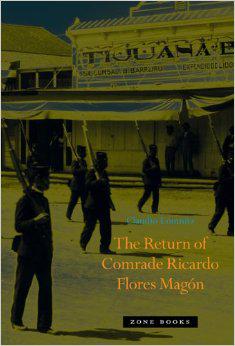
    ImageClaudio Lomnitz. The Return of Comrade Ricardo Flores Magón. New York: Zone Books, 2014. 594 pages. Notes. Index of Names. Photos. Hardback. $35.95.

    If it were a house, Claudio Lomnitz’s The Return of Comrade Ricardo Flores Magón would be a rambling, decaying mansion with various jerrybuilt stories and wings, a ramshackle place filled with archives and artifacts, old political posters and antique typewriters, a building straddling the U.S.-Mexico border, a shared abode whose residents are an interesting and odd collection of characters, some of them lovely people, some noble, and others quite disagreeable, coming and going at all hours, sometimes reciting poetry. And don’t be surprised if, while you’re visiting, the place is raided by Furlong or Pinkerton agents, by the police or the Texas rangers who carry off some of the boarders to prison; some of whom will be gone for years at a time.

    For this house—which over the years was moved from Mexico to the United States and then from one city to another—is the headquarters of a band of anarchist and socialist revolutionaries and their American friends and comrades most of whose time is spent in putting out the newspaper Regeneración, in organizing disastrously failed insurrections in Mexico, and in campaigns to get their correligionarios out of prison. Don’t be shocked if Ricardo Flores Magón, the leader of this outfit, gets angry with you, calls you a pederast and a pervert, a degenerate and a traitor, and publishes in his newspaper a call to have you executed. Don’t take it personally, you are hardly the first. Finally don’t be surprised if the author mistakes this house for a communist utopia, for he has been visiting it for a long time, knows everyone and their brother, and his deep immersion in their cause has on the one hand given him a remarkable familiarity with the place and its people, but on the other hand also sometimes clouded his judgment, as it clouded theirs. And I know how that happens, for it has happened to me too.[1]

    The Return is a prosopography of a dozen or so Mexicans and Americans, the former mostly anarchists and the later mostly socialists, who at the beginning of the twentieth century were engaged in the common cause of defending and supporting the Mexican revolution and its revolutionaries in their attempt to overthrow the dictator Porfirio Díaz. Ricardo Flores Magón and the other Mexican Liberal Party leaders—anarchists and socialists–imprisoned by Díaz in 1903, fled the next year to the United States to continue their organizing and to publish their newspaper Regeneración first briefly in St. Louis and then for many years in Los Angeles. There the Mexicans and their American supporters worked together to expose and publicize conditions in Díaz’s Mexico, above all the existence of a system of debt peonage that was tantamount to slavery and a dictatorship that was every bit as bad that of Czarist Russia.

    Ricardo Flores Magón stood at the center of the exiled Mexican anarchist group together with his brother Enrique, while John Kenneth Turner, author of Barbarous Mexico, his wife Ethel Duffy Turner, John Murray, and Elizabeth Darling Trowbridge were at the center of the American socialists. The Mexicans had founded and led the Mexican Liberal Party (PLM)—which despite its name was actually an anarchist organization—while the Americans were part of the Los Angeles chapter of the Socialist Party of America, the party of Eugene V. Debs. Also supporting the Mexicans, though from a distance, was Emma Goldman, publisher of Mother Earth, the most famous figure of American anarchism. The brothers Flores Magón and the American socialists worked together in relative harmony from 1904 until 1911, when the outbreak of the Mexican Revolution of 1910, led by Francisco I. Madero, led to a break between socialists and anarchists both in the United States and in Mexico, after which the two political tendencies were generally opponents and even enemies. On both sides of the border the socialists broke with the anarchists and supported Madero’s revolution, while the anarchists urged their supporters to resist Madero as a capitalist and the enemy.

    In his introduction Lomnitz writes that he wants in The Return to rescue Ricardo Flores Magón from two particular misinterpretations: first, that which sees the Magonistas and the PLM as only “precursors of the revolution,” a title and also an official organization created by the Mexican government; and, second, that which “brownwashes” the Magonistas and the PLM by seeing them as the origin of the Chicano movement, a point of view developed by Juan Gómez-Quiñones.[2] Lomnitz wants to shift the framework for telling this story, arguing that the history of the Mexican Revolution has usually been told as national or international history, “but analysis of the revolution as a transnational phenomenon has not yet made a deep mark”—though in fact there have been several earlier transnational histories.[3] Flores Magón, the PLM and its allies, Lomnnitz argues were not precursors, they were part and parcel of a transnational movement that formed an essential part of the Mexican Revolution.

    We have had many biographies of Ricardo Flores Magón and the Mexican Liberal Party, as well as several books that have described their transnational political collaboration, but Lomnitz’s The Return, a collective biography based on new archival research on both sides of the border as well as on previously unknown or untapped sources, and written as a cultural history of this milieu and period, represents the fullest and richest account so far.[4] Lomnitz, the Campbell Family Professor of Anthropology at Columbia University, brings to his study of this group his anthropological sensitivity to the complexity of cultures and a deep interest in and fascination with language and literature. While the historical narrative is clear enough, the author is also given to leaving the main highway and taking us on to side roads and occasionally footpaths, especially if he hears someone over the hill reciting a poem. The Return’s solid foundation in the historical record allows Lomnitz to explain previously misunderstood issues; and when he doesn’t have evidence, he boldly risks intelligent psychological speculation about desires, motives, and intentions, many of which are compelling, though not all of them are convincing.

    While I love rambling through this big old house with Lomnitz, I can’t always share in his explanations and sometimes find them farfetched. For example, he spends a couple of small sections of the book called “Families of the Cause” (pp. 214-220) and “Edendale” (pp. 441-443) describing the family relations of the PLM leaders and some of their American allies. He argues that their families were “novel households,” partially reflecting the earlier bohemian lifestyle of their youth, “compounds” involving more than one family, which he says he is “tempted to christen the ‘Liberal Joint Family System’….” He writes:

    Communism, in short, had a real social base. It was not ‘utopian,’ because it was built on real circumstances and on everyday solutions to everyday problems by groups of workerswho had pooled resources, shared rooms, supported one another and composite new families that could, under certain conditions, morph into veritable colonies. Communism was an ideal, certainly, but it also existed, right there, as real lived experience. (p. 220)

    A passage like this—which makes us think of contemporary discussions that developed around the Occupy Wall Street movement under the name of “prefiguration”—strikes me as making a theoretical mountain out of an everyday molehill. Many working class people, and perhaps more commonly among Latin Americans, form families made up not only of parents and children, but also grandparents and grandchildren, aunts and uncles, an often “fictive kin” who are incorporated as well. Poverty is the mother of invention of these families where then and now people share mortgages or rent, clothing and food, as well as incomes and bills in order to survive. While as Ethel Duffy Turner wrote, “There was a remarkable camaraderie in those days,” there was also as Lomnitz himself observes, grinding poverty: people lived close, too close, didn’t have enough money, enough space, or enough to eat. To call this, “Communism…right there…as lived experience” is not only not convincing; it seems downright silly.

    But Lomnitz then goes on to draw from that inference this fantastic conclusion:

    This, in the end, was why many workers felt robbed when the state appropriated these forms, in Russia, for example. The soviets had been betrayed. The state was not a union of soviets, but an armature that had been raised above them and that exploited even their name, only to turn around and call the small-c communists “utopians”

    But I am getting ahead of myself.

    But Lomnitz is not getting ahead of himself—for he never returned to these issues later in the book. He jumped from his observations about the need of Mexican and American radicals to share housing, to the deduction that that was a kind of prefiguration of the communism they desired, and from there to the conclusion that the Russian Revolution had somehow destroyed all of that. It’s hard to take such a passage seriously, especially as there is no sustained discussion of the differences between anarchists and socialists and hardly another mention of the Russian Revolution until the very end of the book and there only in passing. The anarchist movement’s relationship to the Russian Revolution is an important and complicated one that if it is going to be raised deserves more serious comment than this. One also sees in this passage what is a large amorphous problem with this book, namely that because of the author’s immersion in this milieu and identification with its protagonists, it is often hard to separate what the Magonistas are doing and writing from what Lomnitz thinks about it.

    A Rich Book–Poor in Politics

    Lomnitz is clearly at some level in love with Ricardo Flores Magón and company; one sees this in his practice of calling all of the Mexican anarchists and American socialists that he likes by their first names, while others, following standard practice, are called by their last names. Yet Lomnitz has to be credited with seeing the Magonistas as they really were. Lomnitz makes it clear that they were incompetent revolutionaries whose failure to create a clandestine organization meant that their mail was read by the U.S. and Mexican governments, leading to the failure of their insurrections in 1906 and 1908 and to the execution of many their comrades. He also agrees with other historians that the PLM-Industrial Workers of the World (IWW) invasion of Baja California in 1911 was not only a military failure but an even worse political fiasco.[5] Lomnitz doesn’t hesitate to point out that when differences with his comrades arose, Flores Magón lashed out viciously, calling his former friends and comrades not only “traitors” but also “lesbians” or “pederasts” and “perverts.” He also describes how Flores Magón sent out orders that a former comrade who had left the group be shot and mentions other published calls to execute former PLM leaders. And he doesn’t hesitate to mention Flores Magón’s glorification of violence motivated by hatred and a desire for revenge. Yet, while he recounts these faults, we find no systematic political critique of them, so that one comes away feeling that Lomnitz still romanticizes and loves the Magónistas despite these political and moral faults.

    The one political problem that Lomnitz fails to deal with is the Magonistas' opposition to the Chinese, a serious problem for a group that took pride in its proletarian internationalism. The Magonistas’ reformist program of 1906 stated, “The prohibition of Chinese immigration is, above all a measure of protection to workers of other nationalities, principally the Mexicans. The Chinese, disposed in general to work for the lowest wage, submissive, petty in his aspirations, is a great obstacle to the prosperity of other workers. His competition is fatal and it must be avoided in Mexico. In general, Chinese immigration doesn’t produce the least benefit to Mexico.”[6] This was a view shared by the American Federation of Labor and other unions in the United States, a virulent racist sentiment that in the U.S. led to the Chinese Exclusion Act of 1882 and in Mexico during the revolution to the massacre of the Chinese by Francisco “Pancho” Villa’s troops.

    What is most disturbing about Lomnitz’s The Return is that it never systematically discusses the Magonistas' political views or how they came to them. One can read a few hundred pages of this book before the word “anarchist” receives any discussion, though the Magonistas were anarchists.. What is missing from this book is what was at the core of Cockcroft’s Intellectual Precursors of the Mexican Revolution, 1900-1913: that is, a clear intellectual and political description of the Magonistas as Bakuninist anarchists. If one understands their Bakuninism, one then understands the Magonistas’ dual revolutionary strategy of one the one hand behaving as a vanguard organizing repeated revolutionary insurrections and on the other hand acting as an ideological center to guide the rising of what they view as the ignorant and inchoate masses. If one knows they are Bakuninists, one also understands the PLM's conspiratorial character, its authoritarian leadership, its insurrectionism, and its lack of a working class strategy. Lomnitz writes that merely discussing the ideological differences between anarchists and socialists doesn’t explain the developments that took place in the relations among the Mexican and American radicals, and perhaps not, but the reader surely needs that basic information and understanding, even it is supplemented by other material regarding the milieu and the cultures in which it existed.

    When Lomnitz does occasionally venture into political analysis, for example in a short section titled “Revolutionary Theory” (pp. 329-335) he ends up giving us another short historiographical essay (such as we had in the introduction) and then a few paragraphs that suggest that the Magonistas failed “…either because they had insufficient local ties or because leaders who did have ties were often compelled to subordinate their ideals to the practical desires and requirements of local factions and so became vulnerable to accusations of treason from Ricardo, back in Los Angeles” (p. 335). While there may be some truth in this, one would hardly call this a discussion of “revolutionary theory.” There is no discussion of social classes, political organizations, revolutionary strategy, or plans for governance. This book, rich in so many things, is poor in politics.

    If this book were a body of water, it would be a Mississippi, a great meandering river, twisting and turning through the land, at flood carrying everything with it, depositing all the soil and debris, the flotsam and jetsam of a season into the Gulf of Mexico. And if we travel with Lomnitz on his raft down that river, we get a tremendous ride, see many sights, meet a good number of interesting people along the way, but never get up on a hill, never have an overview that allows us to understand what it all means. We can see why he loves the river, but not how the river shapes history.


    [1] I have been working for about twenty years on a history of the Mexican Revolution and its influence on the American left between about 1900 and 1930 and have also been intrigued, absorbed, and sometimes bewitched by the Flores Magón group and their American allies.

    [2] Juan Gómez Quiñones, Sembradores: Ricardo Flores Magón y el Partido Liberal Mexicano: A Eulogy and Critique (1971).

    [3] Transnational studies of this period include: W. Dirk Ratt, Los Revoltosos: Mexican Rebels in the United States, 1903-1923 (College Station: Texas A&M University Press, 1981); Javier Parés, La Revolución sin frontera (Mexico: UNAM, 1990); Colin M. MacLachlan, Anarchism and the Mexican Revolution: The Political Trials of Ricardo Flores Magón in the United States (Berkeley: University of California Press, 1991); James A. Sandos, Rebellion in the Borderlands: Anarchism an the Plan of San Diego, 1904-1923 (Norman: University of Oklahoma Press, 1992).

    [4] The best known individual and collective biographies are: Diego Abad de Santillán, Ricardo Flores Magón (Mexico, D.F.: Grupo Cultural “Ricardo Flores Magón,” 1925); Ethel Duffy Turner, Ricardo Flores Magón y el Partido Liberal Mexicano (Morelia, Michoacán: Editorial Erandi del Gobierno del Estado, 1960); James D. Cockcroft, Intellectual Precursors of the Mexican Revolution, 1900-1913 (Austin: University of Texas, 1971). Transnational studies are: W. Dirk Ratt, Los Revoltosos: Mexican Rebels in the United States, 1903-1923 (College Station: Texas A&M University Press, 1981); Linda B. Hall and Don M. Coerver, Revolution on the Border: The United States and Mexico, 1910-1920 (Albuquerque: University of New Mexico Press, 1988); Javier Parés, La Revolución sin frontera (Mexico: UNAM, 1990); Colin M. MacLachlan, Anarchism and the Mexican Revolution: The Political Trials of Ricardo Flores Magón in the United States (Berkeley: University of California Press, 1991); James A. Sandos, Rebellion in the Borderlands: Anarchism and the Plan of San Diego, 1904-1923 (Norman: University of Oklahoma Press, 1992).

    [5] Lowell Blaisdell, The Desert Revolution: Baja California, 1911 (Madison: University of Wisconsin Press, 1962); Lawrence Douglas Taylor, La campaña magonista de 1911 en Baja California (Tijuana: El Colegio de la Frontera Norte, 1992) and La gran aventura en Mésico (Mexico: Consejo Nacional para la Cultura y las Artes, 1993), two vols.

    [6] Fernando Zertuche Muñoz, Ricardo Flores Magón: El sueño alternativo (Mexico: Fondo de Cultura Económica, 1995), p. 85.


  • Monsters and a Critique of Everyday Neoliberalism:

    Image[This is part two of an interview with scholar-activist David McNally on the current economic crisis. The first part focused on the crisis itself, its causes, the way in which working life has been reorganized, the perspective of ruling elites in managing the crisis and pursuing austerity policies, and how this should help inform our stance as movement activists.

    This second part will concentrate on McNally’s book, Monsters of the Market, asking why the monstrous has captured popular culture. This will lead us into a critique of everyday life under neoliberal capitalism, discussing how the experience of waged labor has created an affinity for monster stories, particularly zombies, vampires, and Frankenstein’s monster. The second part ends with McNally’s thoughts on building a renewed socialism-from-below.—AS]

    Tessa Echeverria: It’s of course important to understand how capitalism works and how the current crisis came to be in order to use that information to mobilize our social movements in a forward trajectory and not just see it as crazy people instituting this plan that’s not good for the economy. I was hoping we could transition into talking about Monsters of the Market. In the introduction, you talk about how people say capitalism is a monstrous system and that’s what we’re up against, but we need to recognize the real monstrosities that capitalism has brought about and the way it forces us to live under the system every day. I was wondering if you could go into why you wrote the book—tell us why you thought this was an important book and what was your process?

    David McNally: It’s interesting because we’ve been starting, I think appropriately, from the economic side of the equation in terms of the most basic thing that people talk about in their lives: paying the bills, paying the rent, paying the mortgage, can they find a few more hours of work and so on. But there’s a danger in that, and I say that as somebody who writes a lot in the area of political economy. There’s a danger that we don’t pay attention to so many other dimensions of experience in a capitalist society. Here I think the image of monsters and monstrosity is really important.

    There is something very unsettling about what goes on in modern society. We’ve created a society in which the mass of humankind is dispossessed of land and any other means of making a living except to go out onto the market and sell your capacity to work to an employer. That experience is one that I don’t think we reflect on much, and I think it’s a problem. It has become so normalized. We treat it as such a natural fact of life that we often forget that you can’t sell your ability to work, your creative energy, your talents and so on, without physically turning yourself over as well.

    On one level we all know this: whether you punch a time clock at a factory or you log on to a computer as soon as you get to work to indicate that you’re present the fact is that there is a rigid, orchestrated routine for most of us governing hours of work: when we get breaks, what kind of communication we can and cannot have with our coworkers, with management, never mind with our loved ones and so on. Literally we surrender control over our body and our wills for a significant part of our waking lives.

    Of course we always try to steal a little bit of that back: sneak off and email someone or send a text message, or whatever. But the truth is that most of our time we are doing something that we don’t think of as living. We think that our lives begin when we leave work. That’s why we get all those expressions, like referring to work as “dead time,” for instance.

    What a remarkable expression to think of a part of our lives as if we are living dead! And of course the living dead is the classic image of the zombie. My own view is that one of the things that’s happened under neoliberalism,  that the power of employers over workers has become so significantly greater as a result of the defeat of unions, the reorganization of work on shop floors and the basic restructuring of labor that’s gone on, that we are in fact more dominated than ever before. We are generally more sped up and stressed in our work than ever before.

    The idea of being a living dead, and very often feeling “zombie-fied,” as we leave work and all we’re good for is opening up a beer, having a bite to eat and watching some mind-deadening stuff on our laptops or what have you, all of that I think is part of the social-cultural reality of what it feels like day after day when we’re working. Your life energies are stolen from you. They’re taken; they’re appropriated by somebody else who treats you simply as a means to an end, which is the profitability of their firm in whatever good or service it is that they’re producing.

    I think that within our culture there is a very deep hostility, but worse often after a very deep depression, about that reality. Part of what’s happening with the proliferation of zombie images in our culture is self-recognition in the zombie. There’s recognition that a lot of the times we shuffle around like the slow moving creatures: awkward, kind of ugly, not looking very uplifting. In some ways the zombie captures a part of our lives that we don’t like to talk about. One of the things that I was trying to do in Monsters of the Market was to really reflect on the ways in which our popular culture is saturated with these images.

    Having said that I think that too often in the Hollywood and the North American genre of the zombie we’ve lost what was once at the heart of it, literally, when the zombie image originated in Haiti. We’ve lost the image of the zombie laborer. That’s what the Haitian image was about, living dead laborers for others. For a whole variety of historical reasons, Hollywood has fallen in love and the mass media in North America has fallen in love with the zombie consumer. You see it even in the idea of zombies as flesh eaters. That’s very new imagery, which probably goes back to George E. Romero’s Night of the Living Dead, which was one of the most powerful critical uses of the zombie as flesh eater. Interestingly, Romero didn’t think they were zombies! They only got called that later. That idea that something monstrous where our life energy is captured and we are turned into something less than fully human is I think part of the story.

    The other side of it, and the one that is very interesting, and one I think some of the best treatments of zombies sometimes get at, is the idea that the zombies might wake up. This is a central part of the Haitian story of the zombie, and the Haitian image is sometimes picked up in sub-Saharan Africa as well. Zombies can awaken.

    Zombies most of the time lack memory, they lack identity and subjectivity, but under certain conditions they awake. This is the image of the zombie rebellion. The carnival of the living dead, who all of a sudden maraud through the streets, scaring polite society and showing them in some ways that those who’ve been downtrodden, those who’ve been zombie-fied and monsterized by this system actually have a monstrous power. Once they get it together, they can use that power in carnivals of revolt, insurrection, and rebellion. There’s one really nice film from the 1990s by Wes Craven called The People Under the Stairs that really gets that image of the zombie revolt.

    There’s also a story of zombies coming up against big business, the bankers. The real zombies are those in life who have no purpose in life except to exploit others for ever swelling amounts of money in bank accounts somewhere. The zombie image can therefore be turned around or inverted to one in which we are criticizing zombie capitalism as a system on life support by governments, pumping trillions of dollars into keeping a certain kind of necropheliac capitalism going and sucking our life energies to do it. The Monsters of the Market is how we all experience being zombie-fied in some ways when we become workers in a capitalist society and live at least part of our lives as the living dead. There are these other sides, the potentially radical usages of the zombie images where zombies awaken, recognize who they are, they come to a capacity for action in their society against those who are a different kind of zombie, another living dead.

    Andrew Sernatinger: Everyone I’ve talked to that’s seen or heard about this book has already been fascinated by it, and I think that’s a remarkable success. Here we just had this fantastic conversation about Global Slump, which I think is probably one of the best books about the crisis that I’ve read, but for a lot of people looking at that sort of political economy is intimidating. But then here you have something that seems almost fun and subversive in this way that everybody can relate to. Everyone has a story or something they want to talk about with the mythology of zombies and vampires and things like that. It’s a brilliant delivery on that.

    It’s really interesting that you talk about the different ways that the zombie myth has been deployed because we’re so used to thinking of the zombie as something you don’t want to be or that you try to escape from. You’re right that there is this kind of small current about the zombie that becomes awakened and transcends being a zombie. You brought up a Wes Craven movie, but even George Romero in Land of the Dead has that same zombie rebellion sequence. People have a discomfort about it, but then you can only take the zombie idea so far before it has to have a resolution. The rebellion motif is one of the places people have taken it to.

    To some extent, the fascination with the zombie myth has changed with the arrival of this crisis and slump. The perception isn’t about alienation as much as it is about survival, it seems. Here you are against a wave of people and you’re competing for your spot. Literally, the alternative is death. That seems to be something that’s really gripped the popular imagination.

    DM: Yes. I basically wrote the book before the explosion of what I would call the “Zombie Apocalypse” idiom that you’re describing there and I think it’s very powerful and I’ll come back to that in a moment.

    On your first point, I think that one of the things that we need to be very careful about on the left is that we are able to talk about the quality of every day experience. Sometimes as huge as issues like employment, wages and so on are, the danger is that those of us on the socialist left may seem to project the idea that all we want is a society with full employment and better pay. Of course I want full employment and better pay, but that can be appropriated to the mythology of perfect full employment capitalism. We wouldn’t be addressing alienated labor, the degradation of work, the fabric of our daily lives, and the exhaustion of people by mundane, boring, incredibly dreary and tedious labor processes without any diversity or creativity to them.

    One of the nice things about coming into this discussions about monsters and zombies and vampires is its one of the ways in which we do get to talk about what daily life experience is like being at work or searching for work in our society. It forces us to think if we really want to imagine a better society then full employment and better wages aren’t enough! We’ve got to be talking about the very qualitative features of everyday life, the fabric of social existence, the question of human creativity, of dis-alienating labor, of finding entirely different rhythms of work and life.

    Those are the kinds of discussions—particularly in a period where we’ve been retreating all the time—that we’re not even having in a serious way in left circles. And yet in my experience if you really want to get across to people the idea of a socialist alternative to how our society operates, one of the things that is most attractive and captivating is the idea that we’re talking about changing the very rhythms, the sensuous fabric of everyday life and creativity. That’s one of the things that I’ve enjoyed about some of the conversations that the book has opened up.

    I think you’re entirely right on your point about the zombie apocalypse. The zombie was there as this incredibly adaptable image that when the crisis hit there was the idea that we could in fact be moving into a stage of capitalism where—forget all these stories about technological progress, which are the old fantasies of ever expanding capitalism—we could be in a meat grinder of a system! It could just chew things up as it rots; as cities rot; as disease spreads; as hordes of homeless people simply move about the land looking for a place to live.

    All of those are just extrapolations of some of the trends of this crisis. The zombie image was highly resonant with that perception. It can also then get married to a certain kind of deeply conservative survivalism. I would suggest that a lot of that is going on in the very popular series The Walking Dead. If you go through the roles played by actors of color in that series it seems to me that you see a certain kind of white survivalism that runs through.

    It’s important therefore to think about how we discuss and analyze why these kinds of images have such powers of attraction: there is something that people really do identify with in the collapse of civilization image, there is a sense that the growth phase of capitalism seems to have disappeared. That’s important to connect with. But at the same time, if collective responses designed to remake the world in radically new ways just don’t seem to be out there then the survivalist mode can kick in. Here I think that Frederick Jameson’s pithy little comment tells us an enormous amount: “It is easier to imagine the end of the world than the end of capitalism.” I think that’s what we’re seeing in these zombie apocalypse stories and scenarios: civilization is collapsing, but all kinds of capitalist modes of survival in the most elemental and brutal sense start to fill the void; you just beat your competitors into the ground. It’s a scenario in which collective solutions to remaking the world tend to disappear. That’s why I think the zombie rebellion idiom becomes really important in a political and historical moment like this. That’s a subversive side.

    There are these little events, the “Zombie Marches,” that you get in a number of cities, that I think are really interesting because zombie marches increasingly have all these financial and capitalist symbolism about them. At the last zombie march in Toronto, I would say half of the zombie marchers had dollar bills pasted all over them and that sort of thing. That way of turning the imagery and talking about capitalism as the living dead system, the idea of zombies who are actually breaking through it, is something that is very difficult to sustain right now but has really huge creative possibilities. I find people responding to some of the better zombie rebellion type images really interesting in that regard.

    AS: One of the things that we like about this discussion about why people are taken with zombies is because it is in a way difficult to grasp everything that’s been happening. But I think you made the point in Monsters that the popular imagination can explain things in capitalism sometimes only through the fantastical. When things like crises happen, sometimes only the monstrous can really describe it. And that is something that Marx gets to also.

    The zombie wasn’t really around when Marx was writing Capital, but Capital is full of all kinds of allusions to vampires and monsters, how there’s a life-force sucking energy in capitalism. On the one hand I think that it’s really interesting that you have to engage with this mythology and that it seems like even Marx was very aware of deploying popular mythology or creating a literary element to his analysis of capitalism. Also the vampire is the counterpart to the zombie in nearly the opposite way.

    DM: There’s no question about it. One of the things I really enjoyed about working on the book was exploring and recuperating what Marx was doing with those monster images. People often talk about Marx’s political economy writings as so difficult and intimidating, and of course Capital is a big fat book and the opening chapters are just full of new concepts, dizzyingly so.

    One of the things that we sometimes forget is that Marx was struggling to find a language with which he could express what was going on in capitalism. The existing theoretical languages (philosophy, political economy) that he had really weren’t fully serviceable. He tried to use them to the extent that he could, but once he gets to the chapters on the working day and what it feels like to be in a factory, or his chapter on machinery and what that is like, Marx has got the whole Charlie Chaplin Modern Times-thing right there! The worker becomes a cog in the machinery; the machinery drives the worker.

    But how does he express it? Chaplin can do it in a filmic way, with these incredibly powerful visual images, but Marx has to generate the imagery through the word. I find it just fascinating the way that he returns over and over to the vampire as an image: the vampire who will not let go until every bit of blood has been sucked dry from the worker.  He also returns to the image of giants. He’s got the factory and machinery as Cyclops at one point. Production is just so overwhelming in the massiveness of the operation that the worker is reduced to mere insignificance in relationship to it.

    I really find it interesting the way in which he’s struggling to bring together all these narrative strategies: yes he’s using some philosophy; he’s using some political economy; but Shakespeare is in there! Faust is in there! Vampires are in there! When he hits the limits of some of the existing theoretical discourse of his day, he goes for the only thing that he can imagine can convey what he’s trying to describe, which is a whole series of literary images. I think we need to appreciate that aspect of Marx.

    In all the ways we think about rebuilding a radical left culture today, we need to put a much greater emphasis on the literary and the cultural as ways of communicating or expressing what it is we’re trying to say in our society. There’s a danger that we become kind of monotonal: we get a certain left discourse that was honed in a particular historical period and we imagine that that discourse and its vocabulary has magical effects because once upon a time the masses mobilized behind those images and that rhetoric. Well, if they’re still effective and there are ways that they still speak to people, that’s fine. But we need to be honest about the cultural transformations that go on in our society and I think it’s important to find the resources within popular culture, in film and literature and so on, that allow us to communicate these sorts of things. That’s why I loved your example from Romero’s Land of the Dead, where there are fascinating scenes where zombies are learning to use weapons! It’s not true that they can’t learn, that they’re uneducable. There’s a learning process happening. There is the de-zombification happening, or what I was calling the “zombie awakening.” I find it’s really interesting the kind of discussions you can get into about our society by using those kinds of cultural reference points as well as the political economy that we absolutely need, as well as the historical understanding. That’s what I mean by not being monotonal: we can draw upon a lot of different languages, visual and imagistic systems to communicate what is going on in our society and how it could be different.

    TE: I wanted to go into vampires a little more. We’ve talked about how zombies have changed in their cultural significance and how they’ve fit into a various stories as capitalism has changed. Talking about vampires the same way, vampires of old were Dracula or Nosferatu; they were terrifying, evil creatures that destroyed every life force around them. Nowadays vampires are majestic and something to aspire to be, instead of something to fear. I was wondering if you could go into this development a bit.

    DM: If we go back to Bram Stoker’s original Dracula story, it’s an aristocratic image to begin with. It’s deeply parasitic and frightening: these vampires do you damage! What we’ve got today is this fascinating romanticization of the vampire. One of my hunches is that, of course, in all kinds of ways the vampire image has lots of different sexual overtones expressed in different cultural artifacts. It particularly speaks to young people discovering their sexuality, and that’s part of what’s there.

    But I find the analyses that only get that far to be a little superficial. I say that because it seems to me that part of the resurgence of the romanticized vampire actually is a kind of anti-alienation theme. It’s speaking to a society in which people feel incredibly atomized, incredibly dissociated from each other; the sense that social connection is at an all-time low. Communities and their resources have been so eroded in the neoliberal era.

    The idea of isolated, self-sufficiency and everything that’s really unsettling and disquieting about that is also running through that image. At the most powerful level, the vampire is an image of incredible closeness. Literally bodies become interconnected in the most intimate ways, and I think that’s picked up again in the mobilization of vampire tropes as love stories, stories of closeness, passion, and belonging; the idea of being infinitely desired and inseparable from others. Sure, we can see various gendered tropes at work there that we’d want to be aware of and critical towards, but just as I was saying before we need to see what it is about the zombie apocalypse image that really is speaking to people’s fears, so I think we need to see the romantic vampire as speaking to the really frightening sense of aloneness that is so pervasive in our society. We need to understand that the desire for an escape from other isolation is something that good politics and social movements of the left ought to be able to speak to.

    There’s a cultural barometer, a kind of reading of the social temperature of our times that we need to do there. All of this is speaking to the huge amount of experience of everyday life. Very often, saying in public something like, “My profound sense of aloneness is really frightening and it scares me”—that’s not something that people do very readily! Those films or novels that capture this particular construction of the vampire I think give people permission to recognize those feelings and then have a fantasy-based projection of a world where they would be desired, where they would belong, they would have togetherness and communion with others. Seeing that side of it, I find it to be really significant.

    AS: One of the things I like about these discussions is that there is no singular “correct” answer when you’re analyzing culture. There’s a lot of room for thinking about all of the different things at work here and trying to pin down what people are really concerned about.

    Part of the reason why we brought this up is because we have these conversations from time to time where, for example, there are progressive institutions and all of their social funding has dried up. Now they’re talking about the need for patrons, essentially, where some wealthy donor will hold up their progressive ideal. I almost see that in the new vampire: the vampire is the image of power, and if someone needs to be lifted out of their situation they can get this vampire-patron, who’s a “good vampire” that helps them out. To me, it doesn’t have to take away from what you were saying before, I think it speaks to a sense that the way to get out of working class life is that you’re lifted out externally.

    DM: I think you’re absolutely right. It connects back to something that is the flipside of the aristocrat image. The aristocrat is a dangerous individual in the Bram Stoker story, but on the other hand the aristocrat is not capitalist. Aristocrats operate according to a different social and cultural code, and one of the characteristics of that code—and I think you’ve nailed it in that description—is noblesse oblige. You have patrons, people upon who you confer some of your wealth and beneficence. I think the fantasy for that, as you say the idea of someone who will rescue us from the fears, the dreariness of a life of wage labor is also probably part of that story in wages that deserve to be thought more about. So yeah, I think that makes a lot of sense.

    TE: I just love the story of Frankenstein and you mention it in Monsters of the Market. I was hoping you could go into the significance of that quintessential monster story. We talked earlier about how with wage labor, you’re selling your body and giving up so much of yourself—talk about how that plays out in the story of Frankenstein.

    DM: It’s such a wonderful story and it’s a shame that people often know the story largely through later adaptations through film and elsewhere and in some ways don’t get to appreciate what an interesting novel Mary Shelley wrote. In the early nineteenth century, Shelley created that whole resonant set of images of the creature and of Dr. Victor Frankenstein and all the interactions that the two have with each other.

    The context is really interesting. Among other things, Mary Shelley is the daughter of Mary Wollstonecraft, the writer of The Vindication of the Rights of Woman, one of the original modern feminist texts of the late eighteenth century. At the time of the French Revolution and its slogan of the rights of man, she wrote on the question of the rights of women. Then Shelley marries the great radical left poet, Percy Shelley. In conversation with others, Mary Shelley is exposed regularly to discussions around the so-called “Luddite Riots” in Britain in the period 1813-1820.

    These rioters, machine wreckers, were basically poor workers across the small industrial towns of Britain who, when they were going to be displaced by various pieces of machinery for spinning and weaving, would show up at night under cover of darkness and burn down the mills or smash the machines. They were being hugely persecuted: they were being arrested and hanged and so on for their crimes against property. The circle of friends that Mary Shelley ran in was opposed to this treatment of poorer people who were trying to preserve their livelihoods.

    What she does is incredibly interesting. She has her isolated scientist, Victor Frankenstein, decide he wants to create a living creature. How does he do it? He raids graveyards. He goes and gets pieces of human body parts and he melds them together with animal body parts. This was a constant theme for the working class in London at the time, because corpses were regularly raided from graveyards. Really only the corpses of the poor because the rich were buying these heavy lead vaults that couldn’t be blasted open. The bodies of the poor were just being stolen from graveyards and sold for medical or anatomical experiments. This spoke to a working class fear that even in death your body could be chopped up and turned into a bunch of saleable commodities. Bad enough in life that you’d have to sell your body to survive, but then to have it chopped up in death was the ultimate indignity.

    Mary Shelley is picking up on that to begin with. But also, she’s imaging the proletariat, imaging the working class, in this notion of grabbing different bits and pieces of random, disparate individuals and cobbling them altogether. Well, that’s what happens when you go to the factory! That’s what happens when you go to the mill or the mine. Bunches of people who have had no previous human contact with one another all of a sudden are thrown together as one creature, one entity: the workforce. She’s imaging all of that and depicting all of it in the construction of this creature, the working class, by this one individual, Dr. Frankenstein.

    I find all of that just incredibly powerful in the way in which it’s depicting both anxiety about grave robbing that workers have—their bodily integrity was regularly being assaulted, and here was the worst possible imaginable result that they even get you as you lay in your grave—and also this idea of being thrown together and becoming one monstrous mass, an enormous creature capable of feats beyond what any one individual could do. Of course, that’s what we are like when we’re all assembled together in a workplace: we can do things that no one of us could do on our own, in terms of the amount of Big Macs we can produce or the amount of automobiles we can produce.

    Contrary to the way in which Hollywood later turns the creature into a slow shuffling zombie without the capacity to speak, particularly in the Boris Karloff movies, that’s not there in Shelley. What’s so fascinating is that once the creature rebels and heads out on his own, he moves through the world quickly, but more than that: he learns to read! There is this amazing set of scenes where the creature sits outside the cottage of a poor family, one of whose young men has married what I can only describe as an Arab feminist. This is a literate, Arab woman and she reads to him the most radical, revolutionary tract of the day by a guy named Volney called The Ruins. It’s about how humanity began in Africa, and it’s still considered by Africanists to be one of the greatest anti-racist texts ever written. So you’ve got an anti-racist theme, a feminist theme, and a working class theme all running through this novel. This is how the creature learns to speak. He learns by hearing an Arab feminist read the greatest revolutionary tract perhaps of the late 1790s or early 1800s.

    Then of course, we know that it has to culminate in a great conflict between the inventor and the creature, the monster that the inventor has created. We get an ending that leaves everything hanging: we don’t really know where things lie. We know that Victor Frankenstein has died and the monster has disappeared. The creature has won a victory, it wanted Frankenstein’s death for the murders he committed, but at the same time it’s unclear whether the creature has killed himself or if he will live to rise another day.

    This to me is one of the most powerful literary imaginings of how capitalism brings into being a monstrous creature that could be its own undoing. What I really am attracted to is that this is not a zombie. The creature learns to read and what it craves throughout the whole story is communion and association; it wants a partner. Victor Frankenstein’s crime is that the creature wanted a partner. Frankenstein started to create it, and then he killed the female companion he was making for the creature out of the fear that a new race of creatures would be bred. Well, if that isn’t the capitalist class’s great fear of the multiplying masses of the proletariat, of the working classes, I don’t know what is.

    There’s so much happening here. This is in my mind the original monster story about capitalism, but also the one that leaves open the idea that this monstrous creature of the working class might just be capable of educating itself; might just be capable of putting an end to this insane, alienating society; it might just be capable of starting something different. But that’s left as a question mark. We’re dangling and there are no easy answers. In some ways of course that is very attractive to me, because if the left ought to have learned anything in the nearly 200 years since Mary Shelley wrote that text, it’s that there are no easy answers. Nevertheless, there are huge and explosive tensions in this society that she just captures so wonderfully.

    AS: That’s a good place to finish with a conversation about the left. You’re talking about, in the literary sense, an antagonism within capitalism but at the same time an uncertainty about capitalism being overcome. We wanted to talk to you a little bit about your thoughts on the left right now, because as far as I’m aware you’ve written a couple of essays but it’s something you haven’t commented very much on recently. Maybe you want to start by telling us a little bit about your history on the left?

    DM: I was in university in the United States and I focused quite a lot on anti-racist and anti-war activism, particularly with the Committee to Free Angela Davis. When I later returned to Toronto for family reasons, there was a kind of radical leftwing that had just emerged in the social democratic party in Canada, the New Democrats. That left wing split off from the New Democratic Party and tried to launch a new kind of radical left party, and I joined it in my teens because it was the one place I could see a left group that actually had really significant working class membership: nurses, steelworkers, teachers, autoworkers and so on. That particular group, known ironically as The Waffle, self-destructed in the mid-1970s and a handful of us had gotten attracted to the “Socialism From Below” politics of the International Socialist groupings at the time. We found that much of what they were trying to do, particularly the rank-and-file labor organizing but also a rank-and-file organizing that was very open in terms of the feminist and anti-racist dimensions of that work; we found that very attractive.

    I became a founding member of what became the International Socialist group here in Canada. I put a lot of years into trying to do activism in that guise. For a whole variety of reasons, that International Socialist current began, I think, to politically degenerate in the later 1970s: it became increasingly bureaucratic, increasingly fundamentalist in the sense of “we have the truth” and we don’t need to ask any questions, and increasingly intolerant to feminism and anti-racism. This eventually, in the early 1990s, drove a bunch of us out and into the political wilderness. We then were involved in creating the New Socialist Group.

    That organization continues today, and what really distinguishes it is that it begins from the premise that first we have lived through a period of the decomposition of the radical left of a previous era. That historic left in virtually all of its forms is effectively over: the social democratic, the Communist Parties, but also the far left versions. That history is basically done, not in the sense that we don’t need to learn from it, but in the sense that I don’t believe those organizations can be the basis for the next new left. Therefore, we need to be thinking about a longer-term process of recomposing the left. That is going to mean a process of socialist renewal in which the socialism that we develop is completely transformed by and shot through with the lessons of theory and practice from the queer movements, the socialist feminists, the most important strands of anti-racist and anti-colonial politics (in Canada of course this means of indigenous liberation politics), and also of eco-socialism.

    Yes, there are very important inheritances from the past. As you can tell, Marx remains central to me for how I think about the world in which we live, but it’s got to be a renewed, extended, developed socialism for the twenty-first century that is going to have a lot of new and unique characteristics that I think are informed by radical participatory democracy, more so than any left we have seen up until now. That’s a big challenge to think about recomposing and renewing the left in those terms and breaking from all the vanguardism of little grouplets that think they are the center of a next left composition. They’re not. If they’re healthy, even semi-healthy, they’ll have a role to play but it’s going to be something very different.

    Of course, it all presupposes a return of large-scale social movements: movements that can produce tens of thousands and sometimes even hundreds of thousands of people in the streets. As we get that, just like the last new left, people are going to look for different kinds of socialist traditions and approaches that can allow them not to have to reinvent the wheel. So the work of small circles and collectives of activists today who are trying to think about what resources can we help preserve and develop for a new left will be really very important. That was true of the last new left, for good and for ill. Having a sense of what ailed the last left, and in particular the small group party-building projects, is important. They can produce fanatical energy, but they all hit a wall because that model has inherent limits. It doesn’t matter if the group grew to a few thousand, as some of them got in France or Britain, because none of them proved capable of moving beyond that and most of them have disintegrated in one way or another since then.

    That’s a very daunting process, but it’s nevertheless something that is our responsibility today. Those like me, and I think of myself as a 1970s radical, I think we have a responsibility to try to preserve and develop a kind of living tradition which has some roots in what we think has been best about past lefts but also a very high allergy to those sectarianized tendencies that did great damage to the last left. Yes, we need organization, that’s absolutely true, but the organizational forms will be different, they will (I hope) be more open, democratic, participatory and thoroughly feminist, pro-queer, and anti-racist in ways in which our spaces weren’t in the last left. It’s a big task, but the truth of the matter is we’re talking about what small groups, circles, collectives, networks and so on can do now just by way of trying to provide some resources for the next left. Those resources will get inherited, edited, deleted, transformed, and re-worked and so on by real social forces and real social movements.

    But it is important that democratic, from-below socialist politics be out there and be available, because one of the problems is that neoliberalism also destroys historical memory. The sense that we have certain continuities that are precious to us and that go back to the great past struggles that people have waged, these are a part of our history, they’re a part of our heritage and we need to make them part of our memory, but in that open-ended way that we know we’re reworking the left and not trying to mimic and repeat as if that could be something good. That’s where I see the kind of task that I’m involved with, with New Socialist in Toronto, but also just staying in touch with all the currents and people I can. We need one another, we need dialog, and we need ways of exchanging experiences and reflecting together. If history has taught us anything, of course mass struggles will emerge again but we can never predict how. When they do, we could have kept resources that will be absolutely precious to the next left.


    Andrew Sernatinger and Tessa Echeverria are socialists based out of Madison, Wisconsin. They produce the podcast Black Sheep, available at www.blacksheeppod.org, where the audio of this interview was first aired.

    David McNally is a scholar-activist based in Toronto, Canada. He is the author of Global Slump: The Economics and Politics of Crisis and Resistance and Monsters of the Market: Zombies, Vampires and Global Capitalism.

  • Global Slump & the New Normal

    McNally, Global Slump[It’s been nearly seven years since the onset of the global economic crisis that began in 2007. In order to get an understanding of the crisis—of its origins, depth, and trajectory, we spoke with David McNally, activist, political economist, and author of Global Slump: The Economics and Politics of Crisis and Resistance (2010) and more recently Monsters of the Market: Zombies, Vampires and Global Capitalism (2012). For readability’s sake, we have broken this interview into two parts. This first part focuses on the crisis itself, its causes, the way in which working life has been reorganized, the perspective of ruling elites in managing the crisis and pursuing austerity policies, and how this should help inform our stance as movement activists.

    Part two will concentrate on Monsters of the Market, asking why the monstrous has captured popular culture. This will lead us into a critique of everyday life under neoliberal capitalism, discussing how the experience of waged labor has created an affinity for monster stories, particularly zombies, vampires, and Frankenstein’s Monster. The second part ends with McNally’s thoughts on building a renewed socialism-from-below.—AS]


    Tessa Echeverria: Let’s start by talking about the history of the crisis that we’re in now, neoliberalism and how capitalist states responded to the meltdown that began around 2007. Could you give us a quick rundown of how the crisis came to be and how that relates to the recent history of capitalism?

    David McNally: I see this as the fourth great slump in the history of global capitalism. The last quarter century or so of the nineteenth century was the first slump, the original “Great Depression” where the term was first used. It began in 1893 and ran for about 25 years. Then, of course, for most of us raised on 20th century history, there was the Depression of the 1930s, which was actually the second of the great slumps. That was followed by the slump in which I came into political activism, the crisis of the 1970s running more or less from 1971 to 1982. And then neoliberalism and the way it reorganized and restructured work, corporate power and so on, managed to engineer another wave of capitalist expansion, which really was exhausted by about 2007 when we entered the fourth of these great slumps. We’re in year seven or so of this slump, with, I would argue, no end in sight.

    That’s just to get us situated historically. Now of course, every great slump has its unique historical features. They show all kinds of different characteristics having to do with the ways in which capitalism has evolved and in our case particularly how it has globalized, much more so than in any time in its history. There is also the specific role of the financial sector, and the very esoteric financial kinds of transactions that have been a feature of the neoliberal era of the last thirty years or so.

    You put those two features together, globalization and financialization, and it allows us to make sense of why it was that a crisis that began in the U.S. real estate sector, probably in 2006/early 2007, then became a full-fledged financial crisis. That has to do with all of these mortgage-based securities that financial institutions were trading back and forth and selling to investors and speculators globally. It explains why the crisis so quickly globalized, because banks in Spain and banks in Scotland and so on were all holding these mortgage-based assets. I say all of that to give us a wider historical perspective: this is the fourth of these great slumps and they tend to last anywhere from slightly over a decade, as the one of the 1970s and early 1980s did, up to a quarter of a century, twenty-five years or so, as the first one in the nineteenth century. But also to point out that each of these has unique features.

    That doesn’t mean that there are not some basic consistencies at work. I would argue that consistently in any economy geared for competition between private owners for sales and for profit you are going to get manic waves of investment where capitalists all try and purchase the latest state of the art technologies that they think will give them an edge in producing the same good or service more quickly. And so computers were used for all of these “just-in-time” production and delivery systems and the like. As long as capitalists are doing that and also trying to corner their markets, at some point they inevitably build more state-of-the-art steel mills and auto factories, build more shopping malls and apartment blocks, build more housing and aircraft than anybody out there can profitably use in a capitalist society. Those crises, which I think can be correctly described as overinvestment and over-accumulation crises, then take some time to get resolved.

    The irony is that the way in which the world central banks responsible to governments intervened to try and stop the financial crisis is I believe stretching out the whole crisis that we’re looking at. When banks the world over started to collapse, central bankers, usually at the direction of governments, did what they did not do in the 1930s: in the 1930s they were so taken with their free market ideology that they thought they had to let the banks go down and let the market mechanism automatically correct itself. What they discovered was they had no idea where the bottom was! 1930 was worse than 1929, 1931 was worse again, all the way to 1933 at which point some governments, particularly the United States, began to try to counter the effects of the crisis by using government spending and banking policies.

    But they learned that that huge collapse from 1929 to 1933 was catastrophic, both economically for capitalism but also socially and politically. This time, governments intervened massively. They did it basically by saying to the banks, “Give us all the toxic assets that you own, give us all the junk, the mortgage-backed securities that are worth nothing; the collateralized debt obligations that are worth ten cents on the dollar of what you paid. You give us that stuff, and we will give you back central bank money, the best stuff out there for investing, buying, and selling; the best paper that can be used for any financial interaction. We’ll give you dollar bills for junk.”

    They threw the first few trillion into the system and that didn’t solve the crisis. They threw some trillions more, and by my reckoning at least $28 or $29 trillion dollars got thrown into the banking system and a little bit into fiscal stimulus programs of the Bush-Obama variety in the United States. Now to give you an idea of what that means, because I suspect you, like me, have never seen $28 or $29 trillion, that’s more than the value of all the goods and services that the U.S. economy produces in two years. In other words, the equivalent of taking more than two times the U.S. gross domestic product and giving it to the banks. Big surprise: that stopped the banking crisis!

    As a result, that part of the crisis is over. Literally, there was no limit: they would just keep bailing out until the banks were stabilized. The problem is that they not only massively injected money into the banks, but they also effectively made the rate of borrowing money free! They made interest rates effectively zero for banks and prime corporate borrowers. What that has meant ironically is that the businesses that would otherwise have collapsed were either bailed out, think General Motors or Chrysler (which were directly bailed out by governments in the United States and Canada), or they were tacitly bailed out by being able to go to the bank and borrow with nearly zero interest attached. Essentially that free money has kept all sorts of businesses afloat.

    I say it’s ironic because in order for capitalism to get back on its feet it needs to get rid of all the excess capital or excess businesses that are out there; all the over-accumulated, over-invested state of affairs. They do that by corporate bankruptcies.

    In the 1970s and 1980s in the United States that is what happened: all kinds of steel corporations went out of business for instance. But we haven’t seen that because money has been effectively free. So we’re in the fourth great slump in the history of world capitalism, a massive intervention by central banks stopped a banking crisis, but by making money effectively free they’ve also blocked capitalism’s own perverse mechanism for getting back on its feet. You bankrupt the least efficient, least productive, least profitable companies, and you let the most efficient, most productive and most profitable take over their markets so that they can now start to expand and invest again.

    You have a bailed out capitalism where the banks aren’t collapsing, but where there’s effectively something close to zero new investment by businesses. There’s this long, high unemployment, very low growth rates and so on. Capitalism needs a wave of bankruptcies to really get back to vigorous growth, but central bankers are worried that in an environment of high unemployment it would have politically damaging effects to see a lot of businesses go under. And maybe some of those companies, if they go under and can’t pay back their loans, will start yet another banking crisis. That’s why I’ve been saying since early on in the crisis that I expect this to be one of those longer kinds of crises, easily ten years, perhaps significantly longer than that.

    TE: I was wondering if you could talk a little bit about how this is more of a global slump than a short-term or localized “crisis.”

    DM: Let me start with the first part of that on how global this crisis has been, because of course early on the claim was, “It’s just a U.S. crisis.” And when Europe was tanking within a matter of months, they said, “It’s just a crisis in the Global North, the South is vigorous. China, Brazil, and India are going to keep the whole system ticking over.” And of course in the last while, it’s been clear that there are big problems in those parts of the Global South as well.

    This doesn’t detract from the fact that there are uneven rhythms to a global crisis—a crisis does in fact have to start somewhere. But if it were only a local crisis, then you would expect just an individual economy, or a couple of regionally connected economies, to go through a crisis. We’ve had crises like that: in 1997 there was the so-called “East Asian Crisis,” which didn’t go global. It stayed within one region of the global system.

    But this was different because a long wave of neoliberal economic expansion from about 1982 to 2007 was winding down due to over-accumulation. In that context, the whole system is vulnerable. Really, everybody is on the edge because it’s just not productive to keep investing when you’ve got already a global capacity to produce 200 million tons of steel more than anybody needs, and that’s where the world is at the moment.

    Once the crisis hit in the United States, it wasn’t long before it was a European crisis. Of course we now know that for a lot of interesting reasons Southern Europe was particularly vulnerable: Greece, Portugal, and Spain really stand out in that regard; Italy becomes part of that story. But not just Southern Europe, contrary to some claims: Ireland has been hit very hard and all the indications are that France is going to continue to just limp along. Those Southern European countries have unemployment rates around 50 percent for youth and about 25 percent of the workforce as a whole. That’s Great-Depression-style unemployment rates that most of Europe is experiencing right now.

    Right at the start of the crisis, China introduced a much bigger stimulus program than did the combined stimulus programs of Bush and Obama in the United States. China massively invested in airports, highways, bridges, hydroelectric stations, and so on as a stimulus response to the crisis, particularly in 2008 and 2009. They were really worried about losing their export markets. That did help stabilize the system for a period of time. Therefore the stories that China, India, and Brazil would be the new growth centers were plausible.

    Today, Brazil has been really sliding down for two years and all of a sudden when you read the business pages you see this incredible worry about China. They’re now talking about all the bad loans that the Chinese put out as part of their stimulus programs five years ago accumulating to a point where they don’t know if the central government can contain that crisis. The Chinese growth rate has already dropped by about a third, or 40 percent.

    But it’s happened unevenly and on a stretched out timeframe, so it’s easy for people to lose the interconnections across this process and understand the way in which it is one large global slump, which I’ve referred to on some occasions as a mutating slump. It may begin in one specific sector, say real estate, and then move into the banking system, and then when the banking system is able to contain it, it moves into an unemployment crisis. Its epicenter may move geographically: if the U.S. banks are bailed out, then the pressure may fall on the European banks; if China does a massive stimulus, they may postpone the day of reckoning, and so on.

    What we’re really seeing is that while the temporal rhythm is stretched out over many years, each time the crisis in one sector or one region sneaks back into other sectors and other regions. China’s turning down will now be very bad for all of those economies which export a lot to China, particularly for the huge building boom they’ve been in. All of those economies can expect to see a slowdown, which will be blamed on China’s slowdown rather than recognizing that China’s slowdown is just part of this wider pattern of a mutating slump that is changing form all the time as its center moves. It’s as if you have an illness that moves from one part of the body to another: it’s still the same organic illness at work, but it’s manifesting in different parts of the ailing organism. That’s really what we’re seeing and the organism in question here is the global economy. Different parts of it become the centers of pain or centers of distress in what is really one integrated global process.

    TE: Following that, a lot of people over the past few years have talked about austerity versus neoliberalism, and I was wondering if you could talk a little bit about the distinctions between those forces and how that plays out in this slump?

    DM: I do think that this is the key to understanding why profits look so robust in the United States. The picture for corporate profits seems to defy the description I’ve given you. The understanding of austerity allows us to grasp some of the key political dimensions of this ongoing crisis.

    Starting with the picture for business, when they recognized that it was not going to be possible to bail out the banks with just a few trillion dollars, the amount of debt governments around the world were going to take on was massive. Very early on, central bankers sent the message to governments that they would have to make somebody pay for the amount of debt governments were taking on to bail out the banks. The obvious candidate was the working class and poor people as a whole, who would in the first instance feel the effects of really dramatic cuts to social spending: education, healthcare, pensions, social assistance, and the like.

    There the campaign has been orchestrated. We had the dubious distinction in Toronto in 2010 of having the G8 and the G20 meetings, the group of the eight largest and twenty largest global economies. They send their finance ministers, prime ministers, presidents, and so on to gather and strategize together. Prior to those meetings in 2010, there had been a phrase kicked around in the business press: “A decade of austerity.” That was the rhetoric. It was going to take a decade to turn around the results of the massive government spending to bail out the banks.

    Then all of a sudden, in and around the G8 and G20 meetings in the early summer of 2010, the phrase “Age of austerity” appeared; the “decade” had been shelved. What they realized was that the scale of their intervention had been so massive, $28-$29 trillion, that there was no way they were going to pay it down and restore the kind of budgets they wanted within ten years.

    But I think there was more to it than that. It was the scale of the debt, but also they recognized the political opportunity: they realized that if movements of mass austerity resistance were not going to topple governments, and that was an open question at first—it certainly looked like a possibility in the days of the Arab Spring, when governments fell in Tunisia and in Egypt—that if by and large they were not going to be swept aside by mass social protest, then they thought, “We can actually use this.” They could use the crisis long term to roll back the kind of gains that have been historically acquired going back to the 1940s or 1930s by labor and social movements.

    Governments beginning in the so-called western, industrialized countries in the late 1930s made concessions to working class and social movements around unemployment insurance, old-age pensions, socialized medicine (the United States being an important exception), public education, and, critically, higher education spending—all of that could be rolled back. You could privatize sections of it; you could move towards user-pay, so that even at public universities students pay more and more of the actual cost of attendance; you could starve the publicly-funded school system so that those of the middle class and above flee towards charter schools and private schools; you could undermine the so-called safety net in such a way that you could also systematically drive down living standards.

    That has unfortunately worked. The majority of people in most of the Global North are poorer today than when the crisis broke in 2008. Their standards of living have declined and profits have soared. This is one of those cases where a really basic correlation works: wages down, profits up. That is largely what has driven the profit recovery.

    Here we have the paradox that corporations have been significantly restored to health thanks to austerity, but they’re not investing. The amount of cash that corporations are sitting on in the United States is around $2 trillion and in Europe it’s around €2 trillion. These are historic highs! They’re raking it in again, but because of the over-accumulation I described earlier there’s not a lot of incentive to invest.

    We have a capitalism that is profitable with high unemployment. It’s a unique combination of capitalist austerity that is working in terms of profits but it is not restoring economic growth to any degree that would really resolve the jobless crisis.

    Unfortunately, the power elite has discovered that they can enforce austerity to a level I think many of them did not imagine pre-crisis. I don’t think they thought they could put the boot in this hard without mass social upheaval. They’re just going to keep testing limits. So what if class sizes in Detroit will be sixty? So what if Latvia has fired one third of all of its teachers? So what if pensions have been chopped by 70 percent in Greece? This is profitable for business! This is great neoliberal austerity for governments.

    As long as they expect that they can keep doing it I think they will. As a result we get the phenomenon that commentators are talking about all the time where we have some of the most extreme degrees of social inequality coexisting with an essentially stagnant global capitalism with high unemployment rates. That is the new normal. I think it will stay the new normal until there is a shift in the balance of social forces by way of the kind of upsurge of mass working class and social protest that we saw, say, in the United States in the second half of the Great Depression of the 1930s.

    Andrew Sernatinger: Could you talk about why having this understanding of the global political economy isn’t just something that’s abstract and “out there,” but is really important for people in terms of movement work and organizing?

    DM: I think this sort of analysis has a lot of value in terms of how progressive/left movements orient themselves and begin to think strategically in the long-term. Unfortunately, one of the things we learned during the neoliberal era from the early 1980s on, where gains won by feminist, civil rights, antiracist, labor, queer, antiwar movements, and so on were rolled back, is a kind of politics of defensiveness. I have so many buttons and t-shirts that begin with the word “stop”. “Stop these cutbacks!” “Stop these attacks!”

    That mode is of course important. We need to try and resist all the attacks we can, stop cuts, and so on. But the danger for left/progressive movements is that we get into a purely reactive mode where we’re simply engaged in damage limitation. We’re not having the discussions, doing the strategic thinking, and raising the organizational or political questions that follow about where are we in world history? Do we need to think in terms of the way the rulers are thinking? They’re thinking of “decades” and “ages”—that’s their rhetoric. If we want to do more than damage limitation and we want to recover a politics of social transformation, to get back to a genuinely radical, transformative, liberatory political and social agenda, then I do think we need to situate ourselves.

    The other thing I think we need to do is actually challenge the idea that austerity is simply being done by a bunch of crazy right-wingers, and what they’re doing is bad for quote “the economy” because it suppresses consumer demand by making us poorer. As though all we have to do is persuade those in power and corporate leaders that what they’re doing isn’t good for themselves. That’s the classic Keynesian argument, all we need to do is restore effective demand and everyone will benefit.

    The problem with that perspective is that austerity is working for business and pro-business governments. Their interest isn’t something called “the economy.” Their interest is the corporate bottom-line and austerity is working for that. It’s true: austerity isn’t producing jobs. But that requires us to reckon with the fact that the purpose of a capitalist economy is not to create employment. That’s not why businesses invest. It’s not why bankers give loans. They don’t do it to create jobs. They do it to help borrowers and investors maximize their profits.

    The outgrowth of the view that austerity is some deluded, deranged right-wing agenda is that if only we could get good Democrats in office in the United States, or good New Democrats in office in Canada, then somehow all these attacks would go away. I’m sorry. I just don’t believe it. I think that the analysis that I’ve been describing says to us that this is in capital’s interest. This is in the interest of corporate power and of the bankers in our society and they’re going to persist with it.

    If you want to stop it, you can’t simply try to do this educational work saying it’s bad for the economy. You actually have to raise the question that radical working class and social movements of the 1930s did, which is how do we shift the balance of social forces in our society? How do we build a counter-power from below that is actually capable of winning victories against the agenda and begins to build an actual social force that is capable of articulating and shaping an alternative? Believe me, I don’t think that can be done over night. But I do think that this is the kind of strategic understanding that follows from the analysis that I’m making. As you say, it’s not just an academic analysis.

    When I talk in these terms, I don’t think I’m being just hopelessly abstractly utopian. If we look at the 1930s in the United States, what we see is that really the first half of the Great Depression was just a carnival for capital, it was austerity on steroids. They hammered labor into the ground. It took really significant grassroots organizing among different lines, particularly the great tactic of the sit-down strike where rather than going out you occupy the place of work. That was a transformative moment in the history of the left, when a radically different strategic and political conception of how you do labor organizing and activism began to sink in. Once the first few victories were won it became infectious. As a result, it always remains possible to push that kind of direction forward.

    Having said that, it can’t happen unless you soberly ask yourself where are we in history, what is the nature of this economy, why everywhere are governments that can get away with austerity doing it, and what does that mean strategically for developing a ten year and twenty year vision for radical politics and organizing.

    AS: The reason I ask this question in part is because a few years ago Richard Seymour posed a question, saying, “Why are we not able to explain this crisis?” Part of the problem with popularizing a movement was that austerity had become very naturalized, and the crisis was seen as something that just happened to people, not something that was systematic or designed. Asking that question, I was hoping to get to how we create a common sense based off of what you’re describing?

    DM: I think that is a key part of it, because you’re right of course that the neoliberal offensive was not just an offensive against labor and social movements. It was those things, but it was also an ideological and cultural transformation. It created a primacy for the market in our own minds and it created a kind of fatalism about the economy. It’s the idea that the economy is like a weather system and it has these patterns entirely outside of our control. When it starts to rain, you simply go for your umbrella. These economic policies have deep-rooted dynamics in the nature of the capitalist system but the way in which they’re translated into social and political policy is not nature-given. There’s nothing meteorological about it. It overwhelmingly has to do with balances of social forces and what our rulers can or cannot get away with.

    There’s no question that what you say is correct: there is a key task of popular education. Having said that, I also think that there is out there a deep and abiding cynicism about Wall Street, banks, and corporate power. We saw that not only reflected in the Occupy movement, whose message I think really did have a popular resonance that surprised many commentators, but also I think we’re even seeing it increasingly in popular culture at the moment. Even in mainstream film and television!

    The irony is that it’s not as simple as there being a deep ideological conviction about the market and about market-based ideas and solutions, but I think there is a historic collapse of any sense of alternatives, which I suspect is what you were getting and as was Richard Seymour. There is that sense out there that we have got this historical moment where the sense that this direction could be reversed is at an incredible low point. The cumulative effect of social retreat and social defeat over the last thirty years has really pulverized the radical imagination and the sense of possibility that was so different when I came into the left in the 1970s. That left had a sense that it had won major battles around civil rights; was winning major battles around gender rights; it could feel that it was having an effect on public opinion over the war in Vietnam. Taking the streets, occupying state legislative buildings, occupying workplaces and striking, occupying schools that are going to close—the sense that that can actually win is intoxicating, but feeling that it makes no difference, that it doesn’t matter what you do, is massively deflating.

    We need to figure out ways of rebuilding the radical imagination practically, by way of identifying those small victories that are tangible and can build a new sense of self-confidence. That’s part of the story for the great shift that happened in the United States in the second half of the Great Depression of the 1930s.


    Andrew Sernatinger and Tessa Echeverria are socialists based in Madison, Wisconsin. They host the podcast Black Sheep at www.blacksheeppod.org

    David McNally is a scholar-activist based in Toronto, Canada. He is the author of numerous books including Global Slump: The Economics and Politics of Crisis and Resistance and Monsters of the Market: Zombies, Vampires and Global Capitalism.

  • No Iraq War Replay!

    Adopted by U.S. Labor Against the War (USLAW) Steering Committee, June 25, 2014

    A majority of working people opposed the Iraq War and participated in the eight year struggle to end it. We felt great relief when the last troops departed Iraq in 2011.

    U.S. Labor Against the War opposes any U.S. military intervention in Iraq, whether that be with weapons, drones, missiles, bombs or troops, including Special Forces “advisors”.  At the same time, we abhor the sectarian violence that is wracking the country, and are appalled at the humanitarian crisis that deepens by the day in Iraq.

    Can sectarian divisions in Iraq be overcome? One need look no further than the Iraqi labor movement, which has operated since the demise of the Hussein regime on the basis of non-sectarian solidarity and mutual respect. Unions in Iraq welcome all workers as members without regard to their religious, ethnic and cultural identity or national origin. When unions and other civil society organizations are allowed to operate free of government interference and repression, the wounds of sectarian division can begin to heal.

    USLAW agrees with Falah Alwan, president of the Federation of Iraqi Workers and Unions in Iraq (FWCUI), who recently said:

    “The working class in Iraq is the common force that exists across the county, from the north of Kurdistan to the furthest points south. It is this force whose very existence and survival depends on the eradication of discrimination and the unification of the Iraqi people. This is the only force that can end fragmentation and division.

    “We reject US intervention and … also stand firmly against the brazen meddling of Iran.

    “We stand against the intervention of Gulf regimes and their funding of armed groups, especially Saudi Arabia and Qatar.

    “We reject Nouri al-Maliki's sectarian and reactionary policies.

    “We also reject armed terrorist gangs and militias' control of Mosul and other cities. We agree with and support the demands of people in these cities against discrimination and sectarianism.

    “Finally, we reject the interference of the religious institution and its call for indiscriminate warfare.”*

    USLAW recommits itself to defend and act in solidarity with the Iraqi working class and labor movement in its quest for a non-sectarian, tolerant, egalitarian, democratic and prosperous Iraq that is at peace with its neighbors and at peace with itself.

    There can be no military resolution to the conflict in Iraq and intervention of the U.S. will only add to the suffering while prolonging the hostilities. The conflict will end when Shiites, Sunnis, Kurds and Christians negotiate a durable just power-sharing arrangement that promotes mutual respect and tolerance rather than sectarian division and enmity. There is no role for the U.S. in those negotiations. U.S. involvement should be limited to providing generous humanitarian aid and reparations for the destruction wrought by U.S. military operations.

    The roots of the present crisis in Iraq can be traced to the U.S. occupation. While the neocons dominated the U.S. foreign policy establishment, an overwhelming bipartisan Congressional majority voted to authorize the Iraq War. The neocons now seek to deflect responsibility for the consequences of their policies by pointing to “age old religious sectarian schisms,” but there had been no violent conflict between Shiites and Sunnis until the U.S. occupied Iraq. George Bush sent Paul Bremer to Iraq to set up the occupation authority. He pursued a ‘divide and rule’ policy that pitted Shia against Sunni against Kurds to create and exploit social, economic, tribal, cultural and religious differences. The present crisis is the bitter fruit of that near-decade long military intervention. The crisis in Iraq has a “made in America” stamp all over it.

    The very same figures who took us into the Iraq War are today calling for U.S. military intervention again in light of growing sectarian violence that threatens to plunge Iraq into civil war. They blame militant jihadists and depict the unfolding conflict as a “takeover” by the Islamic State of Iraq and the Levant (ISIS) bent on establishing a caliphate in which their extreme interpretation of Sharia law will prevail across what are now Iraq, Syria, Lebanon, Jordan and Palestine. But ISIS’s military success has been possible only because it enjoys the support of disaffected Sunnis, former members of the Ba’ath Party and others who have been marginalized and ruthlessly repressed by the autocratic corrupt U.S.-installed al Maliki regime. 

    U.S. missiles, bombs, drones and Special Forces ‘advisors’ will do nothing to resolve the conflict in Iraq but will rekindle Iraqi hatred of the U.S. and entangle the U.S. once again in the internal affairs of Iraq. It will put American troops in harm’s way and inevitably lead to more U.S. casualties. Three hundred U.S. advisors can not accomplish what 165,000 U.S. troops could not.

    We call on USLAW affiliates, the American labor movement and its social allies to demand NO U.S. military intervention in Iraq. Build America, don’t destroy Iraq. Create jobs here not refugees and casualties there. Respect Iraqi sovereignty and the right of Iraqi people to self-determination.

    http://www.commondreams.org/view/2014/06/16-3

    Web: USLaborAgainstWar.org   FB: labor.against.war   

    Twitter: @USLAWLeader  Email: info@uslaboragainstwar.org

    Download as a one-page PDF file: http://bit.ly/NoIraqReplay-1page

    Download as a two-page media release:  http://bit.ly/NoIraqWarReplay-media Organizations and USLAW supporters are encouraged to circulate this widelyadopt it as statement or a resolution and distribute it to local mediaPlease send copies of resolutions and any media coverage you receive.  Because Friday and the weekend are not days on which we are likely to get media attention, the media version will be released Monday morning.

    In solidarity,

    National Co-Convenors:                National Coordinator:

    Kathy Black                                       Michael Eisenscher

    Bob Muehlenkamp 
    Brooks Sunkett                     

    Nancy Wohlforth 
    Michael Zweig 


  • Zapatistas: The Costs of Autonomy

    Book Review

    Bernard Duterme et al. Zapatisme: la rébellion qui dure. Alternatives du Sud. Paris: Centre Tricontinental and Éditions Syllepse, 2014. Chronology. Notes. Index. 205pp.

    All of those who are interested in social movements, especially indigenous movements, in Latin America and in particular in the Zapastista Army of National Liberation (EZLN) will want to read this important collection of essays published in French by experts and analysts from several countries: Zapatisme: la rebellion qui dure (Zapatismo: the Rebellion that Lasts). (Those who do not read French can, using the authors’ names given below, find English or Spanish language versions of some of the essays in this collection on line at various sites.) This book is part of the excellent Alternatives du Sud (Alternatives of the South) series which publishes four titles each year dealing with issues and movements in the Global South. Other recent books (also all in French) are titled: Narco-traffic: The “Drug War” in Question; The State of Resistances in the South: Peasant Movements; Social Welfare in the South: The Challenges of a New Impetus; and, Mining Industries: Extraction at any Price?

    Zapatisme is a reflection on the Zapatista movement on the twentieth anniversary of the Chiapas Rebellion which it led in 1994. The occasion for writing several of these essays was the authors’ participation in one of the Escuelita zapatista (Zapatistas Little School) sessions held in August and December 2013 and in January 2014. In those escuelitas rank-and-file Zapatistas explained to those in attendance, many of whom were illustrious foreign intellectuals, the Zapatista movement’s new perspectives. The authors of these accounts of the schools and the movement are people who place themselves on the side of the indigenous people in their struggle for social justice and wish to encourage others to do so as well. These essays, based not only on the authors’ expertise but also on their observations of the movement, provide us not only with an update but also with a reflection on its past experience and its current status, and, therefore, allow us to form an opinion about its likely future.

    I find this a tremendously informative book, though, in general, I am in fundamental disagreement with the authors’ outlook. The editor, Bernard Duterme, and the authors—Gilberto López y Rivas, Neil Harvey, Alejandra Aquino Moreschi, Raúl Zibechi, Jérôme Baschet, Sylvia Marcos, Gustavo Esteva, Alicia Castellanos Guerrero, and Fernando Matamoros Ponce—tend to find in the Zapatista experience an admirable struggle for social justice and in some cases suggest it may represent some sort of model for other movements in other contexts. They largely ignore the important question of whether or not it represents a model for revolutionary leadership and action, which was the EZLN’s starting point when it was founded in 1983. I recently published my more critical assessment of the Zapatista movement and can only say that information gleaned from this book only strengthens my doubts about the EZLN, its usefulness as a model for other movements, and especially its autonomist strategy. The most romantic accounts in this collection, however, also lead me to question the methods of some of the authors, who it seems to me, make bold assertions without any actual evidence to support their claims.

    As often happens with a collection of this sort, there is almost inevitably a good deal of repetition as the authors recount the basic history of the Zapatista movement: the early origins of the group, the Chiapas Rebellion of 1994, the Mexican government’s initial military response, the early negotiations under Bishop Samuel Ruiz’s mediation, the San Andrés Accords of 1996, the Zapatistas 5,000 envoys who went throughout the country to demand respect for that treaty in 1999, the Zapatista speakers to the Mexican Congress in 2000, the “Other Campaign” during the election period of 2006 when Sub-Comandante Marcos and others toured the country to speak against capitalism, and most recently the Zapatistas’ Little Schools. The book was published just before Sub-Comandante Marcos announced what was either merely a name change or his stepping down from leadership of the group.

    Several of the essays also recount the authors’ experience with the Escuelita: staying in the homes of the Mayan peasants and attending the school taught by indigenous teachers using a modest set of texts produced for the occasion. The authors who participated listened to the teachers’ explanation of how the Zapatistas are working to create autonomous communities and a broader autonomous society, that is, one that does not depend on the Mexican state and the political parties which have always treated the indigenous people poorly and have held them in contempt. Their autonomous communities also appear as an egalitarian and democratic alternative to capitalism. Some of the authors, rather than providing much analysis, spend most of their time simply sharing or expatiating on the teachers’ views and asserting their support and admiration for this project.

    The most interesting essays, however, are those that deal with the difficulties and challenges that the Zapatistas have encountered and the ways they have responded to them. The mythic idea held by some in the first days of the rebellion that the indigenous people were united in their opposition to the Mexican government and capitalism was, of course, never true. Many indigenous people had other stronger identifications: to their tribal group, to Catholicism or Evangelical Christianity, to the Institutional Revolutionary Party (PRI), or simply to the status quo, which, however bad, was “the devil they knew.” The Mexican PRI government in power at the time, as it deployed the army or mobilized party loyalists to harass the Zapatistas, played upon such divisions and worked to accentuate them. Indigenous communities became even more divided. To escape government attack, the Zapatistas fled to the mountain forests and established temporary villages there, even more poverty-stricken than their original homes. Some of the essays take up these problematic situations.

    One fascinating chapter by Alejandra Aquino Moreschi, “The Trajectory of a Zapatista Militant: From Engagement to Disengagement,” traces the experience of Pedro and his wife Ana, explaining how they became involved in the movement and why they eventually left it. Pedro, who came from the village of Agua María, was born in 1971, married at about the age of 16, becoming an adult member of his community, and joined the movement at the age of 19. Four years later he participated in the Chiapas Rebellion and subsequently became a Zapatista militant, continually taking on greater responsibilities. When the Mexican Army invaded Zapatista territory in 1995, he and his wife and the rest of their community fled to the mountains to create a clandestine village, Agua Maria-in-Exile, living there for six years. Finally when in 2000 they returned to Agua Maria, they found that it had been totally destroyed. Meanwhile, new issues had developed: many Chiapanecos were migrating to the United States to work, and coming back with stories of greater opportunity en el norte. The political parties and government agents were offering resources to Zapatistas who would leave their organization, while at the same time there was the implicit threat of hostile neighbors. The long exhausting years of struggle, the destruction of their homes, and the growing divisions in the Zapatista community as people began to leave the movement, left them demoralized, and Pedro and Ana also quit. Still, they would not participate in any government program, as some former Zapatistas did, refusing, for example, government offers of materials to improve their housing. A chapter such as that one gives the reader enormous insights into the whole trajectory of the movement’s experience, into the admirable character of the Zapatista militants and the difficulties they faced, including what seemed to some the hardest challenge of all, deciding to leave the movement which had provided their political and personal identity for years.

    The Central Question: What is Autonomy?

    The central issue that this book presents to the reader is the Zapatista strategy of building autonomous communities. What is meant by “autonomy”? Several of the chapters describe how the Zapatistas answer this question. They define autonomy as the creation of villages and ideally regions that are entirely separate from the government. They refuse to join or work for any political party, arguing that the parties are all corrupt, and they will have nothing to do with government social welfare or development programs, not wanting to become politically beholden. One has to say that their view of the political institutions is certainly correct and their fear of political manipulation well founded. So they have decided that they will not send their children to the government schools, arguing that the mestizo teachers who live in urban areas and drive automobiles to the school look down on the indigenous communities and their students. They will not go to the government hospitals and health clinics, except in extreme cases, arguing that the doctors there do not treat them well or provide them decent care. They refuse government material aid for the improvement of their homes and villages, arguing that if they take it they are expected to work for the ruling political party. Unlike the historic parties of the left, they do not fight through social movements, coalitions, and political parties to take control of these institutions and force them to serve them fairly. They reject dependency on government institutions for the alternative of community self-sufficiency.

    Alternatively, then, the Zapatistas build their own homes and villages, run their own schools, and maintain their own health program. Several of the authors suggest that this is a good policy because it empowers the indigenous people, and especially women, allowing them to create their own institutions and run them democratically. Yet, in general, the authors refuse to ask what this choice means for the indigenous people in these communities. Raúl Zibechi, for example, describes the health system, explaining how each group of eight families chooses a team of three health workers who have been trained by the community, usually mostly women: a woman who prepares cures from medicinal plants, an indigenous “osteopath,” and what is described as a “wise woman.” Zibechi suggests that because women are generally the health workers, by taking on this responsibility they develop as stronger and more equal members of the community. That may be. But one would like to know, does this do anything for community health? Do autonomous community health workers keep their communities healthy? Are they able to prevent illness? Can they cure disease? Are they improving community health overall? Where is the epidemiology? How do Zapatista autonomous communities compare with non-autonomous communities in areas of inoculations, prevalence of contagious disease, chronic disease, infant mortality, and longevity? It does not even occur to Zibechi to ask these questions, much less to answer them.

    He similarly describes the education system whose teachers, similarly trained by the community, have been chosen to teach the children. The facilities, he admits, are pathetic, yet how much better this is, he writes, than the government schools with their mestizo teachers who drive to work from town. We know that these are communities with high levels of illiteracy, with low levels of educational achievement—sixth grade is a common level—and with few trained professionals. Yet Zibechi never asks, how well educated are these teachers? He never tells us how far the students get in school, though he does mention the lack of high schools. He never tells us if the students learn to read, write, do math and algebra, or learn something of chemistry and physics. But, of course, it may not be important, because as other writers in this collection mention, they are principally living in communities engaging in subsistence agriculture. With the education they are receiving, they may never have any alternative. Surely self-reliance and self-respect are important achievements, but any reasonable assessment has to look at the impact on health and education outcomes as well. Zibechi, in my view, does a disservice both to the Zapatistas and to those who want to better understand what is happening in the Zapatista communities by providing no hard information on the issues he take up.

    What about autonomy for women? Sylvia Marcos’ essay “The Zapatistas’ Revolutionary Women’s Law Twenty Years Later” is somewhat useful. The laws, first published in 1994, gave women the rights to full equality in the society and to the fulfillment of their basic needs. Marcos actually took key passages of the law and went among women in Zapatista communities to ask them how the law was being fulfilled and found that women had varying opinions about how well their society was living up to these laws. While Marcos’ survey is useful, one would still like to have some actual facts here. One of the historic problems of women in Chiapas and in Central America (and, of course, other societies as well), is that men get drunk and then beat up their wives. One would like to know to what degree the women’s laws have ameliorated these practices of domestic abuse. Or to take another example, the law says women have the right to determine how many children they will have, but do they have access to birth control information, to diaphragms and contraceptive jelly, inter-uterine devices or pills? And what about the right to abortion should birth control fail? And what about prenatal care if a woman decides to have a child? The team of village health workers clearly would not be able to provide any of these things, though the government health clinics can and do. One would have liked Marcos to ask these questions or present data from other researchers on these matters.

    Reading these essays, one sees that the price of self-sufficiency is clearly very high, yet the value of the Zapatistas’ autonomy is not clear. The initial Chiapas Rebellion and the Zapatistas on-going struggles forced the country to recognize the poverty and oppression of the indigenous Mayan people and led the government to build more roads, to improve housing, to build hospitals and medical clinics, and more schools in Chiapas. There is also a large and powerful social movement,  the dissidents of the teachers union, led by the National Coordinating Committee (la CNTE) of the Mexican Teachers Union (el SNTE), which is especially strong in the state of Chiapas fighting for the right of teachers and communities to control the schools. Yet the Zapatistas do not join the fight to make these potentially valuable, though flawed, social institutions respond to the people, including the indigenous people. One has to wonder whether or not their autonomist strategy represents the best path forward for the indigenous people. And equally important, is it a strategy for social change for Mexico?

    Two other things in particular disturbed me about the Zapatista model as discussed in this book. First is the fact that only one of the authors, Jérôme Baschet in his essay “The Construction of Autonomy: The Lessons of the Zapatista Little School,” touches on the role of the Zapatista military command (CCRI) and its influence in the civilian communities. He quotes one of one of the members of the Council of Good Government as saying, “They are the ones who guide us.” The guerrillas, as Baschet acknowledges, have enormous prestige. Yet he has little more to say about the question. One wonders: Who is really in charge here? The guerrillas or the community leaders? Which is subordinate to the other? The question of the role of these armed men is one that is ignored by virtually all of the other contributors to the book.

    The second issue of concern is what seems to be the Zapatista organization’s almost total control of the lives of its members as described by several of the essayists. Anthropologists have frequently noted the almost totalitarian character of traditional societies guided by hundreds of unwritten but absolutely determinant laws of behavior. And all cultures, including our own American consumerist society, have their myriad unwritten laws of comportment that guide people in their everyday interactions with others of different genders, classes, and ethnicities. As described by the authors of this volume, Zapatista militants were expected to undertake all sorts of responsibilities in their personal, village, and broader community lives as activist, leaders, or participants in the military organization. Their lives were full of their responsibilities to the Zapatista organization. Perhaps this is simply the collective consciousness and labor they value as opposed to our capitalist society’s individualism. Still, the descriptions, scattered throughout the book, reminded me of the life of various religious and political sects with their constant meetings and activities that separate their members from the rest of society and immerse them in a world of their own.

    The authors of this book are good people who place themselves on the side of the indigenous, the exploited and oppressed, but it is disappointing that most of them in doing so, hesitated to ask themselves and their Zapatista hosts more penetrating questions. So we have a book that is informative in its own way, almost in spite of itself, on might say, but useful as long as we the readers ask the hard questions.

  • Red Father Seen Through the Eyes of His Daughter

    Tova Beck-Friedman. “Red Father” A 55-minute documentary film. DVD’s can be purchased at: http://tbfstudio.com/red_father.html

    Tova Beck-Friedman, producer of several films, has created a fascinating documentary about, Bernard Ades, a Communist Party cadre, that leaves the viewer admiring both the filmmaker and Ades' loving daughter Janet Ades. Janet, a central figure in the film, is a critical observer of her father and his friends and from young adulthood an independent person capable of pursuing her own course, even when that meant conflict with her father.

    The film—a photomontage of short readings from FBI reports, historic footage, old newsreels, excerpts from TV news shows, newspaper clippings and family photos, as well as interviews with Janet Ades, with Bernard Ades’ contemporaries, all accompanied by appropriate music—has a strong narrative line that carries the viewer through Ades’ political career and finally brings us in the end to the conflict between father and daughter. I should give a spoiler alert here. Fearing that many may not be able to see this film because it is not being widely shown, this review provides a summary of its content, though it cannot capture the immediacy of the photos and historic film footage that give this documentary its vitality.

    Image

    Bernard Ades, Attorney for Uell Lee

    Bernard Ades, a Jewish lawyer from Baltimore, was one of those men and women who formed the cadres of the Communist Party in the period from the late 1920s to the 1960s. Particularly in East Coast cities like Boston, Philadelphia, and Baltimore, but above all in New York, a large number of them were Jews, immigrants themselves or the children of immigrants from Eastern Europe. Their own experience of discrimination in Russia and then in the United States, as well as the exploitation that many experienced in the American workplace, led many into the labor unions and into the Socialist or Communist Party. Bernard, whose father was born in Russia in 1880 and who himself was born in 1903, was one of these.

    In Defense of African American Civil Rights

    His father was the proprietor of the first Jewish-owned bank in Baltimore, and his wealthy family, which had always expected him to become a lawyer, sent him to Law School of the University of Maryland and then to Johns Hopkins to study economics. Following the Crash of 1929 and the coming of the Great Depression, Ades like a good many others at the time, joined the Communist Party attracted to its ideal of economic and social equality. As an attorney, he began to work for the Communists’ International Labor Defense as part of the party’s anti-lynching campaign. He spent much of his time in the African American community encouraging black people to resist segregation and to join the Communist Party. He took on legal cases of African Americans who had been accused of serious crimes and who in some cases faced the possibility of execution.

    Early in his career, in 1933 and 34, Ades represented Uell Lee, better known as Orphan Jones, an indigent African American accused of killing a white family of four near the town of Berlin in the Eastern Shore of Maryland where Jim Crow was still in effect at the time. Beck-Friedman has Joseph E. Moore, a former state’s attorney for Worcester County, Maryland and author of Murder on Maryland's Eastern Shore : Race, Politics and the Case of Orphan Jones help to tell the story.

    Communist Party Rally for Uell Lee

    A Communist Party rally for justice for Uell Lee

    Lee had worked for the family as a handyman and had been let go, but because he felt he hadn’t been paid fairly, he got into an argument with the family. A few days later the four bodies were found. Lee was arrested and given a court-appointed attorney. The local white community wanted a fast trial, a conviction, and capital punishment, but Ades fought for a change of venue out of hate-filled Worcester County. A local official called Ades a “busybody Communist Jewish lawyer,” thugs beat him up, and there were attempts to lynch both Lee and Ades, who was saved when a judge hid him in the jail. The Lee case also appears to have led to lynchings in other Maryland counties, apparently because of anger that Lee had not been immediately tried, convicted, and hanged. Ades nevertheless stuck with the case and succeeded in having the venue moved out of the County, succeeded in getting an integrated jury of white and African American jurors, and won widespread publicity and the support of the African American community. He won the precedent requiring that African Americans be chosen for jury panels, an historic victory in Maryland. In the end Lee was hanged and charges were brought against Ades for conduct unbecoming a lawyer.

    Ades was ordered to show cause in Federal Court why he should not be debarred. He was successfully defended by Charles Hamilton Houston and Thurgood Marshall of the NAACP. Following the Uell Lee case, Ades ran as the Communist Party candidate for governor of Maryland in 1934 and received 7,000 votes, at the same time giving up his legal career.

    To the Spanish Civil War

    In 1937 Ades went to Spain to fight fascism as a member of the Abraham Lincoln Brigades but ended up serving as an officer in the Spanish Republican Army. The Brigades were a front for the Communist Party, or, as Janet Ades says, “Soviet Policy was…a Popular Front that didn’t proclaim it was Communist, but pretended it was populated by all kinds of Americans of any political persuasion—but the truth was it was the Communist Party. Communists were, to say the least, unpopular in the United States, were considered anathema by many, and they [the Communist Party] perceived the word ‘Communist’ as the kiss of death among the American people, and they therefore hid it, even though it was true.”

    In Spain Bernard Ades was a Communist cadre, “one of the Communist elite,” says his daughter. He was both a political commissar and a military officer, rising to company commander, in the Spanish Army. Janet Ades adds, “As Commissar Bernard was responsible for political correctness in his company.” The Soviet Union and Spanish Communists and their allies in the International Brigades defended the Spanish Republic against what they saw as the menace of revolution by anarchists and what they characterized as the “Trotskyites” of the Workers Party of Marxist Unification (POUM). Though Janet Ades doesn’t go there, as Spanish anarchists and the POUM have argued since the 1930s, and as has been confirmed since the opening of the Communist International archives in Russia, such Communist cadres worked with the Spanish Communist Party and the Soviet GPU to assassinate anarchists, POUMists, and other leftists.[i]

    When he returned from the Spanish Civil War, Bernard Ades got a job with the United States Housing Authority in Washington, D.C., but Congressman Thomas D’Alessandro succeeded in driving him out of that job. The family moved to the Sholem Alechem Houses in the Bronx which had been built by the Yiddishists. Janet Ades says it was, “Safe, secure, and 99 percent Jewish; the lingua franca was Yiddish.” Most of the residents, she says, were Socialists or Communists, and, as a neighbor says, “They were at each others throats’ from the beginning.” 

    The rise of Nazism led to a growing threat of war in the late 1930s. While the Hitler-Stalin Pact of 1939 led many Communists to leave the party, Ades thought it was a stroke of genius, winning the Soviet Union time to prepare to deal with the inevitable attack by the Nazis. With the outbreak of World War II, the family followed the fate of the Soviet Union in the war, putting pins in a map to show the progress of the USSR in taking territory in Eastern Europe. During the war the family contributed clothing to Russian War Relief. After the war, her parents and other Communists, says Janet Ades, never talked about the Jewish Holocaust. They never even talked about their Jewish family members killed in the Holocaust, says Ades. All they talked about was how many people Russia lost.

    The Cold War and McCarthyism

    Throughout his adult life Ades had been followed by the FBI and J. Edgar Hoover personally ordered him to be spied upon after he returned from Spain. By 1948 the Cold War had broken out and Senator Joseph McCarthy of Wisconsin and other politicians heading up Congressional investigating committees were demanding that Communists be ferreted out of their government jobs. The media and private parties also got into the act, denouncing Communists not only in government, but also those working in the private sector. Walter Winchell of the New York Daily Mirror and the Washington Post, used his very popular radio show to denounce “dirty Communists,” including one day Bernard Ades of Maryland. The result was that Ades, who had been working as a public accountant, lost all of his clients. Finding it very difficult to make a living and support his family, Ades told his daughter that he actually considered moving to Israel. Eventually he found foreign companies from Scandinavia that were willing to hire him to represent them.

    Bernard Ades continued throughout these years to be active with the party, always loyal to the Soviet Union and an apologist for Stalin. By the time she was an adolescent, Janet Ades understood that her family mostly socialized with other Communists and only trusted other Communists. Among Bernard Ades’ party responsibilities was being in contact with representatives of the Soviet Union. The FBI and the Internal Revenue Service went after Ades in 1958, charging him with tax fraud, when they discovered that he had briefly put $50,000 belonging to the party in his own bank account. But he succeeded in proving that the money was not his and had only been parked in his account for a day or two. He gloried in having beaten the FBI. 

    While her father was a pillar of the Communist Party, Janet Ades found herself on the outs after her Communist boyfriend who had been to a Communist World Youth Festival in Hungary in 1956 asked questions about why there were so many troops in the streets. “His attitude was noted and an inquiry came back to the United States about him. He was now persona non grata.” Her continued friendship with the young man put Janet Ades “in very poor graces” with the party. Her friends, all members of the party youth group, shunned her. Her father quit discussing political matters with her, “so much so that I wondered if he loved me.” She was called in for a discussion with party leaders and was dropped from the Communists’ teenage club while her father arranged for her to be sent to a political rehabilitation group.

    The study group brought in the “current Soviet nonsense,” as she says, the “cockamamie theory” that American democracy was not a democracy, but rather a repressive system of social control, something called “social fascism.” But she said nothing and shortly thereafter, no longer a pariah in her community, was invited to join the Communist Party. She didn't want to because the party because it was “dogmatic” and she “didn’t want to be under its discipline.” “I was afraid of them,” she says. She found the situation “impossible.” She refused to join the party, but neither did she decline. Her father, appalled, refused to speak to her about politics for several years.

    Janet Addes ends by stating: “I loved my father and I admired him enormously. He had courage, he was brave. And he was savvy, but his loyalty to the party was not consonant with his savviness. So that seems to me a shame. I also have great sympathies for the ideals he had and that the party had, of equality and of social responsibility for one another. I think we are responsible for one another, or should be. But those ideals were poisoned by the way the Soviet Union behaved and by the way the Communist Parties internationally bowed and scraped to the Soviet party. They poisoned the well. And that too was very sad, and it also defeated his ideals, those of them that were noble.”

    Ades, as far as we can tell from his daughter’s words, never had second thoughts about his commitment to the Communist Party and the Soviet Union. He died in New York on May 27, 1986 and was buried in the Baltimore Hebrew Cemetery.

    This well-done documentary will be of particular interest to those who want to better understand the history of the Communist Party of the United States and international Communism, as well as to those interested in American Jewry. As a teacher of college courses in American History, I would certainly use it in my upper division classes. The film which is being independently distributed will be shown in the fall at the University of Minnesota Law School and to the Minnesota Association of Black Lawyers and in the week of November 10 at Baruch College of Performing Arts.


    [i] See Harvey Klehr, John Early Haynes, and Fridrikh Igorevich Firsov, The Secret World of American Communism (New Haven: Yale University Press, 1995), Chapter 4, “The Secret Apparatus Branches Out,” pp. 119- 187.


  • Inequality Kills

    Book Review

    Göran Therborn. The Killing Fields of Inequality. Cambridge, UK: Polity Press, 2013. Hardback: $40.00 Paperback: $19.95 Kindle: $9.99

    Inequality is unnatural. By nature, humans are equal. Genetically, as Harvard biologist Stephen Jay Gould put it, there’s not a dime’s worth of difference among people.[i] Inequality is a social construct. And, according to University of Cambridge sociologist Göran  Therborn in The Killing Fields of Inequality, [ii] it is best defined as a denial of human dignity, a denial of everybody’s human potential to develop. Moreover, its consequences are dire: humiliation, ill health, subjection, exclusion from knowledge, anxiety, poverty, powerlessness, lack of self-confidence and exclusion from life-chances as well as the resources to act and participate in the world. Inequality always means excluding some people from something, ultimately life itself. Death comes earlier to the poor; inequality kills.

    After Auschwitz and apartheid, there’s at least general recognition, however immaterial and nominal, that humans are equal. But what, asks Therborn, is meant by equality, and what equality is desirable? Therborn’s definition is “equality of capability to function fully as a human being,” which must entail “survival, health …, freedom and knowledge (education) to choose one’s life-path, and resources to pursue it.” [iii]  Such a capability approach to equality allows Therborn a basis for analyzing struggles against inequalities, “which should be seen as multidimensional barriers to equal human capabilities of functioning in the world.” In this sense, inequalities are violations of human rights.

    Forms of Inequality

    What are the forms of inequality preventing people from living a life worthy of human dignity? Therborn notes three broad interacting dimensions. First, human beings are organisms, minds and bodies, susceptible to pain, suffering and death, who can therefore suffer from vital inequality, “socially constructed unequal life-chances,” which can be assessed through the study of mortality rates, life expectancy and health expectancy. Second, humans are persons, with selves, living their lives within social contexts. Existential inequality is the “unequal allocation of personhood, i.e. of autonomy, dignity, degrees of freedom, and of rights to respect and self-development.” Third, humans are actors, capable of acting towards aims, but their goals can be thwarted by resource inequality (or, simply, economic inequality), providing agents with unequal resources to act. Resources can most easily be tracked by following the money trail, but one’s first resource is normally one’s parents, their wealth, their knowledge and their support.

    Uneven Playing Field

    What are the mechanisms which produce and reproduce such inequalities? Therborn notes that liberals make much of the distinction between equality of opportunity and equality of outcome, favoring the former, while opposing the latter. Though this was a radical idea two hundred years ago, such a dichotomy between the two is “a sociologically untenable ideological construction” because what liberals call “achievement” is in fact dependent on the systemic rules of the game. And the playing field is skewed at birth. Therborn analyzes four mechanisms designed to keep it that way. The first he calls “distantiation,” that is, what liberals call “achievement” is blind to everything but the so-called achieving individual, telling us nothing about her relations to, and dependence on, others, “about the social script defining ‘achievement’,” or about the contexts of rewards and opportunities.

    This is what is meant by distantiation. A moves ahead of, or distances herself from, B because of A’s better preconditions, such as more affluent parents, private education, constant ego-stroking and the like. And the distance between A and B, given the institutions through which both must maneuver, is only likely to grow over time, because the system not only defines “winning,” it is geared to producing winners and losers, as well as the distance of rewards and opportunities between them. But there are contextual variables other than systemic arrangements, which further put paid to liberal individualist ideology that success is the singular achievement of the successful individual. “Human beings emerge as adult actors with different health and vigor produced by their childhood.” Actors are bound to differ in self-confidence facing risks and uncertainties, given differential access to information and parental support. “In this way, through actor formation, social distances – of school achievement, job careers, social standing – tend to be reproduced over generations.”

    A second mechanism producing inequalities is plain, old-fashioned exploitation, which is “the worst form of inequality.” A derives her advantages over B because of the valuables that B provides her with. Slavery and serfdom were classical examples. Capitalist exploitation, though less obvious, is based on an asymmetrical appropriation of the fruits of human labor, and is in this sense exploitative as well, an assessment which, Therborn claims, “will be rather non-controversial among egalitarians.” Two other mechanisms producing inequality are exclusion, barring the advance or access of others to social goods, a set of hindrances including discriminations of various kinds such as “glass ceilings,” and “hierarchization,” institutionalized rankings of social actors through formal organizations which open the door to the included, while shutting out the excluded, which may also take less institutional, more cultural forms through value systems and aesthetics of “taste” and “style.”

    Today’s Unequal World: Vital Inequality

    In measuring the three forms of inequality, Therborn employs two metrics, inter-national and intra-national. The three types of inequality are unequally distributed throughout the world, but, while vital inequality between nations (inter-national) has generally been declining, within nations (intra-national), after dropping in the ‘50s and ‘60s, it has once again begun to climb, resulting in “a stability of class inequality of life and health.” Therborn cites two chief causes of the resurgence of such life-and-death class inequality: first, growing economic insecurity and polarization, along with lack of respect on the job and control of one’s life and work situation; second, what is generally misnamed “lifestyle.” As Therborn notes, the latter should be better termed “life-options,” not so much a choice of style as a perspective on options. People who have little control of their basic life situation – finding or maintaining a job, paying the bills – may be less prone to control the health of their bodies, to notice and to follow expert advice on alcohol, tobacco, exercise and diet than those who have a sense of controlling their lives. And, at the heart of vital inequality is a negative asymmetry of information; whereas in existential and resource inequality it is usually the disadvantaged themselves who are best informed, the opposite is true when it comes to diet and health.

    Premature adult mortality and socially unequal risks for it are driven mainly by cardiovascular diseases. The major causes of heart and blood vessel diseases are known even to lay people: smoking, animal fats, cholesterol, obesity, lack of exercise. But the most vulnerable know the least what food and medical treatment – what “lifestyle” – are best for them. Moreover, the asymmetry of information, in part a result of increasingly unequal systems of education, one private, the other public, runs even deeper to the psychosomatic effects of social stress, of social hierarchies, and lack of control of one’s work and life-situation. And to make matters even worse, limitations of lay knowledge are compounded by constraints of choice – “not a choice between a good healthy job and a bad risky job, but between a bad job and no job at all.” Furthermore, some of the means to cope with such stress – perhaps granting momentary relief or oblivion – have dire long-term consequences on the body, e.g. alcohol, fats, sweets, nicotine, narcotic drugs. Therborn’s meticulously researched book is peppered with data, backed by copious studies, including many by various committees of the United Nations. For instance, to illustrate growing vital inequality in wealthy states, he looks at life expectancy among adults in London. The results are startling. “If you travel east on the underground Jubilee line [in London, moving from upper middle-class to working-class neighborhoods], life expectancy of the residents is decreasing by half a year at every stop.”

    Existential Inequality

    Unlike vital and resource inequality, existential equality, though far from complete, is largely a success story. The defeat of racist fascism in World War II, culminating in the 1948 UN Charter on Human Rights, gave impetus to the struggle for human rights. But it was not until the 1960s, after the South African Sharpeville massacre and the development of the American civil rights movement, that momentum quickened in the struggle against racism. And, as Therborn puts it, “without social strength, without sustained social struggle, there can be no existential equalization.” The ‘60s witnessed the expansion of the struggle for recognition and respect into gender, sexual and settler-indigenous relations, eventually encompassing the disabled as well. In contrast to income and vital inequality, existential equality, in the aforementioned forms, appears to be gathering force in the early twenty-first century. But the picture becomes clouded with the emergence of a new form of such inequality, intertwined with vital and resource inequality, viz. the “marginalized” or “underclass” excluded from the labor market. In the UK, they’re known as “chavs,” while the American conservative, Charles Murray in his 2012 bestseller, Coming Apart, heaps existential scorn upon a new “lower class” of “the unmarried, lazy, dishonest and godless.”

    Resource or Economic Inequality

    Resource or economic inequality, in stark contrast to existential inequality, has soared over the last thirty-five years. Though world polarization among countries has not stopped, inter-national inequality declined somewhat with post-World War II decolonization. But within nations economic inequality has risen significantly since 1980. Brought on by deindustrialization, the weakening of labor and trade-union strength, financialization of capitalism, deregulation, and a relative decline in social spending, the world has been brought back to pre-WWII, gilded-age levels of inequality.

    Therborn surveys three theories on the causes of the steep rise in economic (or, as he calls it, “resource”) inequality: globalization, technology and politics, and, though the three are interconnected, he settles on the neoliberal politics of the 1% (a percentage made famous by the Occupy movement but which might be extended to 5 or 10% with no alteration in the basic oligarchical point) as the principal factor. The political movement was driven at the top by the expansion and concentration of capital and at the bottom by policies to keep the poor down and “softened up to accept anything.” The methods – and there are many – include “high involvement management” (which some workers less euphemistically labeled “management by stress”), precarious part-time employment, off-shoring or foreign direct investment (FDI) in the endless search for cheaper, more exploitable labor, freeing of financial and currency markets, and, most significantly, strike-breaking and union-busting.

    Class warfare from above has succeeded in diminishing the resources, concentration and cohesion of labor and ensuring that the top 1% of income earners in the United States, one of the most unequal of nations, more than doubled their appropriation of national disposable income from 1979 to 2007, while the bottom 80% lost, and in fact the lowest 40% of full-time workers have seen their paychecks decline each year from 1980 through 2005. Particularly noteworthy in the United States is the limited equality of opportunity, so vaunted by liberals. The rags-to-riches myth is just that … a myth. High intra-generational inequality is connected to high inter-generational inequality. Inequality of opportunity is positively correlated with inequality of outcome.

    How is it possible for existential equality to make progress amidst growing levels of economic inequality? Therborn notes that a crucial difference between the two is that the latter is usually a zero-sum game while the former is usually not. As a privileged beneficiary of existential inequality you can bask in the deference forced upon your subordinates, satisfied that the “unworthies” are kept in their place, while economic inequality means unequal command over resources, with which you can buy whatever you want. Though existential inequality can be used to maintain and enhance economic inequality, existential equalization need not change the advantageous life chances of economic inequality. Existential inequality has been decoupled from resource inequality because powerful elites have found the issue “a gift of costless egalitarianism.” A Black Lesbian single mother or an Inuit seal hunter can be granted a crack at their life-dreams without challenging inequality of resources one whit. Moreover, “existential income discrimination does not make much sense to financial capital.”

    Economic Inequality=Political Inequality

    Hand-in-hand with economic inequality, the movement toward political equality has been stopped or reversed due to deunionization, “monetary electioneering” and what Therborn calls the “social dissolution of popular classes.” What others call an oligarchy, ‘dollarocracy” or kleptocracy, Therborn labels a “dictat-ship,” not quite synonymous with dictatorship, but close. What he means is that a political Diktat does not require a dictatorship for economic elites to exert their political will. In a dictat-ship, like the United States, there may be competitive elections and a diversity of media; you may vote as you wish and say what you like but with no effect. “Virtually all U.S. senators, and most representatives in the House, are members of the top 1 per cent when they arrive, are kept in office by the top 1 per cent, and know that if they serve the top 1 per cent well they will be rewarded by the top 1 per cent when they leave office.”[iv]

    In a study conducted by Princeton University political scientist, Martin Gilens, it was found that neither Democratic nor Republican senators responded positively to any opinion from the lowest earning third of the population and were only moderately responsive to the middle third. When income groups diverge in their preferences, the poorer half of the population has no chance of winning. Only the most affluent 30% stand any chance and the top 10% trumps everyone.[v] Like existential equality, allowing the populous to cast a vote every now and again need be no threat whatsoever to unequal distribution of resources.

    Possible Futures: Historical Egalitarianism

    Inequalities are social constructions, and that which is constructed can be deconstructed through struggle. The French Revolution and American War of Independence of the late eighteenth century, the Russian, Chinese and Cuban revolutions of the twentieth century, while certainly falling short of an egalitarian utopia, have left us legacies of equalization. The two world wars and the labor upsurge of the Depression also spawned game-changing regimes. Therborn maintains that, in addition to such violent revolution, profound economic crisis and industrial war, far-reaching peaceful social reform has been possible, and this, he insists, “is obviously the experience most relevant to the current world.”

    He cites two examples of what he calls peaceful reform movements, the first major, the second, minor. The first was the major advances in vital, existential and economic (resource) equality of the “golden era” of capitalism from 1945 to about 1980. “1968” was part of this larger movement, which was also a global phenomenon, spawning the end of institutionalized racism, the women’s movement, as well as the economic independence and growth of China and South Asia.

    The second, minor, example adduced by Therborn, is the Latin American one, which, since 2002, has been bucking the global tide of inequality. The economic context of both periods of substantial peaceful equalization was economic growth coupled with more or less full employment, while the political context in both cases was the discrediting of right-wing liberalism (laissez-faire capitalism), which was associated with mass unemployment in the Depression and Latin American economic dislocation in the ‘80s and ‘90s, on the one hand, and the disappearance of right-wing authoritarianism, fascism in the first major episode and military juntas in the second minor one, on the other. But Therborn holds that, while the political precondition is a necessity for a future reform movement, the economic one is not. And, since in the wake of the Great Recession we’ve not yet cleared the field of right-wing liberalism (on the contrary, we’re witnessing the “strange non-death of neoliberalism”), the task of any egalitarian reform movement must be an ideological battle for the hearts and minds of the 99%.

    Battlefields of Future (In)Equality

    The three forms of inequality are interconnected, but it is economic inequality which is the principal culprit because of its devastating social, political, as well as psychological and medical effects. The egalitarian focus, Therborn maintains, must be on the multidimensional violations of, and socially constructed hindrances to, the capabilities of humans to flourish and develop. Therborn claims that the three institutions of contemporary inequality are family, capitalism and nation. The family is the conveyor belt of inequality. With the necessity of higher education in the rich countries people of the same education tend to marry each other (class homogamy: like marrying like), resulting in a widening gap in parenting. Therborn proposes that a guideline in redressing familial class divides would be a new emphasis on the rights of children to a good enabling childhood, which would mean massive investment in public education, pre-school child care, and “restrictions on ‘freedom of choice’ of exclusivist schools.”

    Capitalism is the key generator of contemporary inequality, because it divides people into property-owners, property-less workers and, increasingly, the unemployed – “distancing people, excluding or subordinating many, and exploiting the labor of others, as well as our common environment. Its inherent ripping asunder of the social fabric is currently gaining a new dimension, the drive towards a social ‘precariat’ in permanently insecure and marginal employment.” But Therborn, who once upon a time advocated democratic socialism, now believes capitalism is “going to stay, for the foreseeable future.” The best egalitarians can strive for in the current conjuncture is reform to restrain the “animal spirits” of the owners of the earth’s resources. This can be done by demanding two kinds of rights, rights of labor and rights of citizens. Rights of labor would include the right to decent work, decent pay, decent treatment and safe working conditions, but most importantly it would mean the right to labor – “the right to a job, to a non-precarious livelihood.” Rights of citizens would mean the rolling back of “dictat-ships” and the forging of real popular democracy in order for citizens to stand a fair chance of regulating capitalism. Citizens’ rights would mean economic and social regulation through popular self-determination, individual social rights to life-course development, “from childhood possibilities to pensions and old-age care….”

    The nation, forged in the American and French revolutions, proclaimed the equality, however qualified, of its citizens. But in the era of globalization and transnational corporations, “national cohesion and equality have been dumped for national attractiveness to foreign capital….” Egalitarians must demand a new concept of the nation as a human collective living together in a common civility, “not only tolerating its members letting their capabilities flourish, but collectively committed to supporting and promoting those capabilities in their vital, existential and resource aspects.” And this collective must include immigrants.

    Resources of Hope—Egalitarian Forces Today

    While economic and political contexts are of course important, social struggle is essential. And Therborn finds four broad groups who, he believes, will continue the modern egalitarian movement. First, and historically the most significant, is the labor movement, which, though now in retreat except for China and Latin America, was the backbone of economic and political egalitarianism in the recent past, and will be indispensable to the more socioeconomically heterogeneous movement of the twenty-first century. Second will be the urban poor, precarious workers, middle-class employees and peasants in what used to be called the third world and in the rich centers of capitalism “the new servant class” in the service sector. Third, the immigrant sub-proletariat and fourth a substantial part of the professional middle class, both of the latter in the Euro-American zone. Identity movements might also be counted upon to join in the egalitarian struggle.

    Few would argue with Therborn’s claim that the central actor in the struggle for modern egalitarianism was the working class or his contention that indeed “the twentieth century was the century of the working class ….” But he goes on to note that, while labor was the principal force in the battle for democratic and social rights, it was never in a position to carry out its full transformative program; moreover, he insists that in the twenty-first century, while the working class will remain essential, “the chances of equality will hinge primarily not on the strength of the labor movements …, but on the … middle classes.” Therborn acknowledges that this “class” is amorphous and can only be defined as “the non-rich and the non-poor” and that it lacks social cohesion, but he insists that there are promising signs that it may ally with the other three groups in its “anger at the oligarchy,” as evidenced particularly in the 2011 Occupy Movement. Moreover, Therborn is optimistic that a global egalitarian movement may develop:                   

    Though the principal cause of internal, rich-country inequality has been the weakening of labor, it is not unrelated to “globalization,” which has extended the power of Euro-American economic elites. The world has been pried open to rapacious forces in the South as well as in the North, boosting Southern national income, from which crumbs have fallen to the poor. But this also creates new possibilities for the struggle for our future. A class dynamic of intra-national polarization is operating both North and South, which may connect social movements across the equator. A new pathway for such connections is now running through consumer-cum-trade-union concerns in the North with exploitative, outsourced suppliers from the South, bringing pressure most directly on the big Northern retailers, like the biggest and most vicious, Walmart, and designer brands like Apple or Nike.

    The Killing Fields of Inequality is not only useful in its delineation of the forms of contemporary inequality but in its comprehensive compendium of evidentiary data. Moreover, Therborn’s attempt to discern the new twenty-first century agency of egalitarianism is original and helpful. Yet Therborn appears both too optimistic and too pessimistic. Too optimistic in his belief that capitalism can be reformed in a manner egalitarians advocate. True, during the so-called golden era of 1945 – 1980 very significant restraints were placed on capital in the interests of the collective welfare. But this was an anomaly, made possible by unprecedented rates of growth, during which the whole pie – profits, social spending, wages and productivity – was able to expand. When the slice of the pie going to the corporations failed to satisfy the economic elites, the neoliberal counterrevolution, commencing in the late ‘70s and gathering force through the last three decades, was launched, ratcheting up inequality to what has actually been more the norm of the historical capitalist system. Reforms will only be conceded when they do not jeopardize the profits of the 1% whom Therborn calls “resource owners.” Too pessimistic in its assessment of the ability of the working class and the potential allies Therborn notes to enact more far-reaching systemic transformation. Nevertheless, Therborn has carried off a tour de force on the most pressing issue of our time—the killing field of mounting global inequality.

    Therborn ends his comprehensive survey with a poignant question for his readers: “The battle is about to start. Nobody knows how it will end. Which side will you be on?”

    *Bob Turansky lives in Cincinnati where for 35 years he has taught European History and Political Theory. He is a member of Solidarity: A  Socialist, Feminist, Anti-Racist Organization.


    [i] Stephen Jay Gould. The Mismeasure of Man. New York: W.W. Norton, 1996.

    [ii] Göran  Therborn. The Killing Fields of Inequality. Cambridge, UK: Polity Press, 2013.

    [iii] Therborn employs the definition of well-known moral philosopher Amartya Sen. The Idea of Justice.

    [iv] Joseph E. Stiglitz. “Of the 1%, by the 1%, for the 1%,” Vanity Fair, May, 2011.

    [v] Martin Gilens. Affluence and Influence. New York: Princeton U. Press, 2012.


  • Spot-On After All These Years: Robert Tressell's The Ragged Trousered Philanthropists

    We don’t think of philanthropists as ragged: louche, maybe even a tad shabby, as with
    trust-fund hipsters or Palo Alto billionaires, but never ragged. In writing his early-twentieth-century British classic, The Ragged Trousered Philanthropists, Robert Tressell (the pen name of Robert Noonan) wanted to drive home his point. The biggest benefactors of the rich are workers. His is a portrait of hard-pressed working people and their counterintuitive respect and political and economic support for their rulers.

    Tressell’s figures, drawn from his own experiences as a house painter and sign
    writer, not only accept the social order and its extremes as natural and inevitable,
    but think that only slackers complain about the pitiless hard work and early
    deaths. A hundred years after publication, the central message of the book rings true.

    It was an instant success in 1914 and remains the pre-eminent novel of the British
    working-class left. The full manuscript was first published in the United States in 1962 and was reissued in the United Kingdom with new material in 2010. Largely autobiographical—the subtitle reads, “Being the Story of Twelve Months in Hell, told by
    one of the damned, and written down, by Robert Tressell”—it’s a curious and successful amalgam of art and socialist propaganda. The descriptions of working-class life, including everyday interactions and the physical conditions of workers’ homes, show an eye for detail that rivals Henry James and the best ethnographies.

    The book centers on a group of house painters, skilled workers who are underpaid, poorly educated, and always in debt—for necessities, not luxuries. Beaten down as they are, they still vote for their bosses’ two parties— in their day the Tories and Liberals (the newly emerging Labour Party was still a minor player). These fictional but very representative working people are under the thumb of papers such as the Daily Obscurer and the Weekly Chloroform; attend the Church of the Whited Sepulchre; work for bosses
    named Sweater, Makehaste, and Slogg; elect a town council comprising “The Forty Thieves”; and have daughters who work as parlor maids for the likes of the harridan Mrs. Starvum and rentiers like Lady Slumrent. The most boss-friendly toadies are named Crass and Slime.

    Frank Owen, the book’s protagonist, works as a house painter and, as a socialist, tries with little success to get the others to see that they are playing a mug’s game (hence the name of the fictional town, Mugsborough). His fellows regard him “as a bit of a crank; for it was felt there must be something wrong about a man who took no interest in [horse and dog] racing or football and was always talking a lot of rot about religion and politics.”

    Some of that “rot” was Owen’s view of capitalism as “one big Swindle,” where the “unnatural order” may claim affinity with Christian communal values but only rewards those who act like feral lone wolves, because the logic of the system demands selfishness.

    “We must be selfish or we shall be hungry and ragged and finally die in the gutter,” Owen notes. “The more selfish we are, the better we will be. In the ‘Battle of Life,’ only the selfish and cunning are able to survive; all others are beaten down and trampled under foot.”

    During one lunch break, Owen is coaxed into revisiting what his mates think is the outrageous claim that lack of money is not the cause of poverty, and his response—without using the words “exchange value” or “surplus value” or citing Karl
    Marx—shoots down the idea that socialism is about sharing or about putting more money into circulation but is instead about “discovering the reason why there is not enough produced for everyone to enjoy abundance.” So, poverty is not the lack of money: “it
    consists [instead] in a shortage of the necessaries of life—or rather, of the benefits of civilization.”

    Too much propaganda and too little art? Tressell gets the balance right, I think. He writes in his introduction that his work “is not a treatise or an essay, but a novel,” and that his aim was “to write a readable story full of human interest and based on the happenings
    of everyday life, the subject of Socialism being treated incidentally.” Also repeatedly and essentially, but applied with an exacting brush, not a trowel. 

    Michael Hirsch is a labor journalist, political writer, and member of the New Politics editorial board.  This review appeared originally in Democratic Left, Summer 2014

  • When I Was Against Gun Control…And Why I Changed My Mind

    Like many of my generation, I was active in the left. From the mid to late 1960s to the late 1970s, I was affiliated with Trotskyist organizations. We considered ourselves revolutionaries and foresaw the day when the working class would rise up against capitalist oppression, overthrow the government, and establish a proletarian dictatorship. There was no doubt in our minds that this could not be accomplished without violence. When the revolutionary situation was ripe, we would need weapons. Therefore, we were opposed on principle to any laws that would interfere with our ability to acquire them. Others on the left shared this perspective.  After all, it was fully consistent with the teachings of Lenin, Trotsky, Mao, Che, Fanon, etc.  Didn't "political power grow out of the barrel of a gun"?

    During those years of radicalism at home and revolution abroad, we were thrilled when we saw that poster of Malcolm X with his rifle and the photo of the female Viet Cong soldier with a baby on her back and a rifle in her hand. When Malcolm said “by any means necessary” we did not bother to ask for clarification and when he was murdered by the Nation of Islam, we insisted that the police and the FBI were responsible. As for the Viet Cong woman, no one questioned whether she was endangering the welfare of a minor.    

    Thankfully, the left did not practice what it preached, realizing that the time was not right for violent revolution here in the USA. The Weathermen were the exception to the rule. They planted a few bombs and participated in the Brinks robbery. But there was one organization at that time that really did pick up the gun—the Black Panther Party, established in Oakland, California in 1966—in response to incidents of police brutality. They openly brandished rifles at the California State House and their newspaper featured drawings of brave Black men and women toting military style weapons. The Panthers were wildly popular with the left.

    I vividly recall participating in demonstrations in support of the Black Panthers where we chanted "The Revolution Has Come, Off the Pig, Time to Pick up the Gun, Off the Pig…" over and over again. To "off a pig" was to shoot a policeman dead. No doubt about it.  Although the Panthers technically advocated killing policemen only in self-defense, they glorified the use of guns in the "revolutionary struggle" and turned to violence to resolve internal disputes. In 1968, under Governor Ronald Reagan, California reacted to the tactics of the Black Panther Party by enacting a strong gun control law against openly carrying weapons in public. The National Rifle Association (NRA) supported it.

    Nowadays, it is those on the right and the far right who have picked up the gun, insisting that their "right to bear arms" is guaranteed by the Second Amendment. Some who hold this belief have joined armed militias, so named because of the Second Amendment's reference to a "well-regulated" militia. This Amendment exists because when the Bill of Rights was drafted and adopted in 1791, the US did not have a standing army. Its citizens were expected to join their state militias in times of crisis. Of course, slaves and Indians were denied the right to bear arms. In fact one of the purposes of the Second Amendment was to enable white people to keep them in line.    

    The gun advocates deem unlimited gun ownership necessary to defend their freedom. Against whom? Presumably, the federal government — as in Waco, Texas, Ruby Ridge, Idaho and the recent standoff in Nevada outside Cliven Bundy's ranch. The most extreme elements believe they need guns to defend themselves against armed forces in "black helicopters" representing the United Nations or some international conspiracy, prepared to swoop down and throw them in prison camps. These are paranoid delusions.

    It is probably more common, however, for gun advocates to assert that widespread gun ownership is a matter of self-defense against criminals. Declining rates of violent crime appear to have no effect on their fervor. Further, the most common causes of gun violence in American homes are suicide, domestic homicides, and accidents. In fact, there are very few cases of guns used in legitimate self defense. The ratio is 22:1.

    The scenario of a criminal breaking into somebody's home with the intention of harming the occupants is exceedingly rare. In a typical "mugging," the criminal's purpose in brandishing his weapon is to force the victim to give up his valuables. More likely scenarios for gun violence are a depressed person killing himself or a fight between drunks in a bar that escalates into a shooting, because guns are easily accessible.    

    Mass shootings, including work place shootings, admittedly, make up a small percentage of gun violence. But they do make the headlines. Every time there is a mass shooting, the NRA and other gun advocates argue that if only the victims or the bystanders were armed, the "bad guy" could have been stopped dead in his tracks by "a good guy." This assumes that (1) the potential victim will have time to pull his weapon and shoot the bad guy first; (2) the armed bystander can readily tell the difference between the "bad guy" and his potential victim(s); (3) innocent people are not shot in the crossfire; and (4) there are no safer ways to escape the shooter, such as running, ducking, hiding etc.

    For good reason, law enforcement officials are rigorously trained in the proper use of firearms, yet still make plenty of mistakes. Can your average Jane or Joe with a gun be trusted to gun down a shooter without getting herself or others killed? It is far more likely that your average person with a gun will misread the situation and fire recklessly or maliciously. Once the bullets start flying, others may join in, not knowing who to shoot. Reach for your wallet or cell phone and you might get shot in "self-defense." In the real world it's vigilante aggressors like George Zimmerman who get to make life and death decisions. Not John Wayne, Gary Cooper, or Clint Eastwood.       

    Statistically, gun use is most prevalent in African American or other poor minority neighborhoods where the perpetrators and the victims are typically people of the same race or ethnicity. These neighborhoods are also the site of most unjustified police shootings. Yet, this segment of the population supports gun control because they know that more guns breed more violence. Rather, the base of the gun rights movement is white men who live in suburban or rural areas with few people of color. Why?

    In my opinion, it is a way for white men to assert their manhood in a time of insecurity. White men who fear they are no longer the heads of their household — who are threatened by the assertiveness of gays, who believe that immigrants are taking their jobs, and that their tax dollars are going to support what they see as “lazy Blacks” — express their rage by toting a gun. The "open carry" movement is the purest expression of this disorder — white men carrying weapons into retail stores and fast food restaurants, etc. — just to show how macho they are.  The bank may have taken away their home, but no one better try to take away their gun.  By their way of thinking, not even hospitals and schools should be off limits.

    To be fair, many gun owners and advocates of gun rights are not as fanatical. They are solid members of the middle class who are content to keep their guns at home, but are under the influence of an ideology that emphasizes individual responsibility including personal responsibility for their own and their family’s safety.  However, I believe there is an undercurrent of fear in their minds, fear of dark skinned “criminals” invading their homes or rampaging in the streets. It is no accident that the pro-gun movement is nearly all white.

    I want to be careful here. The perpetrators of mass shootings are not only right wing nut cases.  They have often been troubled youth (Eric Harris and Dylan Klebold in Columbine, Colorado, James Holmes in Aurora, Colorado, Adam Lanza in Newtown, Connecticut), including a Korean college student (Virginia Tech). In Maryland, it was two Black men who appear to have been partially motivated by Islamic fanaticism (John Allen Muhammad and Lee Boyd Malvo.) But they all purchased guns and ammo effortlessly due to lax laws crafted by politicians beholden to the NRA.     

    Most gun control advocates do not propose taking away anyone’s guns. They have nothing against people keeping guns at home under lock and key, or using them for hunting or target practice. What they do advocate are bans on assault weapons, limits on the size of ammo clips, limits on the number of weapons that can be purchased at one time, mandatory background checks for guns sold on-line or at gun shows, and other restrictions that are already in place in many states, as well as opposition to "stand your ground" and “open carry”  laws.   

    For example, in my home state of New Jersey, where many people legally own guns, residents must apply for a permit from the state police in order to purchase a handgun and may not carry one in public unless they can demonstrate an "urgent necessity for self-protection, as evidenced by specific threats or previous attacks which demonstrate a special danger to the applicant's life that cannot be avoided by means other than by issuance of a permit to carry a handgun."  As a result, very few people are allowed to carry.  As a matter of public safety, it sounds reasonable to me.

    In their crusade for expanded and unrestricted gun ownership, the NRA and their allies have a perverse message for Jews. Nazi Germany banned guns. Jews desperately needed guns to defend themselves. Therefore, Jews should favor gun rights in the United States. This argument has been rejected by nearly all Jewish organizations. 

    Indeed, there did come a point where Jews needed guns to fight the Nazis — in the ghettos, the camps, and as partisans in the forests. But the United States is a long way from becoming Nazi Germany and the use of guns by the Black Panthers in the late 60s and 70s, when they were, in fact, the target of police violence, did them no good. Harking back to earlier periods in American history, the German anarchists trained with rifles in 1886, but that did not save them from mass arrests and four executions after someone threw a bomb that killed seven policemen in Chicago's Haymarket Square. Sacco and Vanzetti belonged to an anarchist group that engaged in bombings. Vanzetti was carrying a gun when he was arrested. This made it easier, not harder, for the State of Massachusetts to execute them in 1927 for a crime they did not commit.

    The US government has engaged in mass repression in the past. The most notorious case affecting the left was the Palmer raids in January 1920 in which 10,000 immigrant radicals were arrested. Armed resistance would have been futile. There have also been numerous strikes in American history in which police or state or federal troops shot down strikers. Mineworkers, in particular, were known to arm themselves. Yet violent strikes were typically unsuccessful.         

    Coming full circle, what attitude should we on the left have toward gun control?  Is there any truth to the far right's claims that we are living under government tyranny and must arm ourselves to protect our freedoms? How much do we trust our police and military and if they turn their guns on us, then what? Do we "pick up the gun"?  Would it help if we did, considering the overwhelming firepower available to the authorities?

    I think the essential difference between our attitude and theirs is that in our quest for a more just and cooperative society, we have come to either embrace non-violence as a sacred principle or to conceive of violence as the absolute last resort. The far right, on the other hand, sees the right to carry and use guns as its birthright in a dog-eat-dog society where it is every man for himself. For now and the foreseeable future, our weapons of choice must be the ballot, our checkbooks, pens, computers, picket signs, and our bodies. Or to put it another way, we take our stand on the First Amendment, not the long obsolete Second.  

    I know that Trotsky called for the formation of "workers' militias" in the Transitional Program of the Fourth International, but that was in 1938 and times have changed.  


    Bennett Muraskin is a union representative for state college/university faculty, librarians and professional staff in NJ.


  • Angela Walker, “Free Range Socialist,” Runs for Sheriff in Milwaukee

    Angela Walker, an independent socialist, is running for the office of Sheriff in Milwaukee, Wisconsin, this coming November. Her campaign is part of a small trend of independent labor, Green Party, and socialist campaigns around the country that are discussed in a survey article by Dan La Botz in the forthcoming Summer issue of New Politics. Here La Botz interviews Walker to learn why she is running and what she hopes to accomplish.

    New Politics – Angela, thanks for talking with me about your campaign. Tell me a little about your background.

    Angela Walker – I was born in Milwaukee, Wisconsin on January 19, 1974. I grew up primarily on the North Side in what’s identified as the inner-city of Milwaukee. I lived on the South Side for a little bit, but mainly on the North Side with my mom. My mom was a school bus driver for a few years, she had some data entry training, and she went from job to job,. My brother and I are a year apart, and my sister was born when I was 15, when my mom re-married.

    I went to a bunch of different schools. First, I went to elementary school at the Elm Creative Arts School and then to Roosevelt Middle School of the Arts. Somehow I ended up at Bay View High School which completely threw me off the arts track. I don’t know why I did that.

    NP – Did you go on to college?

    Image

    AW – Yes, I went to the University of North Florida in Jacksonville, studying history: American History, World History. I would have liked to specialize in African American and women’s history, but I didn’t continue. I dropped out in my last year because I could make more money as a bus driver than I could as a teacher. Plus I loved it. I drove for Greyhound for two years as a matter of fact.

    It was quite an Odyssey. I drove for two years for Greyhound and moved to North Carolina and got married, and then I moved back to Florida and then to Milwaukee. I got back here March 1 of 2009. My husband I and separated. We’re in the process of divorcing as we speak.

    NP – How did you get involved in politics?

    AW – I got hired by the Milwaukee Country Transit System in November of 2009 and I was made legislative director of the union that represented the transit workers in 2011. I wasn’t looking for that position. I wasn’t in line for it. I was asked to do it.

    There was so much unrest here in Wisconsin at the time because of what Governor Scott Walker did in stripping unions of their bargaining power. I began to go to the protests by myself because I believed in it. I had made some leaflets with information about the Koch brothers and what the Governor was doing and handed them out. So I had become known in my union for my activities.

    It just so happened that about that time the legislative director was stepping down. My local union president asked me if I wanted the job. I said to myself ‘Hey, if my union president asks me, I’m going to do the job.’

    NP – What was it like being legislative director?

    AW – My predecessor didn’t train me, so it was basically: We’ve thrown you in the water, now swim. My thing is social justice, so I wanted to know, what kind of candidates are we endorsing? Where do they stand with the community? Is their approach holistic or is it single issue and that’s all they’re concerned about?

    NP – What do you think you gained from your experience as legislative director?

    AW – I met a lot of absolutely amazing people. I was part of the Occupy movement, so I brought that into the work I did for the union. The ATU nationally supported the Occupy movement. I met a lot of people that I’m still friends with. 

    NP – And what did you think of the legislators you met?

    AW – Legislators….hmmmm….(laughing) a mixed bag. You have some people who are genuinely committed to reform and some who are getting a pay check.

    NP – How long did you work in that position?

    AW – For two years. I stepped down from that position in October of last year.

    NP – How did you decide to run for Sheriff? And why are you running for that office?

    AW – A very good friend of mine, a socialist like me, suggested the idea.

    Our current sheriff, David A. Clarke, Jr. is an interesting character. He’s a very colorful character. He was just reprimanded by the District Attorney’s Office here for his lack of cooperation. He had made a statement about the D.A. being “soft on crime” and the D.A. fired back. Clarke engages in a lot of fear-mongering. He panders to a gun-loving, lock-‘em-up-and-throw-away-the-key base. It’s a particular concern to me, because Milwaukee County and City are still some of the most segregated in the country. We are greatly affected by mass incarceration issues. His messaging is not in line with what’s happening in the county.

    I am running for sheriff because Milwaukee County is dealing with segregation and violence in the inner city, and these issues have deep roots that have only been glanced at in passing. I think that the only way we will finally move Milwaukee in the direction it needs to go is to be truthful about the role that capitalism and white privilege have played in making the inner city a permanent underclass.

    Mass incarceration is a huge problem in Milwaukee. I am sure that you know that Wisconsin leads the country in incarcerating Black and Latin@ folks. Those folks come from Milwaukee County. Many of the prisons they end up in are out-of-state, for-profit institutions. Those institutions are not profitable unless they are full, so we've seen crimes that up until recently were misdemeanors become felonies. And I am sure you know that once someone is labeled a felon, it is much harder for them to find work, housing, and access to educational resources. So they re-offend, and the cycle starts all over again, with prisoners being used for cheap labor in positions that used to be held by union members. It's a dehumanizing situation. I want this system of commodifying human beings called out and ended.

    I support the legalization and decriminalization of marijuana, with the same restrictions as alcohol, because nonviolent offenders make up a disproportionate percentage of this prison population. If legalization and decriminalization happen, these folks will have to be released. The prison system here in Wisconsin is capitalism at its finest, profiting off of the misery and marginalization of people who deserve much better. I think that my campaign will give me the platform to address this.

    NP – If you were elected Sheriff, how would you conduct things differently?

    AW – The way I look at the office of Sheriff is that there is a need for greater cooperation between that office and the county board, the police department; those relationships are extremely damaged under Clarke. I would want to repair that damage and work cooperatively with these agencies.

    For me, criminal justice is an oxymoron. If you want justice, the first thing we have to be addressing is poverty, which is a major problem in Milwaukee, and understanding how poverty and the lack of a living wage keep people in the prison industrial system. The people who are being incarcerated are being incarcerated for profit.

    Also with the passage of Act 10 which took away state employees’ collective bargaining rights you have prisoners doing work previously done by public employees and being paid little or nothing, so it’s very profitable.

    I am supportive of the Living Wage Ordinance passed a few months ago by the Milwaukee County Board of Supervisors, which would require all contractors with the County to offer a minimum wage of $11.61 to those they employed. I realize that this does not go nearly far enough, but I support it as a measure that opens the door to the fight for a real living wage for all workers here. I believe that living wage work and the reinstatement of workers' collective bargaining rights will help to curb the violence in Milwaukee, the root cause of which is poverty.

    Living wage and ending mass incarceration make up my platform, and I think that those issues will resonate with a lot of folks here. We'll be able to address a lot of other issues that stem from these, and build on the good work socialists did in this city decades ago. 

    NP – What's been the response to your campaign?

    AW – I won’t be on the ballot until November 4. Clark is running against an opponent in the Democratic Primary. His opponent is Lt. Chris Moews, a lieutenant in the Milwaukee Police Department. I’ve talked to him on any number of occasions and he’s a good person. The media is concentrating on them.

    NP – Are you a member of some socialist organization or an independent socialist?

    AW – I identify myself as a free-range socialist. I’m very timid when it comes to joining organizations. I tend to do what I want. I know what I believe. I know what things make sense to me.

    To me being a socialist means that we value things that are for the public good: having the proper income distribution, making sure that people aren’t doing without when others have more than they need.

    I like the idea of workers owning where they work. I think it’s fair. I think people are more productive and get more job satisfaction when they own where they work. I was a transit worker and what I would have liked was to have a cooperative system where the workers and riders would have made decisions about how the system is run, and that is not currently the case.

    I’m just a person and one of the things I hope for coming out of this race is that people will feel empowered, that they will say, “I’m not rich and I don’t have a thousand degrees behind my name, but I believe that I can help and I won’t be afraid to try.”

  • Understanding the attack on teacher tenure – Guest blog by Doug Mann

    Guest blog: This week I have a commentary by a reader. Doug Mann provides background about the issue of tenure for teachers in Minneapolis. His analysis, identifying how the Right has pushed this issue and why systemic racism has to be named in defending teachers’ rights to due process, applies in most respects to other urban school districts.  Doug is the Green Party candidate for Minneapolis School Board, citywide, and an education activist.


    The Vergara decision, if upheld on appeal, will strip away key union job

    protections for teachers, including tenure rights. Teachers will become at-will

    employees. "Job protection unionism" will become a crime for public school

    teachers.


          Minneapolis Public School superintendents, going at least as far back as

    Thandiwe Peebles, have been lobbying the legislature to take tenure and

    seniority rights away from teachers, and have gotten some concession on these

    issues from the teachers union in recent collective bargaining agreements.


          School board member Carla Bates was a founder and chief spokesperson for

    Put Kids First Minneapolis, and former School Board member Chris Stewart became

    a leader in that organization after leaving the Minneapolis School Board. The

    mission of Put Kids First Minneapolis is to strip away key union job

    protections for teachers, arguing that bad teachers who get tenure can't be

    fired.


          In my opinion, a lot of public support for eliminating teacher job

    protections from those who are poorly served by the public schools  represents

    misdirected anger about bad teaching in the public schools. The problem is too

    much job protection for "bad teachers," according to corporate school

    reformers. As I will outline in detail in the following paragraphs, teachers

    are being used as scapegoats for problems created by actions of the School

    Board and policy makers at the state and federal level. The Board has played a

    role in segregating students by race and income, and undermining the quality of

    education provided to most students of color and many poor whites. Rather than

    pitting parent and students against the teachers union by word and deed, I am

    appealing to the teachers union to take the side of parents and students who

    are poorly served by the school district, and demand changes in policy that can

    make a quality, public education available to all on an equal basis.


    The Separate but Equal doctrine resurrected in Minnesota


          The Minneapolis School Board passed a resolution in 1995, entitled

    "Closing the gap: Ensuring that all children can learn. The strategy proposed

    was to establish a system of "community schools" in which students within a

    defined area were guaranteed enrollment. The idea was to assign students closer

    to home, which would reduce the cost of transporting them to schools, and

    increase parent involvement. The Closing the Gap resolution promised to use

    money saved on bus transportation to upgrade the quality of education in high

    poverty schools, and to minimize the segregative effect of the Community School

    Plan: Two promises never kept. The Minneapolis City Council passed a resolution

    in support of the Community School Plan, and the State Board of Education

    (since dissolved by the legislature) granted the district a waiver from

    Desegregation Rules.


         In the fall of 1997, the school district began to promote part-time

    ability-grouping for reading and / or math, where students were assigned to

    separate classrooms for reading or math instruction according to ability at the

    beginning of first grade. Instruction for "high ability" students was based on

    a standard academic curriculum with varying degrees of enrichment. The

    curriculum for a majority of students was watered-down to varying degrees. The

    district did not formally evaluate the effects of its ability-grouping

    practices on students, as required under Title 6 of the Civil Rights Act of

    1964, according to the US commission on Civil Rights.  First hand observation

    of the effects of ability-grouping practices and reviews of student test score

    data broken down by race and poverty indicated that the district's ability

    grouping practices were harmful to the majority of students.


         The high concentration of inexperienced teachers in high poverty schools

    was brought to my attention after I joined the National Association for the

    Advancement of Colored People (NAACP) in December 1997 and soon thereafter

    became a member of the Education Advocacy committee of the Minneapolis branch

    of the NAACP and a plaintiff in Xiong et al vs. Minnesota, a lawsuit merged

    with NAACP's education adequacy lawsuit against the state of Minnesota. In the

    spring of 2004, the district noted that about 25% of regular Ed teachers and

    about 33% of special Ed teachers had not completed their 3 year, post-hire

    probationary period. At that time the district sent lay off notices to all

    probationary teachers every spring. Under the Teacher Tenure Act for Cities of

    the First Class, a layoff notice to a probationary teacher is a notice of

    termination of employment. The district is free to replace any and all

    probationary teachers the next fall. Tenured Teachers in Cities of the First

    Class must be offered continuing employment before they can be replaced by

    newly hired teacher. All teachers covered by the Teacher Tenure Act that

    applies to the rest of the State of Minnesota have the same recall rights as

    Tenured Teachers in Minneapolis.


           The Minneapolis School District stopped firing all probationary

    teachers, and selectively rehiring and replacing them around 2010. However, the

    district invented a new class of layoffs: Performance Layoffs. A large

    proportion of teachers are "performance laid-off" before finishing their 3 year

    probationary period. These probationary teacher are heavily concentrated in

    high poverty schools. Since 2009, the district has also had a contract with

    Teach For America to supply provisionally licensed teachers with little formal

    teacher training to work in high poverty schools, including in licensure areas,

    such as early elementary education, where there is an abundant supply of

    regularly licensed teachers who are looking for a teaching job.


           The high concentration of inexperienced teachers in high poverty schools

    is certainly a consequence of firing and replacing a large proportion of

    teachers before they finish their 3 year probationary period. Other

    probationary teachers quit or bid out of high poverty schools at the first

    opportunity due to lack of job security and inadequate support, including a

    lack of support for high needs students in the classroom. Educational Support

    Paraprofessionals should be helping Special Ed students who are assigned to

    mainstream classrooms as well as being assigned to Special Ed resource rooms.


          In 2000, the Minneapolis School District was reprimanded by the Federal

    Department of Education for labeling 25% of all African-American students, and

    close to 40% of African American males as having Emotional Behavioral Disorders

    and enrolling them in Special Ed programs where they are not getting

    appropriate services. Things haven't changed much in this respect. Minneapolis

    enrolls a higher proportion of its students in Special Ed programs than any

    other school district in the United States of America.


         Beginning in the late 1990s, the Minneapolis School District successfully

    carried out a plan to retain nearly all teachers at 2 elementary schools:

    Elizabeth Hall and North Star. The strategic goal of the 2002 District

    Improvement Plan was to bring teacher turnover rates to low levels in all

    schools. However, the District Administration actively sabotaged the plan by

    firing all probationary teachers every year, and by starving high poverty

    schools of the resources that they should be getting. The district has been

    getting substantial funding from federal Title 1 and state compensatory funds

    because a large proportion of the student population is eligible for free and

    reduced-price lunches.


         At a School Board meeting in 2008, there was a discussion about a proposed

    covenant between the District and a coalition of African American parents,

    educators and other community members. The African American group asked for a

    non-binding promise by the district to establish two model schools for poor

    African American students. The only criterion for a model school identified by

    the African American group was a very low teacher turnover rate. Board member

    Lydia Lee stated that the district could not afford to increase teacher

    retention rates in high poverty schools, not even in just two schools, unless

    the district found new money for that purpose.  High teacher retention rates in

    low poverty schools is not a problem, so why isn't there money to increase

    teacher retention rates in high poverty schools?


          Maintaining a large pool of probationary teachers in the district makes

    no sense at all, except as a cost containment strategy. However, it is

    questionable that the district really saves very much, if any money by doing

    so. The increased cost of allowing most newly hired teachers to complete their

    probationary period and to become tenured teachers would be negligible over a

    period of 5 years, when you consider money saved on recruitment of new teachers

    and the extra training they need. Performance evaluations should be focused on

    providing constructive criticism that can help teachers improve their practice.

    There should be more support for classroom teachers in high poverty schools in

    order to reduce job stress and facilitate their professional development. The

    co-teaching model used at Lucy Laney school right now is an example of the type

    of support that regular classroom teachers should be offered to motivate them

    to stay in high poverty schools. Educational Support Paraprofessionals in the

    Special Ed department should be in regular Ed classrooms to provide support for

    mainstreamed special Ed students.


          The Minneapolis School District has a huge population of special Ed

    students not only because a large proportion of poor students experience toxic

    levels of stress outside of schools, but also because of toxic stress

    experienced inside of the schools. The District acknowledged that taking steps

    necessary to stabilize the teaching staff in high poverty schools makes a huge

    difference in outcomes for the students: Higher test scores, fewer student

    behavior problems, higher levels of parent satisfaction with the schools. But

    the District's leadership shows no inclination to bring teacher turnover rates

    to low levels in all schools.


         K-12 students in the Minneapolis Public Schools are being damaged by

    malfunctioning regular Ed programs, and then assigned to special Ed programs

    where they often do not get appropriate services so they can stay in

    mainstream, regular Ed classrooms. At best, the District gets reimbursement for

    40% of special Ed expenditures. Over-enrollment of students in Special Ed

    programs because of malfunctioning of regular Ed programs is an investment of

    resources to remediate a problem that could be solved by taking the steps

    necessary to shrink the pool of probationary teachers and to achieve low

    teacher turnover rates in all schools. Maintaining a large pool of probationary

    teachers should not be tolerated as a cost containment strategy, in part

    because it has a disparate effect on the majority of students of color and many

    poor whites.


  • Betrayals in Social Movements

    For the last two years, Dan La Botz has provided an annual roundup of social struggles in the US. These have been useful, especially insofar as we on the Left are often quick to forget explosive events like the protests against the George Zimmerman verdict, which erupted seemingly spontaneously during a period that we might remember as being otherwise quite docile.

    But every time we consider these actions, we also need to ask why they are so few, so fleeting and so often ineffectual. We also need to look back not only at the events that inspired us, but also the failures, especially those that need not have been. When we wonder why many working people are cynical about mass action leading to change, we need to provide an analysis as to why social struggles fail—not just because they are repressed by the police and by the Right, but because defeats are imposed on movements by their leaders. These betrayals occur on a regular basis, including many times over the past few months. They are all around us and as far as the eye can see.

    Sometimes these occur as the betrayal of a union’s members and their democratic rights, at other times these are betrayals of principles that an organization is supposed to be fighting for. Often they are carried out by professionals—media personalities, union bureaucrats or non-profit staffers—seeking out a compromise nobody wanted in defense of the legitimacy of their organization or career, or simply crushing the spirit of workers who expect something more, as so often happens in labor. Either way, we cannot only blame the Republicans, or even the Democrats, for the failures of social movements when our “leaders” so often betray the very people and issues that we are all supposed to be fighting for.

    This will be a partial list, not nearly as thorough as La Botz’s overviews. Hopefully, this can at least provide a warning about the limitations and even self-imposed defeats that our struggles face so that we can avoid them in the future.

    The US labor movement has been rife, for decades, with leaders whose deals with employers have discouraged and even obstructed working-class struggles. One of the worst recent cases comes from the Teamsters. In April, 2014, 94 percent of the members of Local 89 in Louisville, Kentucky, voted down a UPS contract, among other things in opposition to a requirement that workers wait unpaid for 30 minutes to an hour to take a shuttle to work. Teamster leaders James Hoffa and Ken Hall used a technicality in the Teamsters’ constitution to override this vote and impose the contract on the workers. “I feel let down,” one of the workers told the local media. “I thought we had a strong union, but by what they just did, I don’t know. . . . What good is a union if they’re not going to represent you?” A brewing rejection and fight against the contract was turned into a demoralizing rout.

    Undemocratic moves like this are not always carried out in such a brazen manner. Last year’s Boeing contract in Washington State saw members of the International Association of Machinists vote down a contract that would transfer their pensions to a 401k plan and increase their healthcare costs with minimal raises over eight years. “Because of the massive takeaways,” Local 751 President Thomas Wroblewski told his members, “the union is adamantly recommending members reject this offer.” After the members voted down the contract by 67 percent, Washington State found $8.5 billion in tax breaks for the company and International President Thomas Buffenbarger stepped in to carry this corporate sweetheart deal through the last mile. With Boeing threatening to move the assembly of the new 777X passenger jet to another state, the International demanded a re-vote and the intimidated membership agreed to the same deal they previously rejected. The collusion of a multinational corporation and the state in transferring billions of dollars of wealth from working-class people into the hands of the rich could hardly have been possible in this case without the assistance of the International leadership. Boeing workers got to keep their jobs—but the fight that they may have been prepared to have with their employer was swiftly shut down.

    Last year, SEIU organized a campaign against the greedy healthcare industry, holding rallies outside hospitals and collecting signatures for ballot initiatives that would limit costs and cap CEO pay. All of this, it seems now, was just a public relations ploy to bring the hospitals to the negotiating table. SEIU has since dropped these campaigns and is now working with the hospitals to funnel more Medicaid payments into their coffers, costs and CEO pay be damned. In return, the hospitals agreed to a “code of conduct” to help SEIU organize hospital workers into the union. Such codes of conduct and neutrality agreements are all the rage in labor-management cooperation circles, where collecting members’ dues is the goal toward which fighting the employers is actually an obstacle. Meanwhile the people who attended the hospital protests and collected ballot signatures might be forgiven for thinking they were being used by SEIU to cut a deal with the people they thought they were fighting.

    In late May, SEIU along with several pro-immigrant groups called on President Obama not to issue a moratorium on deportations but precisely the opposite, insisting he take no executive action to alter his deportation policy until House Republicans had time to work out a deal. “We believe the president should move cautiously and give the House leadership all of the space they may need to bring legislation to the floor for a vote.” That is, they demanded that Obama not unilaterally change his policy that has led to the deportation of 2 million immigrants so as not to antagonize the Right. How any progressive or liberal can continue to think that House Republicans will play nice so long as we bargain in good faith is a mystery. One might conclude that some lessons will never be learned by those who have a strategy of looking for a seat at the table above all else. In the end, it took merely two days for Obama to agree to their demand to maintain the status quo, just as 21 immigrants were being rounded up in Milwaukee. The results were harshly criticized by immigrant rights groups such as the Chicago-based Immigrant Youth Justice League. “Organizations that have provided political cover for the President’s political maneuver by asking him to delay relief,” they wrote, “have demonstrated their lack of commitment to immigrant communities and their willingness to use the suffering of these communities for their own gain.”

    On a local level, union leaders have been at war with other each other, falling over themselves to win the approval of political leaders to promote their own organizational legitimacy. This April in San Francisco, the Labor Council’s annual fundraising banquet was picketed by the Building and Construction Trades Council. The two groups disagree primarily over which Democratic Party politician to elect to the state assembly. If only they could use these tactics to fight for their members, like a group of rank-and-file construction workers did when picketing against the anti-union two-gate rule on May Day, only to be denounced by a union business manager, then labor might get somewhere.

    A similar case occurred last fall when Port of Oakland truckers, who are not legally allowed to form a union, went on strike to protest against repressive work rules. The President of ILWU Local 10 helped the police break the picket line and directed his own members to cross, complaining without a hint of irony that the truckers were “trying to use the port as an economic tool.”

    In a similar incident in May, locked-out Teamsters and Construction workers who had not agreed to work rules enforced by the Philadelphia Convention Center watched as Electricians, Laborers and Stagehands crossed their picket line.

    Selling indulgences

    Labor is rife with betrayals, dirty compromises and leaders pushing unpopular contracts down the throats of their members. But unions are not the only organizations whose leaders compromise their members and their principals on a regular basis. There are any number of non-profit progressive organizations which, along with organizing protests—or sometimes instead of doing so—dedicate their resources to helping the enemies of their cause justify themselves. Rather than resisting their opponents, they absolve their supposed enemies of their sins by cutting deals that promote the legitimacy of both parties.

    For several months, Oakland officials discussed establishing a Domain Awareness Center (DAC), which would be a central command post for all of the city’s surveillance initiatives. One of the groups opposed to this effort was the ACLU—until the City Council began considering a smaller DAC dedicated to the Port of Oakland, a pivotal location for labor protests in the Bay Area. At this point, the ACLU staff lawyer increased her lobbying of the Council—in support of the Port DAC. Not only did she encourage the new plan to go forward but she even sent the City Council language for a proposed resolution. In the end, after helping the City Council usher in the Port DAC, the ACLU was able to declare victory and the Council and the Mayor could save face by insisting they did everything in a responsible manner—even the ACLU said so. Of course, a small DAC may have been the real goal all along. If you are a pro-police Councilmember, how do you get a small DAC? Propose a big and scary one, of course, so liberal groups like the ACLU can declare “victory” by supporting a scaled back version. The ACLU could congratulate itself for its efforts, but many Oakland activists in this campaign were against police surveillance altogether and did not want any DAC, big or small. “I am just really disappointed,” one protester told the San Francisco Chronicle. “I guess I have higher expectations” than the ACLU. Of course, we now have a situation where the DAC can begin slowly expanding once the protests have died down, which Mayor Jean Quan told the Chronicle was her plan. “We’ll bring them back one at a time,” she said, referring to the pieces of the DAC that were temporarily abandoned.

    Fighting to scale back a reactionary initiative is one thing. Supporting the scaled back version, though, is a betrayal when the scaled back version does exactly the same thing just not as much. This sort of thing is a strategy for the ACLU. For example, they are currently working with the drone manufacturer Olaeris to help them sell drones in North Carolina. The two approached the legislature to propose the Preserving Privacy Act which would require warrants to be obtained before drones could be used for surveillance. Of course, this guarantees that drones will be used for surveillance, and with the declining fortunes of the Fourth Amendment we can be certain that this privacy policy will be stretched to the limit or even broken outright once drones are in the air. The ACLU should know that no law or policy can protect us from police abusing their powers. Furthermore, this law would allow the police to waive the need for a warrant if they felt that a crime was imminent. But they always think a crime is imminent—the point of restraining the surveillance state is that we do not trust the judgment of law enforcement or politicians because they have consistently proven themselves untrustworthy. A right-wing libertarian group in the area even referred to the bill as “The Preserving Privacy Act that Doesn’t because of this and other loopholes. Sweetening the deal, Olaeris is discussing moving their operations to North Carolina and we should not be surprised if tax breaks are soon rolled out to encourage this. “Drones could mean thousands of jobs and billions pumped into the economy if the state becomes the industry leader,” according to WNCN News. So the politicians can boast about all the new jobs, Olaeris will be assured a contract, and the ACLU can brag about how they are guaranteeing our rights. Win-win-win. Except that once the police have this shiny new toy, they will certainly abuse it because that is what they always do. Warrant or not, people of color and political dissidents will soon be in the crosshairs of drones. But thanks to the ACLU, Olaeris and the police have a valuable fig-leaf without which they might not be able to expand drone use at all.

    While some betrayals require entire organizations, Al Sharpton is often able to manage several all by himself. Last August, he organized a March on Washington to commemorate the anniversary of Dr. Martin Luther King’s historic 1963 march. The march was billed less as a battle against racism and more as a parade in memory of times past. At the last minute, Sharpton announced that the speakers list would include Attorney General Eric Holder, the man who oversees the criminal justice system that warehouses nearly 1 million Black men in prison. In his speech, Holder credited the 1963 march for putting himself and President Obama in office, though he made no mention of the fact that more Black men are caught up in the legal system today than were enslaved in 1850. With politics like this coming from the stage, we can imagine why so many people are cynical about the possibility of social change.

    Not to be outdone by himself, Sharpton later held a tribute in Harlem to the late Nelson Mandela, inviting newly-elected New York City Mayor Bill de Blasio and newly re-appointed NYPD Commissioner Bill Bratton, historically one of the most prominent advocates of the department’s racist stop-and-frisk policy. “There will be freedom and equality for all,” Bratton told the audience, “and my commitment to you is that your police force, in your city, will be respectful. It will practice what Mandela preached.”

    By far the most egregious example of a social justice organization betraying its principles and supporters, though, is the Los Angeles NAACP’s planned lifetime achievement award to Donald Sterling. This was to be Sterling’s second lifetime achievement award in only five years, such were his efforts in support of African-Americans. It turned out that Sterling had donated money to the LA NAACP, who offered these awards even though his racism was well documented before his recent tirade came to light. The LA NAACP eventually canceled Sterling’s award and the chapter president resigned in disgrace. The ceremony went on without these two, with awards given to the Mayor of Los Angeles as well as executives at Federal Express and Wal-Mart—and Al Sharpton.

    This pay-to-play effort may have been surprising on the outside, but it highlighted the role of opportunist organizations who fight for themselves first and their constituents later. The planned award to Sterling was no different from the Catholic Church’s old habit of selling indulgences, wiping out the sins of the sinful for a hefty fee. The sinner receives absolution and the priest gets not only the payout but a seat at the table with the rich and powerful—and the prestige of granting their absolution. The NAACP has even taken money from Occidental Petroleum and in return supported the resumption of nearby oil drilling. The Sterling affair was not a momentary gaffe but rather business as usual for institutional liberalism.

    The role of the Left

    This is only a partial list. No doubt, scouring the local newspapers of cities around the country would reveal dozens of union leaders and non-profits violating the trust of their members and supporters by cutting back-room deals. This problem will never go away so long as there is a capitalist system which provides a niche for organizations and individuals to make a career of claiming to represent the oppressed and exploited. Any future upsurge in working-class struggle will not dispense with these problems. On the contrary, every mass movement will always see the Sharptons and the Hoffas stepping in to take credit for any gains while redirecting everything into negotiations and symbolic actions, if not shutting it down entirely. If the Democratic Party is the graveyard of social movements, the liberal social movement leaders are their undertakers.

    It is important that the Left not mimic these tactics by seeking out symbolic victories which we can use to promote ourselves. Instead it should be our role to prepare for the inevitable sellouts, remembering how militant struggles are cut down and compromised for the benefit of those who want to promote their careers and organizations instead of further strengthening the independent power of the movements.

    Of course, union workers cannot just organize around their leaders, who will play a role in every contract fight, but need to be prepared for the betrayal that lies ahead. Whenever there is a Hoffa or a Buffenbarger, there is often an opposition slate or even a group of rank-and-file truckers or construction workers taking their own direct actions without some highly paid figure taking credit for their sacrifices. These efforts are often small and may seem unimpressive, certainly to the mainstream media who are looking for a spectacle and a sound-bite from an important spokesperson. Yet these small, militant campaigns are far more radical than a mass march with no demands, which can be turned off like a spigot by those directing it from above. As for the large non-profits, we need to be prepared for them to get involved and take credit for cutting a deal, rather than expecting they will lead the way. They do not jump on board to radicalize a moderate struggle, rather they jump onto a radicalizing struggle in order to manage and moderate it for their own ends.

    It is always easier to enjoy a momentary upsurge than it is to organize against its eventual shutting down. But if we on the Left do not insist on a radical and principled agenda for the movements we are involved in and resist back-room deals by our self-appointed leaders, we should not be surprised when nobody else does either.

    The struggle of the radical Left is not merely just against the Republicans and the Democrats, but also against the undemocratic union officials and the career media stars who moderate struggles in order to present themselves as responsible negotiating partners. It is against the civil libertarians who in the end are perfectly willing to help the state erode our civil liberties rather than resist the attacks to the end. It is against the non-profits who put their own funding above the causes they claim to support. When the leaders of social movements have such different goals from the participants, we should not be surprised when the movements fail.

    None of the betrayals mentioned above could have been easily beaten back, but that must be our goal unless we are willing to accept more of the same. Ultimately, the true power of a social movement is not merely its size or its goals but whether it can be easily put back into a box of moderate protest that threatens nobody. It is precisely the ability of a movement to push the boundaries of acceptable forms of resistance and dissent that makes it radical. But in the future, when the inevitable betrayal comes and the movements successfully reject them, then—and only then—will we have a true mass radicalization which cannot be easily corralled and intimidated.


    Scott Jay is a writer and activist living in Oakland, CA. His writing has previously appeared in CounterPunch, The North Star, and The Outsider.

  • Explaining the defeat of tenure and teachers unions in Vergara

    Tenure and teacher unions suffered a defeat this week when a California court ruled in the Vergara case that the state's law giving teachers tenure violated California's constitution.  I've blogged about why the claims in Vergara were manufactured to pit students against teachers. But I think it's important for those of us who support to teachers unions to push on what needed to be done differently to defend tenure.  Yes, it was important to clarify that tenure does not prevent administrators from removing poor teachers, as did both California teachers unions. But once again the unions pulled their punches and were unwilling to make a public case that Vergara is part of a  project to de-professionalize teaching, to make teaching contract labor, so as to allow the global (capitalist) elite to control what our children learn and believe. To win we have to take the offensive. That means telling a radically different story from what's in the media about teacher union and teacher-bashing.

    So what's next?  The bipartisan gang pushing the Vergara case made tenure protections appear very strong.  But in recent years union strength has diminished so much at the school site that teachers are often too frightened or weak to defend their legal rights, including tenure.  The only way we are going to make schools safe for critical thinking and teachers' exercise of their professional judgment is to organize at the school site, bringing parents and students into the struggle.  NEA and AFT need to augment a legal fight to reverse Vergara and keep similar court cases from being won elsewhere with agitation about the real meaning of these reforms that pretend to be about putting "students first."  The capitalist elite that runs the World Bank – and our government – wants to control what kids learn so as to keep their power and profit.  Teachers and unions stand in the way of their goal.  It's as simple – and chilling – as that.

  • Trotskyist Teamsters of the 1930s—an Attempt to Draw the Lessons

    Review of: Bryan D. Palmer. Revolutionary Teamsters: The Minneapolis Truckers’ Strike of 1934. Historical Materialism Book Series. Chicago: Haymarket, 2013. Appendix. Bibliography. Index. Photos. 308 pp.

    In 1934, a small group of dissident Communists, followers of Leon Trotsky, led Teamsters Local Union 574 through a series of strikes and emerged victorious, ending the employers’ open-shop regime and making Minneapolis a union town. It was one of three important strikes that year—the other two were in San Francisco and Toledo—that signaled the beginning of the great labor upheaval of the 1930s with its sit-down strikes, mass picketlines, and violent confrontation, leading to the organization under the aegis of the Congress of Industrial Organizations (CIO) of industrial unions in auto, steel, rubber, and the electrical industry as well as in many other branches of the economy. Overall six million workers were organized by the CIO and the AFL in the 1930s, winning workers union protections, raising wages, improving working conditions, gaining respect from foremen and supervisors, and bringing workers a new sense of self-confidence and pride. Only the Civil Rights movement of the 1950s-1960s rivals the 1930s strikes in significance in modern American history. How could a small group of radicals on the fringes of American society in one second-tier city in the Midwest have played such a crucial role in helping to detonate that momentous development in the American labor movement and society? That is the central question Bryan D. Palmer attempts to answer in his Revolutionary Teamsters.

    We already have several books on the 1934 Teamster strikes, but Palmer’s is distinguished by its focus on the role of the Trotskyist leadership, that is, on the role of revolutionary socialists in the labor movement.[1] Palmer, a Canadian labor historian and Marxist intellectual, describes and analyzes the Trotskyists of the Communist League of America (later the Socialist Workers Party) in the Minneapolis Teamsters, offering an assessment of the group’s strengths and weaknesses in both leading one of the most important labor struggles of the era and in dealing with the political parties in Minnesota at the time: Republican, Democrat, and Farmer Labor. His goal, he writes, is to help today’s leftists and militant labor unionists draw lessons that can contribute to forging a revolutionary leadership for such labor struggles in the present. Such a book then is obviously of great interest to the American and Canadian left today.

    As Palmer himself points out, today the words “revolutionary Teamsters” sound like an oxymoron. The Teamsters union, one of the largest in the United States (as well as in Canada and Puerto Rico), has a well-deserved reputation as a business union—that is, a union both run like a business and operating as a partner of business—with a long history of involvement by organized crime and continuing practices of authoritarianism and the suppression of rank-and-file democracy. In the 1970s Teamster union leaders supported President Nixon, in exchange for banning former President Jimmy Hoffa, Sr. from being involved in union politics and in the 1980s the Teamsters union backed Ronald Reagan—making it an anomaly in the labor movement. Under President Jimmy Hoffa, Jr., in 2008 the Teamsters joined the rest of the unions in backing Barack Obama as it did again in 2012. But it has never supported independent or left wing alternatives. These were hardly the politics of “revolutionary Teamsters. Yet, as Palmer reminds us, it was the Trotskyists, revolutionary socialists, who in 1933 and 1934 led coal drivers and then freight drivers to win union recognition in Minneapolis and then went on between 1934 and 1940 to organized tens of thousands of other truck drivers, warehouse workers, and other laborers throughout the old Northwest Territory—winning higher wages along the way—and laying the basis for the transformation of the Teamsters into an industrial union.

    Palmer’s book on the Teamsters grew out of research he carried out to write his biography of an American Trotskyist leader, James P. Cannon and the origins of the American revolutionary left, 1890-1928, in the course of which he unearthed previously unexamined papers about the role of Cannon and the CLA/SWP in the 1934 Teamsters strikes. Revolutionary Teamsters begins with a brief account of the two other major strikes of 1934, the San Francisco longshoremens’ strike led by Harry Bridges and the Communist Party and the Toledo Autolite led by the Socialist Party. Palmer then writes a detailed and dense narrative of the Minneapolis strikes by coal yard workers and freight drivers that describes and analyzes all of the forces involved in them, from the Teamsters Union to the employers’ Citizens Alliance, from their opponents in the Communist Party and in Governor Floyd Olson and his Farmer-Labor Party. The book’s final sections deal briefly with the union’s regional expansion in the years from 1934 to 1940 and its suppression by the administration of Democrat Franklin D. Roosevelt, eradicating the Trotskyist presence in the Teamsters in that era. Finally the book concludes by drawing some very general lessons for today’s activists and there is an appendix which provides a short account of the American Trotskyists at that time.

    Most of the Trotskyists in Minneapolis who organized and led Teamsters Local 574 had long histories in the labor movement and in the left. Vincent R. (Ray) Dunne and Carl Skoglund, for example, had been involved in the Industrial Workers of the World (IWW) and in the Communist Party (known in the early 1920s as the Workers Party), and had subsequently joined the Trotskyist Communist League of America. Others like Farrell Dobbs were recruited to the CLA in the course of its Teamster organizing. The Trotskyists first organized a strike in the coal yards and then, having won union recognition and a contract there, found an ally in William S. (Bill) Brown, the president of the local union. Working with him, and despite opposition from Daniel Tobin, general president of the International Brotherhood of Teamsters, they launched a drive to organize the truck drivers and make Minneapolis a union town. Without going into all of the details here, suffice it to say that the Trotskyists in leading the freight strikes created a highly disciplined and effective organization that at times in its violent confrontation with the Citizens Alliance’s deputized thugs and the local police took on a quasi-military character, capable of mobilizing hundreds of workers in pitched street battles and in calling thousands to mass rallies. It was not, however, brute force and violence that won the battle, but rather strategic savvy in choosing the right issue, the right moment, and the right tactic.

    In passing, Palmer sketches rather one-dimensional portraits of the Trotskyist Teamster leaders, mentions briefly the Teamsters Women’s Auxiliary, but without really getting into the experience of women, and neglects the one opportunity to deal with racial issues which is provided by the several native American truck drivers (there being few African Americans or Latinos in Minneapolis at the time). The holy trinity of contemporary history and social sciences—race, gender, and class—does not have much sway in this book. Nor is there much more than a sketch of economic or social history. Palmer’s is an old school, leftist, labor history, an account of a strike movement, focusing on the union, the left, and party politics. Palmer wants to understand the degree to which a group of Trotskyists operating in the Teamsters union succeeded or failed in carrying out a revolutionary strategy.

    Palmer, however, describes the Trotskyist leadership’s functioning in Local 574 to only a limited degree; we know that the Trotskyist core cadres are making the decisions, but we don’t really learn how they operated. Did they make decisions first in their cell, fraction, or branch and then work to convince their allies like Brown and others? Or did they make those decisions together with the worker leaders and activists closest to them? Such things are difficult to reconstruct, even with the documents that Palmer has at his disposal, but they are crucial questions that tell us something about the Trotskyists' conception of the party, of leadership, of collaboration and of democracy. The author also describes the role of the CLA leadership — Cannon, Max Shachtman, and others –who traveled to Minneapolis to provide their skills as journalists, organizers, and especially as political advisors. Cannon in particular brought to bear his long experience as a labor organizer who could offer strategic and tactical advice. Still, one would like to know how party leaders interacted with local Trotskyists-Teamster leaders, relationships which don’t come off clearly in this account and may not be something that we can reconstruct. Perhaps only a personal diary, journal, or memoir could provide us with an account that would satisfy our curiosity.

    One of the most interesting things about the Trotskyist Teamster leadership is the degree to which they evaded and ignored both local and national Teamster organizational structures, roles, and rules and simply built a radical, fighting leadership at the core of the local trucking industry. While part of the International Brother of Teamsters, their rank-and-file organization maintained a remarkable degree of autonomy from the national and local union, until they had the power to take over and dominate the local union. When later they fell afoul of Teamster President Dan Tobin and their union lost its Teamster charter, they eventually joined the newly created Congress of Industrial Organizations (CIO), but then, when the opportunity presented itself, they later rejoined the Teamsters, merging with another local that had been created during their brief absence. It is clear that they had no organizational fetishes, but rather created or seized upon whatever organization proved useful to their strategic goal of organizing the Minneapolis and later the Northwest regional trucking industry. One is reminded of how—as described by Wyndam Mortimer in Organize: My Life as a Union Man (1971)—the Communists in the auto workers union worked in the company unions, the AFL Federal locals, and then in the UAW-CIO, seizing up any opportunity to build their rank-and-file group.

    Palmer praises the Trotskyist-Teamsters for their political principles and strategic wisdom, as well as for their obvious strength of character and courage in the face of slander and violence. Yet, he is not uncritical of this “steeled cohort” (p. 272) that he admires so much. He faults the Trotskyists for two things, one at the level of labor unionism and the other at the level of politics. At the level of union strategy Palmer argues that while the Trotskyists were initially far in advance of the conservative union officials in Minneapolis in 1933-34, by the mid- to late-1930s as they began organizing on the regional level, they found themselves dealing with a different sort of union leader. “…Trotskyists found themselves more and more aligned with progressive, but decidedly mainstream, labor-officials.” (p. 234) Palmer writes:

    Rather than utilizing ongoing struggles to build militant class-struggle caucuses in the distant locales where interested organizing campaigns were being launched, the Minneapolis trade union leaders tended, instead, to forge relationships with established IBT union-leaderships. This was the easiest path to follow, and it produced tangible short-term gains s. The result, however, was that a rank-and-file, infused with radical currents, steeled in struggle, and trusting of a revolutionary leadership, did not cohere as it had in Minneapolis in 1934. (p. 234)

    The upshot was that, “Each step in this seemingly benign direction solidified the labor-movement credentials of Trotskyist union-leaders like Dobbs, but moved them further away from their capacity to promote the revolutionary politics of Left Oppositionists [i.e., Trotskyists].” (p. 235) He goes on:

    It was not so much that what the Trotskyist advance-guard in the Minneapolis labor-movement did was wrong; rather it was what it did not do clearly enough that proved troubling. Channeling their energies into consolidating ‘united fronts’ from above with various trade-union leaders, and concentrating their activity on trade-union questions alone, Minneapolis Trotskyists lost an important part of the revolutionary momentum that could have cultivated radicalizing rank-and-file caucuses through which revolutionary politics would have been extended among insurgent workers. This alone could have saved and preserved the victory of 1934. But it was not to be. (p. 235)

    He concludes that:

    The more the Left Opposition within the IBT succeeded, then, the more it seemed to be boxed into making accommodations with forces that had, in any case, adapted to a more liberal, if often bureaucratized stand. Unable to shift political gears sufficiently deftly and utilize the all-too-often meagre resources to develop left-caucuses and mass support within the union locals that they were promoting and working with, the Minneapolis Trotskyists thus found it increasingly difficult to differentiate themselves from ‘progressive,’ but defiantly non-revolutionary, figures within established trade-union officialdoms. The localized base of the Minneapolis revolutionary teamster-leadership, as important as it had become, was unable to actually reach into the kind of broad regional and national development that would have been necessary for the Trotskyists among the teamsters to have been protected from the kind of attack that was entirely possible in the changed climate of Roosevelt’s third, wartime, term as President. (pp. 238-39)

    Palmer, it seems to me, more or less refutes his own criticism when he mentions the Trotskyist group’s “meager resources,” to which he might have added their small numbers and lack of broader influence in the union movement and society. The organization of caucuses in far-flung local unions throughout the upper Midwest and Great Plains states and then throughout the country would have required a much bigger organization in the union and a far larger political party, and with or without such union and party organizations it would have taken time—time during which the organized union base in Minneapolis might well have been destroyed. The Trotskyists would have faced not only the employers, but also ambitious adversaries such as West Coast Teamster leader Dave Beck and Jimmy Hoffa in Detroit. The Trotskyists, moreover, were hated by the bosses, loathed by the Communist Party, despised by the Teamster leadership, and persona non grata with the U.S. government. To say the least, they had few friends. These circumstances led the Trotskyist to ally with progressives or business unionists in order to accomplish the goal of creating regional pattern contracts and building an industrial union in the trucking industry. It is hard to believe, knowing the difficulties they would have faced, that they could have pursued another course, including the course that Palmer suggests, that might have made them more successful than they were.

    Secondly, Palmer criticizes the Trotskyist Teamsters for being insufficiently critical and wary of Floyd Olson and the Farmer-Labor Party. Palmer explains that:

    Trotskyists like Dunne, Skoglund, and Dobbs knew [that Olson could not be trusted], but they chose [initially], unlike the Communist Party, to focus their early approach to Governor Olson not on his shortcomings, but on placing strategic stress on the Farmer-Labor Party leader’s ostensible pro-union sympathies, which could be exploited to build labor-organization among the truckers.” (pp. 64-65).

    This is a position that Palmer agrees with. He disagrees, however, with the Trotskyists later for failing to adequately understand and criticize Olson, who would ultimately call in the National Guard to occupy Minneapolis, stop the Teamsters strike, and impose a settlement that included arbitration. Palmer writes, “Stronger stands could have been taken against Olson, his harnessed use of the National Guard, and his duplicitous role in the obvious ambiguities inherent in the settlement, including the nature of arbitration. There is definitely evidence that Dobbs and others seemed to rely, at times, rather naïvely on Olson’s assurances.” (p. 121). Palmer goes so far as to say that the Trotskyists cultivated illusions in Olson and the Farmer-Labor Party. (p. 236, fn. 11) He argues that the Trotskyists should have criticized the Farmer-Labor Party as a cross-class alliance, and an organization that was, moreover, politically related to the Roosevelt Democratic Party. They should, says Palmer, have advocated more clearly and consistently the organization of a “workers’ party.” (p. 226) Their failure to do so, he believes, meant that workers had no political alternative, which left the Trotskyists open to their ultimate political repression.

    There were throughout the 1930s local labor party efforts and the idea was raised more broadly within the CIO at various points.[2] Yet one has to wonder how successful such an attempt to found a labor or workers’ party would have been in Minneapolis, where a nominal labor party—the Farmer-Labor Party—already existed. Attempting to create such a workers party would have been extremely difficult, especially after 1936 when both the Socialists and Communists had gone over to Roosevelt and the Democrats. This is not to say that the effort might not have been worthwhile for propagandistic reasons, but that such a party could have been built in Minnesota or perhaps anywhere in the United States at that time seems dubious to me. Then too there's the question of whether the Trotskyists had the resources both to build caucuses in the unions and to build a workers’ party.

    I think Palmer’s view of the Trotskyists is open to criticism on another more general level. He argues that it was the presence of the Trotskyist revolutionaries which made possible the Teamster victory, where presumably others would have failed. (He actually writes that the Stalinist Communists would certainly have failed – p.262). Yet we know that Communists won a victory in San Francisco as the Socialists did in Toledo. Communists would just a few years later play a major part in organizing the United Auto Workers victory at General Motors, while both Communists and Socialists played central roles in organizing in the steel industry. One might draw the conclusion that workers’ attempts to build industrial unions were more likely to succeed if they had a far left leadership of almost any sort. Yet we also know that opportunistic business unionists in the Teamsters led the same sorts of fights in Seattle, Chicago, Detroit, and Boston and they also succeeded in organizing big cities and entire regions of the trucking industry. West Coast Teamster leader Dave Beck, for example, who had organized the Seattle area truck drivers in 1933 and 1934, succeeded between 1935 and 1937 in organizing Los Angeles, until then an open-shop stronghold dominated by the Merchants and Manufacturers Association.[3] Perhaps the key ingredient was a cohesive team of savvy strategists—whatever their politics—who were capable of mobilizing workers and were prepared to engage in the kind of violent confrontations required at that time.

    The Trotskyists did bring important elements to their organization of a strike that some others did not: their regular mass meetings and especially their daily strike newspaper. Most important was their political independence from both the Democrats and the Farmer-Labor Party. Still, the question was, perhaps, not so much whether or not workers could fight and win without revolutionary socialist leadership; they clearly did fight and win without it in many situations under various sorts of leaders. The real question is: What sort of union does one get in the end? Does one get a democratic, militant, and socially-conscious union capable of continuing the fight for a socialist society, or does one get a bureaucratic union subordinate to capitalism? Only in a few places—one thinks of the independent Union of All Workers created at Hormel’s meatpacking plant in Austin, Minnesota, in 1933—were genuinely independent, democratic, and militant unions created. That union lasted until the 1980s.[4] Such unions were few and far between.

    The American left, labor unions, and workers in the 1930s only partially succeeded in laying the basis for a more democratic, militant, and socialist union movement. They succeeded in creating the CIO, but lost in their attempt to create a labor party and to bring socialism to the United States. By the 1940s, the New Men of Power, as C. Wright Mills called them, were already heading up what had become simply larger bureaucratic business unions.[5]  In part this is because of the authoritarianism found on the left, for example the terrible role played by the Socialists in driving out the militants and building a bureaucratic machine in the steel industry.[6] Or consider the one-party state that socialist Walter Reuther established in the United Auto Workers, a ruling party so successful that it continues to run the union to this day. Where Communists became the leaders of local unions, they also built powerful political machines with little toleration for opponents. The Smith Act sedition trials of 1941 eliminated the Trotskyists from the labor movement—we will never know what a Trotskyist-led labor movement might have looked like—and other leftists, even where they built strong unions failed to maintain the labor movement’s political independence from the state. The leftist union leaders’ political decisions, especially the almost universal decision not only by the businesses unionists but also by the Communist and Socialist parties to support World War II, meant that unions, employers, and the government came together in kind of partnership that—together with the Cold War and McCarthyism—laid the basis for the dominance of business unionism in the post-war period.[7]

    Palmer’s book gives us one more take on the 1934 Teamsters strike in Minneapolis, but because of its all-too-dense narrative, its portraits of Teamster leaders that border on caricature, and its often reading like a political tract from another era, its audience will, I think, be limited to the small field of labor historians and to the (unfortunately) equally small number leftists. If a labor union activist or some young radical were to ask me what to read about the 1934 strike, I would still recommend Farrell Dobbs personal account in Teamster Rebellion, a memoir that reads like a radical’s strike manual and seems as relevant today as ever.

    [1] The books dealing with the 1934 Teamster strike are: Farrell Dobbs, Teamster Rebellion (New York: Pathfinder, 1972). Dobbs also has three other volumes dealing with his Teamster experience. Charles Rumford Walker’s American City: A Rank-and-File History (New York: Arno Reprint, 1971), originally published in 1937, remains an interesting economic and social history of Minneapolis at the time of the Teamster strikes. Philip A. Korth’s The Minneapolis Teamsters Strike of 1934 (East Lansing: Michigan State University Press, 1995) is a rather undigested combination of historical narrative and interesting oral histories. Elizabeth Faue’s Community of Suffering & Struggle: Women, Men, and the Labor Movement in Minneapolis, 1915-1945 (Chapel Hill: The University of North Carolina Press, 1991), which also deals with the Teamster strikes, emphasizes women workers and communities, but she is less interested in labor union strategy and politics. Finally, Chapter 3 of Paul Jacobs, Is Curly Jewish: A Political Self-Portrait Illuminating Three Turbulent Decades of Social Revolt: 1935-1965 (New York: Atheneum, 1965) provides an interesting and amusing account of his several weeks as a Trotskyist youth organizer in Minneapolis during the period of the Teamster strikes.

    [2] See Eric Leif Davin, “The Very Last Hurrah? The Defeat of the Labor Paty Idea, 1934-36,” in Staughton Lynd, ed., “We Are All Leaders”: The Alternative Unionism of the 1930s (Urbana: University of Illinois Press, 1996), pp. 117-71.

    [3] Donald Garnel, The Rise of Teamster Power in the West (Berkeley: University of California, 1972), pp. 146-64.

    [4] Peter Rachleff, “Organizing ‘Wall to Wall,’ The Independent Union of all Workers, 1933-37,” in Lynd, ed., “We Are All Leaders”, pp. 51-71.

    [5] C. Wright Mills, The New Men of Power: America’s Labor Leaders (New York: Harcourt, Brace, 1948).

    [6] Clinton S. Golden and Harold J. Ruttenberg, The Dynamics of Industrial Democracy (New York: Harper & Brothers Publisher, 1942). The authors describe how they got rid of the troublemakers who had built the United Steel Workers of America as they constructed the union bureaucracy. Golden was a member and sometimes a leader of the Socialist Party.

    [7] The Communist Party officially supported the war, while the Socialist Party did not officially oppose it.

    Dan La Botz was a truck driver and Teamster activist in the 1970s and a founding member of Teamsters for a Democratic Union. He is the author Rank-and-File Rebellion: Teamsters for a Democratic Union (New York: Verso, 1990), of the “The Fight at UPS: The Teamsters Victory and the Future of the ‘New Labor Movement’,” (Detroit: Solidarity, 1997), and of the chapter “Tumultuous Teamsters” in Aaron Brenner, Robert Brenner, and Calvin Winslow, eds. Rebel Rank and File: Labor Militancy and Revolt from Below During the Long 1970s (New York: Verso, 2010). He is a member of Solidarity and a co-editor of New Politics.


  • Is 21st Century Fascism Advancing Undercover?

    The European Parliamentary Election of last May 25 was marked by a strong push from the Europhobic and racist right, which was  rife with currents of the extreme right. Its best showings were achieved by the United Kingdom Independence Party -UKIP (which received 27.5% of the British vote), by the Party of the People of Denmark (26.7%), by the National Front of France (24.9%), and by the Freedom Party of Austria (19.7), and one shouldn’t forget the recent advances of the Swedish Democrats (9.7%) and of Alternative for Germany (7%). Beppe Grillo, the leader of Italy's 5 Star Movement (which garnered 21.1% of the country's vote)  is also connected with some of these parties. With regard to the openly fascist parties on the European periphery, such as Jobbik in Hungary (14.7%) and Golden Dawn in Greece (9.4%) they represent a somewhat different case. One will note finally, that despite exaggerations spread by Russian propaganda and picked up by the western press, the two extreme right candidates in the Ukrainian presidential election together got just 2.3% of the vote.

    About the Anti-Immigrant Parties

    What are the common denominators of these rightwing parties? To begin with, they denounce immigration as the principle cause of the explosion of unemployment, of spending on social services, and of a “lack of safety.” They also oppose the free movement of people within the European Union (UE). This is why they unanimously applauded the success of the initiative introduced by the Swiss People’s Party (SVP – a hard nationalist rightwing party) “against mass immigration” in Switzerland last February 9. However, this does not mean that they are all completely against the EU. At the same time they reassert an unabashed imperialism with its modern day racist rhetoric that plays on Islamophobia in order to attack immigration from outside of Europe. The fascist elements don’t hesitate to develop an anti-Semitic language that is spread discretely or covertly. Today these groups represent a physical danger to immigrants and gender minorities, but also a threat to solidarity activists as was shown recently in the case of Clement Meric in France.

    These parties are all in favor of private property and free enterprise. They advocate the liberalization of the labor market and the reduction of tax burdens on corporations, and in particular on small- and medium-sized businesses. They assert that leaving the euro and building new customs barriers will revive the domestic economy. They propose demagogic measures for those with low income, but exclude raising the legal minimum wage, which they oppose, while asserting that they will defend and ensure the social well-being of citizens. They support industrial production without any concern for the environment. The National Front in France calls global warming into question while the United Kingdom Independence Party wants to banish the subject from British schools. They make repeated declarations in favor of the family and of housewives as well as supporting traditional education. They are partisans of the “moral order,” and they don’t hesitate to flatter homophobia. They defend harsher criminal sanctions and support the death penalty “for the most heinous crimes.”

    Combining the Historic Cultures of the Right

    They say they are against the system, whether the governments are conservative or social democratic.  “What holds these disparate elements of the UKIP together,” writes Richard Seymour in England, “is the socially paranoid ideology of the hard right [for which] the UE is a socialist plot concocted by Eurocrats who live at the expense of small business, encourage immigration, and the welfare state.” (Red Pepper, Sept. 2013). After the fall of the Berlin Wall, these parties went on a crusade against the EU which they liken to the USSR. They owe their success to their capacity to wed the historic cultures of the right: nationalist, militarist, colonialist, racist, sexist, homophobic, authoritarian, religious, conservative, libertarian, anti-socialist, etc.

    Today they appeal to a mass electorate coming from large sectors of the wage-earning and middle classes who are deserting both the social democratic and traditional rightwing parties. Indeed, they contribute to a radicalization on the right based on widespread anger over the dismantling of social services, a process in which the parties in power have been zealous participants. They individualize workers by reducing them to an electoral body of angry whites, but mostly they divide the world of work between foreigners and nationals, people of color and whites, the unemployed and those with jobs, retirees and those still working, etc. They shy away from any collective response. This can be a significant asset to the bourgeoisie, especially in a country like France, where the cure of an austerity program along the lines of the Maastricht Treaty’s Euro-convergence criteria looks extremely severe.

    The New Faces of Barbarism

    The Fascism and Nazism of the 1920s and 1930s was constructed by mass organizations that had served as a battering ram for the most combative sectors of capital, staving off the threat of revolution and then destroying workers’ organizations, eliminating democratic rights, and establishing a long term reduction in labor costs. We're obviously not there today, except perhaps in Greece where Golden Dawn explicitly refers to such a model. But in the rest of Europe, how does the current far right upsurge serve dominant class interests, given that the political and trade union left is in disarray? In fact, given the scope of social regression that they are planning, of which the south of Europe gives us a foretaste, it is probably more useful than one might have thought. It means in fact nothing less than depriving a numerically stronger than ever wage-earning class—the famous 99%—of its main social and democratic achievements in the 20th century, which it rightly considers to be elements of civilization, but that the famous 1% still find far too costly, despite the cutbacks imposed during the last 30 years.

    What were these achievements? First, the idea that wages should allow one to live "decently," that is to say, to cover a range of needs that go beyond the physiological minimum: a diversified diet, attractive clothing, consumer durables, leisure, culture, etc. Moreover, the belief that indirect wages or social insurance (for sickness, disability, unemployment, retirement, etc.) is vital for a large part of the population that does not have any means of production or income of its own, and cannot therefore be considered, even partially, to support itself or somehow subsist. Then too, there was confidence that there would be massive subsidization of public services (education, health, social housing, transport, etc.) supported as necessary by a progressive tax. Now all of this is challenged by "the dictatorship of the markets,” backed by increasingly opaque and authoritarian institutions, which has led some working people to take up the slogan of Spain’s indignados we must fight for "real democracy here and now."

    How to Build a United Front

    Even if today the great majority of the traditional organizations of the old labor movement accept de facto the extremely brutal austerity plans in the name of the “imperatives” of national industry’s need to remain competitive, the unions’ relative weakness doesn’t necessarily allow them to convince the workers that they should go like sheep to the slaughter without resisting. Workers remain deeply attached to the value of their labor power, the result of a long historical evolution marked by many battles, which capital cannot therefore reduce as dramatically and quickly as it would like. It is precisely because the nationalist-populist right justifies the imposition of a radically reduced standard of living for large sections of the popular classes—the undocumented migrants, people of color, young part-time workers, and women—reducing the value of their wages, that it contributes to undermining the historic achievements of the working class. In the same way, in lauding the housewife at a time when, for the great majority of the working class, two wages have become indispensable to the maintenance of a family, it justifies an increase in free domestic work, which permits a reduction in the costs of the reproduction of the labor force. Finally, in beginning to organize popular sectors with which the traditional parties have practically no more organic connections, the right lays the basis for a challenge in the streets to the labor unions, social movements, and the left.

    An acculturation process of this magnitude is inconceivable without a high degree of physical and mental violence, particularly against women, which would be the price to pay for such a decline in civilization. To drive forward, capital will need, in addition to control of the state, auxiliary forces within civil society. In this sense, it is not unfounded to speak of a new proto-fascist threat to the Europe of the 21st century, provided that one emphasizes that its forms could be quite different from those of the past. Nothing would be worse than to play again the musical scores of the past that failed in the 30s, so we must avoid two pitfalls. Firstly, that of a "republican front" with the “social democratic” or "center-right" supporters of social dismantling; and, secondly, that of the division of anti-neoliberal electoral slates which oppose these policies.

    Such a united front for the satisfaction of social needs, against capitalist austerity, and to oppose the national-populist right, must give pride of place to the fight against racism, fully integrating immigrants into its mobilizations, all of this within an internationalist perspective. To do this, we must denounce the actions taken by Frontex, the security service of Fortress Europe, as well as condemning the more restrictive immigration laws adopted by European states, often on the initiative or with the guarantee of social democratic parties. The struggle of migrants against their arbitrary detention and expulsion, but also against the humiliation and slave labor against which  they are often compelled to fight is our struggle. Such a convergence in action cannot be strengthened without clearly stating its trans-European dimension. Despite its limitations and its purely electoral dimension, one must recognize the achievement of an Italian party — The Other Europe with Tspiras — that defined itself in terms of its support for the Greek Syriza party and garnered 4% …Despite its limitations and its purely electoral dimension; one must recognize the significance of its showing in the European elections. The commitment of such forces to resist together on a common platform does not imply in any way denying the autonomy of each of them to democratically define its own objectives in the fight, its own repertoire of actions, and its own political orientations.

    Translation by Dan La Botz

  • The European Elections: Despite the Crisis, the Neoliberals Save the Day

    “Disaster,” “an earthquake,” “electroshock,” “a historic shock,” “a thunderclap,” “a stroke”: the results of the most recent European elections have caused a veritable media storm throughout Europe, beginning with France where the historic victory of the National Front of Marine Le Pen has left commentators with a real hangover.

    Amid the austerity, economic crisis and the loss of confidence not only in European institutions but above all in the political forces that drive them, the major trend of the vote on May 25— the far right’s vote spreading all over Europe –is not surprising. But looked at more closely, some of the important results call into question any one-sided interpretation. To begin with there is the landslide victory of Matteo Renzi's Democratic Party in Italy and the “relative strength” of the great coalition in Germany. Then too, strengthening the anti-capialist left, there were encouraging results of Podemos and the Plural Left in the Spanish State and even more of Syriza in Greece which are political expressions of the popular mass mobilization of the last few years. 

    One of the first things to be noted is the high rate of abstention mentioned by all the commentators, a fact that offers some consolation to those who apparently reason that at least the non-voters didn't vote for the nationalist, populist rightwing: about 57 % of European voters decided not to go to the polls to vote. France, with a 56.5 % abstention rate, is situated right in the European middle of this disaffection, of this distrust or perhaps “desperation” that affects a large part of the population of the 28 countries called to elect the Parliament in Brussels. Still, compared with the abstention rate in previous European elections—57 % in 2009 and 55 % in 2004—this year's is in fact normal. The abstention rate even declined in certain countries such as the United Kingdom, Spain, Finland, France, Sweden, Romania, Germany, Greece and Lithuania. In reality, the increase in non-voting was principally found in the east, in Latvia, Estonia, the Czech Republic, Slovenia, Hungary, Slovakia, and Bulgaria, as well as in some southern countries, Cypress, Italy, and Portugal, and in the North in Ireland and Denmark.

    If the elevated rates of abstention can be partly attributed to the rejection of the European Union by the popular classes, they tell us next to nothing about the evolution of the relation of political forces country by country over the five years that separate the last two elections. Abstention then is not an important measure for understanding the upheavals that preceded May 25. And also, as Manuel Kellner emphasizes, this view tends to lend support to the somewhat magical belief that abstention proves “the lack of legitimacy of the European institutions,” while it leads without a doubt to an underestimation of the real weight of European institutions and politics on the national realities and to a “lack of interest in what happens in other countries.”[1].

    Government Parties in Disarray?

    The second observation that strikes one is that some 43% of European citizens who went to the polls cast their votes against the parties that have been considered to be the representatives of European institutions and against the agents of the policies of austerity in their countries, as well as against a political class that they considered to be corrupt. The great traditional parties, in particular those that were in government, retreated everywhere. In France, the Socialist Party won a little less than 14% of the vote (compared to 16.5 % in 2009). It was rebuffed, confirming the earlier defeat in the municipal elections, and not only in competition with the Union for a Popular Movement (UMP) of former president Nicolas Sarkozy that finds itself in the middle of a financial scandal, coming in second with 20.8% of the votes (against 27.8% in 2009), but especially compared to the National Front of Marine Le Pen, which won with nearly 25% (compared to 6.3 % in 2009).

    In the United Kingdom, the Conservative Party in power also suffered, falling from 27% in 2009 to 23.3% in competition with the nationalist, populist rightwing United Kingdom Independence Party (UKIP) which came in first with 27.5 percent of the votes as compared to only a little more than 16% in 2009. In the Spanish State, the European elections appeared to mark the end of the two-party system (the Popular Party or PP vs. The Socialist Workers Party or PSOE).[2] The PP dropped from 42.2% in 2009 to 26.1% in this election; while the PSOE went from 38.8% in 2009 to just 23.0%. Altogether, the two parties failed to win 50% of the votes cast. The tendency was the same in Poland where the Popular Party fell to 31.3% compared to 44.4% in 2009; in Sweden, where the Moderate Party received 13.6 percent (compared to 18.8 percent in 2009), and in Hungary where the center-right Fidesz Party fell from 56.4% to 51.5%.

    In general then, the parties in power, the Social Democratic and traditional conservative parties, were punished by an opposition vote against the “elites that impose austerity” and which have diligently applied the European Central Bank policies which bring in their wake subjugation, privatization, cut in public services, poverty, unemployment, the destruction of the social state, and the degradation of living and working conditions. Germany and Italy represent notable exceptions that challenge the oft repeated analysis of a vote against the European Union and a rejection of government parties.[3] In Germany, while the Christian Democratic Union / Christian Social Union coalition had been predicted to win with 40% of the vote, its vote actually declined from the 37.9 percent garnered in 2009 compared to 35.3 % in 2014,while the Social Democratic Party rose from 20.8 % in 2009 to 27.3 % in 2014. In Italy, the Democratic Party of Renzi collected 40 % of the votes cast compared to just 26 % in 2009, to which I will return…

    The convergence of rightwing government and neoliberal government is clear in the eyes of millions of workers,” wrote François Sabado in the heat of the moment.[4] The left has long rejected such a conclusion in order to justify the casting of a “useful vote” or support for the “lesser evil ” or the need to present an “ alternative to the right ” and other such arguments ad nauseum. In 2013, the Spanish lefitst Miguel Romero mocked this in a little parable, writing, “Some years ago there was a quite successful film titled Groundhog Day in which Bill Murray plays a character trapped in the nightmare of an infinitely repeating day. Something similar has happened with the various groups of personalities who are addicted to presenting themselves as spokespersons with the goal of ‘a battle against the right’ designating Social Democracy as the protagonist of such a struggle. ”[5]

    This realization has been facilitated by an ever clearer neoliberal positioning of the European Social Democratic parties, which the “anti-austerity ” rhetoric of some of them (we think of Martin Schulz in Germany and of Matteo Renzi in Italy and even of François Hollande in France) has not been able to mask. European Social Democracy seems to be openly following the path of the Italian Democratic Party. Cutting the last of the “fictional” historic links that connected it to a rich tradition of popular struggles for social emancipation, it aims to become the party of a modernist bourgeoisie, such as that which exists in Italy, modeled on the U.S. Democratic Party. Should we be surprised that along the way it will lose some of its traditional electoral base which it obviously hopes to replace with the heterogeneous clientele of popular bourgeois parties?

    In certain countries, such as Portugal, the Socialist Parties can still hope, though less every day, to make some gains in the opposition. So, the Portuguese Socialist Party (PSP) has done noticeably better than the other European socialist parties (from 26.5% in 2009 to 31.4%).  In contrast, the decline of social democracy in other countries doesn’t seem to arouse much resistance on the left, even in France where it has failed, apparently irrevocably.

    The 2008 split which led to the establishment of the Party of the Left by Jean-Luc Mélenchon and to the creation as well before the European elections of a new organization called New Deal which also came largely out of the ranks of the Socialist Party—winning 2.9% of the vote—confirmed the rule that no left current can last for long within that party.

    Overall, the European environmental parties experienced a greater erosion of support than the Social Democrats, no doubt because of the strong perception that they now form part of the mainstream Euro-compatible parties (they went from 57 to 52 seats in the parliament). In France the Greens paid a high price for their participation, crucial participation, in the government of François Hollande, falling from 16,3% to 8.9%, one of the biggest tumbles in Europe.

    For its part, the traditional right also lost ground, with the European People’s Party falling from 35.7% of the seats in 2009 to 28.5% today. This retreat, not surprisingly, touched to varying degrees the conservative political organizations of several important countries, among them the Spanish State, France, Italy, the United Kingdom, and Germany. It should be noted that this also account for the policies of the grand coalition governments (traditional right, Social Democratic, various “center ” parties) tested for “ confronting the crisis ” and justifying austerity policies (in Germany, Austria, Netherlands, Belgium, Ireland, Finland, etc.) The right has to walk a tightrope between its own Euro-skeptic and nationalist forces while also responding to the growing and uninhibited influence of the extreme right which has the wind in its sails. Angela Merkel, the iron lady of the Troika, engages with the advocates of the European Union while at the same time hardening her tone in order to keep in touch with the growing Euro-skeptic fringe of the German right. Just before the election didn’t she emphasize that the European Union was not a “social welfare union”? [Suggesting that the EU was not a place where immigrants could go shopping for welfare benefits. – DL]

    The Irresistible Rise of the National-Populist Constellation

    These manoeuvers are the result of the hard national-populist right, ranging from Europhobic to proto-Fascist, which has today upset the European political situation. The election made manifest the growth of an “anti-system” vote and of a nationalist or regionalist retreat. Its cause is almost self-evident, taking into account the economic, political, and moral crisis which has affected the EU for the last several years. The high vote for catch-all parties, some of which, like Alternative for Germany (Afd), define themselves as “neither left nor right, ” and which profit from the economic and social discomfort of the popular is obviously a vote in opposition to the Troika’s policies, and this includes those in Germany who believe that the EU is too expensive and who reject parties that are “selling off  national independence , people who are angry at the lack of understanding of the impact of austerity politics put in place so zealously by governmental parties.

    The nationalist-populist vote expresses above all a rejection of immigration that is tinged with racism and which is aimed primarily but not only at people from non-European countries, but also expresses contempt toward the most indebted countries of the South of the Old Continent (the PIGS – Portugal, Ireland, Greece and Spain), supposedly lazy spendthrifts who are considered as the principal causes of the crisis. The UKIP puts itself forward today as the champion of the family with 27.5% of the vote (compared to 16.1% in 2009), becoming the leading political party of the country. It belongs to the Europe of Liberty and Democracy group which includes the Danish Peoples Party, another big winner in the election with 26.7% (compared to 14.8% in 2009), with Order and Justice in Lithuania (14.3% compared to 12.2 in 2009), with the Party of the True Finns (12.9% against 14% in 2009), together with Alternative for Germany (7%), and perhaps the Polish New Right, with around 7%.[6]

    The real spoilsport, however, was the National Front of Marine Le Pen which won nearly 25% of the vote (compared to just 6.3% in 2009) becoming the leading party in France. Though the British UKIP refuses for the moment to collaborate with it, in spite of evident smiliarities in their views on immigration, Le Pen’s FN plans to establish a new European parliamentary group with other related parties, some of which have also risen sharply, such as the Austrian Freedom Party (19.7% against 12.7% in 2009) and the Swedish Democrats (9.7% against 3.3% in 2009), though others are in decline, such as the Party for Dutch Freedom (13.2% against 17.0% in 2009), the Belgian Flemish nationalist party Vlaams Belang (4.1% against 9.9% in 2009), and probably the Italian Northern League (6.2% against 10.2% in 2009). Further to the right, we find the Nazi-Fascist Hungarian Movement for a Better Hungary or Jobbik Party (14.7%) and Greek Golden Dawn (9.4%), currently a pariah but with strong support from its base.

    At the periphery of this nebula Beppe Grillo’s 5 Star Movement (M5S) is the surprise guest, involved today in discussions with UKIP the possibility of its eventual affiliation to Europe of Freedom and Democracy. Grillo, who caused a veritable explosion in the 2013 elections, stumbled this time on the steps of the European Parliament. Confident of winning hands down, he ran under the banner, “Either them or Us.” But several factors worked against the M5S and its leader : a nationalist-populist campaign riddled with anti-Semitism, which led him to lose support on the left ; the excommunications of several members of the movement in the course of the last few months which reinforced the image of an authoritarian party headed by unchallengable leaders; the poor management in certain local governments…As I wrote in 2013 (New Politics, Winter 2014), M5S is characterized by Italian subversivism, that Gramsci described as “ a negative class position…that always turns to the right at the decisive moment.” It did not take long for Beppe Grillo to play his hand, although some part of the movement has dissociated itself from him.

    Yet, with or without M5S, the nationalist-populist constellation is ever more deeply rooted in the European soil. It does not appear in the guise of the fascism of yesteryear, although some of its activists and voters claim that legacy, even if it always issues from the fecund womb of the foul beast, as Brecht said in 1941. This is more or less the case of all of these formations. Their speeches are ultra -nationalist, racist, patriarchal, imperialist, anti-socialist, and based on the stigmatization of the poor and the “less productive,” and sexual minorities, as well as the domination of women. Thus, the leader of the New Polish Right, Janusz Korwin-Mikke recently stated that rape was normal, because women want it…. But it is also a "vote representing an attitude that comes from the gut.” Nigel Farage, the leader of UKIP, summons up the picture “of the barfly who you buy a beer and then together denounce all politicians and ruminate against immigrants.”[7] These movements are principally attractive to members of the petty- and middle-bourgeoisie (doctors , teachers, small businesspeople), but also have a significant following among the popular classes (workers, public employees, and the unemployed). They may also, as in the case of the French National Front, attract young people.

    In most countries, these far right parties certainly nibble at the popular electoral base of conservative parties, but they also impinge on the social democratic vote, pushing the government parties to adopt their rhetoric or to follow suit, in particular when it comes to immigration restrictions and national security. Of course, there are a lot of other things to ask about these movements. Who are their sponsors? Where does funding to facilitate their rise come from? What links have been established between them? What kind of relationship do they have with clearly fascist or nationalist groups? Their progress is all the more worrisome given that they do not seem to lead to the social and political mobilization necessary to counter them. Some 8,000 young people did participate in a demonstration on May 29 against the victory of the National Front in the European elections, and that first impulse should be continued and extended.

    The Italian Exception?

    Matteo Renzi is the big winner in the latest European elections. As the international press likes to say, he is an “anomaly,” just one of many such “exceptions” that, seen from afar, seem to punctuate the history of contemporary Italy since the beginning of the twentieth century. The Democratic Party, which won 25.5% of the votes in the Lower House in February 2013, won 40% of the vote more than any other Italian party has won since 1958. The country that British Marxist Perry Anderson recently described as “the real weak link in the EU, at which it could theoretically break,” is thus distinguished by a vote that will perhaps help to stabilize it. Yet the Renzi government has a policy of austerity and social dismantling just as zealous as that of his predecessors.

    Several factors explain this success within the context of the weakness of the social resistance movements. Firstly, the young chairman Matteo Renzi, darling of the international and national press, has only headed the government for a few months. And he spared no efforts in speaking out against European austerity and German domination, he called for the revision of the EU treaties and he contested the idea that there had been a "recovery." So he was able to pose as the man who wanted change and right now, change which would improve the living conditions of all Italians (for example, by adding 80 euros to every worker’s pay check), while at the same time remaining the liege man of the bosses (Confindustria, the employers' association newspaper, devoted 12 pages to support his campaign in the European Parliament). Renzi is thus the prototype politician who "best combines demagoguery of charity with the destruction of what remains of the achievements of organized labor."[8]

    Finally, Matteo Renzi is presented as an alternative to the old Democratic Party, thus assuming no responsibility for the policies pursued hitherto by his predecessors. Criticism of the dinosaurs, by figures such as Massimo D'Alema, who has been accused of "destroying the left," were accompanied both the announcement of the return of the Italian Democratic Party to the Socialist International and the emergence of broad governmental agreements, even including Silvio Berlusconi. So Renzi was able to win "left" voters, recovering some votes that were garnered in 2013 by Grillo’s 5 Star Movement, but also to win “right” votes, given the collapse of the coalition of Berlusconi (People of Freedom – PdL), which alone collected more than 35% of the vote in 2009. Added to this is precisely the failure of M5S which in February 2013 had created a stir by becoming the largest party with 25% of the votes in the House and 23% in the Senate. In the recent election, however, it got only 21% of the vote.

    The Left that’s Coming…From the South

    The left, however, is not without hope, particularly in southern Europe where austerity policies have already brutally battered the region which is also where the most important social movements have taken place up until now. In Greece, Syriza won 26.6 % of the vote (compared to 4.7% in 2009), asserting itself as the leading political force in the country, even though the mass mobilizations are declining. In the Spanish State, Podemos, a new political force arising out of the indignados movement, won its 8% of the vote in its first ever election, becoming the third political power in Madrid, Asturias, and Aragon, and the fourth most powerful party in the country. A true "catalyst popular indignation," this slate represents an undeniable turning point for the radical left, not only in terms of its modes of organization (encouraging the active participation of its members ), but also in its chosen repertoires of action. To this victory must be added the showing of Izquierda Plural (a broadening of Izquierda Unida) growing from 3.7 % of the vote in 2009 to nearly 10 % today. Counting the left nationalist slates in the Catalan, Basque, and Galician regions (The Republican Left of Catalonia or ERC, and the People Decide made up of the Basque Bildu, the Galician Nationalist Bloc or BNG, and the European Spring) the anti-neoliberal left presence rose from 6.25% in 2009 to 26% today.

    In Italy the slate “The Other Europe with Tsipras” (a reference to Alex Tsipras, leader of Syriza) also created a surprise with 4% of the votes, even more striking because this organization had little media coverage. This group is a collection of movement activists, notably No Tav (the mobilization in the Suse Valley against the high-speed Turin-Lyon train), but also including intellectuals and journalists (Barbara Spinelli, Andrea Camilleri, and Marco Revelli) who are close to the daily Repubblica newspaper. Quite a hodgepodge for sure, but a sltate that locates the struggle on the European terrair and could open the way to a transnational expression of the anti-neoliberal left. In Portugal, however, the Left Bloc, that some accuse of having made concessions to the Socialist Party, and which has recently suffered from divisions and departures from the group on the left and the right, fell sharply–from 10.7% in 2009 to 4.6% today. The Communist Party, which is still seen as a mobilizing force in alliance with its environmentalist satellites, rose from 10.9% of the vote in 2009 to 12.7%.

    In the North, the situation appears more mixed. New political forces have arisen, such as the Swedish feminist and anti-racist organization, Feminist Initiative, which won 5.3% of the vote (compared to 2.2% in 2009). Founded in 2005, it is the "worst nightmare" of mainstream parties. In Ireland, Sinn Fein itself also increased from 11.2 % in 2009 to 17 % of the vote today. Added to this is the result of French-speaking Belgium Workers Party (PTB) – Open Left (GO), up from 1.1% in 2009 to 5.5 % today, which benefitted from the call of the Charleroi city FGTB (the main trade union confederation) to break with the policy of the Socialist Party. While Die Linke (The Left) party in Germany remained stable at 7%, the situation in France is undoubtedly the most calamitous, overdetermined by the disappearance of social movements together with the loss of the battle against the pension reform in 2010. Since then, social struggles have remained atomized and have literally disappeared from the radar screens.

    In the European elections in France, the Left Front won only 6.3% of the vote, much the same as it had at its founding in 2009, despite the attractiveness of the New Anti-Capitalist Party (NPA), which then collected 4.9 % of votes. I must say the Left Front may have suffered slightly from the presentation of the "New Deal," which came out of the Socialist Party calling for a program of Keynesian stimulus. But it probably suffered more from the decision of the Communist Party to put up a common slate with the Socialist Party in many municipalities just a few months before the European elections. As Jean-Luc Mélenchon wrote on his blog on May 30: “Our Left Front has a large foot in the system, as shown by the sequence of the Municipal elections.  As a result, thanks to some geometrically varying arrangements and alliances, beyond their local legitimacy or not, have literally associated us with the spectacle of arsenic and old lace of the system. Therefore we made ourselves equivocal or, quite frankly, we ended up being suspect at a time when suspects are submitted to bad treatments! In just one election campaign, all our efforts to become politically autonomous have been destroyed for many people.”

    However, the Left Front, gasping for air as it dealt with the tempestuous struggle between the Communist Party and the Left Party of Mélenchon, apparently did not (or has not yet) benefited from the several waves of defectors from the NPA, who, with other forces, formed the Ensemble (Movement for a Left Alternative) last November, hoping to establish a third pole in the Left Front. As for the NPA, the situation is even more serious, since it won only 0.3% of the vote in 2014 (compared to 4.9% in 2009), a result which probably reflects the degree of confusion among a good many of its supporters since 2009. The overview is not complete without mentioning Workers Struggle (LO), which continues to go it alone with about 1% of the vote. The challenge therefore remains:  to build a united front of the entire anti-neoliberal left remains the key objective; within it, each political tendency should continue to discuss and organize democratically to defend its positions while respecting moments of common struggle to support and encourage social mobilization, but also to make clear the existence of a combative left at election time.

    The European election results are clearly more mixed than they appeared in the first accounts written in the heat of the moment. Although the growing number of nationalist-populist, rightwing groups attest to the depth of the current crisis, the "Eurocrats" limit the damage. Bourgeois and social democratic parties have in effect kept their hands on the control levers, especially in countries that historically formed the core of the EU (Germany, Italy, and Benelux). Even in France, where the Socialist Party is undergoing a profound crisis of political legitimacy, the government Hollande Valls continues its journey. Germany of course but also Italy, deemed the weak link of neoliberal Europe, offer the EU an unexpected reprieve. This situation does not facilitate the task of the radical left, caught between the rising brown tide of the right and austerity parties in power, it does not seem to be able to capitalize on popular discontent, except in Greece and in the State Spanish, thanks no doubt to the mass struggles of the latter period.

    May 31, 2014

    Translation by Dan La Botz


    [1] Manuel Kellner, “ European Elections in Germany : Right-wing Success, Stagnation of the Left ”, 26 mai 2014, www.europe-solidaire.org.

    [2] Jaime Pastor, “ Elections européennes dans l’Etat espagnol : déclin du bipartisme, ascension de Podemos et renforcement du souverainisme en Catalogne ”, 26 mai 2014, www.vientosur.info.

    [3] Cinzia Arruzza, “The European Conundrum ”, Jacobin. A magazine of culture and polemic, Mai 2014, www.jacobinmag.com.

    [4] François Sabado, “ Les élections européennes : une Europe à la dérive et un tremblement de terre en France ”, 27 mai 2014, www.europe-solidaire.org.

    [5] Miguel Romero, “ La política de la marmota ”, Viento Sur Web, 9 nov. 2013.

    [6] Selon le porte-parole de la Nouvelle droite, Tomasz Sommer, son chef de file inclinerait pour la constitution d’un nouveau groupe libertarien, centré sur l’Europe centrale et orientale.

    [7] Dave Kellaway, “ European elections in Britain : Farage shakes it all about-The United Kingdom Independence Party keep through ”, Socialist Resistance, 26 mai 2014, http://socialistresistance.org.

    [8] Cf. Andrea Martini, “ Europee 2014. Lo scontro elettorale dei piccoli titani ”, 23 mai 2014, http://anticapitalista.org.


  • What Is the “Middle Class”? Who Are the 99%?

    What is the “Middle Class”?

                The working class got scarcely a mention in the 2012 election campaign. Instead, it was the great American middle class that got the headlines. As historian Steven Hahn pointed out at the time, “The campaigns of both parties showed an obsessive concern for the fate of the ‘middle class,’ an artificially homogenized category mostly coded white…” while ignoring poverty.  “Middle Class” is a problematic concept that I will explore below.

                Meanwhile, however, the conversation was already changing. In 2012 Elizabeth Warren, an F.D.R.-style liberal, won the Senate seat from Massachusetts. Within a year she had become “the Hot Ticket on the Far Left,” according to The New York Times, apparently because she had the audacity, in a 2011 speech, to declare that the rich didn’t get there on their own; rather, they were helped along by an infrastructure (roads, police, fire departments, vocational training, etc.) that the government paid for. There was no such thing as a “self-made man” (or woman), she insisted. Then in 2013 Bill de Blasio was elected Mayor of New York City. He campaigned on Michael Harrington’s “two nations” thesis: one rich, the other not.  Harrington’s book had been an important spark to the beginnings of what was to be President Johnson’s “war on poverty” in the mid-1960s.

                By New Year’s Day 2014 the Times claimed that “the national debate over inequality and social justice has reached a fever pitch.” President Obama had also been talking about the growing divide between rich and poor. Was this class warfare? Not to worry. Mr. Obama quickly shifted the focus: In his State of the Union address in January, 2014 inequality of opportunity rather than inequality of outcome had become the problem. Neither Obama nor Warren has anything against making lots of money. We just need to tweak taxes a bit in order to be fairer. And how are we to overcome inequality of opportunity? Out of the mountainous issue of “the two nations” comes the mouse of a solution: pre-K education, the heart of de Blasio’s reform program for New York City.  Not that there’s anything wrong with that.

                However, it is critical to note that wealth “come(s) from financial and employment practices that cause widespread joblessness and the very poverty that is being attacked” (Peter Marcuse, letter to The Nation, March 3, 2014). The program of “expanding opportunity” to enter the “middle class” via education and related reforms without altering the exploitative and oppressive rules that are basic to the creation and maintenance of wealth is illusory.

                The idea that most Americans, aside from those at the very top and the poor at the bottom, are “middle class” is deeply rooted in U.S. culture. It has been promoted over many decades by the media and by much of the U.S. social scientific community, which has steadfastly rejected class conflict analysis for most of its history. The result is to make the working class disappear, as Michael Zweig aptly put it.  If there is a working class different from a middle class and an upper or capitalist class, then we must examine what makes it different. This might suggest that there are conflicting economic interests between these classes, something that is outside the permitted framework of public discussion.

                Surveys over the years have tried to demonstrate that most Americans think of themselves as middle class, not working class, as if thinking makes it so. This goes back at least to 1940, when Fortune magazine did a poll asking people to choose between upper, middle, and lower class and, no surprise, the majority of respondents chose middle class. In 1949 Richard Centers, at Princeton, thought this was a bit fishy and did the survey again, adding the category of working class. 51% identified as working class. Since that time, in every survey that included a “working class” choice, those choosing neither “lower” nor “upper” have split in half, with around 45-50% identifying as working class and about the same as “middle class.”

                In August, 2012 the Pew Research Center released a report, “The Lost Decade of the Middle Class.” Among other quite useful data, Pew included a survey asking basically the same Fortune question: which class would you say you belong to, upper, upper middle, middle, lower-middle, or lower class?  49% chose middle, 32% chose lower-middle or lower, and 17% said they were upper or upper-middle. The 49% ranged in income from less than $30,000 to over $100,000, with an average for all of $70,000. From these figures it is reasonable to assume that much of this “middle-class” is part of the working class.

                The confusion that is being sown here is the distinction between middle class, and middle stratum or layer. The middle class, as those working in a Marxian framework insist, consists of people defined by several kinds of relationships to the capitalist economic system different from other people, whose relationships are qualitatively unlike theirs. In short they differ in their source of income from others’ sources of income. Middle stratum is often defined in income terms, or by lifestyle (culture, housing, education, consumer and leisure time activities, etc.). Clearly if we divide the population of income earners into 20% segments, and consider the bottom fifth poor, and the top fifth rich, the remaining 60% who are in the middle constitute a majority. Some of this middle is middle class, but much of it is not. The fact that some of this grouping have a certain level of education or own a house does not make them middle class despite every effort by the cultural and political apparatus to make them think so, and despite the fact that many of them have accepted this definition.

                Most social scientists, who generally lean liberal, are in the business of promoting this same confusion of class with stratum. Their studies often consider many kinds of workers (generally most white collar workers) as middle class because their work may have more prestige, or involves more formal education. For them the concept of exploitation as a tool with which one sector of the labor force can be distinguished from another is absent because that is considered a moral, hence scientifically useless, expression. Even Zweig’s overall very useful book defines class “in large part based on the power and authority people have at work…For all their differences, working class people share a common place in production, where they have little control over the pace or content of their work, and aren’t anybody’s boss.” So for him, professionals, because they have “considerable authority and flexibility in their jobs, whether they are self-employed or work in a corporate department” are middle class.

                For most Marxian sociologists that is wrong: the self-employed (including many professionals) are part of the old middle class, the petty-bourgeoisie. Those who toil for others in a corporate setting are workers, regardless of their authority over their immediate work. The fruits of their work are expropriated by another class. They are exploited, an economic concept, not a moral one. For some other Marxian sociologists, administrators, supervisors, and mid-level bureaucrats who are wage earners constitute a “new middle class” because their function is to support exploitative relations even as they are also themselves exploited. Where to draw the line between new middle class and working class has been a problem for some time.

                The present economic crisis has clearly hit large numbers of households in the middle income strata hard, but the poor even harder. Incomes and wealth (especially as reflected in housing values), have deteriorated for the middle. In fact the so-called middle class has shrunk,  the famous “declining middle thesis.” What does this mean, and where did they go? The Pew authors define the middle-income “tier” (that’s acceptable, it’s a layer, a stratum, not a class) as all adults whose annual household income is from 2/3 of the median household income to twice the median: that is, from $39,418 to $118,255 in 2011. This number constitutes 51% of all households. In 1971, using figures appropriate for that date, it was 61%.  Where did they go? The upper tier increased to 20% of households from 14%, and the lower rose to 29% from 25%. However, in Pew’s three-tier system, only the upper-income tier gained in its share of household income. These folks collected 46% of all income, up from 29% in 1971. The middle tier collected 45%, down from 62%, and the bottom tier got 9%, down from 10% forty years ago. The fact is the income share of the middle 60% of wage earners has been steadily declining since 1965. (Note that tiers are much larger than quintiles.)

                However, this misses a lot. We must also look not only at shares of income, but also at changes in real, actual dollar income. When the U.S. Census looks at quintiles (20% segments) of household income, it turns out that the income of the bottom 40% (two quintiles) was the virtually the same in 2010 as it was in 1970, adjusted for inflation. So this stagnation began well before the Great Recession of 2008. But quintiles do not lose, or gain, in the same proportion: the lower the quintile, the larger the proportion of loss, and the higher you are, the larger proportion of gain. Thus since 1990, the bottom fifth lost 8% of its income, the second fifth lost 6%, while the top fifth gained 20%. What about wealth, which is always more unequally distributed than income? For the top 10% of individual owners (of wealth), their share went up from 67.2% in 1989 to 74.5% in 2010, and that’s after the crash of 2008. Meanwhile the bottom 50% of households went down from 3% of all wealth to 1.1%.

                The mystification that so many people are “middle class” whereas they are simply in some statistical middle has unfortunately been all too successful, and contributes to the relative lack of class consciousness of U.S. workers, although obviously it is not the only factor. Many workers do in fact consider themselves middle class and see themselves as separate from other elements of the working class including the unemployed and the poor.

                The real middle class, as most Marxian sociologists see it, consists of small-scale farmers, small business people (mom and pop operations with a limited number of employees), and self-employed professionals. Franchisees are in a contradictory position: on the one hand, they have purchased a business for about $30,000 up to millions depending on the industry, and in that sense are part of the middle class. On the other hand, their conditions of work, including everything from the percentage of their gross revenue to the specifications of their product (the shape of a hamburger, the print on the advertising, the architecture of their outlets) are determined by the corporate franchiser. What is left after expenses (without considering the purchase price) is the “profit,” or salary, as it is sometimes actually termed in the franchise business. This suggests that franchisees constitute a kind of “secret proletariat.” (The average annual net profit of a franchise is about $66,000, varying with industry, which is a low wage considering the hours worked by many franchisees.) Of course his or her workers are even more exploited, and because the “owner” determines the wage and work assignments she/he is at the same time an exploiter. Aside from sometimes using the term “salary” most franchisees do not grasp that one of their legs is in the working class and the other, given their high bankruptcy rate, is on a banana peel.

                Once we pose the question of how different parts of these strata relate to actual social and economic relations within capitalism, we may be able to get a better grasp of their likely political agendas.

    Who Are the 99%?

    The 99% concept similarly breaks down when we look at the realities of the U.S. class structure. Within the 99% there are deep differences due to divergent, and sometimes conflicting, class interests.

                The famous 1% captures a vastly disproportionate part of the nation’s wealth and income and this disproportion likely grows by the day. The data have been well-known over the years, long before the Occupy Wall Street movement spread the word. “As of 2012, the richest 1% of families, all with incomes above $394,000, receive more than one-fifth of the income of the nation.” (Alex Green reports that the top 1% of households — which includes individuals, hence numerically larger than people in families — begin at $521,000.) As for wealth, the top 1% of individual owners of wealth, averaging about $6.8 million in assets in 2010, commanded 34.5% of all wealth then. Meanwhile the bottom 50% aggregated a big 1.1%, as was noted earlier.

                But the capitalist class consists of a far larger group than the 1%. Consider the next 9%, with an average wealth of $2.37 million. Are they part of the 99%? What about the next 10% (about 12 million households), whose net worth begins at $952,000 and goes up from there? True, a million bucks doesn’t buy what it used to, but considering that much of their wealth, and for those who are retirees their current income, is derived from owning shares of corporations or related financial “instruments” (derivatives, and other complex forms of gambling) aren’t most of them if not directly capitalists, linked to capital rather than labor? (It’s also true that many union pension funds, as well as other progressive institutions, are invested with Wall Street, which may play a role in their lack of revolutionary zeal.) So the 99% has now shrunk to only 80% of individuals who don’t own significant property, that is, aren’t dependent on the survival of capitalism. (To be sure, we know from history that quite a few of the top 20% have social consciences and can be recruited to progressive causes.)

                There’s another factor that supports this lower percentage: the number of people directly owning and operating medium to large businesses. Some are doubtless among the 1%, but many more are not. In 2010 there were about 17,000 businesses with 500 or more employees. 500 is the government’s cutoff, below which it’s “small business.” (Other countries use a much lower cutoff, which is more logical). This is the core of the producing, retailing, and service economy, with nearly 57 million workers. There were another 82,000 firms with 100 to 499 employees. It’s not clear how many of the under 500 group are part of the 1%, but surely many are somewhat below that. Their interests place them into an antagonistic position vis-à-vis the majority of the working (and unemployed) population. These owners, plus those with 20-99 employees, are what we can consider the better-off segment of the old middle class, or petty bourgeoisie (U.S. Census, 2010, Statistics of U.S. Business).

                What are the political interests of those who rank in the top 20% in income and/or wealth but are below the 1%? Or, overlapping with them, the owners of firms with less than 500 workers? And even below that cutoff, the 22.5 million businesses with no employees? They exploit only themselves, and perhaps family members. Many are immigrants, who are overrepresented in these ranks. What are their interests?

                It would be simplistic to suggest that this large mass of the real middle class constitutes a single political bloc that is either pro status quo or part of the 99% that Occupy Wall Street imagines can be brought together in a progressive and vaguely anti-capitalist coalition. However, my argument is that large segments are unlikely to be potential allies in an anti-corporate struggle—logically enough because they are part of the corporate structure, albeit at the smaller-scale level.[1]  How do we know this?

                One way to get at this question is to study specific political organizations and the distribution of occupations among their members. There are many studies of right-wing groups ranging from the KKK to Christian Identity to the Tea Party.[2] If Tea Partiers are disproportionally middle class, as is true for Christian Identity, maybe their political views can be extrapolated to a like-situated larger group. However, the middle class respondents are not “broken out” of the entire group for analysis, so we have no way of knowing whether, or how, they are different from the entire membership.

                We do know that a New York Times/CBS poll of April 2010 shows that in their rather small sample of 881 Tea Partiers 65% see themselves as upper middle or middle class, while 31% see themselves as working or lower class. It could even be that this latter group is more reactionary than the folks in the middle; we don’t know. Without further data, it is hard to argue that the Tea Party, or any organization in which the majority is middle income and/or middle class can show us the political face of the entire, or even most, of the petty bourgeoisie.

                Fortunately we do have further data, courtesy of the small business “community” itself. The National Small Business Association, which conducts surveys, looked at 650 small business respondents in October, 2011.  This report provides details about the makeup of the 650: 70% had less than 20 employees, 25% had from 20-99. Most were in professional services (23%) followed by manufacturing (19%), construction (11%), and retail (8%). From 2008 to 2011 those identifying as Republicans increased from 48% to 54%, while Democrats went down from 33% to 16%, an astonishing drop, which is not explained. Possibly Obamacare had something to do with it. 82% see themselves as conservative or strong conservative on fiscal issues, and 72% see themselves the same way on foreign affairs and national security, whatever “conservative” might mean in this context. Only 11% are moderate or strong liberals. When asked what the federal government should do to help “your business,” the overwhelming sentiments of the Republican majority ran to “reduce and reform taxes,” “reduce and reform regulations,” and, more pointedly, “get out of the way,” the meaning of which would seem obvious.

                In August, 2012 the business magazine Entrepreneur provided the results of a survey done by Manta.com. Manta is an online small business service that collects business data. It did a series of surveys of its approximately 2000 “members” who had registered their business profiles prior to the 2012 election. In May, it reported that only 4% of respondents opted for Ron Paul, the libertarian closest to the Tea Party. Three weeks prior to the election, Romney was down 14% from August, with 48% support, against Obama’s 38%. (Romney apparently lost some support when he picked Rep. Paul Ryan, an extreme right-winger, as his running mate). This group also saw Obama as more in touch with the average American than Romney (after Romney said 47% of the American people would never vote for him because they don’t pay income taxes). However, they did see the Republican Party as the bigger supporter of small business (54% to the Democrats’ 19%, with 14% saying neither). Their biggest concerns were, in order, healthcare (probably because small business is worried about Obamacare’s possible negative economic effect on them), tax policy (likely because they don’t like paying taxes to support “unproductive” people, whether big banks, or the poor), and government regulation (too much, too complicated). They were also concerned about unemployment, but very little interested in foreign policy, or social issues such as gay marriage.

    What are we to conclude from all this?

    1. We learn little by looking at right-wing extremist groups, where the petty-bourgeoisie is overrepresented. From surveys of larger business populations we can gather some pretty good indications, but even so these are limited given that many business people are left out—in particular the surveys do not tell us about minority and immigrant business political sentiment. Nor do the surveys distinguish between men and women entrepreneurs.
    2. It is pretty clear that small business leans conservative and Republican, although the individual business person’s views are not unalterable. The level of support for given candidates does go up and down.
    3. Most small entrepreneurs favor laissez-faire economics, distrust the federal government and most state governments, in particular their regulatory arms. They feel overwhelmed by paperwork. They do not like taxes, which they see as an unfair burden. Since labor unions also infringe on their decisions, and threaten their competitive positions, it is logical to assume that most are hostile to unions, although that issue was not included in these surveys.

                Where does that leave us with respect to the 99% and Occupy Wall Street and its offshoots? While it is not so easy to find a consensus on the entirety of OWS’s program, we can try to compare the sentiments of the small business community to one widely-disseminated document, the OWS Declaration accepted by the New York City General Assembly on Sept. 29, 2011.

                There are 23 points in the Declaration, all of which are essentially indictments of corporations and their economic power, which, the preamble states, “run our governments.” However, it does not say which corporations; presumably, only the very big ones, but many small business people reading this might conclude that OWS is anti-business. Beyond that, lots of the points can hardly be disputed even by Republican entrepreneurs. What rank-and-file Republican can object to protesting illegal foreclosures, bailouts, exorbitant executive bonuses, discrimination in the workplace (surely no small business person does that!), poisoning the food supply, infringements of freedom of the press, coverups of oil spills, etc. But wait: there’s the one objecting to stripping “employees of the right to negotiate for better pay and safer working conditions.” To the extent that these rights infringe on employers’ freedoms, they are not what most bosses would freely agree to: note the widespread resistance to current drives to increase the minimum wage. And, while OWS questions the need to create weapons (of mass destruction) in order to maintain our security, most of the bourgeoisie, large or small, does not.

                A pragmatic businessperson might ask, but what do they advocate positively? Unions, apparently, and regulation: of the food supply, product safety, hiring practices to avoid discrimination; and health insurance. The small business community is largely hostile to regulation in general and Obamacare in particular. Furthermore, OWS tries to get its points across by violating the sacred principle of private property by—occupying it, which is against the law. It is not difficult to conclude that the Republican majority, and even some of the Democrats of the small business community are not in sympathy with OWS, which claims to represent the 99% including that community. Their economic interests trump appeals to the greater good. Their class consciousness, their material self-interests, logically enough support conservative, and for a segment that resents redistributive policies (meaning to the “undeserving” and in their view, minority, poor), reactionary, policies. The surveys we have at hand unfortunately do not go further in exploring the politics of race. Finally, this middle class does not want to hear about equality of outcomes. You get what you work for. Creating  equality of opportunity by improving educational opportunity is probably okay with them. 

                As we try to reverse decades of declining class consciousness (especially among white workers), we need to make the working class visible again. We also need to expose the way wealth is created and made to grow, and how that process leads to unemployment and poverty. We need to call that process by its name: capitalism. What things are called does matter because it affects the way people think of themselves and others, which in turn affects their behavior. We should therefore insist on calling classes by their right names. The “middle class” mythology has the effect of papering over the realities of class and class conflict and maintaining illusions.


    Martin Oppenheimer is Professor Emeritus of Sociology, Rutgers University. He has been a friend to New Politics since its earliest days.


    [1] In the National Small Business Association survey discussed below, 87% of responding businesses were either S-Corporations (40%), Corporations (29%), or Limited Liability Corporations (18%). S-Corps and LLC’s are usually smaller entities.

    [2] See, for example, David Cunningham, Klansville, U.S.A. Oxford U. Press, 2103; James Aho, The Politics of Righteousness, U. Washington Press, 1990; Paul Street and Anthony DiMaggio, Crashing the Tea Party, Paradigm, 2011.


  • Reimagining and remaking union solidarity

    The National Union of Teachers (NUT) hosted a conference on global education “reform” May 24, bringing together NUT activists with union leaders and scholars from the global south and north. My blog this week adapts my presentation, which along with papers from others (all quite informative) will be published on the Research Collaborative of www.teachersolidarity.com

             Global elites are altering teachers work in ways that go well beyond the scope of traditional contract negotiations. Standardized testing, privatization of the education sector, including teacher and school evaluation, creation of private schools paid for by public money, whether called “free schools,” “academies” or “charter schools,”  are undermining the profession and children’s education.  However, a new generation of teachers is being politicized and radicalized very rapidly. Just as we see a global footprint of neoliberalism’s global project in education (with important national differences), so we can now detect a footprint of resistance. One reason international work is so vital is that it enables us to borrow and adapt ideas, just as our opponents do.  We need not and should not wait for successful strategies to emerge spontaneously in our own communities or countries.  One element in the emerging footprint is new kinds of alliances with parents and community, taking traditional coalition work to a different terrain.  This is territory that can make unions uncomfortable because they must share power in ways that are often unfamiliar and difficult to manage with legal strictures of collective bargaining.

             But these new types of alliances are supporting teacher activists where they feel too isolated and weak to speak and act as union members. Teachers are forming organizations with parents and students based on clearly articulated, shared principles that include social justice issues as well as concerns that teachers unions traditionally address.  These alliances, in turn, generate new tactics and strategies. we can learn from what has occurred in Mexico, described in the paper by Hugo Aboites.

    "So, coupled with the demonstrations and marches teachers in several states organized “congresses” as they were called, which reunited hundreds of parents, in one occasion; large numbers of students in another; also communities and parents. From all this, new proposals for education started to emerge. This led to a re-appreciation of many projects organized by teachers and communities founded years before. In one of these projects, pre-hispanic languages were rescued as well as the culture they belonged to..Teachers and communities also organized projects of production and services to benefit students and the whole community. In some states, full-fledged alternative schools were created, and all the schools of the state rejected standardized testing."            

             We have until now been on the defensive.  To shift to the offensive requires putting forward a new narrative of what we want from and in schools and new kinds of activism, moving beyond contract unionism and the strategies associated with it, including the strike.  Though the strike has long been and can still be a powerful weapon, it too is limited in its effect when the employer is willing to weather the loss – which is now the case in much of the world. Alternative tactics are emerging: parents occupying schools to resist school closings in Chicago and Newark; teachers boycotting standardized tests in individual schools, school systems, and countries.  However, we see resistance shifting to the offense in Mexico: teachers occupying schools with parents, making schools sites of human emancipation.  Teachers, together with one another, joined by parents and community, taking back their schools from the powerful elites who aim to eliminate democratic control of education are succeeding in doing so.  What has occurred in Mexico suggests an additional strategy, one that can be added to the “rolling strikes” that have been used successfully.  Why not have “rolling occupations”? Instead of walking out, invite parents and community to join the school staff to make the school liberated territory, for a day emancipating teachers and students from the drudgery and control of a curriculum powerful elites dictate is necessary to make them compete for jobs.

              Very often international work is the provenance of a small sector of union activists or officials. While this is understandable, it is also dangerous because commitments to international work are often seen by members as siphoning off resources better spent at home.  One role for researchers is to help unions and teachers explore the impacts of international policy on their own work. In the end space for meaningful international work depends on the union developing a presence in the school site, having members who understand that they are the union [i] and that “union issues” for teachers must address power struggles about who decides what we teach and how.  The context of struggle over one’s own work, with work being broadly defined beyond contract and economic concerns, supports’ members’ understanding the need to receive – and provide – solidarity, starting in their own school, extending to their nations and globally.

             Reimagining and remaking education, development of a vision constituent members of unions share, is essential for forging authentic relations of solidarity among unions globally. It is this vision rather than a particular set of organizational relations that should define our work.  All who support the vision and principles deserve support.  A redefined solidarity means that we in London send a message of support to the British Columbia Teachers Federation (BCTF), which takes on strike action this week. We call on the EI to do the same.  Is the BCTF a member of the EI? No.  Does this matter? No.  BCTF members are defending teachers’ rights to give all children the education they deserve by having a workable class size and composition.  Their struggle is the same teachers throughout the world have to wage and institutional memberships and national borders ought not influence relations of solidarity.

             Another way we might operationalize the principles I have described would be to draft a statement on control of curriculum and standardized testing, pointing out how international testing, PISA in particular, degrades education and is based on the faulty assumption that globally workers have to compete for jobs in a race to the bottom, in a process that often destroys the environment.  We might circulate this statement for support among researchers, unions and advocacy organizations. Affiliates of the EI might then present it as a motion, directing the EI to end its collaboration on testing and  involvement with the international agencies (and corporations) that design and administer the tests. 

             The agenda I have outlined is admittedly ambitious but so are the aims of our opponents.  They aim to destroy our profession because we educate the next generation. We are a threat to their control over social, political, and economic relations. We cannot win by following the old rules or looking backward to what has been lost. Key to our success is international work among unions, defined as our mutual and collective reimagining and remaking of education to develop the full potential of all children.


    My blog will resume in July.  You can still reach me with comments  at  drweinerlo@gmail.com.  And I’ll be posting (those less frequently) on twitter , Facebook.


    [i] Stephanie Ross, "Varieties of Social Unionism: Towards a Framework for Comparison," Just Labour: A Canadian Journal of Work and Society 11, no. 16-34 (Autumn 2007).


  • SUBCOMANDANTE MARCOS STEPS DOWN – WHAT'S NEXT FOR THE EZLN?

    Subcomandante Marcos, the famous voice of the Zapatista Army of National Liberation (EZLN),announced in the early hours of Sunday, May 26 that he ending his role as the group's spokesperson and military commander. Or as he put it, Subcomandante Marcos, a “harlequin” and a “hologram” created by the EZLN, has now ceased to exist.

    Subcomandante Marcos in Chiapas, 1994

    Subcomandante Marcos in Chiapas, 1994

    Making his first public statement in five years, Marcos denied claims that he was either in ill health, had died, or had been displaced or purged by the EZLN. From now on, he said, he would be known as “insurgent subcomandante Galeano,” taking his new name from José Luis Solis López, better known as “Galeano,” a Zapatista militant assassinated by a paramilitary group on May 2 in the autonomous Zapatista town of La Realidad.

    In stepping down, Marcos pointed to demographic changes in the thirty-year old organization as new younger, indigenous leaders stepped forward replacing an older largely mestizo leadership, several of whom came out of the student and guerrilla struggles of the 1970s and 1980s. With Marcos apparently giving up leadership of the group, what will happen to the Zapatistas? What new political vision and strategy will the EZLN put forward in his absence? And what will be the role of the new subcomandante Galeano?

    Who is Marcos?

    Marcos, whose real name is Rafael Sebastián Guillén Vicente, was born on June 19, 1957 in Tampico, Tamaulipas. His father and mother were both school teachers; his family was middle class and comfortably well off. He graduated from a Jesuit High School in Tampico, studied philosophy at the National Autonomous University of Mexico (UNAM) in Mexico City, and later pursued graduate studies at the elite Autonomous Metropolitan University (UAM). At UAM he studied and taught in the Sciences and Art for Design Department, offering his students a reading list that included Karl Marx, Louis Althusser, and Mao Tse-tung. While there are stories that Guillén has studied at the Sorbonne, been involved in the Sandinistas revolution in Nicaragua or been a labor organizer among Mexico City bus drivers, none of these has been confirmed and all seem implausible.

    Sometime in the early 1980s, Guillén joined a guerrilla organization that later became the EZLN. The National Liberation Front(FLN) had been established in 1969 under the leadership of the brothers Cesar Germán and Fernando Muñoz Yáñez as a Marxist-Leninist organization. Like other such groups of the era its inspiration came from Mao, Fidel Castro, and Ernesto “Che” Guevara. Its goal was the creation of a small revolutionary organization that might lead a revolution such as those that had been carried out in Cuba and in Nicaragua.

    The group, which originally operated in Monterrey, Nuevo Leon in northern Mexico, suffered a police attack in 1974 that virtually destroyed the organization. It was then that Fernando Muñoz Yanez took the survivors to Chiapas, Mexico's southernmost state. The FLN was active in Chiapas from 1974 to 1983 and it was during that period that Guillén joined the organization, which in November 1983, merging with indigenous militants, transformed itself into the EZLN. One of the persistent and unanswered questions remains: what was the relationship between the Marxist-Leninist cadres and their indigenous allies?

    The Chiapas Rebellion

    Chiapas, with a large indigenous Mayan population, is one of Mexico's poorest states despite rich natural resources. The Catholic Bishop Samuel Ruiz García, whose views were informed by liberation theology, sent catechists to teach both the Gospel and to call for social change among the indigenous communities and the mestizo immigrants from other regions of Mexico. It was in this poor, somewhat politicized indigenous population that the EZLN built its organization with tacit support from many of the Catholic catechists.

    In 1993, Guillén/Marcos carried out a political coup within the EZLN. Marcos fought and won a power struggle within the group and, inspired by his hero Che Guevara, created a more centralized and disciplined organization, and planned to launch an armed rebellion.1On January 1, 1994, Subcomandante Marcos led the Chiapas Rebellion in which hundreds of indigenous and mestizo troops seized several small towns and briefly occupied the city of San Cristóbal de las Casas. Those events, communicated through the internet to the rest of Mexico and the world, brought Subcomandante to international recognition as the masked face and the sophisticated voice of the Zapatistas.

    I recently wrote an overview of the twenty years of Zapatista history since the Chiapas Rebellion, so I will not repeat that analysis here. Throughout the last twenty years, as the Zapatistas established their autonomous communities, engaged in attempts to build a national indigenous movement, and carried out political propaganda against capitalism through their "Other Campaign,” it was Subcomandante Marcos who acted as the group's spokesperson. Since the Zapatistas' political decision-making processes are not transparent, one presumes that Marcos played a central role in shaping the EZLN's autarkic and sectarian strategy that rejected not only Mexico's corrupt political system and parties, but also coalitions and alliances with others on the Mexican left.


    Zapatistas observe the 20th anniversary of the 1994 rebellion in January 2014.

    What Next for the EZLN?

    With or without Marcos, the EZLN will continue to face threats from landlords, government enterprises, political parties, and the state itself. The government could see this moment of transition as an opportunity to eliminate the Zapatistas as a factor in the affairs of Chiapas and Mexico. Historically, since the Revolution of 1910 to 1920, the Mexican government has dealt with such movements through a combination of violence and co-optation, killing off the leaders and offering reforms and relative economic security to the followers. Certainly, the government of President Enrique Peña Nieto is capable of just such a strategy. The Zapatistas must be on guard and we must be prepared to offer our solidarity. [The National Committee of Solidarity recently endorsed this statement and has encouraged members of our organization to participate in solidarity events in the US.]

    The best defense for the Zapatistas would be a political offensive, projecting the movement as they did in the mid-1990s to Mexico's indigenous population, civil society, and, above all, to its working class, offering a program of democratic socialism such as they have failed to put forward clearly in the past. The question is, will a new Zapatista leadership be able to develop a new left politics based on a non-sectarian relationship to the left and the social movements in Mexico? And will the EZLN be able to work with others on the left to develop a genuine, independent, and radical political party? Mexico and the world wait to know if the Zapatistas can once again inspire hope of a revolutionary transformation.

    1 See Nick Henck,Subcomandante Marcos: The Man and the Mask(Durham: Duke University, 2007), pp. 183-190, and also my review of Henck.

    Dan La Botz is an editor of New Politics and a member of Solidarity in New York City. He is the author of several books on Mexico. 

    This article was first published on the Solidarity website.


  • Hats off to Philly's Caucus of Working Educators (CWE)

      ImageThis brief story about the Philly TAG (Teacher Activist Group) conference suggests what was special about the occasion but it misses what was the most salient political feature of the conclave.  Philly teachers who are committed to social justice have formed a caucus in their union, an AFT local.  The group has aptly named itself Caucus of Working Educators to signal the disconnect between long-time union officers and staffers and working teachers. 

    I met with several activists in the group after my speech at the conference. They are smart and courageous.  They are committed to rebuilding the union in the schools, transforming the idea of what a teachers union should do to protect kids and public education.  They realize that the neoliberal project derives much of its persuasiveness from its exploitation of inequalities that unions have not combatted with the vigor we should expect.  They are committed to building mutually respectful alliances with parents, students, and communities that go beyond the "you scratch my back, I'll scratch yours" agreement that characterizes business unionism (at its most socially sensitive).

    CWE, like the union reform groups formed in many other cities and states, is the embryo of a new kind of teacher unionism. CWE and the other reform caucuses are  under the radar of the mass media, as was CORE's activity in the Chicago Teachers Union – until CORE's victory and transformation of the union led to the strike that forced the media to pay attention.

    Just remember you read it first here, on New Politics!

  • Steve Kindred (1944-2013) and University of Chicago Students for a Democratic Society

    Steve Kindred, my friend, brilliant Students for a Democratic Society (SDS) leader, organizer with Teamsters for a Democratic Union, activist in the struggle to keep the Stella d’Oro plant in the Bronx open, campaigner against a lockout of workers by Sotheby’s auction house—all this, and a thousand other causes. Steve is, for lack of a better word, “gone,” in a New York hospital, suffering from abdominal cancer, which has spread. Having been close to Steve and having admired and loved him now for 50 years, I am very sad. Other people’s deaths have reminded me of my own mortality. This one focuses me on what we have all lost with Steve gone, and what new movements might learn from him.[1]

    Two clichés about Steve and me come to mind. First, his death violates the laws of nature that say that teachers should die before their students. This applies: I was Steve’s teacher at the University of Chicago in the mid-1960s. The other cliché, that teachers often learn from students, also applies: Steve was my student, and contributed to an electric classroom atmosphere which took me from class to typewriter to write “Jack Tar in the Streets” and “The American Revolution Seen from the Bottom Up.” I had grown up left, but Steve was my instructor (along with Chris Hobson) in the first larger struggle that I experienced in the 1960s in which we had to anguish over programs, directions, and strategies—more complicated than just offering my body for arrest in the civil rights and anti-war protests that I had participated in but that were planned and led by others.

    In the early 1960s, the University of Chicago (U of C) was trying to remodel itself as less Jewish, more sports-oriented, and less left. Director of Admissions Charles O’Connell interviewed and rejected a long-haired applicant: O’Connell’s report described the candidate as “fingering his long tresses.” The student described himself as the son of a victim of McCarthyism: “you can see what kind of a family he comes from,” said O’Connell. “We have enough kids here who cause trouble … Better let him go to Reed or Berkeley.” My students sat in on the 50-yard line, perceptively understanding what the return of football—President Robert Maynard Hutchins had dropped football in 1939—would do to the place. I had warned students of the horrors of becoming like Yale. In my first ecstasies at finally coming “home” to the U of C after 10 years at Yale, I taught while dancing barefoot around the Cobb Hall seminar tables. As for the Jews: the typical undergraduate was exemplified in the invented character of “Aristotle Schwartz.” To cure this condition, the U of C instituted a euphemistically named “Small Town Talent Search”—perhaps a local version of the Ivies’ prior quest for “geographical diversity,” that is, in translation, fewer New York Jews. Steve Kindred seemed to fit: the son of a Methodist minister in Iowa and at the time in so many ways a seeming ur-goy. U of C had not understood its capacity, under the control of an alliance of Hutchinsonians and Straussians, to make radicals out of sons of ministers. (Perhaps Steve, with a passionate and principled father, was already on his way there.) With the draft and the Vietnam war, U of C SDS looked for an approach that would address these issues in ways that meshed with the highly intellectual undergraduate culture. In this quest, Steve was a central thinker. Chicago had never compiled class ranks; now Selective Service wanted them to do so, and to hand over to the Feds what amounted to a kind of a death list. U of C SDS brought out the many ways in which this was a corruption of the educational process, at odds with the College’s often repeated shibboleth, “the life of the mind.” (Wittily, Chris Hobson gave SDS’s campus newsletter that name.) Certainly, I found SDS’s argument compelling: why should I, as faculty, decide who will live and who will die? As in so much of Steve’s politics, this focus addressed a passionate belief in learning held by U of C students, and connected that belief to the war as well as to the life of the university. This minority strain within the New Left gives us a vantage point from which to re-examine the larger Movement and to ponder what might have been had this kind of course been followed. A different SDS was possible, and U of C offers a concrete example of an alternative.

    For several days in the spring of 1966 we occupied the Administration Building: During the sit-in, Staughton Lynd and I taught “history from the bottom up”; Naomi Weisstein and Heather Tobis Booth taught Women’s Liberation. It was a memorable and ecstatic time, with volunteer elevator operators crying out, “Second floor—sleeping, Third floor—studying.” The entire sit-in debated strategies and directions in long meetings of the hundreds present, brilliantly chaired by Jackie Goldberg (just out of Berkeley and the Free Speech Movement, and later a state legislator in California). Noted professors came to the building to tell us that we reminded them of Nazi storm troopers. (Hannah Arendt had earlier responded to my public question in Mandel Hall, saying to a large undergraduate audience that she would not state a position on the war.) Responding to such attacks, I said, in words that turned out to be prophetic, that I would feel myself more honorably treated were I employed by the people in the sit-in rather than by the administration whose building we were occupying. This moment of unexpected faculty solidarity with students, after a parade of accusations, produced a scene that I will always remember: I worried lest the standing ovation might disrupt the sit-in.

    The time came when it looked as if Mayor Daley’s brutal Chicago police would arrest and evict us if we stayed in the building longer. Steve, Chris, and the others wanted to stay in. But we were losing our constituency. Left faculty members came before us with the “you’ve made your point, now go home” speech. A revered dean wept crocodile tears, expressing his love of students. Always seeking to lead their constituency in more radical directions, but also always seeking to stay with them, we came to the difficult decision to leave. We had been outvoted, and we obeyed. Today the building is called Edward H. Levi Hall. It was Provost Levi, later Nixon’s Attorney General, who had told our little faculty group that he could not resist the government’s demands for class ranks because of what he saw to be the “unlovely” consequences of having, perhaps, to receive a subpoena—as if nobody had ever challenged a subpoena.

    I write all this from memory, having run up against a stone wall in seeking to get the U of C library to establish an archive on student protest parallel to the Berkeley Bancroft Library Free Speech Movement (FSM) Archives. FSM and U of C SDS had much in common. They avoided the parochialisms of a narrow and depoliticized student power, while also avoiding the other end of the spectrum: the Third-World vanguardism—and the attendant implied unworthiness of mere student rights—which was to contribute so much to the death of the student movement. U of C, and its present College Dean (an ethically challenged historian and adversary of protest), want to erase all positive memory of that time. Students were so badly treated—40 or 50 were thrown out in 1969, many on the basis not of their actions but rather on the basis of political beliefs. (After the protests of that year, the disciplinary committee asked such general and self-incriminating questions as, “What is your conception of the university?”) U of C’s memories of mistreatment of students are so strong that the Alumni Office refers to the classes of 1964—74 as the “lost classes.” No wonder. The outside world knows the place as the home of rotten and barbaric economic theories (consider the barbarities of the Milton Friedman- influenced Chilean “Chicago Boys”); I know it as a place where the Straussians who ruled the introductory required social sciences courses—“Sosh I” and “Sosh II”—applied their retrograde views to the snippets of US history that the remnants of Hutchins presented in such weighty but lightweight compendia as The People Shall Judge. When I was fired, before the customary second term renewal as assistant professor, it came about through a coalition of the Straussians, who despised me for having sought to teach history and historical context, and the History Department, ruled by the hideous right-winger Daniel Boorstin, and by chair William Hardy McNeill, who contributed to the political neutrality of the place by running an on-campus military intelligence unit. “Your convictions,” McNeill told me when he fired me, “interfered with your scholarship.”

    (Chris Hobson recalls that at one point, Steve—near to graduation and not wanting to risk expulsion—formed with others a “Chickenshit Liberation Brigade,” which would undertake a university office occupation through the standard three warnings and then “throw themselves on their faces and back out of the office chanting, ‘Grovel, grovel, who are we to challenge power?’”)

    For a time, Naomi and I lived in close quarters with Steve, Chris, Jonathan Kaplan, Ron Tabor, and the others resident or hanging out next door to our 5331 South Dorchester apartment. What a time it was! This was the closest that Naomi and I were to come to communal living until her illness brought nurses into the house 24/7 in the 1980s and since. After Chicago, when we lived in a Buffalo suburb, Steve would appear without notice (this was before cell phones) in seemingly block-long trucks that he was driving across the country. He would signal his presence with what sounded like a tugboat horn, resonating through lawns and hedges, even startling the squirrels away from their birdfeed feasts. From an enormous treasury of memories from 1966, another one stands out. In the spring, I handed over my car to Steve for protest preparations and distribution of literature. It was a Saab, which made a distinctive noise—a kind of high-pitched whine. (And it was the first stick-shift that fellow anti-rank activist Miles Mogulescu had ever driven.) While these things were going on in the streets and quadrangle outside, I presented to a History Department seminar in the Faculty Club the paper that I had just presented at the Organization of American Historians (“Jack Tar in the Streets”); it was on its way to being published as a pioneering positive study of the mob in Revolutionary America amidst a history profession that was at that time generally hostile to people in the streets. Boorstin responded, “Jess, those are nice sea stories, but why do you have to talk about class?” At that moment, outside, Steve drove past in my Saab. Hearing the Saab from the streets and Boorstin from inside at the same time, I had no doubt about which side I was on.

    What explains Steve’s radicalism? Was he his father’s son, a Methodist preacher of the next generation, perhaps a lay preacher? (Hutchins had also been a preacher’s son.) But Steve was also deeply a rationalist, and the combination contributed to the making of a distinctive SDS chapter. Steve’s rationalism contributed to the strength of his analyses, but also sometimes led him into culs de sac. In thinking about Steve, I often come back to E.L. Doctorow’s depiction of a Julius Rosenberg-like character in his Book of Daniel. It’s 1949, and a dangerous mob of American Legionnaires are attacking the New York leftists who have come up to Peekskill to hear Paul Robeson sing at a rally. In Doctorow’s telling, as the bus driver tries to drive out through the rock-throwing Legionnaires, Julius asks him to open the door so that he can reason with them. Julius leans out the open door and waves to the Legionnaires. They break his arm. So it was in some ways with Steve. In 2009, Steve worked with the Stella d’Oro Solidarity Committee (“International Troublemakers & Boat-Wreckers Union”) trying to save the jobs of workers at the Bronx Stella d’Oro Biscuit Company plant. As part of his campaign, he tried—on his own and without authorization from anybody—to convince Goldman Sachs to keep the plant open: Steve has done his research, has his numbers, and intends to show them how they can make a profit by keeping the plant open. He can’t get through by phone, so he goes down to Wall Street to persuade them. But he can’t get past the receptionist. The cops are called and seize him; he sits in their squad car, trying to figure out what went wrong. (I get this from Steve’s own hilarious but poignant account to me, delivered with his customary joyful verbosity.)

    Steve often quoted his father’s penultimate words: “We were euchred.” Steve made the error of trying to repeat the 1966 sit-in in 1967, this time as a “study-in,” again in the Administration Building. Naomi, Heather, and others argued against it. (Steve tended not to listen to women in those days, though he grew much better on this front later on.) But Steve bulled ahead. It turned out to be a catastrophic failure. The Administration of that moral sewer sent the teachers of Sosh I and II to take down the names of those protesters who they recognized from their classes. So much for the life of the mind. Deeply and passionately principled, and fully understanding the implications of such a betrayal of teacher—student relations, Steve cried out, again and again, “You hacks, you hacks!” In my head I hear his voice and see his face.

    I think, in the end, Steve and the rest of us were euchred by a medical profession that often deserves contempt and not the deference that they are usually given. Steve spent six weeks in intensive care at a classy New York hospital. Like his father before him, Steve was euchred by medical misdiagnosis and failure to treat. Despite the heroic and resourceful efforts of his wife, Ellen Goldensohn—to whom the doctors remained largely deaf—they found no cause for his condition, missed the significance of the pain’s location, and came up with neither diagnosis nor intervention. When Ellen had him moved to another hospital in the last days, they did the same tests and came up with the grim diagnosis in two days. Too late: precious time had been lost. Steve, and the rest of us, were euchred by hacks. But let us continue to work, as did Steve, intelligently, passionately, and albeit comically, for a better world. And, along the way, let’s rename Edward H. Levi Hall Steve Kindred Hall.

    Note

    1. I wrote most of this on December 5, 2013 at a point when Steve Kindred was gone but not yet dead. He died on December 9, at the age of 69. Since then, I have combined my original with revisions and additions based on conversations and email feedback, mainly from Christopher Z. Hobson and Naomi Weisstein, and from various friends from University of Chicago days in the sixties, including Heather Booth, Rusti Eisenberg, Howie Machtinger, Miles Mogulescu, Bernie Tuchman, and Eric Shtob; also Micah Landau and Joanne Landy. None of these people are responsible for my interpretations.

    Bibliography: Doctorow, E. L. The Book of Daniel: A Novel. Random House: New York, 1971.

    From: THE SIXTIES: A JOURNAL OF HISTORY, POLITICS AND CULTURE, May 2014

    Jesse Lemisch: Jesse.lemisch@verizon.net.