Online Features

The mass murder at Charlie Hebdo in Paris is the leading news story in the world, and is universally condemned – rightfully so. In the left’s condemnation of this brutal massacre of journalists and cartoonists for expressing opinions in satirical form, we need to express our dissent from some of what’s being preached under the foggy cover of “je suis Charlie” (I am Charlie).
 Review of: Richard Steier, Enough Blame to Go Around: The Labor Pains of New York City’s Public Employees. Albany, New York: Excelsior Editions/State University of New York Press, 2014. 304 pp. US$24.95 (paperback).
Two things I know to be true about Richard Steier. He is the best full-time reporter on the New York City labor beat. He is also the only full-time reporter on the New York City labor beat.

Following are the two statements issued by the New Anti-Capitalist Party (NPA) of France after the January 7 killing of Charlie Hebdo joournalists in Paris. – Dan La Botz, Co-Editor
A Barbarous and Reactionary Act
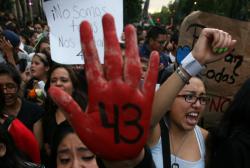
President Enrique Peña Nieto, who had been so successful in advancing his fundamentally conservative economic program during his first year and a half in office, suddenly faced a serious challenge beginning in September 2014 when police apparently cooperating gangsters killed six students, injured at least 25 injured, and kidnapped 43 in the town of Iguala in the state of Guerrero.
[This article, titled “A Chapter of Russian Reaction,” translated into English here for the first time, was written in German by longtime homosexual activist Kurt Hiller (1885–1972) from London and published in the Swiss gay journal Der Kreis in 1946. Hiller had been active in Germany’s first homosexual-rights organization, the Wissenschaftlich-humanitäre Komitee (Scientific Humanitarian Committee), headed by Magnus Hirschfeld (1868–1935). Founded in 1897, the committee was Germany’s most prominent gay group.
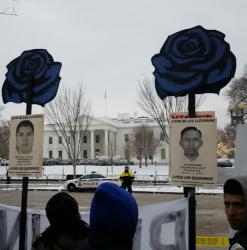

Though little-noticed by the U.S. media, events north of the border bore striking similarities to developments in Mexico in 2014. Like in the mass protests that arose south of the Rio Bravo and then rapidly extended worldwide over the police killings and forced disappearances of the Ayotzinapa rural teachers’ college students in Guerrero, Mexico, the catalyzing issue in El Norte was police violence.

On December 17, 2014, Washington and Havana agreed to a path-breaking change in a relationship that, for more than fifty years, was characterized by the United States’ efforts to overthrow the Cuban government, including the sponsorship of invasions, naval blockades, economic sabotage, assassination attempts, and terrorist attacks.
 As human rights organizations, representing struggles ranging from disability rights to labor rights to criminal justice reform, from migrant justice to climate justice, we recognize the struggle for black liberation as central to securing all of our human rights in a country founded upon systemic racism.

[Editors’ note: The Da’am Workers Party is an Israeli revolutionary socialist organization formed by Palestinian and Jewish activists in 1995. The party initiated the formation of the WAC-MANN trade union movement that aims to organize sectors and populations traditionally neglected by Israel’s mainstream union federation, the Histadrut, and does so based on an explicitly anti-corporate, anti-austerity platform. It opposed the Oslo accords, but supports a two state solution based on the 1967 borders and the dismantling of all settlements. In the last Knesset election, Da’am ran with a Palestinian feminist, Asma Aghbaria-Zahalka, at the head of its list. This article was published on the Da’am website on Dec. 20, 2014.]
There’s blood on many hands tonight. Those that incited violence on this street under the guise of protest, that tried to tear down what New York City police officers did everyday. We tried to warn it must not go on, it cannot be tolerated. That blood on the hands starts on the steps of city hall in the office of the mayor.
 New York, NY — Activists issued a scathing statement this afternoon in response to recent attempts by the NYPD to silence the efforts of citizens seeking justice for victims of police violence.
- « Newer Posts
- 1
- …
- 171
- 172
- 173
- 174
- 175
- 176
- 177
- …
- 227
- Older Posts »