
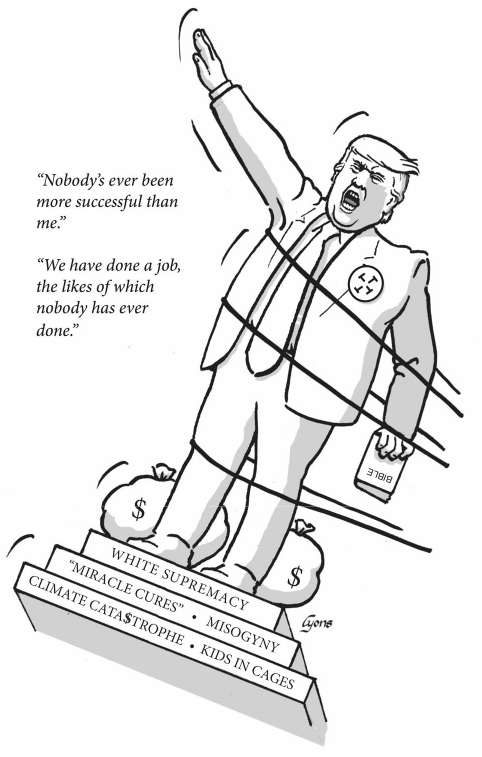
Although it is clear that the Trump regime has launched a massive attack on the economic support of much scientific research—and is imposing racist, sexist, Zionist, imperialist, and other political controls over what research the Federal government funds and what universities can research and teach—the scope and exact contours of this attack are still somewhat murky. Scientific incompetents like Robert F. Kennedy Jr. (who clearly believes that vaccines do little good and lots of harm) have been appointed to lead major scientific agencies like the Department of Health and Human Services, which oversees, among other agencies, CDC and the National Institutes of Health.1 Over one thousand biomedical research grants have been terminated, and critical public health and medical research programs slashed, paused, or terminated. These cuts have interrupted or destroyed the careers of thousands of students and researchers. Thousands of other scientists and technical personnel have been summarily fired from Federal agencies. Federal agencies have been deleting scientific information from websites that had previously made it available to the public, while also discontinuing crucial data-collection projects such as the National Household Study on Drug Use and Health, which gathers data vital to research on overdosing and overdose prevention.
The institutional basis for scientific research at academic institutions has been undermined by efforts to cut “indirect cost rates” for research to 15 percent, far below what is needed for most research. Colleges and universities themselves are under attack politically through efforts and threats to terminate all Federal funding, often on the grounds of alleged “antisemitism” and “wokeness”; these are thinly disguised pretexts for restricting free speech on campuses, including any form of anti-racist or anti-sexist research, teaching, or demonstrating. Attacking institutions of higher learning seems to be the standard practice of extreme right-wing governments around the world—as Orbán has done in Hungary, for example.
The attacks on science seem not to have included certain fields. Research for military needs or for artificial intelligence continues without interference. Yet the anti-science ethos and cuts in basic research may, over time, erode these supports for American capital and imperialism. That is one reason that some capitalists, and some capitalist institutions (such as Harvard University) are opposing the attacks, at least as of this writing.The economic and military power of the United States has long depended upon the country’s strength in many scientific fields. Attacking science is a response to—and likely a source of—deep contradictions in capitalist society and in its regime legitimation. This article will probe into these contradictions.
Some Assumptions
I want to set out some background assumptions for this argument. I assert them not because they are self-evident or non-controversial, but rather for the purpose of brevity. Others have made the case for these presuppositions in New Politics and other left publications; to elaborate them here, yet again, would turn the article into a book.
In quick summation, then:
Inter-imperial rivalry around the globe is heating up both economically and militarily.2 The sources for this lie in the global economic situation since 2008; the specifics of China’s economic and military rise; and the looming uncertainties over how when, and where, climate-change disruptions will take place.
Trump’s strategy seems to be to confront China economically and, if necessary, militarily, including through wooing Russia away from its subordinate alliance with China. This continues the strategies of the Obama and Biden administrations, but with greater emphasis, verging on provocation.
The United States is now highly dependent on commodity chains that can become vulnerable to economic or pandemic disruptions or conflict with China or other countries. Reducing this dependency requires a return of manufacturing to the United States. This is one goal of the Trump administration’s tariff strategies.3
Heightened inter-imperial conflict requires concentrating available surplus value and personnel resources on strategic areas like the military, high tech, and domestic industrial manufacturing This will involve losses for some capitalist industries, as reflected in clashes over tariffs as well as challenges to some of the research Big Pharma depends on.4
Politically, inter-imperial conflict requires heightened nationalism and the disruption of political opposition. The latter in particular underlies the Trump administration’s aggressive approach to universities, which are viewed as centers of independent and sometimes progressive thought.5 But doing so may have negative consequences through undermining some “hard science” research budgets, provoking a brain drain to other countries, and deterring scientific creativity in various fields, including those central to imperial plans.
Capitalist states and capitalists as a class have no solution to the climate crisis. Most of them probably understand that it is real, given the reports of the Intergovernmental Panel on Climate Change or the expressed concern of the Pentagon and other agencies regarding global warming as a threat enhancer. Of course, it is impossible to tell what Trump and his close allies believe about climate change given their penchant for lying. But in any case, neither they nor the left can conceptualize any way the crisis can be resolved within the bounds of capitalism.6
With the forgoing considerations in mind, two problems come into focus. They are interrelated, but should not be confused. One is why members of the ruling class, whether as representatives of capital or as government leaders, attack science. Another is why some sections of the public give credence to what the ruling class is saying. To address these questions, I will start with some history, then take up the logics and ideology of the current attacks on science and why many accept them.
Some History
When evidence emerged that smoking was a cause of cancer, the tobacco industry responded by sowing doubts about the neutrality and methods of the scientists investigating the matter as well as advertising (and sometimes paying for) research intended to cast doubt on their conclusions.7 Fossil-fuel companies followed the same strategy toward scientific work on climate change, as did agribusiness when research showed that GMOs were dangerous. While these campaigns focused on specific findings by researchers, the strategy as a whole was to attack the integrity of scientists and the value of scientific methods.
These attacks were not attacks by capitalism as a whole. While some very powerful industries and companies found it in their interest to smear scientific research, other sections of capital did not join these attacks, or even defended the validity of particular findings. Companies and government officials concerned about the impact of lung cancer or GMOs on their workers had no incentive to deny the evidence. Although the fossil-fuel and associated industries are enormous, so is the threat of global ecological catastrophe; climate-change research has received considerable support from many governments and some sections of capital. In addition, capitalist and military competitiveness as well as product development depend heavily on scientific research, giving capital and governments in general grounds to fund scientific research and training.
The susceptibility of millions of people to the anti-science messaging is not exclusively the product of campaigns to shore up certain industries’ profits, of course. For a variety of reasons, most students do not get good scientific education in schools; and, indeed, many find their science classes boring. (Personal confession: I hated my tenth-grade biology class and vowed never to have anything to do with the field. It is deeply ironic that the last forty-plus years of my life I have worked in fields like public health and epidemiology.) This lack of knowledge and interest leaves people vulnerable to misinformation and corporate propaganda. They also may see scientific expertise as elitist and/or as part of the institutions of power and exploitation. Their resentment can be warranted. People may remember being taught that scientists are an intellectual elite, or hear them making disrespectful remarks about non-scientists in the media—and when science manifests itself in ordinary life, it is often in the form of technology that makes them work harder or steals their jobs. These uses of science by capital and ruling bureaucracies bear much of the responsibility for working people’s susceptibility to reactionary anti-science rhetoric. That includes cases of belief in non-existent conspiracies,8 such as the one about chemicals in tap water turning frogs (and people) gay.
The very workings of capitalism generate irrational thinking of various sorts. Unlike prior modes of production, capitalism obscures the existence of exploitation. Marx himself spent decades trying to describe how this worked. To most people in the world, the workings of the economy seem much like weather or pestilence did in ancient times: the product of unpredictable and inexplicable forces that dominate and threaten human life and social relations.
An employer or industry can suddenly collapse, leaving you jobless and perhaps with skills that are outdated or irrelevant. This was the experience of the hand-loom weavers during Marx’s lifetime, of steelworkers in the Rustbelt a generation ago, and many Federal government employees in 2025. (For that matter, many capitalists and ruling bureaucrats find themselves crushed by the invisible hand of the market, as happened to numerous financial CEOs in 2008 and most of the nomenklatura of the former Russian empire circa 1990.) Once, disasters could only be explained as the action of gods and other supernatural forces. The anxiety of living under the uncertainties and violent upheavals of capitalism have spawned New Age mysticism (also reflecting, perhaps, the defeat of the New Left movements in the 1970s) and strengthened apocalyptic religions. The latter are in some ways are more sensible than the liberal worldview, since we indeed may be approaching the End Times of a planetary inferno.9
Current Logics
What is it about the current situation that leads large parts10 of the American capitalist class and political elites to open a broad attack on the institutions of science? And why has this proven to be appealing to wide swathes of the U.S. population—at least at the level of rhetoric, if not always in practice? I will first discuss why (apart from the factors already discussed) so many voters and others have gone along with such attacks at this time in particular.
The logic of popular support for attacks on science
The legitimacy of science became a political football during the COVID-19 crisis. The absence of a revolutionary left response to this deep social crisis meant that the liberals (including social democrats), traditional conservatives, and the ultraright controlled the discussion globally and in the United States in particular. The utter failure of U.S. rulers’ response to COVID, and the huge tolls in sickness and deaths that this created, have been discussed by my colleagues and me elsewhere.11 Workers who had to go to their workplace faced many months of heightened risk to their health and lives just to earn a living, especially if they had to use public transportation to get there.12 They and the many workers and other adults who stayed at home may also have had to cope with issues around childcare and home learning for children whose schools were closed. A revolutionary left with any weight in the U.S. working class would have had a wonderful opportunity to build collective responses to the situation. And some groups, such as Peoples CDC and a few scattered union locals, did try to help this along. Unfortunately, they had no way to make their efforts known to many people, so the moment was lost.
The extreme right, on the other hand, came into the pandemic well-organized and well-funded. They were able to seize upon the incompetence of the responses by the Trump and Biden administrations to make major gains. Some sections of the populist and even anarchist “left” went along with the attacks on vaccines and/or lent credence to various bogus nostrums that Trump and others were boosting.13 The right seized on public health–related school closures and the difficulties they caused for children and parents as a focus for propaganda talking points. The fact that the parents suffering most from COVID were heavily Black, Latino/a, American Indian, and/or poor workers also gave the right more traction with those white working-class members who had “respectable” incomes but had relatively few friends or relatives who had died from the pandemic.
Liberal leaders, by contrast, were unable to respond effectively to the crisis of ideological legitimacy created by the pandemic. Their commitment to an individualistic ethos made them unwilling and/or unable to mount a collective response rooted in norms of solidarity. Instead, they defended government policies by claiming that they were “just following the science.” When that approach failed to prevent some of the worst infection and death rates of any country on the planet, the effect was to discredit “science” in the eyes of millions of people.
In sum, the right-wing’s propaganda offensive combined with the burdens that liberal pandemic policy left on working-class people, made wide swathes of the U.S. population quite open to attacks on scientific funding, institutions, and intellectual freedoms.
The logic of support by capitalists and government elites for attacks on “science”
On its face, the support many American capitalists and government elites are providing for these attacks on research and universities appears like a suicidal response both to the existential threat of climate change and to the imperial challenge posed by China. On climate change, one popular interpretation is that most capitalists and politicians do not understand that climate change is real and threatens current civilization. But even if this were true, isn’t attacking the scientific base a suicidal response to the Chinese and other threats to American imperialist and economic interests?
It is possible that Trump and many of the leaders of his administration believe that climate change is a hoax. They have said so many times. But they are also inveterate liars and flip-floppers, which I would argue is, to some extent, a deliberate strategy to keep their opponents off balance. So it is not possible to be sure what they are thinking. Nonetheless, some of them may be pursuing a rational (though tragically mistaken) strategy.
The reports of the Intergovernmental Panel on Climate Change—like the perspective of many though not all Marxist analyses14—is that no solution to the climate crisis exists under capitalism. It can be useful, if not especially pleasant, to put oneself into the mind of a billionaire or a member of some capitalist think tank as they face the dilemma faced by our species as a whole: we can have either capitalism or an inhabitable planet, but not both.
It is not a hypothetical alternative. The concept of ending capitalism is literally unthinkable for most capitalists. They know only growth and competition, and many have accepted Margaret Thatcher’s mantra that “there is no alternative” to the market and accumulation. If they do manage to think outside that box, the only imaginable alternative would be something like Russia under Stalinist rule or China under Maoist rule (something I would call either state capitalism or bureaucratic collectivism, not socialism). And an economy modeled on those societies would, like the present system, still generate enormous quantities of greenhouse gases.
Our imagined ruling-class individual would—as the product of economics courses and what they have learned as a corporate or government leader—likely trust “free enterprise” as the best way to meet challenges—that is, they believe that corporate competition is creative and efficient and far better than government bureaucracy at finding solutions. And like most people on Earth at the current time, they have no understanding of how a socialism from below could be created and how it could avoid devolving into Stalinism, much less how it could solve the climate crisis.
Given the contradiction between capitalism and survival, then, the only ruling-class option would seem to be determining how to profit during the climate crisis as it gets worse—how to be “the last man standing.” If there is a solution, they would think it will take the form of new technology (to clear the atmosphere of greenhouse gases, for example) created through the “genius” of capitalist competition, making billions of dollars for the entrepreneurs who develop it.
Assuming the capitalist whose brain we have picked grasps the extraordinary potential for environmental disaster in the not-too-distant future, they will recognize that this scenario is somewhat of a “Hail Mary pass.” But they will see no alternative. And in the meanwhile, they will concentrate on rivalries and competition, as capitalist dynamics force them to do at pains of being eaten by other capitals and/or states.15
Although this rationale seems to make some sense,16 the prospect of a Trumpian execution of it shows some of its contradictions. From a strictly economic point of view, or from the perspective of imperial competition, attacking the economic basis of universities by cutting the indirect cost rate on research grants to 15 percent and by suddenly terminating billions of dollars of research funding is suicidal.17 It will seriously weaken economic innovation and growth in the United States, and at least in the long term, weaken the U.S. military as well.
On the other hand, the attacks on universities may be politically necessary to weaken opposition to the policy and to the regime and to further the racist and sexist goals that have been a defining feature of Trumpism. The prospect of skilled scientific and professional workers leaving the universities (voluntarily or otherwise) to find jobs in the private sector might also benefit some capitalists by lowering their labor costs and increasing their capacity to innovate and develop new products.
So the underlying rationale for MAGA anti-science policies may seem logical from the capitalist perspective of trying to muddle through the contradiction between capitalism and survival. In human terms, it is of course madness and genocidal (indeed, species-cidal), but murderous cruelty is endemic to capitalism, as the history of the last five hundred years has shown.
For the left, the political implications should be clear. The liberal defense of “science” even by institutions as powerful as Harvard University is not likely to change these policies, nor will institutionally acceding to them (although it may yield some competitive advantage at getting research and other funding for reactionary institutions.) Defeating these attacks will require massive popular revolt, led by working-class organization and mobilization in workplaces and in oppressed communities. Such a revolt, if powerful enough, might make the ruling class reverse its attacks on science. They will not, however, suffice to resolve the contradiction between capitalism and survival. That will require a global revolution from below that terminates capital relations of production once and for all and lets us collectively and democratically figure out sustainable ways to live and thrive.
notes
1. This is particularly concerning because the U.S. was particularly incompetent in dealing with COVID-19 so far; since COVID-19 continues to mutate; the HIV/AIDS pandemic is being reignited through U.S. cutbacks of programs to provide treatment and prevention funds overseas; and other pandemics loom. See Sam Friedman, “Plague-pusher politics,” Against the Current, Mar. 30, 2025; S. Friedman and S. Kay, “Marxism and the U.S. Response to the HIV/AIDS and COVID-19 Pandemics,” Spectre, Aug. 25, 2023; and Sam Friedman, Sara Johnson, and Karyn Pomerantz, “Pandemic Futures,” Tempest, 2025.
2. Thomas Hummell, “Building International Solidarity Against Imperial Rivalry,” Tempest, Nov. 2024; Ashley Smith, “U.S. and China Conflict: The 21st Century’s Central Inter-Imperial Rivalry,” New Politics, Aug. 28, 2019.
3. Council on Foreign Relations, “The Contentious U.S.-China Trade Relationship,” Apr. 14, 2025; Paolo Confino, “Trump’s trade war with China…,” Fortune, Apr. 14, 2025.
4. Congressional Research Service, “Great Power Competition: Implications for Defense—Issues for Congress,” Aug. 28, 2024.
5. John Aubrey Douglass, Neo-nationalism and Universities: Populists, Autocrats, and the Future of Higher Education, Johns Hopkins University Press, 2021; Ashley Smith, “Part Two: Resisting authoritarian populism,” Tempest, Dec. 8, 2024.
6. D. Camfield, Future on Fire, PM Press, 2023; J. B. Foster, “The Epochal Crisis,” Monthly Review, Oct. 2013; J. B. Foster, “James Hansen and the Climate-Change Exit Strategy,” Monthly Review, Feb. 2013; J. B. Foster, The Robbery of Nature. Monthly Review Press, 2020; A. Malm, Corona, Climate, Chronic Emergency: War Communism in the Twenty-First Century, Verso, 2020; K. h. Saito, Marx in the Anthropocene, Cambridge University Press, 2022; Richard Smith, Green Capitalism: The God that Failed, 2016. But cf. P. Schwartzman & D. Schwartzman, The Earth Is Not for Sale: A Path Out of Fossil Capitalism to the Other World That is Still Possible, World Scientific, 2019.
7. Robin McKie, “Attack Paid for by Big Business Are ‘Driving Science into a Dark Era,’” Guardian, February 18, 2012; Linda Rosenstock and Lore Jackson Lee, “Attacks on Science: The Risks of Evidence-Based Policy,” American Journal of Public Health 92, no. 1 (2002); Genna Reed et al., “The Disinformation Playbook: How Industry Manipulates the Science-Policy Process —and How to Restore Scientific Integrity,” Journal of Public Health Policy 42 (2021).
8. I want to clarify that conspiracies obviously do exist. It can be hard to differentiate them from plans that various people make that simply are not widely publicized. Did Purdue conspire to make Oxycontin part of the daily lives of millions of people? Probably—they certainly knew it would be addictive and did their best to deny and later to obfuscate this fact. Indeed, it can be difficult sometimes to get at the truth on some issues. However, there is another kind of “conspiracy theory” that takes the form of believing conspiracies to be omnipresent and disregarding clear counterevidence about particular examples. For instance, many on the “left” greeted the mRNA vaccines against COVID-19 with claims that Pfizer and Moderna had faked the evidence for the vaccines and that they were highly toxic substances that would harm vast numbers of people. In my experience, those holding this belief were immune to counterarguments that given the magnitude of the COVID crisis, the scientists and technicians involved in the trials (and maybe even the company executives) would never have gone along with such a conspiracy; as well as being total unwilling to recognize the vast number of lives saved by these vaccines and the relatively small number of people harmed by them. (Personal confession #2: I am friends with, and collaborate closely with, a woman who was almost certainly one of the relatively small number of people whose reaction to the vaccine has been serious and long-lasting.)
Similarly, the White House, under the name of Donald Trump, issued “Lab Leak: The True Origins of Covid-19”, which on its face both pushes a dubious hypothesis about COVID and simultaneously blames the damage the pandemic did on scapegoats like Tony Fauci and Joe Biden. This is also an attack on science (see this excellent article for a discussion of this: J. Alwine, et al. “The harms of promoting the lab leak hypothesis for SARS-CoV-2 origins without evidence,” J Virol, Sep. 17 2024.) In addition, underlying such scapegoating is the same kind of cultural style—blaming social ills on evil actors—that Trump and Orban have promulgated in attacking immigrants to the United States and Hungary, or that the Nazis used in attacking Jews and queers.
9. Marx and Engels wrote extensively about these social roots of religion, as have many Marxists. References to the writings of Marx and Engels, and useful further discussion of some of their ideas, appear in Michael Löwy, The War of Gods: Religion and Politics in Latin America, London, Verso, 1996; Alexander Saxton, Religion and the Human Prospect, New York: Monthly Review Press, 2006; Samuel R. Friedman, Review of Religion and the Human Prospect, by Alexander Saxton. (2008). In Historical Materialism 16:219-226; and Samuel R. Friedman, “War and Religious Beliefs,” International Yearbook for the Sociology of Religion, v. IX, p. 253.
10. I have been asked whether I think this is a “majority” of the ruling class. I find this question very difficult. The ruling class does not work on the basis of majorities. Indeed, even its members would find it hard to define who is and who is not a member of the ruling class, and thus to try to figure out what constitutes a majority. Capitalists work through a whole range of official and unofficial institutions to develop world views and strategies, as well as through economic processes like markets, and to reach decisions about what to do. For this article, the key institution is the government of the United States. Marxists and non-Marxists (such as William Domhoff) have all written many books about these processes. Capitalists are by no means united around the attacks on science—which is why an eminently capitalist institution like Harvard is in open conflict with the Trump administration.
11. LZ Jirmanus, et al., “Too Many Deaths, Too Many Left Behind: A People’s External Review of the U.S. Centers for Disease Control and Prevention’s COVID-19 Pandemic Response,” AJPM Focus, 3(4), Aug. 2024 Aug;3(4):100207; Sara Johnson and Sam Friedman, “Long COVID and Social Struggle,” Tempest, July 25, 2024; Mary Jirmanus Saba and Sam Friedman, “The Left and COVID: A response to Mike Haynes,” Historical Materialism, Dec. 2023; S. Friedman and S. Kay, “Marxism and the U.S. Response to the HIV/AIDS and COVID-19 Pandemics,” Spectre, Aug. 25, 2023; Sam Friedman, “Learning from the COVID War,” July 5, 2023; Sam Friedman, Sara Johnson, and Karyn Pomerantz, “Pandemic Futures,” Tempest, Feb. 3, 2025; Justin Feldman and Sam Friedman, “Where is the Left on pandemic politics?” Tempest, Apr. 18, 2022; Danny Katch and Sam Friedman, “Activism Made AIDS Treatment More Accessible – That’s What It’ll Take for COVID,” Truthout, June 13, 2021.
12. Jamie K. McCallum, Essential: How the Pandemic Transformed the Long Fight for Worker Justice, New York: Basic Books, 2022, provides great detail on these experiences and their meanings.
13. I am working on an article on this topic at present.
14. See note 6.
15. This argument parallels, in some ways, the arguments of Naomi Klein and Astra Taylor in “The rise of end times fascism,” The Guardian Apr. 13, 2025.
16. One member of the New Politics editorial board, on reviewing this article, doubted this argument, saying: “…it’s based on what I think is an untenable assumption of rationality among the ruling classes, that they’re attacking science out of cynical political reasons etc. This is the same ruling class that has apparently convinced itself that AGI will replace all white-collar labor within 2-5 years. I think it’s much more sensible to argue that decadent late capitalism has found itself in the same position as decadent late feudalism — they have forgotten the source of their own wealth and really believe that they rule due to their ‘will’ and ‘superior genetics.’ They sincerely no longer believe in science and assume ChatGPT or something will be able to construct a superior machine intelligence that will make them Gods.”
Nowhere in the paper, however, do I say that the ruling class (or classes) is (are) rational as a unified entity. Capitalists, like every other class, have conflicting beliefs, and capitalist competition creates both conflicting interests and conflicting world-views (to an extent) among different capitalists. What I am saying is that some ruling class members may be acting in accord with a logic they believe in. The fact that this particular capitalist logic is inhuman and irrational was made pretty clearly by Marx in Capital so it should be no surprise to any of us. And if one has ever taken a microeconomics course, the logic of such teaching indeed dismisses the working class as the source of much of their wealth. (Not all of their wealth, a point Marx made clear in his Critique of the Gotha Programme.) Keynesian economics at times does seem to treat workers mainly as consumers, and insofar as this is central to it, indeed has lost sight of workers as the source of profits.
On another level, at least in the U.S. at present, there is a sustained attack on science, and it is supported by a governmentally-dominant part of the capitalist class including what Sam Farber has called lumpen capitalists (“Donald Trump, Lumpen Capitalist,” Jacobin, Oct. 2018) but also by many corporations and corporate leaders of a more establishment sort. The above-quoted member of the editorial board and I agree that they are wrong in their attacks in human terms, and arguably so in terms of defending their own interests. But my point is that there is an underlying (anti-human) logic within the confines of capitalist thinking that holds that the Hail Mary Pass is the best bet not merely for them but for humanity as a whole.
17. See for example Jason E. Lane and D. Bruce Johnstone, eds. Universities and Colleges as Economic Drivers: Measuring Higher Education’s Role in Economic Development, SUNY Press, 2012; or a recent report by an economics major in the Harvard Crimson, Julien Berman, “To Kill a University.”
 If you’ve read this far, you were pretty interested, right? Isn’t that worth a few bucks -maybe more? Please
Leave a Reply