

A shorter version of this article appeared in Foreign Policy in Focus on April 7. 2026.
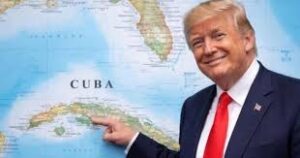
The Cuban government established by the Revolution of 1959 and Communist since the early 1960s seems destined to disappear within a few months and certain to be overturned one way or another by the end of the year. President Donald Trump recently said,
“I do believe I’ll be … having the honor of taking Cuba. That’s a big honor. Taking Cuba in some form. I mean, whether I free it, take it. [I] think I can do anything I want with it, [if] you want to know the truth.”
At the moment, this seems to be true. The Cuban economy has collapsed and none of its former allies have come to the country’s aid. The government has lost popular support. As we have seen in Venezuela and Iran, Trump is prepared to use military force to accomplish his aims. There seems to be nothing at present to stop Trump from terminating the Cuban Communist government.
How did we get here? What will happen to the Cuban people? What can be done to help them? And in particular what has been and what is the role of the U.S. left? As I argue here, the U.S. left made serious mistakes in its dealing with Cuba since the revolution. We should do better in the future. But to do so, we need to know something of Cuba’s history, the role of the United States, and the role of the U.S. left in the past. Those of us who lived through this period, from the Cuban Revolution to today, as I did, know this history but younger people will find it useful to recount it, so that we can prepare for tomorrow.
Cuba: An American Colony, from 1898 until 1959
At the end of the nineteenth century the United States became a major investor in Cuba which at the time was fighting for its independence from Spain. The United States intervened in support of the Cuban struggle for independence, leading to the Spanish-American War. Victorious in the war the United States took the Philippines and Puerto Rico and made them U.S. colonies, while Congress passed, and Cuba was forced to accept, the Platt Amendment, which gave the United States the right to intervene militarily in Cuba. Thus, Cuba became a virtual colony and a valuable one. The Platt Amendment ended in 1934, but in exchange Cuba granted the United States the Guantanamo Naval Base in perpetuity, but in any case, the U.S. continued to exert its influence on future Cuban governments
The U.S. government protected the interests of American companies and their investments in Cuba in utilities, railroads, about half of the island’s sugar production, as well as the hotels, gambling casinos, and brothels run by the Mafia, that made Havana a center of international tourism. Fulgencio Batista played a central role in Cuban politics from 1933 when he and four others led a coup, then in 1940 was elected president, and finally in 1952 led another coup and backed, by the U.S. government, U.S. corporations, and rich Cubans, became the country’s dictator. Under Batista, all civil rights and workers’ rights were abolished, ans students and others protested, but hundreds and perhaps thousands murdered.
In January, 1959, Fidel Castro and his band of guerrillas in the mountains, supported by people in Havana and the smaller cities, overthrew the Batista government and took power.[1] The Cuban people with the exception of the governmental and financial elite overwhelmingly supported the revolution. It led to the total political and economic transformation of the island.
I Followed and Supported the Revolution
When I was a teenager in high school, just fourteen years old, my father bought me a subscription to Liberation magazine, the radical pacifist journal founded in 1956. Editor David Dellinger supported the Cuban Revolution and the journal published radical sociologist C. Wright Mills’ essay “Listen Yankee!” (Later a book.) I followed the revolution in the pages of Liberation. Mills convinced me that after more than a half century of U.S. domination, Cuba was engaged in a fight for national liberation that deserved my support.[2]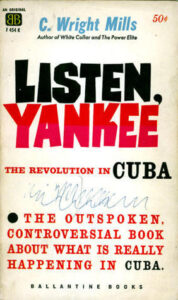
In 1959 Ed Sullivan, the liberal host of a television variety show watched by tens of millions of Americans including my family, saying, “Freedom is everybody’s business,” went to Cuba to interview the Revolution’s leader Fidel Castro. Castro promised to end dictatorship in Cuba forever and to strengthen the country’s democratic institutions. Many of the leading U.S. newspapers also at first presented Castro as the democratic leader of a national revolution who looked forward to working with the United States. (See, for example, early coverage in The New York Times.) Many Americans admired Castro and looked forward to a new democratic government in Cuba, as I did.
The Cuban-U.S. honeymoon was short-lived. By April of 1959 the American press was accusing Castro of being a Communist. Speaking on Meet the Press he denied it, saying. “I am not a Communist.” While it may be true that he was not at that time, a Communist, both his brother Raul Castro and his close collaborator the Argentine doctor Ernesto “Che” Guevara were Communists. Castro promised to strengthen democratic institutions, but he did not organize elections and instead appointed a provisional government. In March of 1959 he promised democratic elections “in two years.” But they never came. Castro, it became clear, would rule the country.
Immediately following the 1959 revolution, the new Cuban government established revolutionary tribunals that quickly found guilty and executed more than 500 people, most of them former Batista government officials or police, guilty of capital crimes against the Cuban people. These kangaroo courts could not by any stretch of the imagination be said to have carried out fair trials, though there was much popular support for them. And Castro did not tolerate critics within his movement. Commander Huber Matos, a comrade in arms in the July 26 Movement opposed the influence of Communists and in protests publicly resigned his position, for which he was accused of treason and sedition, tried, convicted and sentenced to twenty years in prison in late 1959 and remained imprisoned until 1979. Eleven others, captains and lieutenants, were also tried and imprisoned at the same time. The new government later established concentration camps called “Military Units to Aid Production” (UMAPs) in 1965, through which 30,000 people, gays, religious people, and other “anti-social elements” passed before they were abolished in 1968 because of criticism from abroad. Virtually no left organization criticized the lack of due process in all of this.
Cuba’s serious problems with the U.S. government may be said to have begun on May 17, 1959 with the agrarian reform law that seized mostly large, foreign, corporate landholdings, many belonging to U.S. companies. The Eisenhower administration began to contemplate the overthrow of the new revolutionary Cuban government that year.
In March of 1960, Cuba signed a trade agreement with the Soviet Union, as Castro began to see the Soviet Union’s as an alternative to the U.S. sugar market.
The U.S. government, concerned about defending American property and businesses and concerned about Cuba’s turn to the Soviet Union, now began to take action against Castro. On March 17, 1960 U.S. President Dwight D. Eisenhower ordered CIA director Allen Dulles to begin training Cuban exiles for a covert invasion of Cuba to overthrow Castro’s government. At the same time, U.S. Secretary of State Lester Mallory wrote a memo argued for an embargo, “…inconspicuous as possible, [which] makes the greatest inroads in denying money and supplies to Cuba, to decrease monetary and real wages, to bring about hunger, desperation and overthrow of government.” On July 5, 1960 Cuba nationalized all American business and property in Cuba, ending any possible accommodation with the United States.
At the same time, Cuba’s former government officials, wealthy landowners, businesspeople, and professionals decided this was not their revolution and between 1959 and October 1962 some 200,000 to 250,000 fled the island, most settling in the Miami, Florida area. They proclaimed that they were not immigrants but exiles who would return to Cuba to overthrow Castro and reclaim their property. They created a powerful lobby that would become a permanent part of American politics, always on the right.
The Cuban Missile Crisis
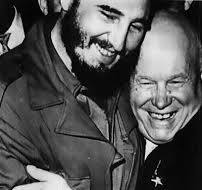
Things were moving rapidly now. At a meeting of the United Nations in September 1960, Castro publicly embraced Premier Nikita Khrushchev, making clear his orientation to the Soviet Union. Dark clouds were gathering. A few months later, on January 3, 1961, the United States broke off diplomatic relations with Cuba. Cuba’s course seemed set. On April 16, 1961 Castro declared, “This is a socialist revolution right under the nose of the United States. This is a socialist revolution that we will defend with these rifles.”
The next day, in a plan conceived by President Eisenhower and carried out by President John F. Kennedy, a group of 1,400 Cuban exiles called the Democratic Revolutionary Front (FDR), directed and financed by the United States, invaded Cuba at the Bay of Pigs. Within three days the FDR had been defeated by Cuban troops personally commanded by Fidel Castro, enormously enhancing his prestige. In July of 1961 Castro’s July 26 Movement merged with the pro-Soviet People Socialist Party, adopting the name Communist Party of Cuba in 1965.
Later that year, on December 2, 1961, Castro declared, “I am a Marxist-Leninist, and I shall be a Marxist-Leninist to the end of my life,” sealing his alliance with the Soviet Union. Some liberal and left historians have argued that the United States forced Castro to become a Communist. Certainly, the United States was in those first years of the revolution putting enormous pressure on Cuba. But, as Samuel Farber has argued persuasively in his book The Origins of the Cuban Revolution Reconsidered, early on Castro made a conscious, independent decision to become a Communist and orient to the Soviet Union.[3]
In February 1962 President Kennedy made formal an on-going embargo of Cuba that continues until this day, and consequently Cuba became largely dependent on the Soviet Union and the Eastern European Communist states for many of its imported manufactured goods and for petroleum.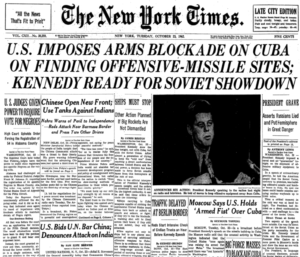
Later that year, October 1962, U.S. spy planes discovered that Soviet Union had secretly installed nuclear missiles and had sent thousands of Soviet troops in Cuba. The Soviet Union also sent freighters loaded with arms to Cuba. Kennedy responded by establishing a blockade, what he called a “quarantine” of the island. Would the U.S.-Soviet conflict over Cuba break out on the high seas? From October 16 to 28, people everywhere feared the outbreak of a nuclear war between the Soviet Union and the United States. I was a junior in high school at the time and remember the tremendous anxiety in my hometown in the San Diego area and throughout the country. We all feared that a nuclear war might break out at any moment and we feared dying in it.
Khrushchev and Kennedy negotiated, and in the end the Soviet Union removed its missiles and Kennedy publicly stated that the United States would not attempt to invade Cuba. Fidel Castro was furious, accusing Khrushchev of reneging on its promise to protect. In a secret addendum to the agreement, the United States agreed to remove its Jupiter missiles from Turkey near the Soviet Union.
Che Guevara
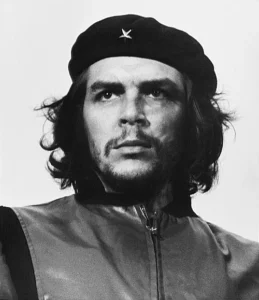
Che Guevara, who had fought alongside Castro in the July 26 Movement, served in the government as head of the National Bank from 1959 to 1961 and then as Minister of Industries from 1961 to 1965. A romantic and utopian, he dreamed at creating a “new man,” a socialist inspired by high ideals. He proposed that workers in Cuba’s centralized, nationalized industries should be motivated not by higher wages but by their revolutionary idealism and should contribute voluntary labor. His economic policies failed while at the same time he had become critical of Castro’s alliance with, dependency upon, and fealty to the Soviet Union.
By 1965 Guevara decided to turn his attention to exporting Cuban-style guerrilla revolution to colonial countries. First, Guevara with 125 soldiers went to the Congo where the U.S.-backed government had assassinated Patrice Lumumba and there joined rebel forces. He never found his way there. He himself called the mission and failure.
Guevara next went to Bolivia, a country with strong labor union and socialist traditions, but ignoring those, he went to the rural Cordillera province where he attempted to establish a guerrilla foco, that is a guerilla nucleus, to overthrow the government of René Barrientos and launch a revolution that he believed would spread throughout South America. But his guerrilla center was found by the Bolivian Army and Guevara was assassinated there on October 9, 1967.[4]
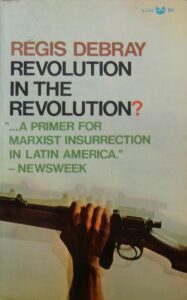 French leftist Régis Debray had at the time popularized Guevara’s idea of organizing guerrilla focos, in his book Revolution in the Revolution, published in 1967 in French and English. The example of the Cuban Revolution and Che’s theory of the guerrilla foco as put forward by Debray, appealed to young people throughout Latin America and they attempted to implement it just as U.S.-backed coups brought dictators to power throughout the continent, leading to a disastrous period for the Latin American left in which thousands died in attempts to carry out guerrilla revolutions. (Debray himself later criticized the guerrilla foco tragedy in his book A Critique of Arms.)
Most of the far left, in the United States and around the world, loved Castro, Che, and the Cuban Revolution. Castro after all had led a revolution that overthrew a dictator who had been supported by the United States. And Castro won freedom for Cuba. Millions of Latin Americans, especially the young, were thrilled. In 1969 Students for a Democratic Society (SDS) and officials of the Cuban government established the Venceremos (We Will Win) Brigade which took supporters to Cuba to help bring in the sugar harvest. Eventually over 50 years about 10,000 leftists went and volunteered work for Cuba.
There was in fact a “revolution in the revolution” as Debray had put it, though not exactly the one he meant. Some Communist parties in various countries, especially in Latin America, broke up leading to many Fidelista or Guevarista parties. The left everywhere believed that Cuba was producing a new leftism, an alternative to the old, gray Communists of the Soviet Union—even as in those years Cuba was becoming part of the Soviet sphere.
Cuba Becomes Communist
Cuba began to assimilate politically and structurally to the Soviet Union and the states of the Communist Bloc, a process completed by 1970.[5] Cuba became a one-party state where the ruling Communist Party now owned and controlled the economy that had been entirely nationalized from the largest businesses to the smallest farms and shops. We cannot call this the socialization of industry since there were no democratic institutions by which the Cuban people might have taken ownership and control of the country’s industry and businesses. Run by Castro, his closest associates, and the country’s new rubber stamp parliament, it was this Communist Party that took ownership and control of industry and that became the employer of Cuban workers. In 1972 Cuba also formally became part of COMECON, the Council for Mutual Economic Assistance, the Soviet Union’s international economic organization. Cuba now had a new Communist ruling class.
In the new Communist Cuba, no other political parties were permitted to organize and there were no legitimate elections where people might choose between candidates of diferent parties with different programs. The Communist state-party controlled the official labor unions, and no other unions were permitted to compete with them, nor could the unions strike. Similarly, the Communist state-party controlled all social organizations in the country: women’s groups, student organizations, sports leagues. Democratic civil liberties—freedom of association, the right to assemble and protest, the right to independent newspapers or independent radio and TV broadcasting—were all abolished. The Soviet Union’s secret police, the KGB helped Cuba to create an intelligence service and its own secret police, the Cuban General Directorate of Intelligence (DGI) along the same lines as the Soviet Union’s. In addition, Cuba’s machista culture created new forms of oppression as homosexuality, a “bourgeois perversion,” was made illegal until 1979 and gay Cubans found themselves harassed, arrested, and condemned to forced labor in concentration camps.
Like the Soviet Union and the Communist Bloc nations of Eastern Europe, Cuba became a totalitarian society where the Communist Party controlled virtually everything. However, unlike the Eastern European Communist countries, most of which had had their Communist government imposed by Soviet tanks, Cuba’s government had come to power through a widely supported revolution and the country was ruled by an enormously popular charismatic leader, Fidel Castro. In the 1960s, the Cuban people were enthusiastic about the revolution and its leader, were proud of the overthrow of Batista and the wresting of independence from U.S. imperial domination. It would take a few decades and a few generations before the popularity of Castro and the Communists would subside.
In that period of the mid- to late-1960s, I had gone to college and then to graduate school and become part of the anti-Vietnam War movement and the other social movements of that era. I was disappointed to see the Cuban Revolution that I had supported in 1959 and 60 become a Communist state now modeled on and allied with the Soviet Union. In those years, attracted by its slogan “Neither Washington nor Moscow,” I joined the International Socialists (I.S.) and became a Third Camp socialist organization opposed to both capitalism and to the bureaucratic collectivist Communist states like the Soviet Union, China, and Cuba. While I still supported Cuba’s right to self-determination, I was opposed to its Communist government. It was clear that Communist Cuba—with a capital C—had nothing to do with the socialist ideal of communism. I hoped that the Cuban people and democratic socialists in Cuba would find a way to change their government.
I was appalled by Cuba’s foreign policy. Castro’s loyal to the Soviet Union can be seen in his reaction to the Prague Spring of 1968, a movement in Communist Czechoslovakia calling for the democratization of the government. When the Soviet Union and the Warsaw Pact nations of Communist Eastern Europe invade Czechoslovakia to crush the movement, Castro publicly supported the Soviet Union invasion, calling the democracy movement counter-revolutionary. Similarly when in 1980 Polish workers created the enormous national Solidarity union movement calling for democracy in that nation, Castro supported its crushing by General Wojciech Jaruzelski.
The Far Left and the Cuban Revolution
Throughout these years from 1959 until today, most group on the far left—from the Communist Party USA, to the Trotskyists, and later the Democratic Socialists of America (DSA)—supported what they called “socialist” Cuba. (The Maoists initially supported the Cuban Revolution but turned against it when Cuba allied with the Soviet Union which the Maoists believed had become capitalist. But by 1980 the Maoist groups had collapsed and the tendency became irrelevant.) While some left groups had reservations and critique, in the end, they were nearly all supporters of the Cuban state. When Cubans engaged in large scale social protest against food shortages and the lack of democracy in 1994, 2021, and repeatedly from 2024 to today, virtually no group on the left gave full throated support to the Cuban people. And few criticized the Cuban Communist state for its repression.
(The old Democratic Socialist Organizing Committee and early Democratic Socialist of America in the era of Michael Harrington criticized Cuba’s authoritarian government, but they supported the Democratic Party. The Democrats of the 1970s were no longer so hostile to Cuba, but their call for diplomatic relations and normalization or economic ties was clearly meant to bring Cuba back into the capitalist world. DSA since 2017 supported Communist Cuba.)
Very seldom did leftists declare that they supported the Cuban people, the poor and working-class Cubans protesting in the streets, against the Communist government. Only a few small socialist organizations, such as the International Socialists (I.S.) of which I was a member, and later the International Socialist Organization (ISO), criticized the Cuban Communists. This journal, New Politics, comes out of that tradition. The tiny anarchist left in the U.S., Europe, and Latin America also criticized the Cuban government and supported leftist dissidents.
Toward the Cuban Crisis
From 1970 until the twenty-first century, Cuba remained relatively stable. The U.S. trade embargo had begun in 1962 and had been strengthened by the Helms-Burton Act of 1996. At the same time, Soviet trade and aid were absolutely critical to the survival and function of the Cuban economy between 1959 and 1989, accounting for up to 70% of its trade and subsidizing over 20% of its GNP in the 1980s. The Soviets provided nearly all of Cuba’s oil, grain, and machinery, while purchasing its sugar at inflated prices, thus enabling the survival of the Cuban state despite the U.S. embargo. At the same time, Cuba’s government, modeling its programs on those of the Nordic countries, created excellent health and education systems, with low infant mortality, high life expectancy, and universal literacy. Cuba’s health system’s results were comparable to those of Sweden.
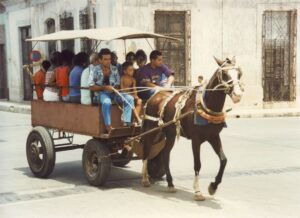
Toward the end of the twentieth century, however, Cuba’s stability became stagnation, principally because of the fall of Soviet Communism. With the end of the Soviet regime, Russia suffered its own economic and social crisis and was no longer able to subsidize Cuba. Russian trade and aid—which had provided most of the country’s economic resources—virtually vanished. Fidel Castro, still the ruler of the country, named the new economic era that began in 1990 the “Special Period in Time of Peace.” Cuba’s GDP shrunk by 35%, agricultural production fell by 47%, construction by 75%, and manufacturing by 90%.
To survive, the Cuban government took several steps that changed the nature of the economy, if not its top-down administration. The country had to carry out dramatic cuts in the national budget, though it protected and maintained the education and health budgets. Cuba found itself unable to import enough goods to feed the population, resulting in widespread hunger. The citizens’ caloric intake declined by 27%; people ate about 1,000 fewer calories per day. So, a new emphasis was placed on food production. And without money for fertilizers and pesticides, Cuba turned toward organic produce. The government created limited free markets for food and some other products. Without fuel, Cubans rode imported Chinese bicycles and vehicles were pulled by horses, mules, or oxen.
The government now encouraged investment from Western capitalist countries. Canada invested in the nickel industry; Canada and France invested in petroleum; Spain became the principal investor in the tourist industry building hotels. Several other nations were also involved in each of those sectors. International tourism replaced sugar as the country’s principal source of revenue, and by the late 1990s it grew from 340,000 to over one million tourists per year. In the decade of the special period.
After the fall of the Soviet Union, lack of oil was the biggest economic problems of Cuba. Then in 1999, Hugo Chavez, an admirer of Castro and the Cuban Revolution, became the president of Venezuela. Chavez began in 2000 to send about 100,000 barrels of oil per day to Cuba, about half of the country’s requirements, in exchange for Cuban doctors, teachers, sports coaches, and military and security officers. And Mexico continued to provide subsidized petroleum to Cuba. Those two nations made it possible for Cuba to continue to provide energy to homes and industry.
In 2008, Fidel Castro, in failing health, retired and was succeeded by his brother Raul, also a veteran of and leader of the Cuban Revolution. His succession insured the continuity of the leadership and the perpetuity of the system.
Tourism, Trump, COVID-19, and the Crisis
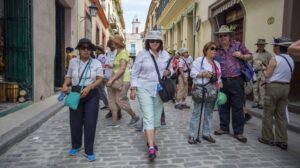
So, Cuba’s economy stabilized in the 2000s. When Barack Obama eased restrictions on Cuba, the tourist sector boomed. “Annual overseas visitors to Cuba rose markedly between 2014 and 2017 to reach 4.65 million. U.S. tourists alone accounted for over 40% of that growth even though there was a surge in arrivals from traditional European source markets such as Germany, France, Italy, Spain, and the United Kingdom (ONEI 2020).” In 2017, the best year for Cuban tourism, hard currency revenues reached 2.3 billion.[6] Then Donald Trump was elected president in 2017, reimposed travel restrictions, resulting in fewer American tourists, and with that Cuba’s tourist business and revenues began to decline.
Raul Castro, gave up the presidency in April 2018 and retired as First Secretary of the Communist Party of Cuba in April 2021. Miguel Díaz-Canel replaced him in both of those roles. For the first time in many decades a Castro no longer ruled Cuba. Díaz-Canel was chosen for his reliability. The system remained unchanged.
Then came COVID-19, with widespread sickness and death around the world, and Cuba closed its borders to tourists from March to November 2021. Not surprisingly tourism, the country’s leading industry, “fell from nearly 4.3 million in 2019 to less than 1.1 million in 2020 and to just about 356,000 in 2021.” While Cuba saw some increase in tourism in the next few years, it never fully recovered. “Cuba is going through its worst economic crisis in thirty years, exemplified by plummeting real wages, frequent power outages, shortages of food, water, medicines, and fuel, crumbling infrastructures, a severe liquidity crunch, and a record-breaking mass emigration.”[7] Tourists went elsewhere. The decline of tourism is the decline of the contemporary Cuban economy. Communist Cuba is going out of business.
Cuba, which depended for years on Mexican and Venezuela for petroleum (Mexico providing 44% and Venezuela 34%) is no longer receiving their oil. The U.S. has imposed an embargo on petroleum shipments to Cuba, permitting only one Russian tanker to make a delivery. The U.S. captured and removal of Nicolás Maduro and established a new relationship between the United States and Venezuela. Acting president Delcy Rodríguez agreed to work with Trump and the United States largely took over the Venezuelan oil industry. Mexican President Claudia Sheinbaum, who expresses her sympathy with Cuba, has been under enormous pressure from Trump who threatens highr tariffs, trade sanctions or even the invasion of Mexico to crush its cartels, so she has stopped shipping oil.
Tourism, the leading industry and principal source of revenue for Cuba, cannot survive without fuel Cuba’s powerplants than can no longer provide electricity as the country has often gone dark. Without hard currency, Cuba has experienced critical shortages of food, medicine and had to turn to other countries for humanitarian aid. Now, without petroleum, which means without, electricity, businesses, hospitals, schools, and universities no longer function. The economy is in free fall.
Not surpassingly, in the last four years one million of Cuba’s 11 million people have left the island nation. Migrants were able for a time to go to Nicaragua without visas and then head north toward the United States, but that is no longer possible. As with most countries, Cuban migrants tend to be the healthiest, best educated, and most ambitious young adults, a great loss to the country. We are at the end of an era though what comes next is not clear.
Cuba’s Military Industrial Complex – GAESA
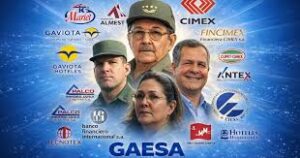
Yet it’s hard to accurately assess Cuba’s economic situation because of the opaque military entity called GAESA, Grupo de Administración Empresarial S.A.. run by the Cuban military, which plays such a huge. Role in the national economy. The Cuban public knows nothing about GAESA and neither did anyone else until a leak published in El Nuevo Herald. An article in the Columbia Law Journal analyzed the data:
The GAESA conglomerate dominates the country’s most strategic and profitable economic sectors. Through its affiliate Gaviota (Grupo de Turismo Gaviota S.A.), it controls a large share of tourism; through affiliates CIMEX and TRD Caribe, retail and wholesale trade, respectively; and through RAFIN S.A. and the Banco Financiero Internacional (BFI), the Cuban financial system.
It also manages remittance businesses, logistics, and storage—including the Port of Mariel—while participating in construction, transportation, and foreign trade. In practice, it administers the country’s main foreign-currency flows, making it the most influential economic actor in Cuba.
GAESA’s gross profits on sales represent close to 37% of Cuba’s GDP, which means that more than one-third of the country’s total value added is generated within the military conglomerate.[8]
GAESA is run by Cuba’s top military leaders who are all Communists, and the public has never had any control over or even a voice in its affairs. With its tremendous GAESA has been called a “state within the state.” This is of course completely consistent with the entire history of Communist Cuba where the people never head a role in running the economy.
What Will Happen to Cuba
At present Cubans are suffering, suffering from the lack of nearly everything. If such conditions continue, it could lead to more social protests or to increased crime and violence. It would not be to the benefit of either the current Cuban rulers, the United States, or anyone else to see current conditions continue and worsen
The Trump administration and Secretary of State Marco Rubio, son of Cuban immigrant, will see no need to militarily conquer Cuba. And the idea that the Cuban Communist state-party would organize a military resistance to U.S. conquest is out of the question given the economic collapse and recent anti-government protests. So, the future of Cuba revolves around what sort of negotiations and can and will be made.
Donald Trump has frequently said that the U.S. capture of Maduro and his replacement by the more amenable Delcy Rodríguez was a. model operation. He apparently thought he might do something similar when he launched his war on Iran, but as he has learned, that will not be possible. But it might well be possible in Cuba, a small country, near the United States, and now collapsing.
U.S. Secretary of State Marco Rubio has said, “Cuba needs to change. It needs to change. And it doesn’t have to change all at once. It doesn’t have to change from one day to the next. Everyone is mature and realistic here. And they need to make dramatic reforms. And if they want to make those dramatic reforms that open the space for both economic and eventually political freedom for the people of Cuba, obviously the United States would love to see that.” Rubio seems to be suggesting the Venezuela strategy.
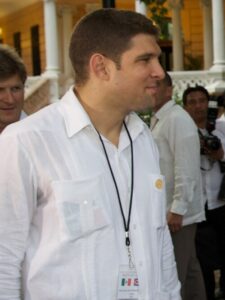
Raúl Guillermo Rodríguez Castro, 41, grandson of former Cuban President Raúl Castro, appears to be the current candidate to be Rubio’s interlocutor in discussions about the island’s future. Known as Raulito, Little Raul, he has been seen frequently lately in the company of Cuban President Díaz-Canel and it is rumored that he has been talking with Rubio. Raul Rodríguez Castro has both a military education and degrees in finance and accounting from the University of Havana. He rose through the army to the rank of colonel and became the head of the General Directorate of Personal Security (DGSP), the equivalent of the U.S. Secret Service, that protects Cuba’s leaders. But he does not have an important position in either the party or the government. His father, General Luis Alberto Rodríguez López-Calleja, was the head of GAESA. Despite his relative insignificance, with the Castro name he might be exactly the person that Marco Rubio would want to head Cuba’s government during transition to a capitalist economy with a liberal state allied with the United States.
Within the year, it seems very likely that Cuba will have a new ruling group, perhaps evolving out of the current Communist leadership and likely joined by Cuban Americans from Miami. The transition to capitalism at the highest level would be relatively easy given that foreign capitalists already control much of the commanding heights of Cuban industry, the Spanish in hotels and tourism and the Canadians and French in minerals and petroleum. As in the former Soviet Union when its economy collapsed, we could see Cuban Communists, such as those who run GAESA, taking over state enterprises for themselves.
The Cuban economy will revive only slowly given its current state, and the country will for sometime be dependent upon foreign aid. How many Cubans return to their country and at what rate remains to be seen.
The United States, and the new Cuban government it creates, will at first dominate the political sphere, but Americans may well prefer to see Cuba with a conservative and a liberal capitalist party, but history suggests that the Communist Party might survive and a democratic socialist labor party develop. Workers will once again fight to create independent labor union with the right to strike and to negotiate contracts.[9]
The Role of the Left Today
Clearly neither American capitalism nor the United States government can offer Cubans what they need today. The American capitalist system that exploits workers at home cannot liberate workers in Cuba. And the U.S. government with its racist attitudes and its reactionary social policies cannot lift up the Cuban people.
What about the U.S. left? The U.S. left never got the Cuban issue right. Understandably thrilled by the revolution and captivated by Fidel Castro and Che Guevara, most leftists gave up their critical faculties and quickly became uncritical supporters of the Cuban Communist state. For more than 60 years the left support a government where the people had no democratic rights and workers had no right to unions of their own choosing. The historic leftist tendencies in the United States, Communists, most Trotskyists, and Democratic Socialists of America all continue to support the Cuban Communists government today.
Why was it impossible for most leftists to say, as some of us did, we oppose U.S. aggression against Cuba, and we support Cubans’ right to self-determination, but we will not support an undemocratic government where neither citizen in general nor workers in particular have any rights.
It is time to start anew and to begin by supporting the Cuban people and the Cuban working class in the midst of the collapse of their old state, its economy, and their society, as they attempt to find their place in whatever new order develops. We should oppose U.S. domination of Cuba and defend the Cuban peoples’ right to self-determination. We should support Cuban workers’ demands for economic security, democracy, civil rights and labor rights. There are democratic socialists in Cuba and we should support them when they are able to organize.
Notes:
[1] On the background of the Cuban Revolution see Samuel Farber, Revolution and Reaction in Cuba, 1933-1960: A Political Sociology From Machado to Castro (Middletown, Connecticut: Wesleyan University, 1976).
[2] In 2014 I wrote “Cuba: A Personal Reflection,” https://newpol.org/cuba-personal-reflection/
[3] Samuel Farber, The Origins of the Cuban Revolution Reconsidered (The University of North Carolina Press, 2007), passim.
[4] For an excellent account see: Samuel Farber, The Politics of Che Guevara: Theory and Practice (Chicago: Haymarket, 2016.)
[5] Samuel Farber, Cuba Since the Revolution of 1959; A Critical Assessment (Chicago: Haymarket, 2011).This book remains an excellent overview of what the mature Cuban Communist system and society looked like.
[6] Paolo Spadoni, “Lagging Behind Competitors: The Cuban Tourism Industry in the Post-COVID Era,” Columbia Law School,” Dec. 16, 2024, https://horizontecubano.law.columbia.edu/news/lagging-behind-competitors-cuban-tourism-industry-post-covid-era
[7] Spadoni, ibid.
[8] Pavel Vidal, “GAESA, the Invisible Elephant in Cuba’s Macroeconomic Stabilizationm,” Columbia Law School, Dec. 19, 2025, https://horizontecubano.law.columbia.edu/news/gaesa-invisible-elephant-cubas-macroeconomic-stabilization#!#text-5976
[9] See here two other interesting interpretations of the Cuban situation: Jon Lee Anderson, “Is Cuba Next?” The New Yorker, March 23, 2026 at: https://www.newyorker.com/magazine/2026/03/30/is-cuba-next. And Samuel Farber, “Trump’s mounting threats against Cuba: An interview with Samuel Farber,” Tempest, March 16, 2026 at: https://tempestmag.org/2026/03/trumps-mounting-threats-against-cuba/
 If you’ve read this far, you were pretty interested, right? Isn’t that worth a few bucks -maybe more? Please
Leave a Reply