Blog

  • The Hidden Agendas Behind the India and Pakistan War

    The Hidden Agendas Behind the India and Pakistan War

    After the April 22, 2025 Pahalgam attack in Indian-administered Jammu and Kashmir, which resulted in the deaths of 26 civilians, the ruling ultra-right BJP government vowed to retaliate and strike hard at terrorist hideouts in Pakistan. The Pakistani government—or more accurately, the Pakistani Army, which acts as a shadow government and is known within the country as “The Establishment”—has a long history of nurturing and supporting Islamic fanatics, aided by CIA and Western funding dating back to the Cold War, when the Soviet Union occupied Afghanistan. Yet, Pakistan continues to feign innocence and victimhood. The war began, and although a ceasefire is currently in place, the specter of conflict still hangs over both nations.

    As an Afghan with leftist ideals, I have witnessed my country burn in the inferno of war for over four decades. Every day, I walked to school in fear of being struck by missiles fired by jihadist factions, who targeted Kabul from the surrounding mountains to pressure the pro-USSR government of Najibullah. When I was in my first year of school, I had to run home during the 1990 failed coup attempt by Shahnawaz Tanai, the Chief of General Staff and Minister of Defense, a member of the Khalq faction of the People’s Democratic Party of Afghanistan (PDPA). Tanai, with the support of Gulbuddin Hekmatyar’s notorious Islamic Party and Pakistan’s Inter-Services Intelligence (ISI), tried to overthrow President Najibullah, who belonged to the Parcham faction.

    By the time I reached 4th grade, I was forced to stop going to school. The jihadist parties had taken over power in 1992, leading to street-to-street battles among rival Islamist factions—chaos that Afghan citizens grimly refer to as the “Jihadist Dogfights.” These battles killed more than 80,000 people in Kabul alone, led to an unknown number of rapes, looting, and the destruction of both public and private institutions, leaving the entire city and country in ruins. Even 35 years later, the scars of that era are still evident throughout Kabul. Anyone who reads Human Rights Watch’s report Blood-Stained Hands: Past Atrocities in Kabul and Afghanistan’s Legacy of Impunity might develop psychological trauma from the horrors described.

    In 1995, I had to leave Afghanistan and my parents behind to continue my education in Pakistan. But a new country brought new suffering. Even after living there for 15 years, from the first day to the last, my fellow Afghan refugees and I had to endure taunts and insults, often being called Mahajir—the refugee—and were frequently forced into physical confrontations with classmates and neighbors. 

    Long story short, the suffering of the Afghan people continues.

    The reader might expect to read about the recent India-Pakistan war, but here is an Afghan recounting the pain of his people—and his own.

    My aim is to warn ordinary people, especially in India and Pakistan, not to be fooled by the jingoism of their ruling elites. Knowing the languages of both countries, having spent time in each—15 years in Pakistan and many visits to India—and closely following their local and international media, I am familiar with both nations. I say this with confidence: the ruling class in both countries is either pushing for war or pretending to do so in order to extend their own power. They are manipulating the mentality of their suffering citizens, using war as a convenient excuse to avoid facing the uprisings sparked by broken promises made during elections—much like what happened in Bangladesh last year, a country which once shared land with both countries and is now close in culture, language, and history.

    The Bharatiya Janata Party (BJP), led by Prime Minister Narendra Modi, has been in power since 2014. Modi, once a member of the far-right Rashtriya Swayamsevak Sangh (RSS), has campaigned on false promises of “Clean India” and “Abolishing Poverty.” However, since coming to power, the reality has been the complete opposite. He and his party have given free rein to the capitalist elite to exploit the people of India. In 2024, we witnessed the second round of the largest protest in the world by Indian farmers, which later grew to include industrial workers, after Modi’s government failed to fulfill promises made in 2021. While 1.77 million Indians have no place to live in the searing heat of the country, the richest man in India, Mukesh Ambani, owns Antilia, the most expensive house in the world, valued at $4.6 billion in 2023. India’s mining industry continues to wreak environmental havoc. In 2023, Indian wrestlers protested against a BJP member of parliament for sexually harassing female wrestlers during his tenure as president of the national wrestling federation. Cases of rape by high-ranking members of the ruling party go unpunished. When I interacted with Indian humanitarian workers during a workshop, I was shocked to learn about the dire poverty and hunger that force people to eat rats, grass, or the liquid extracted from cow dung. The BJP openly espouses Hindutva, a political ideology that advocates Hindu supremacy over India.

    The Situation in Pakistan is equally dire.  The country is burdened by crippling international debts.  Minister Shehbaz Sharif himself stated: “Today, when we go to any friendly country or make a phone call, they think we have come [to them] to beg for money.” Due to widespread poverty and hunger, there are numerous reports of fathers killing their wives and children by poisoning them before taking their own lives, or people exhuming dead bodies to eat the flesh. Religious fanaticism, which began during Zulfikar Ali Bhutto’s era and was amplified during General Zia-ul-Haq’s rule with CIA funding, has transformed Pakistan into a place of intense religious intolerance. Entire Christian communities have had their homes burned to the ground, and Pakistan’s national cricket team members often appear more like religious missionaries than sportsmen, frequently attributing wins and losses to Allah as if god is a team member.

    I remember when I was a student, asking my classmates where they were from, and most didn’t even understand the meaning of my question, replying simply that they were from Pakistan. But today, separatist movements are gaining momentum in Balochistan, Khyber Pakhtunkhwa, Sindh, and Southern Punjab. It has become common in Pakistan for the military establishment to topple a prime minister, prosecute them for corruption, exile them to luxury villas—often in London—and then later reinstate them to power. I recently visited Islamabad after 12 years.  Once one of the cleanest cities, it is now filled with trash on the streets and highways.

    Both countries, under feudal-capitalist governments, have no solution for the suffering of their people except war—just as all reactionary regimes do. People die of hunger in both countries, but who cares? The generals and the elite class profit from the war, while the rest of the population bears the cost. In the coming years, the war started by the ruling elites will be blamed for all the shortcomings they caused. The people will endure all the hardships, while the ruling class continues to live luxurious lives, either within their own countries or abroad. I write this from the perspective of Afghanistan, where no war criminals have been brought to justice. As regimes have collapsed, those responsible for decades of suffering simply moved to offshore countries to live out their lives comfortably, or to await a return to power.

    As a progressive Afghan, I’ve shared a glimpse of the miseries we, Afghans, have faced. Therefore, the people of India and Pakistan should not fall into the trap set by their war-mongering elites. They must choose peace over war because the true winners of this war will be the elite class, while the rest of the population will be the losers.

    Say NO to all unjust wars around the world.

    May 14, 2025

  • Feminism, Capitalism, and Alienation

    Feminism, Capitalism, and Alienation

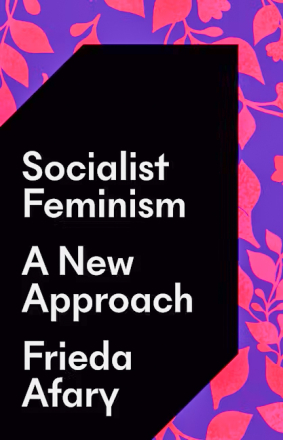
    In Socialist Feminism: A New Approach, Frieda Afary looks to “conceptualize an enriched emancipatory socialism with transformed gender relations at its heart.” She does this by examining four socialist feminist theories of gender oppression: (1) theories of social reproduction, (2) theories of alienation, (3) intersectionality, and (4) queer identities.

    The book contains useful literature reviews of socialist feminist theories, in particular queer theories and social reproduction, which she also subjects to friendly critique.

    She correctly identifies that in its quest to produce a Marxist theory, socialist feminism has become over-reliant on social reproduction theory, which can tell us much about the relationship between paid and unpaid labor and women’s role in the home, but is not an all-encompassing theory of sexism under capitalism.

    Her own explanation for the missing piece of socialist feminism is the relation of alienation to sexism: “Capitalism affects and alienates the mind and body and human relations in insidious ways that are not simply caused by private property and the market. Its alienated mode of labor affects all human relations and most deeply intimate and sexual relations.”

    In the Economic and Philosophic Manuscripts of 1844, Marx discusses the various ways in which workers are “alienated” under capitalism. Opportunities for workers’ creativity are shut down. Routine and repetition increase as work is specialized, to extract more and more profit from more and more intensified work.

    Marx explains how this can “mutilate the laborer into a fragment of a man.” Our project is to return human freedom to those whose labor makes the world run.

    Yes, what Marx described as the working class’s “loss of self” must clearly have some effect on our gendered relations. The coercion inherent to broader society is certainly replicated within our family structures. But the nature of capitalism’s effect on the worker is contradictory, and those contradictions aren’t just waiting within us to be resolved after the revolution. Many aspects of gendered relationships have improved through collective working-class struggle under capitalism.

    It is important not to lean too far towards Marx’s idea of capitalism dehumanizing us; it gives us chances to be humanized too, and Marx identifies those tendencies alongside the dehumanizing ones.

    “Modern Industry, indeed, compels society, under penalty of death, to replace the detail-worker of to-day, grappled by life-long repetition of one and the same trivial operation, and thus reduced to the mere fragment of a person, by the fully developed individual, fit for a variety of labors, ready to face any change of production, and to whom the different social functions they perform, are but so many modes of giving free scope to their own natural and acquired powers…” (and Marx cites testimony from a migrant worker in the capitalist USA on actually achieving that through varied work).

    Realized

    Capitalism brought with it the humanist conceptions of reason, universality and solidarity, but it also prevented them from being fully realized. We can realize movements not possible before capitalism. Men under capital are neither machines nor animals, but people.

    I’m unconvinced too by Afary’s declaration that the end of alienation will bring the end of the unconscious mind. I suspect that human minds will change considerably (as they already have). But the fact will remain that there are things of which we are aware, and other things of which we are not aware, and we will not change so fundamentally that all implicit mental processes will disappear.

    Even where capitalism does brutalize us, it is not right to situate sexism as flowing from alienation. What about the systemic oppression of women that occurred in pre-capitalist societies before capitalist alienation began? In part the working-class family under capitalism derives structures from the ruling class (from the bourgeois family). Both as a conscious ruling-class project of control, and through workers’ understandable desire to emulate lives which look better and more comfortable. Families do not just produce workers, they have an ideological function for capitalism: the reproduction of the relations of production through the socialization of children within the family hierarchy.

    As women have entered the workforce in greater numbers and experienced greater alienation there, we haven’t noticed sudden spikes in women committing rape or domestic violence. In part, Afary gets around this by situating alienation as primary within capitalism. Everything else stems from alienated labor, because alienated labor is essential to the system. To identify alienation as the one decisive element of capitalist exploitation, and ignore its interactions with ever-shifting elements of the capitalist system and changing social forces, seems undialectical.

    Afary argues that we are facing a new model of state capitalism, with the state and military having more and more control over the direction of companies even when there is no direct full ownership. She at one point (borrowing from bourgeois economist Joshua Kurlantzick) defines state capitalism as state ownership or significant influence over more than one-third of the 500 largest companies (by revenue) in a country. It is a very broad definition. She jumps from this to predicting a move to an authoritarian state capitalism, and its potential gender implications. She posits a capitalist future with the state in charge of all aspects of life, including the family: children brought up in care facilities and adults working in workcamps. This seems fantastical.

    There is a blur between “free” wage labor and wage labor in work camps or super-exploited migrant labor in capitalist economies. But workcamps and political labor are not the economic norm. They are exceptions to the wage system. Were the economy not to depend on wage labor, and transition instead to being based on some form of prison labor, I don’t see how you could describe it as capitalist. There are real threats of rising authoritarianism to gender relations, but fringe exceptions do not affect the majority of the workforce. The authoritarians are politically motivated to strengthen gender relations and the family.

    Afary has a commendable humanist and internationalist perspective on the liberation of women. She references Black liberation struggles in US led by women and uprisings in Sudan, Algeria, Hong Kong, Iraq, Lebanon, Chile, and Iran, as well as mass protests and labor strikes in France, Haiti, and elsewhere which had women at the forefront.

    She is not afraid to call out those leftists who are so adamant that imperialism is a western phenomenon that they fail to fight for liberation elsewhere: “Although the Occupy Movement was inspired by the Arab Spring, many of those on the Left who called themselves anti-imperialist supported the Assad regime in Syria because it claimed to be against U.S. imperialism, and its regional imperialist backers Israel and Saudi Arabia. Some leftists also openly supported Russian imperialist intervention in the Middle East and Ukraine, as well as Iranian regional imperialist intervention in Syria and in Iraq. This unprincipled and inhumane attitude, this failure of those who claim to be against capitalism to see the connection between capitalism and the rise of imperialist powers other than those in the West…”

    It would be good to see more books trying to move socialist feminism beyond current approaches. Dual-systems feminism, a perspective within Marxist feminism, argued that women’s oppression stemmed from the intersection of two distinct systems: capitalism and patriarchy. The swing back to social reproduction theory has somewhat overcorrected. The role of women in reproducing workers is part, but not all, of the material basis for sexism, and taking that as the explain-all can be economistic.

    Though I am unconvinced by the way Afary situates sexism in alienation, considering oppressive practices in the context of the dehumanizing nature of capitalism as a political/economic system is necessary too. More discussion is necessary on pre-capitalist gender oppression, which continues not just through human practices being slow to change, but also by their embedding into the material lives of workers.

    This article originally appeared on Workers Liberty, 14 May, 2025.

  • Pan Africanism under elite capture

    Pan Africanism under elite capture

    In The Wretched of the Earth, anticolonial theorist Frantz Fanon warned that Africa’s postcolonial bourgeoisie would co-opt the symbols of Black liberation to advance their own narrow agendas, ultimately failing to break both the psychological and material chains of colonialism. Fanon’s prophecy has proven true: African political leaders not only have seized power to replicate colonial structures of oppression through extractive capitalism and corruption, but also found willing collaborators among the African diasporic elite, distorting pan-Africanist ideals for personal gain.

    There is a longstanding legacy of celebrity being used as soft power in cultural warfare to sanitize and exploit Africa, ultimately manipulating the postcolonial divide. As noted by author Frances Stonor Saunders, the US government recognized the role of music and the arts as a covert strategy to win hearts and minds, resulting in a “cultural Cold War.” This took place in1960, referred to as the “Year of Africa” against the backdrop of 16 African nations gaining independence, as African leaders such as Patrice Lumumba and Kwame Nkrumah became global icons of postcolonial freedom. Fearing a united African front, as well as the perceived growing threat of communism, the CIA deployed musicians like Louis Armstrong and Nina Simone as “jazz ambassadors” of goodwill and freedom to counter the Soviet’s message highlighting the racism in America.

    This stirred an ethical dilemma for Black American artists, who were tasked with presenting a false image of racial harmony in the US which didn’t reflect their lived experience or moral standings under Jim Crow racism. Armstrong initially refused to participate in the state-sponsored musical tours of Africa until legal progress was made on civil rights. The jazz ambassadors’ contradictions between being civil rights activists while playing a role in continental Africans’ plight was shown brilliantly in the critically acclaimed documentary Soundtrack to Coup d’Etat. Though these events didn’t happen in succession, the film’s timeline brilliantly links events such as Armstrong’s visit to Congo just as Lumumba was placed under house arrest and the CIA invaded Congo. This provides both a striking and useful analysis of how these musicians potentially provided a smoke screen for the CIA’s foreign interference, leading to Lumumba’s assassination.

    These celebrity-backed private-public partnerships have recently been reignited by Ghana’s Year of Return in 2019, a government-led initiative positioning Ghana as a premier destination for African Americans and the African diaspora to reconnect with their ancestral roots after four centuries of separation due to chattel slavery. In 2019, tourism in Ghana accounted for 10.3 percent of the GDP, a significant increase from 3 percent in 2016. Soon, the Ghanaian government began welcoming high-profile celebrities such as Chance the Rapper and Meek Mill as unofficial ambassadors, promoting “experience-based tourism” through festivals and restored historical sites.

    Kenya does not have a documented dedicated tourism strategy targeting the diaspora in the same fashion as Ghana, who launched a dedicated diaspora affairs unit under the oversight of former President Nana Akufo-Addo. In 2021, however, Naomi Campbell—who has frequently associated with infamously corrupt members of the global elite such as Jeffrey Epstein and former Liberian president Charles Taylor—was controversially appointed Kenya’s tourism ambassador at a time when the sector was struggling due to COVID-19 restrictions.

    Campbell is far from the exception in recent controversial investments from celebrities throughout Southern and East Africa: British actor Idris Elba, who has advocated for building Africa’s film industry, was allegedly awarded over 80 acres of land in Zanzibar by the Tanzanian government to construct modern film studios, during a political context where political freedom is critically absent for Tanzanians, especially those arrested on petty pretenses such as using “strong words” when simply criticizing President Suluhu Hassan. Moreover, John Legend also chose to perform at the Global Citizen festival in Kigali, despite the Rwandan government’s involvement in the M23 rebel takeover in Congo. By contrast, Tems canceled her headline show in Kigali around a similar time, as she recognized it would be insensitive to Congolese people.

    In defence of his decision, Legend said the following, “I don’t believe that we should punish the people of Rwanda and punish the people of other countries when we disagree with their leaders.” While it is certainly true that not all Rwandans support their government’s political choices, cultural boycotts have proven to be highly significant in holding oppressive regimes accountable, such as the boycott that led to the apartheid South African government’s exclusion from the Olympics. Congolese people’s need for solidarity at a time when Rwanda’s role in the conflict is still invisibilized is markedly more urgent than the Rwandese people’s desire for a glamorous multimillion-dollar concert. Given the context, these high-profile moves reinforce the perception that their governments prioritize wealthy outsiders over their own citizens, an all-too-familiar pattern reminiscent of gentrification.

    American singer and farmer Kelis is the latest celebrity to venture into East Africa, purportedly under the guise of sustainability. She often markets her videos on her instagram account through short-form reels wearing no makeup and casual clothing, coupled by hashtags like #SupportBlackFarmers and #FarmLife, presenting herself as a relatable “girl next door” type of favorite lifestyle influencer. The artist and businesswoman recently expanded her entrepreneurial efforts after purchasing land in Kenya with the stated intention to establish a large-scale commercial farm surrounded by wildlife. To honor this announcement, she took to social media once again, branding herself a “pioneer,” and wearing a T-shirt labeled “Original Farm Owner” to emphasize this persona. On cue, this provoked mixed reactions, particularly among Kenyans concerned about farming close to endangered wildlife and disrupting natural ecosystems. While a minority of people welcomed Kelis using her platform to showcase Kenya in a positive light—arguing that she should be crowned as the new tourism ambassador for the country—amongst detractors, Kelis was quickly labeled a neocolonizer. Speculation began to spread that the land she acquired was reservation land, given its proximity to wildlife, and that she likely leveraged government connections to secure the purchase.

    Though the exact whereabouts of Kelis’s farm are unknown, it’s most likely situated around Naivasha, a town named after its freshwater lake, originally inhabited by the Maasai tribe until it became a significant area for colonial development in the late 19th century. At present, the remnants of settler colonialism persist, as the area is now characterized by vast floriculture farms owned by white settlers. In response to these criticisms, Kelis clarified that the land was privately owned and purchased from a previous landowner, not from a wildlife reserve.

    This defense misses the fundamental issue. Regardless of whether the land was legally available, the concern remains that these celebrity acquisitions reinforce existing patterns of wealth accumulation and land concentration. Kelis’s actions are perceived as emblematic of a broader lack of solidarity from diasporic Africans and the greater Black diaspora, who, in their pursuit of economic opportunity and connection to the African continent, risk becoming the “new wave of gentrifiers.” As Kelis continues to promote her farming enterprise, large-scale farming in Kenya remains largely reserved for white settlers and the Kenyan elite, while indigenous farmers in Kenya are disproportionately impacted by droughts and flooding, resulting in the loss of arable land for livestock and family. Moreover, Lake Naivasha’s water levels have been declining, with floriculture being the major contributor. How sustainable is Kelis’s new business venture when this land and resources could be maximized to achieve food security in a nation where more than 13 million lack secure access to food?

    Beyond the material consequences, these celebrities also aid African governments to craft a progressive, aspirational image that conceals deep-seated class inequalities and the dire material conditions of ordinary Africans. In this distinctively diasporic African imagination, Kenya and other African nations become idyllic homelands, fertile lands of possibility, sanctuaries from the racial injustices of the West, and places where lost ancestral connections can be miraculously restored. “Rwanda! It feels a Utopia like #wakanda truly stunning! So lush and Beautiful! The people here <3,” said Kelis in the caption of one of her other Instagram reels, captured on a hill overlooking vast farmlands. She expresses fascination with the young children “helping and carrying stuff”—not taking into account the implication of young children carrying firewood passing by who were unknowingly featured in the video like props.

    The reel feels reminiscent of a scene from a modern Out of Africa remake, bringing to mind Black feminist historian Jade Bentil’s coinage “Wakandification” to capture this “process through which Africa *as a product* is reimagined to serve the interests of representation, nation, and capital.”  This romanticized Africa is depicted as pure and unspoiled, populated more by wildlife than by people, perpetuating a colonial-era narrative that erases the lived realities of African citizens. It is the Africa of book covers—the Africa of bold colors and baobab trees, devoid of the humanity that lives alongside the vegetation.

    On one hand, it is understandable that diasporic Africans, after centuries of dispossession and racism, are drawn to the aspirations of returning to the African continent. Long before 2019, African Americans have relocated back to Africa, drawn and inspired by these nations’ liberation movements, including prominent academics such as Maya Angelou and W. E. B. Du Bois, who made Ghana their home under the invitation of Nkrumah, while members of the Black Panther Party sought refuge in Tanzania, influenced by Nyerere’s embrace of pan-Africanism under his Ujamaa framework. Even then at the height of the pan-Africanist movement, however, there were noted tensions between these expats and indigenous Africans, as noted in Saidiya Hartman’s Lose Your Mother, where she notes how Ghanaians resented expats for occupying land and “presuming to know what was best for Africa.”

    These diasporic frictions have persisted to present day, as some African Americans have made direct attempts to claim African citizenship. While the bulk of the efforts have taken place in Ghana, one US citizen who has lived in Kenya since 2008 petitioned for recognition as a Kenyan citizen, citing ancestral rights. While most African Americans who are descended from enslaved people trace their lineage to West Africa, his choice of Kenya as his ancestral home was informed by the Abuja Proclamation, a pan-African declaration sponsored by the African Union in 1993. This proclamation calls upon all African states “to grant entrance as of right to all persons of African descent and right to obtain residence in those African states if there is no disqualifying element on Africans claiming the right to return to his ancestral home”—an idyllic goal that has yet to be sustainably implemented in reality beyond catering to elite classes of the Black diaspora

    As the push for economic growth continues, African nations such as Kenya, Tanzania, and Rwanda, where tourism is central to GDP, are likely to begin marketing themselves as relocation destinations for the Black diaspora. While African Americans may not have explicit ancestral ties to East Africa, the region’s infrastructure and perceived stability may attract more returnees. It would not be surprising to see these nations adopt policies similar to South Africa’s “digital nomad” visas to facilitate long-term diaspora migration.

    Given the circumstances, it is easy to direct anger towards the incoming communities of Black expats, who seem to be reaping the benefits of this current incentivized hierarchy. Most of these newcomers, however, are also victims of the neoliberal structures of class exploitation that disenfranchise Black communities across the globe, particularly in America. The real culprits remain the African political and economic elite and the Western powers, former colonizers, and financial institutions who shape their self-interest and continue to amass capital at the expense of genuine racial solidarity, distorting radical unifying principles through the sanitizing process of elite capture.

    In the case of Kenya, the cost of living remains at an all-time high following the country’s  #RejectFinanceBill2024 protests against neoliberalism and poor governance, with Kenya’s debt-to-GDP ratio projected to reach 70 percent. Meanwhile, the Kenyan government remains mired in scandals, from selling fake fertilizer to farmers, to a defunct Social Health Authority (SHA) system leading to a public health crisis. Even more concerning, Kenya’s current administration seems to be deepening economic ties with oppressive regimes, recently hosting Sudan’s Rapid Support Forces (RSF), the same military group responsible for war crimes in one of the most devastating civil wars in recent history, allowing them to charter meetings aimed at forming a parallel government in Sudan. In retaliation, Sudan banned all Kenyan produce imports, disrupting Kenya’s tea trade and further destabilizing the economy. Describing Kenya as a “paradise” of any kind, farmland or otherwise, requires a willful ignorance of the circumstances that Kenyans are fighting to survive in.

    What history warns us is that the pivotal issue lies at the feet of economic mismanagement and lack of structural economic reforms to uplift local African societies. For instance, Nigeria’s Second World Black and African Festival of Arts and Culture (FESTAC ’77) was a billion-dollar celebration of Black pride, but failed to deliver lasting economic benefits for Nigerians, with massive shanty towns surrounding the display and famed Nigerian artist Fela Kuti declining to participate, calling the event a propaganda exercise. As Ghanaian writer Ayi Kwei Armah pointed out in a 1985 essay “The Festival Syndrome,” such festivals risk becoming “wasteful demonstrations of intellectual bankruptcy” rather than vehicles for meaningful change. As African countries continue to find ways to participate in the global community and diaspora, Africa’s resources must be used to address pressing issues like famine, poverty, and economic inequity that persists within its borders.

    Kwame Nkrumah understood the importance of cultural exchange and its practical benefits. “You must not be content with the accumulation of knowledge about the arts,” he declared at the opening of the University of Ghana’s Institute of African Studies in 1963. “Your research must stimulate creative activity; it must contribute to the development of the arts in Ghana and in other parts of Africa.” Tourism and long-term diaspora migration do not need to be inherently exploitative;  they could be a dialogue in service of national needs and true local development. This could mean skills training for locals, fostering job creation and economic sustainability.

    Moreover, diasporic public figures genuinely interested in engaging with the continent should not only seek to develop profit making opportunities that burnish their own reputations, but also make a point to support local grassroots initiatives as opposed to enabling the celebrity-washing practices of corrupt governments. Initiatives like Noname’s book club which builds community through political education, provides a model for ethical engagement—the Chicago rapper and avowed anticapitalist does not center herself with her platform but rather is currently partnering with local African bookstores in places like Nairobi, Accra, and Lagos to host a book club tour.

    The question is not whether the African diaspora has a place on the continent—they always have. As the writer Shamira Ibrahim succinctly puts it, the Black diaspora does not deserve to be turned into “shields for administrative neglect.” Rather, it is about ensuring that their return does not reproduce the same exploitative dynamics that colonialism and neoliberalism have long upheld. True pan-Africanism must be built on mutual solidarity, land equity, and economic justice, not on elite-driven spectacles that serve the privileged few.

    First published at Africa is a Country.

  • May Day in America, Is It Now Here to Stay?

    May Day in America, Is It Now Here to Stay?

    This article was written for L’Anticapitaliste, the newspaper of the New Anticapitalist Party (NPA) of France.

    May Day is not a holiday in the United States. In most states and cities, it is not celebrated. In some places, in schools or public parks, people put up a May pole and danced around it to celebrate the arrival of spring. We did that in my elementary school in Chicago when I was a child. The official Labor Day in the United States, which is a national holiday, is celebrated on the first Monday in September and marks the end of summer and students’ return to school. But maybe this year things finally changed.

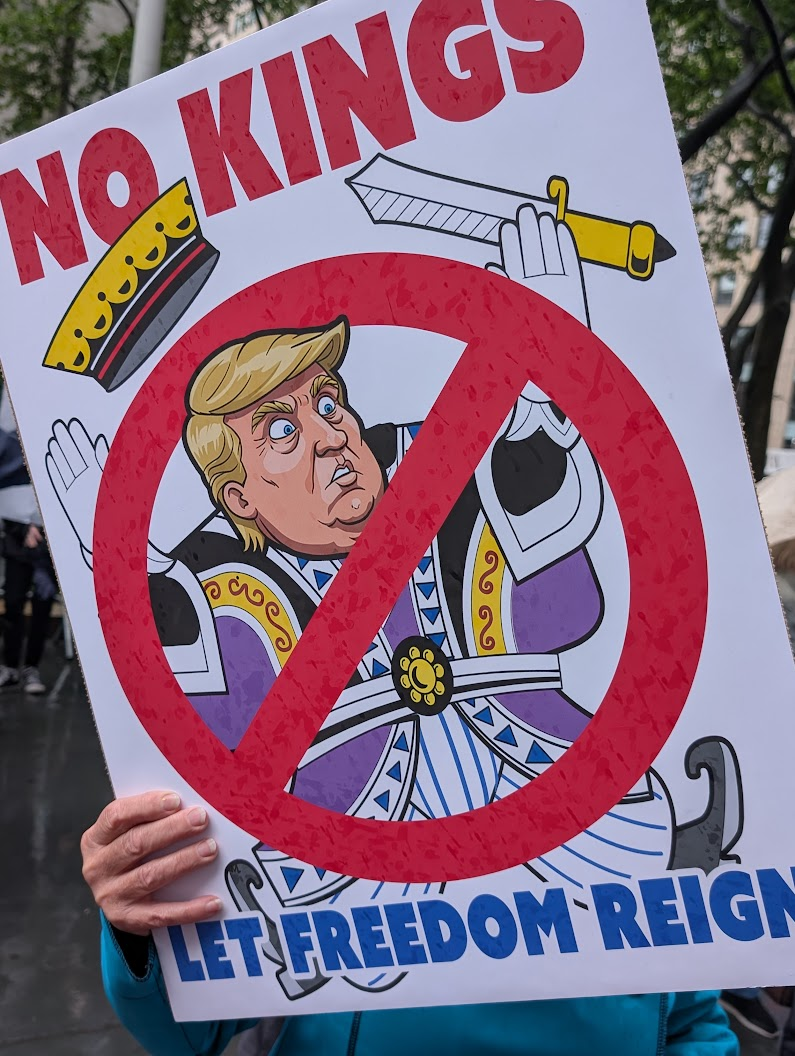
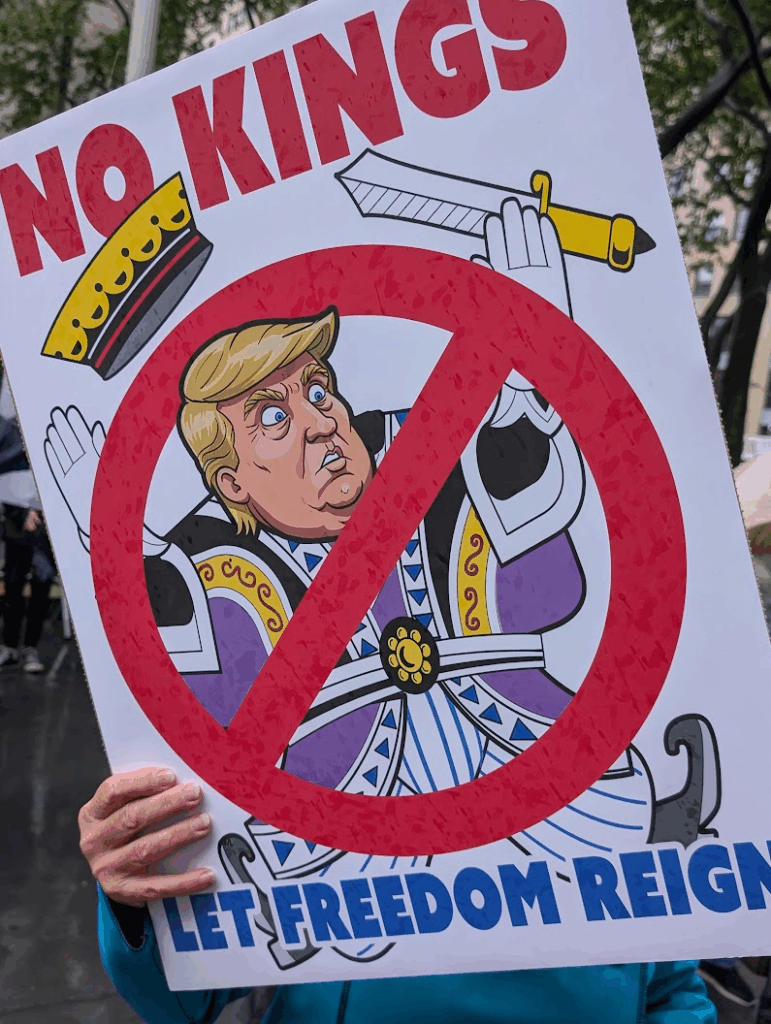
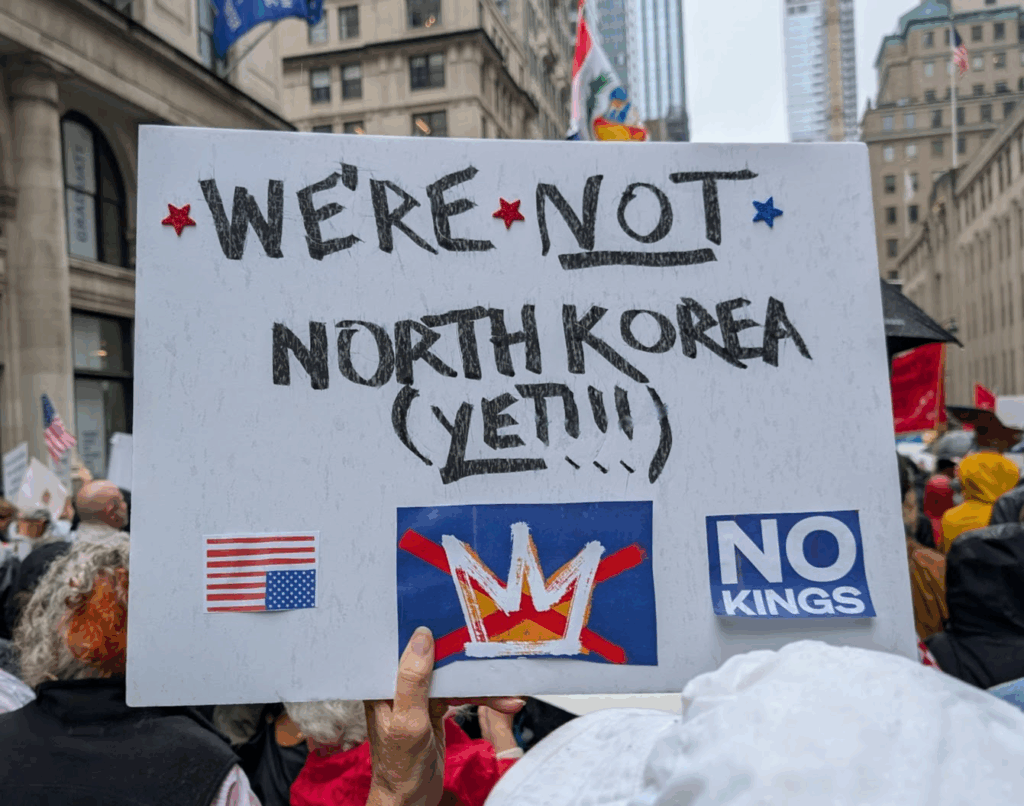
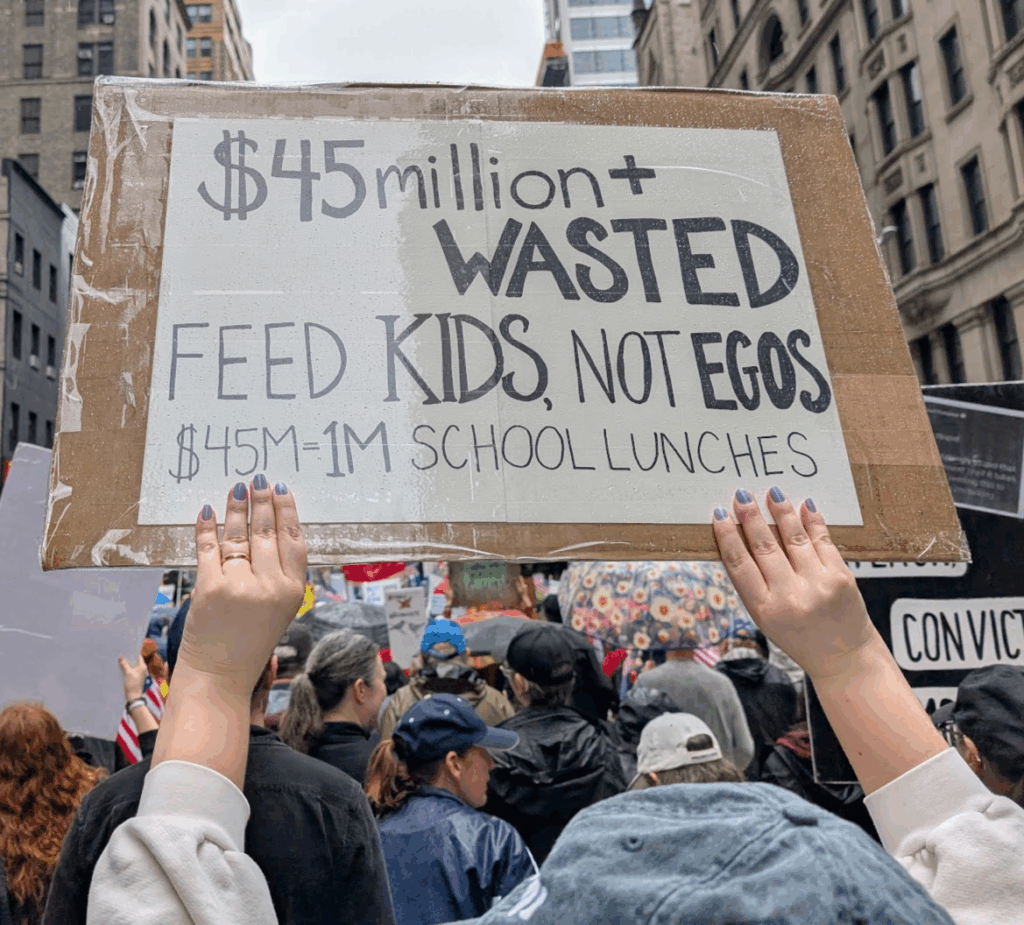
    On this May 1, International Labor Day, hundreds of thousands of Americans joined scores of rallies and marches in all 50 states to protest President Donald Trump’s devastating first 100 days in office. They protested the shutdown of government departments, the layoffs of hundreds of thousands of workers, the ending of food programs for children, the disabled, and the elderly, cuts in health care, the illegal deportation of immigrants, and tariffs and the trade wars, and the many other terrible things Trump has done.

    This is the latest in a series of national protests against Trump and this one had a different character. When I joined the protest in New York City there were many unions present: the Transportation Workers Union that run’s the city’s subways, the Retail, Wholesale, Department Store Union, the United Food and Commercial Workers Union, the Communication Workers, the Professional Staff Council of the City University, and others. The presence of the unions meant that there were more Blacks and Latinos in this protest than in earlier ones. And so, the protest had a different feel, a working-class character.

    Unions marching on May Day is something rare in the United States and in most places something relatively new. In 1882, before the Haymarket events in Chicago, New York unions who were fighting for the eight-hour day, organized a labor day march in September. Then the national union federation called for strikes in May to win the eight-hour day. On May 1, 1886 German anarchists in Chicago organized prolonger workers strikes and protests in support of the eight-hour day, but on May 3 the police attacked the demonstration. The next day there was a protest rally at Haymarket Square, but police attacked it too. Then a bomb was thrown either at the police or at the workers, and eight radicals were arrested, tried and convicted of the bombing, and four eventually hanged. To honor the martyrs of Chicago, the International Socialist Conference of 1889 adopted May Day as the International Workers Holiday.

    American workers then had two options, the September Labor Day, which became a national holiday in 1894, or May 1. Where the Socialist or Communist Parties had a presence, there were May Day celebrations, but in most places the September holiday prevailed. When after World War II the Cold War broke out accompanied by an anti-Communist crusade and Senator Joseph McCarthy’s persecutions of Communist, May 1 celebrations waned. President Dwight D. Eisenhower proclaimed May 1 as Law Day. At the same time, the Soviet Union turned the holiday into a demonstration of its military might with parades of tanks and missiles in Red Square in Moscow.

    In the 1960s and 70s, it was Latino immigrants, Puerto Ricans in New York City and Mexicans in San Francisco and Los Angeles who began to reintroduce May Day workers rallies and marches in their communities. In 2006 in a fight for immigration reform, hundreds of thousands of Latinos demonstrated in Los Angeles and Chicago on May Day, giving the event the character of a general strike. But still the holiday didn’t catch on among the rest of the population.

    This year’s protests against Trump, against his authoritarianism, and his reactionary agenda may have put this holiday back on the national calendar as American workers join the rest of the world’s proletariat in the streets on May 1. We’ll see next May 1.

  • What Iran-U.S. Negotiations Expose About the Nature of the Islamic Republic

    What Iran-U.S. Negotiations Expose About the Nature of the Islamic Republic

    The intricate path of negotiations between Iran and the United States, coupled with their fluctuating rhetoric, offers a crucial lens through which to understand the Islamic Republic’s (IR) position within global power dynamics. These events reveal the unique characteristics of the IR and its historical trajectory in relation to the foundational aspects of the global order, not in isolation or opposition as often portrayed. This essay examines the implications of the context surrounding these negotiations for the IR’s position in the ongoing realignment of inter-imperialist relations.

    The central premise of this analysis is that the IR’s emergence and its subsequent evolution are intrinsically linked to its functions within the framework of imperial power relations in reproducing the global order. This essay aims to substantiate this starting point. The insights gained from recent events concerning the IR’s nature stem from the pressure of historical developments rather than solely from the efforts of opposition forces. The inherent contradictions within the IR’s history and strategies sometimes manifest in ways that exceed the regime’s capacity for management and representation, even though these consequences are often addressed through further contradictory actions.

    1. When You Are Helpless, Be Submissive, But Boast and Deny!

    The trajectory of these negotiations was initiated by continuous threats from Trump, which gained prominence with developments in Syria and Lebanon and solidified into a tangible danger for the IR following the deployment of U.S. warships and bombers in the Indian Ocean.[1] Trump’s dominance in determining the negotiation process undermined the Iranian regime’s aspirations for “indirect and unconditional negotiations.” Moscow’s lack of anticipated support further limited the IR’s ability to insist on its terms through aggressive political maneuvers.

    On the same day Russia approved a strategic cooperation treaty with Iran, the Russian Foreign Ministry clarified that this treaty did not entail military support for the IR in the event of foreign aggression[2] (by the United States). Similarly, Beijing, another eastern ally, could not prioritize further support for the IR due to its trade war with Washington. Consequently, the Iranian leadership found itself isolated in the face of a potential confrontation with Trump.

    This situation acutely highlighted the internal disagreements within the IR regarding over-reliance on Russia and the Eastern global power center. Russia’s perceived abandonment of the IR in Syria (leaving it to Turkey on behalf of the West) seemed to be repeating itself, with the IR facing the United States alone. This validated the pessimism and warnings from certain elements within the IR who viewed Iran as merely a pawn in Russia’s broader interactions with the West.

    Ultimately, the very entities (Beijing and Moscow) once revered in Iran’s foreign policy have now been openly or implicitly repudiated, leading to an embrace of the West. Consequently, the beleaguered IR leadership swiftly moved to meet key preconditions for negotiations set by Trump. While this option may have been a long-standing contingency plan, the IR withdrew its advisory and military forces from Yemen[3] and instructed its Yemeni proxies to de-escalate. Similarly, its Iraqi proxy forces[4] (Hashd al-Shaabi, among others) were ordered to adopt ‘heroic flexibility.’[5] Finally, Hezbollah in Lebanon,[6] the IR’s ideological-military stronghold, was directed to prepare for disarmament.

    These preconditions were rapidly fulfilled to demonstrate the IR’s seriousness and goodwill to the United States, with the underlying hope of avoiding future constraints (like relinquishing missile and drone capabilities) and potentially gaining concessions on ‘peaceful’ nuclear technology. To manage domestic and regional public opinion regarding these ‘heroic compromises,’ the IR orchestrated significant attention on the ‘indirect’ format of the negotiations, presenting this as a crucial and ‘prestigious’ matter. The regime aimed to downplay the fundamental strategic shift and its perceived humiliating retreat, concealing its inherently subordinate position in these negotiations despite its prior aggressive rhetoric. They later boastfully will claim that nothing had been imposed upon them and that the IR was the victor in these ‘indirect’ discussions. However, Trump’s direct announcement of the negotiations’ form disrupted these calculations, negating the possibility of indirect talks. This forced the IR to defend its claims about ‘indirect negotiations,’ which were intended to provide a minimal facade for its power assertions, even resorting to convoluted and sophistical interpretations of ‘indirect negotiations.’[7]

    Beyond the regime’s propaganda regarding the negotiation format for domestic and regional consumption, the recent ‘heroic flexibility’ extends beyond previous understandings. The context and progression of events suggest potential future scenarios for a reconfiguration of the IR’s relationship with the West and a reassessment of Iran’s position in the global market. For instance, the official announcement that the IR and its Supreme Leader have no objections to future U.S. investments in Iran’s economy[8] signifies a substantial shift.

    The IR’s consistently aggressive posture in the Middle East, coupled with strong anti-U.S. imperialism rhetoric, has obscured the more critical reality of the Iranian regime’s subordinate position in the fluid dynamics between global power centers. Recent developments in Syria and Lebanon provide significant evidence for this, suggesting that the IR’s function has been to advance certain proxy battles (primarily on behalf of Russia) in the Middle East as long as the power dynamics allowed. These proxy conflicts have contributed to the perpetuation of a ‘Global War Regime’ and ‘militarized accumulation,’ while simultaneously strengthening Israel’s capacity for aggressive expansion. However, the prolonged nature of this proxy role and the self-aggrandizement of the IR’s rulers have led to a perceived (pseudo-)agency for the Iranian regime in global and regional power relations, a perception that has, in fact, benefited both Western and Eastern centers of power.

    Acknowledging the IR’s subordinate status in global power relations does not diminish the devastating consequences of its regional interventions for the people of the Middle East, nor does it absolve the IR’s rulers of their direct responsibility for these disasters. The role of a proxy power in the region has been facilitated by the military-ideological ambitions and political-economic interests of the IR’s rulers. The alignment of these roles with the interests of the ruling classes in both ‘metropolitan and peripheral’ states has necessitated a certain degree of power and privileges for the Iranian regime. Furthermore, in a multipolar global order, the ability of states to maneuver within the rivalries of imperial power centers has expanded the scope of these powers and privileges, transforming the IR into a regional sub-imperialist power (see appendix).

    The advancement of ‘proxy wars’ by a regional power like the IR is merely the most visible aspect of its ‘proxy roles,’ overshadowing their broader functions. The ‘proxy roles’ of a regional power generally contribute to the reproduction of the entire system underpinning the global order. For instance, the IR, as a sub-imperialist power, has facilitated the realization of global power relations regionally, thereby contributing to the continuity of the global order, despite its limited ability to determine global macro-relations. Beyond aiding the expansion of the ‘Global War Regime’ and ‘militarized accumulation,’[9] the IR’s most significant role in maintaining the global order has been to perpetuate mechanisms of oppression over the subjugated masses within this order. This has been achieved through consistent repression within Iran and the transnational extension of these repressive measures. The ultimate aim of this repression is to impede the development of critical consciousness and anti-capitalist collective subjectivity among individuals and groups. This is evident in the continuous suppression of political currents (especially leftists) and progressive social movements, alongside the creation of reactionary tendencies and movements.

    This aspect of the IR’s sub-imperialist functions in maintaining global order can be summarized in two interconnected elements: (a) preventing the formation of class consciousness and suppressing progressive political forces and social movements, thereby bolstering limited and even reactionary collective tendencies; and (b) obstructing both the mental and material possibilities for solidarity among the oppressed, whether within the country or transnationally in the Middle East.

    2. Where you have power, be ruthless: kill and intimidate!

    How has the IR managed to conceal its overarching function in assisting the reproduction of the capitalist order and imperialist relations? Primarily through the long-standing pursuit of proxy wars in the region, ideologically framed as a struggle against Western powers, specifically as anti-imperialism and anti-Zionism. The aggressive rhetoric, slogans, and actions of the IR’s rulers towards Western powers, along with their sustained opposition to the Israeli state (a key imperial stronghold in the Middle East), have provided sufficient material for this concealment. Notably, in recent years, leftist forces (both aligned with and independent of the IR) have also promoted an anti-imperialist and heroic interpretation of the IR’s foreign policy. Understandably, these claims have resonated with Arab opponents of Zionism in the Middle East. Interestingly, mainstream media in both Western and Eastern societies have facilitated this concealment by endorsing and amplifying the IR’s propaganda.

    Consequently, the protracted political-ideological polarization surrounding the IR’s relationship with the West (or the Western-dominated global order) has obscured their fundamental affinities and mutual benefits. Furthermore, the entrenchment of this image, coupled with the IR’s global position, has made ‘opposition to the West’ a fundamental aspect of the IR’s identity. This has deepened the IR’s rulers’ reliance on this image. Historically, this identity component has significantly influenced the IR’s governance style, serving to project internal contradictions and crises onto external factors and to establish a ‘perpetual state of emergency’ to justify and expand militarization. The expansion of militarization within this state of emergency has fostered the growth of military-economic complexes (led by the Revolutionary Guards), increased the political influence of the military oligarchy, and led to the unrestrained growth of the repressive security apparatus.

    This context explains the IR’s frantic and chaotic efforts to maintain its established image (especially domestically and regionally) while facing its inevitable subordinate position following a strategic shift in global imperialist relations and potentially standing on the verge of a significant deal with the West under Trump. This struggle is most evident in the obsessive focus on whether negotiations with the United States are direct or indirect, a farce that became particularly ridiculous after Trump’s announcement of direct talks. However, this should not distract from the fact that the IR’s rulers are (a) persistently using their extensive propaganda to maintain the regime’s ideological unity around national sovereignty and anti-imperialism, and (b) intensifying public intimidation through security and judicial apparatuses[10] and increased executions to remind the oppressed masses of their absolute power and brutality.

    The conventional image of the IR presented by mainstream media—centered on “opposition to the West” and Shia fundamentalism—not only reflects the regime’s claims but also serves additional functions. Given the role of these outlets in shaping public opinion, this representation has effectively concealed the inherent contradictions within the IR’s “opposition to the West” by obscuring its broader roles as a proxy power facilitating the reproduction of the global order. One consequence of this has been the reaction of the IR’s opponents and dissatisfied masses: facing the disastrous outcomes of the IR’s constant opposition to Western imperialism and Israel, and in despair from their prolonged struggles, a significant portion of the oppressed population has begun to praise the free market, Western powers, and the Israeli regime. Undoubtedly, the transformation of the consciousness and agency of the oppressed in alignment with the foundations of the existing global order represents the most significant service a proxy power like the IR can offer in the reproduction of that order.

    However, the subjugation of the oppressed within Iran has never relied solely on ideology and propaganda. State repression in Iran has consistently included overt and direct aspects, such as economic repression and the imposition of severe livelihood crises on the lower classes, depriving them of essential means of survival—an application of “necropolitics” by the IR’s rulers. Furthermore, state repression is carried out through public intimidation, particularly through daily executions of prisoners, both political opponents and social offenders. This explains the noticeable increase in executions by the IR’s judicial system amidst the rulers’ claims that negotiations with Trump would lead to peace for Iranians.[11]

    The human rights news agency HRANA reported a significant increase in executions, with at least 28 prisoners executed in the first five days of a recent week,[12] averaging five executions per day. Amnesty International’s annual report[13] (April 8, 2024) indicated that while global executions were at their highest since 2015, the Iranian regime was responsible for 64% of all recorded executions (excluding countries with unavailable reliable data). The report stated that Iran’s executions in 2024 reached 972, a 14% increase from the previous year, and highlighted the regime’s use of the death penalty against political opponents, protesters, and ethnic or minority groups.

    Executions are not a novel phenomenon under the IR; they are deeply ingrained in the regime’s history. The use of executions for public intimidation has a grim history dating back to the early years after the 1979 Revolution, with periods of fluctuation. However, since the middle of the Jina Uprising and leading up to the negotiations with the West, this practice has re-emerged prominently. The common thread linking the regime’s resort to this intimidation mechanism in these historical periods is the fragile state of the IR at those times. A key difference is that public intimidation through executions has now become an automated means of regulating political pressure in society to an unprecedented degree.[14] The IR’s structural reliance on killing its citizens, its death-centered existence, is more evident than ever, indicating an escalated level of fragility, though not necessarily implying imminent collapse.

    Alongside direct public intimidation, the Iranian regime continues to employ social repression through strict measures, such as cracking down on women’s dress code, to assert its authority. The threatened implementation of the “Hijab Law,” passed after the Jina Uprising, promises more severe crackdowns to revert society to pre-uprising norms. However, some high-ranking officials have stated that its enforcement has been suspended “for national security concerns.” This threat gains deeper significance when viewed alongside warnings from Fars News Agency (close to the Revolutionary Guards) about the potential for mass unrest if negotiations with the United States fail, and Tehran’s municipality’s announcement[15] of installing approximately 15,000 surveillance cameras. These developments suggest that the IR’s “heroic flexibility” towards its “foreign enemy” is accompanied by an intensified “iron fist” policy against the “internal enemy”—the oppressed masses.

    Conclusions:

    The intensified reliance on “public intimidation” and the increased executions underscore that the IR’s rulers, while facing various political opponents, rightly perceive the oppressed masses as their primary adversaries. Recent events have demonstrated the IR’s readiness to negotiate with its so-called “sworn foreign enemies” from a weaker position, making significant concessions (abandoning proxy forces). Simultaneously, the IR’s rulers show no flexibility towards the oppressed masses (“internal enemies”), intensifying the “iron fist” policy and using their power over life and death as a tool for public intimidation. This reaffirms that for the IR’s rulers, “the main enemy is at home.”

    The IR has played specific roles in the reproduction of the global order, shaped by historical trajectories and the political-economic interests of its rulers, defining its fundamental characteristics. The overarching goal behind the IR regime’s complex maneuvers, including negotiations with the United States, is the preservation and reproduction of the state itself. The IR strives for survival like a living organism, employing all means to ensure this goal, a desperate endeavor now more evident in its brutality. Similarly, the global capitalist system struggles for survival, with its efforts becoming increasingly aggressive and destructive. While the focus on survival is inherent in any state institution, within the IR, this has been sanctified as an unconditional principle[16] since Ayatollah Khomeini’s declaration: “The preservation of the [Islamic] regime is the most important obligation.” This religious legitimization removes any boundaries from the IR’s survival efforts, partly explaining its reckless use of propaganda and repression, its conciliatory foreign policy coupled with uncompromising domestic policy, and its disregard for human life, confronting opponents solely with death-oriented mechanisms.

    From this perspective, the justice-seeking movement for the victims of the IR regime and the “No to Executions on Tuesdays Campaign”[17] represent significant achievements deserving of strong support and solidarity. This support is crucial not only morally (defending the right to life) but also strategically, as a form of resistance against the IR regime, targeting the very foundation of its repression and existence as a death-centered entity.

    Appendix:

    IR as a Sub-Imperialist Power

    The Iranian state has been described as a sub-imperialist power in some analytical and political writings. While a detailed theoretical discussion is beyond the scope of the text, the following outlines the justification for using this term.

    Despite the inherent tendency of capital to expand beyond national borders, the historical development of capitalism involved establishing and solidifying nation-states to overcome pre-capitalist forces and mechanisms. Since the rise of capitalism, nation-states have been responsible for ensuring the conditions necessary for their national capital to prosper. This occurred in two main ways: Domestically: Primarily through controlling labor and suppressing any resistance from it. Externally: By facilitating access for national capital to limited global resources and markets. Consequently, the historical development and continuation of the capitalist system have resulted from the interaction between the internal/national functions of capitalist states and the unavoidable competition and conflicts among them. If we understand global imperialist relations as the power dynamics essential for the continuation of the capitalist order, structured by national borders and competing states, then these imperialist relations cannot maintain their global reach without the active involvement and mediation of national states, especially regional powers. Therefore, when we specifically identify global power centers (the imperialists), we can justifiably consider regional/middle powers (like Iran) as sub-imperialist states because the global power centers rely on these regional powers to pursue and advance their objectives. Historical evidence shows how countries such as Iran, Turkey, Saudi Arabia, and even the United Arab Emirates have acted as sub-imperialists in their surrounding regions. This is evident through: The ideological, political, and military aspects of their interventions and aggressive influence in various regional countries. More importantly, economic factors such as exporting capital (or attracting capital from major global centers) and establishing various means for economic exploitation.

    To validate this claim, an analysis of the economic roles and functions of the Iranian regime in Iraq, Syria, Lebanon, and Yemen would be necessary, along with similar analyses[18] for Saudi Arabia’s, Turkey’s, and the UAE’s involvements in their respective regions. In simpler terms, while there are major global powers (imperialists), these powers rely on regional actors like Iran to help them maintain their influence and the existing global capitalist system. These regional actors, therefore, act as “sub-imperialists,” promoting their own interests and exerting influence in their regions, which in turn supports the broader goals of the dominant global powers. This is seen not just in military actions but also in economic activities that facilitate exploitation and maintain the existing power structure.


    [1]  According to a report by BBC Persian, Pete Hegseth, the U.S. Secretary of Defense, in response to a question about the message conveyed by the deployment of B-2 strategic bombers to Iran, said: “The decision regarding this is up to them…. These bombers are excellent tools and carry a message for everyone.”

    [2] After the Russian parliament (Duma) approved the comprehensive strategic treaty of political, military, and economic cooperation with Iran, Andrei Rudenko, Deputy Foreign Minister of Russia, told Duma representatives that, according to this treaty, in the event of an attack on one of the two countries, the other party is not obligated to provide military support. (State news agency TASS, April 8). See also: Newsweek: Russia Says It Won’t Have to Defend Iran in Win for Trump. Apr 08, 2025.

    [3] Iran is withdrawing its military forces from Yemen; Source: Radio Zamaneh, April 4, 2025.

    [4] Reuters: Islamic resistance groups in Iraq have expressed their readiness for disarmament. (Quoted from Radio Zamaneh, April 7, 2025)

    [5] The term heroic flexibility was first introduced in 2015 by the religious leader of the IR to describe the nuclear agreement with global powers, which represented a strategic retreat for Iran’s leaders. Since then, it has been applied in similar contexts.

    [6] Times of Israel: Most Hezbollah sites in southern Lebanon handed over to Lebanese army. April 12, 2025.

    [7]  For instance, Hossein Mousavian, a former member of Iran’s nuclear negotiation team and a current researcher at Princeton University, wrote: ‘Both sides are correct. There is no contradiction. … It seems that on Saturday in Oman, Mr. Araqchi and Mr. Witkoff will initially start negotiations indirectly, and if the initial atmosphere is positive, after an hour or two, direct talks between the representatives of the two countries will begin.’ [Source: Rokna News Agency, April 8, 2025].

    [8] Pezeshkian, the President of Iran: ‘The Leader has no objections to American investments in Iran.’  (Source: Radio Zamaneh, April 9, 2025)

    [9] The concept militarized accumulation was first developed by William I. Robinson. See: Robinson W. I. (2014): Global Capitalism and the Crisis of Humanity, Cambridge University Press.

    [10]  In Iran under IR, the judiciary has never been independent. However, in the past two decades, alongside the deepening antagonistic divide between the IR-regime and the oppressed, which has been accompanied by the expansion of militarization and the security apparatus of the regime, the judiciary has disgracefully become an extension of the security forces.

    [11] The message from Major General Baqeri, the Chief of the Iranian Armed Forces, delivered by in front of Persepolis for Iranian New Year, serves as a striking example in this regard. (Farhikhtegan News, April 7, 2025)

    [12]  Hrana: “In Iran, at least 28 prisoners have been executed in the past six days.” Source: Radio Zamaneh, April 10, 2025.

    [13] Amnesty International Global Report: Death Sentences and Executions 2024.

    [14] The Islamic Republic, on the verge of forced retreats in its dealings with the international system, resorts to intensifying domestic repression, including a significant increase in the number of executions. The repetition of this pattern in the current situation may somewhat remind one of another historical event: the massacre of political prisoners in 1988. Shortly after the IR accepted the UN resolution for peace (Resolution 598) to end the eight-year war with Iraq, the Islamic Republic secretly executed thousands of political opponents (leftists) in Iranian prisons. This crime occurred just before the ruling authorities began the voluntary establishment of a neoliberal model for the Iranian economy (or its aggressive imposition on the underprivileged). A significant difference is that while the rulers at that historical moment carefully concealed the mass killings of political opponents from public view, today they loudly announce the daily executions (which mainly involve social offenders, particularly from minority groups) in the media. Whereas the primary goal of the 1988 massacre was the physical elimination of opponents, the main objective of the recent daily executions is to intimidate the entire society.

    [15] According to the CEO of the Tehran Municipality Traffic Control Company (in his interview with ISNA on April 8, 2025), “One of the municipality’s urgent projects is to complete the video monitoring system and use artificial intelligence equipment to detect violations that lead to accidents and illegal activities. For this reason, this year, fifteen thousand cameras are set to be added to this system.”

    [16] The approach of “sanctified targeting” is similarly observable in the political sphere of Israel, particularly within Netanyahu’s coalition government: where the extremist right-wingers in Israel justify any means, both in thought and action, to preserve the state of Israel and achieve the sacred goal of a Greater Israel.

    [17] This campaign, despite all the tangible threats and security pressures over the past year, has involved a large number of prisons in Iran and a broad array of political and non-political prisoners. (Telegram page of the campaign “No to Execution Tuesdays Campaign.”)

    [18] For example, this website contains numerous well-documented reports that provide empirical data regarding the regional interventions of Middle Eastern sub-imperialist powers: https://migration-control.info/en/

  • The Other Catastrophe: Genocide and Famine in Sudan

    The Other Catastrophe: Genocide and Famine in Sudan

    Two years have passed since the war broke out in Sudan between the two sides of the military regime that the country inherited from the infamous Omar al-Bashir. While the situation in Sudan does not get even a tenth of the global media attention that the ongoing Zionist genocidal war in Gaza receives, the scale of the human catastrophe there is equally horrific. The death toll from the military-on-military war is estimated at more than 150,000, while the number of displaced people stands at approximately 13 million, and the number of those threatened with severe famine reaches 44 million—a record number that makes the war in Sudan the greatest humanitarian crisis in today’s world.

    Of course, it is easy to understand the geopolitical factors that make the war waged by Israel in Gaza and the rest of the Middle East a major international concern, not to mention the Russian invasion of Ukraine. However, the racist inclination that dominates the global “spontaneous” ideology cannot be denied. It has always made the extent of global media attention to wars inversely proportional to the degree of blackness of the skin of those involved. A striking example of this is the five-year war in the Democratic Republic of the Congo (Congo-Kinshasa) between the summer of 1998 and the summer of 2003, which claimed approximately six million direct and indirect victims. Outside of sub-Saharan Africa, the world turned a blind eye to events in the Congo, while paying far greater attention to events with far lower death tolls, such as the Kosovo War (1999), the Al-Qaeda attacks on New York and Washington (2001), the subsequent US intervention in Afghanistan, and the subsequent US occupation of Iraq (2003).

    In general, wars in which white soldiers from the global North—whether American or European, including, of course, Russians—do not directly participate receive very little global attention. This is the case of Sudan, which is witnessing a war between two exclusively local parties, even if fueled by regional parties, particularly through their support for the genocidal Rapid Support Forces militia. The most dangerous role in this regard has been played by the United Arab Emirates, in alliance with a global player, Russia. This is the same duo that played the primary role in supporting Khalifa Haftar in the Libyan civil war.

    The truth though is that Western countries, even if they have had no direct role in the Sudanese war, bear primary responsibility for what has befallen the country. The UN Special Envoy to Sudan, from early 2021 until his resignation in September 2023, the German Volker Perthes, played the role of the “white man” in his assignment with a stench of colonialism, and acted disastrously, flouting the principles to which Westerners are supposed to adhere, perhaps because he believed the Sudanese are not worthy of democracy.

    When the coup led by Abdel Fattah al-Burhan, which disrupted the democratic process resulting from the 2019 revolution, occurred in the autumn of 2021, it was during Perthes’s watch as UN envoy to the country. Perthes sought to reconcile the military and the civilian leadership they had overthrown, instead of taking a firm stance against the putschists and calling on the international community to exert maximum pressure on them to return to their barracks and allow for the continuation of the democratic process. This leniency toward the military and the attempt to reconcile them with the civilians, rather than taking a harsh stance against their coup, encouraged them to covet maintaining their complete control over the country. This led, two years later, to the outbreak of fighting between the two factions of the military, the regular forces and the Rapid Support Forces, each side vying for sole control of the country.

    The reality is that the war in Sudan faces only two possible outcomes: Either the United Nations finally assumes its responsibility, organizes the intervention of international forces, imposes a ceasefire on both warring parties, and then forces them to retreat to their barracks while allowing the democratic process to continue and providing it with full support, including the necessary means to disband the ill-fated Rapid Support Forces and impose radical changes on the Sudanese regular forces, transforming them from the army of a military dictatorship into one subject to civilian authority. Or Sudan heads toward partition, which would perpetuate military rule in its eastern part and allow the Rapid Support Forces (formerly the Janjaweed militia) to impose complete control over the Darfur region, enabling them to continue the racist genocidal war that they began waging at the beginning of the current century under Bashir’s leadership (he rewarded them in 2013 by granting them official status as a faction of the Sudanese Armed Forces).

    Finally, regarding Sudan’s great tragedy, it is necessary to also point out the failure of international solidarity with the afflicted Sudanese people. While we warmly welcome the tremendous development witnessed by the solidarity movement with the Palestinian people against the Zionist genocidal war in Gaza, we can only regret the continued dependence of global solidarity on the shaping of media attention described above. There is utmost urgency for a broad solidarity movement with the people of Sudan to emerge, particularly in Western countries but also in all regions of the world, including the Arab region, pressing for United Nations intervention to halt this great tragedy.

    Translated from the Arabic original published in Al-Quds al-Arabi on 22 April 2025. Originally published in English here.

  • Netflix Adolescence and the dark energy of patriarchal power

    Netflix Adolescence and the dark energy of patriarchal power

    Netflix’ Adolescence is a flawed but powerfully crafted drama.   The acting and particularly the dialogue is superb – its poignant, witty in places, and offers up a powerful evocation of working-class family life. The existential flaw in the program, however, lies in the premise.  It is endeavoring to grasp the real problem of toxic masculinity/online incel culture purveyed by figures such as Andrew Tate.  But, while this is an incredibly important issue, the program approaches it in a rather liberal and one-sided way. 

    For the type of violence which the thirteen-year-old boy commits against his female classmate presents as something of an anomaly.  If you look at children who commit these types of crimes, the short history they have had in the world is always unremittingly bleak and horrifying, accompanied by extreme forms of abuse or neglect.  One need only reference the cases of the boys who murdered the toddler James Bulger or the case of Mary Bell (who in her adult life was able to enjoy a wonderful rehabilitation). 

    Bulger’s killers were Robert Thompson and John Venables who were both ten at the time they tortured and murdered the toddler. Thompson had grown up being brutalized and molested by his father, and seen his alcoholic mother and siblings endure the same fate.  Venables came from a highly unstable family where both mother and father had histories of clinical depression, where the upheaval caused by their fights meant that he and his siblings were always being shunted from home to home, school to school, and in such a context his mother had been observed physically and verbally abusing him. All of which translated into anti-social behaviour and a violent acting out on his part long before Bulger’s murder. 

    Mary Bell had strangled a four-year-old boy when she was ten and a three-year-old boy when she was eleven.   Her mother had neglected Mary and very likely physically abused her as Mary had been prone to all sorts of ‘household accidents’ as a very young child.   Mary’s mother worked as a prostitute and would allow her clients to sexually abuse her child.

    In Adolescence, however, the child in question has a loving family who are also present in his life, he has stability and support and a secure place in the world.  It is true that he has been bullied at school, but what shapes his murderous rage most fundamentally is his experience of the online world, spending the early hours imbibing the misogynistic politics of the men’s rights movements in the guise of figures like Andrew Tate. 

    And this – as a political premise – is fundamentally liberal in tone; that is, by and large, it disregards the broader sociological content, more general forms of exploitation, anomie, deprivation and substance addiction which, at their most extreme, are concentrated into some of the worst types of abuse against children in the home.   The writers simply replace such social content with internet culture in abstraction. 

    In this respect, the politics of Adolescence is the inheritor of the whole ‘video nasty’ moral panic of the 1980s, the sense the most grievous crimes, especially those committed by children or young adults, could be understood because the individual in question had been exposed to violence on screen, had watched a film such as Child’s Play 3 (this was a key component in the way the media framed the perpetrators in the James Bulger case for example).  It is perhaps no coincidence, therefore, that one of the writers of Adolescence has called for teenagers to be banned from social media as a whole, much the same as those cultural critics of the eighties deciding the best way of solving the problem of violence in society is to ban those films which depict extreme violence.

    That there is a deeply disturbing online culture of misogyny and toxic masculinity, and this is highly damaging (especially to children) is without a doubt the case.  But such online culture is only a symptom of deeper issues about how society is structured and where power lies.  The politics of Adolescence are classically liberal, in that they emphasize the first moment while allowing the second to recede from sight.   

    And this bleeds into the quality of its aesthetic.   The ‘touching’ scene at the end where the mother and father open up about what has happened is actually a little empty and meandering – “We should have stopped it, seen it and stopped it … it’s not our fault, can’t blame ourselves … You were a good mum. You are a good mum … You are good dad. A great dad. But we made him.  So if my dad made me … how did I make that? … Should we have done more? … We should’ve done.”

    The rather nebulous and rambling exchange occurs because the parents are not responding to a genuine content at all.   The basis for their son’s violence has not been derived by the writers as an aesthetic necessity which flows from his broader social existence, but merely by the fact that he has wandered down the wrong internet rabbit hole.   The parents are unable to coherently get to grips with the nature of their son’s mental deterioration because the source of such deterioration has only ever been posed by the writers by way of an empty abstraction (it was all the dark web).

    Ditto with the scene with the boy in the institution being interviewed by the psychiatrist. In terms of dialogue and drama, it is excellent.  But it doesn’t really add to the character development of the boy in any meaningful way.  We don’t see him finding a new understanding of himself, we have no real sense of what lies ahead for him in the future – i.e. how he might begin to overcome the issues which set into motion his crime, for those issues were never truly adduced from the development of himself as living personality, but simply stamped on his character from without by the presence of the most unsavory aspects of the internet.

    I think too that the writers intuit this aesthetic lacuna, this absence of broader social content.  Which is why the story of the bullying is brought in.  The young teenager who commits the crime is bullied at school; indeed the young girl he murders is the person who has been bullying him.  She has taunted him as an ‘incel’ (an involuntarily celibate man) in online fora.  And yet, this strand of the story is not just incongruous but also problematic.  What makes Adolescence so relevant, one feels, is that it purports to show the way in which the misogyny of internet culture and men’s right’s group’s spills into the life of a young boy who then lashes out in a murderous act, killing a female victim because he has been acculturated to hate women per se, women as women.  

    And yet, it now turns out that misogyny is not the true motivation here.  It is because he is being bullied.  It might just as easily have been a boy who taunted him as an ‘incel,’ and he might just as easily have killed his tormentor in a similar fashion.    The work that the writers are doing to demonstrate the toxic masculinity of aspects of internet culture on the lives of the young is undone with this alternative and contradictory plot line which has no real bearing on these central themes.

    In fact, it is more than just undone, it is subverted, for it now turns out that rather than being the victim of patriarchal power and hatred – rather than being attacked simply for being female, the victim herself has actively antagonized her aggressor. The power relation has been inverted; she is made into the bully and he the victim.  I am not saying there is anything in the program to suggest that Katie, the victim, deserved what happened to her. There definitely isn’t. But neither is any great attempt made to flesh out her life. As  Ross Clark points out, the devastating effects of her loss on the people around her are barely referenced; “there is the gaping gap of the victim’s family. What are they thinking, how are they reacting to this cataclysm? We never find out because we never see them. We do see her best friend, briefly ….”

    In depicting Katie as the bully and her murderer as the victim of such bullying, the writers upend the very same processes of patriarchal power and abuse they are endeavoring to describe.   By so doing, although this purports to be a series providing an acute criticism of toxic masculinity, our sympathies as an audience are recentered on the boy who commits murder rather than the girl who is the victim of it.   

    As he is arrested, the police seem extraordinarily attentive to his vulnerability and his confusion, and throughout, the audience are continually invited to adopt an attitude of ‘if only’ – as in, “if only this clearly bright but lonely boy had not found his way into the darker recesses of internet culture, if only such a promising future hadn’t been snatched away.”  The damage to his family is depicted in a vivid and palpable way.  And his voice comes through, resonant and tragic. 

    But the girl who has no future remains mute.  And I wonder if this doesn’t say something about patriarchal culture too.

  • Death Penalty Is a Feminist Issue in Iran

    Death Penalty Is a Feminist Issue in Iran

    Iranian feminists
    Pakhshan Azizi, Sharifeh Mohammadi, and Varisheh Moradi

    At first glance, the death penalty might appear to be a matter of law or human rights, rather than a feminist concern. But in Iran, where gender deeply shapes legal outcomes, the question becomes urgent: why should feminists care about capital punishment? The answer lies in how the Iranian judicial system applies the death penalty—often through a lens that erases the lived realities of women, particularly those who have endured abuse, trauma, and systemic violence. 

    Women who resist the regime, speak out for their rights, or challenge patriarchal structures face a unique and brutal form of repression. Feminists—across their many perspectives—are committed to justice that is nonviolent, equitable, and conscious of how power operates along gender lines. By engaging with the death penalty, they expose not only its cruelty but also its gendered application, framing it as a tool of state control that intersects with issues of gender, class, race, and sexuality. Feminism opposes the death penalty because it reinforces violence, denies justice to the most vulnerable, and forecloses the possibility of healing and transformation.

    Iran’s human rights record has come under intense scrutiny due to a disturbing rise in death sentences. Amnesty International in a report published on April 8th on death sentences and executions globally shockingly report that recorded executions hit their highest figure since 2015. In 2024, Iran, Iraq and Saudi Arabia accounted for 91% of all recorded executions, and were among the five countries with the highest number of executions. The report also states that while “ Iran executed 119 more individuals than last year (from at least 853 to at least 972) – accounting for 64% of all known executions” globally.

    At least 54 individuals have been sentenced to death on political or security-related charges, with numerous cases tainted by due process violations and unfair trials. 

    At least 54 individuals have been sentenced to death on political or security-related charges, with numerous cases tainted by due process violations and unfair trials. This alarming trend is particularly concerning for women’s rights activists, who are increasingly targeted by the regime. Among the most notable cases are those of 

    • Pakhshan Azizi, a humanitarian worker and civil society activist sentenced to death for her involvement in protests and activism; 
    • Sharifeh Mohammadi, a human rights defender facing the death penalty for her activism; and 
    • Varisheh Moradi, a women’s rights advocate sentenced to death for her membership in an opposition group to the Islamic Republic of Iran. 

    These cases not only highlight the regime’s brutal suppression of dissent but also underscore the growing risks for women who dare to challenge the state.

    The post-“Woman, Life, Freedom” uprising has seen a significant increase in harsh sentences, with many prisoners facing execution. The Iranian government’s use of the death penalty as a tool of political repression has raised concerns about its human rights record. Iran has long been notorious for its high number of executions, but in 2024, the country has seen an unprecedented increase in the application of the death penalty, with 972 executions recorded, making it the world’s leading executioner per capita. While many of these executions have been carried out for alleged drug-related offenses, which do not meet the international legal thresholds for capital punishment, an increasing number of political prisoners have also been sentenced to death, reflecting a dangerous shift in the Iranian regime’s approach to dissent.

    The case of the three women—Azizi, Mohammadi, and Moradi—serves as a stark reminder of how political repression is increasingly intertwined with gender and how the Iranian state uses the death penalty not just as a tool of state control, but as a means to silence the voices of women who dare to challenge the regime. The political executions in Iran, particularly of women, demonstrate the convergence of the state’s misogynistic and authoritarian tendencies, where women’s political agency and activism are punished with violence.

    The feminist perspective on the death penalty in Iran reveals a complex interplay between gender, power, and the legal system. Feminism has always been about more than just gender equity. At its core, it is a struggle against all forms of domination. It represents an ongoing pursuit of justice, autonomy, and dignity for all people, especially those who have been pushed to the margins of society.

    The death penalty in Iran is applied disproportionately to women who are involved in political activism, particularly those who challenge the status quo of patriarchal governance. The three women currently facing death sentences—Sharifeh Mohammadi, Pakhshan Azizi, and Varisheh Moradi—are emblematic of this broader trend. They were all arrested in 2023 during the crackdown of the 2022 Woman, Life, Freedom uprising, which have been a significant source of dissent against the oppressive policies of the Iranian regime.

    The involvement of women in political movements is seen as a direct challenge to the patriarchal order in Iran. Women like Mohammadi, Azizi, and Moradi are not only protesting against policies that restrict their freedoms but are also asserting their right to exist as equal and autonomous individuals. This act of defiance against the state’s patriarchal control over women’s bodies, voices, and lives can be interpreted as a feminist act in itself.

    However, the Iranian state does not tolerate such defiance. Women who engage in political movements are often labeled as threats to the nation’s stability, branded as enemies of the state, and subjected to extreme punishments, including the death penalty. In this context, the death penalty serves a dual purpose: it punishes political dissent and reinforces the state’s control over women by attempting to silence those who challenge gendered power structures.

    In many cases, the death penalty in Iran is disproportionately applied to women who are themselves victims of gender-based violence. The women who are sentenced to death penalty are not simply cases of crime, but often stories of survival in the face of deep, systemic harm. The Legal and Judicial Magazine of the Iranian Lawyers Foundation, in an article titled “The Most Famous Cases of Iranian Female Murderers,” notes that “the story of Iranian female murderers has a strange and complicated story, with many cases taking years to reach a conclusion.” Behind these delays are lives marked by child marriage, domestic abuse, and long histories of violence. Rather than acknowledging these structural injustices, the legal system often punishes women harshly, failing to consider the contexts of their actions or the traumas they have endured.

    According to Iran Human Rights, approximately 70% of women executed for murder had killed their male partners, frequently in acts of desperation after enduring prolonged abuse. In 2024, at least 31 women were executed in Iran—the highest number in 17 years—many of whom faced charges stemming from situations like domestic violence or forced marriage. These cases underscore how the Iranian judicial system often disregards the lived realities of women, punishing them harshly without adequately considering the contexts of their actions or the traumas they have endured.

    The death penalty sentence of political prisoners, including those of the three women, are part of a broader strategy by the Islamic Republic to quash dissent and suppress any opposition to the government. The regime has increasingly used the death penalty as a tool to intimidate protesters and activists, using the threat of execution to create an atmosphere of fear and silence those who speak out against it. Feminists argue that the criminalization of political activism and the subsequent use of the death penalty reflects a patriarchal attempt to control and erase the voices of women who dare to oppose the regime.

    One of the most disturbing aspects of the Islamic Republic’s use of the death penalty is the lack of due process and the frequent reliance on forced confessions extracted under torture.

    One of the most disturbing aspects of the Islamic Republic’s use of the death penalty is the lack of due process and the frequent reliance on forced confessions extracted under torture. Political prisoners are often denied access to legal counsel and subjected to sham trials, which violate international standards of justice. In many cases, the “confessions” used to convict individuals are obtained under duress, highlighting the regime’s systematic disregard for human rights.

    The death penalty in Iran is disproportionately applied to members of ethnic and religious minorities. As noted in the case of the three women, those facing execution are often part of marginalized communities, which have historically faced systemic discrimination in Iranian society. These minorities, including Kurds, Baloch, Turks, Arabs and other nationality and ethnics communities, are often targeted by the regime for their involvement in political activism, and the death penalty is used as a means of further suppressing their voices.

    The intersection of gender and minority status makes the experience of facing the death penalty even more complex for individuals like Mohammadi, Azizi, and Moradi. These women, as members of minority communities, are subject not only to gender-based violence but also to ethnic and political persecution. Their executions would serve as a warning to other women and minority communities that resistance to the regime is not tolerated.

    The use of forced confessions extracted under torture is a hallmark of the Iranian judicial system, particularly when it comes to political prisoners. The regime often uses these confessions to justify the death penalty, despite their inherent unreliability. For instance, the cases of Mohammadi, Azizi, and Moradi are likely to involve confessions that were coerced under duress, and the trials that led to their death sentences were marred by serious due process violations. Feminist scholars argue that these confessions are particularly problematic when applied to women, as they often involve the criminalization of women’s political agency. In the case of the three women, their participation in the Woman, Life, Freedom protests was not only a political act but a direct challenge to the patriarchal control that the regime seeks to maintain. The forced confessions extracted from them serve to criminalize their resistance, effectively punishing them for exercising their rights to freedom of expression and association.

    The execution of political prisoners in Iran, especially women, is a gross violation of international human rights law. Iran’s continued use of the death penalty for political crimes is condemned by international organizations, including Amnesty International and Human rights watch and United Nation Human Right Council which have repeatedly called for the abolition of the death penalty and the release of political prisoners.

    However, international governments, particularly those engaged in diplomatic relations with the Iranian regime, have largely remained silent in the face of these executions. The silence of the international community only serves to embolden the Iranian government, allowing it to continue its brutal campaign against dissent.

    Feminist activists and human rights organizations argue that global pressure must be applied to Iran to end the use of the death penalty for political dissidents. Governments must speak out against these executions and demand an end to the systemic persecution of women and minorities in Iran. The international community must hold the Iranian regime accountable for its violations of human rights, particularly its abuse of the death penalty as a tool of political repression.

    The increasing use of the death penalty in Iran as a means to silence political dissent and marginalize women is a deeply troubling practice of Islamic Republic of Iran.

    The increasing use of the death penalty in Iran as a means to silence political dissent and marginalize women is a deeply troubling practice of Islamic Republic of Iran. The cases of Pakhshan Azizi, Sharifeh Mohammadi, and Varisheh Moradi highlight the intersection of gender, politics, and state violence, with the death penalty being used as a tool to maintain patriarchal control and suppress women’s rights. Feminist activists and human rights organizations must continue to push for the abolition of the death penalty in Iran and for the release of political prisoners who have been unjustly sentenced.

    The struggle for women’s rights in Iran is intrinsically linked to the fight for justice and human rights for all. The death penalty sentence for political prisoners, particularly women, are not just a violation of individual rights but a direct attack on the feminist movements that are challenging the oppressive structures of power in Iran. It is time for the international community to act, to demand an abolition and an end to executions, and to support the women and men who continue to fight for freedom, dignity, and equality in Iran.

    In conclusion, the death penalty in Iran, particularly as it relates to all political prisoners and women, is not only a matter of legal justice but one of feminist struggle. The execution sentence of Azizi, Mohammadi, and Moradi highlight the intersection of state violence, gender inequality, and political repression, and the fight to end these death penalty sentences is a fight for justice, equality, and human rights. Feminists, both within Iran, in Iranian diaspora and internationally, must continue to demand abolition of the death penalty in Iran. Abolishing the death penalty is not just a legal reform, it is a commitment to a more humane and hopeful tomorrow.

    This article has been re-posted from LA Progressive. The opinions expressed here are solely the author’s and do not reflect the opinions or beliefs of the LA Progressive.

  • On the April 5 Anti-Fascist Demonstrations

    On the April 5 Anti-Fascist Demonstrations

    As a Black worker I felt a need to attend the April 5th National Day of Action “Hands Off Protest” in downtown Los Angeles where there were an estimated 10,000 plus participants, all there to protest the reactionary right-wing agenda of Donald Trump and Elon Musk.

    I felt a need to attend this particular protest because of all the hype telling the Black masses that we should sit this action out because it doesn’t concern us, how this protest is just a fight between white people, between the Democratic and Republican parties, and also that the white Left has forgotten us as well.

    There has been a strong campaign on YouTube from certain individuals who consider themselves speaking for the Black community. I found the language of these podcasts offensive to the point of anger. In one of the videos I saw, the language was very patronizing to Black people, telling us to stay home and “sit your Black asses down” and not go out in protest as if the attacks upon DEI, federal job layoffs, possible social security and Medicaid cuts, etc. do not affect us.

    This is what MAGA would do to confuse and disarm the Black movement. The language I heard in these videos would never have been used by Black people who knew and understood the Black experience. “Sit your Black ass down” is disrespectful to what historically we have fought for, for new human relationships. To say that it’s not our fight but a fight among whites is to erase the recent history of the Black Lives Matters protests where many whites were on the front lines nationwide fighting alongside us against the police  and some of those whites were jailed and even killed.

    Why should Black folks follow the lead of the MAGA Right? The Black movement has historically pushed American society forward, including pushing the Left movement.  The white working class that voted for Trump en masse needs to realize their class interest as being against the billionaires like Musk and Trump who feed off the racism found within the American working class.  This problem with a long history in America needs to be solved if we as a country are to move forward.

    Having separate movements inflames racism. This is not the time for the Black movement to take a back seat when many of  the whites on the Republican and Democratic side are questioning the direction of this country. The time is now to strike for a new direction.

    The fearmongering of these YouTube videos claiming imminent attack upon Black protesters was a false narrative. I was at Pershing Square in Los Angeles for the speeches and the rally where a Black veteran spoke about the need to fight Trump and DOGE over benefits that helped to save his life from drug addition, imprisonment, and PTSD after he got home from Afghanistan. An African woman immigrant spoke, sang, and danced for the protesters with her demand to reinforce immigrant rights by showing how important diversity has been to making America strong economically and to reinforcing our freedom. Another speaker spoke for Latinx immigrant workers who are at the top of the Trump hit list for deportation, some of whom have been abducted or disappeared.  Immigrant students’ visas have been  revoked for protesting against Israel’s continuing genocidal war against the people of Gaza.

    We as African Americans came to America as slaves. We as Black slaves survived the Middle Passage from Africa to the Americas, and we survived a fistful of atrocities against us as a people, and we will survive Trump’s authoritarian agenda.  But that doesn’t mean we want to live off the scraps from the “master’s” table. Never again. We as a people know that the Trump administration’s agenda has made us invisible.

    I read a statement on Facebook from a Black youth whose mother said that this was a fight between “white folks,” not our fight. But this is our fight.  Historically, the American Civil War could be seen as a fight between white folks with Black slaves being the spoils. But that was our fight too. We are in the middle or at the bottom as Black folks in America today. And the middle or the bottom is where you’re most likely to get hit.

    I don’t think the Democratic or Republican Parties want to represent the Black masses as we continue to present ourselves as a historic and often revolutionary problem for the system. The Trump campaign began as an attack upon the electoral success of the Obama presidency and his expansion of health care for the poor. Trump’s success was built on racist attacks against Obama and Trump fed off the racist backlash. What direction will the Black masses go in? I don’t know. It has yet to be determined, but the Black masses need to be front and center in the fight against fascism if we are to win.

  • The state of Africa in the new world order

    The state of Africa in the new world order

    Africa today stands at a crossroads, caught between internal crises, shifting global power dynamics, and the slow unraveling of the post-liberation political order. Across the continent, ruling parties that once commanded legitimacy as national liberators are losing their grip; yet the opposition remains fragmented, offering little in the way of alternative governance. 

    The Mozambican elections of 2024 provide one of the starkest examples of this decline, as the ruling Frelimo party declared victory in a process widely condemned as fraudulent. Opposition leader Venâncio Mondlane was running under the newly formed Podemos. He accused the government of orchestrating a massive electoral manipulation after parallel vote counts suggested he had actually won. The ruling party responded to mass protests with a violent crackdown. This continued a trend of suppressing political dissent while maintaining control through increasingly authoritarian means.

    The growing illegitimacy of these liberation-era governments is not limited to Mozambique. In South Africa, the ANC has lost its outright majority for the first time since 1994, securing only around 40% of the vote in the 2024 elections. After decades of political dominance, the party now finds itself in an uneasy and deeply fragile coalition with the Democratic Alliance (DA), its long-time rival. This has forced the ANC into a more centrist governing position, limiting its ability to pursue policies that its traditional base might expect. 

    While some within the ANC view this coalition as a necessary compromise to maintain stability, others see it as a betrayal of the party’s historic mission, particularly given the DA’s neoliberal policy orientation. The consequences of this arrangement remain uncertain—whether the coalition will last, whether it will further fracture the ANC, or whether it will give rise to stronger opposition movements outside of the mainstream electoral process.

    The ANC’s decline follows a broader trend in Southern Africa. Zimbabwe’s Zanu-PF remains entrenched through repression rather than popular support, using the judiciary and electoral commission to block serious opposition challenges. Meanwhile, Namibia’s Swapo and Botswana’s BDP have both faced unprecedented electoral challenges (with the BDP losing an election for the first time since independence), signaling that even once-stable ruling parties are no longer guaranteed easy victories. The unraveling of these movements suggests that their once-powerful liberation credentials no longer provide a sufficient mandate for governance.

    Conflict

    The weakening of these governments is unfolding against the backdrop of worsening conflict and instability elsewhere on the continent. 

    Sudan remains locked in a devastating war between the Sudanese Armed Forces and the paramilitary Rapid Support Forces..

    Sudan remains locked in a devastating war between the Sudanese Armed Forces and the paramilitary Rapid Support Forces. This is a conflict that has displaced millions while becoming increasingly internationalised, with Egypt and the UAE backing opposing sides. The war has not only deepened Sudan’s economic collapse but also threatens regional stability, with spillover effects in Chad, South Sudan, and Ethiopia. 

    The Democratic Republic of Congo (DRC) continues to struggle with armed insurgencies, particularly the resurgence of the M23, whose support from Rwanda has exacerbated regional tensions. Accusations of cross-border interference are further straining diplomatic relations. 

    These crises are not isolated; they reflect a deeper failure of governance across Africa, where the state is often unable to resolve social and economic grievances without resorting to violence.

    The Trump effect

    Amidst these crises, Africa is also navigating a shifting international order. The return of Donald Trump to the White House has already begun to reshape US-Africa relations. There has been a turn toward more transactional engagement and a renewed emphasis on security over development. One of Trump’s first major foreign policy moves was slashing foreign aid, dismantling USAID, and cutting funding to key health programmes, including PEPFAR. This left millions without access to HIV treatment and other critical services. 

    This has been felt most acutely in countries where health systems are already under severe strain, exacerbating public health crises that could have long-term destabilising effects. The administration’s rationale for these cuts is rooted in its broader ‘America First’ ideology. This sees foreign aid as an unnecessary expenditure rather than a strategic investment in stability. 

    And this has coincided with a hardening of US immigration policy. The administration is considering a sweeping visa ban that could affect dozens of African countries, restricting travel for students, workers, and tourists alike. This approach is reminiscent of Trump’s first-term travel bans. It signals a deepening of US isolationism in relation to Africa, treating the continent more as a security and migration risk than a diplomatic or economic partner.

    Trump and South Africa

    The administration’s hostility toward South Africa has been particularly striking. Trump expelled the South African ambassador and imposed sanctions. This was in response to Pretoria’s land expropriation policies and its foreign policy positions, particularly its efforts to hold Israel accountable for its genocide in Gaza. The administration brands this sympathy for Hamas and Iran. 

    These punitive measures reflect the administration’s broader discomfort with governments that challenge US hegemony, particularly those within BRICS. By framing South Africa’s policy positions as “anti-American,” Trump has effectively severed one of the most significant diplomatic relationships between the US and an African power. This also plays into his administration’s broader emphasis on privileging right-wing, authoritarian-aligned states while isolating governments perceived as left-leaning or independent.

    US, China and African resources

    At the same time, the Trump administration is pursuing a different kind of engagement with other African states, particularly in the resource sector. The administration is currently negotiating a minerals-for-security agreement with the DRC. They are offering military assistance in exchange for exclusive access to critical minerals, essential for advanced US industries, particularly in technology and defense. The deal would grant US companies extensive control over cobalt and other essential minerals. It reflects a shift in US strategy from development aid to direct economic extraction. 

    Trucks transporting minerals from a pit in Tenke Fungurume Mine in southeastern DRC. The US is offering military assistance in exchange for exclusive access to critical minerals, essential for advanced US industries.

    The administration argues that this partnership will help stabilise the DRC by providing security assistance. Critics warn that it risks deepening neocolonial dynamics by prioritising resource extraction over genuine economic development.

    At the same time, China’s approach to Africa is also changing. For two decades, Beijing was the continent’s dominant economic partner, financing infrastructure and trade at a scale unmatched by any other external power. However, with China’s domestic economy slowing, its willingness to provide large-scale loans to African governments has diminished. Countries like Zambia and Kenya, heavily indebted to China, have already felt the pressure of Beijing’s recalibrated lending strategy. The days of China offering easy credit for grand infrastructure projects may be coming to an end, leaving African states in a precarious position. Many governments, having structured their economies around continued Chinese investment, now find themselves struggling to adjust to this new reality. The shift leaves Africa with fewer external financing options, as Western financial institutions have also tightened lending conditions, particularly for heavily indebted countries.

    A possible new politics?

    For African governments, these developments raise difficult questions about political and economic strategy. The decline of national liberation movements has not yet resulted in the emergence of viable progressive alternatives. Opposition parties across the region have largely embraced neoliberal governance models rather than articulating new visions for economic transformation. Instead of a decisive shift toward democratic renewal, much of the continent appears to be veering between increased state repression and fragmented opposition. Many opposition parties, while vocal in their criticism of ruling governments, have failed to offer economic programmes that break with the dominant neoliberal paradigm. This has meant that, even where ruling parties face electoral decline, there is little indication that their replacements would fundamentally alter the political or economic landscape.

    While movements rooted in labour and grassroots struggles continue to push for change, their ability to challenge entrenched power structures remains uncertain. The weakness of Left alternatives in Africa today reflects broader global trends, where socialist and social-democratic forces have struggled to reassert themselves in a world shaped by finance capital and corporate power. 

    However, there are signs that this could change. Across the continent, there are growing calls for economic sovereignty, demands for stronger social protection programmes, and increased resistance to external financial dictates. If these struggles coalesce into more coherent political formations, they could provide the basis for a new kind of politics—one that breaks with both the failures of post-liberation parties and the limitations of liberal opposition forces.

    The post-liberation political order in Africa is coming apart, but what comes next is far from clear. The erosion of ruling party legitimacy has not yet translated into meaningful systemic transformation. In many cases, it has simply opened the door for new forms of elite maneuvering. In this moment of transition, the real battle is not just over elections but over the very nature of the state, economic governance, and Africa’s place in a rapidly changing world order. Until alternatives emerge that challenge the continent’s dependence on global finance, resource extraction, and debt-driven growth, Africa will remain locked in cycles of instability, with or without the old liberation movements at the helm.

    First published by Amandla.

  • American Unions and Workers Confront Trump’s Savage Attack

    American Unions and Workers Confront Trump’s Savage Attack

    Tens of thousands marched in New York City on April 5 as part of the national “Hands Off” demonstration against President Donald Trump. Few unions turned out in New York City, but the Professional Staff Congress (PSC), the union of workers of the City University of New York did.

    President Donald Trump has launched a vicious, multifaceted attack on American workers of all sorts and workers are beginning to respond, but both the working class and the unions are divided, making it difficult to organize and carry out a unified response.

    Millions of people in all 50 states, joined 1,600 demonstrations in large cities and small towns to protest against President Donald Trump and his henchman billionaire Elon Musk on April 5, with a number of small solidarity demonstrations in European cities. The “Hands Off” demonstrations, the largest anti-Trump protests yet, demanded that Trump keep his hands off democracy, human rights, reproductive rights, Social Security, Medicaid, public schools, immigrants, and LGBT people. In New York City, where I joined the protest in the drizzle, some 50,000 people took part in a spirited march with many creative home-made signs and banners. I saw signs reading: “Hands off Our Planet,” “Disappearing People for Speech = Fascism,” and “Hands Off Our Bodies, Our Democracy, Our Freedom, Our Constitution.” And scattered through the demonstration a few signs in support of Ukraine, though fewer addressed the Palestinian genocide.

    The demonstrations were called by a variety of organizations, including the Democratic Party groups like Indivisible, workers’ groups such as the Federal Unionists Network, and environmental, religious, human rights, and civil rights groups. Yet in New York City, the largest unions such as the Service Employees International Union and the American Federation of State, County, and Municipal Employees, with many Black members, failed to turn out their ranks. An exception was the union of workers of the City University of New York. Most unions failed to mobilize their members anywhere, though Federal workers, many recently fired, did join the protests.

    The NYC protest was overwhelmingly white, with only a small number of Black, participants in a city where Blacks make up 20%, Latinos 28%, and Asians 15% of the population. Some Latinos may have stayed home because of fear of being detained and deported, as Trump is now engaged in a massive deportation campaign. Some Black influencers on social media told their followers to stay home, that the march was not their affair. The low level of participation of Black people was an issue almost everywhere.

    These protests were a significant step forward, but the big unions are still not really in the fight and there is no common leadership and no consensus on whether the Democrats or mass protests represent the future. The left has only a small presence and plays little role so far.

    A protestor at April 5 “Hands Off” demonstration in New York City.

    Trump’s Attack on Labor

    Donald Trump has launched an unprecedented attack on the American working class, threatening dozens of unions and millions of workers. The assault on workers takes many forms. Trump is threatening to deport 20 million undocumented immigrants, though most experts say there are only 11 million in the country. To carry out these deportations he has increased the number of Immigration and Customs Enforcement police and also the Border Patrol officers.

    Among others they have detained, these officers have been rounding up and deporting hundreds of alleged Venezuelan gang members, often identified on the basis of their tattoos. In doing so Trump has often denied immigrants due process and has violated U.S. law and court orders. Many undocumented immigrants now live in fear and often restrict their own movements to avoid the agents, Trump has also targeted foreign students who participated in rallies in solidarity with Palestine, having them arrested and planning to deport them, among them Columbia student Mahmoud Khalil whose case has become a cause célèbre. Yet according to recent polls, 48% of Americans approve of Trump’s immigration policy while 44% disapprove, meaning that many native-born American workers are in favor of deporting the undocumented immigrants.

    Trump has also gone after federal workers. His hatchet man Elon Musk is in the process of carrying out the firing of 13 percent of the country’s 2.4 million civilian workers, that is, 312,000 people. Some of these cuts will have a crippling effect on the agencies involved, such as the 24% of all Health and Human Services employees. Some of these workers have been summarily fired without notice and show up to find their electronic badges don’t work and their government email accounts have been shut down. Others receive emails late at night or early in the morning the day of their termination. Some workers accept buyouts, some combination of severance and pension. Millions of peoples’ lives, the workers, their families, and the people they served are being disrupted and, in some cases, economically ruined in the process. Still, according to recent polls, 40% of Americans approve of Trump’s handling of the federal government.

    At the same time, Trump has by fiat abolished the collective bargaining rights of as many as one million federal workers in ten federal departments, effectively destroying their labor unions. The unions will no longer be able to collect from these workers millions of dollars in dues used to pay union staff and run union programs. The American Federation of Government Employees (AFGE), which represents 800,00 federal workers, is challenging Trump’s outlawing of the unions in court. Just as when Ronald Reagan fired 11,000 striking Professional Air Traffic Controllers in 1981, so too Trump’s attack on federal unions and workers will encourage private corporations to follow suit, seeing if they can get rid of their unionized workers.

    In addition, Trump’s tariffs on dozens of countries, affecting billions of dollars in commerce in many commodities, which he claims will bring back industries and jobs to the United States, have resulted in a trade war that has already had a negative impact on American workers. For example, the car company Stellantis is temporarily laying off 900 workers at five U.S. plants and pausing production at one assembly plant in Mexico and another in Canada, With the disruption of commerce and the breaking of global supply chains other companies will also be forced to shut plants and lay off workers.

    Finally, Trump’s trade war frightened investors leading to a serious decline in the stock market, which was reflected in the value of many 401-k retirement or pension plans. That is, millions of workers in the last week or two saw their personal pension accounts declining. While Trump may not have intended to attack these workers in this way, it is another blow to their well-being. And the tariffs and trade war mean that basic commodities such as food, clothing, and housing will now be more expensive, inflation that has already shown up in economic reports.

    A protestor at the April 5 Hands Off protest in New York City

    U.S. Labor Basics

    What is the American working class today? The United States has a population of 340.1 million people, making it the third largest nation in the world in terms of population following India and China. Of those, about 144.5 earn wages or salaries. Some 78.7 million are hourly wage earners, the core of the working class. Of these about 12 million are manufacturing workers and another six million have blue collar jobs. Unionization rates are low. In 2024, 9.9 percent of wage and salary workers were in labor unions. In the public sector, union membership represented 32.2 percent, while in the private sector only 5.9 percent of workers were unionized. (Public sector unionization was devastated this year, as we will discuss below.) About 8% of the U.S. workforce is made up of undocumented workers. Workers who are Black, Latino, or young tend to generally earn lower wages.

    There were about 16 million workers in labor unions in the United States in January 2024. Some 15 million of these workers belong to 63 unions affiliated with the American Federation of Labor – Congress of Industrial Organizations. Teachers’ unions are among the largest unions in the country: The National Education Association (NEA) has over 3 million members and the American Federation of Teachers has 1.7 million. The other two very large unions are the Service Employees International Union whick has 1.9 million and the International Brotherhood of Teamsters which has 1.4 million. Several other unions have over 500,000 members.

    There has been some increase in strikes over the last decade, peaking in 2023 and 2024. In 2024 some 271,500 workers were involved in major work stoppages. Yet recent strike levels don’t begin to compare with the national strike waves in the periods of 1933-40, 1946-48, or 1969-71 when millions of workers struck, paralyzing various industries. The labor upsurge of the late 1960s and early 1970s ended in the 1980s as conservative Republicans and Democrats inaugurated then the neoliberal period of the 1980s and 90s undermined unions and thwarted strikes so that labor activism declined for over the next 40 years.

    The Labor Bureaucracy

    The shrinkage of unions and their declining militancy can be attributed in large measure to the labor officialdom, that is the elected and appointed staff of the labor unions. The success of labor unions in organizing in the 1930s—both the AFL craft unions and the CIO industrial unions—combine with government regulation of many industries made it possible for unions to hire permanent full-time staff and to pay them decent salaries. When the U.S. entered into World War II, the labor officials collaborated with the corporations and the government to increase production, the result was the continued expansion of the labor movement and its increasing stability and legitimacy—but also a profound conservatizing of the union officials.

    Union officials became accustomed to negotiating with employers and working with government officials to increase the productivity in which workers often shared. Unions won not only wage increases but also acquired health benefits and pensions. But throughout the period from the 1950s to the 1980s, only about a third of all American workers had labor unions and enjoyed those benefits. In the unionized industries, officials tended to trade wages for working conditions, giving employers control of the shop floor. Meanwhile, the union officials congealed into a bureaucracy with high salaries, often ten or even twenty times those of workers in the industries they represented. They also had the perquisites of office including use of union cars, expense accounts, and personal pension plans, some so generous that they were called “golden parachutes.” Upon retirement, some union officials went to work for the companies they had negotiated with or as government arbitrators. Things were even worse in a few national unions—the East Coast International LongShore Association (ILA), the Hotel and Restaurant Workers (HERE), and the International Brotherhood of Teamsters (IBT)–Mafia dominated, violent, and corrupt unions where some officers received salaries of $500,000. The labor bureaucracy thus became a caste with interests quite separate from those of the working class as a whole.

    The bureaucratic caste of labor officials—the labor bureaucracy—developed its own ideology as an expression of its location as negotiator between rank-and-file workers and the employers. This was true whether one talked of the progressive unions like the United auto Workers (UAW) or the corrupt Teamsters union. Officials came to believe that because of their intimate knowledge of the workers, the employers, and government officials, they knew what was best for the working class. So the officials, not the workers, should make the decisions about whether or not to strike and what should go into the contract. These union officials, fearing to harm their own position, tended to seek labor peace rather than conflict and class struggle. Most union contracts contained clauses requiring union officials to prevent work stoppages or strikes during the life of the contract. At the same time, it is true that many local union officials were honest people who attempted to improve the lives of their members, but their national union officials often made that difficult.

    So when in the 1980s the U.S. government promoted neoliberalism, a more ruthless capitalism, the corporations carried out a reorganization of labor, with widespread plant closing, and companies moved some plants to the non-union U.S. South or abroad, and the corporations introduced the new so-called “Japanese management” of the production process, but the labor bureaucracy had no interest in fighting the corporations, no practice in doing so, and little trust and support from the ranks. From the 1980s to the 2000s, union membership fell from 35% to 10% and strikes virtually disappeared from the U.S. labor scene.

    Labor Politics in the U.S.

    The United States has never had a large Socialist, Communist, or Labor Party. Since the early twentieth century, The American Federation of Labor (AFL) and its affiliates tended to support the Democratic Party. During the labor upheaval of the 1930s, largely led by the Socialists and particularly the Communists, some unions experimented with local labor parties, but both the AFL craft unions and the Congress of Industrial Organization (CIO) industrial unions supported the Democrats. In the 1940s the AFL, the CIO, and the Socialist and Communist Parties backed Democrat Franklin D. Roosevelt who was elected to four four-year terms as president.

    During the late 1940s and 1950s, Congress, over a presidential veto, passed the Taft-Hartley Act of 1947 that limited labor unions power. At the same time, the media, the government, and employers carried out an anti-Communist crusade that drove many Communists out of their jobs and out of their unions. In 1955 the AFL and the CIO merged and the new AFL-CIO supported the Democratic Party from then on. The organizing and strikes of the 1930s and 40s brought about 34% of wage laborers into the union movement, but left two-thirds of workers with no union and little political influence. All of this led to the creation of what we call business unionism, that is unions that work to accommodate business and themselves behave like businesses, accumulating millions of dollars in property, bank accounts, and other assets.

    The 1960s and 1970s saw important new union organizing among teachers and other public employees as well as among farm workers in California. At the same time rank-and-file workers in many industries—telephone, auto, trucking, and the post office–rebelled against employers and often their unions too. Young radicals from the civil rights, student, and feminist movements became socialists of various sorts, mostly Maoists, and Trotskyists, got industrial jobs and became involved in the unions. They played a role in organizing the rank-and-file workers movements of that era.

    The International Socialists (IS), Third Camp socialists who opposed both capitalism and the bureaucratic Communism of the Soviet Union, China, Vietnam, Korea and Cuba helped to organize Teamsters for a Democratic Union (TDU) and to found Labor Notes, a publication and labor organizing center. Those last two organizations survived the collapse of the left in the 1980s. Labor Notes continues to play a central role in orienting worker activists, educating and helping to organize them, though it does not represent a significant political tendency in the unions as a whole.

    In June 1998, Tony Mazzocchi, vice-president of the Oil, Chemical and Atomic Workers Union (OCAW), other reform-minded officials, and some of those leftist labor activists came together to organize the Labor Party. Some 1,400 delegates from several large and important unions representing two million union members met in Cleveland to create the new party. But they could not agree on actually running candidates either at the founding convention or later, fearing that their party would take votes from the Democratic Party and lead to the election of a Republican. So the party atrophied and died.

    The Labor Bureaucracy Today

    The union officials today are quite heterogeneous. Most are business unionists who have tied their fortunes to union careers and the union structures and to the Democratic Party. Some are corrupt. And a very few are reformers. Two of the leading officials who have been playing a central role in labor activism and in politics provide a clear sense of the problems faced by workers and unions today.

    Teamsteer President Sean O’Brien

    Sean O’Brien was elected president of the Teamsters in 2022 with the support of the long-time union reform organization Teamsters for a Democratic Union (TDU). In 2022 and 23, O’Brien attracted the support of TDU, Democratic Socialists of America, and other leftists with the implication that he planned to strike UPS. In the end he negotiated a contract with both strengths and weaknesses, criticized by some union members and sme on the left. Then in July of 2024 O’Brien broke ranks with the rest of organized labor and accepted an invitation from Donald Trump to speak at the Republican National Convention, for which he was roundly criticized by other union leaders and the left. Even though the Teamsters made no presidential endorsement, it was understood that O’Brien was backing Trump.

    After the election, O’Brien recommended and Trump nominated Lori Chavez-DeRemer, a Republican congresswoman from Oregon with nothing special to recommend her. Upon being chosen she made the preposterous promise, “I’ll work tirelessly to help President Trump put the American Worker First.” While O’Brien claimed her appointment as a victory for the Teamsters and American workers, in fact the Secretary of Labor has little power and she has and she will do nothing for the American working class.”

    Another important official in the unions today, Shawn Fain, president of the United Auto Workers (UAW), led the union in a 45-day strike involving 50,000 workers against the Big Three U.S. auto companies—Ford, Stellantis, and General Motors—and in the contract negotiated in October 2023 won not only large wage increases and the elimination of tiers but also encroached on the corporations’ control over their plants and the industry. The United States has not seen a union leader of a strike of industrial workers like this for decades. Fain seemed to embody a new unionism that could change the direction of the American labor movement.

    Then in March of this year, Fain declared that the UAW supported Trump’s tariffs on foreign cars. He said, this “signals a return to policies that prioritize the workers who build this country — rather than the greed of ruthless corporations.” And that “ending the race to the bottom in the auto industry starts with fixing our broken trade deals, and the Trump administration has made history with today’s actions.”

    Yet Fain retained his critical faculties. On March 28 Fain issued a statement saying, “Yesterday, President Trump signed an order that tramples on the union rights of more than a million federal workers, stripping them of their ability to negotiate over their working conditions. The 1 million members of the UAW stand with federal workers and their union, AFGE, against the attacks from the Trump administration.”

    As the cases of O’Brien and Fain make evident, there is not yet a clear understanding in the labor unions and much less in the working class as a whole that Trump represents a new and different threat of authoritarianism tending toward fascism that must be resisted at all costs and whose defeat will require a united workers movement with a clear alternative vision of labor and politics. Leftist labor activists have a long way to go in organizing rank-and-file workers and in raising the idea of workers’ power and democratic socialism as the needed alternative. We will only arrive at that point after a long period of social and political battles with the capitalist class and the state.

    A protestor at the April 5, “Hands Off” demonstration in New York.

  • Ukraine: Not a Proxy War

    Ukraine: Not a Proxy War

    A discussion of the New York Times’ article, “The Partnership: The Secret History of the War in Ukraine.”

    The Ukrainian people are currently fighting against Russia’s brutal invasion and the occupation of about twenty percent of its territory. The war remains today what is has been from the beginning: A war of national self-defense and self-determination against Russian imperialism as Vladimir Putin attempts to reduce Ukraine to its former colonial status under both the Tsarist and Soviet empires. From the start of the war Ukraine, like any nation in such a position, has had the right to obtain arms wherever it can get them, despite the fact that the U.S. provision of arms and intelligence could influence and pressure Ukraine. And the right to self-defense remains despite the fact that the Ukrainian people are simultaneously challenging the neoliberal policies of the Zelensky government.

    Now, thanks to a New York Times analysis by Adam Entous, “The Partnership: The Secret History of the War in Ukraine,” published on March 29, we have new information about the extent of U.S. military assistance. The Russian press and pro-Putin media have been crowing about the article, claiming it somehow invalidates Ukraine’s war of self-defense.

    But while the article provides us with the story of the U.S.-Ukrainian military relationship in the Biden years in remarkable detail, significantly it provides no evidence of U.S. political control of the war, let alone that Washington pressed Ukraine to fight on when Kyiv preferred to throw in the towel. The article recounts the continual disagreements and tensions between U.S. and Ukrainian generals, as well as among Ukrainian political and military leaders. Most of those tensions arose from Ukraine’s legitimate and understandable desire to drive the Russian invader from its territory and, importantly, to free Ukrainians in the occupied territories from the oppression they have been enduring, on the one hand, and the U.S. concern about the dangers of a wider, even a nuclear, war, on the other.

    At the center of the article is a long discussion of the attempted Ukrainian counteroffensive of 2023 that ended in “stillborn failure.” Entous shows that Zelensky chose to follow the advice of his ground forces commander to deploy forces to the unsuccessful effort to defend Bakhmut, rather than concentrate forces for a push to the south as urged by both his own supreme commander and the Americans, effectively scuttling the counter-offensive.

    There followed more tensions and rifts among the Ukrainians. Never in the course of reading this article does one have the sense that the Americans were dictating to the Ukrainians. And that, of course, is the key issue.

    Early on in the article, Entous writes, “In some ways, Ukraine was, on a wider canvas, a rematch in a long history of U.S.-Russia proxy wars — Vietnam in the 1960s, Afghanistan in the 1980s, Syria three decades later.” But his article does not substantiate that claim.

    What is a proxy war? One in which the parties doing the fighting are not the ones calling the shots. So the Soviet Union and China provided arms to North Vietnam – as they should have – but the decision to resist the American aggression was made in Hanoi and among the South Vietnamese, not Moscow or Beijing. Likewise, Ukrainians are fighting not because any foreign power compelled them to do so, but because they value their own national survival. In the Biden years, the United States supported Ukraine for its own motives—to weaken and prevent the expansion of Russia and to strengthen its relationship with its NATO allies and with the European Union and its economy. Washington and its generals proved incapable of forcing the Ukrainians to do what they thought was best strategically for American goals and never was able to take control of the war politically.

    Today, the situation is quite different. At the moment, Pres. Donald Trump is attempting precisely to take control, forcing a solution that essentially splits the spoils of Ukraine between the United States and Russia, with Washington getting mineral rights of the sort that great powers have often demanded of their colonies and Russia getting big chunks of Ukrainian territory, including its population and resources. Putin would also strip Ukraine of its autonomy, denying it the right to join NATO or the European Union. It is Trump’s support for Putin’s position that forms the basis for a broader U.S.-Russian partnership that would threaten other European nations. So Ukraine’s fight for its sovereignty is as important as ever.

    But as important as Ukraine’s struggle is for the long-term security of other European countries, the latter could not induce Kyiv to soldier on if Ukrainians themselves didn’t see the value of resisting Russian subjugation. Unfortunately, given the military imbalance between Russia and Ukraine, Ukraine cannot carry on their war of self-defense if other nations don’t contribute arms. We will have to organize to insist that the arms keep flowing until Ukraine can attain the just peace that the majority of the Ukrainian people so desperately desire.

  • Israel Resumes Genocidal Campaign in Gaza

    Israel Resumes Genocidal Campaign in Gaza

    After seven weeks of a ceasefire, Israel suddenly resumed its genocidal bombing campaign on March 18. In surprise air attacks in the middle of the night, it killed at least 400 Palestinians. In the ensuing days, the official Palestinian death toll since October 2023 reached 50,000, with the real figure surely much higher. Hostage releases by Hamas and reciprocal ones of Palestinian prisoners by Israel were thereupon halted, likely sealing the fate of the several dozen remaining living Israeli hostages, and dooming tens of thousands more in Gaza.

    All this is happening in the context of the fascist Donald Trump’s declaration that the people of Gaza should be ethnically cleansed and removed to other countries. Not only did Israel’s reactionary prime minister Benjamin Netanyahu endorse what he called Trump’s “bold vision,” but as recounted by the noted Israeli writer Dror Mishani, “the vast majority [of Israelis] think that the displacement from Gaza of the Palestinian population is a good idea,” this at a time when it has become “a society obsessed by vengeance” (Dror Mishani, “Le traumatisme de 7-Octobre a fait d’Israël une société obsédée par la vengeance,” interview by Raphäelle Rérolle, Le Monde 3/22/25).

    Trump’s plan is no mere verbal excess. The Israeli regime has begun to plan for it and Trump officials have recently approached Sudan, Somalia, and Somaliland as destinations for the people of Gaza, with Sudan at least rejecting it, as had Egypt and Jordan earlier (Jason Burke and Mark Townshend, “Sudan rejects US request to discuss taking in Palestinians under Trump’s Gaza plan,” Guardian 3/14/25).

    Amid all this, the escalating carnage on the West Bank should not be forgotten. Even during the ceasefire, Israel sharply increased its repression and ethnic cleansing there, not only killing over 800 people since October 7, 2023, but also driving tens of thousands off their land. Whole communities have been subjected to terror, not sparing even Hamdan Ballal, one of the winners of an Oscar for the documentary “No Other Land,” who was brutally beaten by Jewish settler fanatics and then briefly imprisoned by the Israeli occupation army.

    Despite the near collapse of Iran’s so-called Axis of Resistance last fall, an “axis” that was always mostly about Iran’s subimperialist aims, and despite the Trumpist fascists’ assault on free speech and academic freedom in the United States, pro-Palestine demonstrations have continued. Beleaguered students and faculty have protested Israel’s renewal of its genocidal war and Trump’s illegal deportation actions against student activists, as well as the capitulation of their universities, if not their outright complicity, in the repression. Particularly in the United States, largely spurious charges of antisemitism have been weaponized for repression, a process escalated by the Trump administration against the universities but often with the passive support, if not worse, of the centrist liberals. Here, Columbia University stands out as a monument of shame, with its trustees having thrown to the Trumpist wolves both its students and the academic Department of Middle Eastern, South Asian, and African Studies.

    Around the world, actions in support of Palestine have been larger and stronger. In the UK, over 100,000 gathered in February to protest Trump’s call for the ethnic cleansing of the people of Gaza. Smaller countries like Ireland and South Africa have not wavered in their support for the prosecution of Israel for genocide at the International Criminal Court, while Mexico has just welcomed a Palestinian ambassador for the first time.

    Above all, the ascendancy of Trumpist fascism in what remains the world’s largest military and economic power and its dirty deals with Russia for redivision of the world have put struggles for human liberation on the defensive everywhere. A new generation of radicals and revolutionaries around the world, born of the struggle against US-supported Israeli genocide, and shaped by other struggles like the Movement for Black Lives, the Second Arab Spring, and the labor upsurges in many countries, is being tested as never before.

  • Bilkis: A Ukrainian Feminist Organization

    Bilkis: A Ukrainian Feminist Organization

    Two members of the Ukrainian feminist organization Bilkis, Tania Vynska and Yana Dotsenko, were in New York for the 69th session of the United Nations Commission on the Status of Women (CSW69), the world’s largest conference on women, that took place at UN Headquarters from March 10 to 21, 2025. The conference was focused on a review and appraisal of the implementation of the Beijing Declaration and Platform for Action adopted in 1995. You can find here an official statement on the situation of women in Ukraine posted on the CSW69 website.

    The Bilkis logo is the vagina dentata or toothed vagina associated with a Ukrainian mythic figure …

    Tania and Yana had also come to meet feminists from other countries and to network with other NGOs and donors. Dan La Botz of New Politics took advantage of their visit to learn about their organization.

    NP – Thanks for making the time to talk with me so that New Politics readers can learn about your organization and about the situation of women in Ukraine. Why did you originally found Bilkis?

    Yana –We founded Bilkis in Kharkiv in 2019 because we didn’t have any project or group like Bilkis at that time. There were some feminist groups, but we didn’t resonate with them, because they didn’t have any left point of view in their agenda. We really wanted to create a group that would change social ideas about gender.

    NP – What were those left ideas that you thought it important to have in a feminist group?

    Yana – We wanted to include the ideas of class, the issue of poverty of women. Women are one of the main groups suffering from poverty. Often in Ukraine NGOs work in an upper- or middle-class milieu. The existing groups at that time worked with businesswomen, but I think only after Russia’s full-scale of invasion of Ukraine did things change, because of the greater need in society. A lot of NGOs started to do humanitarian aid for people in need, but their discourse was still about women’s leadership, becoming a businesswoman, and they never criticized institutional economic problems.

    NP – What was your alternative to the other NGO’s ideas?

    Tania – The main issues of Bilkis are feminism and intersectionality, so we include different forms of combatting discrimination, for example, when thinking about helping people, we thought about groups such as young girls, women, and LGBTQ people. We acknowledge the fact that poor women could use more help than middle-class or upper-class women.

    We have three principal share values. They are social equity, decoloniality, and horizontality. Regarding decoloniality, we are opposed to all imperial states and also for freeing the colonized nations. There is also economic colonialism. And colonial consciousness.

    NP – So you are for “decolonization”…

    Yana – We would use the word “decoloniality.” Once countries were conquered and occupied, but today we still have economic colonialism and there are still colonial ideas. All of that means we have to think in terms of decoloniality. Take Russia, for example. The Russians behave in a very colonial way toward us. Also, in in the cultural sphere, the Russians are very dominant. For example, actors until recently were expected to know Russian if they want to get good roles, even though you live in Ukraine. That has changed some since the full-scale invasion, but it was that way for a long time.

    Tania – We still have this issue that Russian music is most popular, the idea that Russian culture is superior continues to exist in our country’s consciousness.

    We also believe in horizontality, that is we are against hierarchical organization. We based decision-making on consensus, which has worked for us for six years.

    NP – And what sorts of projects or campaigns are you engaged in?

    Tania – We had for a time a project called “space of things,” a place where you can give away your clothes or other things, and you can take whatever you need. We continued this project for two years. Yana started space of things after Russia’s full-scale invasion of Ukraine. Women and children and poor people could go there and take what they needed.

    NP – What are your projects today?

    Tania – We do a lot of educational work and carry out social media campaigns about feminisms, gender, gender inequalities. I’m the creator of our YouTube video essay project, it’s called “Dear Diary.” It’s mostly a queer feminist lens on society, films, and culture.

    Yana – We also have a feminist film club in which we watch and discuss queer or feminist films. We meet twice a month at our office and watch and talk about films about social inequalities.

    We also had a campaign of sixteen days of activism against gender-based violence, from November 25 to December 10, and other organizations started from that campaign. We collected stories by women who had survived gender-based violence and posted them our Instagram pages.

    Tania – We also organized street actions during that period. We had a campaign against Drunk Cherry (Piana Vyshnya), an alcoholic beverage company, which had very sexist advertising, not only sexist images of women, but also suggesting in their text that men didn’t have to hear a woman’s “No.” Our campaign pressured them to change their advertising, though it did not completely fix the problem. Also, we do a lot of media campaigns about consent-culture and why it’s bad to have a rape culture and have gender-based violence against women.

    NP – You haven’t mentioned reproductive rights…

    Tania – In Ukraine the question of abortion isn’t really a central topic for political debate. Ukrainian women and girls have that right. Although, sometimes it may be difficult to exercise it due to impact of Christian beliefs, stigmatization of what women should do with their bodies, or fear of being judged in their communities, especially in rural communities.

    There are also a lot of sex education campaigns that mostly done by bloggers or civil society organizations. Some of them even do lectures in public schools. So, children from a young age would know, for example, about the idea of body autonomy, and they would learn where someone could find contraception and why menstruation isn’t something inherently bad.

    Tania – We should also mention that some of our members have joined the military Two members of Bilkis, Dasha and Ivanka, are fighting in the war right now.

    DL – What is the future for women and feminism in Ukraine?

    Yana – I honestly want to say that for me personally, I can’t think about an end to the war. What I see in the world is that there is more tension between different countries. I don’t have an optimistic outlook. Now we are in a war, and I don’t think it will end in a year or two. There may be some kind of ceasefire, but I don’t see that Russia will leave all of our land. And for me, talking about rebuilding doesn’t make sense before withdraws from Crimea, Luhansk, Donestsky and all of our cities. For myself, I spent a really big part of my life thinking that I should join the army. I don’t see any sense in civil life. Because if Russia occupies our territory, we’re done. I think only this fighting on the front line is very important.

    Tania – If Ukraine is defeated and Russia conquers Ukraine that would mean the end of civil society organizations, and especially of feminist LGBT groups. But if Ukraine is supported by the European Union with weapons and humanitarian aid, then that means that there is a future for women and for feminist organization, but there will be a lot of work to rebuild Ukraine and also return to normal life.

    NP – Thanks to both of you for sharing your perspective.

    Here is another discussion with Bilkis members.

    And another article here.

    And another here.

    You can find Bilkis on Facebook here.

  • Doesn’t Trump know that Israel and Saudi Arabia keep bodies of those they kill?

    Doesn’t Trump know that Israel and Saudi Arabia keep bodies of those they kill?

    One of the cemeteries where Israel buries Palestinians in numbered graves.


    In his latest ultimatum to Hamas President Trump wrote, “Only sick and twisted people keep bodies, and you are sick and twisted!”  Doesn’t he know that that his bosom allies, Israel and Saudi Arabia, keep bodies as bargaining chips and for other reasons?  Isn’t this a case of the pot calling the kettle black?

    Israel

    A group I head, the Middle East Crisis Committee (MECC), got involved in this issue in 2021. It came to our attention that on July 27 of that year an Israeli soldier shot to death a Palestinian plumber named Shadi Shurafi while he was fixing a pipe to his village of Beita. The army made up some story that Shurafi was advancing on a military post across the road armed with a wrench. A week later his body was still in Israeli custody and there were protests.

    MECC started a petition calling for the Israelis to return the body to his family. We noted, “Since 2020 Israel has kept the bodies of any Palestinian it claims to have been involved in an attack against an Israeli. Military authorities don’t even have to prove that there was an attack. This practice is so widespread that sometime friends rush to bury a body before the Israeli military can grab it.” One article said the body was returned a week later, but another in November said the body still was in Israeli custody.

    Actually, the practice of keeping bodies started well before 2020. The Palestinian National Campaign to Retrieve Martyrs’ Bodies stated that Israel has kept the bodies of 665 people in numbered grave yards, that is grave yards where there are no markers of any kind except for a metal plate with a number on it (reported by the Palestinian Information Center on 2-25-25). According to the Campaign, “some of those bodies have been detained by Israel since the 1960s and 1970s.” The article said these were bodies retained after they were killed in the West Bank. It had no information about those bodies retained in Gaza since October 2023. Two weeks later the Information Center wrote that the Palestinian Center for the Missing and the Forcibly Disappeared reported that 1,500 Palestinian bodies were being held.

    National Public Radio (NPR) in 2016 said “human rights groups say Israel still holds nearly 300 bodies gathered over decades.” Not all are Palestinians. Some are Lebanese and some Jordanian. The report says one of these cemeteries is in a “military zone near the Jordanian border, marks graves with no names, just numbers, a few concrete blocks or sticks in the ground.” A picture of the cemetery illustrated the article.

    Israeli courts find this practice legal. Back in 1948 the new Israeli state copied a British Mandate regulation which stated “it shall be lawful for a Military Commander to order that the dead body of any person shall be buried in such place as the Military Commander may direct.” The practice was challenged several times in court, but each time the Israeli court found the practice legal. Usually the retention of bodies is justified as being need for negotiations with forces holding Israeli soldiers or Israeli corpses, but that’s not always the reason. Another reason is to keep control of funeral ceremonies. In 2017 the Israeli Knesset passed a legislative amendment to its counter-terrorism law that explicitly authorized the police to place conditions on Palestinian funerals and to withhold Palestinian corpses until they could exact security assurances. In other words, only small groups of people and low-key mourning are allowed for Palestinians. Just this January (2025) the Israeli High Court ruled that authorities can keep bodies of “terrorists” to use as bargaining chips…even if they are Israeli citizens.

    Saudi Arabia

    Saudi Arabia too retains bodies. Take the case of Jamal Khashoggi, the Washington Post journalist, who was murdered by Saudi government agents in 2018 in a Saudi embassy in Turkey. Hideously, his body was cut up and taken somewhere. Though a Saudi court convicted the men most immediately guilty for the murders, his remains were neither returned to his family nor the location of his remains ever reported.

    Less heard of in the West, but far more well known in Saudi Arabia and other Muslim countries, was the execution and imprisonment of Sheikh Nimr al-Nimr, a leader of Shia in the kingdom and an advocate of a democratic society. He was convicted of “seeking ‘foreign meddling” and “disobeying” its ruler and other fanciful crimes. He was beheaded in 2016 and his body was kept by the monarchy.

    It is much larger that these two cases. Saudi dissident Ali Al Ahmed told me,

    Over the years, thousands have been executed for various reasons including criminal offenses. All those executed are never returned to their families and secretly buried. There is nothing in written Saudi law or in the death sentences that requires such action. In another word, stealing bodies is not legal under Saudi laws. The bodies belong to the family and they cannot be changed or taken.”

    In a 2024 case the Saudis refused to repatriate the body of a Filipino in Saudi Arabia whom they had executed. The Filipino news source GMA News wrote, the “Philippine Embassy in Riyadh said that this was the standard for executed individuals in the country.”

    Presumably the bodies are kept to deter future crime or for reasons of vengeance.

    International law requires parties at war to be “honourably buried, if possible according to the rites of the [victim’s] religion.” The Red Cross has noted that the

    International Convention for the Protection of All Persons from Enforced Disappearance “imposes certain obligations on States Parties: to locate, respect and return the remains of the deceased.” In 2016 a UN committee called on Israel “to return the bodies of the Palestinians that have not yet been returned to their relatives as soon as possible so they can be buried in accordance with their traditions and religious customs, and to avoid that similar situations are repeated in the future.”

    The use of bodies as bargaining chips or for deterrence or vengeance is repulsive. It should be considered a remnant from another backward age. But it is what it is.  So Mr. Trump get off your high horse about who is “sick and twisted”.

  • How I Organized a Tesla Takedown in Troy, Michigan

    How I Organized a Tesla Takedown in Troy, Michigan

    Photo credit: Peter Werbe

    It was a lot easier than I thought. The website teslatakedown.com has a link at the top to ActionNetwork to create your own event at a Tesla dealership or showroom. Once there, I clicked the button that said “Host an Event for this Campaign” and picked my target. Activists had been protesting the showrooms in Ann Arbor and West Bloomfield, but one hadn’t got much attention. In Somerset Mall in Troy, there is a Tesla showroom on the first floor. The mall lies on a major thoroughfare, Big Beaver Road, meaning any protest would reach many people. I selected Sunday, March 9th as the date, 1PM for the time.

    From then on the protest basically organized itself. I pressed friends and family to attend and they spread it to other people. Many saw the event on the #TeslaTakedown website and social media sites Reddit and Facebook. I heard from some participants that the protest was talked about it in church that morning. Fitting, since on the Lord’s day we were doing the Lord’s work: trying to drive the money changers out of the temple.

    On a bright Sunday afternoon, Metro-Detroiters showed up to unequivocally say “No!” to Elon Musk and Tesla fascism. Although the crowd started small, it kept growing until around one-hundred were present at the height. Signs said “Stop the DOGE Coup,” “Detroit vs. Musk,” and “Stop Funding a Fascist: Dump Tesla.” More humorous signs read “If it Honks Like a Goose and it Steps Like a Goose” and “Destroy the Turd Reich.” Trying to give the rally some socialist content, my own sign quoted “Big Bill” Haywood: “The capitalist has no heart, but harpoon him in the pocketbook and you will draw blood.”

    Passing motorists were overwhelmingly friendly, with many laying on their horns to show solidarity. Black drivers were particularly supportive. Nonetheless, there were others who gave the crowd the one-finger salute or a bellowed “Fuck you!” but this was a small minority. The poor rent-a-cops milled around with nothing to do. It was as if they’d never seen a protest before.

    Elon Musk is an eminently hateable figure. He is anti-union. He promotes anti-Semitism. He spews hatred against transgender people. He throws out “Sieg Heils” like they were candy. He is the personification of a decaying system. He is the perfect target for anyone looking to pick a fight with modern capitalism.

    Socialists should take a leading role in organizing these protests. Who else could? Democratic politicians? Congresswoman Haley Stevens was too busy hosting a fundraiser at exclusive Heathers Country Club. After praising Ronald Reagan in her State of the Union response, Senator Elissa Slotkin has been running ads on social asking for money for reelection even though she was just sworn in this January and won’t face reelection until 2030. Governor Gretchen Whitmer was just appointed by Donald Trump to the Council of Governors. Clearly, no condescending savior is coming.

    Opposing Musk gives socialists the opportunity to highlight the century-plus long link between fascism and big business. Standard Oil and Dow Chemical “had significant dealings” with the Nazi conglomerates I.G. Farben and Krupp right up until World War II. Torkild Reiber of Texaco illegally sent oil to Franco during the Spanish Civil War. He then threw a party celebrating the fall of France to the Nazis in 1940. In attendance were executives from ITT, General Motors, and Ford. Henry Ford, who Musk most resembles, received the Grand Cross of the German Eagle from Nazi officials in 1938. Ford worked with Christian Nationalist—and future Holocaust denier—Gerald L.K. Smith to prevent his workers from unionizing.

    Socialists have the opportunity to explain how to effectively counter the unmasked power of big business. Boycotts and corporate campaigns are fine, but what would really damage Tesla’s bottom lines would be to unionize their workplaces. Every dollar in wages and benefits those workers get, is a dollar less Musk has to loot the Treasury for him and his robber baron accomplices.

    Many participants thanked me for organizing the protest, even though I repeatedly stressed it wasn’t difficult. After canvassing the crowd, I announced we will be coming back next week. The people I met are looking for ways to fight back against the present plutocracy. One said they had never been to a protest before. Socialists should take a leading role in taking down Musk and Tesla fascism.

  • The Trump-Putin Axis and Its Impact on Global Politics

    The Trump-Putin Axis and Its Impact on Global Politics

    Donald Trump’s forging of a political alliance with Russia’s Vladimir Putin at the expense of Ukraine’s struggle for self-determination may not be totally unexpected, but its speed and extent represent a dramatic transformation of world politics.

    Nothing more sharply—and crudely—signals this transformation than Trump and J.D. Vance’s public browbeating of Ukrainian President Volodymyr Zelensky on February 28 at what was supposed to be a brief session to take questions from the press prior to a private meeting to discuss conditions for ending the war. In a breathtaking display of imperial arrogance, Trump and Vance turned the session into a shouting match as they insulted and threatened Zelensky for stating the obvious—that Putin cannot be trusted, and that any peace deal requires security guarantees for Ukraine. Trump then cancelled further talks with Zelensky and ordered him to immediately leave the country. This brazen take-down and humiliation of a democratically elected head of state for not totally submitting to U.S. dictates is unprecedented. It is as ominous as Trump’s inauguration five weeks earlier.  Ukraine will be left to feel the full wrath of Putin’s murderous war machine just as Palestine is being left to face Netanyahu’s fascistic effort to annihilate its very existence.

    This is hardly the first time a major imperialist power has suddenly forged an alliance with a longstanding adversary. One can recall war criminal Richard Nixon’s sudden opening to China in the early 1970s, which led to a rapprochement that ended up extending the Vietnam War by several years (Mao reduced aid to North Vietnam to curry favor with the U.S. and Nixon used his entente with him to demand greater concessions from Hanoi). But an even more striking antecedent is the Hitler-Stalin Pact of 1939. This may sound like an exaggeration—after all, the alliance between fascist Germany and Stalinist Russia gave the green light to World War II, and no one is suggesting a third world war is imminent-—although the risks of it are ever-present. Nonetheless, the 1939 Pact is worth recalling since it produced a shift in world politics that had crucial ideological ramifications, as many leftists supported it in the name of opposing Western imperialism while others denounced it as a betrayal of the principles of socialism. Today’s U.S.-Putin alliance likewise has profound ideological ramifications, as seen in how leftists opposed to Ukraine’s struggle for self-determination now find their position being shared by MAGA Republicans, while others on the Left are searching for revolutionary new beginnings opposed to all forms of occupation and colonialism, from Gaza to Ukraine.

    The Betrayal of Ukraine

    The Trump-Putin alliance was forged with the convening of direct talks on February 18 between representatives of U.S. and Russian imperialism in Saudi Arabia, a meeting that excluded both the Ukrainians and the U.S.’s European allies, some of whom were not even informed of it beforehand. These were not negotiations: Trump simply adopted virtually all of the Kremlin’s talking points without so much as suggesting a single concession from Putin. The Russian delegates could hardly conceal their shock and glee at what Trump gave away at zero cost to themselves.

    On February 24, following the talks in Saudi Arabia, the Trump administration voted against a Resolution of the UN General Assembly condemning Russia’s 2022 invasion of Ukraine—the first time it did so, joining Russia, China, Belarus, North Korea, and Israel, as well as 12 other Moscow-friendly countries (93 other countries voted yes, 65 abstained). Brandishing the lie that Ukraine, not Russia, started the war, Trump clearly allied the U.S. with Putin.

    Not a peep of opposition to this was heard from a single Republican member of Congress—even though many of them spent years bashing Russia and voting aid to Ukraine. Many Democrats expressed outrage but seem lost as to what to do next. So much for the claim that the U.S. ruling class has a vested interest in helping Ukraine!

    Trump insists that Ukraine cannot recover twenty percent of the country that Russia occupied since 2014 and 2022, and that no U.S. troops will be used to patrol a ceasefire which is to be imposed largely on Russian terms. Nor can it join NATO, until now the inter-imperialist alliance of the U.S. and Western Europe.

    Most revealing, Trump demanded that the Ukrainian government repay $500 billion to the U.S. (at least four times as much as the value of all the military and economic aid it received under Biden) by surrendering 50% of the proceeds from its sale of national resources, such as minerals, oil and gas, and port fees. Ukraine was moreover expected to repay the U.S. twice the value of any future U.S. aid (it does not indicate whether this would include any military assistance). This amounts to paying $100 percent interest on top of the total principle of a “loan.” Taken as a whole, this would entail that a higher percentage of Ukraine’s GDP become turned over to the U.S. than the allies demanded in the form of reparations from defeated Germany after World War I.

    That would clearly amount to turning what is left of Ukraine (Putin is demanding annexation of parts of it he does not now control) into an outright economic colony of U.S. imperialism. If this mis-named “peace plan” were to go forward, the U.S. would reap profits at Ukraine’s expense and Russia could secure the conquest of parts of its territory while building up its diminished military apparatus (Russian forces are nearing exhaustion due to heavy losses, especially in soldiers and heavy weapons like tanks and artillery) in order to ready itself to launch a renewed assault in a few years.

    Not surprisingly, Zelensky initially balked at Trump’s demands, insisting that any concessions to the U.S. contain security guarantees that could prevent the overthrow of the government or a renewal of the war. It remains to be seen if the Europeans will provide them. They too were taken aback by the recent turn of events and are unsure how to respond: most of the leaders of the European states have lived so long under the protective umbrella of the U.S. that they cannot imagine how to exist otherwise.

    Zelensky has been under tremendous pressure to capitulate to U.S. demands. On February 26 a tentative agreement between Trump and Zelensky was announced that placed slightly less onerous conditions on the amount the U.S. would get from the sale of Ukraine’s natural resources. Zelensky reluctantly agreed, even though the proposal provided no security guarantees for Ukraine. Trump ruled out sending any U.S. peacekeeping forces and says the burden for providing them would fall to the Europeans—which Russia insists it will never accept. On February 26, Russian Foreign Minister Sergei Lavrov referred to any deployment of such peacekeepers as “empty talk.”

    Trump claimed that the presence of U.S. companies on the ground in Ukraine to extract its mineral resources would “provide automatic security” (Ukraine does not currently have the ability to extract more than a small amount of its mineral wealth). But as many in Ukraine have pointed out, the presence of U.S. companies in eastern Ukraine did nothing to stop Putin from invading and occupying those areas. Moreover, over half of Ukraine’s mineral resources are located in the eastern part of the country which is currently occupied by Russia. Trump is surely eyeing those resources as well—which Putin would be glad to provide him with so long as Ukraine is severely weakened and demilitarized.

    Meanwhile, discussions among European members of NATO about increasing military aid to Ukraine are hardly reassuring. It could take years for them to make up for Ukraine’s loss of U.S. military assistance. For example, the entire British army currently has fewer artillery pieces than one brigade possessed in the 1990s. Russia could rest and rebuild for a few years (or less) and then renew its longstanding aim to take over all of Ukraine.

    Setting the Record Straight

    The ideological fallout from the Trump-Putin alliance is already evident from the way Putin’s false claims about Ukraine are being normalized—and not alone by Trump.

    Foremost among these is the claim that Ukraine started the war by provoking Russia through its repression of Russian-language speakers in eastern Ukraine and its desire to join NATO. This overlooks the fact that the war actually began in 2014, when Russia invaded eastern Ukraine and Crimea in response to a mass democratic movement on the streets of Kiev which ousted its pro-Moscow leader, Viktor Yanukovych. As he had done earlier in South Ossetia, Abkhazia, and elsewhere, Putin sent in troops (often in the guise of residents) to stoke separatist sentiment. The response of the U.S. and NATO at the time was meek: it slapped limited sanctions on Russia but did little else. When Russia launched its full-scale invasion in February 2022, the U.S. initially told Zelensky to flee the country on the grounds that there was no chance of holding off the Russian military. The Ukrainians then succeeded in doing so to the shock and surprise of both the U.S. and Putin. Only then did the pipeline of military and economic aid begin to flow from the U.S./NATO to Ukraine.

    As I stated at the time of Russia’s 2022 invasion, the claim that the U.S./NATO were itching for a fight with Russia and jumped at the chance when Putin invaded gets it all wrong. Intra-imperialist conflicts are often driven by economic factors, such as the drive to accumulate capital on an ever-expanding scale at the expense of rivals. But this does not apply to the conflict between the U.S. and Russia, since the latter’s economy is too weak to pose a threat to U.S. economic dominance. As Russian sociologist Ilya Matveev puts it, “Post-Soviet Russia’s economic clout has always been far too limited to threaten the centers of capital accumulation in the Global North… In fact, the Kremlin’s decisions in 2014 and 2022 were the product of a specific ideological vision that overemphasizes Russia’s vulnerabilities and calls for preventive military action under the slogan of ‘offense is the best defense.’ Russia’s conflict with the West, unlike the U.S.-China rivalry, is rooted less in structural, particularly economic, causes and more in ideological (mis)perceptions.”

    This explains why the U.S. and NATO provided enough support for Ukraine to hold off Russia but not enough to enable it to inflict a major victory. I wrote in July 2024, “That the U.S.’s conflict with Russia is not structurally rooted in the dynamics of global capital accumulation does not make it less dangerous. But it does suggest that a change of government in the U.S. in the coming months can easily lead to a rapprochement between Western imperialism and Putin’s Russia.” That has now occurred, capped off by Trump’s claim that Ukraine is responsible for starting the war.

    Putin also claimed that Zelensky is an illegitimate leader of a regime stocked with “Nazis.” In fact, he was voted in through a democratic election with over 70% of the votes while the neo-fascist far-Right (which surely exists in Ukraine, as it does in virtually every European country as well as the U.S.) got 2%. Trump responded to Zelensky’s objection to being excluded from the discussions over the future of Ukraine by denouncing him as a “dictator” who has the support of only 4% of the populace. In fact, as of the end of 2024 his support was 52%, but following Trump’s reversal of U.S. policy in favor of Russia, it shot up to 63%. Many of his most prominent critics, such as Valery Zaluzhny, former Commander-in-Chief of the Army who was dismissed by Zelensky one year ago, now say they intend to vote for him once the war is over (Ukraine’s Constitution prohibits an election from being held during wartime).

    Meanwhile, Putin’s effort to break apart the Western alliance, which has long been his goal, is being codified by Trump as he treats his NATO allies as an after-thought—except when it comes to prodding them to ramp up military spending so as to free the U.S. from being responsible for Europe’s security. The U.S.’s European allies are completely flummoxed by Trump’s threat to cut off military aid to Ukraine and lift sanctions on Russia: they have been thrown into a new world that their neoliberal mindset never prepared them for.

    Redrawing the Political Map

    What we are witnessing today is a redrawing of the political map, as the U.S. is now transitioning from its decades-long pursuit of single world dominance under the illusory claim of supporting democracy to forging a united front of reactionary and neo-fascist powers intent on pursuing national and regional interests.

    This is not isolationism—neither Trump, Putin, nor Xi Jinping fit into that category. It is rather an effort to respond to the U.S.’s failure to secure single world domination (as seen from its defeats in Iraq and Afghanistan) by reverting to a twenty-first-century form of annexationist territorial imperialism. This was initiated by Putin’s imperialist invasion of Ukraine in 2014 and 2022, and it is now embraced by Trump as he threatens to annex Greenland, Panama, Canada, and even Gaza as he promotes Israel’s effort to expel its entire Palestinian populace. This is why Trump finds so much in common with Putin—they share a similar view of the world, in which even the pretense of international law and norms must be cast aside. This should not be written off as a mere quirk of his personality or reduced solely to his business interests (though they both play a big part): they are a reflection of a world gradually being divided up into regional power blocs based on naked national self-interest. As Peter McLaren put it, “Trump and Putin do not seek peace—they seek a pact. A deal that cements Russia’s aggression as legitimate and Ukraine’s sovereignty as expendable. A deal that undermines not only Ukraine but the very idea that nations have the right to exist beyond the will of imperial masters.”

    Of course, it is not alone foreign affairs that binds Trump to Putin—at least for now (one thing about neo-fascists is that they rarely have an easy time getting along with their co-conspirators). What most of all connects them is their disdain for the advances made by women, workers, national minorities, and LGBTQ people over the past decades. The far Right sees in Putin the exemplar of the white-racist attack on democracy that they adore. As Putin stated a few years ago, “The U.S. continues to receive more and more immigrants, and, as far as I understand, the white, Christian population is already outnumbered…. We have to preserve [white Christians] to remain a significant center in the world.”

    This is why those who concede even the slightest ground to Trump’s narrative on Ukraine make a big mistake when they presume it can be somehow separated from his attacks on immigrants, women, workers, and people of color in the U.S.—or separated from his unwavering support for Israel’s genocide against the Palestinians. One example is Medea Benjamin of Code Pink, who in a recent article entitled “Trump Gives Peace a Chance in Ukraine,” wrote: “On both sides of the Atlantic, Trump’s initiative [on Ukraine] is a game changer. Those of us anxious to see peace in Ukraine should applaud Trump’s initiative…. If Trump can reject the political arguments that have fueled three years of war in Ukraine and apply compassion and common sense to end that war, then he can surely do the same in the Middle East.” But the last thing that motivates Trump is compassion and common sense when it comes to Ukraine (or anywhere else)—which is why to expect him to “do the same in the Middle East” is an invitation for ethnic cleansing and genocide. He cares not a whit about the Ukrainians, and even less about “peace.” He is concerned with extracting as many resources from as many places as he can while forging a united front with like-minded authoritarians to crush what is left of democratic norms and institutions.

    This is why Ukraine remains a touchstone of global politics. If Trump and Putin can succeed in curtailing its fight for self-determination, it will make it all the harder to advance freedom struggles elsewhere. Stating that fact does not entail supporting Zelensky or the current Ukrainian government, which clearly governs under a neoliberal agenda, any more than it entails supporting NATO (whose very existence we have long opposed). But as Trotsky noted in his writings on fascism, the truth is concrete: and the concrete truth is that to remain neutral in the face of occupation and colonial domination is to become its accomplice.

    Oleg Shein argues, “While Putin is President—and he will be a president as long as he lives—this war will continue. The reason lies within Russia: Putin does not have a positive program, for the country. External conflict is the basis of his power. It is a way to consolidate the elite and govern the people. Perhaps the war against Ukraine will enter a phase of smoldering. But as long as Putin rules in Russia, the history of external conflict will continue.”

    Solidarizing with Ukraine – and the Larger Struggle

    Ukraine is facing a difficult situation. The ground war has not been going well for it over the last year, and a cut-off of U.S. aid is sure to make the problem worse. So far, it has received half of its armaments and aid from the EU, and a number of states (such as France and Poland) promise to contribute more. It is unclear how much of a difference that will make. But what cannot be denied is the tenacity of the Ukrainians: despite some Russian advances over the past six months, they have taken far less territory than what most analysts anticipated. Zelensky will be under continuous pressure to agree to some kind of rotten compromise, but while the Ukrainian people desperately want peace, the vast majority do not want what they call “a peace of the grave,” that would deny their right to exist as a nation and a culture. It is thus likely the struggle will go on, perhaps in the form of guerilla warfare, even if a dishonorable “peace” is imposed by the great powers behind their backs.

    This too carries risks: it is possible that the far Right will grow in power in Ukraine the more desperate the situation becomes. The Ukrainian Marxist writer Hanna Perekhoda addresses this as follows: “The argument that the presence of the far right in Ukraine justifies a refusal to send arms is based on a rather blatant error of logic…. There are far-right movements in France and Germany that are infinitely more influential than in Ukraine, yet no one would dispute their right to self-defense in the event of aggression…. This argument is all the more hypocritical given that many of these same voices on the left do not hesitate to support resistance movements that include actors who are more than problematic. Why demand a purity from Ukraine that no other society is required to show when it has to defend itself? What is undeniable is that the war, which has lasted for more than ten years, has already helped to strengthen and trivialize nationalist symbols and discourse that were previously marginal. Wars do not make any society better. However, the relationship between the delivery of arms and the strengthening of the far right in Ukraine is inversely proportional. The weapons sent to Ukraine are used first and foremost to defend society as a whole against an invading army. Ukraine’s victory guarantees the very existence of a state in which citizens can freely and democratically choose their future. Conversely, nothing strengthens extreme right-wing movements or terrorist organizations more than military occupation and the systematic oppression that goes with it.”

    This is not the time to refrain from solidarizing with Ukraine—it is more important than ever. It is vital not just for their sake but for ours, as we become increasingly subjected to fascistic repression inside the U.S., the extent of which has only just begun to be seen.

  • Los Angeles Fires

    Los Angeles Fires

    The Los Angeles fires of January 2025 were a shocking and horrific catastrophe. The first concern of course is the threat to the lives of hundreds of thousands of people. This goes beyond just saving people from being burned to death in the fires themselves. What kind of lives and livelihoods will be left for the hundreds of thousands of displaced people and families, after the fires have done all their damage to the Los Angeles metropolitan area? How does a society resettle the inhabitants of the second largest city and metro area in the United States?

    In addition to the humanitarian and ecological disaster, there is also the great political danger that the Los Angeles fires will amplify the threat of mass deportations faced by millions of immigrant workers. Trump has surely already aimed to take advantage of the disaster and have ICE target vulnerable immigrants uprooted and displaced by the fires, some of them living in shelters. Even for Latinos with U.S. citizenship, how will they prove it to authorities if they have lost essential pieces of documentation in the fires? Outrageous actions by Trump and MAGA in the midst of a catastrophe need to be opposed by a mass protest movement in response. In his first week in office Trump disgustingly threatened to withhold federal disaster relief funds from California, unless Los Angeles adopts his racist anti-immigrant Voter ID policy that undermines voting rights especially for Latino and Black people. It is heartening to see that the fires did not prevent large numbers of people from mobilizing for immigrants’ rights protests against Trump and ICE in Los Angeles in the first week of February.

    For the past century the ruling class in Los Angeles has targeted Black people with many of the worst forms of racial oppression. The legacy of racial segregation and racist redlining practices in the real estate industry have forced Black people to live in areas known to be the most vulnerable to environmental catastrophes exacerbated by the impact of climate change. Many Black senior citizens have worked hard their whole lives to achieve the dream of homeownership in the Altadena area, only to lose their homes in the Eaton Fire. A study by researchers at UCLA showed that the homes of Black residents in Altadena were destroyed or severely damaged disproportionately more than the homes of non-Black residents.i Even the hysterical reaction of far-right MAGA supporters against the Super Bowl halftime performance by Kendrick Lamar and Serena Williams’ Crip Walk dance is an example of the racist hostility against the expression and celebration of the Black culture of Los Angeles and Compton.=

    It is also necessary to call out and condemn the capitalist attacks on workers and oppressed people that are being carried out by Democratic Party politicians such as California governor Gavin Newsom. Last summer, Newsom ordered local officials in California to force homeless people to leave their encampments, and then threatened to take away state funding from cities and counties that did not comply with his order. Newsom’s coercive threat was akin to Trump’s method of coercive threats toward California about withholding federal disaster relief funds for recovery from the fires. In 2023, Newsom vetoed a bill that would have provided striking workers with unemployment insurance, and he vetoed another bill that would have granted important protections for laid off workers, including the extension of such protections to long-term contract workers. Even when it is necessary for socialists to make tactical decisions to take the side of Democrats against Trump’s attacks on democratic rights and freedoms, it is crucial to never forget that Democrats like Newsom remain capitalist to the core, the class enemy of workers and oppressed people.

    The Los Angeles fires are symbolic of the collapse of American capitalist society in so many ways. Unlike most other large cities in the U.S., which have centuries of history of development, Los Angeles is a relatively young metropolis: It grew from a small town to a big city in the late 19th and early 20th centuriesii, but it kept growing to become the mega-metropolis that it is today (growing larger than Detroit by 1950 and Philadelphia by 1960) during the post-war boom after World War II.iii Its enormous development was fueled by the mass adoption of the automobile, and its growth was enabled by very artificial modern engineering: It makes no natural ecological sense to have such an enormously populous metropolis—Greater Los Angeles has over 18 million residentsiv—located in an area utterly lacking any natural water supply to support such a population. But post-war American capitalism made it happen anyway. For many people on the East Coast, the relocation of the Brooklyn Dodgers baseball team to Los Angeles was the ultimate symbolic expression of this stage of post-war American capitalism. Los Angeles had the space for huge parking lots for all those automobiles, space that Brooklyn lacked.

    Los Angeles was rivaled only by Las Vegas, New York City, Dallas, and Miami as a symbol of American bourgeois decadence and hedonism in the middle and late 20th century, reaching its apex in the 1970s and 1980s. The Hollywood Hills, Sunset Boulevard, Malibu, and so many other iconic landmarks of the Los Angeles area were recognized by billions of people around the world in this era, seemingly immortalized in film as well as in other forms of mass media. Its status in this era was celebrated in songs such as “I Love L.A.” by Randy Newman in 1983v, criticized for its excesses in songs such as “Hollywood Nights” by Bob Seger in 1978, and also condemned for its racist greed in songs such as “Burn Hollywood Burn” by Public Enemy in 1990. Now in 2025 many of these iconic landmarks are literally burning to the ground, in a perfect storm brought about by climate change that has been greatly exacerbated by the very types of excessive capitalist measures that built Los Angeles into a mega-metropolis in the first place. It is the Earth taking its vengeance against decadent capitalism.

    The Los Angeles fires are a catastrophe of epic and biblical proportions. It is certain that significant works of literature and other artistic forms will be dedicated to portraying the story of the rise and fall of metropolitan Los Angeles. But for political purposes, the main immediate tasks of revolutionary socialists in the United States include the defense of immigrants, Black people, and other workers and oppressed people in Southern California who are and will be in great danger, both from the catastrophe of the fires and from the ongoing racist and anti-immigrant attacks by Trump, MAGA, and other capitalist forces.

    Equitable Disaster Relief: “It’s Really Hard to Do Within Capitalism”

    As the Los Angeles fires were still burning, a controversy erupted online when the actor and musician Mandy Moore made a social media post asking for charitable donations for family members of hers. Moore merely brought greater public attention to a social reality that has always existed under capitalism and in class society: Disaster relief efforts almost always take care of wealthy people much better and much more quickly than working-class and poor people; they take care of white people much better and much more quickly than people of color.

    A recent article in The Guardian, commenting on the Mandy Moore controversy, discussed the broader question of inequitable disaster relief in general. The article cited a quote by disaster historian Jacob Remes, regarding equitable disaster relief:

    “‘It’s really hard to do within capitalism, because all of these structures and policies are focused on property,’ Remes says. ‘When you’re trying to restore property, you end up restoring property.’”vi

    Leon Trotsky could not have said it better himself. “It’s really hard to do within capitalism” is exactly the point of Trotsky’s theory of permanent revolution and his method of transitional demands. The point is that decaying capitalist society cannot afford to satisfy even the basic democratic demands of working class and oppressed people, including simple humanitarian demands such as equitable disaster relief. Thus, according to this theory and method, it will require a socialist revolution even to carry out such basic democratic demands and simple humanitarian demands in a reliably consistent and lasting manner.

    They Built This City on Racist Genocide and Capitalist Anti-Worker Violence

    The early history of Los Angeles, from the Mexican-American War in the 1840s through its booming growth in the 1920s, was a vile saga of racist genocidal violence against Mexicans and indigenous people in the 19th century, followed by decades of openly brazen and violent capitalist suppression of workers’ unionization struggles in the early 20th century.vii

    In the period after the U.S. conquest of California and other Mexican territories in the war, from the late 1840s through 1870, when Los Angeles was still a town with a small population, it already developed a reputation as the “toughest” and most lawless town in the western U.S. and possibly in the nation. Mobs of white settler vigilantes committed lynchings of Mexicans almost twice a year for two decades. The U.S. flagrantly disregarded the clause in the Treaty of Guadalupe Hidalgo that required the granting of U.S. citizenship to indigenous people of the conquered Mexican territories, not granting this right until well into the 20th century. California’s state constitution deemed indigenous people to be non-persons under the law. White people could drive indigenous people out of their own homes and properties, or simply kill them, with complete legal impunity. As one report stated, the white people of Los Angeles in this period decided that the “quickest and best way to get rid of [indigenous people’s] troublesome presence was to kill them off, [and] this procedure was adopted as a standard for many years.”viii Chinese immigrants were also victims of vicious racial oppression in this period, subjected to brutal exploitation as laborers who built the Southern Pacific Railroad that connected San Francisco and Los Angeles in 1876. The most notorious act of anti-Chinese violence was the Los Angeles Chinese massacre of 1871, when a mob killed 19 Chinese immigrants at a time when fewer than 200 Chinese people lived in the city.

    Thus the white settler ruling class of Los Angeles effectively carried out a genocide of the indigenous population and subjugated Mexicans and Chinese people in the middle and late 19th century. Having accomplished this genocide, the white capitalist class of Los Angeles then combined a campaign for economic expansion with an openly brazen and violent campaign against any and all efforts by workers to form labor unions in the city. The Los Angeles Times newspaper played a leading role in this anti-union campaign in the early 20th century.

    In 1907 the AFL began a union organizing campaign in Los Angeles. In response, in 1909 the municipal government of Los Angeles banned free speech on public streets and on private property. In 1910 the Los Angeles Times building was bombed, one of the most notable actions of the early 20th century labor struggles in the United States. Unfortunately, renowned defense lawyer Clarence Darrow let down the labor movement in this instance by persuading the accused McNamara brothers to plead guilty. This undermined the socialist electoral campaign of Job Harriman and contributed to his electoral defeat in 1911.

    The IWW continued its own union organizing campaigns in the Los Angeles area in the following decade. The Los Angeles police violently attacked an IWW rally on Christmas Day in 1913, killing a person in the process. A protest movement erupted after this police attack, and in response the authorities declared martial law in Los Angeles. The Los Angeles Times even described taco vendors as “cultural subversives”.ix

    The last major organizing campaign of the IWW in the Los Angeles area in this period culminated in the longshoremen’s strike in San Pedro in 1923. The LAPD formed a “Red Squad” to arrest strikers, and placed 1,200 dock workers in a stockade in Griffith Park. The Los Angeles Times stated that “stockades and forced labor were a good remedy for IWW terrorism.” Author and activist Upton Sinclair was arrested for reading the Bill of Rights of the U.S. Constitution on the private property of a strike supporter. The strike was broken when the Ku Klux Klan and the American Legion raided a meeting at the IWW union hall, attacking men, women, and children.

    The Los Angeles Economy in the Early 20th Century

    Thus, having effectively exterminated indigenous people, subjugated Mexicans and Chinese people, and crushed the labor movement—all with unbridled and deadly violence—by the middle of the 1920s the white capitalist ruling class of Los Angeles was free to pursue its own enrichment through unrestrained economic expansion with very little restriction or resistance. Among the largest sectors in the area’s economy that emerged in the early 20th century were the oil industry and the film industry. (Of course the agricultural industry was always a major part of the area’s economy.)

    Although Southern California does not have a popular reputation as an oil-producing region, in the way that places like Texas and Oklahoma do, in fact the Los Angeles area was one of the largest oil-producing regions in the world in the early 20th century. By the 1920s the Los Angeles area produced as much as 25% of the total global oil supply.

    The film industry, on the other hand, is virtually synonymous with the name Hollywood in popular culture around the world. The development of the technology for “talking pictures”—films with sound—emerged in the 1920s and went hand in hand with the growth of the Hollywood film industry.

    As the growth of these new industries attracted a larger and larger population to the Los Angeles area, the demand for housing for the hundreds of thousands of people moving to the region naturally created a boom in the real estate industry as well.

    The L.A. Capitalist Class’s War on Mother Nature

    There was, however, always a huge problem with unrestrained economic expansion and population growth in the Los Angeles area: The city is located in a semi-arid coastal basin, with almost no rainfall at all during the six-month period from May through October each year. Los Angeles only has an average of about 34 rainy days per year, producing an average of only about 12-14 inches (300-350 millimeters) of rain per year. For comparison, San Francisco in Northern California has an average of about 71 rainy days per year, producing an average of about 23 inches (585 millimeters) of rain per year. Moreover, the entire Southern California region receives substantially less rainfall and precipitation than Northern California does, as the following map illustrates very clearly:

    As the map vividly shows, a city such as San Francisco is located in rather close proximity to the high-rainfall regions of Northern California. In fact, California’s two largest rivers, the Sacramento River in northern California and the San Joaquin River in central California, both flow together into the Sacramento—San Joaquin River Delta northeast of San Francisco, which then flows via a series of bays into San Francisco Bay. Los Angeles, on the other hand, is not located anywhere near any substantial high-rainfall regions. As a result, Los Angeles and the rest of Southern California never had a natural water supply sufficient to meet the needs of a population of many millions of people.x

    Only the reckless and unbridled economic expansion carried out by the capitalist class of Los Angeles in the 20th century dared to disregard the ecological factors that should have cautioned careful economic planners against the idea of building a major metropolis of many millions of people in such a region. The capitalist ruling elite, who had crushed indigenous people, Mexicans, Chinese people, and the labor movement in Los Angeles, were not about to let a small technicality like the utter lack of a natural water supply spoil their visions of seemingly unlimited profit potential in the rapid expansion of the area’s economy.

    The artificial capitalist expansion of Los Angeles in the 20th century as a metropolis with a population of many millions of people, in a location with no natural water supply in the surrounding region, is the original ecological sin of Los Angeles, from which all the additional reckless anti-environmental policy decisions have flowed. Example: the madness of building residential houses for wealthy people in Malibu, an area naturally and permanently prone to frequent wildfires, and then adopting a policy of fire suppression for the benefit of the wealthy residents, which only leads inevitably to catastrophic fires sooner or later.xi

    When the Los Angeles fires started, Trump made the false claim that the inability to contain and extinguish the fires was caused by a shortage of water in Los Angeles and Southern California at the present moment, which is not actually true. Trump is confusing the chronic long-term issue of sustainable water supply with the acute immediate short-term issue of presently available water resources to combat the Los Angeles fires right now. Trump’s demand to transport more water resources from Northern California to Southern California would do nothing to effectively combat fires either now or in the future. It would, however, contribute to even greater damage to the regional ecosystem than has already been inflicted over the past century, which would exacerbate the conditions of climate change that increase the risk of fires and make them more devastating when they inevitably occur. Trump’s proposed policy would lead to great harm to people and to fish, by deepening the disruption of the entire ecosystem.

    To be clear, human geo-engineering in itself is not necessarily reactionary or wrong—as long as it is carried out for socially necessary purposes of the sustainable development of the productive forces of society in a manner that benefits humanity. But there was no real social necessity for the development of the Los Angeles area in the manner and to the extent that capitalism carried it out, at least since the 1920s. The location of the Hollywood film industry in Southern California was not and is not a social necessity; films can be produced in many places that do not require such ecologically disruptive and unsustainable measures as the large-scale transport of a water supply to Southern California. Places like Hollywood and Disneyland are products of the epoch of decaying capitalism, developed as a type of bourgeois utopian fantasy playground for the fabulously wealthy ruling class of 20th century U.S. imperialism. Supporting such artificial enterprises is not an efficient or justifiable use of human geo-engineering technology. A socialist society would find much more efficient ways to use technology in an ecologically sustainable manner, to support the development of truly socially necessary productive forces of society, for the benefit of all people—and the planet as well.

    A Century of Anti-Black Racism in Los Angeles

    Following in the footsteps of the violent racist history of L.A.’s white ruling class in the 19th century, their descendants who inherited their ill-gotten gains then treated Black people with racist hostility in the 20th and 21st centuries. As Los Angeles grew to become a large metropolis in the 1920s and the following decades, the city’s Black population grew as well. The booming Hollywood film industry and all the wealthy and middle class people who moved into Los Angeles in this period needed a low-paid labor force to support them—not unionized, of course—and Black workers filled many of these positions.

    The racist ruling class of Southern California took measures to ensure that Black people disproportionately bore the brunt of the damage caused by the unnatural capitalist ecological disruptions in the region in the 20th century. South Central, Compton, and other Black areas of Greater Los Angeles became potential death traps in a dangerously unsafe climate prone to ecological catastrophes exacerbated by capitalism. Even in the absence of outright disasters, the steadily worsening conditions created by climate change could make life in these neighborhoods a miserable living hell. Indeed the Watts riots in August 1965 were partly a reaction to the failure of the Los Angeles ruling class to provide sufficient relief from an extreme heat wave that summer: Black people saw the class and racial divide between the comfortable air-conditioned homes and offices of their white bosses vs. the intolerable, miserable conditions of their own homes and neighborhoods.

    The LAPD cops have long been infamous for their racist treatment of Black people in Los Angeles. They inherited the legacy of the genocidal racist white settler “Vigilance Committees” of the 19th century and the anti-labor LAPD “Red Squads” of the early 20th century. After the Watts riots and other uprisings of the 1960s, the LAPD’s racist brutality got national and global attention again in the early 1990s when a resident filmed the beating of Rodney King in 1991. When the four police officers who beat Rodney King were acquitted in late April 1992, Black people, Latinos, and others who solidarized with them erupted in rioting for six days in South Central and other areas of Los Angeles.

    Labor Struggles in Southern California Today

    Undeterred by the vicious and violent history of the capitalist ruling class against labor unions and leftist activists in Los Angeles and Southern California since the early 20th century, workers and socialists continue to fight for unionization campaigns and other struggles to the present day. Shortly before the January 2025 Los Angeles fires started, Amazon workers led by drivers represented by the Teamsters union went on strike across the country during the Christmas holiday week in late December 2024, when Amazon has the largest volume of packages to deliver. Large Amazon facilities in Southern California were one focus of this strike. Socialists and other leftist activists in Los Angeles played an active role in joining the picket lines of this Amazon Teamsters strike: a detailed report has been published recently on the Tempest Collective’s website.xii

    Environmental catastrophes such as the Los Angeles fires often serve to sharpen the existing class antagonisms and conflicts already present in capitalist society. The capitalists will attempt to take advantage of the catastrophe to attack workers while they are temporarily disorganized and atomized by the disruptions of their and their families’ lives caused by the fires. Organized workers and socialists who support them will have the combined challenge of continuing the ongoing labor struggles, such as the Amazon Teamsters campaign, while also fighting back against the new capitalist attacks on workers and oppressed people in Los Angeles and Southern California in the wake of the fires. For example, reports of landlords violating laws against price-gouging in rental charges are already widespread. The organized working class has the potential power to be the central agent in the struggles against the capitalist attacks that the disaster of the Los Angeles fires will only encourage.

    Conclusion

    In many ways, the history of the status of Los Angeles in U.S. capitalist society has proceeded in parallel with the history of the status of U.S. capitalism in the world. When Los Angeles was a fledgling town in the 19th century, the United States was a fledgling capitalist nation in the world. As the United States grew to become an imperialist power in the early 20th century, Los Angeles grew to become a major U.S. city. As the wealth, power, and status of the United States in the world continued to increase during the course of the 20th century, Los Angeles continued to grow in size, wealth, power, and status within the U.S. When the economic growth of the United States peaked and stalled at the end of the post-war boom in the 1970s, the growth and status of Los Angeles also peaked and crested. And now in the 21st century, it is surely not an accident that as the political and economic chickens have come home to roost for the U.S. capitalist ruling class in the age of Trump and MAGA, so the ecological chickens have come home to roost for Southern California’s capitalist ruling class with the wildfires in Los Angeles and elsewhere in the region.

    The catastrophic Los Angeles fires of January 2025 are the inevitable ecological result of a century of unsustainable and artificial capitalist expansion in a geographic location that is simply not endowed by nature to support a large population center. The racist white capitalist ruling class of Los Angeles has spent 175 years waging war on indigenous people, Mexicans, Chinese people, labor unions, Black people, and also the Earth itself. Now the Earth has struck back with a vengeance. The time will come, hopefully sooner rather than later, when all the other victims of the racist L.A. capitalists will strike back successfully themselves.

    Notes

    ii In the period 1870-1900, San Francisco was the only West Coast city among the 10 most populous cities in the United States, at its peak the 8th largest in 1890. Los Angeles replaced San Francisco and became the 10th largest U.S. city in 1920, and then Los Angeles boomed to become the 5th largest by 1930.

    iii Los Angeles grew steadily from 5th largest U.S. city in 1940, to 4th largest in 1950, to 3rd largest in 1960, to become the 2nd largest city in the United States during the 1980s, a status that it has held to the present day.

    iv Greater Los Angeles has 46% of the entire population of the state of California. It is more populous than all other U.S. states except Texas, Florida, and New York.

    v Millions of listeners in the 1980s sang along to the chorus of “I Love L.A.” with sincere enthusiasm, not realizing that the song was actually intended as social satire.

    vii Much of the information in this section is based on the excellent and well-documented summary presented in the section “Early American era” of the “History of Los Angeles” article on the Wikipedia website: https://en.wikipedia.org/wiki/History_of_Los_Angeles#Early_American_era

    viii Cook, Sherburne F. (1971). “The Aboriginal Population of Upper California”. In Heizer, R. F. & Whipple, M. A. (eds.). The California Indians: A Sourcebook (2nd ed.). Berkeley: University of California Press.

    ix “Rioters Must Face the Law”. Los Angeles Times. December 28, 1913.

    x A discussion of the complicated regional political ecology of the water supply of the Colorado River, the southern part of which forms the California-Arizona border in southeastern California, is important in its own right but beyond the scope of this essay.

  • Ukraine Solidarity Under the Trump Administration

    Ukraine Solidarity Under the Trump Administration

    On the third anniversary of Russia’s full-scale invasion of Ukraine, the United States under the Trump administration is now pushing negotiations for a “peace” settlement. The Ukraine Solidarity Network-U.S. (USN) opposes any attempt to impose a settlement that is not acceptable to the Ukrainian people.

    Anyone with an ounce of compassion wants this war to end as soon as possible, but it is morally unacceptable for outsiders to demand that Ukraine surrender. USN continues to support the right of the Ukrainian people to self-determination and to decide for themselves what are acceptable terms for a peace deal. USN will continue to build moral, political, and material support for the people of Ukraine in their resistance to Russia’s invasion, to its occupation of Ukrainian lands, and to its repressive rule over people in the Russian-occupied territories. USN will continue to support Ukraine’s war of resistance, its right to determine the means and objectives of its own struggle, and its right to obtain the weapons it needs from any available source.

    USN opposes the changes for the worse in US policy on Ukraine under the new Trump administration. The Biden administration at least condemned Russia’s illegal war of aggression and supported Ukraine’s self-defense, even if that military aid came with many strings attached and was often too little and too late to defeat the Russian army on Ukrainian land.

    Now the Trump administration is posturing as a “neutral” broker between Russia and Ukraine, as if the aggressor and its victim are equally at fault. But in practice, the Trump administration is publicly supporting Russian demands and rejecting Ukrainian demands. Trump’s calls for U.S. “ownership” of Gaza in Palestine and for U.S. annexation of Greenland, Canada, and the Panama Canal are as brazenly imperialist as Putin’s attempt to annex Ukraine.

    USN opposes any attempt by the Trump administration to make a deal with Putin over the heads of the Ukrainians and to try to force it on Ukraine by threatening to withdraw humanitarian, economic, and military support for Ukraine. We further condemn the Trump administration’s demands for effective control of Ukraine’s mineral resources and other economic assets. The Trump administration has already frozen billions of dollars in humanitarian and economic aid that supports millions of Ukrainians, including:

    • Millions of displaced war refugees inside Ukraine and abroad
    • Tens of thousands of disabled veterans
    • More than 100,000 HIV/AIDS patients
    • Firewood for people without power due to Russia’s war crime of bombarding civilian energy infrastructure
    • Repair and reconstruction of power plants and distribution grids
    • Grants to small farmers for seeds, fertilizer, and the replacement and repair of war-damaged farm equipment, grain storage silos, and ports for food exports
    • Independent media and civic organizations
    • Budget support for social services and public utilities

    The Trump administration has also disbanded the Department of Justice task force charged with enforcing sanctions and anti-corruption laws against Russia’s wealthy political elites and oligarchs.

    As the Russian war against Ukraine enters its fourth year, USN will continue to work for Ukraine’s victory over the Russian invaders, criminal accountability for their war crimes, and their payment of reparations to fund reconstruction.

    • We support the armed and unarmed resistance of Ukrainians against the Russian occupying power.
    • We support economic sanctions against Russia’s war machinery, including its political, military, and economic elite, its access to the international financial system, its imports of weapons-related technology, and its exports of fossil fuels.*
    • We demand that all Russians incarcerated for war resistance and political dissent be freed and that war resisters and political dissidents seeking refuge abroad be granted asylum.
    • We demand that the tens of thousands of Ukrainian children kidnapped to Russia and Belarus be returned to Ukraine.
    • We demand that the tens of thousands of Ukrainian civilians from Russian-occupied territories incarcerated for opposition to the occupation be released and returned to Ukraine.
    • We support asylum in the U.S. for Ukrainians, Russians, Belorussians, Haitians, Venezuelans, Afghans and all people seeking refuge from political repression and war.
    • We demand the cancellation of all of Ukraine’s illegitimate and unjust foreign debts.
    • We demand the confiscation of Russian assets abroad to be used to support Ukraine’s military self-defense, social services, and post-war reconstruction.
    • We oppose the U.S. policy of imposing a neoliberal economic agenda on Ukraine today and for its post-war reconstruction.

    The Ukrainians’ struggle for self-determination, democracy and social justice will continue. We support the political struggles of Ukrainian trade unions, women’s organizations, environmental initiatives, and progressive political organizations to reverse the neoliberal anti-labor and anti-social policies of the Ukrainian government, to expand social, labor, and democratic rights, and to implement a just and ecological reconstruction of Ukraine. We will continue to build material aid and public education campaigns linking trade unions, civic organizations, and progressive political organizations in the U.S. with their counterparts in Ukraine. We urge all opponents of imperialism to join us.            – www.ukrainesolidaritynetwork.us

    ====

    * The question of sanctions is complicated and controversial among activists committed to Ukraine’s struggle. It’s especially important in the USA that we do not accommodate to the predatory politics of the imperialist U.S. state. The Ukraine Solidarity Network will be discussing these issues as the betrayal of Ukraine unfolds in collaboration with our Ukrainian comrades whose lives and national freedom are on the line.


  • Trans Rights are Emancipatory Human Rights

    Trans Rights are Emancipatory Human Rights

    Trump’s executive orders on trans rights is not just an attack on trans and intersexed individuals, but an attack on human freedom. Most problematic was the first which set the stage for setting back gender and LGBTQ+ rights decades. This order states that “It is the policy of the United States to recognize two sexes, male and female.  These sexes are not changeable and are grounded in fundamental and incontrovertible reality.”1 On the policy front, this means that immediately those who are trans, intersexed or non-binary have lost protection from the US federal government, and have, in fact, been written out of legal existence (as has been evidenced over the debate on allowing X as a gender on passports), all of which allows for legal discrimination and targeted violence. Such legal discrimination comes from later Trump executive orders to potentially bar anyone with professed gender dysphoria from serving in the military,2 ending federal funding for gender affirming care, barring trans women from participating in women’s sports, and setting rules for how schools could discuss gender.3

    While it should be obvious what this will mean for those that identify as non-binary in a broad sense, equally problematic is the definition of sex as immutable and the order to not even discuss gender—meaning that “biological sex” is the sole basis in which the administration will classify individuals on these types of matters and that the social has no meaning outside what is decreed by Trump and his administration.4 Logic says that if there are people, no matter how small the number who are born in such a way that makes it difficult to determine whether they carry XX or XY (or XXY, XYY, etc.) chromosomes then sex is far from immutable, and that in nature a clear binary doesn’t exist.5

    Further, actual biological knowledge (v. Trump’s fascist pronouncement of “fact”) shows that biology is not immutable and with the definition in this executive order, we are all transgender. The order defines “man” and “woman” based on the reproductive cells that one has at conception—something that no fertilized egg has at this point.6 For most with XX chromosomes, egg cells are not produced until many weeks later, and for most with XY chromosomes, sperm cells are not produced until puberty. Certainly, one can say that someone with XX chromosomes has the potential to become a woman under this definition and someone with XY chromosomes has the potential to become a man, but potential implies a certain degree of uncertainty. If the “normal” process is interrupted, that potential will not turn into actuality. Not all acorns become oak trees despite their potential to do so.

    The difficulty that the Trump administration is facing is not only that biology is not destiny (human beings have subjectivity and may choose to go on a different path, although the state can make it much more difficult to accomplish), but also that simply making a decree doesn’t change the reality of a process. Certainly, it can change some people’s minds and with the power and wealth of the federal government behind it, it can force changes in policy. However, without the use of actual science, there is no way to assure that chromosomes and visible sex characteristics line up (assuming that that is even possible for science and desirable for society to dictate this as the only course possible). And of course, this says nothing about the choices of individuals who will resist being put into boxes that they don’t identify with.

    While these orders clearly target transgender, intersexed and non-binary people, the writing is on the wall for those assigned female at birth (AFAB) as well as the rest of the LGBTQ+ community. If sex is immutable and based on reproductive cells, then how far off are we from saying that “biological women” have the primary purpose of carrying children to term and taking care of them at the expense of everything else in their lives? Similarly, does that mean that those who prefer relationships with same-sex individuals are “abnormal” and need to put aside their own happiness to produce their own biological children? The recent Dobbs decision paired with Trump’s executive orders seem to point in that direction—biology is written to mean destiny and privacy isn’t guaranteed in the Constitution even in terms of bodily integrity.

    Even before these executive orders, the US was taking many steps backwards regarding issues of gender and sexuality. After the Dobbs decision, abortion is either greatly restricted or completely illegal in 23 states making it difficult or sometimes impossible for women to get the procedure. But as was indicated by a ruling of the Alabama Supreme Court, the goal of Christian fundamentalists is much broader. Using a law that calls for fetal personhood at the moment of conception, the Court ruled that an IVF clinic was liable for the destruction of embryos stored at their facility, causing a number of clinics to close their doors until the law was clarified. After much backlash, legislators carved out an exception to fetal personhood for IVF providers, however, the concept of life originating at the moment of conception remains in place,7 all but eliminating women’s reproductive choice in the state. It is far from surprising that other states are looking to Alabama as a potential model.

    As of the summer of 2024, before Trump’s election there were 523 bills up for discussion in state legislatures throughout the US dealing with such issues as what can be taught in schools, healthcare issues, bathroom bills, book bans, drag bans, and a redefinition of sex on a solely reproductive basis.8 These bills are being put forward in nearly all states, even those like Massachusetts that is known for its liberal politics. Although these types of bills are unlikely to pass in most states, it illustrates the possibilities for LGBTQ+ individuals to face scorn and even violence from those that support these types of policies in their communities. In fact, hate crimes based on sexual orientation were up 13.8% and those based on gender identity 32.9% in 2022.9 We see similar trends as well in Europe with Britain banning gender affirming care last year for minors, for example.10 Given the vitriol from the far Right on these issues, this is far from surprising. Demonization of certain groups in the name of protecting the values of others will almost certainly lead to some level of violence against the reviled group. This demonization is likely to increase greatly as it is now based on federal policy.

    Gender, the Family and the State11

    Every class-based society has clung to specific notions of what is “natural” by formulating certain social relationships as the only possible way of doing things. This is a means for the ruling class to stay in power without expending a huge amount of repressive force. From Aristotle to Confucius to John Locke, to modern politicians of all stripes, all have noted the close relationship between family and the rights of citizenship. Only those coming from the “correct” sorts of family models will be eligible for full citizenship rights.12 This was the basis for the Chinese Exclusion Act of the nineteenth century here in the US just as today’s right-wing politicians point to the supposed breakdown of the Black family, “anchor babies,” Trump’s Mexican “rapists,” economic refugees that can’t support themselves, etc. All these supposed pathologies relate back to a notion of the family and its role for economic support and political socialization. While the examples above largely dealt with issues of immigration, certainly the attacks that we have seen on the LGBTQ+ community are also based on a similar logic. One must adhere to the gender codes of the time and fall into place in the “traditional” family structure; otherwise, political rights will be minimized. Without a significant transformation of gender as a social and economic category, attacks on non-gender conforming individuals will necessarily continue—all the more so now that a fascistic administration bent on turning the clock backward is now in power using both constitutional and extra-constitutional means to do so.

    These attacks against the LGBTQ+ community and bodily autonomy more generally have played itself out worldwide as conservatives capture state power. The question remains of how to best respond to these egregious attacks on basic rights. Here, I borrow from Marx’s theory of the liberal democratic state and how it relates to individuals to illustrate the challenges faced by activists to stave off these Rightist attacks on gender nonconformists (although this was likely far from his intent).13 As Marx argues in “The Jewish Question”, the liberal democratic state at its best does not recognize the concrete individual, but only one abstracted from everything else. This citizen theoretically has equal rights in the political sphere, but in practice this is far from true since political equality is achieved only by abstracting out all difference (class, gender, sexuality, ability, education, etc.). This difference remains outside of the political sphere and can limit participation in civil society and politics. For example, a woman tasked with childcare duties may find it more difficult to lobby the government for change or even find time to vote as childcare is not provided by the state to make up for the socially unequal distribution of care responsibilities by gender, not to mention race and class. Similarly, the debate over mail in ballots often revolves around the issue of the potential for fraud rather than the issues of access for those who are differently abled and may not be as easily able to vote in person. Overall, the citizen tends to be viewed by the state as a white abled middle class cisgendered male, who can find a way to participate in politics (though this is often at the cost of access to civic participation for others).

    Any effort by the state to remedy this inequality will lead to some arguing that the state is giving special treatment to these groups. Marx offers an incipient theory of why states will necessarily vacillate on LGBTQ+ rights because the nature of the state relative to the individual is contradictory. While we cannot rely on the state to be a consistent supporter of LGBTQ+ rights, as Marx points out in “The Jewish Question” and the Critique of the Gotha Program, an understanding of how the state functions is essential for its instrumental use in times where attenuation of oppression is needed in the short term and for theorizing a way out of this racist, sexist, classist, heteropatriarchal system in the longer term.

    Marx specifically points out in “The Jewish Question” that although the liberal state is certainly a major advance over the repressive monarchies of the time, its limitations could be seen as it related to the possibility for equal rights for Jewish people. The general argument can certainly apply to any group that finds itself as a minority. As much as organization for change may have temporary results for groups that face either state or private oppression, it is clear that even state regulation of civil rights is not nearly enough to secure full emancipation for women and non-traditional gender conforming individuals, as is indicated by the current multinational debate over transgender rights because these rights cannot go far enough.

    As Marx points out, simple political equality is not human emancipation. In fact, the abolition of a distinction (often based on structural oppressions like race, class, gender, sexuality, ability, etc.) must presuppose that the distinction actually exists, “Far from abolishing these factual differences, its existence rests on them as a presupposition, it only feels itself to be a political state and asserts its universality by opposition to these elements.” 14 This distinction is then alienated from the individual’s species being: the state ignores the differences of the individual in order to bring them into the community. Thus, the individual is fractured into multiple parts where only the most abstract aspects of humanity are acknowledged by the state and by other human beings. One remains a citizen, but qualifiers must always be added which can ultimately lead to a sort of second-class citizenship, all the more so, the more structural inequality exists. For example, people who identify as non-binary under the current administration are outside of governmental protection as being non-binary rather than being a “man” or a “woman.” It is then fine to remove them from history and social commentary,15 not pay for lifesaving gender affirming treatments for depressed Trans youth or fire a teacher for talking about the gender spectrum in class. Currently, the Trump Administration is using the weaknesses of the liberal state which attempts to mediate class and other societal conflict to undermine the minimalist protections offered to non-binary individuals under Biden. It is able to do so because the liberal state is agnostic when it comes to rights for those facing these types of oppression.

    Marx also critiques the liberal state in another sense for its notion of equal rights. Such rights can only be as advanced as the society in which it exists:

    A right, by its very nature, can consist only in the application of an equal standard; but unequal individuals (and they would not be different individuals if they were not unequal) are measurable only by an equal standard insofar as they are brought under an equal criterion, grasped only in terms of a specific aspect, for instance, in the present case, are regarded only as workers and nothing more is seen in them, everything else being ignored.16

    As Marx continues in the Critique of the Gotha Program, equal right in the labor force under the early stages of a transitional post-capitalist society could be based on how long they work. This does not account for variations in the intensity of labor that an individual can handle, nor does it account for the fact that “one worker is married, another is not; one has more children than another, and so on and so forth… To avoid all these defects, rights would have to be unequal rather than equal.”17 Again, it is the neutrality of the state to issues of difference that leads to the potential for inequality for those who cannot or will not shed these differences. Only a recognition of difference and an incorporation of the uniqueness of each human into society along the lines of “from each according to their ability, to each according to their needs”18 will lead to a society where all can be free to self-develop.

    That is exactly why it is necessary to support liberal elements that want to keep basic protections in place for all human beings while at the same time working for full human rights for all. It is nearly impossible to work for these rights under a government that doesn’t allow for freedom of speech or assembly. Full human rights for trans, intersex and non-binary individuals would mean recognition based on the concrete individual rather than the liberal abstraction. This recognition of the concrete individual would necessarily mean that the state would have to act to smooth out economic and other differences in order to create a truly equal playing field for all within the political sphere—something that is an anathema to capitalism which benefits greatly from these differences.19

    Current policies are particularly insidious for trans, intersex and non-binary individuals, who can rightly feel like they do not have the right to be themselves in public spaces. This is not only the case because of the constant threat of being “outed” and subject to physical violence, but also because of laws and governmental policies that threaten to criminalize the most basic of human functions through, for example, forcing individuals to use bathrooms that do not conform to their lived gender. Further, even when these policies are not in place, these individuals may face the ire of private citizens enforcing traditional gender codes, something that is likely to be exacerbated in the current political climate.

    It seems necessary at this point to return to the issue of identity this time in a more dialectical fashion in order to craft a strategy to fully overcome gender and sexually based oppression. To do this, a theory of the concrete individual is needed. Perhaps there is something that we can learn from Marx in his discussion of gender, albeit his interest was likely far from supporting what would become the LGBTQ+ community or fundamental change in gender roles.

    As the International Marxist Humanists (IMHO) wrote in their trans statement:

    “…Who we are, what we become, and how we define ourselves is not reducible to biology, since we are social beings with the capacity for conscious, purposeful creation. Any effort to prevent trans people from exercising that capacity violates the Marxist-Humanist understanding of what it means to be human.”20

    Alex Adamson (2024) drew exactly on this point regarding the labor of trans individuals. As individuals, cis-gendered or otherwise, we reproduce ourselves in our various identities based in part on the social norms in place at a particular time. This is a certain type of socially necessary labor that all must engage in. While not productive in the capitalist sense of directly producing surplus value, this labor is very much necessary to the continued survival of individuals and the social whole. How this social reproduction takes place can vary greatly depending on a variety of factors.

    In Transmarxism, Gleeson makes a similar point, looking directly at the ways in which trans people must work to reproduce themselves and their preferred gender identity. Because of the economic and social marginalization of trans people, this is often not possible at the individual level. As a result, real and virtual networks have been created to help trans people with basic daily reproduction as well as with putting forward their preferred self through tips that they have developed from their own experiences.21

    Adamson (2024) points to the ramifications of this labor process that must necessarily still be alienated as production of surplus labor for others is still necessary to survive and because as much as trans people may want to have full recognition of their personhood, this is simply not possible. We can look to the sorts of formal and informal networks that Gleeson discusses as starting points for an unalienated identity that acknowledges the full individual as integral to the social, but these groups, like any others will bear the scars that capitalist relations necessarily inflict. This doesn’t mean, however, that they are not a potential starting point for developing a new society:

    If capitalism and its attendant forms of racism, cis-heteronormativity, anti-trans violence, imperialism, and ableism are a first order negation of social life, then what is called for is a negation of a second order; a negation that abolishes the capitalist totality while simultaneously creating social relations corresponding to a new social totality.”22

    The 2023 IMHO statement on Trans rights points to the need to “stand against oppression and structural violence against transgender, non-binary, and other gender expansive peoples throughout the world… [and] recognize the transgender struggle as part of the broader struggle against patriarchy and misogyny, harmful gender norms, and gender-based violence… [and] recognize that free transgender people are an integral force towards greater gender and/or human liberation.”23 This is a path that we must continue to go down especially now when so much in terms of the rights of the human being under threat. We must continue to assert the right of the individual to full self-development and work to theorize and enact the means to make individual self-development possible for everyone. Rosa Luxemburg’s argument that we face a choice of Socialism or Barbarism is particularly apt as we see an American Administration bent on hypostatizing all social relations in order to define them and undermine human self-development. It is up to us to fill in the details of what such a post-capitalist society would look like, lest we continue down the path of barbarism.

    Notes

    1 ACLU, “Trump’s Executive Orders Promoting Sex Discrimination, Explained,” https://wp.api.aclu.org/news/lgbtq-rights/trumps-executive-orders-promoting-sex-discrimination-explained Accessed February 9, 2025.

    2 While one can justifiably question whether the right to serve in a military that’s imperialist at its base is a progressive right, the justification for possible removal of trans individuals in the military showcases the backwardness in thinking of this administration which could have implications well beyond military service. Specifically, the executive order claims that living as a different gender than the one that they were assigned at birth “conflicts with a soldier’s commitment to an honorable, truthful, and disciplined lifestyle, even in one’s personal life.” (Copp, Tara and Baldor, Lolita C. “Trump signs an order to revise the Pentagon’s policy on transgender troops” https://apnews.com/article/hegseth-tuskegee-airmen-dei-pentagon-480d932c8bcb4c6056abe78e34010982, Accessed February 16, 2025. Here, trans individuals are turned into undisciplined and untrustworthy individuals. When applied to a whole class of people this can only lead to discrimination and dehumanization, that given the number and oppressive nature of other executive orders on trans individuals is not likely to stay in the bounds of the military.

    3 CBS News, “Transgender rights lawsuits challenge Trump policies on passport markers, gender-affirming care for minors,” https://www.cbsnews.com/news/transgender-rights-lawsuits-challenge-trump-policies/ Accessed February 9, 2025.

    4 Mulvihill, Geoff and Carla K. Johnson, “What to know about President Donald Trump’s order targeting the rights of transgender people,” https://apnews.com/article/trump-transgender-passports-prisons-eggs-sperm-da1d1d280658a8c85c57cfec2f30cefb Accessed February 9, 2025.

    5 There is an awful history in the US that has sought to do away with this ambiguity by surgically altering the genitalia of infants, physically maiming and sterilizing them before they have a chance to decide for themselves who they are and often depriving these individuals of most or any sexual pleasure later in life. (For more on this, see for example: Anne Fausto-Sterling, 1993, “The Five Sexes: Why Male and Female are Not Enough,” The Sciences. P. 20-24. Of course, we can’t expect the solicitousness of this administration for “protecting” youth from themselves to apply to these victims of a binary understanding of sex.

    6 Mulvihill, Geoff and Carla K. Johnson, “What to know about President Donald Trump’s order targeting the rights of transgender people,” https://apnews.com/article/trump-transgender-passports-prisons-eggs-sperm-da1d1d280658a8c85c57cfec2f30cefb Accessed February 9, 2025.

    7 Chung, Andrew. “US Supreme Court rejects IVF clinic’s appeal of Alabama embryo ruling,” https://www.reuters.com/legal/us-supreme-court-rejects-ivf-clinics-appeal-alabama-embryo-ruling-2024-10-07/ Accessed February 9.

    8 ACLU, “Mapping Attacks on LGBTQ Rights in U.S. State Legislatures in 2024.” https://www.aclu.org/legislative-attacks-on-lgbtq-rights-2024?state= Accessed June 21, 2024.

    9 Luneau, Delphine. “FBI’s Annual Crime Report — Amid State of Emergency, Anti-LGBTQ+ Hate Crimes Hit Staggering Record Highs,” October 16, 2023. https://www.hrc.org/press-releases/fbis-annual-crime-report-amid-state-of-emergency-anti-lgbtq-hate-crimes-hit-staggering-record-highs

    10 John, Tara. “England’s health service to stop prescribing puberty blockers to transgender kids,” CNN, March 15, 2024. https://www.cnn.com/2024/03/13/uk/england-nhs-puberty-blockers-trans-children-intl-gbr/index.html

    11 This section and the two paragraphs above are an edited version of sections of a talk given at the International Marxist Humanist Convention, July 2024: “The Environment, LGBTQ Rights and the Family: What Does Marx Offer for Theorizing Alternatives to Capital?”

    12 Cott, Nancy F. 2000. Public Vows: A History of Marriage and the Nation. Cambridge: Harvard University Press.

    13 Marx has been rightly subject to many critiques for his largely gender-blind notions of social reproduction which led him to often ignore the gendered implications of capitalist daily reproduction and his failure to see the full impacts of capitalism on women. See for example, Furgeson, Sue. 2022. “Engaging Federici on Marx, Capitalism and Social Reproduction,” New Politics. Vol. XVIII, No. 4 for a balanced account of this type of argument. While a full explanation of Marx’s strengths and limitations cannot be fully dealt with here (I take these issues up in much more detail in Marx on Gender and the Family: A Critical Study, 2013. Haymarket Books), I am following Raya Dunayevskaya who saw Marx’s writings less as a static political oeuvre and instead sought to apply his overall theory of human society and especially the self-developing subjects of capitalism that resist and seek to overcome the limitations of capitalism. It is through these individuals and the progressive movements that they create, that we can learn about how to build a non-hierarchical post-capitalist society. See her Marxism & Freedom, Chapters 5 and 6 for an example on how Marx learned from the Paris Commune and updated Capital as a result. See also Philosophy & Revolution Chapter 9 for Dunayevskaya’s take on how Marxism should be updated to account for the US Civil Rights Movement and the Feminist Movement. One must of course remain vigilant when reading Marx this way so that the shortcomings of Marx, the human implicated in the prejudices of his own time are not glossed over, lest important grounds for critique and refinement of theory for today are lost.

    14 Marx, “On the Jewish Question”, p. 53. In McLellan, David. Karl Marx: Selected Writings: Oxford University Press.

    15 The Park Service has recently removed any mention of the trans individuals who participated in the Stonewall Riot from their website and elsewhere on federal government websites, LGBTQ has been replaced with LGB. Kim, Juliana. “Park Service erases ‘transgender’ on Stonewall website, uses the term ‘LGB’ movement” https://www.npr.org/2025/02/14/g-s1-48923/stonewall-monument-transgender-park-service#:~:text=Hourly%20News-,Park%20Service%20erases%20’transgender’%20and%20’queer’%20from%20Stonewall,lesbian%2C%20gay%20and%20bisexual%20people. Accessed February 16, 2025.

    16 Marx, Karl. 2022. Critique of the Gotha Program, PM Press. p. 58-59.

    17 Ibid. p. 59.

    18 Ibid. p. 59.

    19 What societal institutions might exist following an end to capitalist social relations to transition to a higher order of society is far from settled. As Marx noted, right cannot exceed the society in which it exists. There is no reason to believe that an end to capitalist social relations, in and of themselves would mean an end to all forms of oppression. Oppression and bigotry will not disappear overnight. Instead, society will have to find ways of trying to level the playing field and bring in all voices. Marx’s support for the institution of the Paris Commune and its possibilities for a more direct and participatory democracy seem like a good starting point for theorizing a post-capitalist society. Having representatives that are not above the population because they are also workers receiving the same wages as workers and because they can be recalled by popular vote would help smooth out some contradictions to a capitalist representative democracy. More leisure time for workers would mean that they would have more time to participate in community institutions. There will likely be as many missteps as there are successes as this is all new territory. The key will be to find ways to allow all voices to truly be heard.

    20 Algabre, Damian, Heather A. Brown and Rehmah Sufi. (2023) “A Marxist-Humanist Statement in Support and Defense of Transgender Rights.” https://imhojournal.org/articles/a-marxist-humanist-statement-in-support-and-defense-of-transgender-rights/ Accessed February 11, 2025.

    21 Gleeson, Jules Joanne, “How do Gender Transitions Happen?” in Transgender Marxism, Jules Joanne Gleeson and Elle O’Rourke, eds. 2021, Pluto Press.

    22 Adamson, Alex. (2024) “Epistemological Foundations of Transmarxism: Queer Dialectics and Marxist Humanism” The International Marxist Humanist. https://imhojournal.org/articles/epistemological-foundations-of-transmarxism-queer-dialectics-and-marxist-humanism/ Accessed February 11, 2025.

    23 Algabre, Damian, Heather A. Brown and Rehmah Sufi. (2023) “A Marxist-Humanist Statement in Support and Defense of Transgender Rights.” https://imhojournal.org/articles/a-marxist-humanist-statement-in-support-and-defense-of-transgender-rights/ Accessed February 11, 2025.

  • Solidarity with Professor Joseph Daher

    Solidarity with Professor Joseph Daher

    Sign and share the petition. Reposted from Tempest.

    We offer our support and full solidarity to Prof. Joseph Daher, who is subjected to an arbitrary procedure by the University of Lausanne (UNIL) rectorate: the alleged non-renewal of his contract (signed in May 2024) as a Visiting Professor for the spring semester 2025. This sudden, unjustified and unfounded position deprives his students of his teaching at UNIL, despite the fact that his seminar course entitled “History of International Relations Post-1945” has been on the syllabus for months. Students working on their masters’ dissertations under his supervision have also been deprived of his supervision overnight, which is intolerable.

    This arbitrary procedure, which also deprives him of the financial resources associated with his commitment, follows months of relentlessness against Joseph Daher by UNIL management. Such administrative relentlessness is a source of concern for all other UNIL employees, thereby creating an environment where no one is safe. This is even more worrying as UNIL Management has not provided any protection to Prof. Daher against the smear campaign he has been subjected to for several months in the French- and German-speaking Swiss press in connection with his defense of fundamental rights and his commitment to supporting the demands of UNIL students mobilized around the Palestinian cause.

    Prof. Joseph Daher is an internationally recognized scholar of Middle Eastern political history. The author of several books on Middle Eastern societies, he holds two doctorates (one in political science from UNIL, the other in development sciences from London’s renowned School of Oriental and African Studies). He has taught at several European universities (Ghent and Paris-Dauphine) and for several years was visiting professor at the prestigious European University Institute in Florence. He is also involved in numerous study and consultancy missions for various international organizations, NGOs and research institutes. His expertise is regularly sought by the international media.

    The sidelining of the Prof. Daher is part of a wider political context of pressure and repression against scholars involved in solidarity with the Palestinian cause. The chronology of events clearly indicates this, particularly in relation to the occupation of the Géopolis building in UNIL last May by students demanding transparency on partnerships with universities in Israel and the suspension of these agreements in the name of the precautionary principle. We are currently facing serious violations of the fundamental principles of academic freedom and freedom of expression, principles which are under threat, as highlighted by the UN Special Rapporteur on the Right to Education, Farida Shaheen, in her report “Principles for the implementation of the right to academic freedom” as well as by the UN Special Rapporteur on Freedom of Expression, Gina Romero, as consigned in her recommendations to universities in the context of the ongoing mobilization on Palestine.

    We therefore are expressing our deepest outrage and indignation. The measures taken by UNIL’s management align on the long series of national and international attacks on the freedom to think, teach, research and learn that have affected and continue to affect teachers, researchers and students. They threaten the fundamental democratic rights of all.

    As a result, we demand the immediate reinstatement of our colleague Joseph Daher to his teaching and duties within the Faculty of Social and Political Sciences at UNIL.