
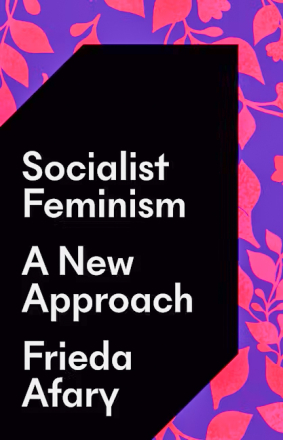
In Socialist Feminism: A New Approach, Frieda Afary looks to “conceptualize an enriched emancipatory socialism with transformed gender relations at its heart.” She does this by examining four socialist feminist theories of gender oppression: (1) theories of social reproduction, (2) theories of alienation, (3) intersectionality, and (4) queer identities.
The book contains useful literature reviews of socialist feminist theories, in particular queer theories and social reproduction, which she also subjects to friendly critique.
She correctly identifies that in its quest to produce a Marxist theory, socialist feminism has become over-reliant on social reproduction theory, which can tell us much about the relationship between paid and unpaid labor and women’s role in the home, but is not an all-encompassing theory of sexism under capitalism.
Her own explanation for the missing piece of socialist feminism is the relation of alienation to sexism: “Capitalism affects and alienates the mind and body and human relations in insidious ways that are not simply caused by private property and the market. Its alienated mode of labor affects all human relations and most deeply intimate and sexual relations.”
In the Economic and Philosophic Manuscripts of 1844, Marx discusses the various ways in which workers are “alienated” under capitalism. Opportunities for workers’ creativity are shut down. Routine and repetition increase as work is specialized, to extract more and more profit from more and more intensified work.
Marx explains how this can “mutilate the laborer into a fragment of a man.” Our project is to return human freedom to those whose labor makes the world run.
Yes, what Marx described as the working class’s “loss of self” must clearly have some effect on our gendered relations. The coercion inherent to broader society is certainly replicated within our family structures. But the nature of capitalism’s effect on the worker is contradictory, and those contradictions aren’t just waiting within us to be resolved after the revolution. Many aspects of gendered relationships have improved through collective working-class struggle under capitalism.
It is important not to lean too far towards Marx’s idea of capitalism dehumanizing us; it gives us chances to be humanized too, and Marx identifies those tendencies alongside the dehumanizing ones.
“Modern Industry, indeed, compels society, under penalty of death, to replace the detail-worker of to-day, grappled by life-long repetition of one and the same trivial operation, and thus reduced to the mere fragment of a person, by the fully developed individual, fit for a variety of labors, ready to face any change of production, and to whom the different social functions they perform, are but so many modes of giving free scope to their own natural and acquired powers…” (and Marx cites testimony from a migrant worker in the capitalist USA on actually achieving that through varied work).
Realized
Capitalism brought with it the humanist conceptions of reason, universality and solidarity, but it also prevented them from being fully realized. We can realize movements not possible before capitalism. Men under capital are neither machines nor animals, but people.
I’m unconvinced too by Afary’s declaration that the end of alienation will bring the end of the unconscious mind. I suspect that human minds will change considerably (as they already have). But the fact will remain that there are things of which we are aware, and other things of which we are not aware, and we will not change so fundamentally that all implicit mental processes will disappear.
Even where capitalism does brutalize us, it is not right to situate sexism as flowing from alienation. What about the systemic oppression of women that occurred in pre-capitalist societies before capitalist alienation began? In part the working-class family under capitalism derives structures from the ruling class (from the bourgeois family). Both as a conscious ruling-class project of control, and through workers’ understandable desire to emulate lives which look better and more comfortable. Families do not just produce workers, they have an ideological function for capitalism: the reproduction of the relations of production through the socialization of children within the family hierarchy.
As women have entered the workforce in greater numbers and experienced greater alienation there, we haven’t noticed sudden spikes in women committing rape or domestic violence. In part, Afary gets around this by situating alienation as primary within capitalism. Everything else stems from alienated labor, because alienated labor is essential to the system. To identify alienation as the one decisive element of capitalist exploitation, and ignore its interactions with ever-shifting elements of the capitalist system and changing social forces, seems undialectical.
Afary argues that we are facing a new model of state capitalism, with the state and military having more and more control over the direction of companies even when there is no direct full ownership. She at one point (borrowing from bourgeois economist Joshua Kurlantzick) defines state capitalism as state ownership or significant influence over more than one-third of the 500 largest companies (by revenue) in a country. It is a very broad definition. She jumps from this to predicting a move to an authoritarian state capitalism, and its potential gender implications. She posits a capitalist future with the state in charge of all aspects of life, including the family: children brought up in care facilities and adults working in workcamps. This seems fantastical.
There is a blur between “free” wage labor and wage labor in work camps or super-exploited migrant labor in capitalist economies. But workcamps and political labor are not the economic norm. They are exceptions to the wage system. Were the economy not to depend on wage labor, and transition instead to being based on some form of prison labor, I don’t see how you could describe it as capitalist. There are real threats of rising authoritarianism to gender relations, but fringe exceptions do not affect the majority of the workforce. The authoritarians are politically motivated to strengthen gender relations and the family.
Afary has a commendable humanist and internationalist perspective on the liberation of women. She references Black liberation struggles in US led by women and uprisings in Sudan, Algeria, Hong Kong, Iraq, Lebanon, Chile, and Iran, as well as mass protests and labor strikes in France, Haiti, and elsewhere which had women at the forefront.
She is not afraid to call out those leftists who are so adamant that imperialism is a western phenomenon that they fail to fight for liberation elsewhere: “Although the Occupy Movement was inspired by the Arab Spring, many of those on the Left who called themselves anti-imperialist supported the Assad regime in Syria because it claimed to be against U.S. imperialism, and its regional imperialist backers Israel and Saudi Arabia. Some leftists also openly supported Russian imperialist intervention in the Middle East and Ukraine, as well as Iranian regional imperialist intervention in Syria and in Iraq. This unprincipled and inhumane attitude, this failure of those who claim to be against capitalism to see the connection between capitalism and the rise of imperialist powers other than those in the West…”
It would be good to see more books trying to move socialist feminism beyond current approaches. Dual-systems feminism, a perspective within Marxist feminism, argued that women’s oppression stemmed from the intersection of two distinct systems: capitalism and patriarchy. The swing back to social reproduction theory has somewhat overcorrected. The role of women in reproducing workers is part, but not all, of the material basis for sexism, and taking that as the explain-all can be economistic.
Though I am unconvinced by the way Afary situates sexism in alienation, considering oppressive practices in the context of the dehumanizing nature of capitalism as a political/economic system is necessary too. More discussion is necessary on pre-capitalist gender oppression, which continues not just through human practices being slow to change, but also by their embedding into the material lives of workers.
This article originally appeared on Workers Liberty, 14 May, 2025.
 If you’ve read this far, you were pretty interested, right? Isn’t that worth a few bucks -maybe more? Please
Leave a Reply