Blog

  • Twenty Years Since the Chiapas Rebellion: The Zapatistas, Their Politics, and Their Impact

    The Chiapas Rebellion led by the Zapatistas took place twenty years ago this month. What was the importance of the rebellion and of the Zapatistas? What was the impact at the time? And what has been its political legacy? What is the role of the Zapatistas in Mexico today?

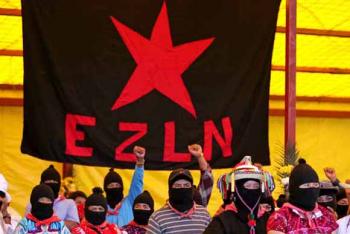
    Twenty years ago, on the morning of January 1, 1994, the Chiapas Rebellion began in Mexico’s southernmost state led by a then unknown group, the Zapatista Army of National Liberation (EZLN) and its mysterious spokesman subcomandante Marcos. Some 3,000 poorly armed, mostly Mayan guerrilla soldiers marched out of the jungles and seized a half dozen towns and briefly took the city of San Cristóbal de Las Casas. The EZLN had chosen January 1 because on that day in that year the North American Free Trade Agreement (NAFTA), an international treaty between Canada, Mexico, and the United States, took effect. The EZLN rebels called for the cancellation of NAFTA, the overthrow of the government of Mexican government, and the convocation of a constituent assembly to write a new Mexican constitution. Some of the guerrilla troops told reporters they were fighting for socialism.

    Image

    The Chiapas Rebellion had an enormous impact at the time, not only in Mexico but around the world. The EZLN had led the first leftist, armed rebellion since the fall of Communism and the break-up of the Soviet Union just a few years before, suggesting that contrary to claims about the death of the left and the “end of history,” a new left had arisen in the Lacandón Jungle of Chiapas. The rebellion also signaled that all was not well in Mexico, where outgoing president Carlos Salinas had been claiming that by joining the GATT, forerunner of the World Trade Organization, in 1980 and by joining NAFTA, and through his privatization of hundreds of state companies, Mexico was leaving the Third World and entering the First World of modern capitalism. The Chiapas Rebellion and the EZLN Manifestos pulled back the veil revealing to the world Mexico’s world of rural poverty and especially the poverty oppression of the indigenous people.

    President Ernesto Zedillo, who had taken office only a month before, responded immediately by sending the Mexican army and air force to suppress the rebellion. Throughout Mexico tens of thousands of people responded by going to the zócalos, the public squares, to protest, demanding that Zedillo stop the military attack on mostly Mayan rebels. Within twelve days Zedillo halted the attack and the EZLN agreed to a truce, the beginning of what has been a twenty-year standoff in Chiapas.

    When several months later the Zapatistas held a consulta, a kind of survey or referendum, asking what role they should place in Mexican society, hundreds of thousands responded, the majority voting that the EZLN should lay down its arms and participate in Mexican social and political life. The initial protests against Zedillo’s use of the army and the results of the consulta suggest that the Mexican people rejected armed violence on all sides. In the Mexican Revolution of 1910-1920, one million had died and one million had emigrated in a nation with a total population then of 13 million. The memory of revolutionary and counter-revolutionary violence seemed to live on in the public consciousness and apparently few wanted to repeat that experience.

    Armed revolution in Mexico it seemed was not on the agenda. The Zapatistas declined to lay down their arms, but on the other hand, for the last twenty years, neither have they used them. The EZLN's continuing struggle took other forms.

    Who Were the Zapatistas?

    The Zapatistas were founded in November of 1983 by a group of leftist activists in northern Mexico. The Mexican left had inherited a long tradition of armed rebellion, one could say going back to the conquest, though certainly the Mexican Revolution’s nationalist legacy was most significant. In addition there was the impact of the Cuban Revolution of 1959 and Ernesto “Che” Guevara’s foco theory (which has been popularized by the French intellectual Régis Debray) and which had had such disastrous consequences throughout Latin America.

    Throughout Mexico in the 1970s and into the 1980s one could find small rural and urban guerrilla groups, some calling themselves Marxist-Leninist and usually combining a left wing version of Mexican nationalism with Cuban foco theory ideas or sometimes with Maoist ideas of a prolonged people’s war. Hundreds of such young men and women were disappeared and murdered during Mexico’s secret war in the 1970s. The Zapatistas had their origins in that political milieu. Initially called the National Liberation Forces, a name that became popular on the left in various counties after the Algerian Revolution, the group later, after moving to Chiapas, added the word "Zapatista" to their name after Emiliano Zapata, the leader of the revolutionary peasant movement during the Mexican Revolution.

    Image

    Later in the 1980s the group decided to move its operations to Chiapas in southern Mexico, a state with a very large indigenous population made up of several different Mayan groups. As in the rest of Mexico at the time, the Institutional Revolutionary Party (PRI) controlled government at all levels and controlled the labor and peasant unions and various indigenous organizations. There was, however, a developing social alternative. Since 1959 the Bishop of Chiapas had been Samuel Ruíz, who had participated in Vatican II (1962-1965) and in the Latin American Bishops’ Medellín Conference (1968) and who was completely involved and identified with the Theology of Liberation, the idea that the Church should be on the side of the poor.

    Under Ruíz’s direction the Catholic Church in Chiapas took an interest not only in the salvation of the souls of the indigenous, but also in improving their material conditions and their social and political treatment. The Church’s catechists became not only carriers of the Gospel but also organizers of the indigenous people’s incipient social movements. It was in this milieu that the Zapatistas now inserted themselves, and with Ruíz’s tacit support, often worked closely with the catechists and other indigenous leaders. Ruíz said that while he shared the Zapatistas’ goals he did not support their strategy of armed rebellion, yet at the same time he did not prevent the EZLN from organizing. So during almost a decade the Zapatistas established their organization in Chiapas, recruited Mayan and mestizo activists to their organization, and laid their plans for an armed uprising.

    What Did the Zapatistas Believe?

    What did the Zapatistas have in mind when they revolted on January 1, 1994? The Zapatistas apparently believed that if they ignited a spark in southern Mexico it would unleash a wildfire across the entire country. Whether or not they were familiar with the concept or the term, this is very like the nineteenth century anarchist notion of the “propaganda of the deed” and also bears a resemblance to the foco idea of the dedicated revolutionaries in the sierra who will ignite a revolution in the plains. The idea is that the people, exploited and oppressed, are simply waiting for a heroic example of revolutionary struggle to show them the way, and that then they will rise up and overthrow capitalism. The Mexican people, as was demonstrated in the early months of 1994, were not prepared to follow the Zapatistas or to rise up, and while millions sympathized with the poverty and indignities suffered by the indigenous, they rejected the idea of armed struggle. Mexico was no different than any other country where social change tends to come not from heroic actions of a few but from years of organization, education and propaganda, and many concerted smaller actions at the base of society before people are prepared for revolutionary change.

    In August of 1994 the Zapatistas called a convention in their jungle redoubt to which they invited some 2,000 Mexican intellectuals, writers and artists, academics, and social movement activists, as well as a few official delegates from the United States of whom I was one. Once in San Cristóbal we traveled to the convention on public buses donated by the state government and attended the ceremony where the stage was lit by stadium lights which must also have been provided by the state and the Federal Electricity Commission. Marcos spoke before an enormous Mexican flag, perhaps 40 by 20 feet, as the Zapatista soldiers (some wearing boots but most in huaraches and a few barefoot) marched before the platform, most carrying wooden rifles, not real firearms. The huge flag and Marco’s rhetoric suggested that the EZLN were radical nationalists and advocates of indigenous rights; while there was a call for a constituent assembly to write a new constitution, there was no talk of socialism. Really, this was not a convention, just a few speeches until the event ended in a tropical downpour of Biblical proportions that put out the lights and swept away our tents. The EZLN’s politics were still in evolution.

    The Zapatistas failure in launching a revolution and the Mexican army’s siege of the zone in which they operated forced them to retreat and fall back on the indigenous and other poor people in the canyons where they had their base. The Zapatistas now did more openly what they had been doing clandestinely for years, organizing their indigenous and mestizo supporters into communities that constituted a kind of liberated zone—though interspersed with other indigenous and mestizo communities that did not support them and surrounded by the army which sometimes harassed them.

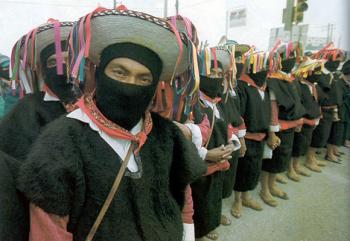
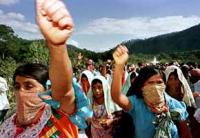
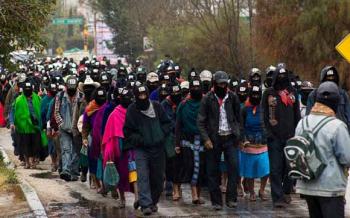
    ImageThroughout the 1990s and 2000s the Zapatistas organized remarkable protests by indigenous women who came out in their traje, their indigenous dress, and literally pushed the armed soldiers out of their villages. The EZLN called indigenous meeting in Chiapas and inspired the convocation of national indigenous meetings that led to the creation of the National Indigenous Congress. After months of negotiation, on Feb. 16, 1996, the Zapatistas and the government of President Ernesto Zedillo signed the San Andrés Accords, a treaty granting autonomy, recognition, and rights to the Mayan people in Chiapas. The Mexican Congress, however, didn’t adopt the accords, and the Zedillo government soon violated them. The Zapatistas announced they wouldn’t therefore hold any further negotiations, withdrawing again into the canyons.
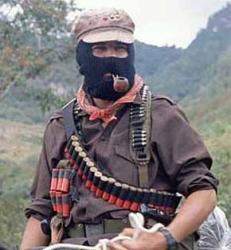
    The Zapatistas and their supporters claimed that they had created new democratic forms of organization in the villages in which women had an equal role. Marcos and other EZLN spokespersons argued that they were reconstituting society from the bottom up a village at a time. Eschewing the state institutions controlled by the PRI, the Zapatistas created their own schools and local governments—though they had few if any economic resources—as an alternative to government institutions. Marcos and the Zapatistas began to develop a new rhetoric and to proclaim a new ideology summed up in the phrase “mandar obedeciendo,” to lead by following. This suggested that the people were deciding and the leaders merely expressing their views and carrying out their desires. Here it was suggested was the socialism from below that many of us believed in and had been working for.

    In the late '90s lawyer and sociologist John Holloway popularized and elaborated on the Zapatistas’ ideas, and his book Zapatista! Reinventing Revolution in Mexico became a best seller on the left. He suggested that, in part under the influence of indigenous ideas, the EZLN had rejected the old Marxist paradigm of the proletariat struggling for state power, putting on the agenda a new theory and practice of revolution that seemed to have more in common with anarchism: anyone from any social class could begin to make the revolution by asserting their dignity and forming a liberated community where they were. The Zapatistas seemed to be building such a communitarian alternative to capitalism in the remote communities in Chiapas.

    Yet it was very hard for outsiders to see and to understand exactly what was really taking place in villages in the canyons of Chiapas where a group of armed men were working among the native people. The continued existence of the EZLN as an armed guerrilla group alongside and among indigenous people led one to ask: How democratic was the movement? How were decisions really made? Who were the real leaders? The Zapatistas and their supporters offered answers that had to be taken on largely on faith given—at least for most of us—the impossibility of entering physically, intellectually, and psychologically into the world of indigenous politics in Chiapas.

    The Zapatistas, as interpreted by Holloway and others, had an enormous impact on the new Global Justice Movement that began in the 1990s and culminated at the Battle of Seattle, the joint environmental-labor protests against the WTO in 1999. Everywhere young people wore the balaclavas and red bandanas of the Zapatistas over their faces, often identifying themselves with anarchism. Every major city and many colleges in the United States had Zapatista support groups. Mexican American youth of the Southwest were particularly inspired by the Zapatistas. The combination of the romance of masked men and women, of armed struggle, and of the utopian idea of an immediate march to an egalitarian future held sway throughout the decade, inspiring many young people to become activists. Then it was all suddenly extinguished along with the Global Justice Movement by the September 11, 2001 attack on the Twin Towers and the Pentagon by Islamic fundamentalist terrorists, and by the War on Iraq, leading to a sudden rightward shift, new levels of government surveillance and repression, and an instantaneous upsurge in American patriotism. Other armed fighters now held the public attention.

    The Zapatistas and the Movement

    In Mexico during the first couple of years after the rebellion the Zapatistas had enormous moral authority. Much of Mexican society admired the Zapatistas for their courage and for speaking out with and for the indigenous. Many were charmed by subcomandante Marcos’ sardonic wit and great creativity both as a speaker and a writer. Mexican youth from the wealthy neighborhoods of Mexico City to the poorest neighborhoods of the border towns adopted a new Zapatista swagger as they painted radical graffiti on the walls. The Zapatistas attempted to capitalize on their moral authority by projecting themselves as a force in the broader Mexican society.

    ImageLiving in Mexico in those years, I attended in Mexico City and in Tijuana meetings of the Zapatista Front for National Liberation (FZLN) which held a founding of the national organization in 1997. The Zapatistas, however, seemed to have no interest in a real front, that is, in a coalition of various left organizations and movements. EZLN leaders found difficult the give and take of coalition building in a country where there were scores of social movements, labor unions, and left political parties. The EZLN’s insistence on dominating the supposed front that they had created meant that it never grew or became popular and never had an impact in Mexican society at large.

    The EZLN also attempted at about the same time, with the aid of leftists in the labor movement, to organize a Zapatista workers’ organization. The labor union activists I knew and with whom I spoke told me that the Zapatistas opposed participation in the existing labor unions, not only because they believed they were bureaucratic, but also in part because the unions held elections and the EZLN didn’t believe in elections and voting. With an unwillingness to deal with the unions and their existing structures and with longstanding rank-and-file labor organizations, the Zapatista labor organization was stillborn. The Zapatistas’ attempt to turn themselves into a political force in Mexican society failed utterly, and they withdrew again to the canyons of Chiapas.

    The Zapatistas were more successful in Chiapas and in some other areas in organizing their autonomous municipalities which they called Caracoles y Juntas de Buen Gobierno. While almost all of these communities were in Chiapas, the Zapatistas did inspire some in other states and in the Plan Realidad Tijuana of 2003 proposed to unite the archipelago of liberated communities in Mexico into one emerging free nation within the nation. Though the plan never proved successful nationally, the Zapatistas did continue to organize their own autonomous communities in Chiapas.

    The EZLN and the National Elections

    When the 2000 elections approached, the EZLN announced that it would not support either of the two rightwing parties—the National Action Party (PAN) and the Institutional Revolutionary Party—nor would they support the leftwing Party of the Democratic Revolution (PRD) led by Cuauhtémoc Cárdenas. Cárdenas, who had been a presidential candidate in 1988 and 1994, remained enormously popular on the left. Many hoped that the Zapatistas would support him, though organizations of the revolutionary left were divided over the issue of whether to support Cárdenas or back some independent socialist candidate. The EZLN, however, rejected elections in general and Marcos excoriated Mexico’s political parties of all stripes as compromised and corrupt.

    Yet the election proved not to be irrelevant to the Zapatistas. When Vicente Fox of the PAN won the election by a large plurality and became president, ending the PRI’s more than seven decade hold on government, the Zapatistas decided to take advantage of what was apparently a new political opening. The Zapatistas traveled to Mexico City and its representatives, in an historic act, actually spoke to the Mexican Congress, asking that it fulfill the principles embodied in the San Andrés Accords. While Fox showed some sympathy with the EZLN, nothing new was forthcoming from the Mexican Congress.

    "The Other Campaign"

    In 2006 when the next presidential elections took place, Marcos and EZLN adopted a different approach. Once again, most of the Mexican left hoped that the EZLN would support the left candidate, Andrés Manuel López Obrador of the PRD, who was speaking out strongly against NAFTA, neoliberalism, and the corruption of the PRI and PAN. The EZLN, still rejecting both elections and the existing parties, had other plans. Marcos announced the organization of la Otra Campaña (the Other Campaign). Unlike other political parties, the EZLN would not put forward its own candidates and would not support the candidates of other parties, but would instead organize a campaign that would travel around the country speaking out against the Mexican government and against capitalism.

    The EZLN’s Other Campaign was joined by several other left groups, from the Trotskyist Revolutionary Workers Party (PRT) to the followers of Albanian Enver Hoxa in the Communist Party Marxist-Leninist (CPML). The Campaign took place during a period of a number of dramatic social conflicts, most important the civil unrest in Sal Salvador Atenco in the State of Mexico. When police suppressed flower sellers and other street vendors, the Peoples Front for the Defense of the Land called upon the EZLN for support. Marcos and EZLN showed up bringing thousands of supporters. During the Other Campaign, Marcos and other speakers held moderately successful meetings and rallies around the country, sometimes speaking to thousands against the evils of capitalism. Everywhere they went, the CPML’s giant portraits of Stalin hung in the background, casting doubt in some minds about the meaning of it all.

    Meanwhile the PRD’s left candidate López Obrador harangued crowds of up to a million, mostly working class and poor people, with his populist rhetoric. When it became clear that President Fox and the ruling PAN party were violating election law and preparing an enormous fraud, which in fact took place on election day in July, there arose an enormous protest movement in defense of a fair election and citizens’ right to have their votes counted. Tens and perhaps hundreds of thousands in Mexico City joined the protests blocking the boulevards and occupying public plazas.

    Several of the revolutionary left groups involved in the Other Campaign went off to join the election protests as a matter of principle; even if they hadn’t liked the parties and candidates offered up in the election they felt the citizens had the right to vote and have their vote counted. Marcos and the EZLN, opposed on principle to elections, refused to participate in the defense-of-the-vote protests. So they withdrew and retired to Chiapas. The Zapatistas sectarian attitude toward that movement did enormous damage to their reputation among those in the broad left and those on the far left. They lost much of the moral authority that had clung to them since the 1994 uprising.

    Image

    Questions Posed for the Left and for the EZLN

    During the last twenty years, the Zapatistas have had a huge impact on Mexican society and on the left both in Mexico and internationally. When the left seemed moribund, they revived it. Where the indigenous had been downtrodden, they were inspired to rise up. Their example enthused radicals throughout the Americas and in Europe and at their international meetings in the Chiapas jungle one could find leftists from dozens of countries exchanging experiences and perspectives. In retrospect, it is surprising that no organized international tendency, no “new international” came out of it. Despite all of the vicissitudes of their twenty-year long career, the Zapatistas remain both a local social movement in Chiapas and the standard bearers of a certain radical politics in Mexico associated with local organizing, support for the indigenous, and political abstentionism.

    The Zapatistas’ experience raises important questions for the left. There is no doubt that in a capitalist system and its liberal democratic state, as it is called, in which political parties operate, elections function primarily to both buttress the system and to regularly place representatives of capitalism in power. It is also true, however, that elections by parties which are genuinely independent provide an opportunity for the left to propagandize for its ideas and to use elected positions to contribute to the organization of social movements.

    The Zapatistas are right that the Party of the Democratic Revolution and its candidates Cuauhtémoc Cárdenas and López Obrador were representatives of social democratic and populist variants of capitalist politics. The PRI, the PAN, and the PRD have all proven to be quite corrupt, it is true. But what if the Zapatistas had used the enormous moral authority that they had in the first years after the rebellion to help to organize—not to insist on controlling—a national social movement and a genuinely independent national political party? How much greater could their impact have been during these last two decades in which, partly under the impact of the NAFTA treaty that they opposed, the power of Mexican capital has grown so much greater and the forces of working people become so much weaker?

    To me, the Zapatistas remain opaque and their politics mysterious. I wonder: Does there still exist at the core of the EZLN a hardened cadre who hold to the classical guerrilla politics of the 1970s and 1980s—or did the Zapatistas under the influence of the indigenous and their own experiences really become some sort of anarchists? What is the real nature and significance of the Caracoles y Juntas de Buen Gobierno? Can the Zapatistas ever overcome their sectarianism and project themselves as an ideological and organizing force in Mexican society—or will they continue to cut themselves from other sections of the far left?

    After twenty years the Zapatistas have not gone away, remaining a challenge to both the government and to the established political parties and the parties of the revolutionary left. The new and deeper integration of Mexico into the U.S. and global economies which has been achieved by the passage of President Enrique Peña Nieto’s structural reforms will raise new challenges and very likely produce new movements. We will see in this new period whether or not the EZLN’s experiences and ideas prove relevant to a new generation of radicals.


    Dan La Botz is a member of Solidarity in New York City, and an editor of New Politics. This article first appeared on the Solidarity website.

  • Closing Bridges While Building Bipartisan Bridges for Corporate-Backed 'Reform'

    ImageIt remains to be seen whether NJ Governor Chris Christie will be able to avoid having his political career crash and burn.


    Politically-motivated lane closures on approaches to the George Washington Bridge were no playful pranks. Massive traffic jams, incredible disruption to the lives of Fort Lee residents, and delays of emergency vehicles — these are serious matters. Students had difficulty getting to school, but that was OK with a Christie pal who had been appointed by him to the Port Authority who happily noted that these were the "children of Buono voters" (referring to Barbara Buono, Christie's Democratic opponent in the November 2013 gubernatorial election). The traffic tie-ups may even have contributed to the death of a woman whose ambulance was slowed getting to the hospital, but perhaps she was also a Buono voter.

    Will Christie be able to avoid responsibility for this criminal behavior? Maybe he didn't know what was being done by his deputy chief of staff, his transition chairperson, his re-election campaign manager whom he had nominated (since withdrawn) to be head of the state GOP, and the high school friend and political confidante whom Christie had appointed along with a political crony to the Port Authority board — though this strains credulity. But it is hard to imagine that anyone watching Christie's months of repeated denials and his stonewalling refusal to look into the matter would absolve him of the charge of covering up a crime.

    Christie claims that he had more important things to do than worry about some lane closures. And indeed he has spent most of his time pursuing policies that have had a much more devastating impact on the people of New Jersey. He vetoed a tax on millionaires multiple times, cut property tax rebates for the middle class, and reduced the earned income tax credit that benefited the poor. He vetoed a minimum wage hike (though voters later passed it in a referendum). He illegally abolished the Council on Affordable Housing. He several times vetoed funding for Planned Parenthood, which provides health care for poor women. He vetoed same sex marriage (though the courts later legalized it). He removed New Jersey from the 10-state Regional Greenhouse Gas Initiative. He opposed the Dream Act until the month before the election, then supported it; but then after the election he agreed to sign it only if the legislature made undocumented residents ineligible for financial aid. He vetoed multiple gun control bills, including one that was a version of what he had himself proposed. He cut school funding, in violation of rulings of the State Supreme Court, and responded to criticisms by trying to pack the Court with his cronies and destroy the teachers unions.

    In short, Christie has caused immense human suffering.

    Image

    The bridge lane closing, though, does raise an interesting question. Why would a Republican governor go to extraordinary lengths to punish a Democratic mayor for not supporting him? Don't Democrats generally not support Republicans? But this is New Jersey, where corrupt party bosses are a major force in the Democratic Party. For these bosses — especially George Norcross, the major power broker in south Jersey and Essex County executive Joseph DiVincenzo — all that matters is their self-interest, political and financial.

    The political bosses fund their efforts by directing state contracts to their moneyed supporters. Christie, the so-called corruption-buster, has been all too happy to work with them. The Governor aggressively went after state officials who were getting public employee pensions and a state salary at the same time, but he gave a pass to DiVincenzo, one of the biggest double-dippers of all, who has also been charged with the largest misuse of campaign funds in state history. Norcross was known to be a bully well before the bully Christie came on the scene ("I will fucking destroy you," he snarled at the co-president of the State Senate back in 2002). One of the owners of the Philadelphia Inquirer and the Philadelphia Daily News, Norcross is a political king-maker (an FBI tape-recording overheard him saying “In the end, the McGreeveys, the Corzines," — Democratic governors — "they're all going to be with me. Not because they like me, but because they have no choice”). Christie and the bosses joined forces in order to pass legislation reducing the pensions of public workers, even of those who had already retired. ("I will protect your pensions. Nothing about your pension is going to change when I am governor," Christie had pledged in 2009.)

    DiVincenzo, the country executive in the most Democratic county in the state, openly endorsed Christie for governor. Dozens of other Democratic politicians — many of them ethically challenged — also endorsed Christie. One reason was that the Democratic candidate was Barbara Buono, a liberal who was not part of the machine. Buono's positions on the major issues were in line with that of the state's Democratic voters (raise the minimum wage, same-sex marriage, tax millionaires, fund public education), and she even selected a union official from the Communications Workers of America, Milly Silva, as her running mate. But Democratic politicians deserted her in droves, and many others sat on their hands. So when the Democratic mayor of Fort Lee refused to join the collaborators, the Christie administration decided to punish him.

    Buono was trounced in the election. But, it was not just the desertion by the Democratic machine that did her in. Obama made clear he wouldn't come to New Jersey to campaign for her, even when he was campaigning nearby. One blogger put it well:

    "I think it's a very good thing that Barack Obama is not using his political capital to support Barbara Buono for Governor of New Jersey. I mean, if he did then the Republicans in Congress would get mad and might not vote to support Obamacare or other things Democrats find important.

    "But since he's refusing to help a progressive woman in a campaign against a conservative, anti-choice Republican now Obama will be able to get anything through the House he wants.

    "Really, it's political genius."

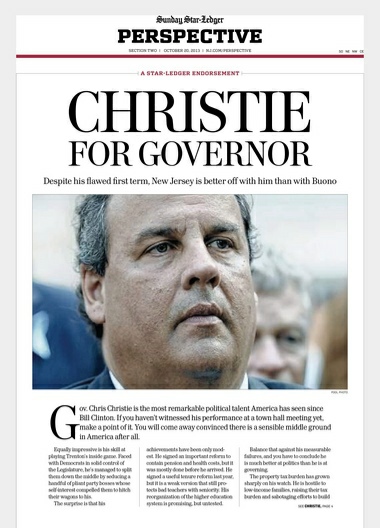
    All the major newspapers in the state — The Star Ledger, Philadelphia Inquirer, Asbury Park Press, Bergen Record, Herald News, and Press of Atlantic City — endorsed Christie. And they did so even though their editorial positions were often closer to Buono's than Christie's on most issues, aside from public workers. "Christie’s great failing has been that he has done little to help New Jersey’s poor," said the Press of Atlantic City. But the programs Buono "proposes make it sound as if we are still back in the free-spending days before the recession. She has yet to learn the tough lesson that New Jersey can no longer afford to fund every worthwhile program." She "is too bound to the public-worker unions to be expected to take the difficult steps necessary to fix" the state's fiscal problems. "We would rather have someone fighting not to increase taxes than a governor willing to capitulate to the demands of special-interest groups," declared the Herald News. The Bergen Record commented that "Buono has spent years advocating for many social causes dear to The Record. But a governor needs more than personal convictions; he or she must be able to achieve results." (No matter that those results were for reactionary policies.)

    But it was the Star Ledger that went furthest in exposing Christie's record while endorsing him:

    "The property tax burden has grown sharply on his watch. He is hostile to low-income families, raising their tax burden and sabotaging efforts to build affordable housing. He’s been a catastrophe on the environment…. "

    "The governor’s claim to have fixed the state’s budget is fraudulent…."

    "… he threatened the independence of judges at all levels…."

    "The public gives him top marks for his handling of [hurricane] Sandy, but the record is mixed….Why did the federal government have to strong-arm the state to include more relief for renters and Spanish-speakers than Christie had proposed? And why should anyone believe taxpayers got the best price on refuse removal when the governor awarded a no-bid contract through a political friend?"

    Image

    The Ledger acknowledged

    "Buono has long been a sturdy voice for progressive causes. She was a key player in establishing paid family leave, protections against bullying and revamping the school aid formula.

    "As governor, she would allow gay couples to marry, raise the minimum wage and stop the baseless attacks on the courts. She would raise taxes on incomes greater than $1 million, and restore at least some of the property tax rebates that Christie cut. She would also restore funding for Planned Parenthood, and sign strong gun legislation. On each of those issues, we are with her."

    So what was the problem? Her support for public unions and her education policy, specifically her opposition to the "education reform" agenda of privatization and removing public accountability from schools. The Ledger was quick to point out that

    "Understand that President Obama endorses the reforms Christie has pushed. This is not a right-wing conspiracy; it is a bipartisan movement…"

    And they're absolutely right. It is bipartisan. Obama and Christie and New Jersey's new senator, Democrat Cory Booker (who did endorse Buono) are all part of a movement, heavily backed by billionaires like Eli Broad and Mark Zuckerberg, to undermine public education. In New Jersey cities such as Newark and Camden and suburbs such as Montclair and Highland Park, a battle is raging between the corporate "reformers" and grassroots movements trying to resist their onslaught. These cities and suburbs all vote heavily Democratic, but their school systems are being run by people connected to the Christie administration.

    New Jersey's current Democratic Party, dominated as it is by corrupt bosses and corporate interests, cannot adequately challenge the rightwing program or the bipartisan corporate-driven education agenda. Christie may be toast, but it will take a real grassroots upsurge to offer a genuine alternative to his policies.


  • Homer and War

    ImageThe following is a response to an article trying to enlist the poet Homer on the side of hawks by the Boston Globe’s resident neocon right winger Jeff Jacoby. This letter was not published.


    Dear Editor:
         Once again Jeff Jacoby flaunts his ignorance, this time on Greek poet Homer (“The Radical Dream of Peace on Earth,” Globe, 12-25-13).

         Failing to grasp Homer’s irony, Jacoby cites Hektor’s militaristic advice to his child—this just moments before Hektor goes to his ignominious death.

         Of course The Iliad portrays men in mortal combat as they endure conflicts of courage and cowardice, of patriotism and family devotion, of friendship and betrayal. But how does it portray them? At the height of his aristeia (string of victories), Achilleus, Homer tells us, “was straining to win glory, his invincible hands spattered with bloody filth.” (Book 20) Achilleus, every Greek knew, had chosen a short glorious life over a long infamous one. And this battlefield glory was spattered with bloody filth—hardly a glorification of war. 

         No, The Iliad does not glorify macho militarism—and I write as a WW2 veteran (88th Infantry Div., Italy). It shows us men caught in a war without meaning; again and again they try to end it, but they cannot—mostly because of their own irrationality. In her brilliant essay “The Iliad or the Poem of Force,” Simone Weil, writing in 1940-41, the darkest days of World War II, shows that in The Iliad force turns humans into things, that it destroys everyone, that all the victors become victims:

            “Force is as pitiless to the man who possesses it, or thinks he does, as it
            is to its victims: the second it crushes, the first it intoxicates. The truth
            is, nobody really possesses it…. In this poem there is not a single man
            who does not at one time or another have to bow his neck to force.”

         In my view, The Iliad ranks among the most powerful anti-war masterpieces, but due to poor teaching and/or careless reading, it has come to represent the opposite.

    Marvin Mandell


  • MEXICAN CONGRESS PASSES ENERGY REFORM: HISTORIC DEFEAT FOR THE LEFT

    The Mexican Congress passed President Enrique Peña Nieto’s energy reform bill in December, allowsing private and foreign investment in the energy sector, despite widespread public opposition and massive protests by opponents. Peña Nieto and his supporters argued that the energy reform would allow more effective development of the country’s petroleum resources, leading to economic growth and more jobs.

    Opponents have argued that the new law turns over the oil industry to foreign capitalists. Ricardo Monreal of the opposition Party of the Democratic Revolution (PRD) said, “This isn't the reform of the century, it’s the robbery of the millennium.”

    The passage of the new energy law, which required amending the Mexican Constitution, represents a historic victory for the country’s conservatives over the left and over the nationalist legacy and institutions of the Mexican Revolution. The new law will allow foreign oil company involvement in Mexican oil production at every stage of the process, ending the country’s monopoly of the petroleum industry.

    The energy reform passed through Congress on a fast track with overwhelming votes in both the Senate and the House. The Mexican Senate voted in favor of the measure by a vote of 95 to 28 on Dec.11, while the lower house passed the bill by a vote of 353 to 134 on Dec. 12. Within just four days, the 17 of 31 states needed to approve the amendments to the Constitution had been found and, on Dec. 21, Peña Nieto signed the bill into law in the historic National Palace. “We Mexicans have decided to overcome myths and taboos and take a great step into the future by way of democratic institutions,” said Peña Nieto. “Mexico has pronounced itself in favor of change and transformation.”

    Proponents and Opponents

    Voting in favor of the law were the Institutional Revolutionary Party (PRI) and its satellites the Ecological Green Party of Mexico (PVEM) and the New Alliance Party (PANAL) of the teachers union, as well as the conservative National Action Party (PAN). Opposing the energy reform were the Party of the Democratic Revolution (PRD) and the Workers Party (PT). The measure was also opposed by the Movement of National Regeneration (MORENA), a political organization in the process of becoming a party, which has no representatives in the Congress.

    Opposition to the bill was organized by historic leaders of the Mexican left such as Cuauhtémoc Cárdenas of the PRD and Andrés Manuel López Obrador, the leader of MORENA. López Obrador, however, suffered a heart attack on Dec. 3, effectively removing him from the culmination of the struggle in December. Joining the left parties in opposing the bill were the independent labor unions such as the Mexican Electrical Workers (SME) and the Coordinating Committee of the Mexican Teachers Union (la CNTE), a large opposition caucus.

    The opposition held large marches and huge rallies throughout December and, as the date for the votes neared, opponents surrounded the Mexican Senate. At one point representative Antonio García Conejo stripped off his clothing except for his undershorts to symbolize the stripping of Mexico’s natural resources and its dignity.

    The actual vote had the atmosphere of a brawl as legislators pushed, shoved, and hollered at each other. As PRI legislators shouted “Mexico! Mexico!” and the PRD legislators shouted “Traitors! Traitors!”, PRD congresswoman Karen Quiroga punched the nose of her female colleague Landy Berzunza Novelo of the PRI, sending the latter to the infirmary. Just before the vote in the lower house, PRD and PT representatives locked the doors to the congressional hall in an attempt to prevent a vote, but legislators simply moved to another room and voted there.

    What Is Changed by the Law

    The new law overturns one of the greatest achievements of the Mexican Revolution that began in 1910 and ended in 1940, the country’s takeover of the foreign oil industry. The Mexican Constitution of 1917 in its Article 27 gave the nation control of all land and water and of the subsoil, that is, of the minerals and petroleum. On the basis of that article, in March of 1938, President Lázaro Cárdenas expropriated (with compensation) and nationalized the foreign oil companies in Mexico, principally the U.S. Standard Oil Company and the British Royal Dutch Shell, as well as several others.

    The nationalized companies were unified as the Mexican Petroleum Company (PEMEX) with representation on the board by the Mexican Petroleum Workers Union (STPRM). PEMEX was the largest employer in Mexico throughout most of the twentieth century and represented one of the largest sources of the country’s GDP as well as providing most of the revenue for the Mexican government. PEMEX’s top officials came, until the PRI’s defeat in 2000, from the Institutional Revolutionary Party (PRI) which also controlled the notoriously authoritarian and corrupt oil workers' union. The wealth produced by PEMEX provided the funds that built Mexico’s national highways, hospitals, and schools during the oil boom of the 1970s, but it also provided the slush funds that oiled the PRI’s political machine.

    Private and foreign companies were for decades forbidden from involvement in exploration, drilling or refining, though over the years they became involved in peripheral aspects of the industry. Proponents of the law argued that by forbidding foreign involvement Mexico was failing to develop deep water off-shore oil reserves as well as potentially rich shale deposits. They claimed that only an influx of foreign capital and technology would be able to take advantage of the existing natural resources. Foreign oil companies, particularly the Americans who have been involved peripherally in the past, were anxious to see the energy reform pass, though the European oil companies have also expressed great interest.

    What the New Law Permits

    The new energy law will effectively grant concessions to foreign oil companies, though that term is not used because of its association with the earlier period of private domination of the industry in Mexico. While Mexico’s oil reserve will remain the property of the nation, companies will be given contracts or licenses to drill for oil; these will be for services or on a profit-sharing or production-sharing basis. That is, companies will share both risks and profits, receiving a percentage of the crude oil produced.

    PEMEX now becomes a for-profit company that will have to compete with private domestic and foreign oil companies. The new law also removes the Mexican Petroleum Workers Union from the board of directors of PEMEX.

    Under the new law the Mexican electricity sector is also open to private investment. All Mexican energy generation and distribution is now in the hands of the Federal Electrical Commission (CFE), a national company created over several decades by the absorption of smaller private and public electrical companies.

    American companies most interested in exploring and drilling for oil in Mexico are Chevron, Exxon, and Shell. These are in fact the successors to Standard Oil and Royal Dutch Shell, the very companies expropriated and nationalized in 1938. So history is reversed.

    Massive Layoffs to Be Expected

    Senator Rabindranath Salazar of the PRD, as well as other opposition legislators, predict that both PEMEX and the CFE will lay off tens of thousands of workers. Salazar believes the layoff of PEMEX workers alone will come to some 100,000. PEMEX workers have long had stable employment paying some of the highest wages in Mexico, but those days may now be over.

    Similar things have happened in the recent past. When Mexico privatized the railroads in the 1990s over 100,000 railroad workers lost their jobs.

    Salazar told the Mexico City daily La Jornada that the energy reform law says that workers’ rights will be protected, but that apparently refers to the right to severance pay.

    Political Implications

    The passage of the energy reform represents a stunning achievement for Enrique Peña Nieto who has finally managed carry out a reform advocated for years by leaders in both the PRI and the PAN. The president’s success in carrying out the labor and education reforms earlier this year and now the energy reform show him to be the country’s most successful president since Carlos Salinas (1988-1994), breaking through all opposition to pass neoliberal reforms that eluded his predecessors.

    Interestingly, the transformation of the oil industry also represents a blow to what was historically one of the principal bases of the PRI. PEMEX was the flagship of the country’s nationalized industries and the oil workers of the STPRM, the vanguard of the working class of an earlier era. The PRI’s power had been based in large measure from the 1930s to 2000 on its control of the nationalized industries and on the unions that represented workers in those industries.

    The energy reform would have been political suicide a few decades ago, but the PRI has become a modern party whose power is based upon its use of the mass media more than on its labor, peasant, and community organizations, not to say that those are totally irrelevant. The energy reform thus not only transforms the economy but also ends a period of political history by demolishing the institutions on which the PRI's one-party state of the 1940 to 2000 period was based.

    Continuing Opposition

    The opposition has promised to continue the fight. Jesús Zambrano of the PRD announced that his party would leave the Pact for Mexico, the alliance between all three major parties formed at the time Peña Nieto became president, punishing the PRI and PAN for their treachery. It is doubtful that this will matter much to them now.

    The opposition has also called for a national plebiscite, though it is not clear that the Constitution permits such referenda.

    Finally, opponents say that they will bring legal cases to challenge the law in the courts. There seems little likelihood that the energy reform will be overturned either by a plebiscite or by litigation. When the oil industry acts, there are few forces today capable of stopping it. Beaten down during the administration of former President Felipe Calderón, Mexico’s independent unions were in no position to stop the Peña Nieto steamroller and could not conceivably force it back.

  • A recipe for building social movement teachers unions – and fig cake too

    Image

                There’s no strict recipe we can follow to build social movement teachers unions though the process will require some indispensable ingredients, robust democracy for one.  Another element is creating relationships among people who inhabit very different social spheres.  While the principles on which we organize are key,  so are the ways we struggle together, creating friendships.

                In my experience, helping to build the AFT local in Hayward California in the early 1970s, sharing food is an important part of community and movement-building. We have to reach people through social media, for sure, but let’s not underestimate the value of face-to-face meetings and the draw of really good refreshments.

                Building the movement we need is arduous.  It should also be joyous. To push both along in 2014, I’m contributing a recipe for fig cake I cut out of Sunset magazine in my California years.  Most people don’t know this, but I am a credentialed, experienced teacher of home economics. In my first teaching job I taught cooking and “apartment living” to high school boys. 

                For the fig cake you can substitute dried figs for fresh.  I use Kalamata figs from Greece and these days think about the heroism of Greece’s teachers, who are leaders in the movement against austerity.  Just soak the dried figs longer, about 25 minutes.  I also use dried ginger instead of cinnamon because I find cinnamon too prosaic – but that’s just my bias.  I also use  1/3 cup of whole wheat flour for 1/3 cup of the white flour. Don’t use all whole wheat or the cake will be too heavy. Vegans can use an egg substitute, probably not banana or tofu. The cake needs the egg for loft.  To be fancy, bake the cake in a well-greased and floured bundt pan but start checking to see if it’s done after 1 hour.

                The cake is fragrant and a bit chewy, perfect for eating after a long day of teaching and organizing. Or maybe serving at a house party to raise money for your favorite union reform caucus?

                Happy 2014!

    I invite reader responses at drweinerlo@gmail.com.  Is there a subject you want me to tackle? Let me know. You can follow me on twitter and Facebook, as well as my blog every Wednesday here at New Politics.  Except next week – I’m taking a break from my blog to work on a critical look at where we stand now in pushing back against the neoliberal project.

  • HOW I LEARNED ABOUT NAFTA – A PERSONAL ESSAY

    During the early 1990s I became involved in the national debate over the North American Free Trade Agreement (NAFTA) then in the final stages of negotiation between Canada, Mexico and the United States. Twenty years later, it’s clear that NAFTA, the creation of a North American common market of sorts, was a watershed event, but I have to admit I had not really been paying much attention to it until I got a phone call in November 1990. On the basis of a book I had written on Mexican unions, The Crisis of Mexican Labor (1988), Pharis Harvey of the International Labor Rights Education and Research Fund (ILRERF) contacted me to ask me if I wanted to go to Mexico on a job for him. I hung up thinking it was a crank call, but he called back and asked if I would be willing to go to Mexico to undertake a study of the state of workers’ rights there in order to help inform the Congressional debate on NAFTA.

    I was warned that this would have to be a low budget operation, that it would have to begin immediately, and that the investigation and report would have to be produced quickly. Enticed by the idea of returning to Mexico where I had worked as a reporter a few years before, I took a quarter-long break form the Ph.D. program I was enrolled in the History Department at the University of Cincinnati and, with the blessings of my pregnant wife Sherry, headed for Mexico where I conducted research from December of 1990 through February of 1991.

    In the 1990s Mexican President Carlos Salinas, Canadian Premier Brian Mulroney, and U.S. presidents George H.W. Bush and Bill Clinton were arguing that NAFTA would be a boon to all three nations. International investment would bring improvements to all, commerce would expand, business would boom, and while some workers might be adversely affected by increasing competition, there would be new and better-paying jobs in industries exporting their products abroad. Conservative, independent presidential candidate Ross Perrot, however, said he heard a “giant sucking sound,” the sound of American jobs being sucked away to Mexico. Many U.S. workers were waiting for the ground to open up beneath their feet.

    American workers, Clinton told the U.S. labor movement, should not be afraid of competition with lower-paid Mexican workers, because even as American workers found new and better paying jobs, Mexican workers’ fortunes would also be improving. Mexican workers would find new jobs at higher wages in their home country, making them less competitive while immigration to the U.S. would also decline. On signing the agreement Clinton predicted “more growth, more equality, better preservation of the environment, and a greater possibility of world peace.” The labor and environmental side agreements, Clinton said, also made the trade treaty “a force for social progress as well as economic growth.” Well, I was going to look into one aspect of all of this. I was going to find out what chance Mexican workers would have to exert their rights once NAFTA went into effect.

    When I arrived in Mexico, I contacted my friend Ricardo Pascoe, who was then a Congressman of the Revolutionary Workers Party (PRT), and asked for his advice. He said I should meet two of his friends and took me over to their house and introduced me. They were Arturo Alcalde, one of the country’s preeminent labor lawyers and a leader of the National Association of Democratic Attorneys (ANAD), and his wife Berta Lujan, a leader of the Authentic Labor Front (FAT), an independent labor federation. Arturo, handing me several typed pages, suggested that I get in touch with the list of ANAD attorneys at their offices in various states and cities in Mexico. He also went to his office and brought me an arm load of books on Mexican labor law, telling me to return them when I was done. Berta gave me contacts in the FAT and said she would let people know I was coming. With that, I was on my way.

    Taking buses and riding the trains—there was still passenger service then in Mexico—I traveled to a number of cities and towns throughout the country visiting the labor attorneys’ offices. I remember that when I arrived in Chihuahua it was snowing, an eventuality for which I was unprepared having come north from warm Central Mexico. Every door I knocked on opened to an attorney willing to help, leading me to the waiting room where workers’ of all descriptions were happy to tell me the myriad ways in which their rights had been violated. They had been fired for attempting to organize a union, for trying to make their unions more democratic, for fighting for a better contract, for speaking out on the job. Some had not only been fired, they had also been threatened and beaten. The FAT leaders I met with, like Manuel Urrutia, explained the structure of various industries and the nature of their unions, from mining to fishing. One of the names on my list was a Catholic worker priest, Father Pantoja, who served a working class parish in the steel town of Monclova. He introduced me to steelworkers there who were dealing with the crisis of plant shutdowns.

    Though farmers and peasants had been among the hardest hit by Carlos Salinas’s neoliberal transformation of Mexico, I felt that given the time available and my areas of expertise it would be impossible for me to look into the conditions of rural workers. Still their situation was at the forefront of the NAFTA discussions in Mexico and the United States. In order to join NAFTA, Mexico had passed Constitutional amendments and laws that changed the nature of the ejido, the state land held in perpetuity by indigenous and rural communities.

    Historically the land while held collectively, was worked individually. Members of the ejidos could not sell or lease the land because it belonged to the community, not to the individual who farmed it. Farmers had long found it difficult to make a living on the land because of the lack of state support for loans, marketing, irrigation, and fertilizers. The amendments and laws passed by the Mexican Legislature at the urging of Salinas permitted farmers to sell their land, and they began doing so at once. Later, after NAFTA took effect, tens of thousands of farmers sold their land or simply abandoned it and went to find work in the industrial cities of Mexico or in the United States.

    Traveling around Mexico I found in many small cities and pueblos newly poured concrete slabs with at each end a basketball backboard. The basketball courts had been built by President Salinas’s PRONASOL community social welfare program. The backboard hoops had no baskets, the original nets having soon deteriorated. The courts stood empty. The families that lived in the pueblos couldn’t afford to buy basketballs, so one didn’t hear the characteristic bang-and-ping of the ball bouncing on the court. In any case, Mexicans, depending on what state you were in, played soccer or baseball; no one played basketball. The vacant courts, monuments to bureaucratic planning, stood as symbols of the emptiness of the Salinas era which had not only stripped Mexico of many of its small farmers and rural communities, but also in the process had laid waste to much its traditional culture.

    When I returned to Mexico City, now staying in Ricardo’s house, I continued to interview union leaders and dissident activists as well as rank-and-file workers from major unions, small independent unions, and opposition caucuses. I interviewed Fidel Velasquez, the powerful leader of the official unions, and met with Ford workers from the Cuautitlán plant who had seen one of their fellow workers murdered in the plant during the suppression of a rank-and-file movement. Two women activists I met, Elaine Burns and Mary McGinn introduced me to leaders and activists at the intersection of feminism and independent unionism. PRT members whom I knew introduced me to workers active in caucuses in the telephone and electrical workers unions.

    Arturo and Berta told me about a service called Prodata that clipped all the Mexican newspapers. The staff provided me with a chronological collection of clips from the major papers on the country’s principal labor unions and conflicts. (You have to remember this was before the era of the internet.) The ten or so bound volumes that Prodata produced for me provided me with the basic narrative of the series of atrocities committed against both official and independent unions during the presidency of Carlos Salinas.

    During the late 1980s and early 1990s Salinas had sent the police with bazookas to blow the doors off the oil workers’ union and to arrest their leaders on trumped up charges. He also sent the army to occupy the town of Cananea, birthplace of Mexican unionism, in order to prevent the union and the miners from protesting when the mine was declared bankrupt and sold to new owners. The government crushed several independent union struggles. Everywhere workers raised their heads, they were bludgeoned into submission, and yet they continued to fight for their rights.

    I returned to Cincinnati just in time for the birth of our son Reed on Feb. 16. I then spent a few weeks writing my preliminary report documenting the lack of workers’ rights in Mexico. The preliminary report was circulated to the U.S. Congress in an attempt to provide some education on the deplorable situation of Mexican workers. During the next few months I banged out the complete report, kindly edited by Matt Witt of the American Labor Education Center, which was published jointly by ILRERF and South End Press of Boston in 1992 as Mask of Democracy: Labor Suppression in Mexico Today.

    At the request of Pharis Harvey, former Secretary of Labor Ray Marshall wrote the introduction to the book. Marshall argued that U.S. trade policy should be used to pressure other countries to protect workers’ rights. I saw my book in part as an exercise in international labor solidarity, explaining to Americans how Mexican workers suffered under a political system that denied them their basic workers’ rights.

    To my surprise the Cincinnati AFL-CIO labor council invited me to speak to a labor meeting about NAFTA. I spoke in the Laborers’ union hall to the assembled union officials and workers and told them about conditions in Mexico, but I found that many of those in the audience, and at other labor events I attended in that period, looked down on Mexican workers as racial inferiors and unfair competitors. Union officials and workers were so concerned about the threat to their own wages, benefits, and conditions posed by NAFTA, that they had little interest in the conditions of Mexican workers, and it had not yet dawned on them that it might take unions on both sides of the border to stand together against their governments and the corporations which had foisted the trade agreement upon them.

    While the Mask of Democracy was published almost 22 years ago, I believe that it is still useful to those interested in the recent history of the Mexican labor movement. Ironically on this twentieth anniversary of NAFTA, Mexican workers still cannot exercise their basic rights, and the recently passed Labor Reform weakens some of their rights even more. Marshall’s hope that U.S. trade policy might be used to strength workers’ rights abroad never came to pass, and on the contrary U.S. trade policy has resulted in the weakening of workers’ rights everywhere including here at home in the United  States.

    On January 1, 1994, the day that NAFTA was to go into effect, a small guerilla group called the Zapatista Army of National Liberation (EZLN) led an uprising of mostly Mayan peoples, seizing two towns and the city of San Cristobal de las Casas. Subcomandante Marcos of the EZLN and his followers called for the overthrow of the nefarious Salinas government and for a constituent assembly to write a new constitution, while some of the rebels said they were fighting for socialism.

    The EZLN hoped through their propaganda of the deed to ignite a revolution in Mexico, but their hopes faded as they were attacked and surrounded by the Mexican Army. Tens of thousands throughout Mexico went to their town and city plazas and called upon President Zedillo to stop the army’s attack, expressing sympathy with the Indians’ long experience of racist oppression, economic exploitation, and social degradation, but the citizenry also called on the Zapatistas to lay down their arms. The Mexican Revolution in its violent phase from 1910 to 1920 had taken one million lives and led a million Mexicans to emigrate from their homeland to the United States and few of their grandchildren and great-grandchildren willing to repeat that experience.

    Perhaps in part because of Mask of Democracy as well as some pamphlets I had quickly written about the Chiapas rebellion, the Zapatistas invited me to their convention in the jungle in August of 1994. This was shortly before the 1994 election that pitted Cuauhtémoc Cárdenas of the Party of the Democratic Revolution (PRD) against Ernesto Zedillo of the PRI. So after the EZLN convention I stayed on to learn more about the PRD, observe the election, have a firsthand encounter with the civil society movement, and interview activists in the women’s movement, as well as to take a look at the struggles of the maquiladora workers on the northern border. That experience led to another book, Democracy in Mexico: Peasant Rebellion and Political Reform also published by South End Press in 1995.

    By 1994 I had become immersed in thinking and writing about Mexico. That year I sought and received a Fulbright as well as another fellowship that allowed me to spend 1994-1997 living in Mexico and doing research on my dissertation about the slackers, American war resisters who became involved in the organization of the Industrial Workers of the World, the Communist Party of Mexico, and the creation of feminist organizations during the era of the Mexican Revolution and World War I. My two years in Mexico from 1995 to 1997, while Sherry worked at the Environmental Center of the Pan-American Health Organization in Toluca, allowed me to learn more about the FAT and about RMALC, the Mexican Network on the Free Trade Agreement.

    I attended the RMALC meetings pretty regularly, giving me an opportunity to see how Mexican labor unionists, environmentalists, feminists, and others were assessing the impact of NAFTA on their society. I also participated in a Labor Notes conference on cross-border organizing held in Ciudad Juárez and it was there that I met Robin Alexander of the United Electrical Workers (UE), which had a strategic organizing agreement with the FAT. Robin invited me to produce a kind of newsletter about the Mexican labor movement written in English for labor unionists and others who wanted to engage in solidarity with Mexican workers. Thus began Mexican Labor News and Analysis which she and I have been producing now for 17 years.

    Life in Mexico from 1994 to 1997 was difficult. The promises of NAFTA were not fulfilled. Ernesto Zedillo’s term had begun with the collapse of the Mexican peso and a national recession that saw high unemployment and a surge in poverty. Crime increased dramatically, not the extreme violence of the drug cartels of the 2000s, but serious crime: break-ins, armed robberies, automobile hi-jacking. I remember a gathering at the home of one of my wife’s colleagues, a well-to-do family, where about fifteen of us sat around talking about the issue of crime. Everyone present had had experienced some incident and several had been robbed at gunpoint. Working class people experienced crime of that sort in their neighborhoods too. When I went to the FAT office for the RMALC meetings in a working class barrio, I was warned to be careful and sometimes walked to the Metro or to my car by a couple of union members.

    The Chiapas Rebellion that had occurred in 1994 continued to have a tremendous impact on the Mexican people and on others around the world throughout the decade of the 1990s. It was sometimes described as the first electronic or internet rebellion because its organizers had used the internet to inform people around the world about their movement and its goals. As a result it had quickly attracted wide support from people in the United States and in Europe. The EZLN transformed itself within a year or two of the uprising from a typical guerrilla organization striving to seize state power into an indigenous organization that called upon its members to “lead by obeying” and seemed to offer a new model of revolution

    John Holloway in his book Zapatista: Reinventing Revolution in Mexico (1998) offered something very like an anarchist interpretation of Chiapas Rebellion and the EZLN. He pointed out that the Zapatistas did not talk about taking state power, but about creating a new kind of democratically run society. The Zapatista leaders I met at meetings of the Zapatista Front in Mexico City and in Tijuana in the 1990s, however, were controlling and sectarian. The EZLN wanted to create a new labor movement, but because they didn’t believe in union structure or in elections, they wouldn’t let their followers participate in labor unions. That doomed their experiment to failure. Some believed the Zapatistas had become anarchists, but I had the impression that at their core they remained the classical leftist guerrilla group they had been back in the 1980s.

    Holloway’s interpretation, however, had a powerful impact. It was seized upon by activists of the new Global Justice Movement that had appeared in the late 1990s and exploded in the Battle of Seattle in 1999 where steelworkers, teamsters and longshoremen joined environmentalists in shutting down the city through civil disobedience in an attempt to stop the World Trade Organization (WTO) meeting. Activists who had successfully stopped the Multilateral Agreement on Investment—a kind of global NAFTA—feared that the WTO would be taking further steps to support the global neoliberalism and the corporations. Many also strongly opposed the admission of China to the WTO.

    I was working at Global Exchange at the time which was deeply involved in organizing the Seattle protests. I and my crew, however, worked on organizing the Globalifóbicos: Cry of the Excluded Ones, a binational conference of a few hundred activists from Mexico and the United States held in Tijuana in October of 2000 to discuss strategies for resisting the globalization movement. The term globalifóbicos or “global-phobics” had been coined by Mexican President Ernesto Zedillo as a way of ridiculing and dismissing the critics of corporate neoliberal globalization. We adopted the term as a badge of honor, while we also embraced the “cry of the excluded ones,” the slogan of the Theology of Liberation movement which criticized global capitalism for its exclusion of the poor.

    The Battle of Seattle and the Global Justice Movement seemed to auger the beginning of a new era of mass struggles such as we had seen around the world in the 1960s and early 1970s. The September 11, 2001 terrorist attacks by Islamic fundamentalists on the Twin Towers in New York and the U.S. Pentagon, however, resulted in a sudden change in government policies and in the national mood. A new Secretary of Homeland Security was created and an entire new police force established overnight to examine airline travelers and to watch railroad yards, bridges and water supplies. At the same time a wave of super-patriotism spread over the nation as the country went to war in Iraq and Afghanistan, while left movements just as suddenly seemed to disappear, victims of the new nationalist fervor. It would take a decade before we once again recovered with the initiation of the Occupy Wall Street movement of September 17, 2011 in Zuccotti Park.

    Today, twenty years later, the forces of global capitalism have grown stronger while the strength of organized labor has weakened. Yet social movements continue to arise from Spain’s indignados, to those who fought for democracy in the Arab Spring, to the Occupy Wall Street movement that swept the United States. History teaches us that no economic, social, or political system lasts forever, that rebellions from below continue to bubble up like unstoppable geysers, and that the recurring crises create revolutionaries who learn from their defeats—and one day win. No advance is permanent, but neither is any setback. NAFTA is twenty—the struggle continues.  

    Dan La Botz is a Co-Editor of New Politics and the editor of Mexican Labor News and Analysis.

  • 'Operation Enduring America'

    "As we reassure our partners that our relationships and engagement in Afghanistan will continue after the military transition in 2014, we should underscore that we have long-term strategic interests in the broader region… As the United States enters a new phase of engagement in Afghanistan, we must lay the foundation for a long-term strategy that sustains our security gains and protects U.S. interests…" —US Senator John Kerry, Chair of Senate Foreign Relations Committee, December, 2011.

    "…A fuller reflection on the last eleven years should include the perverse twist about how in its almost single-minded effort to promote state-building, political tolerance and good governance in Afghanistan, just next door the West [sic] has left a trail of repression, graft and unfulfilled commitments to Central Asia’s fledgling civil society." —Central Asia analyst Alexander Cooley, "Afghanistan’s Other Regional Casualty"

    Despite the projected 2014 "drawdown" of most of its troops from Afghanistan, the US is not about to exit strategically vital and resource-rich Central Asia.

    The Afghan war and occupation created whole new sets of unparalleled opportunities and possibilities for increased US influence across the "post-Soviet space" often referred to as "the Stans". Propelled by the war-driven expediencies of "Operation Enduring Freedom," broader strategic ambitions, and a heavy dose of imperial hubris and arrogance, Washington sought and bought support from the repressive and corrupt regimes in Uzbekistan, Tajikistan, Kyrgyzstan and Kazakhstan, Turkmenistan. 

    In turn, it gained varying degrees of previously unimagined regional access, not about to be relinquished. It also in the process planted seeds of future instability in a region already simmering with potential conflicts.

    The Strategic Tinderbox

    With the Caspian Sea to the west, the vast Central Asia steppes to the north and mountains to the east and south, the region half the size of the lower forty-eight United States sits at the strategic pivot where Russia, China, South Asia and Iran come together. That alone informs US "national interest". 

    The area’s former Soviet republics had their independence thrust upon them with the dissolution of the Soviet Union in 1991. The old system’s disintegration set loose massive dislocations as state subsidies for industry, health care, education and social protections collapsed or disappeared entirely while socialized property was looted and privatized.

    In the process, the region increasingly became a tinderbox mix of endemically corrupt authoritarian states lorded over by a "new class" of ex-Soviet officials and ascendant entrepreneur, those best positioned to grab control of formerly state-run enterprises, assets and the levers of power. 

    Each of the fledgling states started out on a different footing, with varying levels of development and resources. Sprawling Kazakhstan, suddenly the ninth largest country in the world, with its inestimable wealth in oil, uranium and other strategic minerals, immediately dwarfed its southerly neighbors Tajikistan and Kyrgyzstan, currently two of the poorest orphans of the ex-Soviet space. Turkmenistan, with vast stores of natural gas, rapidly became a closed society while Uzbekistan, with the largest population and military in the region, would look to rival Kazakhstan as the dominant regional power.

    The diverse area is characterized by often disputed porous borders, peoples divided by those boundaries, inter-state rivalries, and percolating conflicts over water rights and other resources. Ascendant nationalisms, ethnic antagonisms, and an ongoing revival of long-suppressed Muslim identities also contribute to simmering social and political tensions. 

    At times flaring into open conflict, those tensions have been exacerbated by increasingly vast economic disparities between rich and poor glaringly visible in the contrasts between the region’s major cities with their post-Soviet nouveau riche and the continuing impoverishment of the countryside. 

    Expanding economic and social chasms have been compounded by endemic "misgovernance"—oligarchic rule through patronage systems rife with corruption, nepotism and the "criminalization of the state" involving the symbiotic role of organized crime syndicates in politics; in the case of Tajikistan and Kyrgyzstan, the morphing of "crime bosses" into "political bosses" now seated in parliaments and heading key ministries and agencies.

    In impoverished Tajikistan, for instance, half the population lives on less than two dollars a day while remittances sent home by nearly half of the country’s male work force laboring in Russia provide the country’s largest source of GDP. But the capital, Dushanbe is "awash with cash, construction and flashy cars," the visible results of a huge "shadow economy" largely rooted in the massive drug traffic passing through the country from Afghanistan to Russia.

    According to a 2012 United Nations Office on Drugs and Crime (UNODC) report, some 90 metric tons of Afghan heroin and 30 to 40 more tons of raw opium passed across the region in 2009-10. Netting an estimated $1.4 billion profit that year alone and involving the paid-for complicity of state actors at all levels, the heroin traffic courses its way through every country in the region. Tajikistan, Kyrgyzstan, Turkmenistan have been classified as "narco-states" where the state representative from top to bottom are implicated in the trade, corrupted by it.

    The ‘Stans also have their share of radicalized Islamist insurgent groups, most notably the now regionally dispersed Islamic Movement of Uzbekistan (IMU), often accused of being responsible for the drug trade by the region’s corrupt regimes, complicit themselves. Attributed by some to be the result of decades of war and occupation in Afghanistan and a broader transnational Islamic revival, the various insurgencies, limited in scope, have been propelled more so by indigenous inequities and state intolerance and repression.

    Adding to the tinder box mix, the specter of succession crises and resultant instability currently looms over the region. Party chiefs of their respective republics at the close of the Soviet era and in power since, neither Kazakhstan’s "Leader of the Nation" Nursultan Nazarbayev, nor the brutal "Hero of Uzbekistan," President Islam Karimov, now both in their mid-seventies, have shown any sign of relinquishing supreme authority. 

    Their neighboring autocrat, Emomalii Rahmon, said to run Tajikistan’s "near-failed" state for his own and his family’s profit since he consolidated power following a mid-’90s civil war, is not about to step down, as well. Nor is Turkmenistan’s increasingly authoritarian Gurbanguly Berdimuhamedow, successor to the country’s initial post-Soviet dictator, Saparmurat Niyazov, who died suddenly in 2006.

    Human Rights Abuses

    To one degree or another, all the region’s states have long been cited for their widespread human rights abuses and ceaseless repression of dissent and political opposition. Arguing that economic development must come before openness, transparency and "good governance," elites across the region have come to view democracy as a gateway to instability.

    The 2013 Human Rights Watch (HRW) report on Kazakhstan noted that its human rights record had "seriously deteriorated" in 2012. Freedom House, Transparency International, Reporters Without Borders, Amnesty International, and others including the US State Department have long chronicled the Nazarbayev regime as a serial abuser of basic rights and freedoms. 

    Its 2013 HRW report described Uzbekistan as a country with an "atrocious" human rights record; a nation where horrific torture remains "endemic" and freedom of expression is severely limited. The survey noted an intensified crackdown on civil society activists, political opponents, and journalists, and persecution of religious groups not registered with the state. 

    The Karimov regime, of late an increasingly close US ally, has consistently banned all opposition political parties, severely restricted freedom of expression, forced international human rights monitors and NGOs out of the country, and takes as many as two million children out of school to work, along with their families, as forced labor during the annual cotton harvest. Thousands of dissidents have been jailed and many hundreds have been killed, some of them literally boiled alive.

    Significantly, this year’s HRW Uzbekistan appraisal pointed out that, "Despite the government’s persistent refusal to address concerns about its abysmal human rights record, the United States and European Union continued to advance closer relations with Tashkent in 2012, seeking cooperation with the war in Afghanistan."

    HRW described Turkmenistan as one of the most repressive and closed countries in the world. While pointing to "some small, positive steps on human rights in Kyrgyzstan and Tajikistan," it noted that their poor records had not really improved despite government pledges to tackle the problem of torture and other abuses. Described as "near failed states" honeycombed with corruption, both have provided the prime transit routes for those massive amounts of Afghan heroin and opium headed northward. 

    While not speaking directly to the broader regional impacts of "Operation Enduring Freedom," HRW’s Europe and Central Asia director, Hugh Williamson noted how, "…the EU and the US have largely muted their public concern over the appalling rights records of all Central Asian governments at exactly the time when victims of government repression needed them to speak out on human rights."

    Importantly, the point has not so much been the fact that the US and its allies have been barely audible regarding the abuse of human and political rights. More so, by rewarding those assisting with the Afghan war and occupation, the US has certainly had a direct hand in aiding, abetting and furthering the region-wide corruption, nepotism, ongoing repression and assaults on basic rights. 

    The Strategic Goal

    While the cooperation of the ‘Stans became crucial for the prosecution of the war to the south, US attention on the region has never solely or simply been about Afghanistan.

    Underway before September 11th, the US is now enmeshed in a new "Great Game" in Central Asian remotely evocative of the 19th century one that pitted imperial Russia and Great Britain against each other for control of the "Eurasian core". Its main competitors include Russia, vying to maintain influence in its historic underbelly, and an ascendant China, already the dominant "outside" economic developer and investor in the region.

    Both Russia and China have maintained varying but extending economic, military, and political ties to the region.

    With their own distinctive stakes in the game, the Stans have joined in as well. Each has worked to maximize its own "bargaining power" by playing off the interests of the major contenders.

    Writing in 1998, at a time when the US was still the world’s unchallenged superpower and well before the "War on Terror", imperial strategist Zbigniew Brzezinski could speak of the vital importance of Eurasia as "the globe’s central arena," an area "of decisive importance to America’s global primacy and to America’s historical legacy." 

    The former National Security Advisor argued that the US must strategically focus on the region "to prevent the emergence of a hostile coalition that could eventually seek to challenge America’s primacy." The most immediate task, he asserted, was "to make certain that no state or combination of states gains the capacity to expel the United States from Eurasia or even to diminish significantly its decisive arbitration role…" (Brzezinski, The Grand Chessboard: American Primacy And Its Geostrategic Imperatives, 1998.)

    With the Afghan war in full swing four years later, in February 2002 then-Secretary of State Colin Powell could tell the House International Relations Committee that the United States "will have a continuing interest and presence in Central Asia of a kind that we could not have dreamed of before." Since then, statements regarding the importance of the region, either from State Department officials or from think tank specialists and policy makers have remained on message. 

    In December, 2009, George Krol, at the time a State Department hand on South and Central Asian Affairs and presently the US ambassador to Uzbekistan, told the Senate Foreign Relations Committee (SFRC) that the Obama administration did not view the region as "a forgotten backwater" peripheral to national concerns, but as one "at the fulcrum of key U.S. security, economic, and political interests."

    A December 2011 staff report for the SFRC, chaired at the time by the current Secretary of State John Kerry, articulated a clear set of US regional priorities. The report on "Central Asia and the Transition in Afghanistan" pointedly stated that the ‘Stans would continue to play a critical role, post-2014, in the US strategy for the far wider area extending westward across the Caspian and Caucuses, eastward to China and to Pakistan and India in the southeast. 

    In his remarks marking the release of that report, Kerry noted that, "Central Asia matters"; that its countries were critical not only to the outcome in Afghanistan but to regional stability: 

    "As we reassure our partners that our relationships and engagement in Afghanistan will continue after the military transition in 2014, we should underscore that we have long-term strategic interests in the broader region… As the United States enters a new phase of engagement in Afghanistan, we must lay the foundation for a long-term strategy that sustains our security gains and protects U.S. interests…" 

    Addressing post-2014 security concerns and "fear" of "abandonment" articulated by the area’s regimes, the staff report also asserted that, "Washington should repeatedly stress that its engagement is not ending" and that the US "will protect [its] long-term interests in the region." 

    Underlining those US strategic interests, the report referenced Russia’s historic connections to Central Asia, past and present, and its recurring "encirclement" concerns with a US presence in its "backyard." It pointed out how China also was "leery" of US bases and an extended presence on its borders. 

    The report noted, in passing, how the United States in its efforts to build region-wide political support and cooperation for the Afghan war, had been "forced to rely on highly corrupt, authoritarian governments in countries whose populations are suspicious of [our] intentions." It did not go into what that has meant for the present or the implications for enduring US operations.

    Eurasian Atlanticism

    In specific regard to Central Asia, a November, 2010 report from the Atlantic Council (ACUS) laid out US concerns and strategic interest in the region. The highly influential think tank for the "Atlantic community" (i.e., the US and its major European allies) at the time was chaired by Chuck Hagel, the future Secretary of Defense. Hagel also headed the Council’s "Eurasian Task Force" that issued the paper. (He concurrently was a member of the board of directors of Chevron Corp., at the time Kazakhstan’s largest direct foreign investor.) 

    Released in advance of a December, 2010 Organization for Security and Cooperation in Europe (OSCE) summit in Astana, Kazakhstan (hosted, incidentally, by that country’s autocrat, Nursultan Nazarbayev), the ACUS paper called for President Obama to take advantage of the upcoming conference "to plant the flag of the United States in Central Asia."

    The report began by stating that, "an arc of potential disorder and instability looms over Central Asia." Nevertheless viewing the region as one "important to U.S. national security interests" where the "transatlantic community [sic], the Far East and South Asia come together…," it called for a "new approach" that "should feature sustained engagement to promote an attractive long-term vision."

    Interestingly, the ACUS study candidly pointed out that the "military/Afghanistan component" of US engagement in Central Asia had "overwhelmed other parts of the American agenda." In the view of the ACUS authors, "the nonmilitary aspects of US engagement in the region [had] languished—or at least were seen to diminish in local eyes." 

    That, ACUS suggested, had enabled a climate where demands for improvements in democratic and human rights had come to be seen as "politically threatening and humiliating" by those very same oligarchs assisting the "war on terror" campaign further to the south.

    Along similar lines, a preliminary draft of Obama’s National Security Strategy 2013, while noting the "new international environment in the aftermath of the "Arab Spring," prioritized the need to protect "critical global strategic interests". It noted that "supporting greater human rights and democracy, while an ultimate aim, nonetheless must be balanced with how our [sic] actions may lead to uncertainty." 

    While some regional observers have suggested that Obama’s 2011 "Asia/Pacific pivot"—a shift in the geopolitical center of gravity away from the Atlantic towards the Pacific and ascendant China—will reduce the strategic importance of Central Asia, others have argued that the concern with China has given the region added importance as a "western flank" in the military "repositioning" aimed at containing the rising power.

    Antebellum

    The initial US footholds in Central Asia came soon after the Soviet Union’s collapse as Washington moved immediately to recognize the newly independent states. As the State Department opened consulates and embassies across the region long closed to US interests, international financial institutions such as the US-centered World Bank, the International Monetary Fund, and subsequently the Asian Development Bank and the European Bank for Reconstruction and Development followed suit. 

    With their sights primarily set on the potential returns from largely untapped natural resources unevenly dispersed among the ‘Stans, US-based multinationals and direct foreign investors simultaneously clamored for access wherever they could—especially in oil- and mineral-rich Kazakhstan, and initially in phenomenally gas-rich but largely closed-off Turkmenistan

    Under purview of the State Department, various small scale "security assistance" programs coordinated through military attaches at the various embassies were initiated throughout the decade, as well.

    By 1995-’96, for example, Kyrgyz, Tajik and Uzbek soldiers were participating in military maneuvers in Louisiana and North Carolina under the auspices of an expanding NATO’s "Partners for Peace" (PfP) program. Other PfP maneuvers under US supervision took place in Uzbekistan and Kazakhstan in 1997. Targeting hypothetical "dissident elements," that exercise in "force integration" and "interoperability" involved Kazakh, Uzbek and Kyrgyz paratroops trained at Fort Bragg, North Carolina as well as some 500 soldiers from the US 82nd Airborne Division.

    Enduring Freedom’s Footprints

    The overall US presence, especially on the military end, deepened exponentially after September 11. With the coming of the Afghan invasion that October, the US sought and literally bought varying degrees of logistical support for "Operation Enduring Freedom" from the region’s dictatorships.

    The Pentagon quickly secured regional overflight rights or refueling agreements from all the ‘Stans and "transit center" air bases for Afghanistan-bound troops and weaponry such as the one inaugurated in October 2001 at Karshi-Kanabad (a.k.a., K2 or "Camp Stronghold Freedom" by its US occupants) near Uzbekistan’s Afghan border. 

    Central Asia specialist Alexander Cooley reported that in addition to paying $15 million for use of K2 as a tacit quid pro quo, the Bush administration in 2002 provided $120 million in military hardware and surveillance equipment to the Uzbek army, $55 million in credits from the U.S. Export-Import Bank, and $82 million to the country’s security services. 

    In March of that year, Bush and supreme leader Karimov signed a broader strategic cooperation agreement calling for a partnership in the "war on terrorism" and deepened ties between U.S. and Uzbek military and security agencies. 

    Importantly, as part of the K2 deal, Washington turned a blind eye to the steady increase in political jailings that those very same security services were carrying out in the name of "counter-terrorism". The Bush administration, as part of its practice of "extraordinary rendition," meanwhile ordered dozens of terrorist suspects shipped to Uzbekistan with the full knowledge that Karimov’s police state routinely employed unimaginable torture.

    An additional regional "air transit hub" at Manas outside Kyrgyzstan’s capital, Bishkek, acquired major logistical importance in 2005, after Karimov evicted the US from K2 following mild criticism from Washington in the aftermath of the May massacre of upwards of 800 protesters at Andijan.

    Manas soon became the "premier air mobility hub" for Afghan operations—the main entry and exit point for coalition troops. (In 2011 alone, some 580,000 troops went to and from Afghanistan via the base.)

    Initial rent for use of the Kyrgyz airfield started out at $2 million plus and additional $17,000 for each flight landing and taking off from the base in 2001. The rent went up to $17.4 million in 2005 following the closure of K2. Bizhkek then upped the rent $63 million in 2009. 

    The latter deal, negotiated between the US and the kleptocratic Kurmanbek Bakiyev regime also included an additional $117 million "aid package" to the government with $36 million earmarked for airport improvements, $21 million for ostensible "drug interdiction" and counter terrorism efforts, and $20 million for "economic development." 

    Much of that made its way into Bakiyev family overseas accounts. (As the head of several firms subcontracted to provide Russian-sourced jet fuel for the US military aircraft at the base in the mid-2000s, Bakiyev’s son, Maxim, a.k.a. "the Prince," siphoned off unknown sums from the $2-3 billion doled out by the Pentagon for the vital fuel.)

    "Securitization"

    Accelerating after September 11th, a high percentage of US military assistance came under the rubric of "security cooperation." It went most notably to the training and equipping of domestic special forces units and national police, but also included direct materiel transfers, "military-to-military" joint exercises, and funds for "retooling"—the replacement of Soviet-era equipment and systems upgrades.

    In pursuit of such assistance, and playing into US strategic ambitions and the massive logistical demands of twelve years of war and occupation, the region’s regimes developed their own particular "War on Terror" gambits. 

    Chief among them has been an over-exaggerated threat of an Islamist insurgent "spillover" from Afghanistan. That "specter" of Islamist insurgency and "extremism" has been used both as an effective hook for procuring US aid, primarily military assistance, and as a way of justifying the relentless repression of political opponents, critical journalists and human rights activists.

    In turn, those on the US side promoting the continuation of "partnering relationships" with the region’s regimes have reiterated such claims, highly disputed, to thwart public scrutiny and Congressional strictures on the flow of military assistance to Karimov’s Uzbekistan, Rahmon’s Tajikistan and elsewhere.

    As a result, US assistance and training earmarked for "counterterrorism" and "security" has been used to bolster existing regimes against internal opposition and criticism from those promoting democracy and civil society, regularly classified as "terrorists" or "extremists" bent on "regime change".

    As regional "war on terror" cooperation increased, the State Department sought and received "national security" waivers from Congressionally-imposed restrictions on military funding and assistance to serial human rights violators such as the Uzbek, Tajik and Kazakh regimes. The Bush administration and Congress also acted to speed up the fulfillment processes for funding and military transfers. 

    The Obama administration followed suit. As the New York Times phrased it in mid-2009 in regard to Kyrgyzstan, "…the Obama administration has emphasized pragmatic concerns over human rights in dealings with autocratic leaders in Central Asia." In January, 2012, the White House sought and received a waiver from a Congressional ban prohibiting military assistance to Uzbekistan, in place since 2004 due to the Karimov regime’s horrific human rights record. (Islam Karimov, it should be recalled, acquired an infamous reputation just prior for boiling political dissidents alive.)

    Fueling the region’s endemic corruption, unknown sums of military assistance came to be channeled through often unaccountable "opaque" Pentagon funding streams outside Congressional and public purview as US "security priorities" increasingly trumped human rights concerns.

    A 2010 Open Society study on aid to regional militaries and police between 1999 and 2009 showed that the Department of Defense (DOD) established so many new military and police assistance programs during the decade that it outdistanced the Department of State (DOS) as the traditional funding source of U.S. military assistance. 

    Significantly, the study pointed out that DOD gained "unusual autonomy" in distributing its assistance—that a succession of leading generals at US Central Command (CENTCOM) had charge of unknown hundreds of millions of dollars of what they, the commanders, referred to as "walking around money" dispensed "almost at their discretion" for training and equipment.

    The report’s author, Lora Lumpe pointed out that, "Nobody really knows how much military aid the U.S. government is giving the Central Asian states" and that actual amounts of total assistance dispersed through CENTCOM remained classified.

    The Pentagon also developed a parallel system of "security cooperation." While the State Department continued to maintain some authority over funding to the region’s regular armed forces with their largely conscript base, CENTCOM moved to training and equipping "special forces," comprised of national police and intelligence unit successors of the Soviet-era KGB. 

    Such special units came to have "dual use"—for "counter-terrorism," however defined by regimes brooking no opposition, and for "Praetorian Guard" units protecting the likes of Kyrgyzstan’s former kleptocrat, Kurmanbek Bakiyev and Tajikistan’s Emomali Rahmon. (In the case of Bakiyev, the personal security unit commanded by his brother, elements of which received US training, proved inadequate as he was ousted by a popular uprising in April, 2010.)

    In addition, US-provided equipment has also been used by the regional oligarchs to suppress demonstrations and strikes. In December, 2011 in Kazakhstan, for example, state security forces deployed US-provided Humvees as they attacked and gunned down striking oil workers, killing at least 15, in the Caspian region company town of Zhanaozen.

    Writing in 2012 of the Afghan war’s "other regional casualty," Central Asia analyst Alexander Cooley aptly framed the issue of US "security" assistance":

    "A fuller reflection on the last eleven years should include the perverse twist about how in its almost single-minded effort to promote state-building, political tolerance and good governance in Afghanistan, just next door the West [sic] has left a trail of repression, graft and unfulfilled commitments to Central Asia’s fledgling civil society."

     The Northern Distribution Network.

    US assistance to the ‘Stans fell off in 2003 as the Bush administration turned its "War "as the new Obama administration fixed its sights on the "right war" in Afghanistan and the Pentagon revved up its "Afghan surge." 

    That escalation heightened and accentuated the importance of the Northern Distribution Network (NDN), primarily a matrix of overland truck and rail routes shuttling "non-lethal" materiel and provisions southward to the occupation army. 

    Initial NDN routes came about as insurgent attacks on truck caravans coming from Pakistan stepped up in mid-2008. They came to follow various lengthy paths, such as the one extending from the Baltic port at Riga, Latvia, through Russia (a "frenemy, after all, in regard to the "war on terror"), and down through Kazakhstan and Karimov’s Uzbekistan to Afghanistan. Another would pass from the Georgian Black Sea port of Poti by ferry and rail to Baku, Azerbaijan, across the Caspian Sea to Kazakhstan and southward. Also originating in the Baltic, an additional route came to enter Afghanistan via Tajikistan. 

    The Network took on increased importance in 2011 when over-the-road convoys from Karachi came under increasing attacks by Pakistani militants in retaliation for mounting US drone strikes. Then, in November of that year, Islamabad closed the supply route entirely in protest over air strikes on its territory that killed 24 of its soldiers. 

    With the Pakistani route shut down through July, 2012, the ‘Stans soon came to handle all overland shipments. Uzbekistan—the "front line state" with the best railroads in the region (in large part initially constructed by the Soviets during their 1980s Afghan War) and a US-facilitated rail link running from the "Hairaton Gate" border crossing at Termez to Mazar-e-Sharif in north central Afghanistan—came to handle upwards of 90 percent of the cargo traversing the Network. 

    The NDN clearly came at a highly inflated price. The first routes in 2008-2009 immediately more than doubled what it had cost to transport supplies through Pakistan. By 2012, the cost increased another two and a half times.

    In February 2012, the DoD estimated that it cost $17,500 per shipping container to transit the network. At an average of 750 containers per week, that amounted to a weekly outlay of $13.125 million, $682.5 million per year. By mid-2013, over a hundred thousand cargo containers had passed through the complex. On top of that, the DoD paid each regime undisclosed flat sum "transit fees" for "use of the infrastructure." 

    To assure the uninterrupted NDN flow, the US Central Command stepped up its dispersal of unaccountable "walk around money" and additional cash through numerous DoD agencies and programs. A good part of that went to commercial carriers and private construction companies with insider connections to the ruling oligarchs. Related contracts regularly received "national security" waivers from congressionally mandated "Buy American" stipulations requiring the Pentagon to purchase goods and services from US firms.

    Pentagon funds also ended up going to venal regime middle men and local lesser officials extorting regular bribes from truckers along the routes—"the cost of doing business" in order to assure the movement of vital fuel and other materiel to its occupation army.

    Money and materiel aside, regimes along the route have exacted other benefits. In exchange for their cooperation and access, the State Department under Hillary Clinton, then-Senator John Kerry and other Congressional leaders continued to mute, if not totally silence their criticism in regard to the repressive practices, abysmal human rights records and rife corruption across the region. 

    For example, when the Defense Budget Authorization Act passed by Congress in December, 2011 removed restrictions on military funding to Uzbekistan in place since 2004, Clinton asserted that there had been "progress" on human rights and political freedoms. Central Asia analyst Jonathan Kucera at the time tactfully noted that her claim was "not a realistic assessment of the situation." 

    Offering a similar claim of improvements, the 2011 Kerry Senate Foreign Relations Committee report on Central Asia contended that Uzbekistan would require "a careful balancing of priorities, given its central role in supporting the Northern Distribution Network…." 

    The report noted "significant human rights concerns, including torture in pre-trial detention facilities, imprisonment of human rights defenders, forced child labor in the cotton fields, and government restrictions on religious freedom…." It nevertheless maintained that it was "in the United States’ interest to engage with such admittedly authoritarian countries on the full range of bi-lateral priorities, including security, good governance, human rights, trade, and investment." "Security" remained the top priority.

    The NDN’s US planners initially expressed hopes that the web of military transport routes would encourage regional economic growth by stimulating broader regional trade. Asking if ordinary Central Asian citizens were benefitting from the Network trade, a critical 2012 study found that,

    "…the NDN is not performing in practice as was expected in theory. There is little evidence to suggest that the NDN is increasing regional cooperation, and in some cases, it may be causing rises in border fees. Indirectly, the NDN also appears to be stimulating corruption in Central Asia. It has done little to improve the efficiency of regional trade, and its revenues flow overwhelmingly to opaque state coffers rather than to ordinary citizens."

    In addition, it appears that US-promoted highway and rail improvements along the NDN have facilitated the northward flow of Afghan heroin and opium to Russia and beyond.

    Citing an October 2012 report from the UN Office on Drugs and Crime, Central Asia journalist Joshua Kucera has reported on how the vital CENTCOM-brokered rail line running between southern Uzbekistan to Mazar-e-Sharif in Afghanistan has become a transport route for northward bound opium and heroin.

    The 2010 UN investigation pointed out that most of the drug seizures made on Uzbekistan’s rail network (a minuscule percentage of the amounts shipped) arrived via Tajikistan. A detailed 2009 report on the drug traffic flowing across the US-built $37 million, Army Corps of Engineers designed "Friendship Bridge" crossing the Panj River between Tajikistan and Afghanistan, chronicled the complicity of corrupt Rahmon regime officials in the trade.

    As Kucera put it, "It stands to reason that making transportation easier would make illicit trafficking easier—especially in countries where border officials are notoriously corrupt. Why go through the trouble to cart the drugs by pack animal through remote, unguarded border areas when you can bribe the border officials on a much faster a highway or railroad?" 

    Regardless, with 2014 fast approaching, the Pentagon is looking to remove thousands of vehicles and other equipment of every description brought in over the course of the twelve-year Afghan occupation. Attuned to increasing such "reverse transit" demands and the fact that the NDN cash bonanza will be coming to an end, the various regimes have recently jacked up transit fees and other costs paid out by the Pentagon cash cow. 

    Karimov’s Uzbekistan, a prime beneficiary of NDN/DoD open spigots, has already increased transit fees for rail shipments to and from Afghanistan by 150 percent. Karimov’s people have also been engaged in discussions regarding the amounts and types of war materiel—vehicles and helicopters, night vision goggles, etc.—to be left behind as yet another form of compensation.

    The NDN has laid the foundation for what Obama’s Secretary of State Hillary Clinton pronounced in July, 2011 as a "New Silk Road Initiative (NSRI)—the construction of a trans-regional east-west matrix of roads, railways, electric grids, pipelines and assorted commercial ventures intended to economically integrate greater Central Asia—the five ‘Stans, Afghanistan, Pakistan and India. As part of the NSRI, the State Department has proposed the resumption of the TAPI pipeline project —the construction of a natural gas line running from Turkmenistan, Afghanistan and Pakistan to India —long delayed by Afghan instability.

    NSRI proponents have argued that it will bring longer term stability to Afghanistan the broader region. Planners have also viewed the network, with its east-west and southerly transport corridors and pipelines, as a way to wean the largely landlocked ‘Stans away from their long-standing dependency on Russia-routed trade and further integrate the region to "the West." The project has also been viewed as a counter to Chinese economic influence, already well advanced, across the region. 

    After Afghanistan?

    The success of the NSRI is far from assured. And while the exact course and direction for US involvement in Central Asia is unclear, most observers assume that the region, post-2014, will garner far less US attention once the Afghanistan drawdown concludes. 

    Revenues from the NDN and basing agreements have not been unsubstantial, especially in Tajikistan and Kyrgyzstan, but war effort US largesse is expected to decline dramatically. In tandem with all the preexisting social tensions and national rivalries already in play, the impending decline of "war on terror" economy cash flows will likely assist in increasing instability across the region.

    Inter-state rivalries and tensions are likely to increase as the construction of hydroelectric dams in resource poor Tajikistan and Kyrgyzstan threaten the water supply need for Uzbekistan’s cotton cash crop. (Uzbekistan has already threatened war if Tajikistan proceeds with its Rogun Dam.) 

    Succession struggles are anticipated with the passing from the scene of Kazakhstan’s Nazarbayev, Karimov in Uzbekistan, and Rahmon in Tajikistan while a wave of democratization or at best, "good governance" is unlikely. 

    If prior patterns hold, with their contempt for "good governance" and distrust for democracy, whatever cliques in remaining in power will more than likely resort to the same modalities of repression against all dissent. Internal disputes along class, ethnic and religious lines will likely intensify and overshadow any threat of some "spillover" from Afghanistan, even if the Taliban was take control in Kabul once again.

    Defense Department strategists in the meantime have developed longer, post-2014 designs for future "military-to-military" relations across the region. 

    Pentagon planners have consistently cited the US "transit center" at Manas, as a model "lily pad"— a "reduced footprint," regionally-oriented base, part of an updated "forward basing" strategy and newly restructured "global defense posture." With its lease not renewed by the current Bishkek regime, the base is scheduled to close down in mid-2014. 

    That conceivably could change since the Pentagon payments for access to the airfield currently are the second largest formal contributor to the country’s GDP. Regardless, discussions of opening other regional logistical air hubs either in Kazakhstan, Uzbekistan or as far away as Rumania have been ongoing. 

    As part of its developing "forward partnering" strategy—a combination of continued but scaled-back US "forward force projection" and increased "inter-operability" with allied "regional stabilizers"— the Pentagon throughout the course of the Afghan war has also continued to hold major joint maneuvers with regional forces, NATO allies and US troops, most notably the annual Operation Steppe Eagle held in Kazakhstan on nine occasions through 2013. Such maneuvers are not about to end.

    * * * * * *

    The twelve year war and occupation in Afghanistan has clearly taken a particular toll on the broader Central Asia region. In its "throw money at it" haste to obtain and insure continuing logistical support for its military effort in landlocked Afghanistan, the US has pumped billions of dollars, much of it largely unaccounted for, into countries where corruption and bribery have long been considered part of "business as usual".

    In what has amounted to a spree of bribery and unprecedented grand scale graft, unknown amounts of Pentagon "walk around money" and other US assistance has gone to the region’s authoritarian regimes as compensation for their cooperation. The results have been manifold as injections of war chest cash and credits have also gone to line the pockets of ruling oligarchs, their well-connected cronies, and other "rent takers." 

    Unevenly distributed and largely siphoned upwards and abroad, the vast amounts of military and other forms of aid have assisted in widening preexisting social and economic chasms, the key sources of insecurity and resentment. Much of the funding, doled out for "security assistance," in turn has gone to bolster repression rather than democratization.

    Enabling the corruption and ongoing human rights abuses endemic to the region, US operations have actually benefitted the few at the expense of the many and thereby made all but guaranteed future instability and increased the likelihood of blowbacks yet to come after Afghanistan.


    Alan Ruff is a historian, activist, radio host, and writer. This article appears in the January 2014 issue of Z Magazine.

  • Write on behalf of Iranian teachers facing death

             In much of the global south, teachers are leaders of their communities.  In Iran, two teachers are in mortal danger because they have defended their community’s religious freedom.  Amnesty International has sent an alert for urgent action to defend them. I’ve sent an email message, reproduced below. Please do the same – before January 20.

             Teachers have as part of their professional obligations a responsibility to serve their communities.  As a professor of education and teacher-educator,  I write on behalf of two Iranian teachers, Hadi Rashedi and Hashem Sha’bani Amouri, who were sentenced to death on 7 July 2012 in connection with their cultural activities on behalf of Iran’s Ahwazi Arab minority. They were reported to have been pressured to make videotaped “confessions” and are believed to have been tortured or otherwise ill-treated when they refused.

             The Iranian people have the right to determine their future and for this reason I have consistently opposed use by the US and other nations of force and sanctions against the Iranian people. I urge you to support the same rights for others and reveal the whereabouts of Hadi Rashedi and Hashem Sha’bani Amouri and revoke the order to execute them and the other three men Mohammad Ali Amouri, Sayed Jaber Alboshoka, and Sayed Mokhtar Alboshoka, convicted with them.

             All the men deserve retrials in proceedings in line with international fair trial standards and without recourse to the death penalty. They should be protected from torture and allegations of torture should be investigated.  They should be given medical treatment and are allowed immediate and regular contact with their lawyers and families.

    PLEASE SEND APPEALS BEFORE 20 JANUARY 2014 TO:

    1. Leader of the Islamic Republic

    Ayatollah Sayed ‘Ali Khamenei

    Twitter: @khamenei_ir

    Email: info_leader@leader.ir

    Salutation: Your Excellency


    2. Head of the Judiciary

    Ayatollah Sadegh Larijani

    Email: info@dadiran.ir

    (Subject line: FAO Ayatollah Sadegh Larijani)Salutation: Your Excellency


    3. Copy

    President of the Islamic Republic of Iran

    Hassan Rouhani

    Email: media@rouhani.ir

    Twitter: @HassanRouhani (English) and @Rouhani_ir (Persian)

  • Marta Russell, 61, Writer about Disability Issues

    Marta Russell died a few days ago in Los Angeles days short of her sixty-second birthday. A journalist and commentator about issues affecting disabled people as well as a film industry worker for many years, Russell was best known for her landmark and pioneering book, Beyond Ramps: Disability at the end of the Social Contract (Common Courage Press). Here she set out a compelling critique of how capitalism marginalizes and oppresses disabled workers. Reading it as a young disability rights advocate, I found Marta's book a breath of fresh air, combining passionate advocacy with an understanding of political economy and an account of how disabled people are systematically oppressed by capitalism.
     
    Marta was particularly unique in focusing on an anti-capitalist critique of disablement policy in the United States where postmodern analysis of the disabled body has predominated. With Jean Stewart, she wrote a remarkably biting piece about prisons and disablement for Monthly Review. She was also not shy about criticizing misguided strategies by disability rights movements that she felt were too moderate or co-opted. Disabled since birth, Marta leaves behind a daughter, Georgia Scheele, her partner, Steve Weiss, and countless disabled people she radicalized around the world. Advocates of socialism from below would do well to revisit her work on this too often ignored topic.
     
    Ravi Malhotra is a member of the Human Rights Committee of the Council of Canadians with Disabilities and co-authored an article with Marta Russell in Socialist Register in 2001.  


  • Duking it out with Weingarten on Common Core

                ImageOne of the most confusing aspects of the last decade’s education reforms is that a reform that will do great harm often contains an element that’s useful, even progressive.  The reforms are crafted to seduce liberals with this combination of a carrot and grand rhetoric about the intention of increasing educational opportunity.  Testing was sold to liberals as a way to hold schools accountable.  Now a national curriculum, the Common Core, is being peddled as essential to give all students the rigorous education (they love that word “rigorous”) they need to compete in a global economy in the 21st century.

                We should have learned by now that we can't be seduced by the carrots or the rhetoric.  Yet, here goes Randi Weingarten, President of the American Federation of Teachers, doing exactly that.  Weingarten is being battered on social media for allying with the Business Roundtable to urge acceptance of the Common Core, which is opposed by activist teachers and parents on the Left as well as by elements of the far-right, in particular the Heritage Foundation.

                The Washington Post article practically chortled about Weingarten's jump into bed with the union's foes: “The head of the country’s second-largest teachers union and a business leader who tried to weaken unions as a onetime governor of Michigan have made a joint plea to the nation’s governors to stand by the controversial Common Core academic standards.”  

                Weingarten has endorsed the Common Core in her capacity as union president, speaking on behalf  ofAFT members without this issue having been given the vigorous debate and vote it needs. She has no right to do that and should be called on it.  In allying the union with the forces who aim to destroy public education and teachers unions, she is strengthening them and weakening us.  She is betraying the union’s democratic ideals – and no, the poll the AFT has commissioned cannot substitute for debate and votes, at the local level. Support for the Common Core is disorienting activists, teachers and parents alike, many of whom who are still not totally convinced the union is a trustworthy ally.

                At the same time, we need to acknowledge that union honchos/honchas can get away with this kind of behavior because members allow it.  We have to acknowledge that many union members, though angry, are frightened and passive. They’re waiting for “the union” to protect them. If every member of the AFT Executive Council told Weingarten they would resign unless she pulled back on the Common Core and repudiated linking teacher evaluations to students’ standardized test scores, she would retract her positions.  But AFT Executive Committee members, who are presidents of key locals, don’t do that.  They too are frightened and are used to being told what’s possible for the union to do.

                The AFT and NEA will be as democratic and militant in defense of public education, the profession of teaching, and our students as we make it.  By all means,  duel with Weingarten on twitter for her perfidy. But don’t let this replace organizing in the schools, talking with colleagues about what we can do, together, to make our unions live up to their responsibility.

  • Chicago's Boss against the 99%

    Kari Lyderson, Rahm Emanuel and the Rise of Chicago’s 99%, Haymarket Books, 2013

         New Yorkers rejoicing in Michael Bloomberg’s departure from office can be grateful for another small favor: they don’t live in Chicago, where residents are stuck for at least two more years with an austerity-mad, street-brawling mayor who wields near absolute power over a City Council far more supine than the one we have here.

         Bloomberg, the billionaire CEO, is rarely abusive in public. He speaks well of the city even as he helps friends pick its pocket. When defending neocolonial police action in communities of color, he doesn’t gloat about it ­ at least not within earshot of the press. Chicago’s sharp-elbowed Mayor Rahm Emanuel is more like the schoolyard bully who brazenly steals your lunch and gives it to the rich kids. Think of him as Bloomberg’s nasty little brother. Same pedigree. Different tack.

         Kari Lydersen’s timely Mayor 1%: Rahm Emanuel and the Rise of Chicago’s 99% exhaustively traces the rise of Emanuel, a one-time Clintonista, former congressman and Obama consigliore whose mayoral victory in 2011 changed politics in Chicago from a machine-dominated satrapy where city unions had some small influence to an autocracy where community services were drained, unions frozen out or broken and city workers bludgeoned.

         Like Bloomberg, Emanuel drastically cut library hours. He privatized jobs ­ including cleaning services at O’Hare airport, which were then taken over by funders of Emanuel’s election campaign. As with Bloomberg, he closed schools that needed help and even has his own anti-terrorism Keystone Kops unit, which played a key role in uprooting the local Occupy encampment.

         Unlike Mike, he liquidated community-based mental health programs. These and other policies sparked a grassroots rebellion that has driven down his approval ratings to as low as 19 percent and clouded his 2015 re-election prospects. It has become clear to Emanuel’s growing ranks of opponents that, as one protester told Lydersen, “It’s not a question of whether the city is broke. It’s a question of who the city thinks is valuable.”

    Chicago Politics

         Despite its tradition of labor and community radicalism, Chicago politics has never been dominated by reformers. It’s also been racially and ethnically abrasive, with the color line cutting through Chicago politics in ways that make New York’s look like a Quaker meeting. There, as here, the finance, insurance and real estate sector (FIRE) calls the shots.

         Lydersen’s exposé of the mayor as an arrogant bully is perfect, and she succeeds brilliantly in setting the stage for the big question: if Rahm Emanuel (and by extension Bloomberg) do palpable harm, whose interests do they help? To a degree she makes the case. She shows Emanuel in his days as a top congressional Democrat playing footsie with the later-to-be-disgraced heads of Fannie Mae and Freddie Mac, the government-sponsored mortgage giants that played a key role in fueling the housing price bubble that preceded the 2008 economic crash. She also covers his unwholesome relationship with a host of investment firms and his nefarious role as head of the Democratic Congressional Campaign Committee in axing viable progressive candidates. It’s a hefty indictment. I’d vote guilty.

         What the book doesn’t do is more tightly and instrumentally connect Emanuel to local and national corporate elites. With the Chicago area home to 25 of the Fortune 500 top corporations, just five are mentioned, and only United Airlines prominently. The other four are covered mostly in passing as incidental beneficiaries of the mayor’s largesse. The agenda-setting City Club of Chicago and its grandees are mentioned once.

         Still, it’s one book, and it clears the ground for others. There’s also no need to claim a one-to-one relationship between corporate needs and government policy. Often corporations disagree, or have conflicting interests, and the state has to play arbiter. It will be helpful if Lydersen’s work stimulates others to explore the concrete relationships between city politics, public policy and business elites. If, as Marx argued, government functions as the executive committee of the ruling class, then how this executive body functions in practice needs exposing in great detail.

         Sadly, no one has skewered Bloomberg with great investigative reportage as Jack Newfield and Wayne Barrett once did with Ed Koch and Rudy Giuliani. Some 800 miles to our west, Lydersen points the way with a terrific muckraking tale of palpable harm to the people of Chicago by a smirking prince of the Democratic Party’s neoliberal Wall Street wing. Lydersen’s exposé is a slam dunk about who’s not empowered, who’s fighting back and why. It should provide a useful point of reference in judging the direction of the new de Blasio administration.

    This review was originally published in:The Indypendent.


  • Liberals, race(ism), and ed reform – a NJ fairytale


    Image

    From Doris Mercado-Melon

                Union City, NJ had a brief minute in the sun as the liberals’ example of good school reform. But David Kirp’s analysis of the Union City, NJ schools and the acclaim given to Kirp’s book by liberal pundits, like Rick Kahlenberg, illustrate why liberals end up  wrong about education so much.  They yearn to believe we can have good schools in a society that is unequal and unjust by giving schools more money (which we need, for sure) without dealing with social inequality, in particular racism’s pervasive effects.  They don’t want to admit that a key factor in depressed academic achievement is segregation, which permeates society and pervades education at all levels.

                Union City is overwhelmingly Hispanic, as Kirp and Kahlenberg both note. Kirp’s analysis of why this demographic factor is important is on-target. However, both take the demographic for granted without questioning why the community is almost entirely a Hispanic enclave.  Had they inquired they would have learned that Whites have moved outward in Bergen County. Until the 1950s, Union City was European-American (mostly Italian-American) and people of color were excluded in the ways they generally are: racial covenants in housing; steering by real estate agents; people selling by word-of-mouth to others like them.  Cubans broke the “color line” in the 1950s and other Hispanics followed. Blacks are still kept out though increasing numbers of Arabs are moving into the community. Blacks who wish to live in Hudson County go to Jersey City or West New York.  Bayonne, previously all-white, is now more integrated, due in good part to persistent suits by the NAACP about segregation in housing and discrimination in public employment.

                 Most teachers in Union City are White, as is the Democratic machine that runs Union City. To obtain or keep their jobs teachers have to buy tickets for fund-raising dinners hosted by politicians. (I had one student teacher who didn’t understand when she was told that to be hired she had to buy a $500 ticket “to the party.” “What party do they mean?” she asked me. “I’m a Puerto Rican girl and never went to a party that cost $500!')  In many instances, the politicians are school officials.  Even if the school officials do not run for office, they get and keep their jobs by keeping the political bosses happy. Parents, almost all recent immigrants, often work two and three jobs. Many do not speak English and rarely become involved in school issues; and being unfamiliar with US society they generally accept what teachers and school officials tell them.

                 Kirp states that teachers in Union City have a strong union. This is important to his argument, which is that we don’t have to buy neoliberal teacher-bashing and destroy teachers unions to raise standardized test scores.  However, Kirp is mistaken that Union City has a strong teachers union.  Its union is tired and timid, as is the state union, the NJEA.  Union City’s teachers are afraid they’ll lose their jobs if they speak up about issues that concern them, and though they grumble privately about the relatively low wages, they fear making a fuss about anything. They don’t speak up when a new curriculum is imposed without adequate professional development. They don’t even speak up about their wages, which are considerably less than what their peers earn in neighboring Jersey City. They fear, probably correctly, that their union won’t protect them. I have an inkling they remain in Union City because it is cozy, socially homogeneous, and non-threatening.

                Union City and the other districts in New Jersey with the highest proportion of poor, minority students receive significant state funding that was won through lawsuits and tireless work by the Education Law Center. Though the courts have repeatedly upheld the funding, it has been whittled away by both Republicans and Democrats. The funding has made a significant difference in how kids in these low-wealth mostly urban districts are educated.  They have computers in classrooms, books, and buildings that are maintained far better than they were before the state court required equalized funding.  But we have to acknowledge that the increased funding is not by itself going to compensate for the harm done by having racially segregated schools. The problems are deeper and the solutions must be too. We have to start by naming the problem: racism.  Liberals don’t want to do that.

  • Maybe We All Need Something More Than a Wife

         During the early days of second-wave feminism, I remember reading Judy Brady’s essay “I Want a Wife” about how everyone needed “a wife,” that is someone to take care of the tasks of everyday life, as women were raised to do. I was reminded of that forty-year old, tongue-in-cheek, consciousness-raising essay when I saw the front page headline “Wall Street Mothers, Stay-Home Fathers: As Husbands Do Domestic Duty, These Women Are Free to Achieve” by Jodi Kantor and Jessica Silver Greenberg in the December 8 New York Times. The authors describe the lives of several high-powered women, who make more than a million dollars a year, and  grueling schedules that, like their male counterparts, involve catching early-morning trains into New York City, late night meetings, and frequent travel.

         These women in finance choose not to take flex time because they felt that carried a stigma, so they had to make other arrangements. They concluded, with their partners, that a two-career marriage with children was virtually impossible. Their husbands would have to stay home and take care of the kids. Just as with their male colleagues, the joys and tasks of caregiving and running a household are left to their spouses. There are now 22,000 U.S. women working in finance who have stay-at-home spouses functioning as the primary caregivers for their children. While this figure has almost doubled over the last two decades, it represents less than two percent of all married women in the industry.

    And the Women in the Auto Plants?

         When I worked in an auto parts plant several years ago, those of us active in the union’s women’s committee organized a survey to find out how those of us raising children or grandchildren balanced our lives with the demands of our workplace. What we learned was that we labored under tremendous stress because we live in a society that maintains that rearing children is an individual choice not a social responsibility. That is true whether we are speaking of one-parent or two-parent households, particularly those that are not surrounded by an extended family able to provide additional resources.

         I remember one woman who worked first shift on the assembly line describing how the day care center for her infant didn’t open until 6 a.m. Every morning just before 6 she was there waiting at the door and then drove over the speed limit to work and generally punched in at the gate around 6:23 for the plant line’s 6:30 start up. I also remember one man talking about his need to leave work on time in order to pick up his child who was confined to a wheel chair, and how he had to make alternate arrangements when he had to work overtime.

         Instead of nursing mothers having to pump their breast milk in the crowded locker rooms, our committee tried to persuade management to set up a private room with a rocking chair, breast pump, and refrigerator. They reluctantly agreed to provide an empty space but were very concerned about the possibility of a woman “abusing” her break time. Our committee also tried to get the company to set up a 24-hour quality child care and after-school center—and when they protested that would be too expensive, we countered with having them provide spaces at a nearby childcare center. Unfortunately the union bargaining committee didn’t take our demands seriously, seeing them as no more than bargaining chips to start off negotiations, and then quickly taken off the table.

         The solution to the issue of holding down a job while also dealing with our caring responsibilities (for one’s children, for one’s parents, or for others in our family or community) is to simultaneously reduce the workweek and increase social responsibility for caring and educating. The task of raising the next generation and helping the preceding one requires significant resources. Choosing one parent to be the “wife” doesn’t come close.


    Dianne Feeley is a former autoworker and member of the United Auto Workers union, an editor of Against the Current, and a member of Solidarity: A Socialist, Feminist, Anti-Racist Organization. 


  • “Mandela: Was he pushed or did he jump?,” by Patrick Bond

    Patrick Bond’s piece “Mandela: Was he pushed or did he jump?,” posted At Links International Journal of Socialist Renewal, graphically describes the catastrophic transition from South African apartheid to today’s neoliberalism – a sobering cautionary tale for all fighting for radical democratic change today – in Greece, in the U.S., in the Middle East, and beyond. Even though the neoliberal pressures are enormous, we all need to think about strategic alternatives. Here’s a taste of the article: Bond writes, “Thus, even as racist laws were tumbling in parliament and as the dignity of the majority black population was soaring, the TEC accepted, on December 1, 1993, an $850 million loan from the IMF, signed first by subsequent Finance Minister Pravin Gordhan. It was ostensibly for drought relief, although the searing drought had ended 18 months earlier. The loan’s secret conditions – leaked to Business Day in March 1994 – included the usual items from the classical structural adjustment menu: lower import tariffs, cuts in state spending, and large cuts in public sector wages. In addition, Michel Camdessus, then IMF managing director, put informal but intense pressure on incoming president Mandela to reappoint the two main stalwarts of apartheid-era neoliberalism, the finance minister and central bank governor, both from the National Party…. The question raised by the failure of Mandela’s government to solve all these foundational problems is whether matters could have been different if activists and leadership had agreed on a strategy of transformation based on popular empowerment, as well as renewed international solidarity to change global power relations.”

  • Too old to work, too young to die: The struggle for pensions is the battle for retirement

         Illinois, which has a Democratic governor and a state legislature controlled by the Democratic Party, has just gutted its pension system for public employees.

    Image

    The vote of 62-53 was possible because many Democrats supported the bill, which they cast as the only financially responsible solution to the state’s very real budget shortfall. Chicago will be the next battleground for this struggle, and corporate media are preparing us for gutting the pensions of Chicago’s teachers using this quote from Mayor Emanuel: “The pension crisis is not truly solved until relief is brought to Chicago and all of the other local governments across our state that are standing on the brink of a fiscal cliff because of our pension liabilities.”  Some local coverage seemed more sympathetic to public employees, describing what the cuts to their pension will mean in human terms, but in all cases the media pushed a narrative that this is needed for financial responsibility.

                The union coalition fighting the legislation cast the legislation as “pension theft” – which it is. (I’m assuming that readers know the background information that explains why the pension legislation is unjust.)  In adopting this strategy, the unions put themselves in a weak position. While they may not have been able to stop the legislation, a more politically astute campaign would have better positioned Chicago teachers in their fight. Though twitter was dominated for a bit with the hashtag “#pensiontheft” that effort wasn’t enough – and won’t be.  Even great PR can’t substitute for accurate political analysis and mobilization based on it.

                We are losing on public employee pensions because powerful elites that control our economy, government, and media have won two victories. One is material: The overwhelming majority of people who work in the private sector cannot rely on adequate pensions from their employers. Another is ideological: The belief that people who profit from our labor have an obligation to provide us with a comfortable retirement has been lost.  People who have no pensions themselves are not going to fight for pensions of public employees. Teachers unions, who are now the largest and strongest unions in the public sector, have to face this reality.

                Public employee unions’ defeats on pensions emerge from our having accepted pension increases and school funding based on unjust taxation.  One reason UK teachers have been able to mount a more vigorous campaign for their pensions than we have in the US (though they too have been hampered by neoliberalism’s victories) is that UK schools are funded by the national government. Pension fights are national and therefore mobilization is too. Moreover, the NUT has done much more to mobilize its members, in local campaigns against charter schools, in demonstrations, protests, and strikes about the impact of budget cuts and deprofessionalizing of teaching.  In contrast, the PR campaign the NEA and AFT have organized to “Reclaim the Promise” of public education has been mostly that – PR.  There was a lot of media attention but most of the events that were organized were of the nature of collecting books to give to needy students. While this is a nice gesture, it doesn’t educate teachers or the public about the assault on public education the Right is waging.

                Federal legislation that controls who teaches and what, through standardized testing and legislation making Teach for America immensely power, has given de facto control of our schools to Washington (that is, to the powerful elites who control both political parties). But school funding is still primarily based on local property taxes and oversight is still, nominally, in the local school district -except for poor communities of color, which have had their democratic right to control their schools usurped in state takeovers.

                Teachers unions should be calling for a new system of progressive taxation for education that parallels the federal government’s new control. We should have BIG money from the federal government, now in many districts only 3% of the school district’s per pupil expenditures.  In urban districts, the federal share is higher but still very low.  The federal government should also assume financial responsibility for teachers’ pensions.  And how will this be funded? Through a fair system of taxation, making the bosses pay for the services that have made their profits possible.

                Obviously the Democrats are not going to fight on this issue.  In Illinois what the teachers unions should do is to form an independent labor-education party and run independent candidates against every Democrat who voted for this pension law.   The message we want to bring is that taxation is unjust and pensions for people who work for the public good should be funded by the wealthy, who have escaped their political, economic and moral obligation to pay for what they have received.

                Our defense of pensions is really a battle to save the right to retire in dignity.  All workers deserve that.  First private pensions were gutted.  Now public employee pensions are being destroyed. These victories are strengthening the hand of the 1% to loot social security, their greatest dream, one the Democrats have already shown they’ll grant unless we stop them.  (Barry Finger’s and Betty Mandell’s blogs here on New Politics explain why and how we need to defend social security. )

              "Too Old to Work Too Young to Die," a labor song written by Joe Glazer, was inspired by a speech by Walter Reuther and the Chrysler pension strike in 1950.  The labor movement, even its more progressive unions, decided after World War 2 to fight for pensions by sector, as opposed to demanding a robust national pension, funded by progressive taxation, that would give all workers a comfortable retirement.  We are now paying the price for their unwillingness to fight the bigger struggle.  We need to learn from labor struggles that built the social safety net being destroyed. While there is much we can borrow, we have to learn from that movement’s mistakes. In the final chapter of his history of the Canadian Auto Workers, Sam Gindin observes that “movement unionism includes the shape of bargaining demands, the scope of union activities, the approach to issues of change, and above all, that sense of commitment to a larger movement that might suffer defeats, but can't be destroyed.”

              Labor unions and working people have suffered a defeat in Illinois with the new pension law. But this loss occurs within the context of a “larger movement” Gindin refers to, which has been reinvigorated by the Chicago Teachers Union and reformers in CORE.  It’s up to them now to fight for Chicago’s teachers and public education by ratcheting up the political costs for Democrats who betrayed ideals of social justice. The fight for pensions is for dignity in retirement, for all working people. Joe Glazer’s song is ready to be used again, tweaked to take account of the fact that most teachers are women who provide for themselves as well as their families.


    You work in the factory all of your life,
    Try to provide for your kids and your wife.
    When you get too old to produce any more,
    They hand you your hat and show you the door.

    Chorus:
    Too old to work, too old to work
    When you're too old to work and you're too young to die,
    Who will take care of you, how'll you get by
    When you're too old to work, and too young to die.

    Hear it sung by The Vigilantes.

                I invite reader responses, either to New Politics as a blog I can post or as comments to me at drweinerlo@gmail.com.  Is there a subject you want me to tackle? Let me know. And you can follow my thoughts on teaching, schools, and education on twitter , Facebook, as well as my blog every Wednesday here at New Politics.

  • Lovely Bones: Reflections on the Legacy of Nelson Mandela

    Image

    The question of where Mandela would be laid to rest was finally resolved in June, months before he passed away on December 5, 2013.

    The matter was determined by a court order indicating the exhumation and internment of the bodies of Mandela’s three children that predeceased him. According to tradition and Mandela’s wishes, he will be buried with his children. Initially buried at the family home in Qunu, Mandela’s rural home to which the children’s bones have since returned, they were first removed in the dead of night by Mandela’s grandson and self-styled inheritor of Mandela’s ”chieftaincy,” Mandla Mandela. He reburied them at his homestead in Mveso.

    Some have suggested that Mandla merely wished to protect his grandfather’s bones from any persons with ill intentions and the aim of using them for magical purposes; others argued, more cynically, that family members on both sides envisioned a lucrative tourist attraction at the future site of Mandela’s grave.  While his descendants battled over his future bones and for months afterward, Nelson Mandela himself lay in a state of suspended animation in hospital, likely comatose and on life-support. Now, that he has passed away, a sense of uneasiness remains as to where and how the memory of “Tata,” the Father of the Nation, will rest, and what that will mean to future generations.
     

    The living death of Mandela’s last months mirrored Mandela’s stillborn legacy that preceded the literal collapse of his health and subsequent expiration by twenty years. Mandela’s post-presidency saw the rise of a larger-than-life caricature of Mandela, one that somehow managed to be smaller than both the real accomplishments of the man as revolutionary and politician, and an apolitical, often commercial, valorization of the failures of a lengthy transition to democracy that never seems to amount to liberation.  

    Readers in the United States will be familiar with the phenomenon of a great hero of human rights and the struggle against racial segregation and apartheid becoming a potent symbol of right-wing spokesmen for what anthropologists have termed “color-blind racism.”  Martin Luther King Day, despite being contested as a federal holiday as late as 2000, and which is still celebrated as a Martin Luther King Day/Confederate Heroes’ Day in Texas, becomes an annual opportunity for conservative pundits to rail against positive discrimination and affirmative action using King’s “content of their character” line from the “I Have a Dream” speech, a line that has become ubiquitous. Less remembered is that King was martyred while supporting striking garbage men in Memphis, his declaration that the United States is the “greatest purveyor of violence” in the world today, his opposition to the Vietnam War, or his unfulfilled dream to have millions in his Poor People’s Campaign occupy the nations’ capital.  Undoubtedly, King would have objected to these uses and abuses of his legacy, and were he living, would have drawn attention to the continued asymmetrical antagonisms of American life, from drone warfare to increasingly radicalized disparities in wealth, housing discrimination, and massive increases in income inequality. Instead, the misuses of King’s legacy, serve as distraction from and excuse for all that was left unaccomplished after his death. 

    ImageTragically, it must be said of Nelson Mandela, that he willingly played a similar symbolic role in South African—and global—politics while he was still alive, and perhaps, even that he cultivated an image that could function this way. Mandela is universally loved in a nation, and a planet,  still deeply divided by racism. Like the Texas MLK/Confederate Heroes’ Day, Mandela is celebrated in two mutually irreconcilable ways. On the one hand, for the majority of poor racially marginalized South Africans, Mandela is remembered as a freedom fighter, who founded Umkhonto we Sizwe, the armed wing of the African National Congress (ANC) and who sacrificed 27 years of his life to a prison term on Robben Island. He is lionized as the man who individually symbolized the possibilities of national liberation as he walked out of the prison gates and into his one term as the first democratically elected president of a new Rainbow Nation.

    But to many South African whites and the global elite, Nelson Mandela is an empty symbol of an even emptier politics of racial harmony—and in order to maintain this construction of Mandela’s meaning, the facts of his life are frequently twisted. Though one of many who sacrificed much in a struggle defined by the notion of Ubuntu (collective humanity), Mandela’s story has been primarily told through an individualist lens. His rise from boyish cowherd in the Transkei to towering global figure has morphed into a tale with more ready-made appeal for motivational speakers than utility for future generations of freedom fighters. This happened, not least, because this is the way Mandela himself articulated his own journey in his autobiography Long Walk To Freedom, but the distortion has taken on a life of its own. With Mandela listed on a terrorist watch list drawn up by the USA government as late as 2008, the centrality of political violence to the Mandela story has been so whitewashed and forgotten that after Mandela died, Israeli Prime Minister Benjamin Netanyahu, called Mandela “a man of vision, a fighter for freedom who rejected violence,” grandiosely ignoring the obvious parallels between South African apartheid and the occupation of Israel/Palestine.

    ImageBoth Mandela’s historical role in the South African transition to democracy and his own management of his legacy paved the way for such vacuous treatments of his life. Despite the Hallmark hollowing of his nearly three decades in prison, and constant affirmations of the greatness of his personal character, it is neither his sacrifice nor his rhetorical skill nor his political acumen for which he has been most remembered. If it were, Zimbabwe’s aged and seemingly eternal President Robert Mugabe, who also did his time as a political prisoner, and wowed international audiences in the early eighties, might be equally still considered a global icon rather than an international pariah.  

    Instead, the significant aspect of his legacy is Mandela’s role as the Great Negotiator and the living symbol of Reconciliation. He is a symbol of unity in a country where unity remains almost entirely elusive. His death will change little about this symbolic role, except to perhaps heighten the possibilities for fabrication in the service of perfecting Mandela as a symbol that is most serviceable to the ruling elite. The canonical image of peace-loving, nationally unifying Mandela is, for the historically-minded, the moment when he accepted a Nobel Peace prize with apartheid executive F.W. DeKlerk; for Hollywood, it’s the moment where Mandela donned a Springbok Jersey and reached out  to the mostly rabidly racist white fans of the  nation’s rugby team, memorialized in Invictus

    But the greatness of such moments of reconciliation remains contested for a sizeable number of Mandela’s own struggle-generation comrades from the anti-apartheid movement as well as for many of the younger Born Free Generation that remain economically excluded and socially marginal. His critical ex-wife Winnie Mandela has, since his death, identified the Peace Prize as an unforgivable betrayal. In popular representations of this historic compromise, it too often goes unstated that Mandela’s only bargaining chip was the social and economic power of a massive people’s movement born of strikes in Durban in 1973, the student uprising three years later, and the rise of Steve Biko’s Black Consciousness Movement. Or that the negotiations themselves were a secret affair, hidden, it’s been recently revealed even from even the top leadership of the ANC and Umkhonto We Sizwe.

    The deal he negotiated on behalf of many others who suffered and sacrificed was essentially this: in exchange for one-person-one-vote, both the accumulated wealth of South Africa’s apartheid rulers and global investors would remain untouched, as would rules and conditions of future accumulation. No redistribution, no land reform, and in place of an overhaul of the capitalist system, the ANC government, in coalition with the South African Communist Party (SACP) (an organization that has retrospectively claimed Mandela as a member) and the Congress of South African Trade Unions (COSATU) would seek, to establish a “national democratic revolution.” All of this was decided before a single South African set foot in a voting booth in 1994.  Subsequent battles over housing, health, and economic policy under Presidents Thabo Mbeki and Jacob Zuma have been shaped and fundamentally limited by the terms of this agreement.

    But this pact—and its symbolic hegemony—in the form of the ascendance of Hollywood’s image of Nelson-Mandela-as-Morgan-Freeman—has recently hit a few bumps in the road. As Mandela faded from public view in August 2012, the national police embarked on the premeditated slaughter of 34 striking miners at Marikana. In the intervening year, with Mandela on life-support and vultures descending to pick over his bones, the murder of Marikana, Cyril Rampahosa has completed an upward trajectory from struggle-era leader of the National Union of Mineworkers (NUM), to board member at mining giant Lonmin, and now to Deputy President of the ANC.  The consequences of Mandela’s negotiated transition have been laid bare as a pile of bodies at the foot of a small hill, with literal bullets in their backs.

    The shakeout of this epochal moment in South African history remains unclear. NUM, the central support beam of COSATU, itself the popular base of the ruling alliance, has been deposed as the industrial representative of South Africa’s miners, who in the years since the end of apartheid have  moved from the much-hated prison-like hostels of the mining camps to living in informal, dangerous, and degraded shack settlements around the mines. It seems likely that the first political party with a viable chance of challenging tripartite rule has emerged, led by the erstwhile leader of the ANC Youth League Julius Malema. Malema’s Economic Freedom Fighters (EFF) enjoys widespread youth appeal that is rooted in a call to finally “nationalize” the mines. 

    Malema’s wit, humor, and political facility recall the charisma of youthful black-and-white-news-reel Mandela, whose knowing smile and bold rhetoric inspired a generation.  In those days, young freedom-fighters were aiming not merely for the vote and an end to the formal vestiges of colonialism on the African continent, but envisioned a South African nation that could be “for all who live in it,” a goal enshrined in the political and economic rights enumerated in the Freedom Charter, yet which remains unfulfilled. Today's youth, still desperate, may settle for something less in the name of hope.

    True to the old dictum about tragedy and farce, and despite his enunciated allegiance to the legacy of monk-like Thomas Sankara, Malema is perhaps the real inheritor of the tensions of Mandela’s legacy. Rather than dress up the contradictions as a matter of complex and heroic personal evolution, Malema’s inconsistencies are simultaneous and transparent for all to see. His allegiance to personal wealth and his commitment to the fundamentals of capitalist accumulation are accessories he wears on his sleeve while calling for economic democracy. They are accessories which do not seem to detract from—and likely enhance—his populist appeal to a young generation embittered by economic exile, who yet aspire to the consumer trappings of “success.” To them, perhaps, such open hypocrisy seems one step further on the “long walk” to freedom in a political landscape where the new non-racialism seems much like the old racism, and where symbols have long substituted for substantive change

    Kate Doyle Griffiths-Dingani is a Ph.D. candidate in Anthropology at the CUNY Graduate Center and a member of Solidarity (US): A Socialist, Feminist, Anti-Racist Organization.

  • Ohioans Elect Two Dozen City Councilors on Independent Labor Ticket

    Union-dense Lorain County, Ohio, is now home to an independent labor slate of two dozen newly elected city councilors—recruited and run by the central labor council there. All labor’s candidates had strong showings last month, and all but two were elected.

    “This was a step we took reluctantly,” said Lorain County AFL-CIO President Harry Williamson. “When the leaders of the [Democratic] Party just took us for granted and tried to roll over the rights of working people here, we had to stand up.”

    A series of disputes between organized labor and the Democratic leadership led the labor council and its allies to recruit and run their own slate in this Democratic stronghold, home of Ohio’s largest steel and auto facilities.

    ‘The Final Straw’

    The unions had worked for years to build a labor-community partnership that resulted in a Lorain city Project Labor Agreement (PLA), which required that city contracts be staffed by at least 75 percent local and 9 percent minority workers, and unionized during the period of the project.

    But Mayor Chase Ritenauer pushed the city council to repeal it.

    “It took us three years to negotiate this historic agreement,” said Joe Thayer, marketing director of the Sheet Metal Workers Union, “and it took them three days to kill it!”

    The city council voted 8-2 in favor of the repeal. It was reported that an estimated $29.6 million in city road and water projects were soon to be awarded.

    “Before we had the PLA, Lorain regularly hired contractors from outside the city and county,” said Rick Lucente, councilman and Steelworkers member, who voted no on repeal. “Repealing the PLA is taking work away from people here and revenue away from our city.”

    Another big fight was over a contract dispute involving the Teamsters and the city. Mayor Ritenauer, with some of the council members, borrowed city trucks from nearby Elyria—another Democratic stronghold—and actually worked on the trucks to try to break the sanitation workers’ strike.

    “That was the final straw,” according to Williamson. “You just plain do not cross a picket line and scab! There has to be a line in the sand.”

    Teacher Beats Commerce Captain

    So the labor council decided to run its own slate of two dozen candidates, mostly union members, for city council seats in the towns of Lorain, Amherst, Avon, and Avon Lake.

    Union teacher and newly elected Eighth Ward Council member Josh Thornsberry triumphed over incumbent Frank DeTillio, who is also president of the Lorain County Chamber of Commerce. “This is just a first step,” Thornsberry told the council, “but we will be taking many together in the future.”

    The union crowd at the council meeting, some in “Independent Labor Party” shirts the council had ordered for the campaign, greeted the victorious candidates with loud cheers and optimism. The council has ordered more shirts to supplement the 500 used during the campaign.

    “We didn’t pick this fight, but we had to finish it,” said Thayer. “We need to build stronger alliances, work with more friends. Even if we put our issues on a back burner to help and fight for our friends in the communities, we need to keep reaching out and show that our interests are the same as others’. If we do that, then we’ll grow.”

    The Lorain central labor council is a wide federation, including unions both in and out of the AFL-CIO. A local immigrant rights organization is slated to affiliate, and a student-labor group at nearby Oberlin College will be brought on board, too. Over the years the council has often fought alongside community forces—including defeating a Walmart coming in, working against racist attacks, and working for minority hiring.

    ‘We Can Elect Our Own’

    In an angry letter, Lorain County Democratic Party Chair Tony Giardini called for Democratic union leaders to resign from their party posts as precinct captains.

    The meeting decided not to publicly reply, but to offer to buy a table at the upcoming Party dinner and give all proceeds to Matt Lundy, a progressive Democratic state representative now running for the only GOP-held county commissioner position.

    “Running independent wasn’t our first choice, but hopefully this can help bring the Democratic leaders to their senses,” said Machinist Art Thomas. “If not, we’ve shown them that we can work with our friends and elect our own!”


    Bruce Bostick is now Ohio state coordinator for the Alliance of Retired Americans and the Steelworkers Organization of Active Retirees and was a delegate to the Lorain County central labor council for more than 30 years.

    This article originally appeared in Labor Notes.


  • HOW CAN LABOR SUPPORT A POLITICAL PARTY WHOSE LEADERS VOTE TO CUT FOOD STAMPS?

    On June 10, 2013 the U.S. Senate, with its Democratic majority, approved a farm bill that included a $4.1 billion cut in food stamp funding over a 10-year period. According to the nonpartisan Congressional Budget Office (CBO), under this proposal 500,000 households would lose $90 in food stamp benefits each month. Despite that, the Senate passed the measure by a 66-27 margin, making clear that it had bipartisan support.

    Only one Senate Democrat voted against the farm bill.

    Of course the Senate measure will not become law because it must be reconciled with the Republican-dominated House of Representative's version of a farm bill. 

    On September 19, the House passed a farm bill cutting food stamp spending by $39 billion over 10 years. The vote was 217-210. The AFL-CIO sent members of Congress a letter blasting the House's action as "cruel." The letter stated in part: 

    "The Nutrition Reform and Work Opportunity Act of 2013 [passed by the House] would deny millions of children, seniors, people with disabilities, low-income and unemployed Americans food assistance during a prolonged period of anemic job growth, declining or stagnant wages and growing income inequality."

    (Incidentally, 15 members of Congress are the beneficiaries of subsidies provided by farm legislation, the same legislation that includes food stamp funding. As an example, one of these, Rep. Stephen Fincher, a Republican fromTennessee, and his wife collected nearly $3.5 million in subsidies for 1999-2012. Yet Fincher is one of the loudest voices in Congress demanding steep cuts in food stamp funding!)

    So now representatives from the House and Senate are meeting in an attempt to reconcile the different versions. The question is how deep the cuts to the food stamp program will be. Sen. Debbie Stabenow, who chairs that body's agriculture committee, has already expressed a willingness to cut food stamp funding even more than the Senate bill did.

    President Obama is on record as opposing major cuts in food stamp funding, meaning that he favors cutting such funding providing that the cuts are not too drastic. Labor should demand that the president declare that he will veto any farm legislation that contains any cuts to food stamps!

    What makes the proposed cuts so much worse is that food stamp funding took a big hit on November 1 of this year, when monthly benefits for all 47 million recipients of the program were cut by roughly 7 percent. This occurred due to the expiration of a benefit increase that resulted from the 2009 stimulus program. A number of Democrats supported  the November cuts, saying that the money should be used to forestall the states laying off teachers. This is a crass example of robbing Peter to pay Paul at a time when there is plenty of money available from other sources to maintain teachers' jobs while not only maintaining funding for food stamps but increasing that funding.

    So unless labor intervenes in alliance with its community partners to build a powerful movement that demands no cuts to food stamp funding, further cuts are inevitable in addition to those implemented in November. In fact, we should be demanding not only that the program be maintained, it should be expanded to guarantee more adequate nutrition for children (who make up half of food stamp recipients), disabled people, seniors, veterans, military families and others who rely so heavily on food stamps.

    What Happened to Labor's Proclaimed Congressional Allies?

    Those politicians who like to identify themselves as "friends of labor" have, in fact, compromised away any claim to solidarity with working people. Instead of drawing a line in the sand and forcefully opposing all cuts to food stamps, they caved in, claiming that a farm bill was needed and cutting food stamps was the only way to get it passed. They also point to the fact that in the Senate they voted for an amendment to restore food stamp funding, but it was defeated 26-70. In addition, they take pains to condemn the much more extreme cuts voted by the House.

    None of these rationalizations should carry any weight with trade unionists. Voting to deprive children and their families of essential meals cannot be justified under any circumstances — period. The Senate could have voted to separate food stamp funding from the rest of the farm bill but it chose not to do so. The lopsided vote defeating the effort to restore the $4.1 billion food stamp funding shows where things now stand. Since that failed, then it was incumbent to vote against the farm bill as a whole, as only one Democratic senator did. If a majority had taken that position, the Senate would have been in an infinitely stronger position in negotiating with the Republican-dominated House and preventing additional millions from experiencing greater malnutrition.

    As for the Republicans pressing for greater cuts, that hardly justifies voting for lesser cuts. That is part and parcel of the old discredited game the politicians play of supporting lesser evil legislation and claiming victory in averting a worse outcome, no matter the damage done to the working class majority by whatever is enacted. It has never occurred to Democratic Party leaders to call upon masses of people to descend on Washington to oppose any and all food stamp cuts in this epic struggle. Since when have these leaders ever sought to mobilize the people for any progressive cause?

    Labor's Role

    The failure of labor to mount an aggressive campaign against food stamp cuts, starting with condemning the Senate's June 10 action, is due to its failed strategy of relying on Democratic Party leaders and the president to protect workers' interests. We in labor will continue to suffer painful setbacks so long as this strategy is pursued. What is needed instead is for labor to act independently in the interests of the working class majority. The immediate need is to pull out all the stops in the weeks ahead to ensure the largest possible mobilizations demanding "NO Cuts!" to food stamps. This is a needed step forward for labor and its allies to have a real voice in determining national policies, culminating in forming a party of our own: a workers party based on the unions and our community partners. The public as a whole, according to the latest polls, gives the Democratic Party a low favorability rating.  Over 60 percent have lost faith in both major parties and are looking for an alternative. Labor can provide that alternative.

    It's time for a change! 

    Issued by the Emergency Labor Network (ELN) .For more information write emergencylabor@aol.com or P.O. Box 21004, Cleveland, OH 44121 or call 216-382-4597 or visit our website at http://laborfightback.org/eln/ . Donations gratefully accepted. Please make checks payable to the ELN and mail to the above P.O. Box

  • On Electoral Reforms, Sewer Socialism, and Concern-Trolling Technocrats

    One of the many great things about having a card-carrying socialist elected to a major municipal office [in Seattle] is that we can start to have good arguments.  Peter Lavenia started one with me a couple of weeks ago and I’m going to argue back.

    But before I do, it’s important to stress that, like any other good argument, this one is based on many points of agreement, including on the following four points:

    Most fundamentally, we agree that a socialist transformation of the political and economic system is absolutely necessary for all of the obvious reasons: e.g. for the human species to avert environmental collapse, to stop wasting its remaining resources on senseless wars, to reverse the continuing degradation of the living standards of the vast majority of the population etc. Socialism or barbarism no longer is a deep truth: it is a trivial fact of life.

    Second, we agree that this transformation, if it occurs, will be achieved through some combination of social movement pressure (street protest, boycotts, sit-ins, general strikes and other forms of direct action) and independent political action expressed within existing bourgeois democratic channels, which is to say by competing in and winning elections.

    Third, we also agree that achieving the second of these requires the development of an independent political party running potentially winning candidates.   Initially these will be at local levels, mainly in what Lavenia accurately characterizes as Democratic fiefdoms, localities where Democratic machines exercise unchallenged political control. Eventually, building on the Bernie Sanders model, they ascend to higher office; though unlike Sanders, we will need to insure that the party’s future will not be sacrificed on the altar of one politician’s pursuit of power.

    Fourth, Peter argues that the success of these will depend on various sorts of statutory reforms, of which he lists four:  proportional representation, removing ballot access barriers, public campaign funding and permanent voter registration. It is at this point where our argument begins. Given the subject matter, the following will require what will be for many an excessively detailed discussion of statutory minutiae. Those who have the taste for this kind of discussion are welcomed to read on, though I will observe here that this — i.e. a conversation which will be limited to those well-steeped in technocracy, its insular jargon and norms — is itself a problem, as I will discuss at the end.

    ***

    For those who are not up to speed on what Peter is referring to, ballot access law applicable in most states mandates filing a number of signatures amounting to a percentage of the total vote for a given office.  For state-wide or federal office, this can be large; Peter mentions 15,000 signatures for gubernatorial runs in New York.  This does seem intimidating, but given that we both agree that our immediate concern should be local races, here what is significant is that the barriers in question are far less onerous:  in small races a single digit number of signatures can be sufficient — accomplished by asking members of one’s own family to sign.  In larger local races a few hundred is all that’s necessary. And as anyone who has ever worked on a petition drive knows, these can be achieved by setting up a table in front of a supermarket can during a weekend afternoon.

    Once the party is in a position to compete in state and federal level races, a network of locally elected officeholders will have been established. This necessarily brings with it a system of volunteers and in some cases paid staff (loyal supporters rewarded through patronage positions in government).  With these forces at our disposal, obtaining thousands of signatures is no longer a major obstacle: it is a matter of mobilizing a few teams for a few weekends of work. That it appears as such now is a reflection of political naiveté and an inability to see what kind of organization local victories quickly bootstrap into existence.

    Furthermore, this is one of the many areas where a little knowledge is dangerous in that those taking for granted the consensus position that ballot access laws present an insurmountable barrier will be intimidated from moving forward with their campaigns.   Their negative assessment will be reinforced by Democratic Party operatives, often masquerading as neutral technocrats, who have a vested interested in promoting the Democrats’ presumed invincibility.   Similarly disparaging will be ultra-left wing cynics parroting the childish slogan “revolution is the only solution” in blissful disregard of the last decade of Latin American history, assuming that radical transformations cannot be achieved through established electoral channels.  A left wing party will need to repudiate demobilizing cynicism whether it emerges from concern-trolling Democrats or delusionary neo-Maoists.

    To a lesser degree, the same logic applies to the other categories Peter identifies.  Peter is, of course, correct that a system of proportional representation will greatly aid in achieving representation of minority parties.  But given that an insurgent left party is the de facto second party in the great majority of large cities, a large number of victories are ripe for the taking — as the Sawant campaign showed; and now, not after statutory reforms have been achieved. The fear which is registering among Democrats is an indication of how deeply they are aware of their vulnerability, even without any alteration to the current system.  We should be too.

    ***

    Peter is also correct that an insurgent party would benefit from campaign finance reform and it may well be that certain candidacies will lose to corporate-funded Democrats without it. But it should be clear that at present strong candidates, like Sawant (and previously Matt Gonzalez), were able to raise six figure sums having solicited contributions nationally from those interested in helping third parties to obtain a local foothold.  Once the number of viable candidacies reaches a critical mass, it may be the case that these financial resources will be tapped out.  But we are a long way from reaching this point. And, counterbalancing this, as more third party candidates are successful, the pool of those excited about the possibility of a viable party materializing will likely expand thus making possible the financing of more major local races.  In any case, given that most campaigns will be small and will require only token financing (as did mine) candidates should not be deterred from running based on the assumption that they will not be able to purchase what is necessary to run competitive local campaigns.

    Finally, with respect to Peter’s comment on voter registration, while it is likely that a developing left third party will benefit from increased participation, it is important to understand why. Democratic machines, their official opposition to Republican voter suppression tactics notwithstanding, benefit from and actively seek limited voter turn-out as it confers disproportionate influence on the voting blocs which they have control of: patronage appointments, their friends, families and business associates, unions, churches etc.  At the same time, it is important to recognize that even under existing statutes, voter registration is easily obtained, and a political party that undertakes a registration drive can count on greatly increased participation.  Furthermore, those voters it has registered are generally grateful and often become supporters on this basis, as was my experience in running for office.  Voter registration within the present dysfunctional system should be seen as a central component of campaigns, one which works to our advantage.

    ***

    I’ll conclude my response to Peter with an anecdote from my time as an alderman. When I was elected, there was an opportunity for me to pursue a statutory change of the sort Peter is advocating: the New Haven charter review commission which meets every ten years was scheduled to convene and, through having been granted an ex officio seat, it would have been possible for me to advocate for various sorts of electoral reforms in New Haven.  I remember at the time being contacted by Rob Richie who had just written a book on electoral reform and was pushing for Instant Run-off Voting as a solution to the spoiler problem which he argued had posed an insurmountable barrier to the growth of alternative parties.  While I agreed with him that IRV was important, I chose not to prioritize it, which is to say that I chose not to make the commitment to spend the numerous hours and political capital which would have been necessary to achieve it.

    My reasons for not doing so were, first, that New Haven was and is a quintessential machine town, so it was not clear what electoral positions would be gained, at least in the immediate future, by IRV. Yes, pushing for it so would bring extra visibility to the IRV issue, but this would ultimately be a symbolic measure, one which would have little immediate impact on the day to day lives of our constituents.

    This brings up a second consideration, which is that elected officials need to make a calculation about what sorts of issues will be most likely to resonate and which will have potential for helping to attract a broader base of support to the party among those communities most victimized by the current system.  To make this point, I’ll mention the issue which I decided to make my first priority on taking office: illegal dumping.  It turns out that suburbanites, in a transparent display of racialized contempt, were, quite literally treating New Haven as a trash dump, loading their SUVs and pick-ups with household and construction waste and depositing it on New Haven streets and in our parks.  The NHPD, mostly staffed by out of town cops, turned a blind eye to the trashing of public spaces and had recently removed the one officer who had been assigned to monitor illegal dumping.

    In fact, a dumper had been recently apprehended by a park ranger and he turned out to be a sergeant in the Connecticut State Police.  Surprising no one, he was let off with a small fine, after pleading to a misdemeanor.

    And so rather than IRV, my first policy objective, one that took many hours (in a part time, unpaid capacity) to advance, was to require that the NHPD restore the position of the cop who had been assigned to this beat and, subsequently, to toughen the punishment for those caught.

    ***

    I won’t continue the story here since the point should be clear.  We need to be moving on a 21st century variant of sewer socialism (opposing illegal dumping being a near textbook quality example) one which speaks directly to the needs of the overwhelming majority who are the primary victims of politics as usual. Mobilizing and galvanizing this constituency, as Sawant is already doing, should be our first priority.  Statutory manipulations, of the sort which required the 1000 words above to describe, let alone argue for convincingly, should be left to the academic seminar rooms, at least for now. When we have developed as a party, we can expect our own cadre of academics who will be arguing our case from the inside.  At present, academic political science is rife with Democratic Party apologists posing as “objective” technocratic liberals.  We need to steer clear of them, and of the issues which they promote as central to a third party agenda (often on bad faith grounds).

    Hopefully, two years from now Peter will be in a position where, as a member of the Albany City Council, he will be weighing these sorts of priorities which I faced as an alderman.  I have little doubt that he will come down on the right side of them.


    JOHN HALLE is Director of Studies in Music Theory and Practice at Bard College.


  • How teachers unions should respond to the PISA test results

     Image           How should we respond to the barrage of propaganda about the latest international test of student achievement, PISA? Test data are (once again) being used to  show that US schools are failing. Randi Weingarten, President of AFT, has been crowing on Twitter that PISA supports the contention that US Ed Department policies aren’t working. In contrast, the NEA notes that “Exaggerating the significance of the PISA results unfortunately feeds the agenda of proponents of market-based 'reforms'." NEA explains that the findings are complex and of limited use. 

                 What both unions should be saying is data from international comparisons of student achievement serves primarily to buttress ideological arguments of the wealthy and powerful who want education to suit their purposes.  Last year Richard Rothstein and Martin Carnoy explained how release of the findings from the large-scale PISA study were manipulated by the US government and international organizations (OECD) to hype claims that these test scores “portend an economic disaster for the United States.” (It’s interesting that NEA, which is not a member of the AFL-CIO, highlights work Rothstein and Carnoy did for the labor-supported Economic Policy Institute while AFL-CIO affiliate AFT does not.)

                Research director of the British Columbia Teachers Federation, Larry Kuehn, summarizes what’s wrong with these international comparisons in his critique of “The World is Flat,” Thomas Friedman’s analysis of world trade and economic development.  Kuehn explains that Friedman’s analysis reflects the perspective of global elites that want to “flatten” the world. Education policies that support this world view aim to reduce schooling to vocational training, making nations more competitive economically.  Kuehn writes “International tests are used as comparative measures, propelled by demands of the international monetary institutions to promote uniform policies” (p.53). 

                The vision for schools (and society) underlying these international comparisons ignores the needs and desires of communities who want schools to encourage social cohesion and democratic development and promote cultural hegemony, as Kuehn explains elsewhere.  AFT’s website with information about PISA has a link to a video “Why education in Singapore works.”  “Works” how? As Human Rights Watch reports, the Singapore government continues “to sharply restrict basic rights to free expression, peaceful assembly, and association.”   A school system that “works” in my political lexicon supports human emancipation.  Singapore is no model for me – nor should it be for teachers unions.

                We can’t use the tests for our ends, as AFT (and the international confederation of teachers unions, the EI, (Education International) are trying to do. “‘There is much policy insight in PISA 2012 which I welcome,' says EI General Secretary Fred van Leeuwen.”  Wrong, Fred. The “policy insights” you like are completely undercut by the assumptions of this global project to use education to increase profits which the tests reinforce.  The social movement we need to build has to be based on a contradictory vision, suggested in this posting by the President of the California Federation of Teachers. We should reject these international tests because they are based on premises that are politically wrong, pedagogically unsound, and morally reprehensible.  It’s up to teachers who believe in this alternative vision of democracy, peace, and social justice to fight for it in their unions, throughout the world.

                I invite reader responses, either to New Politics as a blog or to me directly at drweinerlo@gmail.com.  Is there a subject you want me to tackle? Let me know. And you can follow my thoughts on teaching, schools, and education on twitter , Facebook, as well as my blog here at New Politics.

  • Thanksgiving and “identity politics”

    Nasty exchanges about “identity politics” in Left circles on FaceBook I’ve glanced at recently haven’t seemed very relevant to my work as a teacher educator or union activist.  This is curious because I know one reason education is so contested is that schools reproduce (or change) the beliefs that underlie the society’s political and economic arrangements. Schools and teachers convey how we make sense of our identity, as a society and as individuals. So why does the debate seem tangential to me?

    Bush ThanksgivingIn contrast to the back and forth about class and race and culture, thisphoto of George Bush presenting his plastic turkey to soldiers in Iraq struck home. It reminded me how pressing is our job of teaching students to think critically about how the media present what’s real, what’s meaningful. How do we teach the meaning of Thanksgiving?  At what age (and how) should children be taught the racist underpinnings of our nation? Should we link genocide of native peoples to slaughter of turkeys? Was there anything progressive about the nation’s creation that should be taught? And how do we reconcile differences on these issues if we believe in having a democratic school system?

    One factor in my disinterest in the exchanges about identity is that there seems not much new or different from debates over the “national question” that divided the Left more than a century ago.  As I see it, the one new dimension the (Marxist, neo-Marxist) Left has pretty much refused to grapple with is, in the words of the Internationale, the expectation that “the international working class” will “free the human race.” That hasn’t happened. Why? Is our theory flawed? If not, what has gone wrong?  Might we have to figure out how to redefine the “we” in making the capitalist thief “disgorge his [her] booty as this reworking of lyrics to the Internationale suggests?  And what does it mean to ““free the spirit from its cell”? What’s our vision (not blueprint, vision) for human emancipation?  What I find sorely missing in debates over “identity politics” is contextualization of the long-time Left debates in our present economic and political situation and a willingness to be sharply self-critical.

    This challenge of the Left is especially acute for teachers, as for instance right now, when teachers have to decide how they will teach Thanksgiving. (That is, if there’s time to teach anything besides from doing test preparation — a related but separate story.)  My solution as a teacher educator is encouraging my students to understand the conflicting points of view and examine data that supports critical analysis of the mythology/ideology of a nation born in freedom and equality. Frequently my students, often immigrants or children of immigrants, don’t buy that critique, even when presented information about how immigration is configured by imperialist relations. Because I believe in their right as students to disagree with my perspective, the discussion ends in a stand-off.  Am I right to allow this? I think so but look forward to comments by readers about how they think teachers should handle Thanksgiving.

    I invite reader responses, either to New Politics as a blog or to me directly at drweinerlo@gmail.com.  Is there a subject you want me to tackle? Let me know. And you can follow my thoughts on teaching, schools, and education on twitter, Facebook, as well as my blog here at New Politics.