Blog

  • A love supreme: What's inspiring teachers' resistance to the destruction of public schools

    Image

    Teachers are standing up to the intimidation, abuse really, heaped on them by politicians of both parties and the billionaires who have bought them. To understand where the passion of resistance comes from and is sustained, especially in city schools, and especially in schools educating poor kids of color, listen to this podcast of African-American male educators in Philadelphia, including two members of the Caucus of Working Educators, who explain their passion and resistance, their "love supreme." There is a great deal of resistance one does not learn about in corporate or even liberal media.  But it's there and we need to support it. 

    You can follow me on twitter  Facebook, as well as my blog here at New Politics.

  • Brazilian 2014 Elections: Plus ça change…

    Once again the Workers’ Party (PT) found itself in the difficult position of having to defend its government’s sorry record on issues such as the economy, corruption and energy policies, all while fending off  right-wing opposition candidates. Fortunately for the PT and its incumbent president and presidential candidate Dilma Rousseff, their adversaries at the national level  never  managed to assemble a political program that differentiated itself from the PT’s. 

    During the first electoral round, both Marina Silva of the Brazilian Socialist Party (PSB) and Aécio Neves of the Social Democratic Party of Brazil (PSDB) vacillated between two contradictory positions. While their right-wing policies aimed at reducing government and giving the central bank more autonomy in order to attract important economic interests, the parties also played up to the more populous working classes with offers of better public services. Economic shock therapy, however, is not something your average Brazilian would agree to or be interested in. So while the PSDB also promised to uphold the PT’s successful social programs, it offered nothing new in terms of reducing poverty, criminality or inequality.

    Initially Dilma was fortunate to run against the mediocre candidacy of Aécio, who demonstrated a lack of charisma despite favorable media coverage and a major political machine behind him. Then everything changed with the death of the PSB’s Eduardo and his replacement by Marina Silva. This was not her first presidential run but followed her 2010 Green Party sprint, where she placed third with 19 percent of the popular vote.[i]  For many Brazilians, she seemed a decent alternative to the two principal parties, which were widely viewed as incrusted in the state, fraught with corruption, and incapable of representing average Brazilians.

    Marina’s main strategy lay not in pushing her political program (on which  she flip-flopped several times) or her party (which remains divided about her candidacy and support to the PSDB), but in playing the anti-establishment card and attacking her main competitors’ credibility. She often repeated on the campaign trail that she represents the interests of the millions of protesters who took to the streets every evening for almost a month in June 2013.

    Due to her lackluster performance and her lack of an innovative political program, Marina was eliminated from the second round and ended up receiving about the same percentage of votes (20%) as in 2010. It was the PSDB political machine and very favourable press that managed to get Aécio into the runoff election. This was also the PT’s lowest score in the first round since 2002, demonstrating the erosion of popularity in recent years that have included lower levels of economic growth, media-inspired corruption scandals and massive public protests. Although Marina and the executive of the PSB officially and publically endorsed Aécio, others in the PSB especially in North and Northeastern states (Amapa, Bahia, Paraíba) where they are allied with the PT decided to publicly support Dilma.

    It is important to note that the PT did not do as well in Congress in these elections, losing 18 deputies and two senators. In general, there was a swing to the right in both the upper and low chambers of Congress. The PT won in only three important states, Minas Gerais, Bahia and Ceara and lost in states such as Rio Grande do Sul and Mato Grosso do Sul. While the right managed to keep it hold on important states such as São Paulo, Rio de Janeiro, Paraná, Pernambuco, and Para, many have also commented on the conservative nature of the new Congress, given the election of a number of openly homophobic candidates and ex-police and military officers.

    Polling before the runoff elections predicted an Aécio victory of 45 percent, with Dilma following with 43 percent, a gain of only 1.5 % from the first run. This shaped the media’s prediction that Dilma would actually lose votes—itself a reflection of media bias. Such bias is obvious in what makes the front pages: corruption scandals in the PT government are above the fold, while such equally newsworthy crimes as Aécio’s government scandals in the state of Minas, his DUI arrest and his public assault on his girlfriend are barely reported. Although it is not surprising that the elite and upper middle classes voted for Aécio, what these polling surveys attempted to demonstrate was that important segments of the lower middle class were abandoning the PT for the PSDB. This did happen in richer states in the South and Southeast of Brazil, though the poorer states in the Northeast (and in Aécio's home state of Minas Gerais) voted for Dilma.

    The good news for Brazilians is that, Dilma and the PT, warts and all, managed once again to win the presidential elections. In this, we can observe a pattern that dates to the 2002 elections where the PT finds itself lagging in the surveys in the weeks leading up to the elections when markets and mainstream media do everything legal and illegal to influence the popular vote. Then the PT manages to get into the runoffs at a disadvantage, yet pulls ahead in the polling race in the last few meters thanks to its network of activists working not only on the Internet but in the streets convincing a majority that despite corruption and continuity in old politics, the PT is the best bet for the poorer sectors of the population and for the country in general. This also reflects the right's incapacity to develop an alternative project that appeals to large sectors of the population  and to come up with a charismatic and “clean” leader.

    Other interesting observations: Dilma’s victory was the tightest PT win since Lula confronted Collar in the 1989 elections. This narrow winning margin reflects the rising influence of the PSDB and the erosion of the PT's political influence with its allies and with the general public. The PT also becomes the party to hold power federally for the longest period of time in Brazilian democratic history.

    Economically, this election was important because it saved Brazil from a return to purist neoliberal macro-economic policies that would have rapidly erased any progress made on the socio-economic front. Symbolically, it means an ideological polarization will continue for the next few years less over actual policies and more over representation.

    What’s also clear is that the Brazilian elite and its middle-class wannabes have declared an open class war not only against the PT but against the majority of working classes not-as-white or European Brazilians that voted for Dilma. What we can look for in the upcoming months and years is a radicalization of this position attacking not only the PT but those who elected them into power. This is not new. Brazil's rich, white and European-inspired elite have always attempted to position themselves as the “real” Brazil.

    With the election of Lula and the PT to the federal government in the 2000s, this changed politically, economically, and symbolically It is not that the working and middle classes are worse off under the PT, but that they are better off and in position to challenge upper class privilege and their national identity. Given that context, we should not underestimate the force of what the PT represents symbolically to the elite, upper middle, and middle classes.

    The PT has four more years not only to consolidate its gains but to revamp its platform. Dilma has promised an important political reform claimed by its civil society allies. Unfortunately, because of its weak showing in Congress and the Senate and the reaction of the “market,” it will have to depend on sleazy right wing parties as part of its governing coalition. Unless it develops a better political strategy, Dilma’s administration will have to cut deals if it wants to get anything worth having through the legislature. To assure governability, it will also have to cozy up to the private sector so as to not deepen the economic instability that capital and the market know so well how to create when it serves their interests.

    The left that actively supported the PT during these elections will also have to re-evaluate its strategy and relation to the governing party in order to figure out how to better influence this government and help them confront their elected right-wing enemies in government and in society. This will not be an easy task, and I hope that the relationship that the left in civil society has forged with the PT in government will not be simply be a back to the usual rapport that has developed in the past 12 years where social movements allow the PT to control the political agenda concerning important macro-economic issues. Some serious reflection will be necessary in order to think about how to keep the PT out of the clutches of its rightwing political allies and their political gains, and instead wage a real challenge to the the rightwing establishment.  

    *Charmain Levy is a professor of international development studies at the University du Québec en Outaouais since 2005. She is a specialist of Brazil has been following Brazilian elections since 1994. She is also a member of the Leftist Quebec political party Quebec Solidaire and has been a candidate for provincial deputy three times in the county of Pontiac.


    [i] Marina Silva can be best described as a political leech who latches onto small or weak political parties in hopes of running for the presidency. In 2009 she tried to negotiate a deal with the leftist party PSOL and when that fell through, she approached the Green Party.


  • Critique of Piketty on Capital and Inequality

    THE ISSUE OF growing inequalities of in­come and wealth in the advanced capitalist world over the past four decades has been the subject of both social scientific research and political struggle. On the one hand, there is an extensive literature that amply documents the growth of inequality globally since the mid-1970s. While ideologues of neo-liberalism have attempted to dismiss this evidence or diminish its importance,(1) there is a consensus among social scientists that inequality has been on the rise.(2)

    Image

    On the other hand, the widening gap between the super-rich and the rest of us fueled the Occupy movement in the fall of 2011. Occupy targeted the “1%” and its growing income, wealth and political influence in the name of the “99%,” putting inequality at the center of U.S. politics for a brief period of time.

    Image

    Fundamentally, it was the political and ideological impact of Occupy that created the conditions for the reception of Thomas Piketty’s Capital in the Twenty-First Century. It is quite exceptional for a lengthy, academic study by a trained economist — complete with graphs, data tables and various formulae — to become a major cultural sensation.

    Capital in the Twenty-First Century has been the subject of miles of column inches in newspapers and magazines and extensive discussion on the internet, television and radio.(3) As we are writing this review, the book is beginning its fourth month on the New York Times non-fiction best seller list, competing with the latest screeds from various Fox News commentators and Hillary Clinton’s self-congratulatory memoir of her years as U.S. imperialism’s chief diplomat.(4)

    Leftist commentary on Piketty’s book generally makes two points.(5) First, Piketty provides valuable statistical ammunition for activists and organizers in the labor and social movements on the extent of wealth inequality in several major capitalist societies since the late 18th century. Second, Piketty is far from an anti-capitalist radical.

    While the son of revolutionary militants in France,(6) he is a member of the (at best) left-center Socialist Party. Piketty rejects Marx’s analysis of the capitalist mode of production and believes that changes in taxation on wealth could alleviate inequality while preserving the ‘efficiencies of the market economy.’(7)

    There is no question that Piketty is not a Marxist. He conceives of capital as a stock of assets used to produce income rather than as a relation between classes; focuses on the distribution of profits, rent and wages rather than social production; and rejects Marx’s fundamental insight that the same underlying forces that make capitalism incredibly dynamic inevitably lead to periodic crises.

    Still, with few exceptions(8) most left commentary on Piketty has not gone beyond distinguishing his investigation of capital from that of Marx. Put another way, they have not demonstrated how Piketty’s non-Marxist conceptual framework cannot explain the patterns of inequality he documents.

    The Normality of Inequality

    The greatest strength of Piketty’s book is, without doubt, his empirical data.

    Building upon earlier research that he and a team of French economists have been engaged in for over a decade, Piketty’s World Top Income Database (WTID) draws on tax records and other government data to provide detailed documentation of the distribution of wealth and income in France, Great Britain, Germany, Italy, Canada, Japan and the United States (with less thorough data for Argentina, Spain, Portugal, Switzerland, China and India) for the past two and one-half centuries.

    While Piketty engages in flights of fancy concerning inequality before the late 18th century, his data clearly demonstrate that growing wealth and income inequality is a normal feature of capitalism. Contrary to the claims of Simon Kuznets and other mainstream economists writing during the height of the Cold War, declining inequality was the exception — the product of the massive destruction of capital during the Great Depression and the two world wars.

    Inequalities of income and wealth steadily increased from the late 1700s through the 1930s, declining slightly during the “thirty glorious years” after World War II, and again increasing steadily since the mid-1970s.

    Piketty begins with two “fundamental laws of capitalism.” The first is expressed in the formula:

    a = r x β

    Here a is the share of national income from capital, r is the rate of return on capital and β is the ratio of capital to total national income. As Piketty recognizes, this is essentially a descriptive, accounting formula — the percentage of national income from capital is equal to the ratio of capital to national income multiplied by the rate of return on capital. His second “fundamental law of capitalism” is equally descriptive:

    β = s / g

    Put another way, β — the ratio of capital in national income — is the savings rate s divided by the rate of growth of output per capital g, or wealth “saved” divided by the rate of growth of total production of goods and services.

    Piketty uses these two “laws” to illustrate how a rising ratio of capital to total national income before and after the “thirty glorious years” led to a growth of national income from capital and growing inequalities of income and wealth. Conversely, the temporary reduction of the capital/output ratio in the mid-20th century radically reduced the share of national income derived from capital and led to a slight reduction of economic inequality.

    The problems come with what Piketty calls the “central contradiction of capitalism.”

    r > g

    For Piketty, the rate of return on capital almost always exceeds the rate of growth of per capita output, producing greater inequality. While technological innovation can raise the rate of return on capital and the growth of capital can reduce the rate of return, Piketty claims that the rate of return was generally stable both before and after the post-war era of declining inequality.

    By contrast, the rate of growth of output is determined primarily by population growth, except for brief periods when the destruction of existing capital produces growth that exceeds demographic increase. Given slowly growing populations in most of the developed capitalist world in the past two centuries and a relatively stable rate of return on capital, growing inequality was the unavoidable consequence of capitalism.

    The exceptional period of 1945-1975, when inequality declined, was the product of the massive destruction of capital and the exceedingly high growth rates of that era.

    Piketty’s attempt to explain wealth and income inequality, however, is either simply descriptive or theoretically and factually inconsistent.

    On the one hand, it is almost axiomatic in both conventional and Marxist economists that the rate of return on capital shapes the rate of growth of output by determining investment. Put another way, the rate of return and rate of growth are not independent of one another — the higher the rate of return, the more likely capital will be invested and total output increased, and vice-versa.

    On the other hand, Piketty’s claim for a steady rate of return that is consistently higher than the rate of growth is unsupported by any data. For an economist who insists on the need to test all claims against data, this is a rather surprising omission.

    Various Marxist economists(9) have argued that Piketty’s rate of return does not correspond to Marx’s rate of profit — total profits divided by productive capital and total wages — but to the mass of profit, total profits produced annually. There are significant data, in particular by other Marxist economists, that demonstrate that the mass of profit has not been stable, but has fluctuated along with the rate of profit and rate of accumulation/investment.(10)

    While Piketty’s description of the persistent growth of economic inequality under capitalism is unassailable, his explanation of these patterns is inadequate.

    Marx’s Account

    The inadequacy of Piketty’s explanation is rooted in his acceptance of neo-classical economic categories, viewing capital as a mass of wealth rather than a social relation, and wages, rents and profit as determined by the “marginal productivity” of labor, land and capital, rather than by conditions of production, accumulation and exploitation.

    Marx’s account of capitalism provides a much superior account of the growth of economic inequality.(11) The fundamental tendency for inequality to increase under capitalism is built into the exploitative structure of the capital-labor relation.

    Effectively separated from means of production and consumption, the mass of wage workers are forced to sell their ability to work (labor-power) to those who own productive capital.

    Capitalists consume labor-power by compelling workers to labor in excess of the time needed to reproduce the value of their wages. This unpaid surplus-labor — surplus-value — is the source of profits under capitalism, creating the structural inequality in incomes between capitalists and labor.

    As competition among capitalists produces the concentration and centralization of capital, increasing mechanization, and a reserve army of unemployed (and underemployed) workers, the capitalist class becomes numerically smaller while appropriating even larger portions of total social product (Piketty’s capital as share of total output).

    The necessary tendencies towards periodic crises of profitability, rooted in increasing capitalization of production, lead to even greater inequalities as capital becomes centralized into even fewer hands through waves of bankruptcies of inefficient firms; and labor’s share of total output is reduced through wage cuts, speedup and the like.

    How would Marxist theory explain the exceptional period of declining inequality in the three decades after the Second World War? The slight decline in inequality and the general growth in working-class living standards in this period was the product of two historically specific factors.

    As Piketty acknowledges, the depression of 1929-1932 was the deepest and most devastating crisis in the history of capitalism. Across the capitalist world, massive bankruptcies destroyed the least efficient firms and produced a sharp increase in the rate of profit in the 1930s. The destruction of much of the productive capacity of Germany, Japan and Italy during the war sustained this rise of profitability through the late 1940s, producing a period of unprecedented growth through the mid-1960s.

    While the long postwar boom provided the possibility for a decline in inequality through rising working-class income, a unique set of political conditions made them necessary. Even more important than the global rivalry between the capitalist and bureaucratic (so-called “communist”) world, the militancy of the working classes in most industrialized countries in the 1930s and 1940s — including near-revolutionary mass strike waves in France and Italy after the war — compelled capitalists and capitalist states to institutionalize collective bargaining with unions, raise real wages, and expand social welfare.

    The combination of rising profitability and working-class militancy produced the temporary and exceptional decline in inequality after World War II. The subsequent decline of working-class militancy and self-organization, the result of the defeats of bureaucratic unionism and traditional social-democracy in the 1970s and 1980s, allowed inequality to continue to grow even during the neoliberal boom of 1982-2008.(12)

    In sum, the dynamics of capitalist accumulation necessarily produce growing inequality, and only massive disruption — mass strikes and the like — by working people have momentarily tempered these tendencies.

    Thanks to Solidarity and Against the Current for allowing us to reprint this article.

    Notes

    1.  For the latest attempts to dismiss the overwhelming data on inequality, see Chris Giles, “Piketty Findings Undercut by Errors,” Financial Times, May 23, 2014 and Neil Irwin, “Obama’s Top Economist Has Problems with Piketty’s Book,” New York Times Website, May 7, 2014 [http://www.nytimes.com/2014/05/09/upshot/obamas-top-economist-has-some-problems-with-pikettys-book.html?emc=eta1].
      back to text
    2.  For a synthesis of the research on inequality in the United States, see Dennis Gilbert, The American Class Structure in an Age of Growing Inequality (New York: Sage Publishers, 2014).
      back to text
    3.  For a sample of the commentary on Piketty, see Jeff Madrick, “Piketty Review Roundup,” The Century Foundation Blog, July 1, 2014 [http://tcf.org/blog/detail/piketty-review-roundup-capital-in-the-21st-century].
      back to text
    4.  The New York Times Book Review, July 6, 2014, 22.
      back to text
    5.  See, for example, David Harvey, “Afterthoughts on Piketty’s Capital,” Reading Marx’s Capital with David Harvey, May 2014 [http://davidharvey.org/2014/05/afterthoughts-pikettys-capital/]; “Taking on ‘Capital’ Without Marx: What Thomas Piketty Misses in His Critique of Capitalism,” In These Times, May 20, 2014 [http://inthesetimes.com/article/16722/taking_on_capital_without_marx]; and Toni Gilpin, “Them that’s Got Are Them That Gets: Piketty’s Lessons for Activists,” Labor Notes, July 3, 2014. [http://www.labornotes.org/blogs/2014/07/them-thats-got-are-them-gets-pikettys-lessons-activists]
      back to text
    6.  His parents were members of the Trotskyist Lutte Ouvriere (Workers’ Struggle) organization. See “Thomas Piketty,” Wikipedia [http://en.wikipedia.org/wiki/Thomas_Piketty]

      back to text

    7. See “Dynamics of Inequality: Interview with Thomas Piketty,” New Left Review, II/85 (January-February 2014).

    1.  Three exceptions, from which I have borrowed freely, are Michael Roberts, “David Harvey, Piketty, and the Central Contradiction of Capitalism,” Michael Roberts’ Blog, May 19, 2014 [http://thenextrecession.wordpress.com/2014/05/19/david-harvey-piketty-and-the-central-contradiction-of-capitalism/]; Barry Finger, “Coasting on Borrowed Time: Making Sense of Piketty’s Capital in the 21st Century,” New Socialist (Canada) Webzine, June 15, 2014 [http://newsocialist.org/755-coasting-on-borrowed-time-making-sense-of-piketty-s-capital-in-the-21st-century]; and Benjamin Kunkel, “Paupers and Richlings,” London Review of Books, 36, 13 (July 3, 2014). [http://www.lrb.co.uk/v36/n13/benjamin-kunkel/paupers-and-richlings]
      back to text
    2.  See note 8.
      back to text
    3.  See the work of Anwar Shaikh, in particular (with E. Ahmet Tonak) Measuring the Wealth of Nations: The Political Economy of National Income Accounts (New York: Cambridge University Press, 1994) and “The First Great Depression of the 21st Century,” Socialist Register 2011: The Crisis This Time (London: Merlin Press, 2010).
      back to text
    4.  This is drawn from Marx, Capital, Volume I (Ham­monds­worth, England: Penguin Press, 1976) and Volume III (Hammondsworth, England: Penguin Press, 1981).
      back to text
    5.  Kim Moody, “Contextualizing Organized Labour in Expansion and Crisis: The Case of the US,” Historical Materialism 20.1 (2012), 3-30.
      back to text

    September/October 2014, ATC 172


  • Rosa Luxemburg for Today

    ImageBOOKS DISCUSSED IN THIS ESSAY:
    Rosa Luxemburg: Her Life and Legacy
    Edited by Jason Schulman
    Palgrave Macmillan, 2013, 214 pp.

    The Complete Works of Rosa Luxemburg: 
Volume I: Economic Writings 1
    Edited by Peter Hudis
    Verso, 2013, 596 pp.

    Red Rosa
    Conceived and illustrated by Kate Evans 
and edited by Paul Buhle
    Forthcoming, Verso, 2015

    Rosa Luxemburg, a heroic and principled figure of the left, died in 1919 at the hands of the right-wing German Social Democratic Party (SPD) leadership’s militarist Freikorps (Volunteer Corps) allies. When they murdered her and her comrade Karl Leibknecht and threw their bodies into Berlin’s Landwehr Canal, they made Luxemburg a martyr for the socialist workers’ movement. A Polish-German secular Jew, a Marxist political economist and theorist, Luxemburg was a prominent leader of the left wing of the SPD, founder of the Social Democracy of the Kingdom of Poland and Lithuania, and, later, of the Spartacus League and the German Communist Party.

    Luxemburg lived and wrote during the First World War and the Bolshevik Revolution and was witness to historical conditions ripe for actively rethinking socialist theory and practice. The episodic resurrection of Luxemburg’s political thought continues to inflame the political imagination of socialists committed to belief in the democratic possibilities of mass resistance and faith in the long-run capacity of the working class to rebel against capitalism, as demonstrated in her theory of spontaneity. Today, the protests in Tahrir Square, of the indignados in Spain, of Turkish activists in Gezi Park, the piqueteros in Argentina, the SYRIZA Party in Greece, Occupy Wall Street, and many other forms of popular resistance indicate that Luxemburg could appeal to yet another generation. She, too, grappled with what socialist parties and activists should and could do in relation to such protests.

    Rosa Luxemburg: Her Life and Legacy, edited by Democratic Left advisory board member Jason Schulman, underscores Luxemburg’s major contributions to socialism during the years of the Second (Socialist) International and her relevance for contemporary socialist thought. The original impetus behind this project came from Stephen Eric Bronner’s essay “Red Dreams and the New Millennium: Notes on the Legacy of Rosa Luxemburg,” published in the socialist journal New Politics in 2001. Bronner’s article sparked a debate among New Politics writers over the proper interpretation of Luxemburg’s ideas for current socialist politics in light of new historic conditions. 

    Schulman brings together the New Politics debate with new essays on Luxemburg that offer reflections on political events that have transpired since 2001, including popular resistance to austerity measures both here and abroad. Among the new contributors are DSA activists (and DL writers) Amber Frost, Chris Maisano, and Michael Hirsch. The inter-generational approach of this collection reads as if one were listening to the debate in real time. Almost a hundred years after her death, Luxemburg still courts controversy.

    Below, I highlight a few points from the DSA contingent because they demonstrate Luxemburg’s steadfast commitments to radical democracy and internationalism. The only potential weakness of the book is the lack of attention to Luxemburg’s contributions regarding the conditions of women, of which more later.

    The primary contention in the original debate among Bronner, Alan Johnson, and David Camfield is over the “meaning of socialism under modern conditions.” Bronner argues, “Whatever else the term [socialism] might imply, it must initially be understood as a practice intent upon mitigating the whip of the market through the state and abolishing the exercise of arbitrary power by the state.” Bronner points to Luxemburg’s recognition of the necessity of translating economic reform into political demands, including the ultimate goal of revolution. In this regard, she is famous for her debates with Eduard Bernstein against his argument for “evolutionary socialism,” or the idea that socialism will gradually evolve out of economic reform. Today, the call for democratic socialism, Bronner argues, is “predicated on little more than an ethical commitment.” In general, Johnson and Camfield argue with Bronner over points of interpretation of Luxemburg as well as current political-economic conditions.

    Frost, a self-proclaimed activist and non-academic, argues that the participants in this debate are “indulging in Freud’s ‘narcissism of minor differences,’ and subsequently side-stepping more productive debate.” She criticizes other contributors for their “lack of faith in the resilience of Marxism in the face of detractors and assaults,” and takes Michael Thompson, especially, to task for his expressed doubts about the political effectiveness of workers’ councils. In the spirit of Luxemburg’s undying commitment to democracy for the masses, in contrast to Lenin’s supposed notion of the revolutionary vanguard party implanting revolutionary consciousness into the proletariat, Frost defends the democratic potential of workers’ councils by considering ways that the model might be improved and developed as an indispensable organizational form of political education.

    In “Where Do We Go from Here? Rosa Luxemburg and the Crisis of Democratic Capitalism,” Maisano frames his essay around the tension between capitalism and democracy. Echoing Luxemburg’s international commitment, Maisano’s analysis of popular movements extends beyond the United States in his discussion of the political context in Greece, Italy, Germany, France, Spain, the Netherlands, and the United Kingdom. Maisano argues that the appeal of popular movements rests in their democratic nature and offers an explanation as to why “these movements have tended to reject parties, representation, and the state in toto”:

    “People today have very little control over anything that happens in their lives. They feel like playthings of powerful forces that are not subject to even a modicum of democratic accountability or control. This is what accounts for the relentless focus of movements like Occupy on process and consensus.” 

    Maisano summarizes the debates in the book as revolving around two conflicting approaches, with Bronner and Michael Thompson arguing for an approach that appreciates the potentially liberatory qualities of the republican state and gradualist programs of radical reform, and Alan Johnson, David Camfield, Paul Le Blanc, and Barry Finger defending a revolutionary councilist tradition that seeks to overthrow the republican state and replace it with a network of direct organs of popular control.

    In siding with Bronner and Thompson, Maisano underscores that Luxemburg’s legacy includes both direct action and “the need for political representation, leadership, and discipline.” This nuanced approach allows Maisano to argue that democracy is both “direct and representative,” horizontal and vertical. This same argument goes for our understanding of the state, “one that allows for a significant amount of space for popular participation in policy making and administration” as well as of a political party involving “a broad formation that allows for radicals of different persuasions to come together in a pluralistic and egalitarian institutional space.”

    Speaking from decades of experience on the left, Hirsch, in “Contra Bronner on Luxemburg and Working-Class Revolution,” argues that Luxemburg’s strengths lay in viewing history as an interactive process, not a dislocated series of events. She understood, long before Edward Thompson, that social classes were relationships and not categories or things. Luxemburg, with her long view that working people had to be prepared—not just persuaded or anxious—to rule, is an enigma for those conditioned to think revolutions are made by clusters of dedicated operatives, rather than as an expression of a class in formation evolving in experience, consciousness, collective action, and social conditions. 

    In response to Bronner’s argument that socialism is today only an ethical commitment, Hirsch argues, “From the standpoint of class struggle, socialism is not an ethical ideal or a consumer choice; it’s a necessity for survival as a culture and as a species.” 

    Unfortunately, the collection fails to mention Luxemburg’s contributions regarding the condition of women, namely their formal political exclusion despite their intense informal political involvement. Bronner is on record saying, “There is no use artificially trying to turn [Luxemburg] into a forerunner of feminist theory or practice.” Although it is true that Luxemburg never privileged an identity-based politics, surely she was an advocate of what would later become known as socialist feminism. After all, she agreed with Charles Fourier’s assessment that “In any society, the degree of female emancipation is the natural measure of the general emancipation.”

    Schulman has brought together a collection that should be read widely and used in study groups. In addition, I recommend The Complete Works of Rosa Luxemburg: Volume I: Economic Writings 1, edited by Peter Hudis and recently released by Verso. This is the first in an ambitious series of Luxemburg’s writings. It contains not only works that have never appeared in English, but also a new translation of her doctoral thesis and ten previously undiscovered manuscripts.

    Next year, Verso will publish a graphic biographical novel, Red Rosa, written by Kate Evans and edited by Paul Buhle. Evans generously shared a few advance images, shown here. Evans’s book was made possible by the Rosa Luxemburg Foundation of Berlin, which, thanks to the funding given to German political parties based on electoral returns, has now opened an office in New York. The NYC office has become a central location for funding, research, and support for the promotion of democratic socialism in the United States, keeping the legacy of Luxemburg and her thought alive.


    Nichole Shippen is Assistant Professor of Political Science at LaGuardia Community College in Queens, NY. She is the author of Decolonizing Time: Work, Leisure, and Freedom (Palgrave Macmillan). This article originally appeared in the summer 2014 issue of the Democratic Left magazine, and online on the DSA website.


  • The Scottish Independence Referendum: A Socialist Perspective

    ImageOn September 18, 2014, the Scottish people had the opportunity to withdraw from the United Kingdom and become an independent country. The unity of Scotland and England has existed since 1707, so the vote could have broken with three hundred years of history. After a long and bitter campaign, the proposal to leave the UK was defeated by a margin of 55% to 45%. The vote had a profound impact on all of Great Britain and its impact is still being felt.

    Virtually the entire Left supported the campaign for Scottish independence. Toward the end, it seemed possible that the "yes" vote would carry. In the aftermath of defeat, many of those on the Left feel cheated, believing that those opposed to independence violated democratic norms. For a socialist who is not a Scottish nationalist, the independence vote raised a series of difficult issues deserving a close examination.

    Scotland already has its own parliament. Located in Edinburgh, and called Holyrood after a nearby palace, it has limited power to levy taxes. Holyrood receives most of its funds from the general budget of the UK, as determined by the British Parliament. Polls have consistently shown that public opinion is divided on independence but that two-thirds of those living in Scotland support "devolution max." This would result in the Scottish parliament gaining control over its budget in terms of taxes and expenditures, while determining virtually every matter of domestic policy. Only issues related to the military, foreign policy, and the monarchy would be left in the purview of the UK parliament.

    Devo max is so popular in Scotland because of the differences in the political landscape as compared to England. (Wales is somewhere between England and Scotland.) The two parties in the coalition that currently governs the UK are insignificant factors in Scottish politics. Indeed, the Conservatives, or Tories, are despised by the great majority of Scots. There are only two major parties in Scotland, the Labour Party and the Scottish National Party (SNP). The SNP considers itself to be a social democratic party, although it receives generous funding from several powerful Scottish capitalists. The SNP controls the Scottish parliament, and it was its threat to hold a non-binding referendum that forced the coalition government in London to agree to hold a binding referendum.

    Most of the Scottish Left advocated a yes vote, arguing that this would mean that Scotland would never be ruled by the Tories and that the SNP could be pressured into implementing progressive reforms. One of the problems with this argument is that the SNP demonstrated during the course of the independence campaign that it had no interest in establishing a truly independent Scotland. The SNP insisted that Scotland would retain its allegiance to the British monarchy. Furthermore, Scotland would retain the pound sterling as its currency, which means that its monetary policy would continue to be determined by the Bank of England. This promise led to the one of the most heated controversies during the campaign, as the leaders of the mainstream British political parties insisted that an independent Scotland could not retain the sterling, and Alex Salmond, the SNP leader and first minister at Holyrood, retorted that an agreement for a common currency could be hammered out after the vote. The SNP also pledged that Scotland would remain within NATO and the European Union, even though it would have had to agree to stringent conditions before being accepted as a new member.

    The UK is a member of NATO, and indeed a trusted ally of the United States. It also maintains a semblance of a nuclear deterrent. A new generation of nuclear subs, armed with Trident missiles carrying nuclear warheads, is about to be built at enormous cost. The only naval base currently capable of hosting nuclear submarines in the UK is at Faslane, a few miles from Glasgow, Scotland's largest city.

    Polls show that most Scots would like to rid Faslane of nuclear weapons. One of the few promises made by the SNP during the independence campaign was a pledge to remove the nuclear subs from Faslane. Yet Salmond also rammed through a resolution at a recent SNP national conference reversing the party's previous policy and committing it to support for NATO.

    The two policies are directly contradictory. As long as Scotland is part of NATO, either as an independent country or as a region within the UK, U.S. planes and ships armed with nuclear weapons will continue to use Scottish military bases. (This is also true of non-nuclear weapons. Scottish bases will be used as forward posts in the escalating war within Iraq and Syria.) Furthermore, it is highly probable that an independent Scotland would not be permitted to enter NATO unless it agreed to permit the UK to use Faslane as a base for subs carrying Trident missiles for a lengthy transition period until another base in England could be constructed.

    In reality, the SNP offered little to persuade voters that an independent Scotland would be significantly different than the status quo. Nevertheless, during the last weeks of the campaign, as the polls showed the result in doubt, there was a noticeable buzz in the air. Illusory or not, many Scots thought the referendum could lead to a significant change. Voter registration soared and signs and buttons on both sides proliferated. Tables were set up by both camps and people were debating the issue in workplaces and pubs. This was the most positive aspect of the independence campaign. Scotland has been hard hit by globalization as factories and shipyards closed and long-term unemployment soared. There was a pervasive sense of despair and hopelessness that undercut any effort to mobilize for positive changes. The independence campaign began to change this, providing the Left with further opportunities to be heard.

    Still, the Scottish Left played a small role during the campaign. The Radical Independence Campaign (RIC) created a broad umbrella for progressives to urge a "yes" vote while not being totally subsumed by the SNP, but it failed to advance an alternative vision of an independent Scotland. The RIC produced a sticker urging people to vote for independence in order to "sack the Tories," hardly a radical analysis. Green Party leaders were prominent figures within the RIC and the RIC seems to be acting as a funnel to move activists into the Greens. For socialists, this is a dead end.

    In spite of the uninspiring perspective presented by the SNP, and the lack of a radical alternative, the referendum campaign did energize Scottish politics. Even among those voting "no," there was a growing feeling that the UK government had ignored Scotland for too long, and that Scots needed more power to determine their own affairs. In the last weeks of the campaign, the leaders of all three mainstream UK parties, Tories, Labour, and Liberal Democrats, publicly pledged that the Scottish parliament would be granted "extensive" additional powers on domestic issues. These pledges have proven to be problematic in the aftermath of the campaign.

    Yet these last-minute concessions were not perceived as sufficient to guarantee the defeat of the referendum. Thus, there was an orchestrated campaign of fear in the last stages of the campaign, with banks and financial institutions threatening to leave an independent Scotland, as the tabloids screamed these threats in front-page headlines. Furthermore, the Westminster government claimed that public sector workers might lose their accumulated pensions if Scotland became independent. In all likelihood, the corporate threats were bluffs. After all, the SNP was eager to portray itself as pro-business and even promised to cut the corporate profits tax. Nevertheless, corporations are generally risk averse and there was also the concern that an independent Scotland might, in the future, be more likely to accede to public demands for better social services funded by taxes on the rich and the corporations. Most corporate executives opposed independence, and were willing to threaten dire consequences without actually intending to act on these threats.

    The SNP was furious at the fear campaign, which did sway some voters. In general, those with the most to lose were the most susceptible to threats. The "yes" vote polled the highest percentages in the poorest districts. Conservative politicians have been targeting social service benefits for austerity cutbacks and the "yes" campaign argument that an independent Scotland would be free from Tory rule resonated in these areas. In middle-class neighborhoods, and where public sector workers with pensions resided, the referendum was defeated by a substantial margin. (In Glasgow, a post-industrial working class city, a narrow majority voted for independence. In Edinburgh, considerably more affluent and the home of the Scottish financial sector, the referendum was defeated by a sizable margin.)

    After the vote, many leftists denounced the results, arguing that the corporate threats had violated democratic norms. This is a dubious argument for socialists to make. The last days of the campaign brought to the surface the reality of all elections in a capitalist society. Those candidates supported by the wealthy few always have an enormous, unfair advantage in the form of friendly media, sophisticated advertising, and a large staff of highly paid experts. When all this is not enough, there is always the threat to stop investment and curtail employment.

    Rather than complain that the other side is using unfair tactics, we should be pointing out that this kind of crude manipulation of the electoral process will only end when capitalism is abolished and a new and very different society is created.

    Furthermore, although the threats were bluffs this time, in the future, when the socialist movement becomes stronger, the threats will be real. Only when the working class has developed confidence in its ability to maintain the economy without relying on capitalist corporations will it be possible to move toward a just society.

    The aftermath of the referendum has already brought surprises. Alex Salmond has resigned as leader of the SNP and first minister in the Scottish government, taking responsibility for the defeat of the referendum. His deputy, Nicola Sturgeon, is likely to succeed him. Even before the referendum vote, some of those on the Left were insisting that she was more progressive than Salmond and more willing to challenge the established order. Illusions in liberal politicians die hard.

    The mainstream parties in the UK are being pushed to fulfill the pledges made during the campaign to introduce legislation further devolving authority to the Scottish parliament. It seems likely that these concessions will be limited in scope, but the momentum toward devolution max appears to be irresistible. It is also very possible that another independence referendum will be scheduled a few years from now. The question is whether those advocating independence will be more ready to articulate a program of substantive change, not just nebulous nationalist rhetoric.

    Within the Scottish political scene, the referendum campaign has greatly strengthened the SNP while giving a further push to the continuing decline of the Labour Party. The Greens and the RIC hope to nudge the SNP slightly leftward, while avoiding any direct challenge to SNP policies. There are plans for a joint slate of candidates for the next election to the Scottish parliament that would involve the Greens and others on the broad Left based on agreement on a minimum program.

    The radical Left is small but it can still be influential. Socialists can work within single-issue campaigns to advance a more radical program while consistently pointing to the failures of the SNP and the other mainstream parties. At the same time, there is an urgent need for a socialist organization that can develop a socialist vision through its writings and forums. It may also be possible to put forward candidates independent of the joint slate that stand on an explicitly socialist program and emphasize the necessity of a total break with all of the mainstream parties, including the SNP.

    These are stirring times for Scotland, with plenty of pitfalls but also genuine opportunities.


    Eric Chester is an author and activist who has lived for the last five years in Glasgow, Scotland, where he is a member of the Industrial Workers of the World and the Republican Communist Network. His latest book is The Wobblies in Their Heyday (Praeger).


  • Protests Sweep Mexico over Police Attack on Students

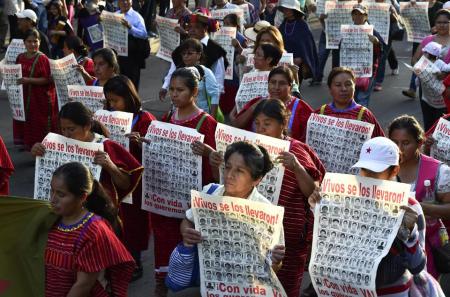
    Image

    [October 24, 2014] Public outrage over the police murders of six people and forced disappearances of 43 students from the Atoytzinapa rural teachers’ college in the southern Mexican state of Guerrero continued to snowball this week.

    Parts of the Mexican Republic were virtually paralyzed by a 48-hour protest convened October 22-23 by student, labor, farmer, and social organizations.  Significantly, actions ranging from the shut-down of university campuses and the takeover of government offices to the blockade of highways and international border crossings extended from the traditionally “politicized” zones of Mexico City and southern Mexico to many nooks and crannies of the country.

    The Mexican press reported actions in at least 18 of the nation’s 32 states, including usually less politically active entities like Colima and Nuevo Leon.

    On the evening of October 22, and for the third time this month, hundreds of people temporarily blockaded the Bridge of the Americas between Ciudad Juarez, Chihuahua, and El Paso, Texas.
    In a march that wound from Borunda Park to the border crossing, protesters shouted out the names of the 43 disappeared students and plastered pictures of the missing young men at the local headquarters of the federal attorney general’s office.

    “To seek a better education is not a crime” and “There are not enough bullets to kill us all” were among the messages spotted on signs. Young people formed the vanguard of the protest, with participating students from the Autonomous University of Ciudad Juarez, Autonomous University of Chihuahua, Technological Institute of Ciudad Juarez and the Ricardo Flores Magon Rural Teachers College of Saucillo, Chihuahua, a sister institution of the Raul Isidro Burgos Rural Teachers College in Ayotzinapa.  The women students from the Saucillo school have been at the forefront of advancing the cause of the Guerrero students in Ciudad Juarez and other parts of Chihuahua state.

    Among numerous actions, an estimated 15,000 people demonstrated in Guadalajara, Jalisco, while 40,000 students joined in shutting down institutions of higher learning in the neighboring state of Zacatecas. For the first time in its 180-year history, students shuttered the University of Guanajuato Law School in protest. Meanwhile, in the southern border state of Chiapas, indigenous Zapatista communities lit candles for the Ayotzinapa students.

    In Mexico City, tens of thousands of students from public and private universities made up huge sections of a march through the capital city. “No violence, no violence,” chanted students from the University of Chapingo.

    “We’re witnessing the largest march of recent years, perhaps since the university movement of 1968,” wrote political analyst and Proceso columnist Jenaro Villamil. “It’s one without party affiliation, without electoral slogans and with a great indignation that is visible on faces, on banners, on placards, in spray paintings, and with slogans that channel the anger in the direction of (President) Enrique Pena Nieto.”

    Interviewed prior to the march, an activist involved in the massive student strike for institutional democracy and accountability, public education and professional integrity still underway at Mexico City’s National Polytechnic Institute (IPN), voiced the heart-felt burst of solidarity with the Ayotzinapa students that is sweeping Mexican university campuses.

    “The rural teachers’ colleges and the IPN are sisters. What is happening to the (Ayotzinapa students) hits us in the guts; it’s family from the other side. We are linked. We were born as institutions for small farmers and workers. We share the same father, (President) Lazaro Cardenas,” said a female student identified as Magali.  “One cannot think of these as isolated events. There are connections between the student teachers and the struggle of the Polytechnic…”

    In Guerrero the movement got a jump-start on the rest of the country as teachers, students and the citizenry in general began occupying nearly two dozen city halls in different regions of the state early in the week.  In Tixtla, thousands of people supported by armed members of the indigenous-led community police effectively took over the small city located near Ayotzinapa. By week’s end, protesters led by the Guerrero State Coordinator of Education Workers and Popular Guerrero Movement occupied Acapulco’s city hall for an “indefinite” time.

    On October 22, between 10,000 and 20,000 people demonstrated in Iguala, the scene of the September 26 crime, garnering enthusiastic support from the residents. A small group of young people broke away from the crowd and set Iguala’s city hall ablaze.

    Across Guerrero protesters demanded the safe return of the Ayotzinapa 43, punishment for the authors of killings and disappearances, medical attention for victims wounded in the September 26-27 attacks, and the ouster and trial of Guerrero Governor Angel Aguirre, whom protesters hold responsible for the violent circumstances prevailing in their state, now considered as the most violent place in the country.

    As the week drew to a close, the protesters got part of their wish: Governor Aguirre announced he was requesting a leave of absence from office, in a move just short of outright resignation.

    “In this tragic scenario, I reject that the public debate should center on whether I remain as the governor in charge,” Aguirre said late Thursday, October 23. “The priority should be on continuing with the search for the missing young people.”

    Internationally, members of Mexico’s vast diaspora and supporters staged demonstrations for justice in London, Paris, Helsinki, Copenhagen, Madrid, Barcelona, Florence, Bogota, La Paz, Los Angeles, and other cities in at least 15 countries. On October 24, activists in Santa Cruz, California, plan a vigil for Ayotzinapa.

    But nearly a month after last month’s violence, it is still not confirmed if the dozens of charred corpses subsequently discovered in multiple, so-called “narco-graves” on the outskirts of Iguala belong to the missing Ayotzinapa students.

    Pushed by Federal Attorney General Jesus Murillo Karam and other government officials, several versions exist (disputed in part by Atoytzinapa attorney Vidulfo Rosales Sierra) of why the students, who were in Iguala collecting monetary donations from the public in order to be able to attend the annual commemoration of October 1968 Tlatelolco Massacre in Mexico City, were so viciously targeted by municipal police and Guerreros Unidos cartel gunmen in the first place.

    Implicated as the authors of the violence, now-fugitive Iguala Mayor Jose Luis Abarca and his wife, Maria de los Angeles Pineda Villa, who has been identified as the sister of founding members of Guerreros Unidos, were reportedly incensed at the Ayotzinapa students’ presence in Iguala while a ceremony and dance attended by the couple was in progress on September 26.

    Consequently, either Abarca or his wife- or both- ordered that a harsh lesson be given to the young people.

    A related explanation for the mass abduction that climaxed the police shootings of the students and passing members of the public is that corrupt city officials and Guerreros Unidos made a monstrous misjudgment in confusing the students with “Los Rojos,” a rival organized crime group.

    So far, more than 50 people have been detained in connection with the violence, including Iguala policemen and alleged Guerreros Unidos members, according to Attorney General Murillo. In comments about this week’s political upheaval, President Pena Nieto reiterated his government’s commitment to locating the missing students and applying justice.

    “The President of the Republic makes the sentiment of indignation his own…,” Pena Nieto said.

    While the Iguala atrocities are far from unique in Mexico, the September 26-27 violence has perhaps no better exposed in one fell swoop the collusion of government and organized crime, the criminal infiltration and corruption of political parties, the cold hand of official repression, and the incapability or disinterest of the state in guaranteeing the security of its civilians.

    A central message of protesters this week: Iguala was a crime against humanity committed by the state. Analysts and commentators of all stripes weighed in on the turmoil.

    “Preceded by the scandal around the (June 30) firing squad execution of 22 people by the army in the Mexico state village of Tlatlaya, the case of the disappearance of the 43 Ayotzinapa students turned on its head the government of Enrique Pena Nieto, which was acting triumphant because of its structural reforms- especially the energy one- and that were displayed abroad as a modern and vanguard government,” wrote Proceso’s Jose Gil Olmos.

    “Nonetheless, Pena Nieto’s government is completely overwhelmed by a social, political and economic crisis…”

    Columnist Jorge Ramos, the star broadcaster of the Spanish-language television network Univision that is beamed into millions of U.S. households, was no less poignant in a column this past week.

    “The dead of Mexico can no longer be hidden. The massacres of Tlatlaya and Iguala show the worst of the country: the army massacring civilians and the police murdering students. This is Barbarous Mexico. And the government of President Enrique Pena Nieto is almost deaf, paralyzed and overwhelmed, as if the fault was not its own,” Ramos wrote.

    “Mexico smells rotten; it smells of the old PRI (President Pena Nieto’s Institutional Revolutionary Party). Students the country over, with marches and protests, no longer swallow the old (government) tale that we will search and punish. The lines are drawn: the government, its army and police are not with the students, with the victims of violence, or their families. Mexico was broken in Iguala…”

    Ironically, the outcomes of the massacre in Iguala, the very place where Mexico’s independence from Spain was formalized in 1821, could well lead to a new day for the nation-or its demise. As one Ciudad Juarez activist remarked to FNS, the great challenge of the youth and popular uprising of October 2014 will be to maintain the grassroots momentum while organizing and articulating the movement in a way so genuine, lasting changes result.

    Sources.  Arrobajuarez, October 23, 2014. Lapolaka.com, October 23, 2014, Nortedigital.mex, October 23, 2014. Article by Miguel Vargas. Milenio.com, October 23, 2014. El Semanario de Nuevo Mexico, October 23, 2014.  Article by Jorge Ramos. El Sur, October 22, 23 and 24, 2014. Articles by Brenda Escobar, Lourdes Chavez, Jacob Morales Antonio, Karina Contreras, editorial staff, and the Reforma news agency.

    La Jornada, October 23 and 24, 2014. Articles by Sergio Ocampo, Rubicela Morelos, correspondents and editorial staff. La Jornada (Guerrero edition), October 21, 2014. Article by Margena de la O and Salvador Cisneros Silva. Proceso/Apro, October 12, 15, 22, 23, 24, 2014. Articles by Marcela Turati, Santiago Igartua,  Jenaro Villamil, Jose Gil Olmos, Patricia Mayorga, Arturo Rodriguez Garcia, and editorial staff.

    Reprinted from: Frontera NorteSur: on-line, U.S.-Mexico border news, Center for Latin American and Border Studies, New Mexico State University, Las Cruces, New Mexico. For a free electronic subscription: email:fnsnews@nmsu.edu

  • Shock, Horror, Anger at Killing of 5, Disappearance of 43 in Mexico; Protests, Marches, Strikes, Gov't Buildings Burned

    Throughout Mexico there is continued shock, horror, indignation, and anger at the police killing of 5 and wounding of 17 other students, and above all at the disappearance of 43 students on the night of September 26 and the early morning of September 27. For almost a month now protests peaceful and violent involving tens of thousands have rippled across Mexico, as students, teachers, and other citizens demand that the missing students be returned alive, though some evidence suggests they may already be dead. While tens of thousands of Mexicans have died in the drug wars since 2006—as many as 60,000, and perhaps another 20,000 have gone missing—there is particular horror and revulsion at the murder and disappearance of these young people from humble backgrounds, children of peasants, who were students at the Ayotzinapa rural teachers college.

    The controversy over the disappearance of the students has taken place just as the Mexican government’s National Human Rights Commission issued a report on October 21 stating that Mexican soldiers had executed at least 12 and probably 15 people of the 22 people who were killed in June in the town of Tlatlaya in the State of Mexico. Two of those killed were minors; several had been tortured. Raul Plascencia, president of the Commission called it, “one of the worst incidents of human rights abuses ever committed.” So far no military officer or soldier has been indicted for the murders.

    The Guerrero students’ killings and disappearances have become a full-blown political crisis for the Mexican government, but above all for Guerrero Governor Ángel Heladio Aguirre Rivero of the left-of-center Party of the Democratic Revolution (PRD). While President Enrique Peña Nieto and opposition leaders such as Cuauhtémoc Cárdenas have called the return of the missing students the country’s most important issue, to many it seems as if there is no response. Guerrero Governor Aguirre Rivero remains in office, no police officers or others have been indicted, and the identities of dozens of bodies found in mass graves in the area have yet to be identified. Government agencies and police have produced conflicting and confusing reports that give the impression that they are intentionally misleading and covering up evidence. There is widespread cynicism about the failure of the government and the political parties, the lack of transparency at all levels, the complicity of the authorities with organized crime, and the impunity of the police. 

    On October 22, Mexico’s Attorney General Jesús Murillo Karam told the media that Iguala’s mayor José Luis Abarca Velázquez and his wife María de los Ángeles Pineda Villa, the head of the municipal police had ordered the attack on the students. But the full story behind the attacks and the role of all of those involved has yet to be clarified. 

    The Police Shooting of the Students

    The events began in the month of September when students had engaged in political protests, claiming that students of urban campuses were being preferred over rural graduates. According to Carlos Pérez, a student eye-witness who survived the massacre, on September 26 a group of students had gone to the city of Iguala to raise money for the studies and when they were done had seized three buses to take them back to the school. Student commandeering of buses had been going on for some time in Iguala and the students had an understanding with the bus companies that drivers would not be harmed and buses would not be damaged. As they were driving out of the city, they passed the spot where María de los Ángeles Pineda Villa, the wife of the mayor of Iguala and president of the agency for the Integral Development of the Family was giving her report.

    To their surprise, the police gave chase and then succeeded in blocking and stopping the buses. When the students stepped off the bus, asking to be allowed to leave, the police “response was to open fire against us immediately,” said Pérez. Some of the wounded shouted at the police that they were from Ayotzinapa, hoping that by identifying themselves as students the police would stop. Ambulances began to arrive to take away the wounded, as students began to use their cell phones to call for support from other organizations or friends. But then a group of men dressed as civilians arrived and began to fire at the students, causing more casualties. One of  the wounded was union leader Alfredo Ramírez García. the Sole Union of Workers of the Bachelors College.

    Earlier Complaints Against the Mayor

    Guerrero, one of Mexico’s poorest states, has a long history of conflict and violence involving criminal gangs, the police, and radical insurgent groups. As in many regions of rural Mexico, political power is often in the hands of local leaders who reach a modus vivendi with the political and economic power-that-be and with drug dealers and even guerrilla groups. The mayor of Iguala, José Luis Abarca Velázquez, who appears to be the figure at the center of the killings, is just such a person.

    Abarca had a reputation for repression long before the recent events. Arturo Hernández Cordona had, a founder and leader of the Emiliano Zapata Peasant Union (UCEZ) and member of the PRD, had appealed to authorities for protection from Abarca who he believed plan to kill him and other leaders of the union. On May 30, Hernández Cordona and his comrades Féxli Rafael Bandera Román, Ángel Román Ramírez, Héctor Arroyo Delgado, Efráin Amantes Luna, Gregoria Dante Cervantes, Nicolás Mendoza Villa and Jimmy Castrejon were kidnapped and three of their bodies were found executed in the town of Tepecoacuilco. The others managed to escape. Mendoza Villa who was an eyewitness to their murder said that it was mayor Abarca who had personally fired a pistol into the face of Hernández Cordona. Autopsy revealed that the man had been tortured. More than twenty others had also faced violence from the mayor according to reports to the National Network of Civilian Organizations of Human Rights for All.

    The recent shooting is not the first attack on students in a commandeered public bus. On November 15, 2012, a gang of armed men attacked a bus carrying three students, the bus driver and his wife. The students were returning from Atoyac where they had taken a group to participate in a protest march regarding the students who had been assassinated on the Highway of the Son in December 2011. When they reached Tierra Colorada, a black Ram  SUV with darkened windows opened fire, forcing the driver to stop. The men threatened to burn the students alive for commandeering the buses of the Estrella Blanca Company, though after threatening them they were let go.

    Looking for the Missing Students

    To return to the recent events, following the September 26-27 shootings in Iguala, the students went looking for their friends in jails and hospitals, finding some being treated for their wounds, but unable to locate 43 of their colleagues. The police and civilians began a search and on October 4 found human remains in a common grave containing an undetermined number of cadavers. By October 9 four other graves containing human remains had been found, and by October 16 the number of such clandestine graves sites had risen to 17. The Mexican Attorney General, Jesús Murillo Kram, announced on October 15 that experts from his office had determined that none of the 28 bodies found in the first 5 of 14 graves being examined were the Ayotzinapa students.

    Murillo Kram also announced that 46 people had been arrested in conjunction with the investigation of the shooting and disappearance of the students: 22 police officers from Iguala, 14 police officers from the town of Cocula, and ten civilians who were gangsters, members of the Guerreros Unidos gang. Warrants for the arrest of Mayor José Luis Abarca and police chife Felipe Flores Velázquez had also been issued. There was also an investigation into María de los Ángeles Pineda Villa, the wife of Abarca for her alleged role in the disappearance of the students.

    While Murillo Kram had ruled out the possibility that the common graves that had been discovered contained the remains of the students, Raúl Plascencia Villa Nueva, president of the Mexican government’s National Commission of Human Rights, suggested on October 22 that indeed the secret graves might contain the students’ remains. The exhumation and examination of the human remains found in the many mass graves in the area continues under the direction of local police.

    Alejandro Solalinde, a Catholic priest and human rights activists, told the media on October 18 that sources in the community had told him that government agents had been responsible for the students’ kidnapping and that several of them who were wounded had been burned alive. They were taken off in police vans, not carried away by criminals. He also said that the Ayotzinapa students were a “stone in the shoe” of the government because they refused to accept the neoliberal model of education that it was promoting.

    The Political Controversy

    The Mexican government and particularly the governor of Guerrero, Aguirre Rivero, have been excoriated by human rights groups, by the church, and by international organizations as calls for the removal of the governor have been ignored. The Senators of the Institutional Revolutionary Party (PRI), the party of President Peña Nieto, and of the conservative National Action Party (PAN), have argued that Aguirre Rivero should be removed from office and some have suggested that the State of Guerrero should be put in trusteeship of the federal government. The leaders of the left-of-center Party of the Democratic Revolution (PRD) voted to reject the call for the removal of the government and both the PRD and the PRI denied that the state was “ungovernable,” the legal requirement for a trusteeship. The continued presence of Aguirre Rivero in the governor’s palace, however, clearly represents a threat to the PRD’s continued claim on representing Mexico’s working people and the poor. The Catholic Bishops of Guerrero called upon the government authorities to make a great effort to clean up the state’s institutions.

    The Organization of American States (OAS) has demanded that the Mexican government clarify these events which in the words of President José Miguel Insulza “sadden all America” (meaning all of the nations of North and South America). Legislators from 33 Latin American countries have called upon the Mexican government to end the impunity and punish those responsible for the events in Iguala. A group of academics and intellectuals from 60 countries and 500 universities and research centers from around the world have called for the immediate resignation of Governor Aguirre Rivero and his Attorney General Iñaki Blanco Cabrera and all the police and military who were involved in the crime.

    Waves of Protest

    Students and teachers have understandably led the protests against the events in Iguala. The State Coordinating Committee of the Education Workers (Ceteg) in Guerrero, other teachers, students, and family members burned the Government Palace in Chilpancingo, the state capital, the headquarters of the Party of the Democratic Revolution (PRD) also in Chilpancingo, and the Iguala town hall. Marches, principally by students, occurred in 25 states. Students called for 48-hour strikes at the National Autonomous University of Mexico (UNAM) and at the Autonomous Metropolitan University (UAM), both in Mexico City. The two universities together have hundreds of thousands of students and many thousands participated in the protests. There have also been strikes in 40 other universities throughout the country.

    In Guerrero, the National Coordinating Committee of the Mexican Teachers Union (la CNTE), the students of 17 rural teachers colleges throughout the country, and the Peasant Organization of the Southern Sierra (OCSS), among other groups, plan to seize the 81 city governments throughout the state as well as highway tool gates until the 43 students are presented alive. Ceteg and peasant organizations have already seized several town halls.

    This article was updated on October 23.

    *This article could not have been written without the daily reporting of La Jornada on which I have relied. 


  • Response to Jay and Sustar & Bean

    The following article by Adolph Reed, Jr. responds to an article that appeared on the New Politics website a week ago. Sadly, since then we have learned that Karen Lewis has been afflicted with brain cancer. We offer our sympathy to her, her family, and her friends and wish for her rapid and full recovery. While she has withdrawn and will not be a candidate in the mayoral race, we believe that the issues raised in this article remain important.

    I recently read two quite similar calls for concern about Chicago Teachers Union President Karen Lewis’s possible campaign for mayor: Scott Jay’s “Karen Lewis and the Long Arm of Lesser Evilism” in New Politics—http://newpol.orgkaren-lewis-and-long-arm-lesser-evilismand Lee Sustar and Brian Bean’s “Don’t Back Down” in Jacobin—https://www.jacobinmag.com/2014/09/dont-back-down/. I admit that I was a little surprised to see that this flavor of the left has already lobbed its charges of selling out before she’s even declared her candidacy. 

    The New Politics piece is just simple-minded and wrong-headed all the way through, pro forma stuff that Jay could have phoned in from and about anywhere. No one except maybe he and his political buddies ever imagined that she’d run as anything other than a Dem in the first place. And why should she in a race that’s officially nonpartisan anyway? The only effect would be to increase the degree of difficulty in what would already be a steep uphill fight. (I was especially taken with Jay’s declaration that he’s not demanding ideological purity, which he follows by raising the bar of ideological purity in arguing that it’s not enough that we avoid the sin of voting Democratic but that we need to take care that our actions not only don’t lead anyone else to vote Dem but that they don’t lead anyone to lead anyone else to do so. This brings to mind my fourth grade Catechism teacher.) He criticizes Lewis for supporting Illinois Senate Bill 7, “that attacked teachers’ seniority and their right to strike,” which certainly would be an odd move for the CTU president. In fact, she contingently supported the version of SB7 that passed over the worse one that had been proposed. He also attacks her for supporting Pat Quinn’s re-election as governor, a move that Jay understands, consistent with his brand of sectarian fantasy, to expose her as a stooge for the Democrats. Of course she supports Quinn over kazillionaire privatizer (and Friend of Rahm) Bruce Rauner. Much as I dislike Quinn’s earlier moves on public pensions, etc (and I think Lewis’s argument is at least plausible that he gambled on backing a proposal that was so extreme the state legislature wouldn’t accept it, which is in fact what happened), I sent him some money because Rauner promises to privatize as much of state government as possible and destroy public education. That’s also why the CTU endorsed him, not some shadowy “pressure to stay within the Democratic Party fold,” as Sustar and Bean contend.

    There’s a flavor of Trotskyist that brings to mind a line from a truly horrible late 1970s Paul Schrader film, Hardcore, in which the stereotypical young hooker with a heart of gold who is helping upper Midwestern Calvinist George C. Scott find his daughter who was spirited into the sex industry on a Disneyland trip, remarks to him that their views about sex are fundamentally similar. When he looks at her like she’s nuts, she explains that he cared so little about it that he didn’t do it at all and she cared so little about it that she’d do it with anyone. The parallel in this domain is with Dems and their antagonists of that sort on the left. Both tend, as a matter of hallowed principle, to overvalue the significance of electoral action and to reduce electoral engagement to a matter of supporting Dems or not; they just take different sides on the question. But voting for a Dem or not is not the end all and be all of politics; whether or not to do so is fundamentally a tactical or strategic question, not a matter of principle. It is high principle for those leftist types because they operate within a mythology—not unlike mental illness—according to which, if we could just get the people to stop voting for Dems, they’ll come to see the necessity for socialism, or the crazier-still version, that the masses already are pleading for socialism, but the elite gatekeepers in the labor movement, etc., keep duping them into supporting Dems. Sustar and Bean are no better than Jay in this regard. Like Jay, they imagine that a mass movement is already out there waiting to be called together, if only Lewis would demonstrate her independence from the Dems and adopt the proper laundry list of lefty proposals. For them that means:

    from raising the minimum wage, to a tax on financial transactions, to higher taxes on the wealthy. The fight against racism will have to be front and center. She will have to highlight underfunding in schools, residential discrimination, and the lack of genuine economic development—not gentrification—in black and brown neighborhoods. Such a campaign would also have to confront the reality of police brutality, from Ferguson to Chicago. Immigrant rights should be a major focus, too, in a city in which a growing Latino population faces a dramatic rise in deportations, as well as racism and poverty.

    All those sound good as talking points (and Sustar and Bean note that Rahm supports increasing the minimum wage), but they generally lack content. What, after all, are the warrants of “the fight against racism” and what does it mean to make it “front and center”? How can we tell what counts as “genuine economic development—not gentrification”? What can the mayor of Chicago do about police brutality in suburban Maywood or Evergreen Park, much less in metropolitan St. Louis?

    Both these pieces betray a really naïve or underdeveloped understanding of electoral action, its costs and benefits, the unavoidable messiness of engaging in it. And, by the way, the same messiness applies to all efforts to build and maintain broad alliances, all of which require finding ways to navigate locating points of agreement and looking the other way at least temporarily at potentially serious differences and contradictions. Jay’s essay is puerile in this regard, but the Jacobin essay isn’t much better; both fall to the level of facile exposé—Lewis calls for more cops on the streets even though the FOP fundraised for Darren Wilson and the CPD has a history of racist brutality!!—and they fail to understand that you can’t build a movement around an election campaign, which requires an approach to organizing built on thin and broad, diffuse even, appeals because the standard of success is tied to % of the vote received. And the logic of electoral campaigns is inexorable; it brings to mind an old college friend’s quip about acid: once you buy the ticket, you have to take the ride.

    And as for the “Lewis’s turn to the right” line, and the need for “the fight against racism [whatever that is concretely] to be front and center,” it’s important to keep in mind the really existing black politics in Chicago, which presents a much more complicated field of action than either essay takes into account. There’s a venerable history of black (and nonblack) aldermen and other politicos pledging to back the insurgents and then putting their troops out on election day to turn out for the machine. For the preachers that sort of duplicity is in their basic job description, and then you have the “community leaders,” who’re likely to be on the administration’s teat either directly or via the nonprofit industrial complex. Then there are whatever remains of the South Side nationalists and Jesse Jackson’s operation to which those “activists” are loosely linked. That element has its own history of cash and carry politics, and its minions have habitually found a way to denounce or quietly reject the insurgent candidates for some arcane political incorrectness and cut deals with the machine or in state politics with the GOP in exchange for working to demobilize around the edges. South Side “activists” did that when liberal Dem Dawn Clark Netsch ran against GOP incumbent Jim Edgar for governor in ’95. They determined that they were affronted that she hadn’t supported Harold Washington in the Dem primary in 1983 (though she did in the general election and again all the way in 1987). So they got some Edgar money. They also worked tirelessly to preempt the emergence of a serious progressive contender against the Lesser Daley during his reign by insisting that only a black challenger could embody the legacy of the Harold Washington coalition.

    And another thing that lefties don’t understand, especially to the extent that they harbor essentialist fantasies about “the black [or Latino] community,” is that it’s such institutional nodes that actually mobilize voters and turn them out. That’s also why a Lewis campaign would need support of whatever unions and other organizations with political capacity it could get. Sustar and Bean’s belief that the positions a Lewis campaign adopts would by themselves turn out voters, working class or otherwise, against an entrenched political apparatus is wishful thinking, and a particular species of wishful thinking at that, an electoral version of the Myth of the Spark that will condense the spontaneous mass demand for socialism. Yes, there are tradeoffs that have to be made; that would be true even for a serious protest candidacy. Such tradeoffs have to be made carefully and judiciously through collective processes, but they have to be made. I don’t see a hint of recognition of that fact anywhere in either of these articles. To that extent they’re not much more than political posturing and dilettantism. They don’t engage at all with the specificities of Chicago politics—electoral or otherwise—and offer only cookie cutter proposals transcribed from those laundry lists so routinely cobbled together by the activistist left and parsed endlessly on the internet and in Brooklyn coffee houses.

    Finally, the problem in Chicago isn’t the need for a break from the Dems; it’s the need to build a broad alliance against neoliberal policy and, it is to be hoped, beyond that. A Karen Lewis mayoral race could be a significant step in building such an alliance; if it is to be, it’ll be a tough struggle that will require broad appeals and wide and deep mobilization. At the same time, I doubt that there are many people more acutely aware than I of the dangers—including the potential contradictions of success—that can come from winning a mayoralty. Some people think that, taking those dangers into account, Lewis might be more effective politically by remaining outside City Hall and agitating to broaden a base within the labor movement and among other constituent groups. That’s ultimately a practical question and one to which there may be no clearly correct answer; nontrivial tradeoffs accompany each course. (However, Lewis’s sudden health complications may be serious enough to render debate about her possible mayoral campaign moot.) That’s the problem with real politics; it’s messy, laden with contingencies and uncertain outcomes and, of course, odd bedfellows. It’s ironic that the political element that is now prepared to denounce Lewis for capitulationism was also among the loudest voices urging her to run in the first place. I see now that what they had in mind, as these critiques make clear, is the sort of purist and pointless suicide mission that is the hallmark of their ideological tendency.

    This article originally appeared at NonSite.org   http://nonsite.org/editorial/response-to-jay-and-sustar-bean


  • Behind the Kobane Tragedy: The Kurdish Political Movement and Turkey

    Image

    The whole world is just watching the forthcoming massacre in Kobane. US-led air strikes seem to be made only for show. When ISIS approached the oil-rich Erbil,  the Kurdish Regional Government’s capital, the U.S.-led coalition forces immediately took action against ISIS. However they didn’t do the same for Kobane.

    John Kerry said  that “The situation in Kobani is a ‘tragedy’ but saving it from ISIS is not part of our ‘strategy’”. Everybody knows that long-term strategy of the US is to establish U.S backed governments on the Erbil – Lazkiye line and dominate the distribution of oil in the Kurdish region controlled by Barzani to the world economy. So, the US uses ISIS to decrease the Shiah effect on this line. For example, Prime Minister of Iraq – Nuri el Maliki who was thought to strengthen Shiah influence in the country and help Esad protect his position in Syria, resigned this summer after the U.S. threated him by not intervening against ISIS should they attack Baghdad. In the middle of this unrest in Iraq, Iraqi Kurdistan Regional Government (KRG) seized the control of Kerkük, which accounts for 40 percent of Iraq’s oil production.

    Kobane, is one of the three cantons that declared democratic autonomy in Syrian Kurdistan and that has been under siege by the Islamic State of Iraq and Levant (known as ISIS, ISIL, or Daesh) since September 16. The other two cantons are Efrin and Cezire. Kobane is between Efrin and Cezire and is located at the heart of Rojava (Syrian Kurdistan). These cantons are self-governed by the local assemblies, which are composed of the representatives of ethnic and religious group on the basis of secular pluralism, gender equality, and democratic autonomy. In Kobane, the political theses of Abdulla Öcalan, the jailed leader of the Kurdistan Workers Party (PKK), regarding governance and living together in solidarity with other peoples have been put into practice. Besides, Party of Democratic Union (PYD) holding the political and military control in Rojava, is the Syrian branch of PKK which has been fighting for the basic right of Turkey’s Kurds for 30 years. Just because of this brand new life project, Kurds, without any heavy weaponry, are trying to defend Kobane against IS,  which captured tanks and advanced weaponry from Mosul.

    It is no longer a secret that Turkey has been providing military equipment and training to ISIS for quite some time. In addition, Turkish soldiers and police using plastic bullets and tear gas attacked Kurds flooding to the border in order to get some news from the other side  and provide help to the Syrian Kurds. Even some of those only slightly wounded bled out after after Turkey chose to keep them waiting at the border. On the other hand, while ISIS was crossing the border during a live broadcast by a pro-Kurdish TV channel IMC, Turkish tanks and soldiers were just watching them. The Justice and Development Party (AKP), with the help of Kobane siege, has attempted to demolish the Rojava model and aims to shape the peace process and solution to the Kurdish issue with a reactionary and sectarian form.

    With the support of AKP and the ultra-right Nationalist Action Party (MHP), the Turkish parliament   voted to  authorize  its government to send military forces to Iraq and Syria to combat the terrorist organizations. However the name of ISIS is not explicitly mentioned in the bill, which makes one think that the bill has some other intentions related with Syria and Assad’s regime. A no-fly buffer zone in northern Syria, which was laid down by Turkish President Erdoğan as a condition for joining the international coalition, also aims to prevent Assad’s air forces from intervening and bombing ISIS positions. The main opposition party, the Republican People’s Party (CHP), comprehending the symbolic importance of Kobane as a secular project very well, joined People’s Democratic Party (HDP) in voting “no” to the war measure, despite the pressure of the nationalist wing in the party which perceives PKK and PYD as an explicit threat to Turkey’s integrity.

    On October 4, PYD leader Salih Müslim visited Turkey and met with both the MIT (National Intelligence Organization of Turkey) and Foreign Ministry officials. He demanded two things: First, permission for the People’s Protection Units (YPG, the armed wing of the Democratic Union Party (PYD), and an affiliate of the Kurdistan Workers Party) fighters in Afrin and Cezire to cross the Turkish border in order to join the resistance in Kobane. Second, allowing the transportation of heavy weaponry coming from North Iraq through Habur Border Gate into Kobane through Mürşitpınar Border Gate. Since ISIS surrounded Kobane from east, west and south, Mürşitpınar Border Gate is the only connection YPG has with the outside world. Casualties and civilians enter Turkey from this gate. Turkey, in exchange for meeting these requirements, demanded unacceptable compromises from Müslim: back down from the cantons and democratic autonomy, stop the collaboration with Assad regime and accept the security zone. AKP, for a long time, has been trying to tame the Rojava Kurds who refuse to come together with the reactionary forces against the regime under the name of a so-called “opposition forces”. However, Rojava once again chose to resist instead of giving up without a fight and Müslim left Ankara.[i]

    After this meeting HDP called on its supporters to mount mass protests all over Turkey and demonstrations showing support for Kobane resistance began. During the demonstrations in the Kurdish cities and the ghettos of Western cities, the clashing parties were not only the Kurds and security forces as in the ‘90s, which were the peak years of the civil war; but also the supporters of MHP, AKP and Hüda-Par, the party of Kurdish Hizbollah. This latter group, which had laid down its arms a few years ago and whose leaders were released from the prison by AKP, were in the streets. Islamo-fascists backing up ISIS started to attack the Kurdish and socialist students in the main universities of western Turkey. The government declared curfew in six cities, including Diyarbakır, and the tanks and infantry forces roamed the streets of Diyarbakır, thought to be the unofficial capital of Turkey’s Kurdistan. After a few days, there were 38 dead, 351 wounded and 58 detainees.

    The Turkish government, in order to put an end to all these protests, assigned MIT officials to talk with Öcalan, who is imprisoned in Imralı and has been conducting peace negotiations with the state for several  years.  Öcalan’s views were conveyed to HDP. After the statement ( below ) made by HDP on October 10, the protests all over the country decreased significantly and the tension eased: “We want to eliminate these internal and external threats to our peoples together with the government… Despite all the tension and pain, we expect the government to continue its positive steps (such as facilitating the passage of wounded people and humanitarian aid across the border), taking into consideration the contribution of Mr. Öcalan, preventing the attacks by provocateurs on civilians, and acting in a responsible way by issuing messages that will defuse tension.”

    The co-presidents of HDP added that they hoped the leaders of the Kurdistan Communities Union (KCK), an organization founded by PKK to put into practice Öcalan's ideology of Democratic Confederalism,  would also repeat their call to demonstrators to refrain from violence, investigate armed actions, and take measures to reduce tension.

    Nearly 40% of Kobane has been taken by ISIS at the moment. The fall of Kobane to ISIS would surely result in a massacre of the town’s civilians. At the same time, a possible future of solidarity of peoples on the basis of secular pluralism and democratic autonomy in the Middle East will be shattered.

    All these goings on related to Kobane, have a special significance for Turkey. Ocalan and Turkish state officials have been carrying out peace talks for several years after a 30-year civil war that took some 40,000 lives. If Kobane falls, it is likely that PKK will put an end to the truce and resume the armed struggle, which will mean thousands of more casualties in a new civil war. If Kobane falls, the violence will escalate in the Kurdish cities of Turkey and the extensions of ISIS in Turkey and the fascists will collaboration on lynching Kurds, Alewites, and socialists in Turkey. That police and Islamo-fascists together have been attacking socialist students in the universities for the last few days is a sign of this.

    The Kurdish political movement is not monolithic. There are moderate Islamists, leftist and nationalists in it and this reality has a significant effect on their policies. The Kobane resistance has brought both the Kurdish national freedom movement and Turkey as a whole at a new and strategic political crossroads. ISIS, maybe for the very first time in Kurdish history, might have been the means of understanding what a big threat political Islam is for most of the Kurdish people. As a consequence, progressive views may gain strength within the Kurdish political movement. “Religious brotherhood” and the “Islamic umbrella,” concepts frequently pronounced by Öcalan during the peace process. may be able to be questioned more loudly. The resistance of the Kurdish people against ISIS and political Islam, may reinforce the possibility of changing the republican masses’ view of Kurdish reality and establishing a dialogue between the Kurds and the secular republicans on the basis of secular or even leftist values. The CHP’s “No” vote to the bill in the parliament is a contribution to this potential outcome.. A significant part of the secular, democratic, and leftist sectors of Turkey know by heart that the only way to get rid of their own Islamo-fascist trouble is a united front comprising socialists and the secular, democratic and leftist wing of CHP and HDP.

    [i] http://www.hurriyetdailynews.com/kurds-are-no-more-mercenaries-pyd-leader-.aspx?pageID=238&nid=72880&NewsCatID=352


  • License to kill?

    Image

    Although it took some time for US media to cover the story, it now clear: Mutilated bodies of teacher education students were found in a mass grave in Mexico.  In response, the American Federation of Teachers (AFT) issued a press statement by the union president, Randi Weingarten, calling for the “perpetrators of this atrocity” to be brought to justice.  The National Education Association has been mum. Shame on the NEA and its President, Lily Eskelsin Garcia for their public silence. It is especially unforgivable given AFT and NEA’s domination of the Education International, the international confederation of teachers unions.

                AFT’s press release was welcome and needed as rebuke to the Mexican authorities (and the US government’s support of them) responsible for these murders. Still the AFT response falls far short of what we need because the atrocity was committed in the context of a new World Bank report about education in Latin America that makes teachers unions a target.  For governments ready and eager to rule with an iron hand, the report provides a license to kill.

                The report argues that poverty in Latin America has to be solved by developing “human capital,” accomplished through the same measures used now in US cities that are all but domestic colonies, like New Orleans and Detroit: excessive testing that determines what is taught and how; replacing experienced teachers who come from the communities they serve with a revolving door of recruits from “alternate route” programs; eliminating legal protections for teachers, so as to give administrators complete control over staff.  The report suggests a hunting season – on teachers unions – when it notes “The deepest challenge… is not fiscal or technical, but political, because teachers unions in every country in Latin America are large and politically active stakeholders” (p. 3). The World Bank report urges stakeholders to break the power of the unions.

                As Mary Compton observes in her invaluable website and resource about the global project to privatize education at any and all costs, the EI should end its collaboration with the institutions directing this project. The AFT and NEA are the majority organizations in the EI and hence control policy. They claim it is practical to be working hand-in-glove with people who are whipping up anti-teacher union sentiment and likely violence against activists.  My question for the EI: At what point does it become impractical to collaborate?  Their answer seems to be “When they’ve destroyed us.” 

                We need to reject collaboration with these architects of our destruction. One way to start is for the EI to publish a report and organize a campaign on the attacks on the reform movement of the Mexican teachers union that is similar to the one on Colombia’s violence against teachers union activists in that country.  If we do not mobilize international pressure, the Mexico massacre may be the first of other violent attacks on teachers in Latin America fighting for public education and democracy.  

  • Indiana Moral Mondays

    Moral Mondays has been established in Indiana. At a founding meeting in Indianapolis in mid-September, the organization adopted a “five-point agenda” similar to those of Moral Mondays movements in other states:

    • Secure pro-labor, anti-poverty policies that insure economic sustainability;
    • Provide well-funded, quality public education for all;
    • Stand up for the health of every Hoosier by promoting health care access and environmental justice across all the state’s communities;
    • Address the continuing inequalities in the criminal justice system and ensure equality under the law for every person, regardless of race, class, creed, documentation or sexual preference;
    • Protect and expand voting rights for people of color, women, immigrants, the elderly and students to safeguard fair democratic representation.

    On September 20, a rally was held at the State House at which the Rev. William Barber, head of the North Carolina NAACP and a leading spokesperson for the Moral Mondays movement, gave an impassioned speech to some 400 people. I was present myself at the rally, and also briefly interviewed Purdue professor, long-time activist, and Indiana Moral Mondays steering committee member Harry Targ on the politics and potential of the organization. 

    Rev. Barber opened the rally with a powerful speech in the oratorical style of the African American church, heavily emphasizing morality and the moral implications of the political issues involved, and how this moral concern drove the sense of correcting injustice and reinvigorating politics that fueled the Moral Mondays movement — a movement that has now appeared in 13 states following its origins as a protest against the legislative activities of the Republican-controlled North Carolina state legislature.  At the rally it was emphasized that Indiana was now the second state to have clearly established Moral Mondays as an organized force.  Whatever one might think as a secular socialist of the politics involved, Rev. Barber’s moving speech, like African American gospel music, was a real treat.  Masterful in its oratorical cadences, it drew in and swept away the audience with its eloquent passion and vivid imagery, drawing mightily on the tradition of the Black church.  Aesthetically, it was a tour de force.

    When I spoke with Targ, he emphasized the nature of Indiana Moral Mondays as articulated by Barber: an individual “state-oriented” political approach that would rely heavily on “fusion politics” to draw diverse constituencies into participation on the key “interconnected issues” of labor, education, healthcare, women’s reproductive rights, and gay and lesbian rights.  “The only way progressives can make a dent," noted Targ, "is if we can work together and look at the interconnectedness of all these issues.”  Moral Mondays would be strongly oriented at “pressing” the Indiana General Assembly, the state’s two-house legislature, and the Governor’s office — both presently dominated by Tea Party-leaning Republicans — on the issues, as well as undertaking education and voter registration and working also for alternative candidates for office. Nevertheless, Targ stressed, Indiana Moral Mondays “is not primarily or exclusively an electoral movement.”

    Conceding that little could be done by the upcoming 2014 elections, Targ underlined that Moral Mondays was looking toward a long-term strategy and presence, and perhaps would be more able to flex its muscle by the 2016 elections.  Education and “working class” economic issues such as inequality, poverty, low-paying jobs and persistently steady unemployment would be emphasized, and that pushing for the right of workers to form unions would be “just one part of a broader effort” to reach out to that 90+ percent of Indiana’s workforce that was non-union.  As part of “fusion politics,” outreach to white workers that educated them on the shared commonalities they faced with African American workers would be an important component of Moral Mondays’ work.  As Targ stated, “All workers are experiencing increased exploitation and immiseration.”  Indeed, outreach to the “white working class,” long an electoral base for the Republican Party in heavily Red-state Indiana, was stressed by several speakers at the September 20 rally.

    Much the same was articulated by Joseph Varga, Assistant Professor of Labor Studies at the main campus of Indiana University in Bloomington. Varga, a self-professed “labor activist and LBGT activist” who is also active in South Central Indiana Jobs with Justice, was enthusiastic about Moral Monday’s potential for “coalition building,” as he saw that “the only way we’re going to stop the reactionary movement in this country is through numbers.” Son of a Hungarian immigrant factory-worker father, Varga grew up with a blue-collar identity and saw that his fellow white worker cohorts would support social safety-net and populist measures out of self-interest, even as they “stayed away from labels of what we call liberalism and leftism in this country.”  Varga feels the United States is in a “state of emergency” for poor and working people, emphasizing that “working people and poor people have no representation whatsoever; they are getting destroyed.”  He added, “I don’t think workers vote against their self-interest if we have a Democratic Party that’s not doing a damn thing for them.”  He thinks “actions are going to speak louder than words,” and that workers will be attracted to, and join, a movement that is in “the places where goods and services are transported and being moved and clog that system up so badly that it cannot operate until our concerns are addressed.”  Civil disobedience was, of course, a hallmark of the North Carolina Moral Mondays, and was also mentioned by Rev. Barber in his speech here in Indianapolis.

    Admitting to feeling a “little bit skittish” with Moral Mondays because of the moralistic emphasis and active presence of churches and Christian religious believers (at the rally, e.g., I saw no discernable Jewish or Muslim presence, and certainly no overt atheist, agnostic, or secular humanist one), Joe Varga emphasized that the activities in Bloomington were strictly secular and, as for overt religious influence, the best course was to “just ignore it.”

    In an article he wrote, Harry Targ emphasized that Moral Mondays, in the 13 states in the South and Midwest where it has a presence, has "begun to build a new fusion movement that draws together workers, women, young and old, black, brown, and white people, documented and undocumented, environmentalists, people of faith and atheists, and the LBGT community based upon ‘moral’ and ‘constitutional’ agendas.”

    It certainly is true that at present Moral Mondays has galvanized a sizeable element of the radical imagination.  But can it succeed, especially here in Indiana, based so fervently as it is on moralism little backed up with concrete program? Or will it go the way of Occupy, which was similarly based on fervid moral indignation with little, or no, attempt to develop a program of concrete action, and thus became only a fond memory for many radicals, having left nothing discernable in its wake?  Probably the only realistic answer at this time is: Only time will tell, as Moral Mondays begins articulating its vision and building coalitions, drawing new people into it, and thus over time becoming more concrete and programmatic in its approach.  And perhaps the success of Moral Mondays movements will vary from place to place, which seems the most likely.  But despite the publicity and activity of the original in North Carolina, it seems to have had little deterrent effect on the Republican supermajority in control of that state's legislature.  Yet despite this, Moral Mondays there has certainly not closed up shop.  Indeed, far from it—to continue the marketing analogy, the franchise has only broadened and set foot in new locales.

    But in terms of Indiana, I’d have to say that Targ’s and Varga’s optimism is based on both of them living in bucolic college-town islands where left political activity is far more the norm than it is elsewhere in Indiana, and where the rest of the state is more a fetid swamp than it is a haven for such activity.  That is especially my jaundiced take on the potential of Indiana Moral Mondays here in Indianapolis where I live, where I’m afraid the prevalent overweening religious pietism and religiosity will turn Moral Mondays here into yet another clique of the “peaceable religious progressives” who will hostilely exclude anyone not of their religious persuasion.  Because I’ve seen too much of that happen before:  in the derailing of a promising, more broadly-based and secular peace movement here in the mid- to late-1980s, when key people instead turned it into an exclusively religious pacifist clique that focused solely on “symbolic protest” and did no mass outreach; and in the destruction of the Solidarity Books/Paper Matches youth collective here a decade-and-a-half ago, where a group of feisty anarchist youth tried to set up a truly viable non-sectarian left bookstore, and were driven out in frustration and disgust by the “respectable religious progressives” who were incensed over these youths’ revolutionary rhetoric.  Which has left Indianapolis, a major metropolitan area, completely bereft of any radical bookstore whatsoever.

    Also, statewide movements in Indiana have never been able to sustain themselves during my 34-year stay here.  The Indiana Green Party tried, but disbanded, and the only movements here that have been able to sustain themselves over a long run have been regional ones based preponderantly in certain major cities and urban areas:  Gary/Northwest Indiana, near Chicago; Lafayette/W. Lafayette, where Purdue University is; Bloomington, where Indiana University is; Mishawaka/South Bend, where Notre Dame is; and Indianapolis, leaving large swaths of the state without any active progressive or liberal, let alone any leftist or radical, presence whatsoever.  Except for the northern, more industrialized part of the state, the rest, preponderantly rural, is home to the Republican and Tea Parties, and these two have dominated Indiana politics easily now for many years. As for the Democratic Party, it’s more a vote-gathering machine which sees “moderates” and “conservatives” having the best electoral chances.

    Further, Indiana is staunchly socially and culturally conservative, even hidebound, and in this is more akin to the Old Confederacy than to the Midwest of which it is geographically part.  Indeed, Indiana, because of its cultural conservatism and lack of significant urbanity, even in its cities, is the great sleeper, the great stealth juggernaut, of Red-state politics that’s consistently overlooked by the national media.  (For an excellent journalistic portrait of this hidden aspect of the state, see Bryan K. Bullock's “The Ultra-Right-Wing State Nobody Mentions,” .) Perhaps Indiana Moral Mondays will succeed where others have failed in the past.  Perhaps.  For Indiana Moral Mondays appears to be off to an auspicious start—but I’m afraid it will take more than moralistic fervor to make it a consistent go.


    George Fish is an anti-authoritarian socialist writer living in Indianapolis, Indiana, whose work has appeared in several left publications. He has also published extensively on blues and other pop music, has published poetry, and does Lenny Bruce/George Carlin-style stand-up comedy. He may be reached at georgefish666@yahoo.com.

  • Ebola: Who are the Architects of Death and How Can We Combat Them?

    ImageAccording to the latest predictions of the U.S. Centers for Disease Control and Prevention (CDC), if the Ebola pandemic continues to progress at the current rhythm, it could affect 1.4 million people in Liberia and Sierra Leone between now and January 2015, leading to the deaths of 700,000 in a year, and thus making Ebola the third leading cause of death from infectious diseases in Africa, after AIDS and respiratory diseases. The two countries most seriously affected could suffer the loss of 10 percent of their populations in a year, if one takes into account the impact of such a catastrophe on food production and the overall health of the populations involved. Our understanding of the causes then is urgent in order to avoid the worst and to prevent similar tragedies in other regions of the global South.

    We should first note that this illness seems to have been controlled in Nigeria and in Senegal, and that it seems to have been slowed down in Guinea. The Democratic Republic of the Congo, where a similar epidemic began at the end of August also seems to have been brought under control, a country that has experience with this disease since 1976. How can we explain then the particular seriousness of the pandemic in Liberia, which has the majority of new cases since mid-August, followed in second place by Sierra Leone? The fact that Guinea has done better suggests that the epidemic began in the forested areas of the south, largely cut off from the northern economy based on bauxite mining, the world’s largest reserve. In fact the south looks toward Liberia and Sierra Leone, which offer it the closest seaports.

    To understand the gravity of the situation in Liberia, in Sierra Leone and in the south of Guinea, it’s necessary to look carefully at the particularities of this sub-region. I note here four characteristics that constitute an explosive cocktail.

    1. At the end of the 1980s, Liberia, Sierra Leone, and the south of Guinea were at the center of armed conflicts for the control of natural resources.
    2. After the reestablishment of relative peace in the early 2000s, there was a surge of foreign investments, accompanied by land-grabbing and the expropriation of the small farmers who had been weakened by war.
    3. The increasingly rapid destruction of the forests endangered many animal species and pushed their microbial parasites to search for new hosts at the margins of their traditional ecosystem.
    4. The collapse of the state institutions that had been established when these countries became independent led to the transfer of their tasks to outside and local non-governmental organizations, private companies, and even to Western powers.

    It is the combination and interaction of these four characteristics that has made these countries an ideal terrain for the diffusion of the Ebola virus.

    Wars for the Control of Natural Resources

    The civil wars that bloodied Liberia and Sierra Leone starting at the end of the 1980s had largely been carried on by groups—whether those in power or those in rebellion—struggling over the control of natural resources, in particular diamonds (which because of these circumstances came to be called blood diamonds) as well as lumber, with the complicity of large multinational corporations. Those wars were the cause of the death of some 200,000 people, not to mention the thousands of wounded, mutilated, raped women, orphaned children, and those displaced and turned into refugees. The vast forests where Liberia, Sierra Leone, and Guinea touch have been particularly ravaged by the battles in which the Guinean army confronted the Liberian forces, which were allied to the rebels of Sierra Leone.[1] In addition, this remote area where the capitals of the three countries are found has continued to be the scene of repeated violence, almost to this day, either in the district of Kolahun (Lofa County) in Liberia, or in that of Guéckédou, Guinea. It is in the latter that the Ebola epidemic broke out in December 2013.

    Liberia and Sierra Leone recovered from their civil wars and attained a relative stability, supported by the diplomats and the special forces of Great Britain and the United States, whose action has been continued by United Nations peace-keeping missions there, so that by 2005 in Liberia and 2005-07 in Sierra Leone there had been put in place a semblance of representative democracy and business-as-usual resumed. The international index of “economic freedom” (of the Heritage Foundation and the Wall Street Journal) showed a continual improvement in commercial freedom, in the monetary and tax systems and in investments in the two countries, and only the rights of workers and public services have worsened.

    No doubt about it: the international competition for the control and exploitation of natural resources has returned with a vengeance, dispensing with the mediation of costly armed bands, as part of the new scramble for Africa. During the last five years, from 2009 to 2013, according to the World Bank, the GDP of Liberia has grown on average by 11.1 percent per year, and Sierra Leone by 10 percent. Overall, Guinea remains behind, with a growth rate of 2.5 percent, though it is true that is has not suffered a destructive conflict in the whole country.

    Expropriation of Rural Communities

    In Liberia and Sierra Leone rural communities have been the first victims of the war and of the savage exploitation of natural resources by the belligerent parties; half of the inhabitants have been internally displaced, while at the same time there has been an influx of refugees from neighboring states, as hundreds of thousands of small farmers have been permanently uprooted. It is in this context of mining and land-grabbing that have developed on a large scale over the last several years, with the delighted encouragement of the authorities, obsessed with the neoliberal ideology if not actually corrupted—that in 2012, the tax abatements conceded to the six largest corporations represented 59 percent of the Sierra Leone budget.

    In Liberia, the grabbing up of arable land by international investors has exploded, notably by rubber and palm oil plantations and biofuels; and finally iron ore extraction has led to new concessions. This country now has the world record for foreign investment ratio to GDP. At the same time, 85 percent of its inhabitants live below the poverty line, and 80% of them are unemployed. Sierra Leone presents the same picture. In November 2011, the Swiss Addax Bioenergy Company of the billionaire Jean-Claude Gandur launched a great production unit aiming to develop 20,000 hectares of sugar cane, an ethanol refinery for export, and an electric power plant. Altogether, multinational corporations today control some 500,000 hectares of land in a single country. These investments deprive agriculture for food production of the land and water that it needs, which is why, echoing numerous popular protests, last June some 180 citizens signed the Freetown Declaration against land-grabbing.

    Destruction of Forest Ecosystems

    Forested areas of the three countries are subject to growing exploitation due to population pressure, aggravated by the influx of hundreds of thousands of refugees fleeing armed conflict. Meanwhile, the timber industry is sold to international dealers that open up roads and employ armies of lumberjacks. Small scale mining and the intensive exploitation of flora and fauna accompany these developments, so that the people whose livelihoods depend on all these activities must rely increasingly on bush-meat, hunted on a large scale, which is sold in regional markets for food.

    Throughout this sub-region, commercial lumbering has caused an irreversible destruction of the forest: while wooded areas represent only 4 percent of the surface of Sierra Leone, their importance in Liberia and the south of Guinea is much greater, representing a larger part of their territory.

    This is what led to the accelerated destruction of wildlife, which despite the animals’ higher morbidity, has not prevented them from also being hunted and consumed by people. This is probably also the reason why the fruit bats, healthy carriers of the Ebola virus, move on, traveling ever greater distances in search of food. It is therefore possible that it is these fruit bats, which originally came from their home in Central Africa, that brought the strain of the Ebola virus causing the outbreak in West Africa. Moreover, they often colonize the fruit trees that grow on the edges of the forests near inhabited areas. (Washington Post, July 8, 2014).

    Privatization and the Out-Sourcing of Public Tasks

    In 1991, Sierra Leone was subjected to a brutal structural adjustment program, reducing public spending by 40%, a development that contributed to the outbreak of civil war. Therefore, the state has increased its contracts with foreign private companies to provide public services, to be paid by a share of the profits from diamonds: the country acquired private troops, private customs agencies, a private central bank, and private fisheries … encouraging a growing complicity between African war lords and large international companies. Liberia has followed the same path, which led to the virtual disappearance of its already minimal medical infrastructure. Today, there are 1.4 doctors and 27.4 nurses per 100,000 inhabitants, compared to 2.2 and 16.6 for Sierra Leone (the OECD average is 320 and 890) (Vox, Oct. 2, 2014).

    With peace restored in the 2000s, similar processes have continued into the present. Now, it is “democratically elected” and internationally recognized officials who are selling off the natural resources of these countries to foreign investors. The latter are not required to accept national participation in these ventures, not even the smallest share; they are allowed to repatriate their profits; they are protected against any possible change in the law that would be unfavorable; they are exempt from taxes; and they have access to the workforce of the country at bargain prices. It must be said that the President of Liberia studied economics in the United States, and has worked for the World Bank, Citibank, and HSBC! There is still a “national” state, though it is primarily used for punishing people who dare to protest against those in power and their decisions. For instance, in dealing with Ebola, the authorities of the countries concerned have focused on military roadblocks, imposing quarantines to hundreds of thousands of people and stalking families who do not report their sick, to avoid their loved ones being taken away and isolated without getting any care,

    We find the same situation in the south of Guinea, where the poor Guéckédou District institutions have not been able to deal with the exponential growth of the population over the last 20 years, an explosion from less than 80,000 to approximately 350,000 people today. The infrastructure is so non-existent that when Doctors Without Borders (MSF) dispatched its first team in March 2014, they had to scramble to make a map of the city. In one day, from satellite images, 200 volunteers from around the world were asked to arrange some 100,000 homes in the metropolitan area on a plane that involved little more than two roads and the indication of some large areas inhabited. A feat that is nothing other than the mirror image of the total collapse of public services.

    AFRICOM is not the Salvation Army

    The role played by MSF on this terrain is emblematic of the abnegation of responsibility by the United Nations organizations such as the World Health Organization (WHO). With an annual budget of $400 million, eighty percent of which comes from private donors, this corps of 35,000 volunteers has without a doubt been the principal actor in the struggle against the epidemic in West Africa since the spring of 2014. Overwhelmed by the breadth of the problem MSF has not hesitated to use its good will to call for massive civilian and military aid. With the exception of Cuba, which has announced that it will send 400 doctors and nurses and already has half of them on the ground, it is essentially the countries most engaged in the new partition of Africa that have responded to this appeal. China has converted a hospital in Freetown that it had previously constructed into a health care center and has sent the necessary medical personnel. The old colonial powers have made small gestures: France announced the establishment of a treatment center and a laboratory in Guinea, while the United Kingdom promised field hospitals in four urban zones of Sierra Leone.

    Obama struck a blow in deciding to send 3,000 troops to the countries most affected and by helping with the distribution of aid, together with the government of Senegal, with the local NGOs, but all by promising to establish 17 medical centers of 100 beds each. The headquarters of the operation is based in Monrovia, Liberia, under the orders of a U.S. AFRICOM general. After its intervention in Nigeria against Boko Haram, the U.S. Army has another occasion to polish its image on the continent, after having failed, despite its attempt to work with 49 African States, to establish AFRCIOM’s command center on the continent. A little more than a month earlier, the U.S. president had brought together 51 delegations from African countries for an unprecedented economic summit in Washington. “Strip away all the modern PR and prettified palaver and it’s an ugly scramble for oil, minerals, and markets for U.S. goods” noted the editor of Foreign Policy in Focus.

    If the devil had wanted to create an advertisement to sell capitalism to humanity, he would have presented the Swiss and their mountains…of chocolate, though while buying it, humanity would have received Liberia, Sierra Leone and Ebola as well. Indeed, the current epidemic is a condensation of the deadly consequences of a world order which feeds on the huge growth of inequalities: the exploitation without limits of men and of natural resources; the destruction of the environment; a double digit growth (for how long?) in profit to foreign investors and a handful of local potentates; states in the service of multinationals, which know nothing other than repression to deal with the discontent caused by their resort to privatization, supplemented by charitable NGOs, and in the case of a sharp crisis, by foreign armies aiming to make the situation permanent. Conspiracy theorists imagine that Ebola is the brainchild of a perverse scientist paid for by the imperialists’ military research funds, but fail to see that the real architects of death are the little circles of people who profit from the existing world order, and that they can only be dethroned by the action of a mass movement of people in struggle.

    In order to get out of this barbaric situation, we have to denounce the mystifications of those who unceasingly praise the “take-off” of Africa, portraying the multinationals as development agencies, that pass off the MSF as the WHO, and suggest that AFRICOM is the Salvation Army. At the same time, our solidarity should go to all of those African social movements that combat the pillage of their natural resources, the expropriation of their peasants, the super-exploitation of their workers, the ruin of their public services, and the repression of their democratic rights.leave


    Translation by Dan La Botz.

    Jean Batou is a professor of Contemporary International History at the University of Lausanne, Switzerland. He is the author of numerous publications on the history of the globalization and social movements.This article appeared in Spanish at Viento Sur.


    [1] Liberians United for Reconciliation and Democracy (LURD) attacked from the south of Guinea to get Charles Taylor out of power in Monrovia, with the support of the U.S., in 2003.


  • What They's Talking about on the Streets in Hong Kong

    After Sunday night, when many people feared that there might be a crackdown on the protests after following several pleas for protesters to leave the sites and the government’s warning that civil servants must be able to return to work the next day, this week the protests have nevertheless continued. While the numbers taking part have fallen – unlike last week, this week is a regular working week – many of the protesters still remain very determined. Talks between the Students’ Federation and the government which had been scheduled for Friday were canceled by the government. Meanwhile pro-Beijing groups have continued to try to disrupt the protesters, although not on the same scale as last Friday.

    Last night I was in Mong Kok and joined one of many of the discussion groups that have been taking place at the protest sites. Participants in this discussion were concerned with the movement’s goals and how best to achieve them in light of the current situation. The discussion is worth commenting on as the majority of participants were ordinary working people of different generations, (instead of students) as well as a few local activists, who had initiated the discussion. Previously working class and lower middle class people in Hong Kong have tended to be more politically apathetic and this is only something that has begun to change recently, beginning first amongst the young people. What started as a small group discussion, last night, quickly drew in a bigger crowd of participants with those passing by also stopping to give their views.

    When I first arrived, the issue of which protest sites should be maintained was being discussed. It was commented that while the site in Causeway Bay, was significantly shrinking and may be difficult to maintain, there were many people keen to keep the site in Mong Kok. One person commented on how the Mong Kok protest was like a following river, and that even if there were those who wanted to call for a retreat to Admiralty, it would have little impact as people would keep coming back here anyway. One participant then raised the issue of what sort of impact would this have on the small businesses and the self-employed in Mong Kok, while a passerby stopped to criticize the traffic disruption caused by the protests.

    Someone then asked whether it was really possible to sustain the protests for 30 or 60 days and this soon led on to the more important question of how long the movement should go on for and when should the protests end. On this question there was a lot of debate about what should be achieved before the protesters withdraw. One man commented on how while it was necessary to be tactically flexible in negotiations, principles should never be sacrificed. He believed that while our goal is universal suffrage, we also want regime change and do not just want another CY Leung as Chief Executive.

    Another participant expressed his opinion that the movement reminds him of the HKTV protests, where thousands of people came out, and then it just died down. He believes that this only encouraged the government to be more offensive and was therefore concerned that if the protesters retreat now, without winning again concessions, the government will only attack more ferociously next time.

    Several argued that we should only leave the streets when we get real universal suffrage, while others disagreed and argued that this was a war to be won in stages. It was argued that it was important to assess whether the movement is expanding or not and that it didn’t mean giving up if we were not occupying this or that street. Despite the different views, however, there seemed to be agreement that regardless of whatever happens it is important not to give up principles and to remember the goal of universal suffrage and civic nominations.

    In the discussion, some also turned their attention to how far the students could represent them. One man commented that while the Hong Kong Federation of Students (HKFS) and Scholarism did not represent us, it is still important to give support to them now as they are a medium between us and the government. He thought that it was important that the HKFS should come out to brief people during the negotiations. Someone also commented that the HKFS does not have the power to tell protesters what to do in the streets, while another also warned that if the students did enter into negotiations depending on the results there would be the danger that they would lose credibility among the people. The question of whether it would be possible to give the students some type of mandate was also raised, although nobody seemed sure exactly how it would be possible to do this.

    On the issue of the negotiations, someone commented that they are just symbolic and it might be the best result if they break down. Others were concerned that they would just be manipulated by the government. One participant commented that they felt pessimistic that the government was not making any concessions, while HKFS seemed to be. Another person expressed the view that we are just at the beginning of the movement and do not actually want a result right now.

    Criticism of the pan-democrats was also a topic of discussion. One woman commented on how the Legislative Council does not have the mandate of the people, including the pan-democrat councilors and then went on to criticize how when the protesters were attacked with teargas, some of the pan-democrats did nothing and just folded their arms. “Why should we re-elect them?” she asked. Another participant observed how the pan-democrats never consult the ordinary people. Meanwhile one person was critical of how some pan-democrats have said that it is alright if we lose the movement now as the seed of democracy has already been sown. He went on to argue that you only have to look at China after the crackdown 25 years ago to see that an entirely different seed has been sown. He also said that after so many people have sacrificed so much it is not alright for the pan-democrats to simply tell them to go home.

    The discussion session concluded with a well-received speech by a long time political activist who commented on the challenges made to the protesters by pro-Beijing groups when they say that everything that Hong Kong people enjoy comes from China. His response to this challenge was that actually our rice does not come from the Communist Party but from the peasants, while consumer goods are produced by the workers. Even the natural water is only polluted by the Communist Party. He also commented on concerns about the divisions in society, and said that while any division between people who were born in Hong Kong and people who have migrated here is entirely unnecessary, the split between the crony tycoons and the ordinary people is a necessary division and that the more this grows the better until it grows to such an extent that the people will take over.


  • Karen Lewis and the Long Arm of Lesser Evilism

    The article by Scott Jay that follows was published on our website several days before the public learned that Karen Lewis was suffering from brain cancer. We are sorry to hear of her illness and offer our sympathy to her and to her family and friends. We leave the article on our website as a matter of public record and because the political issues that it raises remain important, even though she has now decided not to run for mayor. We wish Ms.Lewis a rapid and full recovery. – Editors

    Image


    As the president of the Chicago Teachers Union (CTU) and the leader of the Chicago teachers’ strike of 2012, Karen Lewis has become one of the most popular opponents of the city’s Democratic Party machine. However, it currently appears likely that she will run for mayor of Chicago as a Democrat.

    Accepting the lesser of two evils, usually in the form of supporting the Democratic Party, has led many social movements to their own graveyard. Accepting the logic of supporting candidates who preach against our interests has led many movements to soften their voices, limit their demands, and even disappear rather than embarrass their candidate. However, many on the Left who have been quite clear about this have not always been so clear that lesser evilism does not stop at the voting booth. The issue is not only whether we can build a resistance to the blatantly neoliberal Democrats like Obama but also whether we can stop our own allies from accepting the lesser evil and keep themselves from being pulled in along with them.

    The problem is not one of ideological purity. On the contrary, we can be as pure as we want about never voting Democrat, but if we uncritically promote allies who are dragging others down this road, we are hardly building an alternative to lesser evilism. It is one thing to compromise our demands downward in order to build a larger coalition to fight for them, it is another thing entirely to advocate for things that we oppose. Austerity is often carried out by our “friends,” which weakens our ability to resist these measures because nobody wants to embarrass their friends. After all, the thinking goes, if we fight concessions carried out by our allies–who are generally less evil than the opposition–we will only help bring the reactionaries back into power.

    This thinking is suicidal for the labor movement but it is all too common. The Democratic Party has long been the primary tool of liberalism to facilitate lesser evilism. However, the long arm of lesser evilism reaches far beyond the immediate scope of those who endorse Democrats and often touches their allies and their allies’ allies as well.

    Fighting the Democrats or Supporting Them?

    The impending mayoral campaign of Karen Lewis is a minefield littered with many aspects of this very issue. It would be ridiculous to describe Lewis as “evil.” Rather, she is highly popular precisely because of her role in leading the teachers’ strike. Since then, Lewis and her union have been among the most visible forces of opposition to Mayor Rahm Emanuel’s neoliberal agenda. She is an extremely appealing figure who would be a great champion for labor and its allies. As a candidate, she could carry the banner of a fighting labor movement into the race and provide a voice for working people and people of color that would not otherwise be heard in this election. There are few candidates with the potential and ability to galvanize class politics the way she could

    Unfortunately, Lewis has taken a right-turn in recent months as described in a sharply critical article by Lee Sustar and Brian Bean in Jacobin. While in the past Lewis has spoken eloquently about the effects of racism, she has suddenly begun pushing pro-police rhetoric, commenting on the “tired, demoralized” Chicago police force and calling for more cops to be hired. Additionally, “Lewis spoke approvingly of an agreement between Illinois Governor Pat Quinn and Emanuel to bring in forty state troopers to help Chicago police officers.” This in a city in which police tortured false confessions out of over 100 Black men, sending many to prison and even Death Row.

    Even worse, Lewis has sunk to pandering to racial resentment among middle class ethnic white voters. When Emanuel announced a plan that would give hiring preference in the police and fire departments to graduates of Chicago Public Schools–the schools that her members teach is–she shot back. “Lewis claimed,” Sustar and Bean write, “that this mild affirmative action proposal smacked of religious discrimination–and even racial bias against whites–because many white cops and firefighters send their kids to private Catholic schools.” This is dreadful stuff coming from somebody as promising as Lewis, as Sustar and Bean document quite well.

    What they are less clear about is the fact that—even though the mayoral race is non-partisan–she is campaigning as a Democrat and has been doing so for some time. Rather than just continuing to hope that she will run as a left-wing independent, we need to deal with the far more likely scenario–that she will continue on her current course, which has already been harmful to the labor movement.

    Lewis recently pushed CTU to endorse Governor Pat Quinn for re-election, stating that he “believes in public schools and I know he will fight to make sure every child has a great education.” This is the same Quinn that signed SB 7, a law  that attacked teachers’ seniority and their right to strike. The bill was also endorsed by Lewis. “We’re going to encourage every CTU member to turn out for Governor Quinn in November,” she said in a press release. If the Left is going to build an alternative to lesser evilism, it must oppose this–not just Quinn, but Lewis’s efforts to push labor into his arms.

    Before moving toward her own candidacy, Lewis showed her enthusiasm for Democratic Party Alderman Bob Fioretti, the other major candidate in the mayoral race. She even helped Fioretti with fundraising, suggesting the likelihood that she will throw her support behind him if she is not able to proceed. The Chicago Sun-Times has suggested that an alliance with Fioretti could be a powerful tactic to bring down Emanuel, though Lewis hardly needs their advice on this. She is also encouraging her supporters to donate money to her exploratory committee via ActBlue, a fundraising platform for Democrats. Her fundraising page describes her as a “Progressive Democrat.”

    The Chicago Mayor’s race may technically be non-partisan, but we cannot seriously expect to find solace in the gray area of electoral technicalities. Lewis has embraced the strategy of working within the confines of the Democratic Party some time ago and the fact that she has done so in a far more appealing manner than others does not make it better. In fact, it makes it worse. She will be far more effective at bringing her supporters to the right than anybody else in the labor movement or in Chicago politics. Whether or not this is her actual goal is irrelevant when compared to the consequences of her actions.

    Many will see Lewis’s campaign as an opportunity–though an opportunity for what exactly is not clear. The Chicago teachers’ strike and Lewis’s leadership of it opened an opportunity to build a fighting opposition to the Democratic Party. That opportunity is rapidly being closed by Lewis herself. This poses a number of real problems for the labor movement. Lewis is being pressured by Emanuel’s supporters to step down from the CTU leadership in order to show that she has no conflict of interest as she would be negotiating a raise for her members while defending the taxpayers’ interests. This is, of course, business-speak for not being too generous to the working-class. Whether or not she complies, we can expect this rightward pressure on her campaign to continue and potentially affect the CTU as well.

    The American Federation of Teachers has promised $1 million for Lewis if she runs and has suggested they would launch a Super PAC to help her campaign. For a candidate without Emanuel’s big-money backers, $1 million is a substantial sum and one not likely to be kept available if her fiery rhetoric turns too militant or her campaign takes on a fight with anti-labor Democrats like Quinn.

    Furthermore, Lewis recently gave an interview to the editorial board of Crain’s Chicago Business and suggested her willingness to compromise on the ongoing pension negotiations, which the pro-capital paper described as “an uncharacteristic peace gesture.” Will she accept a worse deal for her members in order to ease the concerns of Chicago taxpayer groups, or even just to get the issue off the table? Will anybody oppose her on this?

    The pressure on Lewis and her allies in CORE will be enormous as such a compromise would probably make for good mainstream electoral politics. However, it would make for horrible class politics. We do not know whether the negotiations will go in this direction or if they will simply continue sputtering endlessly without an agreement. But if Lewis goes down this road, the Left in CORE and CTU cannot support this, regardless of whether she runs as a Democrat or a socialist or an insurrectionary anarchist. This would not be class struggle unionism or social justice unionism but good old fashion Democratic Party machine politics. If Lewis can compromise on this issue without a fight then she can compromise on far more. A labor Left that cannot be clear about this is hardly a labor Left at all.

    Providing an opposing voice to this direction will be highly unpopular in some quarters but that is precisely why it is so important. The Democrats succeed in co-opting the most popular figures in social movements so as to make their party more appealing to liberals. This is exactly why Lewis’s direction is so damaging for the labor movement–hardly anybody will want to oppose her, even when she is cutting deals and throwing around rhetoric that labor militants cannot possibly support. The fact that Lewis is such a strong figure and is probably totally well-meaning does not change the consequences of her actions one bit.

    The Left is uniquely positioned in the CTU both in the rank-and-file and in the elected leadership and some of them may find this interesting or even awkward. Yet, this position is presumably exactly what they always wanted when they got involved in union politics in the first place. We all know well the many stories of union leaders who sell out their members for any number of reasons. The value of having the Left active and even elected in unions is to resist these efforts, not to abide by them or even defend. If the Left cannot lay out a clear strategy to oppose Lewis’s current trajectory–in a clear and comradely way, but clearly opposed to her political strategy–it will find itself in the graveyard of social movement regardless of whether they endorse her as a Democrat or not. A labor Left that does not have a clear sense of purpose and strategy around these issues will find that it has no sense of purpose at all, other than to wait for a better leader or a better Left to come along and do it for them.

    A similar challenge is facing the campaign of Jorge Mújica, an openly socialist candidate for Chicago alderman running in a largely Latino neighborhood against a Clinton Democrat, as Dan La Botz described recently. By many accounts, this campaign provides a great place for the Left to unite in a non-sectarian platform that can project its politics to working-class people. That is still true, but the Karen Lewis campaign poses a whole new challenge. Back in August, Mújica expressed his enthusiasm for Lewis entering the race. And why shouldn’t he have? But as the weeks have gone by it is less clear that socialists can endorse her, and the potential problems this could cause in the campaign are real.

    There will likely be many in the campaign, not to mention the electorate, who will want Lewis to run even as a Democrat. Nobody will want to disagree with the enthusiasm of people who want to support the most popular labor figure in Chicago, and possibly the country, but downplaying this problem is a concession to the suicidal politics of lesser evilism. Quietly accepting the direction in which Lewis is taking her supporters, while doing nothing to challenge her from the Left so as not to alienate important allies, cannot be an option. If the goal is to build an alternative to the politics of lesser-evilism, then the campaign must have clarity around this, otherwise it is just the Left holding hands and patting themselves on the back and feeling good about being socialists. This stark description should in no way be taken to be a prediction of what exactly this campaign will do or a judgment on its many hard-working supporters. This is simply a statement of a very difficult problem which the Left has stumbled over many times in the past and that, hopefully, the Mújica campaign can overcome.

    The Dead End of “Future Opportunities”

    There is a clear opportunity now to have out a debate in the organized labor movement about the role of the Democrats. The fact that one of the US labor movement’s greatest champions is embracing the second party of American capitalism should not be seen as an awkward problem that we hope will go away. On the contrary, it is an historic opportunity–even if a very difficult one–to build an organized, political grouping within labor that understand the anti-union role of the Democrats. There are many radicals in CORE including in the leadership who are now uniquely situated to carry out a political campaign around this issue, but avoiding the debate in the hopes of not alienating valuable allies will mean that it simply never happens, or it happens when it is too late and nobody is paying attention.

    There are so many opportunities for the Left, but often these are misunderstood. There is always some future opportunity that the Left does not want to lose sight of and therefore difficult problems now are avoided in order to carry out a much more powerful struggle in the future. But those struggles rarely come, because the real fight is usually the one just before us, the awkward fight with our compromising allies that just may break up the alliance we have worked so hard to build. On the other hand, the fight in front of us today just might build the clarity and organization that labor actually needs to carry out those bigger battles.

    Karen Lewis’s campaign poses problems not just for her supporters but for the allies of her supporters; her supporters may allow her to go down this road so as not to alienate the allies who follow her. But every challenging problem provides the small kernel of a solution. The Left today that can resist the pull of the Democratic Party, even coming from a figure as admirable as Karen Lewis, will be hardened for even greater challenges down the road.

    Scott Jay is a writer and activist living in Oakland, CA, where he has been active in the Occupy movement, the fight against police brutality and solidarity with port workers.

  • A Challenge to Occupiers and Unionists

    ImageWhere have all the occupiers gone? We have scattered, enmeshed in an economic system we loathe, faced with the dismal realities of the prolonged "Great Recession" and a jobless recovery that only benefits the ruling class. With our future prospects bleak and our hopes for creating a more just economy diffused, we are left with only our collective will, experience, and values. As the reality of poverty and downward mobility looms large in our lives, we are faced with  a choice: to live our values or to give up and submit to economic oppression.  For these concepts of economic democracy and freedom of speech to truly flourish, it is necessary to take the occupation to where it most directly impacts our lives… It's time to take occupation to the workplace!

    We are still the 99%! We are still the workers and the poor, the young and old. We have control of our economic future, if only we choose to grasp it! I believe that it's time to suggest a time- honored, revolutionary idea anew. We need to come together as workers, as a class, to withhold our labor and our consent. Collectively demanding what we have rightfully earned; the capital our labor produces. This means nothing less than giving birth to a new Labor movement, one that seeks to organize against the elites, with all workers in all industries. As capital is now global, so too must we be global. There is no other way to be effective. The fulfillment of our mission is to build a profoundly democratic, collective labor movement organized around the interests of our class, putting the economic needs of the many over the irresponsible and greedy desires of the few.

    Camping in parks and in front of buildings was never enough. It was simply a prelude, a hint of something greater. What it did was give us a collective identity and moral foundation as the 99%. The time has come to move beyond fruitless exercises. If we are to truly live up to the values of the occupy movement, we need to occupy where it counts. The place we are most directly being exploited and used as tools of the capitalist system, the workplace.  We need nothing short of a "One Big Union" of the 99% acting collectively for our class interests. This is the only way that we can ever hope to achieve our great ambition of economic democracy.

    We face a choice as a people. We can either passively go through the motions and be satisfied with the lame and innocuous outlets our culture provides, or we can actually demand a real say in our lives. Through the generations we collectively created the massive wealth and infrastructure on which capitalism depends. Our hard work created it all, in a very literal sense. We are autoworkers, truck drivers, landscapers, farmers, longshoremen, tradesman, fast food workers, nurses, teachers, firefighters. Our labor creates all wealth! Our collective consent is what the economy depends on. Without us, the elites are nothing. They only seek to leach off of the surplus we create. Why should they alone decide what to do with the products of our labor?  Ultimately we will be cast off, once we are no longer needed for their profits. If we don't restructure the economy to work for us, we will only face a non- stop decline in our standard of living. The 1% needs us, but we have no need for them. Their existence is parasitic.

    It's time we examined what has worked in the past and make it relevant today. What social movement was prosperous when the wealth of our society was most equitably distributed? It was the Labor Movement! Look throughout history and you will find that the only time the capitalists have ever ceded anything to us is where we have collectively forced them to. The greater density and power unions had, the better we did as a class. The opposite is also true, as unions have declined our share of the wealth has also declined.

    Let me be clear. When I say “union” I'm not talking about adding another layer of bureaucracy. I'm talking about an organic workers movement that will enable a democratically controlled economy. I'm talking about organizing for justice at work, through direct action. I'm talking about active community unemployment councils. I'm talking about wrenching the money and power out of the hands of the rich through a new organized, class conscious movement.

    The time is gone to be naïve. The rich are class conscious and act in their own interests. It's time we wise up and do the same. The more atomized we become, the more we lose. We need to organize into creative and democratic worker organizations with the explicit purpose of spreading the knowledge of solidarity and collective direct action to all working people. We can no longer afford to think of only ourselves. The self-made man is a myth, invented to prop up an unjust and immoral system.

    In the end we are just another replaceable part for the corporations. Our economic system sees us only as disposable tools for producing capital. Why else would the department that fires and hires us so commonly be called "human resources"? It's time we become more than a commodity. We are the 99%, the vast majority, the working class. If we could only realize our common economic interests and forget about our trivial differences, we would be unstoppable! We are capable of changing the entire economic and cultural system for our collective benefit. We are the most powerful social class on the planet. It's time we start acting like it.

    *Sean Crawford is a fourth generation Union member, raised by women who were part of the Women's Emergency Brigade during the UAW's formation in the Flint Sit-Down Strike of 1936-37. Sean currently works at General Motors Lake Orion Assembly as a nightshift UAW committee person and team leader.

  • A Sleeping Giant Stirs: Mexico's October Risings

    Largely downplayed in the U.S. media, ground-shaking events are rattling Mexico. On one key front, Mexican Interior Minister Miguel Angel Osorio Chong announced October 3 the Pena Nieto administration’s acceptance of many of the demands issued by striking students of the National Polytechnic Institute (IPN). IPN Director Yoloxichitl Bustamante, whose ouster had been demanded by the students, handed in her resignation.

    Image

    Osorio Chong’s words were delivered to thousands of students from an improvised stage outside Interior Ministry headquarters in Mexico City. In addition to Bustamante’s departure, the senior Pena Nieto cabinet official pledged greater resources for the IPN, the cancellation of administrative and academic changes opposed by the students, the prohibition of lifetime pensions for IPN directors, the replacement of a much-criticized campus police force, and no retaliations against the strikers.

    Osorio Chong shared the students’ concerns that IPN policies were turning a professional education into an assembly-line diploma mill and reducing “the excellence of schools of higher education.” Education Secretary Emilio Chuayfett was noticeably absent for Osorio Chong’s presentation, which was held at the conclusion of a Friday afternoon march through the Mexican capital that attracted in  upwards of 20,000 students.

    Distrustful of the government, the students are reacting cautiously to the Pena Nieto administration’s response to their 10-point petition, insisting among other things that Yolo Bustamante be held accountable for alleged transgressions before leaving her job. Student activists said that acceptance of the government’s response will be democratically debated and resolved at upcoming meetings of the 44 schools that form the IPN.

    “In each school we are going to organize (university) assemblies to analyze the proposal that the Interior Ministry delivered,” said activist Ivan Garcia. “This was a gain but not victory.”

    Under the slogan “We are All the Polytechnic,” the IPN students’ strike has drawn enthusiastic support from students of the National Autonomous University of Mexico and other public and private universities, as well as unions and popular organizations.  Additionally, the students support the embattled and repressed students of the Ayotzinapa rural teachers’ college in Guerrero state.

    Erupting on the eve of the anniversary of the October 2, 1968 Tlatelolco Massacre, when hundreds of students were slaughtered by Mexican security forces, the new  student movement is drawing comparisons with an earlier landmark event in the nation’s political history.

    “The giant has awoken,” wrote journalist and political analyst Jenaro Villamil. “(IPN students) aren’t the same young people with the same demands as during the era of (President) Diaz Ordaz or even #YoSoy132 of 2012, but they share the same impetus for criticism of the federal government and attempts at media censorship or distortion, especially by Televisa.”

    Villamil continued: “Many of the young people under 20 years of age that are marching today are the grandchildren of the 68 Movement, and they interact with equal efficiency on social media networks and cyberspace as did the youth of #YoSoy132.”

    Villamil’s mention of #YoSoy132 refers to the mass youth movement that arose against the commercial media’s promotion of Enrique Pena Nieto’s successful run for the presidency in 2012.

    Inspired by their students, members of IPN’s faculty are now beginning to organize and advocate changes like democratizing the naming of directors and publicly disclosing the management of financial resources.

    “We need transparency in the income and expenses of our schools,” said IPN Professor Gerardo Angeles. “This continues being a secret and we also don’t know how (staff) are contracted.”

    Founded in the 1930s during the administration of President Lazaro Cardenas as an institution to prepare professionals for the operation of Mexico’s newly-expropriated oil industry, the IPN has undergone significant changes in recent decades, according to Erika Celestino, professor of economics at the 170,000-plus student school.

    Driving student and faculty discontent are watered-down classes and diplomas; the imposition of “precarious” working conditions on instructors; the whittling away of student rights; and steps toward privatization, she said.

    “There is a conflict in the IPN’s projects going back 15 years,” Celestino said. “On the one hand is the nationalist foundation; on the other, there is the neo-liberal restructuring.”

    The IPN struggle was high on the agenda of this year’s October 2 anniversary commemoration in Mexico City, where an estimated 25,000 students, union activists, members of popular organization and veterans of the 1968 movement  rallied not only to honor the martyrs of ’68 but to call to attention to contemporary struggles.

    Representatives of Sonora’s indigenous Yaquis, who are embroiled in a water conflict with their state government, demanded freedom for imprisoned leaders Mario Luna, Fernando Jimenez and Tomas Rojo.

    Residents of San Salvador Atenco, clutching machetes in their left hands and corn cobs in their right ones,  reiterated opposition to renewed government intentions of building an airport on their land outside Mexico City.

    A special homage was paid to Raul Alvarez Garin, a prominent leader of the ‘68 Committee that has kept alive the October 2 commemoration. The IPN representative on the 1968 student strike committee, Alvarez passed away only days before the event on September 26- ironically just as the 2014 IPN student strike was getting off the ground and on the very day another massacre of students was unfolding elsewhere in Mexico.

    “You see it. You feel it. Raul is present!” thousands chanted.

    Besides the Mexican capital, October 2 demonstrations- both large and small- were reported in at least 15 states. The events ranged from a demonstration of 5,000 in Morelia, Michoacan, and a 12,000-strong rally in Tuxtla Gutierrez, the state capital of southern Chiapas state, to much smaller protests in Tijuana and Ciudad Juarez on the U.S.-Mexico border.

    More than 50 members of the Teachers Resistance Movement occupied a toll booth on the Tijuana-Tecate highway, allowing motorists to pass free of charge as they remembered October 2, denounced the repression against the Ayotzinapa students and protested the national education reform passed in 2012.

    In Ciudad Juarez, about 50 students from the Alta Vista High School marched to the giant flag near Chamizal Park. “October 2 is not forgotten,” the students chanted.  “If they do not allow us to dream, we won’t let them sleep!”

    The students were following in the footsteps of a previous generation. Alta Vista was one of the schools that formed the old, city-wide Student Struggle Committee which emerged after the Tlatelolco Massacre and conducted various protests in the border city between 1968 and 1970.

    The October 2 commemorations were especially intense in the state of Guerrero, where memories of an old government massacre merged with revulsion and anger over a new one.

    For the first time in 10 years, students and their allies commemorated October 2  in the streets of Tlapa, where between 1,200- 2,000 people paraded  in the streets. Other protests were reported in Zihuatanejo, Atoyac, Tecpan de Galeana, Acapulco, Ometepec, Chilapa, Iguala, and Huamuxtitlan.

    In Mexico City, Guerrero and across the nation, the protests reverberated with a word that is now part of the October 2 vocabulary: Ayotzinapa.

    Demonstrators called for the safe return of 43 missing students- all of them young men- from the Raul Isidro Burgos Teachers College of Ayotzinapa, Guerrero, who disappeared after they were attacked by September 26 by municipal policemen and civilian gunmen in the city of Iguala while they were collecting money to pay for a trip to Mexico City for the October 2 protests.

    Six people were killed and 25 wounded in an attack now blamed on the Iguala municipal government working in conjunction with the Guerreros Unidos drug cartel.  On October 2, in the Guerrero state capital of

    Chilpancingo, about 20,000 people marched and then blockaded for six hours the Highway of the Sun connecting Mexico City with the tourist port of Acapulco.

    Besides the return of the missing students, the protesters demanded punishment for the intellectual and material authors of the September 26 massacre; the sacking of Guerrero Gov. Angel Aguirre; and the arrests of Iguala Mayor Jose Luis Abarca Velasquez and Felipe Flores Velazquez, the city’s public safety chief.

    Both Abarca and Flores are fugitives, and it is suspected they could have been tipped off that Mexican soldiers and police were looking for them before they vanished from sight last week.

    According to Guerrero State Attorney General Inaky Blanco, more than 30 policemen and others have been arrested in connection with the Iguala killings and disappearances. More arrests will be forthcoming, he said. On this score, witnesses reported seeing some of the missing students detained and put into municipal police vehicles.  In a swift action, the federal attorney general’s office took charge of the investigation into the attack on the students.

    Guerrero activists and residents charged that government officials had ignored complaints for more than a year that Iguala was a virtual fiefdom under a reign of terror. They cited numerous murders, extortions, arbitrary detentions, tortures, police beatings, and forced disappearances of both activists and the everyday citizens allegedly committed by Mayor Abarca and his henchmen.

    “The events of Iguala might not have happened if the Mexican state had duly investigated the previous violent events in the region,” wrote Abel Barrera, director of Guerrero’s Tlachinollan Human Rights Center.

    “The disappearance and execution of the Popular Unity activists (2013), the penitentiary massacre, the armed incursions in Carrizalillo: all this was tolerated and remained submerged in the only state of law that really exists in Guerrero: the state of impunity.”

    At an October 3 forum in Acapulco sponsored by the municipal government, the director of a National Autonomous University of Mexico cultural institute dedicated to the legacies of October 1968 called the Iguala slaughter a “state crime.” Esmeralda Reynoso Camacho assessed the differences that might exist between 1968 and now.

    “Not much has changed,” Reynoso said. “Deaths, disappearances and repression continue, as the power elite does not understand that it has to listen to the people, that it’s not just about voting for (politicians) but also to see what can be done. As long as the power elite does not realize this, violence and social uprisings are latent.”

    Reynoso’s words were echoed separately by acclaimed writer Elena Poniatowska, author of a celebrated chronicle of the Tlatelolco Massacre, during an October 4 ceremony at the Autonomous University of Guerrero where she was awarded an honorary doctorate.

    “(Iguala) is a human tragedy and a disgrace in a country that presumes to be a democracy like ours,” Poniatowska said. “And besides, it is a tremendous blow to the regime…”

    The Iguala events have captured international attention. The United Nations condemned the violence, urging an effective response from the Mexican government, while the Inter-American Commission on Human Rights ordered protective measures for the Ayotzinapa students. In England and Argentina, demonstrations were held in solidarity with the students.

    In Mexico, students of all the country’s rural teacher training colleges have declared a strike until the Ayotzinapa students are returned. Relatives of the missing young men plan a national demonstration for Wednesday, October 8, which is expected to be accompanied by a nationwide work stoppage in schools and other protests organized by the National Coordinator of Education Workers. On Sunday, October 5, about 700 students and parents conducted another blockade of the Highway of the Sun in Guerrero.

    Nearly 2,000 Mexican soldiers, police and Guerrero state employees scoured the vicinity of Iguala for the disappeared students.  Authorities said they will check the identities of 28 burned bodies uncovered from a mass grave found in the area on October 4, to see if any of them matched the missing students.

    Reportedly tipped off by some of the individuals detained for the Iguala violence, the clandestine burial ground was located in the same zone where 30 bodies were discovered last April and May. Local residents called the site, which offers a panoramic view of Iguala, a “narco-cemetery.”

    One young girl remarked, “On many nights, stinking trucks pass by here. Really, they stink.”

    If the bodies are confirmed as belonging to the Ayotzinapa students, the September 26 massacre could prove to be the worst such incident in the long and bloody political history of Guerrero. Previous massacres include Chilpancingo (1960), Iguala (1962),  Atoyac (1967), Acapulco (1967),  Aguas Blancas (1995), and El Charco (1998). In the both the 1960s and 1990s, the slaughter of unarmed civilians precipitated guerrilla uprisings.

    Meanwhile, about 500 friends and family members of 23-year-old Ayotzinapa student Julio Cesar Chavez Ramirez Nava, murdered in Iguala on September 26, paid their last respects in Tixtla.

    Friends recalled how the young man suspended his studies for some years in order to work as a construction laborer so he could support his family. Ramirez’s activities as a member of a local soccer club and as a musician in the Ayotzinapa school band were likewise remembered.

    “Your place in the band will never be erased,” said the band leader about his murdered companion. “You will always be remembered by us.”

    Sources:  Milenio.com, October 4 and 5, 2014. Articles by Ignacio Alzaga, Liliana Padilla, Marco Campillo, Roberto Agustin Esteban, Pedro Dominguez, and EFE. El Universal, October 4 and 5, 2014. Articles by Adriadna Garcia, Natalia Gomez, Eduardo Hernandez, Vania Pigeonutt, and editorial staff.

    La Jornada, October 2, 3, 4 and 5, 2014. Articles by Elena Poniatowska, Sergio Ocampo, Alfredo Valadez, Ernesto Martinez, Rubicela Morelos, Hector Briseno, Abel Barrera, Arturo Sanchez Jimenez, Gustavo Castillo, Fabiola Martinez, Arturo Cano, and Emir Olivares.

    La Jornada (Guerrero edition), October 3, 4 and 5, 2014. Articles by Margena De La O, Citlal Giles Sanchez, Salvador Cisneros Silva, Rodolfo Valadez, Roberto Ramirez Bravo, and editorial staff.

    El Sur, October 2, 3, 4 and 5, 2014. Articles by Zacarias Cervantes, Lourdes Chavez, Brenda Escobar, Aurora Harrison, Jacob Morales Antonio, Carmen Gonzalez Benicio, Alejandro Guerrero, Rosabla Ramirez Garcia, and Oscar Ricardo Munoz,  El Diario de Juarez, October 2 and 5, 2014.  Articles by Martin Coronado, Juan de Dios Olivas and Reforma.

    Frontera.info, October 3, 2014. Article by Laura Duran.  Proceso/Apro, September 30, 2014; October 2, 3, 4 and 5, 2014. Articles by Jenaro Villamil, Rosalia Vergara, Juan Carlos Cruz, Mathieu Tourlierre, Gloria Leticia Diaz, Ezequiel Flores Contreras, and editorial staff.

    Reprinted with Permisstion of FNS – Frontera NorteSur: on-line, U.S.-Mexico border news, Center for Latin American and Border Studies, New Mexico State University,Las Cruces, New Mexico. For a free electronic subscription email:fnsnews@nmsu.edu

  • Betty Reid Mandell, at 89; longtime advocate for the poor

    Long after retiring as a professor of social work at Bridgewater State, Betty Reid Mandell kept putting her teachings into practice in her 80s by lending assistance to the homeless who were seeking help from the state Department of Transitional Assistance.

    Image

    When she stopped by to volunteer, she recalled in an essay, the homeless section of Boston’s welfare offices reminded her of the front line in an endless conflict.

    “The Homeless Unit feels like a war zone where refugees have been displaced from their homes,” she wrote for the winter 2001 issue of the journal New Politics, which she co-edited until a year ago. “I feel like a war reporter as I tell their stories. There is a war going on against the poor, and most fiercely against people of color.”

    Handing out survival tips she had penned to point people in the direction of food and housing assistance, Ms. Mandell would explain that as poor as they were, the homeless still had rights. “The security guard called her the fairy godmother of the welfare office,” said her daughter Christine of West Roxbury. “People would be surprised when she walked up and said, ‘Would you like my help?’ ”

    A lifelong advocate for the dispossessed, Ms. Mandell combined an upbeat demeanor with a fierce presence on the page, where she picked apart laws and government policies that she believed hurt the poor residents they ostensibly were designed to help. She died Friday in Faulkner Hospital of complications from a blood clot. Ms. Mandell was 89 and lived in West Roxbury.

    “She believed in helping people, and that was her whole life,” said her husband, Marvin Mandell, a retired Curry College English professor. “She was a wonderful person. She was passionate about everything: about causes, about life itself.”

    In the mid-1980s, Ms. Mandell was among the founders of Survivors Inc. and the journal Survival News, which provided a forum for low-income women. In Survival News she also published Survival Tips, a guide that offered phone numbers, websites, and very specific advice on how to apply for everything from food stamps to fuel assistance and therapeutic shoes for diabetics. The most basic necessities were often in short supply for those trying to survive with no homes, no money, and few job prospects in a difficult economy.

    “Government officials tell us how many people are living at or below the poverty line, but they don’t tell us how low the poverty line is,” Ms. Mandell wrote for New Politics in February 2012. “A more appropriate name would be the ‘near starvation line.’ ”

    Though Ms. Mandell was ardent in her advocacy, “I never knew her to be angry,” said her daughter Charlotte Mandell Kelly of Annandale-on-Hudson, N.Y. “She always was more concerned about other people than she was about herself. She was the most generous person I ever knew, and also the most caring and loving.”

    The youngest of four children, Betty Reid was born in 1924 in Roggen, Colo., a small ranching and agriculture community northeast of Denver. Her parents had been homesteaders, and as a teenager, she exhibited a prize-winning steer at a national livestock contest.

    “She was a good horsewoman, but she really wanted to come east and go to college,” her husband said. “She wasn’t that fond of the farm.”

    After graduating from Colorado State University with a bachelor’s degree in sociology, she went to Union Theological Seminary in New York City, where she received a master’s in religious education.

    “She mostly lost her religion at Union seminary,” her husband said. Although she embraced the Christian message, “she thought it was being betrayed all over the world by organized religion.”

    After receiving a master’s in social work from Columbia University in 1952, she worked at the Hudson Guild settlement house in New York City. Through friends, she met Marvin Mandell, a committed socialist.

    “There was never any doubt in my mind that she was perfect for me,” he said. “She embodied everything I always believed in. She was passionate about social justice and helping the poor.”

    They became a couple and married in the 1950s. She taught at the University of Iowa while he completed a doctorate, and she was a social worker later while he taught in Connecticut.

    At the end of the 1960s, the couple moved with their daughters to Boston, where both found college teaching jobs. Ms. Mandell taught at Boston State College until 1981, when she switched to what was then Bridgewater State College. She retired from Bridgewater in 1994.

    Ms. Mandell wrote numerous essays and articles for New Politics, other publications, and her blog, and she wrote and edited books including “An Introduction to Human Services: Policy and Practice” and “The Crisis of Caregiving: Social Welfare Policy in the United States.”

    “Betty has been one of the more visible social activists on the Bridgewater State College campus,” said a December 1994 profile in Bridgewater Review, a college publication. “Over the years she has organized a number of workshops, public hearings, and demonstrations in support of those on welfare.”

    Arrested on occasion at demonstrations, she once found herself face to face with one of her former Bridgewater State students: the police officer who led her away. “He actually apologized and said, ‘I’m so sorry I have to arrest you,’ ” her daughter Charlotte recalled.

    Ms. Mandell “was amazingly tireless,” Charlotte said. “She never seemed to get tired of helping people.”

    A service will be announced for Ms. Mandell, who in addition to her husband and two daughters leaves a sister, Shirley Stanosheck of Longmont, Colo.

    With her husband, Ms. Mandell spent alternate summers at their cottage on Cuttyhunk Island and a chalet they rented in St. Jean d’Aulps, in the Alps region of eastern France near the Swiss border. There and in Boston, her presence was welcomed by all she encountered.

    “I really feel everything I’ve learned about kindness and patience and being good to other people I learned from her,” said Christine, who added that the meals she shared with her mother at home and in restaurants were always “filled with laughter and happiness.”

    “My sister and I are both Buddhists, and she said she believes that Betty was a real bodhisattva, that she was somebody who was put on earth to give people happiness, and I feel that way too,” Christine added. “One time we were out at a restaurant laughing together and the waitress came up and said, ‘I just wanted to remark on what a wonderful relationship you two have. I wish I had that relationship with my mother.’ ”

    Bryan Marquard can be reached at bmarquard@globe.com.

    This article originally appeared in the Boston Globe.

  • Hong Kong – Statement from Four Organizations Calling for a Tactical Retreat and a Report

    Image

    Today [October 3] Hong Kong’s rule of law and basic human rights were totally violated. In Mong Kok, Causeway Bay and Tsim Tsa Tsui fascist thugs and gangs to different extents attacked the peaceful occupiers, resulting in hundreds of injuries. We condemn this most severely. A variety of circumstantial evidence points to the conclusion that Beijing is the biggest suspect behind these thugs and gangs.

    Sadly our government not only made no effort to protect the Hong Kong people but instead let them violently attack the peaceful occupiers. These thugs and gangsters were clearly well prepared in advance, and this being the case, the government must have known. They knew but did not effectively do anything to arrest the attackers and protect the citizens, and were in fact relying on these gangs services to fight against the pro-democracy movement. This situation only makes the actions of the occupy movement even more legitimate and urgent; only with the realization of democracy can the rule of law be guaranteed.

    In this situation of government connivance in such a brutal attack, in order to avoid greater losses and to minimize the impact on innocent people, we call on the occupiers to evacuate the other areas and to focus on Admiralty. At the same time, the Admiralty occupied area should not be expanded but existing positions should be held. This space more than a week ago had already began to become a space genuinely belonging to the people. But we must also understand that the fight against despotism requires long term struggle. Apart from trying to win victories by expanding, the movement also needs to pay attention to retaining its strength and in particularly should avoid providing the CY Leung regime with an excuse to implement martial law and for a comprehensive crackdown.

    This umbrella democratic movement’s development has been so magnificent. The participants have shown such amazing civic solidarity. The Hong Kong people have shown both their eagerness to make their own decisions and that they have the ability to do this. We do not want the elite class to decide everything! We want democracy and autonomy! We want genuine universal suffrage!

    Regardless of the final outcome of the movement, the emergence of the movement itself is already a great achievement because it represents the awakening of democracy in Hong Kong. This guarantees that democracy will triumph.

    Bring the thugs to justice! C.Y. Leung Step down! Implement genuine universal suffrage, genuine democracy! Civic nominations!

    The National People’s Congress (NPC) should withdraw its decision on reform!

    Long live democracy! Long live the people!

    October 3, 2014

    Neighborhood and Workers Service Centre

    Link of Social Democrats

    Globalization Monitor

    Pioneer

    A Report from Hong Kong by Ruixue Bai

    After the attacks of yesterday and further threats by anti-Occupy groups to attack the protesters, large numbers have still turned out today undeterred. One pro-Beijing group, Caring Hong Kong Power, had earlier put out a call to its members to again go to Mong Kok. The message says that the use of violence against the protesters is necessary and that if necessary the PLA should be mobilized. 

    Despite yesterday, however, protesters are still continuing to occupy the streets in Mong Kok and Causeway Bay. Furthermore tens of thousands were once again in Admiralty this evening, where a rally “Citizens Stand Against Violence/Peaceful Resistance” had been called. At the rally there were speeches from protesters who were attacked yesterday, as well as other students, lawyers, teachers, performers and Occupy Central leaders. Some performers also sang songs.

    Meanwhile this evening the Hong Kong Students Federation have also issue another statement saying that it would meet to discuss with the government, provided the government meet two conditions: Firstly that the government promise to investigate the enforcement of the law over the last few days concerning the thugs (who attacked the protest), and secondly that they will only meet with the Chief Secretary Carrie Lam, and not Chief Executive CY Leung who has only continued to ignore public opinion and use the police to violently suppress the peaceful demonstrators.

    I was only able to attend part of the rally, but below is a summary of some of what was said when we were there:

    One lawyer, who was attacked yesterday in Mong Kok, said that when peaceful protesters are attacked by pepper spray or when a mob attack protesters it is an insult to the rule of law. He also reported how a friend was pushed to the ground in a supermarket for wearing a yellow ribbon. He said that he has never seen anything like this before in Hong Kong and that he was previously proud of Hong Kong for having the rule of law and giving high priority to civic values. 

    Another lawyer spoke of how on learning of yesterday’s attack, lawyers lit 800 candles and held a vigil to symbolize how the light of democracy could not be blown away by any violence. He said that lawyers will continue to defend the students who are attacked and arrested and called on everyone to come out and defend the students. 

    Meanwhile a third lawyer appealed to the international media and described what we are seeing tonight as “the purest form of courage that you will ever see on this planet.” He said that the presence of the media was extremely important in keeping the Chinese government from harming the students.

    Academic Wong Wai-gwok read out a statement signed by a group of academics, condemning yesterday’s attack. We want to tell the police that they shouldn’t just fold their arms and we demand that the government respond to the citizens’ aspirations for democracy. Only this can solve the crisis.

    Chua Hoi-wai, the head of the Hong Kong Council of Social Services, said that he was moved by all the people who were there sharing their experiences. Yesterday when he watched TV he was distressed about what he saw happening in Mong Kok. He thinks that we should condemn the violence. However he then went on to appeal to the Hong Kong Federation of Students to review their decision not to talk to the government anymore. He said that leading a social movement is not easy as not everybody has the same idea, however he appealed to the protesters to follow the decisions and advice of Occupy Central, HKFS and Scholarism  even if they decide it is time to call off the action.

    A film director commented on how while there are lots of people in the performance arts who support the students but there are also those who are against their actions. He reported on how he had heard someone remark that it would be easy to get rid of the occupiers. All that would be required is to ask the communications companies to cut off their connections. He has also heard another actor express how he thought it would be good if the protesters were adversely affected by the weather, while another had complained about the occupation having a negative effect on the economy. He reported how he had felt very emotional when he heard this as they are his friends. However he then reported on a forth actress who had said that even if it seems useless to fight for democracy, we should still do this anyway.

    A teacher, who said that she hasn’t taught any classes recently as her students are boycotting classes, spoke about the two Hong Kongs that she has seen in the last few days; the beautiful Hong Kong, where everything is clean and tidy, there are poems written on protesters’ banners, posters written in different languages, where educated people are sitting here and technically breaking the law by blocking the road, and the very ugly Hong Kong witnessed yesterday in the attacks.

    One speaker spoke of how the road to democracy is very long and winding, but that the number of those who are awakening are huge and growing. “Now with so many people coming out we fear no more. I think the awakened citizens, young and old, should hold our hands together and confront the government.”

    Another speaker, who said that he had been at Admiralty since the early morning after hearing that the protesters might be attacked again, made the comment that in 1989 Zhao Ziyang had come out to meet the students but how today none of the high officials have ever greeted the students.

    Amongst several singers who had come to perform songs at the rally, one commented on how they wanted to pay tribute to the young people who are not afraid to sacrifice their future careers to fight for the people. Despite foreseeing bigger difficulties in the future they appealed for the protesters not to be afraid. “Now there is lots of discussion about whether we should retreat or not. But in the long run there are still many tasks for us to do together. The silent majority, including my family do not understand. I want to abandon all the language used by the mainstream media, academia and politicians and instead use human language. It is simple. The present package is evil. If we use simple language then everybody can understand more easily.”


  • Hong-Kong – Chinese Government Sends in its Mafia

    ImageThe following is a report from an on-the-ground source in Hong Kong. – Editors

    The government is mobilizing its mafia extensively. Since noon, the government has started mobilizing gangsters to provoke the public. It is hard to imagine that the government is lining up with the mafia but it now happens during the CY Leung’s administration. This is something expected and no need to be shocked about it.

    Looking at the current situation, the government hopes to shift Occupy Central with Love and Peace into a massive riot and make the Hong Kong public angry with the protesters.

    At the same time, they also have agents in the crowd planning to create serious casualties, hoping that the public opinion will change and justify the government’s action to disperse the public.

    It is the Communist Party’s classic tactic to use one group of people against another group. Before this, they kept assigning people like Robert Chow to start a battle to shift public opinion. Now they have mobilized the gangsters and started violent fights. This tactic will cause no end of trouble, but this also means C.Y. Leung has no other tactics to play with.

    The most urgent thing to do now is to continue to adhere to our principles. Protect our bases. Be persistent. Win public support. Tell them how the government is lining up with the gangsters. All these actions will not only make C.Y. Leung’s plan fail, but will also lead to backlash to his actions. The gangsters were paid to do their dirty work, but they cannot beat the persistence of hundreds of thousands of people. Stay until midnight so that we can start planning ahead and avoid another round of attacks.

    We have been asked: Why are you so sure that they are from the mafia? Come and have a look and you will know. Here is the list of tactics they used to provoke people:

    First, a gangster (possibly a woman) starts shouting to get attention.

    Then another gangster, depending on the reaction at the scene, he may pretend to be an opponent or a supporter.

    The public starts taking photos and among them there is always a video camera.

    The gangsters continuously provoke the protesters and may last for up to two or three hours. The gangsters wait until the movement’s marshals come and ask the public to calm down – then they start harassing the marshal.

    The gangsters do their very best to provoke a conflict – including pushing fences, pulling tents, attacking protesters.

    They do the same thing on the other side of the occupied zone – use the same tactic.

    Photos can be found here.

    Strong Condemnation of Violence towards the Occupy Movement;

    Support of Hong Kong Citizens Fighting for Universal Suffrage

    Left 21 – 4th October, 2014 – a Statement from the Movement

    Boycotts of classes by university and secondary school students initiated by the Hong Kong Federation of Students and Scholars begun on September 22 in the fight for genuine universal suffrage escalated to the full-blown Occupy Movement on the evening of September 26. Attempts by the government and police to evict protestors with violence on September 28 just triggered another wave of ever-expanding autonomous occupation across the territory.

    On the evening of October 2, the Hong Kong Special Administrative Region (SAR) government eventually responded to the Occupy Movement and the open letter of Hong Kong Federation of Students (HKFS) by sending the Chief Secretary of Administration Carrie Lam to meet with HKFS. It is the first concession of the SAR government since the Occupy Movement started, and it is largely because of the anger of Hong Kong citizens against the earlier violent eviction by the police. In the meantime, Hong Kong citizens began occupying areas in the vicinity of Chief Executive Office, which is the political center of the SAR government. Authorities who wished to suppress the movement with violence have obviously been dragged into a prolonged battle by the people. Although we do not have high expectation on the negotiation with the government, such progress shows that our effort in the past 11 days have definitely not in vain.

    Nevertheless, the SAR government is far from sincere to negotiate with the people. Today the peaceful Occupy Movement has been severely threatened by hooligans with destruction to the occupied areas and physical violence against participants, while the SAR government and the police turned a blind eye to the chaos. This is unacceptable and has to be strongly condemned. After the violent clashes in the occupied areas, HKFS has announced the suspension of talks with the government. Authorities managed to suppress the people with the legitimate power of the police and with huge amounts of money, but what we possess is merely flesh and solidarity. We need more people coming out to support the Occupy Movement, to urge the government to bring the suppression to an end, and to enforce universal suffrage.

    We hereby urge the SAR and central government to:

    1. Stop any kind of suppression to the Occupy Movement, which includes illegitimate force by the police and driving other social groups to disturb the occupying crowd with violence.

    2. Hold Chief Executive Leung Chun-ying responsible for the violent eviction and force him to resign

    3. Withdraw the National People’s Congress (NPC) resolution on political reform

    4. Implement genuine universal suffrage with civil nomination and abolish functional constituencies of the Legislative Council.

    5. Repeal all political prosecutions

    We also call upon our fellow Hong Kong citizens to:

    1. Continue participating in the Occupy Movement and pressuring the government with civil disobedience in order to fight for genuine universal suffrage

    2. Convince as many people in your community as possible to join the democratic movement, so as to strength public pressure for universal suffrage and the resignation of Leung Chun-ying.

    Photos can be found here

    *Au Loong Yu is a Hong Kong activist. He is currently editor of China Labor Net and also has a column in Inmedia.

  • Occupy Central–What’s Next for the Hong-Kong Democracy Movement? A Brief Observation on the Current Movement

    Image

    (An earlier version was translated by Bai Ruixue, but since then the Chinese version had been revised and partially translated by the author.)

    Monday 29th September 2014/Occupy Central Day 3 – Occupy central continues to grow by leaps and bounds.

    I. The Situation

    The general public has come out to support the students, and with their own bodies have resisted the tear gas to defeat the offensive of the regime of Leung Chun-ying, better known as C.Y. Leung, the Chief Executive of the Executive Council of Hong-Kong, sparking a new generation of people’s democracy activists. This movement has the following characteristics:

                    1. The students and the public have shown that they have the ability to think for themselves, to take bottom-up direct action, without relying on the leaders. It is within a context where the movement displays deep distrust of not only the Pan-Democracy parties, but also of the Trio of three leading liberal academics and clergymen who suggested the occupation a year earlier. Even the Hong-Kong Federation of Students, which was for a while the vanguard of the movement, saw its proposal to withdraw on September 28 in view of escalation of crackdown was rejected by the masses.

                    2. The students and young people, whose actions have led to the upsurge in the movement, are now the driving force of the movement, rather than the middle-aged and middle-class Pan-Democracy supporters whom the Trio relied on as their constituency for their occupation plan, a fact which reflects the deep distrust towards young people and working people toward the Trio.

                    3. The Hong Kong Confederation of Trade Unions (HKCTU) has called for a workers’ strike and there are some responses; in addition to this there is strong sympathy for the movement among working people. And the occupation of main streets also makes possible a slowdown in workplaces, which in turn allows lots of discussion among colleagues.

                   4. A desire for social equality has also become part of the movement. In his speech to the student boycott on September 22, student leader Alex Chow already mentioned the issue of economic inequality. A few days ago twenty-five trade unions and civil society groups also issued a joint statement not only demanding genuine universal suffrage but also regulations on working hours and a universal pension. The occupation of the last two days has also given the general public the chance to discuss their opinions, and amongst these one frequently hears discussions of the extreme inequality.

    Because of this strong movement from below the C.Y. Leung government has now been forced to stop its offensive, permitting space for the movement to grow even larger. The issue now is how to take advantage of the situation fully and to seek the biggest victory. It means that we have to overcome the movement’s weaknesses:

                   1. The old democracy movement’s former leaders are no longer able to lead, however the new leaderships of the new democracy movement is still in formation. This is a danger. Although spontaneity has been a great factor in advancing the movement, now–with all the sabotage taking place and a crackdown quite possible sometime in the future by the Chinese Communist Party (CCP) and the Leung government–the movement will soon require more organising and leaderships, and I use plural here deliberately.

                   2. Although the students’ organization is comparatively better, the general public lacks the organization and networks to support each other. This is especially so for the strike call. Although there were some early responses to the strike call, a broad strike wave has yet to happen. The HKCTU is not yet strong enough to fully implement the strike call, let alone to organize the solidarity alliance now in preparation. Strengthening movement will require great effort and also new initiatives

    II. Aims and slogans

                  1. The Leung Chun-ying regime must surrender Civic Plaza and Tamar Garden to the people and to withdraw all police from there, so that these two places can be a focal point for the movement. If the government does not promise this then the movement should certainly not withdraw from the streets, and, if they do promise, then the decision to withdraw or stay on will depend on the circumstances and the wishes of the people.

                  2. The Leung Chun-ying regime and its officials must apologise.

                  3. The Leung Chun-ying regime must step down.

                  4. The National People’s Congress (NPC) resolution must be withdrawn; genuine universal suffrage and civic nominations must be implemented.

                  5. Regulations on working hours, a universal pension and collective bargaining rights must be implemented.

                  6. We must win regime change and the self-determination over political reform.

    3. The Way Forward

                  1. Working people need more encouragement to strike. One way is to encourage each company or unit to organise and set up a small group for solidarity with the movement and to establish a strike committee. Only with this foundation, is it possible to discuss the issue seriously.

    Slogan: Students and workers unite together to achieve regime change. For self-determination over political reform!

                  2. Adhere to nonviolence.

                  3. Proposing self-determination over political reform is appropriate. However if anyone proposes Hong Kong independence then we (the democratic left/progressives) can respond that we cannot agree to this, although we respect the right to express this opinion.  Also it is an issue worthy of discussion later, but not for now,  or it may be harmful to the movement.

    Updated on the early morning of 30th September

    Last night when I went to the scene, I found that the movement had again expanded in scale and it was very moving. However this also increases the risk of direct intervention by the CCP–although this does not necessarily mean dispatching the Peoples Liberation Army (PLA) from the outset. Nevertheless it is necessary to avoid provocations and excesses. In the case of escalation of the crackdown from tear gas to shooting–or even worse the mobilization of the PLA–there is no way we can fight that, given the present level of organisation.Therefore we should retreat from the streets when this moment comes, but keep the strike going – no one can force working people to work normally even with guns. In addition to this we will need a deepening of the non-cooperative movement in all areas. 

    *Au Loong Yu is a Hong Kong activist. He is currently editor of China Labor Net and also has a column in Inmedia.


  • Dilma or Marina—Or Luciana?

    Image

    A little more than year ago, Brazil was paralyzed by the enormous popular protests of the June Days of 2013 as, according to a highly regarded poling agency IBOPE, some 8.5 million people joined demonstrations in 400 cities and 22 state capitals, first against high transportation costs and then against just about everything else that had to do with government policies. IBOPE found that 72 percent of the population approved of the demonstraitons and that 89 percent had no faith in the political parties.

    The protests were followed by a wave of strikes–transit workers, teachers, street cleaners– involving 3.5 million workers according the United Brazilian Workers (CUT) federation, a labor upheaval such as had not been seen in the country for decades. The protesters were first violently repressed by the government, but then when it became apparent that they had the public’s sympathy, the government quickly made some minor concessions, offered promises of reform, and then studiously turned its back on the discontented and ignored the issues. Now Brazil is about to go to the polls in an election that pits two of the country’s best known women leaders, once both leaders of the governing Workers Party (PT) against each other in an election that will take place in just a few days. What candidate and party today represents the Brazilian democratic left and radical social movements?  

    Emir Sader, one of the leading Marxist intellectuals of Brazil, best known to English readers for his articles over many years in New Left Review, has just published on the eve of the Brazilian elections scheduled to take place on October 5, an article entitled “Dilma or Marina?” in which he argues for a vote for incumbent president Dilma Rousseff of the Workers Party (PT) rather than for her challenger Marina Silva, the former Minister of the Environment who resigned her cabinet position in an earlier PT administration and is now candidate of the Brazilian Socialist Party (PSB). There is also a third major candidate in the race, the more conservative Aécio Neves of the Brazilian Social Democratic Party (PSDB), and altogether there are eleven presidential candidates. Perhaps most important for the future of the social movements and the left, there is Luciana Genro, the presidential candidate of the Party of Socialism and Freedom (PSOL). If none of the candidates receives more than 50 percent of the vote on October 5, then there will be a run-off election between the two highest vote-getters on October 26.[1]

    Sader states that Dilma would, as she has in her first four years in office, continue the policies of President Ignacio “Lula” da Silva, offering an “alternative to neoliberalism,” while Marina would turn the clock back to the old neoliberal model. While there is no doubt that first Ignacio da Silva, better known as Lula, and then his successor Dilma had the good fortune to preside over expanding economy (until the 2008 crisis) and that beginning in 2003 they put forward social policies that reduced poverty dramatically, it is also true that the PT’s alliance with the bankers and corporations led to greatly increased social inequality. If Marina, once a leader of the environmental movement beside Chico Mendes and now an idiosyncratic conservative, has become the savior of neoliberalism, then one should be clear that Dilma represents what has been called social liberalism, that is, a commitment to neoliberal policies whose impact is softened by social programs for the poor. A victory for either Dilma or Marina will lead to a consolidation of power of Brazil’s capitalist class through a government based on Brazil’s notoriously corrupt political system, an arrangement in which the PT is deeply implicated as was made clear in the 2005 mensalao political-payoff scandal.

    André Singer suggested in his book The Meanings of Lulismo, Lula’s second election in 2006 represented something like U.S. President Franklin D. Roosevelt’s second election victory in 1936 election, that is, the establishment of a hegemonic bloc that laid the basis for a New Deal that established a new and durable social pact. Lula’s poverty programs, most important Bolsa Família, not only reduced poverty between 2003 and 2009 from 22 to 7 percent, they also won him the votes of poor people from throughout the country and especially from the Northeast. At the same time, stronger affirmative action programs improved the situations and raised the expectations of the country’s large Afro-Brazilian population. While Lula had originally been carried to power by the labor unions, the far left, and the Christian base communities informed by the Theology of Liberation, once in office, Lula renegotiated his party’s relationship to society, forming on an economic development alliance with financiers, construction companies, and agribusiness, while his social programs won him the votes of largely politically passive poorer people of the country. That same voting bloc carried Dilma to the presidency in 2010.

    A vote for Dilma then is a vote for the hegemonic bloc and the social pact of the PT—though in today’s world there is no guarantee that the conditions that made possible Brazil’s economic expansion in the 2000s and paid for the expanded social programs will continue into the late 2010s and 2020s. In fact, it is highly unlikely that the economic expansion of the PT’s best years in power can be repeated. Brazil grew under Lula and Dilma through its exports—meat, aluminum and agricultural products such as soya—and through the expansion of heavy civil construction and ship building, though it actually experienced a significant decline in manufacturing.  Brazil’s deep and complicated insertion into international capitalism, especially its economic ties to China and the United States, make it vulnerable to both their influence and to the vicissitudes of the larger international capitalist system. Brazil cannot compete with China in industrial production and its petroleum and agricultural commodities make it dependent on market fluctuations.   

    What’s At Stake in Brazil?

    In another article titled “What’s At Stake in Brazil” Sader writes, “What's at stake in Brazil in these elections is whether the country will continue as a major partner of Latin America and the Global South or if it will return to being a U.S. satellite.” Yet this both distorts and exaggerates Brazil’s role. Though Sader sees Brazil as a kind big brother to other Latin American nations, for years Marxists in Brazil such as Ruy Mauro Marini have argued that in addition to the United States, there exist regional, sub-imperial power, such as Brazil, that while operating within the context of U.S. domination of the hemisphere also itself dominates other nations, a point of view most recently advance by Raúl Zibechi in The New Brazil: Regional Imperialism and the New Democracy. Sader believes that BRICS—the economic alliance of Brazil, Russia, India, China and South Africa—holds the hope of creating an alternative to the World Bank and the International Monetary Fund (IMF), establishing a bi-polar international economy that would seriously weaken U.S. power.

    Yet all of the BRICS’ economies which were thriving a few years ago, have, with the exception of China, gone into decline, with falling growth rates usually related to falling commodity prices. The fanfare surrounding the opening of the BRICS New Development Bank a few months ago does not change the reality that New York, London, Frankfurt and Tokyo remain the financial centers of world capitalism. As several Marxist critics have argued, rather than being an alternative to the existing imperialist system, the New Development Bank seems more likely simply to become a sub-imperialist center. Lula’s himself recognizes this for while in 2009 he blamed “the blue-eyed bankers” for the economic crisis was in New York, in February 2014 begging them to come invest in Brazil.

    What’s Really at Stake?

    With conservative candidate Aécio Neves having fallen behind in the polls and unlikely to make the runoff election, what’s really at stake in this election is whether or not Brazilian capitalism will be consolidated on a neoliberal or social liberal basis, either of which would work to smother the discontented and rebellious social forces of the June Days who represent the future for progressive social change in Brazil. What’s really at stake is the future of that amorphous, rebellious, movement and all the possibilities it suggested.

    The candidate whose party puts itself forward as a vehicle for the hopes of those millions of Brazilians who want a more democratic society that works to meet the needs of its majorities for transportation, education, and health care as well a more livable society is Luciana Genro of Socialism and Freedom Party (PSOL). Luciana Genro is a twenty-three year old political activist and former Congressional Representative (deputada) who in 2003, together with other Workers Party leaders was expelled from the party because she criticized and refused to support its neoliberal policies. Those expelled leaders representing the far left wing of the PT—but made up of people from a variety of political tendencies—regrouped and organized the Party of Socialism and Freedom in 2004 and running Helena Heloísa for president in 2006.

    While the movement activists of the June Days were generally hostile to all political parties left, right, and center, PSOL succeeded in establishing a rapport with the mostly young, low-wage, working class activists. Now Luciana and PSOL are trying to see if they can provide a voice and an organizing center for Brazil’s discontents in order to build a mass movement. Luciana has little hope of winning in the first round, but her party’s goal goes beyond the election to the construction of a new left in Brazil. Dilma and Marina are not the only alternatives. And for the movement they are not alternatives at all. Luciana, PSOL, and the veterans of the June Days represent the future.


    [1] I have broken with our usual style here and followed the Brazilian practice of referring to all of the candidates by their first names.