Blog

  • Collapse of Oil Prices, Fall in Peso, Exacerbate Mexican Political Crisis

    Image

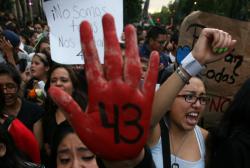
    The Mexican political crisis which arose on September 26 with the killing of six, wounding of 25, and kidnapping of 43 students by police and gangsters in the state of Guerrero, and was then compounded by revelations of a conflict of interest involving the Mexican president and his minister of finance, has been exacerbated in December by a dramatic collapse of oil prices, the decline of the Mexican peso, and a falling Mexican stock market.

    Since oil income represents the largest share of the Mexican government’s revenue, the decline in oil prices portends budget cuts which in turn could lead to more social strife.

    Protests against the government over its role in and handling of the students’ massacre and disappearances continued though they diminished as the Christmas season began on Dec. 6. The students’ parents and much of the Mexican public remain unconvinced of the government’s story that the students were arrested by the police, turned over to the Guerreros Unidos gang, and then incinerated. The fact that Mexican police use torture to extract false confessions to construct a narrative to protect the authorities is well documented by Mexican and international human rights organizations and well known to the public. So the demand for justice continues.

    Confidence in Government Evaporating

    At the same time, confidence in President Enrique Peña Nieto and his administration continued to evaporate as it was learned that not only had the president and his wife been living in a home owned by a big government contractor, but that Minister of Finance Luis Videgaray, architect of the country’s recent economic reforms, had also bought a home from another contractor, as reported in the Wall Street Journal on Dec. 11. Conflict of interest and corruption are endemic in the Mexican government at all levels, but revelations that the president and his finance minister themselves are curled up in bed with the corporations has shocked even the most cynical Mexicans.

    These revelations, together with the murder and disappearance of the Guerrero students have taken a toll on the president’s support. In the two years since Peña Nieto was elected president, polls conducted by the newspaper Reforma indicate that he has fallen in the public’s estimation by 11 percent, with only 39 percent feeling that he is doing a good job. Some 58 percent of the public and 79 percent of opinion makers believe he is doing a bad job.

    Some in the opposition believe Peña Nieto’s administration faces an imminent breakdown. Senator Javier Corral of the conservative National Action Party (PAN), told the Mexico City daily La Jornada that in his opinion, “putting together all of the variables—the lack of economic growth, governmental incompetence, social irritability, political corruption, which includes the scandals of the president’s wife and now of Videgaray, as well as an absolute crisis of insecurity—the government of Peña Nieto is collapsing.”

    The New Oil Crisis

    Mexico’s economy faces serious problems at the moment, and they begin with oil.

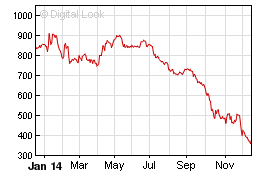
    World oil prices are collapsing. In the summer, oil was selling for $107 per barrel. Since June the price of oil has fallen nearly 50 percent, with oil selling for less than $56 a barrel on Dec. 15. This is mostly due to the United States increasing oil production by more than 70 percent, while demand for oil has also fallen. Countries like Iran, Iraq, Russia, Venezuela and Mexico will be hard hit by this crisis.

    Image

    This graph shows the decline of oil prices over the last year.

    The collapse of oil prices will likely lead the Mexican government to let oil contracts to foreign companies as soon as possible, before prices fall even further.

    Oil income revenues represent the largest single element of Mexican government revenue, and according to one study, the country will receive only 37 percent of the revenue from oil that it had budgeted. This almost certainly means that there will have to be budget cuts that will affect social services, which could lead to more social turmoil.

    Then there is the falling peso. As a result of the oil crisis but perhaps also as a result of Mexico’s deepening political crisis, the value of the peso has fallen by almost half. The Mexican Central Bank has announced that every time the peso falls by more than 1.5 percent it will intervene to stabilize the peso. The devaluation of the peso represents a vote of no confidence in the government, while it also makes its exports cheaper, and constitutes a de facto wage cut for Mexican workers.

    Image

    Note the rise of the number of pesos it takes to equal one U.S. dollar; that is the fall in the peso’s value.

    At the same time, the Mexican stock market has been falling, for example losing 3.5 percent of its value on Dec. 16.

    Foreign direct investment (FDI) is one measure of international investors’ confidence in Mexico and a projection of the future growth of the Mexican economy. Mexico reported US$35.2 billion in FDI in 2013 while, at the same time, FDI in mining was US$2.1 billion for the first nine months of 2014. Those represented a return to levels before the 2008 Great Recession. But FDI in 2014 has declined as shown in the graph below and may not reach US$30 billion this year.

    Image

    While the Mexican economic situation looks bleak, Agustín Carstens, governor of the Bank of Mexico, expressed confidence that, “We are well prepared to face the storm blowing in from outside.” He emphasized that Mexico has international reserves of US$192 billion and has just received a flexible credit line from the International Monetary Fund of US $70 billion. Mexico’s money in the bank and good credit with the IMF does not, however, mean much to most of the country’s people.

    Mexico’s Persistent Poverty

    The current political crisis is in large measure an expression of Mexico’s persistent poverty, a situation that has particularly affected the country’s youth, the force that is driving the current wave of protests over the student disappearances. A recent study published by the Economic Commission for Latin America (ECLAC/CEPAL), as reported on Telesur found that:

    “Out of 38.9 million Mexican young people from 12 to  29 years of age, six million live in a situation of indigence, while 44.9 percent live in some type of poverty. Some 70 percent of Mexican youth lack access to social security, 30 percent to health services, and 15.3 percent to adequate educational opportunities. More than half the country’s unemployed population falls into this age group. The unemployment rate for youth rose to 7.7 percent in 2013, much higher than the 4.6 percent national average.”

    In fact, not only youth, but half of all Mexicans live in poverty, and almost ten percent live in extreme poverty.

    While I have been writing about Mexican labor, social movements, and politics over the past thirty years, these statistics have hardly changed. Though the nationalist economic model of state-owned industries has been replaced by the neoliberal free market model, and though the relative weight of agriculture and industry have changed, and though ten percent of all Mexicans have left the country to go to live in the United States, still, year in and year out, about half of all Mexicans live in poverty. It is this persistent poverty, exacerbated by growing inequality as Mexico produces ever more billionaires, that forms the background to the past social upheavals, to the current crisis, and to the coming ones. Until there is a fundamental change in country’s political, economic, and social system, we can expect continued social eruptions in Mexico.

    Future Prospects

    What, then, are the prospects in Mexico, given the underlying social situation and the current political crisis? Well, first, there are several possibilities in Mexico that are precluded by the United States’ government: 1) the election of a left government; 2) a military coup; or 3) a total breakdown in social order. The United States must maintain a nominal democracy in Mexico or, if it cannot preserve democracy in North America and in its “own backyard” (as Mexico is always so disrespectfully called), it will lose credibility throughout the world. To say nothing of the billions of dollars of U.S. investments in Mexico that must be preserved.

    The question, then, is whether or not there exist social forces that could create a unified movement for the genuine reform of the Mexican government. Reform, because the possibility of revolution in Mexico is impossible without a broad unified movement and a strong left party, neither of which exist at this time.

    While the Mexican government seems in this current conjuncture to be facing serious problems, there is no strong political party on its right or its left that is prepared to push to see if the Peña Nieto administration can be forced to step down. The National Action Party (PAN) is too deeply involved in the political and economic system to risk a serious challenge that might go further than it intends. On the left, the situation is not so different where calls for change are not accompanied by the organization of mass action. Andrés Manuel López Obrador, head of the Movement of National Regeneration Party (MORENA) and the country’s leading left politician, has been calling for months for Peña Nieto to step down, but his call has found little response beyond his own party and others on the left, perhaps because so many Mexicans are cynical about all of the political parties.

    The large and important wave of protests will likely decline during the Christmas season which continues until January 3, and so far they have not led to the building of a massive, national movement that might first bring down Peña Nieto and then put fundamental change on the social agenda. We will wait to see if the movement returns to the streets in January and if it grows.

  • A Herstory of the #BlackLivesMatter Movement

    Image

    I created #BlackLivesMatter with Patrisse Cullors and Opal Tometi, two of my sisters, as a call to action for Black people after 17-year-old Trayvon Martin was post-humously placed on trial for his own murder and the killer, George Zimmerman, was not held accountable for the crime he committed. It was a response to the anti-Black racism that permeates our society and also, unfortunately, our movements.

    Black Lives Matter is an ideological and political intervention in a world where Black lives are systematically and intentionally targeted for demise.  It is an affirmation of Black folks’ contributions to this society, our humanity, and our resilience in the face of deadly oppression.


    We were humbled when cultural workersartistsdesigners and techies offered their labor and love to expand #BlackLivesMatter beyond a social media hashtag. Opal, Patrisse, and I created the infrastructure for this movement project—moving the hashtag from social media to the streets. Our team grew through a very successful Black Lives Matter ride, led and designed by Patrisse Cullors and Darnell L. Moore, organized to support the movement that is growing in St. Louis, MO, after 18-year old Mike Brown was killed at the hands of Ferguson Police Officer Darren Wilson. We’ve hosted national conference calls focused on issues of critical importance to Black people working hard for the liberation of our people.  We’ve connected people across the country working to end the various forms of injustice impacting our people.  We’ve created space for the celebration and humanization of Black lives.

    The Theft of Black Queer Women’s Work

    As people took the #BlackLivesMatter demand into the streets, mainstream media and corporations also took up the call, #BlackLivesMatter appeared in an episode of Law & Order: SVU in a mash up containing the Paula Deen racism scandal and the tragedy of the murder of Trayvon Martin.

    Suddenly, we began to come across varied adaptations of our work—all lives matter, brown lives matter, migrant lives matter, women’s lives matter, and on and on. While imitation is said to be the highest form of flattery, I was surprised when an organization called to ask if they could use “Black Lives Matter” in one of their campaigns. We agreed to it, with the caveat that a) as a team, we preferred that we not use the meme to celebrate the imprisonment of any individual and b) that it was important to us they acknowledged the genesis of  #BlackLivesMatter.  I was surprised when they did exactly the opposite and then justified their actions by saying they hadn’t used the “exact” slogan and, therefore, they deemed it okay to take our work, use it as their own, fail to credit where it came from, and then use it to applaud incarceration.

    I was surprised when a community institution wrote asking us to provide materials and action steps for an art show they were curating, entitled “Our Lives Matter.”  When questioned about who was involved and why they felt the need to change the very specific call and demand around Black lives to “our lives,” I was told the artists decided it needed to be more inclusive of all people of color. I was even more surprised when, in the promotion of their event, one of the artists conducted an interview that completely erased the origins of their work–rooted in the labor and love of queer Black women.

    Pause.

    When you design an event / campaign / et cetera based on the work of queer Black women, don’t invite them to participate in shaping it, but ask them to provide materials and ideas for next steps for said event, that is racism in practice.  It’s also hetero-patriarchal. Straight men, unintentionally or intentionally, have taken the work of queer Black women and erased our contributions.  Perhaps if we were the charismatic Black men many are rallying around these days, it would have been a different story, but being Black queer women in this society (and apparently within these movements) tends to equal invisibility and non-relevancy.

    We completely expect those who benefit directly and improperly from White supremacy to try and erase our existence.  We fight that every day.  But when it happens amongst our allies, we are baffled, we are saddened, and we are enraged.  And it’s time to have the political conversation about why that’s not okay.

    We are grateful to our allies who have stepped up to the call that Black lives matter, and taken it as an opportunity to not just stand in solidarity with us, but to investigate the ways in which anti-Black racism is perpetuated in their own communities.  We are also grateful to those allies who were willing to engage in critical dialogue with us about this unfortunate and problematic dynamic .And for those who we have not yet had the opportunity to engage with around the adaptations of the Black Lives Matter call, please consider the following points.

    Broadening the Conversation to Include Black Life

    Black Lives Matter is a unique contribution that goes beyond extrajudicial killings of Black people by police and vigilantes.  It goes beyond the narrow nationalism that can be prevalent within some Black communities, which merely call on Black people to love Black, live Black and buy Black, keeping straight cis Black men in the front of the movement while our sisters, queer and trans and disabled folk take up roles in the background or not at all.  Black Lives Matter affirms the lives of Black queer and trans folks, disabled folks, Black-undocumented folks, folks with records, women and all Black lives along the gender spectrum.  It centers those that have been marginalized within Black liberation movements.  It is a tactic to (re)build the Black liberation movement.

    When we say Black Lives Matter, we are talking about the ways in which Black people are deprived of our basic human rights and dignity. It is an acknowledgement Black poverty and genocide is state violence.  It is an acknowledgment that 1 million Black people are locked in cages in this country—one half of all people in prisons or jails—is an act of state violence.  It is an acknowledgment that Black women continue to bear the burden of a relentless assault on our children and our families and that assault is an act of state violence. Black queer and trans folks bearing a unique burden in a hetero-patriarchal society that disposes of us like garbage and simultaneously fetishizes us and profits off of us is state violence; the fact that  500,000 Black people in the US are undocumented immigrants and relegated to the shadows is state violence;.the fact that Black girls are used as negotiating chips during times of conflict and war is state violence; Black folks living with disabilities and different abilities bear the burden of state-sponsored Darwinian experiments that attempt to squeeze us into boxes of normality defined by White supremacy is state violence.  And the fact is that the lives of Black people—not ALL people—exist within these conditions is consequence of state violence.

    When Black people get free, everybody gets free

    #BlackLivesMatter doesn’t mean your life isn’t important–it means that Black lives, which are seen as without value within White supremacy, are important to your liberation. Given the disproportionate impact state violence has on Black lives, we understand that when Black people in this country get free, the benefits will be wide reaching and transformative for society as a whole.   When we are able to end hyper-criminalization and sexualization of Black people and end the poverty, control, and surveillance of Black people, every single person in this world has a better shot at getting and staying free.  When Black people get free, everybody gets free.  This is why we call on Black people and our allies to take up the call that Black lives matter. We’re not saying Black lives are more important than other lives, or that other lives are not criminalized and oppressed in various ways.  We remain in active solidarity with all oppressed people who are fighting for their liberation and we know that our destinies are intertwined.

    And, to keep it real–it is appropriate and necessary to have strategy and action centered around Blackness without other non-Black communities of color, or White folks for that matter, needing to find a place and a way to center themselves within it.  It is appropriate and necessary for us to acknowledge the critical role that Black lives and struggles for Black liberation have played in inspiring and anchoring, through practice and theory, social movements for the liberation of all people.  The women’s movement, the Chicano liberation movement, queer movements, and many more have adopted the strategies, tactics and theory of the Black liberation movement.  And if we are committed to a world where all lives matter, we are called to support the very movement that inspired and activated so many more.  That means supporting and acknowledging Black lives.

    Progressive movements in the United States have made some unfortunate errors when they push for unity at the expense of really understanding the concrete differences in context, experience and oppression.  In other words, some want unity without struggle.  As people who have our minds stayed on freedom, we can learn to fight anti-Black racism by examining the ways in which we participate in it, even unintentionally, instead of the worn out and sloppy practice of drawing lazy parallels of unity between peoples with vastly different experiences and histories.

    When we deploy “All Lives Matter” as to correct an intervention specifically created to address anti-blackness, we lose the ways in which the state apparatus has built a program of genocide and repression mostly on the backs of Black people—beginning with the theft of millions of people for free labor—and then adapted it to control, murder, and profit off of other communities of color and immigrant communities.   We perpetuate a level of White supremacist domination by reproducing a tired trope that we are all the same, rather than acknowledging that non-Black oppressed people in this country are both impacted by racism and domination, and simultaneously, BENEFIT from anti-black racism.

    When you drop “Black” from the equation of whose lives matter, and then fail to acknowledge it came from somewhere, you further a legacy of erasing Black lives and Black contributions from our movement legacy. And consider whether or not when dropping the Black you are, intentionally or unintentionally, erasing Black folks from the conversation or homogenizing very different experiences.  The legacy and prevalence of anti-Black racism and hetero-patriarchy is a lynch pin holding together this unsustainable economy.  And that’s not an accidental analogy.

    In 2014, hetero-patriarchy and anti-Black racism within our movement is real and felt. It’s killing us and it’s killing our potential to build power for transformative social change.  When you adopt the work of queer women of color, don’t name or recognize it, and promote it as if it has no history of its own such actions are  problematic.  When I use Assata’s powerful demand in my organizing work, I always begin by sharing where it comes from, sharing about Assata’s significance to the Black Liberation Movement, what it’s political purpose and message is, and why it’s important in our context.

    When you adopt Black Lives Matter and transform it into something else (if you feel you really need to do that–see above for the arguments not to), it’s appropriate politically to credit the lineage from which your adapted work derived.  It’s important that we work together to build and acknowledge the legacy of Black contributions to the struggle for human rights.  If you adapt Black Lives Matter, use the opportunity to talk about its inception and political framing. Lift up Black lives as an opportunity to connect struggles across race, class, gender, nationality, sexuality and disability.

    And, perhaps more importantly, when Black people cry out in defense of our lives, which are uniquely, systematically, and savagely targeted by the state, we are asking you, our family, to stand with us in affirming Black lives.  Not just all lives. Black lives.  Please do not change the conversation by talking about how your life matters, too. It does, but we need less watered down unity and a more active solidarities with us, Black people, unwaveringly, in defense of our humanity. Our collective futures depend on it.


    Alicia Garza is the Special Projects Director for the National Domestic Workers Alliance. Alicia comes to NDWA after serving as Executive Director of People Organized to Win Employment Rights (POWER) in San Francisco since 2009. Under her leadership, POWER won free local public transportation for youth; fought for a seat at the table in some of the most important land use decisions affecting working-class families; beat back regressive local policies targeting undocumented people; organized against the chronic police violence in Black neighborhoods; and shed light on the ongoing wave of profit-driven development that contribute to a changing San Francisco. In 2013, Alicia co-founded #BlackLivesMatter, an online platform developed after the murder of Trayvon Martin, designed to connect people interested in learning more about and fighting back against anti-Black racism. Alicia currently serves on the Board of Directors for the School of Unity and Liberation (SOUL) in Oakland, California, and is a contributing writer for WarTimes magazine.


  • "Class, Race, Gender and U.S. Policing"

    Image

    The white supremacist policing practices behind the murder-by-cop epidemic is really a capitalist, white supremacist, heteropatriarchal policing system that must be analyzed and fought as such.”

    U.S. capitalism’s white supremacist foundation – expressed in phases from primitive wealth accumulation through stolen land and chattel slavery, to segregation, industrial/ agricultural labor exploitation, and relocation, to our current mass incarceration/deportation, and First Nations' land and sovereignty violations – is on full display as more high profile murder-by-cop cases are supposedly resolved through exoneration.

    Forever redefining the term “Black Friday,” last week's Michael Brown/ anti-policing demonstrations, led by determined Ferguson citizens (and the cop acquittals and recent protests against Eric Garner's murderer), reveal exoneration of murdering cops might be routine, but there’s nothing routine about the anti-policing movement’s response. The movement warns authorities that a sustained fight is being waged, led by a generation with the advantage of the past and present: they can access past movements' cumulative knowledge and new social media outlets (as compromised as these outlets can be for organizing.)  This is a very heartening and serious time for resistance, and it begs as much careful and considered reflection as it does directed action.

    One challenge faced by organizers seeking to connect the dots between struggles – expressed in the chant that moves from "Black Lives Matter" to "All Lives Matter" – is how to concretely understand the frequently asserted "connections" or (Kimberle Crenshaw's) "intersections" between class, race, and gender/ sexuality-based struggles. Clearly, women of color, like Detroit’s Renisha McBride, are police harassment and murder victims, too.  Black and brown people are being singled out by the racist policing/ deportation/incarceration system: this is one very concrete and simple unifying thread between struggles.

    But, there is also a deeper unifying factor here: the white supremacist policing practices behind the murder-by-cop epidemic is really a capitalist, white supremacist, heteropatriarchal policing system that must be analyzed and fought as such. In "Fear and Fantasy in Ferguson," Joe Lowndes dissects Darren Wilson's fantasy-based testimony about how threatened he felt by Michael Brown.  Lowndes concludes that "Wilson becomes an innocent child overpowered by a giant adult, instead of an armed adult who in fact killed a child." Setting aside, for some other time, analysis of the bizarre simultaneous presentation of police as both competent men’s men/military experts and helpless victimized babies, we can’t ignore how Wilson's style of victimization narrative is routinely found in domestic violence and gender-based hate crime narratives as well.  6’2” Wilson was rendered helpless (like a baby/woman) in the face of Brown’s hulking presence (!) But why open up the whole gender can of worms, when we already have a hard enough time relating the systems of white supremacy and capitalism?

    “Orthodox Marxists view anti-racist analysis/activism as some kind of threat to the real revolution or as a misguided form of false consciousness.”

    The idea that police serve capital's interest, and thus that the category of "class" is central in anti-policing work, is perhaps the most commonly shared radical leftist insight when it comes to the issue of hostile policing.  (Was I the only one whose eyes glazed over during post-Wilson verdict Facebook threads where people boldly asserted, in their pseudo-sophisticated manner, that the murder-by-cop epidemic is "more about class" and "less about race" – as if we have to choose?) When examining the police state apparatus, it's patently obvious that poor neighborhoods are heavily targeted and policed, poor people can't afford private attorneys and bail, and the American business class’ unregulated and unpunished white-collar crime is permitted as reasonable, even dutiful, wealth acquisition.  There’s really not that much sophistication in this type of analysis.

    Regarding popular leftist analysis of  the current police state apparatus, class comfortably takes its place at the head of the table, with race either right beside it or sitting on its lap – and both are loudly asserting, "Serve me first!" (Gender was never invited.)  A mere assertion of the category of "race-class" handles the conceptual challenge of describing "white supremacist or racial capitalism," for the most part, and it’s amazing to watch the pageantry of avoidance undertaken by various political tendencies – including orthodox Marxists and liberals – in times of crisis, such as now. Orthodox Marxists view anti-racist analysis/activism as some kind of threat to the real revolution or as a misguided form of false consciousness.  In an effort to deny their own privilege and personal racial investments, white liberals jump into bed with orthodox Marxists, asserting that murder-by-cop is “about class, not race." (On the flip side, we see liberals/ progressives of color willing to talk about race here, but avoid its systemic links to capitalism at every turn.) Suddenly, it seems, everyone becomes an amateur Sociological theorist, acting as if sources of systemic violence are self-evident and can be scientifically traced in this late, great, and messy epoch of the corporate state’s war against almost everyone.

    “Louima’s rape-by-cops needs to be analyzed in the historic context of post-slave era race relations, as rape was a projected white male fear used to justify the lynching system.”

    The category of “race-class” works well to make the basic, yet poignant, point that we are not going to sacrifice an analysis of white supremacy for a unifying mandate of anti-capitalist struggle (as recent new social movement history reveals, this logic never works out well for the majority of us who are non white males!)  It's difficult enough to establish "race-class” or "racial class" as analytic categories in the anti-policing movement.  So, why bring the gender/sexuality category in here at all? The feminized, “cop-victim” language found in Darren Wilson's testimony, and high profile old and newer cases like Abner Louima’s rape and Marissa Alexander’s forced guilty plea, show that insertion of gender/sexuality into the analysis isn't opening up a can of worms.  That can has been opened up for us by the corporate state’s sanctioning of mass police violence, and we should respond accordingly with the most accurate analysis and activism possible.

    American policing’s complex class, race and gender dimensions require more than an "additive model," where either capitalism or white supremacy is viewed as "the core" system dictating the material effects of power (profiling, harassment, incarceration, and murder), with other categories added as a side dish to the main entree.  We need a truly intersectional model where we can consider oppression’s categorical likenesses, co-dependencies, and dissimilarities as manifest in social lives and movements.

    The August 9, 1997, rape-by- cops of Haitian immigrant Abner Louima is a real eye-opener regarding the relevance of (Kimberle Crenshaw's) "intersectional" – class, race, and gender – analysis. White police officers from Manhattan's 70th precinct arrested 30 year-old male, Louima, because he was apparently mistaken for someone else.  They arrested him and took him to their precinct where they beat him with several objects (and their fists) before finally anally raping him with a toilet plunger's and broom's wooden handles.  Louima survived the attack, and in a rare case of justice delivered, the police were prosecuted. This case looms large as an egregious example of police brutality in the form of sadistic rape. It's evident that the need for gender/ sexuality analysis cannot be denied here.  Louima’s rape-by-cops needs to be analyzed in the historic context of post-slave era race relations, as rape was a projected white male fear used to justify the lynching system.

    During the post-Emancipation South's lynching era, sexual dominance and rape became an important regulator of race relations.  In White Women, Black Men:  Illicit Sex in the Nineteenth Century South, Martha Hodes states that before emancipation and during the Civil War, white society reacted to affairs between white women and black men with tolerance or denial.  But when the slave system's racial order came crashing down, fictitious tales of aggressive black male sexuality took hold of the white imagination.  This imagined, over sexed, black male enemy was used to justify the lynch system.  It was at this time that gendered norms of (passive/white) female and (active/black) men became culturally encoded and sexualized – and lynching became systematically employed to punish imagined rape through real murder.

    “The imagined, over sexed, black male enemy was used to justify the lynch system.”

    Abner Louima’s rape-by-cops reveals racialized police violence has a historically resonant gender/sexuality dimension; no doubt those cops were consciously or unconsciously enacting revenge against all presumed black male rapists in a sexualized gesture of racial dominance.  (The white psychic origins of the “black male rapist” is difficult to explain, but nonetheless real.) Racial violence has its sexual expressions just as sexual violence has its racial expressions.  Or to put it another way, the practice of rape, which has been one historic hallmark of feminist/womanist struggle, does not remain squarely in the gender/ sexuality system.  Rape-ism is a hostile expression of racism: it was a central method used by white male masters to subordinate black female slaves, after all.

    Gender/sexuality in the anti-policing struggle does not stop at police harassment, rape, and murder of trans/women of color, or the more sensational cases like Louima's.  We see the gender/sexuality dimension of the policing system laid bare in the legal system’s enforcement of generalized "female/passive" and "male/active" gender roles (although the strict equation of female/passive is itself dependent upon racial identities).  Consider sentencing disparities for women defending themselves in domestic violence cases, or even, sentencing disparities for men and women who commit murder in intimate partner violence contexts. According to the Michigan Women's Justice and Clemency Project, "the average prison sentence for men who kill their intimate partners is 2 to 6 years. Women who kill their partners are sentenced, on average, to 15 years." This simple statistic reveals that there is a higher price to pay for women than men when it comes to committing violent acts.  Couple this with the fact that women of color and low income women aredisproportionately affected by mandatory arrest policies for domestic violence, we see how gender and race oppression work together to produce these disparate sentencing outcomes.

    Floridian Marissa Alexander's self-defense case exposes the racially coded Stand your Ground law's white supremacist facilitation of a quick defense strategy for white perpetrators in a racist, trigger-happy gun culture environment – see George Zimmerman's acquittal in the harassment, stalking, and murder of Trayvon Martin for more details. That the state initially sought to incarcerate Alexander (who is black) for 60 years because she fired a warning shot while feeling threatened in a domestic violence altercation, shows that Stand Your Ground, which was not used as her defense when it actually applied, is not intended for use by black shooters.  (I don't know if we can find better evidence of the white supremacist intent behind Stand Your Ground than Alexander's case). But Alexander's case also shows us that a black female defending herself in a domestic violence situation will receive the most heavy-handed weight of the racist patriarchal legal/ policing apparatus.  Alexander is dealing with the double jeopardy of her race and gender in this extreme case of sentencing and punishment (she recently agreed to end the four year case by pleading guilty, receiving time served, and she will be released on January 27, 2014.)

    “There is a higher price to pay for women than men when it comes to committing violent acts.”

    The racial framing of Alexander's guilt as an "aggressive and armed" black perpetrator, combined with the gendered framing of her guilt as a woman with the nerve to defend herself during a violent male threat has led to her trial’s "guilty" outcome.  In addition to Stand Your Ground's racial purpose being placed front and center in this case, we are again reminded that the legal/policing apparatus has to enforce gender roles, because they are far from natural.  So anything other than female passivity is punished through domestic violence victims' harsh sentencing because they fight back instead of accept violence – "like a real woman."

    How does this all get back to Michael Brown and Eric Garner's murders – and the anti-policing movement?  We are inundated by capitalist, white supremacist patriarchal legal/policing ideologies that locate, frame, and decide guilt and innocence in historically prescribed terms rooted in yesteryear’s violent lynching system – and colonial conquest/ slavery before that.  That lynching's ideological locus was not simply motivated by white supremacy, but a perversely preoccupied discourse of imagined sexual dominance of the white female at the black male's hands.  This reminds us that events of social domination – including the racist epidemic of murder-by-cop and vigilante murder (George Zimmerman and Michael Dunn in Florida) – are not singularly expressed along prescribed systemic lines (class, race, and gender/ sexuality), but these events definitely emanate from the corporate state's white male heterosexual ethos.  This is an ethos that is essentially a crisis, due to its illegitimacy.  In a seemingly psychotic paradox, this system has all its (military) equipment, but it persists in evoking its imagined white vulnerability in the face of darker people's also imagined predatory (and highly sexualized) prowess.  

    Class, race, and gender/sexuality swirl together like colors in one of those psychedelic paintings made so popular during the last big upheaval of the 1960’s and 70’s.   Amidst this complex swirl of institutions, ideologies, and identity positions – or systems, standpoints, and subjects – one ultimate unifying truth stands out.  The corporate state relies on policing the social body because submission is not natural.  Submission is a crafted, highly policed, and imagined social fiction that benefits the few, and unites the majority of us, against this policing ethos – this capitalist, white supremacist, and heteropatriarchal omni-crisis.

    *Michelle Renee Matisons, Ph.D. can be reached at michrenee@gmail.com. This article was originally published in Counterpunch and also reprinted in Black Agenda Report.


  • The Faults of American Criminal Justice Run Deeper than Race

    Image

    For those continually exasperated by the spate of white denials of racism in the face of blatantly racist police murders, the #CrimingWhileWhite stories on Twitter were a gratifying rebuttal. 


    By offering a mountain of testimony in the form of direct race-based compare-and-contrast stories, the meme undermined the country's pernicious refusal to acknowledge that perhaps, just perhaps, it might be good to be in the upper caste. In making explicit what all secretly know to be true, an honest conversation seemed at last to be occurring.  

    But one thing remains puzzling about the picture being painted by #CrimingWhileWhite tweets: Who are all these people who have had such positive interactions with cops? Many poor white people might be surprised that "Criming While White" apparently gets one a free pass, and so would the large population of regularly-brutalized homeless people in my own hometown of Sarasota, Florida. The problem with the concept, then, is not that it gives priority to white voices, as some argued, but that it reinforces the myth that the police can have some trace of benevolence, that there is an ideal justice system in miniature lurking beneath the visible one. In doing so, it prevents a full reckoning with American criminal justice’s corrosive faults, and limits possibilities for altering it. 

    The fact is that a bloated, unaccountable police force victimizes a wide swath of people, and that being a member of a privileged race is not always protection. Certainly it wasn't for Kelly Thomas, the homeless man murdered by Fullerton, California police officers. As the schizophrenic Thomas had the life beaten out of him behind the Slidebar Rock-N-Roll Kitchen,he called out hopelessly for his father: “Dad…Dad…Dad.” Thomas didn't fare any better than Eric Garner, except that his officers were put on trial– before being acquitted.

    And so, as the #Criming tweeters painted their picture of an Andy Griffith world of policing, in which whiteness means the local sheriff laughs off your latest teen indiscretion and drops you at your parents' doorstep, it didn’t quite ring true. The fact is that unless you are both white and wealthy, the police are a largely antagonistic force.

    Of course, the level of mistreatment and violence against blacks is unparalleled. But if a theory is to hold, it must be able to deal with exceptional cases, such as the death of a mentally-ill white man at the hands of a Hispanic police officer. If the problem with the American criminal justice system is that it is racist, how can one explain such an incident except as an aberrational absurdity? But it is not an aberrational absurdity; it is a core reality of contemporary criminal justice.

    Constitutional law professor James Forman has pointed this out in critiquing the concept of "The New Jim Crow." As Forman puts it, “The Jim Crow claim is, at the end of the day, an appeal to the base—a metaphor with great potential to mobilize blacks and racial justice advocates to care about mass incarceration. But it comes at a cost—namely, the analogy does not encourage other racial groups to recognize that, on this issue, black interests coincide with their own.” Kelly Thomas didn't have any better luck on account of his race, nor did Dillon Taylor, the unarmed white man gunned down by Salt Lake City police in August, or Robert Saylor, the man with Down’s syndrome asphyxiated by deputies when he refused to leave a movie theater. The homeless and mentally ill of either race, and many poor people generally, can report that life is no #CrimingWhileWhite picnic. The undesirable and excluded are universally subjected to the policeman’s billy club.

    Not accepting this important nuance could have devastating consequences for a movement. If analysis begins and ends at “Black lives matter,” what becomes of the Muslim lives continually under police surveillance since 9/11? The homeless lives who are under daily harassment? The brown lives threatened by a ruthless deportation regime? The more than 200,000 women’s lives in America’s prisons?

    Furthermore, if exorcising racism is taken to be the sole objective, campaigners might be at risk of getting exactly what they wish for: police will diversify their ranks and reduce the ugly racial statistical imbalance, yet ultimately will become not a shred less vindictive, violent, and unaccountable.

    This same trap occurs in discussions of the American death penalty. We can say the death penalty is racist, which is true. But ending our diagnosis there means leaving open the possibility for the state to simply iron out the disparities: as long as people are being executed without regard to their race, there can be no problem. We lack a framework to deal with the case of Scott Panetti, the hideously mentally ill white man under threat of execution in Texas. The point that should be being made is that the death penalty is wrong because it is immoral, not wrong because it is racially disparate. Similarly, American policing must be condemned, not only because it continues Jim Crow, but because it is an uncontrollable, militarized, and yes, racist leviathan that tramples the vulnerable to death without consequence.   

    This does add a small amount of complexity to the post-Ferguson project. But it should not be difficult to simultaneously hold the twin beliefs that criminal justice is racial in nature and that there is an economic elite who enjoy advantages that the poor, no matter what their race, do not. Race-based and class-based analyses of power are not alternatives, they are complements. Each is a hierarchy, and they manifest in different, intricate ways. This is what the theory of “intersectionality” is supposed to be useful for: there are bigotries that a white homeless woman will face that a black male executive will not, and vice versa. But the strategy for success is solidarity among the weak against the strong.

    Race is the central fact of American criminal justice. But race is not the only fact. Understanding this system, and dismantling it, requires understanding that the existence of racism doesn’t preclude the possibility of class domination. It requires affirming simultaneously that black lives matter, and that every oppressed life matters. And it requires that we be haunted not only by Eric Garner’s “I can’t breathe,” but by Kelly Thomas’s “Dad…Dad…Dad…”

    .*Nathan Robinson is a Ph.D student in Sociology and Social Policy at Harvard University, who also writes left-wing children's books like Don't Let the Pigeon Question the Rules! and The Man Who Accidentally Wore His Cravat to a Gymnasium. He has also written for Salon, Campus Progress, and The Hartford Courant as well as for the New Politics.


  • A New American Civil Rights Movement is Being Born

    Image

    A new civil rights movement is arising in the United States.


    Across America from New York to California, in all of the major cities, there have been militant, disruptive demonstrations involving altogether tens of thousands in protests against the police killing of Michael Brown and Eric Garner and the failure of grand juries in either Missouri or New York to indict the police officers who killed them. Beginning in Ferguson, Missouri (near St. Louis) in August, the protests have continued throughout the fall, culminating in a massive movement for days in December. On December 13 hundreds of thousands of protestors marched New York City and Washington, D.C. and other cities. We may be at the beginning of something new, big, and important.  

    Protestors raise their hands shouting “Hands Up, Don’t Shoot,” as Brown is believed to have done. Others grab their throats and scream “I can’t breathe” eleven times as Garner did as he died, an event recorded on a cell phone video and seen by millions now. The demonstrations are diverse in every way: African Americans, whites, Latinos and Asians, mostly young but including people of all ages.

    Where I live in New York we have marched through the streets for miles from Union Square to Harlem, we have blocked major intersections and highways, and we have held die-ins in front of the Barclay Center sports arena where the Brooklyn Nets were playing. In Chicago protestors blocked Lake Shore Drive, a major thoroughfare, while in Berkeley and Oakland they shut down Interstate Highway 80. Hacktivists also shut down several City of Oakland websites. Hundreds have been arrested, though by and large the police have been restrained, and there has been nothing like the massive repression experienced by the Occupy Wall Street movement.  

    While the conservative Fox News has consistently supported the white police officers and denigrated the black victims, one CNN reporter cried as she described the diversity and idealism of the demonstrators. Liberal media coverage of the events has been largely sympathetic and has provoked a national conversation about the status of African Americans that goes beyond criminal justice issues to questions of the economy, to jobs, housing, and education. Some mainstream media commentators have described these developments as a new civil rights movement. And they are right.

    The events began in July and August. A police officer using an illegal chokehold banned by the New York City Police killed Eric Garner on July 27, an unarmed man wanted for selling untaxed cigarettes. Shortly afterwards there were small protests on Staten Island. Then on August 9, Michael Brown, an unarmed man, was stopped by a police officer and an altercation ensued. The officer fired twelve shots at Brown, killing him. When the grand jury refused to indict the officer, Ferguson erupted in violent protests that burned down a commercial district while across the country there were demonstrations in solidarity. Then in December the New York grand jury announced that it would not indict the police officer who had killed Garner back in July, even though coroner ruled his death a homicide resulting from compression of his neck. Of course, these were only the latest in a long list of African American men killed by the police. The Malcolm X Grassroots Movement has done a study showing that a black man is killed by police in America almost every day. No surprise then that when the police officer who killed Garner wasn’t indicted, once again the protests became national.

    Some of these demonstrations have been organized by old left organization or previously existing networks, but most of them have arisen spontaneously, organized on Facebook or Twitter. Longtime African American civil rights leaders such as Rev. Jesse Jackson, who first became prominent in the 1960s and Rev. Al Sharpton who first became a public figure in the 1980s, both of whom have been active in the Democratic Party, have attempted to keep the protests with in the usual liberal channels. But those in the streets are mostly in their teens, 20s, or early 30s, and the old civil rights leaders don’t speak to them or for them. Neither for that matter do the old left groups which have attempted to put themselves at the center of the movement. In truth, the enormous size and fluidity of the movement makes it impossible for any of America’s small left groups to have much impact.

    Like Occupy, where some of the leaders of this new movement got their first experience, this movement is largely spontaneous, decentralized, fast-paced, creative and daring. Most of its activists have never before been in a demonstration and hardly any have been part of a social or political organization. The movement doesn’t so much have a program as it has a moral cry: “Black Lives Matter.” People pour into the streets because they are filled with pain and sadness, with moral indignation, and because they want to live in a better country than the one we have now. As some have said, this is the “American Spring.”

    We see once again in these demonstrations—as we saw in Los Indignados of the Plaza del Sol and the Tahrir Square and Occupy Wall Street protests—the challenge: will a largely spontaneous mass movement create new organizations, push forward new leaders, develop a social and political program, or will the receding tide of the movement leave little behind? The African American civil rights movement of the 1955-1975 period created a whole series of organizations—SCLC, SNCC, and the Panthers—as well as important leaders such as Rev. Martin Luther King, Fannie Lou Hamer, Ella Baker and Malcolm X. Will this new movement create its own organizations, leaders, analyses and programs to match the moment? That’s the question.

    Dan La Botz is a co-editor of New Politics. This article was written for the Swiss socialit solidaritéS journal.


  • Teachers unions, police, and the real 'new civil rights movement'

                ImageWhen Rudy Giuliani blamed the deaths of unarmed Black men on teachers unions in appearances on Geraldo Rivera’s show and Fox News’ “Hannity,” Giuliani relied on the same logic that Rod Paige, Secretary of Education, employed in labeling the NEA a “terrorist organization.”  The argument may seem laughable to many on the Left, but Giuliani’s comment emerges from ideological assumptions articulated quite openly by neoliberals, especially in World Bank documents, ideas that are driving brutal education policies.

               Giuliani argues the real problem communities of color face is not militarization of police or brutality, but rather poverty and Black-on-Black crime, which requires a greater police presence, and results in the disproportionate arrests of Blacks. The solution to poverty (and therefore crime)? Education. "Maybe all these left-wing politicians who want to blame police, maybe there’s some blame here that has to go to the teachers union, for refusing to have schools where teachers are paid for performance, for fighting charter schools, for fighting vouchers so that we can drastically and dramatically improve education," Giuliani observes.

                That's not so far from the World Bank report “Great Teachers” explaining that while the current “deceleration” in the Latin American and Caribbean economies is due to external factors, like slower growth in China, we can't wait for capitalism to ameliorate poverty and its terrible social consequences. Instead we have to turn to education, “building human capital.” To do that, the reasoning goes, we must improve teacher quality, paying teachers for "performance," and changing who goes into teaching. The obstacle? Teachers unions.  “The deepest challenge in raising teacher quality is not fiscal or technical, but political, because teachers’ unions in every country in Latin America are large and politically active stakeholders." Teachers unions are therefore the enemy of economic progress, and governments must persuade parents and civil society to turn against them.

                Randi Weingarten, AFT President, responded  to Giuliani’s comment by asking in a tweet “Did #rudygiuliani really blame school teachers -not economics nor racism nor excessive force 4 #garner's death. Has he lost it?”  In ascribing Giuliani's argument to craziness, (Paige later dismissed his remark as a bad joke), Weingarten lost the opportunity to educate teachers and the public about the ideological battle being waged against teachers, their unions, and public education. We stand in the way of powerful elites controling who teaches and what is taught, as well as their profiting in the process.

                Giuliani was not the only pundit to link teachers unions and police brutality. One blogger demanded that teachers and teachers unions cause as much brutality to minority youth as do police. So let’s be clear about how police and teachers differ in what we do. Police are an arm of the state. Their job is to enforce the laws of the state although they may also help individuals in doing so. Teachers are paid by the state but our obligation is to our students. When the state directs us to do things that are unjust, our professional responsibility is to protect our students as best we can. Our job is to protect democracy.

                Cheerleaders for what’s called corporate education reform (I prefer to describe this as the neoliberal project) describe their agenda as the “new civil rights movement” and enlisted support from celebrity activist Rev. Al Sharpton.  In contrast we see an authentic civil rights movement mushrooming before our eyes. Young people have been protesting deportations, school closings, budget cuts to schools but now tens of thousands of youth, most of them African American, are taking to the streets, often in acts of civil disobedience, to express their rage and hurt at the vicious slayings of unarmed Black males.  

                We should assume that the powerful elites trying to dismantle public education and destroy teaching as a profession, globally, will use all of their resources to turn this authentic civil rights movement against the unions.  We see their strategy already in blogs claiming the unions and teachers are silent about racial justice.  While I welcome Randi Weingarten’s press release condemning the killing of Michael Brown and her arrest in a subsequent demonstration, there’s a legacy of mistrust between communities of color and teachers unions that is not going to be erased by solitary acts of union officials or their public statements.  To heal the breach we have to first admit there is one. Then we have to act like a social movement that is an ally. That means educating members about why the struggle for racial justice is in our best interest as teachers and union members, and then with their support providing material help to an ally we need – and which needs us. Help without control.         


    You can follow me on twitter  Facebook, as well as my blog here at New Politics

    (photo by @glennEmartin)

  • Hong Kong, Ferguson and New York City! Solidarity Statement with Black Communities in Ferguson, Missouri and NYC

    The following statement from Left 21 in Hong Kong was written in early December as the pro-democracy activists there were being driven from the streets. – Dan La Botz, Co-Editor

    From Hong Kong to Ferguson and NYC, we send you our warmest solidarity! 

    No to injustice! No to white supremacy!

    It was outrageous that the grand jury failed to indict Darren Wilson, who had shot unarmed 18-year old Mike Brown. We agree with you that: "The whole damn system is guilty as hell." 

    It was even more outrageous, that after that, Eric Garner’s the Grand Jury failed to indict!

    How can anyone trust the justice system, when the police can shoot you dead while unarmed, before you even reach a court? And when a man is killed by a policeman using an illegal chokehold, recorded on video but the policeman is still not even indicted? 

    All the common sense evidence points to systematic bias, within the police, within the courts and within government. How can democracy exist when these state institutions of courts and law enforcement are ridden with injustice? It is clear to us that genuine democratic governance does not exist in American society. 

    In Ferguson, the jarring truth of racism and injustice exploded with the case of Michael Brown, generating collective outrage against this system that produces these problems. We all know, sadly, that he is only one of many casualties of racist America. 

    We are aware that Black and poor communities in America face state violence, not only in the form of police shootings. It manifests in other aspects of your lives: unemployment, racist welfare laws, disproportionate policing, housing segregation, and health disparities. 

    We recognize that the police are not taking responsibility for your safety. Instead, not only do they squash dissent and free expression, they are sending in military equipmnt into the streets of Ferguson. It seems that the U.S. government and the police forces in your country are willing to use aspects of the military violence they have imposed on the people of Iraq and Afghanistan, and now too on you. 

    To the community of Ferguson and to those who care about justice and racial equality in the United States, we hope you keep going – keep fighting for what is right! Racial inequality is being used to justify and enable economic inequality and exclusion! 

    Here in Hong Kong too, we are fed up with our government doing things on behalf of the wealthy few, and willing to use the police to keep us from speaking out about injustice and broken promises.

    We have not had a genuine democracy, under British colonial rule nor now, under our “high degree of autonomy” with “one country, two systems” under the Chinese government. We have a small legislature dominated by the wealthy, and our Chief Executive was elected by only 689 votes in the last election. 

    Under our undemocratic system is slanted towards the wealthy, our poverty rate has been climbing, our housing has gotten less affordable, and 40% of our elderly are in poverty. The government has poured billions of dollars into development projects, refused to increased taxes on the wealthy, and still cries out that it lacks money to provide a decent universal elderly pension. In short, citizens are being excluded from the community’s wealth, and the "order" and "harmony" we see in the society is only the smooth surface hiding massive suffering and humiliation of our own people, imposed by our own government!

    All along, the Hong Kong government promised a system of universal suffrage and election of our own Chief Executive, but it has denied it over and over, despite the demands of hundreds of thousands of citizens.

    The students, supported by wide masses of the public, have come out to occupy major parts of Hong Kong, simply to demand the government keep its word.

    But in Hong Kong, as we see now that speaking out against injustice and government betrayal of its promise of democracy can lead one to face pepper spray, water cannons, and batons – from our own police! It doesn’t matter if we are students or doctors or journalists – the police have lost control, backed by the unconditional support of the government that is willing to use maximum force on its own citizens to restore an unjust order.

    Just as in Ferguson, we face a police force that has been given the task of basically punishing dissent – while claiming to uphold law. This government and police force have rejected genuine dialogue, denied its obligation to heed the voices of its citizens, and used weapons, threats and even proxy organizations to harass, stigmatize or silence the protesting citizens.

    Here, as in Ferguson and NYC, the laws, courts and legislative procedures claim to protect the innocent from abusers. The truth is we know that these institutions have been used to silence, jail and physically crush us, all in the name of the "law." 

    We know though, that the "law" and justice are not the same thing. We may not have the same struggles, but we share a common situation of government and the police falsely claiming authority over us, and abusing their position of authority and their legitimized use of force, to repress our voices and our just demands.

    No more injustice! Enough is enough! Police are not our rulers! No to militarization! No to social exclusion!

    Solidarity to Ferguson and to NYC! Black lives matter! 

    From Hong Kong to Ferguson and NYC, resist state violence!

  • Police Violence is Not Inevitable

    In the wake of a Missouri grand jury decision not to indict Darren Wilson, the police officer who shot and killed Michael Brown on August 9, it can be difficult to imagine a city in the United States where a police department and a largely black and Latino population work together productively.

    But it’s happening in Richmond, California, a gritty town in the San Francisco Bay Area best known for its massive Chevron refinery and, in past years, for its high crime rate. 

    Thanks to a decade-long experiment with “community policing,” violent crime in Richmond is down. Last year, this city of 100,000 had only 16 killings—the lowest number in 33 years—and far fewer unsolved homicide cases.

    Gun use by the Richmond Police Department (RPD) itself is also way down. Despite making thousands of arrests and confiscating one gun or more every day in the city, the RPD has averaged less than one officer-involved shooting per year since 2008. On September 6, The Contra Costa Times ran a story, citing these and other statistics. It was headlined: “Use of Deadly Force by Police Disappears on Richmond Streets.” 

    Police Chief Chris Magnus has been widely credited with implementing the reforms that led to these changes. In recognition of Richmond’s progress, and Magnus’s role in it, the U.S. Department of Justice recently added him to the panel of experts investigating the breakdown of police-community relations in Ferguson. 

    Magnus was unable to comment about the status of that inquiry or what recommendations might be made regarding the Ferguson police department. Magnus does believe that Michael Brown’s death and related civil unrest last summer has had one positive, far-reaching effect.

    “More communities are now taking a closer look at what’s going on in their own police departments and whether it meets their needs, including on issues involving race and diversity,” he said. “A critical look at any institution with as much power and authority invested in it as the police is probably a good thing.”

    A Community Policeman

    When Magnus first interviewed for the job of Richmond police chief in 2005, Richmond was notorious for its violent crime, youth gangs, illegal drugs, and troubled relations between police officers and city residents. 

    The city’s search committee wanted to hire a new chief who could reduce crime by reconnecting the police department to the people it serves. Those vetting Magnus were duly impressed with his credentials as just this kind of public safety reformer.

    Unfortunately for Magnus, there was the little matter of his previous posting. As police chief of Fargo, North Dakota, he hailed from one of the safest and whitest places in America. Fargo averages one homicide every two years, plus a famous Hollywood film by the same name helped make it synonymous with sleepy, small-town policing in the upper-Midwest.

    Richmond is not much bigger than real-life Fargo, but definitely poorer and more than 80 percent nonwhite. A decade ago, it was about to record an annual homicide rate of 47 per year. In terms of homicides per capita, Richmond was among the most dangerous places in the United States. 

    City officials in Fargo said Magnus had been effective during his 6 years as police chief there. Could his success dealing with “quality of life” issues in rural America be replicated in an urban environment with far greater racial diversity and no shortage of social dysfunction?

    “I really thought Fargo would be a disqualifier for me because of the demographics of the city,” he told The San Francisco Chronicle in 2005. Richmond’s municipal leaders, including Gayle McLaughlin, a Green Party member who will step down as mayor in January, decided that Magnus was the right man for the job anyway. Richmond hired Magnus in December 2005, and he has served throughout McLaughlin’s two terms as mayor.

    Magnus took one unusual step right away. Although most Richmond police officers live outside the city, he bought a home near downtown. From there, he could bicycle to work but, when he was off-duty, never get far from the daily challenges he faced. At home, he could hear police sirens late into the night, the occasional shot being fired, and members of his neighborhood association knocking on his door to report crimes nearby. (Since marrying Terrance Cheung, a top assistant to a county supervisor, Magnus has moved to a quieter part of Richmond, near the city outskirts.)

    In several recent interviews, Magnus explained what it took to re-orient police work in Richmond and establish greater trust in the department. During his nine years as chief, RPD reforms have fall into four main categories.

    1) Rewarding community connections

    Magnus began the process of change in Richmond by reshuffling the department’s command structure and promoting like-minded senior officers.

    He also ended the practice of putting “street teams” into high crime neighborhoods, where they would “roust anybody who’s out walking around, with the idea that they might have a warrant outstanding or be holding drugs.” In his view, that approach only “serves to alienate the whole population that lives in those neighborhoods,” most of whom are “good people not engaged in crime.” 

    Patrol officers were given more regular beats and directed to spend more time on foot, rather than in squad cars. Their job evaluations and career advancement are now tied to the success of their community engagement and individual relationship building.

    “We assign people for longer periods of time to specific geographic areas with the expectation that they get to know and become known by residents,” Magnus explains. “They are in and out of businesses, nonprofits, churches, a wide variety of community organizations, and they come to be seen as a partner in crime reduction. Our idea is that you’re not going to be able to just arrest your way out of crime, but that you have to develop a wide range of strategies that involve community members as partners to really improve public safety.”

    2) Diversifying the Force

    As chief, Magnus has made it a top priority to hire and promote more women, Asians, Latinos, and/or African-Americans. 

    “When you have a department that doesn’t look anything like the community it serves, you’re asking for trouble, no matter how dedicated and professional your employees are,” he says. “So an ongoing mission for us here is to hire the highest quality people that represent that diversity of the community, across the board. I don’t even just mean from a racial, ethnic, or gender standpoint. I mean in terms of life experiences, being connected to neighborhoods, growing up either in Richmond or cities like Richmond.”

    The RPD has changed record-keeping systems since Magnus took office, making it difficult to compare diversity figures directly. But, according to Deputy Chief Allwyn Brown, about 40 percent of the department’s 182 active police officers are white, while the remaining 60 percent are from minority groups. There are now 26 female officers on the force, including highly visible leaders like Captain Bisa French and Lieutenant Lori Curran. 

    3) Partnering with neighborhood groups

    Under Magnus, the RPD has worked closely with the Office of Neighborhood Safety (ONS), a city hall-based program which deploys a network of street-smart youth mentors to identify teenagers most at risk of joining gangs or engaging in gun violence.

    ONS has enrolled scores of young men and women in a “Peacemaker Fellowship,” designed to provide job training, counseling, and financial support to young people who agree to abandon a life of crime. Mother Jones hailed the program as a way for the city “to bring down its murder rate by paying people not to kill.”

    In a city with frequent marches and demonstrations, the RPD has also distinguished itself for working with community organizers to minimize street protest tensions. Even the RPD’s handling of large-scale disobedience, like a sit-in in 2013 at the entrance to the Chevron refinery or more recent skirmishing about the transportation of crude oil through the city by train, won praise from activists wary of most other law enforcement agencies. 

    According to Andres Soto, a native of Richmond and a leading environmental justice campaigner, the city has come a long way from the days when “there were not a lot of professional standards” in the hiring of new officers. Years ago, he recalls, Richmond employed too many “ex-military, thuggish cops and rednecks” whose behavior led to costly police brutality cases and civil rights suit settlements.

    “It can be helpful for officers to have had military experience,” Magnus points out. “But, at the same time, we also want people who can shift gears … and be able to interact, in a very different way, with community members, who can show empathy with victims of crime, who are not afraid to smile, to get out of the police car and interact in a positive way with people, who can demonstrate emotional intelligence, who are good listeners, who have patience, who don’t feel that it takes away from their authority to demonstrate kindness.”

    4) Better Training and Non-Lethal Weaponry

    Magnus has consistently promoted new training programs and the acquisition of non-lethal weaponry, including Tasers, designed to minimize the use of deadly force. 

    Richmond now participates, along with five other cities, in a nationwide Violence Reduction Network, sponsored by the United States Department of Justice. The network is supporting an upcoming RPD seminar on “procedural justice” that will focus, in part, on the problem of “unconscious bias” in police interactions with the public.

    To conduct this training, Magnus has enlisted the services of University of South Florida criminologist Lorie Fridell, who has researched and written about the problem of law enforcement officers acting, unfairly, based on unconscious associations between crime and members of racial minorities.

    An Officer Involved Shooting

    Conditions in Richmond don’t permit police reformers to rest on their laurels for long. On September 14, there was a fatal encounter between Wallace Jensen, an officer on foot patrol, and 24-year-old Richard Pedro Perez III.

    Already on probation for a previous gun incident, Perez was intoxicated and resisted arrest after a liquor store clerk reported that he had been shoplifting. According to the responding officer, Perez tried to wrestle his gun away. The three bullets fired at Perez resulted in Richmond’s first deadly “officer-involved shooting” since 2007.

    Some in Perez’s family wondered why the officer failed to use his Taser or nightstick to subdue the deceased. “These are serious questions asked by a community who pays for police enforcement tools,” editorialized La Voz, a bi-lingual newspaper published by activists involved in the Richmond Progressive Alliance, which backs Mayor McLaughlin.

    The Perez family retained a civil rights lawyer, who has threatened to sue the city. Meanwhile, Perez’s aunt invited Chris Magnus to the funeral, which he and Deputy Chief Brown attended in civilian clothes.

    Magnus also deployed his social media skills to disseminate detailed information about how parallel investigations of the incident are being conducted by the RPD’s Professional Standards Unit and the Contra Costa County District Attorney’s Office. (RPD maintains a website, a Facebook page, and the chief’s own Twitter account to fulfill its organizational “commitment to transparency and openness,” plus solicitation of citizen feedback even if “questioning or critical.”)

    “One of the things we tried to convey is that we have genuine sympathy for the family and acknowledge that the death of this young man is tragic,” Magnus said, noting that the “officer involved had to make a very tough decision in a matter of seconds.”  

    The Perez case led to a single protest by 35 to 40 people at RPD headquarters but many other residents seem to have reserved judgment about Officer Jensen. As one well-known Richmond progressive told me, “Most people had a lot of confidence that the police would look into it and deal with it.” Jensen remains on paid administrative leave pending the outcome of the two investigations into his conduct.

    The setting being Richmond, not Ferguson, both Perez and Jensen were Latino and fellow Spanish-speakers. The officer involved has no reported history of using excessive force. As a member of the RPD’s crisis negotiation team, he had received regular training on how to handle violent situations.

    Nevertheless, on the mean streets of Richmond, even a model for better policing and more trusting relationships with the community is now being tested once again. 

    It took supportive city leadership and nearly a decade of institutional change to get this far—an indication of how long and difficult the road ahead will be in cities where progressive influence is weaker and police reform far more contested.

    (Steve Early wrote this article for YES! Magazine, a national, nonprofit media organization that fuses powerful ideas and practical actions. Early is a journalist and author who lives in Richmond, California. He belongs to the Richmond Progressive Alliance and is currently working on a book about progressive public policy initiatives and political change in the city. He can be reached at Lsupport@aol.com.)


  • “But my union president won’t let me…”

    Image

    I’ve been hearing from teacher union activists they feel stymied because their union president won’t let them carry out a project. It’s good that activists are trying to make their unions stand up for kids and I hope they keep at it.  At the same time the comment reveals the sense of powerlessness that comes from being stuck in the traditional “business union” model.  In this way of viewing the union, the union president is thought to know best. S/he’s considered maybe unwittingly like your boss (or parent).  But this way of regarding union officers reverses what is the rightful power relationship. After all, members’ dues, your money, pays officer salaries and members’ votes put them in office. The deepest, strongest power comes from the members, who “own” the union.

                If you’re feeling the union president “won’t let you” act, the first question to ask is whether a decision is rightfully the union president’s or whether it’s supposed to be made by an executive committee or the membership. While there are exceptions, New York City for example, it’s likely that you have a not too bad local constitution, as far as union constitutions go.  Election procedures are generally explicit.  Your local probably has bylaws.  The union structure is probably representative, on paper. But few members have actually read the union constitution or bylaws, and official regulations and policies are often ignored because members have not organized to defend their rights.  Yes, it’s often the case that people who’ve been elected are tired, authoritarian, lack imagination. It’s also probably true that members are passive and uninvolved and that elected officers feel everything is left for them to do.  What elected officials often don’t see is that in exercising power unilaterally, they block possibilities for others to be more active.

                Here’s how to get out of that space when you’re feeling frustrated that the union president is thwarting your vision and ideas.  Put the situation in a way that gives you (and other members) power: You’ve not yet figured out how to win other members to your point of view and/or use the union’s mechanisms for representation to make your voices heard. Solution: Study the union constitution and bylaws. Insist they be made available. Then get together with a few people who share your thinking. (Consider organizing a caucus for support.) And let the union president know who’s boss – the members. Need more advice? I have so much to say I could write a book. And have: The Future of Our Schools, on sale now at Haymarket Press for 40% off until January 12.

                In considering your end of year donations, I hope you'll put Teachers Unite on your short list. It does great work supporting NYC teachers and students to get rid of prejudicial, punitive disciplinary policies that force kids of color out of schools, into the prison pipeline. (I donate royalties from "The future of our schools" to TU.)

    You can follow me on Twitter and Facebook as well as my blog here at New Politics.  

  • The Mexican Crisis Deepens

    The Mexican government confronts a major political crisis on two fronts. The first is as a result of the massacre and kidnapping that took place on September 26 when police and other assailants in Ayotzinapa, Guerrero killed six, wounded twenty-five, and kidnapped 43 students. Since the massacre and kidnapping took place, there have been demonstrations in Guerrero, Mexico City, and several other states, some of them massive and some violent. Mexicans are appalled at the abduction of these young people and indignant at both the involvement of local officials and police and the national government’s failure to deal with the issue.

    Then, in early November, the media discovered that, in a flagrant conflict of interest, President Enrique Peña Nieto and his wife Angélica Rivera had a $7 million home in the exclusive Lomas neighborhood—the president’s wife call it “their real home”—a modern house that belonged to a subsidiary of Grupo Higa, a company that had done hundreds of millions of dollars of business with the State of Mexico when Peña Nieto was governor and which had just signed a contract on November 3 with a Chinese-led consortium to build a $3.7 billion high-speed railroad between Mexico City and Queretaro. The president and his wife quickly announced that the house was not a gift but that she was buying the home and the government canceled the contract for construction of the railroad.

    The killing and kidnapping of the students in Ayotzinapa on the orders of local government and carried out by the local police—against a backdrop of eight years of the war on drugs that has taken 110,000 lives, seen as many as 20,000 others disappeared, and left over one million displaced—has led to massive protest demonstrations over the last two months by students, teachers in Guerrero, in the Mexican capital, and in several other states.

    While the current crisis is very serious and the mostly peaceful protests have been inspiring and militant, so far the movement — without a strong organization itself and without having created a political leadership — will be challenged to bring significant reform to the Mexican government and to society at large. The movement is large, angry, and in motion, but it does not appear to be big enough yet to move the powers-that-be, who have indicated their willingness to use police and military repression to stop any threat to the government and the economic establishment.

    Though many Mexicans throughout the country are concerned and angry about the disappearance of the students and the government and police role in it, the protest movement so far has been concentrated in Guerrero where the crime took place, Mexico City, and other a few other western, central and southeastern states such as Michoacán, Morelos, and Oaxaca. The large and less populous states of the north, distant both geographically and culturally, have also seen some significant protests. The dominant groups at the center of the movement have been teachers and students, with some participation from middle class and working class groups. Most Mexicans have yet to take a stand and the working classes with few exceptions remain observers. With the left Party of the Democratic Revolution (PRD) implicated in the crime, the new Movement of National Renovation (MORENA) party still in formation and committed to an electoral strategy, and the public fed up with politics as usual, there seems to be little chance that this movement can find a political vehicle to give expression to the movement.

    Peña Nieto’s government has been embarrassed by the revelations of the president’s conflict of interest, the government at the highest levels and shaken by the wide-spread criticism and massive protests. Still, it has shown few signs of division and little lack of confidence in dealing with the crisis.

    Realizing the depth of the crisis, the extent of the public disaffection, and the size and significance of the movement, on November 27 Peña Nieto took for himself the movement’s slogan “We are all Ayotzinapa!” In a remarkable official statement showing that the government has been shaken by the crisis, he said, “The unfortunate events in Iguala have shown that Mexico has deficiencies and conditions to overcome. The shout ‘We are all Ayotzinapa’ is a cry to continue transforming Mexico. The shout ‘We are all Ayotzinapa’ is an example of a nation that has come together in solidarity in difficult moments. As a society we should have the capacity to channel our pain and indignation into constructive propositions. Facing the circumstances in which we find ourselves, we will demonstrate again the unity, the character, and the determination of the Mexican people. The road for Mexico should be peace, unity, and development.” At the same time, Peña Nieto proposed the creation new anti-corruption system, government take-over of crime-controlled municipalities, and special economic zones to help the country’s most backward regions.

    The president, his interior minister, the attorney general, and the head of the army and navy have taken a clear stand indicating their preparedness to use a heavy hand against protestors who become a threat to the established order. Still, should new crimes such as took place in Ayotzinapa continue to be committed or should there be new revelations of presidential corruption, the movement could grow and spread. Or if Mexico’s independent labor unions were to throw themselves into the balance on the side of the protest movement that could be decisive. And we have seen some very tentative moves in that direction. But for now it seems the government is intent on dragging out the investigations, accompanied by pledges of its concern, sincerity, transparency, and seriousness, until December 12 when the Christmas season begins, lasting until January 6, no doubt believing that by then Ayotzinapa will have become history.

    Two Months of Protest

    The protests over the murders and disappearances that began in late September continued throughout October and reached a peak on November 20, anniversary of the beginning of the Mexican Revolution when tens of thousands—some say hundreds of thousands—marched and rallied in the zócalo, the national plaza. Beginning in late September, protestors, striking out at symbols of government and politics burned the Iguala city hall, the Party of the Democratic Revolution state office in Chilpancingo, and in a large protest on November 8, burned the door of the National Palace in Mexico City. The tense atmosphere and the authorities’ tendency to use a heavy hand can be seen in the police incursion into the National Autonomous University of Mexico in Mexico City and a military unit’s entrance into the Autonomous University of Coahuila in Torreon, Coahuila—reminiscent of the military take over of UNAM in 1968 and again in 1971.

    The parents of the 43 disappeared students made a pilgrimage through neighboring states on their way to Mexico City for the November 20 demonstration, continuing their demand that their children be released and returned to them alive. While the movement’s slogan has been “They took them alive, and alive we want them back,” many believe that the students must already have been killed. The Mexico City demonstration was by far the largest, but there have been dozens of others, some protests of thousands in several Mexican states. A number of university campuses have seen not only protests but also strikes by students, faculty, and workers. And in the demonstration in Mexico City on October 28 unions that form part of the National Union of Workers (UNT) joined the students. Yet, at the same time it should be noted that the leadership of the large public employees union (ISSSTE) simply ignored the student disappearance and the scandal of the presidential residence and expressed its continued support for Peña Nieto, for the Institutional Revolutionary Party (PRI), and for the government.

    As a result of the November protests in the zócalo in Mexico City, eleven protestors were arrested and charged with criminal association, mutiny and attempted homicide of a police officer. Amnesty International and many Mexican organizations have called the charges highly exaggerated. The arrests have led to another protest movement especially among university students calling for their immediate release. Therefore, there are now in Mexico two parallel protest movements, one calling for the 43 students kidnapped at Ayotzinapa to be returned alive and the other calling for the release of the 11 students arrested for protesting the Ayotzinapa disappearances. The missing Mexican students, their families, friends, and the movement have received tremendous international solidarity from groups of all sorts around the world, with protests staged at Mexican embassies and consulates in several countries. Many human rights organizations in Mexico and around the world have decried the Mexican government’s failure to adequately respond.

    The Government United

    The revelations of the presidential couple’s occupation of a home owned by Grupo Higa which had done hundreds of millions of dollar deals with Peña Nieto when he was governor and which stood to be involved in a multi-billion dollar deal with him as president caused some embarrassment and discomfort for the president, but it failed to open up any rift within the high levels of the administration. The conservative National Action Party (PAN) in particular went after the issue, but that was of course to be expected from the opposition party. Peña Nieto and his cabinet appeared absolutely united around a hard line toward violent protest accompanied by declarations of their commitment to see justice done.

    President Peña Nieto speaking on November 20, the 104th anniversary of the Mexican Revolution, established the government’s position and the tone of official statements. “Mexico is wounded, but the only way to alleviate this pain is justice and peace,” he said. Mexicans, he told a special meeting of the executive, judicial, and legislative branches, want the law to be observed and want order to be established.” Violence, he said, was absolutely unacceptable, stating that both the government and the society reject it. At the same time, he asserted the “loyalty, nobility, and professionalism” of the armed forces.

    Similarly, Juan N. Silva Meza, president of the Supreme Court, asserted that Mexico’s Revolution of 1910 had left the country with institutions and laws so that it could avoid in the future an event as bloody as the Mexican Revolution. In these turbulent times, he said, all branches of the Mexican government should be united. The Secretary of National Defense, Salvador Cienfuegos Zepeda, speaking on the same occasion and receiving an award for fifty years of service, said, “Violence of any kind is unacceptable” but added that the country needs a “plurality of voices.” Solving the problem of violence, said the Secretary, was not just a problem of the state but of the entire society. What these statements suggest is that while protest has surged from below, it has had little impact on the government which has dedicated its energy to developing a narrative of the crime and a story about how it is handling the issue which will calm critics and placate the public.

    The Fabrication of an Official Story

    Since our last report on these events, the government and the media have worked to establish an official story with the goal of proving that they have uncovered the wrong-doers, that they are seeking justice, and that the matter can soon be considered a closed case. Yet, because the Mexican public knows that the police generally use torture to obtain confessions that often prove false, few believe the official story.

    The official story goes like this: Ayotzinapa Mayor José Luis Abarca Velázquez and his wife María de los Ángeles Pineda Villa, both affiliated with the leftist opposition Party of the Democratic Revolution (PRD), were responsible for the police attack and for then turning over the students to “Guerreros Unidos” (United Warriors), a criminal gang that, according to authorities and the media suffocated 15 and then killed the rest one way or another, threw their bodies into a pit, poured on gasoline and burned them, and finally threw the ashes in a river. The Mexican army officers at a local base claim to have somehow remained unaware of the mayhem taking place in Ayotzinapa.

    The mayor and his wife, who had been fugitives, as well as police officers have been arrested. The governor of the state, Ángel Aguirre Rivero, also of the PRD, had already resigned on October 3.

    Many doubt this quasi-official narrative of the events, having no faith in the government or the police. One reason for the widespread doubt it that Mexicans know all too well that the military and police act with impunity and that confessions extracted through torture always produce statements that corroborate an official narrative concocted by the authorities to cover up wrongdoing.

    Mexican Justice: Torture to Support Confession of an Official Story

    For decades both Mexican and international human rights organizations have documented widespread torture in Mexico. On Sept. 4 of this year Amnesty International released a report entitled “Out of Control: torture and Other Ill-Treatment in Mexico” stating that “…torture and other cruel, inhuman or degrading treatment or punishment play a central role in policing and public security operations by military and police forces across Mexico. These practices are widespread and are frequently condoned, tolerated or ignored by other law enforcement officials, superior officers, prosecutors, judges and some human rights commissions. The result is almost total impunity for abusers and a real fear among the population that arrest for any reason is likely to result in torture.

    The U.S. State Department’s “Country Report on Human Rights Practices 2013” for Mexico similarly concluded, “There were frequent reports of citizens and foreign nationals beaten, suffocated, tortured with electric shocks, raped, and threatened with death in the custody of arresting authorities. According to the human rights nongovernmental organization (NGO) Institute for Security and Democracy (INSYDE), other torture practices included hanging individuals from their feet, fingers, or neck.” This kind of torture used by the police in the process of their “investigations” means that one can have no trust in anything said by the police or their supposed “suspects.

    One of the independent Mexican human rights organizations, CentroProdh, has raised the slogan, “Torture is not justice. Stop the fabrication of guilty persons.” Their website carries a graphic that clearly shows the “cycle of torture,” the system by which the police and military extract false confessions and fabricate narratives to explain crimes for which the police themselves are, not infrequently, responsible. The website recounts the sad stories of men and women tortured by soldiers and police officers.

    This scenario is well known, as Amnesty International wrote in its Annual Report on Human Rights Practices 2013, “There was widespread use of arbitrary detention, torture and ill-treatment to obtain information and confessions from suspects under interrogation. The CNDH reported receiving 1,662 complaints of torture and ill-treatment during the year. There were no reported convictions for torture during the year.” At the same time, says Amnesty in the same report, 98 percent of real crimes go unpunished.

    Mexican civilian authorities, the military, and police count upon the passage of time to take care of all of these problems. That is, as time passes crimes become more difficult to solve. Witnesses die, or are killed. Evidence decays or is lost. The media loses interest in old crimes as it moves on to new ones, with new photos of beaten and bruised men, looking terrified, holding guns in the glare of the flash. What was news becomes history.

    The most famous example of this strategy, of course, is the story of the femicides, the killing of young women in Ciudad Juárez across the border from El Paso. Since the 1990s hundreds of girls and young women in Juárez have been abducted, their bodies disfigured, and murdered, while others disappeared completely. Many of the murder victims bore the scars of what had apparently been ritual, sexual, sadistic murder. The authorities concocted various narratives over the years, arresting and charging a number of individuals for one or more of the murders representing only a small percentage of all of those killed. All of this takes place in the shadow of the multinational corporations’ maquiladoras where many of the young women worked. There have been hundreds of journalistic articles, academic studies, national and international investigations as well as the documentary “Señorita Extraviada” (Missing Young Woman). What emerges from any serious look is, at best, the incompetence of the police and, at worst, their complicity in a cover up and perhaps in the murders themselves.

    We used to think that Juárez with its 400 or more dead girls and women was as bad as it could get. Then came President Felipe Calderón and his drug wars of 2006-2012. Calderón dispatched tens of thousands of federal police, mostly to the northern border region of Mexico, to fight the drug cartels. The result — in struggles between police and drug dealers and between rival drug lords — was the killing of over 100,000 people, the disappearance of 20,000, and the displacement of an estimated 1.6 million. Investigation of the more than 100,000 homicides committed led to conviction in only 1 to 2 percent of the cases.

    There are plenty of atrocities. Mexico has a long history of massacres, many of them political. There was the Aguas Blancas massacre of 17 farmers in Guerrero on June 28, 1995, members of Organización Campesina de la Sierra Sur (South Mountain Range Farmer Organization). Then, too, the Acteal massacre of 45 poor farmers, members of Las Abejas, a pacifist peasant organization carried out by a paramilitary organization in Chenahló, Chiapas on December 22, 1997. Those were political massacres. Then came the drug war period. In June of 2010 Mexican authorities found a mass grave in Guerrero containing at least 55 bodies and perhaps as many as 100, apparently the victims of a mass execution (although we don’t know why). That same month, a grave in Nuevo Leon in the north of Mexico was found containing 70 bodies, also apparently a mass execution, reason unknown.

    One can go on and on with these lists: 193 bodies in a common grave in San Fernando, Tamaulipas in April of 2011. That same month, 340 in a mass grave in Durango. And many other mass graves of 30 or 40 since then. Also, of course, the 19 mass graves found while investigating the disappearance of the 43 students. The dead were mostly not important people. Many, no doubt, were drug dealers, but there were also workers, farmers, students, mothers, children, old men and women. So the police did not think that their cases called for a serious investigation. Their names went on a list, their photos in some cases appeared in the newspaper. They have been dead a long time now, and so, of course, the witnesses have moved, or died, or perhaps themselves been killed. Evidence has decayed or disappeared. The Christmas holidays have come and gone. They will have become part of history, and their investigation will be not police work, but work for historians.

    The Role of the United States

    The United States government and American business exert enormous power on the Mexican government in many different ways. U.S. corporations invest billions in Mexico and exert economic and political influence there as well has having a tremendous impact on Mexican society. The American president, U.S. diplomats, government officials, Senators and Congressmen also develop ties to their Mexican counterparts and exert influence affecting policies. The U.S. Military, intelligence agencies, and various police forces such as the DEA, the Bureau of Alcohol, Tobacco, Firearms and Explosives and others also collaborate with and sometime become directly involved in Mexico. Washington has spent $3 billion in the last six years on the Mérida Intiative, a border security, counter-narcotics, and counterterrorism program established by the George W. Bush administration in 2008. The U.S. Defense Department also spends millions of dollars to train the Mexican military. Both the U.S. government and U.S. corporations have millions of dollars that can be distributed in Mexico to help to lubricate the machine of government to manufacture the results they desire.

    President Barack Obama repeatedly lauded the government of President Felipe Calderón (2006-2012) and its war on drugs and has, in the last two years, praised President Enrique Peña Nieto, even as tens of thousands of Mexicans were killed in the drug wars, thousands more disappeared, and hundreds of thousands were displaced. Yet, it would be a mistake to argue, as John M. Ackerman does that President Barack Obama and the United States Congress are directly responsible for the tragedy of the 3 missing students, and likely massacred student activists in the Mexican state of Guerrero—and for the political crisis that has followed.”

    While subject to enormous pressure, Mexico is not a puppet state run by the U.S. government, but an independent capitalist state with its own government, rival political parties, and policies. The Mexican capitalist class and la clase política together with the political parties and the state bureaucracy are principally responsible for what happens in Mexico, although clearly the U.S. support for the Mexican government and military dramatically magnifies the level of violence and damage to Mexican society.

    The Crisis of the Party of the Democratic Revolution

    While the disappearance of the 43 students has challenged the ruling Institutional Revolutionary Party (PRI) of President Enrique Peña Nieto, it has had a devastating impact on the left-of-center Party of the Democratic Revolution (PRD). The PRD, founded in 1989 by Cuauhtémoc Cárdenas and other leader of the PRI, former Communist Party members and other leftists, adopted a social democratic program, affiliated with the Socialist International, and became a major left-of-center political force, although because of corporate media and electoral fraud it was never able to win a presidential election.

    Whether the presidential candidate was the more statesman-like Cárdenas or the more populist Andrés Manuel López Obrador, the PRD was a force to be reckoned with. Kept from claiming the presidency, the PRD over the years had a substantial congressional delegation in both the Senate and the House, governed several states, and presided over many municipalities. Despite corrupt political leadership and proof of fraud within the PRD itself, the party continued to win the support of about a third of the Mexican people. The party, however, is now in crisis. The events at Ayotzinapa—a town governed by a PRD mayor in a state headed by a PRD governor—could lead to the crumbling of the party.

    Cárdenas, the founder, three-time presidential candidate (1988, 1994, and 2000), the symbolic leaders and the moral authority of the party announced on November 25 that he was resigning from the PRD. Cárdenas, now 75 years old, made the announcement of his resignation after meeting with other historic and current leaders of the PRD who have said that they too may leave the PRD. Cárdenas declared that the PRD was “on the verge of dissolving, or ending up a simple political-electoral franchise subordinate to interests alien to those of the broad base of its members.” Cárdenas’ difference with the party leadership have to do not only with Ayotzinapa, but with the PRD’s having signed the Pact for Mexico, joining with the PRI and the conservative National Action Party (PAN), and for all practical purposes supporting President Peña Nieto’s neoliberal economic program. Cárdenas continues to fight to preserve the Mexican state’s ownership of the oil industry—originally nationalized by his father President Lázaro Cárdenas in 1938—and for keeping oil exploration, production, and refining out of foreign hands.

    Not surprisingly, Andrés Manuel López Obrador, who not long ago resigned from the PRD to establish the Movement of National Renovation Party (MORENA), said that Cárdenas had done well to resign. Yet López Obrador, who was the PRD’s presidential candidate in 2006 and again in 2012, has also been linked to the PRD establishment in Guerrero. As a presidential candidate of the PRD, López Obrador campaigned alongside the PRD state governor and Iguala mayor in Guerrero, and his opponents have suggested that López Obrador and MORENA are also tainted, a charge denied both by him and leaders of MORENA.

    Constituent Congress? What Does He Mean?

    Just days before his resignation, alluding to the events at Ayotzinapa, Cárdenas called for the convening of a constituent congress to write a new Mexican Constitution as the only way for the country to escape from the crisis in which it finds itself. Historically in Mexico and other nations, a constituent assembly or congress has usually arisen from a revolution, a deep political crisis, some major social upheaval leading to a new balance of forces and a new leadership group. Such a constituent congress, even if remaining a capitalist system, often completely changes governmental structures.

    Over the last two decades the Zapatista Army of National Liberation and other leftist organizations or social movements have also called for a constituent congress but with the notion of the total revamping of the government. Cárdenas, however, seems to see a constituent congress as leaving the country’s fundamental institutions intact while providing a space for democratic discussions. It is quite doubtful that there exists a large enough, broad enough, and deep enough social movement at this time to force the calling of such an assembly by the government or to call such an assembly on its own accord.

    What are the Movement's Prospects?

    The current situation is probably the deepest crisis since the events surrounding the 2006 presidential election, believed by many to have been illegal and fraudulent. At that time, Andrés Manuel López Obrador’s followers organized demonstrations of up to one million people and occupied the major thoroughfares of Mexico City for weeks. The current demonstrations, large and militant as they have been, have not reached that level.

    Still, the movement calling for the students to be returned alive and in protest against government at all levels has been growing. Should the movement become larger and stronger, the government will be prepared to use such massive repression that it is crushed, the leaders jailed, and the public demoralized. The precedents for this can be found in 1959 railroad workers strike, 1968 student movement, 1976 electrical workers strike.

    The Mexican State: Divided, Corrupt, Tending toward Crisis

    The combination of angry protests from below over the murder and disappearance of the students and the scandal at the top have made this the most significant Mexican political crisis since the 2006 elections when protests over election fraud brought a million to the capital and protestors blocked streets for weeks. The President of Uruguay, commenting on the disappearances, called Mexico “a failed state,” a remark he almost immediately retracted after Mexico protested. His comment however raised again the question posed only a few years ago by Janet Napolitano, when she was Secretary of Homeland Security, and said that Mexico’s drug dealers posed an “existential risk” for Mexico. Many others have suggested over the past several years that Mexico is a failing state. And others have asked, if it is not a failing state, then what what sort of state is Mexico?

    The suggestion has been made by various analysts that it is a “narco-state” controlled by the drug lords, most recently in Le Monde Diplomatique. One might draw from a narco-state analysis that the goal should be a return to capitalist rule of law, perhaps as the first stage of a broader struggle. The conclusion that Mexico is a narco-state, however, is fundamentally wrong. Mexico remains a capitalist state representing the great financial and corporate interests of the country—some of which are those of drug dealers—but divided into political fiefdoms, riddled with corruption, and facing tremendous centrifugal forces as a variety of forces from drug cartels to self-defense groups to indigenous movements attempt to achieve autonomy at the expense of the central government, creating the tendency toward a permanent crises of governability.

    The government serves the interests of the wealthiest Mexicans and of the largest domestic and foreign corporations, allowing the continued deterioration of the lives of middle class, working class, and poor Mexicans. The power of the state is used principally to enhance the wealth and power of legitimate business, even if it is true that it has also become deeply intertwined at many levels with the drag dealers. Mexico’s politics do not revolve around drugs, they revolve around capitalist finance, production, and trade. The trade policies such as North American Free Trade Agreement (NAFTA) of 1994 and the Trans-Pacific Partnership (TPP) now under negotiation are the result of collaboration between politicians, government functionaries, and corporate leaders.

    Similarly, the neoliberal economic “reforms” of the last two years that have brought labor, education, and energy production and the oil industry more into line with demands of national and international capital. The labor reforms in particular have increased the power of business and reduced the already limited power of unions and workers to organize, strike, and negotiate.

    Drug dealing, it is true, represents a multi-billion dollar business, but it is only one of several sectors which bring billions of dollars to the foreign or Mexican corporations in Mexico. Drugs are more or less of the same magnitude as the other large and important sources of earnings, namely tourism, manufacturing, petroleum, mining, and remittances from workers abroad. In rather rough round numbers the role of these sectors in the country’s earnings are:

    • Manufacturing exports – $110 billion
    • Drugs – estimated between $13 and $50 billion
    • Petroleum – $32 billion
    • Remittances – $22.4 billion in 2012
    • Mining – 19.4 billion in 2013

    The Mexican billionaires who control these sectors dominate the Mexican state, and most of them are not drug dealers. The problem is that the federal government’s ability to maintain the monopoly of violence and to control the society tends, because of the drug dealers powerful economic interests, to face a constant, but never realized, crisis of potential disintegration.

    There is no doubt that the illegal nature of the drug business leads drug dealers and those they work with in government, military, and the police to adopt an extralegal approach—often brutally violent in their dealings with the citizenry. It should be pointed out that Mexican authorities often used such brutal methods of repression long before drugs became so significant, although it is true that the situation is much, much worse today.

    The involvement with drug dealers and other criminal gangs of politicians of all parties, as well as of the government, the military, and the police authorities, at all levels from top to bottom in most Mexican states, does give the government the character of a political mafia that is prepared to use extortion, kidnapping, rape, and murder against the citizenry. Consequently citizens, who never had any confidence in the police, have increasingly little confidence in government of any sort.

    Yet, at the same time, to use a term more often applied to Turkey, “the deep state,” that is the “state within the state” remains a fundamentally capitalist state controlled by high finance, major corporations, the political party leaderships, the highest level government officials, the military command, and the top level police officials. The function of this deep state is to protect and enhance the interests of capital over and against those of the Mexican people.

    Tens of thousands are in motion throughout Mexico, demanding justice from the government, and many around the world support them. The struggle today is not simply for what government officials and the media call “the rule of law,” that is capitalist business as usual, but for a genuinely democratic society and a government committed to social justice. As the call for a constituent congress suggests, many in Mexico believe that the government such as it is now constructed around the interests of Mexican and foreign banks and corporations could ever achieve such a goal. The struggle is for a society where the people come before the politicians, the wealthy, and profits and it is a fight that deserves our full support.


  • OUTRAGE, PROTEST, AND REBELLION OVER REFUSAL TO INDICT MICHAEL BROWN’S KILLER

    Image

    Pain and anger at the police killing of Michael Brown became transformed into protests that swept across America just before Thanksgiving. Thousands of people in the town of Ferguson, Missouri, and tens of thousands in cities throughout the country reacted with indignation, anger and in Ferguson with violent protests after the grand jury failed to indict Officer Darren Wilson in the shooting death of 18-year-old Michael Brown.

    The killing took place on August 9 when Wilson stopped Brown and a friend. A struggle broke out between Wilson and Brown in the course of which the officer shot and killed the African-American teenager. Wilson first fired his gun wounding Brown, who was unarmed, but then nevertheless continued to fire a total of 12 shots, six of which hit Brown, the last shot apparently killing him. Wilson claimed he feared Brown who was moving toward him, though some witnesses said that after being shot Brown had raised his hands as if to surrender. Wilson kept firing anyway and killed him. Contrary to all routine procedures, Officer Wilson was never arrested, was allowed to keep his gun for some time before it was turned in as evidence, and was permitted to speak with others about the events.

    African Americans and many others who were already angry about the many police killings of young Black and Latino men and women were outraged that Ferguson District Attorney Robert McCullough, refused to seek an indictment of the officer. McCullough, whose own father was a police officer killed by an African American, should have recused himself but failed to do so. McCullough pursued an extraordinary legal course in an attempt to protect Wilson from prosecution, first declining to seek an indictment and then using the grand jury as an opportunity to justify Wilson’s action. McCullough selectively examined witnesses to strengthen Wilson’s case that he killed Brown in self-defense. As opposed to a jury trial, the grand jury did not include a rigorous cross-examination of witnesses. Yet, while this was a virtually unprecedented legal strategy—sending a case to a grand jury without a recommendation to indict—still it  was characteristic of the way in which police departments and district attorneys protect officers involved in such homicides so that few are tried and fewer convicted of wrongdoing when they have shot and killed a Black man.

    With no recommendation from the district attorney, the grand jury brought no indictment against Wilson who walked free. The Michael Brown case is seen by many Americans as another in a long series of unjustified and unaccountable killings by police officers. And that, of course, represents the logical outcome of racial profiling, harassment, and routine police violence toward African American, Latino, immigrant and LGBT communities.

    Protests in Ferguson and Nationwide

    When the verdict was announced on the night of November 24, the crowds in Ferguson, made up mostly of African Americans and young white activists who had been expecting and preparing for just such an outcome, continued to peacefully protest as they have been doing for months. Others, however, in response to their own anger and indignation at this reminder that Black lives don't matter, and to the continued militarization and aggressiveness of a police presence (and to the use of language like "rules of engagement") as well as to the deployment of the National Guard as if it were a colonial occupation, went through the town’s business district breaking windows, setting fire to businesses and automobiles, shooting firearms, and looting stores.

    Much of the violence was carried out by youth who, no doubt, identified with the young Michael Brown. Some Ferguson residents and protestors attempted to stop the violence, but others expressed sympathy and support for the young people who were destroying the business district, feeling that it was the only way to force some reaction from the powers-that-be. The Ferguson police, who had earlier talked about their preparedness, were unable to stop the violence despite numerous arrests, while fire fighters left the scene after hearing gun shots.

    Protestors were furious not only at the authorities and the police, but also at the media that had so often portrayed Michael Brown and other African American men as beasts or demons and Black protestors as savages. The progressive media criticized the corporate coverage, while crowds in Ferguson chanted, “Fuck CNN.”

    Throughout the country’s major cities on Nov. 24 and 25—in New York, Philadelphia, Minneapolis, Chicago, St. Louis, Atlanta, New Orleans, Seattle, Oakland, and Los Angeles, among others—there were spontaneous as well as planned protests of hundreds and in some places of thousands. In New York City on Nov. 24, for example, a thousand protestors first gathered at Union Square and then marched several miles through Times Square on their way to 125th street in Harlem.

    When New York Police Commissioner William Bratton appeared at Times Square, protestors, outraged at a recent police killing of a Black youth in a New York housing project, threw red paint representing blood at the commissioner. Later, many of these saddened, indignant, and angry and youth realized their unity gave them power and together blocked several bridges. While Wilson, who shot Brown walks free, Diego Ibañez, the teacher and Occupy activist who threw the paint at the commissioner has been indicted on several criminal charges and if found guilty could face years in prison.

    The most militant and disruptive demonstrations outside of Ferguson took place in nearby St. Louis and in Oakland, California, where crowds blocked streets. Everywhere protestors told of their anger not only at the killing of Brown and the distortion of the justice system in the Wilson case,, but also spoke of the dehumanization many have experienced due to police harassment, stop-and-frisk, unjust detention, unfair trials, and many other aspects of the system of massive incarceration and social control that targets poor and working class communities of color. Some expressed their hope that the Michael Brown case and the reaction to it would represent a turning point.

    The Liberal Establishment Fails

    The liberal establishment had hoped to keep things in Ferguson under control by having figures like Rev. Al Sharpton and Rev. Jesse Jackson exert their moral authority to keep protests peaceful and political aspirations within the political channels offered by the Democratic Party. Crowds in Ferguson booed them, demonstrating the degree to which figures like Sharpton and Jackson are out of touch with young poor and working class African Americans. The historic Black leadership is too integrated into mainstream politics, too separate from the lives of ordinary African Americans to be able to exert much influence. At the same time, it is clear that no new national African American political leadership has emerged which might have led protests into a new social movement.  

    Some young people, however, are radicalizing due to the events of the past few years and becoming leaders themselves, at times connecting with older organizations like the Organization for Black Struggle or with newer groups from other parts of the country such as the Dream Defenders, which formed after Trayvon Martin’s murder. Some of these young people are also building coalitions with other exploited and oppressed youth like the United We Dream immigrant activists or forming national organizations like Freedomside, which linked to veterans of Freedom Summer at this past summer's 50th commemoration event. Clearly if new national leadership develops it will come from these newly radicalized youth.

    The police killing of Michael Brown and grand jury’s refusal to indict the officer represent symptoms of the continuing pathology of American society’s racist and unrelenting  destruction of the lives of the young and poor. The criminal justice system, though, is only part of the larger system that grinds down communities of color. The capitalist economy's  inability to provide living wage jobs, and the government’s refusal to create, maintain, and expand affordable housing, to actually establish universal healthcare, and to build the infrastructure necessary to transition to a non-fossil fuel economy demonstrates that neoliberal capitalists and their politicians and bureaucrats—as well as the majority of the media who justify their actions—have chosen to ignore the economic, environmental, and social crisis of their decaying society in order to maximize and maintain the extreme inequality they have created. They, and their capitalist system, can no longer be considered rational or civilized.

    This system is far more violent and destructive than any protest against it. Capitalism, which was founded on slavery and blood, has now clearly regressed back into a race-based colonial “injustice system." Equally troubling is the failure so far of multiple generations of activists to converge and coalesce, out of the Occupy, abolitionist, queer, and environmental movements, into a social force capable of sustaining a new organizational vehicle, a socialist party for the 21st century that fights for hegemony and power. Yet there are signs that new resistance movements are emerging. They will be essential, because we still need a socialist revolution in order to transform this barbaric system.

  • Özlem Ilyas Tolunay – Socialist, Feminist, Freedom Fighter -1975-2014

    We at New Politics were saddened to learn and are very sorry to have to inform our readers that our good friend and writer Özlem Ilyas Tolunay, 39, died on Nov. 16 of a heart attack. We are heartsick that this young woman, a fighter for social justice in Turkey, wife and mother of a young child, is no longer with us. 

    Image

    Özlem was a member of the Özgürlük ve Dayanışma Partisi (ÖDP) Freedom and Solidarity Party of Turkey and a translator and writer for its newspaper BirGün. Such work was also her profession. She was a committed socialist activist, a feminist, and a believer in the right of the Kurds to self-determination. While on a visit to Turkey, my wife Sherry and I had an opportunity to meet Özlem and her husband Ibrahim Tolunay, a Geography Teacher at Notre Dame de Sion French High School in Istanbul. We accompanied them to a demonstration of thousands organized by her party calling for greater democracy in Turkey where we were introduced to her comrades. We also spent some time with Özlem, Ibrahim, and their son Deniz, now four years old, and so we got to know them a little as a family.

    After we returned to the United States, I continued to be in touch with Özlem and invited her to write for New Politics. Though we came from different political traditions, we felt that we had much in common. Özlem wrote for both the New Politics journal and for our website, helping us to better understand developments in Turkey. Her article “Turkey, the Erdogan Government and the Left Today: An Interview with Oguzhan Müftüoğlu,” was published in our Summer 2013 issue of New Politics and her piece “Women in Erdoğan’s Turkey” appeared in the Winter 2014 issue of the journal. Just last month she wrote “Behind the Kobane Tragedy: The Kurdish Political Movement and Turkey” for our website. Translator and journalist, wife and mother, socialist and feminist, Özlem’s life was full of love for her family and friends, useful work in her society, and a deep commitment to socialism.

    Image

    She was buried on Nov. 18, her coffin draped with her party’s red flag, and as a young friend of hers wrote to me, “surrounded by her women comrades, working class women, the poor, and the oppressed.” 

    We  at New Politics extend our deepest sympathy to her husband Ibrahim and other members of her family, to her friends, and to her comrades. Far away as we are, like you, we will miss her.

  • Sign-on Statement: End the Killing of Students Now: Peace, Justice, and Democracy for Mexico

    Dear Friend of the Campaign for Peace and Democracy,

                We are writing at this critical moment to invite you to sign the CPD statement "End the Killing of Students Now: Peace, Justice, and Democracy for Mexico." Thanks to all of you who have already signed — please invite your friends and social media contacts to sign as well. We plan to publicize the statement widely — to students, parents, and their allies in Mexico, to Mexican and Canadian government officials, President Obama, Secretary of State Kerry, key members of Congress, as well as to the media in Mexico, the U.S. and Canada. 

                The statement is below, along with a list of initial signers. We very much hope you will add your name — a large number of signatures can make a real difference and will let people in Mexico know they are not alone. The statement is now being translated into Spanish and Farsi. We welcome volunteers to translate it into other languages.

                To add your name, see the emerging list of signers and their affiliations, and/or make a tax-deductible donation to publicize the statement, please go to our website.

                You don’t have to donate in order to sign, but please do give if you can, and as generously as you can.

    INITIAL SIGNERS INCLUDE Ervand Abrahamian, Alan Akrivos, Frango Akrivos, Michael Albert, Greg Albo, Bruce Allen, Kevin B. Anderson, Sedef Arat-Koç, Joe Auslander, Jack Bakunin, Rosalyn Baxandall, Domenic Bellissimo, Medea Benjamin, Karl Beveridge, Mel Bienenfeld, Jonah Birch, Paul Bocking, Eileen Boris, Jeremy Brecher, David Camfield, Roane Carey, Donna Cartwright, Noam Chomsky, Dennis Clagett, Tony Clarke, Joshua Cohen, Marjorie Cohn, Saulo Coln, Carol Condé, Margaret Crane, Hamid Dabashi, Gail Daneker, Ariel Dorfman, Dan Edson, Daniel Ellsberg, Samuel Farber, Thomas M. Fasy, MD, Dianne Feeley, John Feffer, Michael Ferber, Barry Finger, David Finkel, Bill Fletcher, Jr., David Friedman, Mike Friedman, Sam Friedman, Barbara Garson, Jack Gerson, Sam Gindin, Walter Goldfrank, Luin Goldring, Alfonso Gonzales, Jeff Goodwin, Jules Greenstein, Ricardo Grinspun, Arun Gupta, E. Haberkern, Thomas Harrison, Trevor Harrison, Howie Hawkins, Teresa Healy, Wayne Heimbach, Judith Adler Hellman, Judith Hempfling, Doug Henwood, Paula Hevia-Pacheco, Madelyn Hoffman, Nancy Holmstrom, Shima Houshyar, Ali Issa, Geoff Johnson, Brian Jones, Yasmine Kamel, Ramsey Kanaan, Temma Kaplan, Michael Karadjis, Jan Kavan, Robin D.G. Kelley, Kathy Kelly, Yusef Khalil, Alex Khasnabish, Mustafa Koç, Dan La Botz, Despina Lalaki, Joanne Landy, Doug Latimer, Marc Lavietes, MD, Sue Leonard, Nicholas Evangelos Levis, Traven Leyshon, Nelson Lichtenstein, Guy M. Liston, Martha Livingston, Michael Lowy, Laura Macdonald, Alejandra Marchevsky, Ravi Malhotra, Carmen Martínez Novo, Marie-Josee Massicotte, Gloria Mattera, Ian McMahan, Tim McCaskell, David McNally, David McReynolds, Teresa Meade, Deborah Meier, Marilyn Morehead, Manijeh Nasrabadi, Immanuel Ness, Piotr Niemczyk, David Oakford, Enrique Ochoa, Stephen Oren, Ph.D., António Simões do Paco, Costas Panayotakis, Leo Panitch, Christopher Phelps, Charlotte Phillips, MD, Justin Podur, Andrew Pollack, Danny Postel, Norma Rantisi, Joanne Rappaport, Judy Rebick, Mubbashir Rizvi, Katie Robbins Corey Robin, William Robinson, Leonard Rodberg, Richard Roman, Bruce Rosen, Fred Rosen, Ruth Rosen, Herman Rosenfeld, Robert Ross, Matthew Rothschild, Abraham Rotstein, Anthony Saidy, John Saul, Kshama Sawant, Jennifer Scarlott, Jay Schaffner, Chris Schenk, Peter Schwartz, Katherine Sciacchitano, Sadra Shahab, Azadeh Shahshahani, Stephen R. Shalom, Margaret Butz Shelleda, Metta Spencer, Stephen Steinberg, Lynn Stephen, Cheryl Stevenson, Jeanne Strole, Jack Stuart, Yifat Susskind, David Swanson, Richard Swift, Ernest Tate, Miguel Tinker Salas, Meredith Tax, Chris Toensing, Patricia Tomic, Marcel van der Linden, Laura Veit, Leandro Vergara-Camus, Daniel J. Walkowitz, Mel Watkins, Lois Weiner, Russ Weiss-Irwin, Naomi Weisstein, Don Wells, Phyllis Willett, Reginald Wilson, Ella Wind, Lawrence Wittner, Sherry Wolf, Kenton Worcester, Julia Wrigley, Yanna Yannakakis, Sina Z., Anna Zalik.

    Identifications of signers are available on the website, and we’ll be updating the signer list regularly.

    In peace and solidarity,
    Joanne         Tom
    Joanne Landy Thomas Harrison
    Co-Directors, Campaign for Peace and Democracy
    www.cpdweb.org/

    PLEASE NOTE OUR CORRECT ADDRESS (it was listed incorrectly for several hours last week):
    2808 Broadway, #12, New York, NY 10025

    Image

    Women hold banners with portraits of the missing students during a protest in Mexico City on November 5, 2014 (AFP Photo/Yuri Cortez)

    Statement by the Campaign for Peace and Democracy
    November 13, 2014

     
    END THE KILLING OF STUDENTS NOW: PEACE, JUSTICE, AND DEMOCRACY FOR MEXICO
    http://www.cpdweb.org/stmts/1024/stmt.shtml

    We send our solidarity to the parents of the dead and missing students, to the millions of student protesters, and to the Mexican people!

    We condemn the murders and human rights violations by the Mexican government and the drug cartels. And we condemn the U.S. and Canadian governments for their support of the Mexican state!

                We feel pain, anger and outrage at the kidnapping, torture, and executions of rural students from the teachers college of Ayotzinapa, Guerrero, Mexico on September 26, 2014, at the hands of police in collusion with groups linked to drug trafficking. This was a crime against humanity. The 43 missing and three of the six whose murders have been confirmed are young students, mostly children of poor rural families. For decades, especially for the past six years, the school where they were studying, the Rural Normal "Raúl Isidro Burgos," a school specializing in training teachers to serve the rural and indigenous poor, as well as rural teachers colleges as a whole, have been subjected to an intense political attack by the state and powerful business groups.

                These crimes against humanity, sadly, are the rule not the exception in Mexico. And they are often carried out or tolerated by different levels of the Mexican government and/or in collusion with the drug gangs. As the protesters in Mexico have repeatedly declared, Fue el Estado (It was the state). The federal government is responsible for the safety of people traveling on federal roads, as the students were doing. The federal army has a strong presence in Iguala, the site of the massacre, and was nearby at the time and aware of the attacks. It did nothing. The federal army itself carried out another mass execution of 22 young people in the same region, in the town of Tlatlaya, in the neighboring state of Mexico in June, 2014. The army and the federal government then attempted to cover up these executions in Tlatlaya, a cover-up that included harassing and threatening witnesses. The investigation that followed the September 2014 massacre of the students from the Ayotzinapa college has been deliberately incompetent and staged as an effort to deflect blame to the local level, to cool out protest without attempting to find the disappeared or to get to the roots of the crime.

                The depth of the Mexican crisis, the state and drug cartel violence, and the perception that the electoral route is closed because of widespread fraud, manipulation and corruption, means that Mexican popular movements have to work in the middle of a boiling cauldron of repression and violence. The United States is deeply involved in this cauldron through military agreements with the Mexican armed forces in carrying out this repression in Mexico under the cover of the drug war. And Canadian mining companies are also deeply involved as they seize and despoil the waters and lands of Mexican peasants and carry out brutal repression through private armies aided by various levels of the Mexican government against many Mexican communities. The giant oil corporations welcomed in by the privatization of Mexican oil will be protected from popular protests by the Mexican armed forces with the ongoing massive military assistance of the United States. U.S. and Canadian companies and their governments are involved in direct and indirect ways alongside the Mexican state in the repression of the Mexican people and the despoliation of their society.

                The drug war, a battle between rival drug gangs, generally linked to different groups of the local, state, and federal authorities, has provided a cover for the renewal of the dirty war of the 1970s, when the Mexican government carried out large numbers of assassinations and forced disappearances in an attempt to stop rising protests and guerrilla movements. State-executed assassinations and disappearances continued at a reduced level in the following decades but have sharply escalated since 2006 and even more so since Enrique Peña Nieto became president in 2012.

                The growing repression is only partially linked to the drug wars. It is intimately linked to attempts to eliminate resistance to the ongoing neoliberal offensive in Mexico, an offensive being promoted by business interests and the governments of Mexico, Canada and the United States. The harsh human consequences of the neoliberal offensive in Mexico — a sharp increase in poverty and inequality, the downgrading of the labor market, and the dispossession of large numbers of rural Mexicans from their lands — have been generating resistance, as have the depredations on communities being carried out by the drug gangs, the police, private security forces of mining companies, and the armed forces. For example, many community militias have been formed in the state of Guerrero and the neighboring state of Michoacán to defend their communities against these aggressions. But the state and national governments have arrested the leaders of the community militias and sought to disband them as they continue to tolerate the attacks by the drug gangs and by the local and state government.

                The recent changes to the Mexican Constitution promise to speed up the dispossession of rural communities as they allow for the privatization of oil and other natural resources and permit the government to remove local communities for the sake of resource development — communities that are already being dispossessed informally by gangs working for business interests, or by the despoiling of their land by mining development. As resistance has increased, so has repression.

                We express our solidarity with the bereaved but courageous parents of the dead and disappeared students of Ayotzinapa and with the millions of Mexican students and citizens demanding justice and a different Mexico, a Mexico of peace, democracy, social well-being and justice. We support their demand for an independent international inquiry not only into the events of Iguala and Tlatlaya but also into the thousands of disappearances, killings and human rights abuses that have been carried out under the umbrella of the drug war. We also call for an end to the role of the United States in facilitating these horrific abuses through the military aid provided in the Mérida Plan and military training, as well as the systematic human rights violations being carried out to protect Canadian and U.S. companies.

                We are heartened by the massive size and national scope of the protests. Thousands of protesters, including family members of the missing students, blocked the Acapulco, Guerrero international airport for three hours interrupting flights on November 10. 22 of the 81 municipalities of the state of Guerrero have been taken over by protesters. Nearly four million students staged a national strike on November 5 and the inter-university committee that organized this third national action within the last month continues to plan new protests. The scale of the protests has grown and the demands have become more radical. The righteous indignation of the Mexican people has not succumbed to fatalism or cynicism nor have they been fooled by the various maneuvers of the federal government attempting to demobilize the protests. The more the mobilizations grow and radicalize, the more likely are attempts to end them by force. We must raise awareness of the ongoing struggles and violations of human rights in Mexico. Their struggle is our struggle. We are all Ayotzinapa!

    To add your name now, go to the Campaign for Peace and Democracy website.


  • The Trials of Rasmea Odeh

    ImageRasmea Odeh, a 67-year-old Palestinian-American, associate director of the Arab American Action Network and organizer of the acclaimed Arab Women’s Committee in Chicago, was convicted in Detroit on November 10 of “unlawful procurement of naturalization” at the time she became a U.S. citizen in 2004.

    Her imprisonment immediately afterward has been the most shocking part of the case, as explained below.

    The verdict itself, announced after only two hours of jury deliberation, looked practically inevitable in the wake of Federal Judge Gershwin Drain’s pre-trial rulings that crippled her legal defense. The government relied on documents from Odeh’s naturalization application, as well as earlier ones from 1995 when she first applied at the U.S. consulate in Jordan for permanent legal residency in the United States.

    On those documents she did not disclose her 1969 arrest and conviction for a bombing in Israel, or the ten years she served in prison before her release in 1979 in an Israeli prisoner exchange with the Popular Front for the Liberation of Palestine.    

    That all may sound straightforward and incriminating enough, to an uninformed observer. Missing from the trial, however, were all the relevant circumstances and background, which the defense was forbidden to present.

    When Rasmea Odeh was arrested 45 years ago, in a mass roundup in the West Bank following the bombing of a Jerusalem supermarket and subsequent bombings at the British Consulate, she was tortured for 25 days of her 45 days in detention – including violent sexual assaults – and finally “confessed” in the face of threats to torture her family. She retracted that confession but was sentenced nonetheless to two life terms by an Israeli military court, where rates of conviction exceeded 99%.

    Judge Drain, after stating in a pre-trial hearing that he found Odeh’s account of torture “credible,” later ruled evidence relating to the torture to be inadmissible. The government was allowed to say that she was convicted of the bombing charges (although enjoined from using the word “terrorism”).  Expert testimony from Dr. Mary Fabri, who has diagnosed Rasmea with post-traumatic stress disorder resulting from her torture, and was prepared to testify to its effects on her memory, was also excluded. In today’s political climate, it’s not hard to imagine how steeply the deck was stacked against the defense. 

    The defense team headed by attorney Michael Deutsch could essentially argue only two points. First, the questions as worded on the immigration and naturalization forms, on which Odeh stated in 1994 and 2004 that she had no arrest record, were far from clear. Second, with the aid of eloquent expert testimony from Professor Nadine Naber and Rasmea’s own account on the witness stand, the defense brought out the record of her astonishing successes among primarily Arab immigrant women in Chicago. (See an article by Professor Naber on Odeh’s work.)

    Odeh testified that she initially applied for U.S. residency in 1994 in order to assist her father, then living in Michigan along with her older brother. (Rasmea’s English was almost nonexistent at the time, and the immigration documents were largely filled out and mailed to her by the brother.) Rasmea explained that ten years later, after her father had died and her brother had also recently passed away, her plans to return to Jordan changed when she visited Chicago and encountered the conditions facing women and girls in the Arab immigrant community.

    These women, as both Rasmea and Professor Nader testified, face the realities of harsh “external” treatment from a sexist and racist U.S. society, but also “internal” oppression within a community where they are often forced to be virtually cloistered. Seeing these dreadful  conditions, Rasmea stated, she  determined to become a naturalized U.S. citizen and devote her life to community service and organizing.

    The results by all accounts have been amazing. The large contingent of supporters who came to Detroit for the week of the trial included not only political activists from Chicago and Minneapolis, but also a substantial group of the immigrant women whose lives Rasmea has helped transform, and who clearly cherish her.

    That’s why the events immediately following the verdict have struck observers as particularly horrific. Judge Drain convened a brief “detention hearing” and two hours later emerged from his chambers to revoke Rasmea’s bond and to order her held until her sentencing, scheduled for mid-March 2015. She was then promptly handcuffed and shipped to the county jail in Port Huron, Michigan, some 400 miles from her Chicago community.

    This action throws some light on a question that defense attorney Deutsch could raise only in passing during his closing argument: Why the prosecution of Rasmea Odeh now? It came out in the course of the government’s case that Odeh’s immigration papers and arrest record had been under investigation for more than three years. Why the expenditure of such time and resources on a woman now 67 years old, undoubtedly an outspoken Palestinian activist but clearly no “threat” to anyone?

    As journalist Charlotte Silver reported in the online Electronic Intifada: “Odeh’s conviction carries a maximum penalty of ten years in prison, as well as fines. Prosecutors indicated in court that they are likely to seek a prison term of no less than 21 months.”

    Imprisonment will also be followed by deportation proceedings (when Odeh would be close to 70 years old). Silver continued:

    “In granting the prosecution’s request to detain her immediately, Drain… invoked her attempt to escape from an Israeli prison in 1975 as proof that she poses a flight risk. The judge also asserted that Odeh ‘has no real ties to anyone in Chicago’ that would prevent her from fleeing the country before sentencing, a pointed dismissal of the dozens of friends and supporters who had travelled from Chicago to Detroit to attend pretrial hearings for over a year, and who were present every day during Odeh’s trial.”

    That the judge would say she has “no real ties” in Chicago, and the exclusion of evidence of torture that he originally deemed “credible,” itself lends credibility to the suggestion that Odeh’s case from the beginning has been a politically selective prosecution with some high-level string-pulling. An Israeli group called Shurat HaDin, linked to the Mossad spy agency, boasts that it obtained the 45-year-old documents that wound up in the hands of the U.S. Department of Justice.

    The case also appears to be linked to federal government attempts to haul activists from Chicago and Minneapolis before grand juries, which so far the activists have been able to successfully defy. 

    The immediate effort is to get Rasmea Odeh’s bond restored during her appeal. Dr. Fabri, the clinical psychologist and torture expert, warns that Odeh’s imprisonment now may trigger her PTSD. In addition, according to Hatem Abudayyeh of the Rasmea Defense Committee, Odeh is being held without her blood pressure medication in a prison that is miserably cold. 

    A motion has been filed to secure Rasmea’s release. According to Abudayyeh:

    “The government is required to respond to this motion by November 19, and after that, the judge could rule quickly. As we await that ruling, we need to keep up the pressure. Two hundred individual and organizational letters have already been submitted by supporters to Judge Drain, urging him to release Rasmea now, but there is still time to collect more. Use the sample letter here and send yours to justice4rasmea@uspcn.org right away.

    “[A] second motion asks the judge to set aside the jury’s November 10 verdict and either acquit her or schedule a new trial. It argues that there was not sufficient evidence presented at trial to prove her guilty beyond a reasonable doubt, and describes how Rasmea was denied her ‘right to present a complete defense.’ This motion puts on record the many injustices that led to the guilty verdict.

    “Some of you have already sent letters to Rasmea. She has called her Chicago colleagues from jail twice and written letters to them, and received a few visitors as well. Her spirits are high and she is looking forward to the next step in the fight for justice in her case. We encourage you to continue to send these letters to her. (Please remember that prison authorities will read all of these letters before Rasmea gets them.) Rasmieh Odeh #144979, St. Clair County Jail, 1170 Michigan. Port Huron, MI. 48060.”

    Rasmea Odeh’s life has been one of many trials, in Palestine, in exile and in America. At age 67, she deserves better treatment than this biased and selective prosecution. To follow the progress of this struggle, you can get updates at the U.S. Palestinian Community Network website, www.uspcn.org.    


    David Finkel is an editor of Against the Current and an active member of Jewish Voice for Peace in Detroit.

  • How Labor Can Save Itself

    ImageReview of The Death and Life of American Labor: Toward a New Workers’ Movement,
    By Stanley Aronowitz, Verso, 2014.

    In 1955, when the country’s two contending labor federations merged to form the AFL-CIO, the combined organization represented more than one in three American workers. Unions then were strong enough, employers cautious enough and the economy juiced enough to create a working class that for the first time in history was for the most part not poor. Today the number of union members in the civilian labor force alone is just a hair above one in nine. The numbers are worse for private sector workers, where just one in 14 are unionized — this in a period when pay is frozen, real wages fall and an explosion of young people work at part-time or contingent jobs, when they work at all.

    The reasons for the collapse of the “House of Labor” are many: the failure of the postwar drive to organize the South, the purges at the onset of the Cold War of radicals who were often labor’s best organizers, insular union leaders who emphasized contract unionism, allowing employers free rein to run their own enterprises with no voice from workers. Union leaders even traded away the right to strike for more or less steady work. Then there’s the sheer power of U.S. capital, at home and unchained.

    Even in their debilitated state, unions remain by far the largest and most deep-pocketed institutions on the left and, in theory, have the potential to be the anchors of a broad-based, multiracial progressive movement. Yet, organizing the unemployed and making alliances with community groups and radicals are sadly rare. Even the support Occupy received from labor — which in New York City was a lot — was episodic. And the outstanding things Occupy did, including intervening in home foreclosures, are not yet on any union’s agenda.

    None of this is new to people who follow labor closely. What’s new is the way it is understood by Stanley Aronowitz, former factory worker, union organizer with the Amalgamated Clothing Workers and the Oil, Chemical and Atomic Workers unions, prolific author and sociology professor at the CUNY Graduate Center. His latest book, The Death and Life of American Labor: Toward a New Workers' Movement is a slim, compelling and highly readable treatment. It builds on work Aronowitz has done over the past four decades since the publication of his seminal work, False Promises: The Shaping of American Working Class Consciousness. This latest not only harks back to the labor movement’s glory days in the 1930s and charts the present hard times for working people, but also looks at a problematic future where he says mass unemployment will be the rule and union resistance extinct unless labor rediscovers its historic mission of fighting not just for its own static or shrinking memberships but for engaging every worker and every worker’s family in the fight.

    ‘Collective Begging’

    Aronowitz targets collective bargaining itself as the rock in the shoe. Contracts have their good points: they lock in wages and benefits, codify work rules and prescribe a transparent and agreed-upon due-process system for handling grievances, discipline and firings. In return, workers give up their birthright: the right to strike and challenge the employer’s arbitrary right to manage.

    In the postwar boom years such a strategy bought labor peace. With the flight of manufacturing jobs, first to the South, then to Mexico and overseas in search of a workforce that would work for almost nothing, good jobs at home shriveled and unions workers were forced to make major concessions on wages, benefits, working conditions and even job security. Collective bargaining today, Aronowitz says, “is now mostly a kind of collective begging.”

    For the author, the era of labor-management cooperation initiated by the New Deal and welcomed by unions has come to an end. At this point business isn’t even looking for lapdogs, let alone labor allies. It’s a brave new world where business-driven automation across many sectors of the economy is gaining speed and destroying more U.S. jobs at home than are outsourced overseas. Worst of all, the unions’ dependency on management circumscribes revolt. Labor-led struggles, such as they are, are either defensive efforts in support of Social Security and Medicare or parochial battles to preserve defined benefit pensions for government workers while private sector employees must rely on 401K plans that are contingent on a booming investment market that regularly goes through bust cycles.

    Act Boldly

    Aronowitz’s advice: encourage direct action in the workplace (such as the walkouts that galvanized the fast-food workers movement), don’t leave the fightback at protracted grievance handling and fight for a guaranteed basic income — even a $15 minimum wage is below the poverty level. He wants working people to intervene in the process of technological change by demanding control over its introduction and design, as well as a say in how the product or service is made. (The first step: recognizing that they currently have no choice in these matters.) He wants unions to stop thinking of workers as purely wage earners or their clients, but as partners in job and community struggles, among them “raise[ing] hell about the virtually closed-down state of mass transit.”

    More. Aronowitz wants the movement to “take seriously the question of workplace democracy,” to stop investing in polluting industries and take seriously that the war measures taken by the last two presidents are as much about spiking war production, with its fading hope of creating large numbers of new jobs, as with actual ongoing imperial ambitions.

    To its credit, the book reads like the words of a secular prophet, but without the hectoring or sanctimony. Where Aronowitz misses the target, and he doesn’t miss it much, is in not quantifying the trends to some of his more scarifying predictions. He first floated the idea of job shrinkage as the wave of the future in his co-authored 1995 book The Jobless Future, and the present book holds that the jobless wave morphed into a tsunami of lost work and blown opportunities for labor. He uses the specter of mass unemployment throughout, a problem that for him outstrips even the creation of a precariat, but he relies on anecdotal evidence for that, when a look at the last 20 years of Bureau of Labor Statistics data would better demonstrate actual job loss trends. Absent that, Aronowitz’s book is a wonder.


    Michael Hirsch is on the editorial board of New Politics. This article first appeared in The Indypendent, Issue #201, Oct. 27, 2014.


  • Kobanê, Turkey, and the Syrian Struggle

    An extended interview with Joseph Daher, a member of the Revolutionary Left Current in Syria, living in Switzerland, will be published in the forthcoming Winter 2015 issue of New Politics. Here we just post the questions dealing with Kobanê and Turkey. Daher is the writer and editor of Syria Freedom Forever, a blog dedicated to the struggle of the Syrian people in their uprising to overthrow the Assad authoritarian regime and to build a democratic, secular, socialist, anti-imperialist, and pro-resistance Syria. A Ph.D. student in Development, he works as an assistant at the University of Lausanne in Switzerland. He was interviewed in Geneva on October 22, 2014, by New Politics board member Riad Azar, with some email updates.

    New Politics. Regarding the recent events in Kobanê, you have reported on a statement by the YPG General Command (the acronym for the People's Protection Units, the currently recognized army of Syrian Kurdistan), and their fight against Islamic State (IS). The report details their determination to see the fight for Kobanê as the struggle for a free and democratic Syria. How do you read events in Kobanê and the struggle against IS, especially since the United States has not only been directly involved in airstrikes against IS, but has been sending supplies to Kurdish fighters?

    Joseph Daher. Let me begin by saying, as a question of principle, that we as the revolutionary left current in Syria support the self-determination of the Kurdish people, not only in Syria but also in Iraq, Turkey, and Iran as well, where they have been oppressed for decades. Further, in Syria we should not forget that the Assad regime developed a policy of colonization of northern and northeastern Syria, where the Kurds are very much present. We strongly condemn this. At the same time, we say also that we would like the Kurdish popular forces to become an ally with us, with the democratic and progressive forces of Syria, to build, and to struggle for democratic, socialist, and secular Syria. We are happy to note that the statement of the YPG Armed Forces goes in this direction.

    The latest events in Kobanê show once more that even though a U.S.-led coalition has recently strengthened its bombardments on IS forces, the intervention is still insufficient in many ways in protecting the Kurdish forces. The sending of arms is propaganda and solely to avoid a complete massacre of the Kurds. I think from the standpoint of the imperialist and sub-imperialist states, the issue of Rojava — which is the Kurdish autonomous region — is a problem and a challenge. These states only favor an autonomous region for Kurdish political forces that are submissive to imperialism, like Barzani in Iraq. Turkey does not want to see a challenge to the status quo that began with the 2013 peace process between the PKK and Turkey. If the PKK had bases in Syria, or ties with a sister organization — which is the YPG — it could challenge the status quo with Turkey. This is an important framework to think about when we speak about the U.S.-led intervention. Only now is the intervention taking a more direct form with some assistance given directly to the Kurdish forces by the United States. But it is very, very light. We will see what will happen. Of course, when Washington really wants to support an ally, like Israel — which is a surrogate of imperialism in the region — it really does work effectively.

    We should put Kobanê into a framework of the U.S.-led coalition, and also remind ourselves that the Rojava administration is a direct consequence of the Syrian revolutionary process. There is no way Kurdish autonomy could have existed without that process. Kurdish autonomy would never be given by the Assad regime, which is chauvinist and Arab nationalist. The Assad regime has been oppressing Kurdish national rights for forty years. It was the Syrian popular uprising that pushed the regime to withdraw from regions where the Kurds are a majority. And some very good things are happening in these areas, although we should not fetishize them; there are also problems. As a principle we support the self-determination of the people of an oppressed nation, but we can also criticize the political leadership. Just as we support the self-determination of the Palestinian people, but we should criticize very much the Palestinian Authority or Hamas. This does not stop us from supporting the self-determination of both peoples.

    What is happening in the Kurdish autonomous region is far from perfect. There is repression of Kurdish activists and forced conscription — people who refuse are imprisoned. Institutions that criticized the PKK were closed. The PYD — the Democratic Union Party, a Syrian Kurdish political party established in 2003 — like its mother organization the PKK, is not democratic in its internal functioning. We must remember for example the protest movements in late June 2013 in some cities of Rojava, such as Amouda and Derabissyat, against the repression by the PYD of Kurdish revolutionary activists.

    But at the same time you have some very positive aspects when it comes to the protection of religious minorities, strengthening women's rights, and secularism. In comparison with the popular councils that were established from below in the liberated areas of Syria by the revolutionaries, which are real example of self-administration, in the case of Rojava it is more a dynamic from above, led and controlled by the PYD. So again, these are the different aspects that you can say about this intervention in Kobanê and how I see it.

    But I also understand that the fall of Kobanê will not only be a big loss for Kurds, but for the Syrian revolution as a whole. Any kind of progress towards greater Kurdish self-determination is linked to the deepening of the Syrian revolutionary process. If that revolutionary process is defeated, you can be sure that the Assad regime and Turkey will do everything in their power to undermine any kind of Kurdish autonomy.     

    NP. The latest news speaks to Turkey's conflicting interests, on the one hand bombarding the PKK, while on the other also allowing Iraqi Kurds to cross the Syrian border to fight ISIS. How do you read Turkey's actions?

    JD. Turkey's actions are definitely linked to the peace process with the PKK that has been ongoing since 2013, and its will to control the PKK's process and Kurdish autonomy in southern Turkey. We are very far from peace, and we can see that curfews have been implemented for the first time since 1992 in the southern and eastern regions of Turkey that are majority Kurdish. Approximately 30-35 Kurdish protestors have been killed and a thousand arrested, so repression is still very much present. There is a fear in Turkey that the PKK might get strengthened by Kurdish autonomy in areas of Rojava.

    The Turks refused the passage of Kurdish PKK fighters to go to Kobanê, just as they wanted to kick out people that were affiliated with the Syrian PKK, and put them back in Syria. The Turkish government has also declared that the PKK are terrorists similar to IS, while saying that it did not understand why Kobanê was such a strategic city for the USA, a way to criticize the very small assistance given by the Americans to the PYD.

    So the solution was, in my view, to allow the passage of a symbolic number of 200 Iraqi peshmerga that are linked to Barzani, who is a Turkish ally. We should not forget that the biggest investor in northern Iraq and Kurdish Iraq is the Turks, and Barzani has been an ally of imperialism for decades. To let the Iraqi peshmerga pass was a way to deal with the Kobanê issue, because they do not want it to fall completely. The Turks wouldn't like to have IS on their border. But at the same time, today the Turkish government said that it was a bad idea for the Americans to send weapons through airdrops to the Kurdish forces in Kobanê. So we can see the double game. Certainly Turkey is not a friend of Kurdish self-determination and Kurdish popular forces. Exactly the opposite, they are an enemy and Turkey sees any kind of strengthening of Kurdish popular forces and Kurdish autonomy as a threat to its own political interests.

    NP. What would you like to see happen in Turkey?

    JD. I would like to see an uprising against the Turkish government and the Turkish army, both of which represent the different interests of the multiple factions of the bourgeoisie in Turkey. They both use forms of sectarianism and national chauvinism against religious and ethnic minorities, with the objective of dividing the popular classes. So I can only support my comrades and the left in Turkey to build a large and independent, democratic, social justice oriented organization, opposed to sectarianism and nationalism. The Turkish left must build a strong front, allied with the Kurdish minorities, to challenge the kind of bourgeois interests represented by the AKP and the army.


  • Midterm Elections, Direct Democracy, and Legitimacy

    If any group of United States citizens can claim a mandate in the midterm elections than it must be the millions of eligible voters who abstained from voting. It is a common excuse when discussing U.S. midterm elections to argue that voters do not participate in the numbers that accompany elections in a presidential election year. However, blaming the low 2014 election turn-out on a historical trend is incomplete and deceptive. There was new and identifiable voting trends in the 2014 midterm elections. According to The Center for American Progress, boycotting midterm elections is much more a function of disillusionment than the absence of a “wow” factor that the Presidential elections produce, “… because voting is an expression of hope, a belief that a citizen’s input into the system will yield social dividends. Or viewing it from another perspective, politicians rarely offer disillusioned citizens reasons for optimism. Lacking hope, those voters do not show up at the polls because they believe nothing politicians say or do makes life better for them.” The old and tired argument that ties the election directly to the President’s popularity polls or that of various candidates is simply not good political science.  

    In the last two presidential election cycles around 130 million citizens of voting age turned out. That was an electoral achievement as the poor, minorities, independents and the left-wing political base of the Democrats turned out in the confident hope that their vote was essential and worthy. In the last midterm elections four years ago 91 million voters cast ballots which was 42% of eligible voters—a historically high number. Yet, the 2014 midterms saw only 36% of eligible voters at the polls. This is a significant outlier considering the relative numbers of eligible voters who refused to participate and stay home. Only 83 million voters cast ballots. As a result, the Republicans won the senate and increased their advantage in the house in an election year that saw the lowest turn-out since 1942 when the US was in the middle of World War II. This is clearly not a mandate for the Republicans and hardly a significant rejection for the Democrats. It is merely a triumph for the two-party or duopoly system which managed another theft of the election while over 60% of eligible voters refrained from voting.  Election boycotts and voter disillusionment was a palpable element to the elections. Sixty percent of eligible US citizens indirectly voted for “none of the above” or rather were inordinately disillusioned and voted for systemic change instead of rubber stamping the usual suspects. Hardly a triumph for US style democracy and never a vote of confidence for a government that cannot even now claim legitimacy. Election boycotts are a tradition in so-called third-world countries where frequently the results are pre-determined by fascist regimes and rigged elections of one candidate or one party preferred by the elite class often with the interference of the US. Does this sound familiar? This is exactly what the recent elections in the US mirror.

    Also, we cannot forget the efforts of the neo-cons to prevent willing voters the chance to cast a ballot by creating impediments to voting by implementing barriers much like we saw in the 1960’s. According to Danielle C. Belton of The Root, “…the reason so many of the working poor don’t vote is that certain politicians have made sure it’s as inconvenient as possible for them.” Indeed, this election cycle saw several barriers to voting, including long waits, strict ID laws, and the potential for increased use of provisional ballots among minorities. Belton concludes that if voting were easier and more egalitarian, politicians would “suddenly have more citizens to answer to—citizens who want different things and can’t be ignored.”

    Any way one looks at the 2014 midterm elections, the results are pathetic and a result of unprecedented spending by the rich, corporate influence, and most likely many eligible voters’ rejection of the system itself. Hence, the lowest turnout since 1942 hints at an illegitimate government. The legitimacy of any government comes from electoral participation in the form of individual engagement, significant majorities, the creation and maintenance of survival strategies, and a set of clear and acceptable ideas in the form of platform that the electorate can identify and accept. The candidate or party must set forth a strategy that can be approved or rejected. This is exactly what didn’t happen. The most significant question championed by the mass media for the mid-term elections was approval or disapproval of the Obama presidency. This is simply not true according to exit polls but a successful ploy by the Republicans and some Democrats. It was more an approval or disapproval of the whole governmental system and its ability to provide a strong state within a strong society. (See Joel S. Migdal, Strong Societies and Weak States: State-SocietyRelations and state capabilities in the Third World 1988).

    Leaving the debacle of the 2014 midterms aside, the most promising results of the elections was a trend towards a more direct democratic society. “This tired argument, that direct democracy is tantamount to “mob rule,” is nothing more than archaic bourgeois propaganda. The arguments which, after little support if any at all is provided, conclude that “those who own the country ought to govern it,” as John Jay opined, or that the system should “protect the minority of the opulent against the majority” rabble masses, to quote James Madison, the main framer of the United States constitution, are clearly exploitive, authoritarian and vulgar apologetics for elite, highly concentrated centers of power and wealth, whereby said centers of wealth and power are protected over and against the “rabble masses,” who are “too stupid to govern.”

    Direct Democracy is gaining traction as referendums and initiatives are forming what Jefferson and the Greeks before him called “pure democracy”. This is a significant development across the U.S. as communities; individual states and municipalities bypass the local legislatures and vote on such social questions as medicinal marijuana, gay and lesbian rights, minimum wages, and taxation levels. As the Denver Green Party reports, “One interesting twist we saw nationwide was the approval of progressive policy positions from ballot initiatives, including four blood-red states passing minimum-wage hikes at more than 50% approval at least (Alaska, Arkansas, South Dakota and Nebraska). While Massachusetts voted in a Republican governor, they also approved mandatory paid sick leave. Similarly, Amendment 67 (“personhood”) was soundly rejected by Colorado voters at 65% to 35%, which had to include Republican voters as well in order to reach that vote total.  It would appear that Republican voters are not quite the social conservative, anti-women people that the Udall campaign painted them to be. This would also explain why Bob Beauprez was basically non-committal about any social issue, saying that his personal views went one way but that he would respect the law.” Although, it is discouraging that some legislatures, recognizing usurpation of their powers, quickly voted to require super-majorities to pass these referendums. Florida’s legislature is one example. The majority of voters approved the legalization of medicinal marijuana with a 58% approval vote but the initiative failed due to the required super-majority (60%) laid on it by the legislature. More of this legislative behavior can be expected as support for direct democracy grows across the nation.

    As I mentioned above, the legitimacy of a political body whether it be the entirety of a national government, individual state or a local board of commissioners is dependent on various factors. The midterm elections certainly brought this discussion to the forefront. The historically low level of voter engagement whether it be registered voters or non-registered voters (both eligible voters) was a particularly grievous hit to the perceived legitimacy of the entire body politic. The end round use of direct democracy as a mechanism to establish political policy certainly hints at the dissatisfaction of voters and their inability to cause political change through representative government.

    The use of the Republican and Democratic parties of the popularity of the president as a rallying cry while never supplying a coherent platform for voters to approve or disapprove shows the disdain politicians have for voter intelligence. The voters were never given a chance to choose based on policy differences among the two parties. This is significant in that the two-party system has melded into a uniparty. Policy differences are slight and obfuscated for purposes of elections based on personality cults and attack advertisements. Corporate money and influence through lobbyists gives the elite class the ability to write their own policy which becomes law through the weak government.

    This leads us to the ability of the government to address the needs of the governed through recognizable survival strategies. According to the weak state, strong society theory of Migdal, the US government is unable to perform its task under the constitution. Clearly, the midterm elections showed us that the various governmental bodies are unable to respond to the electorate and the country as a whole. The governed are beginning to use direct democracy to address policy themselves while the Congress and state legislatures are well behind the progressive choice of its constituency.

    The time for a more direct, socialist democracy is here. It is clearly evident that representative democracy in a world of corporate bullying and unlimited moneyed interests is unable to provide for the welfare of its citizens and provide even a semblance of policy choice. As evident through the nation-wide use of initiatives and referendums, perhaps the political divisions in U.S. society are not as strong as we are lead to believe. Many suggest that voting on policy through the internet, where many more voters can express their choice, is the future of democracy.

    The U.S. government has lost its legitimacy and hence its ability to govern at all. In the face of weak and corrupt political representation we must revolt by working to set aside ineffectual representative democracy. Continuing the trend towards community initiatives and referendums is a strategy that can remedy a weak government. These initiatives are a hint of a more socialist, inclusive governmental system that can provide systemic change. Wherever direct democracy takes root in the United States, perhaps we have a chance of taking back what representative democracy has stolen—that most cherished right of political speech.

  • Global Capitalism and Pathogenic Environments: Is palm oil monoculture responsible for the ongoing Ebola outbreak?

    The Ebola pandemic, which has already caused the death of more than 5000 people in West Africa, could kill more than 90,000 people, just in the Liberian county of Montserrado, between now and 15 December, if measures taken in the affected regions are not massively increased over the next few days.[i]

    Certainly, nothing suggests that the measures taken so far will have a significant impact on the epidemic. In any case, is it really possible to put an end to a health crisis such as this without addressing its social and environmental causes?  We must adopt a broader approach and learn the essential lessons from this catastrophe, in particular from an ecosocialist point of view. 

    I will start by summarizing five arguments, presented in more detail in previous articles published on the New Politics website (September 6, and October 11, 2014).

    1.       The transmission of the virus from animals to humans (spillover) is related to qualitative changes in the regional environment resulting from deforestation, exploitation of natural resources (minerals, wood etc), land grabbing and from the rise of agricultural monoculture for export, phenomena all of which have been aggravated in the context of global warming.

    2.       The increased exposure of village communities to this new pathogenic agent results from accumulation by dispossession which increasingly dominate peripheral capitalism, and is characterized by accelerating privatization of the commons (enclosure), war over the control of raw materials, and the uprooting and forced migration of populations.

    3.       The failure to control the pandemic results from the collapse of health systems and of public services in general in the countries concerned which is a direct result of the imposition of brutal structural adjustment programs at the expense of the basic social responsibilities of states.

    4.       The neocolonial alliance between powerful foreign investors and local bourgeoisies is designed to guarantee their exclusive control of rents. Associated with this is authoritarianism and repression of popular resistance, which has given rise to profound suspicion among the population of local leaders and foreign actors. This is the political context today that undermines all attempts to control the epidemic.

    5.       The pursuit of profit that dominates the pharmaceutical industry paralyses research on poor countries’ health problems to the extent that they do not represent a threat of a global pandemic or a risk of bioterrorism. This is why there is no vaccine against, nor effective treatment for, Ebola, nearly 40 years after its first appearance in central Africa.

    Scientific studies published over the last weeks, in particular in the area of biology, epidemiology and human ecology, have refined our understanding of the links between the development of intensive agriculture for export under the pressure of global market forces, in particular after the financial crisis of 2007-2008, and the rise of the Ebola pandemic. As a general point, these studies suggest that financial circuits of capital open the way for the emergence of extremely dangerous pathogenic agents, particularly in countries of the periphery, which suffer the immediate social effects of the current process of accumulation by dispossession. We will consider here some of the major consequences of these trends.

    Ecosystems and epidemics

    We know that the Ebola virus has been present in West Africa for several years, firstly, because antibodies against several of its variants were found in blood samples taken in Sierra Leone 5 years ago; more recently, because the first analyses of the genome of the strain that has been active for over 10 months, allowed its appearance in the region to be dated to the middle of the year 2000.[ii] Given this scenario, why would occasional infections with this pathogen, not diagnosed as such until the end of December 2014, suddenly produce an epidemic? Because, according to a recent study, “changes in policy or socioeconomic structure, including the economics driving plantation farming, can ‘desterilize’ a natural or human ecosystem in which a pathogen has been largely held in check at a low-level equilibrium value, or simply had not previously evolved”[iii].

    Traditional, smallholder agriculture, to the contrary, because of its diversity in time, space and type, presents numerous physical and functional obstacles (that statisticians call « stochastic noises ») to the exponential multiplication of many pathogens. For each ecosystem, researchers are trying to identify, the kinds of socioeconomic changes that facilitate the evolution and propagation of pathogenic agents. For example, it seems that the commercialization of fruit tree culture and the effects of government policies leading to the dispossession of rural communities, have encouraged increased density of humans and animals around export cultures, as well as the multiplication of contacts among and between species. This increased concentration of the virus in a confined space encouraged its spread in line with the “Allee effect” (which establishes a direct relationship between density and growth of a population).

    This model suggests the possibility that under certain conditions the “friction” of an ecosystem, which impedes the circulation of pathogens, can suddenly be reduced. With this new “fluidity”, emergency interventions are no longer able to contain spread of the virus and ensure its spontaneous regression. From then on, the struggle against the pandemic cannot be managed without structural measures aimed at restoring “viscosity” of the system.[iv] The control of a pandemic implies the capacity to intervene in the ongoing transformations in agriculture, forestry and mining production that are taking place under the pressure of the global market.  Such a policy requires conscious action on the part of the affected populations to resist the forces of the international market from a social and ecological perspective.

    “Tracking disease emergence along circuits of capital”

    The bio-ecologist Robert G. Wallace (University of California, Irvine), among others, promotes the concept of “Structural One Health”. These researchers advocate the development of “a new science tracking disease emergence along circuits of capital”.[v] For example, if Ebola has been confined to the wild over these years, the end of this latency period and the uncontrollable epidemic that it has provoked, could be due to significant changes in the ecosystems of West Africa, relating to changes in production methods of palm oil. The first foyer of contagion, in a village close to Guéckédou, is indeed situated in a densely forested zone containing a mosaic of villages and plantations all of the same type. We know that the oil palm attracts large, fruit-eating bats, which are the favorite hosts of the virus. These bats can then transmit the virus to humans through urine, excrement or saliva, which means that the consumption of bush meat is not necessarily implicated. The neighboring region of Kailahun, (County of Lofa) Liberia, has similar characteristics, made worse still by massive increases in land grabbing [vi]

    Of course, the oil palm tree has been exploited in its natural form and cultivated for hundreds of years in West Africa. However, under international demand, its fallow cycles have progressively decreased, from 20 years in the 1930s, to less than 10 years in the year 2000, resulting in increased plantation density. In Guinea, the cultivation of these trees has expanded recently: 37,000 acres will allow the production of 84,000 tons of palm oil by 2015.[vii] And although the traditional smallholder sector continues to dominate this activity, the Guinean Oil Palm and Rubber company (SOGUIPAH), which is state owned, has served as the transmission belt for foreign markets; through the introduction of a higher yield hybrid variety, the seeds of which can only be obtained through the company,[viii] land requisition and eviction of tenants, multiplication of farming contracts, rationalized production lines, and police interventions to repress popular resistance.

    “Development aid” has encouraged these trends with the European Bank of Investment recently funding a quadrupling of the refining capacity of SOGUIPAH. From now on, under threat of imprisonment, small producers are not allowed to extract oil using traditional methods. These developments result in the privatization of the commons; increasing obstacles to the free exploitation of natural palm oil trees or the development of small scale private slash-and-burn agriculture. So while there are, as yet, no large multinational operations in Guinea, as there are in Liberia or Sierra Leone,  “oil palm there represents a classic case of creeping consolidation, enclosure, commoditization, and capitalization curtailing artisanal production. So while no private companies presently plants oil palm in Guinea, by a relational geography the effects of the global market upon the local agro-ecology appear to be felt already”. [ix]

    The violence of the Ebola epidemic in West Africa is merely the reflection – in terms of health – of the violence that drives the destruction of ecosystems (deforestation), the dispossession of rural communities (privatization), the extreme degradation of working conditions in export sectors (super-exploitation), but also the dismantling of the last remnants of social protection that were set up by states (structural adjustment plans). It is an indication of the price that global capitalism will force people to pay, in particular the poorest and most vulnerable, for the ever increasing commodification of their economies and the increasing environmental damage that it generates. One more reason to fight capitalism in the name of an eco-socialist project, which cannot be regarded as a “luxury” for the North but as an urgent necessity for the whole world.  

    [i] Fishman, D. et Tuite, A.R., “Ebola: No Time to Waste », The Lancet, October 24, 2014.

    [ii] Schoepp, R. J. et al., “Undiagnosed Acute Viral Febrile Illnesses, Sierra Leone”, Emerging Infectious Diseases, 20, 2014, p. 1176-1182; Gire, S. K. et al., “Genomic Surveillance Elucidates Ebola Virus Origin and Transmission During the 2014 Outbreak”, Science, 345, September 12, 2014, p. 1369-1372.

    [iii] Wallace, R. G. et al., “Did Ebola Emerge in West Africa by a Policy-Driven Phase Change in Agroecology?”, Environment and Planning, 46, 2014 (released on-line on October 20, 2014).

    [iv] Osterholm, M. T., “What We Need to Fight Ebola”, Washington Post, August 1st, 2014.

    [v] Wallace, R. G. et al., “The Dawn of Structural One Health: A New Science Tracking Disease Emergence Along Circuits of Capital”, Social Science and Medicine, 2014 (available on-line).

    [vi] Fouladbash, L., Agroforestry and Shifting Cultivation in Liberia: Livelihood Impact, Carbon Tradeoffs, and Socio-political Obstacles, PhD Thesis, Natural Resources and Environment, University of Michigan, 2014.

    [vii] Carrere, R., Oil Palm in Africa: Past, Present and Future Scenarios, World Rainforest Movement, Montevideo, 2010.

    [viii] In case of breach of contract, the use of seeds from the first generation of trees results in a 40% decrease in yield  (Delarue, J. and Cochet, H., “Systemic Impact Evaluation: A Methodology for Complex Agricultural Development Projects. The Case of a Contract farming Project in Guinea”, European Journal of Development Research, 25, 2013, p. 778-796).

    [ix] Wallace et al., «Did Ebola Emerge… », art. cit.


  • Brazil’s Party of Socialism and Freedom, PSOL: Another Way of Doing Politics

    Dilma Rousseff of the Workers Party (PT) won Brazil’s presidential election on October 26, meaning that when her term ends her party will have held the nation’s top office for a remarkable sixteen years, longer than any party in Brazilian history. Rousseff began as part of an armed revolutionary guerrilla organization during the dictatorship from 1964-1985, then helped found the Democratic Workers Party (PDT), and only joined the PT in 2001. The PT of the 1980s and 1990s represented the political expression of militant labor and social movements tending toward socialism, yet today the PT is the establishment. And now others are attempting to build a new revolutionary movement to its left.

    Tremendous opposition to Brazil’s PT establishment has come from both left and right, as seen in the June 2013 demonstrations that swept the country. And in the October 2014 elections, both the left and especially the right grew as a result. The more conservative Brazilian Social Democratic Party (PSDB) succeeded in harvesting much of the discontent that expressed itself in the tremendous demonstrations of June 2013, other rightwing parties have also grown and a number of far right candidates have been elected. Thus we see a polarization of Brazilian society with gains for both the far right and the far left.

    On the left, the Party of Socialism and Freedom (PSOL) proved most successful, especially in Rio de Janeiro where it emerged as a real electoral force to the left of the PT. There are also at least two other important far left parties, the United Socialist Workers Party (PSTU) and the Brazilian Communist Party (PCB), though they are both less significant electoral forces, the former having received 188,473 votes and the latter 66,615 votes in the recent national election. The PSTU is a more important force in the labor unions, while PSOL has deeper roots in other social movements. There have been proposals for electoral fronts of all three parties in the past, but in 2010 and 2014 PSOL was not an attractive electoral ally because it was too weak, so PSTU ran its own candidates. With PSOL’s strength in this election, a left electoral front is more likely, as has already happened in some states.

    This article is a companion to another that analyzes the Brazilian elections which will appear in the January issue of New Politics. We look here at PSOL through the experiences of some of its leaders and activists.

    The Party of Socialism and Freedom (PSOL), a leftwing breakaway from the Workers Party (PT) that has governed Brazil since 2003, did quite well in the October 2014 election, especially in the State of Rio de Janeiro. The PSOL increased its Congressional representatives nationally from 2 to 3 and state representatives from 3 to 5. The PT’s candidate for governor of the State of Rio de Janeiro, Tarciscio Motta, won almost 10 percent of all votes cast. Running for Congress, Chico Alencar was victorious with nearly 200,000 votes as was Marcelo Freixo who received almost 350,000. Luciana Genro, PSOL’s presidential candidate won 1,745,470 votes, compared to the party’s candidate in 2010 who won 1,144,216. The election results make PSOL the most electorally significant party of the par left. Even more important, however, PSOL used the elections to organize and win new activists to its project.

    PSOL represents a different way of doing politics on the far left in Brail. Unlike most other organizations on the far left, PSOL does not see itself as a party in the Leninist mold, but is rather a pluralistic organization that contains several different political tendencies with different histories. While PSOL has its own clear organization and political program, its members strongly identify with the labor and social movements and feel a strong loyalty to them. It is this melding with the movements that allowed PSOL to have greater success in the spontaneous upheavals of June 2013 and to make a strong showing in the October 2014 elections. While in Brazil in August, we had an opportunity to talk with PSOL leaders activists in the enormous metropolis of São Paulo, in the magnificently beautiful city of Rio de Janeiro, and in the historic capital of African Brazil, Salvador. Their biographies help to illustrate the pluralistic, multi-tendency character of PSOL.

    João Machado – The Trotskyists in PSOL

    Image

    To better understand PSOL, we asked several of PSOL’s leaders and activists to talk with us about their personal histories, their work in the party and in the movement. We start with João Machado of São Paulo, who for decades has been in the leadership of the Trotskyist, Fourth International tendency in Brazil, because he and his comrades were so influential in both the PT and then in the creation of PSOL. Machado, one of the central leaders of Insurgência, a tendency within PSOL, was born in 1951 in the state of Minas Gerais. He first became politically active in 1965 at the age of 14 during the period of the military dictatorship as part of Catholic youth group led by priest who organized political discussions. When he was 18 in 1969 Machado had entered the university where he became a Marxist and got involved with a group of people who formed the group Democracia Socialista.

    “We had the idea that we in Democracia Socialista could fight for the leadership of the PT until the early 1990s,” says Machado. “The PT was moving to the left throughout that period.” Then Lula and the PT began to turn in a more conservative direction. “Lula’s government never broke with the bourgeoisie. They wanted to get along with the bourgeoisie while introducing some improvements in the social situation. For example, Lula’s Finance Minister, Antonio Palocci, adopted neoliberal programs, while the government also increased social programs.”

    Machado explains how the DS could in the 1990s have had such hopes of possibility winning leadership in the PT and transforming it into a revolutionary party. “We had an alliance between Articulação Esquerda [Lula’s tendency] and the DS which gave us a majority in the leadership of the PT. Lula wanted to base the party on a broader multi-class coalition and he was in favor of more conservative programs. He was very shrewd would have others present his ideas and when he lost, it didn’t hurt him. During that period Lula often lost votes. We on the left were often able to defeat him up until the early 2000s.” But by 2003 when it was clear that Lula had moved to the right, the situation could no longer be maintained. DS militants and others on the left criticized and voted against Lula and his allies, and were eventually expelled to found PSOL.

    Why, we asked Machado, has the Brazilian capitalist class now become so hostile to Lula, Rousseff and the Workers Party even though they adopted the pro-capitalist neoliberal model? “Under Lula and under Dilma there was an attempt to increase the power of the state in its dealings with big capital, and it was this that led the bourgeoisie to decide to stop collaborating with the PT. They have never felt that the PT was theirs. Now they feel that they could have a president and political party which directly represented their interests.”

    Returning to PSOL, Machado says, “We are aware that back in the 1980s the Workers Party was founded by grassroots movement, rank-and-file movements of workers, of people on the left, and of Christian groups, both Catholic and Protestant—while PSOL was formed in the early 2000s by an expelled senator and expelled deputies. That is, it began with a parliamentary orientation and with positions which were not as far left as those of PT at the time of its founding. PSOL faced a greater parliamentary temptation. Its virtue is PSOL has not been consolidated, it can improve.”

    Machado is optimistic about PSOL’s future. “We believe that the left opposition is well positioned to be able to dispute power with the PT. We have better politics on environmentalism, and we are anti-bureaucratic, opposed to the bureaucracy not only of the PT and other parties, but also to the bureaucracy of the labor unions.”

    Leo Lince – From the Communist Party to PSOL

    Image

    Others came to the PSOL by other paths. Leo Lince, a leading figure in PSOL’s large Rio da Janeiro organization, is a close advisor to Chico Alencar, a PSOL Congressman. Lince told us, “I was born in Goiás, Brazil in 1947. I became a student activist in the university in Goiás, joining the Communist Party of Brazil (PCB) in 1964—the year the military took power—and  was involved in clandestine activity during the period of the military dictatorship. The PCB was a small, illegal party, a party that didn’t have even one congressman. I was arrested in 1968 at the age of 21 and spent one year in prison. I then went into exile and from 1970 to 1972 lived in the Soviet Union. In Moscow I studied at the university but also attended a Communist training school. When I returned to Brazil there were only two legal political powers in the country: the military and the Party of the Democratic Movement of Brazil (PMBD) that had been established by the dictatorship in 1966. While still a Communist, I became active in the PMBD as a way of doing politics.

    “I became part of a group within the Communist Party of Brazil (PCB), a group of about 200 Communists who left the PCB and entered the Workers Party (Partido dos Trabalhadores – PT) in 1989. The group was led by Leandru Konder, a noted intellectual, and Carlos Nelson Coutinho, a longtime PCB leader. That same group, which formed a tendency within the Workers Party (PT), later left to join in the foundation of the Party of Socialism and Freedom (PSOL) in 2004, participating in gathering the 500,000 petition signatures needed to create an official, electoral party. I became part of the national leadership of the PSOL.”

    Asked why he and his comrades left the PT, Lince explains, “In 2002 the Lula government began to move away from the PT’s positions, for example on the question of social security. When they spoke out on this issue, a number of PT leaders and activists—such as Luciana Genro, who was the party’s presidential candidate in October 2014,—were expelled. There were waves of expulsions. We left and formed the PSOL in 2004. Within PSOL there are groups that have come out of the armed organizations, the Trotskyists, various Marxist-Leninists, Luxemburgists, and the believers in the Theology of Liberation.” Lince does not belong to any of the PSOL’s internal tendencies; he is an independent.

    Brazil today, says Lince, is in a transition period that requires a different way of doing politics. “Hannah Arendt once said, ‘We are between “no more” and “not yet”.’ We are in a time of movement, of dislocation, not just a time of change, but a change of time. The events of 2013 were an expression of this transition period.”

    “We saw in the protests of 2013” says Lince, “a complete rejection of parties, though interestingly not of PSOL, and in particular not a rejection of Chico Alencar . One of the reasons for this was that PSOL didn’t try to put itself forward as the leader of the movement, with huge banners with its name on them, but rather entered modestly as part of the movement. In the book that Chico has just written—A Rua, A Naçao, e o Sonho: uma reflexão as novas geraçoes (The Street, the Nation, and the Dream: A Reflection of the New Generatins)—there is a programmatic section. He takes the terms for this section directly from the signs carried by protestors in June 2013.”

    From the Morenistas to PSOL – Ana Carvalhaes

    Image

    Ana Carvalhaes was born in São Paulo and became active at the age of 17 during the last years of the military dictatorship. She became a journalist working for several important Brazilian newspapers while also earning a master’s degree in political economy. She joined the organization of the followers of the Argentine Trotskyist Nahuel Moreno, the group today called the United Socialist Workers Party (PSTU), and worked with them for many years. Through her journalism and her political work she spent five years living in the mining region of Bolivia (in Oruro and Llallagua), a year in Peru, and six months living in Argentina, and as a result of her journalistic and political work speaks not only Portuguese, but also Spanish and English fluently. A group from the Morenista Trotskyists of which she was formerly a member broke away from the main body in 2002 and became some of the founders of PSOL.

    We asked Carvalhaes about the relationship between Insurgência and PSOL. “Insurgência is the result of a merger between several different groups and is affiliated with the Fourth International. We are nearly 700 strong in Rio de Janeiro and play an important role in the Party of Socialism and Freedom (PSOL). We have a representative in the city government. We also have influence in northeastern Brazil, in the city of Fortaleza where we also have a representative in government there, João Alfredo.”

    When asked about PSOL’s internal life, Carvalhaes explained, “We have in PSOL three tendencies. The first is on the right is called Popular Socialist Action (APS) and they are Stalinists. They are at the moment the leaders of the coalition that dominates the party as a result of a 51/49 vote at our last convention. The second is on the left and includes Insurgência. The third is MES, the Movement of the Socialist Left which is also affiliated with the FI as an observer. Our presidential candidate in 2014, Luciana Genro, comes from that tendency which is strong in the South.”

    What does Carvalhaes think about being a member of a pluralistic, multi-tendency party like PSOL? “With all its problems,” says Carvalhaes, “PSOL is richer than any centralized or vertical party. Reaching any decision or taking any action is difficult. We have to negotiate constantly with all the other groups. But this is a far more interesting and richer process.”

    We asked Carvalhaes how she saw the enormous social explosion of the June Days of 2013. “The movement,” said Carvalhaes, “was the result of discontent as a result of economic conditions. The government of Lula and of Dilma, that PT government, had succeeded in improving conditions a little, a very little. But now the people said, ‘We want more.’ We have jobs and we have wages, but we don’t want to pay the high bus fare. One of the slogans of the movement was, ‘It’s not about the 20 cents.’ But it was about the 20 cents. People said FIFA (the World Cup) needs us, but we have needs too, we need health care and education.

    “We should be clear that the PT has not overcome the national scandal of inequality. Brazil has a long history going back to the Portuguese conquest of violence, oppression, and inequality, and those issues continue. And inequality is racial as well. We can say that Brazil has a history of ‘negotiated oppression’ that arose from the Portuguese conquers dealings with the women that they took to bed with them. We have a history of oppression that is based on class, race, and gender violence.

    “So we had this social explosion against everything: against the government, the politicians, the labor unions, against all parties, against us. But, interestingly when Chico Alencar or Marcelo Freixo went to the demonstrations, they were embraced. People loved them because they were known and they were there.

    People who are not on the left think that it was a just a youth movement, but it was also a workers movement. At the end of June, a lot of middle class people pulled out of the movement and only the working class was left.

    “It’s important to understand that in addition to the broad movement in June there were also several strikes. The primary teachers went on strike for months. It was a strike against the mayor of Rio that involved about 10,000 teachers. All of the left groups became involved in it. It was the first such strike in thirty years. There were many demonstrations of thousands of teachers and their supporters and there was solidarity from teachers all over the country. The strike resulted in a draw, but there had been a very large movement.

    “Then there was the strike of the garis, that is, the garbage collectors. That strike took place in February during Carnival and the garbage was piled high in the streets, and the wealthy were surprised that the general population supported the strikers.

    “This was followed in May be a strike in the subway system that moves three million people each day. When you shut down the subway, you shut down Rio. The movement was severely repressed with 70 workers being fired and fines against the union.”

    Anarchists represented a significant current during the June Days. We asked Carvalhaes how Insurgência and PSOL related to the anarchists. “We defend the anarchists who have been criminalized by the government. There are 23 anarchists who were arrested and put on trial. We believe it is wrong to criminalize them and we participate in the movement in their defense. But, we don’t agree with their way of behaving. They go to a movement meeting, but they don’t feel any sense of responsibility to the collective. They leave and do whatever they want.”

    In June 2013 there were eight million people in the streets—today Brazil is quiet. What, we asked Carvalhaes, happened to that movement? “The movement in general retreated,” she told us. “A part of the movement went to the ultra-left, to the anarchists and the black bloc. A small part went to the socialist left, to groups like the Unified Socialist Workers Party (PTSU) and to Insurgência. The June events and the rise in the class struggle are what made it possible for the various groups to come together to form Insurgência. At one point we had a youth camp (Rua campamento) with over 700 young people.”

    Asked about the state of social movements today, Carvalhaes told us, “The LGBT movement is the largest and the most important social movement in Brazil and it is really impressive. The environmental movement and the women’s movement are both quite small. Though it’s interesting that the young women who were involved the June movement are, we might say, unconscious feminists. For example, they don’t allow men to take advantage of them, and if a man does something in appropriate, they push back.”

    From the Brazilian Socialist Party to PSOL – Claudio Serricchio

    Image


    Claudio Serricchio, who works for the national oil company Petrobras and is also an environmental activist. He was a member of the Partido Socialista Brasileira (PSB), then led by Eduardo Campos, before becoming involved in PSOL. We asked him about the Workers Party environmental policies. “When Lula first became president, he appointed a wonderful group of socialist environmentalists, but within a year the group was paralyzed because of the power of economic interests,” said Serricchio.

    “The Lula government dealt with the problems of drought on northeast region, imposing a very expensive and questionable watershed transference project from the San Francisco River. There were many investigations and billions were spent, but they did not deal with the issues. The Lula government permitted the introduction of transgenic soy beans and corn for the agro-export business. We see the use of pesticides and insecticides on an enormous scale. Lula permitted the expansion of the nuclear program and the planning of construction of five new nuclear plants and that was only stopped because of Fukushima. The PT has gone backwards on environmental issues,” he said.

    Serricchio gave expression to the frustration felt by so many in Brazil. “As we saw in the demonstrations of 2013, one of the fundamental slogans was ‘Não nos representam.’ The legislators don’t represent us. We are at a complete impasse. They pass laws only for themselves. They don’t pass laws to advance social welfare, health, or education. The big agricultural and pharmaceutical interests are against measures to improve the environmental health of society. We see no solutions at present. People talk about new majorities, but at the moment the people see no way to advance their interests through politics.

    We also have the problem of environmental groups that get money from corporations, so that they are more concerned with the money they get from the corporation than they are with the environment. Today it is interesting that the public prosecutors and the environmental courts are more powerful than the environmental movement.

    Guilherme Moreira da Silva – A Young, Afro-Brazilian Oil Worker Leader

    Image

    Guilherme Moreira da Silva at the age of 31 is the leader of a local oil workers union, part of the national petroleum works union (SINDEPETRO), in Salvador, Bahia. His father worked at the airport and his mother was a homemaker. He was born in Fortaleza where he went to school and met his wife Lidianny in high school. Later Guilherme went to college and studied mechanical engineering and then got a job for the state oil company (Petrobras).

    Moreira’s union represents eighty technical workers in the State of Bahia where they work in the construction of refineries in the petro-chemical industry.

    Moreira told us, “The Brazilian labor movement is very fragmented. It is divided into several centrais (labor federations) and many of these federations have a negative impact on the workers. The most important federation is the Sole Confederation of Workers (CUT) which is affiliated with the Workers Party (PT), but it has become very bureaucratized. Then there is the Confederation of Brazilian Workers (CTB) which is affiliated with the Brazilian Communist Party (PCB). The different groups on the left are involved in these federations, especially the more leftwing federations, and in their affiliated unions.

    “First, there is CONLUTAS in which the Unified Socialist Worker Party (PSTU) affiliated with the Morenista international (LIT) is involved as is the Left Socialist Movement (MES), a faction of the PSOL. Second, there is the Intersindical which has about 40 affiliated unions in which the Insurgência faction of PSOL is involved. Third, there is the Corriente National de Trabahlo or CONAT.” While there have been attempts over the last five years to merge the leftwing federations, but they have failed. Still Moreira believes it’s important to promote unity in the labor left. “In my own Petrobras union, the left—PSOL, PSTU and the CUT left—put up a common chapa or slate. We believe that we can only develop mutual trust and confidence when those on the labor left work together.”

    Asked about the state of class struggle in Brazil, Moreira told us, “The level of class struggle was very low until last June 2013, then the level of struggle increased but it has been very uneven. The older industrial groups—metal workers and bank workers, for example—have found it harder to mobilize. They have been slow to act. Transportation workers, teachers and others have been more active, fighting both against their employers and their union leaders who have failed to take up their issues.

    “In my union and in others, the government’s tactic has been to draw the workers into negotiations, offering them a small raise together with a one-time-only bonus, in our case a bonus of BR$5,000. The bank workers were offered something similar, though as a profit-sharing scheme, a small percentage of the bank’s profits. Union members are reluctant to be drawn into fights because they have no confidence in their leaders.”

    Moreira is also involved in Brazil’s Movimento Negro, the Black Movement, which is strong in the state of Bahia where he lives.Bahia is the state with the greatest black population and Salvador the city with the greatest percentage of black population,” Moreira told us. “I work in the Institute Búzios which brings together the black movement, the women’s movement, and the environmental movement. We identity with the Salvador Revolt [also known as the Malê Revolt or Great Revolt] of 1835 that was an expression of the influence of the French Revolution on the African descent population of Bahia.

    “Color has an impact. Brazil has an ideology of ‘racial democracy,’ though in practice such a democracy doesn’t exist. For example, in many of the ‘shoppings’ they do not employ black or brown workers, so we have protests to demand that they hire brown and black workers. The PT government has a Ministry for Racial Equality and they have appointed a very famous and well known black person to head that, but the ministry does not have a very large budget or strong administration. We mostly see photo-ops not action.

    “There are racial quotas in the schools and in competition for public employment. When those quotas first went into effect about ten years ago, suddenly many more people said that they were black.

    “The areas where the black movement is strongest are Bahia, Rio de Janeiro, Rio Grande do Sul, and Sao Paulo. There was a black movement in the 1960s and 1970s that created the Movimento Negro Unificado, the Unified Black Movement, and, while that still exists, it is not as strong as it once was. Five years ago there was a National Congress of the Black Movement that brought together many organizations including religious organizations that practice the condomblé religion and black women’s groups. Unfortunately the administration succeeded in dividing that group, winning some to work with the government.

     “The Moviment Negro is an organization for formação política, that is, political education and training. We educate about history and current issues of the black movement. We are currently planning to participate in the Second International March against the Genocide of Black People. Our movement has been influenced by the Black Panthers in the United States and by other experiences in other countries.

    “The Movimento Negro is made up of diverse groups. Most are not socialists and some believe that one can abolish racism without abolishing capitalism. We socialist believe that we must abolish capitalism in order to abolish racism.”

    PSOL, as we noted, represents a new way of doing politics in Brazil, one based on political pluralism. We might end by remembering Ana Carvalhaes’ words: “With all its problems, PSOL is richer than any centralized or vertical party. Reaching any decision or taking any action is difficult. We have to negotiate constantly with all the other groups. But this is a far more interesting and richer process.” The question is whether this richer and more interesting process can also be more effective.


  • Obama’s Failure Leads to Crushing Conservative Victory; Some Signs of Hope on the Left

    The failure of President Barack Obama and the Democratic Party to lead a fight for many of the major social issues on which he had campaigned—jobs and wages, African Americans’ civil rights, immigration, labor union power, and the environment—led to a sweeping victory for the Republican Party and a crushing defeat for the Democrats in the midterm election. The historically low voter turnout of 36.6 percent compared to 40.9 percent in the 2010 midterm, the lowest turnout since 1942, provides a measure of the American people’s sense of alienation from the political process, politicians, and major parties. The Democrats lost turnout from many of those groups who had carried Obama to the presidency six years ago. Young people, Latino, African Americans, women, union members, and independents voted in far lower numbers than Democrats had hoped and needed. The Republicans now take control of the Senate—55 Republicans to 45 Democrats—and increase their dominant position in the House where there will now be 243 Republican representatives compared to the Democrats’ 178. The Republicans will control 31 governor’s mansions, while the Democrats have only 17. The Democrats have not been such a political minority since the Civil War.

    While some leftists had argued that working for Obama and the Democrats would place socialists on the side of the people and that a revived liberalism that would allow us take advantage of a friendly and supportive administration in the shadow of which we could advance social and labor movements, the result after six years has been just the opposite. Obama proved to be the president of high finance and big business, while in foreign policy he has been an inept imperialist whose attempt to control developments in the Middle East have led to disaster for the peoples of the region. Obama saved the banks in 2008, but his temporary and weak stimulus plan failed to adequately revive the economy and to provide jobs to the millions of unemployed, discouraged workers, and those working one or more part-time jobs at low wages. His single major achievement, Obamacare, a plan written by insurance corporations, health companies, and the pharmaceutical industry, while it brought coverage to many, left millions without insurance and failed to have an impact on rising rates and medical costs. Failing at so many things, Obama’s administration did succeed in advancing the privatization of public education through charter schools, also weakening the teachers’ unions.

    The Obama administration, far from encouraging social struggle in any form, worked with local Democrats to crush the Occupy Wall Street movement and contributed to the demobilization of African Americans and the defeat of Latinos’ efforts to reform immigration—while more immigrants were deported than under any other president. The idea that the Democrats serve in any way to advance the left should be abandoned by all, but we know that some will cling to this idea even after this experience. The Democrats’ turn to the right over the last several years and their failure to speak to the issues of the working class majority of our population left them with no program of interest to American voters, and they have reaped the result. If the African American population has remained strongly supportive of Obama, it is not only because he is the first black president, but also because the Republican political alternative seems so hostile and dangerous to the black population, threatening its economic wellbeing and its voting rights. Yet, as some African Americans acknowledge, the president has done little to improve the lives of the country’s black communities.

    The Republican win, a victory for a more conservative Republican Party than existed even a few years ago, may have been, as many commentators suggest, more the result of frustration with the entire political system than an endorsement of the party’s ideology and programs. There was no groundswell for the Republicans and rightwing policies, but rather tremendous disappointment and discontent with Obama. The election results, nevertheless, will increase for the time being the power of economic and social conservatives, continues to move the entire spectrum to the right, and enhance and legitimate rightwing politicians and their attitudes—racist, sexist, pro-business and anti-labor—in the media, in politics, and in society at large. With this election we can only expect more white racism, police brutality and impunity, criminalization of youth, voter suppression laws, moves to shutdown abortion clinics, and so on—all the reactionary feelings and behaviors encouraged by the right and so often aimed at society’s underdogs.

    Republicans Sweeping Victory

    The Republican victory is sweeping if not surprising. In the South, which has been largely Republican territory since the 1970s, the Republicans overwhelmed the Democrats in the Senate races. The arch-conservative Republican Mitch McConnell of Kentucky won 56% of the vote to Democrat Alisson Lundergan Grimes 41%, making it possible for him to become Senate majority leader. Republicans took North Carolina, South Carolina, and Georgia as well. But more surprisingly Republicans also won Iowa, where Obama had his first victory back in 2008 and Arkansas, the home state of Bill and Hilary Clinton, and in Colorado where Democrat Mark Udall had campaigned on his support for women’s reproductive rights.

    Most depressing of all the election results may be the victory of Republican Governor Scott Walker over Democratic challenger Mary Burke by a vote of 53.3% to 46.6%. First elected in 2010, Walker supported legislation in 2011 that effectively dismantled Wisconsin’s public employee unions. Faced with a largely union-organized recall in June of 2012, Walker defeated his Democratic Party opponent then (for a second time) and has now won his third gubernatorial election in four years. Walker’s victory demonstrates that the AFL-CIO’s reliance on a traditional electoral strategy in Wisconsin, adopted after union leaders shut down the strikes and massive protests in the state capital of Madison in 2011, was a tremendous mistake. An electoral strategy unconnected to the building of mass movements will have little effect in stopping the right and advancing the left in this period. Also successful in the Midwest governor’s races were Republicans John Kasick of Ohio, Rick Snyder of Michigan who introduced “right-to-work” anti-union legislation and undemocratic emergency managers there, and venture capitalist Bruce Rauner of Illinois. The Republicans clean sweep of the governor’s mansions in the industrial Midwest, where once cities like Milwaukee, Chicago, Detroit, and Cleveland formed the backbone of the liberal wing of the Democratic Party, is a devastating judgment on the labor unions’strategy and the Democrats’ political commitments.

    Where the Democrats won, there was little for progressives to rejoice in. In the East, conservative Democrat Governor Andrew Cuomo easily won reelection in New York, while in New Jersey, the slick, pro-Israel, “happy to reach across the aisle” Democrat Cory Booker was victorious.  In New Hampshire the liberal former governor and incumbent Senator Jeanne Shaheen was reelected. Surprisingly in a close election the Democrats lost the Massachusetts governorship, with Republican Charlie Baker, a health insurance executive, defeating Democrat state attorney general Martha Coakley.

    The Republican victory—and some Democratic Party victories as well—were largely paid for by corporate and conservative PACs and “dark money”, used to purchase often misleading advertising attack ads. Since the Citizens United case of 2010, the role of money in politics has increased, become more obscure, and more nefarious. Altogether some $3.7 billion was spent on the 2014 mid-term campaigns. The brothers Charles D. and David H. Koch were among the biggest spenders at $77 million on advertising and twice that amount on grassroots organizing. American Crossroads, the U.S. Chamber of Commerce, and many other smaller business and conservative groups spent tens of millions on advertising and organizing aimed not only at beating the Democrats, but also at defeating pro-labor, pro-women, and pro-environmental agendas. The wealthy conservatives and the corporations who contributed to representatives can expect their well spent money to lead to delivery of the XL Keystone pipeline and other legislation they have paid for.

    Obama has made little or no headway on the progressive elements of  his legislative agenda in six years and now any hope that he had of advancing these initiatives is virtually dead. If Obama were a courageous advocate of even his own by no means progressive agenda, he would use his veto power combined with his executive power to advance his own agenda—as he has said he will. But his first six years suggest that he will seek “shared government,” compromise, more-give-than-take, surrender, and ultimately only encourage ever more conservative developments. Both parties now looking at 2016 are likely to move toward the center—which is a center now located further to the right—in an attempt to win and animate the electorate.

    The results pose serious problems for U.S. imperial global management. Various national leaders—from Putin to Erdogan and from Netanyahu to Kim Jong Un—felt free over the last year to flout the nominal “leader of the Free World” so that Obama has lost all authority on the international stage. The Republican Congress will only complicate his attempt to win the cooperation of Russia to conclude a nuclear agreement with Iran, which if it fails could lead to a much more dangerous world situation. Israel’s stranglehold on the U.S. Congress will continue to cripple Obama’s Middle East policy, while the Republicans, neocons, and Hillary Clinton will push for a hard line against Palestine and more aggressive military intervention in Iraq, Syria, and Ukraine, a disastrous course. Conservatives who wish to destroy whatever remains of Obama’s authority might even be tempted to put that priority above their conception of the national interest.

    Some Hope on the Left

    Within the larger context of the Republican surge and the Democratic defeat the far right seemed to retreat while the left made some small gains. The Tea Party, which seemed to dominate all political discussion back in 2010, diminished considerably in significance, as a more disciplined Republicans moved to defeat wildcard challengers. At the same time, of course, Tea Party candidates have become ensconced in the Republican Party and the party as a whole has moved in the direction of the Tea Party’s more conservative policies, though downplaying some social issues, such as abortion, in order to win.

    Over the last couple of years, labor and left candidates have reappeared on the national radar, most spectacularly with the Seattle City Council victory of Kshama Sawant in 2013. The leading left challenger nationally in this election, Howie Hawkins, the Green Party candidate for governor of New York—who had been polling as high as 9 percent—in the end received 166,822 votes or 4.78% of the total votes cast. This is a remarkable gain over the 60,000 votes he received in 2010, votes won in part, no doubt, because Working Families Party members, angry at their leadership for backing Cuomo, cast votes for Hawkins in protest. Hawkins received endorsements from a few local Democratic Party clubs and from several local teachers unions, demonstrating that he and his party have the ability to attract from the Democrats’ left wing. In Ohio, according to unofficial tallies, Green Party gubernatorial candidate Anita Rios of Toledo won 99,402 votes, or 3.3 percent of the vote, meaning the party will keep its ballot line status.

    In Richmond, California, the anti-Chevron petroleum company candidates swept to victory with longtime politician Tom Butt defeating Nate Bates in the mayoral race, while all three Richmond Progressive Alliance council candidates won their seats. In Richmond Mike Parker, a longtime labor union activist and self-identified socialist, had dropped out of the mayor’s race, stepping aside for Democrat Butt in order to preserve the unity of the Richmond Progressive Alliance, which has for years worked to defend Richmond from Chevron whose refinery dominates the local economy.

    In a remarkable showing in the Milwaukee Sheriff’s election, former bus driver, union officer, and independent socialist Angela Walker, a first time candidate, came in second with 67,346 votes behind the victor David A. Clarke with 261,489 —  that is, Walker won 20 percent of the vote her first time out. Walker’s was not the typical sheriff candidate with the usual call for more police; quite the contrary. She argued, “I firmly believe that poverty is violence, and that the gun violence and crime we see on our streets is the outcome of poverty. If we want to honestly address crime in Milwaukee, we need to look at the limitations placed on people in the most affected areas here. We absolutely need living-wage jobs, and safe transit to get people to and from their jobs. We need progressive mental health treatment and drug and alcohol treatment that is dignified and available to anyone who needs it. We need to stop incarcerating people for drug possession, and look at addiction not as a criminal offense, but a matter of public health. People need safe and decent housing.”

    The Presidential Election of 2016

    While the Republicans have done well in the mid-term elections this by no means assures them of success in the presidential and congressional elections of 2016. Hillary Clinton will in all likelihood be the Democratic Party presidential candidate, while the Republicans may find it difficult to unite around a candidate. The liabilities of the leading contenders are many: New Jersey Governor Chris Christie’s “bridgegate” scandal and bullying behavior make him unattractive to many. Texas Senator Ted Cruz’s anti-abortion, pro-gun, and other far right positions may make him too conservative for most American voters. Libertarian Rand Paul could not win the confidence of the Republican elite. The nomination could go to former two-term Florida governor Jeb Bush, though he would have to live down the legacy of his brother George W. Bush’s disastrous presidency.

    Though they are well positioned now, it is altogether possible that by 2016 the tide which turned so powerfully against the Democrats may turn again, this time against the Republicans. Hillary Clinton will not have Obama’s 2008 advantage of being a fresh face and an unknown; her ties to the New York economic elites, to the U.S. foreign policy establishment, and her hawkish attitudes are well known. Therefore, if Clinton is to win the 2016 elections, she will have to revive the electorate, particularly women, African Americans, Latinos, and working people with the same sorts of false promises that carried Obama to the presidency. Clinton and the Democrats will have an increasingly hard time convincing most Americans that they are on their side and represent their best interests.

    Democratic progressives and liberals like Senator Elizabeth Warren of Massachusetts and Mayor Bill de Blasio of New York will be absolutely necessary to help the fundamentally conservative Hillary Clinton win the presidential election. Their job will be to defend the party’s left flank from raids by the Green Party and socialist candidates in an election where every vote may count. The Democrats may also need to find another figure like Rev. Jesse Jackson who in the 1988 election rounded up discontented African Americans, Latinos, and working class white voters who were straying from the flock and brought them back to the party—with the usual results.

    The Elections, the Unions, and the Movements

    The AFL-CIO and the major African American, Latino, women’s, and LGBT organizations remain committed, as always, to supporting the Democratic Party, believing that they can have more influence with Democrats than Republicans. Most American working people don’t share that confidence as revealed by the high level of non-voting and votes cast for Republican candidates. The left’s task remains to build independent workers’ and social movements that can also exert an independent political influence. The continuing economic malaise and the likelihood of recurring economic crises combined with the continuing attack on social programs provides the basis for building such movements with the goal of supporting campaigns such as those of Sawant and Hawkins as the way to a larger and more powerful political alternative independent of the two pro-corporate mainstream parties.


  • The No State Solution: Institutionalizing Libertarian Socialism in Kurdistan

    In what many outside of the territory are referring to as the Rojava Revolution, a major shift in political philosophy and political programmatics has taken place in Kurdistan. Yet, this shift is not limited to the region of Rojava, or what many call Syrian or Western Kurdistan – a region where the Democratic Union Party (PYD) has taken an active part in this change. In “Turkish,” or rather Northern Kurdistan, the Kurdistan Workers' Party (PKK) has been the foremost leader. In Eastern Kurdistan (lying within Iranian borders) the Party for Free Life in Kurdistan (PJAK) has taken to the change in ideological orientation as well. It is an expanding movement towards what is internally being described as a “democratic, ecological, gender-liberated society” – a collection of ideas, institutions, and practices that compose the political, economic and social outlook of Democratic Autonomy and Democratic Confederalism.

    As stated in Democratic Autonomy in North Kurdistan – a book written by a group from TATORT Kurdistan (a human rights advocacy organization based in Germany; “TATORT” translates to “crime scene”) who ventured from Germany into Kurdistan for their research – the paradigmatic shift to Democratic Autonomy and Democratic Confederalism has meant renouncing the establishment of “a socialist nation-state and instead” seeking the creation of “a society where people can live together without instrumentalism, patriarchy, or racism – an 'ethical and political society' with a base-democratic, self-managing institutional structure” (TATORT Kurdistan, Democratic Autonomy in North Kurdistan, Porsgrunn, New Compass Press, 2013, 20). In short, "democracy without a state".

    Contrary to what many might believe, the ideological shift did not take place in the last few months or even the last year. Rather, approximately a decade ago it forthrightly appeared when Abdullah Öcalan, long-time leader of the once Marxist-Leninist PKK, issued The Declaration of Democratic Confederalism. In it Öcalan disavowed the nation-state, deeming it an organizational entity that serves as an obstacle to self-determination instead of as an expression of it. Öcalan states, “Within Kurdistan democratic confederalism will establish village, towns and city assemblies and their delegates will be entrusted with the real decision-making.” For Öcalan this means “democratic confederalism of Kurdistan is not a state system, but a democratic system of the people without a state.”

    This system of Democratic Autonomy and Democratic Confederalism is composed of overlapping networks of workers’ self-managed enterprises, entities of communal self-governance, as well as federations and associations of groups operation according to principles of self-organization. Most, these assemblages function according to direct participatory democracy as well as with close-to-home delegate structures that are accorded through a council system.

    The year 2005 wasn't only a period of theoretical or ideological shifts. It also marked the beginning of the construction of councils. In urban settings, this took place on concentric levels of the neighborhood, district and city. In 2008 and 2009 these councils were reorganized so as to include the input and power of various "civil society organizations, women's and environmental associations, political parties, and occupation groups like those of journalists and lawyers" (TATORT Kurdistan, Democratic Autonomy in North Kurdistan, Porsgrunn, New Compass Press, 2013, 26).

    Yet, before venturing any further it is important to look discuss the ideological roots of Democratic Confederalism.

    Theoretical Roots of Democratic Confederalism

     Much has been said about the influence of the American eco-anarchist Murray Bookchin's influence on Abdullah Öcalan, who has been imprisoned since his arrest in 1999. In fact, through his lawyers, Öcalan contacted Bookchin. Unfortunately, Bookchin was too sick to enter into serious dialogue with Öcalan, but, Bookchin did send his wishes that the Kurds would be able to successfully move towards a free society. Yet, Bookchin's influence on the wider Democratic Confederalist movement can't be overlooked.

    Bookchin is unheard of to many outside-–and even inside-–anarchist circles. Yet, the scale of his political involvement and writing was immense. As Janet Biehl denotes in her article “Bookchin, Öcalan, and the Dialectics of Democracy,” upon Bookchin’s death in 2006 the PKK went as far to call Bookchin “one of the greatest social scientists of the 20th century.”

     Bookchin upheld what he called Social Ecology. Bookchin's view, as stated in his book Remaking Society, was that "the basic problems which pit society against nature emerge from within social development itself" (Bookchin, Remaking Society, Black Rose Books, 1998, 32) and that placing society and nature into an oppositional binary was both descriptively erroneous and prescriptively destructive. More elaborately and succinctly put, “the domination of human by human preceded the notion of dominating nature. Indeed, human domination of human gave rise to the very idea of dominating nature.”

     With Social Ecology Bookchin sought to broaden the scope, nuance, and depth in the ways we look at systems of oppression and the ways in which they are intertwined with and often serve as a production of social hierarchy. Bookchin looked both at the roots of hierarchy and its various mutually supporting manifestations and institutionalizations, as well as at the conditions for its abolition and the founding of institutions based on non-hierarchical relations.

    Like many anarchists, Bookchin saw the State as the highest manifestation of hierarchical organization. Why the opposition to the State? In Bookchin's own words from his book Remaking Society:

    Minimally, the State is a professional system of social coercion – not merely a system of social administration as it is still naively regarded by the public and by many political theorists. The word 'professional' should be emphasized as much as the word 'coercion.' Coercion exists in nature, in personal relationships, in stateless, non-hierarchical communities. If coercion alone were used to define a State, we would despairingly have to reduce it to a natural phenomenon –which it surely is not. It is only when coercion is institutionalized into a professional, systematic, and organized form of social control – that is, when people are plucked out of their everyday lives in a community and expected not only to 'administer' it but to do so with the backing of a monopoly of violence – that we can speak properly of the State (Bookchin, Remaking Society, Black Rose Books, 1998, 66).

    In terms of identity, such coercion is utilized by the State for the purposes of molding a given manifold of cultures and ethnicities into what Joost Jongerden and Ahmet Hamdi Akkaya refer to in their article “Democratic Confederalism as a Kurdish Spring: The PKK and the Quest for Radical Democracy,” from the book The Kurdish Spring, as the attempt to craft “a single identity population” (Mohammed M.A. Ahmed and Michael Gunter, The Kurdish Spring, Costa Mesa, Mazda Publishers, 2013, 170.). More often than not, such ventures are violent ones. The Turkish State has been no exception to this.

    Turkey does not allow the Turkish language to be spoken or taught within State-run institutions, including public schools, and raids are frequently carried out on an array of municipalities and civil society organizations. The treatment of Abdullah Demirbas is exemplary of Turkey's treatment of the entire Kurdish population. He was elected in 2004 as mayor of Sûr, a district in Amed. One of his promises was to conduct affairs in Kurdish, however, according to TATORT Kurdistan “three years later the Council of State removed him for using Kurdish, Assyrian, and English in providing municipal services.” He was reelected in March 2009 by an even wider margin, but in May he was arrested again for supposed ties to the Union of Kurdistan Communities (KCK) as well as for “language crimes.’” For this he was sentenced to two years in prison.

    While there are differences between Bookchin and the Kurdish people whom Bookchin has influenced, what has been most strongly imparted from the former to the latter are goals of building “dual power” and implementing a system of governance that is composed of varying forms of stateless, equalitarian, assembly-democracy.

    With a strategy of building dual power one finds the goal of building, according to Janet Biehl in her aforementioned article, “a counterpower…against the nation state.” This means building a parallel societal structure. Or rather, building a set of and network of alternative and counter institutions that are decidedly different from, and run in contradiction and opposition to, the dominant system. In this case, the nation-state and capitalism. This notion is not original to Bookchin, as one can find its explicit articulation in Vladimir Lenin and Leon Trotsky, and even earlier in the writings of Pierre-Joseph Proudhon. Öcalan himself embraces this outlook of building dual power with his exhortation that “‘regional associations of municipal administration’ are needed, so these local organizations and institutions would form a network” and as such a “non-statist political administration.”

    Building a Solidarity Network

    As a Democratic Society Congress (DTK) member denotes it is "not just about autonomy – it's about democratic autonomy." As such, this has meant organizing institutions outside of the State that are based and operation according to self-organization and self-management. The knitting together of a solidarity network is, in part, a macro-political production of a relationship between such institutions. These institutions are being built in numerous, and concentric, local levels.

    In their article “Jongerden and Akkaya quote a chair of a neighborhood council in one of the poorer areas of the city of Amed asserting, “Our aim is to face the problems in our lives, in our neighborhood, and solve them by ourselves without being dependent on or in need of the state” (Mohammed M.A. Ahmed and Michael Gunter, The Kurdish Spring, Costa Mesa, Mazda Publishers, 2013, 183-184.). This best expresses the meaning of Kurdish communities seeking to establish Democratic Autonomy. As such, Jongerden and Akkaya define Democratic Autonomy as the “practices in which people produce and reproduce the necessary and desire conditions for living through direct engagement and collaboration with one another" (Mohammed M.A. Ahmed and Michael Gunter, The Kurdish Spring, Costa Mesa, Mazda Publishers, 2013, 171.).

    Yet, it is the combination of Democratic Autonomy and Democratic Confederalism that constitutes "for or going beyond those of the nation state" (Mohammed M.A. Ahmed and Michael Gunter, The Kurdish Spring, Costa Mesa, Mazda Publishers, 2013,  178.). This manifests “as a network model of localized small-scale self-organization and self-administration.” With the Democratic Society Congress (DTK) such a network is given institutional shape and form. In 2005 the DTK was founded, with the intention of bringing together a diversity of groups.

    The DTK contains a gender quota: the continuation of its operations contingent on meeting the requirement of at least 40% of attendees and positions being filled by women. The organizational structure of the DTK largely consists of the General Assembly, which meets at least twice per year, and the Standing Committee. The General Assembly holds at least 1,000 delegates, 60% of which come from the grassroots level, and 40% of which are elected officials such as representatives or mayors. The General Assembly elects a Standing Committee of 101 people. There is also a Coordinating Council, which consists of 15 people, and works in the areas of ideology, social affairs and politics. On all levels though, committees are frequently organized based on these three areas. The DTK itself holds numerous committees and commissions, which range from areas of ecology, women, youth, economy, diplomacy, culture and a whole of others.

    The building of such a model is closely aligned to Bookchin's conception of confederalism which he defines as “a network of administrative councils whose members are elected from popular face-to-face democratic alliances, in the various villages, towns and even neighborhoods of large cities” (Mohammed M.A. Ahmed and Michael Gunter, The Kurdish Spring, Costa Mesa, Mazda Publishers, 2013,177.). Such administrative councils do not make policy, but rather are “strictly mandated, recallable, and responsible to the assemblies that choose them for the purpose of coordinating and administering the policies formulated by the assemblies themselves.” Administrative councils are just that: they administrate and do not constitute a system of representation which accords high levels of decision-making and policy-making power to representatives.

    Thus, as Jongerden and Akkaya remark, "Democratic Confederalism can be characterized as a bottom-up system of self-government" (Mohammed M.A. Ahmed and Michael Gunter, The Kurdish Spring, Costa Mesa, Mazda Publishers, 2013,172.).

    The City of Amed – North Kurdistan

    Amed, one of the largest cities in region and by official estimates containing over 1.5 million residents, is part of the DTK. Similar to other cities in Kurdistan, Amed is composed of councils and assemblies on all levels. This includes street councils, neighborhood councils, 13 district councils, and a city council. The city council is comprised of 500 people, containing the mayor, elected officials, delegates from women's and youth organizations, NGOs political parties, and others.

    The city council is organized along five different areas: social, political, ideological, economic and ecological. Within these five areas committees are formed, which all hold the aforementioned 40% gender quota as well. The political area holds a Coordinating Committee, which includes women's councils (there are strictly women's councils, which are self-organized, and mixed gender councils) youth councils, political parties, and others. The economic area concentrates on forming cooperatives. The social area concentrates on things such as education and health.

    For juridical matters, committees handle conflicts and disputes. Their goal is to engage in conflict resolution so that the disputing parties can come to a consensus. This applies to issues ranging across a whole range of potential conflicts. In other areas of North Kurdistan, such as Gewer, legal committees do not purely hold lawyers, but also contain feminist and political activists.

    The Town of Heseke – Western Kurdistan

    Heseke in Rojava holds a similar institutional layout to Amed. Like Amed and the DTK carries a 40% gender quota. It contains a city council, however, it is comprised of 101 people, as well as five representatives each from five other organizations including the PYD, and the Revolutionary Youth. There is also a coordinating council, which is made up of 21 people. Heseke holds 16 district councils.

    District councils hold anywhere from 15-30 people, which meet every two months. Anywhere from 10-30 communes comprise a given district, with 20 communes approximating to 1,000 people. This means that there is often 1 delegate for every 100 people in a district, which is far more direct than many other institutional structures across the world. It should be kept in mind though that what is most frequent is the convening of peoples' assemblies, a phenomenon that also spans across Kurdistan and serves as the base for Democratic Autonomy; many areas in Kurdistan have weekly peoples’ assemblies.

    In Heseke “communes have commissions that address all social questions, everything from the organization of defense to justice to infrastructure to youth to the economy and the construction of individual cooperatives.” The commissions for ecology concern things such as sanitation and specific ecological problems. There are also “committees for women's economy to help women develop economic independence” (TATORT Kurdistan, Democratic Autonomy in North Kurdistan, Porsgrunn, New Compass Press, 2013.)

    This structure also sends delegates to the general council of Rojava. Similar to many other areas in Kurdistan, resolutions and decisions are preferred to be made by consensus instead of simple majoritarian vote.

    Embrace of Heterogeneity

    In the Charter of Social Contract, a constitution formed by cantons in Rojava, begins its document with an embrace of pluralism:

    We the people's of the democratic self-determination areas; Kurds, Arabs, Assyrians (Assyrian Chaldeans, Arameans), Turkmen, Armenians and Chechens, by our free will, announce this to ensure justice, freedom, democracy, and the rights of women and children in accordance with the principles of ecological balance, freedom of religions and beliefs and equality without discrimination on the basis of race, religion, creed, doctrine or gender, to achieve the political and moral fabric of a democratic society in order to function with mutual understanding and coexistence with diversity and respect for the principle of self-determination and self-defense of the peoples.

    This alone in the preface to the Charter contradicts the often oversimplified depictions of theMiddle East by Western media. According to the translation of Zaher Baher of the Kurdistan Anarchist Forum (KAF) from his eyewitness account titled “The Experiment of west Kurdistan (Syrian Kurdistan) has Proved that People Can Make Changes” (Zaher Baher, “The experiment of West Kurdistan…, Libcom, August 26, 2014, www.libcom.org/news/experiment-west-kurdistan-syrian-kurdistan-has-proved-people-can-make-changes-zaher-baher-2), The Charter goes onto state in its first page that “the areas of self-management democracy do not accept the concepts of state nationalism, military or religion or of centralized management and central rule but are open to forms compatible with the tradition of democracy and pluralism, to be open to all social groups and cultural identities and Athenian democracy and national expression through their organization”

    Yet, if one is to truly talk about an embrace of heterogeneity, this must involve the nonhuman just as much as it involves the human. This means going beyond the multilingualism and cultural diversity that many in Northern and Western Kurdistan have embraced – even institutionally – to looking at the ways in which the question of ecology is being tackled.

    Ecology

    For Aysel Dogan, an ecology activist and president of the Alevi Academy for Belief and Culture in Dersim, “the best way to create and ecological system is to build cooperatives” (TATORT Kurdistan, Democratic Autonomy in North Kurdistan, Porsgrunn, New Compass Press, 2013, 165.). Other eco-minded activities include the development of seed banks, protesting the simple notion of nuclear power plan development, and the disallowing the entrance of mining companies.

    All of these are seen as a means to foster an ecologically geared social consciousness. Much of this also includes education, and as such is ecological schooling is part of the explosion of academies and other learning institutions that inhabit the region. The increase in academy and cooperative development has interlocked with other emancipatory efforts as well.

    Education

    A number of academies have opened across Kurdistan. This includes the founding of the Mesopotamian Social Sciences Academy in late August in Qamislo in the Cizîrê canton of Rojava, which operates according to “an alternative education model.” According to Rojava Report, in Cizîrê alone 670 schools with 3,000 teachers are offering Kurdish language courses to 49,000 students (Rojava Report, August 31, 2014, http://rojavareport.wordpress.com/2014/08/31/first-new-university-to-open-in-rojava/).

    Language, cultural and historical academies oriented towards preserving and building identity aren't limited to Rojava. They have taken off in North Kurdistan as well. As of July 2012 there are "thirteen of them, with various foci, including nine general academies, two women's academies and two religious academies, one for Alevis and one for Islamic beliefs." TATORT Kurdistan reports Kurdish youth public school students staging week-long strikes in response to the constraints placed on their language within those spaces and other assimilation policies.

    Commenting on a number of schools run outside of the auspices of the Turkish State a representative of the Amed General Political Academy states, “These schools want to work out the essence of Islam and connect to the oppositional Islamic movements, which reject rulers and an Islamic state but nonetheless are connected to Islam.” (TATORT Kurdistan, Democratic Autonomy in North Kurdistan, Porsgrunn, New Compass Press, 2013.)

    As indicated by the Amed General Political Academy, much of the politicized Kurdish population carries an anti-capitalist, anti-State outlook, including and especially at the grassroots level. TATORT Kurdistan reports in the academy's three-month course, “All participants reflect on what they have learned and formulate a critique of state and ruling class.” These political academies also teach things outside of class analysis, such as histories of women and the development of patriarchy, of which a critique of the latter is raised as well.

    Also, in Amed lies a center that offers courses to women ranging from technical and practical skills, to those teaching the Kurdish language and literacy, as well courses in law and women’s rights. Other centers offer health and sexuality courses. There are also seminars offered on Democratic Autonomy.

    Empowerment of Women

    In multiple ways women are empowering themselves in Kurdistan, and as a result serving as the main thrust of the movement. In a few ways this has already been indicated, such as through the gender quota that is institutionalized on nearly all levels of society, and through learning sites and academies. Another great example of the latter is the Amed Women's Academy.

    TATORT Kurdistan quotes leaders of this academy, “the liberation of women, and of gender, is as significant as the liberation of men in society.” They work on projects, such as transcription of oral histories and engaging in "female writing of history." They offer courses through a participatory discussion-based model.

    Many from these academies and the Free Democratic Women's Movement (DOKH) also engage women by simply striving to empower many to step outside of their home. Some women within this movement take on a particularly radical perspective towards the State consigning to having a role in producing a hierarchical logic within the family unit.

    Along with women's councils, academies and centers, there are women's cooperatives wherein the goal is to “help women create their own relations of production, where they can work and participate,” as TATORT Kurdistan quotes those involved in women’s cooperative development. Through women's cooperative development the altering of gender relations takes place on a number of levels: women's relation to the workplace (previously have very little of such, if at all), in relation to their husbands and male relatives (breaking culturally embedded taboos and gender roles), and in relation to the whole of society (inserting evermore in and through the program of Democratic Autonomy). Through these cooperatives many women have become economically independent, have engaged in individual capacity development as well, and through both are breaking female internalizations of patriarchy.

    As Baher of the KAF specifically reports for the latter region, throughout Northern and Western Kurdistan there is “a system called Joint Leaders and Organizers” meaning “the head of any office, administration, or military section must include women.” Such organizational layouts are manifest in a number of the councils and committees mentioned throughout this article.

    In addition, to this the women have their own armed forces. “Thus, within People's Protection Units (YPG), there has been the formation of Women's Protection Units (YPJ). The YPJ, a 7,000 strong military group have been on the frontlines against ISIS. As might be expected, the emergence of the YPJ has significantly punctured many conceptions of preordained gender roles, particularly ones that have filtered into notions and systems of male domination.

    Empowerment of Youth, and Workers' Self-Management

    With Democratic Autonomy, youth councils, both under-18 and over-18, have emerged. Like the other councils, the youth councils have say and power in the carrying out of initiatives and projects, e.g., in the building and modifying of recreational sites and spaces. Besides this though, some of the most radical perspectives have, with clear articulation and vision, come from the Kurdish youth.

    To TATORT Kurdistan one Kurdish youth, between 16 to 26, remarked, “We don't consider ourselves nationalists. We're socialist internationalists.” There was also the statement by the same Kurdish youth that:

    At the moment we're moving into a new phase of the revolution through the construction of communes, collectives and cooperatives. Popular self-organization of the economy has the goal of laying the groundwork for comprehensive change in prevailing social relations… the movement is building village, youth and women's cooperatives… The different levels of self-management let us enter into the process of organizing more easily.

    There are varying results with the federating of cooperatives and communes. According to a member of a women's cooperative in Baglar, anarchists in twenty-two communes in Gewer have gone as far as to abolish money as a means of exchange.

    The Fight Against ISIS

    The largely lackluster support given by the United States government to the Kurdish line of defense against the Islamic State in Iraq and Syria (ISIS) should come as no surprise, especially when considering the close ties between the United States and Turkey. Given Turkey's extensive history of repressing the over 20 million Kurds that reside within its borders, and given that presently the Kurds are on the frontlines fighting against ISIS, the deficient response by Turkey to ISIS should not be a shock.

    From 2009 to July 2012 over 8,000 people were arrested “for alleged membership in the Union of Kurdistan Societies, KCK, under the Anti-Terror Law” (TATORT Kurdistan, Democratic Autonomy in North Kurdistan, Porsgrunn, New Compass Press, 2013.) More recent reports, as noted by TATORT Kurdistan, have asserted that as many as 10,000 people have been arrested in anti-KCK operations. The incarceration of Kurds is at such scales that one finds examples of thirty-five people thrust together in a single cell , with people being forced to sleep atop one another. The overcrowding of prisons has come to the point that Turkish built F-type cells, originally intended for solitary confinement, often hold four people at a given time.

    Turkey's policy to expand its hydropower base through the building of dams has doubly served as a means to destroy Kurdish culture. As Aysel Dogan, the head of the Alevi Academy for Belief and Culture, states, “Since the holy places are endangered by the dams, the state sent [a] so-called scientist here who's supposed to provide expert opinion. He says that there are only stones here and no indication that it is a holy place. But these stones are sacred for us.”

    Yet, many in the mainstream trumpet their shock at Turkey's and the Obama administration’s hitherto low level response to ISIS. On September 22, the BBC reported that Turkey closed a number of border crossings upon of tens of thousands of Kurdish refugees. This is consistent with Turkey's existing relationship with the Kurds, and so is the U.S. government’s caution in carrying out a policy of bolstering Kurdish defense. Only of late has the U.S. government supplied arms to Kurdish forces in Kobane. Recent reports from Workers Solidarity Movement even show the Kurds gaining on ISIS. Yet, one wonders how far the U.S. government is willing to go in supporting Kurdish forces that carry strong anti-state, anti-capitalist tendencies.

    Simultaneous to all of this, Turkey allowed the Iraqi Kurdish peshmerga passage to Kobane in Rojava to take part in the fight against ISIS. At first this may appear to be a strong policy reversal on the part of Turkey, but amongst the four regions of Kurdistan it has by-far held the best relationship with the Kurdistan Regional Government (KRG) in Iraq, or what is otherwise known as South Kurdistan. The KRG, led by Massoud Barzani, has historically been in violent tension with the PKK, with Turkey naturally welcoming episodes of violence between the two camps. The KRG has also indicated a level of distrust and disavowal of the activities in Rojava, particularly with the PYD, which holds a cordial relationship with the PKK.

    Conclusions

    To any libertarian socialist the developments in Kurdistan over the last decade are strongly encouraging. Many of the Kurdish people assert that Democratic Confederalism can be positioned as a body with transnational capacity potential. Many within Kurdistan, including Öcalan himself, find Democratic Confederalism to be a means to bringing peace and emancipation in the Middle East. Proponents of Democratic Confederalism, as indicated by their apparent openness to cultural diversity, do not simply consider this a solution for the Kurdish population, but for the multiplicity of the groups and ethnicities that constitute the wider region. Öcalan has gone as far as to assert that dual power must be built on a global scale, and that with such, a transnational body competing with the United Nations must be formed.

    Not only does Democratic Autonomy and Democratic Confederalism constitute an ideological and institutional push away from the State and capitalism, but it is a system that is keen on increasingly moving away from representative political structures to those of autonomous and performative practices. Yet, if the institutions and practices that constitute Democratic Autonomy and Democratic Conferederalism are to deepen inwardly and scale outwardly then a critique of all hierarchical social frameworks must be maintained, and the concretization of an anti-hierarchical and non-hierarchical societal outlook and vision must continue to be applied and actualized.

    *Alexander Kolokotronis is a BA/MA philosophy student at Queens College, City University of New York. He is the founder of Student Organization for Democratic Alternatives, a Worker Cooperative Development Assistant at Make the Road NY, and the Student Coordinator for NYC Network of Worker Cooperatives.This piece originally appeared in the GC Advocate of the Graduate Center of the City University of New York.