Online Features
What is the “Middle Class”?
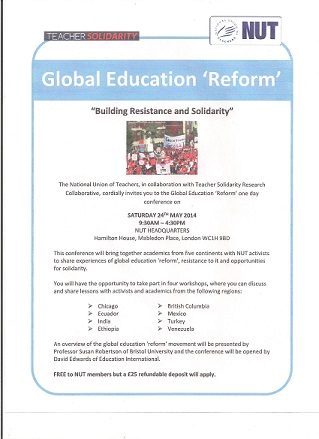
The National Union of Teachers (NUT) hosted a conference on global education “reform” May 24, bringing together NUT activists with union leaders and scholars from the global south and north. My blog this week adapts my presentation, which along with papers from others (all quite informative) will be published on the Research Collaborative of www.teachersolidarity.com
Subcomandante Marcos, the famous voice of the Zapatista Army of National Liberation (EZLN),announced in the early hours of Sunday, May 26 that he ending his role as the group's spokesperson and military commander. Or as he put it, Subcomandante Marcos, a “harlequin” and a “hologram” created by the EZLN, has now ceased to exist.
 This brief story about the Philly TAG (Teacher Activist Group) conference suggests what was special about the occasion but it misses what was the most salient political feature of the conclave. Philly teachers who are committed to social justice have formed a caucus in their union, an AFT l
Steve Kindred, my friend, brilliant Students for a Democratic Society (SDS) leader, organizer with Teamsters for a Democratic Union, activist in the struggle to keep the Stella d’Oro plant in the Bronx open, campaigner against a lockout of workers by Sotheby’s auction house—all this, and a thousand other causes. Steve is, for lack of a better word, “gone,” in a New York hospital, suffering from abdominal cancer, which has spread. Having been close to Steve and having admired and loved him now for 50 years, I am very sad.
 In studying urban teacher preparation (the hat I wear professionally when I’m not thinking about teacher unionism), I examine how school practices and organization influence teachers and students. To understand what goes on inside classrooms we have to look at the welter of powerful influences within schools and outside their walls. Blaming “teacher quality” f
Ghana, known for its stability and economic prosperity in the last 50 years, is praised as a model African state. Despite their rise to a middle income country, Ghana is struggling to deal with the rise of Kayayo’s, a destitute working class who go unacknowledged by policy makers. This is the story of an American living in a Kayayo town.
Arundhati Roy, Capitalism: A Ghost Story. Haymarket, April 2014, $15 paperback.
When you think of ghost stories, you may recall Henry James, Hamlet, or Banquo. Maybe you smell a camp fire, the story going around, the threat of the flame as you extend your arm and that impaled marshmallow over the heat. Or maybe you sense those dying embers, the cool of night taking its grip.
The Party of the Democratic Revolution (PRD), which was founded in 1989 as the hope of the left, celebrated its twenty-fifth anniversary on May 5 amidst expressions of disappointment and disillusion. The hope that the PRD would become a left political party capable of winning the presidency and a majority in the legislature and changing the face of Mexico has not been fulfilled.
The salad days. Too cold or hot or wet for much of anything this time of year, and rereading E. P.
This is “Teacher Appreciation Week.” Should we mark the occasion? How? Why?
Union Power’s sweep of the election for union officers in United Teachers of Los Angeles (UTLA) signals a seismic shift in power relations in the American Federation of Teachers (AFT).
- « Newer Posts
- 1
- …
- 181
- 182
- 183
- 184
- 185
- 186
- 187
- …
- 227
- Older Posts »