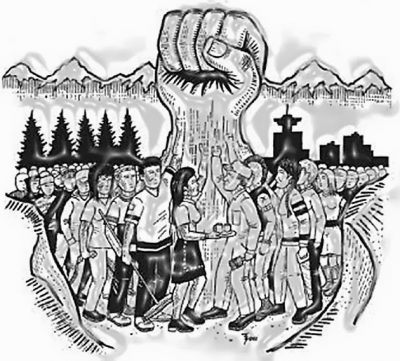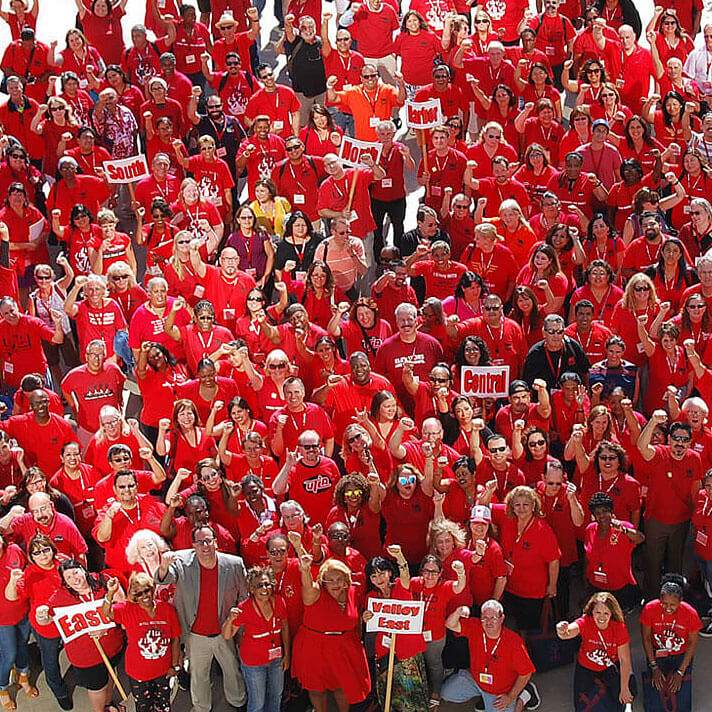


Kim Moody’s “Rank and File Strategy” has influenced much of DSA’s approach to labor organizing. To draw out what he calls socialist “class consciousness,” Moody recommends fomenting member-led struggles in unions that advance self-empowerment. By joining “transitional organizations,” or rank-and-file reform caucuses such as Teamsters for a Democratic Union (TDU), he believes, workers gain experience directly confronting management over working conditions. These organizations prepare workers for larger fights to come.

It has been two years since the explosive surge of the Democratic Socialists of America, now the largest socialist organization in the United States and the largest since the 1940s. And DSA has had some remarkable successes. Today as the country turns its attention to the presidential election of 2020, we ask: How DSA is doing? What is it accomplishing? And where is it going? What do the various caucuses and political tendencies within DSA propose as a future direction for the group? Is there a genuine left wing of DSA, and if not, what is the alternative?
Is the Yellow Vest (Gilets Jaunes) rebellion, now in its seventh week, “petering out?” Such was the near-unanimous pronouncement of the mainstream media, when I returned home to Montpellier, France, eager to participate and to observe first-hand this popular insurrection which I had been afraid of missing.

The environmental policy centerpiece of the incoming Democratic House of Representatives is what’s now known as “The Green New Deal.” But it’s already hit deeply polarizing pushback from the old-line Democratic leadership. And it faces divisive jockeying over the future of nuclear power.

The White-Hot Anger of French Working People as a Real Fact
After rumbling on social media for weeks, the Yellow Vests (Gilets Jaunes) movement emerged suddenly on November 17, when no less than 300,000 protestors occupied roads, traffic circles in exurbs and rural areas. They wore the yellow safety vests the government requires all motorists to purchase, and which immediately became the emblem of the movement. That week and the next, Yellow Vests also ventured into the heart of Paris, blocking the gilded Boulevard Champs-Elysées and almost reaching the nearby presidential palace. From the beginning, women were unusually prominent in the local occupations and the street marches. At the same time, the Yellow Vests chased away many politicians who visited their protest sites, including some from the left.

For some eighteen months now, ethnic minorities in the region of Xinjiang in northwest China have been living through unprecedented wave of repression. The most extreme element of this crackdown is a network of camps across the region, designated “re-education and training centres,” where anywhere from a few hundred-thousand to upward of a million Muslim minorities have been indefinitely interned. Most victims are Uyghurs – the main non-Chinese ethnic group of the region, but the sweep has also caught Kazakhs and Kirghiz, who, like the Uyghurs, practice Islam.

Militarist hawks and liberal pundits alike are up in arms (figuratively speaking, of course) over Donald Trump’s “victory” proclamation and announcement of U.S. troops’ withdrawal from Syria. Howls of Republican outrage may signal a further deterioration of the big twit’s shrinking political support on the home front. The Trump gang’s crisis of legitimacy deepens by the day. But what does it actually mean for the cascading disasters in the Middle East?

Donald Trump’s sudden decision to withdraw 2,000 U.S. troops from Syria is a green light to Recep Tayyip Erdogan to decimate the Kurds in what remains of Rojava in northern Syria. Earlier this year, Turkey invaded the Afrin area with the assistance of Syrian reactionary armed opposition groups, leading to the forced displacement of large sections of Afrin’s Kurdish population and continuous violations of the human rights of the local population.
In 2017 the Texas legislature passed a law forbidding the state from contracting with companies that refuse to do business with Israel. Some interpreted this broadly. After destructive flooding in Houston that year, one town told homeowners that if they wanted aid in rebuilding, they’d have to sign a pledge not to boycott Israel. After another type of flood – of bad publicity – the town said the boycott only applied to actual businesses in the town.

Bill Fletcher, Jr. The Man Who Fell From the Sky. Hard Ball Press, $15, trade paperback, 350 pp.
“Race” as a biological category differentiating humans has been a spurious and discredited marker for more than a century. From Franz Boas’ early pioneering studies of the Inuit to Barbara Fields’ contemporary savaging of race-based ideology, we should all understand that humans are one race, end of discussion!

Nicaragua’s eight-month long political crisis is escalating. In the past two weeks, the government of Daniel Ortega has intensified its crackdown on opposition media and on NGOs while facing the US administration’s passage of the Magnitsky-Nica Act legislation.
The government rescinded the legal status of nine NGOs in one week, at once seizing their assets, freezing their bank accounts, and sending into exile and hiding a new cluster of oppositional leaders. The crackdown began with CISAS, a renowned health promotion NGO led by a vocal feminist opponent to the regime, then CENIDH, the national human rights organization, and then a host of other organizations – from environmental and community development NGOs to economic think tanks that the government itself has relied upon for data and analysis.