
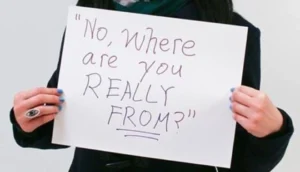
 Looking back at the last sixty odd years, at different times and different places, I have to say I have been asked that question about once every year. Mostly by suspicious white folks. Take away the “no” and the “really” parts then it’s a question of curiosity. I mean, “no” implies I was answering the wrong question and “really” means, I was giving the wrong answer.
Occasionally, the question is accompanied by some curiosity about my “accent” and sometimes, when aggression is the better part of valor, followed by “Why don’t you go back to where you came from?” My answers have been different depending on the situation, the context, and then I recovered this article from The Guardian—with a direct reference to our master’s voice.
In Buckingham Palace and outside it, we know what it means when people ask ‘where are you from’
I realized too that like Malcom X’s “house negro” many among us deny hearing that voice. So, I thought further review and elaboration may be in order.
In the beginning was the word! About a month after I got to the US, (that would be midway between the Birmingham church bombing and JFK assassination) I was invited to a super-rich stockbroker’s house, with a kidney-shaped swimming pool and a museum-like kitchen. And with lots of guests with champagne glasses. At the end of the evening, as I was waiting for my hostess in that kitchen, birthplace of colossal shrimp, for a ride home, she arrived with a model-like woman, glistening and bejeweled. My hostess said to me, “This is our friend Sally, who’s in real estate,” and to Sally, “this is one of our student friends from India.” Sally’s smile was wide, welcoming and sexy. She lowered her voice and spoke thus: “you must be wondering why I didn’t speak to you earlier.” (I had noticed her stunning appearance of course, but also the shunning attitude.)
Sally continued, “I avoided you ’cause I thought you were Mexican.” I was dumbfounded now. “Oh, I have nothing against Mexicans,” Sally lowered her voice some more and added, “But you must admit they are kind of filthy.” On the way home, my hostess said, “Oh that Sally is a good soul. She owns several apartment buildings and sometimes her tenants are unruly!”
That was my first lesson about origins. I felt ashamed for being spineless and speechless, but learned that in 1960s California, a rare Indian was kinda okay, but Mexicans of all hues, not so much! Of course, the narrative has changed as more and more Indians have shown up in America, specially the rich ones, but by then I was not ready to go back. We had a war to resist.
About the other Indian. Years later, once when I was visiting the Taos Pueblo, evening arrived suddenly and the Pueblo, lit only by petromax-kerosene lamps looked like a ghost town. It felt a little eerie in a huge space with a “chiaroscuro” ambiance. Anyway, I entered a store to check out some artifacts and saw there wasn’t anyone at the counter, but a strong scent of ganja filled the air. I looked around and noticed a panel with various currency notes pinned very neatly behind the glass. The British Pound, Swiss Franc, Brazilian Real, Swedish Krona, Deutschemark, Japanese Yen, Mexican Peso… were all represented, but I couldn’t see any Indian Rupee. Then I heard a voice from the depths, “What d’ya think of my display, eh?”
I peered into the darkness and said, “It’s fine but I don’t see my currency there.”
“What’s that?” The voice asked.
“The Indian Rupee,” I answered.
“You from India?” The voice again.
“Yes.” Said I and there followed a long pause.
Suddenly a man leaped over the counter and stood in front of me. A man with shiny skin and long hair. He then gave me the warmest, most welcome hug I have ever got.
“You are the real Indian man, if it wasn’t for that fuckin’ Columbus and other assholes, I’d be called just Taos man or sumphin’ like that.”
This led to a soul-searching discussion of Indian history. Both kinds. In the end, my friend said with a lot of pain, only slightly alleviated by marijuana, “We were here first, you know. But our story has been wiped out forever.”
I have never forgotten that encounter, and over the years have had to contend with the various aspects of being, and occasionally of nothingness too. But the contradictions in a contemporary immigrant identity in the U.S., fostered yet denigrated by structural racism in the Western world, I understand best through an example from the twenty-first century.
One day, when I was driving in Bucks County, near Newtown, PA an aggressive van driver swung from my right to my left directly in front of me, causing me and other drivers to brake suddenly and honk horns. Then the van driver, now on my left slowed down a bit until I came alongside. A woman rolled down the passenger’s side window and tried to speak to me. So, I too rolled down mine. She shouted after a few tries, “Why don’t you go back to where you came from!” Said with much vehemence I should add. I caught a glimpse of her young white driver-companion as well.
Those days, I was teaching at Bucks County Community College in Newtown. About a week later, me and two colleagues were introducing ourselves and our team-taught course on “The Culture of Affluence” in an auditorium classroom that could hold about 200 students. As was my practice, I stood scanning the student faces when I noticed a familiar countenance around the tenth row. Our eyes met for a second. The student was the driver of the van, companion of the woman who wanted me to go back! The young man lowered his head and kept it lowered throughout the session. After that, we never saw him again. My colleagues thought this was good riddance. I thought the student, victim of false consciousness, might have learned something from a critique of the consumerist trap in America.
 If you’ve read this far, you were pretty interested, right? Isn’t that worth a few bucks -maybe more? Please
Leave a Reply