
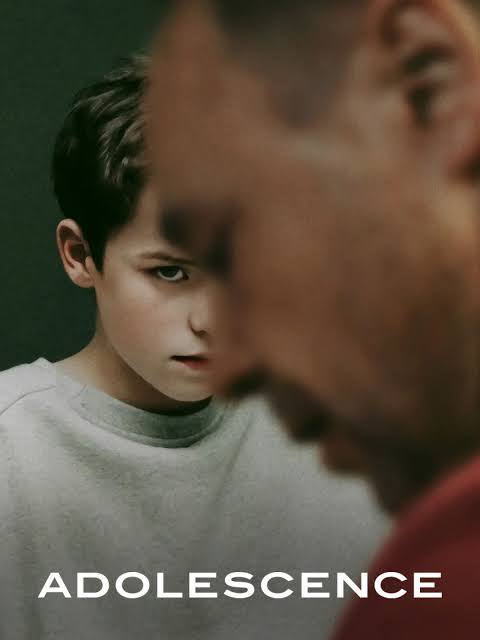
Netflix’ Adolescence is a flawed but powerfully crafted drama. The acting and particularly the dialogue is superb – its poignant, witty in places, and offers up a powerful evocation of working-class family life. The existential flaw in the program, however, lies in the premise. It is endeavoring to grasp the real problem of toxic masculinity/online incel culture purveyed by figures such as Andrew Tate. But, while this is an incredibly important issue, the program approaches it in a rather liberal and one-sided way.
For the type of violence which the thirteen-year-old boy commits against his female classmate presents as something of an anomaly. If you look at children who commit these types of crimes, the short history they have had in the world is always unremittingly bleak and horrifying, accompanied by extreme forms of abuse or neglect. One need only reference the cases of the boys who murdered the toddler James Bulger or the case of Mary Bell (who in her adult life was able to enjoy a wonderful rehabilitation).
Bulger’s killers were Robert Thompson and John Venables who were both ten at the time they tortured and murdered the toddler. Thompson had grown up being brutalized and molested by his father, and seen his alcoholic mother and siblings endure the same fate. Venables came from a highly unstable family where both mother and father had histories of clinical depression, where the upheaval caused by their fights meant that he and his siblings were always being shunted from home to home, school to school, and in such a context his mother had been observed physically and verbally abusing him. All of which translated into anti-social behaviour and a violent acting out on his part long before Bulger’s murder.
Mary Bell had strangled a four-year-old boy when she was ten and a three-year-old boy when she was eleven. Her mother had neglected Mary and very likely physically abused her as Mary had been prone to all sorts of ‘household accidents’ as a very young child. Mary’s mother worked as a prostitute and would allow her clients to sexually abuse her child.
In Adolescence, however, the child in question has a loving family who are also present in his life, he has stability and support and a secure place in the world. It is true that he has been bullied at school, but what shapes his murderous rage most fundamentally is his experience of the online world, spending the early hours imbibing the misogynistic politics of the men’s rights movements in the guise of figures like Andrew Tate.
And this – as a political premise – is fundamentally liberal in tone; that is, by and large, it disregards the broader sociological content, more general forms of exploitation, anomie, deprivation and substance addiction which, at their most extreme, are concentrated into some of the worst types of abuse against children in the home. The writers simply replace such social content with internet culture in abstraction.
In this respect, the politics of Adolescence is the inheritor of the whole ‘video nasty’ moral panic of the 1980s, the sense the most grievous crimes, especially those committed by children or young adults, could be understood because the individual in question had been exposed to violence on screen, had watched a film such as Child’s Play 3 (this was a key component in the way the media framed the perpetrators in the James Bulger case for example). It is perhaps no coincidence, therefore, that one of the writers of Adolescence has called for teenagers to be banned from social media as a whole, much the same as those cultural critics of the eighties deciding the best way of solving the problem of violence in society is to ban those films which depict extreme violence.
That there is a deeply disturbing online culture of misogyny and toxic masculinity, and this is highly damaging (especially to children) is without a doubt the case. But such online culture is only a symptom of deeper issues about how society is structured and where power lies. The politics of Adolescence are classically liberal, in that they emphasize the first moment while allowing the second to recede from sight.
And this bleeds into the quality of its aesthetic. The ‘touching’ scene at the end where the mother and father open up about what has happened is actually a little empty and meandering – “We should have stopped it, seen it and stopped it … it’s not our fault, can’t blame ourselves … You were a good mum. You are a good mum … You are good dad. A great dad. But we made him. So if my dad made me … how did I make that? … Should we have done more? … We should’ve done.”
The rather nebulous and rambling exchange occurs because the parents are not responding to a genuine content at all. The basis for their son’s violence has not been derived by the writers as an aesthetic necessity which flows from his broader social existence, but merely by the fact that he has wandered down the wrong internet rabbit hole. The parents are unable to coherently get to grips with the nature of their son’s mental deterioration because the source of such deterioration has only ever been posed by the writers by way of an empty abstraction (it was all the dark web).
Ditto with the scene with the boy in the institution being interviewed by the psychiatrist. In terms of dialogue and drama, it is excellent. But it doesn’t really add to the character development of the boy in any meaningful way. We don’t see him finding a new understanding of himself, we have no real sense of what lies ahead for him in the future – i.e. how he might begin to overcome the issues which set into motion his crime, for those issues were never truly adduced from the development of himself as living personality, but simply stamped on his character from without by the presence of the most unsavory aspects of the internet.
I think too that the writers intuit this aesthetic lacuna, this absence of broader social content. Which is why the story of the bullying is brought in. The young teenager who commits the crime is bullied at school; indeed the young girl he murders is the person who has been bullying him. She has taunted him as an ‘incel’ (an involuntarily celibate man) in online fora. And yet, this strand of the story is not just incongruous but also problematic. What makes Adolescence so relevant, one feels, is that it purports to show the way in which the misogyny of internet culture and men’s right’s group’s spills into the life of a young boy who then lashes out in a murderous act, killing a female victim because he has been acculturated to hate women per se, women as women.
And yet, it now turns out that misogyny is not the true motivation here. It is because he is being bullied. It might just as easily have been a boy who taunted him as an ‘incel,’ and he might just as easily have killed his tormentor in a similar fashion. The work that the writers are doing to demonstrate the toxic masculinity of aspects of internet culture on the lives of the young is undone with this alternative and contradictory plot line which has no real bearing on these central themes.
In fact, it is more than just undone, it is subverted, for it now turns out that rather than being the victim of patriarchal power and hatred – rather than being attacked simply for being female, the victim herself has actively antagonized her aggressor. The power relation has been inverted; she is made into the bully and he the victim. I am not saying there is anything in the program to suggest that Katie, the victim, deserved what happened to her. There definitely isn’t. But neither is any great attempt made to flesh out her life. As Ross Clark points out, the devastating effects of her loss on the people around her are barely referenced; “there is the gaping gap of the victim’s family. What are they thinking, how are they reacting to this cataclysm? We never find out because we never see them. We do see her best friend, briefly ….”
In depicting Katie as the bully and her murderer as the victim of such bullying, the writers upend the very same processes of patriarchal power and abuse they are endeavoring to describe. By so doing, although this purports to be a series providing an acute criticism of toxic masculinity, our sympathies as an audience are recentered on the boy who commits murder rather than the girl who is the victim of it.
As he is arrested, the police seem extraordinarily attentive to his vulnerability and his confusion, and throughout, the audience are continually invited to adopt an attitude of ‘if only’ – as in, “if only this clearly bright but lonely boy had not found his way into the darker recesses of internet culture, if only such a promising future hadn’t been snatched away.” The damage to his family is depicted in a vivid and palpable way. And his voice comes through, resonant and tragic.
But the girl who has no future remains mute. And I wonder if this doesn’t say something about patriarchal culture too.
 If you’ve read this far, you were pretty interested, right? Isn’t that worth a few bucks -maybe more? Please
Leave a Reply