
 In this exploration, we want to advocate a new strategic narrative about our future. All futures, especially one tangled in the complexities of fascism and socialism, are best rooted in a deep exploration of our past. And since all narratives require a good use of metaphors and analogies, as well as uncovering new facts, we want to start with an unusual but powerful one. Let’s call it “The Black Sea Conundrum.”
The Black Sea, situated to the northeast of the Mediterranean, is unusual in multiple ways. Most especially, it is a sea comprised of two seas narrowly and uniquely connected. How so? There are two “rivers” of sorts, one of fresh water and another of sea water, with fresh water flowing out of the Black Sea into the Aegean, and saltwater flowing in. However, due to the flow paths, the lower saline “river” filling the Black Sea never reaches the surface. The lower sea, therefore, never receives oxygen. Without oxygen, this layer contains very little living organic material, making the bottom of the Black Sea dead and a liquid museum of wrecked ships.
This dual flow, while only recently discovered, has been going on for nearly 8,000 years. It means there are really two seas contained in the Black Sea, and they rarely mix. Yet, the Black Sea as we know it could not exist without both seas existing in opposition. Together they constitute one of the Earth’s largest seas. Still, the Black Sea is dynamic and some of the water at the bottom will periodically make its way to the top.
Appreciating the nature of the Black Sea, therefore, can help us understand the complexity of U.S. history. Most of us are taught a history that is at once linear and supposedly all-encompassing. Yet the reality is far more complicated and essential to understand. Why? Because it is an overdetermined history, to borrow a phrase from the French Marxist, Louis Althusser. And as with our “seas” at the bottom and the top, there are issues that must be understood in all of their complexity.
U.S. history is a compilation of histories, perhaps a dozen of them. In the first cut, ours is a history from the standpoint of the ruling classes of the racialized settler state, while it is also a history from the standpoint of the subaltern classes. We can call this the historical contradiction between the peoples and their ruling adversaries. In a second cut, moreover, it is also a history of the struggles of the subaltern classes and peoples among themselves. We can call this the histories of contradictions among the peoples. Likewise in the first cut, factions of the ruling classes also collude and contend. As socialists, we must contextualize our work and tasks between and within the top and bottom seas. This does not mean exaggerating the splits on top or glamorizing, romanticizing or demonizing the contending subaltern blocs below. Rather, it means that we are partisans. We best understand U.S. history by grasping the audacity of the emancipatory movements, all of which faced a situation where the odds were against them and the situation was grim, to paraphrase the words of a major character from science fiction.
Abolition Democracy, Reconstruction & Counter-Revolution
The emancipatory efforts of the African slaves and the resistance of Native Peoples to the settler state’s westward expansion existed from day one, even if only minor at times. They were at the heart of the complicated question of what form of capitalism would prevail in the United States in the 19th century. Why complicated? Because the initial accumulation of capital combined extermination of the Indigenous for their land, the expropriation of Africans for their labor, and the exploitation of the indentured for their labor time. The critical flashpoint—when the contradictions came together-was in the period 1860-1880. This was the period of the Civil War, Reconstruction, and the 1876 Counter-Revolution against Reconstruction. For the First Nations, the major wars against them were waged throughout, ending by 1900.
There were several major fractures within the movements that created the First Reconstruction. One was the split of the pre-1865 alliance between some white women suffragists and the Black Freedom movement. Another was between the “poor white” Scalawags in the South against the slavocracy; Scalawags became partners in Reconstruction with the Freedmen. Still another was between the “white” labor unions of the North, who ignored or opposed Reconstruction. We could go on. We don’t want to discount other major events, e.g., the U.S. War on Mexico, the Chinese Exclusion Act, and the overall rise of a union movement against the steel, coal and railroad bosses of the Gilded Age. But we are saying that the conflicts comprising Reconstruction and its overthrow were the central contradictions that shaped an era of national rebirth.
W.E.B. Du Bois coined the provocative term “abolition democracy,” which both described a moment and a movement. It was a moment in that it spoke to the period of the Civil War and Reconstruction, which was a period of a social revolution fundamentally different from the 1776 War of Independence (calling it the “American Revolution” is a bit of a stretch). At the same time, the Civil War and Reconstruction was a movement, to put it mildly. It was an elemental rising, and often called the Second American Revolution, or alternately, the completion of the First. It was a movement that encompassed the formal abolitionists of the North, but also the masses of former African slaves and their Scalawag allies who sought to redefine democracy not only in the Southern states, but in the U.S. as a whole.
As Manisha Sinha clarifies in her exceptional new work, The Rise and Fall of the Second American Republic: Reconstruction, 1860-1920, Reconstruction was far more than a Black vs. white affair. Black Reconstruction was an alliance of the laboring poor, both Freedmen and Scalawags, backed by Radical Republicans in Congress. It was a period during which a battle was underway to move the U.S. toward a more egalitarian democratic state. Du Bois called the new governments taking shape in the South “the dictatorship of labor” that, while based in capitalist economics, were also engaged in multiple mass, democratic projects and movements challenging existing property relations. In basic ways, Black Reconstruction was opposed to the trajectory that won out, i.e., the consolidation of war-born manufacturing into monopoly capitalism and the rise of U.S. imperialism. And in describing Reconstruction’s violent overthrow, Du Bois insisted on describing the defeat of abolition democracy as a class defeat of labor by capital, rather than simply a victory of “white” over Black.
Angela Davis, in her Abolition Democracy: Beyond Empire, Prisons and Torture, uses Du Bois’s term particularly in connection with opposition to the prison-industrial complex and the carceral state. We agree with her and her analysis. While not suggesting she would disagree, we are using the term “abolition democracy” in a broader context. As mentioned, abolition democracy had its strongest point as an effort to complete and solidify emancipation. This meant the eradication of the plantocracy and all vestiges of slavery. Although, as Sinha argues, Reconstruction and its aftermath was also directly related to the “resolution” of the Native American question. The usage of the term “abolition democracy” in the 19th century, however, was fundamentally and mainly focused on the future of the former African slaves, the peoples who were becoming the subaltern nation of African Americans. In any case, Sinha was quite right in including the questions of Reconstruction in the West, the subjugation of conquered Mexicans, the wars with the Cheyenne, Apache and Navajo, and the segregation and attempted deportation of the Chinese.
So, at its peak, abolition democracy was uneven. Yet it pointed in the direction necessary for a transformed United States. Elements within the abolition democracy movement recognized the immorality of westward expansion, but the fight against westward expansion was not a dominant theme in the movement. In that sense, “abolition democracy” was not yet a unified theory or objective. Rather, it was a motion, but a revolutionary motion nonetheless.
Abolition democracy and the fight to preserve and extend Reconstruction were efforts equivalent to the Tecumseh’s efforts towards a massive, Native American confederacy (claiming the Northwest Territory as a “Red Homeland”) in the first decade of the 19th century; the Taiping Rebellion in China (1850-1864); and the Paris Commune (1871) in France. These were each mass upheavals and campaigns, revolutionary experiences that were profoundly transformative, yet still failing in their fundamental objectives. In each case, counter-revolutionary forces were able to gain the upper hand and brutally crush these mass insurgencies of the various subalterns concerned. The mass insurgencies, moreover, were not themselves led by a cohesive revolutionary theory embedded in organizations capable of building a successful strategy. They also ran into the challenge of timing, i.e., seizing the right moment in order to strike and pursue the enemy until success was achieved.
Abolition democracy must be understood, then, as going beyond not only the efforts of the 19th century, but also beyond the newer efforts in connection with our current more focused struggles against the carceral state. It is best seen strategically as a stepping stone toward what has come to be referenced as the “Second” and “Third Reconstruction
The Third Reconstruction and the Fight for Power
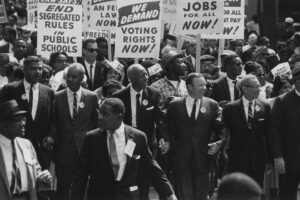
The First Reconstruction was, of course, 1865-1877. The “Second Reconstruction” is a metaphorical reference, roughly, to 1954–1973. This was the “Long 1960s” of civil rights campaigns and the Black Revolt after the assassination of Martin Luther King. During these years major victories were won for racial and gender justice, as well as victories on matters of occupational health and safety, and the environment (and globally, the advances and victories of national independence and liberation struggles). There is debate as to exactly when that moment ended, but by the 1973 recession, it was apparent that the progressive social movements had stalled.
The term “Third Reconstruction” has emerged over recent years to reference progressive political power won within the context of bourgeois-democratic capitalism. When the term first circulated, there was some debate as to whether it was referencing a future of “socialist reconstruction” in the U.S. That debate largely closed in favor of conceptualizing it as a means of discussing a more immediate task of winning what has come to be known as governing power. This is to be distinguished from a socialist movement winning state power, or even “breaking up” an existing state power and creating a new one to move away from capitalism. It was also meant that Reconstruction was not simply to project a pressure campaign for a downward reallocation of resources.
The “Third Reconstruction” then, is an aspirational reference. It is what left and progressive forces should be seeking to achieve. It is not a set of policies or demands, although it does include policies and demands. Like the original Reconstruction, the Third Reconstruction needs to be conceptualized as a political realignment. It’s not a realignment only in terms of voting patterns or even the emergence of a new, mass political party (or a cluster of parties). It’s a realignment in terms of the forces in government—and the popular bloc they represent—which see themselves as engaging in a struggle both inside and outside the democratic capitalist state. It’s a struggle, we wish to emphasize, which is a battle on the ground as well as within the institutions of the state and civil society, including but not limited to the government.
Seeing the Third Reconstruction as about more than a set of demands will immediately make it suspect to many left and progressive forces. How so? Because it necessitates the construction of a bloc or alliance of various class forces and social movements that are not always aligned. Some will be so strategically, but others will only be so tactically. Such an alignment cannot be of the left and core progressive groups alone, but also must engage the vacillating middle forces, those organizations, groups and prominent individuals that are frequently uneasy with the left, even while they are terrified of the right.
In our immediate conjuncture leading into 2025, a version of this alignment has been coming together in opposition to Donald Trump and the MAGA fascists. This alignment goes by many names, but it is objectively a broad front opposing the right and the measure it seeks to implement. It has no overall organizational structure yet, and does not have a longer-term program. In that sense it is very different from the French “New Popular Front” with its four electoral groupings that, both, stood against the French fascists in 2024 as well as promoted their own program. Our “B-4”—or broad front opposing the right—is a collection of organizations and individuals who frequently share little in common except their antipathy towards MAGA. While this is very necessary at this moment, it is not an alignment that can last. One can hear this in the voices of more traditional Republicans. While they are clear with their hatred of Trump, their intention remains that of forming a new party or restoring some variant of the Republican Party. They still want, in the long run, to dominate the U.S. political scene.
Like the original Reconstruction, the Third Reconstruction must advance a platform of deep structural reforms. For the first, this included the 13th, 14th and 15th amendments and the Civil Rights Act of 1866. It also could have included—had it not been for Andrew Johnson and his allies—the complete disenfranchisement of the leaders of the former Confederacy—both government and military—as well as major land reform in the South, such as the “40 Acres and a Mule” formulation of William Tecumseh Sherman, William Stanton, Charles Sumner, and Thaddeus Stevens.
Reconstruction did introduce public schools and voting rights, as well as the protection by the government, at least initially, against terrorism. Additionally, significant worker self-organization and militancy emerged, particularly in the early days of Reconstruction. What might have happened to the Westward expansion, however, is a matter around which there has been considerable debate. Westward expansion and a democratic resolution of Reconstruction would have been in contradiction in many respects.
Reconstruction initially split the ruling classes. The obvious split was between Northern industrial capital and the Southern plantocracy (plantation capital). Reconstruction involved the political suppression of the Southern plantocracy and some limitations on their political activity, particularly after the end of the Andrew Johnson administration. Northern capital, however, was never homogeneous, and the GOP was divided between radicals and liberals. The radical GOP wanted Reconstruction to advance in democratizing the South. The liberals saw the South as a haven to spread manufacturing, managed locally by the “Bourbons.” Among other things, a significant democratization of the South would have had other implications for the North, such as wider democracy for labor, something that probably became clearer in the context of the great 1877 railroad strike, though by that time the die had been cast.
Reconstruction was able to accomplish much of what it accomplished precisely because of the combination of the mass abolition-democratic movement, the creation of the Freedmen’s Bureau as a branch of positive governing power, and the split within the ruling circles. With that split, the more radical elements of the Republican Party, in alignment with the mass of freed Africans and many poor Southern whites, were able to make an historic and strategic breakthrough for a few years.
There are myriad additional lessons and warnings contained in the experience of both the original Reconstruction and the “Second Reconstruction” for today’s left and progressive forces. Some are very important, while others are too numerous to be reviewed here.
The first of central importance is the aim of the struggle for power. The struggle for power is not mainly reflected in demands to be placed on the existing ruling elites. At certain moments, the demands for change must become demands for power to be taken from them, and specifically, the rising to power of new class forces and social movements that represent the interests of the subaltern forces. This demand for power distinguishes a serious, mature left from those who rely on demands for the elites to change policy largely because they do not wish to dirty their hands with the work of electoral coalition-building, Get Out the Vote work and governing.
One distinction worth repeating is between redistributive demands and structural demands. The former aims at getting a bigger piece of the pie by redistributing wealth downward. The latter aims at altering the structures of power to favor subaltern institutions. Both are needed, but the former alone keeps us bound up with liberalism.
The second important lesson is just this critical point about coalition-building. The Shawnee leader Tecumseh probably understood it best in his efforts to construct a massive, North American alliance of Native Americans to lay the foundation for a nation-state of the Native Americans. The conscious and patient work of building an alliance necessitates compromise and the ability to negotiate the constructive resolution of contradictions. It also necessitates the utilization of contradictions among adversaries and splits within the circles of the ruling elite.
The history of the First Reconstruction demonstrated a multi-class alliance for social revolution. This alliance was very tricky. Among other things, while it included Southern labor Scalawags, as in the Free State of Jones,” it did not involve the Northern white workers—after the end of the Civil War—due to their insistence on the racial exclusion of African and Asian workers from organized labor, as well as growing class resentment of the Northern industrial capitalists by Northern white workers. That said, the battle for Reconstruction was, objectively, a battle that was still in the interest of the Northern white workers since it engaged a fight to expand democracy as well as change the nature of the forces who were occupying political power (at least in the South).
A so-called “class-against-class” strategy would not only have failed but would have represented a misunderstanding of the moment. And it was the white-exclusive National Labor Union (NLU)—the first national labor federation—that advocated just that. Specifically, they called upon the emancipated African workers to abandon the Republican Party in favor of a labor party though the NLU would not permit the emancipated African workers or Asian workers—not to mention Native Americans—to enter the ranks of their unions!
Though the 19th century Republican Party was unable to consolidate around the objectives of its radical wing, the refusal of African workers to abandon the Republican Party was quite understandable. It was the Republican Party that was the party of Reconstruction and emancipation. What the white workers of the NLU were offering was not even a pipe dream. Thus, we can see in Reconstruction the failure to have an instrument willing and capable of prosecuting the emancipatory struggle to its fullest, combined with other factors which then opened the door to counter-revolution.
A similar conclusion can be arrived at in looking at the “Second Reconstruction.” The social movements that began to congeal following World War II, and flourished by the 1960s, brought with them both modest and transformative reforms. Through these movements a progressive bloc emerged, though a bloc with myriad contradictions. The Democratic Party, much to its own surprise, became the principal political instrument to collect together these social movements and give them electoral voice. But it did so in a manner to make the demands compatible with New Deal capitalism, and the turning of a blind eye towards the full ramifications of U.S. imperialism.
The great debate in the 1960s was epitomized by Bayard Rustin’s contrasting of the “politics of protest” vs. “the politics of power” (“From Protest to Politics: The Future of the Civil Rights Movement,” Commentary, February, 1965). Rustin identified a central challenge for the progressive social movements, although he created an antagonistic contradiction between the two directions rather than recognizing the relationship that was essential to build. Rustin also emphasized changing the configuration of the Democratic Party, rather than constructing a new bloc—inside and outside of the Democratic Party—that could champion the demands of the progressive social movements.
Nevertheless, Rustin was onto something. The shying away from the fight for political power by much of the left, turned over that terrain to liberals, and failed to prepare the left and progressive forces for the full counter-revolutionary effort of those who, after the failure of the Goldwater campaign, became the germs that built the “New Right” Neither electoral abstentionism nor third-party politics have been deeply rooted in any effective strategy to achieve power in U.S. conditions. To a great extent they have been illusional or apocalyptic, that is, expecting some sort of spontaneous, mass political cataclysm to awaken the masses to the need for a new direction. This applies to the national Socialist Party campaign of Eugene V. Debs as well, although there were some exceptions at state-level and municipal victories.
What To Build?
Much of the discussion of a Third Reconstruction has taken place in the absence of discussion of a strategy to win governing power. Useful exchanges concerning matters such as voting rights, women and reproductive choice, gender freedom, the environment, reparations, new forms of economic development, and even the need for a democratic foreign policy have circulated over time. But without strategy, the danger is that this becomes a wish-list.
Left/progressive discussions of the fight for power in the recent past have, quite logically—though problematically—tended to focus on winning power in cities and counties. There have been some notable exceptions, such as the work of the New Virginia Majority and some other similar formations. The problem, which was in evidence in the aftermath of the first Black political upsurge (circa 1969) and, later, the Black-led political upsurge of the late 1970s–1989, was the ability of the white right, through control of state legislatures, to restrict the ability of cities and counties to operate, i.e., what is known as state preemption. Progressive efforts by officials of color were repeatedly undermined by Republican state legislatures. This has continued to happen and was seen in evidence in the attacks on living wage ordinances by state legislatures.
This points to the need for strategies that focus on winning power in states. Municipalities and counties can be a steppingstone, but it is critical that campaigns at the municipal and county level educate the electorate to the restrictions that are often imposed on municipalities and counties.
Thus, winning states necessitates a whole different approach to united front work. It necessitates building agreements that cross the lines of urban, suburban, and rural districts and precincts. But it also has to deal with the reality of the paramilitary right, especially in rural and semirural areas. Left/progressive forces will need to (1) build a front against MAGA, and (2) build a left/progressive or left populist core for a longer-term struggle. Operating in Republican-dominated areas will increasingly take the form of “underground” activity—at least in the beginning—given the bullying and threatening activities of MAGA. This means, cores of neighbors will need to be quietly organized around a progressive platform, helping to break isolation.
One of the lessons from the First Reconstruction was the manner through which the white terrorist groups, e.g., the Ku Klux Klan, operated to intimidate the population. In many cases, the first targets of these white terrorists were white Unionist Republicans (progressives!) who were siding with the freed Africans and the forces of Reconstruction. The objective of the terrorists was to frame the struggle against Reconstruction as a struggle of white against Black, rather than a class struggle led by the freed African population. We have and will continue to see similar approaches by MAGA, which means schooling activists in various forms of self-defense and operating much like union organizers who are working in a non-union facility, i.e., carefully identifying potential members of a core and building carefully until there is a critical mass that can go public.
Fighting for power, and fighting for the Third Reconstruction is not only an electoral project. As with the First Reconstruction, various institutions were created that gave voice to the freed Africans in particular, and the Southern poor more generally. In the current situation, the growing interest in “mutual aid” and the solidarity economy needs to move from a matter of defense and/or survival, into efforts at securing power. The formation of worker cooperatives and housing cooperatives is an example. Creating alternative methods of work and housing can be a matter of survival as well as inspiration. They are also schools of struggle. If workers can govern a co-op, why not govern their city economy, and so on, moving upward. If connected to progressive political governance, these can work in tandem with broader economic and land development strategies.
Strategy must base itself on a combination of one’s objectives as well as a careful analysis of the current situation and the tendencies at play. Although the Democratic Party establishment probably asks itself about winning this or that state, a comprehensive discussion by leftists and progressives about winning governing power in a state either does not happen, remains superficial, or is an appendage to what the Democratic Party establishment has concluded.
Let’s start in a different place. If we want to move towards a Third Reconstruction and block right-wing efforts at a Constitutional Convention (which would repeal our rights), we must make assessments, state-by-state, of the balance of forces. Specifically: what are the key municipalities and counties to win; what municipalities and counties can we afford to lose; what are the critical progressive and reactionary social movements in the state (and, how are they organized, financed, etc.); what are the key opinion-makers/influencer; what are key media (traditional and social); and major economic tendencies. Through compiling this information and analyzing it, left/progressive forces will be better positioned to construct a strategy toward winning power rather than remaining stuck in the politics of opposition and self-expression.
Following this path and recognizing that this is not an election cycle process, can bring us closer to turning the “Third Reconstruction” into a concrete reality rather than a utopian dream.
 If you’ve read this far, you were pretty interested, right? Isn’t that worth a few bucks -maybe more? Please
Leave a Reply