
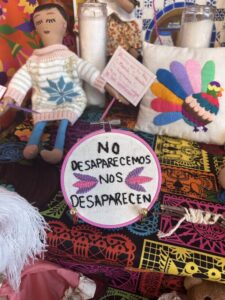
 Femicide, the murder of women, take the lives of about 1,000 women each year. Most are murdered in their homes by their husbands or domestic partners. Many are young women coming and going from work. This year in several states and cities, the murdered women are being remembered and honored on the Day of the Dead (Nov. 1 and 2), a traditional day for families to visit cemeteries and speak with their deceased relatives. People construct ofrendas or altares where they place the favorite foods and memorabilia of the dead.- eds.
In order not to forget on the Mexican Day of the Dead, which is commemorated every November 1 and 2, feminist groups will honor the victims of femicide with marches, masses and offerings. It is about insisting, not forgetting, making visible the violence against women and keeping alive the memory of women whose lives have been cut short just because they are women.
They call it the Day of the Dead in Puebla and other cities in the country. Mexicans consider the placement of the offering to be of utmost importance, since it is believed that the souls of the deceased return from beyond to enjoy the dishes and flowers that they enjoyed in life. While for hundreds of Mexicans this day is remembered as love and joy for their loved ones who left this world to go to outer space, for the families of the victims of femicide it is a day to demand justice for the violent death of their daughters, mothers or sisters. For the writer and researcher of women’s culture who leads the collective “Yo soy” on the border of Ciudad Juárez and El Paso, Hilda Sotelo, it is time to recognize the active role of women in the fight for justice and memory using the Day of the Dead as a space to redefine death from a feminist perspective.
By integrating the names and stories of the victims of femicide into the altars, the ritual becomes an act of denunciation and resistance to gender violence. Text Automatically generated description In her opinion for La Verdad de Juarez.com, she points out that “the Day of the Dead has historically been a celebration imbued with patriarchal symbolism, but Kosmic Feminism allows us to redefine it to honor women and make their struggles visible,” she says.
Mass and offering in Mexico City for feminicides
On October 28, relatives of four victims of feminicide held a mass in a church in the Juan González Romero neighborhood in the Gustavo A. Madero municipality. Brenda Gabriel Olivera Sotelo, Rosalinda Viscarra T, Jazmín Arriaga Becerril and Yolotzin Guadalupe López Ayala were remembered by their relatives. Priest Evaristo prayed for justice for these crimes and asked them not to forget them, and regretted that they will end up in an investigation file. At the end of the mass, the memory of the victims was honored with a pre-Hispanic ritual and dances to the ancient gods. Mothers, sisters and relatives closed the street and placed photographs of their daughters in front of the altar and prayed for all the victims of femicide. Brenda Gabriel Olivera Sotelo, 22, was murdered on July 30, 2016 by her partner. In addition, three other women were killed in 2022 within months of each other. Map Automatically generated description The body of Rosalinda Viscarra Soto, 30, was found in Tecamác on July 8. Jazmín Arriaga Becerril, 33, was murdered on October 3, 2022, by her partner in front of her children, in the Laguna neighborhood of the municipality of Ecatepec. Yolotzin Guadalupe López Ayala, 30, was killed by her ex-partner on November 24, 2022.
Day of the Dead in Puebla, this year 47 women have been killed
In Puebla, which ranks 6th in feminicides in the country, more than 20 collectives are calling for a rally at 7 p.m. in the main square this Friday, November 1, as “a tribute to the comrades who were taken from us” with the title “Not One Less” in memory of the victims of femicide. Crosses will be placed and family members, collectives and civil society are invited to carry a white candle to light the way for victims of violence and wear a purple garment. “It is time to remember, honor and raise our voices, in a state marked by the gender alert, it is time to build community and demand justice.”
While the “March of the Whores” is scheduled for Sunday, November 3, in tribute to women murdered for “being whores, for being lesbians, for going out at night, for going out during the day, for being women, for being sex workers, for being trans”, which will be the 14th edition. “The women you murdered will not die” will be this year’s slogan, members of feminist collectives reported at a press conference. The march will have a route from the Gallito Clock located on Paseo Bravo to the Zócalo of the city of Puebla at least one kilometer away. The march is intended to commemorate and pay tribute to all the women who have been murdered, and they also recalled that so far in 2024 they have counted 47 feminicides that have been committed in the state of Puebla. At the end of the march, a monumental offering will be placed in memory of women who have been murdered.
Also to make visible the re-victimization of murdered women that authorities and comments from the population make for the simple fact of being workers, trans, bisexual, sex workers, for going out at night, among others.
In Morelos 352 embroidered portraits of victims of femicide in offering.
This year 100 women have been killed In Morelos the collective “We Exist because We Resist” that has documented more than 400 femicides since 2010, placed the offering for victims of femicide in the La Casona Spencer Museum in front of the Cathedral in Cuernavaca starting on October 30 with 352 portraits made by the members of “We Name Them by Bordando”. “There are no words to describe what we feel.
Today the project of embroidering silhouettes for the offering ends, the murdered companions were welcomed, we accompanied their families with love and respect. Once again today, her voice and her light will not go out. Thank you to the families for allowing us to fight alongside them, thank you to the embroiderers and artists for making this project yours, thank you, thank you” reads their Facebook page. Ruth Sandoval Ramírez of the organizing committee explained that this initiative also seeks to demand that the authorities do not forget the cases. “For the feminicide to materialize, silence, omission, opacity, negligence, impunity and collusion of the macho society and the authorities in charge of preventing, addressing, sanctioning and eradicating violence against women are criminally mixed,” she said.
For the third time, the collective will open this offering to the public until November 2 and everyone was invited to bring items such as marigold flowers, copal, confetti, food and more to complete the altar. They asked to bring a photo of their female relative who was a victim of feminicide, with the name, the date of the feminicide and the municipality. According to the groups, so far in 2024 they have registered 100 femicides in Morelos, while in the Executive Secretary of the National Public Security System, they only register 42 cases from January to September of this year.
Offering in the town of Miquixtli
The Independent Commission for Human Rights of Morelos on November 2 will pay tribute to all the women and girls who have been murdered in Morelos and will demand justice, and that all the measures established in the Declaration of Gender Violence Alert (AVG) in the entity be complied with. This celebration will be in the town of Miquixtli – where one of the most complete celebrations is held every year – for all women victims of sexist and misogynistic violence that destroys lives and deeply damages social relations.
Statement by the disappeared indigenous peoples of Chilapa, Guerrero
The Collective of Victims of Chilapa and Indigenous Peoples, accompanied by the Regional Center for the Defense of Human Rights “José Ma. Morelos y Pavón”, on this Day of the Dead call on the Mexican State so that the relatives of the disappeared are recognized as victims and that forced disappearance ceases to be a tool of control and dispossession, and so that there is not one more missing person, no more missing persons. At the state level, they call for the approval of the Law on the matter of forced disappearance of persons in the State of Guerrero and immediate regulation. That in the approval of the budget for 2025 they include a specific and sufficient item to comply with all the rights of the victims and their families who are also victims. At the national level, to create actions that make visible, as on this occasion that brings us together, the roots, trunks and branches of all the disappeared, of all the murdered in Mexico, so that all civil society knows that the forced disappearance of people continues to increase.
At the Ibero, an offering is made to victims of femicide “Altar of struggle and living memory” Students from the Iberoamericana University are dedicating the last days of October to remembering and dignifying the memory of those who died as victims of violence, and those who dedicated their lives to fighting oppression in all its forms with the altar ‘Voices of Rebellion: Altar of Struggle and Living Memory’.
Through this altar, the students who collaborate have decided to demand justice for women victims of femicide and other forms of gender violence; to demand clarification of cases of forced disappearance; to recognize the oppression against migrants and people who engage in sex work, and to highlight that this generates displacement and deadly conditions for their existence; as well as to honor those who, for defending the territory, have died, disappeared, or have faced persecution and lost their roots, relationships, traditions and daily life due to forced displacement.
The altar assembly includes 15 skulls, one meter high, made using cardboard; five Judas figures, two meters high, also made using cardboard; and three banners with a papel picado design, six meters high by one meter wide, hung on the esplanade, on which a video mapping made by students will be projected, with narratives and experiences alluding to the different struggles to which the offering refers. To prepare all these materials, the Coordination of Art and Culture, the Office of Community and Student Life, the Community of Representatives of Student Associations (CREA), and the Council of Representations and Societies of Students (CORSA), worked with specialists who for approximately five months taught the technique and collaborated in the creation and execution of the concept. The offering is part of a broad cultural festival of the Day of the Dead called Mictlanverso, with exhibitions, presentations by the artistic groups of the IBERO, a bazaar installed next to the offering, and a tasting of bread of the dead.
Offering to the Carrillo Gil family at the Museum of Art
The Ministry of Culture of the Government of Mexico and the National Institute of Fine Arts and Literature (INBAL) present a broad cultural program in the premises of the INBAL Museum Network, within the framework of the Night of Museums. At the Carrillo Gil Museum of Art, a Day of the Dead offering will be exhibited that will be dedicated to the family of Dr. Álvar Carrillo Gil, his wife Carmen Tejero and their son.
There will also be a tour of the exhibition “Atravesar el tiempo. Memorias y regalos” from the Carrillo Gil collection starting on Wednesday, October 30th at 7:00 p.m. The exhibition highlights the museum’s founding heritage and commemorates the 50th anniversary of the death of one of the most prominent collectors in our country, Dr. Álvar Carrillo Gil. The exhibition is made up of easel works by muralists José Clemente Orozco and David Alfaro Siqueiros, small-format paintings, drawings, engravings and some sketches for murals, as well as seven cubist works by Diego Rivera –very different from his mural work– and pieces by Wolfgang Paalen and Gunther Gerzso. At 6:00 p.m., the offering entitled La Catrina, from engraving to icon. Posada and Rivera will be presented at the Diego Rivera Mural Museum.
This event explores the importance and evolution of the Calavera Garbancera to give it a body and name it La Catrina –the name by which we know it today–, through the engravings of José Guadalupe Posada and the work of Diego Rivera. At the Ciudad Juárez Museum of Art, a dramatization of El luto eterna.
Historia del cuadro de la abuela en mournada (Eternal mourning. History of the painting of the mourning grandmother) will be held, about the donation of the painting La madre del artista (The artist’s mother), a work that has been part of the museum’s permanent collection since 1984. At the Museo Nacional de Arte, a guided tour XX en el XXI will be offered, which will allow visitors to tour the most representative works of the Munal’s modern Mexican art collection, under the guidance of Eduardo Ysita, from the Munal+Educa department, as well as a workshop entitled ¡Que viene los muertos… al Munal! (The Dead Are Coming… to Munal!), in which participants will be able to color the famous engraving La Calavera Garbancera, known as La Catrina, by María Loera.
At the Museo Nacional de San Carlos, visitors will be able to visit the MNSC Ofrenda and participate in a printmaking workshop, with a limited capacity of 100 people. Day of the Dead Exhibition in San Lázaro The Chamber of Deputies, through the San Lázaro Cultural Space directed by maestro Elías Robles Andrade, organized the Day of the Dead exhibition “Hanal Pixan” in the central courtyard of the Legislative Palace, alluding to an Uuchbenaj altar (old house), from the state of Campeche.
The Morena deputy Elda Esther del Carmen Castillo Quintana highlighted that there are 68 native peoples and among them is the Mayan, for which the Hanal Pixan is presented, whose tradition is ancestral, has been passed down from one generation to another and marks the time to prepare the altar where nothing should be missing to wait for them because they begin a journey, we remember their laughter, tears, hugs and so many moments that we spend in daily life and every year we wait for them with much love.
Calaveritas to 11 states of the country by Grupo Xcaret Grupo Xcaret commemorates the Day of the Dead, declared Intangible Cultural Heritage of Humanity by UNESCO, with a series of literary calaveritas in collaboration with the renowned writer Alejandra Flores. These calaveritas are dedicated to 11 states of the country that have been part of the different editions of the Festival of Traditions of Life and Death, an event that has established itself as a space to celebrate and preserve Mexican cultural traditions. The states that have been honored through these literary skulls have participated in previous editions of the Festival of Life and Death, sharing their roots and Day of the Dead traditions with Xcaret visitors: Chiapas (2010), Tabasco (2011), Campeche (2012 and 2013), Michoacán (2014), Puebla (2016), Yucatán (2009, 2015 and 2017), Zacatecas (2018), San Luis Potosí (2019), Tlaxcala (2022), Querétaro (2023) and Quintana Roo (2005, 2006, 2007, 2015, 2021 and 2024). Each literary skull can be downloaded on the Grupo Xcaret website.
In addition to being a symbol of friendship and gratitude, the skulls highlight the festival’s role in the dissemination and preservation of one of Mexico’s most important celebrations. The Festival of Life and Death Traditions, since its inception, has served as a space to preserve and disseminate the customs related to the Day of the Dead festivities, creating a bridge between generations and communities so that this tradition remains a fundamental part of Mexican identity.
Originally published in SemMéxico, Mexico City, October 31, 2024.
 If you’ve read this far, you were pretty interested, right? Isn’t that worth a few bucks -maybe more? Please
Leave a Reply