
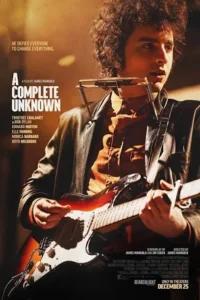
In 1965, then a 19-year-old sophomore at UC Berkeley, I invited my boyfriend to see Bob Dylan live at the Berkeley Community Theater. I had been a fan of Dylan’s since my senior year in high school and was full of anticipation and excitement. I wasn’t sure what my boyfriend would feel about the music; he knew of Dylan but would not have called himself a fan. Finally Dylan came on stage and immediately went into full electric “Like a Rolling Stone.” There were loud boos from the audience, and I was horrified. Not about the electric sound—I was fine with that. But the booing! What would this new boyfriend think?
Now, some 60 years later, I remembered that moment, among many memories, as I watched the new film, A Complete Unknown, directed by James Mangold, written by Mangold and Jay Cocks with my grandson, a 19-year-old sophomore in college. The film, based on Elijah Wald’s 2015 book, Dylan Goes Electric! Newport, Seeger, Dylan, and the Night that Split the Sixties, is about Dylan’s early years, 1961-1965, and his move from folk music to electric rock. And if you are looking for an enjoyable film experience, you will not be disappointed. It is entertaining, with the images and sounds of the early sixties. Iconic images of the Cuban Missile Crisis, and the Civil Rights Movement, and the anti-war movement, are effectively shown with actual newsreels shown on black and white television images. My grandson, like many of the young people who are seeing this film, was fascinated and excited by the times as well as the introduction to Dylan’s music. He was especially thrilled by Masters of War. I, like many of my generation, was pleasantly coddled by the nostalgia evoked by the film—the music, the politics, the emergence of Bob Dylan as the great songwriter and musician that he was and is. The world of Sixties Greenwich Village comes alive, and we see characters we knew or have heard of, running across the screen, Pete Seeger, well played by Edward Norton, Dave Van Ronk, Johnny Cash, Joan Baez. It is fun to watch. It is fun to see Dylan, here played by Timothee Chalamet, pick up a whistle on a street corner, the whistle that went on to open “Highway 61 Revisited”, and fun to see how the young Al Kooper provided the organ music that starts “Like a Rolling Stone”. The climax of the film is the uproar at the 1965 Newport Folk Festival, when Dylan went electric, and drove the fans and folk purists to near apoplexy.
Dylan’s relationships with Suze Rotolo, called Sylvia Russo at the request of Dylan, and Joan Baez, are depicted as manipulating and cold, really not so different from many relationships of the 60’s, before the women’s movement, when men were “cool” and women were “chicks.” Both these women, strong and highly accomplished in their own rights, are portrayed shallowly, neither given the heft that they carried in real life. Neither of the actresses, Elle Fanning as Sylvie Russo, and Monica Barbaro as Joan Baez was given much to work with, and neither came anywhere near capturing the people they portrayed. Dylan is portrayed by Timothee Chalomet, who has received lots of attention and Oscar noise for his role, who plays his own guitar and sings the songs in a decent facsimile of the real thing. But, as I told my grandson, why accept the ersatz when you can listen to the real Dylan so easily. Of Timothee Chalumet’s depiction, Dylan says, “I’m sure he’s going to be completely believable as me. Or a younger me. Or some other me.” (1)
Here is my problem with the film. While enjoyable, it is not a great film. It is pure one-dimensional fiction, a story about a character, perhaps based on Dylan, but in no way capturing the depth of the artist. It is a film of cliches, which is why it is so seductively enjoyable. There is the cliché of the brilliant artist who tramples over people, especially adoring women, on his way to fulfilling his unfettered ambition. It gives us cliches of women, clichés of those adoring women. It is sad to see the spirited and multi-faceted Suze Rotolo, an artist in her own right, deeply involved in civil rights politics, a Red Diaper baby of Italian Communists, but not Stalinists, as she points out in her own memoir (2), reduced to a simpering and pallid wisp of a woman. Similarly, Joan Baez is portrayed without much depth, important only as the troubled partner of Dylan, given only a few spunky remarks and some sarcasm, with a pretty voice that cannot rise to the exquisite heights of Joan Baez’s voice.
What is missing in this film, and what makes it derivative rather than art, is that there is no challenge to the viewer. There is nothing that compels viewers to look at themselves and ask the hard questions like, what is the meaning of this music in my life, then and now. What has it been about Dylan that so captured our souls? What is the meaning of the intense resistance to Dylan’s going electric? What did that have to say about the rigidity, the artistic straight jackets fans and purists were putting on artistic expression? Was this a new historic iteration of the Stalinist insistence on the purity of “proletarian art”? Did we, his fan base, become “Maggie’s Farm”? Today, in an era of social media, how do fans control artistic expression? None of these questions are posed by the film. The film is refined, pasteurized, and spoon fed.
As a fan, I’ve had to ask myself these questions. While I understood Dylan’s need to transcend the folk world, I must admit I, too, was caught in the desire to keep Dylan the way I wanted him. I saw him live in Chicago in the 1980’s. I couldn’t wait for him to sing some of my favorite oldies. He did sing them, but in a way I didn’t recognize, the rhythm was different, the tone was different, and I was very disappointed. It wasn’t until years later, when reading his memoir, Chronicles , that I understood why he did what he did: “By combining certain elements of technique which ignite each other I could shift levels of perception, time-frame structures and systems of rhythm which would give my songs a brighter countenance, call them up from the grave—stretch out the stiffness in their bodies and straighten them out.” (3) He wanted to challenge our entrenched and comfortable perceptions of his music.
Dylan himself, self-aware as always, believes in the responsibility of an artist to challenge through his or her art. He was initially drawn to folksongs because “folksongs transcended the immediate culture.” When that transcendence stopped, his music had to explore elsewhere. In a wonderful, almost Hegelian way, he says, “Opportunities may come along for you to convert something—something that exists into something that didn’t yet.” “You have to show people a side of themselves that they didn’t know is there.” “Art”, he says in The Philosophy of Modern Song (4) is disagreement.”
In the end, it is the words and the songs that matter most to Dylan. This film does not help us, regardless of our generation, look at our own lives in any way deeper than comforting nostalgia and the trivial, though enchanting, mythology of the times. As Dylan points out in The Philosophy of Modern Song, “Knowing a singer’s life story doesn’t particularly help your understanding of a song. Frank Sinatra’s feelings over Ava Gardner allegedly inform “I’m a Fool to Want You,” but that’s just trivia. It’s what the song makes you feel about your own life that’s important.”
For all these years, Dylan has never stopped his genius ability, in words and music, to speak deeply to my soul. The old man, now 83, still has what it takes. But the thrilling enigma of Bob Dylan cannot so easily be captured in a film—it’s like trying to paint the wind. However, after all this, do see this film, see how you feel and what you think about it. And other films to consider: Scorsese’s Rolling Thunder Revue: A Bob Dylan Story , 2019,(Netflix), and I’m Not There, 2007, (Amazon Prime) directed by Todd Hayes, with six actors portraying different aspects of Dylan’s life, none of whom are named Bob Dylan. Both these films challenge and stimulate in ways that this new film cannot.
“ Well, I try my best
To be just like I am
But everybody wants you
To be just like them” (5)
Notes:
- In The Downey Patriot, Alistair Hunter Jan 5, 2025.
- Suze Rotolo, A Freewheelin’ Time: A Memoir of Greenwich Village in the Sixties, Broadway Books, New York, 2008.
- Bob Dylan, Chronicles, Vol.1 (there is no Vol 2), Simon and Schuster, New York, 2004.
- Bob Dylan, The Philosophy of Modern Song, New York, 2022. Brilliantly written, this book shows the depth of Dylan’s understanding of music, and his deep appreciation of other artists, as well as his profound sociological and philosophic analysis of American culture.
- “Maggie’s Farm,” Bob Dylan, on Bob Dylan Bringing It All Back Home, 1965.
 If you’ve read this far, you were pretty interested, right? Isn’t that worth a few bucks -maybe more? Please



Leave a Reply