
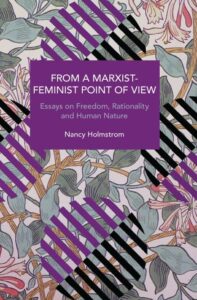
 Haymarket Books has just issued a paperback edition of Nancy Holmstrom’s From a Marxist-Feminist Point of View: Essays on Freedom, Rationality and Human Nature. Nancy talked to the publisher about her intellectual and political history, and some of the themes in the collection.
What was your journey to socialist activism? And how did the political context of the 1960s and 70s shape your vision of the society you wanted to fight for?
Did these experiences change the way you approached philosophy – the subject you studied at university and ended up teaching?
It certainly did, but not at first. My interests in philosophy at the time were philosophy of mind and metaphysics. Analytic philosophy was rigidly differentiated from history and social theory. I viewed philosophy as essentially apolitical. It was only when I started teaching at the University of Wisconsin in 1970, when radical and feminist philosophers were beginning to organize, that I began to connect my political and philosophical interests. I wrote my first article from a Marxist point of view, “Free Will and a Marxist Concept of Natural Wants” in 1975 where I critiqued the dominant theory in the free will debate. Later, I integrated feminism into my account of freedom, in “Against Capitalism in Theory and Reality.”
This transition in the type of philosophy I was doing hurt my academic career. I was denied tenure at Wisconsin and got a job at Rutgers U at Newark, where I was denied tenure again. However, Rutgers had a union, which finally won my job back with tenure. After 18 years as an Assistant Professor, however, I was more estranged from academia than ever, and my writing over the years reflects it. My style became more direct, more explicitly political, and I no longer limited myself to philosophy journals.
Your book shows that we need Marxism if we want to better understand how capitalism constrains human emancipation – and especially women’s freedom. “Modes of production” and “relations of production” – two key Marxist concepts you use throughout the book – are especially important in your analysis. How could a Marxist-feminist point of view, as you propose it, help us radicalize our critique of capitalism?
In what ways has Marxism-feminism changed or developed since you first began writing on the subject?
Then and now most who call themselves Marxist-feminists (within the broader category of socialist feminists) want to signal that capitalism is primary, that the mode of production is foundational to all other kinds of oppression.
There are many new developments in Marxist feminism since I first began writing on the subject, and talked about biology from within a materialist framework. There was a huge debate about human nature (biologically oriented versus social constructivist). Marxist-feminists also theorized more fully the connection between the emergence of gay identities/gay sexuality and capitalist class relations; “Queer Marxism” was coined. The discussion of gender fluidity and trans issues is new but much of what I wrote is compatible with it. Ecosocialist feminism has become more important. Social reproduction feminism, which theorizes the crucial importance of social reproductive labor, done primarily by women, to the reproduction of capitalist society, has emerged as a distinct current of Marxist feminism.
But many Marxist feminist theorists today do not try to theorize at the level of abstraction that characterized earlier work. Rather, theoretical frameworks are elaborated and applied in analyzing particular social, economic, political, cultural issues in particular periods and places. (This was also true of socialist feminists as I showed in my book The Socialist Feminist Project.)
Finally, what would you like Haymarket readers to take away from this book?
I would like them to take away a non-deterministic, non-reductive materialist approach and an excitement about the continuing relevance of core Marxist concepts and applying these concepts to analyze the changing nature of capitalist societies and the global capitalist system in which they are embedded. To see how the workings of the capitalist mode of production place fundamental constraints on social change, helping us understand why, after 50 years of feminist organizing, women’s oppression has changed shape but has not been eliminated.
Also, I would hope that readers understand that the way in which the core concepts of freedom, rationality and human nature are understood within capitalism are capitalist ideology and need a radical critique that a Marxist-feminist point of view can provide.
 If you’ve read this far, you were pretty interested, right? Isn’t that worth a few bucks -maybe more? Please
Leave a Reply