Place: Europe
In France we have just experienced a great wave of strikes that directly addressed matters of political power. French history is defined by explosions of militancy which, for our governing class and for most of our journalists, are a "French sickness" that would be good to get rid of: before 2003 there was 1995; before 1995, 1968; before 1968, 1953 and so forth, all the way back to the Revolution. But this time there is something new: the latest wave of militant action is not an end to itself and is only an introduction.
The Swiss health insurance system, which mandates every individual to buy private health insurance, has been held up by many as a realistic model for the United States. In Switzerland, however, private insurers are far more highly regulated than is conceivable to imagine in the U.S. for example, they are not allowed to make profit on “basic” coverage. Yet even so, as my friend Dennis Clagett who lives in Switzerland has written to me, popular dissatisfaction with the country’s healthcare system is mounting due to the way that the private insurers have behaved.
Empire is characterized by the close proximity of extremely unequal populations, which creates a situation of permanent social danger and requires the powerful apparatuses of the society of control to ensure separation and guarantee the new management of social space.[1]
[Note: This is a corrected version of the footnoted article that was earlier posted on the web.]
In spite of their undeniable differences, Marx and Weber have much in common in their understanding of modern capitalism: they both perceive it as a system where "the individuals are ruled by abstractions (Marx), where the impersonal and "thing-like" (Versachlicht) relations replace the personal relations of dependence, and where the accumulation of capital becomes an end in itself, largely irrational.
On February 13, 1998, Bulgarian President Petar Stoyanov accepted on behalf of his ex-Communist nation the Courage to Care Award, which the Anti-Defamation League (ADL) had bestowed upon Bulgaria in recognition of the heroism of its people in saving Bulgarian Jews during World War II.
If you missed “The Old Man,” Christopher Hitchens’ review of Verso’s reissue of Isaac Deutscher’s trilogy about Leon Trotsky, http://www.theatlantic.com/doc/200407/hitchens do read it. The review describes Trotsky's accomplishments not generally known, for example, his activities as a brilliant war correspondent in the Balkans. But most important of all is the discussion of Trotsky’s polemics against the communist policy in pre-Hitler Germany. Trotsky warned that in communist policy the real enemy was not the Nazis but social democracy.
Are all cultures are equally valid and commendable? asks Peter Tatchell. I just received an email describing speeches Peter Tatchell has delivered on this subject. ( You can follow him with twitter at http://twitter.com/PeterTatchell or Facebook at http://tinyurl.com/cj9y6s ).
Law professor John Spencer, of Cambridge University, has created a huge controversy in the UK by suggesting a reduction in the current age of sexual consent of 16. His proposals, broadcast on BBC Radio 4’s Iconoclasts programme, with my support as a co-advocate, have been savaged by The Sun and the Daily Mail.
Law professor John Spencer, of Cambridge University, has created a huge controversy in the UK by suggesting a reduction in the current age of sexual consent of 16. His proposals, broadcast on BBC Radio 4’s Iconoclasts programme, with my support as a co-advocate, have been savaged by The Sun and the Daily Mail.
Multiculturalism vs. human rights?
Defending multiculturalism but warning against its excesses
Multiculturalism has many positive benefits. It defends the right to the different, which is a very important and precious human right, especially for those people whose difference has historically resulted in social marginalization and exclusion: including women, black, disabled and lesbian, gay, bisexual and transgender (LGBT) people.
THE COUNTRIES THAT CLAIMED TO BE Communist also claimed to meet the needs of their families. What happened to those claims when the countries became capitalist? The fall 2007 issue of Social Politics seeks to answer that question. It analyzes family policies of Russia, Poland, Hungary, the Czech Republic, Ukraine, Moldova, and Armenia. Some social welfare scholars have created a typology of welfare states in relation to the “family wage” ideology, i.e., male breadwinner and woman homemaker.

WITH THE ELECTION OF BARACK OBAMA, millions in the United States and around the world are hoping for relief from the dangerous arrogance and destructiveness of George Bush’s foreign policy. President Obama is expected to take important positive initiatives — like closing Guantanamo and lifting the rule denying international organizations receiving U.S. aid the right to let women know about abortion. When the inevitable right-wing reaction to these initiatives comes, it will be crucial for us in the peace movement to defend them.
IN 1865, WHILE MARX, IN HOLLAND, was playing the Victorian parlor game “Confessions” with his daughter Jenny, when asked for his favorite maxim he replied, “Nihil humani a me alienum puto” or “nothing human is alien to me,” a dictum he had lifted from the second century B.C. Carthaginian slave-turned-playwright Terentius (Terence.)
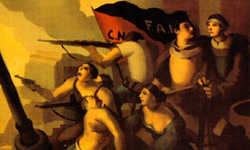
THERE IS A CONSENSUS among democratic socialists today that the struggle for deep social change has to somehow reflect the kind of society we want to build, but this remains inseparable from the questions of power, political strength and effectiveness because prefiguration goes beyond the "pure" ethical sphere to include wider issues of ideological/cultural, political and socio-economic hegemony. The revolutionary syndicalist answer to the problem of integral prefiguration represents a specific and important historical (and contemporary) synthesis.
 TRANSLATED BY MICHAEL SEITZ GUADELOUPE HAS MADE AN IMPRESSION . . . but not yet on the French union movement. The capitalist crisis affects France as it does all industrialized countries.The ingredients are the same:
For immediate release
Contact: Joanne Landy, Campaign for Peace and Democracy, jlandy@igc.org
NEW YORK, March 18, 2009
AS PRESSURE GROWS in Canada to adopt the American justice model of harsh prisons and long sentences, Finland has saved millions and prevented centuries of human misery doing the opposite. HAMEENLINNA, Finland — In a classroom thick with wigs, sinks and barber chairs, a man sprays water through a woman's sudsy hair and works his fingers carefully to rinse the shampoo. Standing in front of a large mirror, another man brushes and sprays a woman's hair. Two others discuss styling techniques. It could be a scene from any community college, but for the bars on the windows.
- « Newer Posts
- 1
- …
- 25
- 26
- 27
- 28