Blog

  • Working People for Peace: The Real Story of Popular Opposition to the U.S. Adventure in Vietnam

    [The following review of mine appears as Hardhats for Peace in the July 18 issue of The Indypendent, which calls itself with considerable justification "A Free Paper for Free People." An expanded version surveying a number of recent (and quite good) critiques of U.S. misadventures in East Asia from the Philippines to today, will appear in the forthcoming New Politics.]


         A lot of books get published. Some are worth reading. Occasionally one comes along that is so complete, so thoughtful and so well-argued that not only does it move the discussion, it closes it. In Hardhats, Hippies, and Hawks: The Vietnam Antiwar Movement as Myth and Memory, City University of New York sociologist and labor educator Penny Lewis does that to a reigning myth — that the mass movement against the United States’ war in Southeast Asia comprised mainly spoiled college kids, and that the true, authentic blue-collar Americans backed the war with brio. That’s a slick line to propagate. Not only does an image like that of construction workers attacking protesters (as famously occurred on Wall Street in May 1970) justify foreign interventions and military spending, it stigmatizes dissenters as illegitimate and alien to the body politic. That grossly distorts real working class sentiment or the class composition of protesters, all to divide critics themselves.

         Slick as it was, the line was not true, says Lewis, whose work in this remarkably readable and textured analysis shows us the past isn’t so much remembered as “reconstructed,” in schools, by the media and elsewhere. Even contemporary polls by Gallup showed that the greater one’s education, the more likely one was to support the Vietnam War. That is the reverse of the urban myth that blue-collar families were the war's key defenders and that a privileged and ungrateful elite — what neoconservatives would soon name a “new class” — was responsible for defeat in the field. It’s an old trope, that wars are lost not through military blunders, or because they were undertaken for the worst possible reasons, or because the domestic effects from an indefensible and bankrupting military adventure estrange growing numbers of people, but because of a “stab in the back” by a willful and disloyal minority.

         In fact, as Lewis demonstrates, the U.S. drive to stabilize what quickly became  a series of milirary dictatorships in South Vietnam was defeated through the resistance of the Vietnamese and the disintegration of a near-mutinous U.S. army in the field. As for the antiwar movement at home, Lewis calculates that some tens of millions of Americans took part at its height, with the majority of Americans opposing the war. If the movement began on elite campuses and with the help of traditional pacifist and left organizations, Lewis demonstrates how it quickly grew to encompass communities of color, including civil rights organizations aghast at the domestic cost of the war, parents with a real expectation of losing sons in a pointless slaughter, mid-level trade union officials and rank-and-file union members bucking their war-abetting union leaders, and returning troops — typically with no more than a high-school diploma or GED — very publicly discarding their medals in antiwar mobilizations while helping build the GI coffeehouse efforts. And with the draft swelling resisters’ ranks, the now grounded multi-class movement changed a bipartisan consensus among Washington policy-makers that “rolling back communism” and “defending freedom” were both fair statements of war aims, let alone real possibilities. Communism would within a generation be rolled back, but by the tenacity of a then ascending global capital, not by the U.S. military.

         Meanwhile, the antiwar movement never transcended its own limitations. Once the body bags stopped flowing home and the draft ended in 1973, the movement — built on the broadest possible agreement on just one issue (Bring the Troops Home Now!) and never really incorporating the latent critique of imperialism, let alone opposition to capitalism — could not grow into an a radical force capable of challenging the U.S. class system itself. It did spark radicalism among erstwhile liberals (like me) and a real effort to organize working people as anti-capitalists at home, where those of us who began purely as war critics and activists grew into radicals of one stripe or another in unions, community organizations and academia. If anything, the meme propagated by some leftists that workers were big backers of imperialism backfired with many of the most dedicated campus antiwar activists, setting the stage for much of the working class organizing that former student radicals did during the 1970s. In myriad industrial cities we found — surprise! — young workers not that different from us, just having different life chances.

         Lewis does much more than just debunk a pernicious myth with her multifaceted and complete analysis. Her effort to complete an exhaustively detailed portrait of a huge movement — one that never received the sort of scholarly attention given to other key upsurges of the 1960s, including the Civil Rights movement — is commendably aimed at confounding what she calls “a faulty memory frame” while forging a true “countermemory.” Thanks to scholars like Lewis, history isn’t always written by the winners.


    Michael Hirsch is a member of the New Politics editorial board.


  • The Double Standard in Europe's Austerity Discourse

         The International Monetary Fund acknowledged making an egregious error in its evaluation of the Greek bailout it helped create after its ambitious push for harsh austerity last month. Their failed analysis highlights the dangers of austerity measures imposed on Greek citizens. According to the IMF report:

    "Market confidence was not restored, the banking system lost 30 percent of its deposits, and the economy encountered a much deeper-than-expected recession with exceptionally high unemployment. Public debt remained too high and eventually had to be restructured, with collateral damage for bank balance sheets that were also weakened by the recession. Competitiveness improved somewhat on the back of falling wages, but structural reforms stalled and productivity gains proved elusive."

         The evaluation additionally predicted that unemployment would reach 15 percent when it actually climbed to 25 percent. IMF analysts claimed that they simply underestimated the consequences that unemployment would play on Greece's recovery.

         This isn't the first time that the IMF has conceded the dangers of austerity. In 2012, the fund's research acknowledged that austerity packages applied throughout Europe were counterproductive and suggested "that fiscal cutbacks had larger-than-expected negative short-term multiplier effects on output." They expected only a loss of growth worth 50 cents for every Euro cut, but the lost growth exceeded three times that value.

         In a more recent report, Director of the International Monetary Fund Christine Lagarde advocated more growth-based policies.

    "Over the past year, substantial actions at both the national and euro-wide levels have been taken to combat the crisis. But despite this progress, the economic recovery remains elusive, unemployment is rising, and uncertainty is high. While substantial collective action has been taken to tackle the crisis in the euro area, further policy steps are needed to support growth and increase employment."

         Though the IMF recognizes the devastating consequences that austerity poses to suffering countries, spending cuts and debt-reduction will likely remain a pillar of Europe's finance orthodoxy as public officials continue to advance the "fiscal responsibility" discourse. In an attempt to attract international investors, Greek Prime Minister Antonis Samaras recently promoted his country as a "success story," downplaying Greece's record unemployment. He assured lenders that the $325 billion in bailout packages that imposed harsh austerity measures on Greek citizens restored the country's "credibility in Europe." He further promised higher rewards for future investments by endorsing Greece as a profitable vacation spot.

         On another front, Angela Merkel's likely reelection to a third term as German Chancellor will bring a renewed mandate to push for austerity in Europe's GIPSI states – Greece, Italy, Portugal, Spain, and Ireland. Her popular support is rooted in an electorate that is tired of German taxes financing bail-outs for EU members largely painted as profligate and reckless. Merkel's prospective victory will frustrate Lagarde's recent push for growth-based policies as the IMF cannot act unilaterally and requires German involvement. Lagarde had primarily focused her attention on raising funds for European bailouts, but she has recently emphasized growth.

         When asked about whether Greece will be writing down more debt in the future, she spoke highly of Samaras saying, "I don't see it, thanks to the very reform-oriented Samaras government." Last year, almost a third of Greece's overall debt was forgiven in a write-down of over a hundred billion euros held by private investors. She ended with an assurance that "debt-sustainability will continue to be ensured."

         The triumph of Europe's austerity discourse advances the narrative that profligate government spending caused the crisis. German Foreign Minister Guido Westerwelle recently stated, "We are convinced that if we give up on budget consolidation in Europe and return to the old approach of more and more debt, then we would cement mass-unemployment over a period of many years" (italics added). Even Merkel recently implied that suffering states spent beyond their means when she snidely commented, "I call it balancing the budget. Everyone else is using this term austerity. That makes it sound like something truly evil."

         This kind of language reveals how the current narrative paints deficit spending as the cause of the financial crisis. In reality, the sovereign debt crisis is a product of the banking crisis, and debts ballooned only after states had spent a large percentage of their GDPs rescuing the financial sector. Up to that point, the public expenditures of those suffering the most were well within in the average of the Eurozone. To confirm this, I collected data from the European Commission's Eurostat and averaged the total general government expenditures as a percent of GDP from Eurozone members in 2008. Spending of the GIPSIs averaged 45.75, which is well within the Eurozone's overall average of 45.05, demonstrating that countries suffering the most did not spend beyond their means.

         In fact, the GIPSI debt burden followed a downward trend throughout the decade leading up to the collapse. Using IMF data, I averaged GIPSI debt relative to GDP from 1997 to 2010. The average of the GIPSI states' debt relative to GDP was 77 percent in 1997, which slowly slid down to 63.5 percent in 2007. Austerity actually magnifies the debt burden as spending cuts slow growth while doing nothing to alleviate the debt. Debt became a problem only after the establishment of the austerity orthodoxy, as debt to GDP ratios shot up to 91.4 percent in 2010.

         The apocryphal narrative of profligate state spending distracts us from the class politics inherent in Europe's austerity project. The promise to return Europe to "stability" and "fiscal responsibility" as well as transform it into a "credible investment" masks how spending cuts target those who rely most on social programs. The ambitious push to shrink government services shows Europe's double standard in its austerity project after states dissipated large amounts of their GDPs rescuing the financial sector. In this regard, austerity serves as a form of redistribution, transferring money and privilege from the bottom to the top.

         Simultaneously, unemployment continues to plague the GIPSI economies. Using data from the World Bank, I looked at the unemployment rate of the GIPSI states over time. The average unemployment rate for the GIPSIs was 7 percent in 2008 but it jumped to 19 percent at the beginning of 2013. Meanwhile, the Tax Justice Network reveals that the wealthiest investors in the world continue to make more money while hoarding up to $30 trillion in secret tax havens abroad.

         There is nothing "stable" or "responsible" about that.


    Ben Luongo is currently a doctoral student in the University of South Florida's Department of Government and International Affairs. He has taught international relations at St. Petersburg College in Clearwater, Florida. He has also coordinated several campaigns with groups like the Human Rights Campaign and Save the Children.

  • Heartbreak and class warfare, Chicago-style

    I’d be heart-broken by the layoffs announced by the Chicago Public Schools, (CPS) even if my pal Xian Barrett (in the photo, talking teaching with me at the DC Save Our Schools demo last April) weren’t one of the folks given a pink slip.

    By pinning the blame for the layoffs on “the lack of pension reform” Mayor Rahm Emanuel is trying to force the Chicago Teachers Union (CTU) to choose between layoffs and cuts to pensions. Meanwhile, the CTU with parent and community allies has brought the district to court to reverse the school closings, tenaciously contested last Spring.

    Layoffs are devastating – as are school closings. Can the CTU win this? Or as a reader of my most recent NP seems to suggest, is schooling just too enmeshed in the muck of capitalist social relations for even a good union to counter?

    No one has a crystal ball – not me, not readers, and not our enemies. No one knows what the outcome of this struggle will be. This is class warfare, and in wars both sides have wins and losses. The CTU’s strike and its success in building solid, mutually respectful alliances with parents, students, community, and other unions go in the “win” column. So far the weight of those successes has not been sufficient to keep Emanuel and the political elite of Chicago whom he represents from countering successfully with the school closings and layoffs.

    What to do now?  I think the union needs to adopt two strategies simultaneously. First is turning up the heat “from below.” CTU knows how to organize and staff are likely cooking up a campaign as  I write.  Maybe a series of rolling strikes? That’s what the two biggest teachers unions in the UK are doing now to push back on the government’s attacks on teachers and public education. (Catch that band playing! Love those hats!) The Bad Ass Teachers Association has a campaign to phone Emanuel's office and demand he call off the layoffs. Nice work, BATS!

    The other part of the strategy is “from above.” This means putting pressure on AFT President Randi Weingarten, who has considerable access to the White House, to use her clout, now.  After letting the White House know her intention, Weingarten could have a coffee date with Rahm and explain why he can’t tell teachers to choose between pensions and layoffs – not, that is, if he wants a single penny from the AFT for Democrats (who don’t deserve a cent to start, but that’s another blog…) No campaign workers, no phone banks. And a campaign in the AFL-CIO to follow suit.

    What if Weingarten doesn’t respond to private pressure? Doesn't want to use her political capital to save the jobs of Chicago teachers? Then we should go public with the demand. Petitions, phone calls, to the AFT national office. Union officials are only as smart and powerful as their members help them to be. Union officers get lots of heat from the media and the politically powerful to be reasonable, that is, make concessions. It’s the job of members to push the other direction, hold our officers’ feet to the fire.  By making demands on Weingarten to defend Xian and the other 2000 CPS employees told they've been laid off, we’ll be helping Randi Weingarten to do her job.  And by organizing at the schools, with parents, students, and community, the CTU is helping Rahm to be a better Mayor. And boy, does he need help. Until we throw him out.


  • Class Struggle from the Couch

    On Sept. 17, Grand Theft Auto V, the latest installment in the wildly popular video game franchise, will be released for the Playstation 3 and Xbox 360, perhaps as one of the final major games for the current console generation.

         Older readers may not be aware, but video games have developed quite a bit since the Pac-Man booths of yore. Games increasingly include sophisticated plots, top-of-the-line voice acting, and graphics that could be mistaken on first glance for live-action film. I have little doubt their quality will increase exponentially in years to come and they will represent one of the most important media of the 21st century. Back in 2011, The Economist reported the video-gaming industry was already three-fifths the size of the movie industry. For that reason alone, games deserve serious critical attention.

         I'd like to take the opportunity of GTA V’s release to examine, as one might books or movies, how its publisher, Rockstar, has dealt with political themes. Specifically, as a fellow traveler myself, I'd like to look at the publisher's portrayal of socialism and class struggle. I'll do this through the lens of Rockstar’s earlier games, Red Dead Redemption and L.A. Noir.

         Red Dead Redemption is a 2010 action and adventure game inspired by the spaghetti westerns of filmmakers such as Sergio Leone. Now, you should know, I'm not a die-hard gamer. I haven't played everything out there, or even close. During the opening character-creation sequence of Skyrim, a game which hardcore reviewers were in ecstasies over, I got bored and gave up. But I LOVED Red Dead Redemption. And yes, the caps lock is necessary. It boasts a beautifully rendered world, solid character development and a well-written story. So if you've never picked up a controller or haven't in a while, give RDR a chance.

         Part of the game is set in the Mexican Revolution. It's my understanding that some of the characters are based on real-life figures but I'll leave discussion of the release's historical accuracy to those with more knowledge of the subject. I am, sadly, just another dumb gringo.

         RDR's central protagonist is a bounty hunter named John Marston. Asked whether he is a socialist, he explains, "I'm many things, most of them bad. But a man of political principles? No." Marston fights on both sides of the conflict before throwing in his lot with the rebels, seemingly more out of personal loyalty than ideological conviction.

         Rockstar portrays the Mexican dictatorship as brutally corrupt, though eventually paints the rebel leadership as little better. Similarly, the publisher seems sympathetic to the revolutionary rank-and-file, while also suggesting they are naive. Luisa Fortuna, a selfless peasant fighter, is perhaps the game's most uniformly likable character. She speaks passionately of the struggle without Rockstar imposing a noticeable sense of irony. At the same time, however, she is in love with a local guerrilla leader, who admits to Marston he would never marry a peasant and is revealed to be something of a political tyrant-in-waiting. His insincere commitment to Fortuna and the rebel cause is perhaps explained by his upper-class origins.

         In the end, Rockstar sides with the rebels, but quite unenthusiastically. Whether this is an appropriate position, given how the revolution turned out, is a question I'll leave for those with more knowledge of Mexico's history. But the publisher seems to go further, cynically suggesting government can never be representative of the people's interests, no matter the circumstances, no matter how much the masses struggle. This, of course, leaves no room for progressive change.

         L.A. Noir, also published by Rockstar, is a 2011 pulpy period piece set in the 1940s. Unfortunately, it's not fractionally as fun as RDR. There's very little overarching story or character development to propel you forward, and the cases you work through could probably be played in any sequence, as you might watch the TV show Law & Order, without missing much.

         One investigation could be interpreted as an implicit criticism of Red Scare hysteria. The central protagonist, a police officer, investigates a series of suspicious fires he believes to be connected. The game leads you to charge a low-level gas company employee found in possession of anarchist pamphlets, specifically Peter Kropotkin's Law and Authority. And if I'm following the game's twists and turns correctly, the employee is actually innocent.

         Another investigation, however, introduces us to a communist character who, while also falsely charged, is the most unflattering representation of a leftist in either L.A. Noir and RDR. The guy's insufferably snotty and just in case you didn't pick this up from what he says, he's wearing an ascot. I mean, an ascot? But it doesn't stop there. He looks down on working class people and beats women, just in case you didn't get that he is a monstrous hypocrite too.

         Of course, we live in a conservative country where, according to Gallup, only 36 percent of the population has a positive view of socialism, however it may be defined. So it makes sense that a major game publisher would present an ambiguous-to-negative view of economic democracy and those who work for it. Have readers out there played any other games, by Rockstar or other publishers, that deal with issues of class struggle?


    Jon Hochschartner is a contributing writer for The North Star, a non-sectarian socialist website.


  • Zimmerman Verdict: Still Impunity in the U.S. for the Killing of Black Men and Boys

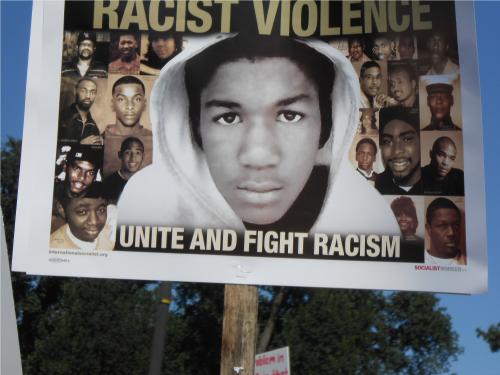
         The acquittal of George Zimmerman on charges of manslaughter and murder in the Trayvon Martin case on July 13 represents another incident in the long history of impunity for those who in the name of the law and order kill African American men and boys. Zimmerman, an armed, neighborhood watch leader in Sanford, Florida, followed Trayvon Martin, a 17-year-old and legally a child, through his neighborhood—despite the fact that after calling the police Zimmerman had been informed that they did not want him to follow the individual that he had identified as “a real suspicious guy.” When Zimmerman overtook Martin, there was an altercation that left the armed vigilante alive and the black teenager dead. Zimmerman’s attorneys argued that he should be acquitted of the charges of manslaughter and murder because he had acted in self-defense after being attacked by Martin.

         The long and complicated trial before a jury of six women, one a woman of color, presented conflicting testimony about who was on top once the two were fighting on the ground and who it was that called for help, the mother of the killer and the mother of the victim both identifying their son’s voice as that calling for help. The jury decided that it had not been proven beyond a reasonable doubt that Zimmerman had not acted in self-defense. Yet, while the specifics of this case may be complex and the decision of the jury consonant with Florida law, the injustice of that decision is all too apparent to African Americans and their allies who know that it is only another example of impunity for those who either as real police officers or would-be police officers kill black men and boys. Let us put the facts simply: an armed vigilante with no legal or police authority followed a black child through the neighborhood and killed him. Yet the killer walks free. Whites in the South and in other regions of the country were free to kill African Americans with little likelihood of punishment under slavery, during the Jim Crow era, and apparently can still do so in what some have called the “post-racial” age. At best one can say the justice system unfortunately failed, though many, especially black Americans will feel that it worked, as it has worked for decades.

         Demonstrations protesting the Trayvon Martin decision began on the West Coast, in the San Francisco Bay area and Los Angeles, the same night as the jury reached its decision. There have also been demonstrations in Washington, D.C. and Tallahassee. Other demonstrations are planned for Sunday, July 14 in cities throughout the country. The National Association for the Advancement of Colored People (NAACP) is calling upon the U.S. Justice Department to act in the case. They are circulating this:

    “We're calling on the U.S. Justice Department to open a civil rights case against George Zimmerman and have launched a petition to Attorney General Eric Holder. The petition says:

    "The Department of Justice has closely monitored the State of Florida's prosecution of the case against George Zimmerman in the Trayvon Martin murder since it began. Today, with the acquittal of George Zimmerman, it is time for the Department of Justice to act. 

    "The most fundamental of civil rights—the right to life—was violated the night George Zimmerman stalked and then took the life of Trayvon Martin. We ask that the Department of Justice file civil rights charges against Mr. Zimmerman for this egregious violation. 

    "Please address the travesties of the tragic death of Trayvon Martin by acting today. Thank you."

    Click here to add your name to this petition, and then pass it along to your friends.

         The struggle for racial justice in the United States continues, now over the killing of Trayvon Martin, where the killer walks free. Perhaps this most notorious of recent cases will provide the occasion for the reconstruction of an African American civil rights movement that can demand not only justice from the courts, but economic and social justice from the society at large.


  • A reply to Herman Benson: The Chicago Teachers Union is a different kind of labor union

    The exchange between Herman Benson and Dan La Botz highlights one, if not the primary, issue that has to be resolved if we are to turn back the tidal wave of anti-union and anti-democratic policies that have transformed the nation’s social and political landscape.  I think both Herman and Dan would agree that we need a revived labor movement. But what will drive the revival? And what form should it take?

    Herman’s definition of revival seems to consist of more “oomph” from the AFL-CIO leadership and more attention to union democracy.  Both are sorely needed. The question is whether these are adequate to restore, let alone push forward, the political and economic policies we so desperately need.  In education, the answer is a clear “no” and the example of the Chicago Teachers Union supports Dan’s argument.


    Yes, the Chicago Teachers Union (CTU) conducted a militant strike. But it was not a traditional strike by any means, if we take as a definition of tradition what has existed in US unions for four decades.  What we see in Chicago has been more  like the kind of organizing done by the CIO, fusing a progressive social program to union demands. CORE, the insurgent caucus that leads the CTU and was re-elected last month in a landslide (with over 60% of the members voting) has shifted the political terrain of education politics by embedding union demands in a vision for public education. Yes, the strike was a contract dispute, but these courageous, wise activists found a way to win over the vast majority of teachers to use the contract fight to fight for much more. Theirs was a fight for public education – as is their current struggle against the unnecessary, racist school closings that other cities are facing.  CTU has taken on the power establishment of Chicago and the White House.  They organize along side parents and community activists, as partners. In doing so, the CTU has shown teachers and organized labor the kind of unions – and unionism – we need.  Now.


    The victory of “right to work” legislation in Michigan shows how very tenuous U.S. labor’s hold is on the right to bargain collectively. Is it even a movement? Herman has been so right for so long about union democracy. Still, his analysis reflects the problems liberals have had in understanding that neoliberalism has destroyed the landscape in which unions have functioned.  (In an upcoming article in “The Jacobin,” I’ll be discussing liberalism’s failure to “get” what’s ailing education and the unions in more detail.)


    (Note: You can now follow me on twitter @drloisweiner.)

  • Real Unions and Unreal Unions

    This discussion has shifted ground. It started with what I proposed, but now we’re discussing Dan La Botz’s views on the AFL-CIO. I wrote about the need to democratize unions. Dan wants to turn existing unions into “real unions.”

    Rich Trumka solicited comments from friends of the labor movement on how the AFL-CIO might best prepare for the future. I replied by suggesting that if unions were thoroughly democratized, millions of members who were now indifferent to their unions or disenchanted could be imbued with the conviction that their unions truly belonged to them and not to the salaried officialdom.

    And so, the labor movement, which now depends upon an active cadre of thousands to bring its message to the nation, could recruit from its own ranks an army of millions of missionaries who would speak up for unions and labor’s cause to their relatives, their friends, co-workers — at home, in social gatherings, in their churches and clubs, at work. And so, in time, the mood of the nation could be affected and the labor movement restored to a powerful social and political force. In this, I do believe. I offered no new program, no alternate leadership, no cure for AIDS, no cure for the many social and economic ills of the nation or of the labor movement.

    Knowing something about Dan and, as an interested reader of what he writes, I am sure he agrees with what I proposed. But he says not a word about the essence of what I wrote. I don’t know if he even noticed it. He is too troubled by the few nice things I said about the AFL-CIO.

    He sees a fatal contradiction between criticizing the AFL-CIO leadership and then noting that the federation has been moving in the right direction. But why? Joe Rauh used to say: “We don’t want to tear down labor’s flag, we only want to wash out the stains.” The reality is that the labor movement has been moving, slowly, in the right direction precisely because of the criticism, the dissident activity of union democrats and reformers. In 2005, the book Rebels, Reformers, and Racketeers added the subtitle, “How insurgents transformed the labor movement.” It was too optimistic. While the decades of insurgent activity did not “transform” the labor movement, it certainly did move it in the right direction; and there is evidence all over the place. I don’t think that Dan would agree with those who claim that all that reform activity was fruitless.

    Dan insists that “we need a completely different labor movement if we are to have real unions.” Does he really believe that? The unions and the labor movement we have today may not meet our standards, but they are real enough for us to support against attack and to applaud efforts to recruit and retain members. In the same declamatory spirit, he writes of the “70-year degeneration of the labor movement.”

    At the risk of alienating Dan and/or his co-thinkers, I admit I see it differently; I don’t think that the more extreme the language you devise in analyzing unions, the more it demonstrates your consistent militancy and hones your effectiveness. I see the labor movement as weaker, relatively smaller, and on the defensive, but it is not in a state of “degeneration.”

    In some respects, we have a better labor movement. The entry of nurses, teachers, communication workers, and public employees has made a difference. The labor movement is more sensitive to the concerns of minorities and immigrants. Organized crime, while still a problem, has been pushed back, notably in the Teamsters union. The combined effort of reformers and government has made internal democracy more secure. Increasingly, unions recognize the need to work with community activists.

    I will agree that in this time of troubles, when unions have been put on the defensive, the dominant labor union officialdom has not displayed the kind of strong leadership we need. Even within the limits of what can be done, they have failed. And that lack has been only partially offset by independent militants, reformers, and insurgents; I am familiar with their battles because I have been working with them for the last fifty years. But at the further risk of disappointing Dan, I must add: The root cause of labor’s setbacks lies not in the derelictions of its top leadership, but in the major national and international political and economic trends of our era:

    The demise of the New Deal coalition and the persisting strength of conservatism which can count upon the support of half the nation and the Supreme Court; the decline of manufacturing in the United States; the change in the nature of our work force; low wage competition from so-called developing countries. The success of anti-union forces in pitting people in private industry against public employees.

    I realize that some may be leery of citing these facts for fear of minimizing the shortcomings of our established labor leadership. Not at all. We must face the reality to assess the validity of our own program and not get swept away by our own rhetoric.

    What are the essential qualities of that “completely different labor movement” and those “real unions”? Dan explains that “they will have to build a movement prepared to engage in job actions and wildcat strikes that violate the contract, meaning that they risk their jobs and court action that will penalize their unions economically, and they will have to engage in civil disobedience and be prepared to go to jail.” More broadly, he adds that they “will have to transform their pro-capitalist ideology, restructure their bureaucratic organizations, and once again inspire militant class struggle unionism.”

    Of course, at critical moments unions have to be ready to take that kind of militant action when need be and when it can be effective. From time to time, some of our most conservative unions have been good at it. But can that be the crux of a union program today? Is that the centerpiece of any program reformers and militants should advance in their unions today? In this, I admit, Dan is in good company. At the 1995 convention, when John Sweeney was pushing his successful insurgent campaign for AFLCIO presidency he told the delegates they had to be ready to “Block bridges’ in labor’s battles. He was greeted with wild applause from the delegates, most of whom were paid AFLCIO officers and staff. Everyone likes to dream of going into glorious battle. But almost no one, not even Sweeney, did much about it, not because they were sellouts, but because back in their unions, it didn’t seem the answer.

    In reply to Sweeney, Tom Donahue said “We have to build bridges.” It is true that in the past decades, there have been decisive moments that cried out for militant civil disobedience in labor battles. In a few instances today, mostly minor, they have been successful. But the dominant call, the most consistent appeal, coming from labor reformers has been for unions to build bridges: to minorities, immigrants, women’s groups, churches, community organizations.

    When Dan comes down to earth and assesses real unions in real battles, he ignores his own exacting standards. For example: he cites two models of his kind of real unionism: Miners for Democracy and the strike led by the Chicago Teachers union.

    The Miners for Democracy was a remarkable and admirable insurgent reform caucus. It ousted the murderous leadership of the United Mine Workers. It rallied support, financial and legal, from liberals and civil libertarians. With the volunteer help of a team of pro-labor attorneys, it wielded its own rights under federal law, and it expanded union democracy law to the advantage of all unionists in all unions. It inspired movements for democracy in other unions. Teamsters for a Democratic Union modeled its very name on theirs.

    But there was no bashing of capitalism, no civil disobedience, few of the standards for “real unionism,” no breaking the law. Quite the contrary, they made effective use of the law. In tendency, the miners and their leaders leaned conservatively. Its attorneys were standard Democratic leftish liberals. The man who inspired the movement at the cost of his life, Jock Yablonski, was a mainstream union leader right out of the old UMW incumbent leadership who finally realized that miners needed union democracy.

    The Chicago teachers gave a great lift to union morale. At a time when teachers and their unions face unremitting attack from governments, moneyed capitalists, and conservatives and criticism even from liberal politicians, the union demonstrated that it is possible, under strong leadership, to gain public support and win a strike. An insurgent caucus convinced the membership to replace an inactive leadership with one more militant. Yes, the CTU is obviously a real union. But like the Miners for Democracy it hardly meets Dan’s criteria. This was no wildcat strike, no break with capitalist ideology, no massive civil disobedience. The new officers led teachers in an effective, classical union strike, solid and disciplined.

    The point is this: The models selected by Dan to illustrate ‘real unionism” do not meet his own standards. There must something seriously wrong with those standards.

    I can’t throw off the nagging notion that I’m making too much of this discussion. I realize that what Dan writes here is not a guide to action, but the kind of evangelical rhetoric that many radicals welcome, inspiring them to persist in the unending battle for social justice. I hate to interfere with that process and do so only reluctantly just to clear the air.

    In my submission to Trumka, I listed nine practical steps unions can take to democratize. I’d be interested in the reactions from leaders and members of unions, both real and unreal. Is it possible to get to that discussion?

    =======================================================

    PS: Just for the record: Trumka was never a leader of the Miners for Democracy. At the time, he was an aspiring young lawyer who, among others, was helping Joe Rauh and Chip Yablonski provide legal support for the dissident miners. Praiseworthy, but no leader.


  • Egypt: Not the next stage of the revolution

    [from Weekly Worker 969, July 4 2013]

    The July 3 army coup that overthrew president Mohamed Mursi will do nothing to end Egypt’s “state of tension and division” – as claimed by general Abdul Fatah Khalil al Sisi in his TV address. The commander of Egypt’s armed forces said that Mursi and the Muslim Brotherhood had “failed to meet the demands of the Egyptian people” and therefore the army had made good its pledge of two days earlier to step in. He announced the suspension of the Egyptian constitution pending new parliamentary and presidential elections, although he did not indicate any timescale.

    Not insignificantly, however, following general Sisi’s address, both pope Tawadros II, the head of the Coptic church, and leading liberal oppositionist Mohammed El Baradei made short speeches about the new road map they had agreed with the army. Later it was reported that Mursi and his close allies had been detained at an unknown location. There are warrants out for the arrest of 300 other Muslim Brotherhood members. Meanwhile Mursi supporters took to the streets protesting against the army takeover.

    Showing the contradictory nature of the anti-Mursi movement, there were huge cheers in Tahrir Square greeting the announcement of the coup. The demonstrations that had taken place in Cairo and other major Egyptian cities had been amongst the largest since December 2011 and the fall of the Mubarak regime. Women, men, secular and religious, many from the working class, had joined forces with the urban poor, as well as sections of the middle classes, to call for Mursi’s resignation. Even outside the presidential offices, used in recent weeks as a rallying point for Muslim Brotherhood supporters, anti-Mursi demonstrators had outnumbered those of the Brotherhood and the MB offices were stormed.

    Anyone on the left tempted to hail the tamarod (rebellion) as the next stage of the revolution surely faces bitter disappointment – the army is not a progressive force and no ally of the working class and poor. But the call for the resignation of Mursi was just about the only unifying demand of the millions on the streets of Cairo, Alexandria and Luxor, so it was hardly surprising that news of the army coup was greeted so enthusiastically. Although the economy, high prices and mass unemployment were key factors driving forward the protests, not all demonstrators were for a genuinely secular democracy – they included some of the softer critics of the Mubarak era, who were among those calling for army intervention. A minority were young activists and workers around the April 6 movement, who put forward radical economic demands, as well as former Muslim Brotherhood supporters disenchanted by a year of failed promises.

    Some Tahrir Square protestors carried placards with anti-US slogans, mainly prompted by a speech by US ambassador Anne Patterson, who had said: “Egypt needs stability to get its economic house in order, and more violence on the streets will do little more than add new names to the lists of martyrs.” Her remarks were interpreted as in effect support for the Muslim Brotherhood and she was widely condemned by its opponents.

    Hopes

    In December 2011, when I was in Egypt, large sections of the crowd in Tahrir Square – even those who were not supporters of the Muslim Brotherhood – had great hopes for the future: Mubarak’s trial was just starting, and there were promises of jobs, economic prosperity and social justice. So what has happened in the last 18 months?

    The reality is that, for all the lofty phrases about defending the poor and seeking social justice, political Islam – be it in Egypt, Turkey or Iran – is failing dramatically, mainly because it cannot provide answers in the face of the global crisis of capital. Out of power it was easy for Islamist populists in the Middle East and north Africa to blame the westernised upper classes for poverty, the gap between rich and poor, and so on. But in power Mursi, Turkey’s Recep Tayyip Erdoğan and Iran’s Mahmoud Ahmadinejad followed exactly the same economic policies as their predecessors, both on a national and international level.

    The demonstrations in Cairo and Istanbul and the abysmal failure of conservative Islamists in the recent presidential elections in Iran are all reactions to the same phenomenon: Islamist populists in power become corrupt capitalists, presiding over increasing inequality, unemployment and spiralling prices. In other words, economic devastation for the majority and huge fortunes for their cronies and allies.

    Islamist economics was heralded as a “third way” that was “neither capitalist nor socialist”. The truth is that Islam, like all other religions, defends private property and has little to say about exploitation and surplus value. Islamic forms of taxation, khums and zakat, are supposed to result in egalitarian societies. In reality, these are voluntary taxes and their calculation is very much at the discretion of the rich themselves – very few, if any, Muslim capitalists pay the stipulated rate (one fifth of annual income). Abolition of interest is also supposed to help the poor, but it is simply replaced by ‘set charges’ in Islamic banks and financial institutions. In this, as in so many other aspects of Islamic economics, the difference with western capitalism is more in terminology than content.

    As with followers of other religions, the only promises made by Islamists that are not immediately broken relate to the afterlife: the poor will be compensated for exploitation on earth, for they will end up in heaven. Mohammed said: “To those who reject our signs and arrogantly turn away from them, the doors of heaven will not be opened; nor will they enter paradise until the camel passes through the eye of a needle” (Soureh 7:40). These phrases will have a familiar ring to Christians: “It is easier for a camel to go through the eye of a needle than for a rich man to enter the kingdom of god” (Matthew 19:24).

    Depression

    What we are witnessing in Cairo, as in Istanbul and Tehran, is indeed disillusionment with the false promises of political Islam and the collapse of its mass appeal. In reporting these events, bourgeois commentators keep talking of ‘middle class rebellion’, but in reality we are talking of the protests of the new working class, white-collar workers and the newly proletarianised middle classes. As the gap between the rich and the poor increases, clerks, teachers, engineers, doctors and many others are facing lower wages, unemployment or underemployment, inflation and increasing difficulty in making ends meet. No wonder so many took to the streets of Cairo, Istanbul and Tehran. Many are indeed the former supporters of Islamists duped by their promises of social justice. The global periphery is bearing the brunt of the economic depression, as companies move out of what are considered ‘risk areas’ in search of ever cheaper, less organised labour – and Islam in power is now widely regarded as part of the problem rather than the solution.

    In Egypt, unemployment – one of the major sources of dissatisfaction in 2011-12 – is worse today. There is little new investment. Government jobs, considered to be safer and better paid than those in the private sector, are few and far between. Many, including women who have lost their public-sector jobs in the last 18 months, blame the Muslim Brotherhood for sacking them to provide work for its own members and supporters. The official rate of unemployment was 13.2% in the last quarter of 2012, but the real figure is much higher and youth unemployment is far worse. Eight out of 10 unemployed Egyptians are under the age of 30.

    In other words, Egypt is facing an economic depression. In 2011 alone, direct foreign investment dropped by $325million, according to the Egyptian Central Bank, and the trade balance deficit reached $16.8 billion in 2012, compared to $15.6 billion the year before.1 The Egyptian currency is losing its value, making an already troubled economic situation worse, and Central Bank intervention – spending dollar reserves to maintain the currency above a certain value to enable the country to pay for the import of essential goods – has had little effect. Egyptians face an inflationary spiral. Food staples, such as rice and potatoes, are now too expensive for the majority of the population.

    The Tamarod (Rebel) petition, apparently signed by 22 million Egyptians, sums up the situation:

    •   Security has not been restored since the 2011 revolution that toppled Hosni Mubarak.
    •   The poor have “no place” in society.
    •   The government has had to “beg” the International Monetary Fund for a $4.8 billion loan to help shore up public finances.
    •   There has been “no justice” for people killed by security forces during the uprising and at anti-government protests since then.
    •   “No dignity is left” for Egyptians or their country.
    •   The economy has “collapsed”, with growth poor and inflation high.
    •   Egypt is “following in the footsteps” of the US.2

    Tourism, which has played a significant role in the Egyptian economy, providing employment for three million people and 20% of the state’s foreign currency, is in a terrible state. This sector was already in trouble before the fall of Mubarak, partly because of the international economic crisis, but national income from it fell again in both 2011 and 2012. Tourism, once the source of income for many Egyptian families, has shed many workers, who now have to rely on relatives and friends for handouts to survive.

    In January 2012, after my short visit to Egypt, I wrote: “The Muslim Brotherhood stood on a clear enough slogan: ‘Islam is the solution’.” The MB distributed meat (a rare commodity in Egypt) in the poorer districts of Cairo. Qatar, Saudi Arabia and the Persian Gulf countries provided funding for the Brotherhood’s election campaigns; however, bribing sections of the population could only be a short-term solution to the catastrophic economic problems facing the country.

    The response to poverty by the MB’s Freedom and Justice Party was a typical Islamic one: charity from the rich, in the form of donations distributed by the mosque to alleviate poverty; meanwhile, multimillionaire allies of the FJP like Khairat Al-Shater became economic strategists – one way of making sure that the liberal market economy of the ancien régime survived! The FJP’s long-term plan for a ‘mixed economy’ were summarised in its ‘renaissance project’, involving investment in health and education. However, most of the new investment funds have ended up in the pockets of major capitalists close to Mursi.

    The FJP, like all other Islamist groups, claimed that income from zakat taxation would make a big difference. In reality there was no noticeable change compared to the Mubarak era. The same was true of Ahmadinejad’s election promises in 2005 and 2009. He was going to put Iran’s oil money “on the table of every citizen”. As it was, he ended up making the rich richer and the poor much poorer. The bribes given in the form of cash incentives to sections of hard-line Islamic supporters ran out once sanctions took effect and the government faced serious economic difficulties. Ahmadinejad’s cash might have helped when he needed demonstrators in 2009. However, his failure to maintain this level of bribing, as well as leaks by former allies about multi-million-dollar corruption amongst the inner circle of the presidential offices, left him and the conservatives isolated by 2011.

    Cronyism

    In Turkey, the AKP also came to power promising social justice, yet it presided over a period of privatisation, following the diktat of the International Monetary Fund. However, new business associations supported by the AKP, as well as an array of Islamic charitable organisations, allowed the party to consolidate its hold on the country’s economy through patronage and cronyism. AKP leaders embarked on major construction programmes that included a new airport for Istanbul and a canal to provide oil tankers with an alternative route to the Bosporus. The plans for a new shopping mall in Taksim Square in Istanbul were the latest in a long list of projects filling the pockets of AKP cronies.

    However, by 2012 the miracle was over. The Turkish economy was in trouble, as the growth rate fell to 2% (from 9%) and the country’s foreign debt doubled, while at the same time its foreign currency deficit rose. In two years the ratio of debt to disposable income in Turkish households rose from 35% to 45%”.3 Last month’s protests and demonstrations also reflected the frustration at high rates of unemployment.

    At a time of world economic recession, it is no surprise that capitalism’s destructive characteristics are fuelling protests throughout the world. The fact that millions have shown their anger towards Islamic rule in Egypt, as in Turkey and Iran, is positive. However, in the absence of an organised working class, at a time when the left is weak, there was always the danger that, for all the courage and determination of the demonstrators, it would be the right that would benefit. There was always the risk of a military coup.


    Yassamine Mather is an Iranian socialist in exile in Britain. Her political activities on the Iranian left started in 1980s Tehran and later in Kurdistan. In exile, she has been on the editorial board of the monthly journal Jahan and a member of the coordinating committee of Workers Left Unity Iran. She is also a member of the Centre for Socialist Theory and Movements (Glasgow University) and the deputy editor of the journal Critique. Since 2007 she has been active in Hands Off the People of Iran (HOPI).

  • Randi Weingarten – my union president, not my bff

    Diane Ravitch has been a powerful voice for US teachers against the Billionaire Boys Club, who have carried out a program of social engineering that has devastated our schools.  Ravitch is a friend of public education, a friend of the social movement trying to push back these terrible "deforms." This distinction is one Ravitch misses when she defends her personal pal, Randi Weingarten, who is coming under intense pressure for  supporting the Common Core,  a national curriculum that is generating resistance on the left– and the right.  Weingarten should state clearly that adopting this curriculum cedes the power decide what our kids learn to a self-appointed elite. The process has been thoroughly undemocratic and a teachers union that wants respect for teachers has to say that. Weingarten is my union president, not my bff.  We need leadership and integrity from her, not  attendance at our birthday parties. And when she's wrong, as she is on this national curriculum, we have to call her out.

    You can now follow me on twitter @drloisweiner.

  • Rejoinder to Bratsis

    In his review of Remaking Scarcity Peter Bratsis raises a number of important issues regarding the relationship between scarcity and economic democracy but does not always offer an accurate account of how the book specifies that relationship. In particular, he claims that my understanding of scarcity follows liberalism’s postulate of a fixed human nature, while also attributing to me the view that “the virtue of economic democracy is that it is more efficient than market mechanisms.” Neither claim does justice to my argument.

                Regarding the first claim, my discussion of scarcity and the configurations of scarcity that social systems, including capitalism, generate offers an explicit critique of the kind of liberal conceptions of a fixed human nature that Bratsis rightly objects to. To be sure, the way I define scarcity is the same as neoclassical economics, namely as any situation in which people’s material desires are greater than what the given economic system, at the given level of technological development, makes it possible to satisfy. This means that there is both a demand side to scarcity (people’s material desires) and a supply side (the resources available for the satisfaction of people’s desires as well as the distribution of these resources between different social groups). Remaking Scarcity offers an analysis of how both the demand and the supply side of scarcity are shaped by the structural logics of socio-economic systems, with special emphasis on how this takes place under capitalism. My discussion of the demand-side of scarcity explicitly addresses Bratsis’ first concern, since I offer a critique of neoclassical accounts which understand human desires as exogenous to the economic system while also dismissing critiques of consumerist society a la Marcuse and Lefebvre as paternalistic attempts to tell people “what they ‘really’ want” (RS, p. 38 and chapters 2 and 4 more generally).

                By contrast to such accounts, I argue that people’s material desires have been profoundly shaped by the use, in the last century, of a significant portion of the economic surplus to build a consumerist culture, which fails to satisfy, which undercuts people’s well-being and which also contributes to the deepening ecological crisis all around us. Since these flaws are, as I show, directly related to capitalism’s undemocratic and profit-driven nature, I argue for a democratization of the economic system.

                Unlike what Bratsis claims, therefore, my argument for economic democracy is not primarily an efficiency argument. If Remaking Scarcity makes the case for economic democracy, it is because it “identifies economic democracy as the condition for a use of scarce resources that is consistent with ecological sustainability, the elimination of unnecessary human suffering, and a richer life for all human beings on this planet” (RS 149). Efficiency, in other words, is not an end-in-itself but only desirable insofar as it facilitates the more complete pursuit of these much more fundamental goals. In fact, to be more precise, efficiency always refers to an underlying goal, since it presupposes as full an attainment of this goal as it is possible given the existing (often material) constraints. Since my book is, in part, a critique of neoclassical economics, it argues against the notion that capitalist markets efficiently serve the wants and needs of consumers. Instead, I argue that the only goal that capitalism can be said to serve efficiently is the pursuit of profit and that this efficient pursuit contradicts, rather than coinciding with, the goals of human well-being and ecological sustainability.

                My acknowledgment of the social construction of human needs is as present in my critique of Sahlins’ discussion of hunters and gatherers as it is in my discussion of capitalism. As I argue in the book, Sahlins inadvertently shows that the way of life of hunters and gatherers both makes it necessary for people to move and makes it impossible for some of the members of hunting and gathering communities to keep up with their group’s movement. As Sahlins himself admits, hunters and gatherers often recount with sadness the infants and old people who were left behind to perish because they could not transport themselves. This admission is also an admission that hunting and gathering societies did create needs they could not meet. In other words, the fact that human needs and desires were constructed differently in hunting and gathering societies than they are under capitalism did not, as Sahlins implies, mean that hunters and gatherers were impervious to the pressures of material scarcity.

                Bratsis also takes issue with my discussion of the literature on how capitalist consumerism undercuts rather than furthering human happiness. Suggesting that “happiness [is] also the goal of liberalism,” he questions whether “happiness [is] a revolutionary or, even, democratic goal.” In my view, the fact that an ideal is claimed by liberalism should not automatically lead to its rejection. After all, liberals would also include democracy in their goals, but this fact rightly does not lead Bratsis to reject democracy as a desirable goal. It is not always the goals that liberalism embraces that are problematic. What is often problematic is liberalism’s refusal to see that the goals it proclaims (human happiness, democracy, and so on) are at odds with the capitalist system it invariably supports. It is this refusal that makes liberalism a capitalist ideology, just as it is Remaking Scarcity’s critique of this refusal that makes the book a critique of the ideological role that liberalism plays within capitalist society.

                At the same time, Bratsis is right to point out that human beings will not abandon “the possessive individualism of liberalism [s]imply by transforming the power relations within the workplace[.]” This is why Remaking Scarcity neither equates economic democracy with democratic workplaces nor conceptualizes it as an economic blueprint. Instead, economic democracy is defined as the normative principle that all human beings should have an equal say over the operation and priorities of the economic system on which their subsistence depends. Far from being economistic, this definition is political through and through. It requires, moreover, the democratization not only of workplaces but also of all other economic sites, including households and the institutions of government.

                Just as he contrasts happiness to democracy, Bratsis sets another stark dichotomy when he asks, “How can we produce the type of people who value autonomy over comfort and commodious living?” Personally, I don’t think that either of these dichotomies is accurate or politically advisable. After all, such dichotomies can be interpreted as conceding that capitalism stands for happiness and comfort whereas anti-capitalists prefer democracy and autonomy. Instead, Remaking Scarcity argues that immense human suffering and unhappiness is the norm for capitalism, not just in the global South but increasingly even in the global North. It also suggests that, given the link between these sad realities and capitalism’s undemocratic nature, human happiness and economic security necessitate the pursuit of economic democracy.

                Beyond that, I also argue that the achievement of human happiness and economic security does not presuppose the complete elimination of scarcity. My claim is not that it is impossible to ever remove scarcity but that scarcity is not, in itself, a problem. People’s material desires can increase not just because of consumerism but also because of an enrichment of human needs (hence my reference, cited by Bratsis, to the possibility that, by increasing people’s awareness of the natural beauty and cultural richness of distant lands, a post-capitalist society might actually increase people’s desire for airplane travel beyond what is ecologically sustainable). In this sense, my claim that scarcity need not ever be abolished does not, as Bratsis suggests, stem from a belief in a fixed and insatiable human nature but from an understanding that an economically democratic post-capitalist society could enrich human needs and possibly lead to the proliferation of material desires that run against the limits set by technology and ecological sustainability alike. Were this to happen, people in such a society might not have every single material desire satisfied but they would all still have equal access to the resources needed to ensure a way of life much more fulfilling and consistent with the ecological integrity of the planet than the way of life afforded to the vast majority of the world’s population today.

                At the same time, it is true that, being more focused on the question of scarcity and the configurations of scarcity that capitalism generates, Remaking Scarcity does not explore in detail the kind of human being that an economically democratic society would presuppose. For example, Bratsis rightly points out that the spread of democratically run enterprises may not automatically guarantee that all workers will value the ability to participate in the economic decisions that affect their lives. There is much discussion in the literature on how a market capitalist environment may adversely affect the operation of worker-run enterprises. Bratsis’ reference to his experience with some of the workers in Argentina’s worker-run enterprises is a reminder that even the workers in such enterprises are not always immune to the effects that capitalism’s consumer culture has on all of us. In other words, Bratsis is right to suggest that there is much work to be done on the kind of human subjectivity required both by economic democracy and by the struggle to make economic democracy a reality. I look forward to probing this question further in the future and invite Bratsis and others to do so as well.

  • Political Economy of the Environment


    A Conference of the Union for Radical Political Economics

    Co-sponsored by New Politics

    St. Francis College, Brooklyn, NY, October 5, 2013

    Call for Workshop Presentations

    If you would like to make a workshop presentation related to the theme of this conference, please send an email to the URPE National Office.

     
    We are living in a period of increasing environmental crisis and growing inequalities within and between the countries of the world.  The obstacles to sustainable development and the equitable distribution of the products of our labor lie in the ways in which our political economic system operates.  The necessary technology is already available, and the resources required to end the use of fossil fuels, for example, exist. But multinational corporations, and the governments they control, base their decisions on the maximization of profits, not on the well-being of the world’s people.  Understanding and challenging capitalism is therefore essential for the building of local, national and international environmental movements.

    The goal of this conference is both to clarify areas of agreement among progressive environmental activists and to promote friendly discussion of disagreements.  Thus we would like the plenaries and workshops of the conference to address questions such as the following:

    • What would a sustainable and just future look like?
    • What short-run reforms, if any, can enable us to survive the climate crisis until fundamental change can be achieved?
    • Would sustainable development necessitate a reduction in living standards?
    • What have been the main successes of environmental movements and how were they achieved?
    • How do we promote environmental justice, making sure that environmental movements in the US address the specific concerns of African American and Latino/o communities?
    • Is there a conflict between the environmental movement and the labor movement?
    • How are people in the US and other countries responding to the challenge of fracking?
    • How do we assess the Kyoto Protocol?  Why did the Copenhagen summit fail?
    • How should we address hazardous waste disposal — locally, nationally,  and internationally?
    • What are the relative merits of carbon taxes and tradable carbon-emission permits as ways of reducing worldwide emissions of greenhouse gases?
    • What are “green taxes” and how could the imposition of taxes on pollutants be made “revenue neutral” or used to make a tax system more progressive?
    • Does environmental regulation result in the loss of jobs, the creation of jobs, or is this the wrong question to ask?
    • How does the changing balance of international power, such as the rise of the BRICS, affect the prospects for reducing environmental damage?

    For updates on the conference program visit: www.urpe.org.

  • Men Without a Country: Snowden and Trotsky

         I have been following the story of Edward J. Snowden, so far the most famous man of the twenty-first century without a country, who at the moment bides his time in an international way station in Moscow waiting for some country to offer him a visa and asylum. A whistle blower who revealed that the U.S. government was conducting massive surveillance of both Americans and foreigners, the government indicted him under the Espionage Act of 1917, a relic of World War I and Woodrow Wilson’s suppression of the American Socialist Party and the Industrial Workers of the World. As Snowden himself explained, he has been stripped of his passport and his citizenship without having been convicted of any crime. Thinking both of Snowden’s situation and his alleged crime, I couldn’t help think of another such case, the most famous man without a country of the twentieth century. While the comparison between Snowden and Leon Trotsky is in many ways unlikely or even preposterous, I think there are more parallels than one would expect.

         In 1936 Trotsky found himself in a situation very similar to Snowden’s. Trotsky, of course, was one of the two principal leaders of the Russian Revolution of October 1917. After the other, Vladimir Lenin, died in 1924, their comrade Joseph Stalin had carried out a kind of creeping coup in the Soviet Union that would eventually centralize the party in his hands, destroy the workers councils (soviets in Russian) and kill at the hands of his new bureaucratic state virtually all of the “Old Bolsheviks,” the men and women of Lenin’s party who had been instrumental in the revolution. Trotsky was Stalin’s principal adversary in the Communist Party, and so at the beginning of that creeping, counter-revolutionary coup, Stalin had organized the expulsion of Trotsky from the Communist Party and then from the Soviet Union, sending him into exile in Turkey in 1929. Expelled from Turkey, the government of France offered Trotsky asylum in 1933, though he was forbidden to visit Paris. When France decided it no longer wanted him, he found refuge in Norway in 1935, but there he was placed under house arrest. In 1936 Norway, anxious to sign a commercial treaty with Stalin’s Soviet Union, informed Trotsky he would have to leave.

         Where could he go? These were of course the years when Mussolini and the Fascists held sway in Italy, Hitler and the Nazis were in power in Germany, Franco was launching his Falangist coup in Spain. In all of those regimes and others in Europe Socialists and Communists were anathema. The Anglo-American democracies, as they were called, Britain and the United States, had no desire to domicile the Russian revolutionary. The Communist Parties of the world, loyal and obedient to the Stalin and the Communist International, railed against Trotsky whom they slandered as a traitor and a fascist. Communist influence, working through their liberal allies, kept the pressure on European governments to deny Trotsky asylum. Fascists, Nazis and Communists, Conservative and Liberals all agreed they did not want him. No European country would offer him a visa. And, if Trotsky failed to get a visa and were returned to the Soviet Union where the famous “show trials” were taking place, he would surely have been put on trial, condemned, and executed. The situation looked hopeless. As the French surrealist poet André Breton put it, “The world is a planet without a visa for Trotsky.”

         To the surprise of the European world, the virtually unknown president of Mexico, the left-leaning nationalist Lázaro Cárdenas, despite the protests of the Communist Party, offered asylum to Trotsky. Cárdenas was a man of remarkable personal courage and great integrity. He explained to his Foreign Minister Eduardo Hay that he had done so not because of any political affinity with Trotsky, but because “established international norms” and “the evolution of Rights in the sense of justice” made it clear that Mexico had a duty to offer asylum to any person, regardless of their origin, who was exiled for political reasons. (Olivia Gall, Trotsky en México y la vida política en el period de Cárdenas, 1937-1940 (Mexico: Ediciones Era, 1991), p. 25.) The same commitment to this sense of Right and justice would lead Cárdenas to offer asylum as well to 40,000 Spanish refugees from the Civil War after the victory of Franco and defeat of the left in 1939.

         One wonders, why has no Cárdenas come forward to rescue Snowden? Is there today no government as far left as Mexico in the 1930s or no leader with the principles and integrity of Cárdenas?


  • Union "reform" or reform?

     In These Times describes reformers winning elections in two key teachers unions, Washington DC and Newark NJ.  While the change in the DC local shows members’ dissatisfaction, that’s nothing new in the local, which for many years has been riven by competing cliques and individuals vying for power.  In contrast, the caucus that provided the organizational backbone for the challenge to the Newark union leadership aims to build the union at the school level and  has been working with parents and students, forming real alliances over school and district issues.  Their inspiration has been CORE’s work in the  Chicago Teachers Union.   For teachers unions to survive in anything but name, they have to be transformed, both in how they operate and the vision for which they fight.  We can’t afford to mistake thorough-going change with replacing the “ins” with the ‘outs.” which is what occurred in DC.   So while two union elections resulted in new faces in leadership positions, only the Newark election posed a threat to the business unionism that characterizes the national AFT – and most of its locals.

  • The Killing of Clément Méric

         The killing of Clément Méric, an 18-year-old anti-fascist activist and member of a student union, by a young fascist skinhead in Paris on May 6th has shocked French public opinion. It comes in a context which many see as a sinister remake of the events that fostered the rise of the far right in France and Europe in the 1930s—increasing poverty, a financial crisis with mass unemployment which successive governments seem powerless to stem, a rise in physical attacks on homosexuals, immigrants and left-wing militants, and the recent mass pro- and anti-gay marriage demonstrations, together with an endless string of corruption scandals and an increasing mistrust of the European Union. All of these have encouraged the rise of so-called “populist” movements, particularly the far right National Front (FN), under its present leader Marine Le Pen, whose skillful rants against a mainstream political class that is “rotten to the core” resonate strongly with more and more regular voters.

         Critics of this alarmist view point to differences between the France of the 1930s and the France of 2013. First, thanks to unemployment and social benefits, the depth of poverty in France today cannot be compared with that of the 1930s, which should keep social tensions under restraint. Secondly, the violence in mass demonstrations is mostly caused by a minority of hangers-on and trouble-makers outside the main body of peaceful marchers and is on a very small scale, compared to the levels reached in the 1930s, when for example there were 15 deaths and 1,500 people injured in a single mass demonstration organized by the right wing Croix de Feu on 6 February 1934. In addition, the international context today, in which France is one of the foremost actors in the European Union, bears little resemblance with the Europe of the 1930s, with Mussolini’s fascists in Italy, the Nazis in Germany and in Spain a civil war which would end in the victory of Franco’s fascist party.

         However, such reassurances can only go so far. According to the traditional Marxist definition, fascism is characterized by its boast of reconciling “workers and bosses” through nationalist propaganda, its strong ruling party, and its gangs of street thugs. Fascism is a reactionary ideology, whose aim is to crush democratic movements and workers’ rights and to destroy autonomous trade unions. However, fascism is also a populist movement that claims to empower the “common man” and give voice to the aspirations of various layers of society, especially those that feel let down by social and economic changes—the lower middle classes, small business owners, and the unemployed. Fascism was in the past characterized by a constant contradiction between its reactionary aims and the lower middle class origins of many of its supporters, who thought of themselves as “the people.”

         Indeed, the Nazi appeal to the German middle class was directed against the bankers above them and the communists and trade unionists below them, both of which were better organized than the middle classes and both of which the Nazis asserted were dominated by Jews. Especially in Germany after the Nazis took power, the working class could be won over, on the basis of the economic expansion driven by militarism and the nationalist ideology that the Social Democrats had to some degree shared.

         Today, with the left parties and unions now so weak, the fascist movement has greater appeal to the working class, with many applauding when the financial establishment is regularly criticized and who are receptive to a xenophobic sentiment that is increasingly easier to articulate and manipulate. Immigrants and certain minority groups are thus lambasted as scroungers and parasites. Greece has witnessed the rise of Golden Dawn, a party with overtly Nazi views, and traditionally open and tolerant societies, like the Netherlands and Sweden, have been the scenes of anti-immigrant hostility.

         The growth of far-right views is undoubtedly on the increase in Europe. Growing social inequality, poverty and unemployment mean large segments of the population feel disenfranchised. Fascism in France and in Europe today feeds on fear of the future, fear that tomorrow’s children will be worse off than today’s. There are 5 million French people unemployed and every month 30,000 more swell their ranks; 8 million are living in poverty, and the questions of social justice and the fair distribution of wealth have become acute. Political democracy has not delivered and desperate people are ready to try something different, outside the beaten track.

         The current French President, François Hollande, and his “Socialist” government have rapidly become more unpopular, losing the confidence of their own voters because of the austerity policies they have introduced. Hollande has reneged on his campaign promises, and instead of “change” has begun to implement a string of anti-social measures such as a decrease in pensions and social welfare benefits, together with tax increases that do not particularly target the rich, but rather force middle and working class families to pay more. This was why, in an attempt to placate progressive supporters, the Hollande government decided to implement a “societal” measure, one of Hollande’s campaign promises: the legalization of gay marriages and the right for gay couples to adopt. Opponents of these proposals, mostly social conservatives and members of the Catholic Church, organized mass demonstrations in Paris which counted up to a million protesters. The government was taken aback by the scale of the disturbances, with debates dragging on for months in Parliament, thus preventing the study of terribly pressing economic problems.

         The right-wing opposition saw here a means to embarrass the government and lent support to the anti-gay marriage protesters. An elected FN politician marched in Paris with politicians of the mainstream right-wing parties, who until now had sworn never to have any dealings with the far-right. This seemed to confirm previous signs that the mainstream right, Nicolas Sarkozy’s former party, the Union for a Popular Movement (UMP), has indeed become more hard-line. In an effort to surf the right-wing populist wave, the French right has openly used traditional far-right rhetoric in connection with issues of immigration and law and order, and has more openly opposed the granting of rights to minorities. “The Right has lost its inhibitions,“ claimed the present leader of the UMP, Jean-François Copé. While the demonstrations and counter-demonstrations proceeded week after week, more and more members of small neo-fascist groups started mingling with the marches, rioting and attacking the police.

         The issue of same-sex marriage was seen as a unique opportunity for the far right groups to appear in the open. With the divisive debate surrounding gay marriage, radical right-wing views with a homophobic and anti-immigrant slant have begun to be voiced more openly. Clément Méric was, like many other progressive activists, directly engaged in the struggle for working-class emancipation and for the rights of immigrants, women, and LGBT people.

         On May 6, Clément Méric and three or four friends went to a private clothing sale in an apartment building in Paris where they encountered some members of the Jeunesse Nationaliste Révolutionnaire (Revolutionary Nationalist Youth), a far-right group. Insults were hurled about and when Méric came out onto the street with his friends, in the ensuing fight his head was battered by a 20-year-old skinhead and he was pronounced brain dead even before being transported to a hospital. The Prime Minister called for the banning of “extremist groups,” the media analyzed the meaning and ramifications of the horrifying event, the trade union movement issued a joint condemnation and an anti-fascist march has been called for June 23 in Paris.

         In an attempt at damage control, the right-wing media hastened to qualify the killing as a sort of unfortunate gang encounter and not a politically motivated murder. (The present charge against the perpetrator is involuntary homicide.) However, there is something disturbing in the glib equation of “left-wing extremists” with “right-wing extremists” that is being spouted by many politicians. Physical violence and political murder is an integral part of the ideology of fascist groups. In a sense it is their raison d’ecirc;tre. Indeed some far-right web sites do not hesitate to pour scorn on Clément Méric, accusing him of having a big mouth but being a weakling, without the guts for a real fight. Thus, to say that they were simply rival gangs facing up to each other and that both parties are equally guilty is disingenuous.

         Like its infamous predecessors in Germany, Italy and Spain, the French FN claims to be neither right wing nor left wing and to have distanced itself from its neo-fascist origins in the early 70s. So far it has remained aloof from the Clement Méric killing and Marine Le Pen has denounced such violence as unacceptable. In fact, the FN is terrified of being linked to the killing and denies any connection with such thuggish behavior. Over the past few years, all demonstrations involving the FN have been carefully policed by its own marshals who have strict instructions not to engage in controversial incidents—such as displays of the Hitler Salute or intimidation of journalists and political opponents—that often characterized such gatherings when Jean Marie Le Pen was in charge of the movement. Indeed the FN has undergone a major makeover since Marine Le Pen took over as leader from her father, Jean Marie Le Pen, whose outspoken anti-Semitic views grated on people who were otherwise attracted by the FN stance. Polls today show Marine Le Pen is one of the most popular French politicians and she is regularly invited to give her views on the media, whereas before her father was regularly persona non grata. She is collecting the good opinions of disappointed working class voters, and even many former Socialist voters and upper and middle class voters, as she calls for priority to be given to French people when it comes to jobs, housing and social benefits, and as she rails against the European Union at present seen by many as the source of France’s woes.

         Although some fear great success for the FN in the 2014 municipal elections and the European Parliamentary elections, the movement so far has never done well in local elections, first because it does not have enough good local candidates embedded in the community and secondly because there is still some stigma attached to a vote for the FN and many people will still hesitate to indicate such a preference to their neighbors.

         However, the political scene is definitely changing in favor of the FN. A vote for the party is no longer seen as a wasted vote for an insignificant minority party but an empowering vote that can actually bring the party to power. The reason for this lies in the particularity of the French two-round electoral system; that is, there is a first round of elections to allow citizens to express their real preferences, for example for minority parties, and this eliminates the weaker candidates. A week later, the two leading candidates face off in the second round.

         The problem today, as illustrated in a by-election last week, is that the FN is now strong enough in many election districts to qualify for the second round. There is also a growing threat of a second round “triangulaire,” that is a triangular list of three candidates—an FN candidate, a mainstream conservative right-wing candidate and a mainstream left-wing candidate. The dilemma for the two mainstream parties is whether one of them should withdraw its candidate, thus allying all the mainstream democratic forces against the FN candidate, but losing its Parliamentary seat in the process or, on the contrary, should both mainstream parties maintain their candidates thus allowing the FN candidate to win, as occurred in two circumscriptions in the 2012 elections. The alliance of the mainstream parties against the FN of course plays directly into the hands of Marine Le Pen, who condemns the whole political caste for being exclusively focused on protecting their collective interests and feathering their own nests at the expense of the common people.

         A further development is the hardening of attitudes in the mainstream conservative UMP, which has adopted certain positions inspired by the FN in order to cash in on the perceived growing conservatism of the French population in general. So far, the official UMP line has been “no alliances with the National Front,” but local ad hoc alliances look increasingly probable in the coming years. According to an FN spokesman, if a partial system of proportional representation is introduced soon—another of Hollande’s election pledges—on the basis of current election polls the FN could have over 100 elected members of Parliament.

         The leader of the FN, Marine le Pen, is aiming for the 2017 Presidential elections and her prospects appear to be steadily increasing as she presents herself as a respectable and effective alternative to the mainstream right and left. It is this gradual, insidious spread of authoritarian ideologies that the movement protesting the killing Clément Méric seeks to prevent today.


    Elizabeth Koechlin is affiliated with the Université Paris IV-La Sorbonne and a union activist.


  • Let’s Accept an Invitation from the Trumka of 1970—to Revolt

    When Herman Benson writes about the labor movement, I read with interest what he has to say, knowing that his last 50 years as head of the Association for Union Democracy (AUD) represent only the most recent part of an even longer career in the labor movement that began when he was a machinist in the auto industry and a member of the United Auto Workers after World War II. Later he became a labor journalist, the trade union editor of the Workers Party newspaper Labor Action, an activist in the Socialist Party, and an active member of the American Civil Liberties Union (ACLU). Throughout his long and distinguished career he has put at the center of his concerns the rights of workers and workers’ power in the workplace, in the union, and in society. Over the years he joined with rank-and-file workers in a wide variety of labor unions to help them clean up unions controlled by mobsters, by corrupt officials, or by bureaucrats who denied them their rights.

    At the heart of brother Benson’s political convictions is the view that when workers have the chance to think about, discuss, and debate not only their immediate union issues, but the larger issues of society and politics, they will make intelligent decisions. Knowing that he and I both believe that debate stands at the heart of a healthy labor movement, I am going to take issue with his recent article “Getting ready for the future: Replying to an invitation from Rich Trumka,” believing that his article puts forward two contradictory positions, only one of which can be right.

    Herman Benson opens his article praising the AFL-CIO leadership, writing that under President Richard Trumka’s leadership “the AFL-CIO is moving firmly in the right direction—its stand on immigrant workers, on taxes, its increased alliance with community activists, its support for the nation’s 99%, its call for social justice.” He praises Trumka for recognizing “that the AFL-CIO must convince a wider audience that the labor movement represents its interests.” Believing that Trumka is on the right track, Benson wants to help, writing: “To advance labor’s cause, union members need not rise up, or revolt!, or struggle, or come out of the shops into the streets and confront capital. All that they need do in the context of our times is to become forthright advocates of the union cause, to speak out to their neighbors, their friends, their relatives, on the job, in the lunchrooms, in the churches. And it is a simple message: ‘We are familiar with unions; they stand for people like us.’” In essence, Benson argues that all we need to do is support the existing labor bureaucracy as it attempts—without much struggle—to advance the labor movement through better public relations and liberal positions on social issues.

    Yet, on the other hand, because he has such long experience in labor and because he is a realist and a radical, Benson recognizes that given the nature of the bureaucracy, we aren’t going anywhere at the moment. Union members, he writes, are “disenchanted” because unions are so fundamentally bureaucratic and undemocratic. As he explains so clearly and powerfully:

    “The obstacle is the divided soul of American labor leadership. In most of the issues that come up for decision in the broad public arena, they can be counted on to stand for progress, for social justice, for democracy in the nation. But it all changes in the union. In their unions, the main leaning of union officials is toward limitation, even repression, of democratic rights. Their instinctive bulldog grip on union power blunts their ability to serve effectively as progressive leaders in the nation.”

    In fact, he writes, when things go to the courts, the unions are for the suppression of members’ rights. What Benson neglects to explain here is the reason for that, namely, that holding good positions on social justice issues ostensibly to be fought for by the Democratic Party (though actually often not) requires little from the unions, while democracy in the unions would force the unions to have to fight the employers and the government. And they do not want a fight. He concludes the section noting, “The AFL-CIO dilemma is personified in the figure of its top leader, President Rich Trumka.” We see here the divided soul of Herman Benson who wants to support the unions as they are, but knows that we need a completely different labor movement if we are to have real unions.

    Benson points out that when Trumka was a young man, he was a leader of the Miners for Democracy, a rank-and-file opposition group in the United Mine Workers that eventually wrested power from the gangster Tony Boyle, but that the union seldom mentions this history, in fact suppresses this history. Why? Because, “The unwritten code, accepted almost universally by the top labor leadership, holds that there is something, suspect, heretical, morally impermissible when a rank and file organizes against its leadership.” Yet the truth is that it is only when rank-and-file workers organize against their union leaders and either force them to fight—not likely—or drive them out of office and put fighters in the leadership—possible but difficult—that things really change. Such is the story of the recent struggle by the Chicago Teachers Union where a rank-and-file group, with socialists from various traditions in the leadership, won the confidence of the members, took office, and carried out the most important strike since the UPS Strike in 1997.

    The strategy needed for American unions is not that of collaborating with Trumka and the AFL-CIO or any of the International Unions and their officers, but rather of organizing rank-and-file workers around the issues they confront in the workplace and in their unions. The unions today are simply hopelessly ensnared in labor law and court decisions, embarrassingly involved in their partnership with the employers, slavishly dependent upon the Democratic Party, the result of a 70-year degeneration of the labor movement. They will not be changed without a fight that will have to transform their pro-capitalist ideology, restructure their bureaucratic organizations, and once again inspire militant class struggle unionism.

    To carry out that fight they will have to build a movement prepared to engage in job actions and wildcat strikes that violate the contract, meaning that they risk their jobs and court action that will penalize their unions economically, and they will have to engage in civil disobedience and be prepared to go to jail. Where is the model for such a movement? Lee Sustar, one of the country’s best labor journalists and analysts lays out these ideas in greater detail in a fine article in the International Socialist Review. The model for what we need today can still be found in the Miners for Democracy that Trumka led in the 1970s and in the Chicago Teachers Union today. We need to accept an invitation from Trumka, but not the Trumka who today heads the AFL-CIO, but from the young Trumka who invited us once long ago to rise up, to struggle, and to revolt! If workers do revolt they may find themselves seeking the assistance of Herman Benson and the Association of Union Democracy which has helped so many rebels in the past.

    Dan La Botz was a founding member of Teamster for a Democratic Union (TDU) and is currently a member of the United Auto Workers / National Writers Union. He edits the UE-FAT publication Mexican Labor News and Analysis. He is also a co-editor of New Politics.

  • Getting ready for the future

         If you’re a friend of labor, liberal or radical, Rich Trumka’s invitation applies to you. He’s asking for your thoughts on how the AFL-CIO can get ready for the future. (As you know, unions have not been doing so well these days, and maybe someone can come up with some good ideas.) Toward that end, he posted questions on the internet submitted by seven presumed notables, including former labor secretary Robert Reich and In These Times labor editor David Moberg. Within a few electronic moments, over a thousand comments poured in. If you want to get in on it, try www.AFLCIO.org and click on “Join the discussion.”

         I did my old-fashioned best to send in my piece, perhaps unsuccessfully; but that doesn’t bother me. It’s hard to believe that any deliberative council of busy labor leaders will ever ponder over this mass of digital printings and use it to work out a policy for the next AFL-CIO convention. Besides, that kind of concentration is hardly necessary. In the last year or two, popular and scholarly books, magazine articles, and internet submissions have proliferated with suggestions on how to steer the labor movements out of its doldrums. Some are written by academics based on research; some by labor organizers, based on experience. It’s already out there: Cooperate with community social organizations; encourage rank and filers and locals to organize; fewer male and pale bureaucrats, more attention to women, minorities, immigrants; demand collective bargaining rights even where unions lack majority support; use TV, radio, internet more effectively; activate city and state central councils; more and even more concentration on organizing; be bold; be imaginative; be demanding and militant; be responsible and compromising.; etc., etc., etc.

         A whole range of ideas has already been public for many months. Unions have been listening and taking advantage of what seems best and inching along in the right direction.

         Still, Rich Trumka’s latest invitation is a welcome sign. At one point, when unions were riding high, the main message of labor leaders to their liberal allies seemed to be: We know what’s best. Shut up and come along. Now in labor’s time of troubles, Rich Trumka is eager to show that they value advice from allies. (In any event, the AFL-CIO will accumulate a valuable new mailing list.)

         Here for your information is what I tried to submit. HB


    ————————

         In preparing for the future, begin at the starting point.

         If you study all its resolutions, its policy declarations, its expressions of good intentions, if you’ve heard the speeches of Rich Trumka, you should know that the AFL-CIO is moving firmly in the right direction—its stand on immigrant workers, on taxes, its increased alliance with community activists, its support for the nation’s 99%, its call for social justice. Back in 1995, when the Sweeney forces replaced the Lane Kirkland camp, the labor movement won the enthusiastic support of liberal and radical intellectuals who rallied thousands of students and teachers to pro-union teach-ins in the universities. But now, eighteen years later, although it won the hearts of liberal academics, the labor movement has failed to break through to a majority in the broad public, not in organizing, not in politics. That’s the problem.

         The union movement can count upon the loyalty of an impressive main base, the pro-union cadres who respond to its call at critical moments and constitute the pillar of its strength. We’ve seen them in action in massive demonstrations in defense of public employee unionism. We know that unions can convince many thousands of their loyal followers to go to the polls at election time, often enough to make the difference.

         But they are moving those already converted. On election day, a huge proportion of the unions’ own white membership (I think, a majority!) vote for labor’s adversaries. And, an amazing irony of our times: although the labor movement is actually the best organized and most numerous continuing people’s movement—reaching almost everywhere in industry and the nation, taking in every race, religion, sex, every philosophy and quirk—a vast section of the nation’s population, hoodwinked, sees it as a “special interest.”

         Rich Trumka, it seems, realizes that the AFL-CIO must convince a wider audience that the labor movement represents its interests. His broad solicitation for comments and his choice of David Moberg to monitor the discussion is a sign of that intention.

         What to do? Some gimmicks that have already been tried have fallen short: union credit cards, associate memberships for sympathizers, a labor-sponsored retirees’ organization. Right now, lots of good labor people are already experimenting with many ways of making labor’s message more persuasive. I am sure that people in the field, based on experience, will come up with excellent ideas for improving what is already in the works.

         Surely, there will be proposals to spread labor’s message more broadly and more effectively: the internet, TV programs, advertising, a newspaper aimed at a general audience. All of which would be worthwhile—and would be expensive. But we must remember that in everything that depends upon mobilizing practical resources, unions can never hope to match or cancel out the resources of their enemies. A single major U.S. corporation can easily afford to outspend the whole labor movement. Now in elections, it has the legal right to do so.

         However, we have one resource that they can never hope to match. They deploy money power. But we count on people’s power. At a time when the force of people’s power is being displayed all over the world, we are reminded that the labor movement has that kind of power at its disposal, but only as a potential. That power resides in the 15,000,000 union members and their families. Sad to say, unions are now able to draw on only a small fraction of that power, only upon its base, only upon its loyal, activist cadre. The AFL-CIO should look inward as well as outward to find the means for winning over its own membership and drawing upon their power.

         To advance labor’s cause, union members need not rise up, or revolt!, or struggle, or come out of the shops into the streets and confront capital. All that they need do in the context of our times, is to become forthright advocates of the union cause, to speak out to their neighbors, their friends, their relatives, on the job, in the lunchrooms, in the churches. And it is a simple message: “We are familiar with unions; they stand for people like us.” Imagine the change in the mood of the country if that message was actively conveyed into the public arena, not only by thousands of union activists and staff employees, but by millions of organized working people.

         A big part of the membership, probably a majority, is indifferent toward their unions. But what is disturbing is that a whole section of the membership, articulate and energetic, has become disillusioned, disenchanted with the labor movement as they see it today. Unions are antagonizing the very kind of active members who could be counted on to shake others out of their passivity.

         How many are there who are disappointed and disillusioned? Nobody is counting, But at one point, long ago, there was a kind of public record. In 1960, drawing upon his experiences as counsel for the McClellan Committee investigating what he called, “tyranny, corruption, and dishonesty” in certain labor unions, Robert Kennedy wrote that he had received “150,000 complaints during the committee’s life,” seventy-five percent from “representatives of organized labor, mostly rank and filers.” That was almost two generations ago, when the labor movement was a more formidable force. Since then, organized crime has been driven out of major unions. Members’ rights are protected by federal law, even though feebly and inadequately. The blatant evils of those days have been mitigated. From that standpoint, ours is a better labor movement, and it continues to change for the better.

         Still, the reality of the disenchanted unionist remains. True, there is no formal public record, but I can cite my own experience of the last fifty years as editor of Union Democracy in Action and then as a founder and executive director of the Association for Union Democracy. In that time, I have dealt with tens of thousands of union activists, as individuals, in caucuses, candidates for office, rank and filers, officers at every level. Part of that record is in the Reuther archives at Wayne State University.

         Except for a rare few, they remained pro-union in their sympathies. Their dissatisfaction resided in their feeling—justified—that their unions fell short of their enthusiastic expectations. From them, I heard about stolen elections, drumhead trials, job blacklisting of those who criticized incumbent officials, phony contract referendums, niggling restrictions on the right to run for office or campaign, arbitrary trusteeships imposed on locals whose elected officers criticized their international leadership, sometimes even arrant physical attacks and corruption. My point here is not to catalogue union flaws but to underline the need to regain the loyalty of these good union activists and restore them as crusaders for unionism. Walter Reuther once said that we must do more than organize the unorganized, we must unionize the organized. In that spirit, a democratization of the AFL-CIO will make it a more powerful force in the public arena.

         But what does all this mean in day-to-day practice? Based on my own experience, let me count the ways:

         Obey LMRDA Section 105 which requires unions to keep members informed of their democratic rights protected by federal law.

         Impose trusteeships over locals only for legitimate causes, not to suppress independent-minded local officers as so egregiously has recently been the case in the Operating Engineers, Machinists, and SEIU.

         Stop using union trial procedures to suppress critics. Institute an impartial trial and appeals procedure modeled upon the UAW Public Review Board.

         Extend the right to elect job stewards and vote on collective bargaining contracts. In major referendums, guarantee an honest count by retaining a reliable outside election agency.

         Where unions operate hiring halls or referral halls, make sure they are run fairly without discrimination. End the widespread patronage system of using control over job assignments to strengthen incumbents’ political machine and starve out critics.

         Encourage members to participate in fair union elections. Toward that end:

    • Guarantee an honest count, especially in major elections, by employing an outside agency, one with a reputation for integrity, to conduct the casting and counting of ballots.
    • End niggling election rules which suppress the right to run for office by the widespread two-year continuous good stand requirement.
    • Eliminate restrictive meeting attendance rules that block the candidacy of 90% of members.
    • Open up the publications to membership discussion, especially in the months before nomination and elections. Too many union periodicals are puff sheets which glorify the words, deeds, and photographs of incumbent officers

         In sum, the goal is to democratize the labor movement, to change the atmosphere within it, to convince members that the union belongs to them, not to its officials, Out of the mass of dues payers, the aim is to create an enthusiastic army of union advocates who are best able to carry labor’s message into the broad national public. These proposals are not intended as the panacea to solve labor’s pressing problems. We need democracy but we also need leadership and direction. But democracy provides people’s power behind any progressive program.

         Will the AFL-CIO ever respond, now or ever? There is no solid basis for easy optimism, but there are justified grounds for hope. The obstacle is the divided soul of American labor leadership. In most of the issues that come up for decision in the broad public arena, they can be counted on to stand for progress, for social justice, for democracy in the nation. But it all changes in the union. In their unions, the main leaning of union officials is toward limitation, even repression, of democratic rights. Their instinctive bulldog grip on union power blunts their ability to serve effectively as progressive leaders in the nation.

         In all of the many cases that have reached the higher courts, where the rights of members in their unions were at stake, the AFL-CIO and/or its constituent unions were on the side of limitation and suppression, never for the defense or extension of democracy in unions. The AFL-CIO dilemma is personified in the figure of its top leader, President Rich Trumka.

         Trumka is a superb public representative for the labor movement, perhaps the best since John L. Lewis or Eugene Victor Debs. He is eloquent, hard-hitting; his words are moving and persuasive. For me, and I am sure for any union loyalist, it is a pleasure to hear him speak out for fair play. But I fear that mainstream nonunion Americans listen skeptically to what they see as just another “fast-talking labor boss” saying and doing what he gets paid for.

         Yet, in one respect, Trumka is an unusual labor leader. As a young miner, he joined up with the Miners for Democracy, Joe Rauh, and Chip Yablonski in their battle to wrest control of the United Mine Workers from a corrupt officialdom headed by the murderer, Tony Boyle. Their success as insurgents opened the way for Trumka as UMW president and from there to the presidency of the AFL-CIO. And so, Trumka became UMW president, not by inheriting the post from an established bureaucracy but as the active beneficiary of an insurgent movement he helped to victory.

         Tell that moving story, and tell it again, to the broad voting American public, and they will surely begin to see Trumka in a new light and receive his message more sympathetically and with an open mind. He will speak with effectiveness to more than those already converted.

         But this part of the Trumka story is classified in official labor channels as jealously as the White House classifies internet wiretapping. When he won office on the Sweeney slate at the 1995 AFL-CIO convention, his official biography released not a word about his admirable UMW insurgency. Not a word when he was later elected AFL-CIO president.

         The suppression of this Trumka story is symptomatic of what must change in the AFL-CIO. The unwritten code, accepted almost universally by the top labor leadership, holds that there is something, suspect, heretical, morally impermissible when a rank and file organizes against its leadership. That closed-circuit mood destroys the image of the AFL-CIO as a great people’s movement.

         There is hope because the labor movement has been changing. In two generations, corruption and organized crime have been pushed back and democracy is more robust in unions. But unions are weaker. Responsible labor leaders realize that something must be done to stop the decline and build the power.

         The United States boasts justifiably of its democracy, of the right of its citizens to criticize political leaders, of all the freedoms we enjoy. Despite its limitations, of the errors, even outrages, our nation may have committed, our democracy still stands as a beacon in the world. The hope is that a democratized AFL-CIO can become a beacon for social justice in America.


    Herman Benson was labor editor of Labor Action until it ceased publication in 1958. He published Union Democracy in Action until 1972 . He helped found the Association for Union Democracy and for many years served as its executive director and editor of its publication, Union Democracy Review.

  • Positive winds of change in Newark NJ public schools

    A reform caucus in the Newark Teachers Union (NTU) made remarkable gains in the union election that ended on Friday. Out of about 3,000 members eligible to vote, 1,200 NTU members cast their ballots.  (Sadly, that proportion is about par for US unions.) The New Visions candidate for President lost by only 9 votes to the long-time chief, Joe Del Grosso, who will now serve his 10th two-year term. New Visions won 18 of 29 slots on the Executive Board, giving this vibrant, multi-racial slate of reformers a majority. Quite an accomplishment for a caucus that really began to pick up steam only after AFT President Randi Weingarten used the national union’s organizers to push acceptance of a contract that strips Newark education workers of their most basic rights as professionals and workers. Shamelessly currying favor with Cory Booker and Chris Christie, Weingarten used the national union’s resources to push Newark teachers and kids under the bus. In this election of officers, NTU members pushed back. But don’t be surprised if Weingarten sees the handwriting on the wall and tries to make nice with New Visions. Still, I’m confident New Visions won’t be snookered. This savvy group of activists are building the union at the school site, working with parents and students, democratizing the union to “give Newark students schools they deserve.” New Visions understands that the future of their union – and public education – requires a different kind of teacher unionism – and union leadership. And they’re poised to provide it.

  • Remembering Margaret Thatcher, with Loathing

         The execrable Maggie Thatcher, erstwhile British prime minister, passed on April 8 with much rending of clothing by her nation’s Right but with something approaching joy by much of the nation’s rest. The following sendoff appears in the Summer 2013 Democratic Left, minus its last graf slapping the endlessly slappable Slavoj Zizek for writing that the Left could learn from her. (Something had to be cut, even if he deserved the slap.) I wrote her exit evaluation in the spirit of Moms Mabley, who observed that while “you should say nothing but good about the dead; she dead. Good!” And at Britain’s Glastonbury Festival, in late June, singer-songwriter Elvis Costello performed his Tramp the Dirt Down in another proper remembrance of her. Costello reportedly told the audience at his hour-long set that while he would not wish death by dementia on anyone, “The things she did to this country are still being done today…..It’s not about burying someone underground, it’s about burying an idea in the ground.”


          As minister for education in the early 1970s Tory government she was labeled “Thatcher the Milk Snatcher” for curtailing free milk to school children.

         That was a foretaste of Margaret Thatcher as the United Kingdom’s prime minister from 1979 to 1990, whose new-model austerity regime auctioned off public housing and bled the nation’s cost-free health care and school systems. She cowed the unions, jailed militant strikers, and forced the layoff of hundreds of thousands of workers as she shuttered or sold for parts state-owned steel mills, coal mines and rail lines from Lands End in southwestern England to John o’Groats in Scotland’s far north.

         Thatcher backed every imperial adventure of three U.S. presidents, plus one of her own—the war with Argentina over the Falkland Islands. That martial drumming got her wobbly government re-elected, a stunt British writer Warren Ellis called “the most shameless, vote-grabbing, artificial war scam in 50 years.”

         Thatcher was the first European leader to abandon even a rhetorical commitment to cooperation with the trade unions. She jettisoned the then-prevailing conservative vision of a social market, which even the continent’s Christian Democrats endorsed. Long considered the architect of a bloodless neoliberalism—the corporate ideology of laissez-faire economics that boosts privatizing state-owned properties (usually at fire-sale prices), shrinking social services, prizing inequitable flat taxes over fair tariffs on business and the over-privileged, and blocking workers’ rights to organize collectively—she was more appropriately its first grand mason. She would shortly be followed by Ronald Reagan in the United States, but never exceeded.

         “The Iron Lady” is best-known for three chilling pronouncements. She referred to the then imprisoned Nelson Mandela as “a common terrorist,” when the anti-apartheid leader was neither terroristic nor common. Her oft-quoted “There is no such thing as society. There are individual men and women, and there are families,” translated as denying the need for social welfare provision or collective responsibility. There was no social world in her cosmology. And her bluster that “there is no alternative” to capitalism was a taunt to the poor and cast-off to suck it up.

         If Reagan’s affect was as the kindly, if quackish, horse doctor administering strong medicine, Thatcher’s was Ken Kesey’s coldly brutal Nurse Ratchet. Her challenge to doubters in her own party, whom she derided as “wets,” was “You turn if you want to. The lady’s not for turning.”

         Predictably, she presided over an explosion in income inequality, something whose growth slowed under succeeding Labour governments and is galloping again under the present Tory regime. Out of office, when asked to name her greatest achievement, she responded “New Labour,” a reference to how Labour’s Blair and Brown governments that followed nearly two decades of Tory rule echoed her key economic policies, sans much of the brusqueness and ill-will that marked her own reign.

         In the end, she was formally undone by her own Tory parliamentary majority. Facing mass demonstrations and crashing poll numbers over her plan for a widely disliked flat “poll tax” and internal disagreements over closer monetary integration with the European Union, Thatcher was made to understand her party risked losing the next election with her as leader. So the “grocer’s daughter,” whose humble-like background she made much off despite her Oxbridge education and posh accent,, resigned in 1990 to a life of leisure as Baroness Thatcher and the great good friend of an actual terrorist, Chile’s Augusto Pinochet.

         Her death on April 8 at age 87 from advanced dementia—she was then living at The Ritz, London’s toniest hotel—was received variously. The current Tory government, despite crying poor-mouth over public spending, arranged a state funeral at a cost of some $16 million in public funds, while a hurriedly called House of Commons congress spent six hours beatifying her. Prime Minister Cameron applauded her as “not a consensus politician but a conviction politician” and one who “didn’t just lead our country, she saved our country.” The scabrous Daily Mail aped Cameron in naming her “The Woman Who Saved Britain.” Even President Obama larded it on, noting in classic Orwellian that “The world has lost one of the great champions of freedom and liberty, and America has lost a true friend.”

         Elsewhere on the Sceptered Isle, it was party time, with champagne and all-night dancing in the streets. Those living in England’s North, hardest hit by her and successive administrations’ industrial closings, were said to party the heartiest. In Northern Ireland’s Derry, a sign read “Iron Lady, rust in peace.” “Ding Dong! The Witch is Dead” was among the most requested songs on Spotify and Pandora, placing second among commercial downloads in the U.K.

         It wasn’t all biliousness from the Left. Some were even covetous. Writing in The New Statesman, boutique Marxian philosopher Slavoj Zizek applauded her attack-dog certitude, likening her to a “master” who, ideology aside, is a fit political model in forcing a soft citizenry to do right, or in our case, Left. “The large majority—me included,” he writes, “wants to be passive and rely on an efficient state apparatus to guarantee the smooth running of the entire social edifice, so that I can pursue my work in peace.” Zizek disputes the democratic ethic that voters know what they want. “No, they don’t,” Zizek insists, “and they don’t want to know it. They need a good elite, which is why a proper politician does not only advocate people’s interests, it is through him that they discover what they ‘really want’.” So much for Marx’s self-emancipation of the working class.


    Michael Hirsch is a New York City-based labor and political writer, a member of the New Politics editorial board and an editor of Democratic Left.


  • The Victims of "Welfare Reform"

         The following letter from me was published in the Boston Globe on June 26, 2013.

    June 18, 2013

    The Boston Globe

    To the Editor:

         Senator Theresa Murray is pleased that the welfare bill she sponsored in 1995 has cut the number of recipients by half (“Senate drafts welfare overhaul,” Boston Globe 6/18/13). However, if she really cared about what happened to those recipients who were kicked off welfare, she might not be so pleased.

         According to a recent study by the National Poverty Center, the prevalence of extreme poverty has risen sharply since 1996, particularly among those most impacted by the 1996 federal welfare reform. Between 1996 and 2011 there was an increase in extreme poverty among U.S. households with children. (“Extreme poverty” is defined as having $2 or less, per person, per day.)

         In the midst of the slow recovery following the Great Recession, millions of parents are experiencing long spells of unemployment, but they have little immediate access to means-tested cash income support.

         Nearly 16 million children in the United States—22% of all children—live in families with incomes below the federal poverty level—$23,021 a year for a family of four. Research shows that, on average, families need an income of about twice that level to cover basic expenses. Using this standard, 45% of children live in low-income families.

         According to a 2010 study by the U.S. Census Bureau, the percentage of married couple families living in poverty was 6.2%. For single-parent households in that same year, the poverty rate was 27.3%; for single mother households, the poverty rate was 29.9%.

         Is this what Senator Murray considers a success?


  • On Syria

         During the past two years, the Campaign for Peace and Democracy has released official statements in broad support of the Syrian revolution: CPD Salutes Syria’s Courageous Democratic Movement and Message of Condolence and Solidarity from U.S. Peace Activists to the Syrian People. What follows, however, is not an official position but rather a personal statement by CPD’s co-directors about the current situation. We hope it will generate an on-line symposium with arguments opposing, supporting, or supplementing our view. Please contact us at cpd@igc.org if you are interested in participating in this symposium.

         We also invite symposium contributions and comments on an important issue that the statement below attempts to address, and that is the question of outside arms to the rebels. Many have argued that if the rebels, even the more non-sectarian and democratic-minded elements among them, get weapons and ammunition from outside, it will have one or both of the following bad consequences: 1) it will only perpetuate the bloodshed, and/or 2) it will greatly increase the influence of foreign powers that are actually hostile to the democratic struggle in Syria, and will thus inevitably pervert the struggle. Others maintain that the democratic rebels have a right to acquire weapons from anywhere they can, as long as they are able to maintain their independence, and indeed must obtain these arms if they are to both avoid defeat and successfully compete with theocratic forces.

         We look forward to hearing from you and to reading your comments and responses.

    In peace and solidarity,

    Tom           Joanne

    Thomas Harrison and Joanne Landy
    Co-Directors
    Campaign for Peace and Democracy
    New York, NY, USA

    STATEMENT ON SYRIA
    By Thomas Harrrison and Joanne Landy
    June 2013

         More than two years ago, the Syrian people, inspired by the Arab Spring, began a democratic revolution against the viciously authoritarian Assad regime, a revolution that we enthusiastically supported from its beginning and continue to support.

         For two long years now, we, like the rest of the world, have watched in horror as the Syrian government waged merciless war on its own people. Some of the revolutionaries argued that for strategic if not for pacifist reasons, the movement should have remained nonviolent despite the mounting repression it faced. However, the extreme violence and unspeakable cruelty, including the use of torture on a massive scale, that Assad unleashed against an initially peaceful democratic movement impelled many of the regime’s opponents to take up arms, understandably believing that they had no choice other than outright surrender, which would be followed inevitably by mass slaughter. Some of the rebels have also committed atrocities; these are indefensible, but it should be remembered that it is the Assad regime that has been the initiator and far and away the greatest perpetrator of violent outrages.

    Nonviolent Syrian demonstrators July 2011. Photo: AP

    Nonviolent Syrian demonstrators July 2011. Photo: AP


         Assad’s brutal effort to stay in power has led to more than 90,000 deaths and the displacement of some four million Syrians, almost 20 percent of the country’s population. The Syrian people have every right to depose him and his cohorts, and to hold them accountable for their crimes. While at this writing the strategy of the Obama administration remains unclear, it has signaled possible military intervention but is more likely to press for a “negotiated solution” that allows Assad or his regime’s military and security forces to remain in power. We would welcome an end to the violence in Syria, but we strongly oppose any diplomatic, not to mention military, intervention by outside powers that tries to dictate the shape of a future Syria or prevents the Syrian people from overthrowing the Assad regime. It is the Syrian people themselves who must make the decision as to how to defend themselves and their basic human rights, and what kind of society they hope to build. We stand in solidarity with their struggle and our hearts go out to them in their suffering.

         The fate of Syria must not be decided by foreign powers or forces, all with their own self-interested agendas. We condemn the support given to Assad by Russia, Iran, China and Hezbollah. Equally, we condemn the attempts by Saudi Arabia, Qatar and the other Gulf states to manipulate the Syrian revolution by promoting reactionary Islamist forces within its ranks. As for our own government and its allies, Washington, London, Paris and Tel Aviv are long-time enemies of democracy in the region; they cannot be trusted to help shape a free and socially just Syria. In particular, we condemn the recent Israeli bombing of Syrian targets.

         Consistent with our strong opposition to any kind of military intervention in Syria by the U.S., or other foreign powers, we also oppose providing air cover or establishing no fly zones. We do believe, however, that the democratic opponents of the Assad dictatorship have the right to get guns where they can, while resisting all attempts by those who provide arms to acquire political and military influence in return.

         At the same time, we are troubled by the growing strength of anti-democratic elements within the Syrian rebel forces. It is clear that extremist Islamist militias, armed and financed by Saudi Arabia and Qatar and including foreign jihadists, are expanding. Increasing numbers of fighters are rallying to Jabhat Al-Nusra, a fundamentalist group with ties to Al-Qaeda. The Syrian revolution was rapidly militarized not only because of the savagery of Assad’s response, but also because it originated in the countryside; peasants and villagers could not readily confront the regime with strikes and other nonviolent mass actions. Once militarization began, leadership came to depend on access to guns rather than on political programs. This helps explain the growing power of heavily armed and tactically skilled Salafi jihadists.

         But if extremist Islamism is now a leading force in the Syrian revolution, it is not the only force. There is a great deal of evidence that the mass of ordinary Syrians, while mostly Sunni and devout, are nevertheless non-sectarian and democratic-minded, and that they are willing to challenge the Islamist militias. Anand Gopal, one of the few international journalists to actually go to liberated towns and cities in Syria, has noted that in some cases, when self-appointed Islamist authorities have attempted to repress women and political opponents, they have been met by effective resistance.

         Even if it is far from inevitable, it is possible that extremist Islamists may yet hijack the Syrian revolution and deflect its democratic potential. It would be a tragedy for the Syrian people if they ended up exchanging the rule of a brutal tyrant for a regime of bigoted fanatics committed to the oppression of women and gays under a theocracy. We are also concerned that the revolution’s democratic promise may be compromised by the oppression of Syria’s many ethnic and religious minorities under a post-Assad government. The largest of these minorities, the Kurds, have a long history of mistreatment, and their national rights should be respected as should the rights of Alawites, Christians, Druze and other minority religions.

         It seems clear, though, that millions of Syrians want neither Assad nor theocratic tyranny. The Syrian revolution continues, and the nature of a post-Assad Syria, should it come to be, is far from clear. But international solidarity can crucially help to influence the outcome. Global public opinion—and especially the left, social justice and human rights movements, and labor—must work both to support the revolution and to strengthen democratic and secular-minded forces within its ranks.

         We stand for full democracy, an independent labor movement, and complete equality for women, sexual minorities, religions and ethnic groups everywhere. We will do everything we can to support Syrian groups and individuals who share this democratic vision, and we call on people throughout the world to do the same.


  • Reaffirming the Chartists’ Revolutionary Moment

    Chartist book cover

    Book Review: David Black and Chris Ford. 1839: The Chartist Insurrection. Foreword by John McDonnell, M.P. London: Unkant Publishers, 2011. 233 pages. Chronology. Illustrations. Appendices. Index. £10.99.

         David Black and Chris Ford in their book 1839: The Chartist Insurrection, a history of the Newport Rising, set themselves a clear objective—though surprisingly they never tell us what it is, leaving that to John McDonnell who wrote the foreword and to Ben Watson who wrote the blurb on the back cover of their book. As McDonnell writes, “The Newport Rising [as the 1839 insurrection is also known] and other attempts to use physical, as opposed to moral force have been, if not hidden from history, then at least pretty well disguised.” The authors aim is to show that modern Britain, so often thought of as a model of moderation and gradualism, where all changes take place within the Parliamentary framework, guided by rules of decorum and deference, and always respecting authority—does indeed have a revolutionary, working class tradition. Their book on the Chartist Insurrection of 1839 is a study of a key moment in a political upheaval that produced an insurrection revealing revolutionary possibilities unfulfilled. Ben Watson writes on the back cover that this is a “revolutionary handbook,” though that would be going too far, for nowhere do the authors, who are great story tellers, attempt to explain the meaning of these events.

         Black and Ford have written a fast-paced, narrative history of the 1839 Insurrection, filled with thumbnail sketches of the Chartist movement’s major figures, descriptions of the most important Chartist organizations and their politics in brief, excerpts from contemporary speeches, and parliamentary debates, and wonderful descriptions of the movement’s rise, growth, and spread throughout Britain. All of this is based on the most masterful command of the sources: newspapers, parliamentary records, memoirs, private papers, and all of the secondary literature. They tell their story in the most straightforward way but at a breathtaking clip that contributes to the sense of the excitement of the movement and its culmination in the insurrection.

    From the Peoples’ Charter to the Insurrection

         The Chartist Party represented the first political response of the working class to capitalism and the industrial revolution in Britain. The combination of the steam engine and machinery began in the 1750s to create modern industrial production, which brought about competition between bosses and workers, the intense exploitation of workers, low wages, long hours, miserable working and living conditions, followed by unemployment and starvation. These conditions led workers first to rage against the machine and then to the creation of labor unions, first legalized in 1824, to try to end competition among workers and raise wages. The labor unions, however, were unstable. They rose with each period of economic expansion and fell with each contraction, while they also faced repression from employers and the state. Workers could do little to change government policies because they did not have the right to vote.

         The recognition by workers that their unions were not enough and that they needed a political party to change their social conditions and to make society more humane for all led the labor movement to enter politics. The British people, both the middle class (large and small business people and professionals) and the working class began to demand universal suffrage, Parliament passed the Reform Act of 1832, extending the vote to the middle classes, those worth at least £10 per year—effectively excluding the working classes. The Reform Act united the property-owning classes throughout the country against their laboring underlings. Britain in 1832 had what Lord Russell thought a perfect electoral system: in a nation of 25 million, half of them male, there were only 700,000 voters, all men of property. At the same time, political associations were banned to prevent the non-propertied classes from organizing.

         These developments led workers and their labor unions to call for The Charter that would give the vote to the working classes. While the Chartists were a political party, they were a party with a difference. As Friedrich Engels wrote in his pioneering book The Condition of the Working Class in England (1845), “Herein lies the difference between Chartist democracy and all former brands of bourgeois political democracy. Chartism is a social movement.1 Engels expected it to soon become a socialist movement.

         Black and Ford provide the reader no such context, but simply plunge into the story, describing the various organizers and their organizations within the broader Chartist movement—George Harney of the National Union of the Working Class; William Lovett of the London Working Men’s Association; Feargus O’Connor of the Great Northern Political Union and his newspaper The Northern Star; Bronterre O’Brien of the London Democratic Association, and local and regional groups and their leaders—as well as the differences and conflicts among them. There were rival personalities, differences of strategy and style, fierce arguments and debates and yet out of them emerged a movement made up of several elements.

    • First, The Peoples’ Charter first published on May 8, 1838 calling for universal manhood suffrage, the secret ballot, no property qualifications to run for office, equal representation for equal districts, and pay for those who were elected to office (making it possible for working people to take office if elected).
    • Second, a “National Holiday” or “Sacred Month,” that is, a general strike.
    • Third, a National Rent Fund to pay for the movement’s expenses.
    • Fourth, the General Convention of Industrious Classes or National Convention, so that leaders of the movement could plan a political strategy.

         The movement’s various leaders began to circulate throughout the country organizing mass meetings of astounding size: 200,000 in Glasgow; 60,000 in Newcastle; 200,000 at Birmingham; 300,000 at Manchester; 250,000 in the West Riding. Black and Ford tell us, “by the end of 1838 there were 608 organizations—Working Men’s Associations, Female Political Unions, Radical Clubs, Political Unions and Democratic Association et al.—collecting signatures for the petition and money for the National Rent.” (p. 23). Women participated in both the organizations and the mass meetings, though the Chartist movement never supported their right to vote. As the movement grew it adopted the slogan, “Peaceably if we can. Forcibly if we must.” As the authors point out, the slogan was ambiguous; was this a call to action or a call to arms?

         The National Convention began in February of 1839 attended by 71 delegates, 40 of them working men, the rest of them newspaper publishers and editors, small businessmen and professionals. It was not so much a Convention as a meeting of the general staff of the Chartist movement that went on for months. The Convention debated principles, strategy and tactics, there was a vote for a general strike, but then the strike was called off, and while Convention members at times threatened the use of force, there was never a clear call for revolution. Strikes and riots broke out in various places, suppressed by the police. Meanwhile the Chartist petition, bearing 1.3 million signatures was presented to the House of Commons which rejected it by a vote of 235 to 46—proof to the physical force tendency that there was no hope for change through moral suasion.

         The Convention collapsed, but a secret group within it had been organizing for an armed insurrection. John Frost, who had been elected the president of the Convention did not support the plans for an armed uprising, but felt that he had to take responsibility for the group, even if it went against his better judgment. The South Wales Directorate, meanwhile had at the same time begun to organize the uprising, planning on a general strike combined with an insurrection to take place on Guy Fawkes Day, using the disorderly celebrations for cover. The Convention’s secret conspirators and the Directorate decided to seize the city of Newport. Many Chartists were already armed and now prepared for the assault. Waiting and watching was General Sir Charlier Napier with about 5,000 troops.

         Frost led what is estimated to have been 5,000 Chartists in an assault on Westgate but were quickly defeated and scattered by a combination of special officers from the propertied classes and British troops. At least 20 of the rebels were killed and some 500 were imprisoned. Another convention was called, another insurrection launched, but only seventy men showed up and it fizzled. Frost and two other leaders were sentenced to death, but their sentences were commuted to transportation for life to Van Diemen’s Land, now called Tasmania, an island off the southern tip of Australia. Chartism continued as a positive force throughout the 1840s, though no longer with the same insurrectionist character. This is the story that Black and Ford tell, though obviously in far greater detail and nuance. They have made their point: “In our view what existed in 1839—and ceased thereafter—was a mass working class democratic movement, with revolutionary tendencies.”

         They conclude by writing, “….we can only salute them and try and understand why they lost.” Surprisingly—they make no attempt to do so, though there have been hints throughout the story suggesting what their explanation might be. Black and Ford, part of the theoretically interesting Marxist-Humanism current inspired by Raya Dunayevskaya, which tends to emphasize the self-organization and spontaneous action of the masses over political organization, seem to value the story much more than they do understanding and explaining it. I understand that 1839 is a book for the general reader and therefore does not have the usual historiographic discussion found in an academic book, but even a popularly-written book might have given us a sense of what sort of debate has gone on about the Newport Rising and how their book differs from other accounts and interpretations. I wondered if their theoretical commitment to the masses’ self-activity and to the role of spontaneity might be the reason that they do not offer more discussion of a variety of questions posed by the events.

         At the same time, the authors seem utterly uninterested in theory, dispatching in sentence or two the theoretical questonsthat arise over the relationship between economic depressions and labor movements (p. 37), on the role of the Welsh national bourgeoisie (p. 47), between wage levels and political consciousness (p. 50), or the later appearance of the “labor aristocracy” (p. 195), though they do spend five pages discussing the role of women in the movement and conclude that, “The Chartists’ failure to support women’s suffrage in 1838 left a legacy that lasted throughout the century.” (p. 64) With no guide to go by in the book—no historiography and virtually no theory—what are we to make of the Newport Rising?

         The authors seem to suggest, though they never say so explicitly and certainly never argue the case, that the movement failed because of the ambivalence of the leaders of the Convention, their lack of clarity about whether they would use physical force, and their failure to create a real command structure to carry out their attempt at insurrection which might have become a revolution. Dorothy Thompson, author of The Chartists: Popular Politics and the Industrial Revolution believes that the Newport rising was meant to encourage others who had been planning for a national insurrection and suggests it might have been successful had they assaulted the town at night or “if there had been no soldiers.” But, of course, there will always be soldiers.2 Edward Royle in his Revolutionary Britannia? Reflections on the Threat of Revolution in Britain, 1789-1848 thought that the insurgents lacked a better coordinated strategy for simultaneous risings in several cities. He writes, “Had the Chartists had better military leadership they would have planned a simultaneous rising in south Wales, rather than leaving the other attacks until after success at Newport was reported.” 3 G.D.H. Cole in his Chartist Portraits, more realistic than Thompson wrote that the “insurrection was hopeless,” because the workers were not well armed and the army was not likely to revolt. “Without a soldiers’ rebellion, a Chartist revolution was impossible.”4 E.P. Thompson has the most powerful explanation that he applies to Chartism and to the European Revolution of 1848:

    What held this movement together was hunger, wretchedness, hatred and hope. And what defeated it, in Chartist Britain, as on the revolutionary continent of 1848, was that the poor were hungry, numerous and desperate enough to rise, but lacked the organization and maturity which could have made their rebellion more than a momentary danger to the social order. By 1848 the movement of the labor poor had yet to develop its equivalent to the Jacobinism of the revolutionary middle class of 1789-94.5

         I would like to have heard what Black and Ford, who tell an important story so well, think about these alternative interpretations of events, and what their explanation is. I am sure they would have interesting things to say and only wish they had said them.

    Notes

    1. Friedrich Engels, The Condition of the Working Class in England, trans. By w.O. Henderson and W.H. Chaloner (Stanford: California: Stanford University Press, 1958), p. 267.
    2. Dorothy Thompson The Chartists: Popular Politics in the Industrial Revolution (New York: Pantheon Books, 1984), p. 85.
    3. Edward Royle, Revolutionary Britannia? Reflections on the Threat of Revolution in Britain, 1789-1848 (Manchester: Manchester University Press, 2000), p. 108.
    4. G.D.H. Cole, Chartist Portraits (London : Cassell, 1941), p. 304.
    5. E.J. Hobsbawm, The Age of Revolution: 1799-1848 (London: Weidenfeld and Nicolson, 1962), p. 216.