
 As we go to print, we have learned of the U.S. attack on Venezuela, the seizing of Nicolás Maduro and his wife, Cilia Flores, and Trump’s declaration that the U.S. will “run” Venezuela. New Politics unequivocally condemns this operation. We will cover these events online.
The situation in the United States, and in the world beyond, makes us feel like we’re watching a report of one of those terrible forest fires that because of climate change have become so much more frequent and destructive around the globe. The reporter describes the extent of the fire, the square miles burned, the homes destroyed, the lives lost—but then we are relieved to hear, the wind has changed direction, it has begun to rain, and the fire fighters are hoping to bring it under control soon. Likewise, in U.S. politics the wind has begun to change.
The international situation is dismal. President Donald Trump and his Secretary of War (heading what was formerly misnamed the Defense Department—it was always about war, not defense) Pete Hegseth have sent ships, planes, and troops to intimidate Venezuela, attacking small boats and threatening the possibility of war to remove Nicolás Maduro and seize the country’s oil.
Washington, which had supplied Ukraine with weapons to defend itself, is now leaving everything up to Europe and the Ukrainians. In reality, Trump supports Russia, the aggressor. Trump takes credit for the phony ceasefire in Gaza where Israel continues to use U.S. provided weapons to kill Palestinians — almost 400 since the October cease-fire in Gaza — and arm hundreds of vicious settler attacks in the West Bank.
The Sudanese civil war continues, with 150,000 killed, maybe another 400,000 dead from hunger and disease. It’s a civil war but also a proxy war between Saudi Arabia and the UAE. But Washington says nothing, perhaps because of Trump’s business deals with the UAE bringing him hundreds of millions of dollars.
The new U.S. National Security Strategy document assigns each superpower control of its region, with the United States in charge of the Western Hemisphere, a nineteenth century vision of rival imperialist states.
Europe is pressed to adopt Trump’s far-right, anti-immigrant agenda. At home, Trump’s and the Republicans’ war on science, education, health, and social welfare continues unabated. Trump and MAGA have fully embraced white Christian nationalism—subordinating women, excluding LGBTQ people, forbidding gender affirming care, and persecuting people of color. Trump’s latest vile racism has been directed at Somali immigrants in Minnesota, sending ICE to round them up—though 80 to 90 percent are U.S. citizens. ICE, its agents masked and armed, often without warrants, increasingly violent, has become a Gestapo-like force kidnapping and disappearing our neighbors.
Fortunately there has been resistance in mass demonstrations and local rebellions. Millions rallied in No Kings protests in thousands of cities and towns. In Chicago and Los Angeles, local residents came out to support immigrants and challenge ICE agents. Worker activists and some unions are building the May Day Strong movement aiming at a May Day general strike in 2028.
Trump and his gang are still in power and doing tremendous damage. But they are losing ground. In the November 2025 elections, Democrat Zohran Mamdani, a democratic socialist and a Muslim, won the New York City mayoral race. Democrats also won races for governor in Virginia and New Jersey. In California, Proposition 50 allowing congressional redistricting that will favor the Democrats won by 64 to 36 percent. In Indiana, 21 Republicans defied Trump to vote against his desired redistricting there. The latest polls show that only 39 percent of Americans approve of Trump.
Opposition to Trump is rising and resistance to the attacks on immigrants is growing, but it will take a lot more to defeat the administration’s authoritarian agenda.
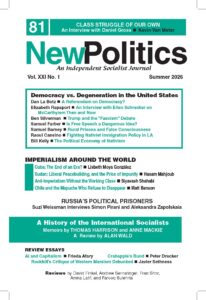
In this issue of New Politics, we try to address many of these themes.
American politics is treated in three articles: Kim Moody examines the role of the Democratic Party, which he calls “the conglomerate party of the center”; Dan La Botz surveys the growing, but still limited resistance to Trump’s authoritarian agenda; and Howie Hawkins offers a “sobering but hopeful” assessment of Mamdani’s coming mayoralty.
Lois Weiner looks at education policy under Trump and the fightback it has engendered. Suppressing dissent is a prominent feature of the Trump agenda, but he builds upon a long history of repression, as Samuel Barney explores in his article on incarcerating radicals.
Sex work under capitalism raises important philosophical issues. These are evaluated in a reprint of an important analysis by Nancy Holmstrom.
Turning to international concerns, Daniel Chavez opposes both U.S. imperialism in Venezuela and the Maduro regime. Amaury Rodríguez discusses the challenges facing the Dominican left. Gilbert Achcar argues that the Gaza genocide has had profound global implications. And Michael Pröbsting challenges the claims of those who see the United States as the only source of imperialism in the world.
We offer two review essays on recent books about Stalinism. Javier Sethness contests Dominico Losurdo’s attempt to whitewash the Soviet dictator, and Paul Le Blanc looks at Douglas Greene’s analysis of modern-day Stalin defenders.
Samuel Farber reviews a comparison of Cuba, China, and Vietnam written by one of the leading experts on Cuba’s economy, Carmelo Mesa-Lago. This is followed by a comment from Mesa-Lago and a response from Farber,
Three other review essays cover diverse topics. Daphne Lawless examines William Gillis’s anarchist analysis of the science wars. brian bean looks at the struggle against Cop City—the Atlanta Public Safety Training Center—and draws lessons for future anti-police efforts. And Peter Ranis discusses Greg Grandin’s magisterial history of the Western Hemisphere.
For shorter reviews, we have Elizabeth Rapaport considering Artem Chapeye’s reflection on taking up arms to defend his native Ukraine; Brian Ward looking at Brian Jones’s Black history survey; Brian Jones examining Brian Kwoba’s new biography of Black polymath Hubert Harrison; Peter Prontzos taking up the question of social ecology as formulated by Murray Bookchin and explicated in a book by Eleanor Finley; and two reviews on Palestine, by Alan Sears and Rachel Eborall.
We end with a song written in memory of Gazan poet Refaat Alareer and a remembrance of Third Camp veteran Ernie Haberkern.
We hope these articles give you sustenance for the struggles ahead.
 If you’ve read this far, you were pretty interested, right? Isn’t that worth a few bucks -maybe more? Please
Leave a Reply