
 This essay was my contribution to Andrew S. Higgins’ book From the Free Speech Movement to the Factory Floor: A Collective History of the International Socialists (Chicago: Haymarket, 2026). Thanks to Higgins and to the publisher for permission to publish in New Politics. The video records a presentation I made about this chapter this chaptr that deals with my early experience in the I.S. and in TDU to members of DSA’s Bread and Roses Caucus at my home in Brooklyn in September 2026.
By Dan La Botz
I joined the International Socialists in 1969, the year it was founded. With other I.S. members I went into industry, eventually getting a job in trucking and becoming a Teamster from 1974 to 1980. My decade in the I.S. and in our union work was for me what boot camp or the Peace Corps were for others of my generation. It shaped my outlook and enriched my life.
I was born in Chicago on August 9, 1945, the day the atomic bomb as dropped on Nagasaki and I was born in a ward of the Lying Inn Hospital at the University of Chicago where the bomb was developed. So, I have always been conscious of growing up in the atomic age, an age of holocausts. My father’s family were Dutch and the men worked as bakers. While the family’s religion had been the Dutch Reformed Church, my paternal grandfather had become a socialist, a pacifist, and an atheist during the Great Depression and his family with him. My uncle said that one day in the 1930s Grandpa came home, got up on a chair, and took down the “Jesus Saves” sign in the living room. My mother’s family were Irish working-class folks, laborers and truck drivers.
I grew up with these two families and their stories of the Great Depression when they lived on government relief. They went to city offices to get bushel baskets of turnips. My maternal grandmother was a barmaid and prostitute, as she later told me. As boys my father and his brothers sold razor blades and shoestrings in the bars at night. My mother when she finished eighth grade went to work in a factory at the age of twelve and my father at the age of fourteen went to work on a grocery truck that drove through the alleys where he carried vegetables up the backstairs to customers in the apartment buildings. Later he worked in bakeries and factories.
When the United States entered World War II, my father and his three brothers registered as conscientious objectors; two of them were 4F, physically unfit for service, and not called, but my father Herb and his brother Bert ended up with other COs in a Public Service Camp at Big Flats, New York. At the end of the war, when the COs were not released from the camps, my uncle joined a strike and walkout at the camps as part of a movement called “End Slave Labor in America.” He was arrested and briefly imprisoned, while my father and mother hitchhiked back to Chicago.
My uncle and father had met non-religious pacifists and socialists in the camp who were followers of Dwight McDonald, editor of Politics magazine. They became part of that circle. One of the other men, Walker Sandbach became a manager of the Hyde Park Coop Grocery Store, then the largest coop in America, and hired my father to work there in the produce department. Later my mother also worked there as a grocery clerk. Both became members of the Retail Clerks Union and my father served as steward, though he later became a manager.
I grew up on Union Street on the Southside of Chicago near the 63rd and Halstead shopping area and in 1950s went to Beale Public School with my fellow students, half of whom were white and half Black. When I was eight years old my father took a position as the manager of a new Coop Grocery in Whittier, California, but the store failed within a year and we returned to the Southside. When I was eleven my father’s persistent philandering led my mother to leave him and she took my five-year-old sister and me to the South Bay of San Diego, California to be near her mother, Ruth. The divorce of our parents, as well as the loss of my father and his big family, was devastating to my sister Janet and me and left us traumatized.
With my mother’s divorce, and my father providing no alimony or child support, we fell into poverty. We lived in an old motor court, that predecessor of the motel, in a tiny apartment attached to the trailer park where my grandparents lived. Ours was a cold water flat, the common showers a five-minute walk into the trailer park, and our toilet was in the patio, shared with the clients of the bar next door. My bed was next to the bar’s wall, on the other side of which the jukebox played Hank Williams and the new guy, Johnny Cash.
My mother worked in a variety of part-time, minimum-wage jobs. Looking for some help, she married Kenneth Hornke, a Navy veteran who suffered from shellshock after freezing up on a destroyer escort anti-aircraft gun during a Japanese attack during World War II. He worked alternately as a tuna fisherman and a house painter, both jobs seasonal in different ways, the former depending on the movement of the tides and the latter on the fluctuations of interest rates. Kenny was an alcoholic and sometimes violent, so life at home became very difficult. My mother, became a grocery checker and was a member again of the Retail Clerks Union. She was both the emotional and the economic mainstay of the family.
They bought a little house in Imperial Beach, a working-class town of shipyard workers, cannery workers, and Navy enlisted men that sat on the U.S.-Mexico Border and the Pacific Ocean. In Chicago, my world had been Black and white, in California it was white, Mexican, Filipino and Japanese. A few whites and some Japanese were farm owners, Mexicans harvested the tomato crops, and Filipino women packed them. Many white people in my world were Navy enlisted men or retired chief petty officers and their families, though some of our better off white neighbors worked making airplanes at Rohr, Convair, and General Dynamics.
My teenage years exposed me to many different ideas. My step-father took me to anti-Communist meetings at the Veterans of Foreign Wars. His brother and sister-in-law Billy and Bessie invited me to attend the Pentecostal Church with them, which I did for a year because I liked the music and the camaraderie, though I resisted with all my strength being pulled to the altar to be saved. I had been raised an atheist and remained one.
At Mar Vista High School I joined the track team and ran the high hurdles and felt more confident in my body. An English teacher named Leroy Wright who had read some of my poetry recommended books for me to read and encouraged me to write. I worked on the school newspaper.
About the same time, I met Virginia “Di” Christiansen, the local Beatnik, a woman about forty who in her youth had traveled in Communist circles. She was a friend of folksinger Barbara Dane. Di introduced me to classical and jazz music, to the post-impressionist painters that she loved, and to everything else from the music of John Cage to the plays of Alfred Jarry. Under her tutelage, we published a hand-painted journal in the form of a scroll called Fallout for Color, with drawings, painting, poems, stories and articles by all of those in Di’s circle: the postman, the Navy chief, the Mexican laborer, and us. From the age of fourteen until my early twenties, I wanted nothing more than to be a poet and a writer.
Di Christiansen involved me in what was then the very small anti-war movement and we wrote and handed out anti-war leaflets at George’s, the local drive-in, hamburger-fries-and-a-shake-restaurant. In our little Navy town, we were shouted and sworn at. I also went with Di to a protest demonstration at a Navy base where the American Legion showed up, took away our protest signs, beat us up, and then when they left the police arrested not them but us! I got my first impressions of the anti-war movement: Quakers and Unitarians, old leftists, and a few young people; and I got my first understanding of the police.
I graduated from Mar Vista High School in 1963 and had to register with Selective Service. Following in my father’s and uncles’ footsteps, I declared myself to be a conscientious objector to war.
College and into the Movement
No one in my family had ever finished high school before, much less gone to college, and my High School’s counselor offered no useful advice, so I went off to nearby Southwestern Community College in Chula Vista to study English literature and journalism. There at the age of eighteen I met and married a beautiful young woman named Winifred, half Chinese-Filipino and half Eastern European Jew. Marrying so young had been common in my parents’ families and also among my peers. Many of my classmates married immediately after graduating from high school; this was before birth control and the marriage was often because the girl was pregnant. Too immature to have married, with no children, Winifred and I divorced in a year.
At Southwestern, I soon met another woman, Barbara, and we moved in together and married a couple of years later. One day Barbara and I went to the grocery store and ran into pickets from the United Farm Workers. They convinced us not to buy grapes, and then not to shop at that store, and then to join them picketing. And for a while we helped the UFW in leafleting at local grocery stores.
I meanwhile had graduated from San Diego State College with a B.A. in English, and with Barbara went off to Library School at the University of Chicago. It wasn’t for me and I quit after a semester. When we returned to San Diego, a friend invited me to go to the University of California at San Diego in La Jolla to hear a lecture by Herbert Marcuse on his book One-Dimensional Man. I was dazzled. I returned the next day to enroll in the Philosophy Department so I could study with him, but I was turned away. So, I went around the corner to the Literature Department and was accepted there. The chairman assigned me to work as a teaching assistant for a young professor named Frederick Jameson.
For the next year or two I was intoxicated with my studies, with Marcuse’s lectures on Karl Marx and Jameson’s seminars in Comparative Literature. My first course in graduate school was a plunge with Jameson into French philosophy (and into the French language) reading Jean-Paul Sartre’s Critique de la raison dialectique. Marcuse’s student Angela Davis sometimes sat in. In Anthony Wilden’s course on Jacques Lacan we read Ferdinand Saussure, Claude Lévi-Straus and Freud. I was immersed in post-structuralism and post-modernism. I also joined the UCSD chapter of Students for a Democratic Society, made up mostly of undergraduates, and participated in its weekly anti-war rallies.
After an intense year in graduate school, I took a break and went up to Humboldt State College where I was a Lecturer in English Literature. There, before my academic year began, I took a summer course on the recent French general strike of 1968 where I met Walt Sheasby, a local activist, a member of both the Young Peoples Socialist League, and as SDS organizer who had just joined the International Socialists. Walt and his wife Madelyn and Barbara and I became good friends, both of us having one-year-old children, ours Jake and theirs Freia. Walt and I spent a lot of time over coffee in the morning at the college and over wine at night discussing socialism. Together with other students and young people we formed a little socialist collective.
Our little socialist group invited all of the major U.S. left groups to come speak to us: the Communist Party, the Socialist Workers Party, the Progressive Labor Party, and the Industrial Workers of the World. Walt saved for last two I.S. organizers: Jack Bloom and Stefanie Beatty. After they spoke, I asked, “When do you expect a revolution to take place.” Jack said, “Within twenty years.” Remember that at the time the civil rights movement, the anti-war movement, and the ghetto rebellions had shaken the country to its foundations. And now a women’s movement was beginning. Yes, I thought, I can imagine a revolution by 1989.
Walt recruited me to the I.S. by giving me two pamphlets: Hal Draper’s The Two Souls of Socialism, that laid out a critical account of Social Democracy and Stalinism and argued for a revolutionary socialist alternative, and Stan Weir’s The New Era of Labor Revolt, which suggested that rank-and-file workers were beginning to challenge the labor bureaucracy in some unions. Draper’s revolutionary socialist politics and Weir’s notion of a rank-and-file rebellion in the unions brought me into the I.S. orbit, and the group’s slogan, “Neither Washington nor Moscow,” that is, its opposition to both capitalism and Communism (or bureaucratic collectivism) convinced me that this was the group for me. I and most of us in our little socialist group joined the I.S.
In my first year in the I.S., living up in Arcata, California, Barbara and I drove down to Berkeley, attended some I.S. meetings there, and met some of the comrades. I liked the group’s principles, its character and its feel, so different from other groups that I had begun to run into such as the Trotskyists in the Socialist Workers Party and the Spartacist League. Unlike those doctrinaire groups, the I.S. had a rather libertarian character. It was not a rigid sect. People in the group read everything and were open to discussion on all sorts of issues. One of the first I.S. members I happened to meet was Dave McCullough who in our initial conversation casually said, “I’m a Buddhist.” The I.S. had been formed in the Free Speech Movement at the University of California Berkeley and that organizing experience had shaped it. I.S. members that I met were both principled and practical socialist organizers.
I returned to UCSD and continued my courses, though the only one I cared about any more was the student-organized seminar on Critical Theory to which we recruited Jameson, Wilden, and Carlos Blanco Aguinaga to serve as our professors. Blanco was a Spanish Communist who had lived in Mexico. We read G.W.F. Hegel, Karl Marx, Alexandre Kojève, J-P. Sartre, Merleau-Ponty, Edmund Husserl, and Martin Heidegger. But also, now in the I.S. and under the tutelage of our comrade Ken B. from Berkeley, Barbara and I read Leon Trotsky, Max Shachtman, and Hal Draper. I stopped attending my other seminars regularly, gave up writing papers, and instead I studied Marx, Friedrich Engels, Trotsky, Vladimir Lenin, and Rosa Luxemburg.
In 1969 and 70, the I.S. conducted a discussion of the unions and our role as socialist in the labor movement. In this period, the three most important names in the labor movement were the conservative George Meany, chief of the AFL-CIO, the social democratic Walter Reuther, head of the United Auto Workers, and the militant but corrupt Jimmy Hoffa, leader of the International Brotherhood of Teamsters. Unions represented more than twenty-five percent of all wage workers, had significant power through the strike and boycott, and vast resources in the from union dues, pension and health-and-welfare funds. While the heart of the labor movement was in industry, at that time, new groups of workers were organizing: farm workers, teachers, social workers, and other public employees.
We had only a few people in the group with labor union experience. Stan Weir had worked in factories, in construction, and in longshore. Anne Draper had worked for a variety of unions, including the United Farm Workers. Most of us in our twenties had no union experience whatsoever. As we tried to figure out our attitude toward the unions there were four different currents of opinion. One of our members argued that the unions had become so bureaucratic, and so conservative, that we had to “smash the unions.” Others tended to see some advantages of working on the staffs of the more progressive unions, as Anne Draper had. Some thought we should organize socialist caucuses in the unions. But most of us, influenced by Stan Weir’s pamphlet, were convinced that it made sense to organize rank-and-file workers in order to turn the unions into instruments of class struggle. Kim Moody, a telephone worker in New York at the time, turned this latter view into a paper, “The Rank-and-File Strategy,” which our group adopted. We vowed to try to carry it out. We decided we would have to leave the East and West Coasts, move to the country’s major industrial cities—Chicago, Detroit, Cleveland, and Pittsburgh—get jobs in auto, steel, telephone, and the trucking industry and organize. (Some members did stay on the coasts and undertake the same kind of industrial work.)
Back to Chicago and into Industry
In 1972, my wife Barbara and I, who had been growing apart, separated. She went to Detroit to work in an auto plant. I went to Chicago with a fellow graduate student named Sandy with whom I had become involved. I took custody of my son Jake and Sandy also had a son of the same age named Darryl. We found a cheap apartment in the poor, difficult, and dangerous neighborhood of Uptown. After working for a bit as a waitress, Sandy got a job as a social worker, meanwhile I found work first as a librarian for a public housing authority, then as a steel worker, then as a social worker, and later as a truck driver.
I worked for only a few months at U.S. Steel Gary Works, first in the labor gang and then as a motor inspector apprentice. The mill, nine miles long, a mile wide, served by two railroad lines and with 10,000 workers (there had been 40,000 during World War II), was my first experience in heavy industry. For a variety of reasons, personal and political, I had to give up that job.
At 25, Sandy and I were among the older half of the Chicago branch and the only ones with children. The young members had no idea of what it meant to take care of kids. We asked to have the branch meetings held in our apartment to make our childcare easier. The weekly I.S. branch meeting was typically divided into a political discussion on some topic and a report on some aspect of our own work. I remember for example, a political talk that I gave on the hot autumn in Italy that stretched from 1969 to 1970 while no doubt someone else talked about their work in the International Harvester plant or something like that. We had at that time a couple of members in the United Auto Workers union in that large IH plant.
During this period, the I.S. followed closely what was happening in the United Mine Workers because of the rise of Miners for Democracy. After UMW President Tony Boyle had his opponent Jock Yablonski and his wife and daughter murdered, the U.S. Labor Department called for new elections. Miners for Democracy then had three important leaders—Mike Trbovich, Harry Patrick, and Arnold Miller—and in several lengthy documents I.S. members analyzed what each of them represented for the future of the UMW. While we were not directly involved in the UMW, it was a great educational experience for our membership to study an unfolding rank-and-file struggle in that union.
After being in Chicago a few years, I became obsessed with a woman named Laura who had been working as our branch organizer. I ended up leaving Sandy and her son and, taking my son Jake, moving in with and later marrying Laura. It proved to be a very intense and stormy relationship. About that time, Ken Paff, leader of the I.S. work in the Teamsters visited me in Chicago and suggested that I get a job in trucking. Shortly afterwards, in 1974, I went to truck driving school for several weeks, graduated and, unable to find a job in a larger trucking company, took a job at F. Landon Cartage, a small, Chicago area carrier. I became a member of the Chicago Truck Drivers Union (Independent), which while not part of the Teamsters International negotiated with the Teamsters the National Freight Agreement.
At the time that we joined the Teamsters, the Hoffa succession fight in Local 299 in Detroit had led to a raging battle among the officials there as they blew up each other’s houses and boats. Around the same time, a group called the Fraternal Association of Steel Haulers or FASH attempted to leave the corrupt and violent international union, and the Teamster officials responded by blowing up the FASH leader’s house. FASH drivers were shot at or ripped from their trucks and beaten. Just about the time we in the I.S. got trucking jobs and joined the union in 1970, a couple of dissidents, not associated with us, had been murdered in New Jersey and Pennsylvania. The Mafia was known to control a number of Teamster locals and to be involved in the Teamster pension fund. Naturally once we became involved, we tried to avoid the mobbed-up locals. But we also bought guns, learned to shoot. While I was a truck driver in Chicago, I carried a pistol with me to work every day and at home I had a shotgun by the door. There was no doubt a lot of romanticism and machismo in all of this fascination with guns, but there was also a real threat. Once we became active, criticizing the contracts and making demands on local leaders, some of us were roughed up at local union meetings—one friend of ours was beaten pretty badly in Cleveland—and a couple of us received death threats. One official said to someone we knew, “If La Botz shows his face in my local again, I’ll send him home in a box.”
The I.S. Teamster Work
The I.S. had various arenas of work: in various labor unions, anti-racist work, feminist work, and anti-war work. Our tradition had a practice of creating separate working groups for each that were called “fractions,” meaning that fraction of the organization involved in that work. The national Teamster fraction was established about the time that I got a job in industry and became a member of the union in 1974. The national fraction produced a periodic mimeographed bulletin circulated to the members that was made up of newspaper clippings on local Teamster elections, strikes, and so on, as well research papers by our own members analyzing the Teamsters, and short proposals for our work. We held occasional telephone conference calls and less frequent face-to-face meetings, one in the Midwest and one on the West Coast. The fraction allowed all of our members to become informed and to participate in the discussions.
Our general method was this. Our members first got jobs in the industry in the Midwestern industrial cities, ideally in the larger national trucking companies and the most important union locals. Once in the union, in every local where we were involved, we met drivers, dockworkers, clerks and others who had been local activists and who were often in opposition to the existing union leadership. While we had socialist politics, an analysis of the unions and the labor bureaucracy, as well as speaking, writing and organizing skills that we’d learned in the civil rights and anti-war movements, the workers we met were the real experts on the companies and the local unions. They knew the specifics about poor working conditions, lack of union democracy, and the failure of the union to fight for its members. We believed that we socialists and the worker activists, joining together in building a rank-and-file movement, could create a powerful synergy.
Our first step was to begin discussions with the local activists about strategies to change the union. We advocated everywhere the creation of a local caucus publishing a newspaper that could reach the members with proposals for building a better union. So, in Los Angeles, Seattle, the San Francisco Bay Area, Chicago, Cleveland, and Pittsburgh we published such papers and established such caucuses.
In Chicago, Ken B. (who had moved to Chicago from Berkeley when I moved from San Diego) had met a group of local Teamsters at a rally for the United Farm Workers who were then battling a violent raid in California fields by the Teamsters Union. Those Teamsters and some of their friends whom we met later, were dissident members of the Chicago Truck Drivers Union (Independent), of Local 705, and of Local 710, some of the most important locals in the country. Bob Grant, a member of CTDU, was their leader and he soon became my mentor in learning about the local trucking companies and the unions.
Bob was not typical of the people we worked with in most cities. Bob was an ex-con, as was his friend Mac McCarthy, while another friend, Bill was a pugnacious bar brawler. Ray and Marcie Lopez were Mexican Americans who had suggested going to the UFW rally where we had met them. Later we met Roger Arnold, whose parents had been German socialists, who was a CTDU steward at the huge Jewel grocery warehouse. There was also Aaron Kesner, a Jewish truck driver. Over the next couple of years, I would spend many hours with this group.
Bob Grant was a remarkable person. As a young man he had participated in an armed robbery of a gas station, was convicted and sent to prison. In prison he and another guy attempted a jailbreak, but in the course of their attempted escape, the other man stabbed Bob in the back. Still a rebellious prisoner, Bob spent a lot of time in “the hole,” a small, uncomfortable solitary confinement. He said he learned prison that when the guards came down on you, you couldn’t trust the white guys, but you could trust the Black ones. Prison trained him to be a barber when he got out, but he couldn’t make much money at that, so he got a job as a truck driver, married, and had a few children.
At Central Steel and Wire where Bob worked, he found that the trucks had holes in the floors, that the side posts were often missing, and that a few trailers had no bulkheads, meaning a fast stop and a sliding load could kill the driver. He decided that the drivers should call a strike over the dangerous conditions, but with no previous experience, he told his friends to bring their pistols to work. On the appointed day they walked into the yard, drew their guns, and told the other drivers that they were going on strike. The predictable result was that Bob and his friends were fired, though fortunately the police weren’t brought into the matter. They all found jobs at other trucking companies, giving Bob had a little network scattered throughout the union.
Bob decided that he should learn more about unions, so he took a few courses in labor relations at Roosevelt University. Armed with his new knowledge, he decided to run for the union’s top office of Executive Director against the long-time incumbent Ed Fenner. When the union didn’t provide a list of the 1,400 workplaces (many small companies with one driver) or the 5,000 members, with our help Bob found a pro-bono attorney and sued the union for that information. With that information, we were able to more systematically reach out to the larger union workplaces, some of which had hundreds of members.
Under Ken B.’s direction, he, Bob, and I put together our local caucus newspaper, The Grapevine, which Bob had named after the prison grapevine that spreads the news by word-of-mount. We published information about the Teamsters union nationally, about the Chicago Teamster locals, and about conditions in the local trucking barns and other workplaces. We gathered our local information from talks with drivers and dockworkers we met either while working or socially. Every month we printed and distributed a couple of thousand copies of The Grapevine through our small network of activists. We also put them in trucks parked in front of restaurants, gave them to drivers waiting to load at factories, or passed them out in trucking company parking lots. When we went to workplaces and tried to hand papers out to individual drivers as they entered or left work, we found that they were reluctant to take the paper, fearing to get in trouble with their bosses or the union officials.
Our Analysis of the Labor Movement
In 1975 we attempted to set in motion the large-scale project of building a rank-and-file movement in a national union. The idea was simple, rather like using a series of pulleys to lift a heavy object. The tiny I.S., an organization of a few hundred, would build and lead caucuses that numbered in the thousands, which could in turn move the Teamsters, whose membership numbered two million. All of this would influence tens of millions in the working class. With this block-and-tackle conception, our efforts would be multiplied a thousand-fold.
We planned to establish a class-struggle pole and to set millions of workers in motion against their employers. We foresaw reform caucuses taking power in the major industrial unions, transforming the AFL-CIO and eventually reaching unorganized workers as well. In doing so we hoped to create a new sense of workers’ power in American society, a power that would move America to the left. To do this, we had to overcome an enormous obstacle: the union leadership.
It’s important to understand our attitude toward the unions and their officials. We believed that U.S. labor unions were dominated by a labor bureaucracy that by and large had become solid defenders of the capitalist status quo and an obstacle to workers’ interests and struggles. The union officials were a caste apart. They received high salaries, often many times those of an ordinary worker. In the Teamsters union in a few cases, they reached $500,000 when an ordinary dockworker, driver made $30,000. Union officials also had union cars and expense accounts that covered their hotel bills, meals, and even bar tabs. At the highest levels they had perquisites such as the union jet (the Teamsters had a small fleet of planes). Teamster officials often wore expensive suits and topcoats, drove Buicks, and flashed diamond pinky rings. Perhaps most important, most union officials had become lifetime career bureaucrats; they no longer drove trucks, loaded freight on the docks, or worked in a factory like the other workers. When they retired, or if they were voted out of office, few indeed were the officials who returned to work. Often, they took jobs with management or with a labor mediation agency or opened their own businesses, sometimes non-union companies in the industries where they had formerly been union reps.
Virtually all union officials held to a view we could call “business unionism,” that is, that the job of the union was to support the businesses that provided the jobs and that the union itself should be run along business lines. The corporate structure of American capitalism was replicated in the union hierarchy’s top-down, vertical control. The industrial unions also reproduced the discriminatory race and gender patterns of American business institutions and society more generally, with white men heading the unions, and with African Americans, Latinos and women usually having small roles. The AFL craft unions still excluded African American, Latino and women members; and when forced by lawsuits or government regulations to admit them, the officials and white male co-workers often made the newcomers’ lives unbearable and often drove them out of the union.
Union officials held their own caste ideology. They believed that they were the best guardians of the workers’ interests. While the UAW and other former CIO unions supported the civil rights movement and the women’s movement, they often ignored the problems of workers in their own unions. So, for decades the most powerful unions negotiated higher wages and better benefits, but ignored the workers’ demands to slow down the speed of the production line, to improve conditions on the shop floor, and to treat workers with dignity. Leaders of these unions saw themselves as speaking for the workers—but they would not let the workers speak for themselves.
Typical union officials without a leftist history generally accepted the capitalist ideology and argued that what was good for the company was good for the workers. If the company was successful, that is, profitable, the union could pressure the company to share some of that profit with the workers. The union’s job then was to see that the workers didn’t interfere with the company’s production and profits. Whether they were Republicans or Democrats—or the rare social democrat—many union officials came to see their role as policing the contract for the company. Above all, company managers and union officials collaborated to prevent workers from engaging in slowdowns, work stoppages, and strikes.
In the worst of cases, such the Teamsters, the Laborers, the East Coast Longshoremen’s union (ILA), the Hotel and Restaurant Workers, and the National Maritime Union, the union officials were corrupt men—some were actually member of the Mafia—who saw the union as their personal property, their business. The union officials used the power of the union to extort money from both businessmen and workers. Union officials took labor peace payoffs, that is, they took money in exchange for accepting a poor contract and preventing a strike. Some literally sold jobs to workers and took payoffs from workers to keep those jobs. Others controlled crime and contraband in the workplace or the job site, promoting gambling and drugs at work.
Whatever the union leadership—whether leftist, business unionist, or corrupt—union officials generally viewed workers as subordinates who had to be controlled. Workers who spoke out or stood up for their rights were viewed as “troublemakers,” and management and the union often colluded to fire them and sometimes blacklist them in the industry. In the more corrupt unions, the gangster union leaders beat workers and even occasionally murdered them—though by the 1970s the murders were rare.
Within these bureaucratic unions, our job as I.S. members would be to organize workers first to take over leadership of the union and then to fight the employers, and while doing that, we hoped to recruit the leaders of the movement to socialism.
We believed that workers—and particularly the more active workers, such as union stewards—would be attracted to the rank-and-file groups we helped to create. We would then recruit the most political of those rank-and-file activists into the I.S. We envisioned growing from a few hundred to a few thousand and, within a decade or so, to a socialist group of perhaps 10,000—what we called a small mass party. We wanted to strengthen workers and the unions, but our goal was never simply union reform or winning a better contract. The goal was to build a revolutionary socialist party that could play a leading role in the overthrow of American capitalism and in bringing about the establishment of a democratic socialist society. Our conception of socialist revolution derived above all form the experience of the Bolshevik-led Russian Revolution of October 1917: a disciplined revolutionary party leading workers in overthrowing the state and taking power.
The Organization of TDC and TDU
The next step after creating local caucuses was to bring all of these local groups into contact with one another, to launch a campaign around the national freight contract. In a preliminary step, we wanted to introduce worker activists in different cities to each other. Bob and his wife Mary and Laura and I traveled to Cleveland to meet the Teamsters activists there. Workers felt stronger being part of the opposition if they knew there were others out there like themselves. At the same time, these trips drew us closer to the people we worked with nationally so that we became part of a team.
Joining with other Teamsters in various regions, we launched a national contract campaign in 1974 that adopted the name Teamsters for a Decent Contract, or TDC. During the course of many meetings and discussions, the I.S. arrived at a consensus about our general organizing strategy. We believed that the synergy of the interaction between IS members and the Teamsters, would be essential to the success of the movement. While we were socialists, we were not attempting to create a socialist movement of Teamsters. Clearly in the United States at that time few truck drivers and dockworkers had any interest in socialism and many were hostile to the idea. We aimed, rather, to build a rank-and-file workers’ movement that could push the Teamsters union to strike against the employers. In this way we would demonstrate the power of the rank-and-file and draw more Teamsters into the struggle, while at the same time exposing some of them to our socialist politics.
We did not have a great TDC following in Chicago, but we distributed literature, talked to our coworkers, and organized demonstrations for a better contract. To our surprise, however, Detroit Teamsters, led by Pete Camarata, organized demonstrations of a couple of thousand members, really putting us on the map. At the same time, the group called Upsurge that we had organized among UPS workers also took off with rallies and meetings of hundreds in several cities. In the end, under this pressure, President Frank Fitzsimmons, called the first ever national Teamster strike, accompanied in some cities by wildcat strikes led by our networks in freight and UPS. The final contract included the unlimited cost of living allowance clause that TDC had demanded.
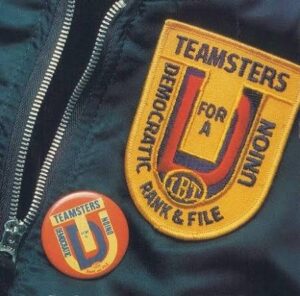
During the TDC contract campaign, we had begun to make plans to found a permanent national opposition group within the union. Teamsters for a Democratic Union (TDU) held its founding convention on September 18, 1976 at Kent State University in Ohio. There were about 200 rank-and-file Teamsters, from 44 local unions and 15 states, in attendance. Bob and I were there. TDU was created as a rank-and-file group focusing on the issue of union democracy, though coming as it did out of a national contract campaign and a series of wildcat strikes, it was clear that the goal of the group was to transform the Teamsters into a more militant and powerful union.
When time came to elect a national steering committee, we in the IS adopted a policy that this should be an organization led by Teamster activists, not primarily by I.S. members. In almost every city in which we were involved, rank-and-file workers nominated I.S. members—dedicated, hardworking, well-educated and well-spoken—to be their elected representatives. I like most of us was nominated at that first convention, but based on a previously made decision, all but a few of us declined, as I did. From the beginning we decided that while a few of our I.S. members would play leading roles in TDU, we wanted grassroots Teamsters from around the country to make up the majority of the movement’s leadership. We rejected the idea of putting a majority of our members on the TDU steering committee. We wanted only a few I.S. members in the leadership so that they could participate in discussions with rank-and-file leaders about how to carry the movement forward. Those Teamster activists were, after all, the ones in touch with the rank and file in workplaces around the country.
We also worked to nominate a committee that would include not only white male workers, who had historically dominated the Teamsters union, but also African Americans and women who had generally been excluded in the past. So, Pete Camarata, a white dockworker, became a co-chair with Al Ferdnance, a Black freight driver. And there were women drivers in the leadership. TDU’s constitution permitted Teamster spouses to be members, leading to more female participation. The TDU founding convention adopted as its central campaign a fight for bylaws reform that would allow members to elected union stewards and business agents. We believed that this kind of reform would unleash the power of the rank and file. Ken Paff, the leader of the I.S.’s Teamster work, who had organized TDC, was chosen by the Convention and the new Steering Committee as the national organizer for TDU.
During the TDC and early TDU period, I worked to help spread the organizations, speaking in Madison, Wisconsin where we had made contact with some warehouse workers, in Green Bay, Wisconsin where I helped to lead a wildcat strike at the Schneider trucking company, in St. Louis, Missouri where some to a meeting of local Teamsters. Later in 1978 I was elected to the I.S. national leadership and became the liaison between the I.S leadership and the I.S. members in the TDU leadership. When I returned to Chicago in 1979, I went back to driving a truck and working with the TDU chapter until the end of 1980.
Socialism in the Labor Movement
While organizing the Teamster reform movement, we were also trying to win individual Teamsters to socialism. First, we attempted to explain our socialist views to our closest collaborators. Second, when we had a national TDU steering committee meetings or TDU convention, we would schedule parallel private meetings with TDU leaders and activists, to talk about the I.S. and socialism. These meetings served three purposes. By explaining our socialist identity, strategy and goals, we anticipated and diminished the impact of red-baiting. If someone accused us of being socialists, our friends would say, “Sure, we know. They told us.” So what?” These private gatherings also allowed us to discuss long-term strategy for the rank-and-file movement with our closest collaborators in a way we could not necessarily do in TDU steering committee. These meetings also made it possible for us to raise the idea of some of these Teamster activists joining the I.S.
In addition to this personal work with specific Teamsters, we had more general work with the Teamster activists at large. The I.S. published a socialist newspaper, written in accessible language, called Workers’ Power, which regularly featured articles about the Teamsters and TDU, as well as other union and political news. Workers Power also covered the Black movement, the women’s movement, and African liberation struggles, as well as the radical labor movement in Southern Europe. All I.S. members sold our paper at selected workplaces. For a few years I sold regularly at the Main Post Office in Chicago at the change of shift at midnight. Other I.S. members who were not Teamsters sold the paper outside of Teamster workplaces.
I.S. Teamster members also sold Workers Power to the Teamsters with whom we worked. In some workplaces we had regular Teamster readers who looked forward to reading our paper. Workers Power occasionally interviewed our “open” or “public” socialist Teamster and TDU activists and leaders.
Finally, the I.S. distributed pamphlets such as Building the Revolutionary Party written by Joel Geier, Class Struggle Unionism written by Jack Weinberg and Conspiracy in the Trucking Industry, a populist pamphlet that I authored. At times, our role as TDU activists and socialist propagandists became hard to keep separate. At Landon, where I worked, I distributed our local paper The Grapevine, the TDU national paper The Convoy, and the IS paper Workers Power. Even though Landon was a very conservative workplace, all the workers always took the first two, which were free, and a few always bought Workers Power. Some of the dockworkers and drivers found my constant propaganda and agitation bizarre and amusing. One day when I arrived at work someone shouted, “Here comes the paper boy!” Still, I recruited one fellow from my barn and convinced a couple of Black drivers to come to our anti-racist demonstrations.
Through this variety of propagandistic efforts, during the period from about 1975 to about 1979, the I.S. managed to recruit about twenty Teamsters. We recruited a few in Chicago. Most of the I.S, Teamster recruits, with a few exceptions, were rank-and-file TDU activists who had been won over to the I.S. because they were impressed with our union strategies and our commitment, and were therefore open to our politics. If socialism made people better fighters for union democracy and justice in the workplace, then they were eager to join up with the socialists—even if they didn’t understand exactly what socialism meant.
Most of these recruits did not become well integrated into our organization and their relationship to the I.S. remained tenuous. The principal reason for this was the great difference between the personal and social lives of the I.S. members and the Teamster rank and filers. Our younger members’ lives revolved around the I.S. and its politics. Most rank-and-file Teamsters, however, almost all a decade or maybe two older than us, had responsibilities to family, community, and church. Our attempt to bridge these different worlds failed for lack of skill on our part and for lack of a big enough movement that might have connected them.
Another failing was that we never established a successful educational program to teach these workers about our politics, nor did we have very good educational materials for workers about the basics of socialist theory, politics, economics, and unionism. At the time, however, we did not yet see and understand these difficulties, we were proud to have brought some real workers into the organization. We felt we had made a breakthrough; a working-class organization in theory, we were about to become one in fact.
After the Teamster Years
In 1978, the International Socialists suffered an internal faction fight and split into three groups: I.S., Workers Power, and the International Socialist Organization (ISO). One of the principal reasons for the split was differences over the labor work. Both Workers Power and the future ISO thought that the I.S. labor work was making the group more conservative. With the split, each of the three groups ended up with about 100 members. I stuck with the I.S. Recognizing that our party building program of the 1970s had failed, I.S. leaders launched the Labor Notes publication and held a Labor Notes conference that brought together a few hundred worker activists.
Meanwhile, Laura and I separated. I left with my son Jake, though I failed to be a good father to him. He dropped out of school, went to live with the family of a friend, and became addicted to drugs and alcohol, though always pursuing his interest in music.
Many other left groups collapsed around 1980, so the I.S. adopted a regroupment strategy aimed bringing leftists together, and in 1982, I was hired to be a traveling organizer working on that program. A year or two later I got a job as a reporter at The Chicago Defender, Chicago’s Black newspaper, but was fired there for attempting to organize workers into the Newspaper Guild. I later won reinstatement at my hearing before the National Labor Relations Board, but there was no going back. I then went to work then for the Organization of the North East, a Chicago community group, and working with Latinos in the area founded the Comité Latino, a Latino group that took up issues of housing for Latinos. I was hired next by the House Staff Association, the union of interns and residents at Cook County Hospital.
The president of the House Staff, Sherry Baron and I became friends, then lovers, then married and had two sons, Traven and Reed. Meanwhile Jake overcame his drug and alcohol problems and we established the best relationship we had ever had. Later I returned to the university and got a Ph.D. in history and became a college history teacher for many years. There were also years of activism on various issues and years of research and writing, all too much to take up here. Sherry and I remained activists and joined the Democratic Socialist of America around the time of the first Bernie Sanders campaign in 2016.
 If you’ve read this far, you were pretty interested, right? Isn’t that worth a few bucks -maybe more? Please
Leave a Reply