
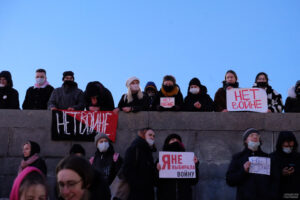
 Russia today holds more political prisoners than at any time since the post-Stalin thaw of the 1950s. Since the full-scale invasion of Ukraine in February 2022, the Russian state has systematically prosecuted antiwar critics on charges ranging from “discrediting the military” to “justifying terrorism”—a legal arsenal that echoes Stalinist methods while deploying them against a new generation of dissenters. Seven political prisoners died in Russian custody in just the first four months of 2026. Beyond Russia’s own citizens, an estimated sixteen thousand or more Ukrainian civilians are held in Russian captivity—many in unregistered facilities, incommunicado, without access to lawyers or family contact.
This interview, conducted by Suzi Weissman for Jacobin Radio on May 19, 2026, brings together two people working at the center of this crisis. Simon Pirani is the editor of Voices Against Putin’s War: Protesters’ Defiant Speeches in Russia’s Courts (Resistance Books), a collection of final statements delivered by antiwar defendants before sentencing — a tradition of dissident speech stretching back to the nineteenth century. The book became the basis for the documentary film “Try Me for Treason,” available free at trymefortreason.org. Aleksandra (Sasha) Zapolskaia is coordinator and editor of Posle, a bilingual Russian-language left journal in exile, and leads Solidarité Free Azat, the international campaign for imprisoned mathematician Azat Miftakhov.
Two of the courtroom speeches featured in the film — by Igor Paskar and Andrei Trofimov — appear below in the form they take in the film, read aloud by volunteer British actors. They stand as the moral and political center of everything discussed in this conversation.
Suzi Weissman: Simon, the final word — poslednee slovo — is one of the few constitutional rights still available to defendants in Russian courts: a chance to speak on the record before sentencing. You spent years collecting these speeches, translating them, turning them into a book, and now a film. How did this project come together?
Simon Pirani: The story starts pretty soon after the full-scale Russian invasion of Ukraine in February 2022. In those first weeks I was in London—shocked by the invasion, not completely surprised, but shocked. There were big demonstrations in Russia that very rapidly became impossible; dissent was driven off the streets by mass arrests, many people left the country, and the forms of protest became limited. What we then saw was a spate of young people throwing firebombs at military recruitment centers when they were closed—not with the aim of hurting anybody, but as a protest against the war.
The very first person to do this, Kirill Butulin, is featured in the book. He nearly got away, but was brought to trial. We don’t have a speech from him because this was right at the start, before dissident Russian media had organized reporters to get into courtrooms and record these statements. The first speech I really knew about was by Igor Paskar.
He was a young man who had not been a political activist—he’d been on a few demonstrations like a lot of young people. One day he made a public protest against the Z banners, the militarist symbols, and nobody took any notice. So he decided he had to try harder. He went and threw a firebomb at a closed office—the local office of the FSB, Russia’s principal security agency and the main successor to the Soviet Union ‘s KGB—and stood there and waited to be arrested. I’m sitting in my comfortable home in London reading about this, and I think: is this crazy? And the answer is no. This man had thought very, very hard about what he wanted to do. He knew what was going to happen. He was taken into the FSB office he had just thrown the firebomb at and was badly tortured. When he came to trial, he spoke about conscience: “my conscience would not allow me to stay quiet.” He asked what will we tell our children and grandchildren many years from now about these troubled times?
From the film “Try Me for Treason”: Igor Paskar’s Final Statement
Igor Paskar, then 28, was arrested in June 2022. He painted his face the colors of the Ukrainian flag and threw an improvised Molotov cocktail at the porch of the Federal Security Service office in Krasnodar, southern Russia. He was charged with vandalism and terrorism. In May 2023 he was tried in the Southern District Military Court. The following is his final statement in court.
Almost a year has gone by since I carried out this action. During that year, I pictured this moment time and again, the moment when I would be given the opportunity to make my final statement. I agonized over the words I would say and the motives that drove me. During the last sitting, Your Honor, you asked me whether I regretted my actions. Well, I understood that the extent of my professed regret would influence the severity of the sentence. But if I renounce my beliefs, I would be acting against my conscience. On the contrary, during the time I’ve been in prison, I’ve seen firsthand the injustices perpetrated against the people who we call our brothers—both prisoners of war who have served in the Ukrainian armed forces and ordinary Ukrainian citizens. The war, or whatever term we use to label it, came to their homes, destroying their lives as they knew them. No matter what slogans and geopolitical interests we use to varnish this, in my eyes it cannot be justified. Do I regret what happened? Yes. Perhaps I’d wanted my life to turn out differently. But I acted according to my conscience. And my conscience remains clear.
Rather than reflecting on who is right and who is guilty, I’d like to pose this question: What did each of us do to stop this nightmare? What, ten or fifteen years from now, will we tell our children and grandchildren about these troubled times? Unfortunately, God has not granted me the joy of fatherhood. The people who are closest to me have gone and I am left alone. It was easy for me to do what I did, even though I was well aware of the consequences. There was no one to agonize about my fate, no one to worry about me or to cheer me on.
But what I really did not expect was the huge number of letters and messages of support that I’ve received. People have written to me from every corner of Russia and not only Russia. Many were grateful for my position, so completely at odds with the notion of unanimous national support for what is being perpetrated. So many warm words. So much sympathy. This is from one letter: “There is very little left of everyday life. It turns out that we can’t live everyday lives anymore.”
I’m listening to the memoirs of prisoners from the 1930s, 40s and 50s. Right now I’m on the breathtaking biography of the actress Tamara Pietkiewicz, who spent seven years in a prison camp. She was arrested in 1943 and lived until 2017. When they came for her, she was only 22, just a girl half the age I am now. I have not read Solzhenitsyn’s Gulag Archipelago and I have not got round to Shalamov’s Kolyma Tales either. But listening to Pietkiewicz, it made me realize that this is exactly what we must listen to, what we must read at school. As a country, we’re obsessed with the past, but we hardly ever think about the present or future. The Americans have their American dream, something to strive for. We have nothing but a fixation on that which happened long ago—that which cannot return. But time and time again, we try to bring back what has passed. And these attempts are absolutely pointless. It’s as though the whole country is stuck in the mud.
Reading these and other words sent to me in prison really touched me and pushed me to write this final statement to the court.
Igor was sentenced to eight and a half years imprisonment.
What then followed was more and more of these statements. With friends who were translating this material for various reasons, we had a group working with Solidarity Zone—a small, flexible, grassroots organization set up to support these cases rapidly, providing lawyers and getting parcels to pretrial detention centers. My friend who writes the Russian Reader blog had translated some of the speeches, and we got together and thought: this is not a new literary genre, but one that has existed in Russia since the nineteenth century, and unfortunately it’s reappearing and taking shape again. We got support from the European Network for Solidarity with Ukraine for printing and design—a beautiful design by a Russian designer in exile in Germany. When we organized an event in London to launch the book, we asked actor friends to read parts of the speeches aloud. Why have people like me talking when you can hear the words of people who have thought so hard and suffered so much? That worked. From there we found Tony Aldous, a videographer active in the Palestine solidarity movement here, who said: I’ll make a film out of this. And so we made it.
Suzi Weissman: Were these people newly activated by the war, or had they been politically active before? And is there any pattern to who gets picked up, who gets put in jail, who gets tortured?
Simon Pirani: There’s a whole range. Anyone who wants to research this in depth should look at the website Posledneye Slovo (“Last Word”), set up by Russians outside Russia, which has collected all the speeches it could find starting from the 1950s—including those of Crimean Tatar activists jailed before the full invasion, when Crimea was already under occupation and there was a real racist and Islamophobic clampdown on the Crimean Tatar organizations.
In terms of antiwar activists from 2022 onward: at one end of the scale there’s Sergei Dudchenko, a biker in Stavropol who was in a small Telegram group that the FSB had under surveillance. The security services broke in by arresting members and essentially torturing passwords out of them, and ended up rounding up the whole group. What Dudchenko said in court was incredible. He told the court that shortly after the invasion he had made a solo protest, driving his motorbike with a Ukrainian flag streaming behind him. He said: “When I sped along with the banner of the oppressed streaming behind me, past an astonished crowd of militarists, I felt the human in me come into bloom.” He said Russia’s political prisoners had become outcasts in their own land. Born in 1987, he referred back to the seven protesters who went to Red Square in 1968 to protest the Soviet invasion of Czechoslovakia—nearly twenty years before he was born—and called them brave people. He said: “There will always be people like us, who will keep emerging to pick up the fallen banner of good and reason.”
At the other end of the scale there’s Alexei Gorinov, a municipal councilor who turned up to a council meeting in May 2022, where they were planning a festival for children, and said: “I’m sorry, I don’t feel like organizing a festival for children while we’re bombing children in Ukraine.” He’s now serving ten years.
And then there’s Alexander Popov—an experienced politician, a socialist, a veteran dissident who had opposed the war in Chechnya in the 1990s. His friends were pleading with him to leave the country, which he had the resources to do. He explained in a letter to his wife, which he asked her to publish, why he chose to stay: “I belong to the Soviet generation of dissident political prisoners. Although its numbers were small, it became a significant historical phenomenon. Most of them have gone. They’ve passed away.” He was, in fact, a dissident among dissidents in the sense that he was a socialist, whereas the dissidents were predominantly liberals. He said, “I want the young people to know that the last guy standing stood with them.”
So the full spectrum is there. One more thing, from a Western perspective: at the end of 2023, we were seeing huge demonstrations in London against Israeli aggression in Gaza, alongside government attempts to classify Palestine Action as a terrorist organization. We thought, with friends who have paid close attention to Ukraine, that these struggles are not separate. Whether against a settler-colonial state supported by Western imperial powers or against Russian imperial aggression against Ukraine, the protesters are being dismissed and denounced as terrorist sympathizers by governments in ways that have a great deal in common. I would take this book to any of my friends in the pro-Palestinian movement and say: look, these people are saying, thinking, and struggling for ultimately the same things.
Suzi Weissman: The producer of the film, Maya Wilcox, drew that same parallel explicitly—occupation is a crime, whether in Palestine or Ukraine. And Dudchenko’s words remind me of something Victor Serge said—because you’ve drawn a line in your introduction, Simon, tracing this history of opposition from the 1870s through the Sinyavsky-Daniel trial of 1965, to the Red Square protesters of 1968 and since. Serge, writing in the 1930s from internal deportation, lamenting that they were dying, that Stalin was killing them, said: “The prophecy of a repressed revolutionary who perished in Stalin’s Gulag will come to pass… we shall serve as manure to fertilize the earth in which, after us, new human harvests of the revolution will spring up.” That spirit seems to live on. Let’s turn to Sasha. Can you address some of what Simon has described, and in particular the case of Azat Miftakhov?
Aleksandra (Sasha) Zapolskaia: Let me start with something slightly abstract, to explain why it matters to talk about political prisoners in an authoritarian country that many people have never visited and probably never will.
What my homeland has been doing for a long time is showing the world a very possible future. It’s important to understand how these machines of state violence work—which mechanisms are being used—so that people in countries that are somewhat freer from this kind of state violence can be very alert to what might be coming. Because it changes very slowly. And then it happens very fast.
After four years of invasion, we say that prisons have gotten worse, that censorship has gotten worse, that there is no independent media and no one can say anything against the regime. But if you look at discussions among the same people ten years ago, they were saying exactly the same things—that prisons were awful, that people were being tortured. You can remember the notorious “Network” case of 2018, when anarchists were accused of plotting a coup, sentenced to sixteen, eighteen, twenty years, their confessions extracted under electric shock. In 2018 we were saying things had never been worse. And yet here we are in 2026 saying again that things have never been this bad. What have we lost in between? Perhaps there were islands of freedom in 2018 that we didn’t quite cherish. Today, in 2026, we should pay attention to those remaining islands of possibility—so that we don’t become someone who in 2030 will say: things were so nice in 2026, we were able to do so many things.
The final word is one such island—a tribune where people can declare their beliefs on the record. Not that we should be grateful to the regime for permitting it. But since it exists, we should make as much as possible of it. Another possibility is writing letters to political prisoners. We have digital tools that allow letters to be sent to any prisoner. Yes, there is censorship, but you can still give them hope—describe nature, a forest—that matters to a prisoner, it is a little bit of support. In Belarus, political prisoners don’t receive letters at all. So until the moment that becomes true in Russia, we must use every avenue.
In the case of Azat Miftakhov, the ability to send a lawyer to him is crucial—it allows us to physically protect him. And we have reached a situation where political prisoners face not only the suffering of lost freedom but a very concrete threat of being murdered. At least seven political prisoners died in Russian custody in 2026. Four cases happened in April alone. May was pretty dark as well. People are now dying. We should use every opportunity to gather attention, because we are still in a situation where attention helps—where publicity helps, where international declarations still work, even if Russia calls those organizations terrorists or foreign agents. So in our quest to protect and defend people, people who say these precious words, who do these acts of radical protest show radical resilience, that they are still human beings. We can still use these tools. That is what the case of Azat shows us.
Suzi Weissman: Let me ask about letter writing as an act of solidarity. The Russian prison mail system is actually quite efficient, and letter writing has become an organized activity around the world. Freedom Zone, organized by Kseniia Kagarlitskaia, holds events from California to the Caucasus where people gather to write to prisoners. You can have a letter translated into Russian through the prison mail system for a minimal fee, and the prisoner can write back—something unthinkable in earlier periods, and still not allowed in Belarus. Simon, which organizations should people know about?
Simon Pirani: First, a group we haven’t spoken about enough: the very large number of Ukrainian civilian prisoners in the Russian prison system. We have one represented in the book—Bohdan Ziza from Crimea, who threw blue and yellow paint at a municipal administration building, the Town Hall, and is now serving fifteen years. The Crimean Tatar activists have very strong organizations even under Russian occupation, and their speeches have been documented. But Ukrainian prisoners tried in the Donetsk and Luhansk territories—tinpot dictatorships incorporated into the Russian Federation—are in a far worse legal wasteland: there are no journalists or human rights monitors able to sit in those courtrooms. We simply don’t know where many of those people are. Fortunately for Ziza, his family has been able to establish contact with him.
There are two absolutely heroic Ukrainian human rights organizations. First, the Kharkiv Human Rights Protection Group—based in Kharkiv, close to where much of this is happening, essentially the continuation of the local Memorial branch. The other is ZMINA, based in Kyiv. Both track human rights violations in occupied territory, where the vast majority of cases occur.
For non-Russian speakers, the best sources are: Memorial, which maintains a register of political prisoners both formally documented and in a gray area. (The security services comb through social media chats constantly; if you are in any country with a dictatorship, do not discuss politics on social media—they find a group, and if they need additional evidence to secure a conviction, they fabricate it.) OVD-Info (ovdinfo.org)—they need donations; their overview reports on how the system of repression is changing are excellent. And Mediazona—a brilliant team of reporters, many still inside Russia, with much of their material available in English. Everything I know about Sergei Dudchenko came from their reporting.
Suzi Weissman: Thank you. Sasha, let’s turn to Azat Miftakhov. Simon has written that Russia holds more political prisoners now than at any time since the post-Stalin thaw, or certainly since the Brezhnev period. Beyond Russia’s own citizens, there are at least 90,000 Ukrainians officially listed as missing, at least 16,000 of them civilians, and hundreds of thousands held at unknown locations in what we should call a twenty-first-century Gulag. But Azat’s case is now receiving wider attention, partly because of reporting in The Insider on his brutal transfer and treatment. He’s an anarchist and a mathematician whose sentence has been systematically extended—the Stalinist tactic of doubling and tripling sentences. Tell us about him.
Aleksandra (Sasha) Zapolskaia: OVD-Info is indeed a very reliable source, and I want to say something more about what it represents. It started as a hotline you called when you were arrested at a demonstration and taken to a police precinct. You might be held for only three hours, maybe nine hours—not sent to a prison camp immediately—but you needed one call to make sure a lawyer would come and that someone would bring you food and water. It was built to solve a very practical, immediate problem, not to make a great analysis of the repressions, not to make some sort of abstract, analytical database. It was made to, to solve what people actually needed. I’ve found that Western countries don’t have anything like it—no single number to call if someone is taken to a police station. It’s high time to think about creating something similar.
Suzi Weissman: We’re starting to see that now in the United States. When ICE detains people, there are networks where witnesses can text a number and report it—and also to call out neighbors to protect people where they live and where they work. A tool of solidarity developed under one form of repression is appropriated and adapted elsewhere, adding to the arsenal of organizing against repression. It’s always been that way.
Aleksandra (Sasha) Zapolskaia: It’s now or never, in terms of self-organization.
Now, Azat. He is one of many political prisoners—estimates range from 1,000 to 11,000, depending on how you count, and those figures cover only Russian citizens. There are also the Ukrainian civilians Simon described: the lowest figure I’ve seen is 16,000; the highest I’ve heard is 40,000. These are people who never carried arms. They were captured in occupied territories, often randomly—perceived as community leaders, or picked out because of a tattoo, or because of a chat message. Many are held incommunicado, without access to lawyers or family, in unregistered buildings on occupied territory. When people discuss ceasefire and territorial concessions as if what’s at stake is only square kilometers, they need to understand that giving up territory means giving up these people—people being held and tortured, with no mechanism for exchange, since Ukraine holds no Russian civilians as an equivalent.
The system of torture now operating in Russian prisons was developed and tested earlier—and it was specifically anarchists who were used as a test group to build the system of terror in prisons. You can trace it through the Network case of 2018 and then through what happened to Azat, whose case began in 2019.
Azat was subjected to severe torture at a Moscow precinct, during which he was pressured to confess to building a bomb. And despite extreme torture, he refused to say anything against himself or other people. No confession came—there was no evidence connecting him to any bomb whatsoever. So the authorities fabricated a different case: they accused him of breaking a window in the middle of the night at a small local office of Putin’s United Russia party office on the outskirts of Moscow. The window cost 50,000 rubles. The only evidence they had was a witness who said he recognized Azat because he had “very expressive eyebrows.” On that basis, Azat was sentenced to seven years.
When he finished serving that sentence and stepped out of the colony, he was arrested again two minutes later. This is the second technique that was first developed and tested on anarchists and is now used more broadly: when your first sentence ends, you are immediately given a second. What could Azat possibly have done while in prison—the very institution designed to prevent any action? They accused him of watching the news on a colony television, seeing a report about a terrorist act, and saying it was a good thing. That’s how he received four additional years for “justifying terrorism.”
Suzi Weissman: “Justifying terrorism” has become an all-purpose accusation. We should also note that people are often placed in so-called solitary confinement with a non-political cellmate—a businessman or an ordinary criminal—whose role is to draw them into conversation that can then be used against them. They tried this with Boris Kagarlitsky, but he didn’t take the bait.
Aleksandra (Sasha) Zapolskaia: Exactly. Azat’s second conviction rested entirely on the testimony of a cellmate who received his own freedom in exchange for that testimony.
Because Azat was now classified as a doubly dangerous person, he was transferred to a penal colony near the Arctic settlement where Alexei Navalny was assassinated, murdered with a poison. There are two colonies in that area: Navalny was in Polar Wolf; Azat was placed in Polar Owl, where those serving life sentences are held, and he is treated accordingly. The day he arrived, the extreme torture began. I won’t enumerate everything that was done to him, but electricity and a hammer were involved. He managed to get word out several days later, and that’s how The Insider obtained and published the full account. They were also able to identify the torturers from Azat’s descriptions.
What happened next shows that being loud helps. Our organization in France—Solidarité Free Azat—issued a communiqué signed by trade unions in Brazil, Spain, and Africa. Brazil and Africa matter because Putin pays close attention to what is said from those countries. After the press release circulated, Azat was called to the prison officials’ office. They very kindly and very politely asked him to stop talking and to ask his friends to stop talking to the media and international organizations, and promised to treat him “respectfully,” to not torture him anymore in return. That shows being loud helps.
Being Silent Doesn’t Help. Being Loud Helps.
Suzi Weissman: You work with Posle media, and there is also Rabkor and many other exile media channels. How much of this reaches people inside Russia? How do you see using these channels as an effective means to build support? There is organizing going on in Europe and elsewhere with Russian leftists in exile. How do you see the connections between the exile left and people inside?
Aleksandra (Sasha) Zapolskaia: It’s genuinely difficult to measure, because readers in Russia access our content through VPNs. We also create “mirrors”—separate website versions for individual articles, so Russian readers can access them without a VPN—but this makes readership tracking even harder. The last figure I heard is that 60 million Russians use VPN every day. The source is the original creator of Telegram, who may have exaggerated. But even at half that, 30 million people is not bad.
More important than content, though, is connection. The primary way of keeping bridges between the exile left and comrades inside Russia is not through articles but through doing things together—organizing jointly, getting on Zoom, dividing tasks. You do what you can from France; I do what I can from Moscow; we check in on a Zoom call and see how it’s going. That’s what we try to do in the Radical Democracy network.
Having content creators with large audiences inside Russia also matters. Evgeny Stupin, who holds a seat in the Moscow Duma, (parliament), continues from exile in Germany to speak directly to his voters. He’s very popular—nearly a million people watch him from inside Russia. That helps. But it’s not the main thing.
Suzi Weissman: Given how war-weary both populations are—in Ukraine and in Russia—and the news that Putin is digging in, how long do you think this can go on? And what can people around the world do? How do you see the longevity of the war and this regime?
Simon Pirani: I don’t know, and I don’t think anybody does. In April, Russia lost more territory than it gained on the front for the first time in years. Ukrainian drone technology has advanced to the point where they are hitting oil refineries and airfields far inside Russia, much further than they could a year or two ago. But we can’t assume that the Russian war effort is about to collapse—that’s ultimately a political question. Putin appears to have concluded that the Trump presidency creates more room for maneuver, and may be waiting to see what happens in Washington. I think much of what is said in Western media about peace talks is nonsense. Ukrainian and Russian people alike are sick of the war. But I see no serious wish on the Kremlin’s part.
What I’d add is this: we shouldn’t make the mistake of thinking the Russian regime is secure or strong. It is not. The wave of right-wing populism and authoritarianism we see globally is itself a reaction to a massive series of struggles—a series of regimes being overthrown, the Arab Spring, even Maidan. However politically confused, those movements frightened states and capital. This is what has triggered much of the extreme reaction. History works this way. Even when things appear very dark, they can change very, very quickly. But if you’re asking when that might happen, I have not got a clue.
Suzi Weissman: Sasha, you work in the broad Russian exile community and in European left circles. What are the discussions there and how do people see or relate to what’s happening inside Russia?
Aleksandra (Sasha) Zapolskaia: It’s been a long time since I’ve joked that if you went anywhere in Russia carrying a placard with only one word written on it—“when?” with a question mark—everyone would immediately understand what you were asking. We’ve been asking that question for a very long time. Which also means the answer might be: a very long time.
I would separate two questions: when the war will end, and when the regime will end. Unless the regime changes drastically, there is no real ending of the war—only a pause. The regime is running short of resources, money, people. But it is a large country. There is still oil, there is still gas, and there are right-wing governments in other countries who are happy to buy it. So yes, the war can be put on pause. That could happen soon. But unless the regime changes dramatically, the war will come again—perhaps worse. Of that I am quite certain.
Suzi Weissman: Do you see political prisoners being freed if the war ends? What happens to the people already in penal colonies, in places like the Arctic where Azat is being held in a freezing, torturous prison?
Aleksandra (Sasha) Zapolskaia: Freeing political prisoners would be the most meaningful indicator that something has actually changed—more meaningful than a ceasefire. A ceasefire is temporary. If political prisoners start walking free, that tells you something structural has shifted.
From the film “Try Me for Treason”: Andrei Trofimov’s Final Statement
Andrei Trofimov, 58, was arrested in May 2022 in Konakovo, northwest of Moscow, charged with attempting to join a volunteer force fighting on Ukraine’s side, supporting extremism, and discrediting the armed forces. In October 2023 he was tried at a closed hearing; the evidence consisted entirely of copies of his social media posts. He managed to communicate the following statement to opposition media based outside Russia.
Andre Trofimov: Honorable court. I certainly did write on the internet everything referred to in the indictment, and I was right to do all that I did. I admit no guilt and do not repent. I publicly approve, heartily endorse and support the explosions on the Crimea Bridge in the autumn of 2022 and the attacks by Ukrainian drones on the Kremlin and other targets in Moscow and the Moscow region in May 2023. Because Ukraine is a victim of aggression. And for myself, I demand the maximum possible prison sentence, because I despise you. I will not share the same space with you or live in the same country as you. If I cannot go to Ukraine, then shut me up in prison forever. Victory will come all the same to those who are now arms in hand, destroying Putin’s scumbags. Glory to Ukraine. Putin is a dickhead.
I was living quietly at the dacha with my cat and was a bother to no one. My life changed drastically on the 24th of February 2022. The reason for both the first criminal case and the current criminal case against me was Russia’s invasion of Ukraine. I’ll explain why I regarded this event in this way. After all, it is for what I have said that I am imprisoned—I took no action in either the first or the second case.
This has been my way of being involved in events, because it was physically impossible for me to leave the country, and I had no desire to stay silent in this situation. I mean, it is my life. Why have I done this? I must respond to your remarks yesterday, to the effect that my statements, including in court, could harm my own interests. Your honor, I have no interest in a shorter sentence. What is the purpose of what I am doing? Writ large, it is a matter of self-preservation. It is just that I understand the instincts of self-preservation, not as the preservation of the body per se of its physical health, because I am not the not my body alone. I want to preserve my conscience in this difficult situation. My ability to tell black from white and lies from truth. And quite importantly, my ability to say out loud what I believe to be true. I have not just acted this way since 2022—I have always tried to live this way. It’s just that my desire to remain like this in such situations that is, being able to tell the truth, to keep my conscience clear, is what causes such actions. In what has occurred since 24th of February, we see concrete evidence of a violation of Criminal Code article 353. That is the planning, preparation, unleashing of a war of aggression.
What have I done in this situation? Publicly, by staging solo pickets, I have demonstrated the Russian state’s insanity. Look, the prosecution is asking for fifteen years in total—the sentence given for murder, although even for murder, sentences are often shorter. And yet my deeds harmed no one, nor caused any damage. I believe this is an example of the state’s insanity. The state happily displays this quality, using me as an example. What have I done in response? I’ve shown fortitude. This is vital because I hope that Ukrainians can see what I do.
Look at this. They arrested him. He was convicted and given a dozen years of maximum security. Did they do a good job of convincing him of the error of his ways? That is, have I stopped doing what I was doing? Has my voice become less audible? No, it has not.
How should my actions correctly be characterized? I am involved in the war on the Ukrainian side. It is just that this involvement takes place without weapons because war is such an extraordinarily multidimensional event. In addition to the fighting in the steppes of Donbas, in the Black Sea and in the skies above Ukraine, the war is fiercely fought in the information space by state entities, by Russian bodies and by the Ukrainian side.
I am an information warrior. In what sense? On the 9th of October 2022, I wrote and sent an email to Ukrainian President Volodymyr Oleksandrovych Zelensky asking him to grant me Ukrainian citizenship. I am entitled to it because of my ancestry—my grandparents hailed from Ukraine. Ukrainian law says that I have the right to Ukrainian citizenship. On 14th of April this year, the Council on Political Prisoners of Memorial International designated me a political prisoner. As part of my work, I have used the criminal cases against me as publicity opportunities. The information war is a real thing. I am involved in it and I’m trying to prove that now. Informationally. I support Ukraine and the armed forces of Ukraine. In fact, I have defected to the enemy side in an armed conflict involving the Russian Federation. This is the essence of the crime defined in article 275 of the Russian Federal Criminal Code. High treason. I asked the court to send my criminal case back to the prosecutor, as the factual circumstances indicate that there are grounds for charging me with a more serious crime.
Try me for treason. I betrayed your deranged state.
Suzi Weissman: Simon, do you have any final words on the book Voices Against Putin’s War? On the film “Try Me For Treason”?
Simon Pirani: Trymefortreason.org is where people should go—it will take them to YouTube. It was put together on a zero budget by volunteers. We hope people will use it. Watch the film, get out there, show it to your friends, organize something. If you have an antiwar group, if you have a book club, if you meet with people to discuss things—get together, watch it, and talk about it. Make these cases, which sit on the other side of a geopolitical divide, as well-known as support for people victimized by ICE or Palestine Action activists targeted for opposing Israeli genocide and aggression. These are causes that ultimately run alongside each other, against similar or even the same enemies.
Suzi Weissman: I can’t thank you both enough. Simon Pirani and Sasha Zapolskaia. Political prisoners are not only a Russian story—they are a global one. And for those of us here in the United States, watching the Trump administration announce plans to charge more people who belong to Antifa—which isn’t really an organization—the lesson from what Sasha told us is worth remembering: the regimes that went after anarchists first, to test their instruments of repression, are regimes that are weak and frightened. Perhaps we can end on that slightly hopeful note.
Further Information
Film: “Try Me for Treason” (50 minutes, free)
Book: Simon Pirani, ed., Voices Against Putin’s War: Protesters’ Defiant Speeches in Russia’s Courts. Resistance Books.
Posle (Russian/English bilingual left journal)
OVD-Info (political prisoner tracking and support)
Mediazona (independent Russian journalism)
Posledneye Slovo (“Last Word”—archive of Russian courtroom speeches)
Kharkiv Human Rights Protection Group
ZMINA (Ukrainian human rights center)
Freedom Zone (letter-writing network and events organized by Kseniia Kagarlitskaia)
 If you’ve read this far, you were pretty interested, right? Isn’t that worth a few bucks -maybe more? Please
Leave a Reply