
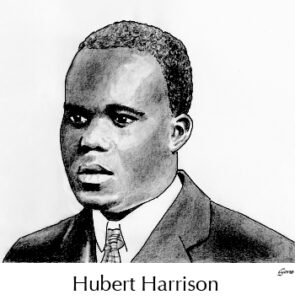
 Foremost among the street-corner speakers who held audiences spellbound in early twentieth-century Harlem was the man dubbed “Black Socrates”—Hubert Henry Harrison. He was a working-class radical intellectual and polymath from Saint Croix who was well-known and widely influential in his adopted home, Harlem. He was a leading participant in two large social movement trends: he was a popular socialist speaker who appeared alongside legends of that movement, such as Elizabeth Gurley Flynn and Big Bill Haywood, and he was a “race-first” man who mentored some of the twentieth century’s most important Black leaders, such as Marcus Garvey and A. Philip Randolph. Harrison was also a central figure in what later became known as the “Harlem Renaissance”; he collaborated with bibliophile Arturo Schomburg and assisted with the planning of the acquisition of Schomburg’s personal Black History collection that set the 135th Street branch of the New York Public Library on the road to becoming the world-renowned Schomburg Center for Research in Black Culture. Harrison was a voracious reader, taking in several books a week (and by some accounts, a day). He was a scholar who was just as comfortable out of doors as inside them; if multiple first-hand reports are to be believed, Harrison regularly lectured to Harlem street-corner crowds of hundreds for hours at a time on topics as wide ranging as literature, religion, African history, sexual politics, and the latest advances in science and technology.
And yet, today, outside of Black History enthusiasts, Hubert Harrison is little known. But he has, in a sense, posthumously recruited enthusiasts to set the record straight. The late independent scholar and activist Jeffrey Perry was an indefatigable promoter of Harrison’s legacy. Perry edited Harrison’s selected works and wrote a two-volume biography. I distinctly recall, around 2008 or 2009, hearing Perry speak about Harrison for the first time and feeling surprised that I had not heard of him before. Learning about this prolific and dynamic Black radical was a profound moment of discovery for me, and Perry’s enthusiasm was infectious. I was immediately hooked and would, in turn, talk about Harrison to anyone who would listen—he has that effect on people.
Now, for the second time in the twenty-first century, Harrison has another formidable champion: Brian Kwoba, an assistant professor at the University of Memphis. His Hubert Harrison: Forbidden Genius of Black Radicalism is an analytical biography of this long-overlooked figure’s political contributions, a study that builds on Perry’s work and extends it.
Kwoba’s book follows the chronology of Harrison’s life, more or less, but is also organized into thematic chapters covering the many dimensions of Harrison’s political thought and activism. The effect is to create what Kwoba describes as “essentially nine different minibooks” on an extraordinary figure. Kwoba enjoys metaphor, and commits early on to the use of two to describe Harrison’s contributions: he was both a “crystallizer” and a “touchstone.”
Inspired by a comment from one of Harrison’s contemporaries who credited him with having “crystallized the radicalism of the New Negro in New York…” (2), Kwoba notes that in chemistry the difficult breakthrough of crystallization “can become the seed form for a rapid and widespread proliferation of a new structure” (3). Kwoba thus sets out to show how Harrison crystallized various innovations (intellectual and organizational) that outlived him.
Kwoba also applies to Harrison a term that Harrison himself used to describe the relationship of Black people to U.S. democracy—the touchstone. A touchstone, Kwoba reminds us, “is a hard, dark stone that is used to test the purity of precious metals by seeing what kind of streaks they leave behind when rubbed against it” (7). Just as Harrison believed that “the Negro is the touchstone of the modern democratic idea,” demonstrating the purity of U.S. democracy, or lack thereof, so too does Kwoba believe that Harrison can serve as a touchstone to test the claims of the Socialist Party, the Garvey movement, and the idea of the Harlem Renaissance.
Restoring Harrison to the narrative of each, Kwoba argues, shows their respective shortcomings. To illustrate each example, Kwoba skillfully uses voluminous archival materials, Harrison’s papers, including diary entries, notes, articles, and books by Harrison and his contemporaries. There is not space here to assess all of Kwoba’s claims, but among the most well supported are: Harrison’s good-faith attempt to work within the Socialist Party made him a touchstone that revealed the party’s commitment to “white-first” politics, not the emancipation of the whole working class (chapter 1); he crystallized Harlem street speaking and other forums for free thinking and learning outside of formal schooling (chapter 3); Harrison developed a unique brand of class-conscious “race-first” politics, including a posture of humility and curiosity toward Africa (chapters 4 and 5); and he crystallized a “generational shift” in favor of more liberated sexual politics, including birth control, and against the repressive Comstock laws (chapter 6); Harrison crystallized a form of mass organization from which Garvey learned and remixed to great success, while also being a touchstone for that movement, a first-hand witness to Garvey’s less-than-scrupulous way of doing business (chapters 7 and 8); and Harrison’s exclusion from the canon of Harlem Renaissance literature is consistent with the explicit intention of the white funders of the “renaissance” narrative to promote non-radical Black cultural production (chapter 9).
Harrison’s role as touchstone also helps us understand how such a man can be forgotten. People are often remembered by the collectives to which they contribute. Through publications, awards, ceremonies, rituals, and so on, organizations and institutions help us hold on to the names of their brightest lights. But for the Socialist Party, the Garvey movement, or the mavens of the Harlem Renaissance, lifting up the name of Hubert Harrison was, to say the least, awkward. His support for progressive thinking on sexual politics may have also been a factor. “The individuals and organizations he criticized,” Kwoba writes, “not only felt stung by his criticisms but also harbored disdain for his advocacy and practice of free love in the sex-negative age of Comstockery” (313). Instead of acknowledging his influence and contributions, these groups found downplaying or erasing them, especially after Harrison’s untimely death at the age of forty-four, was more convenient.
Harrisonians, then, have their work cut out for them—restoring Harrison to his rightful place in those narratives, while also helping us understand the breadth of Harrison’s political context. As Harrison read and spoke and acted on such a broad array of topics, so too our narrator must take a wide view. Mostly, Kwoba is able to effectively use Harrison’s own words and actions to illuminate both the history and Harrison’s place in it.
At other times, when providing historical context or illustrating a point, Kwoba sets Harrison aside almost entirely to teach us about the Russian Revolution (7 pages) or the rise of U.S. imperialism (5 and a half pages) or, most perplexingly, the clean energy discoveries of Serbian inventor Nikola Tesla (5 pages). In each case Harrison warrants only brief or tangential mentions. Kwoba knows that Harrison was interested in science, but has no evidence that Harrison was interested specifically in Tesla. Why devote five pages to Tesla? He was, Kwoba argues, another example of a genius who has been “scandalously marginalized” because his radical solutions challenged ruling-class priorities (316).
The questions of imperialism and revolution are more to the point. Kwoba is, like Harrison, a Bolshevik at heart. Throughout the book, Kwoba’s strident, class-conscious, anti-capitalist tone fits his subject and meets our moment. Like Harrison, Kwoba has been on a similar personal journey absorbing revolutionary socialism (where, as he acknowledges in the preface, we met, and shared an interest in Harrison), exploring African history and identity, and rethinking gender and sexuality.
In Harrison’s time, opposing the war and supporting the Russian Revolution could get one deported. Today, in addition to the scourge of similar political repression, our collective stakes in addressing multiple global crises (including, of course, the need for clean energy) are arguably higher. “Hubert Henry Harrison’s significance,” Kwoba writes, “…lies in his crystallization of radical answers to radical problems that continue to haunt humanity right into the twenty-first century” (1). Kwoba’s book is a multidimensional portrait, offering new ways to encounter one of the twentieth century’s most important Black radicals.
 If you’ve read this far, you were pretty interested, right? Isn’t that worth a few bucks -maybe more? Please
Leave a Reply