
 In recent years, the national conversation about race, history, and education in the United States has become increasingly polarized. The rise of right-wing movements and the resurgence of Trumpism have been fueled, in part, by a mythical narrative of American history—one that presents the United States as an unblemished beacon of freedom and progress. This narrative, however, omits the truths of the nation: the legacies of slavery, segregation, settler colonialism, and systemic racism. In the wake of the massive Black Lives Matter (BLM) protests of 2020 a national conversation about race was opened. Since 2020, much like in the past, there has been a concerted effort by reactionary groups led by the MAGA movement to suppress or censor discussions about these uncomfortable truths. It is within this context that Brian Jones’s book Black History Is for Everyone emerges as a vital and timely intervention.
Historically, periods of social upheaval have often led to renewed attention to marginalized voices and narratives, the BLM movement is no different. The current backlash has taken center stage of late. Efforts to introduce curricula such as Advanced Placement (AP) African American Studies have faced fierce opposition in states like Florida, where lawmakers and activists have sought to restrict or ban discussions of race, often labeling them as Critical Race Theory (CRT). The term CRT has been weaponized in public discourse, used to attack any attempt to address systemic racism or the realities of Black life in America. According to reporting from Education Week, dozens of states have introduced or passed legislation aimed at curtailing the teaching of race and racism in schools.1 The AP African American Studies course itself has been the subject of controversy and political maneuvering.2
Despite this backlash the younger generation is craving this type of education, one that doesn’t sugarcoat and one that tells all sides of the story. As an educator in the Madison, Wisconsin, area I see this every day, even my most conservative student is interested in looking at all perspectives of the story. In addition to the required courses, I teach electives like African American Studies and Indigenous Studies and the interest in those classes has only increased since the 2020 uprisings.
Black History Is for Everyone begins by asserting that Black history is not a niche subject reserved for a single month or a specific group of people. Instead, it is a vital part of the collective human story, shaping societies, cultures, and institutions across the globe. The book’s central thesis is that understanding Black history is essential for everyone—not just for Black individuals or communities—because it offers critical insights into the development of modern society, the persistence of inequality, and the possibilities for a more just future. Jones says,
Ultimately, I came to believe that Black history is for everyone, because Black history is an invitation to rethink everything. But learning to see the world differently, learning to rethink what you think you know, isn’t easy, and it doesn’t always feel good. (p. 4)
This rethinking is what the right-wing fears the most. If young people and beyond start to question the origins of this country and the narrative that they are fed throughout their lives this could further radicalize them to think a better future is possible.
Black History Is for Everyone succeeds in making complex historical topics accessible without oversimplifying them. One of the most compelling aspects of Black History Is for Everyone is its emphasis on the dangers of historical amnesia. Jones warns that attempts to sanitize or erase the difficult parts of America’s past do a disservice to students and society as a whole. The book argues that confronting the realities of slavery, segregation, and ongoing racial injustice is necessary for building a more just and equitable future. By engaging with the “hard history” of the United States, students develop the skills to think critically about the present and to challenge the myths that underpin reactionary movements
The book is broken up into four parts, Race, Nation, Revolution, and Education following the Black experience and its diversity throughout. Jones engages in the debates in the Black community and the hopes and dreams that were set forth by those communities. This history ranges from making democracy a reality to public education.
When talking about the early development of race in the Americas, Jones notes that it wasn’t a foregone conclusion that segregation, permanent slave status, and other atrocities would be a reality. Though people were stolen from Africa and enslaved, laws did not immediately make this a brand that the enslaved could never wash off. It took time. Jones said,
it is important to recognize that this was a process that took time. When I’m teaching this history, I often share a timeline of the slave laws in early colonial Virginia. You don’t bother to write down a law to stop people from doing something they never do or can’t do. Like a child constantly changing the rules of a game when he isn’t winning, the Virginia Slave Code shows us, by its prohibitions, the existing behavior that was widespread enough to be a problem. (p. 31)
This is to note that the ruling class had to go out of their way to create and codify race laws in order to divide people such as poor whites and those enslaved Africans because they were not abiding by that order. Jones uses his ancestors to demonstrate his point. Showing that he came from a long line of free Blacks who fled states like Virginia, where free Blacks could not live, then heading to North Carolina and through intermarriages via poor whites, Indigenous people and other free people of color weaved in and out of the “Black” designation on the census. His personal story helps the reader follow the changes in culture and the law and the social construction of race.
As we enter an age where even the most basic bourgeois democratic rights are under attack, Jones reminds us that this is nothing new. One must understand that at the establishment of the United States only 6 percent of the population could vote. The basic liberal idea of one person, one vote was meaningless unless you were white and owned property. Jones suggests that it is African Americans who have been the vanguard to protect and expand our limited democratic society. He says, “Black people have been the most consistent force in U.S. history for democratizing this democracy.” (p. 49)
This is demonstrated by the experiment of reconstruction where activists from the abolitionist movement made strides to make the ideals of democracy a reality. For a brief moment there were attempts at a multi-racial democracy (though women could still not vote). Through the Freedman Bureau public education became a reality in the South for the first time. Black Americans set the foundations for these institutions that all people benefit from today.
Throughout the book Jones does not describe a single Black experience but grapples with the difference of opinions especially when it comes to accepting or rejecting the United States as a national project. Individuals like Ida B. Wells, Frederick Douglass, Fannie Lou Hamer, and Martin Luther King Jr. embraced the nation and how the words of the constitution, especially the Civil War amendments, could integrate them into the body politics and make the United States a liberatory nation. This was the goal especially of Douglass who lived long enough to see the hope during reconstruction to the dawn of modern U.S. imperialism.
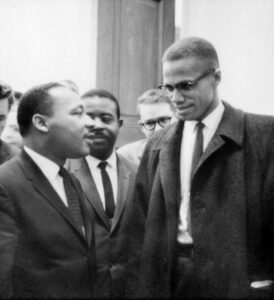
However, there was another Black experience that rejected the U.S. nation state and sought a different future with an internationalist perspective. This was notable in organizations such as the Universal Negro Improvement Association organized by Marcus Garvey and the Nation of Islam and the Black Panther Party. This perspective is most popularized by Malcolm X, among others, who often talked about how the United States was operating exactly how it is set up. Jones says,
Whereas other Black leaders emphasized the hypocrisy of the United States, Malcolm emphasized its consistency. In Malcolm’s hands, the political horizon of separatism, however far away in reality, opened a rhetorical space to make a more radical critique of the United States. That critique included the Democratic Party. Whereas other Black leaders hoped to influence the Democratic Party to support civil rights, Malcolm harbored no such illusions. (p. 58)
These critiques were made famous in his well-known speech, “The Ballot or the Bullet.” This way of thinking made Malcolm and others more willing to critique the American war machine, especially during the Vietnam War.
These two perspectives were not in isolation but in conversation with each other and Douglass and King and others were influenced to shift their positions at times too. This leads Jones into his chapter about the Haitian revolution and the idea of Black liberation outside the system. These themes of reform or revolution continue to show up in the book and are part of Black history in America. The reality is that it’s complex. Jones engages this issue at the end of the book noting that some people believe that Black history is problematic because it is “fundamentally unpatriotic.” He says,
Little do they know that so many of the leading lights of Black-led social movements in North America did, in fact, fight for change from a place of love, including love of country. But it won’t do to respond, “No, everyone you learn about when you study Black History loved America” or “Black history is American history.” That’s not true, either, and it’s really beside the point. Nations of people, like races of people, are relatively new in human history, and therefore it is entirely appropriate that we consider them both as objects of study, including critical study, no unquestioned loyalty. Classrooms are places for critical inquiry, debate, and disagreement. Emotions are part of the learning process, and teaching is relational.… In the process of a deeper engagement with Black history, teachers and students are also learning about each other. (p. 153)
Jones shows the complexity of the Black experience and the current terrain in the classroom and the debate over how our youth engage in these topics.
In conclusion, Black History Is for Everyone by Brian Jones is an essential resource for educators, students, and anyone interested in understanding the true scope of American history. The book provides a thoughtful and accessible overview of the importance of Black history, while also addressing the political and cultural forces that seek to suppress it. In a time when discussions of race and history are under attack, Jones’s work serves as a powerful reminder that the study of Black history is not just for Black students—it is for everyone. By embracing a more inclusive and honest approach to history, we can equip the next generation with the knowledge to build and fight for a better future.
notes
1. Sarah Schwartz, “Map: Where Critical Race Theory Is Under Attahttps://www.edweek.org/policy-politics/map-where-critical-race-theory-is-under-attack/2021/06ck”, Education Week, July 22, 2025
2. Ileana Najarro, “How AP African American Studies Came Under Attack: A Timeline,” Education Week, Feb. 13, 2023
 If you’ve read this far, you were pretty interested, right? Isn’t that worth a few bucks -maybe more? Please
Leave a Reply