
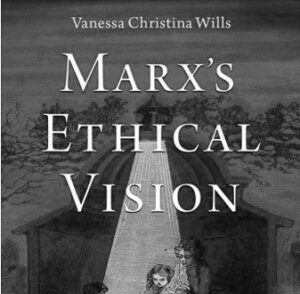
Vanessa Wills is associate professor of philosophy at George Washington University, a founding editor of Spectre journal, and the author of Marx’s Ethical Vision (Oxford University Press, 2024). She discussed her book with New Politics co-editor Phil Gasper in April. The interview has been lightly edited for clarity.
Phil Gasper: Congratulations on the book. It seems to be getting a lot more attention than most academic publications, because I’ve seen you’ve done a series of events and interviews and so on. So that’s fantastic.
Vanessa Wills: Yeah, it makes me happy, especially when I hear about people enjoying the book and learning from the book who are outside of my orbit. I tried to write a book that would hopefully speak as broadly as possible. So often in academia you write these things and it’s a very small niche that pays attention to your work. So, it’s been fun to see it go much further, beyond me and my circles, and get picked up by people in different disciplines, because it’s a philosophy book, but I wrote it in a way that I hoped would be of interest to more than just philosophers.
PG: What got you interested in writing about Marx’s ethical vision?
VW: It’s a question that came up for me during the second Iraq war, at the time of the 2003 U.S. invasion of Iraq, because I was doing antiwar work and that’s how I started to learn more about socialism and about Marx and about far-left politics. And I was feeling dissatisfied with so many of the mainstream conversations in the liberal media and liberal press, and liberal morality. I was a philosophy major, and I was a philosophy grad student, and I just felt that I wasn’t seeing the resources to help me make sense of the moral harm that was being done and what seemed immoral and unethical about it. It felt like an impulse that I had, or an instinct, and I wanted to follow that through. Am I off? I don’t think I am, but what is there to say about why it is that this is wrong? And as I was learning more about Marxism, I thought, wow, it’s got answers for all these other questions that I’ve been wondering about, maybe it has an answer here. So that’s basically become the central question of my whole academic career.
PG: So it’s been a 20-year inquiry for you.
VW: Yeah, exactly.
PG: Marx often seems antagonistic to morality, but you’ve written a whole book about his ethical vision. Can you summarize what you think his ethical perspective is?
VW: I’ll start with the antagonism, because it’s absolutely right that he does often speak in very critical ways about morality. And that’s actually one of the major themes of my book, because oftentimes he is offering criticisms of specific moral theories, like Kantianism, utilitarianism, various kinds of Christian ethics, and so on.So one thing that’s going on is that he often is criticizing some specific moral theory on the basis that the deck is stacked in such a way that it ratifies bourgeois capitalist ways of being and of perceiving the world, and delegitimizes the perspective of oppressed and exploited people. So often that’s the criticism he’s raising.
But there’s also a broader criticism about the role of morality in the world, and whether morality itself is a major tool with which to bring about social transformation, and whether the thing that we need to do is have more moral arguments. And he thinks no, or that it is at least quite secondary to actually taking power and transforming our material circumstances in order to bring about a world that is more conducive to human flourishing.
And that question of human flourishing, I think, is at the center of his ethical perspective. Because we still see Marx, consistently throughout his work. justifying various kinds of interventions and transformations, or doling out certain kinds of praise, on the basis of what things promote the flourishing of human beings and help to bring about the fully realized expression of their nature as rational creative beings.
So there is this idea of the labor process as the essence of human nature, the essence of human life. And then the question is what kinds of circumstances help human beings to expand their capacity and better intervene into their natural and social environment in such a way as to satisfy their needs and realize their aims, and which circumstances tend to stultify and restrict our ability to develop in that way.
There’s a conception of human nature here, but it’s important to distinguish it from human nature, as a sort of fixed set of necessary and sufficient conditions to count as a human being. This is human nature as itself the process through which we produce ourselves, through which we intervene into our circumstances and therefore transform ourselves.
PG: In other words, Marx is a kind of ethical naturalist, both because he sees human beings as part of the natural world and because his ethical views are rooted in a complex conception of human nature.
VW: I think that’s fair to say, yeah.
PG: A lot of people have drawn comparisons between Marx and Aristotle. Do you think that that’s a good way of understanding Marx’s perspective?
VW: I think that it is, if we can call it neo-Aristotelian. That’s not a term that rolls off my tongue typically, but I think that is fair as a way of thinking about the reading of Marx that I’m putting forward and arguing for.
Marx seems to think that morality will be abolished in a fully developed communist society and that this is good—he doesn’t complain about this. And this is one of the important arguments for the claim that Marx doesn’t have anything to contribute to our understanding of ethics, because he seems like he wants to abolish it and get rid of it. But I appeal to a reading of Aristotle’s De Anima, which Marx was very familiar with—he actually produced the first German language translation of De Anima.
You see throughout Marx’s writings references to the human senses. So he’ll talk, for example, about how the ear is not just a physiological structure, it also has a history. Human beings, over the course of their development, as a species, acquire all kinds of new nuances in this capacity to hear and what it is that we hear. We know that anyone who goes through music appreciation has this transformation. It’s the same physiological structure, but the sense changes. And Marx makes similar comments about the power of sight.
I think what we’ve got is Marx arguing that part of what’s gone wrong under capitalism is that the commodity form—the generality of all things as instruments of exchange or objects to be exchanged, always asking “What can I get for this?”—submerges specificity, uniqueness, particularity and difference in the merely quantitative calculation of profit accumulation.
Marx thinks this is a way that commodity exchange ruins our ability to actually apprehend reality, to actually perceive the world that we’re in, and that this extends to our relationships to other human beings. Earlier, he called this alienation. One of the things I argue in the book is that he never actually stops talking about alienation, even though he will use different terminology, all the way through his corpus. You got this idea that our senses are dulled, they’re stunted, and that what’s needed is circumstances that could put us in a position, and develop within us the capacity, to actually see other human beings. And if we could actually see and perceive other human beings, we might also inculcate in ourselves and develop within ourselves a disposition to respond to them in a different way, to respond to their unique needs, requirements and capacities, instead of having to translate that through a rule book of moral principles.
And so, this is, I think, what Marx is talking about when he talks about the abolition of morality. It’s the abolition of what we have, which is a kind of stopgap to help us work around the fact that we don’t actually have what Marx sometimes calls a human sense. Recognition is what I’m talking about, really, if we want to get Hegelian about it.
PG: Yes, that’s interesting. In the Anti-Dürhing, Engels doesn’t say that morality will be abolished in a classless society, but he says that the abolition of classes will allow a truly human morality to emerge, and what we deal with in class society are various kinds of class moralities. Would you agree with that, or is that a different way of thinking about things? He doesn’t say abolition, he says transformation.
VW: I wouldn’t put it in those exact terms because it actually seems to me that Marx really does think of it as an abolition. But I think I would agree with the spirit of Engels’ statement. I think of morality as inherently classed, or at least inherently about a kind of gap or misalignment between the world as it ought to be and the world as it is. Once we’re talking about a transformation that allows human beings to have an outer outward appearance that is expressive of their essence as self-creating universal beings, then it’s hard for me to understand where morality fits in. So I would say I agree with the spirit of it, although I wouldn’t put it in those terms.
PG: In your book you argue that a Marxist worldview is at the same time ethical and scientific. Can you say a little bit more about how you see the relationship between ethics and science in Marx’s writings? You’ve started to talk about this because you’ve talked about what he says about the senses and the relationship between ethics and human nature. But perhaps you could say a little bit more.
VW: Yeah. It also relates to some of the things I say early in the book about why the reception of Marx’s ideas among analytical philosophers, in particular, has been troubled, to put it mildly.
I argue for a Marx who is set into context with his Hegelian lineage, which he himself was not shy about, even though, of course, he had a critical relationship to that lineage. One way that that matters is the idea that there is a hard and fast separation between what is the case and what ought to be the case, so that claims about what ought to be the case are not deducible from claims about what is the case.This sort of is-ought divide is not universally endorsed by analytic philosophers, but it is analytic philosophical common sense. Marx rejects this—it is just not part of his perspective, and I think that comes in part from that Hegelian lineage.
Marx believes that the world is inherently dialectical, which is to say that it contains contradictions. When we describe what the world is, for Marx a fully scientific accounting of what the world is, includes a tendency toward a certain type of future. I’m trying not to put this too fatalistically. Sometimes people understand this as a kind of gestational picture. Seeing it as fully gestational, would mean the world that is to be is just already here. That’s somewhat right —and I do sometimes speak like that—but I think it’s important to see that what exists now is a tendency toward a different world. And so I think what exists is both the capitalist world that we know and loathe, and also the working class.
The working class is not an idea, and its resistance is not an idea. It’s happening now. If you have a kind of flattening perspective on the existing world, where you just say that everything is subsumed by capitalism and totally exhausted by capitalism—there are ways to say that and not be wrong per se, but it’s important to keep in mind that there’s also already a struggle for human survival that’s ongoing all the time. And for Marx, studying that, analyzing it, taking up the aim of human survival, and then analyzing the existing world to say, well, what is here that tends in the direction away from our survival and what tends towards our survival, all of that is scientific. It is attempting to look at objective reality and say true things about it. But it’s also understanding that a full accounting of reality is going to include some contradiction. An important element in that contradiction is a dynamic already existing, already struggling, that is headed someplace. And that’s the thing that Marx is tracking and that I’m trying to track when I talk about an ethical vision.
This also relates to something that Marx and Engels say: the communists do not preach morality. And I think that’s exactly right, because it’s not a question of abstractly developing a principle and then superimposing it onto the world. It is a strategy of looking at the world and seeing what aims are already present within humanity and which of those aims are consistent with the persistence and survival of humanity, and advocating for those and seeking to promote those.
PG: So there’s a moral perspective, but a rejection of moralism in which you put a heavy emphasis on making appeals to abstract principles of some kind. On the other hand, what you said about the future not being preordained in the present, leaves things open to a certain extent. I see Marxism as a theory of potentialities.It shows us different possible futures, but it’s not determined that one of them will prevail, even though Marx sometimes talks about victory being inevitable. I don’t think he really believes that, because history can develop in more than one way.
But as soon as you have the idea that there is more than one possible future—socialism or barbarism, in Rosa Luxemburg’s famous expression—that does leave a sort of opening for a certain kind of moralism, if you like. When people struggle to improve their situations, they often think about it in terms of social justice or universal rights. These are terms which have histories, and which may not be perfect for describing what people are thinking about, but they often think about the possibilities in broadly humanistic terms. That’s what motivates them. And that can be a strong motivation if you’re fighting. You can fight for your immediate material interests, and people do, but if you are also fighting for a conception of justice, that can be an additional motivation. And that that can be important because you may have to do things that require justification. You may have to restrict what other people can do. You may be in a life-or-death battle with other forces. So is there a middle ground between moralism in a sort of strong sense and making these sorts of appeals to notions like social justice? Is there room for that in Marx’s perspective?
VW: I think there’s room for it. Certainly, if I find out that somebody that can be very helpful to the struggle for human emancipation has the sort of psychology where it’s actually very important to make explicitly moral arguments to them, then it would be strange, I think, to stand on principle and say no, I’m not going to do that. Sure, make the moral case for it. But I think what Marx is skeptical of—and I would share his skepticism—is that on the whole, as a general rule, that kind of argumentation is a thoroughly efficacious way of bringing about resistance and of engaging people in struggle. And it’s not because people are just totally indifferent to right and wrong, because you’re absolutely right, of course they’re not. But it is just a fact about human psychology that the things that are connected in some way to your concrete circumstances, tend to put a fire under people in a different way. And it tends to be that people will be motivated by the concerns that connect to their personal situation, or the things that they value in some way.
And I think this is important for all sorts of reasons, but one of them is that it goes to the ethics and science question. Sure, I can make an ethical argument and do right. One of the aims in the book is to actually spell out what an ethical argument is. But if I only have time to make one argument to a person and I’m trying to impress upon them how important it is that they join the struggle for human emancipation, I’m going to make the argument where I’m able to connect that seemingly abstract aim to the issues that directly impact them.
And this is where Marx, I think, identifies a strength of his perspective as opposed to a number of other moral theories. Marxists have a perspective about good and bad, right and wrong, what ought to be done and what ought not to be done, etc., that comes out of the clouds and actually aligns with reality—aligns in a way where I can also say by the way, it’s actually absolutely imperative that this be done because otherwise we’re not going to survive. You’re not going to survive. Your children are going to do worse. The ethical aspiration of Christianity, a brotherhood of men—Karl didn’t come up with that one. But he brings it down to earth.
I think this is important too, because there’s a tendency to say, well, these things that Marx is advocating for—peace and abundance, and individual freedom, and so forth—why do we need Marx for that? Doesn’t Kant want the same thing? Doesn’t John Stuart Mill want the same thing? And the answer is that at a high level of abstraction, sure, but the devil is in the details of how we are going to get there. And I think that’s where having an account of history and of politics and of economics and of how it affects you, specifically is important. A shorter way to put this is that Marx thinks the interests of the working class are coincidental with the interests of humanity. So the interests of humanity don’t have to become this abstraction that we confront as a demand on us. Our demands as workers are also the demands that are necessary for the good of humanity.
PG: So there are certainly strands in earlier ethical thinkers that Marx doesn’t reject.But there are also important strands that he does reject. And you talk about some of his criticisms of other theories. Take Kantianism, for instance. Kant says we should treat other human beings as ends in themselves. That to me seems to fit very well with Marx’s perspective. But there’s also an aspect in Kant in which human beings are seen as in need of being disciplined all the time. You have to control desire with reason, and you have to suppress urges to act in various ways. So there’s a kind of puritanical aspect to Kant that I think is very alien to Marx’s view of ethics. Marx’s naturalistic view has to do with human flourishing. You don’t want to suppress your desires. You want to find a way in which you can harmoniously develop them.
VW: Yeah. And it also goes to the question of interests, because Kant thinks your interests are always inherently suspect and such as to lead you away from the good. Marx does have a skepticism about bourgeois interests. But he takes himself to have identified this element within society that doesn’t have an inherent and necessary contradiction between their interests and the good—these things are completely coincidental. The working class can be misled about its interests and often is. Racism and sexism and homophobia and nationalism, these are all ways of doing that. But this again goes to that question of science—the idea that there are nonetheless objective interests, and the more that working people become aware of those and able to discern them, that is the good. That is completely coincidental with the good for humanity as a whole.
PG: At the beginning of the book, you talk about the way in which Marx has always been rediscovered in times of crisis, and we’re in an acute period of crisis today. People talk about a polycrisis because we have economic, social, environmental challenges, all of which are reinforcing each other. So Marx has been rediscovered again and there’s a lot of interest in his ideas. How do you think understanding Marx’s views about ethics helps us to respond to the crisis? In other words, if somebody picks up your book, will they find it useful to think about the practical tasks facing us in the current situation? Or is it more that this is something that you should think about at some point, but it isn’t the most urgent? How does understanding what Marx says about ethics help us as political activists in the current moment?
VW: The main question of the book for me came precisely out of political urgency, precisely out of crisis. I was in my early 20s, and I thought, the world is going to end. I thought the whole idea of the War on Terror and these invasions were obviously setting the world on a path towards greater destruction, greater suffering. Greater hatred. And in that moment, this question seemed to me to be a really important one. I’ve continued to be an activist and an organizer and to do whatever I can think of to try to be a force for good, in circumstances that have just gotten worse and worse.
And I think one of the things that stands out to me is that, on the one hand, you hear people saying ethics, that’s so abstract, who cares, blah, blah, blah. And yet people have ethical debates all the time and people treat them with real seriousness, and I don’t just mean people inside the academy in an ivory tower. For example, the conversation that has happened around Luigi Mangione, the person who is accused of shooting the executive from United Healthcare. All of a sudden, the whole country, the whole United States, was engaged in this ethical debate about what he is accused of doing, about health care in general.
I think that the skepticism about the importance of ethical discussion and ethical theory is one version of a kind of anti-intellectualism that takes these questions that animate everybody, that everybody cares deeply about, and treats them as though it’s some weird obsession of the philosophers, when that’s just not really how it is.
Right now, we see Trump taking these people that have had no due process and throwing them into a concentration camp in El Salvador with the assistance of President Bukele. And that’s an ethical problem. It’s a lot of other problems at once as well, but I think having clarity about ethics and about right and wrong, and about what human beings should demand. I think it absolutely is incumbent upon us to think that through, and I think that as an academic—as somebody who does have access to that ivory tower, which means I have time and opportunity for now, while we still have academic freedom to some extent in this country—that’s a role I can play, to help contribute to answering those questions that people are fired up about and want to know about and want to understand. I think that’s a role that I can play.
I think people that pick up this book—even if they read it and say, you know, I don’t really agree with Vanessa Wills—will walk away with some new tools and new perspectives and new ways of thinking about the relationship between ethics and our observations of the world, because people’s ethical perspectives often get denigrated as mere taste or mere personal preference, and not views that map on to and reflect something that is objectively the case. And that’s what I argue for—that there is an objective set of truths about how human beings ought to live, and that we’re not doing it right now.
 If you’ve read this far, you were pretty interested, right? Isn’t that worth a few bucks -maybe more? Please
Leave a Reply