
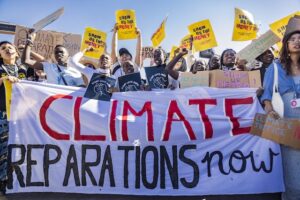
 Grassroots delegates from 142 countries assembled in Cochabamba, Bolivia, fifteen years ago and endorsed treaties defending Mother Earth, compensating the plundered Global South, and stabilizing warming near pre-industrial levels. Having attended that conference, Ashley Dawson examines in Environmentalism from Below “what an environmental liberation movement that began from the needs of the Global South would look like.” Following the tradition of Joan Martinez-Alier and Ramachandra Guha’s “environmentalism of the poor,” Dawson provides important accounts of proletarian and peasant land defense struggles having little in common with the corporate greenwashing and fortress conservation passing for environmentalism.
The first chapter, “Decolonizing Food,” opens with the 2020–2021 autonomous encampments that compelled Narendra Modi’s government to repeal three laws deregulating India’s agricultural sector. Dawson rightly highlights the globalized coordination of La Via Campesina (LVC) with its estimated 200 million members across 81 countries. Citing David Montgomery’s research on declining soil fertility, Dawson illustrates the ongoing relevance of nineteenth-century warnings from Justus von Liebig and Karl Marx of agricultural disruption to biogeophysical cycles.
Against ecomodernist proposals to salvage capitalism’s agricultural biotechnologies, Dawson convincingly argues that the Green Revolution has been “effectively a program of chemical carpet-bombing” and that genetically modified organisms “are expressly designed for domination.” Dawson could have strengthened his case that small-scale agroecology can feed the world had he emphasized LVC’s opposition to the Global North’s wasteful animal consumption levels, a leading cause of deforestation, biodiversity depletion, and global warming.1
The next chapter, “Urban Climate Insurgency,” begins with Chileans’ 2019 insurrections that achieved the repeal of subway fare hikes. Without framing themselves as environmentalists or decarbonizers, participants succeeded in protecting access to public transportation. Dawson then discusses sustainable communities such as the Uruguayan Federation of Mutual Aid Housing Cooperatives, which cooperatively builds and manages communal housing, and Cape Town’s Empower Shack, which builds neighborhoods of solar panel-covered and water-recycling houses clustered around courtyards with trees and playgrounds.
Oddly, Dawson champions Slum Dwellers International (SDI) as “organized along lines very similar to La Via Campesina.” Aside from having a comparatively vertical structure, SDI shies away from the radical anti-capitalism that LVC advocates. Unmentioned by Dawson, SDI has accepted millions from the Gates Foundation, among other neoliberal NGOs, and has been favored by the South African government as a palatable alternative to the grassroots Abahlali baseMjondolo.2 This isn’t to deny the benefits of mutual savings and credit programs that SDI members coordinate.
Next, a chapter titled “Reclaiming the Energy Commons” begins with India’s Adivasi communities’ resistance to coal mining and logging (although a critical discussion of the Naxalite rebels’ ideology and methods would have been welcome3) then moves to South Africa’s KwaZulu-Natal Province where the assassination of organizer Fikile Ntshangase hasn’t halted mobilizations against coal mining. Stressing an overlooked abundance of environmental victories, Dawson cites the finding of Martinez-Alier and his co-authors that up to 27 percent of extraction projects are halted when confronted starting in the proposal phase and with an adequately diverse mix of tactics.4
However, Dawson’s descriptions of public solar and wind infrastructure remain grounded more in aspiration than actualization. After highlighting South Africa’s “One Million Climate Jobs” campaign, launched by the Alternative Information and Development Centre and supported by unions including the National Union of Metalworkers of South Africa, he acknowledges the proposal lost traction due to disagreements “between those who believed that the South African labor movement should maintain its longstanding alliance with the ruling ANC party, and those who believed that workers needed a more independent, militant federation.”
Given his predominant focus on South Africa and India, Dawson doesn’t discuss China’s leading role in expanding world solar and wind energy capacity nor the related contradictions entailed both in mineral extraction and China’s expansion of coal, oil, and gas. There’s likewise little discussion of how societies of Southwest Asia and North Africa could utilize their plenitudes not of petroleum but of sunlight. Although Dawson can’t be faulted for omitting such topics, readers seeking a comprehensively global account will need to supplement this volume with other studies.5
Dawson’s final chapter provides a convincing case “Against Fortress Conservation.” As an example of the abuses under top-down conservation, it describes India’s Kaziranga National Park where park guards killed 106 local people in the two decades up to 2017. Rejecting proposals to establish protected areas encompassing at least half the planet, Dawson overlooks that radical social transformations could make such ambitions consistent with his own advocacy for “an alternative mode of conservation grounded in the work of Indigenous people and local communities to preserve their lifeworlds.”6
Dawson’s proposals for climate debt and border abolition will become increasingly urgent given climate-driven impoverishment and dispossessions projected for coming decades. Researcher Marten Scheffer and co-authors predict that 30 percent of the world’s population will inhabit insufferably hot regions by 2050. Given such migration, strict border enforcement would spell social catastrophe. Compensating the South for climate impacts and facilitating sustainable technology transfers will be essential for climate stabilization.
The 2010 grassroots Cochabamba accords, reproduced in the book’s appendix, remain relevant despite the Bolivian government’s role in coordinating them and anti-extractivist critique from some members of the country’s indigenous population.7 The conference’s People’s Agreement found, “Humanity confronts a great dilemma: to continue on the path of capitalism, depredation, and death, or to choose the path of harmony with nature and respect for life.” Achieving even the Paris Agreement’s goal of keeping the temperature increase to 1.5°C—let alone Cochabamba’s precautionary 1°C level based on 1980s’ research led by Egyptian anti-colonialist and scientist Mostafa Tolba—will minimally require something like 2020’s lockdown-induced levels of decarbonization to be sustained year after year. This would mean an end to endless economic growth and thus an end to capitalism. With deeply sunk costs in fossil fuel industries, the Global North is unlikely to initiate such a trajectory.8
Perhaps instead the Global South will lead the way, following Trotsky’s theory of permanent revolution, in which less-developed societies initiate worldwide social transformations.9 Dawson’s examples of communities organizing around truly living well (buen vivir), public rather than private affluence, and establishing peace with the Earth, offer hopeful seeds of such a radical and necessary future.
notes
1. Amir Kassam and Laila Kassam, eds. Rethinking Food and Agriculture: New Ways Forward (Duxford: Woodhead Publishing, 2021).
2. Jared Sacks, “How NGOisation Provides Cover for the Murder of Shack Dwellers,” Review of African Political Economy, Oct. 4, 2018.
3. See Alpa Shah, Nightmarch: Among India’s Revolutionary Guerrillas (University of Chicago Press, 2019).
4. Arnim Scheidel et al., “Environmental conflicts and defenders: A global overview,” Global Environmental Change (Vol. 63, July 2020).
5. Richard Smith, China’s Engine of Environmental Collapse (Pluto Press, 2020); Adam Hanieh, Crude Capitalism: Oil, Corporate Power, and the Making of the World Market (Verso, 2024).
6. Eileen Crist et al., “Protecting Half the Planet and Transforming Human Systems are Complementary Goals,” Frontiers in Conservation Science (No. 17, 2021).
7. “Manifesto of Mesa 18, the ‘rebel session’ at the 2010 Tiquipaya Climate Summit.”
8. Andreas Malm and Wim Carton, Overshoot: How the World Surrendered to Climate Breakdown (Verso, 2024).
9. Michael Löwy, The Politics of Combined and Uneven Development: The Theory of Permanent Revolution (Haymarket, 2010).
 If you’ve read this far, you were pretty interested, right? Isn’t that worth a few bucks -maybe more? Please
Leave a Reply