
 Two years ago, the Bureau of Labor Statistics released updated union density figures for 2022. The number of union members was larger by several hundred thousand. But per usual, the unionized portion of the total U.S. workforce was smaller than the previous year—this time declining to 10.1 percent from 10.3 percent. (Due to continued workforce growth averaging 1.5 million annually, that’s now down to an historic low of 10 percent).
As In These Times labor columnist Hamilton Nolan reports in his new book, The Hammer, this was not good news after “a year in which unions were historically popular with the public, high profile union drives were heavily covered in the mainstream press, and Democrats controlled Washington.”
Two female labor leaders, highlighted in Nolan’s book, had varying reactions. Liz Shuler, new president of the AFL-CIO, hailed “the momentum of the moment we are in” and the large numbers of “working people rising up despite illegal opposition from companies that would rather pay union-busting firms millions than give workers a seat at the table.”
Sara Nelson, president of the Association of Flight Attendants/CWA and a member of the AFL-CIO executive council, offered a more self-critical assessment. According to Nelson, “these numbers are incredibly disappointing” and a sign that “the labor movement is not meeting the moment.” To better respond to workers “real desire to join unions,” she argued that the latter will have to do “something pretty extraordinary.”
In The Hammer and Eric Blanc’s just published We Are the Union, both authors tackle a perennial question facing the labor left—namely, what kind of break with business as usual, within organized labor, would help many more workers win union recognition, first contracts, and strikes.
Both books went to press before the results of the 2024 presidential election were known. Even in the more favorable scenario of a Kamala Harris presidency, major unions would have still struggled to consolidate recent contract campaign and strike gains, while trying to figure out how best to “go bigger” in their new organizing.
Now they will be fending off an all-out right-wing assault under a second Trump Administration, this time guided by the union-busting agenda of Project 2025, from the Heritage Foundation. Labor will not have friends at the National Labor Relations Board (NLRB) like General Counsel Jennifer Abruzzo; her Republican successor and Trump-appointed federal judges hostile to collective bargaining, will reverse, as quickly as they can, the many helpful NLRB enforcement actions of the last four years.
Breaking with Business as Usual?
Nolan and Blanc bring a shared generational perspective on the revived labor militancy and flurry of new organizing recounted in their books. Both come from union families shaped by the radicalism of the late 1960s and early 1970s. Nolan grew up in the south, where his parents once belonged to the October League, a Maoist group that believed they should take blue collar factory jobs to become “embedded in the proletariat.” The author’s first and only organizing experience, as a reporter, was at Gawker, a now defunct new media outlet whose editorial staff in NYC unionized with the help of the Writers Guild-East.
This 2015 victory was followed by organizing wins at other online publications like Salon, HuffPost, Slate, Vox, and Vice. As Blanc documents in greater detail, the News Guild’s initial failure to capitalize on this union revival among younger media workers soon led to a successful internal union challenge to the Guild’s longtime national president, Bernie Lunzer. Since he was defeated in 2019 by Jon Schleuss, a then 31-year-old organizing committee member at the Los Angeles Times, the Guild has become what Blanc calls a “powerhouse of new organizing.”
Now a labor relations professor at Rutgers, Blanc grew up in San Francisco, where his father was a longtime central labor council activist and advocate for a labor party. His mother was an elementary school teacher, elected as president of the United Educators of San Francisco on a reform slate ten years ago. A former high school teacher himself, Blanc’s own previous book, Red State Revolt: The Teachers Strike Wave and Working-Class Politics, chronicled the 2017-18 uprising in public education in Oklahoma, West Virginia, Arizona, and other states.
Both authors rely on case studies of recent organizing, bargaining, or strike activity to make their argument about what needs to be done to change the current imbalance of power between labor and management in the United States.
In The Hammer, Nolan first profiles a model 20-year collaboration between the American Federation of State, County, and Municipal Employees (AFSCME) and the Service Employees International Union (SEIU) to build Child Care Providers United (CCPU), a state wide organization of family day care providers who now number 40,000 in California.
One key element of this effort was encouraging often “marginalized and ignored working people” to act like they were part of a union, long before they had an established bargaining unit. As Nolan reports, CCPU “got thousands of workers to pay voluntary dues of ten dollars a month long before any collective bargaining law covering them was passed.” Their continual grassroots mobilization, aimed at state legislators in Sacramento, won a series of financial concessions prior to Gov. Gavin Newsom signing a bill finally “giving child care providers the right to negotiate as a group” five years ago.
Turning to the private sector, Nolan similarly praises the integration of internal and external organizing, contract campaigning, political action, and chain-wide walkouts by hotel workers in Las Vegas and other cities. As a national organization, Unite-Here is only “moderately sized.” But its three hundred thousand members have long punched way above their weight, thanks to what Nolan calls “deep organizing, bitter strikes, militaristic discipline, and collective sacrifice by tens of thousands of working people.”
Even amid widespread layoffs, due to pandemic disruption of the hospitality industry in 2020-22, Unite Here “rolled out its most ambitious election door-knocking campaign in history.” More than 1,000 of its well-trained, highly motivated rank-and-filers fanned out in Nevada, Arizona, Pennsylvania, and Georgia to help prevent right-wing Republicans from gaining control of the Senate. (With a new cohort of volunteer canvassers, the union tried to have the same electoral impact in battleground states, last fall.)
National Bargaining Fights
In his detailed account of a 2021 contract fight between the new corporate owners of Nabisco and several hundred workers at its Portland, Oregon plant, Nolan confirms that “blue-collar union strength not only still exists, but is still able to be a bulwark against the vampires of capital.” The national organization involved—the 138-year-old Bakery, Confectionary, Tobacco Workers and Grain Millers (BCTGM)—was not known to be a “particularly bold union.” Yet many of its rank-and-file members rejected industry-wide demands for concessions, backed up by lay-offs and outsourcing threats across the country that year.
The result was strikes at Frito-Lay, Nabisco, and Kellogg’s. (After the 11-week walk-out by 1,500 cereal makers in three states, one of the BCTGM local presidents involved, Dan Osborn, decided to run for the U.S. Senate as a labor-backed independent candidate from Nebraska.) In Portland, the new owner of Nabisco was Mondelez International, a “gargantuan, self-described global snacking powerhouse.” In an earlier bargaining impasse, Mondelez (like Boeing and other major firms) froze its defined benefit pension plan contributions and offered cheaper 401(k) coverage instead.
When management lawyers went to the bargaining table in 2021, the company had just closed cracker factories in Georgia and New Jersey, throwing nine hundred BCTGM members out of work. The price of keeping Portland open, they implied, was healthcare concessions, scheduling changes, and keeping temps in the plant.
Members of BCTGM Local 364 had already staged a sickout over pandemic related contract violations involving the use of temps. But they were part of a national contract bargaining process that involved Nabisco workers in four other states who were not necessarily “pissed enough to walk out.”
No Contracts, No Snacks
In August, 2021, the first national Nabisco strike since 1969 occurred anyway, with far less planning and coordination than Unite Here employs in its multi-state work stoppages at a nationwide hotel chain. Fortunately, Portland-area labor solidarity activists, in other unions and in Democratic Socialists of America, intervened in a helpful way. They encouraged strikers like Donna Jo Marks, one of the many brave rank-and-filers profiled in Nolan’s book, to avoid over-reliance on traditional picketing because strikers were already being temporarily replaced by busloads of scabs protected by private security guards from the same strike-breaking firm hired by Nabisco.
Marks and her co-workers started building broader community, labor, and political support for their fight against this brand-name company. One of the most famous names in Hollywood, actor Danny DeVito, tweeted his support—“NO CONTRACTS, NO SNACK,” which became the motto of the strike. Portland’s newly unionized women’s professional soccer team, the Thorns, showed up to picket, en masse. As production with a scab workforce lagged and Nabisco had greater difficulty filling orders, the broader disruption of global supply chains during the pandemic proved to be a strike ally as well.
After five weeks, a new contract offer, with modest raises and a $5,000 signing bonus, was put to a vote. Most Portland strikers voted against the deal, because of concerns about new scheduling language; three-quarters of Nabisco workers nationally voted “yes” because the new contract “largely preserved the benefits of previous ones” (although not in the area of pensions).
In Nolan’s view this and other BCTGM strikes four years ago nevertheless “played a significant role in the nationwide realization that workplace organizing offers a path for regular people to do something” and, in the process, can renew workers’ “belief that all is not lost, that people power is still real.”
The Starbucks Model
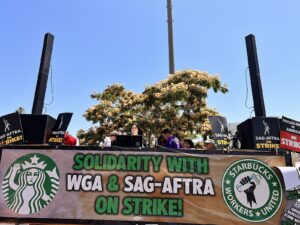
As the Portland strikers returned to work, Starbucks baristas at three coffee shops in Buffalo were preparing for separate NLRB-conducted votes in December, 2021. A clear cut 19 to 8 victory at just one of them helped inspire like-minded fellow Starbucks workers across the country to join a network of rank-and-file organizers called Starbucks Workers United (SBWU). By late 2024, backed by Workers United/SEIU, they had helped 11,000 of their co-workers win bargaining rights at 500 Starbucks locations. They’re now engaged in an-on-going campaign to bargain a first contract with a $110 billion firm employing 380,000 workers, which makes it one of the biggest restaurant companies in the world.
To Eric Blanc, this “worker-to-worker” organizing breakthrough is worthy of close study and wider emulation. Starbucks’ workforce was widely dispersed and fragmented into small, retail store size groups. SBWU had to develop union majorities, unit by unit and maintain them before, during, and after hotly contested NLRB elections. To discourage the spread of unionization, countless workers were harassed, several hundred were fired or suspended for their union activity, and, most consequentially, locations that voted for collective bargaining were illegally denied wage and benefit improvements granted to non-union stores, as an incentive to keep them that way.
This was not membership recruitment conducted under the more favorable conditions of an SEIU-AFSCME campaign among publicly-funded child care providers in a union-friendly state like California or a Communications Workers of America (CWA) drive among wireless phone store workers covered by a card check and neutrality agreement, negotiated with an already unionized parent company.
Instead, for over two years, SBWU supporters faced a “scorched earth union busting campaign of unparalleled intensity and breadth,” which, according to Blanc, cost an estimated $250 million. It was orchestrated by Littler Mendelson, a corporate law firm notorious (and often victorious) in the field of “union avoidance.” The author’s interviews with SBWU founders take readers of his book behind the scenes of an amazingly durable grassroots effort that began when “ten young radicals started salting Buffalo Starbucks stores in early 2021.”
Worker to Worker
By November of that year, billionaire Howard Schulz, the company’s founder and CEO, had to make a personal visit to Buffalo to help counter the influence of these pro-union “partners,” who he later complained were “outsiders trying to take our people.” Schulz’s appeal to company loyalty didn’t work; on average, over the next six months, SBWU filed almost two representation election petitions per day, imprinting what Blanc calls “worker-to-worker DNA into the entire subsequent trajectory of the campaign,” which could not have taken off, using a traditional staff intensive approach. Because of its do-it-yourself spirit, the campaign’s initial election win rate was a remarkably high 80 percent, Blanc reports.
Collective action—especially work stoppages—were “key to sustaining momentum and forging solidarity” and keeping the pressure on management, he believes. “In addition to periodic nationwide mobilizations, many Starbucks strikes were begun locally as responses to grievances at their stores.” According to the author, SBWU also “did a great job fighting for and highlighting partial concessions from management secured along the road to a first contract.”
That goal suddenly became more achievable in February, 2024, when “Starbucks raised a white flag” and agreed to “begin bargaining in good faith and stop illegally denying equal benefits to unionized workers.” (Whether this process actually leads to a first contract remains to be seen; if the company’s new CEO changes course, in light of Trump’s victory and the resulting hobbling of the NLRB, labor relations at Starbucks could turn brutal again, very quickly.)
As Blanc sums up the lessons of the Starbucks fight so far, his good advice for labor organizations lagging behind is as follows: Develop and train more rank-and-file leaders in non-union workplaces, who “can self-organize and train others.” Use digital communication tools like Zoom “to quickly and widely scale up drives across huge spatial divides … so workers can directly coordinate and support each other without relying as much on paid staff and union resources.” Increase funding for “widespread salting at strategic targets,” like Workers United did in upstate New York with a “crew of radical salts” whose efforts led to the formation of SBWU. And be ready to seize high-profile opportunities to “spread unionization as widely as possible,” as SBWU organizers did when they were deluged with appeals for organizing help from baristas around the country. In short, Blanc argues, “the labor movement needs to finally start acting like a movement again.”
New Voices at the AFL-CIO?
Unlike Blanc, Hamilton Nolan does much wistful thinking about the national AFL-CIO becoming an effective catalyst for mass organizing. When Service Employees President John Sweeney and Mine Workers President Rich Trumka took over the national labor federation in 1995, after winning its first contested election in a century, there were similar high hopes, on the left, that their “New Voice” slate—and headquarters staffers hired after it won—would help launch new industry-wide drives.
Under the old AFL-CIO regime of Lane Kirkland, the labor federation had already created an Organizing Institute “to train thousands of new organizers, jumpstart union organizing nationwide, and reverse the decline in union density.” The OI’s first director was Richard Bensinger, now a Workers United staffer whose key Starbucks campaign role has become what Nolan calls “the capstone of a four-decade career of successful organizing.”
After Sweeney was elected, Bensinger led the charge to get all AFL-CIO affiliates to spend 30 percent of their budgets on organizing. But this New Voice attempt “to reorient the priorities of organized labor crashed on the rocks of big union apathy and independence.” A decade later, some of the biggest AFL-CIO unions—SEIU (under Sweeney’s successor, Andy Stern), the Teamsters (under James Hoffa), the United Food and Commercial Workers, and the Laborers—responded to that setback by creating their own new and improved U.S. labor federation. The Change to Win coalition quit the AFL-CIO with a quarter of its membership—more than five million workers who were not much consulted about staying or leaving.
According to Nolan, CTW was also not able “to organize effectively on a large scale, although there were some valiant attempts.” It was soon wracked with internal dysfunction and jurisdictional conflicts of its own; by 2009, its better affiliates like Unite-Here were trickling back into the AFL-CIO. Others—like SEIU, the IBT, and the Carpenters—have still not “rejoined the AFL-CIO, secure in their belief that to do so would be a waste of time and money.”
Despite this useful reality check on prior efforts to reform the AFL-CIO or create an alternative to it, The Hammer entertains the fantastical notion that a single left-leaning member of the AFL-CIO executive council—namely, AFA-CWA leader Sara Nelson—could have been a more successful institutional change maker than the New Voice coalition and/or its later CTW defectors.
Labor Politics as Fantasy Baseball
This part of Nolan’s book reads like a labor politics version of playing fantasy baseball. It reprises his own gushing fan-boy coverage of Nelson’s many trial balloons about running for AFL-CIO president during what was expected to be Trumka’s final term in office. During that time, the charismatic and media-savvy AFA/CWA president became a much-applauded speaker at left labor events, solidarity rallies, and strike picket-lines. According to the author, she was trying to position herself as someone who could become a “spokesperson for the working class as a whole,” instead of being tethered to the job of “running an individual union” with “its narrow focus on a single industry.”
Nelson gave frequent press interviews, on a variety of labor and political topics. She made headlines in 2018 by calling for a general strike to protest President Trump’s furloughing of 800,000 federal workers during that year’s government shutdown. (In the four years that Nelson had served as president of her own 50,000-member union, she had not personally led a single strike but, via that speech alone, she become “a national political figure,” according to Nolan.) The result was a wave of “enthusiasm for Nelson among the long-suffering radicals in organized labor” because they had, at long last, found “a credible candidate to make unions badass again.”
Unfortunately, 72-year-old Rich Trumka had a sudden heart attack and died in 2021. The AFL-CIO’s 55-member executive council quickly named its Secretary Treasurer to serve out the remaining ten months of his term. This enabled Liz Shuler, a former local union and headquarters staffer for the International Brotherhood of Electrical Workers (IBEW) to enter the 2022 AFL-CIO convention as a truly unbeatable incumbent president. Nelson ended up not challenging her—for the practical reason that no major union, including AFA’s own parent organization, CWA, supported that personal ambition!
Since taking over, Shuler is talking up her own plans for shifting more federation resources into what Nolan calls “a splashy new Center for Transformational Organizing.” It will have “the staff and resources to build multi-union coalitions to carry out the sort of sprawling, national campaigns necessary to unionize strategically important targets like Amazon, the gig economy, or the green-energy industry.” But the author remains unimpressed with the Center’s $11 million a year budget (“better than nothing, but hardly adequate to be ‘transformational’”).
According to Nolan, “when you sweep away the words and look at the actual substance of the plans, you find the same old AFL-CIO.”
An Organizing Boost from Union Reform
Within the United Auto Workers (UAW) and NewsGuild/CWA, recent union democracy and reform struggles at the top have led to substantial organizational change, according to Blanc. This has taken the form of expanded organizing, more rank-and-file engagement in contract campaigns, and creative strike action. As labor researcher Chris Bohner has argued, direct election of top officers by UAW and Guild members—instead of the convention election system more widely used—was essential to ousting old guard leaders and making both unions more attractive to non-union workers, as an organizing vehicle, in their respective industries
Given the UAW’s much bigger size, the positive impact of the election of Shawn Fain and other members of Unite All Workers for Democracy (UAWD) to leadership positions, two years ago, is more widely known. Blanc captures a common dynamic of both election upheavals, “in which small pockets of newly organized, radicalized young workers played an outsized role.” He lauds the UAW’s reformed leadership for new internal and external organizing initiatives which have “raise[d] expectations, tap[ped] into anger at corporate overlords, and show[n] that workers can win big through mass militancy.”
It was no easy task rallying a rank-and-file understandably “cynical and checked out” after years of Solidarity House corruption and dysfunction. Yet, in 2023 bargaining with the Big Three, using membership education and mobilization, unprecedented bargaining table transparency, and a selective strike strategy, the UAW was able to make major gains, after years of divisive and demoralizing concessions. As a result, newly energized and inspired UAW supporters at Volkswagen in Tennessee achieved a major southern organizing breakthrough just a few months later.
The catalyst for a similar organizational shake-up in the now 30,000-member NewsGuild was the election of Jon Schleuss as its new president five years ago. As Blanc recounts, his main credential as a candidate was leading a “worker-to-worker” drive at the Los Angeles Times, a non-union paper for 135 years. Unlike Fain in the UAW, Schleuss had never been an elected local officer or appointed national union rep. In fact, he was the only person in his new bargaining unit of 460 actually paying dues to the Guild, because it was not yet covered by a collective bargaining agreement with dues check-off.
Shaking Up the Guild
In 2018-19, Times staffers were not the only newly-organized workers at new or old media outlets still bogged down in difficult first contact talks. And, if they were upset about how those were being handled—as many were—they couldn’t do much about it. While having the right to elect their local negotiating committee and participate in any subsequent ratification vote, when a tentative agreement was reached, they were otherwise disenfranchised from “union politics.” Guild supporters at the Times, like Schleuss, had no elected officers of their own yet or the ability to send voting delegates to the union’s national convention.
On his own dime, Schleuss went to the 2019 Guild convention anyway. With backing from three locals, he got himself nominated as a candidate for national president in a race everyone assumed was a shoo-in for Bernie Lunzer, the 61-year-old incumbent. (The affable Lunzer had been a full-time union office holder in the Guild for as long as his challenger had been alive!) Schleuss was not able to run as part of a UAWD-style reform ticket, because none of his fellow dissidents were, at the time, able or willing to join such a slate. All Guild national officers, executive council members, headquarters and field staffers, along with most local union leaders, favored Lunzer and the status quo.
Nevertheless, the young journalist proved to be an effective organizer of restive media workers nationwide. As Blanc notes, Schleuss was initially backed just by his own co-workers in Los Angeles—who could not vote for him—his own meager bank account, and activists in a few reform-minded locals, like the New York Guild, who volunteered time and money to help elect him. That took two national membership votes in 2019, after Guild headquarters’ bungling of the first election required a re-run, sought by Schleuss.
During a rare union presidential campaign debate, Schleuss called for “tapping the creativity of our members” in better organized campaigns against newspaper take-overs by hedge-fund owners and others “intent on destroying journalism.” If elected, he pledged to seek more resources from the Guild’s parent organization, CWA, and expand rank-and-file participation in the union’s “Member Organizing Program.” This MOP draws on four decades of CWA-backed member-based organizing in the public and private sector—using the model favored by Blanc for all unions (i.e., training and deploying active members, on a “lost-time” or volunteer basis, to recruit non-union workers in the same industry or occupation as their own.)
Union Rebuilding
Aided by higher turn-out and a growing volunteer network, Schleuss beat Lunzer in the second round of mail balloting, becoming Guild president for the next four years and joining the CWA Executive Board, where he serves alongside fellow Labor Notes supporter Sara Nelson. As part of the broader organizing surge that made this possible, nearly 11,000 media workers won bargaining rights in more than 200 new units between 2018 and 2023, according to Blanc. In the last four years, the union has helped workers secure 100 first contracts.
During the last five years the Guild has invested heavily in on-line and in person training of activists who want to get involved in external and internal organizing, contract bargaining, job actions, and strikes. In April 2024, it sent one of the largest delegations of any union—150 members—to the Labor Notes conference in Detroit, to share their experiences and learn from workers in other unions.
By last fall, when Guild members walked out at a legal publication called Law360, it was the union’s 24th strike of the year. The targets included Teen Vogue, Vanity Fair, the New York Times, the Chicago Tribune, and other media outlets, large and small. In 2023, 36 newsrooms were struck for varying lengths of time. While many of these were quickie strikes, not open-ended ones, 100 workers at the Pittsburgh Post-Gazette have been out for two years, in the longest-running strike in the nation. As Schleuss noted in one of his recent and always detailed monthly reports, thousands of Guild members now “know that the way to move management is by building escalating pressure campaigns that win supermajorities of support ending in a work stoppage.”
In his interview with Blanc, Schleuss recalls that when he and other Guild supporters signed up enough co-workers to get an NLRB election seven years ago, they knew their job was not over. After winning that vote, “we would still have to do everything we could to fix the union—to make it more focused on organizing and more focused on building rank-and-file power.” To keep their spirits up during their difficult contest with management, Times organizing committee members reassured each other that “we have more power than we know.”
Achieving that collective realization helped make the difference between victory and defeat at a major newspaper non-union for more than a century. And in Schleuss’s view, it’s a source of empowerment whether you’re “struggling against an employer who is fighting you every step of the way or you’re a rank-and-filer pushing against deadweight union leadership.” The strength of Blanc’s We Are the Union and Nolan’s The Hammer lies in their inspiring examples of workers fighting back and winning on both fronts.
 If you’ve read this far, you were pretty interested, right? Isn’t that worth a few bucks -maybe more? Please
Leave a Reply