Place: Africa
 According to the latest predictions of the U.S. Centers for Disease Control and Prevention (CDC), if the Ebola pandemic continues to progress at the current rhythm, it could affect 1.4 million people in Liberia and Sierra Leone between now and January 2015, leading to the deaths of 700,000 in a year, and thus making Ebola the third leading cause of death from infectious diseases in Africa, after AIDS and respiratory diseases.
 Filoviridae Ebola is a virus made up of ten proteins that was first identified in 1976 in Zaire, today the Democratic Republic of the Congo (DRC). While today five types of the virus are recognized, they are all believed to be mutations of the first known strain, which one finds today in western Africa. (Gire et al., Science, August 28, 2014).
 [Ed. note: This essay by James Kilgore was the winner of the Daniel Singer Prize for 2013. Kilgore lived in South Africa from 1991-2002. During that time he was a fugitive from U.S. justice living under the pseudonym “John Pape.” He worked as an educator and researcher for unions and social movements. In 2002 he was arrested on the streets of Cape Town, then extradited to the United States where he served six and a half years in prison. In July 2012 he returned to South Africa for the first time since his arrest. Here he presents his reflections on the journey.]
Ghana, known for its stability and economic prosperity in the last 50 years, is praised as a model African state. Despite their rise to a middle income country, Ghana is struggling to deal with the rise of Kayayo’s, a destitute working class who go unacknowledged by policy makers. This is the story of an American living in a Kayayo town.
Patrick Bond’s piece “Mandela: Was he pushed or did he jump?,” posted At Links International Journal of Socialist Renewal, graphically describes the catastrophic transition from South African apartheid to today’s neoliberalism – a sobering cautionary tale for all fighting for radical democratic change today – in Greece, in the U.S., in the Middle East, and beyond. Even though the neoliberal pressures are enormous, we all need to think about strategic alternatives.
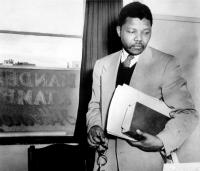
The question of where Mandela would be laid to rest was finally resolved in June, months before he passed away on December 5, 2013.
I’m here with Mazibuko Jara. Mazibuko is from the Democratic Left Front of South Africa. He was spokesperson for the South African Communist Party and the deputy secretary for the Young Communist League, back a decade and more ago. He is one of the co-founders of Amandla magazine and the Democratic Left Front, and they’ve been extremely active in the support for the Marikana miners and for South African farmworkers, and elsewhere. We’ll talk about this and more in this interview. Today is Sunday, Dec 2, 2012.
Translated by Dan La Botz
In mid-January of this year France invaded Mali, a former French colony that sits in the middle of what was once the enormous French empire in Africa that stretched from Algeria to the Congo and from the Ivory Coast to the Sudan. The French government argued that its invasion of its former colony was an anti-terrorist and humanitarian intervention to prevent radical Salafist Muslims from taking the capital of Bamako and succeeding in taking control of the country.
[This article will be appearing in the summer 2013 issue of New Politics.]
Our correspondent and contributor in South Africa, Andre Marais, sent us the link to this recording of the Rosa Choir, a diverse group that sings in traditional songs in Afrikaans, Xhosa and English.
"To sin by silence when they should protest makes cowards of men." – Abraham Lincoln
New Politics interviews an MJEM activist in the United States
[Reprinted from the History News Network.]
[The following appeal has been endorsed by New Politics as well as The Nation, The Progressive, and the Campaign to End the Death Penalty, among others.]
Six people in Zimbabwe are now imprisoned on charges of treason for organizing a meeting to discuss the mass movements in Tunisia and Egypt. For this “crime” they face a possible death sentence. They have been tortured and are now in solitary confinement.
This truly path-breaking book goes against the grain of the conventional wisdom which reduces Marx to an Eurocentric and economistic thinker; as Douglas Kellner comments, Kevin Anderson shows that Marx “is the sophisticated and original theorist of history some might not have ever expected him to be.” Analyzing a variety of Marx’s writings, including his journalistic work written for the New York Daily Tribune as well as unpublished material on non-European societies, it brings to the fore a global theorist whose soci
The emergence of Darfur as a cause célèbre in the West has been one of the more notable propaganda achievements in recent memory. Though the Darfur region of Sudan has been the scene of great human suffering, a death toll of perhaps 300,000 and a population of displaced persons numbering well over 2 million qualifies Darfur as serious but — regrettably — hardly unique for the scale of its violence in the first decade of the 21st century.
“Unions are killing the economy” says Henry Blodget at the Business Insider. He gleefully applauds the firing of every teacher in a Rhode Island school for their arrogance. How dare workers, teachers especially, think they have a voice in their working conditions or salaries? How uppity of teachers to sneer at the bosses’ absolutist control of the workplace. Let’s recall that Henry Blodget was indicated for insider trading.
Dennis Brutus – celebrated poet, anti-apartheid fighter and lifelong socialist – died last week. As a student activist at the University of Pittsburgh in the mid-2000s, I was privileged to know Dennis in the short time before he departed for the University of KwaZulu-Natal, where he spent his last years. Throughout the world and for a long time to come, Dennis’ outstanding contributions to peace and justice struggles will be recounted.
Are all cultures are equally valid and commendable? asks Peter Tatchell. I just received an email describing speeches Peter Tatchell has delivered on this subject. ( You can follow him with twitter at http://twitter.com/PeterTatchell or Facebook at http://tinyurl.com/cj9y6s ).