
Place: Afghanistan
Obama’s decision to radically escalate the wars he was ostensibly elected to terminate is a measure of U.S. imperialism's desperation. It’s not just that our erstwhile peace candidate and future Nobel peace laureate is withdrawing exhausted U.S. troops from the frying pan of Iraq only to transfer them into the fire of Afghanistan, although that itself was an act of desperation. Many of these “volunteer” soldiers and reservists, shattered after several devastating tours of duty in Iraq, are being forced to remain in the service years beyond their contracts.
Since George Bush launched Operation Enduring Freedom in October 2001 — the unjust, illegal, and unnecessary attack on Afghanistan — there have been constant US and NATO strikes on Afghan civilians, along with constant denials that such strikes have taken place.
Kathryn Bigelow, the director of The Hurt Locker, claims that many men in Iraq and Afghanistan are addicted to war. If this is true, could it have something to do with the fact that GIs today do not face the endless bombardment from airplanes, field artillery, and tanks that World War II soldiers did?
I served in the 88th Infantry Division in Italy and I never met anyone so addicted. Had we met someone like that we would have considered him “Section 8,” that is, seriously disturbed.
Does that mean that many gung-ho GIs now serving in Iraq and Afghanistan are Section 8?
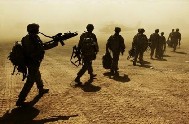
THIS MAY BE A TURNING POINT for the expanding U.S./NATO wars in Afghanistan and Pakistan, a time when speaking out clearly and unambiguously against war can make a crucial difference. Today we see signs all too reminiscent of the step-by-step deepening of the U.S. commitment to the war in Vietnam in the 1960s. In response, we declare ourselves firmly against military escalation in the region and for the withdrawal of all U.S. and NATO forces from Afghanistan and Pakistan now. We also call for an end to drone attacks in both countries.
In his speech justifying his escalation of the war in Afghanistan, President Obama reminded us why the US was fighting there in the first place. After 9-11, he recalled, the United Nations Security Council "endorsed the use of all necessary steps to respond to the 9/11 attacks." And then, "only after the Taliban refused to turn over Osama bin Laden," did the United States send its troops into Afghanistan. This account is doubly wrong.
The President and Congress are reviewing U.S. policy on the wars in Afghanistan and Pakistan. This is a critical moment. This may be a turning point for the expanding U.S. wars in Afghanistan and Pakistan, a time when speaking out clearly and unambiguously against war can make a crucial difference. We urge you to sign the Campaign for Peace and Democracy emergency statement calling for an end to military intervention in both countries. The statement declares us firmly against military escalation in the region and for the withdrawal of all U.S.
There’s an AP story today that the U.S. commander in Afghanistan “will soon order U.S. and NATO forces to break away from fights with militants hiding among villagers.” The order is expected to reduce “the use of air strikes, mortars and artillery in villages.” There are three points to note here: 1. The order does not prohibit U.S. troops from using massive force when civilians are nearby if the troops are in “imminent danger,” and indeed, the order allows massive force if necessary to avoid “undue danger” to the troops.

WITH THE ELECTION OF BARACK OBAMA, millions in the United States and around the world are hoping for relief from the dangerous arrogance and destructiveness of George Bush’s foreign policy. President Obama is expected to take important positive initiatives — like closing Guantanamo and lifting the rule denying international organizations receiving U.S. aid the right to let women know about abortion. When the inevitable right-wing reaction to these initiatives comes, it will be crucial for us in the peace movement to defend them.
